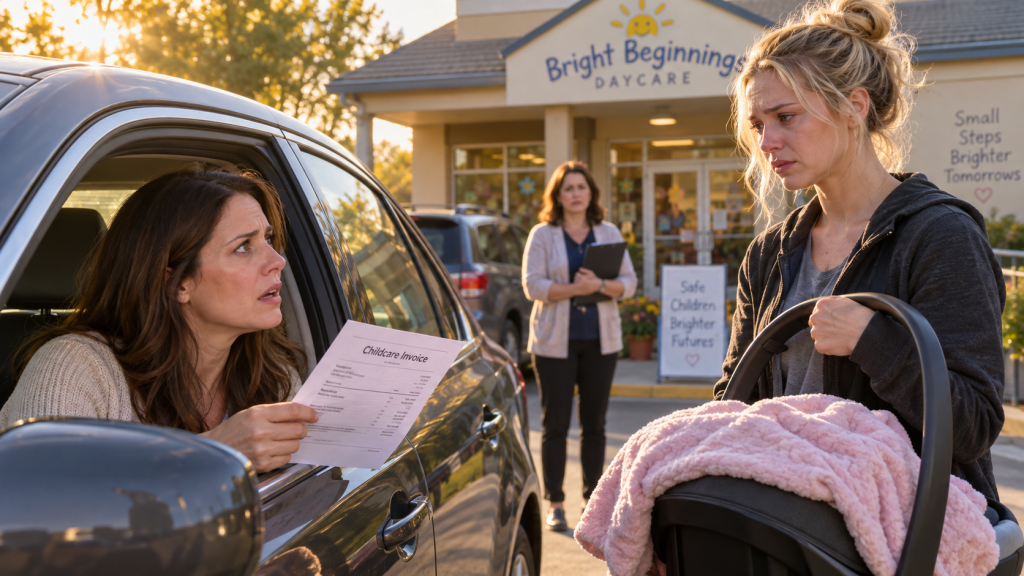
My husband signed a second child into our son’s daycare under his last name. The front desk handed me the invoice for both. I thanked her and paid it. He does not know I have it, and tomorrow at 5:30 I am going to be standing at that door when somebody comes to pick up a little girl I have never “It’s the sibling rate,” the director said, smiling.

“Your husband set it up in January. He didn’t tell you? Men.”
“Men,” I said, and put the invoice in my purse.
Two children. Same account. Same autopay card.
My name is Monica. I am 34. My husband works nights at the distribution center, or that is what the schedule on our fridge says.
I endured the phone that charges face down.
I endured the second toothbrush he said was for the gym.
I endured “you’re paranoid, Mon,” every time I asked a question with a date in it.
I endured his mother saying “a man needs his space” like it was scripture.
And now I was holding a paper that said a four-year-old named Brooklyn shared my husband’s last name.
I did not cry in the parking lot. I sat in the pickup line with the invoice on my knee and read it eleven times.
The autopay card was the one he told me was canceled in March.
My son climbed in and asked why I had his school paper.
“Grown-up stuff, buddy.”
“Is Brooklyn in trouble?”
My hands went cold on the wheel.
“Who’s Brooklyn, baby?”
“She’s in the Butterfly room. Daddy says she’s my cousin.”
I said okay. I drove.
Thursday night he came home at 6:40 in the morning smelling like fabric softener we do not own.
“Long night,” he said.
“How was work?”
“Same as always.”
“They gave me the sibling rate at daycare.”
His hand stopped on the coffee pot. Then it started again.
“They must have mixed up the accounts. I’ll call them.”
“I already paid it.”
“You didn’t have to do that.”
“I know,” I said.
Friday at noon I drove past the distribution center. His truck was not in the lot. I called the front desk and asked for him by name.
“He hasn’t been on the night rotation since February, ma’am. He’s days now. Can I take a message?”
“No message.”
So the nights were not nights.
At 4:50 I parked across from the daycare, two spaces from the door, and turned off the engine.
At 5:10 the director came out and stood on the step with a clipboard, looking up and down the street like she was waiting for someone specific.
At 5:22 my phone buzzed. My husband.
“Where are you?”
“Getting Owen.”
“Mom said she’d get him tonight. Go home. I’ll bring him.”
“I’m already here.”
Silence. Then typing. Then no typing.
“Don’t do anything stupid, Mon.”
I put the phone face down on the passenger seat, which is a thing I learned from him.
At 5:29 a gray sedan pulled into the fire lane.
A woman got out. Younger than me. My height. My haircut, which I did not expect, and I felt it in my knees.
She was holding a car seat with a pink blanket in it, and she waved at the director like they did this every week.
The director waved back and pointed at my car.
The woman turned around and looked straight at me through the windshield.
She did not look surprised.
She looked like she had been waiting for this longer than I had.
She walked over to my window. I rolled it down four inches, because I did not trust myself with any more than that.
“You’re Monica,” she said.
“You know my name.”
“I’ve known your name for three years. He told me you were his sister.”
The pink blanket moved.
“Is that his?”
“She is,” the woman said, and shifted the car seat to her other arm. “And so is the boy you’re here to pick up. Which is why I need you to see something before he gets here, because he told me the daycare mixed up the accounts, and he told me the card was canceled in March, and he told me his mother would be the one at this door tonight, and Monica.
PART 2
“Monica…”
The woman stopped.
Her grip tightened around the car seat.
The pink blanket shifted again.
A tiny fist appeared for half a second, then disappeared beneath the fabric.
I stared at it.
The world felt very far away.
Cars moved behind her.
Parents crossed the daycare parking lot carrying backpacks, paper crafts, forgotten water bottles.
Ordinary Friday afternoon things.
And there I was, sitting behind four inches of rolled-down glass while a stranger held a baby she had just told me belonged to my husband.
“What do I need to see?”
My voice sounded calm.
Too calm.
The woman looked over her shoulder.
The director was still standing by the front entrance.
Watching us.
Then she looked back at me.
“My name is Rachel.”
I said nothing.
Rachel swallowed.
“Rachel Hayes.”
Still nothing.
“I know how this looks.”
I laughed once.
I couldn’t help it.
“How does it look?”
She flinched.
“Bad.”
“No.”
I looked at the car seat.
“I think we passed bad about thirty seconds ago.”
Tears filled her eyes.
That irritated me.
Not because she was crying.
Because some part of me had already decided I was not allowed to.
Not yet.
“Show me.”
She nodded.
Then she reached into her purse and pulled out her phone.
Her hand shook.
She unlocked it.
Opened a photo.
Held it against the glass.
My husband.
Ethan.
Standing in a hospital room.
Holding a newborn.
The baby was wrapped in the same pink blanket.
His face was tired.
Proud.
Happy.
Not the exhausted smile he wore in photographs with Owen when I practically begged him to stand still.
This smile was different.
Soft.
Unprotected.
The kind of smile I had spent years trying to earn back.
My lungs forgot what they were supposed to do.
“When?”
I whispered.
“Three months ago.”
I stared at the screen.
Three months.
The same week Ethan told me he had mandatory overtime because the distribution center had lost two supervisors.
He came home Sunday morning with a hospital wristband looped around his key ring.
I noticed it.
He said a coworker had gone to the emergency room and left it in his truck.
I believed him.
God.
I believed almost everything when he sounded annoyed enough.
Rachel changed the photograph.
Ethan sitting on a sofa.
Brooklyn asleep against his chest.
Christmas stockings behind them.
One said BROOKLYN.
One said RACHEL.
And one said DADDY.
My stomach turned.
“How old is Brooklyn?”
“Four.”
I looked toward the daycare building.
Four.
Ethan and I had been married seven years.
Owen was six.
That meant this was not one reckless affair.
This was architecture.
Schedules.
Birthdays.
Christmases.
Excuses.
Years.
“How long?”
Rachel’s eyes filled.
“Five years.”
I stared.
“Five.”
“Yes.”
“You have been with my husband for five years.”
She shook her head quickly.
“I didn’t know he was your husband.”
I looked at her.
She did not look away.
“He told me he was divorced.”
Of course.
There was always a dead marriage somewhere in the story men told women they wanted to keep separate.
“What did he say about me?”
Rachel hesitated.
“My sister.”
The words went through me strangely.
Not ex-wife.
Not unstable wife.
Sister.
He had not even given me the dignity of being a failed marriage.
He had rewritten my entire role.
“What exactly did he tell you?”
She shifted the baby against her hip.
“That you lived with him because you were going through a bad divorce.”
I almost laughed again.
“He said Owen was his son?”
“Yes.”
“And I was what?”
“His sister.”
I looked away.
Across the lot, a little boy ran toward his father holding a painting shaped like a butterfly.
The father crouched.
Opened his arms.
Simple.
Normal.
My chest hurt.
Rachel continued.
“He said you helped with Owen because he worked nights.”
“Days.”
“What?”
“He works days.”
Her face changed.
I nodded.
“He hasn’t worked nights since February.”
Rachel stared.
“But he leaves my place at six-thirty almost every evening.”
There it was.
A complete rotation.
Day shift at work.
Evenings with her.
Nights somewhere between lies.
Mornings home with me.
I had spent months imagining one woman.
One secret apartment.
One affair.
But Ethan had been doing something more exhausting.
He had been maintaining two homes as though families were shifts he could clock into.
“What time does he get to you?”
“Usually seven.”
“And leaves?”
“Six-thirty.”
My hands went cold.
He did not work nights.
He slept there.
With her.
Then came home at 6:40 a.m. and told me the warehouse had been brutal.
I leaned back against the headrest.
The car suddenly felt too small.
Rachel crouched beside my window.
“Monica.”
I closed my eyes.
“Don’t.”
“Okay.”
“I need one minute where nobody says my name.”
She went quiet.
For years, Ethan used my name when he wanted me to doubt myself.
Mon.
Come on, Mon.
You’re doing this again, Mon.
You’re paranoid, Monica.
Do you hear yourself?
Now hearing it from anybody felt like being pulled backward.
I opened my eyes.
“Why did the daycare put them on the same account?”
Rachel swallowed.
“That’s what I found yesterday.”
She pulled up another document.
Registration form.
Brooklyn Hayes.
Authorized parent:
Ethan Mercer.
Relationship:
Father.
Secondary emergency contact:
Linda Mercer.
My mother-in-law.
My skin went cold.
Linda.
“A man needs his space.”
Linda.
“Don’t interrogate him every time he works late.”
Linda.
“You’ll push him away if you keep accusing him.”
She knew.
I did not need Rachel to say it.
The emergency form already had.
I whispered:
“His mother knows.”
Rachel looked devastated.
“I thought she was your mother too.”
I stared at her.
“What?”
“She told me to call her Mom.”
Something broke inside me then.
Not loudly.
No scream.
No sob.
Just a clean little fracture.
Linda had held Brooklyn.
Bought birthday presents.
Probably rocked that baby.
Then sat in my kitchen and told me Ethan needed space.
I had gone to her six months earlier.
I remember exactly.
Her dining table.
Lemon cleaner.
A bowl of plastic fruit.
I said:
“I think Ethan is seeing somebody.”
She poured tea.
Didn’t look surprised.
That should have told me everything.
Instead she sighed and said:
“Marriage gets stale if a woman starts treating her husband like a suspect.”
I went home ashamed.
She must have called him the second I left.
Rachel touched the screen.
“There’s more.”
Of course there was.
“What?”
She showed me a photograph of Linda holding Brooklyn at a birthday party.
Pink cake.
Four candles.
Ethan beside them.
Rachel smiling.
A banner behind them.
HAPPY 4TH BROOKLYN.
The date stamp was six weeks earlier.
Six weeks.
That night Ethan told me Linda had fallen in her bathroom.
He said he needed to stay with her until morning.
I had texted her.
Hope you’re okay. Let me know if you need anything.
She answered:
Just bruised. Your husband is a good son.
I stared at the photograph until the image blurred.
“She knew everything.”
Rachel nodded.
“I think so.”
“You think?”
“She told me you were difficult.”
I looked at her.
Rachel immediately regretted it.
“What did she say?”
“Monica…”
“What did she say?”
She swallowed.
“That you never accepted the divorce.”
I laughed.
Actually laughed.
A sharp sound.
Parents near us turned.
I didn’t care.
“What divorce?”
“She said you and Ethan had separated years ago but stayed in the same house because of money and Owen.”
The lie was elegant.
Just enough truth-shaped detail to survive casual questions.
Why does his sister live with him?
She doesn’t.
Why is another woman always at the house?
Ex-wife.
Why does she act familiar?
She’s bitter.
Why does he still share finances?
Child arrangements.
He had given Rachel a story that explained every loose thread before she could pull it.
I looked at her.
“Have you ever been inside my house?”
“No.”
“Why?”
“He said you lived there.”
Not we.
You.
Interesting.
“And where does he say he lives?”
Rachel’s face crumpled.
“With me.”
My heart sank.
Of course.
I was the woman living in his house.
She was the woman he lived with.
We had both been demoted in each other’s version.
I asked:
“Why are you here today?”
She wiped her cheek.
“Because the daycare called me yesterday.”
“About the invoice?”
“Yes.”
“They said there had been a payment-account question.”
My stomach tightened.
“I paid.”
“I know.”
“How?”
“They told me the cardholder handled it.”
I looked at the building.
Privacy at that daycare was apparently more of a decorative concept.
Rachel continued.
“I asked whose card.”
“And?”
“They said yours.”
I stared.
“She gave you my name?”
“She said Monica Mercer.”
I breathed slowly.
“And you recognized it.”
“Yes.”
“Because I’m his sister.”
“Yes.”
She looked ashamed.
“But it didn’t make sense.”
“What didn’t?”
“The card.”
Rachel looked at me.
“Ethan told me you two barely spoke.”
I laughed softly.
“We sleep in the same bed.”
Her face went white.
There it was.
The sentence that finally destroyed whatever scraps of his story she still carried.
“We slept in the same bed Wednesday night.”
Rachel’s mouth trembled.
“No.”
“Yes.”
“He told me—”
“I know.”
“He said he hadn’t touched you in years.”
I stared at her.
“What a hardworking man.”
She covered her mouth.
Then began crying.
This time, I let her.
Not because I forgave anything.
But because I understood we were standing inside different rooms of the same burning house.
“How old is the baby?”
I asked.
“Three months.”
“Name?”
“Lily.”
I looked at the pink blanket.
Lily.
My husband had a daughter named Lily.
I did not know whether to hate the name or protect it.
Neither felt fair.
“She is his?”
Rachel nodded.
“We did a paternity test.”
That surprised me.
“Why?”
Her face changed.
“Because…”
She looked toward the daycare entrance.
Then back at me.
“Because somebody sent me a message when I was pregnant.”
My heartbeat shifted.
“What message?”
“Anonymous.”
“What did it say?”
She pulled it up.
The text was eight months old.
Before you put Ethan Mercer’s name on another birth certificate, ask how many families he already has.
I read it twice.
Another.
Birth certificate.
How many families.
My hands went cold.
“Another?”
Rachel nodded.
“I thought it meant you and Owen.”
“No.”
“I know that now.”
“Who sent it?”
“I don’t know.”
“Did you ask Ethan?”
“Yes.”
“What did he say?”
“That you sent it.”
I closed my eyes.
Of course.
“What did he say about me?”
“That you had been trying to destroy every relationship he had since the divorce.”
The imaginary divorce.
I shook my head.
“And you still did the DNA test.”
“Yes.”
“Why?”
She looked down at Lily.
“Because I needed one thing that didn’t depend on his explanation.”
I understood that.
God, I understood that.
“And he is the father.”
“Yes.”
“Of Lily.”
“Yes.”
“And Brooklyn?”
“Yes.”
“So the anonymous message was not about paternity.”
“No.”
It was about scale.
How many families.
I felt cold.
“Rachel.”
She looked at me.
“Could there be another woman?”
The question hurt both of us.
“I don’t know.”
I looked at my phone.
5:36.
Ethan would be coming.
He had told me not to do anything stupid.
Maybe because he knew Rachel was here.
Maybe Linda had warned him.
Maybe the daycare director had.
I looked toward the entrance.
“Where is Brooklyn?”
“Inside.”
“And Owen?”
“Inside.”
“Why hasn’t anyone brought them out?”
Rachel looked toward the director.
“She asked me to wait.”
“Why?”
“She said Ethan called.”
My stomach dropped.
“When?”
“About ten minutes ago.”
“What did he say?”
“I don’t know.”
The daycare doors opened.
The director walked toward us.
No smile now.
She looked nervous.
“I think we need to go inside.”
I got out of the car.
My legs felt weak, but they held.
Rachel carried Lily.
We followed the director through the lobby.
Children’s artwork covered the walls.
Paper caterpillars.
Handprints.
Construction-paper suns.
The ordinary tenderness of a daycare made everything uglier.
A receptionist looked up.
Then immediately looked away.
The director led us into her office.
“Sit.”
Neither of us did.
“What did Ethan say?”
I asked.
She closed the door.
“He called and requested that neither Owen nor Brooklyn be released to either of you.”
Rachel stared.
“What?”
I said:
“He can’t do that.”
The director looked miserable.
“He stated there was a family emergency.”
“What emergency?”
“He did not specify.”
“And you accepted that?”
“No.”
She glanced between us.
“That’s why the children are still here.”
Good.
At least someone had stopped simply believing him.
“He also said his mother was on the way.”
I laughed bitterly.
“Of course she is.”
The director folded her hands.
“I need to apologize.”
“For what?”
“The account disclosure.”
I stared at her.
She continued.
“When you were given the combined invoice, that should have been flagged.”
Rachel said:
“You mean because we weren’t supposed to know about each other?”
The director flinched.
“I mean because there are conflicting household records.”
My pulse changed.
“What conflicting records?”
She looked at me.
“I reviewed the file after you called yesterday.”
I hadn’t called yesterday.
Rachel had.
But I let it go.
“And?”
She opened a folder.
“Owen’s enrollment lists you and Ethan as married parents at your home address.”
“Yes.”
“Brooklyn’s lists Ethan and Rachel as cohabiting parents at another address.”
Rachel grabbed the edge of the desk.
“What?”
I looked at her.
She whispered:
“He listed us as living together.”
The director nodded.
“He did.”
Rachel laughed faintly.
“We do.”
Then she looked at me.
“He lives with me.”
My stomach turned.
Not visits.
Lives.
Officially.
At least on forms.
The director continued.
“There’s something else.”
I almost said please stop.
Instead:
“What?”
“Both files list Linda Mercer as authorized emergency pickup.”
I nodded.
We knew that.
“Anything else?”
She hesitated.
That hesitation had become a warning signal in my life.
“Say it.”
“Linda signed several forms.”
“Which forms?”
The director turned one around.
A family-information certification.
At the bottom:
I confirm the household information above is accurate to the best of my knowledge.
Linda’s signature.
Dated January.
My heart hardened.
She had not simply known.
She had certified the lie.
Rachel whispered:
“Why would she do this?”
I answered.
“Because she chose him.”
The words came out flat.
Linda did not choose truth.
Or grandchildren.
Or me.
Or Rachel.
She chose Ethan.
Whatever version of him required protecting.
The director said:
“I’m going to have to contact our corporate office.”
“Do that.”
“And possibly child services if there are disputes over custody information.”
Rachel’s face changed.
“Custody?”
I looked at her.
“Do you have a custody order?”
“No. We’re together.”
Were.
Maybe.
“What about Brooklyn’s birth certificate?”
“Ethan is listed.”
“Lily?”
“Yes.”
I closed my eyes.
Three children.
One father.
Two homes.
One mother helping him.
Maybe more.
Then my phone rang.
Ethan.
The director looked at it.
Rachel did too.
I answered.
Speaker.
“Where are you?”
His voice was tight.
“At daycare.”
“I told you to go home.”
“You don’t give me orders.”
Silence.
Then his tone softened.
“Monica.”
I nearly smiled.
There was my name again.
The tool.
“Come home and we’ll talk.”
“Rachel is standing next to me.”
Nothing.
Not one sound.
Then:
“Who?”
Rachel made a broken laugh.
The director looked down.
I said:
“Try again.”
His breathing changed.
“Monica, listen to me.”
“No.”
“Rachel is confused.”
Rachel stepped closer to the phone.
“Am I?”
Silence.
“Ethan?”
His voice changed instantly.
“Baby—”
Rachel recoiled as though the word had touched her.
“Don’t.”
“Rachel, she is doing exactly what I told you she would do.”
I laughed.
“What, exist?”
“Monica, shut up.”
There.
The director’s eyes widened.
Rachel went still.
Ethan realized.
Too late.
He tried to recover.
“This is complicated.”
I asked:
“Are we married?”
Silence.
“What?”
“Simple question.”
“Monica—”
“Are we legally married?”
“Yes.”
Rachel closed her eyes.
I continued.
“Have we ever been divorced?”
“No.”
Rachel started crying.
I did not stop.
“Do you live at my address?”
“Yes.”
“Do you sleep there?”
A pause.
“Sometimes.”
I laughed.
“Wednesday?”
Silence.
Rachel whispered:
“Answer.”
“Yes.”
Her face broke.
He said quickly:
“Rachel, it isn’t what you think.”
She laughed through tears.
“What part?”
“Brooklyn?”
“Lily?”
“Your wife?”
“Your mother?”
“Which part?”
His voice sharpened.
“I’m on my way.”
I looked at the clock.
5:44.
“Good.”
Then I ended the call.
The director whispered:
“I’m sorry.”
I looked at her.
“For what?”
“This.”
I looked toward the classroom hallway.
“No.”
My voice softened.
“You handed me an invoice.”
That invoice had done what suspicion could not.
Paper did not get defensive.
Paper did not call me paranoid.
Paper simply sat there with two names on it.
Owen Mercer.
Brooklyn Mercer.
Sibling rate.
I asked:
“Can I see the original registration?”
The director hesitated.
“Only Owen’s file is yours to access.”
“Fine.”
She handed it over.
I scanned it.
Nothing unusual.
Then I saw the emergency contacts.
Me.
Ethan.
Linda.
A fourth name.
I frowned.
“Who is Patrick Doyle?”
The director looked.
“Authorized pickup.”
“I’ve never heard of him.”
Rachel stopped crying.
“What name?”
I turned the page toward her.
Patrick Doyle.
Her face went white.
“You know him.”
She nodded.
“Ethan said Patrick was his supervisor.”
My pulse changed.
“At the distribution center?”
“Yes.”
I stared.
The distribution center where Ethan no longer worked nights.
The supervisor who apparently had access to my son.
“Why would his supervisor be authorized to pick up Owen?”
Nobody answered.
I looked at the director.
“When was he added?”
She checked.
“February.”
February.
The month Ethan moved to day shift.
The month the night lies began.
The month someone else became authorized to remove my child.
Cold moved through me.
“Has Patrick ever picked Owen up?”
The director looked toward the computer.
“I can check.”
She typed.
Once.
Twice.
Then stopped.
Her face changed.
“What?”
She looked at me.
“Three times.”
My chest tightened.
“When?”
She read the dates.
Two were nights Ethan claimed he had emergency overtime.
The third was a Saturday I had spent with my father at the hospital.
Ethan told me he and Owen had gone to a movie.
I looked at Rachel.
“Do you know Patrick personally?”
“No.”
“Seen him?”
“Once.”
“Where?”
“At Ethan’s apartment.”
My stomach dropped.
“His what?”
Rachel stared.
“The apartment.”
I could barely speak.
“What apartment?”
She looked confused.
“The place he uses near work.”
I gripped the back of a chair.
“He told me it was for night shifts.”
Of course.
A third place.
Not my house.
Not Rachel’s.
An apartment.
“How long?”
“Two years, I think.”
The room became cold.
The director looked between us.
Rachel whispered:
“You didn’t know.”
“No.”
I looked at her.
“Did you ever stay there?”
“No.”
“Why?”
“He said it was company housing.”
There was no company housing.
I knew because I had once asked.
He laughed at me.
Said warehouses did not give night supervisors apartments like corporate executives.
I stared at the fourth contact.
Patrick Doyle.
A man authorized to take my son.
A man connected to an apartment neither wife nor mistress was supposed to question.
“Director.”
“Yes?”
“I need every pickup record for Owen that I’m legally allowed to receive.”
She nodded.
“And I need Patrick removed as authorized pickup now.”
“Yes.”
“Linda too.”
Her eyes widened slightly.
Then nodded.
“Yes.”
Rachel said:
“Remove Linda from Brooklyn’s too.”
The director looked at her.
“Of course.”
We were not allies.
Not exactly.
But for the first time, we were acting in the same direction.
That mattered.
At 5:53, Linda arrived.
I saw her through the office window.
She walked through the lobby wearing a beige coat and the expression of a woman coming to solve a problem everyone else had caused.
Then she saw Rachel.
Then me.
She stopped.
That face told me everything.
No surprise.
Only calculation.
“You two need to stop this.”
Not hello.
Not what happened.
Stop this.
I stepped into the hallway.
“What exactly are we stopping?”
Linda lowered her voice.
“The children are here.”
“Yes.”
“So don’t create a scene.”
Rachel came out behind me.
“You told me Monica was his sister.”
Linda looked at her.
“Rachel—”
“You told me they were divorced.”
“Lower your voice.”
“No.”
Rachel’s voice cracked.
“You held my daughter.”
Linda’s face tightened.
“I love those children.”
I stared at her.
“And Owen?”
Her eyes moved toward me.
“Of course.”
“Then why did you help his father lie to everyone around him?”
She exhaled.
“You don’t understand Ethan.”
I laughed.
“Apparently neither of us did.”
“He was unhappy.”
There it was.
The justification.
“He didn’t know how to leave.”
“So he built another family?”
“You made everything difficult.”
I stared at her.
I should have been hurt.
Instead, I felt clarity.
“Linda.”
She looked at me.
“I asked you six months ago if he was cheating.”
Her face changed.
“You looked me in the eye and told me I was paranoid.”
“I said you needed to trust your marriage.”
“No.”
I stepped closer.
“You knew I was right.”
Silence.
“You let me think I was losing my mind.”
She looked away.
That was worse than any excuse.
Rachel whispered:
“And you let me think I was building a life with him.”
Linda snapped:
“Neither of you knows what pressure he was under.”
I almost smiled.
There it was.
Her son.
Always the center.
Women became weather around his stress.
Children became evidence of his needs.
Lies became pressure.
“What pressure?”
I asked.
She said nothing.
“Financial?”
Her face changed.
Small.
But I saw it.
Rachel saw it too.
“What financial pressure?”
Rachel asked.
Linda turned away.
My stomach tightened.
“What did he do?”
“Nothing.”
“That face says otherwise.”
“Monica.”
“Stop saying my name like it’s a warning.”
She went silent.
Then the front doors opened.
Ethan walked in.
He looked tired.
Not panicked.
That scared me.
He had had twenty minutes to decide what story to tell.
He saw me.
Rachel.
His mother.
The director.
His eyes moved between us.
Then settled on Linda.
“You were supposed to get the kids.”
Rachel laughed.
“Which kids?”
His jaw tightened.
I felt something inside me go still.
He stepped toward me.
“Give me Owen.”
“No.”
“He’s my son.”
“He’s mine too.”
“Monica.”
“No.”
The director stepped forward.
“Mr. Mercer, we have conflicting pickup instructions and significant discrepancies in the household records.”
Ethan smiled at her.
That polite public smile.
“I can clear it up.”
“No.”
I said it.
He looked at me.
“You don’t clear anything up anymore.”
Rachel moved beside me.
Not behind him.
Beside me.
Something in his face changed.
He noticed that too.
Then the director asked:
“Who is Patrick Doyle?”
For the first time, Ethan actually looked afraid.
Not annoyed.
Not cornered.
Afraid.
I saw it.
Linda did too.
She whispered:
“Don’t.”
Ethan turned sharply.
“Mom.”
There.
Another secret.
I looked between them.
“You both know him.”
Neither answered.
Rachel stepped closer.
“Who is Patrick?”
Ethan’s voice became cold.
“None of your business.”
“His name is authorized on both school files.”
I frowned.
“Both?”
The director looked at me.
“I only checked Owen’s.”
Rachel said:
“He’s on Brooklyn’s too.”
She pulled up her phone.
Her emergency contacts.
Ethan.
Linda.
Patrick Doyle.
Same man.
Authorized to pick up both children.
My stomach turned.
“Why?”
Ethan said nothing.
The director looked increasingly alarmed.
“Mr. Mercer, I need an explanation.”
He snapped:
“You don’t need anything.”
Wrong room.
Wrong tone.
He knew it immediately.
The director stepped backward.
I looked at him.
“Who is Patrick?”
Silence.
Then Linda started crying.
Not slowly.
Suddenly.
Ethan turned.
“Mom, stop.”
She covered her face.
I stared at her.
“Linda.”
She shook her head.
“Don’t.”
“What did you help him do?”
Nothing.
Ethan grabbed her arm.
“We’re leaving.”
Rachel stepped forward.
“Don’t touch her.”
He stared.
So did I.
Strange.
The mistress defending the mother-in-law who helped deceive her.
But fear changes alliances quickly.
Linda pulled her arm away.
“I can’t keep doing this.”
Ethan froze.
The hallway became silent.
“Mom.”
“I can’t.”
He stared at her.
“What are you talking about?”
She looked at me.
Then Rachel.
Then toward the classrooms where three children connected to Ethan were waiting.
Owen.
Brooklyn.
And Lily in Rachel’s arms.
Linda whispered:
“Patrick is not his supervisor.”
My heart slowed.
I knew that already.
But not what came next.
“Who is he?”
Linda looked at Ethan.
He shook his head.
A warning.
She closed her eyes.
Then said:
“He’s Ethan’s brother.”
Nobody spoke.
I stared.
“Brother?”
Rachel whispered:
“Ethan doesn’t have a brother.”
That was what I believed too.
Only child.
Raised by Linda after his father left.
That was the story.
Linda started crying harder.
“He does.”
Ethan turned away.
“Half brother?”
I asked.
Linda nodded.
“Older.”
“Why have I never heard of him?”
“Because their father took Patrick when he left.”
My mind raced.
“Then why is Patrick involved now?”
Linda looked at Ethan.
“He found us three years ago.”
Three years.
The apartment.
Two years.
The lies beginning earlier.
“What does he want?”
Linda said nothing.
Ethan snapped:
“Enough.”
I looked at him.
“Why is a brother I have never met authorized to take my son?”
Ethan’s face went flat.
“Because I trust him.”
“I don’t.”
“You don’t have to.”
“Yes.”
I stepped toward him.
“When it involves Owen, I absolutely do.”
Linda whispered:
“Monica…”
I looked at her.
“What?”
Her eyes filled with horror.
“Patrick is the reason Ethan needed the nights.”
My skin went cold.
“What does that mean?”
Ethan moved toward her.
“Mom.”
The director stepped between them.
“Sir.”
He stopped.
Linda continued.
“He had debts.”
I stared at Ethan.
“Patrick?”
Linda shook her head.
“No.”
“Ethan.”
My stomach dropped.
“What debts?”
Ethan laughed bitterly.
“This is ridiculous.”
Linda looked at him.
“Tell them.”
He stared at his mother.
“Tell them what?”
“That Patrick has been moving money for you.”
Rachel stopped breathing.
I felt cold.
“What money?”
Linda wiped her face.
“Ethan got into trouble.”
“With what?”
She said nothing.
“Linda.”
“Sports betting.”
My heart sank.
Ethan had mocked one of my cousins for gambling.
Called it pathetic.
Said men who risked grocery money were selfish.
“How much?”
No answer.
“How much?”
Linda whispered:
“More than eighty thousand.”
Rachel gasped.
I felt strangely calm.
“Where did he get eighty thousand dollars?”
Linda looked at me.
That answer terrified me before she said it.
“Some from credit.”
“Some from me.”
“And…”
She stopped.
I knew.
“What?”
“From the daycare account.”
I frowned.
“That makes no sense.”
Ethan spoke quickly.
“She doesn’t know what she’s saying.”
Linda shook her head.
“Not tuition.”
“What then?”
She looked at Rachel.
“Childcare reimbursements.”
Rachel’s face went white.
“What reimbursements?”
Ethan closed his eyes.
I looked between them.
Linda continued.
“He listed both children under a dependent-care benefit plan.”
I stared.
“Through work?”
“Yes.”
“But he only claimed Owen on our taxes.”
“I know.”
“Then Brooklyn?”
Rachel whispered:
“I claimed her.”
We looked at each other.
Double claims.
Maybe not just daycare.
Taxes.
Benefits.
Accounts.
Ethan had not combined our children out of laziness.
He had connected them financially.
I looked at him.
“What did you do?”
He said nothing.
Linda whispered:
“He used Patrick’s address.”
The apartment.
My stomach turned.
“For what?”
“Mail.”
“Accounts.”
“Some benefit paperwork.”
I felt sick.
Rachel stepped closer.
“Did he use my information?”
Linda looked away.
That was answer enough.
Rachel’s face collapsed.
“Oh my God.”
Ethan snapped:
“Nothing was stolen.”
I stared.
That sentence told me everything.
Not nothing happened.
Nothing was stolen.
The defense before the accusation.
“What did you take?”
I asked.
“Nothing.”
“What did you put in my name?”
“Monica.”
“Answer.”
He stepped toward me.
The director reached for her phone.
Ethan stopped.
Then he said quietly:
“You paid the daycare bill.”
I stared at him.
“What?”
“You paid it.”
“Yes.”
His mouth twisted.
“You always pay things.”
There was something ugly in the sentence.
Familiar.
He had counted on that.
Like everything else.
“Why does that matter?”
He said nothing.
My stomach turned.
The invoice.
Same account.
Same autopay card.
The card he told me was canceled.
I looked at Linda.
“What card was attached?”
She began crying again.
“I don’t know.”
I pulled the invoice from my purse.
The last four digits.
I knew that card.
It was mine.
Not ours.
Mine.
A card I had opened before marriage and added Ethan to as authorized user years ago.
He told me it had been canceled in March because fraud detection flagged charges.
I had believed he handled the replacement.
I had been using another card ever since.
But the account had never closed.
He had redirected statements.
Changed paperless settings.
Kept using it.
I looked at him.
“How much is on this card?”
Silence.
“Ethan.”
No answer.
Rachel whispered:
“Check.”
My hands shook as I opened the banking app.
I had not logged into that account in months.
Password rejected.
Of course.
I reset it.
Email verification.
Then the screen loaded.
Balance:
$27,843.11.
My knees weakened.
Charges.
Daycare.
Gas.
Restaurants.
A furniture store.
A jewelry store.
Cash advances.
And monthly payments made from an account I did not recognize.
I clicked.
Bank ending 9032.
“What account is 9032?”
Linda looked at Ethan.
He went pale.
Rachel stared.
I repeated:
“What account?”
Linda whispered:
“Patrick’s.”
The room seemed to move.
My husband had kept a credit card in my name alive.
Used it for expenses connected to another family.
Then paid it from his secret brother’s account.
Which was tied to gambling debt and benefit money.
My marriage had stopped being a relationship.
It was becoming evidence.
I looked at the director.
“I need copies of everything legally available to me.”
She nodded immediately.
Rachel said:
“Me too.”
Ethan laughed.
Not because anything was funny.
Because people laugh when control leaves too quickly.
“You two really think you’re on the same side?”
I looked at Rachel.
Then at him.
“No.”
My voice was quiet.
“We’re on our children’s side.”
That was enough.
His face changed.
The director called security.
Ethan argued.
Then stopped when another staff member appeared.
No violence.
No scene.
Just a man suddenly discovering that confidence works poorly when documents begin speaking louder.
Owen and Brooklyn were brought out separately.
Owen ran to me.
Brooklyn ran to Rachel.
Then they saw each other.
“Bye, Brookie!”
Owen called.
Brooklyn waved.
“Bye!”
So normal.
That nearly broke me.
They knew each other.
Played together.
Shared snacks.
Probably shared stories about the same father without understanding the sentence.
Daddy took me to the park.
Daddy made pancakes.
Daddy was tired.
Daddy was working.
Children do not notice contradictions adults build around them.
They simply love the version they receive.
I buckled Owen into the car.
He looked at Rachel through the window.
“Is Brooklyn’s mom your friend?”
I swallowed.
“I don’t know yet.”
He accepted that.
Children sometimes tolerate uncertainty better than adults.
Then he said:
“Daddy says Brooklyn might come live with Grandma someday.”
My hands stopped.
“What?”
Owen kicked his shoes lightly against the seat.
“Grandma said if Brooklyn’s mommy gets sick, Brooklyn can stay with her.”
I looked through the windshield.
Linda stood near her car.
Crying.
Ethan beside her.
Rachel on the other side of the lot with Lily.
What had they been planning?
Maybe nothing.
Maybe just contingency.
But by then I had learned that with Ethan, casual sentences deserved investigation.
I drove home.
Not to confront him.
To lock documents away.
At 7:12, I changed the garage code.
At 7:24, I froze the credit card.
At 7:40, I downloaded every statement.
At 8:03, Rachel texted me.
Can we meet tomorrow? Without him.
I answered:
Yes.
At 8:17, another message arrived.
From a number I did not know.
My name is Patrick Doyle. We need to talk before Ethan convinces you I’m the problem.
My heart began pounding.
Then a photograph came through.
Ethan.
At the apartment Rachel had mentioned.
Sitting at a table covered in paperwork.
Patrick stood beside him.
And across from them was Linda.
On the table were three folders.
One labeled:
OWEN
One:
BROOKLYN
And the third:
LILY
I stared at the baby’s name.
Another message.
He has been using the children’s identities.
My hands went cold.
Then:
I helped him at first. I didn’t know what everything was for.
Another.
When I tried to stop, he threatened to tell the police the accounts were mine.
I sat down.
My six-year-old son.
Brooklyn.
Three-month-old Lily.
Children who could not sign contracts.
Could not check credit.
Could not ask why their names appeared on accounts.
I typed:
What accounts?
Patrick answered with one photograph.
A spreadsheet.
Three columns.
Three children.
Numbers beside each.
I zoomed in.
Credit lines.
Benefit accounts.
Custodial savings.
Transfers.
Then one line at the bottom froze me completely.
Life insurance — dependent riders.
Owen.
Brooklyn.
Lily.
My lungs stopped working.
I typed:
Why does Ethan have life insurance on all three children?
Patrick did not answer immediately.
Then my phone rang.
He was calling.
I answered.
“Tell me.”
Patrick’s voice was rough.
Scared.
“Monica, listen carefully.”
“What did he do?”
“He didn’t take out those policies because he expected anything to happen to the kids.”
“Then why?”
A pause.
“He used them as part of the collateral package.”
I stared at the wall.
“What collateral package?”
“The loan.”
“What loan?”
Patrick exhaled.
“The one nobody knows about yet.”
My stomach dropped.
“How much?”
Silence.
Then:
“Two hundred and seventy-five thousand dollars.”
I closed my eyes.
“In whose name?”
Patrick’s answer came quietly.
“Yours.”
The room went still.
“No.”
“Yes.”
“I never signed anything.”
“I know.”
My hands began shaking.
“How do you know?”
“Because I watched Ethan sign for you.”
I could barely breathe.
Then Patrick said:
“And Monica?”
“What?”
“That isn’t the part you should be most afraid of.”
I stared at Owen’s school backpack on the chair.
“What is?”
Patrick’s voice dropped.
“The loan wasn’t for gambling.”
My skin went cold.
“Then what was it for?”
He hesitated.
“For the house.”
I stopped breathing.
“What house?”
Another pause.
“The house Ethan bought last year.”
My heartbeat became unbearable.
“We own one house.”
Patrick said:
“No.”
And then he gave me an address.
Not Rachel’s.
Not mine.
Not Linda’s.
A property on the other side of town.
I typed it into my phone.
A real-estate listing appeared.
Four bedrooms.
White siding.
Fenced backyard.
Sold eleven months earlier.
I scrolled to the ownership record.
My stomach dropped.
The buyer was not Ethan.
Not Rachel.
Not Patrick.
The property had been purchased by:
Mercer Family Holdings LLC.
I whispered:
“What is this?”
Patrick went silent.
“Patrick.”
When he finally answered, his voice sounded almost ashamed.
“That’s where Ethan planned to move all three kids.”
My blood turned cold.
“What?”
“He told me once everything was ready, he was going to stop living between houses.”
I could not speak.
“He said the kids belonged together.”
“What about their mothers?”
Silence.
“Patrick.”
“He said neither of you needed to know until it was done.”
I stood so fast the chair scraped across the floor.
“What was done?”
“He was trying to change the custody paperwork.”
My whole body went cold.
“That’s impossible.”
“He has forms.”
“Forged?”
“I don’t know.”
“What forms?”
“He said once he proved both households were unstable, his mother could help.”
Linda.
Of course.
My hands shook so badly I nearly dropped the phone.
Patrick continued:
“Monica, there’s something else in the folders.”
“What?”
“Medical records.”
I stopped.
“Owen’s?”
“All three children.”
“Why?”
“I don’t know.”
Then his voice dropped.
“But some of them aren’t real.”
I could not breathe.
“What does that mean?”
“Diagnoses.”
“Notes.”
“Things that never happened.”
My mind flashed to Owen saying:
Grandma said if Brooklyn’s mommy gets sick…
The words changed shape.
I whispered:
“He was building a case.”
Patrick said nothing.
“He was trying to make us look unstable.”
Still nothing.
“So he could take the children.”
Patrick finally answered.
“Yes.”
I stared into the dark kitchen.
The daycare invoice lay on the counter.
The paper I had thanked the receptionist for.
The paper I thought had exposed an affair.
It had exposed something much larger.
A second daughter.
A third baby.
A hidden brother.
Fraudulent accounts.
My mother-in-law’s complicity.
A secret house.
And a father quietly collecting documents about three children and two mothers as though we were all pieces in a custody plan none of us knew existed.
I looked upstairs.
Owen was asleep.
Safe.
For tonight.
I whispered:
“Patrick, where are the original folders?”
A pause.
“With me.”
“Do not give them to Ethan.”
“I won’t.”
“Do not give them to Linda.”
“I won’t.”
“And tomorrow morning…”
I looked at the clock.
10:14 p.m.
“…you are going to hand them to me, Rachel, and an attorney.”
Patrick exhaled.
“Okay.”
I ended the call.
Then I stood alone in my kitchen for a long time.
Less than twenty-four hours earlier, I thought the worst thing my husband had done was have another child.
I was wrong.
The affair was only the doorway.
The real betrayal was what he had been building behind it.
And the next morning, when Patrick opened the first folder and showed us the forged custody petition with my supposed signature at the bottom, Rachel reached for my hand.
Not because we were friends.
Not because we had forgiven each other for existing in the same man’s lies.
But because on the final page, beneath a paragraph claiming I was mentally unstable and unable to care for Owen, was the name of the person who had signed as a witness.
Linda Mercer.
My husband’s mother.
And beside her signature was a filing date.
Monday.
Three days away.
PART 3 — THE CUSTODY PAPERS HE NEVER EXPECTED ME TO SEE
Monday.
Three days away.
That date sat at the bottom of the forged custody petition like a countdown.
Rachel was still holding my hand.
Neither of us seemed to notice.
Patrick sat across from us at a conference table inside my attorney’s office, his shoulders hunched, both hands wrapped around a paper coffee cup he had not touched.
In front of us were three folders.
OWEN.
BROOKLYN.
LILY.
Three children.
Three little lives turned into tabs, forms, credit lines, medical notes, and plans made by adults who believed paperwork could become reality if nobody challenged it in time.
My attorney, Serena Walsh, read the petition twice.
Then a third time.
She was in her late forties, wore thin silver glasses, and had the kind of stillness that made everyone else in the room speak more carefully.
Finally, she looked at me.
“Monica, you did not sign this?”
“No.”
“You did not authorize Ethan to sign for you?”
“No.”
“You did not agree that Linda Mercer should seek temporary placement of Owen?”
“No.”
Rachel leaned forward.
“Placement?”
Serena looked toward her.
“There are parallel documents in Brooklyn’s file.”
Rachel went white.
“Let me see.”
Serena handed them over.
Rachel read silently.
Then covered her mouth.
The language was almost identical.
Mother emotionally unstable.
Household conflict.
Concerns about supervision.
Paternal grandmother able to provide consistent care.
I watched her eyes move down the page.
Then stop.
“Ethan told me this was school paperwork.”
Patrick looked down.
Rachel stared at him.
“You saw this?”
“Not all of it.”
“That’s not what I asked.”
He swallowed.
“I saw pieces.”
My jaw tightened.
“How many times are we going to hear that sentence?”
Patrick looked at me.
“I deserve that.”
“Yes.”
He nodded.
Then pushed his cup away.
“I helped Ethan open accounts.”
Rachel’s face hardened.
“We know.”
“I helped with the apartment.”
“We know.”
“I let him use my address.”
“We know.”
His voice broke slightly.
“But I didn’t know he was building custody files until three weeks ago.”
I studied him.
“Why tell us now?”
Patrick looked toward the three folders.
“Because I found Lily’s.”
That answer changed something.
He continued.
“Owen and Brooklyn are older. Ethan could tell himself stories about schedules, schools, stability.”
He shook his head.
“But Lily is three months old.”
Rachel’s eyes filled.
Patrick looked at her.
“He had a document saying you had postpartum instability.”
Rachel stopped breathing.
“I don’t.”
“I know.”
“He told someone I did?”
Patrick nodded.
Her face crumpled.
I knew that look.
The moment a lie stops being insulting and becomes frightening.
Rachel whispered:
“He was making medical claims about me.”
“Yes.”
“Why?”
Serena answered.
“Because medical language sounds authoritative.”
She turned another page.
“And because if someone wanted to manufacture concern around parental fitness, medical notes would make the story look more complete.”
Rachel sat back.
For a while, nobody spoke.
Then I asked:
“Was he really going to file Monday?”
Serena looked at the timestamp.
“Possibly.”
“Can we stop it?”
“Yes.”
That one word gave me oxygen.
She continued.
“We can notify the court immediately that fraudulent documents may exist.”
“We can request emergency orders preventing unauthorized changes to custody or school pickup.”
“We can preserve daycare records.”
“Bank records.”
“Digital communications.”
“And we can ask the court to restrict Ethan from removing Owen pending review.”
Rachel whispered:
“And Brooklyn?”
“You need separate counsel because your legal relationship is different.”
Rachel nodded.
“I have someone coming at noon.”
Good.
For once, nobody in the room was waiting for Ethan to explain what should happen next.
Serena looked at Patrick.
“Did Ethan create these documents alone?”
He hesitated.
“No.”
My stomach tightened.
“Linda.”
He nodded.
Rachel closed her eyes.
Of course.
Serena asked:
“What did she do?”
Patrick exhaled.
“She helped with the statements.”
“What statements?”
“About the mothers.”
My hands went cold.
He looked at me first.
“She wrote things down after conversations with you.”
I stared.
“What conversations?”
“Any time you called her upset.”
My mind flooded.
The afternoon I told Linda I thought Ethan was lying.
The night I cried because he stayed out until four.
The time I admitted I had barely slept for three days because Owen had bronchitis and Ethan refused to take a day off.
Things I told a mother-in-law because I believed she was family.
Apparently, she had been taking notes.
“What did she write?”
Patrick looked ashamed.
“Things like emotional distress.”
“Fixation on Ethan’s whereabouts.”
“Difficulty coping.”
I laughed.
Not because it was funny.
Because betrayal kept recycling ordinary pain into evidence.
“So every time Ethan lied to me until I became upset…”
I looked toward the petition.
“…Linda wrote down the upset and left out the lie.”
Patrick said nothing.
Rachel whispered:
“She did that to me too.”
I looked at her.
“She used to text me after Ethan and I fought.”
Her face changed.
“She’d say, ‘You seem overwhelmed. Maybe I should take Brooklyn tonight.’”
I stared.
“She did that often?”
“More after Lily was born.”
My stomach turned.
Linda had not simply covered for Ethan.
She had been gathering language.
Tired.
Overwhelmed.
Emotional.
Unstable.
Little words.
Soft words.
Dangerous when arranged correctly.
Serena closed the file.
“We are not waiting until Monday.”
By one o’clock, legal notices were moving.
By two, both daycare files were flagged.
By three, Patrick had given a sworn statement.
At four, Rachel and I sat in separate offices speaking to separate attorneys, then came back together in the hallway holding different folders but wearing almost the same expression.
Exhausted.
Angry.
Clear.
She looked at me.
“I don’t know what we are.”
I almost smiled.
“What do you mean?”
“You and me.”
I thought about it.
“Two women who should never have met this way.”
Her eyes filled.
“That’s not a category.”
“It is now.”
She laughed once.
Then cried.
I surprised both of us by hugging her.
Not because the affair disappeared.
It didn’t.
She had still been with my husband for five years.
Even if she believed his lies, her life had overlapped mine in ways that hurt.
But she had not known who I really was.
And I had spent months imagining some faceless woman who knowingly helped destroy my marriage.
Reality was uglier and kinder at the same time.
We had both been lied to.
Different lies.
Same man.
That did not make us sisters.
It made us witnesses.
Sometimes that is enough.
Ethan began calling around four-thirty.
First me.
Then Rachel.
Then Patrick.
Then Linda.
I ignored him.
Rachel did too.
Patrick looked at his phone every time it buzzed and became paler.
At 5:17, a text arrived from Ethan.
You’re all making this worse.
I stared at it.
Then another.
The custody paperwork was only a contingency.
Contingency.
Such a neat word for planning to take children behind their mothers’ backs.
Another:
My mom was trying to help.
I almost laughed.
Then:
Patrick is using you to save himself.
That one mattered.
Because it might partly be true.
Patrick had helped.
He was not innocent just because he handed us the folders.
I showed Serena.
She nodded.
“Good.”
“Good?”
“He’s putting things in writing.”
For once, Ethan’s need to explain himself was useful.
At six, Linda called me.
I answered.
Not because I wanted to.
Because I was finished letting her speak only when she controlled the room.
“Monica.”
Her voice was shaking.
“Yes.”
“Please don’t involve the courts.”
I closed my eyes.
Too late.
“Why?”
“You know how these things get.”
“No.”
I looked toward Serena’s office door.
“I know how hidden things get.”
Silence.
“I was trying to protect the children.”
“No.”
“Monica—”
“Which children?”
She stopped.
“All of them.”
“By helping Ethan open accounts under their names?”
“I didn’t know everything.”
“By signing statements about me?”
“I was worried.”
“About what?”
Silence.
“Me discovering he had another family?”
“That isn’t fair.”
I laughed softly.
“No?”
“You were upset all the time.”
There it was.
I felt something inside me settle.
“I was upset because your son was lying.”
“You accused him constantly.”
“Because he was lying.”
“You checked his schedule.”
“Because he was lying.”
“You drove to his job.”
“Because he was lying.”
Her voice rose.
“You don’t understand what you were like!”
I went quiet.
Then said:
“Linda.”
She stopped.
“You keep describing my reaction as though it happened without a cause.”
Nothing.
“That was the trick, wasn’t it?”
My throat tightened.
“You removed Ethan from every sentence.”
Silence.
I continued.
“Monica was suspicious.”
“Monica was emotional.”
“Monica was difficult.”
“But never Ethan lied.”
“Ethan cheated.”
“Ethan forged.”
“Ethan stole.”
Linda started crying.
I felt nothing but exhaustion.
“You want me to tell you I did my best.”
Her voice cracked.
“I did.”
“No.”
I shook my head.
“You did what was easiest for your son.”
“That is not the same thing.”
She sobbed harder.
Then said the sentence I think she had been carrying for years.
“He was going to leave you anyway.”
I froze.
There it was.
Not denial.
Knowledge.
“How long have you known?”
Silence.
“How long?”
“Three years.”
Rachel had said she had known my name for three years.
Linda had probably met her around then.
Three years.
I whispered:
“You watched me stay married to a man you knew had another family.”
Linda cried.
“I thought eventually he would choose.”
The sentence was so ugly I almost missed its meaning.
“Choose?”
“He kept saying he was going to resolve everything.”
“So you let him maintain both families while he decided which one deserved reality?”
“No.”
“That is exactly what you did.”
She cried harder.
“What was I supposed to do?”
“Tell the truth.”
Silence.
It had been that simple all along.
Not easy.
But simple.
“Monica…”
Her voice became small.
“What?”
“I love Owen.”
That hurt.
Because I believed her.
“And Brooklyn.”
“Yes.”
“And Lily.”
“Yes.”
“Then stop helping their father use them.”
She said nothing.
“If you ever loved those children more than you loved protecting Ethan, now is the time to prove it.”
Then I ended the call.
The next morning, police financial investigators contacted us.
Patrick’s documents had opened another door.
The $275,000 loan in my name was real.
The signature was not.
The loan funded Mercer Family Holdings.
That company bought the secret house.
But the house was not simply intended to hold all three children.
It was collateral too.
Ethan had borrowed again against it.
Another $120,000.
Some money had gone to gambling debt.
Some covered credit cards.
Some paid daycare.
Some supported Rachel’s household.
Some paid our mortgage.
The two-family life had not merely required lying.
It required constant movement of money.
Ethan had been using one household to stabilize the other.
Then reversing it.
I would pay groceries.
Rachel would cover a utility bill he claimed he forgot.
Linda would pay daycare.
Patrick would move money from one account.
Ethan would take another cash advance.
A family built like a house of cards.
Every person holding one piece without seeing the table.
The children’s identities were used because their credit files were clean.
That part made me furious in a way the affair never did.
Owen was six.
Brooklyn was four.
Lily had barely learned to focus her eyes.
They could not protect their names.
Their father should have.
Instead, he used them.
My lawyer helped freeze Owen’s credit.
Rachel did the same for Brooklyn and Lily.
Accounts were flagged.
Benefits reviewed.
The dependent-life policies turned out to be ordinary employment riders, not some dark plan.
That mattered.
Not every frightening document meant something sinister.
I was learning not to turn suspicion into certainty simply because Ethan had trained me to expect the worst.
The policies were legitimate.
The unauthorized credit was not.
The forged loan was not.
The custody paperwork was not.
Truth became easier when we stopped trying to make every discovery equally dramatic.
Some things were bad enough exactly as they were.
The emergency custody hearing took place Thursday.
Ethan walked in wearing the navy suit from our wedding anniversary dinner two years earlier.
I noticed that.
Of course I did.
Memory is rude.
He looked at me.
Then Rachel.
Then his mother.
Linda sat three rows behind him with her attorney.
Patrick sat near the aisle.
Nobody sat with Ethan.
For the first time, he looked like what he had created.
Alone in the middle of people he had connected through deception.
His attorney argued the petitions were drafts.
Never filed.
Contingency planning.
Concerns about family instability.
Serena placed the daycare records on the table.
Then the forged signature.
Then Ethan’s texts.
Then the altered account information.
Then Linda’s statements.
Then Patrick’s sworn declaration.
Contingency began sounding less harmless.
The judge did not award some dramatic final victory that morning.
Real courts rarely move like movies.
But she issued temporary orders.
Ethan could not remove Owen from school or daycare without my written consent.
Patrick and Linda were removed from pickup authority pending review.
Ethan’s contact with Owen continued under a structured temporary schedule because despite everything, he was still Owen’s father.
That was harder than I expected.
Part of me wanted him erased.
Then I looked at Owen.
He loved his dad.
Children do not stop loving people on schedule just because adults finally know the truth.
So I swallowed my anger and followed the order.
Not for Ethan.
For Owen.
Rachel received similar protections for Brooklyn and Lily through her own case.
The secret house was frozen from sale or refinancing.
The loan investigation continued.
And Linda?
The judge warned her directly about interference.
I watched her face.
For once, someone outside the family told her that helping Ethan did not make her behavior harmless.
She cried afterward.
I did not comfort her.
That was new too.
Ethan confronted me in the courthouse parking lot.
Not physically.
Just words.
He stood ten feet away because attorneys were watching.
“Happy?”
I looked at him.
“No.”
That surprised him.
“You wanted this.”
“No.”
“I wanted the truth.”
He laughed bitterly.
“Same thing.”
“No.”
I shook my head.
“If I wanted revenge, I would enjoy watching you lose everything.”
I looked toward the courthouse.
“I don’t.”
His face softened slightly.
For one dangerous second, I remembered the man I married.
The man who built Owen’s crib.
The man who made pancakes shaped like dinosaurs.
The man who sat beside me when my father had surgery.
Then he said:
“Come home.”
And the memory died.
I stared at him.
“What?”
“We can fix this.”
I almost laughed.
“Which home?”
His face changed.
Mine?
Rachel’s?
The apartment?
The secret house?
He had created too many homes to use the word as comfort anymore.
“Monica.”
“No.”
His voice lowered.
“Think about Owen.”
“I am.”
“You’re breaking his family.”
My eyes filled.
“No.”
I stepped closer.
“You broke his understanding of it.”
Silence.
“I’m just refusing to lie to him about the shape.”
He looked away.
Then said:
“I did love you.”
My throat tightened.
I believed him.
That was the worst part.
“I know.”
He looked back.
Hope.
Then I said:
“But love without truth becomes something else.”
His face collapsed.
I walked away.
The criminal investigation lasted months.
The divorce lasted longer.
Ethan eventually admitted to forging the loan documents and using unauthorized accounts.
Several charges were negotiated.
He pleaded guilty to financial crimes.
He received probation on some counts, restitution obligations, and a period of incarceration tied to the larger fraud.
Not forever.
Enough to change everything.
Patrick cooperated.
He faced consequences too.
He had knowingly helped move money and allowed his address to be used.
His cooperation reduced what happened to him, but did not erase it.
I respected him more for accepting that.
One afternoon, almost a year later, he told me:
“I kept saying I didn’t know what Ethan was doing.”
I looked at him.
“And?”
“I knew enough to stop earlier.”
That was the first time I believed he might actually change.
Linda’s consequences were different.
She was not charged with everything I once feared.
But her role in false statements and financial arrangements became part of the custody record.
Her unsupervised access to Owen disappeared for a long time.
That broke her.
She sent letters.
I ignored the first six.
Read the seventh.
It said:
I thought protecting my son meant protecting the family. I understand now that I protected him from becoming accountable, and everybody else paid for it.
I sat with that for a long time.
Then I let her see Owen.
Supervised.
Two hours.
A park.
I stayed nearby.
She cried when he ran to her.
So did I.
Forgiveness did not return trust.
But boundaries allowed some love to survive without pretending nothing happened.
Rachel and I became something neither of us expected.
Not best friends.
That would have been too neat.
But connected.
Birthday parties.
School events.
Pickup emergencies.
Brooklyn and Owen already loved each other.
They had known the truth before we did.
Not the adult truth.
The simple truth.
They were siblings.
When we eventually explained it, we kept the story small.
Daddy made choices that hurt people.
You did nothing wrong.
Brooklyn is your sister.
Owen is your brother.
Lily is your sister.
Adults are working out the rest.
No villains.
No details they were too young to carry.
Just truth sized for children.
Owen asked:
“Does that mean Brooklyn can still come to my birthday?”
I laughed through tears.
“Yes.”
That was his concern.
Not marriage.
Not fraud.
Cake.
Sometimes children rescue adults from complexity by asking what actually matters to them.
Two years after the daycare invoice, Rachel and I sat beside each other at Brooklyn’s kindergarten concert.
Ethan was not there.
He was still completing his sentence.
Linda sat at the opposite end of the row, where we had agreed she would.
Patrick came too.
Late.
Quiet.
Owen waved wildly at Brooklyn from his seat.
She waved back from the stage and nearly missed her cue.
Rachel leaned toward me.
“Remember the Butterfly room?”
I smiled.
“Unfortunately.”
“The invoice?”
“Yes.”
She shook her head.
“One piece of paper.”
“One sibling discount.”
We laughed.
Then got quiet.
Because that invoice had destroyed one version of our lives.
And saved us from another.
After the concert, Owen grabbed Brooklyn’s hand.
“Come on!”
They ran toward the playground.
Lily toddled behind them shouting nonsense.
Rachel watched.
“You ever hate me?”
I considered lying.
Then chose better.
“At first.”
She nodded.
“Fair.”
“Do you hate me?”
“No.”
She smiled sadly.
“I hated what you proved.”
I understood.
We sat in silence.
Then she said:
“I used to think if you disappeared, Ethan would finally be mine.”
I looked at her.
She laughed without humor.
“Turns out he was never really anybody’s.”
That was true.
Not because he could not love.
Because possession and love had become tangled inside him.
He wanted families like other people wanted rooms.
Different spaces for different needs.
No one allowed to compare notes.
No one allowed to see the whole house.
Eventually, I sold our old home.
Not immediately.
For a while, Owen needed continuity.
Then one spring, I realized I was staying for ghosts.
Ethan’s coffee mug.
His tools.
The dent in the hallway from moving Owen’s crib.
The fridge where the fake night-shift schedule had hung.
I did not want every room to remain evidence.
So we moved.
Smaller house.
Blue front door.
Backyard big enough for a swing set.
Owen chose his bedroom because it had “the fastest hallway to the kitchen.”
I chose mine because morning light reached the bed.
The first night, I woke at 2:00 a.m.
Silence.
No phone charging facedown.
No listening for a garage door.
No wondering whether fabric softener belonged to a warehouse.
Just silence.
I cried.
Peace felt unfamiliar enough to scare me.
Then I went back to sleep.
Three years later, Ethan was released and began rebuilding a relationship with the children under strict boundaries.
That was not easy to accept.
But fatherhood does not disappear just because marriage does.
He apologized to Owen when Owen became old enough to ask why Daddy had gone away.
Not every detail.
Enough.
“I lied and used money in ways I wasn’t allowed to.”
Owen asked:
“Did you lie to Mom?”
Ethan looked at me.
Then back at him.
“Yes.”
Owen thought about that.
“You should say sorry.”
Ethan cried.
“I have.”
Owen nodded.
Then went back to his Legos.
Children can be brutal in their simplicity.
No dramatic forgiveness.
Just:
You did wrong.
Say sorry.
Now build the spaceship.
Ethan and I never reconciled.
That question came up more often than I expected.
People love redemption stories that end with the marriage restored.
Mine did not.
Some things can be repaired.
Others should be understood, mourned, and left behind.
I forgave him eventually.
Not as a wife.
As a person who no longer wanted anger renting space inside me.
Forgiveness did not mean access.
That distinction changed my life.
Linda and I never returned to what we were.
Maybe because what we were had been built partly on my misunderstanding of her.
But years later, she thanked me.
“For what?”
“For letting me be Owen’s grandmother after I failed you as a mother-in-law.”
That was painful.
And true.
“I didn’t do it for you.”
“I know.”
She nodded.
“That’s why I’m grateful.”
On the fifth anniversary of the daycare invoice, I found the original paper inside a file box.
I had kept it without realizing.
Two children.
Sibling rate.
Autopay.
Owen Mercer.
Brooklyn Mercer.
I sat at my kitchen table and stared at it.
That paper used to feel like a weapon.
Now it looked almost ordinary.
A daycare bill.
Nothing more.
Nothing less.
I thought about the woman I had been in that parking lot.
Sitting with the invoice on my knee.
Reading it eleven times.
Trying to make the names rearrange themselves into something harmless.
I wished I could reach through time and touch her shoulder.
Not to tell her:
Your husband has another family.
That would come soon enough.
I would tell her something gentler.
You are not paranoid.
You are not difficult.
Questions do not become unreasonable because someone dislikes the answers.
And the truth does not need permission from the person hiding it.
I folded the invoice.
Then I put it into Owen’s memory box.
Not because I wanted him to carry the scandal.
He never would.
Because it was part of the story of how he found his sisters.
That was the strange mercy inside everything.
Brooklyn.
Lily.
Two little girls I had never expected.
Two children who were innocent of every adult lie that connected us.
Years later, Lily called me Aunt Mon even though we were not related by blood.
The first time she said it, Rachel laughed.
“What?”
I asked.
“She made that up herself.”
I looked at the little girl.
She shrugged.
“You’re Owen’s mom.”
Perfect logic.
I kissed the top of her head.
“Okay.”
Family had become less tidy.
And more honest.
Maybe that was better.
One Friday afternoon, long after the worst was over, I went back to the daycare building.
Not because anyone still attended.
The place had changed owners.
The Butterfly room had become the Bluebird room.
I stood across the street for a moment.
Same curb.
Same fire lane.
Different paint.
I remembered the gray sedan pulling in.
Rachel walking toward me with Lily beneath a pink blanket.
The look on her face.
Not surprised.
Waiting.
I had thought she was the threat.
She probably thought I was.
Neither of us understood yet that the real danger was the wall Ethan had built between us.
One lie for me.
Another for her.
Another for Linda.
Another for Patrick.
As long as nobody opened the doors between rooms, he stayed safe.
Then a daycare invoice did what none of us could.
It put two names on one page.
Truth loves comparison.
That may have been Ethan’s greatest mistake.
He allowed his separate lives to touch.
I got back into my car.
My phone buzzed.
Rachel.
Brooklyn wants to know if Owen can sleep over Saturday.
I smiled.
Typed:
Yes, if they actually sleep this time.
Her reply came immediately.
Impossible.
I laughed.
Then drove home.
There are still days when I think about everything Ethan took.
Trust.
Years.
Money.
Certainty.
But I no longer let loss be the only accounting.
Because the truth gave things too.
It gave Owen his sisters.
It gave Rachel and me our sanity back.
It forced Linda to learn that protecting someone from consequences can become its own form of harm.
It forced Patrick to stop confusing silence with innocence.
And it gave me something I had not possessed for years.
My own judgment.
That may sound small.
It isn’t.
There is a particular kind of freedom in asking a question and trusting yourself enough to hear the answer.
The old Monica used to bring evidence to Ethan like a student asking whether she had solved the problem correctly.
A receipt.
A schedule.
A smell on his clothes.
A missing truck.
“Explain this.”
Then I waited for him to tell me what reality meant.
I do not do that anymore.
If something is wrong, I am allowed to notice.
If someone lies, I am allowed to remember.
If love asks me to distrust myself in order to preserve it, I know now that whatever survives is not love worth keeping.
The invoice is still folded in that memory box.
Every once in a while, I see it.
Sibling rate.
Funny.
That was the first true thing anybody handed me.
Owen and Brooklyn were siblings.
The daycare knew before I did.
Rachel knew my name before she knew who I was.
Linda knew the truth and chose silence.
Patrick knew pieces and chose fear.
Ethan knew everything and believed he could keep us separated forever.
He was wrong.
Five years later, Owen, Brooklyn, and Lily sit at my table fighting over the last pancake.
Rachel is pouring coffee.
Linda is allowed to visit.
Patrick sends birthday cards.
Ethan sees the children according to boundaries that protect them instead of protecting his secrets.
Nobody’s life looks the way it was supposed to.
Maybe that is all right.
I once thought discovering another child in my husband’s daycare account meant my family had been destroyed.
Now I understand something different.
The family I thought I had was already built on a lie.
The invoice did not destroy it.
It exposed it.
And once the false version finally collapsed, the people left standing had a chance to build something real.
Messy.
Awkward.
Imperfect.
But real.
I will take real every time.
Because the afternoon I sat outside that daycare waiting to see who would pick up a little girl I had never met, I believed I was waiting for proof that my husband had betrayed me.
I was.
I just did not know I was also waiting to meet the people who would help me stop believing his version of my life.
Rachel.
Brooklyn.
Lily.
Even Patrick, eventually.
One gray sedan pulled into a fire lane.
One woman walked toward my car.
And one lie finally ran out of places to hide.
That was the beginning.
Not the end.
The end came years later, in a bright kitchen filled with children arguing over pancakes, when Owen looked at Brooklyn and said:
“You took mine.”
She shouted:
“We’re siblings. You have to share.”
I looked at Rachel.
She looked at me.
And we both started laughing.
Because after everything Ethan had done to hide the truth, one part of the daycare invoice had been right from the beginning.
They really did qualify for the sibling rate.
THE END STORIES! THANK YOU FOR READING GOOD LUCK !❤️
Related Posts