“Every Christmas for 15 years, my family “forgot” to invite me and let me find out on Instagram, but after I inherited grandma’s beach house, 23 relatives showed up—and I was waiting with a sheriff and an…

Every Christmas for fifteen years, my family forgot to invite me.
Not once.
Not twice.
Fifteen times.
I found out the same way every year: Instagram photos posted at midnight, my cousins in matching pajamas, my aunts holding wine, my parents smiling beside a tree taller than the ceiling. Someone would caption it, Nothing better than having the whole family together.
The whole family.
Except me.
If I asked, Mom sighed and said, “Oh, honey, we thought you were busy.”
Dad said, “Don’t make Christmas about hurt feelings.”
My sister Lauren said, “You always bring weird energy anyway.”
So I stopped asking.
I spent Christmas alone in apartments, borrowed guest rooms, hospital waiting areas during extra shifts, and once in my car outside a closed diner because my heating broke and I did not want to bother anyone. Every year, Grandma Ruth called me the next morning and said, “I saved you pie.”
She was the only one who never forgot.
When she died in October, the family suddenly remembered my number.
Not to comfort me.
To ask about the beach house.
Grandma’s beach house sat on a gray stretch of coast in Maine, with cedar shingles, blue shutters, and a porch that faced the water. Every summer, my relatives used it like a free resort. They left sand in the beds, wine stains on the rugs, and grocery receipts for Grandma to pay.
I was the one who fixed the loose railing. I was the one who drove her to appointments. I was the one who sat beside her when she was too tired to speak.
At the will reading, my aunt Patricia wore black lace and said, “Ruth would have wanted us to share the house.”
The lawyer adjusted his glasses. “Ruth left the property solely to Nora.”
Twenty-three faces turned toward me.
For the first time in my life, they all remembered I existed.
By December, the messages started.
Can’t wait for Christmas at the beach house.
We’ll need the upstairs rooms.
Tell the cleaning lady to come early.
No one asked.
They assumed.
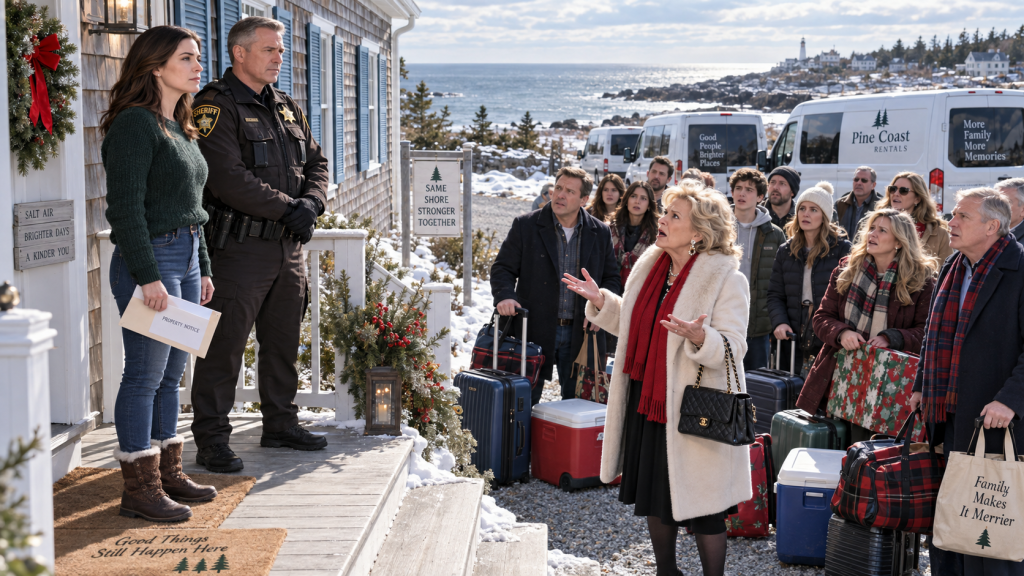
On December 23rd, I drove to the house before sunrise. I found four rental vans pulling into the gravel drive by noon, packed with suitcases, coolers, gifts, and relatives who had not invited me anywhere in fifteen years.
Aunt Patricia stepped out first.
“Nora,” she said brightly. “Open up. It’s freezing.”
I stood on the porch with Sheriff Callahan beside me and an envelope in my hand.
“No,” I said. “This year, you’re not coming in.”
“No,” I said.
“This year, you’re not coming in.”
For one second, nobody moved.
Twenty-three people stood in the gravel driveway surrounded by luggage, wrapped presents, coolers, garment bags, and enough food to feed a wedding reception.
The December wind came off the ocean hard enough to lift the ends of Aunt Patricia’s scarf.
She stared at me.
Then at Sheriff Callahan.
Then back at me.
Her smile disappeared slowly.
“Nora.”
She said my name the way people say the name of a child who has embarrassed herself in public.
“Don’t be ridiculous.”
I held the envelope tighter.
Behind Patricia, my mother climbed out of the second van.
Dad followed.
Lauren was already standing beside her husband, arms crossed, looking irritated.
My cousins began whispering.
One of my uncles laughed softly.
Not because anything was funny.
Because people laugh when they are waiting for the person they have underestimated to remember her place.
I didn’t.
Patricia stepped toward the porch.
Sheriff Callahan moved half a step forward.
That was enough.
She stopped.
“What exactly is this?”
she asked.
“A boundary.”
I had practiced the sentence all night.
It still shook when it came out.
Patricia stared at me.
“A what?”
“A boundary.”
Lauren rolled her eyes.
“Oh my God.”
My mother immediately said:
“Please don’t start.”
I almost smiled.
Fifteen Christmases.
Fifteen years of being omitted, minimized, forgotten, and then blamed for noticing.
And somehow, I was still the one starting something.
I looked at Mom.
“I’m not starting anything.”
Then I looked at the vans.
“You are.”
Dad sighed loudly.
“Nora, people drove for hours.”
“I know.”
“They booked time off work.”
“I know.”
“We brought food.”
“I can see that.”
“Then open the house.”
“No.”
His face changed.
He had always expected resistance to become obedience if he used a firm enough voice.
It had worked when I was twelve.
Twenty-two.
Thirty.
Not anymore.
Lauren laughed.
“This is insane.”
I looked at her.
“Why?”
“Because it’s Christmas.”
“Yes.”
“And we’re family.”
The words landed softly.
Family.
That word had been used on me for years like a collection notice.
Family helps.
Family understands.
Family forgives.
Family doesn’t keep score.
Funny how family had never once meant:
Family remembers Nora exists before December 26th.
I said:
“You didn’t invite me to Christmas for fifteen years.”
Lauren’s face tightened.
“Oh, here we go.”
My mother whispered:
“Nora.”
“No.”
I looked at all of them.
“You came to my house without asking.”
Patricia scoffed.
“Your house.”
“Yes.”
“This house belonged to Ruth.”
“Yes.”
“And Ruth believed in family.”
That one hurt more than I expected.
I felt Grandma in the house behind me.
Her wool sweaters.
Her chipped blue teapot.
The scent of cinnamon she somehow carried into every room.
The little kitchen table where she would push a slice of leftover pie toward me on December 26th and say:
“They don’t know what they’re missing.”
I looked at Patricia.
“Grandma also believed in invitations.”
Silence.
Sheriff Callahan almost smiled.
Patricia noticed.
Her face reddened.
She pointed at him.
“Why is he even here?”
Sheriff Callahan answered himself.
“Ms. Bennett asked me to be present because she expected a possible property dispute.”
Dad stared at me.
“You called the sheriff on your own family?”
“No.”
I looked at the driveway.
“I asked him to witness what happened when twenty-three people arrived at private property after being told they did not have permission to enter.”
Patricia turned sharply.
“We were never told that.”
I lifted the envelope.
“Yes, you were.”
Her expression changed.
Small.
But I saw it.
So did Sheriff Callahan.
“What’s that?”
my mother asked.
“The certified notice.”
Dad frowned.
“What notice?”
“The one mailed to Patricia three weeks ago.”
Every face turned toward my aunt.
She went pale.
Lauren looked at her.
“What is she talking about?”
Patricia recovered quickly.
“Oh, for heaven’s sake.”
She waved one hand.
“I got some ridiculous lawyer letter.”
I stared.
“You signed for it.”
“It was nonsense.”
“It said the beach house was not available for family gatherings unless I personally invited people.”
Patricia scoffed.
“I thought you were emotional.”
That sentence almost made me laugh.
Of course.
Legal notice became emotion when delivered to a woman people were used to ignoring.
Sheriff Callahan said:
“Ma’am, did the letter state that entering without permission could be considered trespass?”
Patricia’s mouth tightened.
“I didn’t read every word.”
I opened the envelope.
“You initialed the acknowledgment page.”
Silence.
That was the first real crack.
One cousin whispered:
“Patricia?”
She turned.
“Don’t.”
I almost felt sorry for the others.
Almost.
They had driven to Maine believing this was simply another family Christmas.
Maybe some of them genuinely thought I had agreed.
Maybe they simply never asked.
That distinction mattered.
But not enough to open the door.
I looked at everyone.
“Who here was told I invited you?”
Hands did not go up.
Instead, people looked at Patricia.
Then Mom.
Then Dad.
Lauren looked away.
Interesting.
I asked again.
“Who was told I said yes?”
My cousin Ben finally spoke.
“Patricia said the house was staying in the family.”
I nodded.
“What does that mean?”
He looked uncomfortable.
“That we could still use it.”
Patricia snapped:
“Because Ruth would have wanted that.”
I felt something harden inside me.
“No.”
Everyone went quiet.
“You don’t get to use Grandma’s wishes as a key.”
Patricia’s face changed.
“She was my sister.”
“And she left the house to me.”
“That does not erase thirty years of family tradition.”
“Neither does it create ownership.”
Dad stepped forward.
“Nora, enough.”
Sheriff Callahan moved again.
Dad stopped.
I looked at him.
“No.”
He stared.
“Enough was fifteen years.”
My voice shook now.
I let it.
“Enough was finding Christmas pictures online every year.”
“Enough was Grandma calling me the next morning because she knew.”
“Enough was everybody telling me I was too sensitive when what you really meant was inconvenient.”
Mom’s eyes filled.
I saw it.
I did not soften.
Not yet.
Dad said:
“You chose to distance yourself.”
I actually laughed.
A full laugh.
Cold air burned my lungs.
“I chose?”
“Yes.”
“You stopped coming around.”
“I stopped asking to be included after being told for fifteen years there was no room.”
“That is not what happened.”
Lauren jumped in.
“You always made gatherings uncomfortable.”
I turned toward her.
“How?”
She crossed her arms.
“You were quiet.”
I stared.
“That’s the crime?”
“You acted like you were judging everybody.”
“I was sitting there.”
“You had an attitude.”
“Because I existed without entertaining you?”
Her face flushed.
“You know what I mean.”
“No.”
I shook my head.
“I actually don’t anymore.”
The quiet afterward was different.
For years, I had allowed vague accusations to become verdicts.
Difficult.
Awkward.
Sensitive.
Weird energy.
Nobody ever had to define them.
They just had to repeat them until I began editing myself.
Not that day.
Patricia pointed toward the house.
“You can’t keep everyone out forever.”
I looked at her.
“I don’t plan to.”
Her expression brightened slightly.
Then I continued.
“Just people who arrive without permission.”
That ended the hope.
A gust of wind swept through the driveway.
Someone’s gift bag tipped over.
A roll of wrapping paper slid beneath one of the vans.
The whole scene looked ridiculous.
Twenty-three adults stranded outside a house they had assumed belonged to them socially because one dead woman had been too generous while alive.
My mother finally spoke.
“Nora, can we at least come inside and talk?”
I looked at her.
For one second, I wanted to say yes.
That old instinct.
Make things comfortable.
Offer coffee.
Explain.
Give them somewhere warm to accuse me.
Then I remembered a Christmas eleven years earlier.
I had called Mom on December 23rd.
“Are we doing anything?”
She hesitated.
Then said:
“Nothing big.”
Instagram showed thirty-one people at her house.
I spent that Christmas eating vending-machine crackers during a double shift.
Grandma brought me turkey the next day.
No.
The porch was warm enough for the truth.
“We can talk here.”
Mom’s face fell.
Dad said:
“This is humiliating.”
I looked at him.
“Yes.”
He stared.
“I know what that feels like.”
Nobody spoke.
Sheriff Callahan glanced away.
Not embarrassed.
Giving me space.
Patricia said:
“What do you want?”
There it was.
Finally.
Not what do we deserve?
Not what would Grandma want?
What do you want?
I looked at her.
“I want everyone to leave.”
A chorus started.
Complaints.
Disbelief.
One uncle said there were children in the vans.
Someone mentioned hotel prices.
Lauren said I was punishing everybody because of “ancient history.”
I let them talk.
Then Sheriff Callahan raised his voice.
“Folks.”
The driveway quieted.
“The property owner has stated you do not have permission to enter.”
He looked down the line of vans.
“You need to leave.”
Patricia stared at him.
“You’re actually going to enforce this?”
“Yes, ma’am.”
“My sister lived here for forty years.”
“She did.”
“I have a key.”
That changed everything.
I went still.
“What?”
Patricia realized too late.
Sheriff Callahan looked at her.
“You have a key?”
She hesitated.
Then lifted her chin.
“An old one.”
My pulse began pounding.
The locks had been changed two weeks after Grandma died.
My attorney insisted.
The estate lawyer too.
Patricia should have known an old key was useless.
Unless she had tried it.
I said:
“When were you last here?”
No answer.
“Patricia.”
She looked at me.
“This is ridiculous.”
“When?”
Dad said:
“Nora, let it go.”
I turned on him.
“You knew?”
Silence.
There it was.
My mother looked suddenly nervous.
Lauren looked confused.
I looked from one face to another.
“What did you do?”
Patricia’s voice hardened.
“We came to collect family belongings.”
My stomach dropped.
“What belongings?”
“Things that belonged to Ruth.”
“When?”
No answer.
Sheriff Callahan asked:
“Before or after title transferred?”
Patricia looked at him.
“That is none of your business.”
“It may become my business if property was removed without the owner’s authorization.”
Patricia’s face changed.
My skin went cold.
I stepped off the porch.
Aaron—
No.
There was no Aaron in this story. Keep Nora single? User never specified spouse. Need continue. We’ll maintain no spouse.
I stepped down one stair.
“What did you take?”
Mom whispered:
“Nora.”
“What?”
She looked at Patricia.
Then at Dad.
I understood instantly.
All of them knew something.
“How much?”
Nobody answered.
I walked back inside.
Sheriff Callahan called after me.
“Ms. Bennett?”
“I’ll be right back.”
I went straight to Grandma’s study.
When I inherited the house, most rooms looked untouched.
I had cried in the doorway because her reading glasses were still beside the chair.
The drawers were neat.
Photo albums.
Old bills.
Recipe books.
But one cabinet had been empty.
I remembered now.
The low oak cabinet beneath the window.
Grandma kept silver there.
Not fancy silver.
Old family pieces.
A tea service.
Two engraved candlesticks.
A small jewelry box she once told me held “things too sentimental to insure properly.”
When I found it empty, I assumed the estate lawyer had removed the contents.
I called him from the study.
He answered after two rings.
“Daniel?”
“Nora?”
“Did your office remove anything from Grandma’s study after she died?”
A pause.
“Such as?”
“Silver.”
“No.”
“Jewelry?”
“No.”
“Documents?”
“Not from the house.”
My chest tightened.
“Are you sure?”
“Yes.”
Then his voice changed.
“Why?”
I looked through the study window.
Twenty-three relatives in the driveway.
Patricia gesturing angrily.
Dad talking to Sheriff Callahan.
My mother standing still.
“I think my family came in before the locks were changed.”
Daniel went silent.
Then:
“Nora.”
“Yes?”
“Do not confront them about missing property until I get there.”
My heart began pounding.
“Why?”
“Because Ruth had an inventory.”
“What inventory?”
“Everything of significant value in the house.”
I stared.
“She did?”
“Yes.”
“Why?”
Another pause.
“Because last summer she believed things were already disappearing.”
The room went cold.
“What?”
Daniel’s voice lowered.
“She asked me to document several items.”
“Who was taking them?”
“She never proved it.”
“Who did she suspect?”
He did not answer immediately.
Then:
“Patricia.”
I closed my eyes.
Of course.
But Daniel continued.
“And someone else.”
I looked outside.
“Who?”
“Your father.”
My stomach turned.
Dad.
Grandma’s own son-in-law.
The man who had spent years telling me not to make Christmas about hurt feelings.
I whispered:
“What was missing?”
“Cash at first.”
“Then jewelry.”
“A few antiques.”
“She thought family members were borrowing things and intending to return them.”
“Did they?”
“Some.”
Not all.
I pressed one hand against the desk.
“Daniel, what exactly did Grandma leave me besides the house?”
Silence.
Then:
“You need to look in the bottom drawer of her desk.”
I froze.
“I already checked.”
“No.”
He spoke carefully.
“Not the visible drawer.”
I stared at the desk.
“There is a false panel.”
My pulse jumped.
“How do I open it?”
“Under the right side.”
I crouched.
Ran my fingers beneath the edge.
Found a small brass catch.
Click.
A narrow compartment slid forward.
Inside was a red leather notebook.
And an envelope.
My name.
Again.
Grandma’s handwriting.
I sat on the floor.
My legs suddenly would not hold me.
“Nora?”
“I found it.”
“Good.”
“What is it?”
“Read the notebook first.”
I opened it.
Dates.
Names.
Amounts.
Items.
Grandma had documented everything.
Patricia — $2,300 cash “borrowed” for furnace repair.
Never returned.
Dad — antique watch removed “to have serviced.”
Never returned.
Lauren — diamond earrings for wedding.
Returned damaged.
Uncle Stephen — $4,800 “emergency loan.”
No repayment.
Patricia again.
Dad again.
My mother.
Even cousins.
Page after page.
Not theft in Grandma’s language.
She still called them loans.
Borrowing.
Help.
But the totals were brutal.
By the final page, more than $186,000 in money and property had left Grandma’s hands over twelve years.
And almost none of it had come back.
Then I reached the last entry.
Dated six weeks before her death.
Patricia and Michael came while I was at oncology. Nora drove me. Missing afterward: jewelry box, Thomas paintings, Maine deed copies, blue binder.
Michael.
My father.
I stopped breathing.
Below it, Grandma had written:
I am done pretending not to notice.
My eyes filled.
For years, she had saved me pie.
Called me.
Asked whether I was warm enough.
Told me the family’s cruelty was not my fault without ever saying it directly.
And while I thought she was merely lonely, they had been draining her too.
I opened the envelope.
One letter.
“Nora,
If you found this because they came back for the house, then I am sorry I was right.”
My vision blurred.
Of course she knew.
Grandma always knew.
I kept reading.
“They will call the house family property.”
“It is not.”
“They will tell you memories give them rights.”
“They do not.”
“They will say I would want everyone together.”
“I did.”
“Just not at the cost of one person always being the one excluded.”
I covered my mouth.
Outside, a car horn sounded.
I barely heard it.
Grandma continued:
“I watched your family teach you that loneliness was the price of refusing to disappear into their expectations.”
“That was wrong.”
“I wish I had challenged them harder.”
“But I did one thing clearly.”
“I left you this house because you were the only one who treated it like a home instead of an entitlement.”
Tears fell onto the page.
Then:
“There is something else you must know before you decide what to do with them.”
My pulse changed.
“Daniel has the amended estate ledger.”
“The beach house is not the largest thing I left you.”
I stopped.
What?
I read the line again.
The beach house was valuable.
Very valuable.
I thought it was most of Grandma’s estate.
Apparently not.
I kept reading.
“The family believes my investment account was nearly empty.”
“It was not.”
My heart started pounding.
“I moved most of it three years ago.”
“To where?”
I whispered aloud.
Grandma answered on paper.
“To a trust in your name.”
My body went cold.
I kept reading.
“I did this because I began to understand that what happened to you at Christmas was not forgetfulness.”
“It was policy.”
That sentence hurt.
Policy.
Not accident.
Not oversight.
Policy.
“Patricia and Michael believed that as long as you remained outside the center of family decisions, you would be easier to ask for help without ever becoming someone who could question where the money went.”
My breathing stopped.
Money?
What money?
Then:
“Your father knows about the trust.”
Everything went still.
I looked through the window.
Dad was standing beside the second van.
Talking urgently to Patricia.
He knew.
“Your mother does not.”
“Lauren may know part of it.”
I gripped the page.
“The trust currently contains approximately $2.7 million.”
My heart stopped.
I read it again.
Two point seven million.
The room tilted.
Grandma had never lived like a woman with millions.
She clipped coupons.
Reused aluminum foil.
Complained when lobster rolls reached twenty dollars.
But she had invested for decades.
Maybe that explained it.
The letter continued.
“I intended this money to give you the one thing the family never did.”
“A place where your future could not be voted on.”
I cried.
Not because of the amount.
Because of the sentence.
A future that could not be voted on.
Grandma had watched every holiday become a committee decision in which I somehow lost.
She had left me something nobody could outnumber me inside.
I reached the bottom.
“If they arrive together, remember that numbers are not the same as belonging.”
“Twenty-three people can stand on your porch.”
“They are still twenty-three guests.”
“You are still the owner.”
I closed my eyes.
Outside, Patricia was shouting now.
Sheriff Callahan must have told her again to leave.
I stood.
The red notebook in one hand.
Grandma’s letter in the other.
When I returned to the porch, everyone looked at me.
Dad saw the notebook.
His face changed.
That was all the confirmation I needed.
He whispered:
“Where did you get that?”
I almost smiled.
“Grandma’s desk.”
Patricia went white.
Mom looked confused.
“What is it?”
Dad said quickly:
“Nothing.”
I looked at him.
“No.”
My voice came out steady.
“It’s not nothing.”
I held up the notebook.
“It’s a record.”
Dad’s jaw tightened.
“Nora.”
“A record of what people took from Grandma.”
The driveway went silent.
Several cousins looked at one another.
Patricia said:
“She was confused near the end.”
I laughed.
“She dated everything.”
“She forgot things.”
“She included receipts.”
Silence.
Dad stepped forward.
“Give me that.”
Sheriff Callahan moved between us.
Dad stopped.
I looked at Mom.
“Did you know they went into the house while Grandma was at oncology?”
Her face drained.
“What?”
Patricia snapped:
“Don’t listen to her.”
I turned toward Dad.
“Did you take Grandma’s jewelry box?”
Nothing.
“The paintings?”
Nothing.
“The blue binder?”
His face changed.
Blue binder.
That mattered.
“What was in the blue binder?”
I asked.
He stared at me.
“Nora.”
“What?”
He swallowed.
“That has nothing to do with Christmas.”
I almost laughed.
“Apparently Christmas has very little to do with Christmas in this family.”
Lauren stepped forward.
“What blue binder?”
Dad turned on her.
“Stay out of it.”
Her eyes narrowed.
That was new.
For once, the favorite child was being excluded from the secret.
I looked at her.
“Did you know Grandma left me a trust?”
Her face changed.
Tiny.
But visible.
Dad whispered:
“Stop.”
I looked at Lauren.
“Did you?”
She hesitated.
“I knew there was money.”
My mother turned.
“What money?”
Silence.
Now the fault line opened.
Dad stared at Lauren.
Lauren stared at me.
Patricia said:
“This is not the place.”
Sheriff Callahan murmured:
“It’s her property.”
I almost smiled.
Lauren looked at Mom.
“Dad said Grandma had set aside money for Nora.”
“How much?”
Mom asked.
Nobody answered.
I said:
“About $2.7 million.”
The reaction was immediate.
Someone gasped.
One cousin actually said:
“What?”
Patricia’s face went rigid.
Dad looked at the ground.
Mom stared at him.
“You knew?”
He said nothing.
“Michael.”
“I knew there was a trust.”
“How much?”
Silence.
“You knew?”
Her voice broke.
“Yes.”
She looked like someone had slapped her.
Then she turned toward me.
“You inherited almost three million dollars?”
“I learned that five minutes ago.”
Patricia immediately said:
“Then this is absurd.”
I looked at her.
“What is?”
“You have more than enough.”
There it was.
Before congratulations.
Before shock.
Before apology.
More than enough.
My stomach turned.
“For what?”
She gestured toward everyone.
“For all of us to stop fighting over one house.”
I stared.
“You want me to buy peace.”
“No one said that.”
“You did.”
Dad interrupted.
“This is exactly why Ruth should never have done this.”
I looked at him.
“Done what?”
“Put so much in one person’s hands.”
“One person.”
I let the phrase hang.
“You mean me.”
“You’ve always had resentment toward the family.”
I almost laughed.
“You spent fifteen years teaching me I wasn’t in it.”
Silence.
Mom began crying.
Lauren looked at Dad.
“What did you know?”
He did not answer.
“What was in the blue binder?”
That changed him.
He looked frightened again.
More frightened than when he arrived.
I knew then.
The $2.7 million was not the worst secret.
The notebook was not.
The missing jewelry was not.
The blue binder was why he was truly afraid.
I looked at Patricia.
She looked away.
Sheriff Callahan noticed.
“What is it?”
I asked.
Dad shook his head.
“Old papers.”
“What papers?”
“Nothing relevant.”
I stared.
“Then why did you take them?”
No answer.
“Why did Grandma list them separately?”
Silence.
My mother whispered:
“Michael.”
He snapped:
“Enough.”
Lauren flinched.
I did too.
Then something inside me steadied.
No.
Not this time.
I looked at Sheriff Callahan.
“I would like to make a formal report about the missing property.”
Dad’s face drained.
Patricia shouted:
“Nora!”
I ignored her.
Sheriff Callahan nodded.
“We can document the allegation.”
Dad stepped forward.
“You are not doing this.”
I looked at him.
“Yes.”
His voice dropped.
“You have no idea what you are opening.”
There.
The sentence that told me everything.
Not:
You’re wrong.
Not:
Nothing happened.
You have no idea what you are opening.
I held his gaze.
“Then maybe somebody should have invited me into the family sooner.”
He went silent.
Sheriff Callahan began taking names.
One by one, the vans eventually left.
Some relatives angry.
Some embarrassed.
Some refusing to look at me.
A few apologized quietly before getting into their cars.
Ben said:
“I really thought you knew we were coming.”
I believed him.
I still did not open the door.
An apology does not automatically create an invitation.
Patricia left last.
She stood beside her van and looked at the house.
Then at me.
“Ruth would hate this.”
I walked down one porch step.
“No.”
My voice was quiet.
“I think Grandma spent the final years of her life preparing for it.”
Patricia’s face tightened.
Then she left.
Dad remained.
Mom refused to get into the car with him.
Lauren left with Mom.
That was another fracture.
Dad stood alone beside his SUV.
Sheriff Callahan was still there.
He looked at me.
“You think you won.”
I stared.
“No.”
“I think I found out there was a game.”
His mouth tightened.
“You always did enjoy making yourself the victim.”
That used to work.
It did not anymore.
I looked at Grandma’s letter.
Then back at him.
“Where is the blue binder?”
He went pale.
“What blue binder?”
I almost laughed.
“Fifteen years of pretending not to remember me, and now you’re pretending not to remember paper.”
His face hardened.
“You should leave the past alone.”
“No.”
I said it softly.
“That advice has served you better than me.”
He looked at the house one last time.
Then got into his SUV.
Before leaving, he rolled down the window.
“Nora.”
I waited.
“If you call that lawyer tomorrow, you will regret it.”
My pulse changed.
“Daniel?”
His face told me yes.
I stepped closer.
“Why?”
He drove away without answering.
That night, I slept in Grandma’s room.
Not because I felt brave.
Because I didn’t want to be alone on the far side of the house.
The wind battered the windows.
Waves hit the rocks beyond the porch.
At 2:13 a.m., I woke from a dream in which twenty-three people were sitting around a table eating while I stood outside holding a plate.
I went downstairs.
Made tea.
Sat at Grandma’s kitchen table.
The red notebook was beside me.
Her letter underneath.
At 7:06 the next morning, Daniel called.
His voice was tense.
“Nora.”
“What happened?”
“I received your voicemail.”
“Dad knows I’m going to call you.”
“I assumed.”
“Why is he afraid of the blue binder?”
Silence.
Then Daniel said:
“Because Ruth asked me to keep a copy.”
My heart started pounding.
“You have it?”
“Yes.”
“What’s inside?”
He hesitated.
Then:
“Bank records.”
My stomach tightened.
“What bank records?”
“Transfers.”
“From Grandma?”
“No.”
That answer surprised me.
“Then whose?”
A pause.
“Yours.”
I stopped breathing.
“What?”
“The account was opened when you were nineteen.”
“I didn’t have an investment account at nineteen.”
“I know.”
“Then what are you talking about?”
Daniel’s voice lowered.
“Your father opened one using money Ruth had gifted you for college.”
The room went cold.
I remembered college.
Loans.
Two jobs.
Calling Dad sophomore year because tuition increased.
He told me:
“You need to learn that nobody owes you an easy life.”
I whispered:
“How much?”
“Initially?”
“Yes.”
“Forty thousand dollars.”
I closed my eyes.
Grandma gave me forty thousand for college.
I never saw it.
“What happened to it?”
Daniel exhaled.
“It grew.”
My pulse hammered.
“How much?”
“By the time Ruth discovered the account, just over $180,000.”
My stomach turned.
“And then?”
“Transfers started.”
“To where?”
Silence.
“Nora.”
“Tell me.”
“Lauren’s education account.”
I stopped breathing.
Of course.
My sister had graduated debt-free.
Dad told everyone she earned scholarships.
I took eleven years to pay off my student loans.
“What else?”
“Mortgage payments.”
“Your parents’ house.”
“Family vacations.”
“And several transfers to Patricia.”
My hands began shaking.
The Christmas pictures flashed through my mind.
Ski trips.
Matching pajamas.
Rental cabins.
Big dinners.
Years when Dad told me there wasn’t room.
Years when I worked holiday shifts.
Some of those Christmases may have been paid for with money intended for me.
I covered my mouth.
Daniel continued.
“Ruth found out five years ago.”
“Why didn’t she tell me?”
“She was gathering records.”
“Why wait?”
“She confronted Michael.”
My heart pounded.
“And?”
“He told her something that changed the situation.”
“What?”
Daniel went silent.
Then:
“He said the account was never legally yours.”
I frowned.
“But Grandma gifted me the money.”
“Yes.”
“Then why would he say that?”
“Because he claimed he had authority over your finances under an old family agreement.”
“What agreement?”
Another pause.
“The document in the blue binder.”
I stared at the dark ocean beyond the window.
“What document?”
Daniel’s answer came carefully.
“A guardianship order.”
I laughed.
“That makes no sense.”
“I was nineteen.”
“I know.”
“I wasn’t disabled.”
Silence.
My heart slowed.
“Daniel.”
“Yes?”
“Why was there a guardianship order?”
His voice changed.
“That is what Ruth spent the last five years trying to undo.”
My stomach dropped.
“Undo what?”
He inhaled.
“A legal arrangement your parents obtained when you were seventeen.”
I could barely speak.
“For what reason?”
He hesitated.
Then said:
“They told the court you were mentally incapable of managing money.”
The room disappeared.
“No.”
“I’m sorry.”
“No.”
“I went to college.”
“Yes.”
“I worked.”
“Yes.”
“I rented apartments.”
“I know.”
“I never had a guardian.”
“Not one you knew about.”
My breathing became shallow.
“Who?”
Silence.
Then:
“Your father.”
I stood so quickly the chair scraped backward.
“No.”
“Nora—”
“What did they tell the court?”
“That you had a developmental condition.”
“I don’t.”
“I know.”
“Who signed that?”
Daniel was quiet.
I already knew.
“Who?”
“A doctor.”
My hands went cold.
“Which doctor?”
Another pause.
“Patricia’s husband.”
Uncle Stephen.
A psychiatrist.
The uncle whose ski trip I had once paid into because “family helps family.”
I could not breathe.
Daniel continued.
“Ruth found evidence that the order was based on false or grossly misleading information.”
My vision blurred.
“Why would they do that?”
Silence.
Then he said:
“That is the question Ruth wanted answered before she died.”
I sat down slowly.
The house seemed to move around me.
Fifteen years of Christmases.
The trust.
The stolen money.
The blue binder.
A guardianship I never knew existed.
My father controlling an account in my name.
An uncle signing medical paperwork about a condition I did not have.
This was not simply a family that forgot me.
They had built a legal version of me that made my exclusion useful.
I whispered:
“Daniel.”
“Yes?”
“Do you have the court documents?”
“Yes.”
“Everything?”
“Copies.”
“And the original blue binder?”
“No.”
“Who does?”
A pause.
“We believed your father.”
My stomach dropped.
Of course.
Then Daniel said:
“But Ruth left one final instruction.”
My pulse changed.
“What?”
“If you ever learned about the guardianship…”
I waited.
“…I was supposed to give you another envelope.”
I closed my eyes.
Grandma.
Always another layer.
“What’s in it?”
“I haven’t opened it.”
“When can I get it?”
“Today.”
I stared at the ocean.
“What does the outside say?”
Daniel hesitated.
Then read it.
For Nora, when she finally learns why they needed everyone to believe she was the difficult one.
I stopped breathing.
Fifteen Christmases.
Fifteen years of hearing:
You bring weird energy.
You’re too sensitive.
You make things hard.
Don’t make Christmas about hurt feelings.
Maybe those sentences had never been casual.
Maybe they had been maintenance.
A family story repeated often enough to make an old lie sound plausible.
I looked at Grandma’s red notebook.
Then at the letter beside it.
Twenty-three relatives had shown up expecting a holiday.
Instead, they had opened the first door.
Behind it was stolen money.
Behind that, a secret guardianship.
And behind that was one last envelope Grandma Ruth had hidden for the day I finally understood that my family had not merely forgotten me.
They had spent years making sure everyone else believed there was a reason I deserved to be forgotten.
PART 3 — THE REASON THEY NEEDED ME TO BE THE DIFFICULT ONE
Daniel brought the envelope to the beach house before noon.
He did not come alone.
A woman named Elise Warren came with him.
She was an attorney.
Not an estate attorney.
A civil-rights attorney who specialized in guardianship abuse.
The fact that Daniel had called someone like her before arriving told me everything I needed to know about the seriousness of what was in his briefcase.
We sat at Grandma’s kitchen table.
The same table where she had fed me leftover Christmas pie for fifteen years.
Outside, the ocean was gray and restless.
Inside, there were three mugs of coffee, Grandma’s red notebook, copies of court records, and one sealed envelope with my name written across the front.
Elise did not touch it.
“That belongs to you.”
I stared at it.
My hands were cold.
“Before I open it, tell me what they did.”
She looked at Daniel.
Then back at me.
“What we know?”
“Yes.”
She opened a file.
“When you were seventeen, your father petitioned for what was then described as limited financial guardianship.”
My stomach tightened.
“For a minor?”
“It was designed to continue after you turned eighteen.”
“Why?”
“He claimed you had impaired judgment related to a developmental and anxiety disorder.”
I laughed once.
There was nothing funny in it.
“I had neither.”
“We know.”
“Who evaluated me?”
“According to the court file, Dr. Stephen Marsh.”
Uncle Stephen.
Patricia’s husband.
The psychiatrist who had spent every Thanksgiving asking me whether I was “still overthinking everything.”
I closed my eyes.
“Did he ever evaluate me?”
Elise hesitated.
“There is an evaluation.”
“That isn’t what I asked.”
“No.”
Silence.
“He relied on family statements.”
My father.
Patricia.
Possibly Mom.
Maybe Lauren was too young.
Elise continued.
“The report describes emotional instability, poor impulse control, difficulty understanding financial consequences, and dependence on family for decision-making.”
I stared at her.
“I had a part-time job.”
“Yes.”
“I was accepted to college.”
“Yes.”
“I handled my own school applications.”
“Yes.”
“I had never been hospitalized for anything psychiatric.”
“We found no record of that.”
My throat tightened.
“Then how did a judge approve it?”
Elise looked tired.
“The petition was uncontested.”
“Because I didn’t know about it.”
“Yes.”
“How was I not notified?”
That question changed her expression.
Daniel looked down.
Elise turned one page around.
There was a signed acknowledgment.
My name.
A signature beneath it.
Not mine.
I stared.
“That is forged.”
“We believe so.”
I sat back.
For a moment, I could hear Grandma’s old clock in the hallway.
Tick.
Tick.
Tick.
Someone had told a court I was incapable of managing money.
Then forged my signature to make it appear I agreed.
After that, they used the legal arrangement to manage money I never even knew existed.
It was not neglect.
It was infrastructure.
I looked at Daniel.
“Grandma knew all of this?”
“Not at first.”
“When?”
“Five years ago, she hired me to review the trust.”
He folded his hands.
“She thought distributions were disappearing.”
“That was when she found the account.”
“Yes.”
“And then?”
“We traced authority back to the guardianship.”
I felt sick.
“What did she do?”
Daniel looked toward the envelope.
“She confronted your father.”
“And he said?”
“Initially, that he had done it to protect you.”
I laughed.
Of course.
Protection.
The word people use when control would sound too ugly.
Daniel continued.
“He said you were too emotional at seventeen to handle an inheritance.”
“What inheritance?”
“The first forty thousand from Ruth.”
“That was enough for a guardianship?”
“No.”
He looked at me carefully.
“But there was another reason.”
My pulse changed.
“What?”
Daniel did not answer.
He nodded toward the envelope.
Grandma wanted to tell me.
My fingers shook as I broke the seal.
Inside were six handwritten pages.
I knew before reading that they had cost her something.
The handwriting was uneven.
She must have written them near the end.
I began.
“Nora,
If you are reading this, then I have failed to clean up one mess before leaving you to live with it.”
My eyes filled immediately.
Grandma never liked dramatic openings.
That made it feel more real.
I kept reading.
“The guardianship was not created because your father believed you were incapable.”
I stopped.
Elise watched me.
Daniel said nothing.
I continued.
“He created it because of a lawsuit.”
My stomach tightened.
What lawsuit?
The next paragraph answered.
“When you were sixteen, your father was sued over a construction partnership he operated with your uncle Stephen and Patricia’s husband’s brother.”
I frowned.
Dad had owned several small businesses over the years.
He always blamed taxes and bad partners when they failed.
Grandma continued.
“He feared creditors would reach family accounts.”
“Your father learned that money held for a legally dependent child under guardianship could be treated differently.”
My skin went cold.
No.
I kept reading.
“He told Stephen he needed a way to place certain assets beyond the reach of the lawsuit.”
“He used you.”
I stopped breathing.
Not because he thought I was incapable.
Not because I needed protection.
Because my name was useful.
Elise said quietly:
“We found evidence consistent with that.”
I looked at her.
“What evidence?”
“The timing.”
She opened another file.
“The guardianship petition was filed eleven days after your father received notice of the civil claim.”
My chest tightened.
Grandma’s letter continued.
“Stephen provided the medical language.”
“Patricia helped gather statements.”
“Your mother signed because Michael told her the arrangement was temporary.”
Mom.
There it was.
Not innocent.
Not mastermind.
Complicit.
I kept reading.
“Money moved first into an account designated for your benefit.”
“Then Michael used his authority to redirect it.”
“By the time the lawsuit was resolved, the system was already useful to him.”
I understood.
He had built a structure for one crisis.
Then kept it.
Because control, once profitable, rarely volunteers to disappear.
The letter continued.
“After you left for college, he realized you had become easy to exclude.”
That line hurt differently.
“Because you did not live nearby, you did not see household finances.”
“Because you worked hard, you rarely asked for help.”
“Because you were proud, you did not tell people when you were struggling.”
My eyes blurred.
She knew.
The broken heater Christmas.
The car outside the diner.
The hospital shifts.
I had told nobody.
Except Grandma.
“Each year you became more independent, the family story had to become harsher.”
My throat tightened.
“What story?”
The next sentence answered.
“That you were difficult.”
I stopped.
There it was.
Not accidental.
Maintenance.
Grandma wrote:
“If people asked why you were not included, Patricia said you preferred to be alone.”
“If someone asked why you were not given money, Michael said you were irresponsible with money.”
“If relatives wondered why Lauren received help you did not, they were told you rejected help.”
My hands began shaking.
I had not rejected help.
I had not even been offered it.
Grandma continued.
“They needed everyone to believe your distance was your choice because otherwise someone might ask what they were doing with money attached to your name.”
I put the pages down.
For several seconds, I could not read.
Elise slid a box of tissues toward me.
I did not take one.
I was too angry to cry properly.
I looked at Daniel.
“Did my cousins know?”
“No.”
“My aunts?”
“Some knew there was family tension.”
“Did Patricia know the whole thing?”
“Yes.”
That one hurt.
“What about Lauren?”
“We don’t believe she knew about the guardianship.”
I nodded.
That mattered.
The difference between benefitting from a lie and building one was not small.
I picked up Grandma’s letter again.
The final pages were less legal.
More personal.
“I am sorry I did not tell you sooner.”
“I kept believing I could fix the money first and spare you the ugliness.”
“I was wrong.”
“The truth belongs to the person whose life it explains.”
That line stopped me.
The truth belongs to the person whose life it explains.
I whispered it aloud.
Elise looked down.
Daniel stared at the table.
Grandma continued.
“I have amended my estate because I do not trust your father to stop.”
“I have left you the beach house.”
“I have placed the investment trust beyond his reach.”
“And I have instructed Daniel to challenge the guardianship after my death if Michael does not voluntarily terminate it.”
My heart stopped.
“Terminate it?”
I looked at Elise.
“Is it still active?”
She nodded slowly.
“On paper.”
I felt sick.
“I’m thirty-seven.”
“Yes.”
“How?”
“The original order required periodic reviews.”
“Were there reviews?”
“Documents were filed.”
I knew before asking.
“With my signature?”
“Yes.”
“For years?”
“Yes.”
I laughed.
Then I cried.
It came out together.
Ugly.
Sharp.
Fifteen Christmases.
Fifteen years of being excluded from tables where people discussed me as unstable, awkward, difficult.
Meanwhile, somewhere in a courthouse file, my father was maintaining paperwork saying I could not manage my own finances.
And I had been paying taxes.
Rent.
Student loans.
Hospital bills.
Everything.
By myself.
The absurdity almost swallowed me.
Grandma’s final paragraph was underlined.
“Nora, listen to me carefully.”
“You were never the difficult one.”
“You were the useful one.”
My chest broke open.
“Once you understand that, do not spend the rest of your life proving to them that you are easy to love.”
“People who need your silence will always call your voice a problem.”
I cried then.
Really cried.
Daniel stepped out of the room.
Elise remained.
Not touching me.
Just present.
I finished the last lines.
“Keep the house if it brings you peace.”
“Sell it if it becomes a burden.”
“Use the money.”
“Give it away.”
“Travel.”
“Do nothing.”
“But make one decision no one else votes on.”
“Have one Christmas where nobody gets to forget you.”
“Love,
Grandma Ruth.”
I pressed the letter to my chest.
Outside, the ocean kept moving.
It did not care that the explanation for half my life had just arrived in blue ink.
Elise waited until I could breathe again.
Then she said:
“We can challenge the guardianship immediately.”
“What happens if we do?”
“The court can terminate it.”
“Can my father be held responsible?”
“Potentially.”
“For the forged documents?”
“Yes.”
“The money?”
“Yes.”
“Stephen?”
“If he knowingly submitted false medical information, yes.”
“Patricia?”
“Depending on what we can prove.”
I nodded.
“What about my mother?”
Elise did not soften it.
“If she signed documents she knew were false, she may face consequences too.”
I looked at Grandma’s letter.
Then said:
“Do it.”
The next six months were the ugliest and clearest of my life.
The guardianship was suspended within days.
Terminated completely after an emergency review.
The judge who handled the matter was not the original judge.
That man had retired.
The new judge read the file.
Then read my employment history.
My bank records.
My degree.
My lease agreements.
My tax returns.
My medical records.
At one point, she looked at my father’s attorney and asked:
“Are you seriously arguing this woman has lacked capacity since seventeen?”
Nobody answered well.
The guardianship ended.
Officially.
A legal fiction that had followed me for twenty years disappeared in fourteen minutes.
I cried in the courthouse bathroom afterward.
Not because a judge had given me my independence.
I had been independent all along.
Because a file somewhere finally stopped saying otherwise.
The financial investigation took longer.
The original forty thousand dollars from Grandma.
The account growth.
Transfers.
Family expenses.
Lauren’s tuition.
Vacations.
Patricia.
Stephen.
My parents’ mortgage.
The total misuse connected directly or indirectly to money intended for me exceeded three hundred thousand dollars.
Some had been legally recoverable.
Some not.
Some was too old.
Some could be traced into property.
Dad fought everything.
At first.
Then documents began speaking.
Bank authorizations.
Forged acknowledgments.
Emails.
Patricia’s messages.
Stephen’s medical report created without examining me.
That one cost him dearly.
His professional board opened an investigation.
He eventually lost the right to practice for a period and faced further sanctions tied to falsified documentation.
He called me once.
I answered.
He said:
“I was trying to help your father protect the family.”
I replied:
“You diagnosed a girl you never examined.”
Silence.
“That is not family help.”
Then I hung up.
Patricia was louder.
She called me selfish.
Vindictive.
Ungrateful.
Said Grandma had become confused.
Said lawyers poisoned everything.
I asked one question.
“Why didn’t you invite me to Christmas?”
She went silent.
I waited.
Finally, she said:
“Because your father didn’t want questions.”
There it was.
No apology.
But truth.
Sometimes truth arrives because the liar runs out of prettier language.
Mom came to the beach house in March.
Alone.
She stood on the porch exactly where Patricia had stood.
She did not bring luggage.
She did not assume she was coming inside.
That mattered.
I opened the door.
She looked thinner.
Older.
She said:
“May I come in?”
I almost cried at the question.
May I.
Not open up.
Not family has rights.
Permission.
“Yes.”
We sat in Grandma’s kitchen.
Mom cried before I did.
“I should have protected you.”
I looked at her.
“No.”
She winced.
“You should have told the truth.”
She nodded.
“Yes.”
“Protection was the word everyone used while taking decisions away from me.”
She cried harder.
“I was scared.”
“I know.”
“Michael said if the lawsuit took everything, we’d lose the house.”
“I know.”
“He said the guardianship would be temporary.”
“I know.”
“Then once it worked…”
She stopped.
I finished.
“It became convenient.”
She nodded.
I stared at her.
“Did you believe I was unstable?”
“No.”
That answer came immediately.
It hurt more than hesitation would have.
“So you knew.”
“Yes.”
“You knew every time Dad said I couldn’t handle money.”
“Yes.”
“You knew every Christmas.”
Her face collapsed.
“Yes.”
That one broke something.
“Why?”
She covered her mouth.
“Your father said if you came around too much, someone would tell you about the account.”
I stared.
There it was.
Fifteen missing Christmases.
Not because I brought weird energy.
Not because I was difficult.
Because my presence created risk.
They needed me outside the room.
Mom whispered:
“I told myself we would fix it later.”
I almost laughed.
“Everyone was going to fix it later.”
She nodded.
“I know.”
I did not forgive her that day.
But I let her finish.
That was more than she deserved and less than she wanted.
Months later, we began speaking again.
Slowly.
Phone calls first.
Then coffee.
No holidays.
Not yet.
Dad was different.
He never truly apologized.
He settled.
That was not the same thing.
His attorney negotiated restitution.
Part of his interest in the family home was sold.
Funds were returned.
He admitted to certain financial misconduct but continued insisting the guardianship began for practical reasons.
At our final mediation, he said:
“I raised you.”
I stared at him.
“Yes.”
“And this is how you repay me?”
For the first time, the sentence did not hurt.
It clarified.
I said:
“Raising your child is not a loan.”
His face hardened.
“I gave you everything.”
“No.”
I shook my head.
“You gave me enough love to keep me confused about the control.”
Silence.
“I’m done confusing the two.”
We have not spoken since.
Maybe we will someday.
Maybe not.
Family endings do not always need funerals.
Sometimes they are just two living people who stop forcing a relationship to mean more than it can safely hold.
Lauren surprised me most.
She showed up in June.
No warning.
But she stayed at the bottom of the porch steps.
“Can I talk to you?”
“Yes.”
“Can I come up?”
I nodded.
She sat beside me.
For five minutes, neither of us spoke.
Then she said:
“I thought you hated us.”
I looked at her.
“I thought you hated me.”
She started crying.
“Dad always said you thought you were better than everyone.”
My chest tightened.
“He told me you didn’t like family events.”
“I stopped liking being excluded from them.”
She nodded.
“I know now.”
She wiped her face.
“I benefited from money that was yours.”
“Yes.”
“I didn’t know.”
“I believe you.”
She cried harder.
“But I liked being the easy daughter.”
That was honest.
“I let them compare us because I always won.”
I looked at her.
She continued.
“I’m sorry.”
Not for Dad.
Not for circumstances.
For herself.
That mattered.
Lauren repaid what she could.
Not because I demanded it.
Because she said she did not want the rest of her life resting on money stolen from me.
It took years.
I accepted every payment.
Then, when the final one came, I sent half of it back into a college account for her daughter.
Lauren called immediately.
“You don’t have to do that.”
“I know.”
“Then why?”
“Because this time it’s my choice.”
We both cried.
The $2.7 million trust remained mine.
After legal recovery and investment growth, it became more.
I did not announce the amount.
I did not become the family bank.
That chapter was over.
I paid off my remaining student loans.
Bought a reliable car.
Reduced my hospital hours.
Started sleeping without calculating every emergency around money.
And the beach house?
I kept it.
Not because Grandma told me to.
Because I loved the sound the floorboards made in winter.
Because the porch faced the ocean.
Because her blue shutters made me smile.
Because for the first time, I owned a place where invitation meant something.
The following Christmas, I did exactly what Grandma asked.
I had one Christmas where nobody forgot me.
But I did not spend it alone.
I invited carefully.
Lauren came with her daughter.
Mom came for dinner but stayed at a nearby inn because that boundary still mattered.
Ben came.
Two cousins who had apologized came.
Daniel came.
Elise too.
Sheriff Callahan received an invitation as a joke.
He actually showed up with a pie.
We laughed so hard when he walked through the door that he said:
“I assume I’m authorized to enter this time?”
“Yes.”
“Good. Saves paperwork.”
There were only eleven of us.
Not twenty-three.
No matching pajamas.
No performance.
No giant caption about the whole family.
Just food.
Music.
The ocean.
A fire.
At dinner, Lauren’s daughter dropped mashed potatoes on the floor.
Nobody cared.
Mom burned the rolls.
Ben opened wine with a screwdriver because nobody could find the corkscrew.
It was imperfect.
It was wonderful.
After dessert, I brought out Grandma’s pie plate.
The same one she had used all those years.
Blue flowers around the rim.
I served apple pie.
Mom started crying.
Then Lauren.
Then me.
Grandma had spent fifteen December mornings telling me:
“I saved you pie.”
That Christmas, I finally understood what she had really been saving.
Not dessert.
A place.
A witness.
A reminder that being left out by many people did not make me unworthy of belonging.
Before everyone left, we stood on the porch.
Someone suggested a photo.
For one second, I nearly said no.
Then I smiled.
We took it.
Eleven people.
Windblown hair.
Bad lighting.
One child looking in the wrong direction.
I loved it.
Lauren asked:
“Are you posting it?”
I thought about those fifteen Instagram Christmases.
The captions.
The whole family.
The ache of discovering where everyone had been without me.
Then I opened my phone.
I posted one photograph.
No long explanation.
No revenge caption.
Just:
Home.
That was enough.
Years passed.
The legal files eventually moved into storage.
Grandma’s red notebook went into a safe.
The final letter stayed in my desk.
My relationship with Mom became something real, though smaller than before.
Smaller is not always worse.
Sometimes smaller means honest.
Lauren and I became sisters for the first time as adults instead of roles assigned by our parents.
Dad remained absent.
Patricia sent Christmas cards for two years.
Then stopped.
Stephen never contacted me again.
I survived.
Not dramatically.
I just kept living.
That was another discovery.
People who control you often make themselves feel like the center of your life.
Then you remove them and discover mornings still happen.
Coffee still tastes good.
Work still needs doing.
The ocean still moves.
One winter, long after everything settled, I found myself sitting alone at Grandma’s kitchen table on Christmas morning.
Not lonely.
Alone.
There is a difference.
Snow was beginning outside.
The beach had gone nearly white.
I made coffee.
Cut myself a slice of apple pie.
Then I opened Instagram.
Old habit.
The family had posted photos.
Different houses now.
Smaller gatherings.
New people.
Some faces missing.
For years, those pictures had felt like proof that everyone belonged somewhere except me.
That morning, I looked at them and felt almost nothing.
Not because I stopped caring.
Because I stopped using other people’s tables to measure whether I had a place.
I closed the app.
Then my phone buzzed.
Lauren:
Driving up tomorrow. Save me pie.
I smiled.
Typed back:
No promises.
Then I cut a second slice and covered it.
Just in case.
I still think about December 23rd sometimes.
Four rental vans.
Twenty-three relatives.
Suitcases.
Coolers.
Aunt Patricia stepping out and saying:
“Open up. It’s freezing.”
They thought Grandma had left me a house.
They were wrong.
The house was only the visible inheritance.
Grandma left me evidence.
Money.
Truth.
And one sentence strong enough to dismantle the lie I had carried most of my adult life.
You were never the difficult one. You were the useful one.
For years, I heard that sentence as grief.
Now I hear the second half of it.
Useful is not the same as loved.
Needed is not the same as valued.
And being excluded from people who only welcome you when they want access to something you own is not loneliness.
Sometimes it is protection.
Real protection.
The kind with a locked door you chose.
A porch that belongs to you.
A sheriff standing beside you if necessary.
And the right to say no without explaining until someone agrees.
My family spent fifteen Christmases forgetting to invite me.
Then Grandma died.
And suddenly twenty-three people remembered exactly where I lived.
For a while, I thought that was the cruelest part.
It wasn’t.
The cruelest part was learning that some of them had never forgotten me at all.
They had been keeping track.
Of my money.
My legal status.
My distance.
My silence.
They remembered me whenever I was useful.
Grandma was the one who remembered me when I was not.
That is why the house became mine.
And every Christmas now, before anyone arrives, I unlock the front door myself.
Not because family has the right to enter.
Because I decided who was invited.
There is always pie.
There are never twenty-three people.
And nobody in that house is allowed to use the words “whole family” while pretending someone missing does not count.
Grandma taught me that much.
A family is not whole because every chair is filled.
It is whole when nobody has to disappear to keep everyone else comfortable.
That was the Christmas inheritance I kept.
The house was just where I finally learned how to use it.
THE END STORIES! THANK YOU FOR READING GOOD LUCK !❤️
Related Posts