My sister said I owed her my inheritance because she has a family. I booked a flight instead. Hours later, Mom messaged, “Transfer it to her or don’t bother coming home.” That night, I locked everything down. Forty-three missed calls. One rage-fueled voicemail from Dad.

The first call came on a Tuesday afternoon while I was reviewing quarterly reports in my apartment in Chicago.
The sun was dropping behind the skyline, turning the buildings across from me into sheets of gold, and I was in that last tired stretch of the day where numbers start blurring together and all you want is to close the laptop and be done. I’d been staring at the same spreadsheet for ten minutes when my phone lit up with my mother’s name.
I almost let it ring out.
Almost.
Because my mother never called to ask how I was doing. She called to assign. To direct. To inform me what a good daughter would do, what a decent sister would do, what a selfish woman like me had apparently forgotten how to do. And if I didn’t comply, she had her usual methods waiting for me—silence that felt like punishment, disappointment sharpened into shame, and that chilly tone that always made me feel like I’d failed some exam I never signed up to take.
I answered anyway.
“Hello?”
She didn’t say hello back.
“Your grandmother left you everything in her will,” she said, clipped and efficient, like she was reading from a prepared memo. “The house. The accounts. All of it. Your father and I think you should split it with Olivia. It’s only fair.”
Fair.
That word had been twisted into a weapon in my family for as long as I could remember. It never meant justice. It never meant balance. It meant Olivia wanted something, and everyone else was expected to hand it over with a smile.
I set my pen down and forced myself to speak carefully.
“Grandma Ruth made her own decisions,” I said. “If she wanted Olivia to have part of it, she would have put Olivia in the will.”
The silence that followed was so long I pulled the phone away from my ear and checked the screen, half expecting the call to have dropped.
Then my mother spoke again, and her voice had changed. Not louder. Not softer. Just wounded in that deliberate way she used when she wanted me to feel monstrous.
“I can’t believe how selfish you’ve become since moving to that city,” she said. “Olivia has two children. Mason is only four, and they’re trying for another baby. You’re single. No responsibilities. What do you even need that money for?”
There it was.
The script.
Olivia has a family.
I’m just me.
As if a woman without children is somehow unfinished. As if my life counted less because no one was calling me Mom. As if my bills were imaginary, my work was decorative, and my future only mattered when it could be sacrificed for someone else’s convenience.
I turned toward the window and looked out over the city. Chicago had never once asked me to justify my existence. It didn’t care whether I was married, maternal, lonely, ambitious, tired, healed, or still becoming. It cared whether I showed up and did the work. It was one of the reasons I had stayed.
“I need to get back to work,” I said. “We can talk another time.”
“There’s nothing to talk about,” my mother snapped. “Your father expects you to do the right thing.”
Then she disconnected.
Not hung up like a normal person ending a conversation.
Disconnected like a queen dismissing someone beneath her.
I sat there with the phone still in my hand, jaw tight, anger burning under my skin with something even worse than anger.
Recognition.
Because none of this surprised me.
My grandmother had been dead for three weeks, and my family was already trying to strip her final decision down into something more useful to them. They hadn’t asked how I was holding up. They hadn’t asked what I missed most about her. They hadn’t asked whether I wanted the blue teacups she used every Sunday, or the stack of old gardening journals she wrote in, or the cedar chest at the foot of her bed with the quilt she always folded by hand.
They heard the word inheritance, and instantly translated it into Olivia.
That was the pattern. It always had been.
Growing up, Olivia wanted.
Olivia received.
Everyone else adjusted.
When Olivia wanted to be a cheerleader, my parents paid for camps, uniforms, shoes, travel, hotel stays, competition fees, all of it. They called it an investment in her future.
When I asked for art classes the same year, my father told me there were books at the library if I was serious.
Olivia’s first car was a used SUV my parents proudly called a necessity.
My first car was a train schedule and a lecture about independence.
Olivia’s college was fully funded.
I left school with loans I only finished paying off two years ago.
My mother once told me I was lucky Olivia was willing to give me her old clothes, like wearing my sister’s discarded sweaters and stretched-out jeans was some kind of luxury. I learned early that in our house, generosity only flowed one way, and gratitude was expected from the people standing underneath it.
For a long time I told myself it didn’t matter.
At some point, when you realize the system was built before you were old enough to name it, you stop trying to win. You adapt. You become the easy child. The mature one. The one who doesn’t ask for much. The one who is praised for being low-maintenance while quietly being given less.
I thought moving to Chicago had loosened their grip.
In some ways, it had.
Distance gave me silence. Work gave me identity. Paying my own bills gave me a kind of dignity no one in my family had ever bothered to offer. But grief has a way of dragging old family roles back out into the light, and money turns those roles into sharpened metal.
My phone buzzed again.
Olivia.
Of course.
Mom told me about the inheritance. I’m so glad Grandma Ruth left you something. We should grab coffee soon and talk about how to handle everything. The kids need winter coats and Mason starts preschool next month. It’s all so expensive.
I stared at the message for a full ten seconds.
Not I miss her.
Not I still can’t believe she’s gone.
Not I keep thinking I’ll hear her laugh when I walk into the kitchen.
Just an invoice wrapped in soft language.
I deleted it without replying.
Then I did something I hadn’t done since the funeral.
I searched my email for Lawrence Whitfield.
My grandmother’s attorney.
His first message had been formal, careful, and cleanly organized. At the time I had barely absorbed it through the fog of funeral flowers and casseroles and the numbness that comes after you lose the only person in your family who ever made you feel seen.
This time I read every line.
The estate was larger than I’d expected.
The Stillwater house, valued at roughly four hundred thousand.
Investment accounts, around six hundred thousand.
The car. Jewelry. Furniture. A few keepsakes listed separately.
And one very specific instruction: twenty thousand dollars to the animal shelter where Ruth had volunteered every Thursday for fifteen years.
Everything else went to me.
Not my parents.
Not Olivia.
Me.
And that detail mattered, because my grandmother was not careless. She wasn’t forgetful. She wasn’t the kind of woman who made legal decisions by accident and hoped people sorted them out later. If she had written my name, she meant my name.
By the time I closed the email, I already knew what I was going to do.
I was going to Minnesota that weekend.
I was going to meet Whitfield in person.
I was going to walk through Ruth’s house one more time while it still smelled like cedar and tea and the hand lotion she kept by the sink.
And I was going to handle the estate exactly the way she trusted me to handle it.
Not because I wanted revenge.
Because I wanted control over the one thing my family always assumed they could take from me if they pushed hard enough.
I booked a flight for Friday evening.
Then I emailed Whitfield and asked whether he could meet me Saturday morning.
He replied within the hour.
10:00 a.m. confirmed.
I should have felt calmer after that.
Instead, it was like something in the air had shifted. Like my family could sense, even from several states away, that I wasn’t folding this time.
At 6:14 p.m., my mother texted.
Have you thought about what we discussed?
At 6:19, before I answered, another one came in.
Olivia has real needs, Amelia. Don’t be cruel.
Cruel.
I was staring at that word when my sister called. I let it ring through. She called again immediately.
Then Dad.
Then Mom.
Then Olivia again.
By eight o’clock my phone had become a weapon vibrating itself across the counter.
I finally answered Olivia because I wanted, just once, to hear her say it plainly.
“Hey,” she said, her voice too bright, too smooth. “Mom said you’re upset.”
“I’m not upset,” I said. “I’m just not giving you my inheritance.”
A pause.
Then the brightness vanished.
“Wow. Okay. So that’s who you are now.”
“No,” I said. “This is who I’ve always been when someone stops talking over me long enough to hear it.”
She laughed once, short and cold.
“You don’t need all that money. Be honest. You just don’t want me to have it.”
I leaned against the kitchen counter and closed my eyes.
“Grandma made her choice.”
“Grandma was old,” Olivia shot back. “And you were always in her ear after you moved away. You had more time. More influence. You knew what you were doing.”
That actually made me laugh, and I hated that it sounded shaky.
Because if there was one thing my sister could never tolerate, it was the possibility that someone had chosen me on purpose.
“You really think I manipulated Grandma Ruth into rewriting her whole estate because I visited and called her?” I asked.
“I think lonely old people get attached to whoever is around,” she said. “And I think you should do the decent thing before this gets ugly.”
Before this gets ugly.
As if it wasn’t ugly already.
As if demanding someone hand over a dead woman’s final gift under the banner of motherhood was normal.
I ended the call without another word.
Nine minutes later, Mom sent the message that made everything crystallize.
Transfer half to your sister before the weekend or don’t bother coming home.
I read it three times.
Then once more.
There was something almost funny about it. The arrogance. The certainty. The assumption that Minnesota was still home in the way they meant it, as if I was still twenty-two and desperate to be invited back into the family circle.
I typed one sentence.
I’m not asking permission to visit Grandma’s house.
I didn’t send anything else.
That night, I changed every password tied to the estate communication. I added two-factor authentication to my email, banking, and cloud storage. I forwarded Whitfield’s messages to a separate secure folder. I called my bank and put verbal security in place, not because I thought my family could magically access my accounts, but because that was the mood they had pushed me into: barricades, deadbolts, damage control.
By midnight I had forty-three missed calls.
One voicemail from Dad.
I listened to it once.
His voice was so angry it sounded unfamiliar.
He said Grandma would be ashamed of me. He said family comes first. He said I had always been jealous of Olivia and this was my chance to prove what kind of woman I really was. Then his voice dipped into something more dangerous, lower and meaner.
“You think you can come here and walk into that house after what you’re doing?” he said. “Try it. See how that goes.”
I replayed that part twice.
Not because I doubted what I’d heard.
Because some part of me had waited my whole life for one of them to say the quiet part out loud.
The next morning I sent the voicemail to Lawrence Whitfield.
His response came twenty-three minutes later.
Do not meet your family alone at the property. I will arrange to be present when you arrive. There is also something your grandmother instructed me to give you privately before anyone else enters the house.
I read that sentence sitting at my desk with cold coffee in my hand and a pulse suddenly drumming in my throat.
Something your grandmother instructed me to give you privately.
Not a key.
Not paperwork.
Something.
I called him immediately, but it went to voicemail. A minute later he emailed again.
Please keep your travel plans confidential. Your grandmother anticipated conflict.
That sentence followed me for the rest of the day.
She anticipated conflict.
Which meant Ruth had known.
Known what they would do. Known how fast they would move. Known exactly what kind of pressure would arrive once her signature became real.
And if she had known that much, then whatever she had left with Whitfield wasn’t just a formality.
It was protection.
Friday night I landed in Minneapolis under a low gray sky and drove the rental east with both hands clenched around the wheel. The farther I got from the airport, the more the old feeling returned—that strange shrinking inside my chest that only happened when I crossed back into the geography of my childhood.
By the time I pulled into the hotel near Stillwater, my mother had sent four more messages, each one colder than the last. Olivia sent one photo of the kids in matching pajamas with no caption at all, which somehow felt worse. Dad sent nothing.
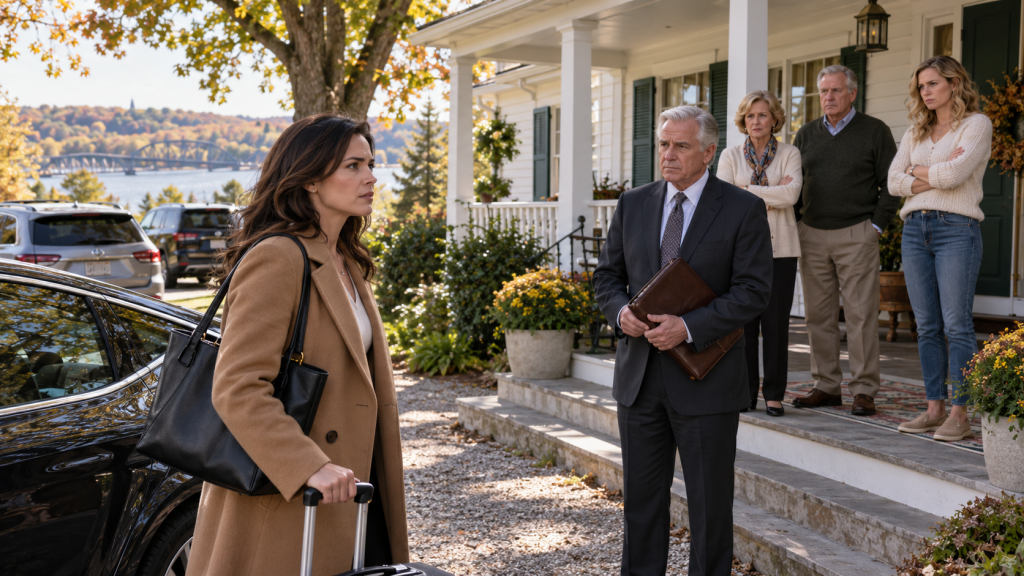
Saturday morning, I parked half a block from Grandma Ruth’s house and just sat there.
The place looked the same from the outside. White siding. Green shutters. The wide porch where she used to shell peas in the summer. The maple tree in the yard was bigger than I remembered, its branches shifting in the wind like someone waving me forward.
But there were cars already in the driveway.
My father’s truck.
My mother’s sedan.
Olivia’s minivan.
And standing on the porch beside Lawrence Whitfield, one hand wrapped around a leather document case, was my grandmother’s lawyer with an expression so grave it made the back of my neck go cold.
Because my family wasn’t just there early.
They were waiting.
And when I stepped out of the car, Whitfield looked straight at me and said, very quietly,
“Before anyone says another word, your grandmother asked me to play you something she recorded the week before she died, and after I heard what was on it, I understood exactly why she made me promise that your parents and sister would not hear it first.
Lawrence Whitfield looked past me toward my family.
Then back at me.
“Before anyone says another word, your grandmother asked me to play you something she recorded the week before she died.”
My father stepped off the porch immediately.
“What recording?”
Whitfield did not even turn.
“Amelia first.”
Dad’s face hardened.
“This concerns all of us.”
“No.”
Whitfield’s voice remained polite.
“That was not Mrs. Ruth Bennett’s instruction.”
My mother folded her arms.
“Oh, for heaven’s sake. Lawrence, we’re her family too.”
Whitfield finally looked at her.
“I’m aware.”
Something in the way he said it made Mom go quiet.
Olivia stood beside the front door with her purse clutched beneath one arm.
Her eyes moved from Whitfield to me.
Then to the leather case in his hand.
I had known my sister long enough to recognize calculation.
She was trying to guess what was inside before I heard it.
I walked toward the porch.
Dad blocked the first step.
Not dramatically.
Just enough.
The old move.
When I was sixteen, he used to stand in my bedroom doorway when I wanted to leave an argument.
He never touched me.
He simply made escape socially expensive.
“Amelia.”
His voice dropped.
“You are not going inside that house while you’re trying to steal from your sister.”
Something inside me went strangely calm.
I looked at him.
“The house is mine.”
His jaw tightened.
“Grandma’s house.”
“Legally, mine.”
“That doesn’t make what you’re doing right.”
Whitfield stepped forward.
“Mr. Bennett.”
Dad turned.
“If you interfere with the beneficiary’s access to estate property, I will document it.”
The color changed in my father’s face.
There are sentences that work because they contain no emotion.
Document it.
No yelling.
No threat.
Just consequence.
Dad stepped aside.
I climbed the porch.
My mother muttered:
“This is disgusting.”
I stopped.
Looked at her.
“What part?”
She stared.
“Grandma making a will?”
Silence.
“Me showing up?”
Nothing.
“Or you three arriving before the legal owner and waiting on her porch?”
Olivia snapped:
“We came because this is still our family home.”
I looked toward the white siding.
The green shutters.
The porch swing Grandma had repainted every second spring even though nobody else could tell the color had faded.
“No.”
I said it softly.
“It was Grandma’s home.”
That distinction mattered.
They had already begun talking as though Ruth’s life had been a waiting room for their inheritance.
I would not help them.
Whitfield unlocked the door.
Then looked at my family.
“You will wait outside.”
Mom laughed.
“You cannot be serious.”
“I am.”
Dad pointed at me.
“If she goes in there alone, things will disappear.”
I almost smiled.
Whitfield answered before I could.
“I will be with her.”
“Then you can make things disappear together.”
That was when Whitfield’s expression changed.
Only slightly.
But enough.
“Mr. Bennett, I have represented this family for seventeen years.”
My father said nothing.
“I will give you one opportunity to reconsider that accusation.”
Dad looked away.
Good choice.
Whitfield opened the door.
I stepped inside.
And immediately smelled cedar.
For one terrible second, Grandma was alive again.
Not visually.
My body simply expected her.
Tea from the kitchen.
Slippers against the floor.
Her voice calling:
“Shoes off, Amelia. I just cleaned.”
My throat closed.
I stopped in the hallway.
Whitfield gave me time.
“Take as long as you need.”
“I’m okay.”
It was a lie.
But a functional one.
We went into the sitting room.
Grandma’s chair was exactly where she left it.
Blue blanket folded over one arm.
A book facedown on the side table.
Her reading glasses beside it.
I touched the back of the chair.
Then had to sit.
Whitfield placed the leather case on the coffee table.
Inside was a small digital recorder.
A sealed envelope.
And a red notebook.
My heartbeat changed.
“What is all that?”
“The recording first.”
He picked up the device.
“Your grandmother made this eight days before she died.”
“Was she lucid?”
Whitfield looked almost offended on Ruth’s behalf.
“Completely.”
I nodded.
“I had to ask.”
“I know.”
He pressed play.
There was static.
Then Grandma’s voice.
Thin.
Older than I remembered.
Still unmistakably hers.
“Amelia.”
My hand flew to my mouth.
I had not heard her voice since the hospital.
Not really.
Voicemail did not count.
Memory did not count.
This was her.
“If Lawrence is playing this for you, then I am gone.”
I started crying immediately.
Whitfield looked away.
Grandma continued.
“And if your mother, father, and Olivia are outside looking angry, then apparently I still know my family.”
A laugh broke through my tears.
Of course.
Even dying, Ruth knew how to land a sentence.
Then her voice softened.
“Sweetheart, I am sorry.”
I stopped laughing.
“I am sorry because I should have protected you from this pattern earlier.”
My chest tightened.
“What pattern?”
I whispered.
The recording continued.
“I watched your parents make Olivia’s needs everybody else’s obligation for almost forty years.”
My eyes filled again.
“I told myself it was none of my business.”
“That parents raise their children as they choose.”
“That you were strong.”
“That you would be fine.”
A pause.
“Strong children are often the easiest ones to neglect because adults mistake endurance for permission.”
I closed my eyes.
That sentence entered somewhere deep.
I had spent half my life being told I was fine.
Responsible.
Independent.
Ruth continued.
“I saw the difference.”
“The cars.”
“School.”
“Birthdays.”
“College.”
“Loans.”
“The way your mother praised you for being low-maintenance after teaching you that asking was dangerous.”
My breathing became uneven.
Whitfield sat silently across from me.
Then Grandma said:
“I did not leave you the estate because Olivia has children and you do not.”
“I did not leave it to punish your parents.”
“I did not leave it because you visited me more.”
“I left it because it is mine, and I chose you.”
I cried harder.
One sentence.
I chose you.
All my life, my family had treated affection like a clerical error whenever it landed on me.
Grandma had known.
“I need you to remember that when they start telling you fairness means undoing my choice.”
A pause.
“Fairness is not taking from the child who received less because she finally received something.”
I pressed both hands against my face.
Outside, through the closed windows, I could faintly hear my father’s voice.
Grandma continued.
“There is another reason I left everything to you.”
My hands dropped.
Something in her tone changed.
“I discovered money had already been taken.”
I looked at Whitfield.
He did not react.
He already knew.
“What money?”
I whispered.
Ruth answered as though she had heard me.
“For the last six years, I have been helping your parents.”
My stomach tightened.
“I knew Dad had money problems.”
“You did not know how many.”
Grandma’s voice remained calm.
“Your father came to me after a failed investment and asked for forty thousand dollars.”
“I gave it.”
“Then another twenty.”
“Then fifteen.”
“Then more.”
My mouth went dry.
Dad had spent years lecturing me about responsibility.
Grandma continued.
“I do not regret helping them.”
“That money was mine to give.”
“But help becomes something else when the person receiving it starts signing for you.”
My heartbeat stopped.
I looked at Whitfield.
“What does she mean?”
He raised one hand.
Listen.
Grandma continued.
“Three years ago, I found a withdrawal from one of my investment accounts that I did not authorize.”
“Twenty-five thousand dollars.”
“I asked your father.”
“He said I had forgotten.”
My skin turned cold.
“He was wrong.”
“I had not forgotten.”
“There were four withdrawals.”
“Then seven.”
“Then a line of credit I never requested.”
The room seemed to narrow.
My father.
Grandma’s accounts.
“No.”
I whispered.
Ruth continued.
“Your mother knew.”
My eyes closed.
Of course.
“Olivia benefited.”
My stomach dropped.
“The money paid her mortgage arrears twice.”
“Credit cards.”
“A car.”
“And part of Mason’s preschool tuition.”
I stared at the recorder.
The kids need winter coats.
Preschool is expensive.
The message from Olivia came back to me.
Not greed beginning after Grandma died.
A habit continuing.
Grandma said:
“I confronted them last spring.”
“They told me family money belongs to family.”
I felt something cold settle in my chest.
My mother had used almost the exact phrase with me.
Family comes first.
Grandma continued.
“I told them no.”
“Your father became angry.”
“Your mother cried.”
“Olivia said I was humiliating her.”
A dry little laugh.
“I told her unpaid credit cards had done most of that work already.”
I almost laughed through my tears.
Then Grandma’s voice became serious again.
“I changed every authorization.”
“I moved my accounts.”
“I hired a forensic accountant.”
“I revised my will.”
There.
The inheritance had not been impulsive.
It had been protective.
“They do not know the full extent of what I found.”
My heartbeat quickened.
“Lawrence does.”
I looked at him.
He nodded.
“There is documentation.”
The recording continued.
“You need to decide what you want to do with it.”
“Not me.”
“You.”
“I did not go to the police because I was tired, Amelia.”
“That may have been cowardice.”
“Or selfishness.”
“I wanted the last months of my life to contain something besides lawyers.”
A pause.
“But I made copies.”
“I made notes.”
“And I left them where people who love you more than they fear conflict can find them.”
My eyes filled again.
“Whatever you decide, do not let them tell you there was nothing.”
“There was.”
Then:
“And sweetheart?”
I leaned toward the recorder.
“If Olivia says she deserves your inheritance because she has children, ask her whether those children would want their future financed by taking from another woman who was supposed to be family.”
My mouth trembled.
“I love Olivia.”
“I love your mother.”
“I love your father.”
Her voice broke slightly.
“Love is not evidence of innocence.”
That sentence silenced the room.
Then came the final part.
The part I would replay years later.
“Amelia, I need you to understand why I chose you.”
“You know how to leave.”
I frowned.
Grandma continued.
“You left Minnesota.”
“You built a life.”
“You stopped asking your parents to approve every breath.”
“I never did that.”
A pause.
“I should have.”
“So I am asking you for one thing.”
“Do not use this estate to buy your way back into a family that already taught you the price of admission.”
My eyes closed.
“Keep what you want.”
“Give what you want.”
“Sell what you want.”
“But do not surrender anything because somebody threatens to call you selfish.”
Then her voice softened until it was almost a whisper.
“Sometimes selfish is what people call a woman when she finally stops being useful.”
The recording clicked off.
Silence.
I sat there crying.
Not elegantly.
Not quietly.
My shoulders shook.
My nose ran.
I looked terrible.
Whitfield handed me tissues without pretending not to notice.
For almost five minutes, neither of us spoke.
Then I looked at the red notebook.
“What’s in that?”
“Ruth’s records.”
“And the envelope?”
“A letter.”
“For me?”
“Yes.”
“Do I read it now?”
“That’s your choice.”
There it was.
Choice.
I almost laughed.
Apparently, I was going to have to learn the word.
I picked up the notebook first.
Grandma’s handwriting filled the pages.
Dates.
Amounts.
Names.
Dad — $40,000.
Mom asked for another $12,500. Said not to tell Amelia because she worries too much.
Olivia mortgage — $18,200.
Olivia Visa — $9,740.
Dad withdrew $25,000 without consent. Says I approved. I did not.
My hands began shaking.
Page after page.
Not all theft.
Some gifts.
Some loans.
Grandma distinguished them carefully.
GIFT.
LOAN.
UNAUTHORIZED.
Three categories.
She had highlighted the last one in red.
I looked at Whitfield.
“How much?”
“Confirmed unauthorized movement?”
“Yes.”
“Approximately one hundred seventy-three thousand dollars.”
I stared.
“And suspected?”
“More.”
“How much more?”
“We’re still reconstructing.”
My stomach turned.
“What line of credit did she mention?”
Whitfield opened his document case.
“A home-equity line.”
“Against this house?”
“Yes.”
My pulse changed.
“How much?”
“One hundred eighty thousand.”
I stared around the room.
Grandma’s house.
Paid off for years.
“That can’t be right.”
“It was opened eighteen months ago.”
“Did Grandma sign?”
“She denied it.”
“Then who did?”
“We do not know yet.”
My body went cold.
“Is there a balance?”
“Yes.”
“How much?”
“One hundred forty-six thousand.”
I stood.
Too fast.
The room shifted.
I sat again.
“So I inherited a house with a fraudulent loan against it.”
“Potentially fraudulent.”
Whitfield was careful.
I appreciated that.
“Who received the money?”
“We know where some went.”
My mouth went dry.
“Where?”
“Your father’s business debts.”
“Olivia.”
“How much to Olivia?”
“Directly?”
“Yes.”
“About fifty-two thousand.”
I closed my eyes.
Fifty-two thousand.
And she wanted half my inheritance.
Whitfield continued.
“There were also transfers to an LLC.”
“What LLC?”
“North Shore Family Management.”
“Who owns it?”
He hesitated.
“Your mother.”
I stared.
Mom.
Not Dad.
Mom.
“What does it do?”
“On paper, property management.”
“And actually?”
“It appears mostly to move family funds.”
I felt nauseous.
“How long has it existed?”
“Five years.”
Five years.
A structure.
Not emergency help.
Not occasional borrowing.
A system.
Then I heard pounding at the front door.
Dad.
“Lawrence!”
Whitfield looked toward the hallway.
“Time.”
My mother shouted:
“You cannot keep us outside forever!”
Olivia:
“This is insane!”
I stood.
“Are we letting them in?”
“That depends.”
“On what?”
“Whether you want to.”
Again.
Choice.
I looked around Grandma’s sitting room.
Then toward the front door.
“Yes.”
Whitfield nodded.
“Then I would suggest we do it with boundaries.”
I almost smiled.
“I’m starting to like you.”
“Your grandmother found me irritating.”
“That means she liked you too.”
He opened the door.
My family entered like weather.
Dad first.
Mom behind him.
Olivia last.
All talking.
“What the hell was that about?”
“What did she say?”
“What did he show you?”
Olivia looked at the red notebook in my hand.
Her face changed.
Only for half a second.
But I saw it.
Recognition.
“You know this?”
I asked.
She recovered quickly.
“What?”
“The notebook.”
“No.”
Too fast.
Mom looked at Dad.
Dad looked at Whitfield.
Then my father said:
“This is exactly what I warned you about.”
I stared.
“What did you warn him about?”
“Grandma was confused.”
My chest tightened.
Whitfield spoke.
“Ruth passed a capacity assessment eleven days before signing the final amendment to her estate documents.”
Dad’s face changed.
Mom interrupted:
“She was on pain medication.”
“She was.”
Whitfield nodded.
“And repeatedly evaluated.”
“She had full testamentary capacity.”
Olivia crossed her arms.
“That doesn’t mean Amelia didn’t influence her.”
I laughed.
“Interesting.”
“What?”
“You haven’t even asked what was on the recording.”
She went quiet.
I held up the notebook.
“But you care about this.”
Mom stepped forward.
“Give me that.”
“No.”
“Amelia.”
“No.”
Her face hardened.
“You don’t know what you’re looking at.”
“So explain.”
Silence.
Dad said:
“Your grandmother kept terrible records.”
Whitfield almost smiled.
“No.”
He said it mildly.
“She kept extraordinary records.”
Dad glared at him.
I opened the notebook.
“Twenty-five thousand unauthorized.”
Dad’s jaw tightened.
“Forty-two thousand.”
“Seven thousand.”
“Fifteen.”
Mom said:
“She gave us permission.”
“Grandma wrote that she didn’t.”
“She forgot.”
“Every time?”
Mom went silent.
I turned to Olivia.
“Fifty-two thousand.”
Her face drained.
“I don’t know what you mean.”
“Money from the line of credit.”
“What line of credit?”
I watched her.
“You genuinely don’t know?”
She looked at Mom.
That was enough.
“You knew something.”
Olivia started crying.
“Grandma helped me.”
“That’s not what I asked.”
“I had children.”
There it was.
Again.
As though motherhood were a financial instrument.
“I was drowning, Amelia.”
“Then why didn’t you tell me?”
She laughed bitterly.
“Because you would judge me.”
“I might have helped you.”
That stopped her.
For once.
“I helped people.”
“You just never asked me without making it an obligation.”
Her eyes filled.
Then Dad snapped:
“This is not about Olivia.”
I turned.
“No?”
“No.”
“It’s about your grandmother turning against her own family at the end.”
My chest tightened.
“She didn’t turn against anyone.”
“She documented what happened.”
Dad’s face reddened.
“You think that notebook proves anything?”
Whitfield answered:
“Not by itself.”
Dad looked at him.
“There are bank records.”
Silence.
“Electronic authorizations.”
Nothing.
“Emails.”
Mom sat down.
Slowly.
That scared me more than shouting.
“What emails?”
I asked.
Whitfield looked at me.
“You haven’t read them yet.”
Dad immediately said:
“There’s nothing in them.”
I stared.
He knew.
Of course he knew.
I asked:
“What did you send?”
“Nothing.”
“You just said there’s nothing in them.”
His mouth closed.
I felt something almost sad inside me.
My father had always been bad at lying when frightened.
He usually relied on anger to keep people from noticing.
I said:
“Lawrence.”
Whitfield opened his case.
Dad stepped forward.
“No.”
Whitfield stopped.
Dad looked at me.
“You do not need to see every ugly conversation a family has when people are under pressure.”
My pulse changed.
“That sounds like I definitely do.”
Mom started crying.
“Amelia, please.”
I stared at her.
There were so many versions of my mother’s tears.
Angry tears.
Manipulative tears.
Real tears.
These looked real.
That made them harder.
“What happened?”
She wiped her face.
“We were trying to save your father.”
“From what?”
Dad snapped:
“Enough.”
Mom looked at him.
“No.”
That surprised all of us.
She continued.
“His business was worse than you knew.”
Dad’s face hardened.
“I said enough.”
Mom looked at him.
For once, she did not stop.
“He owed people money.”
“How much?”
She looked at Whitfield.
He answered.
“Over three hundred thousand at one point.”
My stomach dropped.
Dad’s shoulders sank.
Mom whispered:
“He was going to lose everything.”
“So you took Grandma’s money?”
“She offered at first.”
“At first.”
The words mattered.
Mom started crying harder.
“Then she started saying no.”
I stared.
“And instead of stopping?”
Silence.
“You decided she didn’t mean it.”
My mother looked down.
Dad exploded.
“You have no idea what it’s like to spend forty years building something and watch it collapse.”
I looked at him.
“No.”
“I know what it’s like to spend thirty-eight years being told my needs come after everyone else’s.”
Silence.
“That seems relevant.”
Olivia whispered:
“This is cruel.”
I turned.
“No.”
“Cruel was threatening me with exile because I wouldn’t give you money Grandma deliberately left to me.”
Her face tightened.
“I never said that.”
“Mom did.”
“You agreed.”
She said nothing.
Then Whitfield placed a stack of printed emails on the coffee table.
My father looked at them.
And went pale.
That told me everything before I read a word.
The first email was from Dad to Mom.
Three years earlier.
Ruth is starting to question the withdrawals. Keep Olivia out of it unless we need her.
My skin went cold.
Second:
Mom to Dad.
She called Lawrence. You need to stop using the old authorization.
Old authorization.
I looked up.
“What authorization?”
Dad said nothing.
Third email.
Dad:
If Lawrence finds out the POA is expired, we have a problem.
My heartbeat slowed.
“Power of attorney?”
Whitfield nodded.
“Ruth gave your father limited financial power of attorney eight years ago while she recovered from hip surgery.”
“How long did it last?”
“Six months.”
I looked at Dad.
“You kept using it?”
He stared at the wall.
Whitfield continued.
“Some institutions apparently retained outdated authority in their systems.”
My stomach turned.
Grandma trusted him during surgery.
He turned temporary access into a key he kept using.
The next email was worse.
Mom to Olivia.
Grandma may ask you about the mortgage payment. Tell her I gave you the money. Do not mention the account.
Olivia covered her mouth.
I stared at her.
“You knew.”
Tears filled her eyes.
“I knew Grandma helped.”
“You knew enough to lie.”
Silence.
Then:
“I was desperate.”
Again.
The universal solvent.
Desperate.
I looked at the final email on the page.
Dad to Mom.
Dated six months earlier.
If Ruth leaves the house to Amelia, we need to challenge it immediately. Olivia has more standing because of the kids.
My hands went cold.
Six months before Grandma died.
They had already anticipated her will.
Already planned the argument.
Olivia has children.
I looked at my sister.
Her face collapsed.
“You knew the plan.”
She whispered:
“Not all of it.”
“How much?”
“Mom said Grandma was punishing us.”
“Did you believe her?”
Olivia cried.
“I wanted to.”
That answer was at least honest.
Then Whitfield said:
“There is another document.”
Nobody moved.
Dad looked suddenly exhausted.
Mom stopped crying.
I looked at Lawrence.
“What?”
He reached into the bottom of the case.
A pale blue folder.
“My office discovered it while reviewing the county records after Ruth’s death.”
My stomach tightened.
“What is it?”
“An ownership transfer.”
Dad stood.
“No.”
Whitfield ignored him.
“Lawrence.”
Dad’s voice changed.
Not angry now.
Afraid.
“What ownership transfer?”
I asked.
Whitfield handed me the document.
At first, I did not understand it.
Grandma’s address.
Parcel number.
Legal description.
Then:
QUITCLAIM DEED.
My heart stopped.
Grantor:
Ruth Bennett.
Grantees:
Michael and Diane Bennett.
My parents.
I stared.
“What is this?”
Whitfield answered quietly.
“A deed purporting to transfer Grandma Ruth’s house to your parents.”
My mouth went dry.
“That’s impossible.”
“The county records show it was submitted nine months ago.”
I looked at Mom.
Dad.
Olivia.
“Nine months?”
Dad said:
“Ruth wanted us to have the house.”
“No.”
Whitfield’s voice was calm.
“She did not.”
Dad turned.
“You weren’t there.”
“No.”
“I was simply the attorney who prepared every legitimate estate document for her during the last seventeen years.”
Dad’s face reddened.
“She changed her mind.”
“Then why did she never tell me?”
“She didn’t need your permission.”
“No.”
Whitfield nodded.
“She did not.”
“Which is why I investigated.”
My heartbeat pounded in my ears.
“What did you find?”
“The deed was notarized.”
“By who?”
Whitfield looked at Olivia.
My sister stopped breathing.
“No.”
I whispered.
Olivia shook her head immediately.
“I didn’t know what it was.”
My stomach dropped.
“What did you do?”
She started crying.
“Dad brought papers to my house.”
“What did you do?”
“He said Grandma had already signed.”
My pulse slowed.
“And?”
“He asked me to witness.”
“You’re not a notary.”
“No.”
“Then how?”
Whitfield answered.
“Olivia’s friend Stephanie was.”
I remembered Stephanie.
College friend.
Real-estate office.
My stomach turned.
Olivia whispered:
“She notarized it.”
“Was Grandma there?”
Silence.
My body went cold.
“Olivia.”
“No.”
There.
The room vanished around me.
Grandma had not even been present.
I looked at Dad.
“You forged her signature?”
He stood.
“Do not accuse me of something you don’t understand.”
Whitfield’s voice cut through the room.
“We had the signature examined.”
Dad froze.
My mother covered her face.
Whitfield continued.
“The preliminary comparison indicates Ruth did not sign that deed.”
Silence.
I looked down at the paper.
My grandmother’s name.
Her home.
My parents.
A forged transfer.
Suddenly Dad’s voicemail sounded different.
You think you can come here and walk into that house? Try it. See how that goes.
He had not only meant emotionally.
He thought the house was his.
Or at least he thought he had paperwork saying so.
I looked at Whitfield.
“Is the deed valid?”
“We are challenging it.”
“Has ownership changed?”
“The recording exists in county records, but fraud can void the instrument.”
“Can they sell the house?”
“Not now.”
“Why?”
“I filed a notice of dispute yesterday.”
Dad stared.
“You what?”
Whitfield did not blink.
“Ruth anticipated conflict.”
There it was again.
Protection.
My grandmother had known enough to leave breadcrumbs.
But not enough to see everything.
Or maybe she had.
I looked at the red notebook.
“Did Grandma know about the deed?”
Whitfield went quiet.
My stomach tightened.
“Lawrence.”
“We don’t know.”
“What do you mean?”
“She discovered something was wrong with the property file shortly before she died.”
My heart started pounding.
“How shortly?”
“Six days.”
The recording was eight days before she died.
Two days later.
“What did she find?”
“A property-tax notice addressed differently.”
I stared.
“She called your father.”
Dad looked away.
“She called my office after.”
Whitfield’s voice softened.
“She was very upset.”
My chest hurt.
“What did she say?”
“She said…”
He paused.
“Lawrence, I think Michael has taken my house.”
The words broke me.
I sat down.
Grandma Ruth.
Seventy-nine.
Sick.
Knowing her own son may have forged her out of her home.
Whitfield continued.
“She asked me to come the next morning.”
“Did you?”
“Yes.”
“What happened?”
“She showed me the tax notice.”
“We began pulling records.”
“And then?”
“She became ill that afternoon.”
Hospital.
Decline.
Death.
She never had time to finish.
My father said quietly:
“She was dying.”
I looked up.
“What is that supposed to mean?”
“She knew we’d care for the property.”
“No.”
He shook his head.
“You’re twisting this.”
“I’m twisting it?”
My voice rose for the first time.
“You used an expired power of attorney.”
“Moved her money.”
“Opened debt against her house.”
“Planned to challenge her will before she was dead.”
“And now there is a deed with a signature she apparently didn’t write.”
Dad stepped toward me.
“You think your grandmother was perfect?”
“No.”
The answer came immediately.
“I think her property belonged to her.”
Silence.
“And I think no means no even when the person saying it is old.”
Mom started sobbing.
Olivia sat on the sofa.
Her face buried in her hands.
For the first time, I saw the family not as a unit.
But as individuals.
Dad had driven it.
Mom had helped.
Olivia had benefited and lied.
Different responsibility.
Same pattern.
Then my phone buzzed.
Whitfield’s assistant.
No.
Not mine.
His.
He looked at the screen.
His expression changed.
“What?”
I asked.
He did not answer immediately.
“Lawrence.”
He stood.
“We need to pause.”
My stomach tightened.
“Why?”
He looked at Dad.
Then at Mom.
Then Olivia.
Finally me.
“My office just received confirmation from the bank.”
“What confirmation?”
“The home-equity line against Ruth’s house was increased three months ago.”
I stopped breathing.
“Increased to what?”
“Four hundred thousand dollars.”
My mouth went dry.
Dad looked shocked.
Genuinely.
That mattered.
Mom looked even worse.
Olivia whispered:
“What?”
Whitfield continued.
“Two hundred seventy thousand was drawn.”
My hands went cold.
“Where did it go?”
He checked the message again.
Then frowned.
“That’s the problem.”
“What?”
“It didn’t go to your father’s business.”
Dad looked at him.
“Then where?”
Whitfield slowly raised his eyes.
“The receiving account is in Olivia’s name.”
The room went completely silent.
I turned toward my sister.
Olivia’s face drained of all color.
“No.”
Dad stared at her.
Mom stopped crying.
Olivia stood.
“No.”
Her voice shook.
“I didn’t take two hundred seventy thousand dollars.”
Whitfield looked at the banking confirmation.
“The transfer went to an account ending in 4419.”
Olivia went still.
I knew before she answered.
“That’s yours.”
I whispered.
She nodded.
Then immediately:
“But I didn’t know.”
Dad exploded.
“What do you mean you didn’t know?”
“I don’t know!”
“You received a quarter of a million dollars!”
“I didn’t!”
Whitfield said:
“The account is yours.”
Olivia covered her mouth.
Then something changed in her face.
Not guilt.
Recognition.
“Oh my God.”
“What?”
I asked.
She looked at Mom.
Not Dad.
Mom.
“Mom told me she opened a new account for the kids.”
My mother went white.
“What?”
Olivia’s voice cracked.
“She said Grandma wanted to start education funds.”
Mom sat perfectly still.
Dad turned toward her.
“Diane.”
Mom said nothing.
Olivia started crying.
“She had me sign forms.”
My stomach tightened.
“When?”
“Three months ago.”
Exactly when the credit line increased.
I stared at Mom.
“Where is the money?”
Mom’s hands began trembling.
Dad said her name again.
“Diane.”
This time, there was fear in his voice.
My mother looked at him.
Then at me.
And whispered:
“I was trying to fix it.”
Nobody spoke.
“Fix what?”
I asked.
Her mouth trembled.
“The money Michael took.”
Dad stared.
“What are you talking about?”
Mom started crying again.
“I knew Ruth was going to find everything.”
Dad’s face changed.
“So you borrowed more?”
“I was going to put it back.”
My stomach dropped.
“What?”
“I moved money into Olivia’s account temporarily.”
“Why hers?”
“Because Lawrence was watching ours.”
Whitfield’s expression went cold.
My mother looked at me.
“I was going to repay Grandma’s accounts.”
“With money borrowed against Grandma’s house?”
Silence.
The logic was so twisted it almost became absurd.
Steal from one pocket to hide theft from another.
Dad whispered:
“You did this without telling me?”
Mom laughed bitterly through tears.
“You were drowning us.”
That stopped him.
“You kept borrowing.”
“Taking.”
“Lying.”
“I was trying to stop everything from collapsing.”
Dad looked as though she had struck him.
For the first time, their united front disappeared.
The family machine cracked down the middle.
Then Whitfield’s phone buzzed again.
He read.
And went completely still.
I was already afraid to ask.
“What now?”
He looked at me.
“Amelia.”
“What?”
“The bank account in Olivia’s name is empty.”
Olivia stared.
“What?”
“The two hundred seventy thousand was transferred out eleven days after it arrived.”
Her knees weakened.
She sat.
“Where?”
Whitfield’s eyes moved toward my mother.
Then stopped.
“The final recipient is an investment company.”
“What company?”
He read the name slowly.
Northland Elder Asset Partners.
Dad frowned.
“I’ve never heard of it.”
Neither had I.
But my mother had.
I could tell.
Her face gave her away.
“Mom.”
She shook her head.
“No.”
“What is it?”
“Nothing.”
“You know it.”
“No.”
“Mom.”
She stood so quickly the chair scraped backward.
“I need to go.”
Whitfield stepped toward the front hall.
“No documents leave this house.”
“I’m not taking anything.”
Dad stared at her.
“Diane.”
She reached for her purse.
Her hands shook so badly she dropped it.
The contents spilled across Grandma’s hardwood floor.
Keys.
Wallet.
Lipstick.
Receipts.
And a business card.
I bent before she could.
Picked it up.
White card.
Dark blue lettering.
NORTHLAND ELDER ASSET PARTNERS
Below it:
GREGORY VALE — SENIOR CLIENT DIRECTOR
A phone number.
An address in Minneapolis.
And on the back, in my mother’s handwriting:
Ruth — competency strategy / emergency transfer before probate
My skin went cold.
Competency strategy.
Emergency transfer.
Before probate.
I looked at Whitfield.
His face had changed.
“What does that mean?”
He did not answer immediately.
Mom grabbed for the card.
I pulled it away.
“Mom.”
“It’s not what you think.”
“I don’t know what I think.”
I looked at the words again.
“Explain it.”
She started crying.
Real terror now.
Not guilt.
Terror.
“I was afraid your grandmother would cut us all out.”
“She did.”
“No.”
Mom shook her head.
“You don’t understand.”
“She was going to do more.”
My heartbeat changed.
“What more?”
Mom looked at Dad.
Then Olivia.
Neither seemed to know.
That frightened me.
“She was going to report the withdrawals.”
My chest tightened.
“Yes.”
“And change the house.”
“What does that mean?”
“She was going to put everything somewhere none of us could touch.”
I stared.
“The estate?”
“No.”
Mom’s voice broke.
“A trust.”
Whitfield went still.
“What trust?”
Mom closed her eyes.
“The one Gregory told me about.”
Silence.
I looked at Lawrence.
He genuinely did not know.
That was worse.
Mom continued.
“He said if Ruth moved everything into it before she died, we would never be able to challenge the will the normal way.”
My pulse pounded.
“So what did you do?”
“I asked how to stop it.”
Olivia whispered:
“Mom…”
My mother looked at me.
And for the first time in my life, I saw something in her face beyond control.
Shame.
“He said if we could establish that Ruth wasn’t competent when she changed her estate plans, everything could be reviewed.”
My stomach turned.
“Establish?”
“How?”
She looked away.
Dad whispered:
“Diane, what did you do?”
She started sobbing.
“I only gave him documents.”
“What documents?”
“Medical records.”
Whitfield’s expression sharpened.
“You did not have authorization to provide Ruth’s medical records.”
Mom cried harder.
“She had left copies at our house.”
“What else?”
I asked.
Silence.
“Mom.”
“He wanted examples.”
“What examples?”
“Forgetfulness.”
“Confusion.”
“Things she said.”
My throat tightened.
“You built a file saying Grandma was incompetent.”
“I was scared.”
“That is not an answer.”
She covered her face.
Then Whitfield quietly asked:
“How much did Northland receive?”
Mom did not respond.
“Diane.”
She whispered:
“Two hundred seventy thousand.”
The whole amount.
I looked down at the card.
“Why?”
Mom’s answer came almost too softly to hear.
“They said that was the retainer.”
I stared.
“A two-hundred-seventy-thousand-dollar retainer?”
“For what?”
My mother lifted her face.
Tears ran down both cheeks.
“To challenge Ruth’s estate.”
The room became completely still.
Then Whitfield asked one final question.
“Was the engagement signed before or after Ruth died?”
Mom looked at him.
And that hesitation was enough to make every hair on my arms rise.
“Before.”
Whitfield closed his eyes.
“When?”
My mother whispered:
“Four days before.”
Four days before Grandma Ruth died, my mother had borrowed money against a house Ruth may never have legally transferred, routed that money through Olivia’s account, and paid a company hundreds of thousands of dollars to prepare a competency challenge against a living woman’s estate plan.
My father had known about some of the theft.
Olivia had known about some of the money.
But this—
This was Mom’s.
Whitfield took the business card from my hand.
His expression had become almost frighteningly calm.
“I know this company.”
I stared.
“What do you mean?”
He looked at me.
Then at my family.
“Northland Elder Asset Partners is not a law firm.”
My stomach dropped.
“Then what is it?”
“A financial consulting company that has been sued twice for allegedly pressuring elderly clients into restructuring assets.”
Silence.
Mom stopped breathing.
Whitfield continued.
“And Gregory Vale is not an attorney.”
My mother’s face drained.
“What?”
“He told me—”
“I don’t care what he told you.”
Whitfield’s voice sharpened for the first time.
“What did you give him besides the money and medical records?”
Mom stared.
Then whispered:
“Copies of Ruth’s identification.”
My heartbeat stopped.
“What else?”
“Account numbers.”
Dad swore.
“What else, Diane?”
She looked toward the floor.
“The trust drafts.”
Whitfield froze.
“What trust drafts?”
“The ones I found in Ruth’s desk.”
His face changed completely.
“Describe them.”
Mom shook her head.
“I don’t remember.”
“Describe them.”
She swallowed.
“Green folder.”
Whitfield’s hand tightened around the business card.
“Title?”
Mom whispered:
Ruth Bennett Legacy Protection Trust.
Whitfield sat down.
Slowly.
I had never seen an attorney look frightened before.
“What?”
I asked.
He looked at me.
“That is the trust Ruth told me was missing.”
My skin went cold.
“Missing?”
“She drafted it with another attorney because she wanted independent review.”
“Why didn’t you tell me?”
“Because I thought she had decided not to execute it.”
He stared at Mom.
“But if Diane found the draft…”
My father whispered:
“What was in it?”
Whitfield looked at me.
Then answered.
“The house.”
“The investment accounts.”
“Almost everything.”
My breathing stopped.
“And who was beneficiary?”
Whitfield’s eyes held mine.
“You.”
Olivia made a small sound.
But Lawrence wasn’t finished.
“There was one significant difference from the will.”
“What?”
I asked.
“The trust contained a forensic schedule.”
My stomach tightened.
“A what?”
“A list of every transfer Ruth believed had been made without authorization.”
Dad went pale.
Mom sat down.
“And,” Whitfield continued, “instructions requiring the trustee to pursue recovery from anyone who received those funds.”
Silence.
The inheritance was not only a gift.
Grandma had been preparing to claw everything back.
My parents had not merely feared being cut out.
They feared being made to repay what had already been taken.
Then Whitfield looked at the business card again.
“If Northland has Ruth’s ID, account information, medical records, and a draft of that trust…”
He stopped.
I whispered:
“What?”
He looked at me.
“They may have everything they need to create a competing version.”
My blood went cold.
“A fake trust?”
“I don’t know.”
“Then what?”
His answer came quietly.
“Something designed to make it look as though Ruth changed her mind.”
My mother began shaking her head.
“No.”
Whitfield stood.
“We need to contact the banks.”
“Now.”
He reached for his phone.
Then mine rang.
Unknown number.
Minneapolis area code.
Everyone stared.
I almost ignored it.
Then Whitfield looked at the card.
The number on my screen matched.
Northland.
My pulse thundered.
I answered.
“Hello?”
A man’s voice.
Smooth.
Professional.
“Amelia Bennett?”
“Yes.”
“Ms. Bennett, my name is Gregory Vale.”
Every person in the room went still.
He continued.
“I believe you and I need to discuss your grandmother’s final estate instructions.”
My hand tightened around the phone.
Whitfield silently shook his head.
Do not reveal anything.
I said:
“What instructions?”
Gregory paused.
Then:
“The ones she signed three days before her death.”
My stomach dropped.
Behind me, my mother made a broken sound.
Gregory continued.
“According to the documents in our possession, Ruth Bennett revoked the will you’re currently relying on.”
I stopped breathing.
“And she did not leave the estate to you.”
The room disappeared around me.
I whispered:
“Who did she leave it to?”
Gregory answered calmly.
“To your sister.”
And when I looked across Grandma Ruth’s sitting room at Olivia, her face told me something terrifying.
She was just as shocked as I was.
THE END STORIES! THANK YOU FOR READING GOOD LUCK !❤️
Related Posts