The lock clicked upstairs. Sarah’s face changed instantly. Not fear exactly. Recognition. She had been waiting for this. “Dad,” she whispered, “don’t answer him.” I stared at her. “You knew he might come?”
“I knew he was watching.” Noah stirred against her chest. His cheeks were bright with fever. She kissed his damp hair and pulled the blanket closer around him. Above us, Mark’s footsteps moved slowly across the kitchen.
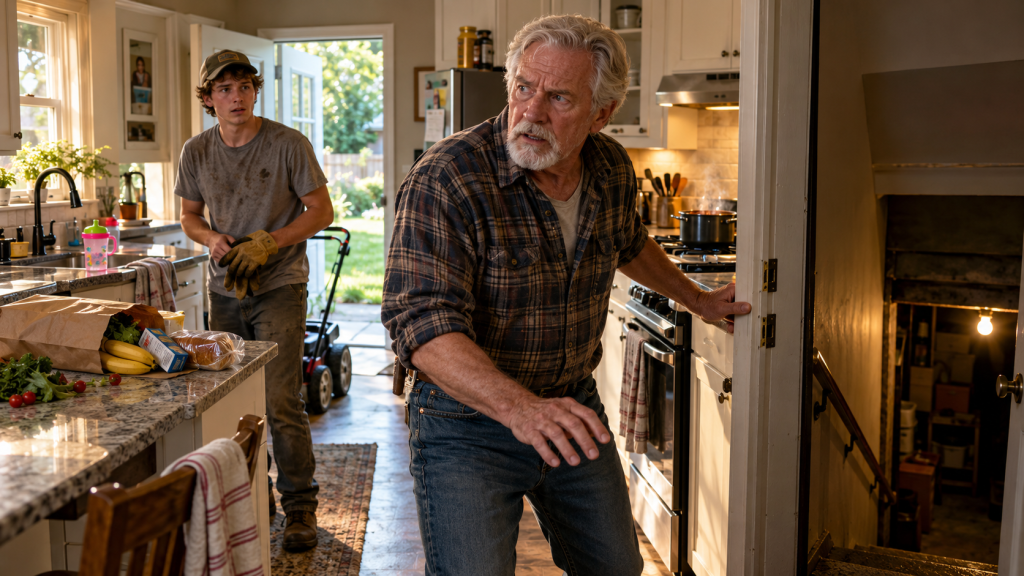
Not rushed. Not confused. He walked like a man who believed he belonged there. “Sarah?” His voice drifted down the basement stairs. Calm. Almost gentle. “I’m not angry.” Tyler looked at me. His face had gone completely pale. Mark continued.
“I know you’re scared.”
Sarah closed her eyes.
“He does that.”
“What?”
I whispered.
“He starts soft.”
A floorboard creaked overhead.
“I just want Noah.”
Sarah’s arms tightened around her son.
“He’s sick.”
Mark replied immediately.
“I know.”
Sarah’s eyes flew open.
I felt cold.
How could he know?
Noah had developed the fever only that morning.
Sarah had not told him.
Mark called again.
“I brought everything we need.”
My heart began pounding.
Sarah looked toward the basement ceiling.
Then at me.
“He shouldn’t know.”
Tyler quietly pulled his phone from his pocket.
I whispered:
“Call 911.”
He nodded.
He stepped behind the furnace and dialed without speaking.
A dispatcher answered.
Tyler kept his voice so low I could barely hear it.
“There’s a man inside a house who wasn’t invited. There’s a woman and a sick toddler hiding downstairs.”
The footsteps stopped directly above us.
Mark said:
“I can hear somebody talking.”
Nobody moved.
Then the basement door opened farther.
Light spilled down the stairs.
Mark appeared at the top.
He was wearing jeans and a gray quarter-zip shirt.
No weapon.
No mask.
Nothing dramatic.
That frightened me more.
He looked exactly like the man who had eaten Thanksgiving dinner at my table.
The man who once brought flowers to my wife when she was in the hospital.
The man who had held Noah five minutes after he was born.
“Tom.”
My name sounded almost disappointed in his mouth.
“What are you doing here?”
I stepped onto the first stair.
“What are you doing here?”
“This is between Sarah and me.”
“No.”
His expression hardened slightly.
“Tom.”
“No.”
“You don’t understand what’s happening.”
“I understand my daughter is hiding in her basement with your sick son while you’re walking through a house you no longer live in.”
His jaw tightened.
“I have every right to be concerned about my child.”
“Concern doesn’t explain why she’s hiding.”
Mark looked past me.
“Sarah.”
She did not answer.
He continued:
“You need to come upstairs before this gets worse.”
Sarah’s voice was quiet.
“It already got worse.”
Mark sighed.
“See?”
He looked at me.
“This is exactly what I’m talking about.”
“What are you talking about?”
“She’s not thinking rationally.”
Sarah flinched.
I felt something ugly move through my chest.
Three weeks earlier:
If a car keeps driving past your house slowly… would you think that was weird?
I had let her convince me it was nothing.
Now her ex-husband stood above us describing her fear as proof that she was unstable.
Mark continued.
“She was supposed to take Noah to Denver.”
“She didn’t.”
“She lied to everyone.”
“She shut herself in a basement.”
“That isn’t normal behavior.”
Sarah whispered:
“Show Dad the order.”
Mark went still.
I turned.
“What order?”
Sarah pointed toward the envelope on the floor.
“The one I found.”
I picked up the unsigned document.
Mark’s face changed.
Only slightly.
But enough.
“Where did you get that?”
Sarah laughed bitterly.
“Your truck.”
“You went through my truck?”
“You left Noah’s inhaler in the back seat.”
“I went to get it during exchange.”
“The folder was open.”
Mark came down one stair.
“Give me that.”
I held the papers behind me.
“Stay there.”
His expression hardened.
“Tom, you are interfering in a custody matter.”
Tyler whispered behind the furnace:
“Police are on the way.”
Mark heard him.
“Who’s that?”
Tyler stepped partially into view.
“The guy mowing the lawn.”
Mark stared at him.
“You’re inside?”
Tyler swallowed.
“Mr. Henderson invited me.”
“I did.”
Mark looked back at me.
“You have some stranger in Sarah’s basement with my son?”
I almost admired it.
Every fact entered his mouth and came back rearranged.
“You walked in after locking the door behind you.”
“I used my key.”
Sarah’s head snapped up.
“You don’t have a key.”
Mark’s expression flickered.
She stood slowly, Noah still in her arms.
“I changed the locks.”
“I returned every copy.”
Mark said nothing.
Sarah stared.
“How did you get in?”
“The back door was open.”
“It was shut.”
“Not latched.”
That part might have been true.
But Sarah’s face told me the question was larger.
“How did you know I was here?”
Mark looked toward her.
“You called me.”
“No.”
“You texted.”
“No.”
“Then I saw your car.”
“My car is at the airport.”
Silence.
The temperature in the basement seemed to drop.
Mark looked at me.
I looked at Sarah.
She whispered:
“I left it there on purpose.”
Then at Mark:
“How did you know?”
He rubbed his jaw.
“Sarah, this is ridiculous.”
“No.”
Her voice changed.
Stronger now.
“How did you know I was in this house?”
Mark took another step down.
I moved upward.
He stopped.
For several seconds, no one spoke.
Then Mark said:
“Your thermostat.”
Sarah stared.
“What?”
“You still use the same smart-home account.”
Her face emptied.
“No.”
“Yes.”
“I removed you from it.”
“You changed the password.”
I felt sick.
Mark continued:
“But you never removed the backup administrator account.”
Sarah’s mouth opened.
He had been watching the house digitally.
Not through a window.
Through the temperature.
Door sensors.
Movement history.
Maybe more.
She whispered:
“How long?”
Mark sighed.
“It wasn’t like that.”
“How long?”
“I checked occasionally.”
“How long?”
His voice sharpened.
“After you started keeping Noah from me.”
Sarah almost screamed.
“I followed the parenting schedule.”
“You manipulated the schedule.”
“The judge signed it.”
“You asked for it.”
“Because you kept showing up unannounced!”
Mark looked toward me.
“You see?”
There it was again.
Her fear becoming his evidence.
Her boundaries becoming irrationality.
Her response becoming the problem while the cause disappeared.
A siren sounded faintly in the distance.
Mark heard it.
His face changed.
“Did you call the police?”
Tyler said:
“Yes.”
Mark stared at him.
“Why?”
Tyler’s voice shook, but he answered.
“Because you locked the door behind you and there’s a woman downstairs telling you to leave.”
Mark laughed in disbelief.
“She is my ex-wife.”
“That doesn’t mean you own the house.”
I looked at Tyler.
Good kid.
Mark came down another step.
“Everybody needs to calm down.”
Sarah said:
“Then go upstairs and unlock the door.”
Mark stopped.
“Why?”
“Because I’m asking you to leave.”
“We need to talk.”
“No.”
“Sarah.”
“No.”
Something passed over his face.
Anger.
Quick.
Controlled.
But there.
“Stop doing this.”
Her voice trembled.
“Doing what?”
“Making everything impossible.”
“I am asking you to leave my house.”
“We have a child together.”
“That is not a key.”
The sirens grew louder.
Mark looked toward the basement window.
Then back at Sarah.
“Fine.”
He turned.
Walked upstairs.
For one terrible second, I thought he was leaving.
Then I heard cabinet doors opening.
Sarah looked at me.
“What is he doing?”
I started up.
“Dad, wait.”
I ignored her.
Mark was standing in the kitchen with his phone raised.
Recording.
He turned the camera toward me.
“Tom Henderson is in Sarah’s home interfering with a custody exchange.”
I stared.
“What custody exchange?”
He spoke to the phone, not me.
“Sarah was scheduled to travel out of state with our son despite my objection.”
I stepped closer.
“Turn that off.”
“No.”
Then he angled the phone toward the basement door.
“Sarah is currently hiding downstairs with Noah.”
He wanted a record.
Not of what happened.
Of the version he intended to show later.
The police arrived before he could continue.
Two officers entered through the back after Tyler unlocked it.
Mark immediately lowered his phone.
That told me more than anything.
The older officer looked around.
“Who called?”
Tyler raised his hand.
“I did.”
“Who lives here?”
Sarah came slowly up the stairs carrying Noah.
“I do.”
The officer looked at Mark.
“And you?”
“Mark Ellison.”
“I’m Noah’s father.”
“Do you live here?”
“No.”
“Were you invited inside?”
Mark hesitated.
“I have parental rights.”
The officer asked again.
“Were you invited inside?”
“No.”
Sarah’s voice came from behind me.
“He was not.”
The officer nodded.
“Do you want him here?”
“No.”
Mark cut in.
“This is a custody situation.”
“I have an emergency order pending.”
Sarah said:
“It’s unsigned.”
The officer looked at him.
“Do you have a signed court order changing custody?”
Mark’s jaw tightened.
“My attorney filed this morning.”
“That isn’t what I asked.”
“No.”
The officer looked at Sarah.
“What does the current order say?”
She pointed toward the envelope.
“It’s my parenting time until Monday morning.”
The officer checked.
The paperwork matched.
Mark spoke quickly.
“She was supposed to take him to Denver.”
The officer looked at Sarah.
“Were you legally prohibited from traveling?”
“No.”
Mark interrupted:
“The custody agreement requires notice.”
Sarah said:
“I gave notice.”
“That doesn’t mean I agreed.”
The officer looked at the order again.
“Does it require his agreement?”
Sarah’s voice was quiet.
“No.”
It didn’t.
Mark knew that.
The officer asked:
“Why didn’t you go?”
Sarah looked at Noah.
“Because I found those papers three days ago.”
“I became afraid Mark was building a false emergency case against me.”
“I parked my car at the airport so he’d think I left.”
“I came home through a rideshare.”
“I planned to stay out of sight until my lawyer could file a response.”
The officer glanced toward me.
“And you didn’t know?”
“No.”
Sarah looked at me.
“I’m sorry.”
I shook my head.
“Later.”
The officer turned to Mark.
“How did you know she was here?”
Mark exhaled.
“I checked the smart-home account.”
Sarah said:
“An account he was removed from.”
Mark snapped:
“I was not removed.”
“You used a backup admin profile I didn’t know existed.”
The second officer was already writing.
“Do you have access to cameras?”
Sarah went still.
Mark answered too quickly.
“No.”
The officer noticed.
“So only thermostat information?”
“Door sensors.”
“Temperature.”
“Basic system data.”
Sarah whispered:
“Motion sensors.”
Mark looked at her.
She stared.
“The hallway motion sensor.”
“You can see that too?”
No answer.
The officer said:
“Sir?”
Mark rubbed his forehead.
“Yes.”
My stomach turned.
He had known when she moved through the house.
When doors opened.
When the thermostat changed.
When someone entered.
Sarah looked like she might be sick.
“How long have you been monitoring my house?”
Mark’s voice softened.
“For Noah.”
She laughed.
One sharp sound.
“No.”
“Sarah—”
“For Noah?”
She was shaking.
“You drove past my house for weeks.”
Mark’s face changed.
“That wasn’t me.”
Sarah froze.
“What?”
“That wasn’t me.”
The charcoal pickup.
The slow car.
Someone else.
The officer asked:
“Who was it?”
Mark stayed silent.
Sarah’s eyes widened.
“Who?”
He finally said:
“A private investigator.”
I felt the room tilt.
“You hired someone to watch my daughter?”
Mark looked at me.
“It was legal surveillance from public roads.”
Sarah whispered:
“You had someone follow me?”
“I needed documentation.”
“For what?”
“That you were unstable.”
The words came out before he could stop them.
Nobody moved.
Not even Noah.
Mark closed his eyes.
The officer said:
“Sir, step outside.”
Mark opened them.
“I didn’t mean—”
“Outside.”
“This is being taken out of context.”
“Outside.”
Mark looked at Sarah.
She turned away.
That hurt him.
I saw it.
Good.
Not because I wanted pain for him.
Because for months Sarah’s fear had existed entirely inside her body.
Now, finally, some of the weight moved back toward the person who created it.
Mark walked outside.
The officer followed.
The second stayed with us.
Sarah sat at the kitchen table.
Noah whimpered.
Tyler brought her the sippy cup without being asked.
She whispered:
“Thank you.”
He nodded.
Then stood awkwardly near the door.
I looked at him.
“You should go home.”
He shook his head.
“Not until they say it’s okay.”
Twenty-one years old.
Still grass clippings on his shoes.
More sense than many adults I had known.
The second officer asked Sarah about the grocery bag.
She explained.
She had taken a rideshare back from the airport after leaving her car there.
She entered through the side gate.
She stayed inside with the blinds closed.
Around noon, Noah developed a fever.
She ordered groceries through an app but changed the delivery instructions at the last second because she was afraid a driver approaching the porch would attract attention.
She met the driver near the back alley.
That explained the bag.
She had carried most of it inside.
One bag broke.
The crackers and receipt fell out.
She had been too anxious to retrieve them.
Then:
“Why the basement?”
the officer asked.
Sarah looked embarrassed.
“Because the smart-home motion sensors didn’t reach all the way down there.”
Mark had once installed them upstairs.
She knew the basement remained mostly analog.
She thought she had found the one part of her home he could not see.
She was wrong only because Noah cried loudly enough for Tyler to hear.
The officer looked toward the basement.
“You were planning to stay down there how long?”
“Until my attorney called.”
“When was that supposed to happen?”
“Three.”
I looked at the clock.
2:41.
Fifteen more minutes.
If Tyler had not heard the crying, I might never have known.
Mark would still have arrived.
Sarah would still have been trapped downstairs.
Only without me.
Only without Tyler.
Only without the police already coming.
I thought about that too much for years.
At 2:58, Sarah’s attorney called.
Her name was Elaine Brooks.
Sarah put her on speaker after asking permission.
Elaine’s first question:
“Are you safe?”
Sarah looked at the officers.
“For the moment.”
“What happened?”
The story took six minutes.
Then silence.
Finally, Elaine said:
“Sarah, listen carefully.”
“I checked the court docket twenty minutes ago.”
“Mark’s attorney filed an emergency motion this morning.”
Sarah’s face drained.
“So it’s real?”
“The motion is real.”
“The order is not.”
“No judge has signed anything.”
“What does the motion say?”
Elaine hesitated.
“Among other things, that you may have removed Noah from the state without proper notice, that you have exhibited increasingly paranoid behavior, and that you may be concealing the child’s whereabouts.”
Sarah closed her eyes.
I felt rage rise in me.
Elaine continued.
“His attorney attached photographs.”
“What photographs?”
“Your house.”
“Your vehicle.”
“Your father’s house.”
“Daycare.”
Exactly what had been in Mark’s folder.
Sarah whispered:
“So he already filed them.”
“Yes.”
“But there’s something else.”
“What?”
“Mark’s attorney emailed me after filing.”
“Why?”
“Because she became concerned after reviewing additional material he delivered this morning.”
Sarah opened her eyes.
“What material?”
“A purported text message.”
“From you.”
Sarah frowned.
“What text?”
Elaine read:
If I have to disappear with Noah to keep him safe, I will.
Sarah stared.
“I never sent that.”
“I know.”
“How?”
“Because the screenshot has an incorrect phone interface.”
Sarah blinked.
Elaine continued:
“The message is shown as an iPhone exchange.”
“You’ve had an Android for four years.”
Even the officer looked up.
Sarah whispered:
“Oh my God.”
Elaine said:
“Mark’s attorney noticed after filing.”
“She has not accused him of fabrication.”
“But she told me she intends to notify the court that authenticity is disputed.”
The room went silent.
A fake text.
A draft emergency order.
Private surveillance.
Smart-home monitoring.
A hidden parenting narrative built out of real fear and manufactured evidence.
Sarah’s hands began shaking.
“No.”
I moved beside her.
“No.”
She whispered:
“He wanted me to look crazy.”
Elaine said:
“He wanted evidence supporting his position.”
Sarah laughed bitterly.
“That’s a lawyer answer.”
“It is.”
Then Elaine’s voice softened.
“And this is the human answer: do not be alone with him tonight.”
The officers arranged for Mark to leave the property.
Not arrested.
Not dragged away.
He had entered through an incompletely latched back door and claimed he believed he had a right to check on Noah.
The legal question was messy.
The officers documented everything.
More importantly, they told Mark clearly:
Sarah wanted him gone.
He had no permission to reenter.
Future exchanges would occur elsewhere until the court ruled.
Mark stood at the curb.
Before leaving, he looked toward the window where Sarah held Noah.
He raised one hand.
She did not wave.
The charcoal pickup appeared twenty minutes later.
Not Mark.
A man in his forties stepped out.
Baseball cap.
Gray T-shirt.
He approached one of the officers and handed him a card.
Private investigator.
Evan Cole.
Sarah froze.
“That’s him.”
“The truck?”
“Yes.”
Evan looked uncomfortable.
“I heard there was police activity.”
The officer asked:
“Why are you here?”
“I’ve been retained to document custody-related activity.”
“By Mark Ellison?”
“Yes.”
Sarah stepped outside.
I followed.
“You’ve been following my daughter?”
Evan looked at me.
“From public areas.”
“For how long?”
“Approximately five weeks.”
Sarah’s face went white.
“Were you driving past my house at night?”
“Yes.”
“Slowly?”
“Sometimes.”
“You saw me notice?”
He hesitated.
“Yes.”
“Why keep doing it?”
“I was hired to document entries, departures, overnight visitors, and potential travel.”
Sarah stared.
“I thought I was losing my mind.”
Evan’s expression changed.
Not guilt exactly.
Discomfort.
“My job was surveillance.”
“Not harassment.”
“It became harassment when I started changing my behavior because of you.”
Evan had no answer.
Then he said:
“I think you should speak with your attorney about something.”
Mark had made a mistake.
Another one.
He had hired a licensed investigator.
Licensed investigators keep records.
Invoices.
Instructions.
Messages.
Dates.
That would matter later.
The emergency custody hearing occurred the next morning.
Sarah wore the same navy blouse she had worn to her divorce mediation.
Not because it had special power.
Because everything else felt wrong.
Noah’s fever had broken overnight.
Tyler’s call had prevented the situation from becoming worse.
I drove Sarah to court.
Before we went inside, she sat in the passenger seat with both hands wrapped around a paper coffee cup.
“Dad.”
“Yes?”
“If the judge believes him…”
I looked at her.
“No.”
“What?”
“We are not finishing that sentence in the parking lot.”
She almost smiled.
“I’m serious.”
“So am I.”
I pointed toward the courthouse.
“You tell the truth.”
“Elaine presents the records.”
“The judge decides.”
Sarah swallowed.
“I’m scared.”
“I know.”
Then I said something I wish I had said three weeks earlier when she asked about the slow-moving car.
“I believe you.”
She cried.
Quietly.
Then wiped her face.
“Okay.”
The hearing lasted almost two hours.
It felt like two days.
Mark sat across the courtroom with his attorney, Dana Reeves.
She looked furious.
Not at Sarah.
At her own client.
That was the first surprise.
Dana addressed the judge before Elaine did.
“Your Honor, before proceeding, I need to clarify that one exhibit attached to our emergency filing has become materially disputed.”
The judge looked over his glasses.
“Which exhibit?”
“The screenshot labeled Exhibit F.”
“The alleged text from Ms. Henderson concerning disappearance with the minor child.”
“Yes.”
“And you are withdrawing it?”
“Yes.”
“Why?”
Dana hesitated.
“Because I cannot presently authenticate it.”
The judge looked toward Mark.
His face was expressionless.
“What was represented to you when you filed it?”
“That it was a screenshot captured from Mr. Ellison’s device.”
“And now?”
“I have concerns.”
The judge did not look pleased.
Elaine then introduced Sarah’s actual device records.
No such message.
Carrier data showed no text matching it.
The timestamps did not align.
The display format was wrong.
Not absolute proof Mark created it himself.
But enough that the judge refused to consider it.
Then came the photographs.
Daycare.
My driveway.
Sarah’s house.
Private investigator.
Legal?
Mostly.
Wise?
Different question.
Then Elaine introduced the police incident report from the previous afternoon.
Mark’s access to Sarah’s smart-home backup account.
His knowledge of movement inside her home.
His arrival after Sarah had intentionally left her vehicle at the airport.
His statement that he wanted evidence she was unstable.
Dana objected to characterization.
The judge allowed the officer’s documented words but not Elaine’s interpretation.
Fair.
Then Mark testified.
At first, he was excellent.
Calm.
Concerned.
Reasonable.
He said Sarah’s behavior had changed.
She checked locks repeatedly.
Closed blinds.
Asked neighbors about cars.
Changed routines.
Spoke about “being watched.”
He claimed those behaviors caused legitimate concern.
Listening to him almost made me question what I knew.
That was the frightening part.
Everything he said contained pieces of truth.
Sarah had checked locks.
Because someone was following her.
She had closed blinds.
Because someone was watching.
She had asked about slow cars.
Because Mark had hired one.
He had taken the effect and erased the cause.
Elaine stood.
“Mr. Ellison, did you hire Evan Cole to surveil Ms. Henderson?”
“Yes.”
“For five weeks?”
“Yes.”
“Did you instruct him to drive past her residence?”
“I instructed him to document activity.”
“Did you receive daily reports?”
“Yes.”
“Did you know she had noticed the vehicle?”
Mark hesitated.
“Yes.”
“Did you tell the investigator to discontinue nighttime passes after learning she was frightened?”
“No.”
“Why not?”
“I needed accurate information.”
Elaine nodded.
“Did you retain access to her smart-home system after divorce?”
“I retained backup administrator access.”
“Did Ms. Henderson know?”
“I don’t know.”
“Did you ask?”
“No.”
“Did you use that access to determine whether she was inside the home yesterday?”
“Yes.”
“Did you enter after she had changed the locks?”
“The door was unsecured.”
“Did she invite you?”
“No.”
“Did she ask you to leave?”
“Yes.”
“Did you leave immediately?”
“No.”
The room felt smaller with every answer.
Then Elaine asked:
“Did you tell your private investigator that you needed one incident showing Ms. Henderson was dangerous or irrational?”
Dana stood.
“Objection.”
Elaine held up a printed message.
“Foundation available through investigator records.”
The judge allowed her to proceed carefully.
Evan Cole had turned over his engagement communications after receiving a subpoena request and legal advice.
One message from Mark read:
I don’t need months of this. I need one clean incident that shows she is unstable enough to justify emergency custody.
Mark said:
“That means I needed documentation.”
Elaine replied:
“I’m sure your attorney will argue context.”
Then another:
If she reacts to the truck, document it. Don’t engage. The more paranoid she looks, the better.
Sarah closed her eyes.
I felt physically ill.
Mark’s attorney did too.
Dana leaned toward him and whispered something sharp.
The judge read the message twice.
Then asked:
“Mr. Ellison, did you understand that the presence of the investigator’s truck was contributing to the behavior you intended to use as evidence?”
Mark answered:
“I understood she had noticed surveillance.”
“That was not my question.”
Silence.
The judge repeated it.
Mark finally said:
“Yes.”
There it was.
The central truth.
He had created pressure.
Then documented her response to it.
Not every part illegal.
But deeply relevant to custody.
Then came the unsigned emergency order.
Elaine asked:
“Who prepared this?”
Mark said:
“It came from legal forms.”
Dana stood immediately.
“My office did not prepare that document.”
Everyone looked at her.
Mark’s face changed.
The judge asked:
“You are representing to the court that this proposed order was not drafted by your office?”
“Yes, Your Honor.”
Mark had downloaded a standard proposed-order template.
Filled it himself.
Placed his own desired findings into it.
Not illegal by itself.
Litigants prepare draft orders all the time.
The problem was what he had told Sarah.
He had allowed her to believe it was already on its way to becoming enforceable.
And inside the draft was language claiming she had “demonstrated acute instability.”
No doctor.
No evaluation.
No diagnosis.
Just words.
The judge did not terminate Mark’s parental rights.
Good.
That would have been absurd.
He did not declare him a monster.
Good.
Courts are not movie theaters.
He did something more practical.
He denied Mark’s emergency request.
He ordered the existing parenting arrangement temporarily modified pending full review.
No exchanges at Sarah’s home.
All communication through a parenting application.
No surveillance of Sarah except through lawful discovery or agreed third-party channels.
Mark was ordered to relinquish all access to smart-home accounts, shared devices, cloud backups, and property credentials belonging solely to Sarah.
A neutral custody evaluator would review the situation.
Noah’s time with Mark continued, but for the next six weeks exchanges were supervised at a family-services center because of the escalating conflict.
The judge said:
“This is not a final finding of parental unfitness.”
“Both parents need to understand that.”
“But manufacturing or amplifying conflict to create evidence is contrary to the child’s best interests.”
Mark looked down.
Sarah cried silently.
Not victory.
Relief.
After court, Dana Reeves approached Elaine privately.
Then asked if she could speak to Sarah.
Sarah looked at Elaine.
Elaine nodded.
Dana said:
“I cannot discuss privileged communications.”
“Understood.”
“But I can tell you that I withdrew from representing Mr. Ellison this morning.”
Sarah stared.
“Why?”
Dana answered carefully.
“Because my professional obligations required it.”
Enough.
She handed Elaine a formal notice.
Then walked away.
Mark stood across the courthouse steps alone.
For one second, Sarah looked toward him.
He looked back.
There was no hatred in her face.
That surprised me.
Only exhaustion.
He took one step toward her.
Elaine moved slightly.
Mark stopped.
Then said:
“I never wanted to hurt Noah.”
Sarah’s voice was quiet.
“Then stop using me as the battlefield.”
He looked as though she had struck him.
She got into my truck.
We drove home.
The basement mattress remained behind the furnace for three days.
Sarah could not make herself touch it.
Finally, I carried it upstairs.
Noah climbed on it immediately and bounced.
Sarah laughed.
Then cried.
Children have a way of converting trauma back into furniture.
We threw it away.
The next discovery came from a cybersecurity specialist Elaine recommended.
Mark had not installed secret cameras.
Thank God.
But he had retained access to more than the thermostat.
Door openings.
Motion events.
Alarm state changes.
Garage status.
Historical occupancy patterns.
A digital map of whether the house seemed active.
Sarah sat at the table while the specialist explained.
“Your ex had an administrator account created when the system was installed.”
“During the marriage.”
“Yes.”
“It was tied to a secondary email.”
“His?”
“Yes.”
“When you changed your main password, his administrative credentials remained active.”
Sarah rubbed both hands over her face.
“I thought I changed everything.”
“You changed what you knew existed.”
That sentence stayed with her.
The specialist removed the account.
Reset the system.
Replaced credentials.
Disabled legacy integrations.
Checked cameras.
Checked router logs.
No spyware found on Sarah’s phone.
No hidden microphones.
No cinematic nightmare.
Just ordinary technology left connected too long.
That was frightening enough.
The charcoal pickup had a simpler explanation too.
Evan Cole.
Licensed investigator.
He had followed Sarah to daycare.
The grocery store.
My house.
The pediatrician.
He had photographed her talking to a male coworker outside a coffee shop.
Mark later described the man in his custody notes as “an unidentified male frequently meeting Sarah privately.”
The truth?
He was Sarah’s seventy-two-year-old department supervisor, married for forty-eight years.
“Frequently” meant twice.
This was how narratives were built.
Not always through pure invention.
Sometimes through cropping.
Angle.
Selection.
Words.
At the full custody review eight weeks later, the evaluator’s report was not kind to either parent.
That surprised Sarah.
It surprised me less.
The evaluator criticized Mark’s surveillance, his escalation, his disputed evidence, and his attempt to interpret Sarah’s fear responses as proof of pathology without acknowledging his own role.
But the report also criticized Sarah.
For lying to family about the Denver trip.
For hiding with Noah instead of immediately contacting counsel or law enforcement.
For allowing fear to drive an improvised plan that increased risk.
Sarah cried when she read that section.
“I was trying to protect him.”
Elaine said:
“I know.”
“The evaluator can believe that and still think the plan was unsafe.”
Both can be true.
That became a theme.
Mark’s conduct could be wrong.
Sarah’s response could still be imperfect.
You do not need saints to identify harm.
At the final hearing, the judge kept joint legal custody but adjusted parenting time.
Sarah remained primary residential parent.
Mark received structured parenting time.
Both attended co-parenting counseling separately at first.
Use of private investigators to monitor the other parent was prohibited absent court authorization or specific legal necessity.
The parenting app became mandatory.
Most importantly, Noah was removed from the center of information exchange.
No messages through him.
No questions about Mommy.
No questions about Daddy.
No using a two-year-old as a courier.
Mark hated the order initially.
Then something happened nobody expected.
He complied.
Not beautifully.
Not immediately.
But enough.
The first month, his messages through the app were stiff.
Noah has mild cough. Temperature 99.1. Medicine at 7:00 p.m.
Sarah replied:
Received. Thank you.
No accusation.
No history.
No hidden meaning.
Boring.
Beautiful.
The private investigator disappeared from her street.
The slow truck stopped.
The blinds opened again.
Not all at once.
The first evening Sarah left them open until sunset, she called me.
“Dad.”
“Yes?”
“I feel stupid.”
“Why?”
“Because I’m sitting here proud of myself for not closing curtains.”
“That isn’t stupid.”
“It’s curtains.”
“No.”
“It’s nervous-system paperwork.”
She laughed.
“That is not a phrase.”
“It is now.”
Noah’s fever that day turned out to be a routine virus.
Nothing serious.
The child whose cry exposed everything was fine within forty-eight hours.
Tyler came back the following Saturday to finish mowing.
He tried to refuse payment.
I refused his refusal.
He stood in the driveway holding the envelope.
“This is too much.”
“It includes hazard pay.”
He laughed.
“I didn’t do anything.”
“You heard something.”
“That’s all.”
“That was enough.”
He looked toward the house.
Sarah came outside carrying lemonade.
Noah toddled behind her.
When he saw Tyler, he pointed and said:
“Mow!”
Tyler laughed.
“Yeah, buddy.”
Sarah handed Tyler the glass.
“Thank you.”
He looked embarrassed.
“Anybody would’ve called.”
“No.”
Sarah shook her head.
“Not everybody stops the mower.”
That became the sentence we remembered about Tyler.
He stopped the mower.
Simple.
Sometimes heroism is not charging into a burning building.
Sometimes it is turning off a loud machine because a faint sound underneath it does not feel right.
Tyler was studying nursing.
Two years later, he became an emergency-room nurse.
When he graduated, Sarah and I went.
He pretended not to cry.
Terrible liar.
Mark’s reckoning came more slowly.
Three months after the final hearing, he asked through the parenting app for permission to discuss “non-parenting matters.”
Sarah showed Elaine.
Elaine said:
“You don’t have to.”
Sarah said:
“I know.”
Then agreed to one mediated conversation.
Not alone.
Not at home.
A family therapist’s office.
I was not there.
Sarah told me afterward.
Mark began with:
“I thought you were going to take Noah away.”
Sarah said:
“I wasn’t.”
“I know that now.”
“No.”
She looked at him.
“You knew it then.”
He did not answer.
Sarah continued:
“You knew the parenting order allowed the Denver trip.”
“Yes.”
“You knew I had given notice.”
“Yes.”
“You knew I had never missed an exchange.”
“Yes.”
“Then what were you afraid of?”
Mark stared at the floor.
Finally:
“That you didn’t need me anymore.”
Sarah had expected anger.
Instead, pity almost destroyed her.
Not because his answer excused anything.
Because it explained too much.
The divorce.
The custody fight.
The surveillance.
The need to document her weakness.
If she looked unstable, he looked necessary.
If she looked dangerous, he looked protective.
If she looked likely to disappear, he looked like the parent trying to preserve family.
He had built a role for himself by making her the threat.
Mark said:
“I kept thinking if the court reduced my time, Noah would grow up thinking I left.”
Sarah whispered:
“So you made me look like I was leaving.”
He cried.
“Yes.”
That was not enough.
But it was honest.
He continued:
“The investigator was supposed to prove something.”
“What?”
“That you were violating the order.”
“Were I?”
“No.”
“So you kept him watching.”
“Yes.”
“Why?”
“Because I had already spent money.”
Sarah almost laughed.
Human stupidity rarely sounds grand when finally explained.
Momentum.
Pride.
Fear.
Sunk cost.
Mark continued:
“Then you noticed the truck.”
“I should have stopped.”
“I didn’t.”
“I started thinking your reaction proved you were unstable.”
Sarah stared at him.
“You frightened me.”
“Yes.”
“And then used my fear against me.”
“Yes.”
That word mattered.
No explanation after.
Just yes.
Then she asked about the fake text.
Mark went quiet for a long time.
Finally:
“I made it.”
Sarah closed her eyes.
There it was.
No ambiguity.
No bad screenshot from someone else.
He had typed it into a mock-message generator he found online.
He told his attorney it came from an old phone.
He believed she would never check closely.
“Why?”
Sarah asked.
Mark covered his face.
“Because I thought the judge needed something stronger.”
“You mean true evidence wasn’t enough.”
“There wasn’t true evidence.”
Silence.
That sentence ended the fantasy.
He had not exaggerated because reality was ambiguous.
He fabricated because reality did not support what he wanted.
Sarah stood.
The therapist asked:
“Do you want to continue?”
“No.”
Mark looked up.
“Sarah.”
She shook her head.
“No.”
For once, he did not argue.
She left.
Later, Mark’s admission was conveyed through attorneys.
It had consequences.
Not a dramatic prison sentence.
Not handcuffs at work.
His former attorney documented that she had withdrawn the disputed exhibit and representation.
The court sanctioned him financially for portions of the bad-faith litigation.
He paid part of Sarah’s attorney fees.
The custody evaluator amended the file.
The judge warned that future dishonesty would weigh heavily in any modification.
Mark also lost his private investigator.
Evan terminated the client relationship and documented that he had not been told any evidence would be fabricated.
No one went to jail.
Life became more expensive.
More supervised.
More honest.
Sometimes consequences look like that.
Sarah asked me once:
“Are you disappointed there wasn’t some huge punishment?”
I thought about it.
“No.”
“Why?”
“Because Noah still needs a father.”
She nodded.
“That’s how I feel.”
Then:
“I need him to be better, not destroyed.”
That was Sarah.
Even after everything.
But being compassionate did not mean becoming available again.
Mark never received a key to her house.
Never regained access to devices.
Never came inside for birthdays.
Exchanges happened outside or at agreed places.
For years.
Boundaries can be permanent even when anger is not.
I struggled with my own guilt.
A lot.
The slow truck.
Her Sunday-dinner question.
Her anxiety.
The locks.
I had seen pieces.
I had accepted “probably nothing.”
One night, I told Sarah:
“I should have pushed harder.”
She looked at me.
“No.”
“I’m your father.”
“I was seventy-one.”
“You were forty.”
“I should have known.”
“Dad.”
She reached across the table.
“I didn’t want you to know.”
“That doesn’t matter.”
“It does.”
“I spent six months making everything look normal.”
She smiled sadly.
“I was good at it.”
I still blamed myself.
For a while.
Then Sarah said something her therapist had told her.
“Responsibility follows control.”
I frowned.
“What does that mean?”
“You can be sad you didn’t know.”
“You can wish you had done something differently.”
“But you are not responsible for information I worked to hide.”
I looked at her.
“That sounds annoyingly healthy.”
“It is.”
“I hate therapy.”
“You recommended it.”
“I make mistakes.”
We laughed.
The Denver story had another piece I did not learn until months later.
Sarah had genuinely planned to go.
Conference reservation.
Hotel.
Flight.
Noah’s travel bag.
Everything.
The night before departure, she found a small magnetic tracker taped beneath the rear bumper of her car.
Not an AirTag.
A commercially available GPS tracker.
She photographed it.
Called Elaine.
Elaine told her not to destroy it.
The next morning, Sarah drove to the airport as planned.
Called me from the terminal.
That part was real.
Then, instead of boarding, she left through another exit, took a rideshare home, and left her tracked car in long-term parking.
Why?
She wanted to confirm whether Mark was relying on the tracker.
If he believed she flew, maybe surveillance would stop long enough for her to organize evidence.
Risky.
Yes.
But human.
The tracker was later traced to an account paid through Mark’s business card.
He claimed the investigator installed it.
Evan denied it.
Records showed Mark purchased the device himself.
That became another issue in court.
Again, not dramatic criminal prosecution.
Local law about vehicle tracking between former spouses was complicated.
But in family court?
It mattered.
Sarah had not imagined the feeling of being followed.
Her body knew before she had proof.
That discovery changed how I thought about fear.
For most of my life, I believed fear should be treated like a witness.
Questioned.
Tested.
Not trusted blindly.
I still believe that.
But I learned something else.
Sometimes fear notices patterns before language does.
A car twice.
A door slightly wrong.
A login notification.
A question that arrives at the wrong time.
One event means nothing.
Ten events become a shape.
Sarah had been living inside that shape.
By the time I saw it, she was hiding behind a furnace.
Three years later, Sarah sold the house.
Not because Mark forced her out.
Not because she hated it.
Because she wanted a new place without old systems.
A smaller house.
One story.
Big windows.
No basement.
When she told me, I said:
“No basement?”
“Absolutely not.”
Noah, now five, complained.
“Basements are cool.”
Sarah said:
“You can have one when you’re thirty.”
He crossed his arms.
“I’ll be old.”
I laughed for five minutes.
Mark helped Noah move one box into the new house.
Only one.
Sarah invited him to step inside the entryway.
He stopped at the threshold.
“Is it okay?”
“Yes.”
He entered.
That mattered too.
Years earlier, he had entered because he believed fatherhood gave him access.
Now he asked.
Small sentence.
Big difference.
He put down the box.
Looked around.
“Nice place.”
“Thanks.”
Then left.
No tour.
No lingering.
No argument.
Sarah called me afterward.
“You’re not going to believe this.”
“What?”
“He asked permission.”
I smiled.
“I believe it.”
Mark improved.
Not perfectly.
People always want transformation to be clean.
It wasn’t.
He missed a pickup once.
Blamed traffic.
Forgot Noah’s antibiotic at another exchange.
Sent one rude message through the parenting app.
Then apologized without being prompted.
Progress can be disappointing if you expect miracles.
It looks like fewer bad choices.
Faster corrections.
Less damage.
Noah grew.
At seven, he had no memory of the basement.
Thank God.
He knew his parents lived separately.
He knew Mom checked doors more than most people.
He knew Dad sometimes got quiet when legal dramas appeared on television.
He did not know the details.
Not yet.
Sarah and Mark agreed, with therapists, that he would learn age-appropriate truth later.
No child needs to carry adult evidence before they can understand it.
When Noah was twelve, he asked:
“Why did you and Dad fight so much when I was little?”
Sarah answered:
“Because we were both scared and your dad made some choices that crossed serious boundaries.”
She did not call Mark dangerous.
Did not call herself blameless.
Did not hand Noah court filings.
He asked Mark separately.
Mark said:
“I was afraid your mom would take you away.”
“So I watched her when I shouldn’t have.”
“I lied about something important.”
“And I made things worse.”
Noah asked:
“Did Mom do bad stuff too?”
Mark answered:
“She made mistakes.”
“But the lie was mine.”
That was one of the best things Mark ever did as a father.
He did not make his son divide responsibility equally to protect adult comfort.
At fifteen, Noah learned more.
Not everything.
Enough.
He asked me:
“Grandpa, were you really the one who found Mom?”
“No.”
“Tyler did.”
“The lawn guy?”
“Yes.”
He laughed.
“Mom says he saved her.”
“He heard you crying.”
Noah looked embarrassed.
“I was two.”
“I know.”
“So technically I saved everyone.”
I stared at him.
Teenagers.
“Sure.”
He grinned.
“Put it in the history book.”
Tyler remained loosely connected to us.
Christmas cards.
Occasional texts.
When his first child was born, he sent Sarah a photograph.
She replied:
If you ever hear crying under a house, call someone else this time.
He answered:
Deal.
We laughed.
I grew older.
Sarah grew stronger.
Mark grew quieter.
Noah grew tall enough that I had to look up at him.
Life did what life does.
It moved beyond the day that once felt like the only day we would ever talk about.
But every now and then, something brought it back.
A mower stopping outside.
A charcoal pickup.
The smell of chicken broth.
A basement door cracked open.
One winter afternoon, Sarah and I sat at her new kitchen table.
She asked:
“Do you remember what I said on the phone that morning?”
“What?”
“Before I pretended to leave.”
I thought.
“You thanked me for checking the house.”
She nodded.
“And?”
“You said you loved me.”
Her eyes filled.
“That part was true.”
I looked at her.
“I know.”
She cried.
So did I.
Because that was what trauma sometimes does.
It makes people revisit ordinary sentences years later just to rescue the honest parts from everything that followed.
The airport announcement was real.
Her exhaustion was real.
Her love was real.
The trip was the lie.
Not the whole conversation.
At seventy-nine, I finally stopped replaying the charcoal truck leaving the neighborhood.
For years, I imagined pulling out behind it.
Following.
Writing down the plate.
Calling Sarah.
Calling police.
Becoming the father who saw everything before danger grew.
But I was not that father.
I was the father who noticed a truck and kept driving.
Then answered the phone when Tyler called.
That had to be enough.
Not because missing the sign did not matter.
Because regret becomes useless when it demands a different past instead of better attention in the present.
So I became better at asking twice.
When Sarah said:
“I’m fine.”
I sometimes asked:
“Fine, or safe?”
She laughed the first time.
Then answered.
“Both.”
Good.
When Noah became a teenager and said:
“Nothing’s wrong.”
I did not interrogate.
I said:
“If nothing becomes something, call me.”
He did.
Once.
At midnight.
Car trouble.
Nothing dramatic.
Beautiful.
Mark remarried when Noah was seventeen.
A woman named Claire.
Before their wedding, he asked Sarah for one thing.
Not forgiveness.
Not approval.
“Would you be comfortable if Claire had access to Noah’s school emergency contact information?”
Sarah said:
“Yes.”
Then Mark added:
“She won’t get any home-system access.”
Sarah laughed.
Actually laughed.
So did Mark.
Some scars become jokes only after they stop being weapons.
At the wedding, Noah gave a short speech.
He said:
“My dad taught me something the hard way.”
Mark visibly panicked.
Everyone laughed.
Noah continued:
“If you love somebody, don’t make them prove they’re safe by giving you all their privacy.”
The room went quiet.
Then Mark nodded.
Noah smiled.
“And also always update your passwords.”
Laughter.
Mark cried.
So did Sarah.
I watched from a back table and thought:
There it is.
Not redemption.
Not erasure.
Integration.
The story had become something the family could hold without letting it define every relationship.
Sarah never married again.
Not because Mark ruined love.
Because she liked her life.
People kept asking.
She kept declining to treat singleness as a diagnosis.
At fifty-six, she bought a kayak.
At fifty-eight, she took a cooking class.
At sixty, she went to Denver.
Finally.
She sent me a photograph from the airport.
Actually boarding this time.
I replied:
Call when you land.
She sent:
I promise.
The exact words from that Thursday morning.
This time, the promise was simple.
No tracker.
No basement.
No watcher.
No custody file.
Just a daughter traveling.
A father waiting for a call.
She called.
We talked for twelve minutes about airport coffee.
It may have been the happiest boring conversation of my life.
The old house was sold to a young couple with twins.
Sarah never told them about the basement.
Why would she?
Houses hold all kinds of stories.
The new family painted it.
Removed the furnace.
Finished the basement.
Turned the corner where Sarah once hid into a playroom.
When she saw the listing years later, she stared at the photographs.
Bright carpet.
Toy shelves.
A yellow beanbag chair.
She sent me the link.
Look.
I called her.
“How do you feel?”
She thought.
“Good.”
Then:
“Strange.”
Then:
“Mostly good.”
That was enough.
The place where fear had gathered was now somewhere children built block towers.
Life had no obligation to preserve our meanings forever.
I liked that.
Mark died before Sarah.
Not young.
Years later.
Heart disease.
No dramatic final confession.
No secret folder.
No last twist.
Noah was with him.
Claire was with him.
Sarah went to the funeral because Noah asked.
She stood near the back.
Afterward, Noah said:
“Mom, did you forgive Dad?”
Sarah looked at him.
“Yes.”
“When?”
She smiled sadly.
“In pieces.”
That may be the truest thing anyone in our family ever said.
Forgiveness in pieces.
Trust in pieces.
Safety in pieces.
Memory in pieces.
Not one grand moment.
Not one courtroom.
Not one apology.
Not one siren.
Pieces.
The last time I saw Tyler, he was forty-six.
He came to my ninetieth birthday because Sarah found him online.
He walked in carrying a toy lawn mower.
I laughed so hard I nearly choked.
“You’re terrible.”
He grinned.
“You paid me hazard pay.”
Sarah hugged him.
Noah, now grown, shook his hand.
“So you’re the guy.”
Tyler looked at him.
“You’re the crying basement kid?”
Noah groaned.
“Please never call me that again.”
Everyone laughed.
Then Tyler became serious.
“I’m glad you’re okay.”
Noah nodded.
“Me too.”
Later, I asked Tyler:
“Why did you stop the mower?”
He shrugged.
“I heard something.”
“No.”
“Why didn’t you assume it was nothing?”
He thought.
Then said:
“My mom always told me if something sounds wrong, get quiet before you decide.”
I smiled.
“Smart woman.”
“Yeah.”
He looked toward Sarah.
“Sometimes noise makes you miss the small stuff.”
That line stayed with me.
Because the whole story began with noise.
Mower engine.
Airport announcements.
Custody arguments.
Court filings.
Accusations.
Fear.
Mark had built noise around Sarah.
He needed everyone to hear “unstable.”
“Paranoid.”
“Flight risk.”
“Dangerous.”
And beneath all that noise was a simpler truth.
A woman was scared because someone was watching her.
A child was sick.
A door was locked.
A young man turned off a mower.
And in the quiet, we finally heard what mattered.
If Tyler had kept mowing, maybe the day would still have ended safely.
Maybe Sarah’s attorney would have called at three.
Maybe Mark would have left.
Maybe police would have arrived later.
Maybe.
I stopped building my life around maybes.
The mower stopped.
The cry was heard.
I answered the phone.
We went.
That is what happened.
And sometimes what actually happened is enough.
Years after Sarah sold the house, she gave me the ceramic turtle that had hidden the spare key.
I stared at it.
“Why do I want this?”
“You don’t.”
“Then take it back.”
“No.”
She put it on my porch.
“You love ugly yard decorations.”
“I do not.”
“You have three plastic geese.”
“Those are seasonal.”
She laughed.
The turtle stayed.
Underneath it?
Nothing.
No spare key.
No secret.
No emergency.
Just concrete.
Exactly how I liked it.
When people hear our story, they usually ask about the basement.
What was under the house?
Who was crying?
Was Mark dangerous?
Was Sarah really leaving?
Those are fair questions.
But they are not the question that stayed with me.
The question I carried was simpler.
How many times do we hear something small and decide not to stop the mower?
A strange sentence.
A changed routine.
A friend who laughs too quickly.
A daughter who asks whether a slow car seems weird.
You cannot live in permanent suspicion.
You should not turn every odd detail into catastrophe.
But attention costs less than regret.
Ask.
Listen.
Then listen again.
Sarah once thought locking every door would make her safe.
Mark once thought collecting enough evidence would make him right.
I once thought being a good father meant trusting my adult daughter when she said everything was fine.
All of us learned a more complicated truth.
Safety is not control.
Trust is not blindness.
Love is not access.
And listening is not the same as believing every fear.
Sometimes listening simply means turning off the noise long enough to hear whether someone underneath it is asking for help.
That Thursday afternoon, the sound was Noah.
Weak.
Tired.
Almost swallowed by walls.
But we heard him.
And once we did, nothing stayed hidden for very long.
THE END STORIES! THANK YOU FOR READING GOOD LUCK! ❤️
Related Posts