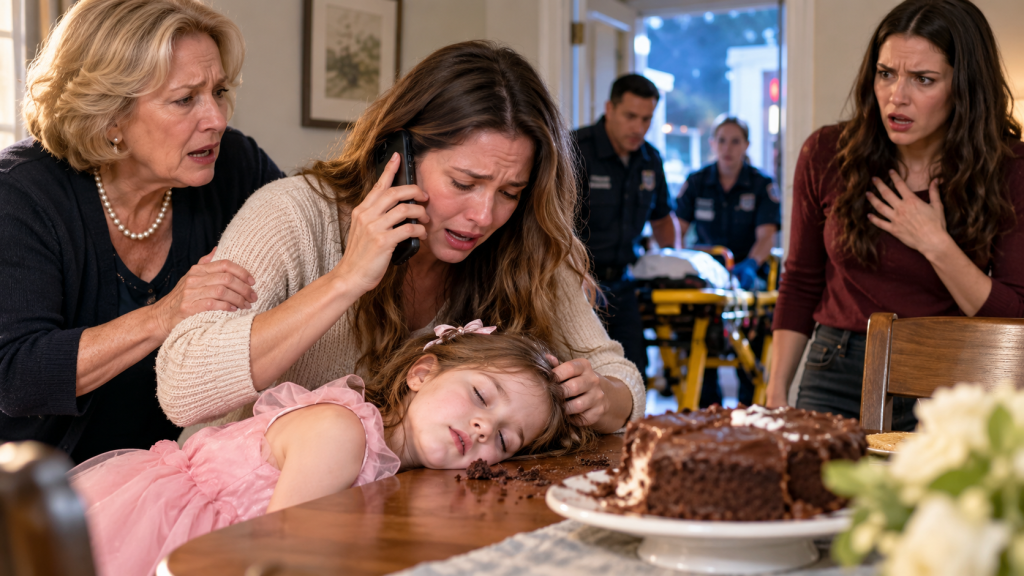
My daughter stopped crying the instant my sister smashed her face into the table. Five years old. One bite of chocolate cake. Unconscious in her little dress while my own mother pinned my arms and hissed, “You’ll make Vanessa worse.” Then my daughter’s breathing changed.

I went dead quiet, and that silence scared my mother more than all the screaming before it.
I stopped fighting my mother and looked only at my daughter.
Her cheek rested against the edge of the table, chocolate frosting smeared across her skin. Her eyes stayed closed. Each breath came differently now—short, uneven, with a faint sound in between that made every instinct in me snap into place.
“Let go of me.”
Mom tightened her grip.
“She’s breathing,” she whispered. “Just give Vanessa a minute.”
Vanessa stood on the other side of the table with one hand pressed against her own chest. She wasn’t looking at my daughter. She was staring at me like I was the dangerous one.
“She took my cake,” Vanessa said.
That was her explanation.
One bite.
I looked at Mom. “You’re holding me back from my unconscious child because Vanessa is upset?”
“Don’t start,” Mom said. “You know how she gets when people push her.”
There it was.
Not an accident. Not confusion. Not even denial.
Mom knew exactly what Vanessa had done, and her first instinct was still to manage Vanessa instead of helping her granddaughter.
My daughter made another strange sound.
I moved.
Mom tried to keep hold of me, but I twisted one arm free and dropped beside my little girl. Her tiny hand lay limp against her dress. I touched her shoulder gently and said her name, once, then again.
Nothing.
Behind me, Vanessa said, “She’s being dramatic.”
I pulled my phone from my pocket.
Mom grabbed for it.
“No.” Her voice cracked. “If you call somebody, this becomes a whole thing.”
I stared at her hand wrapped around my wrist.
“My daughter is unconscious.”
“Vanessa didn’t mean to hurt her.”
“You already knew she hurt her.”
Mom froze.
Vanessa snapped, “Mom, stop talking.”
That told me more than either of them realized.
I yanked my wrist loose and made the call.
The person on the line kept me focused on my daughter while I stayed beside her, watching every breath. Mom paced behind me, whispering that I was destroying the family. Vanessa kept insisting it had been an accident, although I hadn’t accused her of anything beyond what I had watched with my own eyes.
Then Mom crouched beside me.
“If you tell them Vanessa did this,” she said softly, “you could ruin her life.”
I looked at my daughter lying there in her little dress.
“You’re worried about the wrong life.”
When help arrived, the room changed fast. Questions. Hands moving carefully. My daughter being lifted while I answered everything exactly as it happened.
Vanessa tried to interrupt.
Mom tried too.
I didn’t argue with either of them.
I just kept telling the truth.
As they started taking my daughter toward the door, Mom caught my sleeve.
“If you leave with her after doing this to Vanessa,” she whispered, “don’t expect to come back here.”
I looked down at her fingers, then at the stretcher carrying my five-year-old child away from that table.
I pulled my sleeve free, climbed in beside my daughter, and the doors swung shut between us.
PART 2
The ambulance doors closed.
And for the first time in my life, my mother could not follow me into the next decision.
I sat beside my daughter while the vehicle pulled away from the house.
Her name was Lily.
Five years old.
Forty-three pounds.
Pink dress.
White socks.
One glittery shoe missing because someone had removed it while placing her on the stretcher.
I stared at that bare little foot because looking at her face was almost unbearable.
An oxygen mask covered her mouth and nose.
A paramedic named Lucas kept one hand near her shoulder while watching the monitor.
“Lily?”
Nothing.
“Sweetheart, can you open your eyes for me?”
Her eyelashes moved.
Barely.
Then stopped.
I gripped the edge of the bench.
“Is she okay?”
Lucas looked at me.
“We’re taking good care of her.”
That was not an answer.
I knew it.
He knew it.
But I also knew he was not going to give me promises he could not keep.
“When did she lose consciousness?”
“Immediately.”
“How long ago?”
“Maybe twelve minutes.”
“Did she vomit?”
“No.”
“Seizure?”
“No.”
“Did she say anything after she hit the table?”
“No.”
He nodded.
Then asked:
“What exactly happened?”
I swallowed.
“My sister pushed her face into the table.”
His eyes lifted from the monitor.
“Pushed?”
“No.”
The distinction mattered.
“She grabbed the back of Lily’s head.”
My voice cracked.
“And slammed her down.”
Silence.
Lucas did not react dramatically.
He simply reached for something on his tablet.
“Did you witness it?”
“Yes.”
“Anyone else?”
“My mother.”
“And?”
“She held me back afterward.”
His expression changed.
Only slightly.
But I saw it.
“She prevented you from reaching Lily?”
“Yes.”
“For how long?”
“I don’t know.”
Seconds.
Maybe less than a minute.
It had felt like a year.
“She kept saying Vanessa would get worse if I reacted.”
“Vanessa is your sister?”
“Yes.”
He typed.
Then:
“Has Vanessa hurt Lily before?”
“No.”
I answered too quickly.
Lucas looked at me.
I realized I did not actually know.
“No,” I repeated more quietly.
“I don’t think so.”
That answer terrified me.
Lily opened her eyes three minutes before we reached the hospital.
Only for a moment.
Her gaze moved toward me.
Confused.
“Mommy?”
I nearly fell apart.
“I’m here.”
Her eyes closed again.
“Cake.”
My heart broke.
“What, sweetheart?”
She whispered:
“I’m sorry.”
I leaned closer.
“For what?”
“I took it.”
My throat closed.
One bite.
She thought she needed to apologize.
“No.”
I touched her fingers.
“You did nothing wrong.”
Her eyes stayed closed.
“Aunt Vanessa said it was hers.”
“It doesn’t matter.”
“I’m sorry.”
“No, baby.”
My voice cracked.
“You never have to be sorry for what happened.”
I said it to her.
But some part of me heard it too.
The emergency department swallowed us in light.
Doctors.
Nurses.
A trauma team.
Questions repeated because repetition catches mistakes.
What happened?
When?
How hard?
Did she fall afterward?
Any bleeding?
Any previous head injuries?
I answered every question.
Exactly.
No minimizing.
No protecting Vanessa.
No protecting Mom.
I had spent thirty-six years translating my family into softer language.
Vanessa didn’t scream.
She became overwhelmed.
Mom didn’t favor her.
Vanessa required more support.
Vanessa didn’t ruin birthdays.
She had difficult days.
Mom didn’t pressure everyone else to accommodate her.
We were being compassionate.
I was done translating.
My sister grabbed my five-year-old daughter by the head and smashed her face into a table because Lily took one bite of chocolate cake.
That was the sentence.
Ugly because what happened was ugly.
They took Lily for imaging.
I was allowed to stay nearby until they needed the room clear.
A nurse showed me a chair.
I could not sit.
My whole body felt wrong.
Still full of the energy I had needed to fight my mother.
My hands would not stop shaking.
Then someone said my name.
“Emily?”
I turned.
A woman in dark green scrubs stood beside me.
“I’m Dr. Sarah Kim.”
I held my breath.
“Your daughter’s scan doesn’t show bleeding inside the brain.”
My knees nearly gave out.
I sat.
“Okay.”
“She does have a concussion.”
I nodded.
“And a small fracture of the nasal bone.”
My heart tightened.
“Her nose?”
“Yes.”
“There’s also significant facial bruising, and we’re watching her closely because she lost consciousness.”
“But she’ll be okay?”
Dr. Kim paused.
That pause hurt.
“We expect her to recover.”
I covered my face.
Expected.
It was the closest thing to certainty anyone had given me.
I took it.
“She’ll need observation.”
“Neurological checks.”
“We may keep her overnight.”
“Keep her as long as you need.”
The answer came so fast the doctor almost smiled.
I thought of Mom.
If you call somebody, this becomes a whole thing.
Good.
Let it become a whole thing.
My daughter had a fractured nose.
A concussion.
And the people responsible were worried about embarrassment.
A hospital social worker came thirty minutes later.
Her name was Priya Nair.
She sat with me in a consultation room while Lily slept under observation.
“I understand another adult intentionally injured her.”
“Yes.”
“Your sister?”
“Yes.”
“Does your sister live with Lily?”
“No.”
“Regular caregiver?”
“No.”
“Does she babysit?”
My stomach tightened.
“Sometimes.”
“How often?”
“Not often.”
I thought.
“Maybe once every couple of months.”
“At your mother’s home?”
“Yes.”
Priya wrote that down.
“Has Lily ever seemed reluctant to go?”
The question stopped me.
Had she?
Christmas.
Lily clinging to my coat.
“Can I stay with you?”
I thought she was tired.
A Sunday in August.
Lily crying when I said Grandma was taking her for ice cream.
I assumed she wanted me.
Then Thanksgiving.
Vanessa entering the room.
Lily immediately climbing onto my lap.
My mouth went dry.
“Yes.”
Priya looked up.
“I didn’t understand it.”
“That does not mean you ignored something obvious.”
I shook my head.
“No.”
“I need to think.”
I closed my eyes.
“She used to love going there.”
“When did that change?”
I tried to build a timeline.
“Maybe six months ago.”
“Anything happen then?”
“No.”
Then a memory came.
Lily had returned from Mom’s house with a bruised upper arm.
Mom said she ran into the bathroom door while playing.
Lily nodded when I asked.
But she had not looked at me.
My stomach turned.
“There was a bruise.”
Priya waited.
I explained.
“Did you photograph it?”
“No.”
“Medical visit?”
“No.”
“Any other injuries?”
I hated the question.
Because memories were suddenly rearranging themselves.
A scratch near Lily’s ear.
“Grandma’s cat.”
Except Mom did not own a cat.
No.
Wait.
That had been Vanessa’s cat.
Maybe.
I felt sick.
“I don’t know.”
Priya’s voice stayed gentle.
“Emily, I’m not asking you to solve the past right now.”
I looked at her.
“We’re documenting what you remember.”
That word again.
Documenting.
The opposite of family memory.
Family memory could be edited.
Documenting could not.
A police officer arrived shortly afterward.
Officer Rebecca Sloan.
She did not begin with Vanessa.
She began with Lily’s safety.
“Your sister does not live at your home?”
“No.”
“Does your mother have keys?”
“Yes.”
That answer made me sit straighter.
Mom had a key to my house.
For emergencies.
I immediately called my neighbor, Rachel.
“Can you go to my place?”
“What happened?”
“Please.”
She heard my voice.
“Okay.”
“Mom has a key.”
Silence.
“Do you want me to change the lock?”
“Yes.”
No hesitation.
“Tonight?”
“Yes.”
“I’ll handle it.”
That was friendship.
Not asking whether family would be offended.
Not telling me to calm down.
Just:
I’ll handle it.
Officer Sloan waited until I finished.
Then asked me to describe what happened again.
I did.
Chocolate cake.
Lily taking one bite.
Vanessa saying:
“I told you that was mine.”
Then grabbing Lily.
The sound.
The terrible silence afterward.
Mom holding me.
Not Vanessa.
Me.
Officer Sloan asked:
“Did your mother see the contact?”
“Yes.”
“What did she do?”
“She grabbed me.”
“Before or after Lily became unconscious?”
“Immediately after.”
“Did she attempt to help Lily?”
“No.”
“Call emergency services?”
“No.”
“Did she discourage you from calling?”
“Yes.”
“What did she say?”
I closed my eyes.
“If you call somebody, this becomes a whole thing.”
Officer Sloan wrote.
Then:
“And she said Vanessa didn’t mean to hurt her.”
“Yes.”
“And that if you told responders Vanessa did it, you could ruin Vanessa’s life?”
“Yes.”
Officer Sloan stopped writing.
Looked at me.
“Anything else?”
I almost said no.
Then remembered Mom’s final words.
“If you leave with her after doing this to Vanessa, don’t expect to come back here.”
Officer Sloan’s eyebrows lifted.
“She said that while your daughter was being transported?”
“Yes.”
I laughed once.
A broken sound.
“She thought I was doing something to Vanessa.”
Officer Sloan did not comment.
She simply documented it.
My phone had been buzzing continuously.
Mom.
Vanessa.
Mom.
Mom.
Vanessa.
Then Uncle David.
Then Mom again.
I had thirty-one messages.
Priya asked:
“Do you want to look at them?”
“No.”
Then:
“Yes.”
Because if they were discussing Lily, I wanted them preserved.
The first from Mom:
Please do not exaggerate what happened.
Then:
Vanessa is hysterical.
Then:
You need to understand she didn’t know Lily would hit the table that hard.
I stared.
That hard.
Not:
She did not touch Lily.
Interesting.
Another:
Call me before you say anything to police.
Too late.
Vanessa’s first message:
I barely touched her.
Second:
She pulled away and hit the table.
I froze.
That was not what happened.
Third:
Mom saw everything.
Fourth:
If you tell people I “slammed” her, I swear to God, Emily.
Officer Sloan asked:
“May I photograph those?”
I handed her the phone.
Then another message arrived while she was holding it.
From Vanessa.
You better remember Mom will tell them it was an accident.
Officer Sloan looked at me.
I looked at her.
Neither of us needed to say anything.
Lily woke fully around seven that evening.
I was beside her.
The room was dim.
Her face was swollen along one cheek.
There was dried blood beneath one nostril.
When her eyes found mine, she started crying.
“Mommy.”
I climbed carefully onto the edge of the bed and held her hand.
“I’m here.”
“Are we at the doctor?”
“Yes.”
“I want to go home.”
“We will.”
“Grandma’s?”
The question surprised me.
“No.”
Her body relaxed.
Not dramatically.
But I felt it.
“No Grandma?”
“No.”
“Aunt Vanessa?”
“No.”
She closed her eyes.
“Good.”
My blood went cold.
I looked toward Priya, who had quietly entered moments earlier.
She heard it too.
I stroked Lily’s hair.
“Sweetheart.”
She looked at me.
“Has Aunt Vanessa hurt you before?”
Priya immediately said:
“Emily.”
Not harsh.
A reminder.
Do not interrogate.
I stopped.
“Sorry.”
Priya came closer.
“Lily, you don’t have to answer lots of questions right now.”
Lily looked at her.
Priya introduced herself.
Then asked something much simpler.
“Do you feel safe with Mommy?”
“Yes.”
“Do you feel safe going to Grandma’s house?”
Lily’s eyes changed.
“No.”
My heart shattered.
Priya did not ask why immediately.
She let the silence exist.
Then Lily whispered:
“Grandma says I make Aunt Vanessa sick.”
I stopped breathing.
“What does that mean?”
Priya asked.
Lily shrugged slightly.
“If I don’t listen.”
My stomach turned.
“Listen to what?”
“Rules.”
“What rules?”
Lily looked at me.
“Don’t touch Aunt Vanessa’s things.”
“Don’t make loud noises if she sleeps.”
“Don’t tell Mommy when Aunt Vanessa gets mad.”
I felt something inside me fall away.
“When did Grandma tell you not to tell me?”
Priya asked.
Lily’s eyes filled.
“Lots.”
One word.
Lots.
I had to look away.
Because if Lily saw my face, she would start comforting me.
And that was not her job.
Priya said:
“You are not in trouble.”
Lily looked uncertain.
“Grandma said Mommy gets too upset.”
My throat closed.
“What else did Grandma say?”
“That Aunt Vanessa has problems.”
There it was.
The sacred family phrase.
Problems.
The word we used to build a wall around every consequence Vanessa should have faced.
Lily whispered:
“Grandma says I’m bigger now so I have to understand.”
Five.
She was five.
Bigger now.
I covered my mouth.
Priya asked:
“Did something happen another time that scared you?”
Lily went quiet.
Then touched her upper arm.
My stomach dropped.
The bruise.
“The bathroom door?”
I whispered before I could stop myself.
Lily looked at me.
Then nodded.
But not the way I expected.
“Aunt Vanessa did it.”
I felt sick.
“What happened?”
Priya asked.
Lily’s voice became tiny.
“She squeezed me.”
“Why?”
“I was crying.”
“Why were you crying?”
“Because I wanted Mommy.”
I closed my eyes.
The room tilted.
Lily continued.
“Aunt Vanessa said babies cry for Mommy.”
“And Grandma said stop making her mad.”
Tears ran down my face.
I had asked Lily about that bruise.
She had lied.
No.
A five-year-old did not create that lie.
She had been taught it.
“Who told you to say you hit the bathroom door?”
Priya asked.
Lily stared at the blanket.
“Grandma.”
My hand went cold.
There was no misunderstanding anymore.
Mom had not simply reacted badly today.
She had been helping hide previous harm.
Officer Sloan returned.
This time with a detective.
Daniel Reyes.
He did not question Lily in the hospital beyond what was necessary.
He explained that a trained child interviewer might speak with her later in a more appropriate setting.
That mattered.
I did not want Lily repeating trauma for every adult holding a clipboard.
Detective Reyes asked me something I had not considered.
“Does your mother have cameras inside her home?”
I blinked.
“Yes.”
“Where?”
“Kitchen.”
“Back door.”
“Living room.”
“Why?”
“Dad installed them after someone broke into the garage.”
My father.
I had barely thought of him all day.
He died two years earlier.
The cameras remained.
Mom complained about them constantly but never removed them because she did not know how.
I did.
I had installed the app on her tablet.
And mine.
My heart started pounding.
“The kitchen camera.”
Detective Reyes leaned forward.
“Would it capture the table?”
“Yes.”
“Cloud storage?”
“I think thirty days.”
His expression changed.
“Do you have access?”
I grabbed my phone.
Opened the app.
Password rejected.
Again.
Rejected.
Mom had changed it.
My stomach turned.
“She changed the password.”
“When?”
“I don’t know.”
Detective Reyes said:
“Don’t keep attempting.”
He wrote down the camera company.
“We’ll work on preservation.”
I nodded.
Then remembered something.
“The account recovery email might be mine.”
“Why?”
“I set everything up for Dad.”
Detective Reyes looked at me.
“Do not access or alter anything if you’re unsure what permissions you have.”
Again.
Careful.
Proper.
“We’ll preserve it through the right process.”
I handed him the details.
For the first time that night, I felt hope.
Not because I needed proof of what I saw.
I knew.
But because Mom could not tell a camera I was overreacting.
At 9:14 p.m., Mom finally left a voicemail instead of texting.
I listened with Detective Reyes and Priya nearby.
Her voice sounded exhausted.
“Emily, I know you’re angry.”
Not afraid for Lily.
Angry.
“I need you to think about what you’re doing.”
“Vanessa has struggled her whole life.”
“You know that.”
“She has never been good with stress.”
“Lily surprised her.”
“Things happened too fast.”
Then:
“I should not have held you.”
At least that.
“But I was trying to keep you from attacking your sister.”
I almost laughed.
I had been trying to reach my unconscious child.
Mom continued.
“If police ask, please tell them Vanessa reacted without thinking.”
“That’s the truth.”
Then her voice cracked.
“And please don’t tell them about the other times.”
The room went completely still.
I stopped breathing.
Detective Reyes raised one finger.
Listen.
Mom continued.
“Those things were different.”
“She never seriously hurt Lily before.”
My stomach turned.
Before.
Not:
There were no other times.
“She grabbed her arm once.”
“And the bath incident was an accident.”
Bath incident.
I looked at Priya.
She had gone very still.
I had never heard about a bath incident.
Mom continued.
“Vanessa was trying to make her sit down.”
“That’s all.”
“Please.”
“If you tell them every little mistake Vanessa has made, they’re going to make her sound like some kind of monster.”
Then the voicemail ended.
I stared at the phone.
Detective Reyes asked:
“What bath incident?”
“I don’t know.”
My voice barely worked.
I looked toward Lily’s room.
“I have no idea.”
The next morning, a child advocacy specialist spoke briefly with Lily.
Not a full forensic interview yet.
Just safety questions.
Afterward, Priya came to me.
Her expression made my chest hurt.
“What?”
“Lily mentioned something involving a bathtub.”
I stopped breathing.
“What?”
“She said she doesn’t want to take baths at Grandma’s anymore.”
My mouth went dry.
“Why?”
Priya sat.
“According to Lily, a few months ago Vanessa became angry because Lily would not stop splashing.”
My fingers tightened around the chair.
“And?”
“Lily says Vanessa held her face near the water.”
Everything inside me went silent.
“No.”
Priya continued carefully.
“Lily did not describe losing consciousness.”
“She said Grandma came in.”
“And stopped it?”
I asked.
Please.
Please let Mom have stopped it.
Priya’s expression answered before she spoke.
“She told Vanessa to go calm down.”
My chest collapsed.
“And Lily?”
“She says your mother told her not to tell you because Vanessa would get taken away.”
I stood.
Then immediately sat again because my legs would not hold me.
Months ago.
My daughter.
At Mom’s house.
Terrified.
And they sent her home to me.
They looked me in the face.
Mom probably kissed me goodbye.
Maybe gave me leftovers.
I had no idea.
I whispered:
“Why didn’t Lily tell me?”
Priya’s answer was gentle.
“Because she was five.”
That broke me.
Not because I blamed Lily.
Because I realized how quickly I had almost begun asking the wrong question.
Why didn’t she tell me?
No.
Why did adults teach her silence was necessary?
That was the question.
The camera company preserved the recordings before noon.
Detective Reyes called me around four.
“We have footage.”
My whole body went cold.
“Of yesterday?”
“Yes.”
“Can I see it?”
“Not yet.”
His voice changed.
“There’s something else.”
I closed my eyes.
Of course.
“What?”
“The kitchen camera captured the incident clearly.”
My stomach twisted.
“Okay.”
“It also continued recording after you left.”
I waited.
“Your mother and sister remained in the kitchen for approximately twenty-three minutes.”
“What did they do?”
He paused.
“They discussed what happened.”
My pulse slowed.
“Tell me.”
“Emily, I would rather not quote every detail over the phone.”
“Tell me enough.”
Silence.
Then:
“Your mother tells Vanessa they need to agree Lily slipped.”
My eyes closed.
Vanessa apparently refused at first.
Not because she wanted honesty.
Because she believed I had seen too much.
Then Mom said:
Emily always gets emotional first. Give her a day. She’ll start worrying about the family.
I stopped breathing.
There it was.
My mother’s entire understanding of me.
Wait.
I soften.
I forgive.
I protect.
Detective Reyes continued.
“Then your sister says something about ‘last time.’”
My stomach tightened.
“What exactly?”
Another pause.
“She says: ‘You said that last time, and she believed the bathroom story.’”
I pressed my fist to my mouth.
Mom answered:
Because I handled it.
I felt physically ill.
Handled it.
My daughter’s fear had been a management problem.
Not a safety problem.
Then Detective Reyes said:
“There’s another statement.”
“What?”
“Your mother tells Vanessa: ‘I told you if you lose control, do it when Emily isn’t here.’”
The world went completely quiet.
I could hear my own heartbeat.
“No.”
“I’m sorry.”
No.
I needed to hear it.
Every ugly word.
Because for years, Mom had trained us all to believe the problem was the person who said the uncomfortable thing aloud.
Not anymore.
“What else?”
“Vanessa says she’s tired of everyone treating Lily like she’s special.”
My stomach turned.
A five-year-old.
Special.
“She complains that your mother pays more attention to Lily when she visits.”
I stared at nothing.
Then:
“She says you always bring Lily over and expect everyone to rearrange themselves.”
I almost laughed.
I visited maybe twice a month.
Usually for two hours.
Mom begged me to come more.
Detective Reyes continued.
“Your mother tells her…”
He stopped.
“What?”
“Tell me.”
His voice softened.
“She says: ‘She’s a child. You can’t keep competing with a child.’”
For one second, relief.
At least Mom saw that.
Then he continued.
“And Vanessa answers: ‘You let me before.’”
My blood went cold.
“You let me before.”
“What does that mean?”
“We don’t know.”
But Mom’s response was worse.
Detective Reyes said:
“Your mother tells her: ‘That was different. Emily never knew.’”
I stopped breathing.
Emily never knew.
Not Lily.
Me.
Different.
Before.
“What was different?”
“We’re investigating.”
My hands began shaking.
“Different when?”
“He doesn’t specify.”
“Is there older video?”
“We’re checking what exists.”
The standard cloud archive only went back thirty days.
But the camera system also saved clips locally when motion alerts were manually tagged.
Dad had set that up years ago.
Mom had apparently never understood it.
Detective Reyes continued:
“We found older saved clips.”
“How old?”
“More than a year.”
I closed my eyes.
“Of Lily?”
A pause.
“At least one appears to involve her.”
My stomach dropped.
“What happens?”
“We need to review it fully before I characterize it.”
That terrified me more than anything.
Then he said:
“Emily.”
“Yes?”
“There’s another child in one of the clips.”
I froze.
“What child?”
“We’re trying to identify him.”
My throat went dry.
“Boy or girl?”
“A boy.”
“How old?”
“Maybe seven or eight at the time.”
I knew immediately.
My cousin Rebecca’s son.
Noah.
He was nine now.
Two years earlier, Noah had broken his wrist at Mom’s house.
Everyone said he fell off the porch.
Vanessa had been there.
I sat down slowly.
“Was it Noah?”
“We don’t know.”
“I think I do.”
I called Rebecca.
She answered:
“Hey, Em.”
I could not find a gentle entrance.
“Did Noah really fall off Mom’s porch two years ago?”
Silence.
Long enough.
Then Rebecca whispered:
“Why are you asking?”
My skin went cold.
“What happened?”
She started crying.
And in that moment, I understood.
Not everything.
Enough.
“Rebecca.”
She whispered:
“Your mom made us promise.”
My heart stopped.
“Promise what?”
“That we wouldn’t tell you.”
My hand went numb around the phone.
“Tell me what happened to Noah.”
Rebecca sobbed once.
Then said:
“Vanessa pushed him down the porch steps.”
I closed my eyes.
There it was.
Another child.
Another secret.
“Why?”
“He called her weird.”
I almost stopped breathing.
“He was seven.”
“I know.”
“What did Mom do?”
Rebecca went quiet.
Then:
“She paid the emergency-room bill.”
My stomach turned.
“What?”
“She said if we reported Vanessa, she’d lose everything.”
“I was going through my divorce.”
“I needed help.”
“Your mom offered to cover the medical bills and three months of my rent if I said Noah fell.”
The room blurred.
“How much?”
“Emily.”
“How much did she pay you?”
“About eleven thousand.”
I closed my eyes.
Not because Rebecca took the money.
Because Mom had turned silence into a family expense.
My daughter was not the first child.
My mother had done this before.
Maybe more than once.
Rebecca cried.
“I’m sorry.”
I said nothing.
“I wanted to tell you when Lily was born.”
My breath stopped.
“What?”
“But your mom said Vanessa was doing better.”
“And she said if I brought up the past, I’d destroy the family.”
Same phrase.
Destroy the family.
The accusation given to whoever opened the locked room.
Rebecca continued.
“I should’ve told you.”
“Yes.”
I said it quietly.
Not cruelly.
But truthfully.
“Yes.”
She cried harder.
I closed my eyes.
“Will you talk to the detective?”
Silence.
Then:
“Yes.”
That mattered.
Not enough to erase the past.
Enough to change what happened next.
Lily was discharged that evening.
Not to Mom’s house.
Not anywhere near Vanessa.
Home.
My locks had been changed.
Rachel had filled my refrigerator.
There was a stuffed rabbit on Lily’s pillow.
No note.
No speech.
Just a rabbit waiting.
Lily climbed into my bed that night instead of hers.
I let her.
At 2:00 a.m., she woke crying.
“Mommy?”
“I’m here.”
“Is Grandma mad?”
My chest tightened.
“You don’t need to worry about Grandma’s feelings.”
“She said families forgive.”
I closed my eyes.
“What do you think forgive means?”
Lily shrugged.
“Don’t tell.”
There it was.
The damage beneath the bruise.
I pulled her gently against me.
“No.”
“Forgiving and keeping secrets are different things.”
She was quiet.
Then:
“Am I bad?”
“No.”
“Even because of the cake?”
My heart broke again.
“Especially because of the cake.”
“It was one bite.”
“I know.”
“She said it was special.”
“No cake in the world is more important than you.”
Lily thought about that.
Then whispered:
“Grandma thinks Aunt Vanessa is.”
I had no answer that would not hurt her.
So I gave her the truth she could carry.
“Grandma made very bad choices.”
“Is she still Grandma?”
“Yes.”
“Do I have to see her?”
“No.”
Her whole body relaxed against mine.
That told me everything.
The next morning, Detective Reyes came to the house.
He brought no uniformed officers.
No drama.
Just a folder.
“There’s a saved clip I need to ask you about.”
My stomach tightened.
“Lily?”
“Yes.”
“When?”
“Seven months ago.”
The bruise.
I knew.
He opened a still image.
Mom’s kitchen.
Lily near the counter.
Vanessa behind her.
My mother by the sink.
“What happens?”
Detective Reyes looked at me.
“Your daughter is crying.”
“She asks for you.”
My throat closed.
“Vanessa grabs her arm.”
“The bruise.”
“Likely.”
“Mom sees it?”
“Yes.”
“Does she stop her?”
He paused.
“Eventually.”
Eventually.
I hated that word.
“What does she do first?”
His expression changed.
“She closes the kitchen blinds.”
The room went completely still.
No.
Not misunderstanding.
Not freezing in shock.
The blinds.
My mother had seen my sister grab my crying child—
and her first move had been to make sure nobody outside could see.
I could not speak.
Detective Reyes continued.
“There’s audio.”
I did not want it.
I needed it.
“What does Mom say?”
He looked down at the transcript.
Then read:
Vanessa, not so hard. You’ll leave marks again.
Again.
I stared.
Again.
“Again?”
My voice sounded far away.
Detective Reyes nodded.
Then:
“Vanessa answers, ‘Then make her stop crying.’”
My hands became ice.
“And Mom?”
A pause.
“She tells Lily…”
He stopped.
“Tell me.”
His voice softened.
“She tells her: ‘If you keep upsetting Aunt Vanessa, your mommy won’t bring you here anymore, and then Grandma will be lonely. Is that what you want?’”
I covered my mouth.
My five-year-old daughter had been made responsible for her grandmother’s loneliness.
For Vanessa’s anger.
For keeping the family together.
Same job I had held my whole life.
They had already begun handing it to her.
No.
Not anymore.
I looked at Detective Reyes.
“Is that all?”
“No.”
My stomach dropped.
He opened another page.
“The system contains one older clip.”
“How old?”
“Eighteen months.”
“Lily was three.”
“Yes.”
I stopped breathing.
“What happens?”
“Your mother and Vanessa are talking after you leave.”
“About Lily?”
“About you.”
My pulse changed.
“What do they say?”
Detective Reyes looked at me carefully.
Then:
“Your mother says you’re becoming too protective.”
Vanessa says:
She wasn’t this annoying before she had the kid.
I almost laughed because it sounded exactly like her.
Then Detective Reyes continued.
“Your mother responds…”
He hesitated.
“What?”
We handled Emily when she was little. We can handle Lily too.
The room disappeared around me.
I stared.
“What does that mean?”
“We don’t know.”
I could barely breathe.
Handled Emily.
When she was little.
Not my daughter now.
Me.
I looked at the detective.
“There’s more?”
“Yes.”
My throat tightened.
“Vanessa asks your mother whether you remember.”
My skin went cold.
“Remember what?”
Detective Reyes read the next line.
Does Emily remember what you used to do when she cried?
My heart stopped.
“And Mom?”
He looked at me.
Then said:
“Your mother answers, ‘No. And she never needs to.’”
Silence.
Complete.
Terrible.
I sat there unable to move.
My daughter’s assault had opened a door I did not even know existed.
All day, I had believed I was discovering how far my mother had gone to protect Vanessa.
I was wrong.
Whatever had happened in that family had started long before Lily.
Long before Noah.
Long before Vanessa became the sister everyone was required to manage.
And somewhere inside a recording from eighteen months ago, my mother had just admitted there was something from my own childhood she had spent decades making sure I never remembered.
PART 3 — THE SECRET MY MOTHER THOUGHT I WOULD NEVER REMEMBER
My mother’s voice kept repeating in my head.
No. And she never needs to.
For several seconds, Detective Reyes said nothing.
Neither did I.
The room around me seemed strangely normal.
Morning light.
A coffee cup cooling beside the sink.
Lily’s stuffed rabbit lying upside down on the couch.
But something had shifted beneath everything.
I had spent the last forty-eight hours discovering what my mother had hidden from me about my daughter.
Now I was beginning to understand that Lily had not been the beginning of the secret.
I was.
“What did she do to me?”
My voice sounded small.
Detective Reyes closed the transcript.
“We don’t know yet.”
I hated that answer.
Not because it was wrong.
Because it was honest.
“Can you ask her?”
“We will.”
“What about Vanessa?”
“We’ll ask her too.”
I stood.
Then sat again.
A memory had come.
Not a whole memory.
Barely an image.
A bathroom light.
Yellow.
A towel on the floor.
My mother saying:
“Enough crying.”
Then nothing.
I closed my eyes.
“Emily?”
Detective Reyes leaned forward.
“I remember a bathroom.”
He waited.
“I don’t know if it’s real.”
“That’s okay.”
“A yellow light.”
“What else?”
“My mother.”
Silence.
“And?”
“I don’t know.”
He did not push.
That mattered.
Because the worst thing someone can do with a frightened memory is force it into a shape before it is ready.
He said:
“If more comes back, write it down before talking through it repeatedly with relatives.”
“Why?”
“Memory gets influenced.”
I nodded.
Facts.
Again.
Facts before family stories.
I had lived too long in the opposite order.
Lily woke an hour later.
Her face looked worse that morning.
Purple beneath one eye.
Swelling along her nose.
Still beautiful.
Still mine.
She climbed into my lap carefully.
“Does Grandma know where we live?”
My chest tightened.
“Yes.”
“Can she come?”
“No.”
“How do you know?”
“The locks changed.”
She thought about that.
Then:
“What about windows?”
I almost broke.
Five-year-olds should not think about windows after family visits.
“They’re locked too.”
“And Aunt Vanessa?”
“She cannot come here.”
Lily leaned against me.
Her little body softened.
That relief told me more than any interview could.
I stroked her hair.
“We’re going to be safe.”
She whispered:
“You promise?”
Promises had started to frighten me.
Adults in my family used promises as decoration.
So I chose my words carefully.
“I promise I will keep listening when you tell me something feels wrong.”
She looked up.
“That’s different.”
“Yes.”
“Better?”
“I think so.”
She nodded.
“Okay.”
Then asked for cereal.
Children are merciful that way.
The world can collapse at nine in the morning and they will still want the blue bowl.
I gave her the blue bowl.
My mother was interviewed that afternoon.
I did not attend.
Vanessa was interviewed separately.
I was grateful.
I did not want to watch Mom build explanations in real time.
Detective Reyes called me that evening.
“She admitted some things.”
My body went cold.
“What things?”
He paused.
“From your childhood.”
I sat down.
“What did she say?”
“When you were between three and five, you had what she described as ‘severe crying spells.’”
I almost laughed.
Three-year-olds cry.
“What did she do?”
“She says she sometimes put you in the downstairs bathroom until you calmed down.”
The yellow light.
My hands went cold.
“Locked?”
“She says no.”
“That means yes.”
“We’re checking what other witnesses remember.”
“What else?”
He hesitated.
“She says she would sit with you and hold you.”
I closed my eyes.
“Hold me how?”
“She described restraining your arms so you wouldn’t scratch yourself or hit.”
A memory flashed.
Cold tile.
My wrists pressed against my chest.
Not clear enough.
Gone before I could grab it.
“She says it was for safety.”
Of course.
Every harmful thing in my family had arrived wearing a safety label.
“What did Vanessa say?”
Detective Reyes went quiet.
That frightened me.
“Tell me.”
“Vanessa said your mother would hold you on the bathroom floor and cover your mouth when you screamed.”
I stopped breathing.
“No.”
“She also remembers your mother putting a washcloth over your mouth.”
The room tilted.
“Wet?”
A pause.
“Yes.”
I stood so quickly the chair scraped backward.
“No.”
My body knew before my mind did.
A wet cloth.
Cold.
The smell of soap.
My mother’s voice.
Quiet now.
I pressed both hands against the counter.
Then another memory surfaced.
Not a scene.
A sensation.
Panic when water ran over my face in the shower.
I had hated it my whole life.
I never knew why.
I washed my hair leaning backward.
Never forward.
At swimming lessons as a child, I screamed when instructors asked me to put my face in the water.
Mom used to laugh about it.
“Emily always hated getting her face wet.”
My stomach turned.
Detective Reyes said my name.
“I’m here.”
“Do you want me to stop?”
“No.”
My voice shook.
“Finish.”
“Vanessa claims your mother believed startling you with cold water stopped the crying faster.”
I closed my eyes.
“And Vanessa?”
“What about her?”
“Did she do things to me too?”
Long silence.
Then:
“Yes.”
My heart broke in a different place.
“What?”
“She remembers pinching you.”
“Pushing you.”
“Taking toys.”
“Occasionally hitting you.”
My hands shook.
“And Mom?”
“Vanessa says your mother usually blamed you for provoking her.”
There it was.
The original script.
Not created for Lily.
Inherited by Lily.
Don’t make Vanessa worse.
Those words were not born beside the chocolate cake.
My mother had been saying them for decades.
Maybe not always aloud.
But the rule had been there.
Vanessa hurts.
Everyone else adjusts.
I whispered:
“How old was Vanessa?”
“About eight when you were three.”
Five years older.
A child too.
That mattered.
Not because it excused what adult Vanessa did to Lily.
But because there had once been two children in that house.
One acting out.
One absorbing it.
And one mother teaching both of them the wrong lesson.
Vanessa learned:
Your distress gives you permission.
I learned:
Your pain is less important than keeping Vanessa calm.
The tragedy was not that the lesson existed.
It was that nobody corrected it when we grew up.
I called my aunt Carol that night.
My mother’s younger sister.
We had not spoken in almost a year.
She answered cheerfully.
“Emily! I was just thinking—”
“Aunt Carol.”
She stopped.
“What happened when I was little?”
Silence.
Not confusion.
Silence.
My stomach tightened.
“You know.”
Her voice dropped.
“Who told you?”
That question answered everything.
“Mom said something on camera.”
Carol exhaled.
“Oh, God.”
“What happened?”
She started crying.
I waited.
Then she said:
“Your mother was overwhelmed.”
I almost hung up.
“No.”
“I don’t need the explanation first.”
Silence.
“I need what happened.”
Carol took a shaky breath.
“You cried a lot after your father left.”
My father had disappeared when I was four.
Occasional birthday cards.
Nothing else.
“Your mom couldn’t handle noise.”
“And Vanessa was having problems at school.”
“What kind of problems?”
“Fighting.”
“Tantrums.”
“Jealousy.”
Carol paused.
“She hated when your mother held you.”
My stomach turned.
“So Mom stopped?”
“Not completely.”
“But she expected you to be easier.”
At three.
At four.
At five.
Easier.
“What did she do in the bathroom?”
Carol cried harder.
“I saw it once.”
“What?”
“She sat behind you.”
“Held your arms.”
“You were screaming.”
“And she put a cold washcloth across your mouth.”
My eyes closed.
“Could I breathe?”
“Yes.”
Carol said it immediately.
Too quickly.
Then:
“I think so.”
I almost laughed.
A family tradition.
Not knowing enough to be certain while defending anyway.
“Did you stop her?”
Silence.
“No.”
“Why?”
“I was twenty-two.”
“That’s not why.”
She cried.
“Because your mother told me she knew what she was doing.”
There.
Authority.
Family hierarchy.
The same thing that nearly kept me from calling emergency services for Lily.
Carol whispered:
“I should have done something.”
“Yes.”
I said it gently.
But I said it.
“Yes.”
No more rescuing adults from accurate guilt.
Then Carol told me something I did not know.
At five, I had been taken to the emergency room after fainting in the bathroom.
Mom said I slipped.
There were no serious injuries.
I had been discharged.
But a nurse documented bruising around both upper arms.
Child services had apparently been notified.
“What happened?”
I asked.
Carol went quiet.
“Your mom said you bruised easily.”
“Vanessa said you fell.”
“And?”
“The case closed.”
My stomach twisted.
“Did they interview me?”
“I don’t know.”
“Did you?”
“No.”
Of course.
Then:
“Carol.”
“Yes?”
“Did Mom ever do that to Vanessa?”
Silence.
“No.”
That answer hurt more than I expected.
Not because I wanted Vanessa hurt.
Because it confirmed the structure.
Vanessa’s distress controlled the house.
Mine had to disappear.
The old hospital record still existed.
Not everything.
Enough.
Emergency visit.
Age five.
Reported fall.
Bruising inconsistent with a simple bathroom slip was noted but not conclusively explained.
A social worker had recommended follow-up.
Mom apparently switched pediatric practices months later.
That was not proof of why.
But it was another piece.
The investigation into Lily and Noah became more serious.
Not because of my childhood alone.
The statute-of-limitations questions around decades-old conduct were complicated.
Memories were imperfect.
Some witnesses were dead.
Some records incomplete.
Detective Reyes never promised me justice for four-year-old Emily.
I appreciated that.
He focused on what could be proven now.
Lily.
Noah.
The saved recordings.
Mom’s own statements.
Vanessa’s texts.
The kitchen footage.
The voicemail mentioning “other times.”
The bath incident.
The arm bruise.
Those were current enough to matter.
And they mattered a lot.
The full forensic interview with Lily happened days later.
I was not in the room.
That nearly killed me.
But trained professionals explained why.
She needed space where my face could not accidentally reward, frighten, or steer an answer.
So I waited.
I held her rabbit.
And hated every adult who had made this appointment necessary.
When Lily came out, she ran straight to me.
I did not ask what she said.
I said:
“Do you want pancakes?”
She nodded.
That was all.
The interviewer later told authorities what could appropriately be shared.
There had been more intimidation than I knew.
Vanessa yelling close to Lily’s face.
Squeezing her arm.
Once throwing one of Lily’s toys against the wall because Lily would not stop asking to call me.
The bath incident.
And repeated instructions from Grandma:
Don’t tell Mommy.
Mommy gets too upset.
Aunt Vanessa cannot help it.
Good girls understand.
That phrase nearly destroyed me.
Good girls understand.
I had been a good girl.
Quiet.
Low-maintenance.
Easy.
That was the legacy Mom had tried to hand my daughter.
No.
Rebecca cooperated too.
Noah’s old medical record documented the wrist fracture.
The porch story had been repeated at the time.
But now Rebecca admitted the truth.
And then another family came forward.
My cousin Daniel’s daughter, Sophie.
Seven years old now.
Vanessa had once slapped her hand hard enough to leave swelling after Sophie touched a figurine.
Mom told everyone the child had caught her hand in a drawer.
Daniel had suspected something.
But Mom convinced him that reporting Vanessa would “destroy her chance at getting better.”
Three children.
Different incidents.
Same protector.
Same rewritten story.
My mother had not caused every injury.
But she had built the shelter around them.
Vanessa was arrested first.
The charges centered on the clearest provable conduct against Lily and evidence involving Noah and the other incidents.
Not every allegation became a charge.
Not every memory became evidence.
That mattered.
I did not need the legal system to confirm every painful thing before I believed my daughter.
Mom faced her own consequences.
Not because she had been standing beside Vanessa every second.
Because there was evidence she had interfered after injuries, discouraged reporting, coached false explanations, and failed to protect children despite knowing there was a repeated danger.
Her attorney called it panic.
The prosecutor called it concealment.
I called it a pattern.
Eventually, there were negotiated pleas.
Vanessa received a sentence that included incarceration, mandatory treatment, and strict restrictions involving contact with minors after release.
It was not forever.
No dramatic life sentence.
But for the first time, her distress did not erase consequence.
Mom avoided prison on the most serious possible terms partly because she cooperated later, had no prior criminal history, and some counts were legally harder to prove.
There was probation.
Court-ordered counseling.
Restrictions on contact with children.
No unsupervised access to Lily.
No access at all unless I allowed it later.
I did not.
Not then.
For years.
That was my decision.
Not hers.
The day after Mom entered her plea, she asked to see me.
I refused.
Then she wrote.
Ten pages.
The first six were terrible.
Vanessa’s diagnoses.
Stress.
Single motherhood after Dad left.
Money.
Fear.
Her own childhood.
I almost stopped reading.
Then page seven changed.
I kept believing that if I could prevent everyone from reacting to Vanessa, then I could prevent Vanessa from becoming worse.
I read on.
I asked everyone else to become smaller because I did not know how to make her safer.
My throat tightened.
Then:
I did it to you first.
There.
Finally.
When you cried, I did not ask what you needed. I asked how quickly I could make the crying stop.
I closed my eyes.
When Vanessa hurt you, I taught you to forgive before you were allowed to be angry.
Tears ran down my face.
When she began hurting other children, I recognized the pattern and still told myself I was protecting her.
Then the sentence that mattered:
I was not protecting Vanessa anymore. I was protecting myself from admitting what I had allowed her to become.
I cried.
Hard.
Because truth, when it finally arrives after decades, does not always bring relief.
Sometimes it simply gives grief the correct name.
Mom ended with:
You do not owe me access to Lily.
Good.
You do not owe me forgiveness.
Better.
I am sorry I taught you that keeping this family together was your job.
I folded the letter.
I did not answer for eleven months.
Lily healed physically faster than I did.
Her nose healed.
Bruises faded.
The concussion symptoms disappeared.
The first time she ate chocolate cake again, she froze.
Birthday party at school.
I saw her staring at the slice.
“Want something else?”
I asked.
She looked at me.
“Can I have it?”
My heart broke.
“Yes.”
“All of it?”
“If you want.”
“What if somebody else wanted it?”
“Then we get another piece.”
She smiled cautiously.
Then took one tiny bite.
Nothing happened.
No shouting.
No hand.
No table.
She chewed.
Then took another.
By the fourth bite, she had frosting on her nose.
I cried in the school bathroom afterward.
Healing sometimes looks ridiculously small.
A child finishing cake.
Therapy helped both of us.
Separate at first.
Then some sessions together.
Lily learned that adults are responsible for their own feelings.
That sentence sounds obvious.
It was revolutionary in our family.
We practiced.
“If Grandma is lonely, whose job is Grandma’s loneliness?”
“Grandma’s.”
“If Aunt Vanessa gets angry because you touch something?”
“Aunt Vanessa’s.”
“If Mommy gets sad when you tell the truth?”
Lily hesitated.
Then:
“Yours?”
I smiled through tears.
“Yes.”
“My feelings are my job.”
She grinned.
“I’m getting good at this.”
She was.
So was I.
My own memories returned in fragments.
Not enough to construct every event.
Enough.
The bathroom.
Cold cloth.
Mom’s hand.
Vanessa watching once from the doorway.
Me learning to stop crying because stopping was how the door opened.
For a while, I became obsessed with remembering everything.
My therapist stopped me.
“You are allowed to heal without recovering a perfect archive.”
That sentence saved me months of pain.
I had evidence enough to know the truth of the pattern.
I did not need to excavate every minute of childhood.
Some doors do not need to be broken down.
Knowing they existed is enough to stop building new rooms like them.
Noah went to therapy too.
Rebecca apologized to him.
Properly.
Not:
I was under pressure.
Not:
Grandma made me.
She told him:
“I knew the truth and helped hide it because I was scared.”
He was nine.
He asked:
“Did you choose money?”
Rebecca cried.
Then said:
“Yes.”
That honesty hurt them.
But it also gave them somewhere real to begin.
Months later, Rebecca told me Noah had asked to see the porch.
He stood at the top.
Then walked down every step slowly.
When he reached the bottom, he said:
“I remember.”
Rebecca asked what.
He said:
“That I didn’t fall.”
Then walked away.
Children should not have to reclaim truth from adults.
But sometimes they do.
My relationship with Mom changed into something I never expected.
Not reconciliation.
Not estrangement forever.
Distance with conditions.
For almost two years, we communicated only through letters.
Then one day, I agreed to meet her at a therapist’s office.
No Lily.
Just me.
Mom looked older.
Much older.
She started crying when she saw me.
I did not comfort her.
That was new too.
She said:
“I’m sorry.”
I waited.
“For what?”
Her face crumpled.
I needed specificity.
She understood.
“For holding you down when you were little.”
“For covering your mouth.”
“For telling you Vanessa’s feelings mattered more than your pain.”
My chest tightened.
“And Lily?”
She cried harder.
“For seeing what Vanessa was becoming and still leaving Lily alone with her.”
“For lying about the bruise.”
“For telling her to protect Vanessa.”
“For holding you back when Lily was unconscious.”
That was enough for that day.
Not forgiveness.
Truth.
Before leaving, Mom asked:
“Will I ever see Lily?”
I looked at her.
“I don’t know.”
She nodded.
No bargaining.
Good.
Years later, Lily chose to see her once.
Supervised.
Short.
Her choice.
Mom apologized.
Lily listened.
Then asked:
“Why didn’t you help me?”
Mom cried.
But answered.
“Because I was more afraid of what would happen to Vanessa than what was already happening to you.”
Lily thought about that.
Then said:
“That was bad.”
Mom nodded.
“Yes.”
No adult forced Lily to make the moment prettier.
I was proud of that.
Afterward, Lily decided she did not want another visit for a while.
I respected it.
Mom did too.
That was the first truly protective thing she gave my daughter.
Acceptance of no.
Vanessa wrote me from prison once.
I almost threw it away.
Instead, I read it.
She said Mom had taught her all her life that losing control meant everyone else should adapt.
She said she believed pain made her exceptional.
She said when Lily took the cake, she experienced the bite as theft, disrespect, rejection.
Then:
None of that makes what I did her fault.
I stopped there.
For once, she had reached the correct sentence.
She continued:
I spent my whole life believing having reasons meant I did not have responsibility.
I folded the letter.
I never replied.
Maybe Vanessa changed.
Maybe she didn’t.
Her healing was no longer my assignment.
That was freedom too.
Five years passed.
Lily turned ten.
Chocolate cake was her favorite.
Of course.
For her tenth birthday, she asked for a three-layer chocolate cake with strawberries.
I laughed.
“Trying to make a statement?”
She looked confused.
“No.”
Even better.
The cake had stopped being a symbol for her.
It was just cake.
That was healing.
Rebecca came.
Noah came.
Rachel.
Friends from school.
Mom was not invited.
Lily had considered it.
Then said:
“Not this year.”
I said:
“Okay.”
No guilt.
No lecture about family.
Just okay.
At the party, Noah stole a strawberry from the top of the cake before we cut it.
Lily gasped dramatically.
“Criminal!”
He ran.
She chased him around the table laughing.
For one split second, my body remembered.
A child reaching for food.
A table.
Vanessa.
Silence.
Then Lily came around the corner laughing so hard she nearly fell.
Noah held both hands up.
“I surrender!”
Lily grabbed another strawberry.
Handed it to him.
“Fine.”
And the moment passed.
No violence.
No ownership worth hurting someone over.
Just children being children.
I turned away because my eyes filled.
That night, after everyone left, Lily helped me clear plates.
There was one piece of cake remaining.
She put it in the refrigerator.
Then asked:
“Mom?”
“Yes?”
“Why did you get so quiet earlier?”
I hesitated.
She was ten.
Old enough for more truth.
“You and Noah were playing around the cake.”
“And?”
“It reminded me of the day you got hurt.”
She went quiet.
Then:
“I don’t remember all of that day.”
“Good.”
“Do you?”
“Yes.”
She looked at me.
“Does it still hurt?”
I thought about the question.
“Sometimes.”
She nodded.
Then said:
“But I’m okay.”
I smiled.
“You are.”
“And you’re okay?”
I looked around our kitchen.
Locks I chose.
People invited because we wanted them.
A daughter who knew no did not mean betrayal.
A home without secrets assigned to children.
“Yes.”
I realized I meant it.
“I am.”
People sometimes ask when I stopped loving my mother.
I didn’t.
That was never the point.
Love survived.
Trust did not.
Then pieces of trust returned in forms smaller than before.
That was more honest.
I loved Vanessa too, in some damaged old way.
But love stopped being a reason to remove consequences.
That was the lesson my family should have learned decades earlier.
Love is not protection from accountability.
Forgiveness is not silence.
Mental illness is not permission to hurt people.
Being overwhelmed does not make another person’s body available for your anger.
And family is not a room where the most frightened person controls everyone else.
For years, Mom believed keeping Vanessa calm meant keeping the family safe.
She was wrong.
Safety cannot be built around the person everyone is afraid to upset.
That is not safety.
That is orbit.
We had all orbited Vanessa.
Then they began teaching Lily to do it too.
That was where the pattern ended.
Sometimes I still think about the moment my daughter stopped crying.
Not because silence was peaceful.
Because it was terrifying.
Her little body went limp.
Her breathing changed.
And something inside me changed with it.
Mom thought my silence meant she had finally controlled me.
It didn’t.
I stopped screaming because I had reached a place beyond argument.
For years, I argued with my mother because some part of me believed if I explained enough, she would choose differently.
At that table, I finally understood.
I did not need her to understand.
I needed to move.
So I did.
I called.
I told the truth.
I climbed into the ambulance.
And when Mom said not to come back, I let the doors close.
That was not the day I lost my family.
It was the day I stopped sacrificing the smallest person in it to preserve everybody else.
Years later, Lily asked me something while we were baking.
She was twelve by then.
Flour everywhere.
Music playing.
Chocolate melting on the stove.
“Mom?”
“What?”
“If Grandma had said sorry that day, would you have gone back?”
I stopped stirring.
“No.”
She looked surprised.
“Why?”
“Because sorry would not have made you safe yet.”
She considered that.
“So people can be sorry and you can still leave?”
My throat tightened.
“Yes.”
“People can love you and you can still leave?”
“Yes.”
“People can be family and you can still leave?”
I smiled.
“Especially if staying means someone keeps getting hurt.”
She nodded.
Then went back to stirring.
I watched her.
A child learning boundaries without needing bruises to teach them.
That might be the greatest thing I ever accomplished.
Not a career.
Not a house.
Not surviving my childhood.
This.
Raising a daughter who knows love does not require endurance.
The old kitchen camera footage remained evidence for years.
Eventually, after every case and appeal and legal retention period ended, I was given a copy of the recording.
I never watched the impact again.
Once was enough.
But I watched the minute before it.
Lily at the table.
Swinging her legs.
Chocolate cake in front of Vanessa.
My daughter looking at it.
Vanessa distracted.
Lily reaching forward.
One tiny finger catching frosting.
Then one bite.
That was all.
One bite.
A child behaving like a child.
Then I watched myself in the background.
I was laughing at something Mom had said.
Completely unaware that thirty seconds later my life would split into before and after.
I stopped the recording there.
Before the violence.
That is how I choose to remember that room now.
Not Lily unconscious.
Not Mom holding me.
Not Vanessa’s hand.
I remember my daughter alive and mischievous, stealing one bite of cake because she assumed the people around her were safe enough for such a small mistake.
She had been wrong that day.
But she did not stay wrong forever.
We built somewhere safer.
On Lily’s fifteenth birthday, she requested chocolate cake again.
No strawberries this time.
“Too childish.”
I rolled my eyes.
She brought three friends home.
They ate half the cake directly from the tray after midnight.
When I came downstairs and caught them, everybody froze.
Lily had frosting on her finger.
For one second, she looked exactly five again.
Then she grinned.
“Sorry?”
I looked at the ruined cake.
Then at her.
“No, you’re not.”
Her friends laughed.
I took a fork.
Stole a bite myself.
Lily gasped.
“Mom!”
“What?”
“That was mine.”
I raised an eyebrow.
She laughed.
Then pushed the cake toward me.
“Fine.”
And standing there in my kitchen, eating cake with my teenage daughter in the middle of the night, I suddenly understood the ending.
My mother had spent decades teaching us that family peace depended on one child being quiet.
First me.
Then Lily.
Vanessa had learned that everybody else’s comfort, food, space, and bodies could become secondary when she was upset.
I could not rewrite the childhood I had lost inside that system.
I could not give Noah back the moment before the porch.
I could not make Lily’s concussion never happen.
But I could decide what happened after.
I could build a family where crying was allowed.
Where anger did not become authority.
Where apologies did not erase consequences.
Where children were never asked to keep dangerous secrets just to keep adults comfortable.
And where one bite of chocolate cake was exactly what it should have been all along.
One bite of chocolate cake.
Nothing more.
The day Lily stopped crying, my mother thought silence would protect Vanessa again.
She was wrong.
That silence was the last thing our family ever sacrificed to her.
Because when my daughter’s breathing changed, I stopped protecting the people who hurt her.
And I finally became the adult I had needed when I was little.
THE END STORIES! THANK YOU FOR READING GOOD LUCK !❤️
Related Posts