I lost my fifth baby after my husband left me for my younger sister — but on their wedding day, our 9-year-old daughter did something neither of them was prepared for. Ryan and I had spent thirteen years together.

We had four wonderful children, and I was pregnant with our fifth.
For years, I genuinely believed we had created a loving, stable family.
I had never been more mistaken.
One afternoon, I returned home from the store earlier than usual.
As I walked inside, I heard Ryan speaking on the phone.
He didn’t realize I was there.
“Baby, I love you so much. I’ll see you later at our usual hotel. I’ll make up another excuse for her. She believes everything I tell her. She’s such an idiot.”
For several seconds, I couldn’t move.
It felt as if everything beneath me had suddenly disappeared.
Then Ryan turned around.
He saw me standing there.
And somehow, his reaction made everything even worse.
He didn’t panic.
He didn’t rush to explain.
He barely even looked guilty.
Instead, he admitted the truth.
He had been seeing someone else for a long time.
That someone was my younger sister.
And according to Ryan, he was in love with her.
He even told me he was happy.
In a matter of moments, the life I thought I had completely fell apart.
The man I had loved for more than thirteen years had betrayed me.
But the betrayal from my own sister cut almost as deeply.
I had spent my entire life loving her.
Supporting her.
Standing up for her.
Helping her whenever she needed anything.
I had always assumed she would protect me the same way.
Clearly, I had been wrong about both of them.
I filed for divorce almost immediately.
At the time, I had no idea how I was supposed to rebuild my life after something like that.
But Ryan and my sister didn’t appear interested in giving me even a moment to process what they had done.
Before our divorce was finalized, they announced their engagement.
They had already started planning a wedding.
The only reason they couldn’t get married right away was because Ryan was still legally married to me.
Then my parents began calling.
I expected anger.
Shock.
Maybe even disappointment toward my sister.
Instead, they told me I needed to accept the situation.
“Your sister deserves happiness too.”
I will never forget those words.
As if her happiness somehow made everything she had done acceptable.
As if destroying my marriage was simply the price everyone expected me to pay so she could have the life she wanted.
Before long, the entire family knew.
Relatives whispered behind my back.
Friends gave me sympathetic looks.
Everyone suddenly seemed to have something to say about my marriage and how it had ended.
Meanwhile, I was trying to survive a divorce, a pregnancy, public humiliation, betrayal from two people I trusted, and pressure from my own family to simply move on.
Then something happened that hurt more than all of it.
I lost the baby.
Our fifth child.
The grief was overwhelming.
By that point, I felt like I had already lost my husband.
My sister.
And, in many ways, my family.
Then I lost my baby too.
I truly didn’t know how much more I was capable of carrying.
Several months later, Ryan and my sister mailed out invitations to their wedding.
They invited me.
They also invited the children.
I refused immediately.
There was no universe in which I was going to sit politely among relatives while my husband married the woman who had helped tear apart our family.
But my oldest daughter, Amelia, surprised me.
She was nine years old.
And she told me she wanted to attend her father’s wedding.
Hearing that hurt, but I didn’t stop her.
Ryan had failed me as a husband.
But he was still her father.
I knew our children would continue having some kind of relationship with him, and I never wanted them to believe they were being forced to choose between us.
So I told Amelia she could go.
On the morning of the wedding, my mother came to pick her up.
Before they left, Mom looked at me and started criticizing me all over again.
She actually called me a terrible sister because I refused to attend the wedding and “support the family.”
I didn’t even bother arguing.
I no longer had the energy.
After Amelia left, I stayed home with my other three children.
We curled up together on the couch beneath a large blanket and turned on their favorite cartoon.
I tried to focus only on them.
I tried not to picture Ryan standing at the altar.
I tried not to imagine my sister walking toward him wearing a wedding dress.
And I tried not to think about my parents sitting there smiling proudly while everyone celebrated a relationship that had begun by destroying mine.
More than anything, I just wanted the day to end.
Then my phone rang.
It was my cousin.
She had been the only relative who consistently stood beside me throughout the divorce and everything that followed.
The second I heard her voice, I knew something was wrong.
She sounded completely shaken.
“Annie, you are not going to believe what your daughter just did.”
I sat upright immediately.
“What happened? Is Amelia okay?”
“She’s fine. But you need to get here. RIGHT NOW.”
My heart began pounding.
“What did she do?”
My cousin almost yelled into the phone.
“Amelia just interrupted the wedding ceremony in front of EVERYONE. Ryan has no idea what to say, your sister is standing there completely speechless, and the whole family is staring at your daughter.”
I was already getting to my feet.
Then my cousin added,
“Annie, you need to come here. You cannot miss this.”
“What happened?”
For a moment, she said nothing.
Then her voice dropped.
“You need to see this for yourself.
PART 2 — THE DAUGHTER WHO REFUSED TO STAY QUIET
“You need to see this for yourself.”
My cousin’s words stayed in my ear even after the call ended.
For several seconds, I stood in the middle of my living room with the phone still pressed against my palm.
My three younger children stared at me from beneath the blanket.
The cartoon continued playing behind them.
Bright colors.
Silly voices.
A world where every problem disappeared before the credits rolled.
“Mommy?” my six-year-old son asked.
I forced myself to breathe.
“Everything’s okay.”
It was the automatic answer mothers give even when absolutely nothing is okay.
I knelt in front of them.
“I need to go get Amelia.”
My oldest son, Noah, immediately sat up.
“Is she hurt?”
“No.”
That part, at least, was true.
“She’s not hurt.”
“Then why do you look scared?”
Children notice what adults spend years learning to hide.
I touched his cheek.
“Because something unexpected happened.”
That was all I could say.
My neighbor, Mrs. Keller, came over to stay with the younger children.
She knew enough about the divorce not to ask questions when she saw my face.
“Go,” she said.
“I’ve got them.”
I grabbed my coat.
My hands shook so badly that I dropped my keys twice.
The wedding venue was twenty-five minutes away.
I made it in eighteen.
I do not remember most of the drive.
I remember red lights.
I remember my heart pounding.
I remember whispering Amelia’s name every few minutes as though repeating it would somehow keep her safe.
More than anything, I remember being afraid she had done something she would regret.
She was nine.
Nine years old.
She should have been worrying about spelling tests and whether her friends liked the same songs she did.
Instead, she had spent the previous year watching her father leave.
Watching her aunt replace me beside him.
Watching her grandparents insist everyone pretend nothing terrible had happened.
And watching me lose a baby she had already chosen a nickname for.
Children may not understand adultery.
But they understand absence.
They understand broken promises.
They understand when adults demand silence because the truth is inconvenient.
When I reached the venue, cars lined both sides of the circular drive.
White ribbons decorated the entrance.
A sign beside the doors read:
WELCOME TO THE WEDDING OF RYAN & KELSEY
My sister’s name beneath my husband’s.
Even though the divorce was final, seeing them written together felt like touching a bruise.
I parked badly.
I did not care.
My cousin Sarah was waiting outside.
She ran toward me.
“Where’s Amelia?”
“Inside.”
“Is she okay?”
“She’s upset, but yes.”
“What happened?”
Sarah grabbed both my hands.
“Annie, you need to prepare yourself.”
“For what?”
“She stood up during the vows.”
My stomach dropped.
“And?”
“She asked Ryan a question.”
“What question?”
Sarah looked toward the building.
“She asked him whether promises only mattered until you found someone younger.”
I closed my eyes.
“Oh, Amelia.”
“That wasn’t all.”
Of course it wasn’t.
“What else?”
“She brought something.”
“What?”
“A little pink backpack.”
I knew the backpack.
Amelia carried it everywhere when she was younger.
She had recently started insisting she was too old for it.
“What was inside?”
Sarah shook her head.
“Come see.”
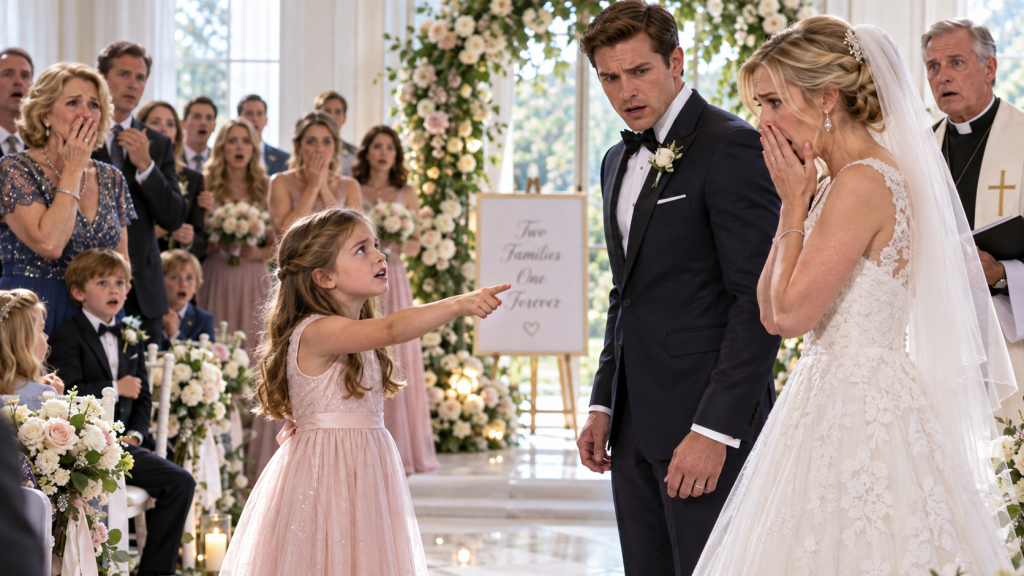
The reception hall had gone almost completely silent.
That was the first thing I noticed when I entered.
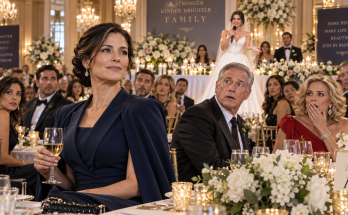
More than a hundred people sat in rows of decorated chairs.
Some turned toward me immediately.
Others whispered.
The music had stopped.
The officiant stood awkwardly near the altar.
Ryan was still wearing his suit.
Kelsey stood beside him in a white dress.
My younger sister looked beautiful.
That hurt too.
There had been a time when I imagined helping her choose that dress.
I thought I would cry at her wedding.
I thought I would stand beside her.
I never imagined the groom would be the father of my children.
Then I saw Amelia.
She stood in the center aisle.
Alone.
Her pink backpack sat at her feet.
Her hands were clenched together.
My mother stood several feet behind her.
“Amelia,” Mom hissed. “Sit down right now.”
My daughter did not move.
My father looked pale.
Ryan looked furious.
And Kelsey looked as though someone had removed every word from her mouth.
“Amelia.”
Ryan’s voice had the tone he used when he wanted the children to obey without making a scene.
“Go sit with Grandma.”
My daughter shook her head.
“No.”
I had never heard her say that word to him like that.
Ryan’s jaw tightened.
“This is not the time.”
Amelia’s voice trembled.
“You said that every time I asked you something.”
The room became even quieter.
Ryan glanced around.
“Sweetheart, we can talk later.”
“No.”
Her eyes filled.
“Later is when you tell me I misunderstood.”
I stopped walking.
Because suddenly, this was not simply a nine-year-old interrupting a wedding.
This was a child who had been trying to speak for a long time.
Nobody had listened.
My mother finally noticed me.
Her face hardened.
“Oh, wonderful.”
She walked toward me.
“Look what you’ve caused.”
I stared at her.
“What I caused?”
“Yes.”
She lowered her voice.
“You’ve poisoned that child against her father.”
I looked past her at Amelia.
My daughter still had not seen me.
“What did she say?”
Mom’s expression changed.
“That doesn’t matter.”
“It clearly matters.”
“This is Kelsey’s wedding.”
I almost laughed.
Of all the possible sentences.
My sister’s wedding.
As though the entire day existed in a vacuum.
As though Ryan had appeared unmarried.
As though four children and thirteen years had vanished simply because invitations were printed.
“Move.”
Mom stared.
“What?”
“I need to get to my daughter.”
“You need to stop encouraging her.”
Something in me finally snapped into place.
Not rage.
Clarity.
“I said move.”
Maybe she heard something in my voice she had not heard since the divorce began.
She stepped aside.
I walked down the aisle.
People watched me.
Aunts.
Uncles.
Old family friends.
People who had told me I should forgive.
People who had said marriages ended every day.
People who insisted children were resilient.
People who congratulated Kelsey because apparently happiness mattered more than the road taken to reach it.
I stopped several feet from Amelia.
She saw me.
Her whole face changed.
“Mom?”
I opened my arms.
She ran.
The second she reached me, whatever courage had been holding her upright disappeared.
She buried her face against my chest and started sobbing.
“I’m sorry.”
My heart broke.
“No.”
I held her tighter.
“You don’t have to apologize.”
“I ruined everything.”
“No, baby.”
Behind us, Kelsey began crying.
My mother said sharply, “You see?”
I turned.
“Please stop talking.”
She froze.
Amelia pulled back.
“I didn’t mean to ruin the wedding.”
Ryan finally stepped down from the altar.
“Then why did you do this?”
His tone was too sharp.
I moved Amelia slightly behind me.
Ryan noticed.
“So now you’re protecting her from me?”
“I’m standing beside her.”
“Same thing.”
“No.”
I held his gaze.
“They are not the same thing.”
Ryan looked exhausted.
Embarrassed.
Angry.
But there was something else beneath it.
Fear.
That surprised me.
“What happened before I got here?”
He looked away.
Sarah answered from behind me.
“Amelia asked him to tell everyone the truth.”
Ryan glared at her.
“This is family business.”
Sarah crossed her arms.
“You invited the family.”
Several people shifted uncomfortably.
Under different circumstances, I might have smiled.
I looked at Amelia.
“What truth?”
She wiped her face.
Then reached for her backpack.
Ryan moved.
“Amelia.”
She flinched.
I saw it.
So did half the room.
Ryan stopped immediately.
My daughter knelt and opened the bag.
The first thing she removed was a folded piece of paper.
Then a small envelope.
Then something wrapped in tissue.
She handed the tissue bundle to me.
I unfolded it.
And forgot how to breathe.
It was an ultrasound photograph.
My baby.
The one I had lost.
I recognized it immediately.
Twelve weeks.
A tiny curved shape surrounded by darkness.
I had believed the photograph was still inside a box beneath my bed.
“Where did you get this?”
Amelia’s lips trembled.
“I took it.”
“When?”
“After the baby died.”
My throat closed.
“Why?”
“I didn’t want everyone to forget.”
That sentence cut through every person in the room.
I knelt.
“Oh, sweetheart.”
She began crying again.
“I wanted to remember what he looked like.”
He.
We never knew for certain.
But Amelia had decided almost immediately that the baby was a boy.
She called him Peanut.
She used to kneel beside my stomach at night.
“Goodnight, Peanut.”
After I miscarried, she stopped saying the nickname.
I thought she had moved on.
Children do not always move on.
Sometimes they simply learn which grief adults cannot bear to watch.
Amelia looked toward Ryan.
“Dad forgot.”
Ryan’s face crumpled.
“I didn’t forget.”
“You never talk about him.”
“That doesn’t mean—”
“You told Grandma we needed to stop making Mom sad about the baby.”
He stopped.
I turned toward him.
“What?”
Ryan’s eyes closed.
Amelia continued.
“And Grandma said Mom needed to get over it before court.”
The room shifted.
Not loudly.
But I felt it.
A subtle current of confusion.
“What court?”
I asked.
No one answered.
I looked at Ryan.
“What court?”
He rubbed his forehead.
“Annie, not here.”
My stomach tightened.
“No.”
The word came calmly.
“Absolutely here.”
My father stood.
“Ryan?”
Ryan looked toward him.
“It’s nothing.”
Amelia shook her head.
“It isn’t nothing.”
My mother moved toward her.
“That is enough.”
Amelia stepped behind me.
“Mom,” I said.
“Stay away from her.”
My mother stared as if I had slapped her.
“I’m her grandmother.”
“And right now she is asking for distance.”
“She’s nine.”
“Yes.”
“Which means she should not be controlling this room.”
I looked at my daughter.
Then at the adults surrounding her.
“She wouldn’t have had to if the adults had behaved like adults.”
My mother’s face reddened.
Kelsey finally spoke.
Her voice shook.
“Can somebody please tell me what she has?”
Everyone turned toward Amelia’s backpack.
My daughter removed the folded paper.
“I wrote this.”
Ryan whispered, “Amelia, don’t.”
She stared at him.
“Why?”
“Because this is private.”
“You told Aunt Kelsey everything about Mom.”
That silenced him.
Amelia unfolded the paper.
“I wanted to say it before you promised things.”
My heart ached.
“Baby, you don’t have to—”
“Yes, I do.”
She looked at me.
“Because nobody listens when I tell them at home.”
That destroyed whatever resistance I had.
I nodded.
“All right.”
Her hands shook as she began reading.
“Dear Dad and Aunt Kelsey.”
Kelsey closed her eyes.
“I know everybody says you love each other.”
Amelia swallowed.
“I know Grandma says love is the most important thing.”
She glanced toward my mother.
“But I don’t understand why your love gets to hurt everybody else.”
Nobody moved.
“When Dad left, Noah cried every night for two weeks.”
I covered my mouth.
I had not known she noticed.
“Emma thought it was because she was bad.”
My six-year-old daughter.
My heart cracked.
“Ben asked if Dad would come home if we cleaned our room.”
Ryan looked down.
“And Mom cried in the bathroom because she didn’t want us to see.”
Tears blurred my vision.
“Then Peanut died.”
Her voice broke.
Several people began crying.
“I know adults say the baby wasn’t born yet.”
“But we knew him.”
“I talked to him.”
“Mom bought a little blanket.”
“Dad helped choose his name list.”
“And then he was gone too.”
Ryan covered his face.
Amelia continued.
“After that, Grandma kept saying we needed to be happy for Dad.”
Her voice strengthened.
“But nobody asked if we were sad for Mom.”
My mother sat down.
I had never seen her look so small.
“Everybody told us not to pick sides.”
Amelia wiped her cheek.
“But then everybody picked Aunt Kelsey’s side.”
That sentence fell into the room like glass.
My aunt Linda began openly crying.
My father lowered his head.
Several cousins looked toward my parents.
Amelia looked at her father.
“I love you.”
Ryan’s shoulders shook.
“I love Aunt Kelsey.”
My sister gasped.
“I still love her because she was my aunt before she became this.”
Kelsey broke down.
“But I hate what you did.”
The honesty of children is brutal because they have not yet learned how adults disguise contradictions.
Love and anger.
Loyalty and disappointment.
All existing together.
“You told me Mom should move on.”
Amelia’s voice trembled.
“But you moved on before you even left.”
Ryan looked as though the sentence physically hit him.
Then she reached the final lines.
“If you want to get married, I can’t stop you.”
“I’m a kid.”
“But don’t stand in church and promise you’ll never betray each other unless you tell everybody what happened to the promises you already made.”
Silence.
Complete.
Even the officiant looked away.
Amelia folded the letter.
“I’m done.”
She started toward me.
Ryan whispered, “Wait.”
She froze.
He looked broken now.
Not angry.
Not defensive.
Just broken.
“Amelia.”
She did not turn around.
“I’m sorry.”
My daughter looked back.
“For which thing?”
I felt my heart stop.
Ryan had no answer.
Children ask simple questions adults spend entire lives avoiding.
Amelia nodded.
“That’s why I came.”
Then she picked up the small envelope.
“And because of this.”
Fear returned to Ryan’s face.
Immediate.
Undeniable.
“What is that?”
Kelsey asked.
Amelia looked at me.
“I found it at Grandma’s.”
My mother stood so quickly her chair scraped the floor.
“Give that to me.”
I stepped between them.
“What is it?”
“Nothing that concerns you.”
The room seemed to inhale together.
I stared at my mother.
“Then why are you trying to take it from a child?”
“It is private paperwork.”
Amelia grabbed my hand.
“Grandma said Dad needs it after the wedding.”
My heartbeat changed.
Ryan looked furious now.
Not at Amelia.
At my mother.
“You left that where she could find it?”
Mom whispered, “I thought it was in my desk.”
“What paperwork?”
I demanded.
Kelsey looked between them.
“What is happening?”
Ryan said, “Nothing.”
My sister turned on him.
“Stop saying that.”
For the first time that day, something in Kelsey’s expression looked like doubt.
Not guilt.
Not yet.
But doubt.
I held out my hand.
“Amelia.”
She gave me the envelope.
My name was printed across the front.
ANNIE MARSHALL — FAMILY COURT PREPARATION
My fingers went numb.
I looked at Ryan.
“You hired a custody attorney?”
He did not answer.
I opened the envelope.
There were printed emails.
Notes.
A preliminary parenting proposal.
And a document titled:
FACTORS SUPPORTING MODIFICATION OF PRIMARY RESIDENTIAL CUSTODY.
I stopped breathing.
Ryan and I currently had shared legal custody.
The children lived primarily with me.
He had agreed to that during the divorce.
Because, according to him, his work schedule was unpredictable.
Because he was “thinking about what was best for the kids.”
At least that was what he told me.
Now, in my hands, was a plan to change everything.
I scanned the first page.
Mother exhibits prolonged emotional instability following marital separation and pregnancy loss.
Pregnancy loss.
My miscarriage.
My grief had become evidence.
My hands began trembling violently.
The next line:
Mother has withdrawn socially and demonstrates difficulty maintaining normal family relationships.
Of course I had withdrawn.
My husband had left me for my sister.
My parents defended them.
Family gatherings became unbearable.
Now my absence was apparently instability.
Another line.
Father will establish a stable two-parent household upon remarriage.
I looked toward the altar.
Stable two-parent household.
Ryan.
My sister.
Together.
The affair that destroyed our family was being repackaged as proof that they were more stable than I was.
I felt physically sick.
Kelsey approached.
“What is that?”
Ryan reached toward her.
“Kelsey.”
She pulled away.
“What is it?”
I handed her the page.
She read.
Color drained from her face.
“You knew about this?”
I asked.
She looked at Ryan.
“I didn’t.”
Ryan sighed.
“It’s preliminary.”
Kelsey’s eyes moved over the document again.
“You’re trying to take Annie’s children?”
“They are my children too.”
“That is not what I asked.”
Ryan’s jaw tightened.
“I’m trying to make sure they’re okay.”
I almost laughed.
“You mean the children you left with me while you planned a wedding?”
“I never abandoned them.”
“You moved out.”
“I saw them.”
“Every second weekend.”
“Because you made things difficult.”
My cousin Sarah said, “She followed the schedule you agreed to.”
Ryan ignored her.
He looked at me.
“Annie, you were barely functioning after the miscarriage.”
My vision blurred with rage.
“I lost our baby.”
“I know.”
“No.”
I stepped toward him.
“You knew a fact.”
My voice broke.
“You did not carry the grief.”
His face tightened.
“I lost a child too.”
“And you planned to use that loss in court against me.”
Silence.
There it was.
No answer could make that beautiful.
Kelsey looked horrified.
“When were you going to tell me?”
Ryan turned.
“It wasn’t definite.”
“When?”
“Kelsey.”
“Were you planning to move the kids in with us?”
“It was an option.”
Her mouth fell open.
“We never discussed that.”
“I was going to.”
“When? After today?”
Ryan became irritated.
“Why does everyone keep acting like I’m some monster for wanting my children?”
Amelia whispered behind me:
“Because you didn’t ask us.”
Everyone turned.
Ryan stared at her.
“What?”
“You didn’t ask us.”
He opened his mouth.
Amelia continued.
“You asked me if I liked Aunt Kelsey’s new house.”
My stomach dropped.
“What house?”
Kelsey looked confused too.
Ryan went pale.
Amelia looked between them.
“The blue one.”
My sister frowned.
“What blue house?”
Ryan said quickly, “She means the rental.”
“No.”
Amelia shook her head.
“The one Dad showed Grandma.”
Ryan closed his eyes.
My mother whispered, “Amelia.”
My daughter ignored her.
“He said there were enough bedrooms for all four of us.”
Kelsey turned slowly toward Ryan.
“You bought a house?”
“No.”
“Then what is she talking about?”
“I was looking.”
“For us?”
“Yes.”
“Why didn’t I know?”
Ryan rubbed his forehead.
“Because nothing was finalized.”
It was almost surreal.
The wedding ceremony had begun with Ryan standing at an altar confident that he controlled the day.
Now every sentence pulled another thread from the life he had carefully arranged.
My sister looked at him as if she were meeting him for the first time.
“Were you going to take Annie’s kids and move them into a house I hadn’t even seen?”
“I wasn’t taking anyone.”
“That paperwork says otherwise.”
“It says we were evaluating options.”
“We?”
“Yes.”
“Who is we?”
Ryan looked toward my mother.
My heart sank.
Mom sat completely still.
“No.”
I whispered.
She did not look at me.
“Mom.”
My father turned toward her.
“What did you do?”
She began crying.
“I was trying to help everyone.”
I actually laughed.
The same sentence.
Always.
Help.
Support.
Family.
People can hide astonishing cruelty beneath gentle words.
“How?”
My father demanded.
Mom looked at me.
“You weren’t well.”
I stared at her.
“After the baby.”
She wiped her eyes.
“You barely left the house.”
“My baby died.”
“I know.”
“You criticized me for not attending dinners three weeks later.”
“I wanted you around people.”
“No.”
My voice remained calm.
“You wanted me performing recovery quickly enough that everyone else could feel comfortable.”
Her face crumpled.
“That isn’t fair.”
“And this is?”
I held up the custody paperwork.
“You were helping my ex-husband build a case to take my children?”
“I thought maybe temporarily.”
My knees nearly gave out.
My father grabbed the back of a chair.
“You knew?”
Mom started crying harder.
“Ryan said the children needed stability.”
My father looked toward the man at the altar.
“The man who cheated on our daughter told you our daughter was unstable, and you believed him?”
“He was concerned.”
“He was sleeping with your other daughter!”
His voice echoed through the room.
I had never heard Dad yell like that.
My mother recoiled.
Kelsey started crying.
Dad looked around, suddenly seeming to understand the scene his family had become.
He took off his glasses.
“God.”
Then Amelia tugged gently at my coat.
“There’s another thing.”
I looked down.
“What?”
She pointed toward the backpack.
My heart sank.
“Another thing?”
She nodded.
“I recorded them.”
Every adult in the room became still.
“Who?”
“Dad and Grandma.”
Ryan went white.
“When?”
“Last weekend.”
My mother whispered, “No.”
Amelia took out a small tablet.
“I was coloring in Grandma’s bedroom because they told me to stay upstairs.”
I knew that house.
The guest bedroom sat directly above the kitchen.
There was an old heating vent connecting the rooms.
“I heard Dad say my name.”
Ryan stepped toward her.
“Amelia, give me that.”
I moved in front of him.
“Do not.”
His voice sharpened.
“That is a private conversation.”
Sarah laughed bitterly.
“You’re having a rough day with private conversations.”
Amelia unlocked the tablet.
“I didn’t understand all of it.”
She looked at me.
“But they were talking about making us say things.”
My blood went cold.
“What things?”
“That you stayed in bed all day.”
I swallowed.
“I did sometimes.”
“I know.”
She held my hand.
“Because you were sad.”
Her voice broke.
“But Dad said we should say you forgot to feed us.”
The room vanished.
For a second, all I saw was my daughter.
Nine years old.
Being asked to transform her mother’s grief into neglect.
“I never forgot to feed you.”
“I know.”
She started crying.
“I told Grandma that.”
My mother covered her face.
“What did she say?”
Amelia looked at her.
“She said I didn’t have to lie.”
Relief tried to arrive.
Then Amelia continued.
“She said I just had to say I didn’t remember.”
My father turned away.
I thought he might be sick.
There are moments when betrayal reaches beyond anger.
This was one.
My mother had not wanted Amelia to lie.
She wanted her to become conveniently uncertain.
Ryan’s voice cracked.
“Play it.”
I looked at him.
His expression had changed.
Something almost desperate was happening.
“Ryan?”
“Play the recording.”
Amelia pressed the screen.
My mother’s voice filled the silent wedding hall.
“She has good days and bad days, Ryan. You can’t expect Amelia to understand the difference.”
Then Ryan:
“She doesn’t have to understand it. The evaluator just needs to hear what the house was like after the miscarriage.”
My stomach turned.
Mom:
“Annie loves those children.”
Ryan:
“I know she does.”
That surprised me.
Then he continued.
“But love isn’t the issue. Stability is.”
Mom:
“Kelsey isn’t ready to raise four children.”
A pause.
Ryan answered:
“She’ll adjust.”
Kelsey made a sound beside me.
Not a sob.
Something colder.
The recording continued.
Mom:
“Does Kelsey even know you talked to the attorney?”
Silence.
Then Ryan:
“Not yet.”
Kelsey took a step backward.
His face collapsed.
The recording kept playing.
“Once we’re married, it’s different. We’re a legal household. Two incomes. Two parents. The judge looks at that differently.”
Mom:
“And Annie?”
Another pause.
“Annie will fight.”
My entire body shook.
Ryan’s recorded voice continued.
“But she’s exhausted. She’s grieving. She barely has the energy to argue with anyone right now.”
That sentence hurt more than the others.
Because it was true.
I had been exhausted.
I had been grieving.
And my husband had looked at the weakest season of my life and seen opportunity.
Then came Mom’s voice.
Quiet.
“I don’t want to hurt her.”
Ryan answered:
“Then help me do this before she gets stronger.”
The recording ended.
No one moved.
The wedding hall felt like a tomb.
Ryan stared at the floor.
My mother sobbed.
My father sat down as though his legs had stopped working.
And Kelsey—
Kelsey was looking at Ryan.
Really looking.
Not at the man she had fallen in love with.
Not at the groom.
Not at the future she had defended against everyone.
At the man beneath all of it.
“You were going to use her grief.”
Ryan whispered, “Kelsey.”
“You were going to take her children while she was grieving.”
“I was trying to protect my kids.”
“You just said on that recording that you needed to do it before she got stronger.”
He said nothing.
My sister looked at me.
Her face was covered in tears.
For the first time since I learned about their affair, I saw shame in her.
Not discomfort.
Not defensiveness.
Shame.
“Annie.”
I raised one hand.
“Not today.”
She stopped.
I could not comfort her.
I could not hear her apology.
Not while she was wearing a wedding dress chosen for a marriage built inside the ruins of mine.
Amelia leaned against me.
I wrapped my arm around her.
Ryan looked toward his daughter.
“Amelia, why didn’t you tell me you recorded that?”
She stared at him.
“Because you would’ve deleted it.”
There was no accusation in her voice.
Only certainty.
And that was perhaps the saddest thing my daughter had said all day.
Ryan looked destroyed.
“You really think I would do that?”
Amelia did not answer.
Children sometimes understand adults most clearly when they stop believing their words.
My father stood.
He faced Ryan.
“This wedding is over.”
My mother looked at him.
“You can’t decide that.”
He turned toward her.
“No.”
His voice became quiet.
“I’m deciding what I participate in.”
Then he looked at Kelsey.
“Your choice is yours.”
My sister stared at the floor.
The officiant shifted uncomfortably.
Ryan took Kelsey’s hands.
“Kels.”
She pulled them away.
“I need a minute.”
“Don’t do this because everyone is emotional.”
She laughed through tears.
“You mean the way Annie was emotional?”
He froze.
Something in her face hardened.
“You really like that word when a woman stops agreeing with you.”
For the first time in a year, I saw my little sister.
Not the person who betrayed me.
The girl who used to sneak into my room after nightmares.
The girl whose hair I braided before school dances.
The girl who apparently believed Ryan had chosen her because their love was extraordinary.
Maybe she was finally realizing he had chosen himself all along.
Kelsey looked at me.
“I didn’t know about the children.”
I said nothing.
“I swear.”
My eyes filled.
“That doesn’t erase what you did know.”
She nodded.
“No.”
Another first.
No defense.
No but we fell in love.
No you and Ryan were having problems.
Just:
“No.”
She turned toward Ryan.
“I’m not marrying you today.”
A gasp moved through the room.
Ryan stared.
“What?”
“I can’t.”
“Kelsey, we can discuss this privately.”
She looked around.
“Apparently privacy is where you do your best work.”
Sarah covered her mouth.
Ryan’s face went red.
“This is insane.”
“No.”
Kelsey removed her veil.
“My niece just played a recording of you planning to use her mother’s miscarriage to take her children.”
“You knew I wanted more custody.”
“I knew you wanted to see them more.”
“Same thing.”
“No.”
Kelsey’s voice broke.
“It isn’t.”
She removed the ring.
Ryan stared at it.
“Kelsey.”
She placed it in his hand.
The wedding was over.
Not because I stopped it.
Not because I stood up and objected.
I had not even planned to attend.
It ended because a nine-year-old girl refused to let the adults around her build another beautiful ceremony on top of an ugly secret.
I looked down at Amelia.
“You ready to go home?”
Her lip trembled.
“Are you mad?”
“At you?”
She nodded.
I knelt.
“No.”
“But I interrupted.”
“Yes.”
“And everybody’s crying.”
“That isn’t your responsibility.”
“But the wedding—”
I touched her face.
“Adults make choices.”
My voice broke.
“And adults are responsible for what those choices cause.”
Her eyes filled.
“I just didn’t want Dad to promise things if promises don’t mean anything.”
That shattered me.
I pulled her into my arms.
“Promises do mean something.”
She whispered into my shoulder:
“Then why did he break yours?”
I closed my eyes.
Because there are questions children deserve answers to, and there are questions nobody can answer without giving them burdens they should not carry.
“Because adults can love people and still make selfish choices.”
“Does that mean love isn’t enough?”
I looked at her.
Maybe the whole room needed the answer.
“No.”
I brushed the hair from her forehead.
“Love is important.”
“But love without honesty, loyalty, and kindness can still hurt people.”
She nodded slowly.
I hoped she remembered that longer than she remembered the wedding.
We started toward the exit.
Then my father called my name.
“Annie.”
I turned.
He held another sheet from the envelope.
His face looked strange.
“What?”
He glanced toward Mom.
She immediately started shaking her head.
“Robert.”
He ignored her.
“Annie, there’s something else in here.”
My stomach tightened.
“What?”
“It’s from the attorney.”
Ryan’s face changed.
“Give me that.”
My father looked at him.
“No.”
“Robert, it’s privileged.”
“You left it in my house.”
My father unfolded the page.
I watched his eyes move downward.
Then stop.
“What is it?”
He looked at me.
And suddenly the anger disappeared from his face.
In its place was something that frightened me more.
Confusion.
“Dad.”
He looked toward Ryan.
Then toward Kelsey.
Finally, back to me.
“This isn’t just about custody.”
My heartbeat accelerated.
“What do you mean?”
My mother began crying harder.
“Robert, please.”
“What did you do?”
I whispered.
She shook her head.
Nothing.
My father looked at the page again.
“The attorney’s notes say Ryan expected the custody petition to become significantly easier once a pending medical report was introduced.”
I frowned.
“Medical report?”
Ryan went completely pale.
My body went cold.
“What medical report?”
Nobody answered.
I looked at Ryan.
“What medical report?”
His mouth opened.
Nothing came out.
Kelsey stared at him.
My cousin Sarah stepped closer.
Amelia grabbed my hand.
Finally, my mother whispered:
“Annie…”
I turned.
Her face was gray.
“What?”
She looked at the ultrasound photograph still trembling in my other hand.
Then she said the sentence that made every person in that room go silent again.
“There was something about the baby that we never told you.”
I stopped breathing.
Ryan closed his eyes.
And suddenly, the wedding, the affair, the custody case—everything that had brought me there—felt like only the surface of a secret I had never known existed.
I looked at my mother.
“What about my baby?”
She began sobbing.
And Ryan whispered:
“Annie, please let me explain.”
PART 3 — THE PROMISE MY DAUGHTER KEPT
“What about my baby?”
My mother began sobbing.
Ryan closed his eyes.
And suddenly I hated both of them for the silence more than I hated whatever answer was coming.
“Tell me.”
My voice barely sounded like mine.
Mom pressed one hand against her mouth.
“Annie…”
“Tell me.”
Ryan took one step toward me.
I moved backward.
“Not you.”
He stopped.
I looked at my mother.
“You knew something about my baby.”
She nodded.
“How long?”
Her face crumpled.
“Since a few weeks after you lost him.”
The ultrasound photograph trembled in my hand.
A few weeks.
While I was waking up every morning with my palms automatically moving toward a stomach that was no longer pregnant.
While I was standing in the shower wondering what I had done wrong.
While I was lying awake at three in the morning replaying every stressful argument with Ryan and asking myself whether my body had failed because I had not been strong enough.
They knew something.
And they let me grieve without it.
“What did the report say?”
Mom looked toward Ryan.
I saw it.
That tiny movement of her eyes.
Permission.
Habit.
Even now, she wanted to know what version he preferred.
Something inside me hardened.
“Do not look at him.”
Her eyes snapped back to mine.
“What did it say?”
She began crying harder.
“The hospital sent additional testing.”
“What testing?”
“Chromosomal testing.”
My throat closed.
Ryan whispered, “Annie, the doctor said—”
I turned on him.
“You will get your turn.”
He fell silent.
I looked at Mom again.
“What did they find?”
She swallowed.
“The baby had a chromosomal abnormality.”
The room disappeared.
Not literally.
People were still there.
The abandoned wedding flowers.
The overturned program on the floor.
Kelsey in her white dress.
Amelia holding my hand.
But all of it receded behind one sentence.
“What kind?”
Mom whispered, “They said it was not compatible with the pregnancy continuing normally.”
My knees weakened.
Sarah caught my elbow.
I barely felt her.
“So…”
I struggled to form the words.
“It wasn’t because of the stress?”
Ryan covered his face.
Nobody answered.
I already knew.
But I needed someone to say it.
“Was it because of what happened with Ryan?”
“No,” Mom whispered.
“Because I wasn’t sleeping?”
“No.”
“Because I missed meals?”
“No.”
“Because I cried too much?”
“No.”
My voice broke.
“Because I failed him?”
My mother sobbed.
“No, Annie.”
And just like that, grief I had been carrying for months changed shape.
It did not become smaller.
My baby was still gone.
There was no medical explanation powerful enough to restore the heartbeat I had once watched flickering on a screen.
But for months, I had been carrying guilt beside the grief.
Quietly.
Secretly.
I blamed my body.
I blamed my stress.
I blamed myself for not protecting the pregnancy from the disaster happening around it.
And the two people standing in front of me had known I was wrong.
I looked at Ryan.
“You had the report?”
He lowered his hands.
“Yes.”
“How?”
“The clinic sent a copy because I was still listed as your spouse and emergency contact.”
“Did they send it to me?”
He hesitated.
“I told them I would explain it.”
My whole body went cold.
“You told them you would explain my medical results to me?”
“You weren’t doing well.”
There it was again.
The excuse that apparently opened every door.
I was grieving.
Therefore Ryan could decide.
I was exhausted.
Therefore Ryan could speak for me.
I was devastated.
Therefore everyone else became entitled to manage the truth.
“Did you ever intend to tell me?”
“Yes.”
“When?”
He said nothing.
I laughed.
It came out broken.
“Was it before or after you used my grief to take my children?”
Kelsey covered her mouth.
Ryan looked toward the floor.
I stepped closer.
“You knew there was a medical explanation for the miscarriage.”
“Yes.”
“You knew I blamed myself.”
His face twisted.
“I didn’t know how much.”
I stared at him.
“You watched me apologize to you.”
His eyes closed.
That memory came back so violently I almost staggered.
Three weeks after the miscarriage, Ryan had come by the house to pick up the children.
I was standing in the kitchen.
I suddenly started crying.
I told him:
“I’m sorry I couldn’t keep the baby safe.”
Ryan had hugged me.
He had actually hugged me.
He had rubbed my back and whispered:
“You can’t blame yourself forever.”
I had thought it was compassion.
Now I understood the full ugliness of the moment.
He knew I had nothing to blame myself for.
And he let the guilt remain.
“You held me.”
Tears ran down my face.
“You held me while I apologized for losing our baby.”
Ryan began crying.
“I didn’t know how to tell you.”
“You say things, Ryan.”
My voice rose.
“That is how you tell someone.”
“You open your mouth and tell the truth.”
He stepped toward me again.
“I thought the information might make things worse.”
“How?”
“You were already obsessing over every detail.”
I stared at him.
“So you chose for me.”
“I thought—”
“You chose.”
He stopped.
I held up the custody papers.
“And then my grief became useful.”
His face went white.
“No.”
“Your lawyer wrote it down.”
“I never said we should hide the pathology because of court.”
“Did you give your attorney my medical records?”
Silence.
“Ryan.”
“Yes.”
“Did you give them the report about the baby?”
He looked toward the floor.
“Eventually.”
“What does eventually mean?”
“After the initial consultation.”
“Did your first description of me mention the medical cause of the miscarriage?”
He said nothing.
Sarah whispered something under her breath.
Kelsey turned away from him.
I understood.
Ryan had built a story first.
Emotionally unstable wife.
Withdrawn mother.
Woman unable to cope after pregnancy loss.
Then, somewhere later in the paperwork, came the inconvenient fact that my pregnancy had ended for a medical reason I did not cause.
The truth had been included only after the narrative had already been written.
“What was the medical report they were waiting for?”
I asked.
Ryan looked confused.
“The attorney’s notes.”
I pointed at the page in Dad’s hand.
“It says the custody petition would become easier when a pending medical report was introduced.”
Ryan’s silence returned.
My father spoke.
His voice was frighteningly quiet.
“Answer her.”
Ryan rubbed his forehead.
“It was a psychological assessment.”
I stopped.
“What psychological assessment?”
“Not an assessment exactly.”
“Then what?”
“Notes from your grief counselor.”
My mouth went dry.
“You got my therapy records?”
“Not the full records.”
“How?”
“I requested information during the custody consultation.”
“You weren’t entitled to that.”
“It was going to be handled formally.”
“Did my therapist give them to you?”
“No.”
“Then what did you have?”
Ryan hesitated.
“An intake summary.”
My stomach dropped.
My mother began crying again.
I looked at her.
“You.”
She shook her head.
“Annie—”
“You had it.”
“I found a copy at your house.”
“How?”
“You left paperwork in the kitchen.”
I stared at her.
My own mother had gone through papers in my house.
She had found records from a grief counselor.
And instead of protecting them—
she had handed them to my ex-husband.
“What did it say?”
Mom whispered, “That you had acute grief symptoms.”
“Of course I did.”
“It mentioned insomnia.”
“My baby died.”
“Loss of appetite.”
“My baby died.”
“And feelings of hopelessness.”
“My husband left me for my sister and my baby died!”
My voice echoed through the hall.
No one moved.
I could hear myself breathing.
Too fast.
Too sharp.
Amelia squeezed my hand.
That little pressure brought me back into my body.
I looked down.
My nine-year-old daughter was crying.
And suddenly I remembered something more important than destroying Ryan in front of a hundred people.
Amelia was watching.
She had already carried too much.
I knelt in front of her.
“Are you okay?”
She nodded automatically.
The same way I always did.
I almost smiled through my tears.
“Real answer.”
She looked at me.
“No.”
“That’s okay.”
Her lip trembled.
“Did the baby die because you were sad?”
My heart shattered.
“No.”
I held both of her hands.
“No, sweetheart.”
“Are you sure?”
“Yes.”
For the first time that day, I felt grateful for the medical report.
Not for me.
For her.
“The doctors found something in the baby’s chromosomes that meant his little body couldn’t keep growing.”
Amelia’s eyes filled.
“So nobody made it happen?”
“No.”
“Not Dad?”
I hesitated.
“No.”
Ryan’s betrayal hurt me terribly.
The stress had been cruel.
But I would not give my daughter a medically false answer just because it made Ryan easier to blame.
“Not Dad.”
“Not Aunt Kelsey?”
“No.”
“Not you?”
My voice broke.
“Not me.”
She started sobbing.
I pulled her against me.
For months, I had believed I was hiding my guilt from my children.
Apparently grief has a way of leaking through walls.
Amelia whispered against my shoulder:
“I thought maybe if everybody had been nicer, Peanut would still be here.”
I closed my eyes.
“Oh, baby.”
That sentence hurt more than everything Ryan had done.
My child had been building her own explanation.
Just like I had.
And no adult had realized she needed the truth too.
I held her tighter.
“You did nothing wrong.”
“Neither did you?”
“Neither did me.”
Her grammar was nine years old.
Her grief was much older.
When I stood again, something in me had changed.
I was still furious.
But I no longer wanted the day to belong to Ryan.
I wanted it to belong to Amelia.
To truth.
To the children everyone claimed to be protecting while using them as pieces in adult arguments.
I looked at the guests.
Relatives who had whispered about me.
Friends who had congratulated Ryan and Kelsey.
People who had told me to move on because discomfort is exhausting to watch from a safe distance.
“I’m taking my daughter home.”
Ryan stepped forward.
“Annie, wait.”
“No.”
“We need to talk.”
“We do.”
Hope appeared in his face.
“Through lawyers.”
It vanished.
“Please don’t do that.”
I almost laughed.
“You were already doing that.”
“That’s different.”
“No.”
I looked at him.
“The difference is that you thought I didn’t know.”
He had no answer.
Then Kelsey spoke.
“I want a copy of that recording.”
Ryan turned sharply.
“Kelsey.”
She ignored him.
She had removed the veil completely.
Her hair was beginning to fall from the elegant pins.
Mascara darkened the skin beneath her eyes.
She no longer looked like a bride.
She looked like my little sister standing in the ruins of a terrible choice.
I looked at Amelia.
“Is that okay?”
Amelia nodded.
“Yes.”
Ryan stared at Kelsey.
“Why?”
“Because I need to know what else you’ve been planning without me.”
“Kels—”
“No.”
She stepped away.
“Do not call me that right now.”
Something in her voice silenced him.
She looked at me.
“I know I have no right to ask you for anything.”
I said nothing.
“But I need you to know I did not know about the custody plan.”
“I believe you.”
Her face collapsed.
That surprised her.
Then I added:
“But you knew he was married.”
She nodded.
“You knew I was pregnant.”
Another nod.
“You knew he had four children.”
“Yes.”
“And you chose the affair anyway.”
“Yes.”
No excuses.
Not today.
I appreciated that more than tears.
She whispered, “I thought if he chose me, it meant what we had was special.”
I felt something twist inside me.
“People can choose you for selfish reasons too.”
Her mouth trembled.
“I know that now.”
Ryan looked at her.
“Kelsey, don’t let one bad conversation rewrite everything.”
She turned toward him.
“One bad conversation?”
Her voice rose.
“You spent months preparing to take Annie’s children.”
“I was trying to become more involved.”
“You wrote that she was unstable.”
“She was struggling.”
“Of course she was struggling!”
My sister shouted it.
“You left her for me while she was pregnant!”
Ryan stared at her.
The entire room did too.
Kelsey began crying harder.
“I kept telling myself your marriage was already dead.”
She wiped her face.
“You told me she barely noticed you.”
Ryan said nothing.
“You told me you two hadn’t been happy for years.”
“Kelsey—”
“You told me she stopped caring.”
I looked at him.
That part was new.
Ryan closed his eyes.
My sister laughed bitterly.
“She didn’t know that story either, did she?”
No.
I hadn’t.
I had believed our marriage was loving until the day I overheard the hotel conversation.
Apparently Ryan had needed a different version for Kelsey.
One where betrayal looked more like escape.
Kelsey looked at me.
“He told me you stayed together for the kids.”
My eyes filled.
“Three weeks before I caught him, he booked us an anniversary weekend.”
Her face changed.
I continued.
“He talked about renewing our vows for fifteen years.”
Ryan whispered, “Annie.”
“No.”
Kelsey stared at him.
“He told me you hadn’t slept together in months.”
I almost laughed.
“I was pregnant.”
The room went still.
My sister closed her eyes.
A sob left her.
Ryan looked furious.
Not ashamed.
Cornered.
That distinction finally became obvious.
“You’re both making me sound like some calculated psychopath.”
My father stared at him.
“You lied separately to two sisters so each would cooperate with what you wanted.”
Ryan turned.
“I made mistakes.”
Dad’s expression hardened.
“No.”
He shook his head.
“Leaving your keys somewhere is a mistake.”
“This required scheduling.”
That sentence landed hard.
Hotels.
Phone calls.
Lawyers.
Records.
Stories.
Ryan had not accidentally fallen into a second life.
He had managed one.
My father walked toward Mom.
She looked terrified.
“Robert.”
“You helped him.”
“I thought Annie needed help.”
“You gave him her counseling information.”
“I was scared for the children.”
“Did you ever see the children neglected?”
“No.”
“Hungry?”
“No.”
“Unsafe?”
“No.”
“Did Annie ever leave them alone?”
“No.”
“Miss school?”
“No.”
“Forget medical appointments?”
“No.”
Dad’s voice broke.
“Then what exactly were you protecting them from?”
Mom began sobbing.
She could not answer.
Dad nodded slowly.
“You were protecting Kelsey from the consequences of what she had done.”
Mom whispered, “She’s my daughter too.”
“So is Annie.”
The sentence shattered something.
Mom lowered her face.
For the first time since the affair began, my father had said aloud what I had desperately needed one of them to understand.
So was Annie.
I did not want to be chosen over Kelsey.
I had wanted to matter too.
There was a difference.
Dad took off his wedding ring.
My mother stared.
“Robert.”
He looked at it.
Then slipped it into his pocket.
“I cannot stand here today pretending I understand the woman I married.”
“Please.”
“We’ll talk later.”
“Are you leaving me?”
“I don’t know.”
She started crying harder.
Dad looked tired.
Not cruel.
“Unlike everyone else in this family, I’m going to take time before making a life-changing decision.”
No one had anything to say to that.
I took Amelia home.
That evening, the younger children surrounded their sister.
They had no idea she had stopped a wedding.
Not really.
Noah asked whether there had been cake.
Emma wanted to see Kelsey’s dress.
Ben asked why Amelia was crying.
I realized then that truth needed different sizes.
Children deserve honesty.
They do not deserve every adult detail at once.
So I sat all four of them on the couch.
“The wedding didn’t happen.”
Noah’s eyes widened.
“Why?”
“Because Dad and Aunt Kelsey realized there were some very serious things they needed to sort out first.”
Emma looked worried.
“Is Dad coming home?”
My heart tightened.
“No, sweetheart.”
“Why not?”
“Because Dad and I are still divorced.”
She nodded slowly.
At six, she accepted the legal reality more gracefully than half our relatives had.
Then Amelia whispered:
“I told everyone about Peanut.”
The others became quiet.
Ben crawled closer.
“Why?”
“Because I was mad.”
She looked at me.
“And because I thought everybody forgot.”
Noah shook his head.
“I didn’t.”
Emma whispered, “Me neither.”
Then Ben disappeared down the hallway.
He returned carrying a tiny stuffed rabbit.
I recognized it immediately.
We had bought it for the baby.
He placed it beside Amelia.
“I didn’t forget.”
That was when all five of us cried.
Not dramatically.
Just together.
The grief finally belonged to the family instead of living privately inside each of us.
A week later, we planted a small magnolia tree in the backyard.
Amelia chose the place.
Noah dug the hole badly.
Ben put the dirt back in before we were ready.
Emma tied a blue ribbon around one branch because she still believed the baby had been a boy simply because Amelia did.
We placed no plaque.
No date.
No grand words.
We just called it Peanut’s tree.
For months, I had thought remembering the baby meant remembering loss.
The tree taught us otherwise.
Memory can also mean making space.
Ryan filed the custody petition anyway.
That surprised me.
Some part of me believed public exposure would stop him.
It didn’t.
People who build their identity around being right often become most dangerous when the evidence proves otherwise.
His attorney eventually withdrew.
A new attorney took over.
Then the recordings entered the process.
So did the messages between Ryan and my mother.
So did Amelia’s account of being asked to describe me as unreliable.
The custody evaluator was not impressed.
I will never forget what she told me.
“Children should never be recruited as witnesses for a parent’s narrative.”
I almost laughed.
Because that was exactly what everyone had been doing.
My mother wanted Amelia to support Ryan’s version.
Ryan wanted the children to confirm instability.
Relatives wanted them smiling in wedding photographs to prove the family was fine.
Even I had occasionally wanted their affection to reassure me I was still the good parent.
After that meeting, I stopped.
Completely.
I told the children they were allowed to love their father without protecting me from it.
They were allowed to be angry with him without protecting him from it.
Their feelings belonged to them.
Not to the divorce.
Not to the court.
Not to me.
That became one of the most important decisions I made.
The court did not remove Ryan from their lives.
I never asked for that.
But his requested custody change was denied.
The judge kept the children primarily with me.
Ryan received structured parenting time and was ordered to attend co-parenting counseling.
More importantly, the court specifically prohibited either parent—or extended family—from questioning the children about legal strategy or coaching them about the other household.
My mother nearly disappeared from their lives for several months.
That was her choice.
She said she felt “punished.”
I stopped explaining that boundaries were not punishment.
Some lessons only become possible when you stop doing another person’s emotional homework.
Dad moved into a furnished apartment.
He and Mom separated.
They did not divorce immediately.
He spent almost a year deciding whether their marriage had enough honesty left to rebuild.
Eventually, he returned.
But not to the old marriage.
Mom began therapy.
She apologized to me many times.
For defending Kelsey.
For giving Ryan the counseling summary.
For telling Amelia to soften the truth.
For treating my grief like a social inconvenience.
I listened.
I did not immediately forgive.
Then one afternoon she finally said something different.
“I kept asking why you couldn’t move on because if you stayed hurt, I had to admit Kelsey had done something terrible.”
I looked at her.
She continued.
“And if I admitted that, I had to decide whether supporting her meant betraying you.”
Tears filled her eyes.
“So I made your pain the problem.”
There it was.
The first real apology.
Not:
I’m sorry you were hurt.
Not:
I was trying to keep the family together.
Just responsibility.
I cried.
“So what changed?”
She looked toward the backyard, where Amelia was helping Emma ride a bicycle.
“My granddaughter had more courage at nine than I had as her grandmother.”
That was true.
Painfully.
Kelsey did not marry Ryan.
Not that day.
Not later.
She moved out of the house they had rented together within two weeks.
Ryan blamed me at first.
Then Amelia.
Then my father.
Then my mother.
Then Sarah.
Anyone except himself.
Eventually, there was nobody left.
That was when therapy apparently became useful.
Months later, he asked to meet me after a co-parenting session.
We sat on opposite sides of a small conference table.
He looked older.
Not dramatically.
Just less certain.
“I owe you an apology.”
I almost smiled.
“You owe me several.”
He nodded.
“I know.”
He looked down.
“I did love you.”
That hurt.
But not the way it once would have.
“I know.”
His head lifted.
“You believe me?”
“Yes.”
“Then how can you hate me?”
“I don’t.”
He seemed confused.
I continued.
“Love does not automatically make what you did less cruel.”
He stared at me.
“You can love someone and still treat them selfishly.”
“You can love them and lie.”
“You can love them and still choose yourself every time it costs something.”
My eyes filled.
“That’s what makes it sad, Ryan.”
He wiped his face.
“I let myself believe our marriage was over before I ever told you I was unhappy.”
I nodded.
“I know.”
“I made you the villain when I talked to Kelsey.”
“Yes.”
“Because otherwise I had to admit what we were doing.”
“Yes.”
“And I used the miscarriage.”
His voice broke.
I looked away.
That wound remained different.
“I don’t know how to apologize for that.”
“You can’t fix it with the right sentence.”
“I know.”
“Then don’t try.”
He nodded.
After a long silence, he said:
“I should have told you about the chromosomal results the day I got them.”
“Yes.”
“I thought I was protecting you.”
“No.”
He stopped.
I looked directly at him.
“You were protecting yourself from having a difficult conversation.”
His face fell.
That distinction mattered.
People often call avoidance protection because it sounds kinder.
It isn’t.
Before we left, Ryan asked:
“Do you think Amelia will ever forgive me?”
I thought about my daughter.
“I don’t know.”
He looked crushed.
“But if she does, it will happen because she feels safe enough to.”
He nodded.
“Not because you convince her she should.”
That became the beginning of Ryan becoming a better father.
Not a better husband.
That chapter was over.
But gradually, he stopped demanding the children move past things quickly enough to make him comfortable.
He started listening.
When Noah asked why he had left, Ryan answered without blaming me.
When Emma cried because Daddy did not live at home, he did not promise we might reconcile.
When Ben asked if he was going to marry Aunt Kelsey, Ryan said no.
And when Amelia refused to see him alone for almost three months, he did not force the issue.
He wrote letters.
Not asking forgiveness.
Just showing up.
Eventually, she agreed to have lunch with him.
I waited in the car outside.
She returned forty minutes later.
Her eyes were red.
“How was it?”
She shrugged.
“Bad.”
I almost smiled.
“Real answer?”
“That is the real answer.”
Then she added:
“But maybe next time will be less bad.”
That was enough.
Healing rarely arrives looking impressive.
Sometimes it is simply agreeing there can be a next time.
Kelsey and I did not speak for almost a year.
People expected us to reconcile because we were sisters.
Family loves the idea of reconciliation.
It makes gatherings easier.
I was no longer interested in arranging my healing around Thanksgiving seating charts.
Then one afternoon, a package arrived.
Inside was no gift.
No dramatic apology.
Only a letter.
Annie,
I have written this fourteen times. Every version sounded like I was trying to explain myself, and explanations are the last thing I owe you.
I stopped reading.
Then continued.
I knew Ryan was married. I knew you loved him. I knew you were pregnant. I knew he had four children. I wanted what I wanted anyway.
My eyes filled.
He lied to me about your marriage, but he did not force me to betray you.
For the first time, she separated the two truths.
Ryan deceived her.
She still chose to hurt me.
I spent months thinking being chosen by him meant I had won something. On our wedding day, Amelia showed me that what I had actually won was a man who could justify betrayal whenever another person became inconvenient.
I sat down.
I am not asking to be your sister again. I gave up the right to expect that relationship from you. I only want to say I am sorry without requiring you to make me feel better afterward.
I read the letter three times.
Then put it away.
I did not answer for two months.
When I finally did, I wrote only:
I believe you are sorry. I am not ready for more.
Kelsey replied:
Okay.
No guilt.
No pressure.
No Mom calling to negotiate.
That one word probably repaired more than every tear-filled apology before it.
Years later, Kelsey became part of my life again.
Carefully.
Slowly.
Never as though nothing happened.
The old sisterhood did not return.
We built a different one.
Smaller.
More honest.
Sometimes repaired relationships are beautiful precisely because nobody pretends the cracks disappeared.
Four years after the wedding that never happened, Amelia turned thirteen.
She had become taller.
Sarcastic.
Far too interested in eyeliner.
She no longer carried the pink backpack.
It sat in a box in her closet beside dolls she claimed she had never loved.
On her birthday, she asked if we could visit Peanut’s tree.
The magnolia had grown taller than me.
White flowers covered the branches.
The other children ran around the yard while Amelia and I stood beneath it.
“Mom?”
“Yeah?”
“Do you wish I hadn’t stopped the wedding?”
The question surprised me.
“No.”
“Really?”
“Really.”
She looked down.
“I used to feel bad.”
“For what?”
“Everybody said I was brave.”
She kicked lightly at the grass.
“But I wasn’t trying to be brave.”
“What were you trying to be?”
“Mad.”
I laughed softly.
“Those can happen together.”
She smiled.
Then became serious.
“I thought if I didn’t say anything, everybody would keep pretending.”
I understood.
“That happens sometimes.”
She looked toward the tree.
“Did I ruin Dad’s life?”
My heart tightened.
“No.”
“But Aunt Kelsey left him.”
“Because of choices he made.”
“Grandma and Grandpa separated.”
“Because they had problems they needed to face.”
“The court—”
“Amelia.”
I turned her toward me.
“You revealed information.”
“That is not the same thing as causing the consequences.”
She watched me carefully.
“Adults are responsible for what they do before a child tells the truth about it.”
Her eyes filled.
I wished someone had taught me that at nine.
At twenty-nine.
At thirty-six.
Truth does not create the wound.
Sometimes it only removes the bandage someone wrapped around it to hide the blood.
Amelia leaned against me.
“I miss Peanut sometimes.”
“Me too.”
“Even though I never met him.”
“You did meet him.”
She looked at me.
“You talked to him.”
I touched her chest gently.
“You imagined him.”
“You loved him.”
“Sometimes that’s how we meet people first.”
She smiled through tears.
“Do you still think he was a boy?”
I asked.
“Obviously.”
“Based on absolutely no evidence.”
“I had sister intuition.”
“You are impossible.”
“You raised me.”
I laughed.
There was something almost holy about that moment.
For months after the miscarriage, I thought remembering my fifth baby would always destroy me.
Now grief had softened.
Not vanished.
Softened.
I could think of that little ultrasound photograph without immediately feeling as though my lungs had collapsed.
I could say:
I had five children.
Four stayed.
One did not.
All were loved.
The medical report had not given me closure.
I no longer believed closure was a door people walked through once.
It gave me something simpler.
Mercy.
I had finally stopped accusing myself of a crime my body had never committed.
Ryan eventually remarried.
Not Kelsey.
Years later, he met a woman named Laura.
Before they became serious, he told her everything.
The affair.
The failed wedding.
The custody petition.
The recording.
Even the medical report.
I knew because Laura asked to meet me before she met the children.
That alone told me Ryan had changed in ways I had once begged him to.
We sat at a coffee shop.
She looked terrified.
“I want you to know I’m not trying to replace you.”
I smiled.
“The children already have a mother.”
“I know.”
“And if you love them, there will be room for you too.”
She looked surprised.
So was I.
But I meant it.
Ryan and I never became friends.
That word would be too generous.
We became respectful co-parents.
People sometimes call that a sad ending.
I don’t.
The sad ending would have been staying married while teaching our children that love required swallowing betrayal until everyone else felt comfortable.
Instead, they saw something more complicated.
Adults can fail.
Adults can separate.
Adults can face consequences.
Adults can sometimes change.
And forgiveness does not always mean returning.
That lesson mattered.
My parents stayed married.
But the marriage changed.
Dad told Mom he would only return if they both stopped treating silence as family loyalty.
Mom agreed.
She spent years repairing what she could with me.
She never fully repaired it with Amelia.
My daughter remained polite.
Kind.
But careful.
Mom once cried to me about that.
“I hate that she doesn’t trust me.”
I looked at her.
“Then become someone trustworthy and let her decide what happens next.”
She nodded.
No argument.
That was growth too.
Ten years after the wedding, Amelia was nineteen.
She came home from college one weekend and found me looking through an old box.
Inside was the pink backpack.
The ultrasound picture.
Her letter.
I had kept everything.
She sat beside me on the bedroom floor.
“Oh my God.”
“What?”
“My handwriting.”
“It was adorable.”
“It looks like a raccoon wrote it during an earthquake.”
I laughed.
She took the letter.
For several minutes, she read silently.
Then her expression changed.
“What?”
She looked at me.
“I was really angry.”
“Yes.”
“Did I actually say, ‘You moved on before you even left’?”
“You did.”
“That’s pretty good.”
“You were terrifying.”
She smiled.
Then turned the ultrasound photograph over in her hand.
“Do you ever wonder who he would’ve been?”
“All the time.”
We sat quietly.
Then Amelia said:
“I think that wedding was the day I realized adults could be wrong.”
I looked at her.
“That’s a rough lesson at nine.”
“Maybe.”
She rested her head against my shoulder.
“But I also learned you could love somebody and still tell them they hurt you.”
That sentence stopped me.
Because I had spent years worrying about what the affair, divorce, miscarriage, and wedding had taught my children about love.
I feared Amelia would grow up suspicious.
Afraid.
Unable to trust.
Instead, she had learned something I did not understand until much later.
Love is not silence.
Love is not pretending.
Love is not protecting someone from the consequences of hurting you.
Sometimes love says:
I care about you.
And this is still wrong.
Sometimes love leaves.
Sometimes love sets boundaries.
Sometimes love comes back in a different shape.
And sometimes the most loving person in the room is a nine-year-old girl who stands in the middle of an aisle and refuses to let adults make promises over truths nobody is willing to say aloud.
I put the ultrasound picture back inside the backpack.
Amelia stopped me.
“Wait.”
She took it again.
Then walked downstairs.
“Where are you going?”
“To Peanut’s tree.”
I followed.
The magnolia was enormous now.
Its branches stretched over the corner of the yard.
Amelia stood beneath it holding the photograph.
“I think we should put this somewhere safer.”
“Probably.”
She looked at me.
“Not hidden.”
I understood.
We eventually framed it.
A small silver frame.
Nothing dramatic.
It sits today on the bookshelf in my living room among photographs of graduations, birthdays, vacations, and four children growing into people I am endlessly grateful to know.
Visitors sometimes ask who the ultrasound belongs to.
I tell them.
“My fifth baby.”
I no longer whisper it.
There is no shame in loving someone who could not stay.
Just as there is no shame in having trusted people who eventually betrayed you.
For a long time, I thought Ryan and Kelsey had humiliated me.
Maybe they had.
But humiliation only becomes identity if you continue carrying someone else’s shame as your own.
Their affair belonged to them.
My mother’s choices belonged to her.
Ryan’s custody plan belonged to him.
My miscarriage was not punishment.
My grief was not instability.
And my daughter’s refusal to remain silent was not disobedience.
It was the moment our family finally stopped asking the wounded people to make everyone else comfortable.
People still occasionally tell the story as:
“The little girl who stopped her father’s wedding.”
That isn’t how I remember it.
Amelia did not stop a wedding.
Ryan and Kelsey’s choices stopped it.
Amelia simply opened the door and let the truth walk inside.
And truth has a strange way of doing that.
It does not always save the relationship.
Sometimes it ends it.
It does not always keep the family together.
Sometimes it forces the family to separate before anything healthy can be rebuilt.
But truth gives everyone something lies take away.
A choice.
Kelsey got to choose whether she still wanted Ryan after understanding what he was capable of.
My father got to choose whether he could remain married to my mother after learning what she had done.
The court got facts instead of a story designed around my grief.
My children eventually got to choose their own relationships with their father.
And I finally got to choose what kind of life I wanted after thirteen years of believing my future had already been decided.
That was Amelia’s real gift.
Not revenge.
Choice.
The thing Ryan had taken away every time he lied.
Years earlier, I stood in my sister’s wedding hall with an ultrasound photograph trembling in one hand and my daughter holding the other.
I thought I had lost everything.
A husband.
A sister.
A baby.
The family I thought would protect me.
But I had not lost everything.
I still had four children watching what I would do next.
I still had a life that belonged to me.
I still had the ability to become more than the worst year I had survived.
And standing beside me was a nine-year-old girl who had already figured out something it took me decades to understand.
You do not protect a family by helping it hide what is hurting people.
You protect a family by making it safe enough for the truth to be spoken.
Even when the truth ruins the wedding.
Even when it embarrasses the adults.
Even when everybody wishes the child would sit down and stay quiet.
Especially then.
On the day Amelia was born, I promised her I would protect her.
Nine years later, in the middle of a wedding aisle, she reminded me that protection sometimes moves in both directions.
She did not save me because I was weak.
She reminded me that I was allowed to stop pretending strength meant enduring everything silently.
And when I think about that day now, I no longer remember Ryan standing at the altar.
I no longer remember Kelsey’s dress.
I barely remember the flowers.
I remember Amelia running into my arms.
I remember her letter shaking between her fingers.
I remember her asking why promises mattered if adults could simply break them whenever they wanted something else.
And I remember the answer I gave her.
Love matters.
Promises matter.
But neither one means much without honesty, loyalty, kindness, and choice.
Years later, I would add one more thing.
Courage.
Not the kind that never feels afraid.
The kind that stands up anyway.
My daughter was nine years old when she taught an entire room full of adults that lesson.
And as we walked out of that ruined wedding together, her little hand wrapped tightly around mine, I thought I was taking her home.
It took me years to understand the truth.
She was helping me find my way home too.
THE END STORIES! THANK YOU FOR READING GOOD LUCK !❤️
Related Posts