In 1995, I sent my fourteen-year-old son to live with his grandparents, and for thirty years I have carried the shame of how easily I called it temporary. His name is Michael. Back then, my second wife, Linda, and he could not be in the same room for ten minutes without something catching fire between them.

She said he was disrespectful. He said she treated him like an unwanted guest in his own home. I stood between them for months pretending neutrality was the same thing as parenting. Then one night, after an argument over something so small I cannot even remember it now, Linda said, “Either he goes, or I do.” I wish I could tell you I chose my son. I did not. I chose the quiet house. I chose the marriage I was afraid to lose. I chose the easier morning, the dinner without tension, the bedroom without another argument waiting behind the door. And because cowardice hates its own name,
I dressed my decision in respectable language. “Your grandparents can give you stability.” “The school district is better.” “This will be good for you.” I repeated those sentences so often that eventually I almost believed them. Michael never cried when I drove him the forty miles to his grandparents’ house. That somehow made it worse. He sat in the passenger seat with a duffel bag between his feet and stared out the window while I talked too much. When we pulled into the driveway,
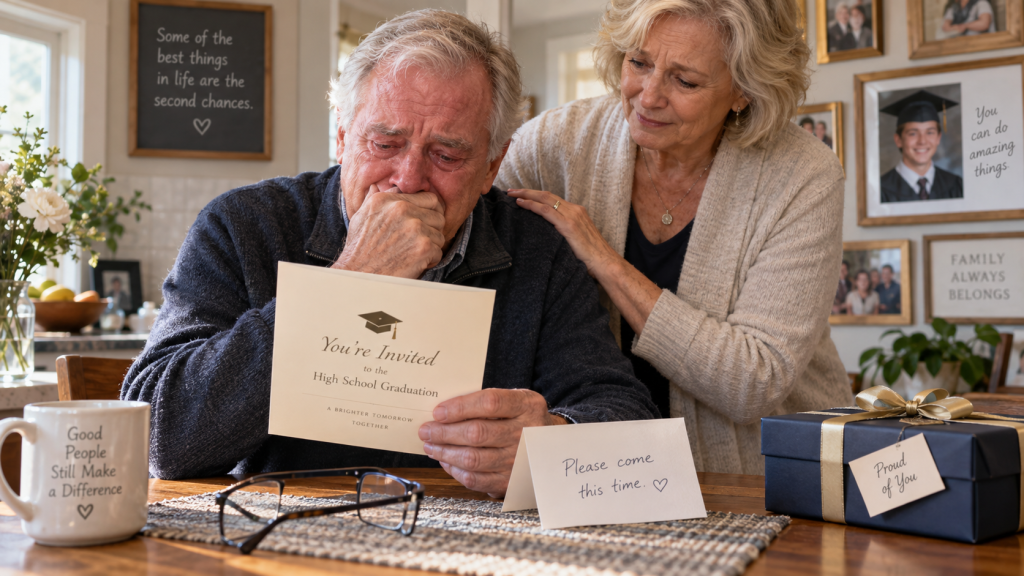
his grandfather came outside and carried his bag in. Michael stood beside the car and looked at me. “How long?” he asked. “Just until things calm down.” He nodded once. “Okay.” I hugged him. He did not hug me back. Things never calmed down because I never brought him home. Weeks became months. Months became years. He finished high school there. His grandmother taught him to drive. His grandfather stood beside him in his graduation pictures. I was there too, of course, smiling from the edge of the frame like a visiting relative. We did holidays after that. Christmas every other year. Thanksgiving when schedules worked. Birthdays by phone. Polite conversations. “Work going okay?” “Yeah.” “How’s Linda?” “Fine.” “Good.” There is a special kind of grief in having a living child who no longer expects anything from you. Michael built a life anyway. He went to college, married a kind woman named Sarah, became an engineer, bought a house with a maple tree in the front yard, and had two children of his own. I attended his wedding and sat three rows back. His grandfather walked with him before the ceremony. I told myself it was appropriate. That word again. Appropriate. So much easier than honest. Over the years, I watched Michael become everything I should have helped him become. Patient. Steady. Present. He coached his son’s baseball team. He never missed school concerts. Once, at a family barbecue, I saw his little boy fall and scrape his knee. Michael was beside him before anyone else moved. He knelt in the grass, cleaned the blood with his shirt, and said, “I’m right here.” Those three words stayed with me for years because they were exactly what I had failed to say when it mattered. Linda died five years ago. Cancer. Michael came to the funeral. He stood beside me at the graveside, put one hand on my shoulder, and said, “I’m sorry, Dad.” I nearly broke apart right there. After everything, he was comforting me. I wanted to tell him then. I wanted to say I was sorry, that I had been weak, that no marriage should have required the exile of a child. Instead, I said, “Thank you.” Cowardice becomes a habit if you feed it long enough. Then last week, an envelope arrived. Cream-colored. Heavy paper. My wife now, Carol, brought it in from the mailbox and set it beside my coffee. “Looks fancy,” she said. Inside was a graduation invitation for Michael’s oldest son, Ethan. May 22nd. High school graduation. I smiled before I could stop myself. Ethan had been accepted to the same university Michael attended. I had sent him a congratulatory text a month earlier. He replied, “Thanks, Grandpa.” Just that. Still, I saved it. Carol picked up the envelope and frowned. “Did you notice this?” “What?” “The address.” The invitation itself was printed professionally, but our address on the envelope had been written by hand. I knew the handwriting immediately. Michael’s. I had seen it on birthday cards, tax forms, the rare Christmas note. He had addressed it himself. That should not have meant as much as it did, but after thirty years of polite distance, every deliberate gesture from my son felt enormous. Then something slipped from inside the invitation and fell onto the table. A small folded piece of paper. My name was written on the front. Dad. Not Robert. Not Grandpa. Dad. My hands began trembling. Carol sat across from me without speaking. I opened it. Four words. That was all. Four words in my son’s handwriting. “Please come this time.” I read them once. Then again. Then a third time because suddenly I was back in 1995, standing beside a fourteen-year-old boy with a duffel bag at his feet, promising him something I never fulfilled. Please come this time. I covered my face and cried harder than I had at Linda’s funeral. Carol moved beside me and put a hand on my back. “You’re going,” she said. It was not a question. “What if he doesn’t want me there?” She tapped the note. “He wrote that himself.” For the next week, I carried those four words in my wallet. I bought Ethan a graduation gift. I ordered a new suit. I rehearsed apologies in the mirror and hated every version because none of them were big enough for thirty years. Then, two days before the ceremony, Michael called me. He almost never called. My heart started pounding before I answered. “Hello?” There was a pause. “Dad.” “Michael.” Another pause. “You got the invitation?” “Yes.” “And the note?” “Yes.” I swallowed. “I’m coming.” Silence. Then he said quietly, “Good.” I wanted to say everything right there, but before I could, he continued. “There’s something Ethan asked me to do after graduation.” “What?” Michael exhaled slowly. “He wants all four of us to sit down. You, me, him, and Grandpa.” My throat tightened. His grandfather was ninety-two now, frail but sharp-minded. “Why?” I asked. Michael was silent for so long I thought the call had dropped. Then he said, “Because Ethan found the letters.” My entire body went cold. “What letters?” Michael’s voice changed. Softer. Older. Hurt in a way I had never heard before. “The ones I wrote you after you sent me away.” I gripped the edge of the table. “Michael…” “Grandma kept copies.” I could barely breathe. “I never got any letters.” Another long silence. Then my son said, “I know.” And just before he hung up, he added, “That’s what we need to talk about.
PART 2 — THE LETTERS I NEVER READ
“I never got any letters.”
The words came out of me so quickly that for one second I thought Michael might believe I was defending myself.
I wasn’t.
I was frightened.
There is a difference.
On the other end of the phone, my son was silent.
Then he said:
“I know.”
Two words.
Quiet.
Almost gentle.
Somehow they frightened me more than anger would have.
“What do you mean, you know?”
Another pause.
“Ethan found Grandma’s copies.”
My mouth had gone completely dry.
“Copies of what?”
“The letters I sent.”
“How many?”
Michael exhaled.
“Twenty-three.”
I sat down.
Twenty-three.
Not one birthday card misplaced in a stack of mail.
Not one teenage note thrown away accidentally.
Twenty-three attempts from a boy I had sent away.
“I swear to you—”
“I know, Dad.”
“Michael, I never saw them.”
“I know.”
“How?”
“That’s what we’re going to talk about.”
Then he hung up.
I sat at the kitchen table with the phone still pressed against my ear.
Carol stood in the doorway.
She had heard enough.
“What happened?”
I lowered the phone.
“Twenty-three letters.”
She came closer.
“What letters?”
“Michael wrote to me after I sent him away.”
Her face changed.
“And you never answered?”
“I never got them.”
“Are you sure?”
The question hurt.
Then I realized it was fair.
“Yes.”
I looked at her.
“I would remember.”
Would I?
That question arrived immediately after.
I hated it.
Thirty years is enough time to become suspicious even of your own innocence.
I tried to picture our old house in 1995.
The brass mailbox mounted beside the front door.
Linda bringing in bills.
Catalogs.
School notices.
My father’s Christmas cards.
Michael’s handwriting on an envelope.
Would I have noticed?
Of course.
I told myself.
Of course I would.
But then another memory surfaced.
Linda sorting mail at the counter.
Her saying:
“I’ll handle Michael’s school things. You two always get emotional.”
I had let her.
Just like I had let her handle too many uncomfortable things because relief felt like agreement when I was younger.
Carol sat across from me.
“Robert.”
“Yes?”
“Do not decide the whole story before you get there.”
I stared at her.
“I know who hid them.”
“No.”
“You suspect.”
“Linda.”
“She hated him.”
“Maybe.”
“Carol—”
“She is dead.”
Her voice stayed gentle.
“That means she cannot explain herself.”
“Do not turn that into permission to make every piece of the past her fault.”
I almost became angry.
Then stopped.
Because this was why I married Carol.
She was kind without making kindness dishonest.
I had already spent thirty years doing the opposite.
“I sent him away.”
I whispered.
“Yes.”
“Even if she hid every letter, I sent him away.”
“Yes.”
That answer hurt.
It also steadied me.
The letters might change the shape of the wound.
They would not erase who opened it.
Graduation morning arrived bright and painfully beautiful.
May twenty-second.
Blue sky.
Warm enough for short sleeves.
The kind of day people describe as perfect because they have no idea what is happening inside other people’s cars.
Carol straightened my tie before I left.
“You look terrified.”
“I am.”
“Good.”
I frowned.
“Good?”
“Means you understand this matters.”
I slipped Ethan’s gift envelope into my inside pocket.
“Should you come?”
“No.”
“Why?”
“Because Michael asked for four people.”
“You.”
“Him.”
“Ethan.”
“His grandfather.”
She kissed my cheek.
“This is not my history.”
Then she added:
“But call me when you need somewhere to put your feelings afterward.”
I almost laughed.
“I have too many.”
“I have a large kitchen.”
That was Carol.
I drove alone.
Michael’s house still had the maple tree in the front yard.
Bigger now.
Thicker trunk.
Branches shading half the driveway.
I remembered when he bought that house.
He had called me.
Not to ask advice.
Just to inform me.
“We closed today.”
“Congratulations.”
“Thanks.”
I had wanted to ask if he needed help moving.
I did not.
Cowardice survives on tiny omissions.
By the time I arrived that morning, cars lined the curb.
Blue and gold balloons were tied to the mailbox.
A sign in the yard read:
CONGRATULATIONS, ETHAN!
I sat in my car for almost five minutes.
Then the front door opened.
Michael stepped outside.
He was fifty-nine now.
That number still felt impossible.
In my head, some version of him remained fourteen beside a duffel bag.
But the man walking toward my car had gray at his temples.
A slight limp from an old running injury.
A wedding band.
A father’s posture.
He stopped beside my door.
I got out.
Neither of us knew what to do.
Then he held out his hand.
I stared at it.
He noticed.
A faint smile.
“We can start there.”
I shook his hand.
“Congratulations.”
“Not mine.”
“It is a little.”
His face softened.
Then:
“Dad.”
That word.
Thirty years and still enough to break me.
“I’m glad you came.”
I almost said:
I should have come before.
Instead, I said:
“Thank you for asking.”
Better.
Not enough.
But true.
Ethan came running out a minute later.
Eighteen.
Tall.
Same shoulders Michael had at that age.
He hugged me.
Actually hugged me.
“Grandpa.”
“Hey.”
“You came.”
My chest tightened.
“Yes.”
He pulled back.
“Dad said you would.”
Michael looked away.
I wondered how often my son had protected his children from expecting too much from me.
That thought followed me all the way to the ceremony.
The graduation took place on the football field.
Hundreds of folding chairs.
Parents fanning themselves with programs.
Teenagers in blue gowns trying not to look emotional.
I sat beside Carol’s empty seat in my mind and two rows behind Michael and Sarah.
Not three rows back this time.
Michael had saved me a chair with the family.
That mattered more than I wanted it to.
His grandfather sat on Michael’s other side.
My father.
Raymond.
Ninety-two.
Thin now.
Bent.
Still wearing the same silver watch he had worn when I was a boy.
He looked at me when I sat down.
“Robert.”
“Dad.”
His voice was weaker than I remembered.
His eyes were not.
“We need to talk afterward.”
“I know.”
He tapped his cane against the grass.
“About damn time.”
Michael heard.
A tiny smile crossed his face.
I deserved that too.
When Ethan’s name was called, Michael stood before anyone else.
He shouted:
“That’s my boy!”
Sarah laughed and pulled him down.
I watched my son clap until his hands went red.
No embarrassment.
No calculated dignity.
He was completely present.
Ethan crossed the stage.
Diploma folder in hand.
He looked toward us.
Found his father immediately.
Michael put two fingers to his lips and pointed toward him.
Some private gesture.
Something built over eighteen years of mornings I had not witnessed.
Baseball.
Homework.
Driving lessons.
Broken hearts.
College applications.
All the ordinary attendance that becomes a childhood.
I felt shame.
Then something else.
Pride.
My son had learned presence without being taught it by me.
For years, I believed that fact condemned me.
That morning, I understood it also honored him.
Children do not only become what we give them.
Sometimes they become what they needed.
After the ceremony, there were photographs.
Hundreds.
Ethan with friends.
Ethan with Sarah.
Ethan with Michael.
Then Ethan called:
“Grandpa!”
I looked up.
“Which one?”
he joked.
My father smiled.
Ethan pointed at both of us.
“All of you.”
He positioned us beneath the maple tree.
Four generations.
Raymond.
Me.
Michael.
Ethan.
Someone handed Sarah a phone.
She lifted it.
I stood beside Michael.
Not at the edge.
Beside him.
My shoulder touched his.
For the photograph, he did not move away.
That tiny contact almost ruined me.
The shutter clicked.
For one second, thirty years became a single picture.
Not repaired.
Simply standing in the same frame.
The celebration lasted until evening.
Cake.
Hamburgers.
Neighbors.
Teenagers appearing and disappearing through doors.
At six-thirty, Ethan found me near the garage.
“It’s time.”
My stomach tightened.
“Now?”
He nodded.
“Grandpa Ray gets tired.”
Of course.
I followed him.
Michael was already inside.
My father sat in an old armchair near the window.
On the coffee table was a blue metal box.
Small.
Dented.
I knew it.
My mother kept recipes in that box when I was growing up.
Snickerdoodles.
Pot roast.
Her terrible tuna casserole.
My throat tightened.
“She put the letters in there?”
Michael nodded.
“Copies.”
I sat.
Ethan sat beside his father.
My father looked at the box but did not touch it.
For a moment, nobody spoke.
Finally Ethan said:
“I found them in Great-Grandma’s closet.”
My mother had died eleven years earlier.
The closet in my parents’ house remained mostly untouched because my father could never bring himself to sort it.
“I was helping Grandpa find his military papers for a school project.”
Ethan looked at Raymond.
“He told me I could look in the top cabinet.”
“I pulled this down.”
My father whispered:
“I forgot it was there.”
Michael looked at him.
“You forgot?”
Raymond closed his eyes.
“No.”
Then:
“I tried to.”
That was different.
Ethan opened the box.
Inside were envelopes.
Photocopies.
Pages folded in halves and thirds.
My son’s handwriting aging in front of me.
I could see it just from the top pages.
Large block letters becoming smaller.
Neater.
Older.
Michael reached in.
He took the first one.
Dated September 12, 1995.
Three weeks after I left him at his grandparents’ house.
He handed it to me.
“I think you should read that one.”
My fingers trembled.
I unfolded it.
Dad,
Grandma says school starts Monday. Grandpa says I can use the desk in his room. I’m okay here. I just wanted to know if things are calmer yet. You said I could come back when they were.
I stopped.
Already.
First paragraph.
I could not breathe.
Michael looked at the floor.
I continued.
I’m not mad at Linda anymore. Tell her I’m sorry for yelling. I can stay in my room more if that helps. I don’t care. I just want to know what I’m supposed to do so I can come home.
My eyes blurred.
I had spent thirty years remembering fourteen-year-old Michael as angry.
Defiant.
Impossible with Linda.
Here he was three weeks later negotiating away pieces of himself for permission to return.
I read the final line.
Please write back because I don’t know if I’m supposed to unpack everything.
I folded the paper.
Then unfolded it again because closing it felt like abandoning him twice.
“I never saw this.”
Michael nodded.
“I know.”
“Why do you keep saying that?”
My voice cracked.
“How do you know?”
Ethan pulled out a notebook.
Not Michael’s.
My mother’s.
Small floral cover.
Her handwriting.
Dates.
Sept. 13 — mailed Michael’s letter to Robert.
Then:
Sept. 28 — mailed second letter. No response to first.
Then:
Oct. 17 — Michael asked if I used correct address. Mailed third.
My heart pounded.
Every letter logged.
My mother had documented them.
Twenty-three.
Michael handed me another.
December 1995.
Dad,
I got your Christmas present. Thank you. Grandpa says maybe you are busy. I’m not asking to come home before Christmas because I know Linda probably doesn’t want me there yet. Maybe after New Year’s?
I pressed my fingers against my mouth.
I remembered that Christmas.
I bought him a portable CD player.
Linda wrapped it.
She said she mailed it.
I called Christmas afternoon.
Michael had sounded distant.
I thought he was punishing me.
He had been waiting for an answer I did not know he had asked for.
“Read another.”
Ethan said softly.
Michael looked at him.
“Maybe enough.”
“No.”
I said it.
My voice broke.
“No.”
I looked at my son.
“I need to know what he said.”
Michael’s face tightened.
“You don’t need to punish yourself.”
“This is not punishment.”
I looked at the box.
“This is what I refused to ask for thirty years.”
He stared at me.
Then nodded.
April 1996.
Dad,
Baseball starts next week. Grandpa says I might play second base. I know you work Saturdays but if you ever have one off you can come. You don’t have to tell me first.
He had left the door open.
I never walked through it.
October.
Dad,
I got an A in algebra. Grandma said you’d want to know.
One line about algebra.
No request.
The letters were changing.
So was he.
The early ones said:
Can I come home?
Then:
Can you visit?
Then:
Can you call?
Then simply:
Thought you might want to know.
By sixteen, even that disappeared.
One letter contained only:
Happy birthday. Hope work is okay.
I could see hope shrinking across the pages.
Not dramatically.
That would have been easier.
Quietly.
A child adjusting expectations downward until disappointment became manageable.
There is no sound more terrible than a child learning not to ask.
Then Michael handed me the last copy.
June 1998.
He was seventeen.
Already finishing junior year.
The handwriting looked almost like the man’s handwriting on the graduation invitation.
Dad,
Grandma says I should keep writing if I want to, but I think this is probably my last one.
I stopped.
Michael stared out the window.
I continued.
I understand now that I’m not coming back. You don’t have to keep saying “maybe summer” when we talk. It’s okay. Grandpa says people should say what they mean, so I’m trying that.
My father covered his face.
Ethan’s eyes filled.
Then the line that took the air from me.
I miss you less now, which I guess is good.
I could not continue.
Michael finished from memory.
“I hope you’re happy.”
He swallowed.
“Love, Michael.”
I stared at him.
“You remember it.”
“All of them.”
Of course he did.
I had never read them.
He had lived them.
“I never got one.”
I said again.
This time nobody mistook it for defense.
My father nodded.
“I believe you.”
I turned toward him.
“Why?”
He opened my mother’s notebook.
Near the middle was a different entry.
January 8, 1996 — called Robert. Linda answered. Said letters were upsetting the situation and Robert wanted Michael to settle instead of dwelling on home. Told her I wanted to speak to Robert. She said he agreed with her.
My heart stopped.
“Linda told her that?”
“Yes.”
“Did Mom talk to me?”
“No.”
My father looked ashamed.
“Why not?”
“She tried again.”
He turned the page.
January 11 — Linda says Robert does not want more pressure. Asked us to stop encouraging Michael to write.
I stood.
“That is not true.”
“I know that now.”
“Why did you believe her?”
My father’s eyes filled.
“Because you had sent him away.”
The sentence landed like a fist.
He continued.
“You had already done the one thing that made what she said believable.”
I sat again.
There was no defense against that.
He was right.
Linda’s lie worked because my behavior had prepared the ground for it.
If I had spent every weekend at my parents’ house—
if I had called every night—
if I had stood in their kitchen demanding to see Michael—
nobody would have believed I wanted his letters thrown away.
But I had accepted distance.
Linda only gave that distance a voice.
Michael whispered:
“She called me too.”
I looked at him.
“When?”
“Six months after I moved.”
My stomach tightened.
“What did she say?”
He rubbed his palms together.
“She asked me to stop writing.”
My chest broke open.
“Why didn’t you tell me?”
He looked at me.
There was no accusation.
That made it worse.
“How?”
I stopped.
“We didn’t talk like that.”
There.
The whole failure in five words.
Michael continued.
“She said you were trying to save your marriage.”
“That every letter made you feel guilty.”
“That you loved me but needed me to stop making you choose.”
I closed my eyes.
“Michael—”
“She said if I loved you, I would give you some peace.”
My father swore under his breath.
Ethan stared at his dad.
“You were fifteen.”
Michael nodded.
“Did you believe her?”
“I believed part of it.”
He looked at me.
“Because you had already chosen.”
That was the line.
No shouting.
No cruelty.
Just history.
“I had.”
I whispered.
“Yes.”
Michael’s eyes filled.
“That’s what I need you to understand.”
He leaned forward.
“Finding these copies changed something.”
“I spent thirty years thinking you read every letter and decided I wasn’t worth answering.”
“I know now that isn’t true.”
My eyes burned.
“But it does not turn you into an innocent person in the story.”
“I know.”
“You sent me away.”
“Yes.”
“You let weeks become years.”
“Yes.”
“You could have driven forty miles any Sunday.”
“Yes.”
“You could have asked me what I wanted.”
“Yes.”
“You could have told Linda no once.”
My throat closed.
“Yes.”
Tears ran down his face.
“And you didn’t.”
“No.”
I stopped trying to hold myself together.
“I didn’t.”
The words came apart.
“I was a coward.”
Michael closed his eyes.
“I know.”
“No.”
I shook my head.
“I have spent thirty years calling it everything else.”
“Complicated.”
“Impossible.”
“Bad timing.”
“Trying to keep peace.”
“Linda putting me in the middle.”
I looked at him.
“But I was your father.”
“There was no middle.”
“My place was beside you.”
He started crying.
So did Ethan.
My father leaned back and stared toward the ceiling.
“I sent you away because I wanted my life to be easier.”
I continued.
“Whatever Linda did afterward matters.”
“But it happened after I made the first betrayal possible.”
Michael covered his mouth.
“I am sorry.”
I said.
Not the rehearsed apology from my mirror.
That one had sounded better.
This one was ugly.
“I am sorry I made you fourteen years old and responsible for surviving a decision I was too weak to own.”
“I am sorry I let your grandparents raise you while I visited.”
“I am sorry I taught you to stop asking.”
“I am sorry I watched you become a father and admired all the things you did for Ethan without ever saying that every one of them showed me what I had failed to give you.”
My voice cracked.
“And I am sorry that when Linda died and you put your hand on my shoulder, I accepted comfort from the son I had never had the courage to apologize to.”
Michael began sobbing.
Not quietly anymore.
He bent forward.
Ethan put one hand on his father’s back.
That nearly destroyed me.
Another generation doing what I should have done.
I waited.
I did not reach across.
Not yet.
My apology did not give me the right to touch him.
Finally Michael wiped his face.
Then whispered:
“I wanted you to say that for thirty years.”
My chest tightened.
“I know.”
He looked up.
“No.”
A weak smile through tears.
“Now you do.”
Fair.
Then Ethan spoke.
“Can I ask something?”
Michael nodded.
He looked at me.
“Grandpa, did you ever write Dad?”
I froze.
A strange question.
Then a memory surfaced.
Paper.
Blue ink.
An envelope on our kitchen counter.
“Yes.”
Michael turned sharply.
“What?”
“One time.”
The shame of it made me sick.
“Maybe 1996.”
“Your birthday.”
“I wrote you a letter.”
Michael stared.
“I never got a letter.”
My father’s head lifted.
“What did you write?”
I tried to remember.
“I don’t know exactly.”
“I said I missed you.”
“I think I told you Linda and I were working things out.”
“I said maybe once everything settled, we could talk about summer.”
Michael laughed through tears.
“Summer.”
I closed my eyes.
Yes.
Always summer.
The magical season when cowardly fathers planned to become brave.
“Did you mail it?”
“I gave it to Linda.”
Silence.
Every person in the room understood before I finished.
“She was going to the post office.”
Michael covered his face.
My father whispered:
“Jesus Christ.”
I stared.
“I never asked if you received it.”
That admission felt almost worse than losing the letter.
One letter.
One attempt.
And when no answer came, I had not followed it.
No call.
No second envelope.
No forty-mile drive.
I had interpreted silence in the way most convenient for me.
Maybe Michael did not want to respond.
Maybe he was angry.
Maybe giving him space was kinder.
Always language.
So much language protecting cowardice.
Michael whispered:
“I would have answered.”
I started crying again.
“I know.”
This time I did.
Ethan reached inside the blue box.
“There’s something else.”
My stomach tightened.
“Please tell me we’re running out of something else.”
For the first time, all four of us laughed.
It lasted only seconds.
But it mattered.
Then Ethan pulled out a small cassette tape.
My father looked at it.
His face changed.
“What?”
Michael asked.
Dad swallowed.
“Your grandmother’s answering machine.”
I stared.
“What?”
“She saved tapes.”
“Why?”
“She saved everything.”
True.
My mother kept appliance manuals for appliances she no longer owned.
Ethan held up the cassette.
“I found it with the letters.”
Written on the label:
1995–1996 — MICHAEL / ROBERT
My hands went cold.
“Have you listened?”
Ethan nodded.
“Dad has.”
Michael looked away.
“What’s on it?”
I asked.
Michael answered.
“Grandma calling your house.”
“Linda calling back.”
“And one message from you.”
My heart stopped.
“Me?”
“Yes.”
“What did I say?”
He stared at me.
“You tell Grandpa that you’re too busy to come Sunday.”
Memory arrived before the tape played.
Work.
A client deadline.
Linda saying:
“Your father will understand.”
Me leaving a message on my parents’ answering machine.
I had forgotten.
Michael had not.
Ethan set a small old cassette player on the table.
Apparently my father still owned one.
Of course he did.
He pressed play.
Static.
Then my younger voice filled the room.
Thirty years vanished.
“Dad, it’s Robert. I’m not going to make it Sunday. Work’s a mess.”
A pause.
Then:
“Tell Michael I’m sorry.”
Another pause.
“I’ll get out there soon.”
Click.
Static.
That was all.
I stared at the machine.
My voice.
Younger.
Casual.
No idea it would become evidence.
Michael whispered:
“You didn’t.”
“I know.”
“No.”
He looked at me.
“Don’t say that automatically.”
I stopped.
He was right.
“I didn’t come soon.”
“No.”
“Do you remember waiting?”
“Yes.”
That answer would live with me.
Not because I needed punishment.
Because truth deserved somewhere permanent to stay.
Then the next recording played.
Linda.
Her voice.
Alive again.
I had not heard it in five years.
For one second, grief hit me before anger.
That was confusing.
People do not become only their worst choices when they die.
Linda had held my hand through my father’s heart surgery.
Sat beside me when my mother died.
Made coffee every morning exactly the way I liked it.
And had apparently done something unforgivable to my son.
Both could be true.
Her voice filled the room.
“Mrs. Hayes, it’s Linda.”
My mother’s name.
“I got your message.”
A pause.
“You need to stop sending Michael’s letters to the house.”
My entire body went cold.
“He’s upsetting Robert.”
Michael closed his eyes.
Linda continued.
“Robert is trying to move forward and every time another letter comes, we have another fight.”
My father’s jaw tightened.
“I’m not saying Michael can never talk to him.”
“But this constant writing is not healthy.”
Then the sentence:
“Robert agrees with me.”
I covered my face.
The tape clicked.
Silence.
Nobody spoke.
Then my father whispered:
“That’s why your mother stopped mailing them to the house.”
I looked up.
“What?”
“She started mailing them to your office.”
My heart stopped.
“What?”
Michael stared at him too.
“Grandma mailed some to Dad’s work?”
“Three.”
My father nodded.
My mind raced.
My old office.
Reception desk.
Internal mail.
I received everything there.
I would have seen—
“No.”
My father looked at me.
“What?”
“I never got those either.”
The room became still.
“Where did Mom send them?”
He gave me the company name.
Correct.
Address.
Correct.
My department.
Correct.
“They should have reached me.”
Michael’s face tightened.
“Did Linda ever come to your office?”
I looked at him.
Then remembered.
Often.
She worked only ten minutes away.
Lunch.
Dropping things off.
Once she knew the receptionist well enough to walk back without calling.
My stomach turned.
But that was still speculation.
Facts.
Thirty years late, but facts still mattered.
“I don’t know what happened to those.”
Michael nodded.
And to my surprise, he did not push.
Maybe because the larger truth no longer depended on proving every missing envelope.
Twenty-three letters.
One voicemail.
One intercepted conversation.
One father who had not tried hard enough.
There was already enough.
My father began crying.
We all turned.
At ninety-two, I had seen him cry perhaps four times.
My mother’s funeral.
His brother’s funeral.
Once when Michael graduated high school.
Now.
“I failed you too.”
he told Michael.
Michael frowned.
“Grandpa.”
“No.”
Dad shook his head.
“Your grandmother wanted to drive to Robert’s house.”
“She wanted to put you in the car and take you home.”
My chest tightened.
“What?”
I had never heard this.
“When?”
“Your first Christmas with us.”
My father looked at me.
“I stopped her.”
“Why?”
“Because I thought we would make it worse.”
There it was again.
Peace.
Appropriate.
Do not make it worse.
Every generation apparently had its own respectable language for fear.
Dad continued.
“I told her Robert knew where Michael was.”
“If he wanted his son home, he would come.”
My throat closed.
“That was cruel.”
“Yes.”
“But it was true.”
Also yes.
He looked at Michael.
“We gave you a home.”
“We loved you.”
“I don’t regret that.”
Michael reached for his hand.
“You saved me.”
Dad shook his head.
“We raised you.”
“That is different.”
He was right.
I hated how right everyone had become.
“We should also have forced your father to face what he was doing.”
Michael squeezed his hand.
“You weren’t my father.”
Dad looked at me.
“No.”
“He was.”
I let the sentence stay where it landed.
Ethan had been quiet for several minutes.
Then he said:
“I didn’t ask us to do this so everybody could decide who was the worst.”
We all looked at him.
At eighteen, he somehow sounded older than the room.
“I found those letters and I got mad.”
“At Grandpa.”
“At Linda even though she was dead.”
“At Great-Grandpa.”
“At Dad for acting like none of it mattered anymore.”
Michael glanced at him.
“I never said that.”
“I know.”
Ethan looked at his father.
“But you act like you don’t need anything from Grandpa.”
Michael became still.
Ethan continued.
“You invited him to things.”
“You’re polite.”
“You tell me he made mistakes.”
“You never say you’re hurt.”
My son looked away.
His own son had seen him too clearly.
Then Ethan looked at me.
“And Grandpa, you keep apologizing to yourself instead of Dad.”
That one hurt.
“What does that mean?”
“You’ve been guilty for thirty years.”
He shrugged.
“That’s kind of private.”
“Dad didn’t get anything from that.”
Silence.
No one had ever said it that plainly.
My shame had felt enormous to me.
Heavy.
Constant.
Punishing.
But Ethan was right.
Most of it had happened inside my own body.
Michael had received polite phone calls.
Birthday cards.
A father standing at the edge of photographs.
My guilt had not raised him.
Had not apologized.
Had not brought me closer.
Unexpressed remorse is often just another secret.
I looked at Michael.
“I don’t want to do that anymore.”
He nodded slowly.
“I don’t know what that means.”
“Neither do I.”
That was the first answer all evening that did not feel rehearsed.
We sat in silence.
Then Michael asked me something I did not expect.
“Did you love me?”
I stared.
The question was so simple I almost became offended.
Then I saw the fourteen-year-old beneath it.
Not:
Did you feel guilty?
Did you regret it?
Did Linda manipulate you?
Did you miss my letters?
Just:
Did you love me?
“Yes.”
My voice broke.
“Always.”
He nodded.
Tears filled his eyes.
“I think that was the hardest part.”
“What?”
“I knew you loved me.”
I stopped breathing.
“If I thought you didn’t, I could have made sense of it.”
He wiped his face.
“But you loved me and still let me go.”
There are truths no apology can soften.
I nodded.
“Yes.”
He continued.
“That’s why I became the father I became.”
I looked at him.
“I never wanted Ethan wondering whether love meant I’d stay.”
My chest cracked.
Michael glanced toward his son.
“So every game.”
“Every concert.”
“Every stupid science fair.”
Ethan smiled.
“They were pretty stupid.”
“Extremely.”
Michael laughed through tears.
Then looked at me again.
“I went.”
“Even when I was tired.”
“Even when Sarah and I were fighting.”
“Even when work mattered.”
“Because I wanted him to know something I never knew with you.”
“What?”
His voice softened.
“That love should have a calendar.”
I stared.
He continued.
“It should show up somewhere.”
“A chair.”
“A driveway.”
“A Saturday morning.”
“A phone call.”
“You can’t just feel it privately and expect your kid to live on that.”
I broke.
Completely.
Not because he was cruel.
Because he had just explained thirty years in one sentence.
I had loved Michael privately.
He had needed me publicly.
In the car.
At the door.
At the game.
Coming back.
“I’m sorry.”
Again.
Smaller this time.
Maybe apologies become more honest when they stop trying to carry everything.
Michael nodded.
“I know.”
Then, after a moment:
“I believe you.”
Not forgiveness.
Not yet.
Maybe not ever in the shape I once imagined.
But belief.
That was more than I had earned for a long time.
My father was exhausted by eight.
Sarah came in to help him upstairs to the guest room.
Before he left, he put one hand on my shoulder.
“You’re driving me home tomorrow.”
I smiled weakly.
“Yes, sir.”
“And you’re coming in for coffee.”
My throat tightened.
“I will.”
He nodded.
“Good.”
Apparently attendance could begin even at seventy-three.
Then he left.
That left three of us.
Michael.
Ethan.
Me.
The blue box.
The letters.
I looked at Ethan.
“Why did you write ‘Please come this time’?”
He smiled sadly.
“Dad wrote it.”
I frowned.
“I know.”
“I mean why did you ask him to?”
Ethan looked at Michael.
Then back at me.
“Because he wasn’t going to.”
My son’s face tightened.
Ethan continued.
“He wanted to send the normal invitation.”
“No note.”
“He said you’d come if you wanted.”
I looked at Michael.
He looked embarrassed.
“That sounds like me.”
Ethan nodded.
“Exactly.”
Then he told his father:
“So I said that was stupid.”
Michael almost smiled.
“It was a spirited discussion.”
“I said if you wanted him there, tell him.”
I stared at the four words again in my memory.
Please come this time.
Michael had written them.
But his son had taught him to ask.
Another generation correcting what the one before had learned to survive.
Then my phone rang.
Carol.
I almost ignored it.
Then remembered what she said.
Call when you need somewhere to put your feelings.
I answered.
“Hi.”
Her voice was strange.
“Robert, are you still at Michael’s?”
“Yes.”
“Is he there?”
I looked at him.
“Yes.”
She exhaled.
“I need you to put me on speaker.”
My stomach tightened.
“Why?”
“Because I think I found something.”
Michael and Ethan both looked at me.
I put the phone on the table.
“You’re on speaker.”
Carol spoke slowly.
“After you left this morning, I went into the basement.”
My heart began pounding.
“Why?”
“Because you mentioned the letters.”
“And I remembered that we never finished going through Linda’s old filing cabinet after she died.”
I stopped breathing.
The metal cabinet.
Gray.
Locked.
It had belonged to Linda’s father before her.
After the funeral, I opened two drawers.
Bills.
Insurance.
Old tax returns.
I closed it.
Could not face more.
Carol continued.
“There was a box behind the bottom drawer.”
Michael went completely still.
“What kind of box?”
I asked.
“Cardboard.”
“Small.”
“Robert…”
She hesitated.
“There are envelopes inside.”
Nobody moved.
“How many?”
“I haven’t counted.”
My mouth went dry.
“What do they say?”
“Most are addressed to you.”
Silence.
Then:
“The return address is your parents’ house.”
Michael covered his mouth.
Ethan whispered:
“Oh my God.”
The originals.
Thirty years.
Sitting in my basement.
Not lost.
Not destroyed.
Kept.
Carol continued.
“Some have been opened.”
“Some haven’t.”
I could barely speak.
“Is Michael’s handwriting on them?”
“Yes.”
My son closed his eyes.
Then Carol said:
“There’s another envelope.”
I looked at the phone.
“What?”
“It’s addressed to Michael.”
My heart stopped.
“From who?”
A pause.
Then:
“You.”
I could hear nothing except my own breathing.
Michael stared at me.
I whispered:
“Is it sealed?”
“Yes.”
His face changed.
My one letter.
The only one I remembered writing.
The one I handed Linda to mail.
Still sealed.
Still carrying a stamp from 1996.
Still waiting thirty years to reach the fourteen-year-old boy I had already made wait too long.
Carol’s voice broke.
“And Robert?”
“Yes?”
“There’s something written across the front in Linda’s handwriting.”
My hands went cold.
“What does it say?”
Carol went silent for a second.
Then she read the four words my dead wife had written across the letter I tried once—and only once—to send my son:
DO NOT MAIL THIS.
Nobody in the room moved.
Michael stared at the phone.
I stared at him.
And for the first time in thirty years, we were no longer arguing with memory.
The past had kept its receipts.
PART 3 — THE LETTER THAT FINALLY CAME HOME
DO NOT MAIL THIS.
The four words sat between us like a sentence handed down thirty years late.
Nobody in Michael’s living room moved.
The graduation balloons were still visible through the window.
Outside, somebody laughed near the driveway.
A car door slammed.
A dog barked.
Ordinary sounds.
I remember them because the room itself had become impossible.
Michael stared at my phone.
Ethan stared at his father.
And I stared at the place on the table where my one letter should have been sitting three decades earlier.
Still sealed.
Still carrying a stamp.
Still waiting for a boy who had already waited too long.
Carol’s voice came through the speaker.
“Robert?”
I swallowed.
“I’m here.”
“What do you want me to do?”
My first instinct was to say:
Open it.
Read it.
Tell me what I wrote.
That would have been easier.
The whole problem had always been that I wanted easier.
So I looked at Michael.
“It’s yours.”
His face tightened.
“What?”
“The letter.”
“I wrote it to you.”
“I don’t get to decide what happens to it now.”
He stared at me for a long time.
Then said:
“Bring the box tomorrow.”
Carol answered:
“I will.”
Michael looked at the phone.
“And Carol?”
“Yes?”
“Thank you for looking.”
Her voice softened.
“You’re welcome.”
We ended the call.
No one spoke for almost a minute.
Then Ethan said:
“Do you think Linda read the other letters?”
I answered before Michael could.
“Yes.”
He looked at me.
“How do you know?”
“Because she kept them.”
That did not prove she read all of them.
But some were opened.
Enough.
Michael leaned back.
His face looked strangely calm.
Not relieved.
Not devastated.
Just tired.
I understood that.
For thirty years, he had believed one version.
His father read twenty-three letters and chose silence.
Now he had learned another version.
Linda intercepted them.
I wrote one response.
She stopped it.
That should have made something easier.
Instead, it created a new question.
If the letters had reached me, would I have brought him home?
I wanted desperately to say yes.
I could not.
Michael asked it anyway.
“Would you have come?”
I stared at him.
There it was.
The question underneath everything.
Not:
Would you have answered?
Would you have been angry at Linda?
Would your marriage have survived?
Would you have come?
I looked at the blue box.
At the first letter asking whether he should unpack.
At the last one saying he missed me less.
Then I told the truth.
“I don’t know.”
Ethan looked startled.
Michael did not.
I continued.
“I want to tell you yes.”
“I want to believe I would have read the first one and driven to your grandparents’ house that night.”
“I want to believe I would have told Linda I made a mistake and brought you home.”
My throat tightened.
“But I was already the man who sent you away.”
“I was already hiding behind work.”
“I was already letting weeks pass.”
“So I don’t know what I would have done.”
Michael’s eyes filled.
It hurt him.
But he nodded.
That was the first time honesty gave us pain without adding another lie.
Then I said:
“I know what I should have done.”
He looked at me.
“I should have come before you ever needed to write.”
His mouth trembled.
That was the answer.
Not good enough for 1995.
Maybe good enough to begin 2025.
The next morning, Carol arrived at Michael’s house carrying the cardboard box.
She had not touched anything inside beyond confirming the names.
She set it on the dining table.
Then looked at Michael.
“I think I should go.”
He surprised all of us.
“Stay for coffee.”
Carol glanced at me.
Then back at him.
“Are you sure?”
Michael nodded.
“You found it.”
“That makes you part of today.”
Not the past.
Today.
Carol sat.
I loved her very much in that moment for understanding the distinction without needing it explained.
My father joined us an hour later.
He had slept badly.
At ninety-two, guilt apparently disturbed sleep just as efficiently as at seventy-three.
Ethan came too.
Sarah stayed upstairs, deliberately giving us space.
Four generations again.
This time no graduation gowns.
No camera.
Just paper.
Michael opened the box himself.
Twenty-three envelopes.
His handwriting.
Some large.
Some careful.
Some angry.
Some barely containing anything at all.
He touched the top one.
“Those are the originals.”
I nodded.
“I know.”
Then he reached for the envelope addressed to him.
From me.
The one Linda marked:
DO NOT MAIL THIS.
He held it for a long time.
“Do you want to know what’s inside?”
I asked.
His eyes met mine.
“I want to know if you remember.”
I closed my eyes.
Fragments.
Kitchen table.
Linda upstairs.
A blue pen.
I had been drinking coffee.
Maybe Sunday night.
I remembered writing:
I miss you.
I remembered crossing something out.
Then:
“I remember telling you I was sorry I had not visited.”
Michael nodded.
“What else?”
“I think I wrote that work had been bad.”
He looked away.
Of course.
Work.
My favorite alibi.
“I think I said things with Linda were still tense.”
“And?”
I swallowed.
“I asked if maybe we could spend a weekend together.”
Michael’s expression changed.
“A weekend.”
“Yes.”
“Not come home.”
“No.”
The truth made me sick.
Even my one secret letter had not been brave enough.
I had not written:
Pack your bag.
I’m coming.
I had offered a weekend.
A temporary father asking a permanent son for a visit.
Michael turned the envelope over.
Then opened it.
Slowly.
The paper inside had yellowed.
My handwriting looked younger.
More confident than I deserved.
He read silently.
I watched his eyes move.
Then stop.
Then continue.
Finally he handed it to me.
“Read it.”
I hesitated.
Then did.
Michael,
I know I have been bad about calling. Things are difficult here, but that is not your fault. I miss having you around more than I say.
My voice broke.
I kept going.
Maybe we can go fishing next month, just you and me. I don’t want things between us to stay strange forever.
I stopped.
Strange.
Another cowardly word.
Not abandoned.
Not wrong.
Strange.
Then the final paragraph.
I know you probably think I chose Linda over you. I don’t think of it that way, but I understand why you might. I love you. I hope you know that.
I could not continue.
Michael finished aloud.
Write me back if you want. Dad.
He placed the letter on the table.
Nobody spoke.
Then Ethan whispered:
“That’s awful.”
Michael almost laughed.
I did too.
Because he was right.
Not cruel.
Awful in its insufficiency.
A letter written by a man who wanted forgiveness without first naming what required it.
I looked at Michael.
“I’m sorry.”
He touched the page.
“No.”
I frowned.
“I mean, yes.”
He smiled faintly.
“But I’m glad this exists.”
“Why?”
“Because it’s exactly who you were.”
That hurt.
Then he continued.
“You loved me.”
“You missed me.”
“You knew I thought you chose Linda.”
“And you still couldn’t say you had.”
I closed my eyes.
“Yes.”
“That matters.”
He looked at the letter again.
“It’s more honest than the version of you I spent thirty years imagining.”
“What version?”
“The one who never thought about me.”
My eyes filled.
“I thought about you every day.”
“I believe that now.”
Then:
“But thinking about me wasn’t the same as coming.”
“No.”
Not anymore.
I did not fight that sentence.
The box contained more than letters.
At the bottom was a small spiral notebook.
Linda’s handwriting.
Not a diary.
Notes.
Lists.
Appointments.
Things to remember.
Carol found my name repeated near the middle.
Then Michael’s.
I did not want to read it.
Then did.
Robert upset after call with Michael. Says boy sounded cold.
A week later:
Another letter came. Took it before R saw. He sleeps better when Michael does not pull him back into guilt.
My whole body went cold.
Michael read over my shoulder.
No one breathed.
Next page:
M keeps writing about coming home. Impossible. Robert cannot handle another fight.
Then:
Told M to give his father peace. Felt cruel but necessary.
Necessary.
There it was.
The word people use when they want control to sound mature.
Another entry.
Robert wrote M tonight. Very emotional afterward. Hid letter. He will thank me eventually.
My hands started shaking.
My father muttered:
“Good Lord.”
Michael said nothing.
I continued.
Then the line that made me put the notebook down.
If Robert speaks to him directly, everything starts again. I cannot go back to that house.
There it was.
Not hatred of Michael alone.
Fear.
Linda had believed Michael’s return meant the end of her marriage.
And instead of making me choose honestly, she manipulated the distance I had already created.
Carol whispered:
“She was afraid.”
I looked at her.
“Yes.”
Then:
“And she was wrong.”
Both.
We did not need to make Linda into a monster.
That would have been another easier morning.
She had loved me.
She had feared losing me.
She had looked at my son and decided his absence was the price of her security.
Then she had made sure I did not see the bills.
Michael turned another page.
A year later.
He is settling there. Robert seems calmer. Maybe this is what everyone needed.
Michael laughed once.
Settling.
I thought of his letter:
I miss you less now, which I guess is good.
Linda had interpreted a child giving up as evidence the arrangement was working.
Maybe I had too.
That was one of the worst things I learned.
Adults often call children resilient when what they mean is:
They stopped making our choices uncomfortable.
Ethan closed the notebook.
“I don’t want to read more.”
I looked at him.
“Why?”
“Because I understand.”
He looked at his father.
“She hid the letters.”
Then at me.
“You didn’t know.”
Then:
“But Grandpa still left Dad there.”
Simple.
Complete.
Michael nodded.
“That’s where I am too.”
For the first time, I realized the letters had not come back to divide guilt correctly.
There was no correct percentage.
Thirty percent Linda.
Forty percent me.
Twenty percent my parents.
Ten percent circumstance.
Life does not divide that cleanly.
The letters answered one question.
I did not knowingly ignore Michael’s pleas.
They did not answer the larger one.
Why did he have to plead at all?
That belonged to me.
My father asked for the notebook.
He read several pages.
Then shut it.
“I blamed Linda for years.”
I stared.
“What?”
“Not openly.”
He looked ashamed.
“After your mother died, I kept thinking about how Linda spoke to her.”
“How she discouraged contact.”
“I thought she had more influence than we knew.”
“Why didn’t you tell me?”
He looked at me.
“Because you were still married to her.”
I laughed bitterly.
“So you protected my marriage.”
“Yes.”
There it was.
Again.
Every generation hiding truth to preserve a structure already damaged by the hiding.
My father’s eyes filled.
“I thought it was too late to help Michael and too cruel to hurt you.”
Michael leaned forward.
“Grandpa.”
Raymond looked at him.
“It would have helped me.”
That sentence landed gently.
Still heavy.
“I spent my whole life thinking Dad got those letters.”
“If you suspected differently, telling me would have mattered.”
My father cried.
“I’m sorry.”
Michael took his hand.
“I know.”
Then smiled sadly.
“Apparently we say that a lot in this family.”
Ethan laughed.
Even I did.
It felt almost indecent.
Then I understood something.
Laughter did not disrespect pain.
Sometimes it was what told you the pain had not consumed every available room.
After lunch, Ethan left to meet friends.
Before he walked out, he stopped beside me.
“Grandpa?”
“Yes?”
“Can I ask you something?”
“Anything.”
“Are you coming to college move-in?”
My throat tightened.
“When?”
“August.”
“I know when college starts.”
He grinned.
“Do you?”
“I have Google.”
He laughed.
Then became serious.
“Dad says move-in is chaos.”
“It is.”
“You coming?”
I looked at Michael.
He was watching.
Not interfering.
The old version of me would have said:
If work allows.
We’ll see.
Probably.
Words that protected me from promises.
I said:
“Yes.”
Ethan nodded.
“Good.”
Then left.
Michael stared at me.
“What?”
“Nothing.”
He smiled.
“Just checking whether you learned anything.”
Fair.
A week passed before Michael called.
Not about the letters.
About my father.
“Grandpa has a cardiology appointment Thursday.”
“I know.”
“Can you take him?”
My chest tightened.
“Yes.”
Simple.
That became the beginning.
Not some grand reconciliation.
Appointments.
I drove my father.
Then I started stopping at Michael’s house afterward.
Sometimes for coffee.
Sometimes ten minutes.
Sometimes two hours.
At first, every visit felt ceremonial.
Then one afternoon Michael asked:
“Can you help me move the grill?”
No emotional significance.
Just a heavy grill.
I nearly cried.
Because there are moments when being asked to lift one end of something means more than being invited to a wedding.
I helped.
We scratched the deck.
Sarah yelled from the kitchen:
“You two are terrible at this.”
Michael looked at me.
“Family trait.”
I laughed.
That word used to hurt.
Not that day.
I went to Ethan’s college move-in.
Of course something went wrong.
His dorm was on the fourth floor.
The elevator broke.
I carried a microwave up four flights and nearly joined the ancestors.
Michael laughed the entire time.
At the top, Ethan said:
“You okay, Grandpa?”
“No.”
“Need an ambulance?”
“Need a better grandson.”
He hugged me.
Then Michael and I stood in the hallway while Ethan unpacked.
For a moment, I looked at my son.
At the man I once left with a duffel bag.
Now helping his own son move somewhere by choice.
That distinction overwhelmed me.
Michael caught me staring.
“What?”
“I’m sorry.”
He exhaled.
“Dad.”
“I know.”
“Wrong moment?”
“No.”
He looked toward Ethan.
“Maybe right moment.”
I swallowed.
“I should have made leaving different for you.”
His eyes filled.
“Yes.”
“I should have made sure you knew the door stayed open.”
“Yes.”
“I should have come back.”
His mouth trembled.
“Yes.”
No absolution.
No denial.
Just yes.
Then he put his hand on my shoulder.
“Help me with this bookshelf.”
So I did.
Sometimes reconciliation is two people assembling cheap furniture after saying the thing that once seemed impossible.
Over the next year, Michael and I began having lunch once a month.
The first few were awkward.
Weather.
Sports.
Grandchildren.
Then deeper things emerged naturally.
His first semester at college.
The time he nearly dropped out.
The night Sarah told him she was pregnant with Ethan.
His fear of becoming a father.
I stared.
“You were afraid?”
“Terrified.”
“Why?”
He smiled sadly.
“Because I knew exactly what not to do.”
“That is not the same as knowing what to do.”
I nodded.
“What helped?”
“Grandpa.”
Of course.
“He told me babies don’t need perfect fathers.”
“They need fathers who come back after they make mistakes.”
My throat tightened.
My father had learned too late with me.
But not too late to give Michael something better.
That was how families healed sometimes.
Imperfect information handed forward.
Not purity.
Improvement.
Michael continued.
“I decided Ethan would never have to guess whether I wanted him around.”
“You did that.”
“Yes.”
Then he looked at me.
“And you can stop admiring me like I’m evidence against you.”
That startled me.
“What?”
“You do it.”
“No.”
“You do.”
He smiled.
“Every time I talk about coaching baseball, you look like someone stabbed you.”
Fair.
“I’m proud of you.”
“I know.”
“But you also punish yourself with me.”
That sounded like Ethan.
Apparently wisdom had become hereditary in the other direction.
“What do I do instead?”
“Be proud.”
“That’s it?”
“That’s enough.”
I tried.
Two years after Ethan graduated high school, my father died.
Ninety-four.
Home.
Peacefully.
Michael was there.
So was I.
The last clear thing Dad said to me was:
“Don’t miss Sunday.”
I thought he meant church.
He meant dinner at Michael’s.
Of course.
Even dying, the man had become a scheduler.
At the funeral, Michael stood beside me.
This time when he put his hand on my shoulder, I did not only say thank you.
I covered his hand with mine.
Then said:
“I’m glad you’re here.”
He looked at me.
“I’m right here.”
Those three words.
The ones I had watched him say to his son years ago.
The ones I failed to say when he was fourteen.
I broke.
Michael held me while I cried.
But this time, accepting comfort did not feel like stealing something.
Because we had finally spoken the debt aloud.
Care could move both directions without pretending history had disappeared.
After Dad’s funeral, we went through the old house.
Michael took his grandfather’s watch.
Ethan wanted the blue letter box.
That surprised me.
“Why?”
he said:
“Because it reminds me people should keep receipts.”
Michael laughed.
I stared at him.
“Morbid child.”
“Family trait.”
Again.
Family.
Not obligation.
Not exile.
Family.
The box went with Ethan.
The letters did not.
Michael asked what I wanted to do with them.
I said:
“They belong to you.”
He considered.
Then:
“I don’t want them in my house.”
I understood.
“Burn them?”
“No.”
He frowned.
“Maybe scan them.”
I stared.
“Why?”
“For my kids.”
He looked embarrassed.
“Not because I want them angry at you.”
“I want them to understand how families can love each other and still do damage when nobody says the hard thing.”
That was wiser than destroying them.
We scanned every letter.
Then Michael kept only three originals.
The first.
The last.
And mine.
The unsent one.
I asked why that one.
He said:
“Because you tried once.”
The words hurt.
Then he continued.
“And because trying once wasn’t enough.”
That was exactly right.
He framed none of them.
Good.
Not every truth needs wall space.
Carol became close to Michael slowly.
She never tried to become his mother.
That helped.
One Christmas, he handed her a gift.
She looked startled.
“For me?”
“No, for the mailman.”
She laughed.
Inside was a mug.
THANKS FOR OPENING THE BASEMENT.
Carol cried.
Then called him a smartass.
I watched them and thought about how different love looked when nobody demanded a title before earning a place.
Three years after the graduation, Michael invited me to his birthday dinner.
His sixtieth.
A restaurant.
Small family table.
At dessert, Ethan stood.
“Speech.”
Michael groaned.
“No.”
“Yes.”
Ethan raised a glass.
“To Dad.”
Then:
“You taught me that showing up is a form of love.”
Michael looked at me.
My throat tightened.
Ethan continued.
“And you taught Grandpa too.”
Everyone became quiet.
I stared at my grandson.
He smiled.
“Eventually.”
Laughter.
Then he raised his glass higher.
“To people who come this time.”
Michael covered his face.
I cried.
Of course.
No dignity left at seventy-six.
Carol squeezed my knee beneath the table.
Michael forgave me.
I need to say that carefully.
He told me one afternoon while we were repairing a fence.
Of course it happened during manual labor.
Our family apparently distrusts sofas for emotional breakthroughs.
He was holding a post level.
I was mixing concrete badly.
Then he said:
“I forgive you.”
I stopped.
“What?”
“You heard me.”
“Why now?”
He shrugged.
“I don’t know.”
“That is not satisfying.”
“Sorry.”
I stared at him.
He smiled.
Then became serious.
“I think I stopped needing the past to become different.”
My chest tightened.
“That’s forgiveness?”
“For me.”
He looked at the fence.
“It doesn’t mean I think what you did was okay.”
“I know.”
“It doesn’t mean Linda hiding the letters makes you innocent.”
“I know.”
“It doesn’t mean I wasn’t fourteen and waiting.”
“I know.”
He raised one eyebrow.
I laughed.
“Sorry.”
He continued.
“It just means I don’t need to keep you standing beside the car forever.”
I could not breathe.
That image.
Duffel bag.
Driveway.
Fourteen.
“How long have you kept me there?”
“Long time.”
He smiled sadly.
“Me too.”
I put down the shovel.
My hands were shaking.
“I don’t know what to say.”
“You don’t have to say anything.”
That was new.
For thirty years, words had been missing.
Then words had become everything.
Now silence could finally mean peace again.
I crossed the yard.
Stopped in front of him.
“Can I hug you?”
His eyes filled.
“Yes.”
I did.
This time, he hugged me back.
Both arms.
Tight.
Thirty-three years after the driveway.
I do not believe time vanished.
I do not believe the fourteen-year-old in him disappeared.
I believe the man he became finally stopped carrying that boy alone.
That was enough.
I never forgave myself in exactly the same way.
Maybe we are not supposed to.
Self-forgiveness is a phrase people sometimes use as though the goal is to stop feeling responsible.
I did not want that.
I wanted responsibility without endless punishment.
Carol helped me understand the difference.
One night I told her:
“I don’t deserve how good things are with Michael now.”
She looked annoyed.
“Then what should happen?”
I frowned.
“What?”
“Should he withdraw forgiveness until you suffer enough?”
“No.”
“Should Ethan stop inviting you?”
“No.”
“Should Michael become fourteen again so you can redo it?”
My eyes filled.
“No.”
“Then stop treating happiness like theft.”
That sentence changed me.
I could regret what I did and still receive what my son freely chose to give later.
Otherwise, even forgiveness becomes another thing the injured person has to manage.
So I learned.
Slowly.
To enjoy lunch.
To laugh.
To let Michael call because he wanted to, not because every call needed to become evidence of grace.
That was perhaps the final work.
I am eighty now.
Michael is sixty-six.
Ethan is twenty-five.
He is an engineer too.
Of course.
Apparently family patterns can be harmless occasionally.
He recently bought a house.
Maple tree in the front yard.
When he called to tell me, I laughed.
“What?”
he asked.
“Nothing.”
Then:
“You need help moving?”
I asked.
There was a pause.
Old me would have waited for him to invite me.
New me asked.
“Actually, yeah.”
“What time?”
“Saturday at eight.”
“I’ll be there.”
Michael came too.
Three generations carrying boxes.
At one point, Ethan handed me a small cardboard box.
“Careful with that.”
“What is it?”
“Letters.”
I almost dropped it.
He laughed.
“Not those letters.”
Apparently his girlfriend had kept every note he wrote in college.
Good.
Different letters.
Different family.
I carried them inside.
Later that afternoon, Michael and I sat beneath the maple tree.
Ethan was inside arguing with an internet company.
We had done enough work to justify avoiding more.
Michael looked at the house.
“Remember mine when we bought it?”
“Yes.”
“You came two weeks after we moved.”
I flinched.
He smiled.
“Not accusing.”
“Just remembering.”
“Still sorry.”
“I know.”
Then he looked at me.
“Do you know what I remember about graduation now?”
“What?”
“Not the letters.”
That surprised me.
“What then?”
“You sitting two rows behind me.”
I frowned.
“That mattered?”
“Yes.”
“Why?”
“Because I asked you to come.”
He looked toward the house.
“And you did.”
Four words started it.
Please come this time.
For thirty years, I thought the great tragedy of my life was that I failed to go back for my son.
That remained true.
Nothing changed 1995.
But perhaps redemption is not about pretending you returned when you didn’t.
Maybe it is about hearing the next invitation clearly.
And going.
Again.
And again.
Until presence stops feeling like repayment and becomes simply who you are.
I still have a copy of Michael’s first letter.
He gave it to me years ago.
Not the original.
A photocopy.
It sits inside my desk.
Sometimes I read the final line.
Please write back because I don’t know if I’m supposed to unpack everything.
That boy eventually unpacked.
At his grandparents’ house.
Built a life.
Went to college.
Married.
Became a father.
Forgave an old man who arrived thirty years late to an apology.
There is no version of this story where I get credit for how well he turned out.
That belongs to Michael.
To my parents.
To Sarah.
To himself.
But there is a version where I finally stopped standing at the edge of his life congratulating myself for loving him quietly.
I learned his calendar.
His birthdays.
Ethan’s move-ins.
Doctor appointments.
Fence repairs.
Sunday dinners.
I came.
That word became sacred to me.
Not because attendance erased abandonment.
Because attendance was something I could still choose while time remained.
Last Sunday, Michael called at seven in the morning.
Too early.
I answered anyway.
“Everything okay?”
“Yes.”
“Then why are you calling before civilized hours?”
He laughed.
“Breakfast.”
“What?”
“Come over.”
“Today?”
“Yes.”
“Why?”
“Do I need a reason?”
I smiled.
“No.”
“Good.”
Then, just before he hung up, he said:
“Dad?”
“Yes?”
“Bring Carol.”
“I will.”
We arrived at nine.
Michael was making pancakes.
Badly.
Sarah was correcting him.
Ethan was there with his girlfriend.
Nobody had graduated.
Nobody had died.
No letters waited on the table.
No confession.
No ceremony.
Just breakfast.
Michael handed me coffee.
“Sit.”
I sat.
At one point, Ethan asked:
“Grandpa, why are you smiling?”
I looked around the table.
At Michael.
My son.
Not fourteen.
Not abandoned beside a car.
A sixty-six-year-old man arguing about whether pancakes should have blueberries.
I said:
“I’m here.”
Michael looked at me.
He understood.
His face softened.
“Yes.”
he said.
“You are.”
That was all.
No dramatic forgiveness.
No final speech.
Just confirmation.
Thirty years after I promised I would come back when things calmed down, I finally understood something.
Things do not calm down first.
You come while they are messy.
You show up while marriages are tense.
While work is demanding.
While apologies are inadequate.
While people are angry.
While you are ashamed.
You come because love should have a calendar.
A chair.
A driveway.
A Saturday morning.
A place where another person can point and say:
He was there.
I had spent half my life loving my son in ways he could not use.
The years I had left, I loved him in ways that took up space.
I drove the miles.
Answered the phone.
Sat in the chair.
Helped with the grill.
Moved the boxes.
Came to breakfast.
Nothing brought back the fourteen-year-old boy with the duffel bag.
Nothing needed to pretend it could.
But when Michael opened another door later in life and asked me to come inside, I finally stopped calling tomorrow a plan.
I went.
And this time—
I stayed.
THE END STORIES! THANK YOU FOR READING GOOD LUCK !❤️
Related Posts