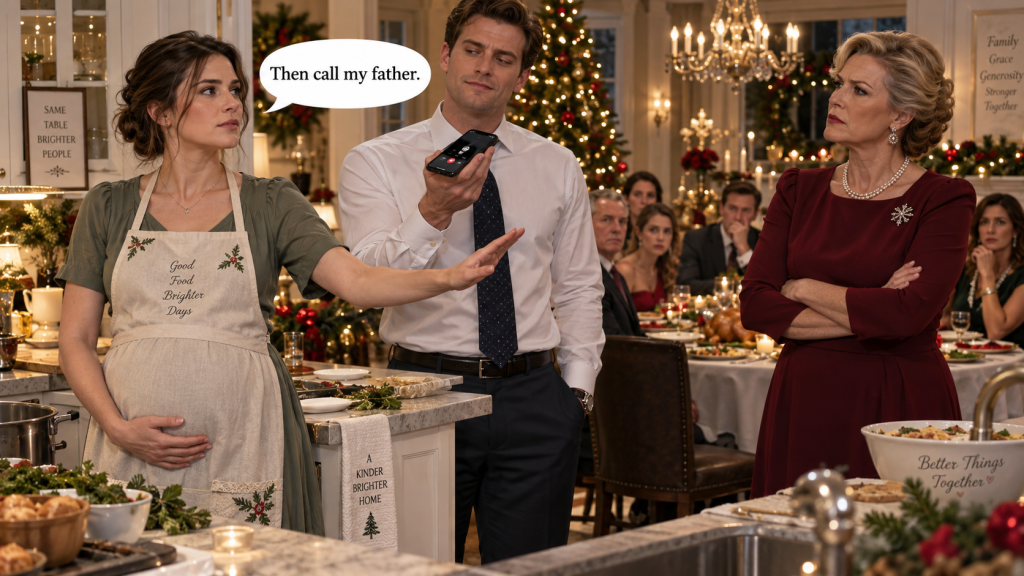
I never told my in-laws that I am the daughter of the Chief Justice of the Supreme Court. When I was seven months pregnant, they forced me to cook the entire Christmas dinner alone. My mother-in-law even made me eat standing up in the kitchen, saying it was “good for the baby.”

When I tried to sit down, she pushed me so hard I began to lose my child. I tried to grab my phone to call the police, but my husband snatched it away and mocked me: “I’m a lawyer. You aren’t going to win.” I looked him straight in the eyes and said calmly: “Then call my father.” He laughed as he dialed, unaware that his career was about to end.
By 5:00 a.m., the house already smelled like roasting turkey, melted butter, cinnamon, and that sharp pine cleaner my mother-in-law, Sylvia, sprayed on everything before company came. The oven had been breathing heat into my face for hours. My feet were swollen inside my flats, the waistband of my maternity dress felt rough under my apron, and every time I bent over the stove, my seven-month belly tightened like a warning.
The dining room looked perfect from the doorway. Christmas candles. Wine glasses. David’s colleagues laughing too loudly at the table. Sylvia floating around in her church dress like she had personally invented family.
I was the only one sweating in the kitchen.
When the last tray came out, I pressed one hand to my back and asked if I could sit for just a minute before dinner started. Not a chair at the head of the table. Not even a place beside my husband. Just a minute.
Sylvia’s palm hit the dining table hard enough to make the silverware jump.
“Servants don’t sit with the family,” she snapped, her smile gone. “Eat in the kitchen, standing up, when we’re finished. It’s good for the baby. Know your place.”
I looked at David.
He did not look at me.
He lifted his wine like he was hearing weather, not his pregnant wife being humiliated in front of a room full of people.
“Listen to my mother, Anna,” he said quietly. “Don’t embarrass me in front of my colleagues.”
Something inside me cramped so sharply that the edge of the doorway blurred. I caught the counter, breathed through my nose, and tried not to make a sound. I had spent years learning that in David’s house, pain was only respected when it belonged to him.
“David,” I whispered. “It hurts.”
Sylvia followed me into the kitchen, heels clicking on the tile.
“Oh, stop it,” she said. “You always perform when work needs doing.”
I reached for the chair by the breakfast nook. She got there first.
Both of her hands hit my shoulders.
I fell backward into the granite counter, hard enough that the room flashed white. My hand went straight to my stomach. A hot, terrible pain ripped low through my body, and I slid toward the tile, knocking a dish towel and a serving spoon to the floor.
“My baby,” I said, but it barely came out.
David rushed in, saw me on the floor, saw the white tile beneath me, and frowned like I had spilled gravy.
“Anna,” he hissed, “get up. Clean this before the guests see.”
“Call 911,” I begged, reaching for my phone with shaking fingers. “Please. I’m losing the baby.”
He snatched it first.
Then he threw it against the wall.
The crack sounded louder than the dining room laughter.
“There will be no ambulance,” David said, standing over me with my broken phone near his shoe. “The neighbors will talk. I just got promoted. I don’t need police cars in my driveway on Christmas.”
I did not scream. I wanted to. I wanted to claw his face, crawl to the front porch, pound on the neighbor’s door under the little American flag by the mailbox. Instead I pressed both hands around my belly and forced air into my lungs.
David crouched close, his lawyer voice dropping into that smooth tone he used when he wanted people afraid.
“I play golf with the sheriff,” he said. “If you say one word, I’ll tell everyone you’re unstable. You’re an orphan, Anna. Who do you think they’ll believe?”
That was the first mistake he made.
He knew the law.
He did not know my family.
I looked up at him through the kitchen light, through the heat, through the ringing in my ears, and kept my voice calm because rage would only give him the scene he wanted.
“You’re right, David,” I said. “You know the law. But you don’t know who writes it.”
His smile flickered.
“Give me your phone,” I told him. “Call my father.”
Sylvia laughed from behind him. David laughed too, cruel and easy, because to him my father was just some old man I had never brought around for holidays.
He dialed the number I gave him and put the call on speaker so everyone could hear my father be small.
The ringing stopped.
A man’s voice came through, steady and official.
“Identify yourself.
PART 2 — THE CALL HE THOUGHT WOULD MAKE ME SMALL
“Identify yourself.”
My father’s voice came through the speaker with the clipped steadiness I had heard my entire childhood.
David’s smile faltered.
He looked at me.
Then at the phone.
“This is David Mercer.”
A pause.
“Anna’s husband?”
David’s expression changed.
Not much.
Just enough.
“Yes.”
My father did not ask how Christmas dinner was going.
He did not wish him Merry Christmas.
He asked:
“Why are you calling me from your phone instead of Anna calling me from hers?”
David glanced toward the shattered pieces of my phone near the wall.
My father could not see that.
I could.
“I—”
David cleared his throat.
“Anna wanted to speak with you.”
“Then give her the phone.”
David looked down at me.
I was still sitting against the kitchen cabinet with one arm wrapped under my stomach.
Another deep cramp moved through me.
I bit down on a cry.
Then felt something warm beneath my dress.
Fear moved through my entire body.
“Dad.”
The word barely came out.
The silence on the phone changed.
I knew my father well enough to hear it.
“Anna?”
“Yes.”
“What happened?”
David interrupted quickly.
“She’s having some pregnancy discomfort.”
I looked at him.
Pregnancy discomfort.
That was what he called it.
My body folded around another wave of pain.
My father heard me gasp.
His voice sharpened.
“Anna, are you bleeding?”
David’s face went pale.
I answered.
“Yes.”
Everything in the kitchen became quiet.
Even Sylvia stopped moving.
My father spoke slowly.
“Has anyone called 911?”
“No.”
“Why not?”
I looked at David.
He stared back at me.
My throat tightened.
“David won’t let me.”
Silence.
Then my father asked:
“Is that phone on speaker?”
“Yes.”
“David.”
David straightened automatically.
“Yes?”
“Call 911.”
There was no anger in Dad’s voice.
That was worse.
David laughed once.
Nervously.
“She doesn’t need an ambulance.”
My father replied:
“You are not her physician.”
“She is seven months pregnant, bleeding after an injury, and reporting abdominal pain.”
“Call emergency services.”
David looked at Sylvia.
Sylvia’s mouth tightened.
Then David said:
“Sir, with respect, you’re getting one side of—”
My father interrupted.
“What injury?”
I closed my eyes.
“Sylvia pushed me.”
My mother-in-law inhaled sharply.
“That is not what happened.”
Dad heard her.
“Who is speaking?”
Sylvia stepped closer to the phone.
“This is Sylvia Mercer.”
“My daughter’s mother-in-law?”
“Yes, and Anna is being extremely dramatic. She lost her balance.”
I stared at her.
My father was quiet.
Then:
“Did you put your hands on her?”
Sylvia’s face changed.
“I guided her away from a chair.”
“You pushed me.”
I whispered.
“Anna, stop.”
David snapped.
The room went silent.
Dad heard that too.
Then he asked another question.
“What happened to Anna’s telephone?”
David’s jaw tightened.
I answered before he could.
“He broke it.”
My father breathed once.
Slowly.
“David.”
“Yes?”
“Call 911 now.”
David’s face hardened.
“I don’t appreciate being ordered around in my own house.”
My father replied:
“I am not speaking to you as a judge.”
Then, after a pause:
“I am speaking to you as the father of a woman who says she is bleeding after being shoved and whose husband has destroyed her telephone and refused to summon medical help.”
The dining room had become quiet behind us.
No more laughter.
No clinking glasses.
David’s colleagues were listening.
Good.
My father continued.
“You have two choices available to you at this moment.”
“Call emergency services yourself.”
“Or hand Anna the telephone so she can.”
David’s eyes narrowed.
“And who exactly do you think you are?”
I looked at him.
For the first time since he took my phone, I almost felt sorry for him.
Almost.
My father answered:
“My name is Jonathan Bennett.”
David frowned.
Nothing.
Then Dad continued.
“I am Anna’s father.”
“Yes, I gathered that.”
“And I am currently serving as Chief Justice of the Tennessee Supreme Court.”
The color drained from David’s face.
Completely.
Behind us, somebody dropped a fork.
It struck a plate with a bright metallic sound.
Sylvia whispered:
“No.”
My father did not stop.
“But listen carefully, Mr. Mercer, because this is the most important part.”
David stared at the phone.
“I am not going to call a sheriff for special treatment.”
“I am not going to contact a prosecutor.”
“I am not going to make a telephone call to the bar and demand your license.”
“I am going to do exactly what any father should do when his pregnant daughter reports an injury and denial of emergency care.”
“I am going to make sure an ambulance is called.”
Then:
“If your career is harmed after tonight, it will be because of what you did before you learned my name.”
David looked at me.
Ghost-white.
There it was.
Not power.
Consequence.
He picked up the phone.
His fingers shook.
“Fine.”
He dialed 911.
My father remained connected on another line only long enough to hear the call begin.
Then he said:
“Anna.”
“Yes?”
“Do what the dispatcher tells you.”
“I’m coming.”
My eyes filled.
“Dad—”
“I’m coming as your father.”
His voice softened.
“Nothing else.”
Then he disconnected.
I cried.
Not because the Chief Justice was coming.
Because Dad was.
There is a difference.
The dispatcher asked whether I was conscious.
Yes.
Whether I had fallen.
Yes.
Whether I had been struck in the abdomen.
“I hit the counter.”
“How?”
My eyes moved toward Sylvia.
“She pushed me backward.”
Sylvia immediately said:
“That is not true.”
The dispatcher heard her.
“Ma’am, please do not interfere.”
Sylvia froze.
That voice did something even my father’s title had not.
It removed her from the center.
She could no longer define what was happening.
The dispatcher asked about bleeding.
Contractions.
Baby movement.
I pressed both hands against my stomach.
“When did you last feel movement?”
I stopped breathing.
I could not remember.
The kitchen.
Turkey.
Pain.
Falling.
Before that?
Maybe an hour.
Maybe less.
“I don’t know.”
My voice cracked.
“I don’t know.”
The dispatcher’s voice stayed steady.
“Help is on the way.”
I looked at my stomach.
“Come on.”
I whispered.
“Please.”
For one terrifying second, nothing happened.
Then—
a small movement.
Barely more than pressure.
I sobbed.
“He moved.”
“Good.”
the dispatcher said.
“Stay where you are.”
I closed my eyes.
One movement was not a promise.
But it was something.
One of David’s colleagues stepped into the kitchen.
Her name was Melissa Grant.
I had met her twice.
She worked in the same firm.
Senior litigation associate.
Usually immaculate.
Always polite.
She looked at me.
Then the broken phone.
Then David.
“What happened?”
David immediately said:
“Anna fell.”
Melissa’s eyes moved to Sylvia.
Sylvia answered:
“She lost her balance.”
I stared at both of them.
Two minutes earlier, David had heard me tell the truth in front of my father.
And already the story was changing.
Melissa looked at me.
“Anna?”
I swallowed.
“She pushed me.”
Sylvia scoffed.
“Oh, please.”
Melissa’s face hardened.
“Don’t.”
Sylvia stared.
“What?”
“Don’t answer for her.”
The room went still.
Melissa knelt several feet from me.
Not touching.
“Do you want me here?”
That question almost made me cry.
“Yes.”
She stayed.
The first siren appeared faintly in the distance.
David stood near the counter.
No longer looking at me.
He was looking toward the dining room.
His colleagues.
His professional world.
Witnesses.
I realized then why he had broken my phone.
Why he had refused the ambulance.
It was not only control.
It was image.
David’s life depended on witnesses believing he was reasonable.
I was allowed to hurt privately.
Not publicly.
The ambulance would make pain visible.
That was what frightened him.
Not losing the baby.
Being seen near the loss.
The paramedics arrived first.
Police came with them because the dispatcher had heard an allegation of assault and interference with emergency care.
David saw the cruiser through the window.
His face tightened.
“I knew this would happen.”
he whispered.
I stared at him.
Not:
Thank God.
Police.
Exactly what he had tried to prevent.
The front door opened.
A paramedic entered carrying equipment.
A woman in a navy jacket followed.
“Anna?”
“Yes.”
“I’m Brooke, paramedic.”
She knelt.
“Tell me where you hurt.”
I pointed.
Lower abdomen.
Back.
My shoulder.
She checked my blood pressure.
Pulse.
Asked about gestational age.
“Twenty-nine weeks and four days.”
“Any previous complications?”
“No.”
“Placenta previa?”
“No.”
“High blood pressure?”
“No.”
“Did you lose consciousness?”
“No.”
Then:
“Did someone push you?”
I looked at David.
Brooke noticed.
She shifted slightly so her body blocked my view of him.
“Anna.”
she repeated.
“Did someone push you?”
“Yes.”
“Who?”
“My mother-in-law.”
Sylvia shouted from the dining room:
“She is lying!”
A police officer immediately said:
“Ma’am, come with me.”
“I’m not going anywhere.”
“You can come into the other room voluntarily, or we can continue this conversation differently.”
Silence.
Then heels crossing hardwood.
For years Sylvia had controlled rooms by being the person least afraid of making them uncomfortable.
Now she had met people whose job did not depend on keeping her comfortable.
Brooke listened to the baby’s heartbeat with a portable monitor.
The seconds before sound arrived were the longest of my life.
Then:
Fast.
Rhythmic.
There.
My baby.
I burst into tears.
Brooke looked at me.
“Heartbeat is present.”
Not:
Everything is fine.
She did not lie.
“We need to get you to labor and delivery immediately.”
I nodded.
Then she asked:
“Can we move you onto the stretcher?”
“Yes.”
Two paramedics helped carefully.
When I tried to stand, pain tore through me.
I cried out.
David stepped forward instinctively.
“Anna—”
I recoiled.
Immediately.
Everyone saw.
David stopped.
Melissa saw too.
Her expression changed.
Not shock.
Understanding.
Sometimes one flinch tells a story a marriage has spent years hiding.
As they rolled me through the dining room, I saw the table.
Christmas dinner still steaming.
Candles burning.
Turkey carved perfectly.
Wineglasses.
Green beans.
Potatoes.
Everything I had worked since before sunrise to make beautiful.
My chair was not there.
There were twelve place settings.
Twelve guests.
No place for me.
That image hurt almost as much as the kitchen floor.
I had spent hours feeding people who had been willing to watch me remain standing.
Some looked ashamed.
Some stared down.
One man would not meet my eyes.
Melissa walked beside the stretcher.
Then stopped at the dining table.
She looked at the place settings.
“Where was Anna sitting?”
Nobody answered.
Melissa’s mouth tightened.
That silence became evidence too.
Not of a crime by itself.
Of a family.
Of a pattern.
At the hospital, everything happened quickly.
Monitor straps around my belly.
IV.
Blood draw.
Ultrasound.
Questions.
More questions.
A doctor named Dr. Patel examined me.
Then said:
“You’re having uterine contractions.”
My throat closed.
“Am I in labor?”
“Possibly.”
“We’re watching closely.”
“What about the baby?”
“Heart rate is reassuring at the moment.”
At the moment.
I hated those words.
Needed them.
She continued.
“You had trauma and bleeding.”
“There are several things we have to consider, including possible placental injury.”
My fingers tightened around the sheet.
“Am I losing him?”
Dr. Patel looked directly at me.
“I cannot promise you what happens next.”
No false comfort.
“But right now, your baby has a heartbeat, and we have both of you where you need to be.”
I cried.
The nurses gave medication to reduce complications if the baby came early.
They monitored.
Waited.
More bleeding.
Then less.
Contractions continued.
Then slowed.
Time became machines.
Numbers.
Breaths.
I had never known waiting could require so much physical strength.
My father arrived forty-three minutes after I did.
Not alone.
My mother had died when I was seventeen.
Dad had never remarried.
He entered the room in dark trousers, a sweater under his coat, and snow still melting on his shoulders.
No robe.
No court staff.
No security spectacle.
Just Dad.
I saw him.
And became seven years old again.
“Daddy.”
His face broke.
He crossed the room.
Then stopped beside the bed.
“Can I hug you?”
That question.
After a day filled with hands that took, pushed, grabbed, and denied—
my father asked.
“Yes.”
He bent carefully around the monitors.
I buried my face against his shoulder.
For several minutes, neither of us spoke.
Then he whispered:
“I should have known.”
I pulled back.
“No.”
“Yes.”
“No.”
My voice shook.
“I hid it.”
He looked at me.
“Why?”
There was no accusation.
That made answering harder.
“Because I knew what people would think.”
“What?”
“That if your daughter complained about her husband, she had an army.”
“That anything that happened afterward would be because of you.”
Dad sat beside me.
“And?”
“And I wanted my life to be mine.”
His face softened.
“So you told David you were an orphan?”
I looked away.
“Not exactly.”
“He assumed.”
“And you let him.”
“Yes.”
Dad was quiet.
Then:
“Why?”
“Because he changed whenever he thought someone mattered.”
My father’s eyes closed.
There.
He understood.
“When we met lawyers or judges socially, he became charming.”
“When it was just me…”
I stopped.
Dad took my hand.
“How long?”
I started crying.
“I don’t know.”
That was not true.
I knew.
I simply did not yet know how to explain the thousand small permissions that become abuse.
The criticism.
The money.
Sylvia entering our house without knocking.
David deciding where I went.
Which friends were “bad influences.”
Who handled accounts.
How often I called Dad.
The first time he called me stupid.
The first time he apologized.
The first time I believed being married to a lawyer meant every argument had cross-examination rules.
Dad did not push.
“Later.”
he said.
“We can talk later.”
Good.
There would be later.
I needed that.
Then he asked:
“Where is David?”
I stared.
“Do not call anyone.”
Dad understood immediately.
“I won’t.”
“Do not talk to the sheriff.”
“I won’t.”
“Do not call the bar.”
“I won’t.”
I began crying again.
“I need to know whatever happens is because of what he did.”
Dad squeezed my hand.
“It will be.”
Then:
“I have already instructed my chambers that I am to be walled off from any matter arising from tonight that could conceivably reach the court.”
I stared.
“Already?”
“Yes.”
“You did that before coming?”
“Yes.”
“Why?”
“Because I am your father.”
He smiled sadly.
“And because I am also a judge.”
He looked toward the monitor.
“One role does not get to corrupt the other.”
I closed my eyes.
That was my father.
David thought power meant having someone important in your corner.
Dad understood power as knowing when your corner was exactly where you were required to remain.
A police detective arrived later.
Not because Dad requested her.
Because officers at the house had taken initial statements.
Her name was Detective Ruiz.
She asked whether I wanted Dad present.
I said yes.
Then changed my mind.
“No.”
Dad stood immediately.
No wounded expression.
No:
I’m your father.
He kissed my forehead.
“I’ll be outside.”
The door closed.
Detective Ruiz sat.
“Anna, I’m going to ask about what happened today.”
“Okay.”
“Start wherever makes sense.”
I told her.
Five in the morning.
Cooking.
Standing.
The chair.
Sylvia.
The push.
The phone.
David refusing emergency care.
The sheriff comment.
Calling me unstable.
The call to Dad.
When I finished, Ruiz asked:
“Has David ever physically assaulted you before?”
“No.”
Then I stopped.
Physical.
The word became slippery.
“He grabbed my wrist once.”
“When?”
“Last summer.”
“Any mark?”
“Yes.”
“Photographs?”
“No.”
“Any other incidents?”
“He blocked the front door.”
“When?”
“October.”
“Why?”
“I wanted to go to my father’s.”
“Did he prevent you?”
“Yes.”
“Any threats?”
I looked down.
“He says things.”
“What things?”
“That he knows judges.”
“That nobody believes emotional wives.”
“That if we ever divorced, he would make sure I got nothing.”
“Anything about the baby?”
My throat tightened.
“He said if I tried to leave after the baby was born, he could make me look unstable and get custody.”
Ruiz remained quiet.
No dramatic gasp.
She wrote.
Then:
“Did you believe him?”
“Yes.”
That was the part that hurt.
Not that David knew the law.
That he had spent years convincing me law belonged to him.
Detective Ruiz placed an evidence bag on the table.
Inside were the broken pieces of my phone.
I stared.
“We recovered these from the kitchen.”
My stomach tightened.
“There’s more.”
She opened her notebook.
“Several guests gave statements.”
My eyes widened.
“What did they say?”
“Not everyone observed the push.”
“Some did.”
“Several heard your mother-in-law tell you to eat standing in the kitchen.”
Shame flooded me.
Even now.
I hated that strangers knew.
Ruiz seemed to read my face.
“Anna.”
I looked at her.
“The embarrassing fact here is not that you were told to stand.”
“It’s that grown adults participated in humiliating you.”
I started crying.
She waited.
Then continued.
“One guest reports hearing you say you were in pain before the fall.”
“Two report hearing you ask for 911 afterward.”
“Multiple witnesses saw David take possession of your phone.”
“One saw him throw it.”
Melissa.
I knew.
Ruiz continued.
“Several heard him say he did not want police at the house because of his promotion.”
My eyes closed.
David had been so concerned about witnesses.
And still he had created them.
Arrogance does that.
It makes secrecy sloppy.
“What happens now?”
I asked.
Ruiz answered carefully.
“Police and prosecutors make their own decisions based on evidence.”
“Your relationship to your father will not determine that.”
I nodded.
“Good.”
“Your husband is currently being interviewed.”
“And Sylvia?”
“Also separately.”
“Are they arrested?”
“Not at this moment.”
Facts.
Process.
No cinematic handcuffs just because my father answered a phone.
Strangely, that made me feel safer.
Everything was moving through procedures David had once used to scare me.
Without him controlling them.
Around midnight, Dr. Patel returned.
I knew from her face that the news was not terrible.
People in hospitals learn to read doors opening.
“The contractions have slowed.”
I stopped breathing.
“The bleeding is decreasing.”
Tears filled my eyes.
“And him?”
“Still reassuring.”
She smiled.
“We’re not declaring victory.”
“But right now, we are not delivering your baby.”
I sobbed.
Actually sobbed.
Dr. Patel waited.
Then:
“You’ll stay for observation.”
“Yes.”
“No argument.”
“None.”
Good.
For once, obedience felt beautiful.
Dad came back inside.
I told him.
His knees nearly gave.
He sat.
Covered his face.
The Chief Justice of a state Supreme Court crying beside a hospital bed because his grandson might stay where he belonged a little longer.
I touched his shoulder.
“Dad?”
He looked up.
“Yes?”
“I’m sorry.”
His face changed.
“For what?”
“I should have told you.”
“No.”
“I should have—”
“Anna.”
He leaned closer.
“You are responsible for what you do next.”
“Do not rewrite his behavior into a test you failed to pass sooner.”
I stared.
He continued.
“You hid things.”
“We can talk about why.”
“But David broke the phone.”
“Sylvia pushed you.”
“David refused help.”
“Those choices belong to them.”
I cried quietly.
Then Dad said:
“And if you decide tomorrow that you still love your husband, that does not transfer his choices back to you either.”
That sentence surprised me.
Because I did.
I hated David.
Feared him.
Wanted him nowhere near me.
And some unbearable part of me still loved the man who used to bring coffee to my law-school library carrel.
The man who learned to make my mother’s spaghetti sauce from an old recipe card.
The man who cried the first time we heard our baby’s heartbeat.
Love does not disappear on command when evidence arrives.
Dad understood that.
Thank God.
At 1:37 a.m., Melissa called.
I almost did not answer.
Then did.
“Anna?”
“Hi.”
Her voice broke.
“I’m so sorry.”
I closed my eyes.
“You didn’t push me.”
“No.”
“But I sat at that table.”
Silence.
Then:
“I knew something was wrong.”
My throat tightened.
“How?”
“David talked about you at work.”
My entire body went cold.
“What did he say?”
Melissa hesitated.
“That you were difficult.”
“Emotionally unstable.”
“That pregnancy made you irrational.”
I stopped breathing.
“He said that?”
“Yes.”
“How long?”
“Months.”
There it was.
A narrative.
Already built.
Not unlike what he threatened in the kitchen.
He had been preparing witnesses long before he needed them.
Melissa continued.
“I believed some of it.”
I stared at the ceiling.
“Why?”
“Because he was calm when he told it.”
That sentence hurt.
She continued.
“And because you were never there to tell your side.”
I laughed bitterly.
“Convenient.”
“Yes.”
She began crying.
“At dinner, when Sylvia told you to stand, I thought it was some weird family dynamic.”
“I should have said something.”
“Then you said you hurt.”
“And David told you not to embarrass him.”
“That was when I knew.”
I closed my eyes.
“You did say something eventually.”
“Not soon enough.”
No.
But I had learned enough about guilt to resist easy cruelty.
“Melissa.”
“Yes?”
“Tell the truth when they ask.”
“I will.”
“That’s enough for now.”
She cried harder.
“Okay.”
Then:
“There’s something else.”
My stomach tightened.
“What?”
“David called me three weeks ago.”
“At night.”
I frowned.
“Why?”
“He asked me a professional question.”
“What question?”
“Whether I knew anyone who handled physician expert reports in custody cases.”
Everything inside me became still.
“Custody?”
“Yes.”
“He said a friend had a wife with serious prenatal mental-health issues and wanted to be prepared.”
My skin went cold.
A friend.
Of course.
“What did you tell him?”
“That family law isn’t my area.”
“Then I gave him a name from the firm directory.”
My hand began shaking.
“Did he contact them?”
“I don’t know.”
Melissa whispered:
“Anna, I didn’t know he meant you.”
I believed her.
That did not make the information smaller.
David had not invented the custody threat while crouching beside me on the kitchen floor.
He had thought about it.
Maybe weeks earlier.
Maybe longer.
The next morning, Detective Ruiz returned.
She did not need Melissa’s information from me.
Melissa had already reported it.
Good.
Ruiz said:
“We also found something during the follow-up at the house.”
My stomach tightened.
“What?”
“A folder in David’s home office.”
No.
My pulse rose.
“What folder?”
“Your name was on it.”
I stared.
“What was inside?”
She answered carefully.
“Copies of medical bills.”
“Texts.”
“Notes about disagreements.”
“A calendar documenting days he claims you were emotional or fatigued.”
My body went cold.
“Pregnant.”
I whispered.
“What?”
“I was fatigued because I was pregnant.”
Ruiz’s expression softened.
“I understand.”
Then:
“There are also screenshots of messages between you and him.”
“Some appear incomplete.”
Of course.
“What does that mean?”
“Selected portions.”
Context removed.
A fight where I said:
I can’t do this anymore.
Probably no line showing I meant cooking for twelve people while nauseated.
A message:
I hate this house.
Without the ten messages before it explaining Sylvia had moved our furniture while I was at work.
David knew evidence.
He knew framing.
He had been curating me.
I felt sick.
“What else?”
Ruiz hesitated.
Then:
“A draft email to a family-law attorney.”
My eyes closed.
“How old?”
“Created twelve days ago.”
Christmas had not even happened.
The kitchen floor had not happened.
My phone was still whole.
He had already been thinking about how to make me unstable on paper.
“What did it say?”
“Among other things, it asked how courts evaluate prenatal mental-health concerns when determining future parenting arrangements.”
I stopped breathing.
My father had nothing to do with the coldness that moved through me then.
This was not a powerful family destroying David.
This was David’s own documents.
His own words.
His own planning.
That distinction mattered more than anything.
“Was he planning to leave me?”
I whispered.
Ruiz shook her head.
“I can’t tell you what he intended.”
Facts.
Always facts.
Then:
“But the material is being preserved.”
I nodded.
My hands rested on my stomach.
A small kick answered.
I closed my eyes.
For months David had told me I was paranoid for worrying that Sylvia would control how we raised the baby.
He had called me dramatic when I asked what would happen if we disagreed.
Meanwhile he was building a file.
Maybe insurance.
Maybe leverage.
Maybe preparation.
Whatever he called it—
I had not imagined the danger.
I had merely underestimated how organized it was.
At noon, a hospital social worker came in.
Then an advocate.
Safety planning.
Protective orders.
Temporary housing.
I almost laughed when they asked where I could go.
“My father has a house.”
Then stopped.
For years, I had avoided relying on Dad because I feared becoming a woman protected by his name.
Now I understood independence differently.
Accepting help is not the same as surrendering agency.
I could stay with him because he was my father.
Not because he was Chief Justice.
I chose yes.
David tried to call that afternoon.
I declined.
Then he sent an email through an address the hospital advocate helped me access safely.
Subject:
Please let me explain.
I did not read it immediately.
An hour later, I did.
It began:
Anna, I am horrified by what happened.
Not:
What I did.
What happened.
I kept reading.
My mother should never have touched you. I should have called an ambulance immediately. I panicked because of the guests and because I was afraid the situation would be misunderstood.
Misunderstood.
My jaw tightened.
Then:
I broke your phone because you were escalating and I thought taking communication away for a moment would calm things down.
I stopped.
Taking communication away.
He had found a phrase for destroying the phone.
Lawyers are dangerous when they use language to anesthetize themselves.
Then:
I never intended to deny medical care.
I laughed.
He literally had.
Intent is not a magic eraser for conduct.
Further down:
The custody research was precautionary. You have been emotional during pregnancy, and my obligation as a father requires me to think ahead.
There.
Not apology.
Documentation.
Even now.
Then the final paragraph:
I love you. Please do not let your father turn this into something that destroys our family and my career.
I stared.
My father.
Still.
David could not imagine consequences without imagining a man more powerful than him causing them.
He could not see that I was the one saying no.
So I replied with only three sentences.
My father is not making my decisions.
You are not to contact me directly again unless an attorney or court-approved process permits it.
What happens to your career will be determined by your conduct, not my father’s title.
I pressed send.
My hands shook afterward.
Not because I was uncertain.
Because sometimes the first boundary feels physically like grief.
Sylvia sent no apology.
She sent something worse.
A message through a relative:
Families forgive mistakes.
I deleted it.
A push might be called a mistake if you turn too quickly in a hallway.
Humiliating a pregnant woman for hours, denying her a chair, then putting both hands on her when she tried to sit did not become smaller because Christmas decorations were nearby.
Family forgiveness was not a coupon she could redeem before accountability.
Three days later, I was discharged.
Still pregnant.
Still being monitored closely.
Modified activity.
Follow-up appointments.
Warnings about bleeding, contractions, decreased movement.
No guarantees.
But my son remained inside me.
Every extra day felt borrowed from terror.
Dad drove me to his house.
The first thing I noticed was that my old bedroom still had blue curtains.
“Dad.”
He looked embarrassed.
“I never redecorated.”
“You’ve had twenty years.”
“I’m busy.”
I laughed.
Then cried.
He took my bag upstairs.
I stood in the doorway.
The room was smaller than I remembered.
My childhood desk.
Books.
A photograph of Mom.
There was one addition.
A rocking chair.
New.
I stared.
Dad shrugged.
“I panic-bought it.”
I laughed through tears.
He looked at my stomach.
“Too much?”
“No.”
Then:
“It’s perfect.”
For the first week, Dad asked before everything.
“Want breakfast?”
“Want company?”
“Want me to drive?”
“Want me in the appointment?”
At first, I became irritated.
Then understood.
He was handing choices back faster than I knew how to receive them.
David had spent years making decisions sound like facts.
Dad turned facts back into questions.
That was healing in a form I had never expected.
The legal consequences did not happen overnight.
That mattered.
David was not disbarred because the Chief Justice frowned.
No sheriff dragged him from his office because Dad called.
In fact, Dad did almost nothing beyond what any father could do.
He recused himself from anything connected to the matter.
He avoided speaking publicly.
He refused interview requests when rumors eventually surfaced.
Once, a reporter asked whether he believed David should lose his license.
Dad answered only:
“That is not my decision, and it should not be.”
I watched on television.
Then cried.
Because he understood exactly what David never had.
The law was not a weapon you inherited through relationships.
It was a process that became corrupted the moment someone believed personal importance entitled them to a different one.
Police investigated.
Prosecutors reviewed evidence.
The domestic case moved separately.
The bar’s disciplinary authorities received information through proper channels about allegations involving David’s conduct and possible dishonesty.
His firm placed him on administrative leave.
Not because Dad demanded it.
Because Melissa and several others had given statements.
Because the firm discovered he had used office resources while researching a personal custody strategy and had described me to colleagues in ways that now raised uncomfortable questions.
Because professional reputation is fragile when built on being the calmest person in the room.
And Christmas had produced too many witnesses to his calmness becoming cruelty.
David’s promotion disappeared first.
Then his firm announced he was no longer handling client matters while the situation was reviewed.
He blamed me in his first message through counsel.
Then stopped.
His lawyer was apparently better at controlling him than he had ever been at controlling himself.
Good.
Sylvia told relatives my father was orchestrating everything.
That story spread.
For a while, I hated it.
Then Dad said:
“People who need that story will keep it even if I produce my calendar.”
I smiled.
“What do I do?”
“Nothing.”
“Nothing?”
“Truth does not require chasing every person who prefers gossip.”
Hard lesson.
Useful.
Two weeks after Christmas, Melissa asked to meet me.
Public place.
I agreed.
She looked exhausted.
“I resigned.”
I stared.
“Because of David?”
“Partly.”
“You didn’t have to.”
“I know.”
She wrapped both hands around her coffee.
“The firm knew he talked about you.”
“Not everything.”
“But more than I realized.”
My stomach tightened.
“What do you mean?”
“He made jokes.”
“What jokes?”
“That marrying someone without family was easier because holidays belonged to his side.”
I went cold.
“He said that?”
“Yes.”
Another:
“That you were ‘socially unsophisticated’ because you didn’t understand legal circles.”
I almost laughed.
My father had sat at the head of one of those circles for years.
But the joke was not funny.
It revealed what David loved.
Not me as I was.
Me as he imagined me.
Unconnected.
Dependent.
Impressed by him.
Melissa continued.
“I think learning who your father is shocked him because it rearranged the hierarchy he had invented.”
There.
Exactly.
David’s terror on Christmas had never been moral.
At first, it had been status.
He thought I was powerless.
Then discovered I had a powerful father.
But that was not the lesson I wanted.
I did not want to become valuable because a Chief Justice answered the phone.
I had been valuable on the kitchen floor before Dad said his name.
That became the truth I fought hardest to keep.
At thirty-three weeks, I had another bleeding episode.
Hospital again.
Dad drove too fast.
I yelled at him.
Normal family.
The baby stayed put.
Thirty-four.
Thirty-five.
Every week became a celebration.
Then, at thirty-six weeks and two days, my son decided he had waited long enough.
Labor started naturally at 2:11 in the morning.
Dad drove me.
This time, within the speed limit.
Mostly.
Twelve hours later, Benjamin Jonathan Bennett Mercer entered the world screaming.
Six pounds, four ounces.
Small.
Healthy enough to stay with me after observation.
When they put him against my chest, I cried until I could not see his face.
“Hi.”
I whispered.
“You stayed.”
His fist opened against my skin.
Dad stood several feet away crying so hard a nurse handed him tissues.
Then he said:
“His middle name doesn’t have to be Jonathan.”
I laughed.
“Too late.”
“Poor child.”
David was notified through attorneys.
He was still Benjamin’s father.
What happened between us did not erase biology or legal parenthood.
That part became complicated.
Careful.
Supervised contact initially.
Temporary family-court arrangements.
Independent professionals.
No shortcuts because of Dad.
I insisted on that.
Especially because of Dad.
I wanted Benjamin protected.
I also did not want my son growing up believing his grandfather’s office determined who got access to him.
Evidence.
Evaluations.
Court orders.
Ordinary procedure.
That was enough.
The bar matter took longer.
Months.
Then more.
I will not pretend there was one dramatic afternoon where somebody tore David’s law license in half.
Real accountability is usually paperwork.
Hearings.
Findings.
Arguments.
Records.
His conduct at home did not automatically determine his professional fitness in a single step.
But alleged dishonesty, misuse of professional status to intimidate, destruction of my phone, his documented custody planning, and statements he made during the aftermath became part of a broader review.
The result was serious.
His career did not end because he called my father.
It changed because people finally examined the man behind the sentence:
“I’m a lawyer. You aren’t going to win.”
That sentence followed him.
Not because I repeated it on television.
I never did.
Because witnesses heard enough around it.
And because professional ethics mean very little if a lawyer believes legal knowledge exists to frighten someone away from seeking help.
Months after Benjamin was born, David wrote me a letter.
Not an email.
Handwritten.
His attorney forwarded it after mine reviewed it.
I expected excuses.
The first line surprised me.
I thought the worst thing I did on Christmas was break your phone.
I kept reading.
It wasn’t.
Then:
The worst thing was believing that because I understood legal systems better than you did, I was entitled to make you afraid of using them.
I stopped.
There.
Something real.
He continued.
I spent years thinking being the more informed person meant being the more rational person. Eventually I began treating disagreement as evidence you did not understand enough.
My eyes filled.
When you told me to call your father, I became terrified because I suddenly thought you had more power than I did. I understand now how revealing that was. I did not become afraid because I had hurt you. I became afraid because I thought the hierarchy had reversed.
I put the letter down.
For a long time.
Then continued.
Your father did not destroy my career. I did damage to it myself.
That sentence mattered.
Not enough.
But it mattered.
My mother pushed you. I watched years of her mistreating you and treated keeping her happy as part of your obligation as my wife. On Christmas, when she hurt you, I still cared first about appearances. There is no legal argument that changes the moral fact.
I cried quietly.
Then:
I am not asking you to come back.
Good.
I am asking for the opportunity, under whatever safeguards are considered appropriate, to become a father Benjamin does not have to fear and a man who no longer confuses knowledge with authority over other people.
I folded the letter.
I did not answer that day.
Or the next.
Eventually, through attorneys, I agreed that his relationship with Benjamin could continue under the existing professional structure.
Not because of the apology.
Because fatherhood and marriage were separate questions.
He had failed catastrophically as my husband.
Whether he could become a safe father would be decided over time by conduct.
Not Christmas words.
Not my father.
Not guilt.
Time.
Sylvia remained harder.
She insisted for months that I had exaggerated the push.
Then video emerged.
Not from the kitchen.
From a small home-security camera David had installed facing the back hallway after a package theft.
The kitchen doorway appeared at the edge of the frame.
No perfect angle.
No sound clear enough for everything.
But enough.
Me reaching toward the chair.
Sylvia moving quickly.
Both arms extending.
My body disappearing backward.
Then David entering.
Seconds later, the broken phone skidding partially into view.
I watched it once.
Never again.
Sylvia eventually changed her statement.
Then called it an accident.
I stopped needing her vocabulary to match mine.
Evidence had already done the work.
A year after Christmas, I attended a holiday dinner at Dad’s house.
Small.
Dad.
Benjamin.
Melissa, surprisingly.
Two old family friends.
I cooked one dish.
One.
Potatoes.
Dad burned the turkey.
It was glorious.
At seven, he looked at me and asked:
“Sit down?”
I laughed.
“Yes.”
There was a chair.
My chair.
No symbolism planned.
Still, when I sat with Benjamin in a high chair beside me, my throat tightened.
Dad noticed.
He said nothing.
That was love too.
Not every scar needs to become a speech while dinner gets cold.
People eventually learned who I was.
Not “who I really was.”
I hate that phrase.
I had always been Anna.
My father’s office did not reveal a hidden superior version of me.
It revealed only that David had made assumptions.
I had let him assume I had no family influence because I wanted to know whether he could respect me without borrowed authority.
For a while, I thought that had been foolish.
Now I think it gave me an answer.
A painful one.
David respected power long before he learned to respect personhood.
The lesson he needed was never:
Be careful who you mistreat. She might have an important father.
That lesson is rotten.
It still permits cruelty toward people without important fathers.
The real lesson was simpler.
The woman on the kitchen floor deserved the ambulance if her father had been a janitor.
A mechanic.
Unemployed.
Dead.
Unknown.
She deserved it because she was bleeding.
Because she said she was hurt.
Because her body was hers.
Because law does not become more available when your surname becomes impressive.
It belonged to me before David knew who Dad was.
That realization changed me more than anything else.
I filed for divorce.
Not immediately.
After Benjamin was stable.
After I could breathe enough to make decisions that were not purely survival.
David did not contest the divorce itself.
There were still legal questions.
Parenting.
Property.
Support.
Boundaries.
But he did not use my father publicly.
Did not claim judicial conspiracy in court.
His attorney probably advised him.
Therapy may have helped.
Either way, he stopped.
Our marriage ended.
Quietly compared with Christmas.
That felt right.
Some things begin with spectacle and end with signatures.
Dad never told me to divorce him.
Not once.
After I filed, I asked:
“Were you waiting for me to do it?”
He thought.
“No.”
“You’re lying.”
“I was hoping.”
I laughed.
Then:
“Why didn’t you tell me?”
He looked at Benjamin sleeping in my arms.
“Because a father ordering his adult daughter out of a marriage is still a father making her life his decision.”
My eyes filled.
“I had enough people doing that?”
“You had enough.”
Good answer.
Two years later, David’s contact with Benjamin was less restricted.
Slowly.
Professionally.
He never had unsupervised access simply because time passed.
He had to demonstrate stability.
Compliance.
Appropriate behavior.
Eventually he did.
The first time Benjamin called him “Dad,” I cried in my car afterward.
Not because I wanted David back.
Because healing creates complicated happiness.
I could be glad my son had a father becoming safer.
And still remember the man who broke my phone.
Both truths fit.
David apologized publicly to Melissa and several colleagues he had misled about me.
Not grandly.
No social-media confession.
Personally.
That mattered more.
He acknowledged that he had described me as unstable to create sympathy and professional cover for himself.
He corrected the story where he had helped spread it.
Good.
Accountability should travel along the same roads as the lie.
His career never returned to what it had been.
The firm was gone.
The promotion gone.
Professional discipline remained part of his record.
Years later, he worked in a different legal capacity with far less status and much more supervision than the life he once imagined.
When Benjamin was old enough to ask why his father had changed jobs, we gave age-appropriate truth.
Not:
Grandpa ruined Dad.
Never.
David himself told him later:
“I behaved in ways that made people question whether I was using the law responsibly.”
That mattered.
No inherited blame.
No powerful grandfather villain.
His choice.
His consequence.
Sylvia never became part of my life again.
Her contact with Benjamin remained restricted for a long time and later depended on professional and legal decisions, not my need to punish her.
By the time Benjamin was old enough to understand who she was, I no longer needed him to hate her for me.
That is a strange freedom.
I did not forgive her in any ceremonial way.
I simply stopped organizing my emotions around whether she deserved forgiveness.
Some relationships do not need reconciliation to reach an ending.
A closed door can be an ending.
Dad retired eventually.
The day his portrait went up in the courthouse, Benjamin was six.
He stared at it.
Then whispered:
“Grandpa looks grumpy.”
I laughed so loudly an administrator turned around.
Dad heard.
“Good.”
he said.
“I spent thirty years practicing.”
Benjamin asked:
“Were you the boss of all the judges?”
Dad crouched.
“No.”
“But you were Chief Justice.”
“Yes.”
“So boss.”
Dad shook his head.
“Different job.”
“What did you do?”
Dad thought.
Then:
“Mostly tried to make sure rules applied even when people wished they didn’t.”
I looked at him.
He looked at me.
Christmas existed between us for half a second.
Then Benjamin said:
“That sounds boring.”
Dad smiled.
“Exactly.”
Good.
The law should be more boring than David once made it sound.
Years later, Benjamin asked about his birth.
Not Christmas.
Birth.
“Was Dad there?”
“No.”
“Why?”
I looked at him.
He was thirteen.
Old enough for more truth.
“Your father and I were separated because something serious had happened.”
“Did he hurt you?”
I did not lie.
“Yes.”
His face changed.
“Did Grandpa send him to jail?”
“No.”
“Could he?”
“No.”
Benjamin frowned.
“But Grandpa was—”
“A judge.”
“Yes.”
I leaned closer.
“That did not make him owner of what happened.”
“Police investigated.”
“Lawyers did their jobs.”
“Other judges handled legal questions.”
“Grandpa stayed out.”
Benjamin thought.
“Why?”
“Because loving me did not give him permission to change the rules for me.”
My son looked toward the floor.
Then:
“Did Dad lose his job because of Grandpa?”
“No.”
“Dad’s choices damaged his career.”
I watched that settle.
Then added:
“And Dad did work to become different afterward.”
Benjamin nodded.
“Do you forgive him?”
Children love impossible questions.
I smiled.
“I don’t know if one word is big enough.”
“That’s not an answer.”
“Correct.”
He rolled his eyes.
Then asked:
“Do you hate him?”
“No.”
“Did you?”
“Yes.”
“For long?”
“Long enough.”
He smiled despite himself.
Then:
“Can people do awful things and not stay awful forever?”
My throat tightened.
“Yes.”
“Does that mean you have to let them back?”
“No.”
That was the answer I most wanted him to remember.
Change can be real.
So can boundaries.
Every Christmas after that became simpler.
Not because I hated Christmas.
I refused to give Sylvia ownership of a holiday.
Sometimes Dad cooked.
Badly.
Sometimes I did.
Never alone.
Never because being a woman made the kitchen mine.
Benjamin learned mashed potatoes at nine.
Burned gravy at eleven.
At fifteen, he made the turkey.
Dry.
We lied and praised it.
Family tradition.
No one ate standing unless they wanted to.
That became our quiet rule.
There was always a chair.
Always.
Years later, I found a piece of my old broken phone in a box.
A tiny corner of the cracked case.
Police had returned property after the case ended, and somehow the fragment survived a move.
I held it in my palm.
For a moment, I was back on the kitchen tile.
Seven months pregnant.
Bleeding.
David towering over me.
“I’m a lawyer.”
“You aren’t going to win.”
I had spent years thinking my response was powerful because I knew something he didn’t.
Call my father.
But age changed the memory.
My father’s identity was not what saved me.
It interrupted David’s confidence.
That mattered.
But the ambulance saved time.
Doctors protected my pregnancy.
Witnesses told the truth.
Police preserved evidence.
Lawyers followed procedure.
Advocates helped me leave.
And I eventually made choices David could not make for me.
Dad did what a good father should do.
He answered.
Then he refused to become the weapon David expected powerful men to be.
That may have been the most important thing he taught me.
Power is not proven by how quickly you can punish someone.
Sometimes it is proven by refusing to put your hand on the scale.
I threw the phone fragment away.
No ceremony.
I did not need it.
Some evidence is needed in court.
Not forever.
Dad died when Benjamin was twenty-one.
Quietly.
At home.
I held his hand.
Near the end, he opened his eyes.
“Anna?”
“I’m here.”
He smiled.
“Good.”
Then:
“You all right?”
I laughed through tears.
“Dad, you’re dying and you’re asking if I’m all right?”
“Answer.”
“I’m all right.”
He nodded.
Then whispered:
“I worried.”
“About what?”
“That Christmas.”
My throat closed.
“You did everything right.”
He shook his head faintly.
“No such thing.”
Then:
“But I answered.”
I cried.
“Yes.”
“You answered.”
That was enough for him.
And maybe for me too.
Parents cannot protect adult children from every room they enter.
Sometimes they can only make sure the phone is answered when the child finally calls.
At Dad’s funeral, Benjamin spoke.
He said:
“My grandfather spent his life around law, but the most important rule he taught me never came from a case.”
I looked up.
Benjamin continued.
“He taught me that knowing more than someone does not make you more entitled to decide for them.”
My eyes filled.
Then:
“And loving someone does not give you permission to control the outcome of their life.”
I covered my mouth.
Dad would have pretended not to cry.
Terribly.
Today, Benjamin is grown.
A teacher.
Not a lawyer.
Dad pretended to be disappointed from heaven, I’m sure.
David is older too.
We attend the same milestones.
Graduations.
Birthdays.
Eventually Benjamin’s wedding.
We are not friends.
We are not enemies.
We are two people who share a son and a history neither of us is allowed to rewrite.
David has never again told me Christmas was a misunderstanding.
That matters.
At Benjamin’s wedding, he approached me near the end of the reception.
“Anna.”
“Yes?”
He looked toward our son dancing with his wife.
“I still think about what I said.”
I knew.
“I’m a lawyer.”
“You aren’t going to win.”
I waited.
David swallowed.
“I thought marriage was something I could win.”
My throat tightened.
“And?”
“I was wrong.”
“Yes.”
He nodded.
No defensiveness.
Then:
“I’m glad you called your father.”
I looked at him.
“I’m glad you finally understood it wasn’t my father you needed to be afraid of.”
His eyes filled.
“I know.”
That was all.
No hug.
No reconciliation.
No perfect bow.
Truth did not need decoration anymore.
People who hear my story often focus on the reveal.
The Chief Justice.
The powerful father.
The arrogant lawyer turning white.
I understand why.
It is dramatic.
But it is not the part I want remembered.
Because most women on kitchen floors do not have Chief Justices answering the telephone.
Some have fathers who work nights.
Some have mothers three states away.
Some have no parents.
Some truly are orphans.
None of them deserve less protection.
None of them should need an important surname before an ambulance becomes acceptable.
If the lesson is:
Be careful who you abuse because she might be connected to someone powerful,
then we learned nothing.
The lesson is:
Do not abuse people.
Not because of who their fathers are.
Because they are people.
That was the truth David had to learn.
It was the truth I had to learn too.
My value had never been hiding behind Dad’s title.
It had been there all along.
In the kitchen.
Sweating.
Seven months pregnant.
Cooking for people who would not give me a chair.
It existed before anyone knew my last name.
Every Christmas, I still set one extra chair at the table.
Not for ghosts.
Not for symbolism.
For whoever needs it.
Sometimes a neighbor.
Sometimes a friend.
Sometimes it remains empty until somebody drags it closer.
The rule is simple.
Nobody in my house earns a place at the table by serving everyone else first.
Nobody is told pain is embarrassing.
Nobody has a phone taken away because their truth might inconvenience someone.
And nobody uses knowledge, money, family, law, or status as proof they matter more.
It took me years to build a home where those rules felt ordinary.
That is the strange thing about recovery.
Eventually the extraordinary safety you fought for becomes boring.
A chair.
A working phone.
A person asking:
“Do you need help?”
Boring can be beautiful.
Sometimes, when I remember Christmas, I still hear David laughing before he dialed.
He thought he was about to prove I had nobody.
Then my father answered.
But the older I get, the less important Dad’s title becomes in that memory.
What I remember now is the first thing he said after hearing my voice.
Not:
Do you know who I am?
Not:
I will destroy him.
Not:
Put the sheriff on the phone.
He asked:
“Anna, are you bleeding?”
That was love.
He heard pain before status.
Emergency before pride.
Daughter before office.
And when he realized what was happening, he did not tell me how powerful he was.
He made sure help was called.
There is a lesson in that too.
The people who truly love you do not need you weak enough for them to feel strong.
They use whatever strength they have to help you recover your own.
PART 3 — THE CHAIR I FINALLY LEARNED WAS MINE
For years, people assumed the story ended when my father answered the phone.
They imagined David’s face turning white.
The Chief Justice identifying himself.
The ambulance arriving.
The powerful man finally discovering that the woman he had treated as powerless came from a family he should have feared.
It made a satisfying story when told that way.
It was also the wrong story.
Because my father did not rescue my marriage.
He did not raise Benjamin for me.
He did not sleep through the nightmares that came after Christmas.
He did not sit inside my body when the smell of roasting turkey suddenly made my hands shake.
He did not stand beside me in the bathroom the first time I looked at the faint scar on my side from striking the granite counter and realized I would carry a physical memory of Sylvia’s hands long after the bruises disappeared.
Dad answered the phone.
That mattered.
Then I had to answer my own life.
That took much longer.
David’s professional case took almost two years to finish.
By then, Benjamin could walk.
He called dogs “gogs,” bananas “nanas,” and every older man with gray hair “Grandpa,” which Dad considered an insult to the dignity of the judiciary.
David missed much of those early years.
Not entirely.
He saw Benjamin under structured conditions.
He learned how to feed him.
Change him.
Comfort him.
He learned that fatherhood was not a legal entitlement but a relationship built one safe hour at a time.
Meanwhile, the disciplinary process continued.
Witnesses testified.
Documents were reviewed.
The broken telephone mattered.
So did his statements about using legal knowledge to frighten me.
So did the way he had spoken about me at work.
So did the custody research.
So did his attempts to minimize what happened afterward.
No single fact destroyed his career.
That was important.
David liked single arguments.
Single witnesses.
Single technical weaknesses.
That was how he thought.
Find the weak point.
Attack it.
Win.
But professional character is not always one fact.
Sometimes it is a pattern.
And for the first time, people outside our marriage were looking at the pattern instead of letting David choose which fact came first.
The final disciplinary order was forty-three pages.
I read it once.
Then never again.
David received a lengthy suspension from practicing law.
Certain findings involved conduct outside the courtroom.
Others involved honesty, misuse of professional status, and behavior the disciplinary panel found incompatible with the obligations attached to the profession.
He appealed parts of it.
Not all.
That surprised me.
Months later, he withdrew the remaining challenge.
When Benjamin was older, David told me why.
“I kept reading the opinion looking for the sentence that was unfair.”
I waited.
“And?”
“There were things I disagreed with.”
“Of course.”
“But eventually I realized I was still doing it.”
“Doing what?”
“Trying to find one imperfect sentence so I wouldn’t have to face the whole picture.”
I looked at him.
That sounded like the man from Christmas.
Except now he could recognize himself.
His suspension eventually ended.
He was legally eligible to seek broader professional restoration under conditions.
He chose not to return to courtroom practice.
Instead, he worked first in compliance, then later in a nonprofit legal-services organization in a role where his work was reviewed and where he had very little of the status that once mattered so much to him.
It paid less.
Much less.
He drove a used car.
Stopped playing golf with people he did not particularly like.
His life became smaller in prestige.
Larger in honesty.
I never told him that.
He did not need me to award him points.
Sylvia’s case ended differently.
For months, she insisted she had merely tried to keep me from sitting because dinner was not ready.
Then the video appeared.
Her story changed.
She had “lost balance.”
Then I had “leaned backward unexpectedly.”
Then finally, through her attorney, she acknowledged that she had put both hands on me during an argument and that doing so had caused me to fall.
It was still not an apology.
But it was the first sentence in which gravity was no longer blamed.
Her criminal case resulted in a plea, probation, mandatory counseling, and strict no-contact provisions.
No dramatic prison sentence.
No Christmas morning revenge.
Just consequences.
Ordinary.
Written down.
Enforced.
That disappointed some people when they heard the story later.
They wanted punishment large enough to match the fear I had felt on the kitchen floor.
I understood.
For a while, I wanted that too.
Then my advocate said something I remembered:
“The purpose of a consequence is not to reproduce the amount of pain you felt.”
That helped.
I did not need Sylvia crushed.
I needed her stopped.
There is a difference.
For almost four years, she did not see Benjamin.
Not once.
David never argued with me about that.
That mattered.
His younger self would have said:
“She’s still my mother.”
Or:
“Benjamin deserves his grandmother.”
As though the title itself created access.
He no longer said that.
When Benjamin was almost five, Sylvia wrote him a letter.
Not directly.
Through attorneys.
The envelope came to me first.
I almost returned it unopened.
Then read it.
Her handwriting was rigid.
Old-fashioned.
The first paragraph annoyed me immediately.
I have spent years thinking about the Christmas when everything changed.
Everything changed.
Still passive.
Then the next line surprised me.
That sentence is dishonest. Everything did not change. I changed it.
I stopped.
I kept reading.
I treated you as though marrying my son meant entering my household beneath me. I called it tradition because tradition sounded respectable. I called obedience respect because respect sounded better than control.
My throat tightened.
This was not the Sylvia I remembered.
Maybe therapy.
Maybe time.
Maybe loneliness.
Maybe consequences finally became quiet enough for truth to be heard.
She continued.
I pushed you because you tried to sit in a chair I had decided you had not earned. I have had years to understand how ugly that sentence is.
I closed my eyes.
Yes.
That was the truth.
Not:
I was tired.
Not:
I didn’t mean for you to fall.
The chair.
That had been the heart of it.
She believed access to rest had to be granted by her.
I am sorry.
Then:
I am not asking you to let me see Benjamin. I am not asking you to forgive me. I am writing because I spent years believing an apology was useless unless it restored something to me. I know now that this made even apology another way of demanding.
I put the letter down.
Cried.
Then finished.
If Benjamin ever asks why he does not know me, tell him the truth in whatever way you believe he can carry. Do not protect my reputation at the cost of confusing him.
At the bottom:
Sylvia.
Not Mom.
Not Grandma.
Sylvia.
She had finally stopped claiming titles as leverage.
That mattered.
I did not answer.
Not for six months.
Then one afternoon, I wrote three lines.
I received your letter.
I believe you understand more now than you did then.
I am not ready for contact.
That was all.
She replied once.
I understand.
And for the first time in our entire relationship—
she did.
No second message.
No relative calling.
No accusation.
No “family forgives.”
Just:
I understand.
I sat at the table staring at those two words.
Sometimes the smallest proof of change is that a person finally lets your boundary remain boring.
Benjamin grew.
Of course he did.
Children refuse to remain symbols no matter how much adults try to make them one.
He was not “the baby we almost lost” forever.
He became a toddler who hated peas.
Then a six-year-old who believed dinosaurs were morally superior to every other animal.
Then a ten-year-old who lied about brushing his teeth with the confidence of a criminal mastermind despite having toothpaste nowhere near his mouth.
Then a teenager.
God help us.
When he was little, David and I told him almost nothing about Christmas.
Only:
“Mom and Dad stopped living together because Dad made serious choices that were not safe.”
That was enough.
As he grew, the truth grew with him.
Not as a weapon.
Not as a secret explosion waiting for adulthood.
Piece by piece.
At twelve, he knew Sylvia had pushed me.
At thirteen, he knew David had broken my phone.
At fifteen, he knew his father had threatened me using his profession.
At seventeen, he asked to see the disciplinary order.
I hesitated.
David said:
“Let him.”
I looked at him.
“You’re sure?”
“No.”
Good answer.
Then:
“But he’s old enough to ask.”
So Benjamin read it.
Not all forty-three pages.
Teenagers have limits.
He made it to page nine before looking up.
“Dad.”
David sat across from him.
“Yes?”
“You actually said that?”
David swallowed.
“Yes.”
“That Mom would never win against you?”
“Yes.”
Benjamin stared.
“Why?”
There are questions children ask that reveal whether all the therapy in the world has done anything.
David looked at me.
Then back at our son.
“Because I thought knowing more about the law made me more powerful inside our marriage.”
“That’s stupid.”
“Yes.”
“And Grandpa was Chief Justice.”
“Yes.”
“So you didn’t even know more.”
I almost laughed.
David did.
“That turned out not to be the important part.”
Benjamin frowned.
“What was?”
David answered:
“Even if your mother knew nothing about the law, I still had no right to use what I knew to frighten her.”
I looked away.
My eyes filled.
There it was.
The lesson.
Fully his now.
Not something my father forced into him.
Something he had finally learned.
Benjamin nodded.
Then:
“Okay.”
And went back to reading.
Teenagers can walk past emotional breakthroughs like they are mailboxes.
Bless them.
At seventeen, Benjamin met Sylvia.
His choice.
Not mine.
Not David’s.
His.
She was older.
Smaller.
Her hair almost completely white.
They met in a therapist’s office first.
I did not attend.
David did.
Afterward, Benjamin came home quiet.
I wanted to ask everything.
Instead:
“How was it?”
He shrugged.
“Sad.”
“What was sad?”
“She cried.”
I waited.
“And?”
“I thought I’d be angry.”
“Were you?”
“A little.”
He sat on the couch.
“But mostly she looked old.”
That sentence hurt more than I expected.
Trauma freezes people.
In my memory, Sylvia was still standing upright in her church dress.
Strong hands.
Hard face.
Commanding the kitchen.
Benjamin had met an old woman who could no longer enter a room without asking permission.
He continued.
“She said she was sorry.”
“What did you say?”
“That I know.”
My throat tightened.
“Do you want to see her again?”
“Maybe.”
I nodded.
That was his answer.
His relationship.
I refused to turn Benjamin’s contact with her into proof that I should reconcile.
Healing is not democracy.
One person may reopen a door another person keeps closed.
Both can be right.
Eventually, Sylvia and Benjamin developed a limited relationship.
Birthdays.
Occasional lunch.
Cards.
She never came into my home.
Not once.
She asked only after seven years.
I said no.
She answered:
“I understand.”
Again.
I appreciated that.
When she died, Benjamin attended her funeral.
I did not.
David did.
Afterward, Benjamin came to my house.
He sat at the kitchen table.
The one I bought after the divorce.
He said:
“Do you feel bad for not going?”
I thought.
“No.”
“Nothing?”
“I feel sad that her life ended.”
“That’s different.”
He nodded.
“Do you forgive her?”
I smiled.
“Apparently everyone in this family thinks I maintain a spreadsheet.”
He laughed.
Then I answered seriously.
“I stopped needing anything from her before I ever decided what to call it.”
He considered that.
“Did you love her?”
“No.”
That surprised him.
“You can say that?”
“Yes.”
I leaned closer.
“Not every ending needs love.”
“Sometimes respect from a distance is enough.”
He nodded.
Then:
“I think I loved her a little.”
“You’re allowed.”
That was important.
My son did not have to inherit my enemies.
My relationship with Dad changed after Christmas too.
People assumed we became inseparable.
We didn’t.
We were already close in a careful way.
What changed was that I stopped hiding parts of my life to prove adulthood.
Before, I thought independence meant needing nothing.
After, I understood it meant being able to choose when to accept help without surrendering ownership of yourself.
Dad drove me to appointments.
Then I told him when to stop.
He called too often.
I complained.
He complained that complaining was disrespectful to retired chief justices.
I reminded him he was retired.
Normal.
Beautifully normal.
Once, three years after Christmas, we fought.
A real fight.
He wanted to put money into an education account for Benjamin.
I said it was too much.
Dad said:
“I can afford it.”
I said:
“That isn’t the point.”
He stopped.
Both of us heard the echo.
Ability is not permission.
Dad smiled slowly.
“Your mother would enjoy this.”
“She absolutely would.”
We compromised.
Smaller amount.
Written terms.
No control attached.
That conversation taught me something.
Even good people can use generosity badly if nobody is allowed to say no.
Power does not become harmless just because the person holding it loves you.
Healthy love makes room for refusal.
Dad understood immediately.
That was why I trusted him.
After his retirement, Dad began volunteering at a legal education program.
Not because he could not leave the courthouse emotionally.
Though probably partly that.
He taught young lawyers about professional responsibility.
One afternoon, he asked permission to tell an anonymized version of my story.
I stared.
“You’re asking?”
“Yes.”
“That’s new.”
He sighed.
“I raised a monster.”
I smiled.
Then asked:
“What part?”
“The part where a lawyer uses status and legal knowledge inside a relationship as intimidation.”
I thought.
“Yes.”
“On one condition.”
“What?”
“Do not tell them the woman was your daughter.”
His expression softened.
“Why?”
“Because I want them to understand it would be wrong no matter whose daughter she was.”
Dad nodded.
“Good condition.”
Years later, one of his former students told me the story had become one of Dad’s most repeated lessons.
He ended it by saying:
“Expertise is not authority over another person’s humanity.”
That sounded like him.
Pretentious enough to be a judge.
True enough to keep.
I changed careers too.
Not because Christmas gave me some dramatic calling.
I distrust stories where trauma conveniently becomes a career plan.
For a while, I did less.
Rested.
Raised Benjamin.
Went to therapy.
Learned how to sleep without listening for footsteps outside my bedroom door.
Then, slowly, I began volunteering with a legal-aid organization that supported people navigating protective orders and family-court processes.
Not as a lawyer.
As a coordinator.
Forms.
Scheduling.
Resources.
Sitting beside people while they waited.
I discovered something strange.
I was good at waiting rooms.
Maybe because I understood them.
A woman once whispered to me:
“My husband knows people.”
I felt Christmas move through my body.
“What kind of people?”
“Police.”
“Lawyers.”
“Judges.”
I looked at her.
Then said:
“Knowing people does not make him the law.”
She started crying.
I did not tell her who my father was.
It did not matter.
She did not need an impressive name.
She needed her fear separated from his bluff.
That became part of my work.
Not giving people courage.
That sounds arrogant.
Helping them locate the courage already hiding underneath intimidation.
David once asked if I hated that he became a better person only after losing me.
We were sitting outside Benjamin’s middle-school graduation.
Plastic chairs.
Bad coffee.
I looked at him.
“Why would I hate that?”
“Because you didn’t get the better version.”
I thought.
Then:
“I did.”
He looked confused.
“I got enough of the better version to co-parent with.”
“That’s not what I mean.”
“I know.”
I smiled sadly.
“David, becoming better does not mean the woman you hurt is supposed to receive you as a prize afterward.”
He looked down.
“I know.”
Then:
“But I’m glad you changed.”
His eyes filled.
“For Benjamin?”
“Yes.”
“And for you.”
He looked surprised.
“You still have to live with yourself.”
He laughed softly.
“Unfortunately.”
Good.
The first time I dated after David, I almost ruined it myself.
His name was Michael.
Teacher.
Widower.
Kind.
The first time he disagreed with me about something stupid—where to spend Thanksgiving—I went completely rigid.
He noticed.
“Anna?”
“I’m fine.”
Classic lie.
He waited.
Then:
“You look like you’re preparing a closing argument.”
I almost laughed.
Instead, I cried.
Right there in a restaurant.
Poor man.
I explained more than I planned.
How disagreement had become dangerous in my marriage.
How David collected statements.
How I had learned that saying no often produced a case against the no.
Michael listened.
Then said:
“So if you say you don’t want Thanksgiving at my sister’s house, that’s the whole sentence?”
I stared.
“Yes.”
“Okay.”
“That’s it?”
“Was there supposed to be litigation?”
I laughed so hard I cried harder.
We did not go to his sister’s house.
The world continued.
That sounds small.
It wasn’t.
Recovery sometimes arrives as someone allowing a preference to remain a preference.
Michael and I married years later.
Small ceremony.
Dad gave no grand speech.
I threatened him.
Benjamin stood beside me.
David attended.
Yes.
People found that strange.
I didn’t.
He was Benjamin’s father.
By then, we had become something like distant family.
Not close.
Not erased.
At the reception, David approached Michael.
I watched from across the room.
My stomach tightened instinctively.
Then later I asked Michael:
“What did he say?”
Michael smiled.
“He told me you hate roses.”
I laughed.
“That’s it?”
“And that you pretend not to like sentimental movies.”
“Traitor.”
Then Michael became serious.
“He also said I should listen the first time you say no.”
My throat tightened.
I looked across the room.
David was helping Benjamin steal cake.
Some apologies travel forward through behavior.
I appreciated that one.
Benjamin eventually became a teacher.
Not a lawyer.
As Dad would complain theatrically:
“Four generations of perfectly good argumentation wasted.”
Benjamin taught history.
He said he liked showing students that events never have only one narrator.
I wondered where he learned that.
Probably everywhere.
When he married, his wife Lena told me something months later.
“The first time we disagreed about money, he asked, ‘Are you saying no, or are you saying you need more time?’”
I stared.
“What did you say?”
“No.”
“And?”
“He said okay.”
My eyes filled.
Lena looked worried.
“Was that bad?”
“No.”
I laughed through tears.
“That may be the best thing he ever learned.”
The cycle had not disappeared because Benjamin never felt anger.
Or because he became unusually gentle.
He could be stubborn.
God help Lena.
What changed was simpler.
He did not interpret another person’s boundary as a challenge to his authority.
That was enough to alter a family tree.
Dad died before meeting Benjamin’s first child.
That still hurts.
He would have been unbearable as a great-grandfather.
When my granddaughter, Clara, was born, I held her in the hospital.
Tiny.
Warm.
Perfect.
Lena looked exhausted.
Benjamin looked terrified.
A nurse asked whether everyone wanted to stay in the room.
Before anyone answered, Benjamin turned to Lena.
“Do you want company?”
She thought.
“No.”
Benjamin nodded.
Then looked at me.
“Mom.”
“Already leaving.”
He smiled.
I kissed Lena’s forehead only after asking.
Then walked out.
In the hallway, I cried.
Not because I felt excluded.
Because my son knew that a woman who had just given birth still owned the room around her.
No title changed that.
Not wife.
Not mother.
Not grandmother.
Not family.
Her body.
Her room.
Her yes.
That was inheritance too.
Clara grew into a little girl who hated sitting still.
At five, she came to Christmas dinner wearing reindeer pajamas instead of the dress Lena bought.
Lena looked exhausted.
Benjamin said:
“She won.”
I laughed.
At dinner, Clara stood on her chair.
I said:
“Sit down before you fall.”
She said:
“No.”
I nearly choked on my drink.
Benjamin gave me a look.
“Family history.”
I pointed.
“She’s five.”
Clara eventually sat because dessert appeared.
No force required.
No one earned a chair.
No one lost one.
And for one second, Christmas became just Christmas again.
That took almost thirty years.
I kept Dad’s old rocking chair.
The one he panic-bought before Benjamin was born.
It moved from his house to mine after he died.
One arm had a scratch from Benjamin’s toy truck.
The cushion sagged.
Michael wanted to have it reupholstered.
I said no.
Then laughed at myself.
“No?”
he asked.
“I’m thinking.”
Growth.
Eventually we repaired it together.
New cushion.
Same wooden frame.
I sat in it when Clara visited.
Sometimes she climbed onto my lap.
And occasionally, usually when the house was quiet, I remembered the chair Sylvia refused me.
For years, I thought my life after Christmas was about finally being allowed to sit.
It wasn’t.
It was about understanding I had never needed permission.
That realization took longer than any legal process.
Because oppression becomes intimate when you begin enforcing it against yourself.
Even after David was gone, I would apologize before resting.
Explain why I was tired.
Justify purchases.
Ask whether a preference was reasonable before expressing it.
It took years to stop presenting evidence for my own needs.
Eventually, I could say:
“I’m tired.”
And sit.
No closing argument.
No witness.
No exhibit.
Just a chair.
David died before me.
That surprised both of us.
Cancer.
He was sixty-seven.
By then, Benjamin was grown.
Our grandchildren knew him.
His relationship with them was gentle.
Nothing like the man standing over me on Christmas.
When he became ill, Benjamin visited him often.
I visited once.
Not because David asked.
Because I wanted to.
He was thin.
Gray.
The hospital gown made him look smaller than I had ever seen him.
He smiled.
“Anna.”
“Hi.”
We talked about Benjamin.
Dad.
Work.
Nothing dramatic.
Then, near the end, David said:
“I spent years wondering what I would say to you if I knew it was the last time.”
I waited.
“And?”
“I think I made apologies too complicated.”
He looked at me.
“I was cruel to you.”
My throat tightened.
“Yes.”
“I loved you.”
“I know.”
“I thought those two truths couldn’t exist together.”
“They can.”
He nodded.
“That took me too long.”
Silence.
Then:
“I’m sorry.”
No request.
No:
Do you forgive me?
Just sorry.
I touched his hand.
Not because the past had disappeared.
Because the present was simple.
A dying man.
A woman he once harmed.
Two people who had spent decades allowing truth to become less defensive.
“Thank you.”
I said.
That was enough.
He died three weeks later.
At his funeral, Benjamin spoke.
He did not make his father a saint.
He did not make him a monster.
He said:
“My father spent the first half of his life believing being right and being good were nearly the same thing.”
A few people smiled sadly.
“The second half taught him they were not.”
Then:
“He hurt people.”
“He changed.”
“Neither truth erases the other.”
I cried.
Because my son had grown into a man capable of holding complexity without turning it into excuse.
That was perhaps the greatest victory of all.
After David died, I finally opened a box I had kept sealed for years.
Inside were papers from the criminal case.
Hospital records.
Copies of statements.
The disciplinary order.
Photographs of my broken phone.
One photograph showed the kitchen.
Christmas candles in the background.
Serving spoon on the floor.
I stared at it.
Then something strange happened.
I no longer felt afraid.
Sad.
Yes.
Angry.
A little.
But fear had gone.
The kitchen in the photograph was simply a room.
David was dead.
Sylvia was dead.
Dad was dead.
The baby inside me was now a grown man with gray appearing at his temples.
Time had outlived the terror.
I took the documents outside.
Not all of them.
Some legal records remained stored properly for family history.
But the duplicates?
I shredded them.
Bag after bag.
Michael helped.
At one point, he held up a copy.
“You sure?”
“Yes.”
I was.
Evidence is meant to prove something when truth is disputed.
I no longer needed to live inside trial exhibits.
The truth had already been established.
I was allowed to stop proving it.
That Christmas, I cooked.
By choice.
A turkey.
By choice.
Potatoes.
By choice.
Clara helped.
Mostly by eating ingredients.
Benjamin arrived early.
Lena brought pie.
Michael opened wine.
The house became loud.
At one point, everyone sat.
Except me.
I was stirring gravy.
Benjamin called from the dining room:
“Mom.”
“What?”
“Sit down.”
“I’m finishing this.”
He looked toward me.
Then smiled.
“You know you’re allowed, right?”
I stared.
For half a second, Christmas folded.
Kitchen heat.
Seven months pregnant.
Sylvia.
Chair.
Pain.
Then unfolded again.
My son.
My husband.
Granddaughter.
A table where one place remained open.
My place.
I turned off the stove.
Carried the gravy over.
Then sat.
Nobody applauded.
Thank God.
Some healing deserves to become too ordinary for applause.
Clara looked at me.
“Grandma?”
“Yes?”
“Why are you crying?”
Everyone looked.
I laughed.
“Because I’m old.”
Michael said:
“She uses that excuse constantly.”
I kicked him under the table.
Clara considered this.
Then pushed the bread basket toward me.
“Here.”
“Why?”
“Bread makes me stop crying.”
Excellent medical advice.
I took a roll.
Everyone kept talking.
The moment passed.
That was perfect.
There is one thing I wish I could change about the way people tell my story.
They always want to begin with my secret.
She never told them who her father was.
But that was never the secret that mattered.
My father’s title was information.
The real secret was how small I had allowed myself to become before I called him.
I had hidden bruising comments.
Hidden fear.
Hidden isolation.
Hidden the fact that my marriage had become a courtroom where David was always counsel and I was always the witness.
I hid because I thought silence made me independent.
Then Christmas taught me something different.
Silence can become another person’s evidence that everything is fine.
So now, when someone I love asks:
“How are you?”
I try to answer accurately.
Not dramatically.
Accurately.
Sometimes:
“Good.”
Sometimes:
“Not today.”
Sometimes:
“I need help.”
Those three words once felt like failure.
Now they feel like freedom.
And when I think of Dad, I do not picture the courthouse portrait.
Or the robe.
Or journalists.
I picture him standing beside my hospital bed in a sweater with snow melting on his shoulders.
I picture him asking whether he could hug me.
That question became a kind of inheritance.
Can I?
Do you want?
Are you comfortable?
Would you rather?
The grammar of respect is full of questions.
The grammar of control is full of declarations.
You will.
You should.
You have to.
I know better.
David used declarations.
Sylvia used declarations.
Dad, with all his authority, asked.
That was why he was safe.
The last photograph I have of Dad and me was taken at Benjamin’s high-school graduation.
Dad is leaning on a cane.
I am laughing at something outside the frame.
Benjamin is between us.
Three generations.
If you looked only at the photograph, you would never know about Christmas.
Good.
Not every picture needs to carry every wound.
Sometimes a photograph is allowed to contain only one happy afternoon.
I learned that too.
I am old now.
Old enough that standing for an entire dinner would be impossible.
Nobody asks me to.
In fact, everyone is constantly trying to give me chairs.
Too many chairs.
“Grandma, sit.”
“Anna, sit.”
“Mom, sit.”
Apparently history overcorrected.
I complain.
They ignore me.
Family.
Last Christmas, Clara’s daughter—my great-granddaughter—pulled out a chair beside her.
“Great-Grandma Anna, this is yours.”
I sat.
She leaned toward me.
“Mom says you’re famous.”
I looked at Clara.
Clara looked guilty.
“I am not famous.”
My great-granddaughter frowned.
“Were you a judge?”
“No.”
“Lawyer?”
“No.”
“Then why?”
Excellent question.
I looked around the table.
Benjamin older.
Clara grown.
Michael gone now too, though his photograph rested on the sideboard.
Lives continuing.
Then I said:
“A long time ago, I learned something important about chairs.”
She stared at me like I had gone senile.
“What?”
I smiled.
“That everybody deserves one.”
She shrugged.
“Obviously.”
My eyes filled.
Obviously.
There it was.
The entire life I had wanted.
A child for whom dignity was so ordinary the lesson sounded stupid.
I touched her hand.
“Yes.”
I said.
“Obviously.”
That is the ending I prefer.
Not David’s career.
Not Sylvia’s probation.
Not the moment my father identified himself.
Those things mattered.
But consequences are not the same as endings.
The ending is a family where nobody believes love creates rank.
Where expertise does not become domination.
Where apology does not demand access.
Where children are told enough truth to understand their lives but not forced to carry adult hatred.
Where people change without requiring the people they hurt to return.
Where power means taking responsibility for how carefully you use it.
And where a woman who once begged for a chair can grow old enough to watch her great-granddaughter assume one will simply be there.
That is the part that makes me cry now.
Not the kitchen floor.
The chair.
Because for years, I thought winning meant David losing.
His career.
His reputation.
His control.
Eventually I understood.
Winning was never about what disappeared from David’s life.
It was about what returned to mine.
My voice.
My choices.
My father.
My son.
My ability to rest without explaining why.
My belief that love should make me more myself, not less.
And the simple knowledge that I did not need to be the daughter of anyone important before I deserved safety.
I only needed to be Anna.
That had always been enough.
David just learned it too late.
I did not.
And every Christmas now, before dinner begins, I look around the table once.
Not for status.
Not for perfection.
Not for witnesses.
For chairs.
There is always one for every person.
Including me.
Especially me.
Then I sit.
And nobody in the room thinks that is remarkable.
That is how I know the story is finally over.
THE END STORIES! THANK YOU FOR READING GOOD LUCK !❤️
Related Posts