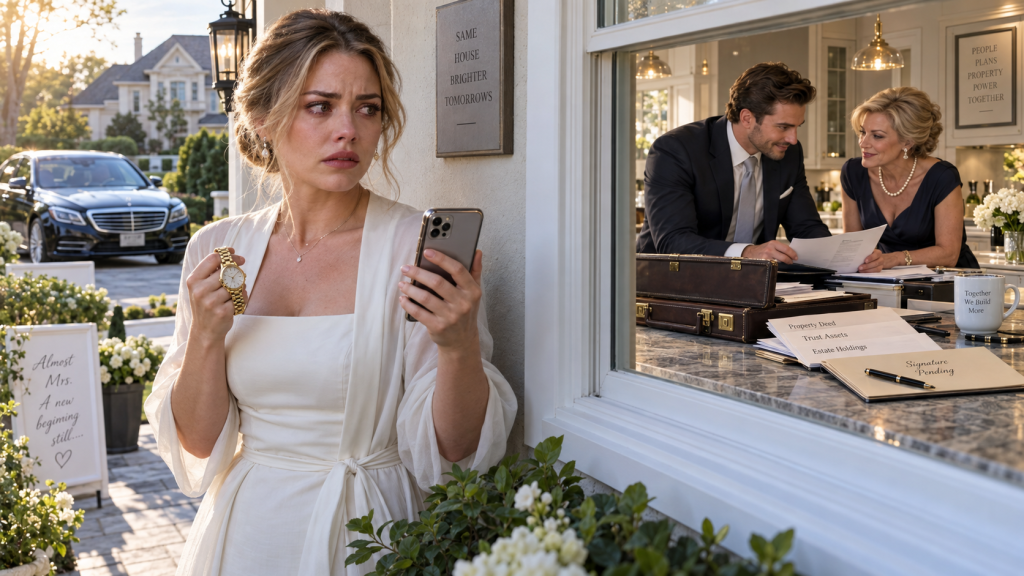
Three hours before my wedding, I returned home to pick up my late father’s watch. As I reached the front door, I heard my fiancé mention my name. Then his mother laughed. “Three more hours, and everything will be official.”

I stopped in my tracks.
Daniel and his mother were supposed to be at the hotel.
Ten minutes later, I canceled the wedding.
But the call I made next changed everything.
Three hours before I was supposed to marry Daniel Mercer, I stood outside my own home listening to a conversation I was never meant to hear.
“Three more hours,” his mother, Patricia, said with a laugh, “and everything will finally be official.”
Then Daniel replied,
“Once the paperwork is signed, I can start handling the house and some of the company matters.”
I went completely still.
I had driven back from the Grand Ashford Hotel for one reason.
I had forgotten my late father’s watch.
It was the one keepsake I wanted tucked beneath my bouquet as I walked down the aisle.
Daniel and Patricia were supposed to be at the hotel taking photographs.
Instead, their Mercedes was parked a short distance from my house.
Through the slightly open kitchen window, I heard Patricia continue.
“You’ve been patient long enough. Her father left her with control over almost everything.”
Daniel gave a quiet laugh.
“She trusts me.”
“She certainly does.”
Daniel paused.
“She wants a family again. That makes all of this easier.”
My hand tightened around the porch railing.
My father had passed away eighteen months earlier.
Daniel had been beside me through some of the hardest days afterward.
He helped organize the funeral flowers.
He answered calls when I didn’t have the energy.
And whenever I worried about facing life without Dad, Daniel would tell me,
“You won’t have to do everything alone anymore.”
Until that moment, I had always believed those words were comforting.
Now they sounded completely different.
Patricia lowered her voice.
“What about the property paperwork?”
“It’s in my briefcase,” Daniel said. “After the honeymoon, I’ll talk to Claire about adding me as an authorized manager. Once we’re married, she’ll probably be more comfortable letting me handle things.”
“And the Harbor Street building?”
Daniel paused.
“That’s the important one.”
A chill went through me.
Harbor Street wasn’t simply another property.
It was the headquarters of Ellison Maritime Analytics, the company my father had spent years building from the ground up.
For two years, Daniel had acted as though business conversations bored him.
Yet he had always seemed unusually curious about trusts, voting rights, company ownership, and real estate.
Suddenly, all those casual questions felt very different.
I quietly took out my phone and saved the conversation.
Then Patricia said something that made my decision clear.
“Your father always believed marrying into the right family could open doors.”
Daniel responded,
“Claire trusts people when she cares about them. She isn’t thinking about protecting every detail.”
That was enough.
I didn’t cry.
I didn’t knock on the door.
And I didn’t confront either of them.
Instead, I quietly walked around the side of the house and entered through another door.
I went upstairs and retrieved my father’s watch from the safe.
Then I noticed Daniel’s briefcase sitting open on my desk.
Inside were unsigned authorization documents.
My name was already typed on them.
So was Daniel’s.
Beside the papers was a copy of my father’s trust summary.
I stared at it for several seconds.
I had never given Daniel that document.
Ten minutes later, I was sitting inside my car with my father’s watch in my hand.
I called the hotel.
“This is Claire Ellison.”
“Yes, Ms. Ellison?”
“I need you to cancel the wedding.”
There was a brief silence.
“The entire event?”
“Yes.”
“All of it.”
Then I made one more call.
This time, I called Martin, my father’s longtime attorney.
“Martin,” I said calmly, looking toward the house where Daniel was still talking with his mother, “I think I finally understand why Daniel has been so interested in my father’s estate.”
Martin was silent for a moment.
Then he answered carefully.
“Don’t discuss anything with him until we review what you found.”
I looked down at my father’s watch resting in my palm.
“That was already my plan.”
And Daniel still had no idea the wedding had just been canceled.
PART 2 — THE SIGNATURE DANIEL WAS NEVER SUPPOSED TO HAVE
Martin did not ask whether I was sure I wanted to cancel the wedding.
That was the first thing I noticed.
He did not say I was emotional.
He did not remind me how much money had already been spent.
He did not tell me that Daniel’s conversation might have an innocent explanation.
He asked one question.
“Claire, are you still outside the house?”
“Yes.”
“Is Daniel inside?”
“Yes.”
“And Patricia?”
“Yes.”
“Then do not confront either of them.”
I looked through the windshield.
My father’s watch rested in my palm.
Its leather strap was worn smooth from years against his wrist.
The second hand continued moving.
Tick.
Tick.
Tick.
As if this were any other afternoon.
“What do I do?”
I asked.
Martin’s voice became quieter.
“First, send me the recording.”
“Then photograph every document you saw in Daniel’s briefcase.”
“Do not alter anything.”
“Do not sign anything.”
“And do not let him persuade you that marriage automatically gives him authority over the company or the trust.”
My fingers tightened around the phone.
“Does it?”
“No.”
Immediate.
Relief hit so quickly I almost cried.
Martin continued.
“Marriage would not make Daniel a trustee.”
“It would not give him voting control over Ellison Maritime Analytics.”
“It would not put him on the Harbor Street property entity.”
“And it certainly would not turn him into an authorized manager because Patricia thinks weddings work like corporate mergers.”
Despite everything, I laughed once.
It hurt.
Then Martin said:
“But if he gets you to sign the right papers afterward, that is a different matter.”
I stopped laughing.
I looked toward my house.
Daniel was still inside.
The man who had held me while I cried after my father died.
The man who knew exactly how frightened I was of inheriting responsibilities I had never expected to carry alone.
He had spent eighteen months telling me:
“You don’t need to know everything immediately.”
“I can help.”
“We’ll figure it out together.”
Suddenly those sentences had edges.
“What could those papers do?”
I asked.
“I need to see them.”
Martin paused.
“Claire, your father structured things carefully.”
“I know.”
“No.”
His tone changed.
“I mean very carefully.”
There was something in his voice.
Something he had not told me before.
“What does that mean?”
“Photograph the documents first.”
Of course.
A lawyer’s favorite answer:
Later.
Normally, I would have argued.
That afternoon, I did exactly what he said.
I returned through the side entrance.
Quietly.
The kitchen voices had moved toward the back terrace.
Daniel and Patricia were still talking.
I could hear Patricia complaining about the florist.
Normal wedding nonsense.
As though they had not just discussed my grief like a business opportunity.
I went upstairs.
Daniel’s briefcase remained open on my desk.
My hands shook as I photographed every page.
The first document was titled:
AUTHORIZATION OF ASSET MANAGEMENT REPRESENTATIVE
My name was already typed beneath:
Claire Ellison, Trustee
Daniel’s name appeared under:
Authorized Management Representative
The document did not transfer ownership.
Martin would later make that very clear.
But it gave the proposed representative broad authority to communicate with property managers, obtain financial statements, interact with lenders, review leases, and receive information concerning several trust-held properties.
Including Harbor Street.
I photographed every page.
Then the second document.
BUSINESS INFORMATION ACCESS AUTHORIZATION
This one concerned Ellison Maritime Analytics.
It would allow Daniel to receive certain internal financial reports and participate in communications with accountants and banking contacts.
Again, no ownership.
No voting rights.
But access.
A foot in a door my father had spent thirty years building.
The third document made my stomach twist.
It was a draft letter.
Supposedly from me.
To the Board of Directors of Ellison Maritime Analytics:
As I continue assuming responsibilities following my father’s passing, I have asked my husband, Daniel Mercer, to assist me with certain administrative and financial matters. Please extend him the professional courtesies and information access necessary to support me in this role.
My husband.
Not fiancé.
Husband.
The letter had been written for after the wedding.
There was a blank signature line.
Mine.
Daniel had not forged it.
Not yet.
That mattered.
But he had drafted words for me that I had never asked to say.
Then I reached the trust summary.
Martin was right.
Something about it was strange.
At the bottom of every page was a faint gray footer.
CONFIDENTIAL — DISTRIBUTION COPY 07
I had never noticed numbering on my own copy.
I photographed that too.
Then one last item.
A handwritten page in Daniel’s notebook.
Not a legal document.
Just notes.
But sometimes ordinary handwriting reveals more than contracts.
After wedding:
1. Harbor Street manager authorization
2. Board information access
3. bank introductions
4. insurance beneficiary review
5. estate plan update
Then:
Patricia — condo?
EMA distributions / timing
And beneath that:
Claire won’t want to deal with details during honeymoon / first weeks. Better then.
I sat down.
Hard.
Because that sentence stripped away every remaining possibility that I had misunderstood.
He knew I would not want to deal with paperwork.
He planned around my exhaustion.
Not because I had asked.
Because my vulnerability created an easier window.
Footsteps sounded downstairs.
I put everything back exactly as I found it.
Or as close as I could.
Then I left through the side door with my father’s watch.
My wedding dress was still hanging at the hotel.
My guests were probably already getting dressed.
The string quartet had likely arrived.
Somewhere, someone was arranging flowers around an aisle I would never walk down.
I should have felt embarrassed.
Instead I felt strangely detached.
When something breaks completely enough, the sound comes later.
I drove to Martin’s office.
He had called his partner, Rebecca Sloan, who specialized in trusts and closely held businesses.
Two folders waited on the conference table when I arrived.
Martin hugged me.
Not like a lawyer.
Like the man who had sat beside my father during chemo appointments when neither of them wanted me to know how frightened they were.
Then he looked at the watch in my hand.
“You went back for Arthur.”
My eyes filled.
“Something like that.”
My father’s name almost undid me.
Martin pulled out a chair.
“Sit down.”
I did.
Then I sent them the photographs.
Rebecca studied the first authorization.
“This does not give Daniel ownership.”
“Good.”
“It would give him access if you signed it.”
“Not good.”
“No.”
She looked at the next.
“And this one could create practical problems even though it does not transfer stock.”
“How?”
“Information becomes leverage.”
She turned the paper toward me.
“Financials.”
“Property details.”
“Banking relationships.”
“Lease terms.”
“Vendor contracts.”
“If someone has enough information, they can begin presenting themselves as part of management even before formal authority exists.”
That was exactly what Daniel had been doing socially for two years.
Never saying:
I run Claire’s company.
Just:
Claire and I are looking at—
We’ve been discussing—
We may restructure—
Little pronouns.
We.
Our.
Us.
I had thought they were affectionate.
Now they felt preparatory.
Martin examined the draft board letter.
His jaw tightened.
“Your father would have thrown him out of the building.”
I almost smiled.
“Yes.”
Dad had liked Daniel.
At least I thought he had.
But he had a deep suspicion of people who wanted titles before they had responsibilities.
Then Martin became quiet.
Too quiet.
“What?”
I asked.
He looked at the trust summary photograph.
“Copy seven.”
“So?”
“There were eight controlled summaries prepared after Arthur died.”
My stomach tightened.
“Who got them?”
He began counting.
“You.”
“Me.”
“Rebecca.”
“Your CPA.”
“The trust tax accountant.”
“Ellison Maritime’s general counsel.”
“The company’s chief financial officer.”
“And one sealed archive copy.”
Eight.
“Which number was mine?”
Martin looked at Rebecca.
Then opened a file.
“Copy one.”
My skin went cold.
“Daniel had seven.”
“Yes.”
“Who had seven?”
Martin found the distribution sheet.
Then stopped.
Rebecca leaned closer.
His expression changed.
“Claire.”
“Who?”
He turned the page toward me.
Distribution Copy 07 — Ellison Maritime Analytics, Chief Financial Officer
My father’s CFO.
Nathan Cole.
I knew Nathan well.
Fifty-eight.
Careful.
Soft-spoken.
He had worked with my father for nineteen years.
At the funeral, Nathan cried harder than almost anyone.
He called my father his mentor.
When I inherited the controlling interest, Nathan had been one of the first people to reassure me.
“You don’t need to become Arthur overnight.”
he told me.
“The company has systems.”
“We’ll protect what he built while you decide how involved you want to be.”
Protect what he built.
I stared at the watermark.
“Are you saying Nathan gave Daniel this?”
Martin immediately shook his head.
“No.”
“Do not jump there.”
“But it’s his copy.”
“It was assigned to his office.”
“That is all we know.”
Rebecca nodded.
“It could have been copied.”
“Scanned.”
“Accessed by an assistant.”
“Removed temporarily.”
“Daniel may have obtained it some other way.”
Facts.
Always facts.
I hated facts when emotion had already reached its verdict.
Still, they were right.
Martin called Nathan.
Not accusing.
He asked whether he still had his numbered trust summary.
Nathan sounded confused.
Then concerned.
He said yes.
It should be in the locked governance cabinet at Harbor Street.
Martin asked him not to touch anything until company counsel was present.
That frightened Nathan.
“What’s going on?”
Martin answered:
“We’re reviewing an unauthorized copy.”
Nathan went silent.
Then:
“I’m coming to the office.”
“No.”
Martin’s voice sharpened.
“Wait for counsel.”
Good.
No one got to clean up first.
Even innocent people can disturb evidence while trying to help.
Then my phone began exploding.
Daniel.
Seven calls.
Twelve texts.
Patricia.
Four calls.
My cousin.
The wedding planner.
The hotel.
Finally Daniel sent:
WHERE ARE YOU?
Then:
They’re saying you canceled the ceremony.
Then:
Claire, answer me.
I stared at the screen.
Martin said:
“You do not owe him a live conversation.”
I knew.
Still, this was the man I had planned to marry in less than two hours.
I typed:
The wedding is canceled. Do not come to Martin’s office. Do not enter my home or remove documents from my office. We will communicate later.
I looked at Martin.
“Too much?”
“Accurate.”
I sent it.
Ten seconds later, Daniel called.
I declined.
Then Patricia.
Declined.
Then a message from Daniel:
What did you hear?
Not:
Why?
Not:
Are you safe?
What did you hear?
The question answered itself.
The wedding planner called next.
I answered because she had done nothing wrong.
Her name was Sophie.
She sounded close to panic.
“Claire, I just want to confirm.”
“Yes.”
“Cancel everything.”
“What should I tell the guests?”
The question pierced through the numbness.
One hundred forty-two people.
My aunt who had flown from Denver.
Dad’s oldest business partner.
Friends.
Coworkers.
Daniel’s relatives.
Everyone dressed.
Traveling.
Waiting.
I closed my eyes.
“Tell them there is a private family matter and the ceremony will not take place.”
“Do not blame Daniel.”
“Do not blame me.”
“No details.”
Sophie exhaled.
“Okay.”
Then softly:
“I’m sorry.”
That nearly broke me.
Because she meant sorry as a human being.
Not a strategist.
“Thank you.”
The hotel had nonrefundable deposits.
Florist contracts.
Catering minimums.
Thousands of dollars.
I did not care that afternoon.
Later, I would.
Later, accountants would separate what could be recovered.
That day, money was merely the least expensive thing I was losing.
At 2:08 p.m., Martin’s assistant came into the conference room.
“Daniel Mercer is downstairs.”
Of course.
Martin looked at me.
“Do you want him allowed up?”
“No.”
Immediate.
It surprised me how easy the word had become.
The assistant nodded.
“He has his mother with him.”
Of course.
Martin called building security and instructed them that neither person was authorized beyond reception.
No drama.
No police.
No shouting.
Just access denied.
A boundary.
Daniel called again.
This time I answered.
“Claire.”
His voice broke.
“What is happening?”
“You tell me.”
“Where are you?”
“With Martin.”
Silence.
That frightened him.
Good.
“I can explain.”
“Then start with the documents in your briefcase.”
Long silence.
Patricia said something behind him.
Daniel moved away.
“You went through my things?”
“Your open briefcase was sitting on my desk.”
“Claire.”
“No.”
My voice shook for the first time.
“You were discussing my trust and my company in my house three hours before our wedding.”
“You said you wanted me more involved.”
“I said I wanted a partner.”
“That’s what I was trying to be.”
“A partner asks.”
Silence.
Daniel sighed.
“The forms weren’t signed.”
“I noticed.”
“I was going to talk to you.”
“When?”
“After the honeymoon.”
“Why after?”
“Because today was already stressful.”
“No.”
I looked at the handwritten note on Martin’s screen.
“Your own note says I wouldn’t want to deal with details during the honeymoon or first weeks.”
Silence.
“How did you—”
He stopped.
Good.
“I was planning to make your life easier.”
“By drafting a letter in my name?”
“It was a template.”
“By getting a confidential trust summary I never gave you?”
Nothing.
There.
That silence mattered.
“Where did you get Copy Seven?”
I asked.
Daniel said:
“What?”
“The trust summary.”
“I don’t know what copy it is.”
“Where did you get it?”
His breathing changed.
“Your office.”
My stomach tightened.
“When?”
“A while ago.”
“That document has never been stored in my home office.”
Martin looked up sharply.
I had kept my trust summary in a safe-deposit box after Dad died.
The only copy at home was a simplified personal balance sheet, not the controlled trust summary.
Daniel had just lied.
Or revealed something else.
“I’m done talking right now.”
I said.
“Claire, please.”
“No.”
“We are supposed to be getting married in an hour.”
The sentence finally brought tears to my eyes.
“We were.”
He started crying too.
At least I think he did.
“I love you.”
I closed my eyes.
“I believe you might.”
That startled him.
It startled me too.
Because love was no longer the question.
People think betrayal becomes easier if you decide every affectionate moment was fake.
Sometimes it does not.
Daniel may have loved me.
He might also have loved what marriage to me could give him.
Both could exist.
That was harder.
“I need space.”
I said.
Then ended the call.
At 2:31 p.m., Patricia sent me a message.
You are humiliating my son over business paperwork you clearly do not understand.
I stared at it.
Then showed Martin.
He removed his glasses.
“Would you like professional advice?”
“Yes.”
“Do not respond.”
“Personal advice?”
“Yes.”
“Frame it.”
I laughed so hard I cried.
For two minutes, I could not stop.
Grief makes strange sounds when it is trying not to drown.
Then Nathan called Martin.
Company counsel was now with him at Harbor Street.
They opened the governance cabinet.
Copy Seven was gone.
Not copied.
Gone.
The checkout log attached to the cabinet showed three people with key access:
Nathan.
The general counsel.
And Nathan’s executive assistant, Melissa Grant.
Nathan sounded horrified.
“I haven’t opened that folder in months.”
Company counsel asked when he last remembered seeing the summary.
After my father’s death.
Maybe ten months ago.
No one could say more.
So they pulled electronic access records.
The governance suite required badge entry after business hours.
We would know who had entered.
Eventually.
Not instantly.
Real investigations make you wait.
Then Rebecca asked me something.
“Has Daniel ever been to Nathan’s office?”
“Of course.”
“How often?”
I thought.
Company holiday party.
Dad’s memorial scholarship event.
A charity board dinner.
Daniel had also picked me up from Harbor Street several times.
Then I remembered something.
Six months earlier, Daniel brought lunch to my office.
Nathan joined us.
They talked about sailing.
Daniel stayed after I left for a meeting.
“How long?”
Martin asked.
“I don’t know.”
Maybe twenty minutes.
Maybe forty.
Was that how he got it?
No.
Too easy.
Nathan’s office was not a cartoon vault where guests wandered through governance cabinets.
We needed evidence.
At 3:05 p.m., I should have been walking down an aisle.
Instead, I sat in a law office eating half a turkey sandwich Rebecca forced into my hand.
Martin poured coffee.
My father’s watch lay beside the legal pad.
Three o’clock arrived.
Nothing happened.
No music.
No vows.
No Daniel.
I watched the second hand move.
Then I cried.
Quietly.
Not because I regretted canceling.
Because certainty does not erase grief.
I had lost a wedding.
Maybe a marriage.
Maybe the man I thought I knew.
And my father was still dead.
There are some days when loss does not replace loss.
It stacks.
Martin sat beside me.
For a while he said nothing.
Then:
“Arthur asked me something about Daniel once.”
I turned.
“What?”
“About six months before he died.”
My whole body tensed.
“What did he say?”
“Nothing dramatic.”
Martin leaned back.
“He asked whether marriage would give Daniel any automatic authority over your trust or voting shares.”
I stared.
“Why would Dad ask that?”
“I asked him the same thing.”
“What did he say?”
“That Daniel had been asking a lot of sophisticated questions while pretending not to know much about the company.”
My throat tightened.
Dad noticed.
Of course he did.
My father noticed when a warehouse manager changed freight insurers without telling him.
He noticed everything.
“Did Dad think Daniel was after my money?”
“No.”
Martin’s answer was immediate.
“He specifically told me not to turn curiosity into accusation.”
That sounded like Dad too.
“What did you tell him?”
“That marriage alone would not hand Daniel control.”
“And?”
Martin smiled sadly.
“Arthur said, ‘Good. Claire is generous when she loves someone. Make sure the paperwork never mistakes generosity for surrender.’”
I covered my mouth.
That did it.
I bent forward and cried into both hands.
Dad.
Even dying, Dad had been thinking about the difference between love and authority.
“Why didn’t you tell me?”
I asked eventually.
“Because Arthur did not ask me to warn you away from Daniel.”
“He asked me to protect the structure.”
“There is a difference.”
Yes.
A painful one.
My father had respected me enough not to turn suspicion into an order.
He had not chosen my husband for me.
He had simply made sure no husband could become me on paper without my consent.
I looked at Dad’s watch.
For the first time that day, wearing it felt less like grief.
More like inheritance of another kind.
By late afternoon, guests had dispersed.
Sophie texted that most people had accepted the explanation gracefully.
Some relatives asked questions.
A few did not.
Daniel’s family was furious.
Patricia had apparently told several guests I had “had a breakdown over estate anxiety.”
Excellent.
I did not respond.
Truth does not become stronger because you chase every lie into every room.
At 5:40, company security sent the first badge report.
Nathan called.
The governance suite had been accessed eleven times outside normal business hours in the last year.
Most entries matched expected activity.
Nathan preparing board meetings.
General counsel retrieving records.
Melissa working late.
One entry did not.
A Saturday.
Seven weeks earlier.
Badge:
Melissa Grant.
Entry at 10:12 a.m.
Exit at 10:47.
Melissa was not scheduled to work that weekend.
That did not prove theft.
Maybe she forgot something.
Maybe Nathan sent her.
Nathan said he had not.
Martin instructed company counsel to preserve the logs and Melissa’s work computer.
Not seize her personal life.
Preserve company records.
She would be interviewed with proper HR procedures.
Again:
facts.
Then security pulled visitor records for the same Saturday.
At 10:18 a.m., someone had entered the Harbor Street lobby.
Guest signed in by security.
Daniel Mercer.
My blood ran cold.
Sponsor:
Melissa Grant.
I stared at the screen.
Seven weeks ago.
Daniel and Nathan’s assistant.
In the building together on a Saturday.
I had been at my aunt’s house that weekend helping sort my father’s personal books for donation.
Daniel told me he was playing golf.
Martin looked at me.
“Do you know of any reason they would meet?”
“No.”
“Did you know they were in contact?”
“No.”
Rebecca said:
“Do not assume affair.”
I almost laughed from shock.
“I wasn’t.”
“Good.”
“Because there are plenty of other explanations.”
Some innocent.
Some not.
A trust summary missing from a cabinet they both had access to by different routes was already enough.
We did not need romance to make it worse.
At 6:22, Melissa was contacted by company counsel.
She denied giving Daniel the trust summary.
Then, after being told there were access records, she changed part of her account.
Yes, Daniel had come in.
He told her I needed old real-estate records for wedding-related estate planning.
He said he wanted to prepare a surprise binder for me after the honeymoon.
Melissa knew him as my fiancé.
She believed him.
Or said she did.
She admitted letting him use an empty conference room while she retrieved public and internal property reports.
But she insisted she never opened the governance cabinet for him.
Company counsel asked why her badge accessed that suite six minutes before Daniel arrived.
Silence.
Then Melissa requested to continue the conversation with counsel present.
Smart.
And her right.
The interview stopped.
No dramatic confession.
But the room around me became colder.
At 7:10, I finally returned home.
Not alone.
My cousin Emily came with me.
Daniel and Patricia were gone.
His briefcase was gone too.
Good.
I did not want to touch it.
The house looked exactly as it had that morning.
Flowers from relatives.
Wedding gifts stacked in the dining room.
My veil box near the staircase.
On the kitchen counter sat two champagne flutes someone had delivered the previous evening.
CLAIRE & DANIEL
etched in gold.
I turned them around.
I could not throw them away yet.
Could not look at them either.
Emily slept in the guest room.
I slept badly.
At 2:16 a.m., I woke from a dream in which Dad was waiting at the end of the wedding aisle instead of Daniel.
He was wearing his old navy suit.
The one he hated.
He kept looking at his watch.
I woke crying.
For a while, I sat on the bedroom floor holding the real watch in both hands.
Then my phone lit up.
An email from Martin.
Subject:
URGENT — CALL WHEN AWAKE
I called immediately.
He answered on the first ring.
“Sorry.”
I said.
“I’m awake.”
“So am I.”
“What happened?”
Martin paused.
That pause terrified me now.
“We found something else.”
After the badge records surfaced, company counsel conducted a targeted review of recent authority-change requests involving me, the trust, and related entities.
Nothing had been changed at Harbor Street.
No deed.
No ownership transfer.
No manager added.
Good.
But three weeks earlier, Ellison Maritime’s primary bank had received a request through its business banking portal.
The request sought to add a new “information-only administrator” to several company accounts.
Not someone who could wire money.
Not someone who could withdraw funds.
But someone who could view balances, statements, and transaction histories.
The proposed new administrator:
Daniel Mercer.
My entire body went cold.
“Who submitted it?”
“That is what we’re determining.”
“Was he added?”
“No.”
Thank God.
“Why not?”
“The bank required secondary verification because of the company’s control structure.”
Good systems.
Again.
“What happened?”
“The bank sent a confirmation request to your company email.”
“I never saw it.”
“We know.”
“How?”
Martin exhaled.
“Because someone marked the bank’s email as read twenty-three minutes after it arrived.”
I sat up straighter.
“I didn’t.”
“I know.”
The request had stalled because I never completed the required callback.
The bank closed it after five business days.
No access granted.
No financial loss.
But someone had tried.
Before the wedding.
Before the unsigned papers in Daniel’s briefcase.
Before Patricia laughed in my kitchen.
Someone had already moved from planning to action.
“Was the request made from Daniel’s email?”
“No.”
“Melissa’s?”
“No.”
“Whose?”
Martin hesitated.
“The portal session used your company credentials.”
My stomach dropped.
“My login?”
“Yes.”
“That’s impossible.”
“Not impossible.”
“Just unauthorized, according to you.”
“I never gave Daniel my password.”
“I believe you.”
“Did he have access to my laptop?”
“Maybe.”
I thought of evenings.
Daniel bringing me tea while I worked.
My laptop open on the coffee table.
My password manager.
My phone.
A thousand ordinary domestic moments where security depends on the assumption that the person beside you loves you enough not to become a threat.
Martin continued.
“The bank also retained the uploaded administrator authorization form.”
My hand tightened around the phone.
“What form?”
“Claire.”
His voice became very quiet.
“It has your signature on it.”
I stopped breathing.
Not typed.
Not a blank line waiting for after the honeymoon.
A signature.
Mine.
Or something designed to look like mine.
“And?”
I whispered.
“There’s more.”
Of course there was.
“The signature was dated three weeks ago.”
I closed my eyes.
“Did Daniel sign too?”
“Yes.”
As proposed administrator.
His actual signature.
My supposed authorization.
His acceptance.
Together.
I whispered:
“I never signed it.”
“I know.”
“You know?”
“We compared it with the signature on your annual shareholder consent.”
My throat tightened.
“Martin.”
“What?”
“It’s the shareholder signature, isn’t it?”
Silence.
Then:
“Yes.”
An image.
Copied.
Placed.
The same long downward stroke in the C.
The tiny ink skip before the final n.
My father used to tease me that I signed formal documents like I was trying to impress a nineteenth-century banker.
That exact signature had been reproduced beneath an authorization I had never seen.
I got out of bed.
Walked toward the window.
Outside, the yard was dark.
The wedding flowers on my porch had already begun to sag in the summer humidity.
“Who downloaded the shareholder consent?”
I asked.
“We’re checking.”
“Who had access?”
“Several people through the corporate records system.”
“Martin.”
“I know.”
Then he said:
“But there is something else you need to hear before you decide what any of this means.”
I waited.
“The bank request included a contact phone number for verification.”
“Daniel’s?”
“No.”
“Melissa’s?”
“No.”
My skin prickled.
“Whose?”
Martin read the number.
I knew it.
Not from business.
Not from Daniel.
I had seen it hundreds of times.
It belonged to Patricia Mercer.
Daniel’s mother.
The woman who had laughed in my kitchen and said:
Three more hours, and everything will finally be official.
I stood beside my bedroom window with my dead father’s watch still wrapped around my wrist.
And for the first time, I understood that Patricia might not merely have known about Daniel’s plan.
She might have been part of it before Daniel ever asked me to become his wife.
PART 3 — THE THREE HOURS THAT SAVED MY LIFE
I did not sleep again after Martin told me Patricia’s phone number was attached to the bank request.
I sat on the edge of my bed until dawn with my father’s watch around my wrist and the curtains open to a sky slowly changing from black to gray.
Three hours.
That was the phrase Patricia had used.
Three more hours, and everything will finally be official.
At first, I thought she meant marriage itself would somehow give Daniel control over my house, my trust, or my father’s company.
It would not.
Martin had made that clear.
Marriage was not a magic key.
But by morning, I understood something more unsettling.
Daniel and Patricia had never needed the wedding to transfer ownership automatically.
They needed it to change the story.
Before the wedding, Daniel was my fiancé asking for access.
Afterward, he could introduce himself as my husband.
My representative.
The man “helping Claire handle things after her father’s death.”
Every unsigned authorization in his briefcase would look more natural if his last name sat beside mine on hotel reservations, invitations, photographs, and eventually legal records.
They were not waiting for the law to hand him control.
They were waiting for the marriage to make his requests look ordinary.
And they were counting on me to help finish the illusion.
At 6:15 that morning, Martin called again.
“I want you at Harbor Street by eight.”
“What happened?”
“The bank found a recorded verification call.”
My stomach tightened.
“From Patricia’s number?”
“Yes.”
I stood.
“What did she say?”
Martin paused.
That pause had become something I hated.
“She identified herself as you.”
For a moment, I genuinely stopped understanding the words.
“What?”
“The bank called the contact number provided with the administrator request.”
“A woman answered.”
“She said, ‘This is Claire Ellison.’”
I sat back down.
The room tilted.
“Did they believe her?”
“Not for long.”
The bank’s employee had followed verification procedures.
Patricia apparently knew my birthday.
My address.
The last four digits of a business tax identifier Daniel had probably obtained from paperwork.
Then the employee asked a question tied to a prior banking instruction.
Patricia answered incorrectly.
The call was escalated.
The request was flagged.
A separate confirmation was sent to my corporate email.
Someone marked it read.
No callback ever came from me.
So the request died.
A small procedural inconvenience had stopped Daniel from obtaining information-only access to company accounts.
Not a heroic rescue.
A banker asking one more question.
That was how close ordinary systems sometimes come to disaster.
One careful person refuses to assume.
I reached Harbor Street just before eight.
The building had always made me think of Dad.
Red brick.
Steel-framed windows.
A brass plaque beside the entrance:
ELLISON MARITIME ANALYTICS
He had started the company with two rented rooms and three employees.
By the time he died, it occupied most of the building and advised shipping companies, ports, and logistics firms across the country.
Daniel once called it “a boring company with a beautiful balance sheet.”
At the time, I laughed.
That morning, I remembered every word.
Nathan was waiting in the conference room.
He looked terrible.
Melissa’s chair was empty.
Company counsel sat beside Martin and Rebecca.
The head of IT had two laptops open.
Nobody offered coffee.
That frightened me more than if they had.
Martin began.
“We need to separate what we know from what we suspect.”
Good.
Even now.
He listed the confirmed facts.
Daniel had possession of controlled trust summary Copy Seven.
Copy Seven had been assigned to Nathan’s office.
Melissa’s badge accessed the governance suite on a Saturday seven weeks earlier.
Daniel signed into the building six minutes later as Melissa’s guest.
Three weeks before the wedding, someone using my company credentials requested that Daniel be added as an information-only administrator on company bank accounts.
A false authorization bearing a copied version of my signature accompanied the request.
Patricia’s phone number was supplied for verification.
When the bank called, Patricia claimed to be me.
No account access was granted.
No money moved.
No voting rights changed.
No company ownership changed.
That last part mattered.
I repeated it silently.
Nothing changed.
Nothing changed.
Nothing changed.
Then IT explained the company-login issue.
The request had originated through my legitimate business portal credentials.
My password had not been reset.
There had been no obvious external hack.
The session originated from the home internet connection registered to my address.
My house.
At 11:46 p.m. on a Tuesday.
I knew where I had been.
Asleep upstairs.
Daniel had stayed over that night.
I remembered because the following morning he made pancakes before work.
The memory nearly made me sick.
“Could he have gotten the password?”
I asked.
The IT director hesitated.
“You often used the portal from your personal laptop.”
“Yes.”
“Did you save passwords?”
“Sometimes.”
“Was Daniel able to access that device physically?”
“Yes.”
That was enough.
Not proof by itself.
Access.
Opportunity.
No magic hacking required.
He had been inside the house.
Beside me.
Trusted.
That was the vulnerability.
My phone buzzed on the table.
Daniel.
Martin looked at the screen.
I silenced it.
Nathan finally spoke.
“Claire, I’m sorry.”
I looked at him.
“For what?”
“For the governance failure.”
His voice shook.
“I trusted too much access to one office.”
“You didn’t give Daniel my password.”
“No.”
“You didn’t give him the bank form.”
“No.”
“Then don’t confess to things we haven’t established.”
Martin looked at me.
A tiny expression.
Approval, maybe.
Dad would have said the same thing.
Evidence before blame.
Even when anger wants a larger target.
Melissa arrived with her attorney at nine-thirty.
The company had placed her on administrative leave.
Not fired.
Not yet.
She agreed to a formal interview.
I did not attend.
That was intentional.
If she saw me sitting across from her, the conversation could become personal.
I wanted facts.
Two hours later, Martin summarized what she had admitted.
Melissa had let Daniel into the building that Saturday.
Yes.
She had used her badge to enter the governance suite.
Yes.
She had removed Nathan’s trust-summary folder.
Yes.
My stomach turned.
Then:
She said Daniel told her I had asked him to prepare an “estate transition binder” after the wedding.
He claimed Martin’s office was moving slowly.
He said I wanted property summaries, trust information, company contacts, and old banking relationships organized so I would not have to deal with them during the honeymoon.
That sounded exactly like the language in his notes.
Melissa said she believed him because he was my fiancé.
Because I had brought him to company events.
Because Dad had liked him.
Because Daniel spoke as though every request came from me.
She copied several documents for him.
Including Copy Seven.
She returned the folder afterward.
That explained why the cabinet did not look disturbed.
But later, during the office review, Copy Seven itself could not be found.
Had she accidentally given Daniel the original?
She thought she had copied it.
She could not be certain.
Bad procedure.
Serious.
Still different from knowingly participating in the bank fraud.
“Did she know about the administrator request?”
I asked.
“Her attorney says no.”
“Do we believe her?”
Martin gave me the look.
Wrong question.
“Can we prove she knew?”
“No.”
Not then.
So we did not call her a conspirator.
The company later terminated Melissa for violating confidentiality and access procedures.
That was enough.
She had taken controlled governance materials out of secure storage for someone who had no business receiving them.
Whether she thought she was helping my fiancé did not make the act acceptable.
But investigators found no evidence that she helped forge my signature or submit the bank request.
No secret affair.
No payoff.
No hidden partnership.
Just an employee who let familiarity defeat procedure.
Ordinary mistakes can become very expensive when made near determined people.
The investigation into Daniel and Patricia moved faster after the recorded bank call surfaced.
Patricia initially denied pretending to be me.
Then the bank produced the recording.
Her voice.
My name.
No ambiguity.
Her explanation changed.
She said Daniel had told her the bank might call while I was busy with wedding preparations.
He had asked her to “confirm basic information.”
She claimed she did not understand she was impersonating me.
Her own voice undermined that defense.
The call began:
“Yes, this is Claire Ellison.”
Not:
I’m Claire’s future mother-in-law.
Not:
I’m helping her.
Claire.
She had borrowed my name as easily as Daniel borrowed my signature.
I did not speak to Patricia for five months.
Not once.
She sent letters.
Emails.
Messages through relatives.
I read none until my lawyer said it was fine.
When I finally opened the first letter, she spent three pages explaining Daniel’s childhood.
His father, Robert Mercer, had been ambitious.
Always chasing deals.
Always talking about “getting into the right rooms.”
He believed relationships were assets.
Schools were networks.
Marriage was opportunity.
People were doors.
Patricia wrote that she had spent thirty years listening to Robert describe wealthy families as though prosperity were a club you entered by knowing the right person.
Daniel absorbed more of that worldview than she realized.
Then she wrote:
I absorbed it too.
That was the first honest sentence.
She admitted that when Daniel began dating me, she looked up my father’s company.
Not unusual by itself.
Then she looked up property records.
Company articles.
News profiles.
Charitable filings.
She knew what Harbor Street was worth before I had ever invited her to Christmas.
That hurt.
She insisted she had never told Daniel to date me for money.
I believed that.
The relationship had lasted four years.
There had been tenderness in it.
Daniel knew how I took my coffee.
He knew I hated thunderstorms while driving.
He sat with Dad through two oncology appointments when I could not get away from work.
Real affection existed.
Again.
The hardest truth.
But Patricia admitted something uglier.
Once she understood the scale of Dad’s estate, she began talking to Daniel about “protecting his place” in my future.
Her words.
His place.
When Dad died, those conversations intensified.
What would happen to the company?
Would I sell?
Would I remarry quickly?
Would spouses have rights?
Was there a trust?
Could Daniel manage properties if I did not want to?
Patricia called these “normal family questions.”
They were not normal at the frequency she asked them.
And eventually curiosity turned into planning.
Daniel brought her the idea of becoming my authorized manager after the wedding.
Patricia encouraged him.
She said I would probably feel relieved if he handled paperwork while I was grieving.
When he showed her the bank-access form, she agreed to be the verification contact because Daniel said I was overwhelmed.
That was her explanation.
Then she answered the phone pretending to be me.
Somewhere between helping and impersonating, any innocent version collapsed.
Daniel’s explanation was more complicated.
He did not confess immediately.
His attorney stopped him from speaking directly to me after the bank recording emerged.
Good.
That protected everyone from emotional conversations contaminating evidence.
The bank preserved logs.
The company preserved portal records.
My laptop was examined through proper channels.
Investigators eventually found that the copied signature image used on the bank form came from a PDF stored in my personal business folder.
The same shareholder consent Martin had suspected.
The file had been opened from my laptop during the late-night session originating from my house.
The administrator request had been uploaded minutes later.
Again, not movie hacking.
Open laptop.
Saved credentials.
Trusted fiancé.
That was enough.
Daniel eventually admitted using the computer.
He said he intended only to “prepare access” for after the wedding.
Prepare access.
Like setting out breakfast.
He insisted he did not plan to steal company money.
The evidence supported that narrower point.
The access requested was information-only.
No wire authority.
No signing authority.
No ability to transfer funds.
That mattered.
I refused to let anger upgrade the conduct into something it had not been.
But information has value.
Account balances.
Cash flow.
Vendor payments.
Debt.
Investment holdings.
Timing.
The knowledge could have made Daniel appear indispensable in later conversations.
And more importantly, he used my identity to try to obtain it.
Intent to steal millions was not required for that to be wrong.
When investigators asked why he wanted the access before the wedding, Daniel finally gave the answer I needed.
“I wanted to understand what I was marrying into.”
The investigator apparently asked:
“Why not ask Claire?”
Daniel answered:
“Because she was protective about her father’s business.”
Protective.
Meaning I had boundaries.
Then:
“I thought once we were married, she would want me involved anyway.”
Again.
Future consent used as present permission.
That pattern seemed to follow me everywhere once I learned how to see it.
The unsigned papers in his briefcase had been stage two.
First, obtain information.
Then marry me.
Then introduce authorization documents gradually.
Not on the wedding day.
Daniel was not stupid.
He planned to wait until the honeymoon ended.
A week or two later.
He imagined saying:
“You have enough on your plate.”
“Let me deal with the property managers.”
“Let me talk to the bank.”
“You don’t need another meeting.”
Then he would place forms in front of me.
No gun.
No threat.
No forged signature required if I signed willingly.
That was what made it so unsettling.
Most of his plan depended on me saying yes.
He simply wanted to arrange the circumstances so yes felt easier than asking questions.
When Martin told me that, I asked:
“Would I have signed?”
He did not answer.
I already knew.
Possibly.
That was the part that haunted me.
I loved Daniel.
I trusted him.
I was tired.
Dad’s estate overwhelmed me.
Some weeks I wanted nothing more than for somebody else to call the property manager, read the insurance renewal, or sit through another board packet.
Daniel knew that.
Because I had told him.
Vulnerability had given him information.
Love should have made him protect it.
Instead, he designed around it.
The wedding costs became absurdly unimportant.
Still, we handled them.
The hotel refunded some services.
Kept some deposits.
The florist donated unused arrangements to a hospital and charged us according to the contract.
Catering costs were partly unavoidable.
Daniel’s family paid certain expenses originally assigned to them.
My side absorbed others.
I did not sue Daniel over centerpieces.
There are battles that become beneath you once the real wound is visible.
Wedding gifts were returned.
Every one.
That took weeks.
Some guests insisted I keep theirs.
I did not.
One aunt mailed hers back with a note:
Buy yourself something for the life you chose instead.
I kept the note.
Returned the money.
For months, the dining room of my house held unopened boxes from a wedding that never happened.
Finally Emily came over.
We spent an entire Saturday returning, donating, and sorting them.
Two champagne flutes remained.
The gold ones.
CLAIRE & DANIEL
Emily held one.
“What do we do with these?”
I stared at them.
“Throw them away?”
“Too easy.”
“Smash them?”
“Too dramatic.”
We put them into a donation box.
Some thrift-store shopper probably bought them for ninety-nine cents and wondered who Claire and Daniel were.
I liked that ending.
Objects do not have to inherit our tragedy.
The legal case took almost a year.
No millions stolen.
No company takeover.
No secret deed transferred.
Those facts mattered.
Daniel and Patricia had attempted unauthorized access and used false identity representations and a copied signature in documents submitted to a financial institution.
The precise charges were determined by prosecutors based on the evidence and local law, not by my anger.
Daniel eventually entered a plea to supported offenses involving identity misuse, false documents, and unauthorized computer activity.
Patricia resolved a lesser case tied to the bank impersonation and her participation in the false verification.
Neither received the mythical fifty-year sentence angry relatives predicted online.
Daniel served a custodial term followed by supervision.
Patricia received probation, fines, and community-service requirements.
Both paid significant legal costs.
The bank suffered no direct financial loss.
The company suffered investigation and security costs.
I suffered something harder to invoice.
Still, consequences arrived.
Not revenge.
Accounting.
Melissa was not prosecuted.
After the company review, there was insufficient evidence that she knew Daniel intended fraud.
She lost her job because the security breach was serious enough on its own.
Nathan took that badly.
He felt responsible for trusting her.
I told him:
“You can improve a system without pretending you caused someone else’s decision.”
The company changed procedures.
Sensitive trust material no longer sat in individual executive cabinets.
Controlled documents moved to encrypted systems with dual authorization.
Guest access changed.
Administrator requests required in-person or independently verified approval.
No single assistant could retrieve certain governance files without a second person logging it.
Dad would have approved.
Then complained the software was annoying.
Nathan stayed CFO.
So did most of the management team.
I did not become CEO.
That surprised people.
Some expected betrayal to transform me overnight into my father.
It did not.
I had my own career.
My own skills.
My role as controlling beneficiary and board member became more active, though.
I learned enough to stop treating the company as a sacred machine Dad alone understood.
I read board packets.
Asked questions.
Took courses on corporate governance.
Met banking officers myself.
Not because I believed nobody could ever help me again.
Because delegation works better when it is chosen consciously.
Dad had never wanted me chained to his desk.
He wanted me able to recognize when someone was trying to sit there without permission.
The Harbor Street building remained in the trust structure Dad had created.
No transfer.
No Daniel.
No Patricia.
Just brick, windows, offices, leases, maintenance bills, property taxes, and a furnace that failed at the least convenient time every winter.
Assets become less glamorous when you actually own responsibility for them.
That made me laugh sometimes.
Patricia had spoken about Harbor Street like a treasure chest.
Dad mostly complained about the roof.
Daniel wrote me letters during his sentence.
I did not read the first four.
Martin stored them.
Then one afternoon, almost two years after the canceled wedding, I asked for them.
I read them in order.
The first was defensive.
He loved me.
He never intended to hurt me.
Patricia had influenced him.
Dad’s estate intimidated him.
The bank access was “only informational.”
I put it aside.
The second was less defensive.
The third contained an apology.
The fourth finally contained responsibility.
He wrote:
I thought because I loved you, my interest in your life was automatically legitimate.
I stopped reading for several minutes.
Then:
When you kept parts of your father’s estate separate, I treated that separation as evidence that you did not trust me enough. I now understand that intimacy does not require access to everything.
Better.
Then:
I kept telling myself I was preparing to help you. The truth is that I wanted to make myself necessary before you had a chance to decide whether I should be.
There.
That was the sentence.
I cried.
Not because I wanted him back.
Because he finally understood the shape of what he had done.
Another letter said:
Your grief made me feel important. You needed me. When you slowly became stronger again, I was afraid I would become less necessary. Getting involved in the company and properties felt like a way to secure my place in your life.
That was painful.
And human.
Terrible decisions often grow around ordinary fears.
Fear of being left.
Fear of being unnecessary.
Fear of someone becoming strong enough not to depend on you.
None of those fears made the actions acceptable.
But understanding motive helped me stop turning Daniel into a monster.
Monsters are easier.
Daniel was a man who loved me and tried to protect his place beside me by removing my ability to decide what that place should be.
That was worse in some ways.
More instructive.
I replied once.
Only once.
I wrote:
I believe you loved me. I also believe you repeatedly chose access over trust. I don’t need to decide which of those truths cancels the other, because neither does. I hope you build a life where being loved is enough without needing authority over the person loving you.
Then I mailed it.
No invitation.
No promise.
No cruelty.
That was closure.
Patricia wrote too.
Her later letters became less about Daniel.
More about herself.
She admitted she had spent much of her adult life confusing status with safety.
Robert Mercer, her late husband, had constantly feared being ordinary.
He chased connections.
Prestige.
Exclusive clubs.
Wealthier friends.
The right addresses.
Patricia learned to treat proximity to money as protection from uncertainty.
When Daniel became serious about me, she saw not only a future daughter-in-law but entry into a world she had admired from outside.
That confession did not flatter me.
It saddened me.
Imagine spending sixty years believing the value of a person can be improved by standing closer to someone else’s balance sheet.
She wrote:
The ugliest thing I said was that you wanted a family again and that made things easier.
Yes.
That sentence had stayed with me.
Patricia continued:
I took your loneliness after Arthur died and treated it like leverage. I am ashamed of that in a way I do not know how to repair.
Good.
Some things cannot be repaired directly.
Only learned from.
I never resumed a relationship with her.
But I stopped hating her.
Eventually.
Those are not the same thing.
Three years after the wedding that did not happen, I attended the annual Ellison Maritime scholarship dinner at Harbor Street.
Dad had started the scholarship for students studying logistics, marine engineering, and data science.
The first year after his death, I could barely give the speech.
That year, I stood at the podium without notes.
My father’s watch was on my wrist.
I had finally had the cracked leather strap replaced.
Not the watch.
Just the part worn beyond saving.
Martin noticed.
Afterward he said:
“Arthur would complain.”
“About the strap?”
“About you spending money instead of using duct tape.”
I laughed.
Dad absolutely would have.
Nathan joined us.
Older.
Still soft-spoken.
He raised his glass.
“To better access controls.”
I groaned.
“Romantic.”
“We’ve all become very boring.”
“Dad would be proud.”
We toasted.
Not to survival.
Not to defeating Daniel.
To governance.
If that sounds terribly unpoetic, you never watched your personal life collapse because someone treated procedure as an inconvenience.
Sometimes boring systems are beautiful.
Later that night, I went upstairs to Dad’s old office.
It was no longer preserved exactly as he left it.
I had resisted that temptation.
Someone else used the desk now.
Books had moved.
New artwork.
Different computer.
Good.
Companies should live after founders die.
Still, one photograph remained.
Dad and me at Harbor Street on the day I graduated college.
I looked twenty-two.
Terrified by the future.
Dad looked young enough to annoy me.
I touched the frame.
Then sat alone for a while.
For years after his death, I believed the hardest part of grief was losing the person you asked for answers.
Later, I learned something stranger.
Sometimes grief teaches you that they already gave you the answer.
You just did not understand the question yet.
Dad had told Martin:
Make sure the paperwork never mistakes generosity for surrender.
At the time, I thought he was protecting money.
He wasn’t.
Not really.
He was protecting choice.
He knew I was generous.
He knew I loved deeply.
He knew losing him would make me want to build family quickly around the empty space he left.
He did not try to stop me.
He did not ban Daniel.
He did not write some dramatic clause saying:
My daughter’s husband gets nothing.
He simply structured things so affection could not accidentally become authority.
Love could happen.
Marriage could happen.
Help could happen.
But signatures still mattered.
Consent still mattered.
Roles still mattered.
Dad had trusted me enough to leave those decisions mine.
Daniel had not.
That was the difference.
I dated again eventually.
Slowly.
The first man asked too many questions about the company on our second date.
I nearly climbed out a restaurant window.
Maybe unfair.
Still funny.
The next relationship lasted eight months.
Nice man.
Wrong fit.
Then I met Thomas Avery, a history professor who had absolutely no idea what maritime analytics meant and did not pretend otherwise.
On our fourth date, he asked:
“So, do you own ships?”
I laughed for five straight minutes.
He looked offended.
“No?”
“No.”
“Good. I get seasick.”
Promising.
When the relationship became serious, I told him everything.
Not on the first date.
Not as a test.
When trust made it relevant.
The canceled wedding.
Daniel.
Patricia.
The copied signature.
Harbor Street.
Thomas listened.
Then said:
“That must make sharing things hard.”
I expected:
You can trust me.
Instead he said:
“If there are things you never want to share, tell me where the line is.”
I cried after I got home.
Not because that sentence was extraordinary.
Because after Daniel, ordinary respect felt extravagant.
Years later, when Thomas asked me to marry him, he did it without a ring hidden in dessert or my father’s company in the background.
We were walking beside the river.
He said:
“I would like to be your husband if being married is also something you still want.”
Not:
When.
Not:
We should.
If.
I said yes.
Eventually.
After laughing.
Then crying.
Then asking for five minutes because apparently trauma can make even joy request documentation.
Thomas waited.
We signed a prenuptial agreement.
Romantic?
Maybe not.
Beautiful?
In its own way.
He had his own attorney.
I had mine.
The trust stayed mine.
His retirement stayed his.
We discussed what would become shared after marriage and what would remain separate.
Nobody sulked.
Nobody said:
If you loved me, you wouldn’t need this.
Thomas asked one question about Harbor Street.
“What happens if you die first?”
I explained.
He nodded.
“Okay.”
That was all.
No spreadsheet.
No manager access.
No sudden fascination with voting rights.
On our wedding day, I wore my father’s watch.
This time, I did not hide it beneath my bouquet.
I wore it openly.
Martin sat in the second row.
Emily cried before I even entered.
Nathan came with his wife.
There were sixty-two guests.
Not one hundred forty-two.
No enormous hotel ballroom.
No corporate donors.
No strategic family friends.
Just people.
Before walking down the aisle, I looked at the watch.
Three minutes until the ceremony.
The memory came instantly.
Three more hours, and everything will finally be official.
For one second, I was back outside my old house listening through a kitchen window.
Then the second hand moved.
Tick.
Tick.
Tick.
And I understood something.
Time had never been the danger.
Daniel and Patricia had treated time like a countdown to access.
Three hours until marriage.
A honeymoon before paperwork.
A few weeks before authorization.
They believed if they waited for the right moment, my future consent could be assumed in advance.
But time does not turn no into yes.
A wedding does not turn trust into ownership.
Love does not mature into authority unless someone gives it.
Thomas appeared at the far end of the aisle.
He smiled.
Not like someone who had won.
Like someone happy I had arrived.
That difference nearly undid me.
I walked toward him.
My father’s watch warm against my wrist.
No one waiting for control.
No one calculating what would become “official” besides the promises we were actually making.
When the officiant reached the vows, Thomas said mine carefully.
Then I said his.
My own words.
My own voice.
Nothing drafted for me in someone else’s briefcase.
After the ceremony, Martin hugged me.
Then looked at the watch.
“Still keeping time?”
“Yes.”
He smiled.
“Arthur would approve.”
“Of Thomas?”
“Let’s not exaggerate.”
I laughed.
Dad would have liked that answer.
Harbor Street still stands.
Ellison Maritime still operates there.
I remain involved, though not consumed by it.
Nathan retired eventually.
The board hired a new CFO through an actual search process, which I now find deeply attractive.
Trust summaries have watermarks.
Administrator requests require two-factor verification.
My laptop locks automatically after five minutes.
Thomas complains because he can never use it to look up restaurants.
He has his own computer.
Miraculously, civilization survives.
I kept the original recording from that first wedding morning.
For years.
Then one evening I found it while cleaning cloud storage.
Patricia’s laugh.
Daniel’s voice.
“She trusts me.”
I listened once.
Only once.
Then deleted my personal copy after confirming the evidentiary retention period and legal matters were long finished.
Not because it had stopped being true.
Because I no longer needed proof.
The court records existed.
The company files existed.
The past existed.
I did not need Daniel’s voice living forever inside my phone to validate what I had already survived.
Dad’s watch stopped two winters ago.
I panicked.
Then laughed at myself.
A watchmaker replaced one tiny worn component and cleaned the movement.
When I picked it up, he handed it back and said:
“Good for another generation if somebody takes care of it.”
I stood there with tears in my eyes.
Another generation.
Maybe.
Maybe not.
The point was not who would own it someday.
The point was whose wrist it belonged on now.
Mine.
That was the lesson Daniel never understood until too late.
Future closeness is not present permission.
Expected marriage is not current authority.
Being invited into someone’s life does not make every room yours.
And grief does not make a lonely person available for management.
My father left me property.
Shares.
A company legacy.
A watch.
But the greatest thing he protected was less visible.
The right to decide who could stand beside me without becoming me.
Three hours before my first wedding, I thought I was returning home to retrieve something my father had left behind.
I was wrong.
The watch was only the reason I went back.
What I really recovered that morning was my own signature.
My own judgment.
My own future.
And when I finally walked down an aisle years later, nobody was waiting for the paperwork to become useful.
They were simply waiting for me.
I looked once at Dad’s watch before taking Thomas’s hand.
The second hand moved forward.
Not counting down.
Just keeping time.
THE END STORIES! THANK YOU FOR READING GOOD LUCK !❤️
Related Posts