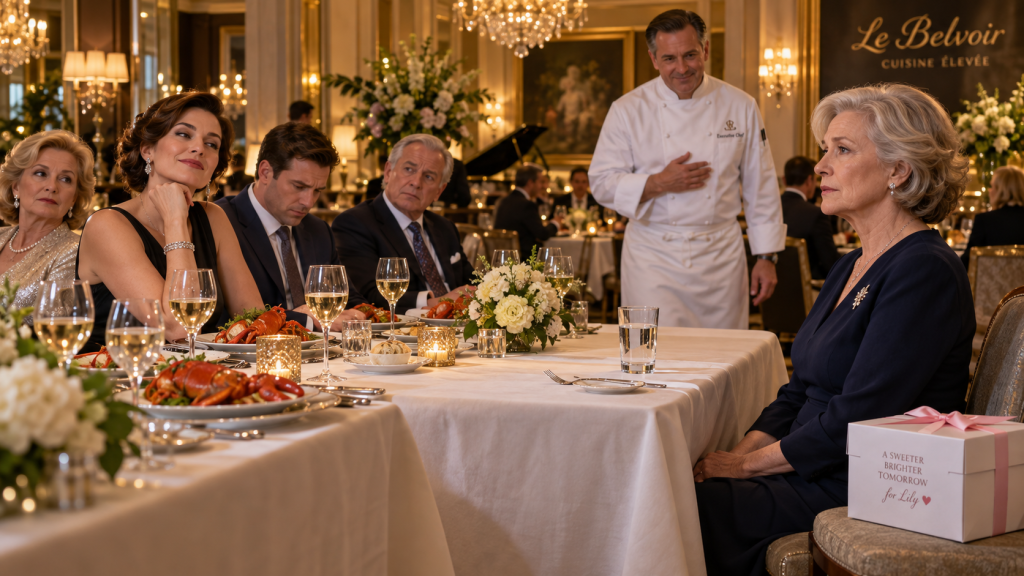
At dinner, my daughter-in-law ordered lobster for everyone at the table—everyone except me. Then she slid a glass of water toward my place and said, “That will be enough for her.” I looked at my son, waiting for him to defend the mother who had raised him alone. Instead, he lowered his eyes and said, “Remember your place, Mom.” I didn’t argue. Ten minutes later, the executive chef walked up to our table and addressed me with such deep respect that my daughter-in-law’s smile vanished.

Part 1: The Glass of Water They Thought Was Enough
At dinner, my daughter-in-law ordered lobster for everyone at the table except me.
Then she slid a glass of water toward my seat at the far end and smiled like she had done me a kindness.
“That will be enough for her,” Claire told the waiter.
I looked at my son, Ethan, waiting for him to defend the woman who had raised him alone. He sat beside his wife beneath the crystal chandeliers, dressed in an expensive suit, staring down at his plate like he had heard nothing.
“Ethan?” I asked.
After a long pause, he answered quietly.
“Just accept it, Mom. Remember your place.”
For a moment, I did not see the successful man across from me. I saw the little boy whose hand I held through winter rain, the child I fed before myself, and the student whose shoes, lunches, and college bills I somehow managed to pay.
I looked down at the water.
“Understood,” I said.
Claire seemed disappointed. She had expected tears, anger, or a scene she could use to call me difficult.
I gave her nothing.
My name is Eleanor Hayes. I am sixty-five, and I raised Ethan alone after his father disappeared when Ethan was six. No explanation. No support. No one to step in when life became hard.
So I did everything.
I cleaned offices before sunrise, worked lunch shifts in a school cafeteria, waited tables, and spent long hours in commercial kitchens. I carried trays, stood beside hot ovens, and went home with aching feet, but Ethan always had clean clothes, school supplies, and food on the table.
When college came, I found a way to help with that too.
I wanted my son to have choices I never had.
He graduated, built a career, and married Claire.
At first, I tried to love her because I thought making Ethan happy was enough. I ignored her comments about my clothes, my apartment, and the way she looked around my modest home like poverty might rub off on her.
Then came the exclusions.
Birthday dinners I heard about afterward.
Holidays I was not invited to.
Family trips they mentioned only after they came home.
Ethan allowed all of it.
So when he called and said they wanted to repair our relationship, I let myself hope. I wore my best navy dress and accepted their invitation to one of the city’s most exclusive restaurants.
But the table told me the truth before anyone spoke.
Claire sat between her parents. Ethan sat beside her. My chair had been placed far away, with an uncomfortable stretch of empty space between us.
Then the waiter came.
“Four lobster dinners,” Claire said. “Imported wine, appetizers, and desserts.”
I waited for her to include me.
She didn’t.
The water arrived soon after.
As they ate, Claire’s parents talked about people who reached retirement without planning properly. They laughed about small apartments, working-class neighborhoods, and people who spent life “getting by” instead of becoming important.
Then Claire looked at me.
“I think Eleanor should attend fewer family events,” she said. “We have a certain image now.”
Ethan said nothing.
Beside my chair sat the strawberry cake I had brought for Claire’s four-year-old daughter, Lily, because I knew she loved strawberries.
Claire glanced at the box.
“What exactly do you think you can contribute?”
I looked at her calmly.
She leaned back.
“Love is nice, Eleanor. But love doesn’t provide status, opportunities, or useful connections.”
Something inside me went quiet.
They had decided who I was.
And as the executive chef entered the dining room, I decided it was finally time for them to learn how wrong they were.
PART 2 — THE WOMAN THEY THOUGHT HAD NOTHING TO OFFER
The executive chef stopped beside our table.
For one second, nobody spoke.
He was a tall man in his early fifties with silver beginning at his temples and the calm, controlled presence of someone used to running a kitchen where a hundred things could go wrong at once.
His white coat was immaculate.
His name was embroidered over the heart.
MARCUS ALVAREZ — EXECUTIVE CHEF
Claire smiled immediately.
The kind of smile she reserved for people she considered important.
“Oh, Chef Alvarez,” she said warmly. “Everything has been wonderful.”
He did not look at her.
He looked at me.
Then his entire expression changed.
“Mrs. Hayes?”
My throat tightened.
“Marcus.”
His face softened.
And in front of Claire, Ethan, her parents, two waiters, and half the nearby tables, the executive chef reached for my hand with both of his.
“I cannot believe you’re here.”
Claire’s smile froze.
Marcus laughed quietly.
“You should have told me you were coming.”
“I didn’t know I was supposed to.”
He looked genuinely offended.
“You come into my dining room, sit at my table, and don’t tell me?”
Then his eyes dropped toward my place setting.
Water.
No plate.
No food.
His smile disappeared.
“What happened here?”
The waiter beside him went pale.
Claire answered quickly.
“Oh, Eleanor isn’t hungry.”
I turned my head.
Interesting.
Ten minutes earlier, apparently water had been all I deserved.
Now I had voluntarily lost my appetite.
Marcus looked at me.
“Mrs. Hayes?”
I could have embarrassed her.
One sentence would have done it.
I could have said:
They decided lobster was wasted on me.
Instead I replied:
“I haven’t ordered.”
Marcus stared at the untouched menu beside me.
Then at the plates surrounding the table.
Four lobster dinners.
Appetizers.
Wine.
My glass of water.
He was a chef.
A dining room told stories to people like him.
He did not need much help reading this one.
Marcus turned toward the waiter.
“Bring Mrs. Hayes the tasting menu.”
Claire blinked.
“The tasting menu?”
Marcus ignored her.
“And no charge.”
I shook my head.
“Marcus.”
“No.”
“Absolutely not.”
“You paid for enough meals for me.”
His voice softened.
“Let me buy one.”
The table became very quiet.
Claire’s father, Richard, lowered his fork.
Her mother, Patricia, stared at me.
Ethan finally looked up.
Marcus pulled an empty chair from the neighboring table and sat beside me as though the restaurant did not belong to people who paid hundreds of dollars for reservations.
“How long has it been?”
he asked.
“Fifteen years?”
“Closer to eighteen.”
He smiled.
“Still correcting people.”
“Someone has to.”
He laughed.
That laugh carried me backward twenty-five years.
Not to crystal chandeliers.
To a hotel kitchen with cracked tiles, screaming ticket printers, and an eighteen-year-old dishwasher who barely spoke English and wanted desperately to become a cook.
Marcus had arrived at the Benton Hotel kitchen when Ethan was in middle school.
I was working evenings there after my cafeteria shift.
Not glamorous.
Not important.
At least that was how people like Claire would describe it.
I was a line cook then.
Not formally trained.
Everything I knew had been learned standing beside people willing to show me.
How long to brown butter before it burned.
How to sharpen a knife correctly.
How to tell when dough had enough water without measuring twice.
How to feed two hundred people and somehow still care whether plate number one hundred ninety-nine was good.
Marcus washed dishes.
He watched everything.
Whenever the kitchen slowed, he asked questions.
One night he burned three pans trying to practice a sauce after closing.
The sous-chef told him:
“You’re not a cook.”
Marcus stayed.
The next night, I gave him a saucepan.
“Again.”
That was the beginning.
Marcus looked around the table.
“Mrs. Hayes taught me half of what kept me alive in professional kitchens.”
I shook my head.
“That is nonsense.”
“No.”
He looked toward Claire.
“She was the first person who let me touch a stove after everyone else decided I belonged at the dish station.”
Claire gave a weak laugh.
“Oh.”
Marcus continued.
“When I applied for my first certification course, I was short two hundred eighty dollars.”
I closed my eyes.
“Marcus.”
“You paid it.”
“You paid me back.”
“Three years later.”
“You still paid me back.”
“I have never forgotten.”
Ethan’s face changed.
He had never heard this story.
That was not entirely his fault.
I had never told it.
When you spend your life surviving, you rarely document the parts where you mattered to other people.
You simply come home and make dinner.
Marcus leaned back.
“And when I cut my hand and management wanted to replace me because I couldn’t work the line for six weeks, who went into the general manager’s office?”
I sighed.
“That man was an idiot.”
Marcus smiled.
“She told him if he fired me while I was injured, she would resign too.”
Richard looked impressed despite himself.
“Did he back down?”
Marcus nodded.
“He did.”
I added:
“Because three other cooks threatened to follow me.”
Marcus looked at me.
“Because you asked them.”
“I did not.”
“You didn’t need to.”
Silence settled over the table.
Claire looked suddenly uncomfortable.
The social hierarchy she had built over dinner had cracked.
Not because I had become rich.
Not because I secretly owned the restaurant.
Because someone she respected respected me.
Apparently that was harder for her to understand.
Marcus stood.
“I need to get back to the kitchen.”
Then he looked at the cake box beside my chair.
“What’s that?”
“Strawberry cake for Lily.”
His eyebrows rose.
“You made it?”
“Yes.”
He looked almost offended again.
“And nobody told me Eleanor Hayes brought cake into my restaurant?”
I laughed.
“It’s for my granddaughter.”
“Good.”
Then he glanced at the table.
“Dessert is canceled.”
Claire nearly choked.
“What?”
Marcus smiled politely.
“If Mrs. Hayes made strawberry cake, you already have something better.”
Then he looked at me.
“If you’ll allow my pastry chef to plate it.”
“Marcus.”
“Please.”
I gave up.
“Fine.”
He kissed my cheek.
Not theatrically.
Affectionately.
Then returned to the kitchen.
For almost a minute, no one at our table spoke.
The restaurant noise continued around us.
Glasses.
Silverware.
Low conversation.
Then Claire said:
“You never mentioned knowing him.”
I looked at her.
“You never asked what I did before retirement.”
Her face tightened.
“I knew you worked in kitchens.”
“Apparently not.”
Patricia cleared her throat.
“So you were a chef?”
“No.”
The answer seemed to disappoint her.
“I was a cook.”
Then:
“I was good at it.”
That mattered.
People often try to upgrade working-class jobs before they respect them.
As though dignity needs a better title.
It does not.
I had been a cook.
A very good one.
I had fed people.
Trained people.
Cleaned grease traps.
Worked through fevers I should have stayed home with.
Burned my hands.
Ruined sauces.
Made beautiful ones.
Paid rent.
Raised a child.
That was enough.
Ethan finally spoke.
“Mom, I didn’t know any of that.”
I looked at him.
“No.”
“Why didn’t you tell me?”
The question almost made me laugh.
“When?”
He frowned.
“What?”
“When exactly should I have told you?”
“When you were fourteen and embarrassed that my shoes smelled like fryer oil?”
His face went pale.
“When you were seventeen and asking whether I could work another Saturday so you could attend that college prep program?”
“Or when you were twenty-two and I was taking double shifts so you could finish school without carrying as much debt?”
I did not say it cruelly.
That made it worse.
Ethan lowered his eyes.
Again.
Claire sighed.
“Can we not turn dinner into some kind of emotional trial?”
I looked at her.
“You ordered food for everyone except me.”
Richard shifted uncomfortably.
Claire’s mother looked away.
“You told the waiter water was enough for me.”
“That was a joke.”
“No.”
I said it softly.
“It was only a joke after someone you respect treated me like I mattered.”
Claire’s mouth opened.
Closed.
Good.
Then Lily appeared.
She had been at the restaurant’s children’s room with a sitter because Claire did not like “interruptions” during adult dinners.
Four years old.
Pink cardigan.
Wild curls.
She saw me and ran.
“Grandma!”
I stood just in time.
She hit me around the waist.
There are hugs that tell the truth adults spend hours avoiding.
“Did you bring my cake?”
I smiled.
“Yes.”
“Strawberry?”
“Yes.”
“Pink inside?”
“Very pink.”
She squealed.
Claire looked annoyed.
“Lily, lower your voice.”
Lily ignored her.
She looked at my empty place.
“Where’s your food?”
Before I could answer, Ethan said:
“It’s coming.”
His voice was quiet.
Ashamed.
Maybe there was still hope for him.
I was not sure.
The tasting menu arrived.
Six small courses.
More food than I wanted.
Marcus knew that.
He had clearly designed it as theater.
A tiny mushroom tart.
Sea bass.
Roasted vegetables.
A spoonful of risotto.
A piece of lamb.
Then the strawberry cake.
My strawberry cake.
The pastry chef had placed one slice in the center of a white plate with fresh berries and cream.
Beautiful.
Lily clapped.
Then Marcus sent out enough cake for the entire table.
I watched Claire eat mine.
That felt almost poetic.
Dinner might have ended there.
If Claire had been wise, it would have.
Instead, embarrassment made her crueler.
She leaned back and said:
“Well, clearly Eleanor has a lot of old kitchen friends.”
Old kitchen friends.
A category.
Something that could be placed back beneath her.
Then:
“But that doesn’t really change what we were discussing.”
I looked at her.
“What were we discussing?”
“Family priorities.”
Interesting.
She continued.
“Ethan has worked very hard to move forward.”
“Move forward from what?”
The question escaped before I could soften it.
Claire blinked.
“From where he started.”
Where he started.
Me.
Apparently I was a location to escape.
Ethan whispered:
“Claire.”
She ignored him.
“We are trying to create opportunities for Lily.”
“Social circles matter.”
“Schools matter.”
“Connections matter.”
“And frankly, sometimes certain family dynamics can make that harder.”
Lily was beside me eating cake.
Too young to understand the words.
Old enough to feel tone.
I stroked her hair.
Then asked:
“Are you saying my presence harms my granddaughter?”
Claire hesitated.
That meant yes.
Richard stepped in.
“Claire, enough.”
She turned.
“Dad.”
“No.”
Interesting.
Her own father had found a boundary before my son did.
Patricia looked embarrassed.
“This dinner has gone far enough.”
Claire laughed bitterly.
“Fine.”
Then she looked at Ethan.
“Tell her.”
He went still.
My stomach tightened.
“Tell me what?”
Ethan looked like he wanted the floor to open.
Claire folded her arms.
“Tell her why we actually invited her.”
There it was.
Of course.
Repairing our relationship had never been the entire reason.
I looked at my son.
“Ethan?”
He swallowed.
“Mom, there are a couple of things we need to discuss.”
I almost smiled.
“Of course there are.”
Richard pushed his plate away.
“I was told this was a family dinner.”
“It is.”
Claire replied.
Her father looked unconvinced.
Then Ethan reached beneath his chair and pulled out a thin leather folder.
A folder.
My body became very still.
He placed it on the table between us.
“We didn’t want to bring this up until after dinner.”
Claire glanced at my cake.
Apparently humiliation was the appetizer.
Paperwork dessert.
I opened the folder.
Inside were property records.
My property records.
Not the little apartment Claire despised.
The duplex on Cypress Avenue.
I looked at Ethan.
“Why do you have this?”
He rubbed his hands together.
“Mom, please let me explain.”
I already hated the sentence.
The Cypress duplex had belonged to my mother.
After she died, she left it to me.
I had lived in one unit for three years after Ethan went to college.
Then, when I remarried briefly in my late forties—another story, another mistake—I moved out and rented both units.
The property was modest.
Two apartments.
Old brick.
Small yard.
Nothing glamorous.
But the mortgage had been paid off years ago.
The rental income supplemented my retirement.
Ethan knew that.
He did not know the details.
Or at least I thought he did not.
Claire pointed at the property sheet.
“That building is wasted.”
My eyebrows rose.
“Wasted.”
“Yes.”
“It could be sold.”
“So can your jewelry.”
She stared.
I smiled.
“See how strange it sounds when somebody volunteers property that isn’t theirs?”
Richard covered his mouth.
Possibly hiding a laugh.
Claire did not appreciate it.
Ethan leaned forward.
“Mom, we are not trying to take anything.”
That phrase should be printed on warning labels.
“Then why are we discussing my property at a restaurant?”
He glanced at Claire.
“We’re looking at Lily’s school options.”
I waited.
“The private academy near us has an entrance donation program.”
I knew the school.
Tuition alone cost more than my first annual salary.
“How much?”
Claire answered.
“Fifty thousand would make a meaningful difference.”
I stared.
“A meaningful difference to whom?”
“Our family.”
There was that word.
Family.
Always remarkably flexible when someone wanted access to another person’s wallet.
Ethan rushed in.
“No one is saying you have to pay fifty thousand.”
“What are you saying?”
“That if you sold Cypress, you could invest most of it and help us with part.”
I looked at him.
“You invited me here to ask me to sell my rental property so you can make a donation to a private school.”
“When you say it like that—”
“How else should I say it?”
Silence.
Claire looked furious.
“It’s not just school.”
“Then what else?”
She leaned closer.
“You’re sixty-five.”
I smiled.
“Correct.”
“You don’t need to be managing tenants forever.”
“I have a property manager.”
She blinked.
That information did not fit her version of me.
“I pay someone to handle most maintenance and tenant issues.”
“Oh.”
“And the income pays several of my expenses.”
Claire looked at Ethan.
He knew.
Of course he knew.
Then Richard said slowly:
“Ethan told us Eleanor was considering selling.”
I turned toward my son.
He went white.
“What?”
Richard continued.
“He said you wanted to simplify your finances and were discussing helping with Lily’s education.”
Claire snapped:
“Dad.”
“No.”
He looked at me.
“That is what I was told.”
Patricia nodded.
“So was I.”
I stared at Ethan.
The restaurant disappeared.
All I could see was my son.
“Did you tell them I agreed to sell Cypress?”
“No.”
“Did you tell them I was considering it?”
He hesitated.
That was enough.
“Ethan.”
“I said you might.”
“Based on what conversation?”
He looked down.
None.
Claire jumped in.
“He was trying to get everyone thinking constructively.”
I laughed.
“About my property.”
She opened her mouth.
I turned back to Ethan.
“Answer me.”
He whispered:
“We haven’t talked about it yet.”
“Then you lied.”
“No.”
“You told people I was considering something I have never discussed with you.”
“I assumed—”
There it was.
Assumed.
The favorite word of entitled children.
I sat back.
Suddenly the lobster made sense.
The seating.
The mockery.
The talk about retirement.
Small apartments.
Useful connections.
They had not invited me to repair anything.
They invited me to establish hierarchy before asking for money.
Make me feel small.
Then make generosity feel like the price of remaining included.
That realization hurt more than the glass of water.
Because Claire was cruel.
I knew that.
Ethan had participated.
That was new.
Or maybe I had simply stopped making excuses.
I closed the folder.
“No.”
Claire blinked.
“What?”
“No.”
“To the sale?”
“To all of it.”
I looked at Ethan.
“I am not selling Cypress for Lily’s school.”
“I am not donating fifty thousand dollars.”
“I am not paying for access to my own family.”
Claire laughed coldly.
“Nobody said that.”
“You did.”
“Not in those words.”
“No.”
“You used lobster.”
Richard put his napkin down.
“Claire.”
She looked furious.
Ethan said:
“Mom, please.”
I turned toward him.
“What?”
“Can we talk privately?”
“We are.”
“Not with them.”
Interesting.
He had needed an audience when he thought I would agree.
Now he wanted privacy.
“No.”
His face fell.
Then Marcus returned.
He had probably been warned by staff that our table had become a small diplomatic crisis.
He looked at me.
“You all right?”
I smiled.
“Yes.”
He glanced at the leather folder.
Then at Ethan.
Something in his face changed.
Not judgment.
Recognition.
Maybe he had seen family negotiations before.
Restaurants witness everything.
Proposals.
Affairs.
Divorces.
Inheritance fights beside tiramisu.
Human beings are determined to make food watch us suffer.
I stood.
“Marcus, thank you for dinner.”
“You’re leaving?”
“Yes.”
“I’ll have the car brought around.”
Claire gave a tiny laugh.
“She didn’t valet.”
Marcus looked at her.
“I know.”
Then at me.
“Our driver will take you.”
I shook my head.
“Absolutely not.”
“Mrs. Hayes.”
“Marcus.”
We stared.
Old kitchen contest.
He lost.
“Fine.”
Then he said:
“Call me tomorrow.”
“I will.”
“You always say that.”
“I am sixty-five. Stop giving me assignments.”
He smiled.
There it was.
Respect without pity.
I had missed that more than I realized.
Lily grabbed my hand.
“Grandma, are you going home?”
“Yes, sweetheart.”
“Can I come?”
Claire stiffened.
I knelt.
“Not tonight.”
“Why?”
“Because your mom and dad brought you.”
She frowned.
“When can I see you?”
I looked up at Ethan.
He looked ashamed.
Then back at Lily.
“Whenever your parents and I arrange it.”
Important.
I would not use my granddaughter as revenge.
Children are not bargaining chips.
I kissed her forehead.
She smelled like strawberries.
As I left, Richard followed me into the lobby.
“Eleanor.”
I stopped.
He looked embarrassed.
“I owe you an apology.”
“You didn’t order the water.”
“No.”
“But I participated in the conversation.”
Fair.
He continued.
“I believed what Ethan told us.”
“That you were financially dependent on him.”
I went still.
“What?”
Richard immediately knew he had said too much.
Good.
Because now I needed all of it.
“What exactly did Ethan tell you?”
Richard looked toward the dining room.
Then back at me.
“He said he had been helping you financially for years.”
I stared.
“He said your retirement income was limited.”
“That you had difficulty managing the property.”
“That he often covered emergencies.”
My hands turned cold.
None of that was true.
Ethan had paid for dinner occasionally.
Bought me a television two Christmases earlier.
Once covered a plumbing repair because he insisted it was my birthday gift.
That was it.
I had never borrowed money from him.
Never asked him to pay my rent.
Never needed him to support me.
Richard continued, uncomfortable now.
“He said one reason he and Claire had excluded you from some events was because you became upset when people spent money around you.”
My throat tightened.
I almost laughed.
“What?”
“He made it sound like dinners and trips embarrassed you because you could not afford them.”
I thought of the birthday dinners.
The family vacations.
Christmas brunch I saw afterward on social media.
All those years I had told myself:
Maybe Claire prefers her own family.
Maybe Ethan is trying to keep peace.
Maybe they assume I’m tired.
No.
My son had created an explanation.
One that made excluding me sound compassionate.
One that protected his image.
He was not ashamed that his mother was poor.
He was ashamed that his successful life had begun with a mother who had once been poor.
There is a difference.
A brutal one.
“Why would he say that?”
I whispered.
Richard shook his head.
“I don’t know.”
Then:
“I thought you knew.”
Of course.
Everyone always thinks the person being discussed knows the story told about them.
I smiled sadly.
“Thank you for telling me.”
“I’m sorry.”
“So am I.”
I left.
At home, I did not cry immediately.
I changed out of the navy dress.
Hung it carefully.
Washed my face.
Put the strawberry cake plate Marcus had packed for me into the refrigerator.
Then sat at the kitchen table.
Silence.
No applause.
No executive chef.
No Claire.
No Ethan.
Just me.
That was when the tears came.
Because hunger had never been the insult.
I had gone hungry many times in my life.
When Ethan was little, there were weeks I told him I ate at work because there was only enough dinner for one decent portion.
A glass of water could not humiliate me.
What hurt was that my son had watched someone try.
And helped.
Remember your place, Mom.
I pressed both hands over my face.
“What place, Ethan?”
Mother?
Burden?
Embarrassing origin story?
Someone to be hidden until useful?
At midnight, my phone rang.
Ethan.
I let it ring.
Then again.
Then a text.
Mom, I’m sorry dinner got out of hand.
Interesting wording.
Dinner got out of hand.
Like a toddler.
Another:
Claire was embarrassed by the chef situation and reacted badly.
Still Claire.
Then:
Dad told you things that were taken out of context.
Richard.
Not Dad.
Apparently Ethan was typing fast.
Then:
Please don’t make a permanent decision because everyone was emotional.
I almost laughed.
Permanent decision?
I had said no to selling my own building.
Apparently that qualified as instability.
Then came another message.
We should talk about Cypress before you do anything with it.
There.
The part he cared about.
I turned off the phone.
The next morning, Marcus called before I could call him.
“Did you eat?”
I stared at the ceiling.
“Why is everyone suddenly monitoring my food?”
“You left after six tiny courses.”
“Six courses.”
“Tiny.”
I laughed.
Then he became serious.
“Are you okay?”
I hesitated.
“No.”
Good people do not always say:
Tell me everything.
Marcus said:
“Okay.”
Then waited.
So I told him some of it.
Not the property amount.
Not Lily’s school.
Just Ethan.
The lies.
The exclusion.
Marcus was silent for a long time.
Then:
“You spent your whole life making him feel like he came from somewhere better than struggle.”
My eyes filled.
“Yes.”
“Maybe he misunderstood the lesson.”
I frowned.
“What do you mean?”
“You wanted him to know poverty did not define him.”
“Maybe he learned that poverty was something to hide.”
That hurt.
Because it might be true.
Marcus told me something I had forgotten.
When Ethan was sixteen, he came to the Benton Hotel once.
I needed to drive him home after work.
He sat in the kitchen waiting.
Marcus remembered Ethan watching me scrub down my station.
Apparently another cook said:
“Your mom works harder than all of us.”
Ethan looked embarrassed.
Not proud.
Marcus never forgot.
Neither had I, once he reminded me.
I had simply filed the memory somewhere kinder.
Parents do that.
We edit our children in real time.
I spent the morning reviewing my own finances.
Not because I doubted them.
Because clarity steadies me.
Cypress Avenue.
Two rental units.
Modest monthly income.
Property manager.
Taxes.
Repairs.
Insurance.
Emergency reserve.
My retirement account.
Social Security.
Savings.
No debt except a small credit-card balance paid monthly.
I was not wealthy.
I was secure.
There is dignity in that word.
Secure.
Enough.
Not dependent.
Not desperate.
Not waiting for my son to rescue me.
Then I opened the small fireproof box in my closet.
Inside were the property deed, insurance papers, and a folder from my attorney, Denise Harper.
I had met with Denise the previous year after a health scare.
Nothing dramatic.
High blood pressure.
A reminder that sixty-five is not thirty-five with better stories.
We updated my will.
Power of attorney.
Healthcare documents.
Cypress remained mine.
Eventually, after my death, the property or its proceeds would be divided.
Half to Ethan.
Half into a trust for Lily.
I had chosen that because I loved them.
Not because they knew.
Ethan did not know.
I stared at the documents.
Then wondered how much he thought he knew anyway.
At eleven, I called Denise.
I told her about dinner.
The Cypress folder.
Ethan telling people I was considering a sale.
She listened.
Then asked:
“Has he ever asked you to sign anything related to the property?”
“No.”
“Has anyone contacted you about valuation, listing, refinancing, management, or transfer?”
“No.”
“Any mail you did not recognize?”
I thought.
Then remembered an envelope from a title company two months earlier.
I assumed it was advertising and threw it away.
My stomach tightened.
“Maybe.”
Denise’s voice changed.
“Tell me.”
I did.
“Do you remember the company?”
“No.”
“Check your email.”
I searched.
Nothing.
Then Denise asked:
“Do you have online access to your county property records?”
“Yes.”
“Check them.”
The deed remained unchanged.
Mine.
Good.
No liens I did not recognize.
Good.
I breathed.
Then Denise said:
“I’m going to ask one more question.”
“Okay.”
“Has Ethan ever asked for a copy of your deed or lease agreements?”
I almost said no.
Then remembered Thanksgiving.
Last year.
He said he wanted to understand the property “in case something happened.”
I emailed him a PDF of the deed and the management agreement.
At the time, it felt responsible.
He was my son.
My likely future executor.
Why wouldn’t he know where things were?
“I sent him copies.”
Denise sighed.
“That is not wrongdoing.”
Good.
“Do not turn normal document sharing into evidence.”
Also good.
Facts.
Then:
“But if he has been representing that you intend to sell, we should see whether anyone else has been contacted.”
My chest tightened again.
“How?”
“I’ll make a few calls with your permission.”
“Yes.”
Two hours later, Denise called back.
Her tone was careful.
“Eleanor.”
“What?”
“A real-estate broker contacted my office.”
My stomach dropped.
“When?”
“Last month.”
“Why?”
“She wanted to confirm whether you had counsel because your son said there might be an intra-family transfer of Cypress Avenue.”
I stopped breathing.
“Intra-family transfer?”
“Yes.”
“Transfer to whom?”
“Ethan.”
The room became very still.
“What did the broker say?”
“That Ethan was exploring whether you could transfer the property to him while retaining a life-income arrangement.”
I laughed.
Not because it was funny.
Because apparently my son had built an entire financial future in conversations I had never attended.
“Did she say I agreed?”
“She said Ethan told her you were ‘open to it.’”
There it was again.
Open.
Considering.
Possibly.
Words that cost nothing when spoken about someone else’s property.
“Did you tell her no?”
“I told her I had no instructions from you and would not discuss your property without your authorization.”
“Good.”
“She never contacted me again.”
“Did Ethan?”
“No.”
That was almost worse.
He had tested the idea.
Hit resistance.
Then invited me to dinner.
Water.
Lobster.
Status.
Remember your place.
The dinner was not merely cruelty.
It was preparation.
Make me feel lucky to be included.
Then ask for something.
Denise continued.
“There is something else.”
I closed my eyes.
“Of course.”
“The broker forwarded the email Ethan sent her.”
“What does it say?”
A pause.
Then Denise read:
My mother has agreed in principle that Cypress should stay in the family. She no longer wants the burden of managing tenants. We are working through the timing, but she wants me to begin exploring the transfer structure now.
I stood.
My chair scraped the floor.
“I never said that.”
“I know.”
Then:
“He attached a document.”
My hands turned cold.
“What document?”
“A one-page family-property memorandum.”
“Signed?”
“Not by you.”
Relief came.
Briefly.
“His signature?”
“Yes.”
“What does it say?”
Denise hesitated.
“It says the intended transfer is based on conversations between you and Ethan regarding succession of the property.”
I laughed bitterly.
Succession.
I was sixty-five.
Healthy enough to bake strawberry cake and argue with chefs.
Apparently I had already become an estate event.
Then Denise said:
“There is a handwritten note at the bottom.”
My stomach tightened.
“What note?”
“It says:
Mom wants Lily to benefit eventually. This is the cleanest way.”
I sat down.
Lily.
Of course.
The justification.
No entitlement survives long without wrapping itself in someone innocent.
I asked Denise:
“Is any of this legally effective?”
“No.”
Immediate.
“Your property remains yours.”
“The memorandum is not a deed.”
“It does not transfer title.”
“There is no recorded transfer.”
“Ethan cannot make himself owner by emailing a broker.”
Good.
I breathed.
Then:
“But?”
“But I think you should talk to him before this becomes more confused.”
“Yes.”
“And Eleanor?”
“Yes?”
“Do not sign anything because you want the argument to end.”
I closed my eyes.
Apparently every good lawyer had the same line eventually.
I called Ethan.
He answered immediately.
“Mom.”
“Come to my apartment at six.”
“Okay.”
“Alone.”
Silence.
“Claire should be there.”
“No.”
“Mom—”
“Alone.”
My voice left no space.
“Fine.”
“And bring every paper you have related to Cypress.”
He stopped breathing for a second.
“How do you know about that?”
There.
Not:
What papers?
“How do you know?”
I answered:
“Six o’clock.”
Then hung up.
At 5:55, Ethan arrived.
No Claire.
He carried a leather folder.
The same one from dinner.
He looked younger without her beside him.
Or maybe simply less armored.
I let him in.
No hug.
He noticed.
We sat at my kitchen table.
The table where I had once helped him with multiplication homework.
Where I filled out college financial-aid forms.
Where he cried after his first breakup.
Life is cruel enough to reuse furniture for everything.
He placed the folder down.
“Mom, I’m sorry.”
“For what?”
He stared.
“Dinner.”
“What part?”
His face tightened.
“Claire should not have ordered for everyone except you.”
“No.”
“And I shouldn’t have said what I said.”
“What did you say?”
He looked ashamed.
“Remember your place.”
I waited.
He whispered:
“That was disgusting.”
“Yes.”
No rescue.
He needed to hear the word land.
Then I asked:
“Why did you tell Richard I depend on you financially?”
His face changed.
“I didn’t say it exactly like that.”
“Tell me what you said.”
He rubbed his forehead.
“I said I help you.”
“How?”
“Things.”
“What things?”
“Mom.”
“Name three.”
He could not.
I waited.
Finally:
“The TV.”
“A Christmas gift.”
“The plumbing repair.”
“A birthday gift you insisted on paying.”
He looked away.
“And dinners.”
I almost laughed.
“Ethan, buying your mother dinner six times a year is not financial support.”
“I know.”
“Then why did you make it sound like it was?”
His eyes filled.
Because the answer was uglier than money.
“I didn’t want Claire’s parents thinking you were struggling.”
I stared.
“Why?”
He looked at me helplessly.
“They’re different.”
“Meaning?”
“They come from money.”
“So?”
“Mom.”
“So?”
He started crying.
“I was embarrassed.”
There it was.
Not of me exactly.
Of the story attached to me.
I let him continue.
“When Claire and I first got serious, her family kept asking about my background.”
“Where Dad was.”
“What you did.”
“Where we lived.”
“I hated it.”
My throat tightened.
“So you rewrote me.”
He cried harder.
“I made it sound better.”
“No.”
I leaned forward.
“You made me sound dependent on you because being a successful son supporting his poor mother felt better than being the son of a cafeteria worker and cook who supported him.”
He closed his eyes.
Yes.
That was it.
I sat back.
Something inside me broke.
Not loudly.
A clean break.
For decades, I had thought sacrifice automatically became gratitude.
It does not.
Sometimes sacrifice becomes invisible.
Sometimes children grow so used to being carried they remember only arriving.
“What about Cypress?”
I asked.
He wiped his face.
“What about it?”
“Why did you tell a broker I agreed in principle to transfer it to you?”
His face paled.
“I thought you would.”
Again.
I laughed softly.
“I thought you would.”
The four most dangerous words in our relationship.
Ethan looked down.
“I knew you wanted Lily to have something someday.”
“Someday.”
“Yes.”
“After what?”
He said nothing.
“After I die, Ethan.”
His face crumpled.
“That is what inheritance means.”
“I know.”
“Do you?”
I opened the folder.
Inside were printouts.
Property estimates.
Potential tax scenarios.
A sample intra-family sale structure.
A proposed lease arrangement.
My life converted into columns.
“You were planning around my property.”
“I was exploring.”
“For yourself.”
“For Lily.”
“No.”
I shook my head.
“Do not use your daughter to soften this.”
He flinched.
“This was for you.”
“The private school.”
“The larger social circle.”
“The image.”
“Your life.”
“Not hers.”
Silence.
Then he whispered:
“You’re right.”
That surprised me.
Maybe dinner had finally cracked something in him too.
I asked:
“Did Claire know you told people I was considering a transfer?”
“Yes.”
“Did she know I had never said that?”
Long pause.
“Yes.”
There.
No more pretending Claire was merely rude.
She knew the financial story was ahead of reality.
Still, Ethan had been the one telling it.
His responsibility.
I stood.
Went to the fireproof box.
Returned with my estate-plan summary.
Not the full documents.
Just enough.
I placed it in front of him.
“What is this?”
“My current plan.”
His eyes moved over the page.
Then stopped.
Cypress Avenue — fifty percent to Ethan Hayes, fifty percent to trust for Lily Hayes, subject to sale or retention at trustee discretion.
He looked up.
“You were already leaving me half?”
“Yes.”
His face collapsed.
“And half for Lily.”
“Yes.”
“Why didn’t you tell me?”
I almost smiled.
“Because inheritance is not a negotiation you get to manage while I am alive.”
Tears ran down his face.
All that manipulation.
All that embarrassment.
All that plotting.
For something he had already been included in through love.
Not entitlement.
Love.
Then I took the paper back.
“But this plan is under review.”
His face changed.
“Are you cutting me out?”
“I don’t know.”
Honest.
“I will not make that decision tonight.”
He nodded slowly.
Good.
“But I am changing one thing immediately.”
“What?”
“You will not be my financial agent.”
He froze.
“Was I?”
“Second alternate.”
Not anymore.
His face fell.
“I understand.”
For once, he did not argue.
That mattered.
Then the doorbell rang.
I frowned.
Ethan looked confused.
I had not invited anyone.
I opened the door.
Claire stood there.
Of course.
She had lasted forty minutes.
“Can I come in?”
“No.”
The answer surprised both of us.
Her face hardened.
“Eleanor.”
“You were not invited.”
“This concerns my family.”
I looked at her.
“This is my home.”
For several seconds, neither moved.
Then Ethan appeared behind me.
“Claire, go home.”
She stared at him.
“What?”
“I said go home.”
Her face changed.
Maybe for the first time, my son had chosen a boundary she had not approved.
“This affects Lily.”
Ethan said:
“No.”
“It affects Mom’s property.”
“That is the point.”
Claire looked at me.
“You’re turning him against his own daughter.”
I laughed once.
“No.”
Then Ethan said something I had waited years to hear.
“She is my mother.”
Claire stared.
He continued.
“And we treated her terribly.”
Silence.
“She doesn’t owe us Cypress.”
“Or school money.”
“Or anything because we excluded her.”
Claire’s face went pale.
I almost felt sorry for her.
Almost.
Then Claire said:
“So that’s it?”
“No private school?”
Ethan looked at her.
“We’ll pay for what we can afford.”
“And if that school is outside what we can afford, Lily goes somewhere else.”
Claire stepped back as though he had struck her.
Not because of school.
Because the hierarchy had changed.
Money she had already mentally spent had returned to its actual owner.
Me.
She left.
No dramatic screaming.
No broken vase.
Just a door closing.
That was enough.
Ethan sat back down.
For another hour, we talked.
Not solved.
Talked.
He told me how ashamed he had been of our old apartment as a teenager.
How Claire’s family triggered every insecurity he thought success had erased.
How he began polishing his past.
At first, small things.
Then larger.
My cafeteria work became “food-service management.”
My apartment became “a small investment property.”
My gifts to him became his support of me.
Every lie moved him farther from the boy he had been.
And farther from me.
I listened.
Then told him:
“Being ashamed of poverty is understandable.”
He nodded.
“Being ashamed of the person who survived it for you is different.”
He cried.
Good.
Not because I wanted pain.
Because some truths deserve to be felt.
Ethan left at almost nine.
At the door he asked:
“Can I hug you?”
That question alone nearly made me say yes.
Nearly.
“Not tonight.”
His face fell.
Then he nodded.
“Okay.”
And left.
Respect sometimes begins with surviving a no.
The next morning, Denise called.
I expected a routine update.
Instead, her voice was tight.
“Eleanor.”
“Yes?”
“I received something from the broker.”
My stomach tightened.
“What?”
“After Ethan met with her last month, someone sent a follow-up email from an address using your name.”
I stopped breathing.
“My name?”
“Yes.”
The email address looked like mine.
But was not.
One extra letter buried in the domain.
Easy to miss.
The message said:
I’ve discussed the Cypress transfer with Ethan and am comfortable moving forward once final tax questions are resolved. Please keep him copied on everything.
My hands turned cold.
“I did not send that.”
“I know.”
“Was anything signed?”
“No.”
Good.
“Was anything filed?”
“No.”
Good.
“Then what—”
Denise interrupted gently.
“There was an attachment.”
My chest tightened.
“A signed property-intent statement.”
My whole body became still.
“Signed by whom?”
A pause.
“Purportedly by you.”
I sat down.
“Purportedly.”
“Yes.”
The signature looked like mine.
Not perfect.
Good enough for a broker who had never seen me sign.
I stared at the wall.
“Did Ethan send it?”
“We do not know yet.”
Facts.
Always facts.
“Could Claire?”
“We do not know.”
“Could someone else?”
“Yes.”
“Do not accuse anyone yet.”
I closed my eyes.
Fine.
Then Denise said:
“There is one more reason I called immediately.”
“What?”
“The attached document is dated two months ago.”
Before dinner.
Before Ethan supposedly planned to “bring up” Cypress with me.
Before he claimed he was merely exploring possibilities.
Two months.
Someone had been trying to create written evidence of my approval long before I ever sat beneath those chandeliers with a glass of water in front of me.
I whispered:
“Send it.”
Seconds later, the document appeared.
FAMILY PROPERTY TRANSFER INTENT
My name.
Ethan’s name.
Cypress Avenue.
A statement that I intended to begin transferring management and future ownership to my son.
At the bottom:
Eleanor Hayes
My supposed signature.
I stared.
Then recognized something.
The E.
The long loop.
The tiny break after the H.
I knew exactly where it came from.
The birthday card I had given Lily six months earlier.
I had written:
Love always, Grandma Eleanor Hayes.
Claire had photographed Lily holding it.
Posted it online.
My full signature visible beneath the drawing.
I felt sick.
Not because that proved Claire created the document.
It did not.
Anyone who saw the image could have copied it.
Including Ethan.
Including Claire.
Including someone else.
Facts.
But the timing destroyed one thing completely.
This had never been a spontaneous family discussion over dinner.
Someone had already begun building a paper trail around an answer I had never given.
I called Ethan.
He answered on the first ring.
“Mom?”
I looked at the false signature.
Then said:
“Ethan, I need you to answer one question very carefully.”
Silence.
“Okay.”
“Did you create a document using my signature to say I agreed to transfer Cypress?”
He stopped breathing.
For three seconds, there was nothing.
Then:
“Mom…”
My stomach dropped.
Not no.
He said my name.
And sometimes the truth begins with the answer someone cannot give.
PART 3 — THE PLACE MY SON FINALLY LEARNED WAS MINE TO CHOOSE
“Mom…”
That was what Ethan said when I asked whether he had created the document using my signature.
Not no.
Not outrage.
Not confusion.
My name.
Softly.
Like he could make the question smaller by making me his mother again before he answered it.
I closed my eyes.
“Ethan.”
“I can explain.”
“No.”
My voice came out calm.
“First, you answer.”
Silence.
Then:
“Yes.”
The room around me disappeared.
Not because I had not suspected it.
Because suspicion still leaves one narrow door open.
A place where the person you love can step through and say:
You were wrong about me.
Ethan closed that door himself.
I sat down.
“Did you create the fake email address?”
“Yes.”
“Did you send the message to the broker pretending to be me?”
“Yes.”
“Did you copy my signature?”
He started crying.
“Yes.”
I stared at the false document on my screen.
Two months old.
My name.
My property.
My supposed intention.
A future transfer I had never discussed.
“Why?”
He breathed hard.
“Because the broker wanted something showing you were serious before she spent more time on transfer structures.”
“You knew I wasn’t serious.”
“I thought you would be.”
There it was again.
The sentence at the center of every betrayal.
I thought you would.
Not:
You said yes.
Not:
You asked me.
He had built permission out of prediction.
I asked:
“Did Claire know?”
Long pause.
“Yes.”
My fingers tightened around the phone.
“Did she help create it?”
“No.”
“Did she know you copied my signature?”
“Yes.”
I stared toward my kitchen window.
Outside, an ordinary delivery truck moved past.
A woman walked a golden retriever.
The world remained insultingly normal.
“What did she say?”
Ethan answered slowly.
“She said we needed something to show the broker we were serious.”
“We?”
“She and I.”
“About my property.”
Silence.
“Yes.”
“Did she tell you to forge my signature?”
“No.”
That mattered.
I held onto facts.
“She told me I should make the paperwork look complete enough that the broker would keep working.”
“And you decided how.”
“Yes.”
He began crying harder.
“I’m sorry.”
I looked at the false signature again.
“I don’t know what that sentence means yet.”
He asked:
“Are you calling the police?”
Not:
Are you okay?
Not:
What can I do?
Consequences first.
I noticed.
“I’m calling Denise.”
“Mom.”
“Yes?”
“Please.”
That word angered me more than the tears.
“Please what?”
“Don’t destroy everything.”
I became very still.
“You are sixty percent owner of nothing here, Ethan.”
“What?”
“You are asking me not to destroy the consequences of something you built out of my name.”
“I didn’t take the property.”
“No.”
“The transfer never happened.”
“No.”
“I didn’t take money.”
“No.”
He sounded relieved.
I cut through it.
“You created false evidence so other people would believe I had already agreed.”
Silence.
“That is not nothing.”
I called Denise.
She listened without interrupting.
Then she said:
“Preserve the text messages.”
“I will.”
“Do not delete the email thread.”
“I won’t.”
“Do not make any promises to Ethan about whether you will report this.”
“I didn’t.”
“Good.”
The broker had already frozen all activity.
No deed had been drafted for execution.
No title change had been recorded.
No lien existed.
No transfer occurred.
My property was still mine.
That mattered.
Denise also explained that the false email and signature could have legal consequences even though the scheme had not completed.
The exact outcome would depend on what Ethan had submitted, what he represented, and whether any institution had relied on it.
So we did not invent crimes over the phone.
We documented.
Again.
Boring procedure.
Bless boring procedure.
I slept badly that night.
At three in the morning, I got up and made tea.
Then I found myself looking through old photographs.
Ethan at six.
Missing front tooth.
Ethan at twelve holding a science-fair ribbon.
Ethan at eighteen beside me at his high-school graduation.
I wore a dress from a discount store.
He wore a suit I had saved six months to buy.
I remember standing beside him afterward while he hugged me and whispered:
“We did it, Mom.”
We.
At the time, I thought it meant he understood.
Maybe he did.
At eighteen.
Then success gave him rooms where he became embarrassed by the woman who helped him get there.
People do not become different all at once.
They edit themselves.
One shame at a time.
The next morning, Claire called.
I let it go to voicemail.
Then another call.
Then a message.
I know Ethan told you. I need to explain my part.
My part.
Interesting.
I sent one reply.
Put it in writing and copy Denise.
No private emotional cleanup.
No opportunity to tell one version to me and another to someone else.
If we were discussing property and false documents now, words could live where everyone could see them.
Claire sent an email two hours later.
Long.
Careful.
Less polished than usual.
She admitted she knew Ethan was communicating with the broker before I had agreed to any transfer.
She admitted she encouraged him to “prepare options” because she believed I would eventually consent.
She admitted she knew the email address using my name was not actually mine.
She admitted she knew Ethan had copied a signature image onto the intent document.
She denied creating either.
She said she did not realize he had actually sent the signed-looking document until later.
Maybe true.
Maybe self-protection.
The records would tell us what they could.
Then she wrote:
I thought Eleanor had already discussed leaving the property to Ethan and Lily, so I convinced myself we were only accelerating a plan that existed anyway.
There.
That was the disease.
Acceleration.
As though consent were a slow elevator and they had found the stairs.
She continued:
I also believed Ethan supported Eleanor financially. I understand now that he exaggerated that.
Exaggerated.
A graceful word for a lie.
Then:
I am ashamed of how I treated her at dinner.
Not me.
Her.
Interesting distance.
Then:
The water comment was cruel.
At least that sentence was clean.
I did not respond.
Not yet.
Instead, I met Denise at the property office.
We reviewed Cypress Avenue.
Every record.
Every inquiry.
Every email.
Nothing had changed hands.
The broker had done preliminary work but had not prepared a deed.
No buyer existed.
No lender.
No hidden sale.
Good.
The false property-intent statement had functioned as a way to make Ethan look authorized enough to continue discussions.
Serious.
But contained.
That made me grateful and furious at the same time.
Denise asked:
“What do you want to do with Cypress?”
I stared.
“Nothing.”
She smiled.
“Good answer.”
“For now.”
“Also good.”
I laughed.
Then became serious.
“I want Lily protected.”
“She can be.”
“I don’t want Ethan managing her share if something happens to me.”
Denise nodded.
“That can be changed.”
“And I don’t want Claire either.”
“Understood.”
A professional trustee would administer Lily’s future trust.
Ethan could remain a beneficiary of my estate without controlling Lily’s portion.
I liked that.
Love without concentration of power.
Family without assuming family is automatically competent.
Then we reviewed my will.
I expected anger to tell me:
Cut Ethan out.
Leave everything to Lily.
Make him feel what he risked.
But revenge is just another way of letting someone else write your estate plan.
I refused.
So I did not disinherit him.
Not then.
Instead, I changed structure.
He would not serve as executor.
Not financial power of attorney.
Not trustee.
His eventual share would be determined by the plan I chose after careful review.
Not by fear.
Not by dinner.
Not by forged paper.
I added an independent fiduciary.
I updated beneficiary instructions.
And I wrote a short personal memorandum.
Not legally magical.
Just clear.
No anticipated inheritance gives anyone present authority over my assets. If I am living, ask me. If I am gone, follow the documents. Do not improve my answer after the fact.
Denise read it.
Then smiled.
“Direct.”
“I’ve had practice.”
The broker’s compliance department made its own report regarding the false email and signature.
At that point, I no longer controlled whether outside authorities reviewed it.
That was important.
Families often imagine they can keep everything “inside” after they involve banks, brokers, title companies, hospitals, employers, or courts.
They cannot always.
Systems have obligations too.
Ethan hired a lawyer.
Good.
I was glad.
Not because I wanted a legal war.
Because from that moment forward, nobody needed to rely on family improvisation.
The investigation was slow.
Painfully slow.
No arrest at my apartment.
No dramatic detective slamming the fake document onto a table.
Records were requested.
Emails compared.
The false account traced.
The upload logs matched a device registered to Ethan.
His own admission simplified parts.
Claire’s email established that she knew about the fake address and intended pressure campaign, but evidence did not show she created the signature image herself.
The broker documented that no transfer occurred and no commission was earned.
My financial loss consisted mainly of legal costs, review costs, and the time required to secure the property.
That mattered.
Actual harm and intended misconduct are not always the same thing.
Both matter in different ways.
Eventually, Ethan resolved the matter without a trial.
The exact legal labels mattered to the lawyers and court.
What mattered to me was simpler.
He admitted he created and used false documents connected to my property.
He accepted responsibility.
The resolution included probation, financial penalties, repayment of my documented costs, and required compliance conditions.
No prison.
No ruined life.
No magical disappearance of consequences either.
He also had to complete financial-ethics counseling connected to the resolution.
At first, I thought that sounded ridiculous.
Then Denise said:
“Perhaps the man who forged his mother’s signature over property could benefit from a few structured conversations about boundaries.”
Fair.
Claire was not charged with creating the forged document.
There was not enough evidence for that.
Her participation remained mostly in the realm of encouragement, deception, and family pressure.
That was serious enough for our relationship.
I did not need criminal charges to validate cruelty.
Some people confuse legality with morality.
The law does not prosecute every ugly thing.
Nor should it.
Claire had told me water was enough because she wanted me diminished.
She had helped create a dinner where humiliation came before a financial ask.
She had accepted Ethan’s false story about supporting me because it made their status cleaner.
She had encouraged him to move ahead with my property because she believed eventual consent was close enough.
That was enough information for me.
Their marriage began to crack.
Not because I wished it.
Not because I demanded Ethan leave her.
I said nothing about that.
But pressure exposes structure.
Claire blamed Ethan for “taking the paperwork too far.”
Ethan blamed Claire for pushing the transfer.
Both were partly right.
Both were also escaping.
Their counselor eventually told them something Ethan later repeated to me:
“You can influence someone’s bad decision without becoming the person who made it.”
That sentence stayed with him.
He had created the document.
His hand.
His device.
His decision.
Claire’s pressure mattered.
It did not erase him.
They separated eight months later.
Not solely because of me.
Their marriage had other fractures.
Status.
Money.
Control.
Claire’s family.
Ethan’s shame.
The relentless need to appear more secure than they were.
They tried counseling.
Stayed separated.
Eventually divorced.
I did not celebrate.
My granddaughter lost the ease of having both parents in one home.
No grandmother should cheer that.
Instead, I helped where appropriate.
Not automatically.
Not every time.
Boundaries do not require becoming hard.
They require choice.
Lily spent Saturdays with me sometimes.
Only through arrangements her parents both approved.
I never questioned her about Claire.
Never used her as a courier.
Never said:
Your mother treated me terribly.
Children should not be recruited into adult accounting.
When Lily asked why her parents were divorcing, I said:
“Sometimes adults discover they are healthier living separately.”
She accepted that for four years old.
Later, she asked harder questions.
We gave age-appropriate answers.
No villains.
Enough truth.
Marcus became part of my life again too.
Not romantically.
He was happily married.
His wife, Elena, was funnier than he was and told me immediately that he had been insufferable since seeing me at the restaurant.
“He has told everyone the woman who taught him to cook came back from the dead.”
“I was at home.”
“I know.”
“He likes theater.”
“He’s a chef.”
“Same disease.”
I liked her instantly.
Marcus invited me to speak once at a culinary scholarship event.
I refused.
He asked again.
I refused.
The third time, he said:
“Fine. Don’t speak. Just come eat.”
That worked.
At the event, a young woman named Tasha Reed received a scholarship for culinary school.
She was twenty.
Single mother.
Worked nights.
I watched her hold the certificate with both hands.
Something in my chest shifted.
After dinner, Marcus introduced us.
Tasha said:
“Chef says you helped pay for his first course.”
I looked at Marcus.
Traitor.
Then she said:
“I hope I meet somebody like that.”
I answered:
“Be somebody like that.”
The sentence surprised me.
Maybe that was what I had been trying to do all along.
Not create dependence.
Create possibility.
There is a difference.
I wished I had learned it earlier.
Ethan began therapy.
Real therapy.
Not court-required boxes.
He chose to continue after the legal requirement ended.
One afternoon, almost a year after the dinner, he called.
“Can I come over?”
He asked.
Asked.
I noticed every time.
“Yes.”
He arrived carrying no folder.
No paperwork.
No Claire.
Just himself.
We sat at the kitchen table.
He said:
“My therapist asked me when I started being ashamed of you.”
I did not move.
“That sounds pleasant.”
He gave a sad smile.
“Not really.”
Then:
“I think it started before Claire.”
I had known.
Still hurt.
He told me about high school.
A classmate whose father owned a chain of dealerships.
Another whose mother was a surgeon.
College roommates with vacations in Europe.
Parents who paid tuition without three jobs.
Ethan said he loved me.
Always.
But he also learned to avoid saying cafeteria.
To say hospitality.
Not cleaner.
Facilities.
Not small apartment.
Rental property.
Each translation made our life sound more expensive.
Eventually, he told the translated version so often he began to believe the original was something shameful.
I listened.
Then asked:
“Why didn’t you ever tell me?”
He laughed bitterly.
“What would you have done?”
“Probably worked another job to buy you something.”
We both went quiet.
Exactly.
There was my part.
I had spent years responding to his discomfort with more sacrifice.
Better shoes.
Better school trip.
Better laptop.
I thought I was removing obstacles.
Sometimes I was teaching him that embarrassment could be solved by making the evidence disappear.
I hated that realization.
But ownership goes both directions.
“I’m sorry.”
I said.
Ethan stared.
“For what?”
“For making your comfort the measure of whether I was doing motherhood correctly.”
He started crying.
“That isn’t the same as what I did.”
“No.”
Important.
“I did not forge your signature.”
He almost laughed.
“No.”
“But I helped build a relationship where you rarely heard no.”
He nodded slowly.
“That’s true.”
We sat with that.
Not equal guilt.
Shared history.
Different responsibilities.
That mattered.
Then I asked the hardest question.
“Why did you say ‘remember your place’?”
His face crumpled immediately.
“I don’t know.”
“You do.”
He wiped his eyes.
“Claire and I had argued before dinner.”
“About?”
“You.”
Of course.
“She said if I didn’t establish boundaries, you would expect to be included more.”
My chest tightened.
“And what did you say?”
“I told her I would handle it.”
There.
He continued.
“When you challenged the water thing, I panicked.”
“I knew her parents were watching.”
“I knew Claire was angry.”
“And I said the sentence that would prove I was on her side.”
My throat burned.
“You used me to reassure your wife.”
“Yes.”
“By humiliating me.”
“Yes.”
No excuse.
Good.
He whispered:
“I have replayed it a thousand times.”
“Don’t.”
He looked confused.
“You do not need to suffer forever to prove you understand.”
That surprised him.
Maybe me too.
“Then what do I need to do?”
“Behave differently.”
Evidence.
Again.
It had become my word.
Our relationship returned slowly.
Not to what it had been.
That was impossible.
Better in some ways.
Less sentimental.
More honest.
Ethan stopped calling every boundary rejection.
If I declined a holiday, he said okay.
If I chose not to loan money, he did not argue.
If Lily needed something, he asked.
Sometimes I helped.
Sometimes I did not.
Both answers remained family.
That was new.
Cypress Avenue stayed mine for another five years.
The tenants changed.
One roof leak nearly made me sell out of spite.
The property manager retired.
I hired another.
I never transferred it to Ethan.
Eventually, I did sell.
Not because anyone pressured me.
Because the market was good and I was tired of owning a building with plumbing installed during an era apparently hostile to modern water pressure.
When I told Ethan, he asked:
“Want me to help?”
I smiled.
“With what?”
“Whatever you ask.”
Good answer.
I said:
“No thanks.”
He nodded.
“Okay.”
The sale closed three months later.
My signature appeared on every page.
My hand.
My pen.
My decision.
I read every document twice.
The attorney joked:
“You trust no one.”
I smiled.
“I trust plenty of people.”
“I just read what I sign.”
Different.
The sale proceeds went into my investments.
Not Ethan’s.
Not Lily’s yet.
Mine.
I did increase Lily’s education trust.
By choice.
Not fifty thousand to buy social status.
A reasonable contribution toward future education.
Public.
Private.
Vocational.
Whatever fit her later.
No prestige requirement.
If she wanted culinary school, good.
If she wanted engineering, good.
If she wanted to become a florist, fine.
The money was meant to expand choice.
Not purchase an image.
Ethan learned about the trust only when I chose to tell him.
He stared.
“You did this for Lily?”
“Yes.”
“After everything?”
I looked at him.
“Your mistakes did not make me stop loving my granddaughter.”
His eyes filled.
Then:
“You didn’t have to.”
“No.”
That was why the gift felt clean.
Claire eventually apologized directly.
Not through Ethan.
Not by email.
She asked to meet.
I agreed to coffee.
Public place.
She looked older.
Softer.
Divorce had stripped some performance away.
She said:
“I treated you like your worth was measurable by what you could offer us.”
“Yes.”
“I thought social standing was something I had to protect for Lily.”
“Yes.”
“I was cruel.”
“Yes.”
She smiled sadly.
“You still don’t make apologies easy.”
“They are not meant to be negotiated.”
Fair.
Then she said:
“I’m especially sorry about the water.”
I looked at her.
“That was not the worst part.”
“I know.”
“What was?”
She swallowed.
“Believing I had the right to decide how much of the family you were allowed to be.”
There.
That was better.
I nodded.
“Thank you.”
She cried.
I did not hug her.
We were not there.
Maybe never would be.
Forgiveness does not require closeness.
Another lesson learned late.
Years passed.
Lily turned ten.
Then twelve.
She loved baking.
That thrilled me.
Claire hated mess.
Ethan could barely boil pasta.
So my kitchen became Lily’s territory.
Strawberry cake remained her favorite.
Every year, she asked for the same one.
One afternoon, while whipping cream, she asked:
“Grandma, did you really used to work in a restaurant?”
“Yes.”
“Like Chef Marcus?”
“Not like Marcus.”
“Were you a chef?”
“No.”
“What were you?”
“A cook.”
She nodded.
“Were you good?”
I smiled.
“Very.”
She accepted that without needing a fancier word.
Children can be wiser than adults if nobody teaches them ranking too early.
On my seventieth birthday, Ethan insisted on taking me to dinner.
I almost refused.
Then asked:
“Where?”
He named Marcus’s restaurant.
I laughed.
“Trying to traumatize me?”
“Marcus invited us.”
That changed things.
So I went.
Navy dress again.
Same one, altered slightly.
Still fit.
Mostly.
The restaurant had changed.
New chairs.
Different menu.
Marcus more silver than black now.
He saw me and opened his arms.
“Mrs. Hayes.”
“Chef.”
He hugged me.
Then Ethan stepped forward.
For one second, I watched them look at each other.
Marcus knew enough of the story by then.
Not every legal detail.
Enough.
Ethan held out his hand.
“Chef Alvarez.”
Marcus shook it.
“Ethan.”
No hostility.
No special warmth.
Respect had to be earned separately.
Fair.
We sat.
Lily beside me.
Ethan across.
Claire was not there; it was Ethan’s parenting week, and by then the three of us could share events without turning them into political statements.
The waiter brought menus.
Then asked:
“Would anyone like to begin with drinks?”
I ordered sparkling water.
Ethan’s face flickered.
He remembered.
So did I.
The waiter left.
Ethan leaned forward.
“Mom…”
I smiled.
“I want water.”
His eyes filled.
That was the difference.
Not what sat in the glass.
Who decided it was enough.
When the waiter returned, Ethan did not order for me.
No one did.
I chose roasted fish.
Lily ordered pasta.
Ethan ordered steak.
Marcus sent strawberry cake afterward.
Of course.
Then came out personally.
He placed the cake in front of me.
“Still better than my pastry department.”
“Liar.”
“Tradition.”
Lily said:
“Grandma taught me.”
Marcus looked at her.
“Then you’re dangerous.”
She grinned.
Ethan lifted his glass.
“I want to say something.”
I groaned.
“No speeches.”
“Short.”
“Dangerous word.”
He smiled.
Then looked at me.
“When I was younger, I thought Mom worked so I could become someone important.”
My throat tightened.
He continued.
“I was wrong.”
“I became whatever I became because she already was someone important.”
I looked down.
Oh, Ethan.
Then:
“I spent too much time trying to distance myself from the life she built for me.”
“And eventually I became ashamed of exactly the things I should have understood.”
Silence around the table.
No audience beyond us.
Good.
“I’m still sorry.”
I looked at him.
“I know.”
Then:
“And I’m grateful she made me earn the right to sit at her table again.”
That one broke me.
I reached across.
Took his hand.
Not because everything had vanished.
Because enough had changed.
Lily looked between us.
“Why are you both crying?”
Ethan laughed.
“Adults.”
She nodded solemnly.
“Yeah, you guys do that a lot.”
Marcus nearly choked laughing.
The moment passed.
Good.
Not every emotional scene needs to become a monument.
Sometimes you eat cake afterward.
I kept working with Marcus’s scholarship fund.
Not as a donor at first.
As a mentor.
Young cooks.
Older women restarting careers.
Single parents.
People who believed everyone important had already gotten a head start.
I told them what I knew.
How to stretch soup without making it taste thin.
How to fix broken mayonnaise.
How to survive a double shift.
How to ask for more money when you have earned it.
How not to apologize for honest work.
Maybe those lessons mattered more than the certification money I gave Marcus all those years ago.
Maybe not.
You rarely know which kindness becomes somebody else’s turning point.
That is why kindness should not come with ownership attached.
When I turned seventy-three, I revised my estate plan one final time.
Ethan remained included.
Lily’s trust remained separate.
Professional administration.
Clear instructions.
No guessed intentions.
No secret future promises.
I told Ethan the basics.
Not every number.
He listened.
Then asked:
“Do you want me to know anything else?”
“No.”
“Okay.”
No argument.
I smiled.
“You’re improving.”
“I’m old now.”
“You’re forty-three.”
“Exactly.”
Lily rolled her eyes.
Family.
Real family.
Messy.
Changed.
Still family.
I sometimes think about that first dinner.
The lobster.
The chandeliers.
Claire sliding water toward me.
That will be enough for her.
At the time, the cruelty seemed to be about food.
It wasn’t.
It was about definition.
She had decided what was enough for me.
Enough food.
Enough family inclusion.
Enough respect.
Enough voice.
Then Ethan told me to remember my place.
That was the true wound.
Because I had spent my life making sure he never felt trapped by where we started.
And somewhere along the way, he decided my place should remain behind him.
But places change.
People change too.
My place was never the far end of someone else’s table.
Never outside photographs.
Never below wealthier relatives.
Never inside the financial story Ethan invented to make himself feel more successful.
My place was wherever I chose to stand.
Kitchen.
Apartment.
Cypress Avenue.
Marcus’s restaurant.
Beside my granddaughter.
Across from my son when truth was finally more important than comfort.
The last strawberry cake I baked with Lily came out slightly crooked.
She had rushed the layers.
Too much filling.
Cream sliding down one side.
She looked horrified.
“It’s ugly.”
I studied it.
“Terrible.”
“Grandma!”
I laughed.
Then cut two slices.
She pushed the larger one toward me.
“You get more.”
“Why?”
“Because you made most of it.”
I shook my head.
“You did half.”
“Okay.”
She cut the slices again.
Equal.
Then poured me water.
She set the glass beside my plate.
For one second, memory moved through me so sharply I could almost smell lobster.
Lily noticed my face.
“What?”
I looked at the water.
Then at her.
“Nothing.”
She frowned.
“Is water okay?”
The question was simple.
So simple.
Asked.
Not assumed.
I smiled.
“Yes, sweetheart.”
“Water is exactly what I want.”
She nodded.
Then we ate cake.
No chandeliers.
No executive chef.
No social ranking.
No paperwork.
Just two people at a kitchen table, sharing something made by hand.
And I thought about how long it had taken all of us to learn that dignity is not in the lobster, the restaurant, the property, or the people who know your name.
It is in having your answer heard.
Your work respected.
Your boundaries believed.
Your place chosen by you.
That was enough for me.
Because this time, I was the one who decided what enough meant.
THE END STORIES! THANK YOU FOR READING GOOD LUCK !❤️
Related Posts