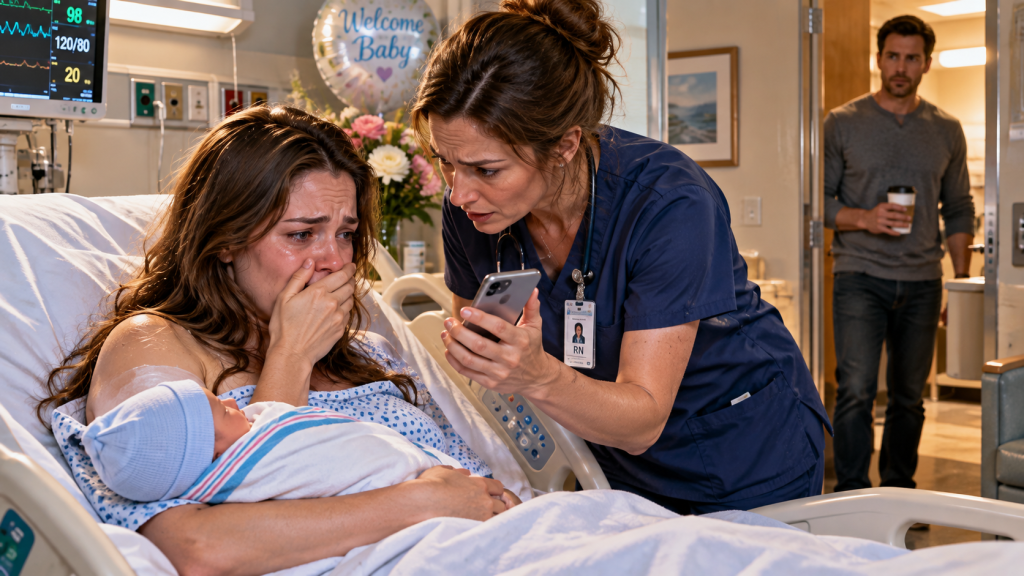
I lost one of my twin babies during labor—when the nurse placed my surviving son in my arms, she leaned in and whispered, “Watch the video I just sent you before you trust your husband.”
PART 1
I was thirty-eight weeks pregnant with twin boys when everything collapsed.
My pregnancy had been smooth. Then, one afternoon, a sharp, blinding pain tore through my stomach and dropped me to my knees. Minutes later, I was in an ambulance.
The next thing I remember was waking up in a hospital room three days later. Every part of my body ached. Even breathing felt like too much.
My husband, Mark, was sitting beside me, holding my hand. The moment he saw my eyes open, he broke down.
“I’m so sorry,” he said quietly. “They couldn’t save one of the babies.”
I stared at him. “What…?”
His grip tightened around my fingers. “They did everything they could. We have to focus on the son we still have.”
Then he buried his face in my shoulder, and I cried with him. I thought we were grieving together.
For the next two days, Mark barely left the hospital. He brought me flowers. He helped me sit up. Everyone kept telling me what an amazing husband and father he was. I believed them.
Then, on the morning the NICU finally cleared our baby to stay in my room, a nurse named Judy wheeled him in. She smiled at Mark. “Congratulations,” she said.
Then she leaned over my son, adjusting his blanket. Without looking at me, she whispered under her breath, “Don’t react. Just smile. I sent something to your phone.”
My heart skipped. She gently placed my son into my arms, then leaned closer.
“Watch it after your husband leaves,” Judy’s voice dropped even further. “You have no idea WHAT HE REALLY DID TO YOUR OTHER BABY.”
Half an hour later, Mark kissed my forehead and stepped out to get coffee.
The second the door closed, I grabbed my phone. There was one new video from an unlisted number. It was just twenty-seven seconds long.
I pressed play.
Five seconds later, my phone slipped from my hands onto the bed.
“No…” I breathed. “Oh my God…”
I looked toward the door, realizing the man I’d been mourning with had been lying to me from the moment I woke up.
PART 2 — THE BABY THEY TOLD ME WAS DEAD
The video did not show my baby dying.
That was the first thing my mind understood.
The second thing was worse.
He was alive.
I stared at the frozen screen on my phone, unable to breathe.
The video had been recorded through a narrow opening in a hospital-room door.
The angle was imperfect.
The sound crackled.
But there was no mistaking Mark.
My husband stood in the hallway outside a neonatal treatment room.
He was wearing the same gray sweater he had been wearing when I woke from surgery.
Across from him stood a woman in dark-blue scrubs and a man I did not recognize.
Behind the glass wall, under bright white lights, lay a tiny baby.
My baby.
A bracelet around his ankle showed the same last name as mine.
MILLER, BOY B.
Alive.
Moving.
His tiny arm lifted once beneath the blanket.
Then Mark’s voice came through my phone.
“She can never know he made it.”
My heart stopped.
The man beside him said something I could barely hear.
“She has parental rights.”
Mark answered immediately.
“She’s unconscious.”
Then the woman said:
“You understand this transfer is temporary unless both parents consent.”
Mark leaned closer.
“Then don’t call it what it is yet.”
The video ended.
Twenty-seven seconds.
Twenty-seven seconds long.
Long enough to destroy every memory I had made since waking up.
Long enough to transform my husband’s tears into something unrecognizable.
Long enough to turn grief into terror.
I pressed play again.
My hands were shaking so violently the screen blurred.
“She can never know he made it.”
Again.
“She can never know he made it.”
Again.
I paused on the baby.
His face was mostly covered by a breathing mask.
He was small.
So small.
But alive.
My son.
The son I had been told was dead.
I pressed one hand over my mouth because something raw was trying to escape me.
A scream.
A sob.
Maybe both.
Then I remembered Judy’s first words.
Don’t react.
Smile.
My eyes flew to the door.
Mark could return at any moment.
Coffee in one hand.
That careful expression on his face.
The expression of the grieving father.
I looked down at the baby sleeping against my chest.
My surviving son.
The child Mark had told me was all we had left.
Suddenly even that sentence felt poisonous.
We have to focus on the son we still have.
Still have.
As though the other one had disappeared by accident.
As though he had not stood in a hospital hallway discussing how to hide him from me.
I forced air into my lungs.
Once.
Twice.
Three times.
Then I picked up the phone and typed one message to the unlisted number.
Where is he?
The reply came almost immediately.
Do not text details. Your husband may have access to your phone account. Delete this thread after reading. I will come back in twenty minutes.
My body went cold.
I looked at my son.
Then at the door.
And for the first time since I had married Mark seven years earlier, I was afraid of him.
Not afraid he would hit me.
Mark had never hit me.
Not afraid he would shout.
He rarely shouted.
I was afraid because I suddenly understood there were parts of him I had never seen.
And a person does not need to raise his hand to become dangerous.
Sometimes all he has to do is decide he has the right to control what truth reaches you.
The door opened.
I nearly screamed.
Mark walked in carrying two coffees.
“There’s my family.”
My family.
The words turned my stomach.
I smiled.
I do not know how.
Maybe childbirth had left something stronger inside me than I understood.
Maybe mothers become actresses when the thing they are protecting is small enough to sleep in their arms.
Mark set one cup beside me.
“Decaf.”
“Thank you.”
He leaned over and kissed the top of our son’s head.
“What do you think?” he asked.
“About what?”
“The name.”
We had chosen two names months earlier.
Noah and Gabriel.
We had refused to assign them before birth.
We wanted to meet them first.
Mark smiled sadly.
“I think he looks like Noah.”
My throat closed.
If this baby was Noah, then somewhere in this hospital system, Gabriel existed.
Alive.
Or had existed.
I did not know.
I could not let Mark see the question on my face.
“Noah,” I repeated.
Mark touched the baby’s cheek.
“Yeah.”
Then he looked at me.
“You okay?”
No.
“I’m tired.”
His expression softened.
“You’ve been through hell.”
I watched him say it.
And something inside me cracked.
Not because the sentence was false.
Because he had helped build the hell and was now comforting me inside it.
“I keep thinking about the other baby,” I whispered.
Mark’s hand froze for half a second.
Just half.
I would not have noticed before.
Now I noticed everything.
He sat beside me.
“I know.”
“Did you see him?”
The question came out before I could stop it.
Mark looked down.
“Yes.”
My heart pounded.
“After he died?”
Another tiny hesitation.
“Yes.”
There it was.
A lie.
Clean.
Calm.
Practiced.
I stared at him.
“What did he look like?”
Mark swallowed.
“Small.”
My eyes burned.
“Did he have hair?”
“Yes.”
“What color?”
“Dark.”
The baby in the video had dark hair.
Truth tucked inside a lie.
That somehow made it worse.
Mark took my hand.
“You don’t need to do this to yourself.”
I almost pulled away.
Instead, I squeezed his fingers.
“Maybe I need to.”
He leaned closer.
“You nearly died, Emma.”
My name in his mouth made me feel sick.
“You lost a lot of blood.”
“I know.”
“The doctors weren’t sure you’d wake up when you did.”
That sentence sat between us.
I looked at him.
Was that what he had counted on?
More time?
Enough time to make my son disappear?
A knock came at the door.
Judy entered.
She carried a clipboard and wore the ordinary expression of a nurse checking vitals.
“Morning again.”
Mark smiled.
“Back already?”
“Your wife’s becoming popular.”
She checked my IV.
My blood pressure.
The baby’s chart.
Everything looked routine.
Then she said, “Dad, neonatal pharmacy needs someone to confirm the insurance information downstairs. They have an issue with the secondary policy.”
Mark frowned.
“I already gave that to admissions.”
“I know. Apparently something didn’t transfer.”
“I can call.”
“They specifically asked for a signature.”
Mark sighed.
“How long?”
“Ten minutes.”
He looked at me.
“I’ll be right back.”
My stomach twisted.
“Okay.”
He kissed my forehead again.
Then left.
Judy waited.
Five seconds.
Ten.
She moved to the door and looked down the hallway.
Then she closed it.
Locked it.
Turned.
And all the professional calm fell off her face.
“Oh God,” she whispered.
I burst into tears.
“Where is my baby?”
She came quickly to the bed.
“He’s alive.”
The words tore through me.
I grabbed her arm.
“Where?”
“He was transferred.”
“Where?”
“To a private neonatal facility across town.”
“Why?”
Judy looked at the baby in my arms.
Then at me.
“I need you to stay as calm as you can.”
“Stop telling me to stay calm.”
My voice cracked.
“That is my son.”
“I know.”
“Where is he?”
“Sunrise Children’s Medical Center.”
I had heard of it.
A small specialty hospital.
Private.
Expensive.
“What happened to him?”
“He was born in respiratory distress.”
My heart twisted.
“But he responded.”
She spoke quickly now.
“Both babies had complications. Baby A stabilized first. Baby B needed respiratory support and had some concerns on imaging that required specialist evaluation.”
“Brain damage?”
“We don’t know.”
“Don’t soften it.”
“I’m not.”
Judy squeezed my wrist.
“The neurologist wanted observation and additional testing.”
I struggled to breathe.
“And Mark?”
“He was told your second baby had a chance.”
A chance.
The room blurred.
“He told me there was nothing they could do.”
“I know.”
“Why would he…”
The question died.
Judy looked toward the door.
“Because someone else was here.”
“Who?”
“I don’t know who she is to him.”
Cold flooded my body.
“Woman?”
Judy nodded.
“The woman in the video?”
“Yes.”
“Who is she?”
“She signed visitor documents under the name Helen Carlisle.”
The name meant nothing.
“Do you know her?”
“No.”
Judy hesitated.
“She was here while you were in surgery.”
“How long?”
“Hours.”
“Was she with Mark?”
“Yes.”
Something dark opened beneath me.
“Are they…”
“I don’t know.”
“Tell me what you know.”
Judy sat.
“The night you delivered, everything happened fast.”
“You had a placental abruption.”
The phrase was familiar.
I had heard it once after waking.
Barely understood it.
“You were bleeding heavily. The babies had to be delivered immediately.”
I touched Noah’s blanket.
“Baby A responded after delivery.”
“That’s Noah?”
“Yes.”
“And Gabriel?”
“Baby B.”
Gabriel.
Just saying his name nearly destroyed me.
“He needed more support.”
“Mark was told?”
“Yes.”
“You were unconscious by then.”
Judy paused.
“About six hours later, Gabriel improved enough that the neonatologist wanted him transferred for specialized monitoring.”
My hands shook.
“Why didn’t they wait until I woke up?”
“Emergency treatment consent can be complicated when one parent is incapacitated and another is available.”
She frowned.
“But the transfer itself isn’t what frightened me.”
“What did?”
“Mark kept asking questions that didn’t make sense.”
“Like what?”
“Whether you needed to be notified.”
“Whether his name could be removed from certain online patient systems.”
“Whether a baby could be transferred under privacy restrictions.”
I stared at her.
“And nobody thought that was strange?”
“Some people did.”
“Then why didn’t anyone stop him?”
“Because he was the father.”
Her voice carried frustration.
“And because people were running between an emergency surgery, two premature newborns, paperwork, specialists, and your unstable condition.”
I closed my eyes.
Chaos.
Mark had hidden inside chaos.
Judy continued.
“Then Helen arrived.”
“What did she do?”
“She kept calling Gabriel ‘the baby.’”
“Not his name?”
“No.”
“She asked whether he could be moved without being listed in the standard family portal.”
“Mark told staff there were privacy concerns.”
My stomach turned.
“What privacy concerns?”
“He said there was a complicated family situation.”
I laughed once.
Brokenly.
“I was the family situation.”
Judy’s eyes filled.
“I think so.”
“What happened after the transfer?”
“Mark signed some forms.”
“Which forms?”
“That’s the problem.”
She reached into the pocket of her scrub jacket.
“I copied what I could.”
She handed me folded pages.
I stared at them.
I could barely process the words.
Temporary medical guardianship.
Emergency consent authorization.
Secondary decision-maker.
Helen Carlisle.
My vision blurred.
“What is this?”
“I’m not a lawyer.”
Judy spoke carefully.
“But it appears Mark attempted to authorize her to participate in decisions about Gabriel.”
“Why?”
“I don’t know.”
“He can’t just give our baby away.”
“No.”
“Can he?”
“I don’t believe so.”
Her uncertainty terrified me.
“He kept saying you were too ill to make decisions.”
“I was unconscious.”
“Yes.”
“That isn’t consent.”
“I know.”
I looked down again.
There was Mark’s signature.
The signature I had watched appear on birthday cards.
Mortgage papers.
Our marriage license.
Now beneath words involving my child.
“Who is Helen?”
“I searched only what was publicly available.”
Judy hesitated.
“She runs a foundation.”
“What foundation?”
“Carlisle Family Foundation.”
I waited.
“It supports adoption services and pediatric care.”
The word adoption hit like a fist.
“No.”
“I’m not saying Gabriel was adopted.”
“No.”
“I’m saying I don’t know what Mark intended.”
My baby stirred in my arms.
I held him tighter.
“Why did you record them?”
Judy’s face changed.
“Because I lost my sister twenty years ago.”
I stared at her.
“She had a baby when she was nineteen.”
“Our parents convinced her to sign temporary papers while she was hospitalized with postpartum complications.”
Judy swallowed.
“They told her she could undo it later.”
“She couldn’t.”
“I was fourteen.”
Her eyes glistened.
“I still remember her coming home without her daughter.”
The room went quiet.
“When I heard Mark say you could never know Gabriel survived…”
She looked away.
“I knew what it sounded like.”
My throat closed.
“Did you report it?”
“Yes.”
“To your supervisor.”
“And?”
“There is an internal review.”
“That doesn’t help me.”
“I know.”
“Police?”
“Not yet. I wanted evidence before making accusations about a legal process I didn’t fully understand.”
She leaned toward me.
“But Emma, listen carefully.”
I did.
“Gabriel is alive.”
I began crying again.
“Alive?”
“Yes.”
“As of when?”
“This morning.”
My heart nearly stopped.
“You checked?”
“I called the receiving facility through the clinical transfer line.”
She smiled through tears.
“He’s stable.”
The world changed.
Not healed.
Changed.
My son was alive this morning.
Not three days ago.
Not yesterday.
This morning.
I pressed my forehead against Noah’s.
“You have a brother,” I whispered.
The words broke apart.
“You have a brother.”
Judy reached for a tissue.
I did not take it.
“What do I do?”
“First, you do not confront Mark alone.”
My eyes lifted.
“Second, you ask to speak privately with hospital administration and the attending physician.”
“Third?”
“You call a lawyer.”
“I don’t have a family lawyer.”
“Call anyone you trust who can find one.”
I thought of my older cousin Rebecca.
Attorney.
Different state, but practical.
Sharp.
Never liked Mark much.
“Okay.”
“And Emma?”
“Yes?”
“Do not leave this hospital with Mark until you know where Gabriel is and who has authority over him.”
I looked toward the door.
For the first time, I understood the hospital was no longer only the place where I had almost died.
It was also the place where I had to begin fighting.
Rebecca answered on the first call.
I barely got through the story.
At first, she thought I was confused.
Sedation.
Trauma.
Medication.
Then I sent her the video.
Silence.
Long silence.
Finally:
“Emma.”
“Yes.”
“Do not say anything to Mark.”
“I know.”
“No, listen.”
Her voice hardened.
“Do not threaten him.”
“Do not tell him what you know.”
“Do not let him take your phone.”
“Email me the video right now.”
I did.
“And the documents.”
I sent those too.
Rebecca cursed.
She almost never cursed.
“What?”
“This guardianship document.”
“What about it?”
“It’s incomplete.”
My stomach dropped.
“Meaning?”
“There’s no maternal consent.”
“Good?”
“Potentially.”
“Potentially?”
“Emma, calm down.”
“Everyone keeps saying that.”
“Fair.”
She exhaled.
“I’m calling a family-law attorney in Albuquerque I trust.”
“Can you come?”
A pause.
Then:
“I’m booking a flight.”
I cried harder.
“Thank you.”
“Don’t thank me.”
Her voice softened.
“Get your baby.”
Both of them, I thought.
I wanted both.
The attending physician came thirty minutes later with a hospital administrator.
A woman named Dr. Reeves.
A man named Mr. Holden.
Judy stood near the wall.
I had asked Mark to go home and bring me fresh clothes.
He resisted.
I said I wanted underwear that did not come from a hospital mesh package.
That finally worked.
The humiliation of that excuse would have been funny in another life.
The moment the door closed behind him, I told them everything.
Dr. Reeves looked horrified.
Mr. Holden became very still.
Hospital administrators have a special kind of stillness when they realize a conversation contains legal consequences.
I played the video.
Neither interrupted.
Then I showed the papers.
Mr. Holden said, “Where did you get these?”
“Does it matter?”
“They may be protected documents.”
“My child is a protected person.”
He stopped.
Dr. Reeves stepped in.
“Mrs. Miller, Gabriel is alive.”
Hearing his name from a doctor destroyed the last fragile wall inside me.
I covered my face.
“I’m sorry.”
Dr. Reeves pulled her chair closer.
“No.”
“You don’t need to apologize.”
“What condition is he in?”
“He has respiratory complications, but he is stable.”
“Brain damage?”
“We cannot say yet.”
“Will he survive?”
Her eyes softened.
“We believe he has a very good chance.”
I cried silently.
Noah made a small sound against me.
I kissed his head.
“Why was I told he died?”
Neither answered immediately.
That frightened me more than an answer.
Finally, Mr. Holden said, “Your chart indicates your husband requested that information about Baby B be discussed only with him until you were medically stable.”
“Why?”
“He represented that the child’s prognosis was extremely poor and that disclosure could endanger your recovery.”
I stared.
“You let him decide that?”
Dr. Reeves said, “That was not a medical order.”
“Then who told me my baby was dead?”
Silence.
I searched their faces.
Then I understood.
“Mark.”
Dr. Reeves nodded slowly.
“The medical team did not document that you were informed of a death.”
My whole body went cold.
Mark had told me.
Only Mark.
Everyone else had assumed I already knew whatever he had told me.
I remembered flowers.
His tears.
His hand around mine.
They couldn’t save one of the babies.
Not a doctor.
Not a nurse.
Him.
“How did Gabriel end up across town?”
Dr. Reeves answered.
“He needed a service that was available there.”
“So the transfer itself was legitimate?”
“Yes.”
“And Helen Carlisle?”
Mr. Holden spoke.
“She is listed as a secondary medical contact.”
“Who authorized that?”
“Your husband.”
“Remove her.”
“We are reviewing—”
“No.”
I leaned forward despite the pain tearing through my abdomen.
“Remove her.”
Mr. Holden glanced at Dr. Reeves.
She nodded.
“We can notify the receiving facility that you are now awake and capable of participating in medical decisions.”
“Not participating.”
My voice shook.
“I am his mother.”
Dr. Reeves looked at me.
“You are.”
Something about hearing it nearly broke me.
“You are Gabriel’s mother.”
I cried.
Not quietly this time.
Noah began fussing.
Judy came closer but did not take him.
She let me hold both grief and life at once.
That was what motherhood had become in forty-eight hours.
Holding one baby while fighting for another.
Rebecca’s attorney arrived before she did.
His name was Aaron Patel.
He walked into my room wearing a navy suit and carrying the expression of a man who did not enjoy mysteries involving newborn children.
He shook my hand.
“I’ve reviewed what Rebecca sent.”
“Can Mark take my baby?”
“No.”
The answer came firmly.
I nearly collapsed from relief.
“Can Helen?”
“No.”
“Then what is happening?”
“That’s what we’re going to establish.”
He placed his folder on the table.
“The document Mark signed does not terminate your parental rights.”
“Can it transfer custody?”
“Not by itself.”
“Then why would he do it?”
Aaron’s eyes met mine.
“That is the question.”
He hesitated.
“There is something else.”
My stomach tightened.
“What?”
“Helen Carlisle has been trying to become a parent for several years.”
The world narrowed.
“How do you know?”
“Public court filings from an adoption dispute.”
I could not breathe.
“No.”
“I’m not concluding anything.”
“You don’t have to.”
I stared at the wall.
A woman desperate for a child.
My husband.
A baby with an uncertain prognosis.
A wife unconscious.
Temporary guardianship.
She can never know he made it.
The shape was there.
I just did not understand why Mark would do it.
“Was he selling my baby?”
Aaron’s face hardened.
“I have no evidence of that.”
“Then why?”
“I don’t know.”
But I had begun to.
Not money.
Something more ordinary.
Something worse.
Fear.
Mark had always feared imperfection.
He liked order.
Predictability.
Clean outcomes.
When we learned we were having twins, he made spreadsheets.
Bought matching cribs.
Planned college funds before the second trimester.
He joked that the boys would attend Stanford because “we weren’t raising mediocrity.”
I had thought it was ambition.
What if Gabriel’s uncertain medical future had terrified him?
What if Mark had seen disability and decided our family could not survive it?
The thought made me sick.
Mark returned at 5:26 p.m.
He walked into my room carrying a duffel bag.
Then stopped.
Aaron sat beside my bed.
Rebecca had just arrived and stood near the window.
Judy was gone.
Noah slept against my chest.
Mark looked at each of us.
“What’s going on?”
I had spent hours preparing for that moment.
I still was not ready.
Rebecca answered first.
“Sit down, Mark.”
He looked at me.
“Emma?”
I could not speak.
He set down the bag.
“What happened?”
Aaron stood.
“My name is Aaron Patel. I represent Emma.”
Mark’s face drained.
“For what?”
Nobody answered.
His eyes found mine.
“Emma.”
I finally spoke.
“Where is Gabriel?”
Everything stopped.
Mark did not blink.
Did not breathe.
For one second, he looked like a photograph of himself.
Then:
“What?”
I stared at him.
“My son.”
His mouth opened.
I continued.
“The one who died.”
His eyes moved toward Rebecca.
Then Aaron.
Then the door.
I saw calculation.
It hurt worse than panic.
“Who told you?”
There.
No denial.
My heart broke.
I whispered, “You did.”
Mark sat down.
“Emma.”
“You told me he was dead.”
“I can explain.”
“Then explain.”
His hands shook.
“I was trying to protect you.”
I laughed.
It sounded almost insane.
“From my living child?”
“You were dying.”
“I woke up.”
“You were unstable.”
“I woke up.”
“The doctors didn’t know what condition he would be in.”
“He was alive.”
“Emma—”
“He was alive.”
My voice rose.
Noah startled.
I immediately softened, rocking him.
Mark stared at our son.
Then at me.
“He may have serious complications.”
“So?”
Mark closed his eyes.
That one syllable exposed him.
So.
So what?
He could not understand it.
“He may never be normal.”
Rebecca inhaled sharply.
I felt something inside me turn to stone.
“Normal?”
“That’s not what I meant.”
“Yes, it is.”
Mark stood.
“He had abnormal scans.”
“He might have neurological damage.”
“They said developmental disability.”
“They said years of specialists.”
“They said we might spend our entire lives—”
He stopped.
“Our entire lives what?”
I asked.
“Taking care of him?”
Mark looked away.
I knew.
My stomach turned.
“You decided he was too damaged.”
“No.”
“You decided.”
“I panicked.”
“You gave him to another woman.”
“I did not give him away.”
“Then what did you do?”
Mark dragged both hands across his face.
“Helen offered to help.”
“How do you know her?”
Silence.
Rebecca stepped forward.
“Answer her.”
Mark’s jaw tightened.
“She’s a client.”
I stared.
“A client?”
“Her foundation invested in one of our projects last year.”
“How long have you been talking to her?”
“Months.”
“About our babies?”
“No.”
“Then how did she appear at the hospital while I was unconscious?”
Mark’s shoulders fell.
“She knew about the pregnancy.”
“And?”
“She knew we were having twins.”
My heart pounded.
“When Gabriel had complications…”
He swallowed.
“I called her.”
The cruelty of that choice was almost impossible to understand.
Not his parents.
Not mine.
Not a doctor.
Helen.
“Why?”
“Because she’d told me about what happened with her adoption.”
I stared.
“She said if…”
He struggled.
“If what?”
“If one of the babies had serious needs…”
I stopped breathing.
“She said she had the resources.”
There it was.
Not an affair.
Something I somehow found even harder to forgive.
He had discussed giving away one of our children before the emergency ever happened.
“How long ago?”
Mark said nothing.
“How long ago did you talk about giving her one of my sons?”
“Emma.”
“How long?”
“Two months.”
Rebecca cursed under her breath.
I felt the room moving.
Two months.
While I folded baby clothes.
While Mark assembled two cribs.
While we took photographs beside two tiny pairs of shoes.
He had created a contingency plan for a child he might find inconvenient.
“You planned this.”
“No.”
“You discussed it.”
“Only hypothetically.”
“He is not hypothetical.”
My voice broke.
“He has a heartbeat.”
“He has a name.”
“He has a brother.”
“He has me.”
Mark started crying.
“I thought you would choose him over everything.”
For a moment, I did not understand.
Then I did.
“You thought I would choose my sick baby.”
“Yes.”
The word slipped out.
I stared.
Mark shook his head.
“That came out wrong.”
“No.”
I almost smiled through the tears.
“That is the first honest thing you’ve said.”
He sank into the chair.
“I was scared.”
“So was I.”
“You weren’t awake.”
“Exactly.”
Tears ran down my face.
“I wasn’t awake to protect him from his own father.”
Mark covered his face.
I looked at Aaron.
“Can I see Gabriel?”
“Yes.”
“When?”
“The receiving hospital has been notified.”
He glanced at his phone.
“They are waiting for you.”
I looked down at Noah.
Then back at Mark.
“You are not coming.”
His head snapped up.
“Emma.”
“You are not coming near Gabriel until I understand exactly what you signed.”
“I’m his father.”
“And I’m his mother.”
The room went silent.
“You forgot that.”
I saw Gabriel at 8:13 that evening.
Rebecca pushed my wheelchair.
Noah remained at the first hospital with a nurse I trusted.
I hated leaving him for even an hour.
But I needed to see my other son.
Sunrise Children’s Medical Center smelled different.
Less antiseptic.
More plastic.
Warmer lighting.
None of it mattered.
A neonatal doctor met us in the hall.
Dr. Vasquez.
She spoke gently.
“He’s stable.”
I cried before I even reached the room.
Then the doors opened.
And there he was.
My son.
Tiny.
Wrapped beneath wires and monitors.
A soft breathing tube under his nose.
Dark hair.
One hand curled near his cheek.
Alive.
I stopped moving.
Rebecca whispered behind me.
“Oh, Emma.”
I could not approach him.
Not at first.
Because I had already mourned this baby.
I had imagined him somewhere unreachable.
I had cried into Mark’s shoulder for a child who had been breathing less than five miles away.
Grief had already taught my heart to release him.
Now love was demanding I take him back.
My body shook.
“Can I touch him?”
Dr. Vasquez smiled.
“Yes.”
I rolled closer.
I slid one finger through the opening in the incubator.
Gabriel’s hand moved.
Then his fingers closed weakly around mine.
That was it.
I broke.
I bent forward and sobbed against the edge of the incubator.
“I’m sorry.”
Rebecca put a hand on my back.
“I’m so sorry.”
Gabriel’s tiny fingers remained around mine.
“I didn’t know.”
The monitors continued their soft rhythm.
“I would have come.”
I cried harder.
“I would have come for you.”
Of course he could not understand.
Or maybe babies understand more than we know.
Maybe love does not need vocabulary.
Dr. Vasquez quietly said, “Talk to him.”
So I did.
“My name is Mommy.”
My voice cracked.
“You have a brother.”
“His name is Noah.”
“He’s waiting for you.”
I touched Gabriel’s hand.
“And nobody is giving you away.”
Rebecca began crying behind me.
“Nobody.”
I repeated it.
Not for Gabriel.
For myself.
“Nobody is giving you away.”
I stayed beside him until after midnight.
The doctors explained everything.
There were concerns.
Yes.
Possible neurological injury.
Yes.
No guarantees.
Development would need monitoring.
Specialists would be involved.
Maybe therapy.
Maybe long-term challenges.
Maybe not.
No one knew yet.
But every time someone said maybe, I heard something Mark apparently had not.
Possibility.
He heard burden.
I heard future.
Uncertain did not mean worthless.
Difficult did not mean disposable.
I sat beside Gabriel and watched his chest rise.
That tiny movement became the most beautiful thing I had ever seen.
At 12:41 a.m., my phone buzzed.
Mark.
I ignored it.
Again.
Ignored.
Then a message.
Please let me see him.
I looked at Gabriel.
Another message.
I know what I did was wrong.
Then:
I thought I was saving our family.
I stared at those words.
Saving our family.
People can do terrible things when they decide their version of family matters more than the people inside it.
I typed one response.
You tried to save the shape of our family by removing a child from it.
Then I blocked him.
The next morning, Helen Carlisle came to the hospital.
She did not get past reception.
Aaron called me first.
“She’s downstairs.”
My whole body tensed.
“Why?”
“She says she wants to speak to you.”
“No.”
“Okay.”
Then something stopped me.
“Wait.”
Aaron remained silent.
I looked at Gabriel.
“Does she know I’m here?”
“Yes.”
I thought of the video.
Her standing beside Mark.
Her name on the papers.
I wanted to hate her.
It would have been simple.
Maybe I needed to see whether simple was true.
“I’ll talk to her.”
Aaron objected.
Rebecca objected more loudly.
I insisted.
Helen entered the family consultation room twenty minutes later.
She looked nothing like a villain.
That annoyed me.
She was about forty-two.
Elegant.
Tired.
Red-eyed.
She sat across from me.
Aaron remained at my side.
Rebecca stood by the door.
Helen looked at me.
“I’m sorry.”
I did not answer.
“I believed you knew.”
My entire body went still.
“What?”
Her voice shook.
“Mark told me you and he had discussed what would happen if one of the twins had significant disabilities.”
“No.”
Helen’s face changed.
“He said you were afraid you couldn’t care for two children if one had severe medical needs.”
“He lied.”
She closed her eyes.
“Oh God.”
“He told you I wanted to give away my baby?”
“He told me…”
Her voice broke.
“He said it was something you had both discussed before the birth.”
I stared.
“He said if the situation happened, you might not be emotionally capable of signing papers immediately.”
I felt sick.
“And you believed that?”
Helen cried.
“I wanted to.”
The honesty silenced me.
She wiped her face.
“I’ve wanted a child for eleven years.”
“There have been failed adoptions.”
“A failed surrogacy.”
“My marriage ended partly because of it.”
Her voice dropped.
“When Mark first mentioned your twins, it was just conversation.”
“Then one day he said…”
She stopped.
“What?”
“He said there was a small possibility you might consider placing one child with someone close enough to remain involved.”
Rage rose.
“He was offering you my son.”
“I know that now.”
Helen began crying harder.
“I should have called you.”
“Yes.”
“I should never have accepted Mark’s version without speaking to you.”
“Yes.”
She nodded.
“I have withdrawn my name from everything.”
“Good.”
“And I gave your lawyer copies of every message between Mark and me.”
Aaron looked at me.
I turned toward him.
“You have them?”
“Received twenty minutes ago.”
My heart pounded.
Helen reached into her bag but stopped when Aaron moved.
“It’s just a letter.”
“I don’t want it.”
She nodded.
“Okay.”
Then she looked at me.
“I never touched him.”
I froze.
“What?”
“Gabriel.”
Her voice softened.
“I saw him through the glass.”
“I never held him.”
“I never told anyone I was his mother.”
“I need you to know that.”
I did not know why that mattered.
But it did.
A little.
“He was always yours.”
Helen stood.
“I was just selfish enough to believe a lie that made him feel possible.”
She walked toward the door.
Then turned.
“I hope he gets everything Mark was afraid he would need.”
I stared at her.
“What does that mean?”
“Therapy.”
“Doctors.”
“Patience.”
“Time.”
Her eyes filled.
“And I hope he gets all of it from people who never make him feel guilty for needing it.”
Then she left.
For a long time, nobody spoke.
Finally Rebecca whispered:
“Well.”
I looked at her.
“What?”
“I came here prepared to hate her.”
“So did I.”
Aaron closed his folder.
“Unfortunately, truth is rarely considerate enough to provide only one villain.”
That sentence stayed with me.
Mark had lied to Helen too.
Her choices were still wrong.
But they were not what I had imagined.
Human beings are difficult that way.
Sometimes several people can be guilty in different amounts.
Sometimes understanding does not excuse.
It only makes the map clearer.
Gabriel remained hospitalized for nineteen more days.
Noah came home with me first.
Rebecca stayed.
My mother came.
My father came.
Friends rotated meals through my refrigerator.
For the first time in my adult life, I let people help without apologizing for needing them.
Mark did not return to the house.
Aaron helped arrange that.
Mark’s parents called.
At first, they defended him.
“He was terrified.”
“He had just almost lost you.”
“He thought he was making the best choice.”
Then I sent them the video.
His mother called back crying.
“I didn’t know.”
Neither did I.
That became the terrible sentence connecting all of us.
I didn’t know.
Mark had created separate worlds and given each person only enough information to behave the way he needed.
That kind of manipulation is powerful because everyone believes they are making independent choices.
Eventually the walls between those worlds collapse.
Then the truth does not arrive gently.
It floods.
The messages Helen provided were devastating.
Mark discussing “options.”
Mark describing me as emotionally attached to the idea of twins.
Mark speculating about disability.
Mark saying:
Emma would never agree once she sees him. She bonds too quickly.
Bonds too quickly.
I read that sentence ten times.
As if loving my own child were a defect he needed to work around.
Another message:
If she wakes before the transfer, everything changes.
Everything changed.
Just not the way he planned.
The hospital opened a formal investigation.
So did outside authorities after Aaron turned over the documents.
I stopped trying to understand every legal piece.
I was healing from surgery.
Feeding Noah.
Driving daily to Gabriel.
Sleeping in ninety-minute fragments.
Some days survival was enough.
On day twelve, I held Gabriel for the first time.
Skin to skin.
His cheek against my chest.
So light that I was afraid to breathe too deeply.
A nurse covered us with a blanket.
I stared down at him.
“You caused a lot of trouble,” I whispered.
His tiny mouth moved.
I smiled through tears.
“Good.”
Because that was what I had begun to understand.
Some children arrive quietly.
Some arrive already asking the adults around them a question.
Will you love me if I am difficult?
Will you choose me if I need more?
Will I still belong if my future does not resemble the one you imagined?
I kissed Gabriel’s head.
“Yes.”
Whatever the question was.
My answer was yes.
Mark wrote me a letter.
Aaron asked whether I wanted it.
For two days, I said no.
Then I changed my mind.
Not because I wanted an apology.
Because there was one question still burning inside me.
Why?
The letter was twelve pages.
I read only four.
Emma,
I know there is no explanation that makes what I did acceptable.
You may never believe me, but I loved Gabriel from the second I saw him.
That was the problem.
I was terrified.
The doctors were talking about brain injury, feeding problems, developmental delays, years of uncertainty.
You were unconscious.
They had nearly lost you.
I looked at Noah, then Gabriel, then you, and all I could see was our life collapsing.
I had this picture in my head of what our family was supposed to be.
Two healthy boys.
You.
Me.
Our house.
Our plans.
Then suddenly nothing looked like the picture.
I kept thinking that if I could make one impossible decision, I could preserve the rest.
Helen had resources.
She wanted a child.
I convinced myself Gabriel would have more than we could give him.
I convinced myself you would eventually recover from losing him.
I told myself I was choosing the least painful future.
I stopped.
There.
That sentence.
I convinced myself you would eventually recover from losing him.
Mark had been willing to let me mourn a living child because he decided grief would be easier for me than motherhood.
He had assigned me pain without asking which pain I would choose.
I kept reading.
The worst thing I did was not signing papers.
It was deciding I knew what you could survive better than you did.
I know that now.
I put the letter down.
For the first time, I understood exactly why our marriage was over.
Not because Mark had been afraid.
Fear can be forgiven.
Not because he had made a terrible decision under pressure.
Human beings break under pressure.
Our marriage was over because when life became frightening, Mark stopped seeing me as his partner.
He saw me as a variable to manage.
Someone whose knowledge could be controlled.
Whose grief could be engineered.
Whose child could be removed if he believed the result made practical sense.
There was no marriage left inside that.
Only administration.
I folded the letter.
I did not finish it.
I did not need to.
Gabriel came home on a Tuesday morning.
Rain tapped against the windows.
I had imagined something grand.
Balloons.
Photographs.
Family waiting outside.
Instead, I wanted quiet.
I carried Noah’s car seat.
Rebecca carried the diaper bag.
The nurse brought Gabriel to the entrance.
He wore a tiny blue hat.
Too large for his head.
I started crying before she handed him to me.
“There he is,” she said.
There he is.
Three words.
Simple.
Miraculous.
There he is.
I held Gabriel against me.
Then leaned toward Noah.
“Look.”
Noah was sleeping.
Of course.
I laughed through my tears.
“Your brother came home and you can’t even stay awake.”
Rebecca cried beside me.
The nurse cried too.
Everyone cried.
Maybe hospitals should issue tissues with discharge papers.
At home, I placed both bassinets beside my bed.
Two.
I stood there looking at them.
For months during pregnancy, those bassinets had represented expectation.
Then one had become unbearable to look at.
My mother had offered to remove it.
I refused.
I did not know why.
Maybe some part of me had refused the story Mark gave me before my mind knew it was false.
Now both bassinets held blankets.
Both held babies.
Noah.
Gabriel.
I sat on the edge of my bed and watched them sleep.
My body still hurt.
My marriage was destroyed.
There were lawyers.
Investigations.
Doctors.
Bills.
Uncertainty.
A future I could not predict.
And yet the room felt fuller than any room I had ever entered.
Not perfect.
Full.
There is a difference.
Perfection is fragile.
One abnormal scan can destroy it.
One unexpected diagnosis.
One loss.
One betrayal.
But fullness?
Fullness can contain grief.
Fear.
Anger.
Hope.
Two sleeping babies.
And a mother who is no longer asking life to become what she planned before she agrees to love it.
Three weeks later, Mark was allowed one supervised visit.
I almost canceled it.
Then I looked at Gabriel.
Whatever Mark had done to me, he was still their father.
What that relationship became would be decided carefully.
Slowly.
By actions.
Not biology alone.
Mark entered the visitation room looking like a man who had not slept in months.
He saw Noah first.
Then Gabriel.
His face collapsed.
He began crying.
I remained near the wall.
The supervisor sat between us.
Mark approached Gabriel’s bassinet but did not touch him.
“Hi.”
His voice broke.
Gabriel blinked.
Mark covered his mouth.
“I’m sorry.”
My chest tightened.
Not because I forgave him.
Because there is something unbearable about watching a parent apologize to a child too young to know he was betrayed.
Mark whispered:
“You didn’t do anything wrong.”
He looked at Gabriel.
“None of this was because you weren’t enough.”
I looked away.
That sentence mattered.
Maybe one day Gabriel would need to hear it again.
Maybe many times.
Mark sat beside Noah next.
He cried through most of the visit.
At the end, he approached me.
Not too close.
“I finished the evaluations.”
I nodded.
Aaron had told me.
“I started therapy.”
I said nothing.
“I’m not asking you to take me back.”
“Good.”
He flinched.
Then nodded.
“I know.”
He looked toward the twins.
“I want to be their father.”
“That will depend on what being their father means to you.”
“I know.”
“Do you?”
My voice remained quiet.
“Because being their father is not deciding which version of them is easiest to love.”
Tears filled his eyes.
“I know.”
“It’s not protecting yourself from their needs.”
“I know.”
“It’s not choosing their future without listening to the people who love them.”
“I know.”
I swallowed.
“And you will never lie to me about their health again.”
“Never.”
I looked at him.
“I don’t trust that promise.”
His face fell.
“That’s fair.”
That answer surprised me.
Old Mark would have defended.
Explained.
Demanded credit for apologizing.
This Mark only nodded.
Maybe consequences had begun teaching him something.
Maybe not.
Time would decide.
That was no longer my job.
He left.
I went home with my sons.
Six months after they were born, we received Gabriel’s latest neurological evaluation.
I sat in the doctor’s office holding my breath.
Noah slept in a stroller.
Gabriel chewed the corner of a soft cloth book.
Dr. Vasquez smiled.
“He is behind in a few areas.”
My heart tightened.
“But he is progressing beautifully.”
I cried.
She laughed gently.
“Parents usually wait until I finish.”
“I’ve had a difficult year.”
“That’s fair.”
We discussed physical therapy.
Occupational therapy.
Monitoring.
The unknowns remained.
But the word hopeless never appeared.
Neither did burden.
On the drive home, I stopped at a red light and looked in the mirror.
Two car seats.
Noah staring out the window.
Gabriel asleep.
For a second, I thought about Mark’s letter.
The picture he had carried in his head.
Two healthy boys.
Perfect future.
Order.
Control.
I had once carried a picture too.
Marriage.
Twins.
Family photographs.
Sunday breakfasts.
Growing old beside the same man.
That picture was gone.
But my life was not.
That was perhaps the most important thing I learned.
When the picture breaks, the people inside it do not disappear.
You can still love what remains.
You can build around truth instead of fantasy.
You can discover that a life you never planned can still be worth choosing with your whole heart.
The light turned green.
I drove home.
At the house, there were two bottles waiting to be washed.
Laundry piled on the couch.
Three therapy appointments on next week’s calendar.
A divorce document on my desk.
Flowers from Judy on the kitchen counter.
Chaos.
Beautiful, exhausting chaos.
I placed Gabriel on the rug beside Noah.
For a few seconds, they stared at each other.
Then Noah reached toward his brother.
His fingers touched Gabriel’s hand.
Gabriel grabbed them.
I froze.
Two tiny hands.
Holding on.
Tears filled my eyes.
I took a picture.
Not for social media.
Not for anyone else.
For me.
Proof.
Not that everything had turned out perfectly.
It hadn’t.
Proof that both my sons were here.
That the child I had mourned had returned to me.
That a lie had nearly changed the entire course of our lives and one nurse had refused to look away.
That mattered.
People like to imagine courage arrives loudly.
Sometimes it does.
Sometimes courage is a nurse standing in a hospital room pretending to adjust a blanket while whispering:
Watch the video.
Sometimes courage is a woman waking from surgery and realizing the person holding her hand is also the person who betrayed her.
Sometimes courage is not screaming when you desperately want to scream.
It is waiting.
Gathering evidence.
Calling a lawyer.
Finding your child.
Sometimes courage is simply refusing to let someone else decide which parts of your life are too difficult to love.
I looked at Noah.
Then Gabriel.
For months, I had thought I lost one son during labor.
The truth was stranger.
I had almost lost him after.
Not to death.
To fear.
To control.
To another person’s belief that an uncertain child was less valuable than a predictable life.
And that was the lie I would spend the rest of my sons’ childhoods making sure neither of them ever learned.
Noah would never be “the healthy one.”
Gabriel would never be “the difficult one.”
One would not become the blessing and the other the burden.
They were simply my sons.
Two different boys.
Two different futures.
Equal places in my heart.
That evening, I sat between their bassinets while the house grew dark.
Noah fell asleep first.
Gabriel fought sleep with furious determination.
I smiled.
“You’re stubborn.”
His eyes blinked slowly.
“Good.”
I touched his tiny foot.
“Keep some of that.”
Outside, rain began tapping against the glass.
The same sound I remembered from the night I first saw him again.
I whispered the sentence I had said beside his incubator.
“Nobody is giving you away.”
Then I looked toward Noah.
“Nobody is deciding which of you is easier to keep.”
My throat tightened.
“And nobody gets to call fear love ever again.”
Gabriel finally closed his eyes.
I remained there long after both boys were sleeping.
For the first time since labor, silence did not frighten me.
It felt peaceful.
Not because the story was over.
It wasn’t.
There would be courtrooms.
Doctors.
Therapy.
Divorce.
Questions my sons would someday ask.
There would be a day when Gabriel was old enough to learn that his father once looked at uncertainty and chose escape.
I dreaded that day.
But when it came, I would tell him the whole truth.
Including the part Mark forgot.
That one terrible choice did not define Gabriel’s worth.
It did not even have to define Mark forever, if Mark spent the rest of his life becoming better than the man who made it.
But forgiveness would never require forgetting.
And love would never again require blindness.
I leaned back in the chair.
Two bassinets beside me.
Two babies breathing.
Two lives that were never supposed to be compared.
I closed my eyes.
And somewhere beneath the exhaustion, betrayal, fear, and grief, gratitude rose.
Not gratitude for what Mark did.
Never that.
Gratitude for Judy.
For the video.
For twenty-seven seconds of truth.
For the tiny hand that closed around my finger.
For the chance to walk into a hospital room and say:
My name is Mommy.
For the chance to bring both of my children home.
For the chance to learn, before it was too late, that the most dangerous lies are sometimes told by people crying while they hold your hand.
And the most life-changing truths are sometimes whispered by strangers brave enough to risk everything so a mother can find her child.
I looked at my sons one final time before turning off the lamp.
For three days, I had believed I was the mother of one living child and one dead one.
Now I knew the truth.
I had two sons.
One husband I no longer recognized.
And a future I would rebuild without asking anyone else which parts of it were worth keeping.
PART 3 — THE SON THEY THOUGHT WOULD BE TOO MUCH
For the first year after Gabriel came home, I measured time in appointments.
Neurology.
Physical therapy.
Occupational therapy.
Pediatric cardiology.
Developmental assessments.
Feeding therapy.
Follow-ups.
Blood work.
More follow-ups.
There were weeks when the calendar looked less like a family schedule and more like a battlefield map.
At first, every appointment frightened me.
Every time a doctor paused before answering a question, I stopped breathing.
Every time Gabriel missed a milestone Noah reached easily, fear climbed into my throat and sat there.
Noah rolled first.
Gabriel did not.
Noah sat independently at six months.
Gabriel needed more time.
Noah crawled toward me with reckless enthusiasm.
Gabriel learned to shift his weight slowly, deliberately, as if the floor required negotiation.
The comparison happened automatically.
I hated that.
Not because Noah was doing anything wrong.
Because I had promised myself neither boy would become a measurement for the other.
So I began writing something above their changing table.
Not in a frame.
Not elegantly.
Just a sentence on a yellow sticky note.
Different is not behind.
I moved it when we changed rooms.
Different is not behind.
I rewrote it when the paper curled.
Different is not behind.
Some days, I believed it.
Some days, I needed the words to believe for me.
Gabriel’s neurologist never made promises.
I appreciated that.
Dr. Vasquez had a way of telling the truth without making the truth sound like a sentence.
“He may need longer.”
“He may always need support in some areas.”
“We don’t know yet.”
“Let’s see what he shows us.”
What he showed us was determination.
Fierce, quiet determination.
At nine months, Gabriel learned to roll across the living-room carpet to reach a red plastic ring.
He rolled in the wrong direction first.
Then again.
Then got stuck beside the couch.
I sat on the floor watching him become increasingly furious.
Noah crawled past him, grabbed the ring, and waved it triumphantly.
Gabriel screamed.
Noah stared.
Then, in one of the first acts of brotherhood I would remember forever, Noah dropped the ring beside Gabriel’s hand.
Gabriel stopped crying.
He grabbed it.
Noah slapped the carpet happily.
I burst into tears.
My mother, who was washing bottles in the kitchen, turned around.
“What happened?”
I pointed.
She looked at the boys.
Then at me.
“You’re crying because one baby stole a toy and gave it back?”
“Yes.”
She nodded.
“Motherhood has destroyed you.”
“Completely.”
She laughed.
Then she came to sit beside me.
We watched the boys together.
Noah patted Gabriel’s hair.
Gabriel tried to bite his sleeve.
Perfect.
Not the picture Mark had once imagined.
Better.
Because it was real.
The divorce was finalized thirteen months after the twins were born.
Mark did not fight it.
That surprised people.
Some of his family assumed he would.
His attorney apparently advised him to contest several financial provisions.
He declined.
When Aaron told me, I said, “Why?”
Aaron looked at me.
“Do you really want me to speculate?”
“No.”
“Good.”
I signed the final papers in a conference room with a pen that kept skipping.
That annoyed me.
The end of a marriage should not be signed with a bad pen.
I asked for another.
Aaron smiled.
“Nervous?”
“No.”
“Liar.”
I looked at the papers.
Seven years of marriage.
Reduced to twenty-three signatures and initials.
No mention of the first apartment.
No mention of the night Mark proposed in the rain because he forgot the restaurant had closed early.
No mention of the two miscarriages before the twins.
No mention of how carefully he painted their nursery.
No mention of twenty-seven seconds of video.
Documents are strange.
They record consequence without memory.
I signed.
At the final page, my hand stopped.
Aaron waited.
“You okay?”
I looked down.
“I thought I’d feel happier.”
“You’re not required to.”
“I wanted it over.”
“It is.”
“Then why does it still hurt?”
Aaron leaned back.
“Because ending something harmful does not erase the parts that were once good.”
That sentence gave me permission I had not realized I needed.
I had been ashamed of missing Mark.
Not the man who hid Gabriel.
I did not miss him.
I missed the earlier versions.
The man who slept on the bathroom floor beside me when morning sickness was unbearable.
The man who learned to make my father’s chili.
The man who cried at the first ultrasound.
Those memories had not become false merely because something terrible happened later.
Life would have been easier if they had.
But betrayal does not always erase love retroactively.
Sometimes it contaminates memory without destroying it.
You learn to hold both.
He loved me.
He betrayed me.
He loved our sons.
He was willing to remove one of them.
All of those things were true.
Human beings would be much easier to understand if only one truth could exist at a time.
I signed the page.
And that was the end of my marriage.
Not the end of Mark.
Not the end of his relationship with the boys.
Just the marriage.
That distinction would matter.
Mark’s visitation remained supervised for almost a year.
He never missed one.
Not once.
Rain.
Flu.
Work.
Traffic.
He came.
Sometimes with toys.
Mostly without.
I had made it clear that I did not want apology gifts becoming a substitute for presence.
So he learned.
He sat on the floor.
He fed bottles.
He changed diapers.
He learned Gabriel’s therapy stretches.
At first, he looked terrified of hurting him.
The physical therapist noticed.
“Support his hips here.”
Mark’s hands shook.
“Like this?”
“Gently.”
He adjusted.
Gabriel kicked him in the chest.
The therapist laughed.
“He seems medically opposed to your technique.”
Mark laughed too.
For one second, I saw the old man.
The man before fear distorted him.
Then reality returned.
There was no going back.
But perhaps there was somewhere else to go.
A different kind of family.
A harder one.
More honest.
At eighteen months, Gabriel took his first independent step.
Not at therapy.
Not for me.
For Mark.
That still makes me laugh.
We were in the supervised visitation room.
Noah was stacking blocks.
Mark sat four feet away from Gabriel.
Gabriel was standing against a padded chair.
Mark held out both hands.
“Come on.”
Gabriel stared.
His therapist had been working on independent steps for weeks.
He had managed one while distracted once.
Mostly, he refused.
Mark waited.
“Come on, Gabe.”
I almost corrected him.
Gabriel.
I hated Gabe at first.
Then I stopped myself.
Let fathers have nicknames too, I thought.
Gabriel released the chair.
One hand.
Then the other.
He swayed.
My heart stopped.
One step.
Then another.
Then a third.
He fell directly into Mark.
Mark caught him.
For a moment, nobody moved.
Then Mark began to sob.
Not politely.
Not quietly.
He wrapped his arms around Gabriel and cried into his tiny shoulder.
Gabriel looked deeply inconvenienced.
Noah knocked down his blocks.
The supervisor wiped her eyes.
I cried too.
Mark looked at me over Gabriel’s head.
“I almost…”
His voice failed.
I knew the rest.
I almost gave this away.
I almost missed this.
I almost made sure this child grew up believing he was too difficult to keep.
I did not rescue him from the sentence.
Some grief belongs to the person who created it.
He whispered to Gabriel:
“I’m sorry.”
Our son patted his cheek.
Not forgiveness.
Not understanding.
Just a toddler touching his father.
But Mark closed his eyes as if the hand weighed more than judgment.
Two months later, the court approved unsupervised daytime visits.
I was terrified.
I did not tell Mark.
I told Naomi.
She had become my therapist during the hospital investigation and remained the person most skilled at identifying when my fear was wisdom and when it was memory.
“What are you afraid will happen?” she asked.
“He’ll panic.”
“About?”
“Something medical.”
“Has he?”
“No.”
“Has he completed the parenting classes?”
“Yes.”
“Therapy?”
“Yes.”
“Medical training?”
“Yes.”
“Does Gabriel’s care team support the visits?”
“Yes.”
“Then what is the fear based on?”
I stared at the carpet.
“The man from the hospital.”
Naomi nodded.
“That man existed.”
“I know.”
“And?”
“And I don’t know if he still does.”
“That is fair.”
She paused.
“But people are not photographs.”
I looked up.
“We are not frozen at our worst moment.”
I felt something tighten inside me.
“That does not mean you trust him blindly.”
“I won’t.”
“It means you assess who he is now while remembering who he proved capable of being then.”
That became the rule.
Not trust.
Evidence.
Mark earned longer visits.
Then Saturdays.
Then one overnight when the twins were almost three.
I did not sleep.
At 9:07 p.m., Mark texted.
Both asleep. Gabriel tried to feed a cracker to the fish. Fish declined.
I laughed.
At 10:31:
Forgot how much laundry two humans this small can generate.
At midnight:
No emergency. Just saying goodnight.
That one made me cry.
Because he understood why silence would frighten me.
Not because I had demanded updates.
Because he had finally learned that caring for someone includes recognizing what your past choices make difficult for them.
At 7:12 the next morning, he sent a photograph.
Noah and Gabriel asleep sideways in Mark’s bed, one foot on his face.
Caption:
I have lost custody of the mattress.
I laughed so loudly my mother called from the kitchen.
“What?”
“Nothing.”
She looked at my phone.
“Mark?”
“Yes.”
“Everything okay?”
“Yes.”
She studied me.
“And that scares you.”
I looked at her.
“Sometimes.”
Mom sat across from me.
“You know you don’t have to forgive him just because he improves.”
“I know.”
“You also don’t have to remain angry just to prove what he did mattered.”
I stared at her.
“When did you become wise?”
“Age.”
She sipped coffee.
“And podcasts.”
I laughed.
Then I looked at the picture again.
I no longer wanted Mark destroyed.
That surprised me.
For months, I had imagined consequences as something large enough to match what he did.
Loss of career.
Loss of reputation.
Loss of access.
But punishment had stopped being useful.
What mattered now was whether he became the father our sons deserved.
Especially Gabriel.
And slowly, painfully, he was trying.
That did not restore the marriage.
That did not erase the video.
It created something new.
Accountability with movement.
The hospital investigation concluded shortly after the twins turned two.
Several procedures changed.
Consent protocols.
Parental notification.
Restrictions on adding medical decision-makers during maternal incapacity.
Escalation requirements when one parent requested information be withheld from another competent parent.
Judy received a formal commendation.
She hated it.
“I don’t need a plaque.”
“You deserve one.”
“It collects dust.”
“So do most heroic things.”
She rolled her eyes.
We had become friends.
Not everyday friends.
Something stranger.
More permanent.
The kind formed when one person exists at the hinge of another person’s life.
Every year on the twins’ birthday, Judy came for cake.
Every year, I watched her with Gabriel and thought:
This child is here partly because she refused to tell herself something was not her business.
There are moments when minding your own business is cowardice.
Judy taught me that.
The first birthday she attended, Gabriel smeared blue frosting across her white blouse.
She stared down.
“Well.”
I laughed.
“You saved him. He’s marking territory.”
“I reconsider everything.”
She kissed his forehead.
“No refunds.”
Helen Carlisle sent one letter that year.
Only one.
I nearly returned it unopened.
Then I read it.
She had created a restricted fund through her foundation for families raising children with neurological disabilities.
No connection to Gabriel.
No conditions.
No public story.
She wrote:
I once mistook wanting a child for being entitled to an opportunity involving someone else’s child. I cannot undo that. I can only try to become the sort of person who understands the difference.
I did not reply.
But I kept the letter.
Not because I forgave her.
Because accountability interested me now.
I had learned that apologies were easy.
Transformation was expensive.
Mark paid for therapy.
Helen redirected her foundation.
The hospital rewrote policy.
Judy risked her job.
Those things mattered more than crying.
People often apologize because they want relief.
Change happens when they accept inconvenience.
When the twins were four, Gabriel received his most significant diagnosis.
Mild cerebral palsy.
I had expected the words for years.
Still, hearing them landed heavily.
Dr. Vasquez spoke carefully.
“It primarily affects his left side.”
I looked at Gabriel.
He was sitting on the exam table attempting to remove the doctor’s badge.
“Will he walk?”
“He already does.”
“Run?”
“He already tries.”
She smiled.
“Poorly.”
I laughed through tears.
“What does this mean long term?”
“Therapy.”
“Monitoring.”
“Possibly orthopedic interventions later.”
“Some limitations.”
“Maybe pain as he grows.”
My chest tightened.
“And cognitively?”
“So far?”
She looked at Gabriel, who had finally captured her badge.
“He is opinionated.”
“That sounds genetic.”
“Extremely.”
She smiled.
“His cognitive development looks strong.”
I exhaled.
Then hated myself for the relief.
Dr. Vasquez noticed.
“Mothers are allowed to be relieved.”
“I don’t want to act like physical disability is some terrible outcome.”
“You’re not.”
She leaned back.
“You are allowed to grieve difficulty without grieving your child.”
That sentence changed something.
For years, I had been so determined never to see Gabriel as a burden that I had sometimes denied my own exhaustion.
There were difficult days.
Therapy appointments were exhausting.
Insurance battles were exhausting.
Watching him fall more often than Noah hurt.
Wondering whether classmates would mock his gait hurt.
Love did not require pretending difficulty did not exist.
It required refusing to confuse difficulty with reduced worth.
That was the distinction Mark had once failed to make.
I would not repeat the mistake from the opposite direction.
That evening, I told him the diagnosis.
We sat at my kitchen table.
He had come to pick up the boys.
His face went pale.
“Cerebral palsy?”
“Yes.”
He looked toward the living room.
Noah and Gabriel were building an enormous track for wooden trains.
Gabriel’s left hand moved more slowly.
I had seen it for years.
Now it had a name.
Mark looked down.
Tears filled his eyes.
“What?”
He shook his head.
“I was right.”
My body went cold.
“What?”
He looked up quickly.
“No.”
“That came out wrong.”
Again.
The same phrase.
My anger ignited.
He saw it.
“I don’t mean I was right to do what I did.”
“Then choose your next words very carefully.”
He nodded.
“I mean the doctors were right that there might be something.”
I stared.
Mark continued.
“And he’s still…”
His voice broke.
“Still what?”
“Gabriel.”
He looked toward our son.
“He’s still funny.”
“Stubborn.”
“Annoying.”
I almost smiled.
“Loud.”
“Obsessed with trains.”
“He hates peas.”
“Loves his brother.”
Mark wiped his face.
“I imagined a diagnosis would erase everything.”
He shook his head.
“But it didn’t change who he already was.”
I said nothing.
He looked at me.
“I was afraid of a word.”
“Disability.”
“Yes.”
“And I almost traded an actual child for avoiding that word.”
His shoulders collapsed.
I had never heard him state it that clearly.
Not once.
I softened despite myself.
“Mark.”
“I know.”
“No.”
I waited until he looked at me.
“You need to stop apologizing for Gabriel’s existence.”
He frowned.
“I’m not.”
“You are.”
I spoke gently.
“Every time you look at him and think about what you almost did, you make his life part of your punishment.”
Mark went still.
“He doesn’t deserve that either.”
Tears filled his eyes.
“What am I supposed to do with it?”
“Carry it privately.”
He looked down.
“And when he is old enough, tell the truth if he asks.”
“What if he hates me?”
I thought about it.
“Then let him.”
Mark’s face tightened.
“You don’t get to control his reaction because you finally regret what happened.”
He nodded.
“That’s fair.”
“And if he forgives you?”
“I won’t deserve it.”
“Stop.”
He looked up.
“That isn’t your decision either.”
Mark stared at me.
I continued.
“You tried to control everyone’s emotional future once.”
“Mine.”
“Helen’s.”
“Gabriel’s.”
“Yours.”
“Don’t turn remorse into the same habit.”
His eyes closed.
That was the first time I saw the pattern clearly.
Control had been Mark’s addiction.
Not perfection.
Not image.
Control.
He had wanted to decide which future would hurt least.
Who should know what.
Who should love whom.
Who should grieve.
Who should raise Gabriel.
Even his self-hatred risked becoming another form of control if he decided in advance what forgiveness was allowed to look like.
He breathed slowly.
“Okay.”
Then he stood.
“I’ll take them for dinner.”
“Good.”
“What should we tell them?”
“Nothing yet.”
“The diagnosis?”
“Eventually.”
“They’re four.”
“We explain what matters.”
Mark nodded.
“Gabriel’s muscles work differently.”
“Yes.”
“He may need extra help.”
“Yes.”
“But…”
He stopped.
“No but.”
I looked at him.
“Just and.”
“His muscles work differently, and he can do a lot of things.”
Mark smiled slightly.
“And is better than but.”
“Usually.”
He picked up their jackets.
When he reached the living room, Gabriel shouted:
“Dad! Noah wrecked my train!”
Noah shouted:
“It was an accident!”
Mark looked back at me.
“Neurologically, they seem excellent.”
I laughed.
“Take your children.”
The question I had feared arrived when Gabriel was seven.
Not from him.
From Noah.
We had always told the boys that Gabriel had been transferred to another hospital after birth because he needed extra care.
That was true.
We had never told them the rest.
One Saturday, Noah found the blue box.
My mother had been helping me reorganize the hall closet.
She moved several old legal files.
One box ended up on a low shelf.
Inside were hospital documents.
Mark’s letter.
The guardianship papers.
And the printed still from Judy’s video.
Mark in the hallway.
Helen beside him.
Gabriel behind glass.
Noah brought it to me.
“Mom?”
I turned.
“What?”
“Why does this say Dad tried to give Gabriel to someone?”
The world stopped.
Gabriel sat ten feet away drawing dinosaurs.
My mother froze.
I looked at Noah.
Seven years old.
Too young for the whole truth.
Old enough to know when adults lied.
“Where did you find that?”
He pointed.
I closed my eyes.
Then I sat.
“Come here.”
Gabriel looked up.
“What happened?”
I considered separating them.
Then stopped.
The story belonged to both.
“Come here too.”
They sat beside me on the couch.
Noah held the paper.
Gabriel stared at his own name.
“What is that?”
I took a breath.
“When you were born, both of you got very sick.”
“I know,” Noah said.
“Gabriel was sicker.”
Gabriel frowned.
“I’m okay.”
“You are.”
I smiled.
“You were tiny and tough.”
He liked that.
I continued.
“Dad became very scared.”
Noah looked at the paper.
“Why did he give Gabriel away?”
“He didn’t.”
“But this says…”
“He thought about letting another family care for him.”
Both boys went quiet.
Gabriel looked at me.
“Why?”
The question I had feared for seven years.
Why?
I wanted to protect him.
To soften.
To edit.
Then I remembered everything I had learned.
Truth does not need to be cruel.
But it needs to remain truth.
“Because doctors told Dad that Gabriel might need a lot of help growing up.”
Gabriel looked at his left hand.
Then at me.
“Because of my CP?”
My throat tightened.
“Partly.”
Noah’s face hardened.
“That’s stupid.”
A startled laugh escaped me.
“That is not the word I would use.”
“It is.”
He looked furious.
“Gabriel is annoying, but you can’t give him away.”
Gabriel shoved him.
“I’m not annoying.”
“You steal my markers.”
“They’re our markers.”
My mother turned away, crying silently.
I almost laughed.
Children have a gift for carrying unbearable truths into ordinary sibling arguments.
Gabriel looked at me again.
“Did Dad not want me?”
There it was.
The dangerous sentence.
I touched his face.
“Dad was afraid.”
“That isn’t the same thing.”
Gabriel stared.
“He made a terrible choice because he was afraid of what your life might be like.”
“But did he want me?”
I swallowed.
“I think he loved you.”
“Then why?”
I could not rescue Mark.
I would not.
“Because people can love someone and still make terrible choices.”
Gabriel looked down.
“Did you want me?”
My entire body broke.
I pulled him against me.
“Yes.”
He stiffened.
“Always?”
“From the second I knew you existed.”
“Even when I was sick?”
“Yes.”
“Even if I couldn’t walk?”
“Yes.”
“What if I couldn’t talk?”
“Yes.”
“What if I needed a wheelchair?”
“Yes.”
“What if I was really hard?”
I held his face.
“Gabriel.”
He looked at me.
“You never had to be easy to be loved.”
Tears filled his eyes.
Noah wrapped both arms around him from the side.
“You’re not easy anyway.”
Gabriel elbowed him.
My mother started laughing through tears.
So did I.
Noah looked at me.
“Does Dad know we know?”
“Not yet.”
“I want to ask him.”
My stomach tightened.
“Okay.”
Gabriel was silent.
Then:
“I do too.”
Mark came over that evening.
I called first.
I told him the boys found the papers.
There was a long silence.
Then he said, “I’ll come.”
“Are you sure?”
“No.”
At least he was honest.
He arrived twenty minutes later.
The boys were at the dining table.
I stayed in the room.
So did my mother.
Mark sat across from them.
His hands shook.
Noah went first.
“Did you try to give Gabriel away?”
Mark closed his eyes briefly.
“Yes.”
Gabriel flinched.
Mark saw.
His face broke.
“I am so sorry.”
Noah asked, “Why?”
Mark took a breath.
“Because I was scared.”
“That’s dumb.”
“Yes.”
Mark almost smiled.
“It was.”
Gabriel stared at the table.
“Were you scared because I have CP?”
“We didn’t know exactly what you would have.”
“But you knew I might be different.”
“Yes.”
“And you didn’t want that.”
Mark’s eyes filled.
“I was afraid of it.”
“That’s not what I asked.”
My breath caught.
Seven years old.
His father’s son in precision.
Mark swallowed.
“No.”
He looked directly at Gabriel.
“At that moment, I did not want the life I was afraid you might have.”
Silence.
“That was wrong.”
Gabriel’s eyes filled.
“Did you want Noah?”
Mark covered his face for one second.
“Yes.”
Gabriel began crying.
So did I.
Mark leaned forward but did not touch him.
“I need you to hear the next part.”
Gabriel did not look up.
“I was wrong because I thought loving a child was connected to what that child would be able to do.”
Mark’s voice shook.
“I thought I needed to protect our family from a difficult future.”
“I was wrong.”
“Not a little wrong.”
“Completely wrong.”
Gabriel wiped his face with his sleeve.
“You almost missed me walking.”
“I know.”
“My first day of school.”
“I know.”
“My soccer.”
Mark smiled through tears.
“Your terrible soccer.”
“I’m good.”
“You kick the ball with the wrong foot.”
“It still goes.”
“That is true.”
Gabriel’s mouth twitched.
Then he became serious again.
“What if I was worse?”
Mark froze.
“What?”
“What if I couldn’t walk?”
I stopped breathing.
Gabriel continued.
“What if I needed a wheelchair?”
“What if I couldn’t play soccer?”
“Would you love me now?”
Mark began sobbing.
“Yes.”
Gabriel stared at him.
“Because you changed?”
“Yes.”
“How do I know?”
Mark wiped his face.
“You don’t.”
That answer surprised all of us.
Mark continued.
“You don’t have to believe me because I say it.”
He looked at his son.
“You get to watch what I do.”
Gabriel considered that.
There it was.
The most honest thing Mark could have said.
No demand for forgiveness.
No insistence that seven years of good behavior canceled one terrible beginning.
Just:
Watch what I do.
Noah asked:
“Is Mom still mad?”
Mark almost laughed.
“That is a question for your mother.”
Both boys looked at me.
I sighed.
“I am less angry than I used to be.”
“Do you forgive Dad?”
Noah asked.
Mark looked down.
I had thought about that question for years.
Perhaps I had been waiting for the boys to ask before I admitted the answer to myself.
“Yes.”
Mark’s head snapped up.
I raised one hand.
“But forgiveness did not mean we stayed married.”
Noah frowned.
“Why not?”
“Because forgiveness and trust are different.”
He thought.
“Like when Gabriel broke my controller and I forgave him but I don’t let him use it?”
Gabriel shouted:
“It slipped!”
I laughed.
“Yes.”
“Something like that.”
Mark looked at me.
His eyes filled.
I continued, mostly for the boys.
“You can forgive someone and still decide that what happened changed the relationship.”
“You can love someone and still need boundaries.”
“You can believe somebody has become better without pretending they never did something painful.”
Gabriel looked at Mark.
“Do I have to forgive you?”
Mark answered before I could.
“No.”
The room went still.
“No?”
Gabriel asked.
“No.”
Mark shook his head.
“I hope someday you do.”
“But you never owe me that.”
Gabriel looked at him for a long time.
Then he asked:
“Can I have ice cream?”
Mark laughed so suddenly it turned into another sob.
“Yes.”
My mother covered her face.
Noah shouted:
“I want chocolate.”
Gabriel said:
“Mint.”
“You have bad taste.”
“You’re bad at soccer.”
“Mom!”
And just like that, the most frightening conversation of my life ended with an argument about ice cream.
Maybe that was mercy too.
Children do not live entirely inside trauma unless adults teach them to.
They return to hunger.
Play.
Arguments.
Homework.
Life.
That night, after Mark left, Gabriel climbed into my bed.
He had not done that in years.
“Mom?”
“Yes?”
“Do you think Dad wishes I was Noah?”
My heart cracked.
“No.”
“How do you know?”
I thought carefully.
“Because I’ve watched him learn who you are.”
Gabriel was quiet.
Then:
“Do you ever wish I didn’t have CP?”
There are wrong ways to answer that question.
I had rehearsed many.
I chose truth.
“I wish your body never made anything harder for you.”
He listened.
“But I don’t wish you were a different boy.”
“What’s the difference?”
“I wish you didn’t have pain.”
“I don’t wish away the person who learned to be brave because things were hard.”
He looked skeptical.
“That sounds like a mom answer.”
“It is.”
He smiled.
I kissed his forehead.
“You are not a lesson.”
“You are not an inspiration.”
“You are not a burden.”
“You are Gabriel.”
He settled against me.
“That’s enough?”
“More than enough.”
He slept.
I did not.
I watched him breathe the way I had beside the incubator seven years earlier.
Some habits never leave.
When the twins were ten, Gabriel decided he wanted to run a mile.
Not walk.
Run.
His physical therapist said it would be difficult.
That was enough to guarantee he would attempt it.
Noah joined him.
Then Mark.
Then, somehow, me.
We trained for three months.
Gabriel’s gait remained uneven.
His left leg tired quickly.
He fell twice during early practice.
The second time, he sat on the track furious.
“I hate this.”
“Then stop.”
I said it gently.
He glared.
“I’m not stopping.”
“Then don’t.”
“You’re supposed to motivate me.”
“I am.”
“That was bad motivation.”
“Your mother is complicated.”
Mark jogged up behind us, breathing too hard.
“Your mother is evil.”
I stared at him.
“We are divorced. You cannot insult me recreationally.”
He laughed.
“Fair.”
Gabriel stood.
“Again.”
We ran.
Race day arrived in October.
A small community event.
Nothing special.
Unless you knew.
Judy came.
My parents came.
Mark came.
Noah wore a shirt he had made himself:
MY BROTHER RUNS WEIRD BUT FAST.
Gabriel threatened to kill him.
I made him change fast to determined.
The race began.
Noah sprinted ahead.
Of course.
Gabriel started slowly.
Mark and I ran on either side of him.
At half a mile, he was tired.
At three-quarters, his left leg began dragging more.
“Want to walk?”
I asked.
“No.”
“Gabriel.”
“No.”
Mark said, “You don’t have to prove anything.”
Gabriel snapped:
“I’m not proving it to you.”
That shut us both up.
He continued.
One step.
Another.
Uneven.
Determined.
The finish line came into view.
People were cheering.
Noah had finished and was running back toward us.
“Come on!”
Gabriel’s face twisted.
Pain.
Effort.
Something older than ten.
Mark slowed.
I did too.
“No.”
Gabriel gasped.
“What?”
“Go ahead.”
I frowned.
“I’m staying.”
He shook his head.
“I want to do it.”
I understood.
Not alone.
But by himself.
There is a difference.
We fell back.
Noah stopped beside us.
Gabriel kept moving.
Thirty yards.
Twenty.
Ten.
He crossed the line.
Then collapsed onto the grass.
Everyone cheered.
Mark cried.
Of course he did.
He cried at everything now.
Judy cried too.
Noah threw himself onto Gabriel.
“You did it!”
Gabriel pushed him.
“You’re heavy!”
I stood a few feet away.
I thought about the incubator.
The blue hat.
The breathing tube.
The uncertain scans.
Mark saying:
He may never be normal.
I smiled.
Normal had turned out to be such a useless ambition.
Gabriel was difficult.
Loud.
Funny.
Stubborn.
Sometimes physically limited.
Sometimes astonishing.
Sometimes ordinary.
A terrible loser at board games.
A good student.
A mediocre soccer player.
A determined runner.
A boy.
Exactly a boy.
Nothing more was needed.
Mark came beside me.
“He did it.”
“Yes.”
His voice shook.
“I almost…”
I looked at him.
He stopped.
Then nodded.
“Right.”
No more making Gabriel’s life the monument to his guilt.
Progress.
“Just say you’re proud.”
Mark smiled.
“I’m proud.”
“Good.”
Then Gabriel yelled:
“Dad! Stop crying!”
We both laughed.
The twins turned thirteen on a rainy Tuesday.
Thirteen.
Teenagers.
I hated it.
They loved it.
Noah had become taller first.
Gabriel resented that deeply.
Gabriel had become sharper with words.
Noah resented that more.
They fought over bathroom time.
Chargers.
Shoes.
Friends.
Music.
Nothing.
Everything.
I adored them.
I also occasionally considered boarding school.
On the night of their birthday, after everyone left, Gabriel found me cleaning cake plates.
“Mom?”
“Yes?”
“Can I see the video?”
My hands stopped.
The video.
I had known the day would come.
I had hoped it might not.
“Why?”
“Because everyone knows what happened except me.”
“That isn’t true.”
“You’ve seen it.”
“Dad has.”
“Grandma has.”
“Judy obviously has.”
“Noah saw the screenshot.”
He crossed his arms.
“I want to see it.”
I looked at my son.
Not the baby.
Not the child asking whether his father wanted him.
Thirteen.
Old enough for more truth.
Still young enough that truth could cut deeper than he expected.
“You may regret it.”
“I might regret not seeing it too.”
He sounded like me.
That was unfortunate.
I sat.
“Okay.”
I retrieved the encrypted file.
I had not watched it in years.
My hands shook as I opened it.
Gabriel sat beside me.
I pressed play.
Twenty-seven seconds.
Mark.
Helen.
The treatment room.
A tiny baby behind glass.
Then:
“She can never know he made it.”
Gabriel did not move.
The video ended.
Silence.
He pressed replay.
I wanted to stop him.
I did not.
Again.
“She can never know he made it.”
When it ended the second time, Gabriel closed the laptop.
His face was pale.
“That was me?”
“Yes.”
“Dad knew I was alive.”
“Yes.”
He swallowed.
“And you thought I was dead.”
“Yes.”
“For days?”
“Yes.”
His eyes filled.
“Did you cry?”
I almost laughed.
“What kind of question is that?”
“I don’t know.”
“Yes.”
“I cried.”
“A lot.”
Gabriel looked down.
“Do you wish you never saw the video?”
“No.”
The answer came instantly.
“Why?”
“Because truth hurt.”
I touched his hand.
“But the lie would have cost me you.”
He stared at our hands.
“Do you think Judy saved me?”
I considered it.
“In part.”
“She saved you from being hidden.”
“She saved me from not knowing.”
“Doctors kept you alive.”
“You kept fighting.”
“A lot of people mattered.”
He nodded.
Then:
“Dad says the worst thing he ever did was deciding what everybody could survive.”
“That sounds like therapy.”
I smiled.
“Probably.”
Gabriel looked at me.
“Do you love him?”
The question surprised me.
“As your father?”
“Yes.”
“No.”
His face fell slightly.
“I care about him.”
“I respect the work he has done to change.”
“I’m grateful he is a good father now.”
“But I don’t love him the way I did.”
Gabriel nodded.
“Does that make you sad?”
“Sometimes.”
“Do you hate him?”
“No.”
“What do you feel?”
I thought.
“History.”
He frowned.
“That’s not a feeling.”
“It becomes one eventually.”
He rolled his eyes.
“Mom.”
I laughed.
“Fine.”
I looked at the dark laptop screen.
“I feel tenderness for the person he was.”
“Anger at the person he became.”
“Respect for some of the person he is now.”
“And gratitude that I no longer need him to be anything for me personally.”
Gabriel considered that.
“That’s complicated.”
“Welcome to adulthood.”
“No thanks.”
“Too late.”
He smiled.
Then became serious.
“I think I forgive him.”
My throat tightened.
“You don’t have to tell me.”
“I want to.”
“Okay.”
“But I don’t forgive the thing.”
I understood immediately.
“I think that makes sense.”
“I forgive Dad.”
He looked at me.
“But what he did is still wrong.”
“Yes.”
“And I can talk about it?”
“Yes.”
“He doesn’t get to be embarrassed and make me stop?”
“No.”
Gabriel nodded.
Then:
“I think I’m going to show him I watched it.”
“Tonight?”
“Tomorrow.”
“What are you going to say?”
He shrugged.
“I don’t know.”
Then he smiled slightly.
“Maybe just watch what I do.”
My eyes filled.
He remembered.
Of course he did.
Mark came over the next afternoon.
I stayed in the kitchen.
The conversation belonged to them.
I heard only pieces.
“I saw it.”
Long silence.
“I’m sorry.”
“I know.”
Another silence.
Then Gabriel’s voice.
“Do you know what made me mad?”
“What?”
“You kept saying Mom couldn’t know.”
“I know.”
“You never said I couldn’t know.”
Silence.
“I had to find out about my own life from papers.”
Mark said something too low to hear.
Then Gabriel:
“No. Let me finish.”
I almost smiled.
Definitely my son.
“I don’t want you apologizing every time I do something.”
“I know.”
“I don’t want you crying when I run.”
“I’ll try.”
“You cry a lot.”
“I know.”
A pause.
Then Gabriel’s voice softened.
“I forgive you.”
Silence.
Long.
Then Mark began crying.
Of course.
Gabriel groaned.
“See?”
I covered my mouth to keep from laughing.
Then Mark said:
“Thank you.”
Gabriel answered:
“It doesn’t mean you get to forget.”
“I won’t.”
“Good.”
More silence.
Then:
“Can you drive me to practice?”
“That’s it?”
“What else?”
I closed my eyes.
That was it.
Not because the past vanished.
Because life moved around it.
That may be the closest thing to healing we get.
The wound remains part of the body.
But it stops being the whole body.
Years passed.
Not dramatically.
That was my favorite part.
No secret babies.
No emergency transfers.
No lawyers.
Just years.
Noah became obsessed with architecture.
Gabriel fell in love with biology.
At sixteen, he announced he wanted to become a physical therapist.
Mark cried.
Gabriel threatened to change careers just to stop him.
At eighteen, the twins graduated.
Gabriel crossed the stage with a slightly uneven gait and the largest smile I had ever seen.
Noah yelled louder than anyone.
Mark stood beside me.
My mother sat on my other side.
Judy sat two rows behind us.
When Gabriel’s name was called, everyone rose.
I did not cry.
I thought I would.
Instead, I laughed.
Because Gabriel reached the principal, shook his hand, then deliberately turned toward Mark and exaggerated his limp.
Mark covered his face.
Noah screamed:
“YOU’RE TERRIBLE!”
The auditorium laughed.
I laughed harder.
There was freedom in that joke.
The thing that had once represented terror could now become teasing.
Not because disability was gone.
Because shame was.
After the ceremony, we took photographs.
The twins together.
Me with them.
Mark with them.
All four of us.
Then Judy.
Gabriel put one arm around her.
“You know, this is your fault.”
She stared.
“What?”
“This.”
He pointed at himself.
“You sent Mom the video.”
Judy laughed.
“That is a deeply inaccurate medical summary.”
“No video, maybe no me.”
Judy’s expression changed.
“Gabriel.”
He softened.
“I know.”
Then he hugged her.
She cried.
Mark cried.
I sighed.
“My entire life is emotional people.”
Noah said:
“You raised us.”
“Unfortunately.”
We laughed.
A photographer caught that moment.
Not the posed one.
The real one.
Noah laughing.
Gabriel leaning into Judy.
Mark wiping his eyes.
Me looking exhausted and happy.
That photograph became my favorite.
Because nobody looked perfect.
Perfection had nearly cost us everything once.
I wanted no part of it.
The night before Gabriel left for college, he sat beside me on the back porch.
Noah was going two states away.
Gabriel had chosen a university closer to home because its physical-therapy program was exceptional.
He insisted the decision had nothing to do with his mother.
I pretended to believe him.
We sat beneath yellow porch light.
He handed me an envelope.
“What is this?”
“Open it after I leave.”
“That guarantees I’m opening it now.”
“Mom.”
“Fine.”
I placed it beside me.
He looked out at the yard.
“I’ve been thinking about something.”
“That sounds dangerous.”
“Do you ever think about the baby that would have existed if Dad had gotten his way?”
I frowned.
“What do you mean?”
“Me.”
“But somewhere else.”
I understood.
A different family.
A different name.
A mother who had never known him.
A brother who grew up without him.
A father who spent his life with a secret.
“Yes.”
I answered honestly.
“Sometimes.”
“Do you think I’d still be me?”
“That is far above my philosophical pay grade.”
Gabriel smiled.
“Seriously.”
I thought.
“No.”
“Why?”
“Because people are shaped partly by who loves them.”
He looked at me.
“You would still have been you in many ways.”
“Stubborn.”
“Funny.”
“Annoying.”
“Brilliant.”
He smiled.
“But different people would have known different parts of you.”
He nodded.
“Do you think Helen would have loved me?”
The question no longer frightened me.
“I think she would have tried.”
“Do you hate her?”
“No.”
“Do you forgive her?”
I thought.
“I think so.”
He looked surprised.
“Why?”
“Because she eventually chose truth when truth cost her something.”
I looked toward the dark yard.
“She could have continued pretending she was entitled to you.”
“She didn’t.”
“That matters.”
Gabriel nodded.
“Do you forgive Dad?”
“Yes.”
He stared at me.
“Really?”
“Yes.”
“When?”
I smiled.
“I don’t know.”
“That’s anticlimactic.”
“Most forgiveness is.”
He waited.
I tried to explain.
“I kept expecting a moment.”
“A speech.”
“An apology.”
“Something where I would suddenly feel different.”
“It didn’t happen.”
“So what did?”
“I realized one day that when I thought about the hospital, I no longer wanted him punished.”
Gabriel listened.
“I still wanted what he did named accurately.”
“I still wanted boundaries.”
“I still wanted you protected.”
“But I no longer needed him to hurt because I had hurt.”
I touched his hand.
“That was forgiveness for me.”
“Not forgetting?”
“Never.”
“Not trusting the old version?”
“No.”
“Not getting back together?”
I laughed.
“Absolutely not.”
“Good.”
“Excuse me?”
“I like your house.”
“You can inherit it after I die.”
“That sounds slow.”
I shoved him.
He laughed.
Then his expression softened.
“I’m glad you watched the video.”
“So am I.”
He leaned his head against my shoulder.
There he was.
Eighteen years old.
Tall.
Strong.
One side still tighter than the other.
A faint drag in his left foot when he was tired.
The child someone once believed would be too much.
Too difficult.
Too uncertain.
He had grown into exactly what all children become when given time.
A person nobody could have predicted.
That was the arrogance at the center of Mark’s decision.
He thought diagnosis could forecast a human being.
It cannot.
A scan cannot tell you who will make terrible jokes at graduation.
A prognosis cannot tell you who will love biology.
A developmental chart cannot tell you who will comfort his brother after heartbreak.
Fear sees the future as a list of burdens.
Love waits to meet the person.
That was the lesson.
Not that everything turned out easy.
It didn’t.
Gabriel had surgeries.
Pain.
Therapy.
Frustration.
Days he hated his body.
Days he hated people staring.
Days I cried in parking lots after appointments.
But difficult never meant regrettable.
That distinction held our whole life.
He stood.
“I should pack.”
“You should have packed yesterday.”
“I work better under pressure.”
“That is your father talking.”
He grimaced.
“Cruel.”
“Accurate.”
He kissed my forehead.
“Love you.”
“I love you too.”
He went inside.
I waited ten seconds.
Then opened the envelope.
Of course.
Inside was one page.
Mom,
I know you think Judy saved me.
She did.
But I think you did too.
Not by finding me.
By deciding that once you found me, whatever came next was mine to live.
You never made me feel like surviving had created a debt.
You never made me prove I was worth the trouble.
You never told me I had to become extraordinary so Dad would have been wrong.
You let me be average at soccer.
Bad at piano.
Good at science.
Lazy on Saturdays.
Mad sometimes.
Happy sometimes.
Just a person.
I think that is the best thing you ever did for me.
Dad made one terrible decision because he saw me as a future problem instead of a baby.
You spent eighteen years letting me become a person he could never have predicted.
Thank you.
Also, do not turn my room into an office until Thanksgiving.
Gabriel.
I was already crying before the joke.
By the end, I could barely see.
I pressed the paper against my chest.
That was the first time I understood something I had never been able to name.
For years, I had believed the great victory of our story was that Gabriel survived.
It wasn’t.
Survival was the beginning.
The victory was that we did not turn his survival into an obligation.
He did not have to become remarkable to justify being kept.
He did not have to outrun his diagnosis.
He did not have to become a doctor.
An athlete.
An inspiration.
He simply had to live.
That was enough.
The next morning, both twins left for college.
Different cars.
Different directions.
Noah hugged me until I complained.
Gabriel hugged me longer.
Mark arrived to say goodbye.
He stood in the driveway.
Older now.
Gray at the temples.
Not my husband.
Not my enemy.
The father of my children.
A person whose worst act had changed all our lives.
A person who had spent years refusing to let that act remain the last thing he ever did.
That mattered.
Gabriel loaded the final box.
Then looked at us.
“Stop looking tragic.”
Mark laughed.
“You’re leaving.”
“For college.”
“That’s what leaving means.”
“Noah is leaving farther.”
“Excellent point.”
Noah shouted from his car:
“Stop making everything about distance!”
Gabriel rolled his eyes.
Then he came back toward us.
He hugged Mark first.
A real hug.
Not hesitant.
Not ceremonial.
Mark closed his eyes.
When they separated, Gabriel said:
“Don’t cry.”
“I’m not.”
“You absolutely are.”
“Allergies.”
“In October?”
“Very aggressive pollen.”
Gabriel laughed.
Then he hugged me.
I whispered:
“You never had to be easy.”
He went still.
Eighteen years.
Same sentence.
Different body.
He pulled back.
“I know.”
That was enough to break me.
Because he did.
He knew.
Not because I had told him once.
Because we had built a life that proved it.
He climbed into the car.
Started the engine.
Rolled down the window.
“Thank you for not giving my room away!”
“I make no promises!”
Then he drove.
I watched until the car disappeared.
Mark remained beside me.
For a long time, neither of us spoke.
Finally he said:
“He’s incredible.”
I smiled.
“He’s Gabriel.”
Mark nodded.
“Right.”
He had learned.
Incredible was fine.
But he did not need to be.
Mark looked toward the empty road.
“I used to think about what would have happened if Judy never sent the video.”
“So did I.”
“I don’t anymore.”
I looked at him.
“Why?”
“Because I can’t live in that world.”
He swallowed.
“I can only live in the one where you found out.”
“That sounds healthy.”
“Therapy.”
“Expensive wisdom.”
“Very.”
We smiled.
Then he turned to me.
“Emma.”
“Yes?”
“I know I’ve said it too many times.”
My body tensed slightly.
He noticed.
“So I won’t apologize again.”
I relaxed.
“Good.”
He continued.
“I just want to say thank you.”
“For what?”
“For not turning the boys against me.”
I thought carefully.
“I didn’t protect you either.”
“I know.”
“I told them the truth.”
“I know.”
“That was the deal.”
Mark nodded.
“That was the gift.”
I looked at him.
“No.”
“What?”
“The gift was what you did afterward.”
He frowned.
“You stayed.”
“You did the work.”
“You let them be angry.”
“You let Gabriel ask questions you hated.”
“You didn’t run.”
Mark’s eyes filled.
I sighed.
“You’re crying again.”
He laughed.
“Yes.”
I smiled.
“Goodbye, Mark.”
“Goodbye, Emma.”
He walked to his car.
I stood alone in the driveway.
For the first time in eighteen years, no child slept in my house.
I expected emptiness.
Instead, I felt fullness.
The strange kind that remains after love leaves the room but not your life.
I went inside.
Two bedrooms.
One messy.
One less messy.
Shoes by the stairs.
A forgotten water bottle.
The remains of eighteen years everywhere.
On the hallway wall, a photograph hung in a black frame.
Two newborn boys.
Noah asleep.
Gabriel awake.
Both wrapped in white blankets.
The caption beneath it contained no inspirational quote.
No story.
Only their names.
NOAH.
GABRIEL.
I touched the frame.
For years, strangers occasionally told me Gabriel was lucky.
Lucky Judy spoke up.
Lucky I fought.
Lucky the truth came out.
Maybe.
But standing there, I thought about how dangerous the word lucky can become.
Gabriel was not lucky to have almost been taken.
I was not lucky to have been lied to.
Mark was not lucky to have made a mistake that cost him his marriage.
Pain does not become fortunate simply because something meaningful grows afterward.
What we were given was not luck.
It was a second chance.
Those are different.
Luck suggests the wound was worthwhile.
A second chance says:
The wound happened.
Now what will you do with what remains?
Judy told the truth.
I went to find my child.
Mark faced what fear had made him capable of.
Helen stepped away.
The hospital changed.
Gabriel lived.
Noah became his brother in every possible way.
And I learned that motherhood was never about protecting my children from every hard future.
It was about refusing to abandon them when the future became hard.
That was all.
And it was everything.
I walked into Gabriel’s empty room.
His college boxes were gone.
The bed was unmade.
On the desk sat one object he had forgotten.
The red plastic ring.
The same kind of toy he had rolled across the carpet to reach as a baby.
I picked it up.
Maybe it was not the original.
Probably not.
But memory does not care about inventory accuracy.
I sat on the bed holding it.
And suddenly I was back in the hospital.
Twenty-seven seconds.
A tiny baby behind glass.
My husband saying:
“She can never know he made it.”
I closed my eyes.
Then opened them.
The room was quiet.
My son had made it.
Not into some flawless future.
Into life.
Messy.
Difficult.
Ordinary.
Extraordinary only because all life becomes extraordinary when someone nearly decides it is not worth the uncertainty.
I smiled through tears.
Then I whispered into the empty room:
“I know you made it.”
Not survived.
Made it.
To scraped knees.
Homework.
Therapy.
Ice cream.
Soccer.
Arguments.
Running.
Forgiveness.
Graduation.
College.
His own future.
A future nobody had the right to decide for him before he could even open his eyes.
I placed the ring on the desk.
Turned off the light.
And closed the door halfway.
Not all the way.
He was coming home for Thanksgiving.
After all, he had specifically forbidden me from turning the room into an office.
And some promises, unlike the ones that destroyed our family, were easy to keep.
That night, before bed, my phone buzzed.
A message from Gabriel.
Made it.
Underneath was a photograph of his dorm room.
Unmade bed.
Boxes everywhere.
A ridiculous poster.
Then another message.
Roommate seems normal. Suspicious.
I laughed.
I typed:
Different is not suspicious.
He responded:
Did you seriously turn the sticky note into life advice?
I stared at the words.
Different is not behind.
All those years.
All those appointments.
I typed:
Maybe.
Three dots appeared.
Then:
Love you, Mom.
I answered:
Love you too.
A second message appeared.
Tell Dad I love him too. He’ll cry if I text him directly and I’m busy.
I laughed until tears came.
Then I forwarded the message to Mark.
His response arrived thirty seconds later.
Too late.
I’m already crying.
Of course he was.
I put down my phone.
Turned off the lamp.
And for the first time in almost nineteen years, I thought about the nurse’s whisper without feeling the floor disappear beneath me.
Watch the video before you trust your husband.
I had watched it.
I had stopped trusting him.
Then, over many years, I watched something else.
His actions.
My sons growing.
My own heart changing.
Truth had destroyed my marriage.
But truth had also saved my child.
And in the end, I learned that trust was never something another person was entitled to because of a ring, a title, or a shared history.
Trust was evidence collected slowly.
Choice after choice.
Year after year.
Mark lost mine in twenty-seven seconds.
He never got back the trust of a husband.
That relationship was gone.
But he eventually earned the trust required to be a father.
Those were not the same thing.
Forgiveness did not restore what betrayal destroyed.
It simply allowed something healthier to grow in the space afterward.
And Gabriel?
Gabriel never became the tragedy Mark once feared.
He became a person.
Which was all he had ever been asking for the chance to become.
I closed my eyes.
Somewhere miles away, both my sons were beginning their adult lives.
Noah beneath one unfamiliar ceiling.
Gabriel beneath another.
Two children I had once carried together.
Two futures no doctor could predict.
Two lives nobody should ever have tried to rank according to how difficult they might be.
And if I had to reduce everything we survived to one lesson, it would not be about betrayal.
Or hospitals.
Or marriage.
It would be this:
Never let fear make a permanent decision about a life that has only just begun.
Because the future you are afraid of may contain laughter you cannot imagine yet.
Milestones you have no right to predict.
People who will surprise you.
Pain, yes.
Difficulty, certainly.
But also love.
Ordinary mornings.
Bad soccer.
Mint ice cream.
Graduation pictures.
A child saying, “I know.”
And one day, if you are lucky enough to remain present, you may look at the person everyone was once so afraid he might become and understand the simplest truth of all.
He was never too much.
We were simply being asked to love enough.
THE END STORIES! THANK YOU FOR READING GOOD LUCK !❤️
Related Posts