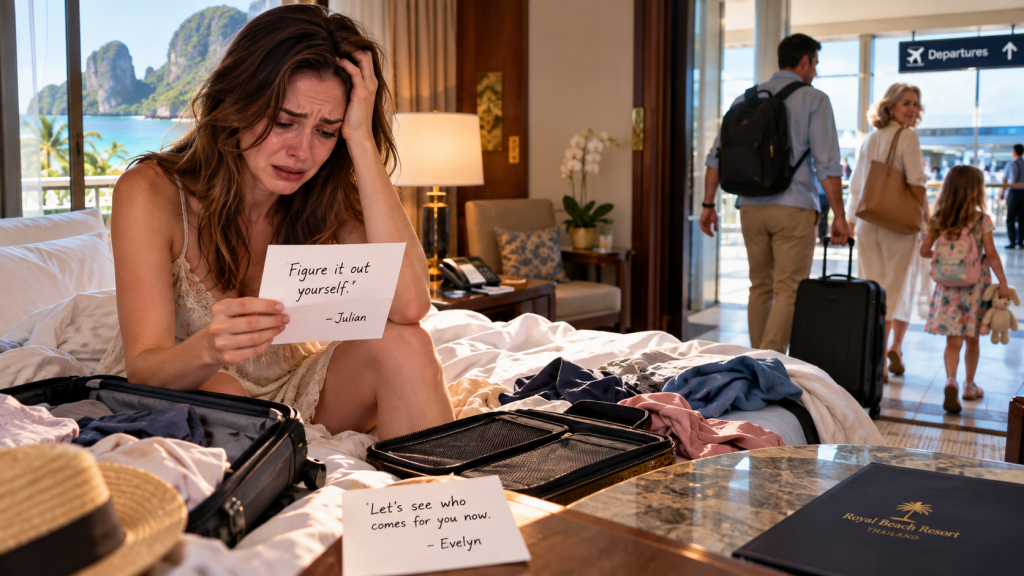
“I woke up in our Thailand hotel and immediately knew something was wrong. My husband was gone. So were his mother and our daughter. Then I discovered my phone and passport had disappeared too. On the bedside table, Julian had left only a short note:
“Figure it out yourself.”
His mother, Evelyn, had left one of her own.
“Let’s see who comes for you now.”
They thought they had left me completely helpless.
What they didn’t know was that I still remembered an emergency code capable of setting something much bigger in motion.
PART 1
Panic hit as I emptied my suitcase onto the floor.
Clothes.
Shoes.
Toiletries.
Nothing.
My phone was missing.
I checked the nightstand, bathroom, charging area, and every pocket in my luggage.
Then I reached for the hidden waterproof pouch where I kept my most important travel documents.
Gone.
My passport was inside it.
For several seconds, I simply stood there staring at the empty space.
Then I ran.
I didn’t even stop to put on shoes.
When I reached the lobby, the receptionist looked startled to see me.
“My husband,” I said breathlessly. “Julian Vance. Is he still here?”
She hesitated before turning toward her computer.
After a few keystrokes, her expression became cautious.
“Mr. Vance checked out at approximately 4:50 this morning, ma’am.”
My stomach dropped.
“Alone?”
She shook her head.
“He left with his mother and your daughter. They took the hotel shuttle to the airport.”
I stared at her.
For one strange second, a hollow laugh escaped me.
My entire practical life was stored inside the phone Julian had taken.
Bank accounts.
Two-factor authentication.
Airline information.
Contacts.
Travel confirmations.
Everything I normally used to solve a problem was now somewhere between Thailand and the United States.
I returned to the suite feeling numb.
A housekeeper was waiting near the doorway.
She held out another folded piece of hotel stationery.
“We found this on the floor.”
I recognized the handwriting immediately.
Evelyn.
My mother-in-law had always known exactly where my vulnerabilities were.
She knew I had lost my parents.
She knew I didn’t have siblings or relatives I could simply call and ask to rescue me from another country.
And she had apparently decided to remind me of that.
Her note contained one sentence:
“Let’s see who comes for you now.”
I read it twice.
Then I looked at Julian’s note again.
“Figure it out yourself.”
Suddenly, the situation became painfully clear.
They hadn’t simply left after an argument.
This wasn’t some impulsive family tantrum.
They had coordinated everything.
They waited until I was asleep.
They packed their belongings.
They took Maya.
They removed my phone.
They took my passport.
Then they disappeared before sunrise.
And they had done it believing I would have no immediate way to follow them.
The room phone suddenly rang.
I jumped.
When I answered, it was the receptionist.
“Mrs. Vance?”
“Yes?”
“I checked your airline itinerary after you came downstairs.”
I sat on the edge of the mattress.
My heart was already pounding.
“So I missed the flight?”
There was a brief silence.
“No, ma’am.”
Something about her voice made my stomach tighten.
“What do you mean?”
She spoke more quietly.
“Your return reservation was canceled.”
I stopped breathing.
“What?”
“Your flight home was canceled yesterday afternoon.”
I looked toward the two notes lying beside me.
Yesterday.
Not this morning.
Not after some argument.
Not after Julian suddenly decided to leave.
Yesterday.
Which meant he had planned this long before I woke up alone.
My husband hadn’t simply abandoned me in a foreign country.
He had taken my phone and passport, left with our daughter, and deliberately canceled the ticket that could have brought me home.
And he had done it all before the sun even went down the previous day.
They believed they had removed every lifeline I had.
They were about to discover they had forgotten one.
An emergency code I had memorized years earlier.
Two words.
Blue Lantern.
And Julian had absolutely no idea what those words could set in motion.
PART 2 — BLUE LANTERN
For almost thirty seconds, I sat on the edge of the hotel bed staring at Julian’s note.
Figure it out yourself.
Then Evelyn’s.
Let’s see who comes for you now.
They had made one mistake.
They thought being alone meant being helpless.
It did not.
I picked up the hotel phone and called the front desk.
The receptionist answered immediately.
“Mrs. Vance?”
“Yes.”
“My name is Claire Vance.”
My voice sounded steadier than I felt.
“I need you to connect me to an international number.”
“Of course.”
I closed my eyes.
The number had changed twice over the years, but the company maintained a routing line that never did.
I still remembered it.
I had repeated it during annual security training until the numbers became almost meaningless.
The receptionist connected me.
One ring.
Two.
Then a calm male voice answered.
“Global Response Desk.”
I swallowed.
“My employee number is 77142.”
A pause.
“Please state your name.”
“Claire Vance.”
“Ms. Vance, are you calling about a travel emergency?”
I looked at the empty space where my passport had been.
At the charger with no phone connected to it.
At the two notes.
“Yes.”
“Are you physically safe right now?”
“I think so.”
“Are you alone?”
“Yes.”
“Do you believe someone has intentionally separated you from your identification, communications, money, or transportation?”
My throat tightened.
“Yes.”
“Do you have an emergency phrase?”
I closed my eyes.
Two words.
The last lifeline Julian did not know existed.
“Blue Lantern.”
The man on the other end stopped sounding like a call-center employee.
Not frightened.
Focused.
“Understood.”
Then:
“Ms. Vance, do not hang up.”
Blue Lantern was not a government code.
It could not close airports.
It could not order police to arrest my husband.
It could not magically return my daughter.
It was something far less cinematic and, at that moment, far more useful.
I worked for Meridian BioSystems, an American medical-technology company with employees traveling constantly between hospitals, research sites, factories, and conferences around the world.
Years earlier, after one of our engineers had been robbed and stranded overseas without documents, Meridian rebuilt its international crisis program.
Anyone traveling abroad could register a trip.
Business or personal.
Most employees ignored the option on vacations.
I never did.
Thomas Mercer, the company’s former head of global security, had once told our department:
“Emergency systems are useless if you only remember them when life is normal.”
He made us memorize the crisis number.
And one phrase.
Blue Lantern.
It meant:
I may not control my communications. Verify me another way.
It triggered identity checks that did not rely on my phone.
A live security officer.
Emergency travel assistance.
Local counsel if necessary.
And, most importantly, someone outside my family who would begin preserving facts while I was still too frightened to know which ones mattered.
Julian had always teased me about the annual training.
“Corporate paranoia.”
he called it.
That morning, corporate paranoia was the first thing standing between me and complete isolation.
The man identified himself as Marcus Bell, Meridian’s overnight crisis manager in London.
He began asking questions.
Not dramatic ones.
Practical ones.
“Are you injured?”
“No.”
“Do you need medical care?”
“No.”
“Is the child your biological or legally adopted child?”
“Biological.”
“Her age?”
“Seven.”
“Full name?”
“Maya Elise Vance.”
“Is her father with her?”
“Yes.”
“Do you have any court order limiting his travel with her?”
“No.”
That answer hurt.
Because the truth was immediately more complicated than the terror in my chest.
Julian was Maya’s father.
A parent traveling with his child was not automatically a kidnapper because his wife did not know where he was.
But he had taken my passport.
My phone.
Canceled my flight.
Left me deliberately unable to follow.
Those facts mattered too.
Marcus did not call it kidnapping.
I respected him for that.
He said:
“We are going to treat this as a family-safety, document-theft, and possible coercion incident until local counsel tells us otherwise.”
A name for the problem.
Not a conclusion.
I needed that.
He asked whether my company phone had been taken.
“Yes.”
“Personal or corporate-managed?”
“Corporate-managed.”
“Good.”
That word startled me.
Then he clarified.
“Good because I can protect company access.”
Not because he could spy on Julian.
Not because he could magically activate the microphone.
The company’s mobile-management system allowed Meridian to revoke corporate credentials and wipe work data once the device connected again.
That was all.
Still useful.
Marcus disabled my work email sessions.
Revoked internal-app access.
Flagged the device.
Then he asked permission to notify my manager and corporate legal team that I was safe but temporarily unreachable.
“Yes.”
I whispered.
My normal life began reconnecting one thread at a time.
“Do you have access to money?”
Marcus asked.
I almost said yes.
Then realized I did not know.
My cards were still inside my wallet.
At least Julian had left those.
But most of our household money sat behind banking apps that wanted verification from my stolen phone.
“I have two credit cards.”
“Good.”
“Do you know the PIN on either?”
I did.
“Cash?”
“About six thousand baht.”
“Good.”
“Do not assume the cards will continue working.”
My stomach tightened.
“Why?”
“I’m not saying they won’t.”
Marcus replied.
“I’m saying we plan for failure before it becomes another emergency.”
He arranged an emergency cash authorization through Meridian’s travel-support partner.
Not millions.
Not a suitcase.
Enough for accommodation, local transportation, meals, document replacement, and a flight when I was legally able to travel.
I started crying.
Quietly.
Marcus paused.
“Claire?”
“I’m here.”
“Do you need a minute?”
“No.”
That surprised me.
I wiped my face.
“No. Keep going.”
Within forty minutes, people I had never met were moving toward me.
A local security consultant.
A Thai attorney experienced in international family and travel cases.
An interpreter if I needed one.
An appointment request with the appropriate U.S. consular section for replacement travel documentation.
None of them could promise when I would leave Thailand.
None promised Maya would be returned by dinner.
They were not superheroes.
They were simply people with phones Julian had not stolen.
And that suddenly felt enormous.
The first person to arrive was Kanya Suriya, the attorney.
She was in her forties, dressed in a pale gray suit, carrying a leather folder and an expression so calm I nearly hugged her.
She did not hug me.
Good lawyer.
She sat across from me in the hotel business center.
A hotel manager joined us because Kanya wanted documentation of what had happened on the property.
Then she said:
“Tell me everything from yesterday morning.”
Not just the notes.
Everything.
I tried.
Breakfast.
Pool.
A disagreement with Julian about Maya wanting to stay near me rather than go shopping with Evelyn.
Dinner.
Wine.
Going to bed around eleven.
Nothing explosive.
No giant argument that explained waking up abandoned.
Kanya took notes.
Then asked:
“Did you drink more than usual last night?”
The question offended me.
I felt it.
She noticed.
“I am not judging you.”
she said.
“I am asking because if someone later says you were intoxicated, confused, or unable to care for your child, I need to know what actually happened.”
My anger disappeared.
“One glass of wine.”
“Only one?”
“Yes.”
“Medication?”
“No.”
“Sleeping medication?”
“No.”
“Any history of psychiatric hospitalization?”
“No.”
“Panic attacks?”
I hesitated.
“One.”
“When?”
“After my mother died.”
“How long ago?”
“Eight years.”
“Treatment?”
“Therapy.”
“Medication?”
“For three months.”
She wrote it down.
My stomach tightened.
“Why does this matter?”
Kanya looked at me.
“Because your husband did not merely leave.”
“He left notes.”
“He removed documents.”
“He canceled transportation in advance.”
“That suggests planning.”
“And when people plan family conflict, they sometimes plan explanations too.”
The room became colder.
A security consultant named Arun Chaiyasit arrived next.
He reviewed the hotel’s key-card records with management.
Not secretly.
With my consent and the hotel’s cooperation regarding my room.
The electronic log showed Julian’s key entering the suite at 3:41 a.m.
Then again at 4:12.
Mine had not been used after 10:54 p.m.
The housekeeper’s key did not enter until after I went to the lobby.
Nothing proved when my phone or passport disappeared.
Still, there was a timeline.
Hotel cameras showed Julian, Evelyn, and Maya leaving at 4:46.
Maya was walking.
Not being dragged.
She wore her pink sweatshirt and carried her stuffed elephant.
Seeing her on the monitor broke something inside me.
“Maya.”
I whispered.
I moved closer.
She looked sleepy.
Confused.
Evelyn held her hand.
Julian rolled two suitcases.
And over his shoulder was my blue travel tote.
My blue travel tote.
I pointed.
“That’s mine.”
Arun paused the video.
“What would normally be inside it?”
“Documents sometimes.”
“Could your passport pouch fit there?”
“Yes.”
My stomach twisted.
Not proof it was inside.
But the bag had not left with my permission.
The hotel saved the relevant footage.
Preserved, not handed to me casually.
Again:
Process.
The local police report came next.
I sat beneath fluorescent lights and explained to an officer that my husband had left with our daughter and taken my passport and phone.
The officer asked whether Julian had threatened me.
“No.”
Hit me?
“No.”
Whether Maya was in immediate physical danger from him.
I wanted to say yes because every cell in my body was screaming my child is gone.
But danger has meanings larger than panic.
“Not that I know.”
I said.
The truth hurt.
Julian had never hit Maya.
Never neglected her basic needs.
He loved her.
At least I had believed that yesterday.
The officer documented the missing passport and phone.
Kanya explained the cancellation and notes.
The officer took copies.
No sirens followed.
No citywide search.
But there was now an official record created before Julian could return home and tell whatever story he intended.
That mattered.
By noon, the U.S. consular staff had been notified of the lost or stolen passport report.
Kanya explained that replacing it would require identity verification and paperwork, and the exact timing would depend on the consular process.
Meridian sent a secure copy of my employment records and identity documents they lawfully held.
I also remembered my old passport number from a visa form.
For once, my habit of memorizing useless numbers paid off.
My wallet still held my U.S. driver’s license.
A small mercy.
I was not going home that afternoon.
But I was no longer a woman trapped in a hotel room with no name.
Then Marcus called again.
The hotel placed us in a private conference room.
His voice came through speakerphone.
“Claire, I need to ask about Julian’s access to your work information.”
“Almost none.”
“Does he know about Blue Lantern?”
“No.”
“Certain?”
“Yes.”
“He knows Meridian has security support.”
“But he used to make fun of it.”
Marcus paused.
“That is relevant.”
“Why?”
“Because two days before your flight to Thailand, someone contacted Meridian Human Resources from Julian Vance’s email address.”
Every hair on my arms lifted.
“What?”
Kanya leaned forward.
Marcus continued.
“The message was not suspicious enough at the time to trigger escalation.”
“What did it say?”
“He asked whether spouses could contact the company’s travel-assistance provider if an employee experienced a mental-health emergency overseas.”
I stopped breathing.
The room disappeared around me.
“What exactly did he write?”
Marcus was careful.
“I can summarize what has been preserved.”
“He stated you had experienced ‘periods of heightened anxiety’ in the past and asked what support would be available if you became confused, panicked, or unwilling to travel during a family trip.”
Kanya’s pen stopped.
I stared at the speaker.
“He planned this.”
No one answered.
Because none of them needed to.
Marcus continued.
“HR replied that employee privacy rules limited what could be discussed with a spouse and told him the employee should contact the travel-assistance provider directly.”
“Did he respond?”
“Yes.”
“What did he say?”
A pause.
“He thanked them and said he was only planning ahead.”
Planning ahead.
I laughed once.
The sound frightened me.
Kanya leaned toward me.
“Did Julian ever tell you he contacted your employer about your mental health?”
“No.”
“Did he have reason to expect a psychiatric crisis on this trip?”
“No.”
“Any recent symptoms?”
“No.”
“Any medication changes?”
“No.”
“Any physician warning?”
“No.”
She nodded.
Then:
“Good.”
I almost screamed.
“How is any of this good?”
“Because we are separating allegation from fact.”
she said.
“He may describe you as unstable.”
“That does not make you unstable.”
The sentence landed somewhere deep.
My first instinct was to call Julian.
I had no phone.
My second was to borrow one.
Kanya stopped me.
“Why?”
“I need to hear Maya.”
“Yes.”
“Anything else?”
“I want him to know I know.”
“No.”
Her answer came immediately.
I stared at her.
“He took my daughter.”
“He took his daughter.”
she corrected.
“At this point, the legal distinction matters.”
I hated her for three seconds.
Then understood why she said it.
“If you contact him now and say you have lawyers, police, company security, and consular assistance involved, what will he do?”
I thought.
“Change plans.”
“Possibly.”
“Turn off devices.”
“Move.”
“Destroy evidence.”
“Or simply begin constructing his explanation around what he knows you can prove.”
She folded her hands.
“Your priority is Maya’s safety and location.”
“Not making Julian feel caught.”
That hurt because it was right.
So we did not call him.
Instead, we worked.
My banking access came next.
Using a secure computer and identity-verification procedures, I regained access to our joint credit-card accounts.
No dramatic emptied bank accounts.
Thank God.
Our checking balance looked normal.
Then I opened the travel card.
Four charges from the previous afternoon stopped me.
One from the airline.
One from a hotel booking service.
One from a transportation company.
And one from a family-law firm in Massachusetts.
My heart began pounding.
“Wait.”
Kanya looked over.
I pointed.
The family-law charge was dated nine days before we left the United States.
A consultation retainer.
Bennett, Sloan & Hart — Domestic Relations.
Julian had spoken to a divorce lawyer before Thailand.
I sat back.
Everything became painfully clear and terribly unclear at once.
Had this entire trip been a setup?
Had he planned to divorce me here?
Leave me stranded?
Take Maya home?
What kind of person arranges a family vacation while consulting a custody attorney?
Then I forced myself to stop.
Facts.
Julian had paid a family-law firm.
That proved legal consultation.
Not motive.
I had already learned how dangerous imagined endings could become.
Kanya took the information.
“Preserve the statement.”
I did.
Then we opened the hotel-booking charge.
The merchant descriptor did not show a hotel name clearly.
Only a travel platform.
Arun began working through lawful channels.
The credit-card company would not simply tell us who had used a booking.
The platform would not hand over another traveler’s itinerary because I demanded it.
Good privacy law feels infuriating when you need an answer.
So we waited for police inquiries.
I paced.
I drank terrible conference-room coffee.
I imagined Maya asking where I was.
I imagined Evelyn telling her I chose not to come.
That thought nearly destroyed me.
At 2:40, my personal email access was restored through account recovery.
I immediately searched Maya’s school.
Nothing.
Then I searched Julian.
Hundreds of ordinary messages.
Grocery lists.
Vacation confirmations.
A reminder about dental insurance.
Marriage reduced to keywords.
Then one email appeared from Maya’s elementary-school office.
Sent to both parents.
I opened it.
Re: Maya Vance — Extended Absence
My hands went cold.
The message was dated three days before our trip.
The school secretary wrote:
Mr. Vance, confirming your notice that Maya may be absent for several additional school days following your Thailand vacation. Please submit any missed-work requests through her classroom teacher.
I stared.
Additional days?
We were all supposed to return Sunday.
Maya was supposed to be in school Monday.
I had never agreed to an extended absence.
Kanya read over my shoulder.
“Scroll.”
Below was Julian’s original message.
There is a chance Claire may remain abroad briefly after the family portion of the trip due to personal wellness needs. Maya will remain with me and my mother if that occurs. I wanted the school prepared in case our return schedule changes.
I stopped breathing.
Personal wellness needs.
Three days before we boarded the plane.
I stood so quickly the chair rolled backward.
“He planned to say I stayed.”
Kanya did not answer immediately.
I pointed at the screen.
“He planned to leave me here and say I stayed because I was unwell.”
“It is evidence that he anticipated that possibility.”
“No.”
My voice broke.
“He created it.”
Kanya looked at me.
“We may ultimately conclude that.”
“But do not give him facts we do not yet have.”
I hated restraint.
But restraint was becoming the difference between my panic and a record someone else could trust.
I sat.
Slowly.
I searched again.
There was another message.
This one from Julian to Maya’s teacher.
Please do not mention the possible schedule change to Maya yet. We do not want her worried about Claire.
I pressed my hands against my mouth.
He had been preparing my daughter to hear a story about me.
A story in which I was fragile.
Unwell.
Left behind for reasons that belonged to my mind rather than his choices.
Evelyn’s note returned:
Let’s see who comes for you now.
It was not just cruelty.
It was confidence.
They believed isolation would prove something.
That without family, I would collapse.
Then Julian could point at the collapse and call it evidence.
I finally cried hard enough that Kanya stopped taking notes.
Not because I was stranded.
Not because of the passport.
Because I imagined Maya on an airplane asking:
“Where’s Mommy?”
And Julian saying:
“She needed to stay.”
I could hear his voice.
Gentle.
Reasonable.
The way he explained unpleasant things to children.
I bent over the table.
“What if she thinks I let them leave?”
Kanya moved the tissue box toward me.
“She is seven.”
“She will remember what the adults around her tell her.”
“That can be repaired with truth.”
“What if he makes her afraid of me?”
“Then you do not repair that by panicking faster.”
I looked up.
“What do I do?”
“Stay factual.”
“Stay reachable.”
“Document.”
“And find her.”
At 4:10 p.m., the consular office confirmed the next steps for my replacement travel document.
Not instant.
But moving.
At 4:35, the hotel manager brought printed copies of my stay record.
At 5:00, Meridian’s cyber team confirmed no company data had been accessed after the stolen phone left the hotel.
At 5:20, I ate half a sandwich because Kanya ordered me to.
At 5:41, Arun’s phone rang.
He answered in Thai.
His face changed.
Then he stood.
Kanya stood too.
I stopped chewing.
“What?”
Arun held up one finger.
Listened.
Asked something.
Then turned toward me.
“We have information from the airport inquiry.”
I dropped the sandwich.
“Are they in the United States?”
“No.”
The room went still.
“What do you mean?”
“Thailand immigration has no departure record showing Maya exited the country this morning.”
I stared.
“That’s impossible.”
“They went to the airport.”
“Yes.”
“But they did not leave Thailand through international departure control.”
My heart started pounding.
“So they missed the flight?”
Arun spoke carefully.
“We do not believe they attempted to take the international flight.”
Kanya moved closer.
“What about Julian and Evelyn?”
Arun nodded.
“No exit record matching them either.”
My legs weakened.
All three were still in Thailand.
Somewhere.
The airport had not been an escape route home.
It had been another step.
“Then where are they?”
Arun looked at his phone.
“The police are confirming domestic-flight information.”
Every second stretched.
I thought of Phuket.
Chiang Mai.
Krabi.
Islands.
Cities.
A country suddenly too large.
Then Arun’s phone buzzed again.
He read.
Looked at Kanya.
Then at me.
“They boarded a domestic flight shortly after seven this morning.”
“Where?”
“Phuket.”
I grabbed the edge of the table.
“Why?”
No one answered.
Not yet.
Then another piece arrived.
The airline records available through the inquiry showed Julian had changed their international return flights.
Not canceled them.
Changed them.
Four days later.
From Bangkok.
He had not planned to take Maya home without me that morning.
He had planned to remain in Thailand with her and Evelyn for four more days.
While I woke without a passport.
Without a phone.
Without a flight.
Without knowing where my child was.
Four days.
Four days for me to panic.
Four days for me to fail.
Four days for whatever version of “personal wellness needs” Julian had already begun writing to become believable.
My skin went cold.
“He wanted me stranded.”
Kanya said nothing.
“He wanted time.”
Still nothing.
“For what?”
Arun’s phone rang again.
This time, he put it on speaker after telling us the call was from Meridian’s Bangkok travel partner.
A woman on the other end spoke quickly.
Arun answered.
Then asked:
“Can you repeat the property name?”
He wrote something down.
I watched his face.
“What?”
He ended the call.
Then turned the paper toward us.
A villa reservation.
Four nights.
Phuket.
Booked under Evelyn’s maiden name.
The travel partner had located it only because the charge on our joint travel card matched a property in its affiliated booking network and the police inquiry had supplied enough identifying information for confirmation.
I stared at the address.
My daughter was somewhere behind those words.
Then I saw the note attached to the reservation.
A guest request entered the previous afternoon.
Three guests. Grandmother, adult son, minor child. Privacy requested. Do not disclose guest presence to outside callers.
My mouth went dry.
Of course.
Evelyn.
Then another line:
One additional adult may attempt to contact property. Please direct all inquiries to primary guest.
I stopped breathing.
They had planned even for me to find them.
Kanya read it twice.
Her face hardened for the first time that day.
Not panic.
Not outrage.
Something colder.
Professional anger.
She picked up her phone.
“We involve Phuket police now.”
I reached for her arm.
“Can we go?”
“Yes.”
“Tonight?”
“If practical.”
“Can they stop Julian from leaving with Maya?”
“We will ask local authorities what lawful steps are available based on the facts.”
No promises.
Of course.
“What about me?”
“You stay with the team.”
“I’m her mother.”
“And if you appear at that villa screaming, Julian gets exactly the scene he may be expecting.”
The words hurt.
Because once again, she was right.
Marcus came onto speakerphone minutes later.
Meridian approved the travel-support transfer south.
Hotel.
Transport.
Security consultant.
Counsel.
Everything moved.
Not because my company owned Thailand.
Not because Blue Lantern was magic.
Because one emergency phrase had connected me to people who knew how to keep fear from wasting time.
I stood by the conference-room window while Bangkok turned orange beneath the evening sun.
My daughter was still in the same country.
That should have relieved me.
Instead, another thought arrived.
Julian had not taken her home.
He had hidden her somewhere I could not reach.
On purpose.
For four days.
And he had told her school in advance that if I did not return with them, it might be because I was unwell.
This was not an impulsive marriage fight.
It was not Evelyn convincing her son to punish his wife after breakfast.
The notes had been written as theater.
The canceled ticket had been logistics.
My stolen phone and passport had been containment.
And the email to Maya’s school had been the beginning of a story Julian expected other people to believe.
Then Marcus said something that made every person in the room stop moving.
“Claire.”
“Yes?”
“We found one more pre-trip communication.”
My stomach tightened.
“What?”
“Julian contacted a Massachusetts family-law firm nine days before departure.”
“I know. I saw the charge.”
“There’s more.”
Marcus hesitated.
“Your company legal team cannot obtain privileged communications between Julian and his attorney.”
“Nor should they.”
Kanya added.
“But the firm contacted Meridian this morning.”
I stared at the speaker.
“Why?”
“They were trying to reach you.”
“Me?”
“Yes.”
“What did they want?”
Marcus paused.
Then:
“They said they received an instruction from Julian overnight directing them to prepare an emergency custody filing upon his return to the United States.”
My knees nearly gave out.
Kanya caught my chair.
“What grounds?”
I whispered.
Marcus answered carefully.
“We do not have the filing.”
“We do not know what his lawyer advised.”
“But the message to Meridian stated Julian had reported concerns that you suffered a mental-health episode in Thailand and had voluntarily separated from the family.”
The room disappeared.
Voluntarily.
I looked at the stolen-passport report.
The canceled flight.
The school email.
The hotel footage.
The note.
Figure it out yourself.
Voluntarily.
Then Marcus continued.
“And Claire…”
I closed my eyes.
“What now?”
“The law firm apparently became concerned when Julian’s account of events did not match something in the documents he sent them.”
“What documents?”
A pause.
“Your handwritten note.”
I opened my eyes.
“I didn’t write him a note.”
No one moved.
Marcus spoke slowly.
“I know.”
My blood turned cold.
He continued.
“The firm says Julian sent them an image of a letter he claimed you left before the family separated.”
I could barely breathe.
“What did it say?”
“We don’t have the full text.”
“Only the portion the firm quoted when asking Meridian whether you were safe.”
I gripped the table.
“Tell me.”
Marcus did.
The words were simple.
Almost believable.
Exactly the kind of thing a frightened husband might show an attorney.
I can’t be a wife or mother right now. Take Maya home. I need time away from all of you. Don’t come looking for me.
I stared at the two real notes on the table.
One from Julian.
One from Evelyn.
Neither written by me.
And suddenly the four-day detour to Phuket made terrible sense.
Julian was not merely waiting for me to figure out how to get home.
He was waiting for a version of events to settle into place before he returned.
A version in which he had not abandoned me.
I had abandoned them.
I looked at Kanya.
“He made a letter.”
She did not soften the truth.
“It appears someone did.”
I swallowed.
“And his own lawyers questioned it.”
“Yes.”
Marcus said.
“They are the reason Meridian learned of the allegation.”
That mattered.
Even Julian’s preparation was beginning to crack under its own contradictions.
I looked toward the evening sky.
Maya was in Phuket.
My passport was missing.
My phone was stolen.
My flight home had been canceled.
My husband had told her school I might remain abroad for “wellness.”
His attorney had been given a note I never wrote.
And somewhere at a villa four hundred miles south, Julian and his mother still believed I was sitting alone in a hotel room wondering who would come for me.
I picked up Evelyn’s note one last time.
Let’s see who comes for you now.
Then I folded it carefully and placed it into Kanya’s evidence folder.
Because by then, I finally knew the answer.
Not one person.
A lawyer.
A security team.
A consular officer.
Local police.
My employer.
People Julian had never bothered to imagine because control makes arrogant people confuse isolation with invisibility.
I looked at Kanya.
“When do we leave for Phuket?”
She closed the folder.
“As soon as the police coordination is confirmed.”
I nodded.
For the first time since waking, my fear did not feel larger than me.
It had become direction.
Then Arun’s phone buzzed again.
He looked at the screen.
And every trace of relief left his face.
“What?”
I asked.
He lifted his eyes.
“The villa says the child is no longer there.”
My heart stopped.
“What do you mean no longer there?”
Arun read the message again.
Then answered:
“Julian checked out less than an hour ago.”
“With Maya?”
“Yes.”
“And Evelyn?”
“Yes.”
I could barely form the next question.
“Where did they go?”
Arun looked at Kanya.
Then at me.
“They did not return to the airport.”
A silence.
Then:
“A driver took them north.”
I stared at him.
“North where?”
He placed the phone on the table.
“The driver says Julian gave only one destination.”
A private marina.
And suddenly I understood that finding Phuket had not ended the search.
It had only told us where Julian wanted us to look first.
PART 3 — THE STORY HE COULDN’T MAKE TRUE
The private marina was forty minutes north of the villa.
For twelve of those minutes, I believed we were already too late.
That is what panic does when it finally learns how to use evidence.
It does not disappear.
It simply becomes more educated.
Arun was on one phone.
Kanya was on another.
The hotel conference room had emptied around us, but I barely noticed.
All I could see was the sentence on the screen.
Driver dropped guests at private marina.
Three guests.
Julian.
Evelyn.
Maya.
My daughter.
I reached for my bag.
“Let’s go.”
Kanya put one hand over it.
“Claire.”
“No.”
I looked at her.
“I am not sitting in another hotel room.”
“You are not.”
“Then we leave.”
“We will.”
Her voice stayed calm.
“But we do not race to a marina with no coordination and give Julian a frightened confrontation involving a seven-year-old.”
I hated every reasonable word.
“My child is there.”
“Yes.”
“And that is why we do this correctly.”
Correctly.
I had spent my entire marriage assuming correct meant calm.
Polite.
Not embarrassing anyone.
Now I was learning a different definition.
Correct meant creating a situation Maya did not have to survive emotionally just because I needed immediate relief.
So I sat.
Barely.
The marina operator answered police before they answered us.
That was appropriate.
A charter reservation had been made under Evelyn’s maiden name.
A small boat.
Three passengers.
Destination: an island resort several hours away by combined sea transfer.
Nothing illegal about that by itself.
Tourists changed hotels every day.
Grandparents traveled with grandchildren.
Fathers traveled with daughters.
The problem was the larger picture.
My missing passport.
The canceled return flight.
The false note.
The school email.
The documented attempt to portray me as mentally unwell.
And the fact that Julian had gone to unusual lengths to keep me from knowing where our child was.
The police did not declare him a kidnapper.
They did something more useful.
They asked the charter operator not to depart until officers arrived to verify the welfare of the minor and clarify the reported document issue.
The boat was still at the dock.
When Arun told me, my knees almost gave out.
Still there.
Maya was still there.
We flew south that night.
Not on a private jet.
Blue Lantern did not come with one.
Commercial flight.
Middle seat.
Bad coffee.
A Meridian travel-security contractor met us at the airport.
Kanya came too.
I carried temporary identity documents, a police report number, my driver’s license, and the strange feeling that my entire life had been reduced to folders.
Before boarding, I finally received a replacement phone.
Nothing special.
Just a device.
But when it lit up in my hand, I cried.
Not because I missed technology.
Because for the first time since waking alone, I could choose whom to call.
That choice felt enormous.
I called my manager.
Then my friend Nina, who lived outside Boston and had known me since graduate school.
When she answered, she shouted my name.
“Claire?”
“Yes.”
“Oh my God.”
I closed my eyes.
Someone knew me before Julian’s story.
That mattered.
“Are you okay?”
“I don’t know.”
“Is Maya okay?”
“I think so.”
“What happened?”
I looked through the airport window.
“Too much.”
Nina was quiet.
Then:
“What do you need?”
Not:
What did you do?
Not:
Why would Julian leave?
What do you need?
I cried again.
Apparently that was my full-time job now.
I asked Nina to do one thing.
“Please don’t call Julian.”
“I won’t.”
“Don’t post.”
“I won’t.”
“Don’t confront his mother.”
“I won’t.”
“Just…”
My voice broke.
“If anyone asks whether I voluntarily stayed in Thailand…”
Nina’s voice changed.
“Claire.”
“I didn’t.”
“I know.”
“You don’t even know the story.”
“I know you.”
That sentence reached somewhere the evidence could not.
We landed after midnight.
The marina was dark except for security lights.
Police had already spoken with the charter operator.
The boat had not departed.
Julian, Evelyn, and Maya had been moved to a waiting area while officers worked out how to handle the situation.
I stopped walking.
Kanya looked at me.
“What?”
“She’s in there.”
“Yes.”
For the first time all day, the idea of seeing Maya frightened me.
What if she ran to Julian?
What if she was angry with me?
What if he had told her I abandoned them and she believed him?
What if she looked at me the way Julian’s school email had already tried to teach everyone else to look at me?
Unwell.
Unreliable.
The mother who stayed behind.
My hand shook around the strap of my bag.
Kanya saw it.
“Claire.”
“Yes?”
“Your daughter does not need a courtroom answer from you.”
I looked at her.
“She needs her mother.”
That I could still be.
We did not rush inside.
Local officers spoke with Julian first.
Then Evelyn.
Then Maya separately with an appropriate adult present.
I hated waiting.
Every minute felt stolen.
But I understood why.
If adults were telling different stories, the child should not have to listen to us compete.
I sat outside under a ceiling fan that clicked once every rotation.
Kanya beside me.
Arun across the room.
No one filled the silence.
Then the door opened.
A female officer stepped out.
She spoke with Kanya.
Kanya listened.
Then turned toward me.
“Maya is asking for you.”
I stood too quickly.
The room swayed.
Kanya caught my elbow.
“Go slowly.”
I almost laughed.
I had been moving toward my daughter since dawn.
There was nothing slow left inside me.
Still, I walked.
Maya sat in a small office holding her stuffed elephant.
The same one from the hotel camera.
Her hair was messy.
Her pink sweatshirt was tied around her waist.
She looked tired.
Small.
Seven.
When she saw me, her face changed so completely that whatever Julian had told her broke apart in one second.
“Mommy?”
I stopped breathing.
“Maya.”
She ran.
I dropped to my knees.
She hit me hard enough to knock me backward.
Her arms wrapped around my neck.
I held her.
Too tight.
Then loosened because suddenly every adult decision in the world felt less important than letting my daughter breathe.
She started crying into my shoulder.
“I thought you didn’t come.”
My heart broke.
“I came.”
“You stayed.”
“No.”
She pulled back.
Her eyes were swollen.
“Daddy said you needed to be alone.”
I swallowed.
“I did not choose to stay behind.”
“He said you were sick.”
“I was scared.”
I told her.
“But I was not too sick to come with you.”
Her face crumpled.
“Why didn’t you call me?”
That question hurt more than anything else.
“Because I did not have my phone.”
Maya stared.
“Daddy had it?”
I glanced toward the officer.
Then back at my daughter.
“I did not have it.”
I was not going to turn this reunion into testimony.
Not yet.
Maya whispered:
“Grandma said you wanted to sleep.”
I closed my eyes for one second.
Then opened them.
“Sometimes adults say things because they are trying to explain something difficult.”
“But I want you to know this.”
I took both her hands.
“I did not leave you.”
“You hear me?”
She nodded.
“I did not choose not to come.”
Another nod.
“I have been trying to find you since I woke up.”
Her eyes filled again.
“Really?”
“Yes.”
“How?”
I almost laughed.
“That is a very long story.”
Maya thought.
Then asked:
“Was it Blue Lantern?”
I froze.
“What?”
She sniffed.
“Daddy said somebody at your job might use blue something if you called them.”
Every person in the room became still.
I looked toward Kanya.
Then back at Maya.
“Who told you that?”
“Daddy.”
My stomach turned.
Julian did know more than I thought.
Maybe not the phrase itself.
Maybe enough to fear it.
Maya added:
“He said it didn’t matter because you didn’t have your phone.”
There it was.
Not proof of every motive.
But proof that removing my phone had not been random.
I did not question her further.
Kanya later told me I made the right choice.
At the time, I was simply her mother.
I kissed Maya’s forehead.
“Are you hungry?”
She nodded.
Of course.
Children can survive emotional disaster and still want noodles.
Someone found food.
Maya sat beside me eating slowly while the adults did the harder work outside the room.
Julian wanted to speak with me.
I said no.
Not yet.
Evelyn demanded it.
I still said no.
The police and Kanya worked through the immediate situation.
There was no existing court order saying Maya belonged exclusively with either parent.
Julian was still her father.
I was still her mother.
The officers were not going to invent American custody law at a Thai marina.
But they had enough concern to prevent another sudden relocation while lawyers and consular officials clarified next steps.
For that night, an arrangement was reached.
Maya stayed with me in a hotel under conditions everyone’s counsel understood.
Julian stayed elsewhere.
No secret departures.
No additional travel without notice while the immediate matter was being resolved.
Not victory.
Stability.
I had never loved such a boring word.
The next morning, Julian returned my passport.
Through his lawyer.
Not directly.
My phone came too.
Powered off.
My waterproof document pouch.
Everything.
For several minutes, I stared at the passport as though it belonged to someone else.
Kanya photographed the returned items as part of our record.
The police documented recovery.
Then I opened the pouch.
Passport.
Emergency credit card.
Photocopy of Maya’s passport.
My vaccination records.
Nothing visibly missing.
I looked at Kanya.
“Why return them now?”
“Because keeping them became harder to explain once there was a police report.”
Maybe.
I did not need a more dramatic answer.
My old phone powered on after charging.
Messages exploded across the screen.
My manager.
Nina.
Hotel alerts.
Airline notifications.
Then Julian.
Twenty-three messages sent after he left.
My hands went cold.
The first:
Claire, I know you’re angry. You need to calm down before you contact Maya.
Sent at 6:12 a.m.
I had been asleep or just waking then.
Another:
This is what happens when you refuse to listen.
Then:
Maya is safe. Do not turn this into one of your episodes.
My skin crawled.
He had taken the phone.
Then sent messages to a device he knew I could not see.
Not to communicate.
To create a record.
That realization made me physically ill.
More messages:
I’m giving you space like you asked.
I had asked for no space.
Please stop making this harder than it needs to be.
I had not been able to answer.
Your behavior last night frightened Mom and Maya.
What behavior?
I had gone to bed.
I remembered brushing my teeth.
Reading for ten minutes.
Julian asking whether I wanted the air-conditioning colder.
Nothing else.
Then the last one:
When you are ready to behave rationally, contact me.
All unanswered.
Of course.
Because the phone had been in his possession.
Kanya stared at the timestamps.
“Preserve everything.”
I did.
Then we checked deleted messages.
Not through some magical recovery trick.
The phone still contained a recently deleted conversation because Julian had apparently forgotten the folder existed.
Between him and Evelyn.
My heart pounded.
Kanya stopped me before I opened everything.
“This is your device?”
“Yes.”
“Your account?”
“Yes.”
“Then preserve before scrolling too much.”
Arun helped create a backup.
Afterward, I read.
Not hundreds.
Enough.
Three nights before the trip, Evelyn wrote:
She won’t agree if she knows.
Julian replied:
That is why she cannot know until we’re already there.
My hands shook.
Then:
And if she refuses to stay?
Julian:
She won’t have the documents to leave quickly.
I stopped reading.
There it was.
Plain.
No interpretation necessary.
He had planned to remove my ability to travel.
Evelyn answered:
Good. She needs to learn what being alone actually means.
My stomach turned.
Then Julian:
Do not antagonize her before we go. I need her normal until the trip.
Normal.
Like I was a weather system he needed stable until departure.
Another exchange.
Evelyn:
What about Maya asking questions?
Julian:
Tell her Claire is tired. If Claire makes a scene later, it only proves the point.
I put the phone down.
Could not breathe.
Kanya sat beside me.
No comforting lie.
Just presence.
I whispered:
“They wanted me to panic.”
“Yes.”
“They wanted me to look unstable.”
“It appears they expected your distress to support the explanation they were preparing.”
That sentence was careful.
Devastating.
True.
The forged note became the next piece.
Julian’s American attorney retained separate counsel and withdrew from representing him in the emergency matter once concerns about document authenticity arose.
I did not learn privileged details.
Nor should I have.
But through my own American lawyer—whom Meridian helped me contact from Thailand—I learned what could properly be disclosed.
The law firm had received a photograph of a handwritten note Julian claimed I left.
They became concerned because the image metadata showed it had been created before the morning Julian said he discovered it.
That did not automatically prove who wrote it.
But it was enough to make them hesitate.
When they could not contact me directly, they reached out through Meridian using public professional contact information because Julian’s description suggested I might be in crisis abroad.
That attempt to verify my safety cracked the plan open further.
Sometimes ethical caution is not dramatic.
Sometimes it is one lawyer asking:
Has anyone actually spoken to the person this letter supposedly came from?
The original image was eventually preserved through the legal process.
The handwriting looked enough like mine to be unsettling.
Not perfect.
Close.
Someone had practiced.
The phrasing did not sound like me.
I can’t be a wife or mother right now.
I would never write that sentence.
Not because mothers never break.
Because even at my worst, I never thought motherhood was a role I could switch off.
Then investigators found something simpler.
Evelyn had packed one of my old holiday cards.
The kind I wrote every Christmas.
Long message.
Signature.
Several lines of handwriting.
Not proof she forged the note.
But source material existed.
Later, in family-court proceedings, a document examiner concluded the abandonment note was highly inconsistent with my genuine writing in several features despite superficial imitation.
The court did not need a television-show revelation about who held the pen.
It only needed to understand that the note was not reliable evidence that I voluntarily abandoned anyone.
That was enough.
We stayed in Thailand six more days.
Not because I remained trapped.
Because leaving with Maya had to be done carefully.
Julian wanted to travel back on the originally changed itinerary.
I wanted Maya with me.
Lawyers worked.
Temporary written arrangements were negotiated while American counsel prepared for proceedings back home.
Julian’s own conduct weakened his position.
He had removed my passport.
Canceled my ticket.
Told school I might remain abroad for mental-health reasons before anything had happened.
Moved Maya between locations without telling me.
Sent self-serving messages to a phone he knew I did not possess.
And produced a questionable abandonment note.
None of those things automatically erased him as a father.
But together, they made it very difficult to argue that this was a normal family travel disagreement.
Maya asked questions.
So many questions.
Children always find the ones adults wish did not exist.
“Are you and Daddy getting divorced?”
I sat beside her on the hotel bed.
“I don’t know exactly what everything will look like yet.”
“Do you love him?”
I thought.
“I care about him.”
Not a lie.
Not the whole truth.
“Does he love you?”
My throat tightened.
“I think he believes he does.”
Maya frowned.
“That’s weird.”
“Yes.”
Then:
“Did Grandma steal your passport?”
I breathed in.
“I don’t know exactly who took it.”
“Daddy had it.”
“How do you know?”
“I saw him put the blue bag in the car.”
Children notice.
Always.
I resisted asking more.
“That must have been confusing.”
She nodded.
Then:
“Grandma said grown-ups sometimes need consequences.”
I almost laughed from the cruelty of it.
“What did she mean?”
Maya shrugged.
“She said you needed to learn people won’t always rescue you.”
There was Evelyn’s note again.
Let’s see who comes for you now.
I touched Maya’s hair.
“Sometimes grown-ups say things that are not appropriate to put on children.”
She nodded solemnly.
Then:
“Grandma says lots of inappropriate things.”
Despite everything, I laughed.
Maya did too.
The first clean laughter since this began.
I needed it.
Julian and I finally spoke on the fifth day.
Lawyers nearby.
Neutral meeting room.
No Maya.
He looked exhausted.
So did I.
For several seconds, neither of us spoke.
Then he said:
“You activated Blue Lantern.”
I stared.
“So you did know.”
“Not the code.”
“Just enough.”
“My old coworker mentioned Meridian had a distress protocol.”
There.
His explanation.
Not secret espionage.
A passing detail remembered because he was preparing to isolate me.
“Why?”
I asked.
He looked down.
Not:
Why the flight?
Why Phuket?
Why the passport?
One word covered everything.
Why?
Julian said our marriage had been failing for more than a year.
I knew that part.
Arguments.
Distance.
His mother becoming more involved.
Me working late.
Him saying I cared more about work than home.
None of it justified what came next.
He admitted consulting a divorce attorney.
Admitted worrying I would fight him over custody.
Then he said the sentence that revealed more than he intended.
“You always win when other people are watching.”
I stared.
“What?”
“At work.”
“With friends.”
“Even with Maya.”
“People believe you.”
There it was.
Not fear that I was unstable.
Fear that I was credible.
He continued.
“Mom said if everyone saw how you were when no one could fix things for you, maybe they’d understand what I deal with.”
I almost could not speak.
“What do you deal with?”
“Your anxiety.”
“My need to control.”
“My overreactions.”
I stared.
“You stole my passport.”
“I didn’t steal—”
“You removed it without permission and left with our child.”
His mouth closed.
“You canceled my flight.”
Silence.
“You told Maya’s school I might remain abroad because of wellness issues before we even landed.”
Silence.
“You messaged a phone you had taken from me so you could build a record that looked like I refused to answer.”
His eyes filled with something.
Shame, maybe.
Not enough.
“And then you expected my distress to prove that I was the problem.”
He whispered:
“It got out of control.”
I laughed.
“No.”
I shook my head.
“It was control from the beginning.”
He said Evelyn pushed harder than he expected.
That she wrote the second note herself.
Of course.
That part I believed.
He said the island move was her idea after they realized the hotel might give me departure information.
Maybe.
He admitted he had my phone and passport in his blue tote.
He admitted deliberately canceling my flight.
He admitted planning to return four days later and file for temporary custody using the story that I had become unstable and chosen to remain in Thailand.
Then he denied forging the abandonment note.
“Mom handled that.”
There.
The cowardice almost made me laugh.
Even now, the worst piece belonged to someone else.
Did Evelyn forge it?
Maybe.
Evidence later supported her involvement more than his, but not enough for me to pretend certainty where there was none.
The more important fact was that Julian sent it to his lawyer knowing I had not written it.
That was his choice.
Enough.
I asked:
“Did you ever actually think I was dangerous to Maya?”
He looked down.
Then:
“No.”
That answer ended my marriage.
Not the passport.
Not Phuket.
That.
If he had truly believed Maya was unsafe with me, his actions would still have been wrong in execution, but there would have been a different moral center.
Instead, he had used the language of safety as strategy.
He had turned my mental health history into a weapon because it was convenient.
A panic attack after my mother’s death eight years earlier.
Three months of medication.
Therapy.
Grief.
He took one of the most vulnerable periods of my life and repackaged it as evidence I could not be trusted with my own daughter.
I looked at him.
“We’re done.”
He started crying.
I did not.
Not then.
We returned to the United States on separate flights.
Maya flew with me under the temporary agreement our attorneys had reached.
Julian followed later.
Evelyn stayed in Thailand several extra days, then returned separately.
No airport arrest.
No reporters.
No dramatic federal agents waiting at the gate.
Just customs.
Baggage claim.
Nina standing beyond the barrier with tears running down her face.
When Maya saw her, she shouted:
“Aunt Nina!”
Nina ran.
Not elegant.
Not dignified.
Perfect.
She hugged Maya.
Then me.
Then whispered:
“You came home.”
I closed my eyes.
“Yes.”
Home.
A word I had almost lost.
The legal process took more than a year.
Temporary custody orders came first.
Then evaluations.
Then hearings.
Then negotiations.
Julian’s contact with Maya continued, but with conditions at first.
He was her father.
The court’s job was not to reward me for being betrayed.
It was to decide what arrangement best protected Maya’s stability and relationship with both parents while accounting for what Julian had done.
The Thailand evidence mattered.
The school email.
Hotel footage.
Travel records.
Canceled reservation.
Phone messages.
Passport report.
His communication with Evelyn.
The unreliable abandonment letter.
His own admission that he did not believe I was dangerous.
Together, they created a picture no polished explanation could easily erase.
The final parenting plan gave me primary residential responsibility for a substantial period, with Julian receiving structured parenting time that expanded only after therapy, compliance, and consistent behavior.
Details changed over time.
Maya’s needs changed too.
No single order lasted forever.
That was healthy.
Children grow.
Plans should be capable of growing with them.
I never asked the court to erase Julian.
I wanted boundaries.
Not disappearance.
Maya had already experienced enough disappearing adults.
Evelyn’s access became much more limited.
Not because grandmothers are automatically punished for bad behavior.
Because after what happened, I would not allow unsupervised contact until I trusted that she would not involve Maya in adult conflict.
For almost two years, I did not.
Evelyn called me cruel.
Then manipulative.
Then unforgiving.
Eventually she stopped calling.
Time passed.
Therapy apparently happened.
I say apparently because she did not use it as a ticket back into my life.
That helped.
One day, nearly three years later, she sent a letter.
One page.
No excuses.
I believed you needed to be humbled because I resented how much influence you had over Julian and Maya. I convinced myself your anxiety made you dangerous when what actually frightened me was that you did not need me. I involved Maya in an adult conflict and helped create a situation designed to make you look unstable. There is no defense for that.
I read it twice.
Then put it away.
Forgiveness came later.
Access came later still.
Not the same thing.
Never again.
Julian faced consequences beyond family court too.
The passport and phone incident was investigated.
So were the false representations surrounding the trip.
The exact legal outcomes were narrower than anger wanted.
There was no sweeping conviction for kidnapping.
He was Maya’s parent.
There had been no prior custody order preventing travel.
Jurisdiction was complicated.
Some conduct occurred abroad.
Some at home.
What could be proved cleanly mattered.
The strongest formal consequences came through family court, civil orders, attorney sanctions around false submissions, and the destruction of his credibility in proceedings where credibility mattered enormously.
His American attorney withdrew before filing the false abandonment story as fact.
That decision probably prevented something even worse.
I remain grateful to people I never met who became suspicious when paperwork and reality did not align.
The marriage ended.
Divorce documents are surprisingly ordinary.
They do not say:
He left you in Thailand without a passport.
They say:
Irretrievable breakdown.
They divide accounts.
Property.
Retirement.
Parenting obligations.
Numbers.
Dates.
The emotional truth lives elsewhere.
Mine lived in two hotel notes I kept for years.
Figure it out yourself.
Let’s see who comes for you now.
I eventually destroyed both.
Not because they stopped mattering.
Because I got tired of letting cruelty take up drawer space.
Maya went to therapy.
So did I.
Separately.
Later together.
Her hardest wound was not the travel itself.
It was the belief, for several hours, that I had chosen not to come.
Children can survive extraordinary logistics more easily than uncertainty about love.
One night, months after we returned, she climbed into my bed.
“Mom?”
“Yes?”
“If you ever need space, will you tell me?”
The question pierced straight through me.
“Yes.”
“Not just leave?”
“Never just leave.”
“What if you’re mad?”
“I’ll still tell you.”
“What if you’re sick?”
“I’ll tell you what I can.”
She nodded.
Then:
“Daddy said you were sick.”
I swallowed.
“I know.”
“Were you?”
“I was frightened.”
“Is that sick?”
“No.”
“Sometimes people are frightened and need help.”
She thought.
Then whispered:
“You got help.”
“Yes.”
That mattered.
For a long time, Maya believed Blue Lantern was a kind of superhero.
At school she once told a teacher:
“My mom has a secret international rescue code.”
I received a concerned email.
I had to explain.
The teacher laughed.
Then so did I.
But privately, I corrected Maya.
“Blue Lantern didn’t rescue me.”
“Yes it did.”
“It helped.”
“That’s rescuing.”
“Not exactly.”
She frowned.
I touched her cheek.
“The code worked because people had already built systems for emergencies.”
“Lawyers.”
“Security people.”
“Consular staff.”
“Police.”
“Friends.”
“And because I remembered enough to ask.”
Maya considered this.
“So you rescued you?”
I smiled.
“Partly.”
Then:
“And a lot of people helped.”
She nodded.
That answer satisfied her.
Eventually, it satisfied me too.
Years later, I changed jobs.
Not because Meridian failed me.
The opposite.
I stayed another four years partly out of gratitude.
But eventually I wanted work that did not remind me of crisis protocols every time annual training appeared.
At my farewell, Marcus Bell sent a message.
We had never met in person.
He wrote:
You did the hardest part yourself. You identified that the situation was wrong before anyone else could normalize it for you.
I printed that.
Kept it.
For a while.
Then I stopped needing it too.
Julian became a better father over time.
That is probably not the ending some people want.
People prefer villains who remain convenient.
Life is less considerate.
He did therapy.
Parenting work.
Eventually admitted to Maya, in age-appropriate language and with professional support, that he had made serious choices in Thailand that were wrong.
He did not tell her I drove him to it.
That mattered.
When she was eleven, she asked him directly:
“Did you take Mom’s passport?”
He said yes.
“Why?”
He told her:
“Because I wanted control over what happened next.”
I learned that later from Maya.
I sat alone in my kitchen after she went upstairs and cried.
Because truth had finally entered the room without someone trying to shape it first.
At thirteen, Maya asked me whether I hated him.
I thought carefully.
“No.”
“Why not?”
“Because hate would require more daily attention than I want to give him.”
She laughed.
Then became serious.
“Do you forgive him?”
“Some of it.”
“Not all?”
“Not yet.”
“Is that bad?”
“No.”
She nodded.
Children need permission to understand that forgiveness is not a performance of goodness.
It can be partial.
Slow.
Private.
Or absent.
What matters is what you do with the hurt.
Maya grew into the kind of teenager who hated being tracked.
Irony has a sense of humor.
At fifteen, she demanded location sharing be turned off except when traveling.
My first instinct was terror.
Thailand flashed through me.
Airports.
Missing phones.
A pink sweatshirt on security footage.
Then I stopped.
She was not Julian.
She was not seven.
My fear did not get to become her cage.
We compromised.
Travel plans.
Check-ins.
Emergency contacts.
No constant tracking.
That conversation may have been one of the most important things I ever did as her mother.
Trauma teaches control very quickly.
Healing teaches when not to use it.
On Maya’s eighteenth birthday, she asked me to tell the whole Thailand story.
Not the child version.
Everything.
We sat at the kitchen table.
No lawyers.
No therapists.
No protected phrases.
I told her.
The notes.
The canceled flight.
The school email.
Phuket.
The marina.
The false letter.
Her father’s messages.
Blue Lantern.
She listened for almost two hours.
At the end, she cried.
Then asked:
“Why did Dad do it?”
I had spent years preparing an answer.
Still, only one felt honest.
“Because he was afraid of losing control.”
She looked down.
“And Grandma?”
“Because she believed humiliating me would make your father need her more.”
Maya wiped her eyes.
“Did they love me?”
“Yes.”
Her face tightened.
“Then how could they do that?”
There it was.
The hardest question.
I took her hand.
“Love does not automatically make people wise.”
“It does not automatically make them safe.”
“And it does not excuse what they do when they are scared.”
She nodded slowly.
Then Maya asked:
“Did you ever think I would believe them forever?”
“Yes.”
“Were you scared?”
“Terrified.”
She squeezed my hand.
“I don’t remember thinking you abandoned me for long.”
I laughed through tears.
“It felt like years to me.”
“I remember the marina more.”
“What about it?”
“You smelled like hotel soap.”
That was what remained in her memory.
Not the legal strategy.
Not the evidence.
Soap.
My arms around her.
Her stuffed elephant crushed between us.
Children preserve strange details.
Maybe that is merciful.
I finally visited Thailand again when Maya was twenty-one.
Her idea.
I almost said no.
Then realized the country had done nothing to me.
A husband had.
A mother-in-law had.
Thailand had given me hotel staff who helped.
Police who documented.
A lawyer who refused to dramatize.
People who kept telling me truth before comfort.
So we went.
Just Maya and me.
Different hotel.
Different city first.
Then Bangkok.
On the last day, we returned to the hotel where it began.
Not the room.
I did not need that.
We sat in the lobby.
Ordered tea.
The receptionist who had helped me was long gone.
Of course.
Life moves.
Maya looked around.
“So this is where you called Blue Lantern?”
“Yes.”
She grinned.
“Very spy movie.”
“It was a beige office phone.”
“Less cinematic.”
“Much.”
Then she asked:
“Do you remember the number still?”
I did.
Every digit.
Trauma stores ridiculous files.
I smiled.
“Yes.”
“Would you use it again?”
“If I needed it.”
Then:
“But I hope I never need to.”
We walked outside afterward.
Bangkok loud around us.
Traffic.
Heat.
Food carts.
Tourists.
Ordinary life.
For years, I had imagined that morning as the moment everything was taken from me.
Phone.
Passport.
Child.
Marriage.
Agency.
But standing there with Maya grown beside me, I understood the truth differently.
They had taken tools.
Not agency.
They had removed documents.
Not identity.
They had taken my phone.
Not my voice.
They had taken Maya from the hotel.
Not from my life.
And they had tried to take the truth itself by preparing a version of events before I could speak.
That was the one theft they never completed.
Evelyn once wrote:
Let’s see who comes for you now.
For years, I thought the answer was the impressive part of the story.
Security teams.
Lawyers.
Police.
Consular staff.
Friends.
A company emergency protocol.
All true.
All important.
But she had misunderstood something.
The point was never whether someone would come rescue me.
The point was that she believed being alone meant I would become whatever they said I was.
Unstable.
Abandoned.
Unable.
Easy to erase.
I wasn’t.
And Julian’s note?
Figure it out yourself.
I did.
Not everything.
Not instantly.
Not alone.
That is the part he never understood.
Figuring something out yourself does not mean refusing help.
It means recognizing when the story being handed to you is false and reaching for the people, systems, evidence, and courage that can help you prove what is real.
That morning, Julian thought he had left me without anyone.
What he actually did was force me to discover how many forms support could take once I stopped believing family was the only one that counted.
Maya and I stood outside the hotel for a long time.
Then she took my hand.
Not because she was seven.
Because she wanted to.
“Ready?”
she asked.
I looked back once.
At the glass doors.
At the lobby where I had run barefoot asking where my family went.
At the place where Claire Vance had once believed losing her passport meant losing her way home.
Then I looked at my daughter.
“Yes.”
We walked away together.
No secret code.
No security team.
No one following.
Just two women choosing where to go next.
And after everything Julian had tried to control, that ordinary freedom felt larger than any rescue in the world.
THE END STORIES! THANK YOU FOR READING GOOD LUCK !❤️
Related Posts