I married my terminally ill first love as her “dying wish” — but at her funeral, a stranger handed me an envelope and whispered, “She wasn’t ready to tell you why she really came back. Now she has nothing to fear.”

I met Cara in college thirteen years ago.
From the beginning, it felt like we were meant to be together.
For three years, we were inseparable. We talked about our future, built our lives around each other, and shared the kind of quiet everyday moments I thought would last forever.
Then one morning, she was gone.
The night before, we’d had a stupid argument about our future.
By the next day, Cara had packed her things and disappeared.
She deleted her social media, changed her phone number, and left me with no way to contact her.
For ten years, I searched for her.
I moved on with my life as best I could, but nobody ever truly replaced her in my heart.
Then one evening, someone rang my doorbell.
When I opened the door, Cara was standing there.
But she looked nothing like the vibrant woman I remembered.
She was painfully thin and pale.
Then she told me why she’d come.
Cara was terminally ill.
She said she had days left, not months.
And before she died, she had one final wish.
She wanted to marry me.
I asked why she’d come back to me after disappearing for an entire decade.
Cara didn’t answer.
She only gave me a soft, bittersweet laugh and squeezed my hand.
Two days later, we were married in a quiet courthouse ceremony.
Despite how sick she was, she looked beautiful.
Holding her again after all those years felt like getting back the one thing I’d never stopped wanting.
Five days later, Cara died peacefully in her sleep.
Those five days were the happiest of my life.
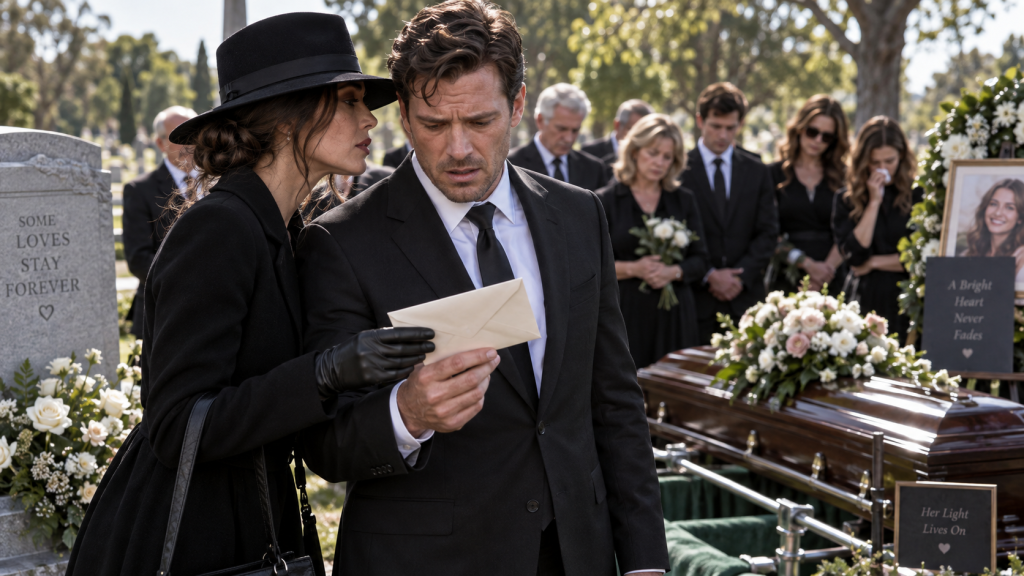
At her funeral, while her casket was being lowered, a woman dressed in black stepped out from behind the small crowd.
I’d never seen her before.
She walked straight toward me and silently pressed an envelope into my hand.
Then she leaned closer and looked directly into my eyes.
“She wasn’t ready to tell you why she really came back,” she whispered. “Now she has nothing to fear.
PART 2 — THE TEN YEARS CARA COULDN’T GIVE BACK
The stranger did not wait for me to open the envelope.
After whispering those words—
She wasn’t ready to tell you why she really came back. Now she has nothing to fear.
—she stepped away.
I caught her arm.
Not hard.
Just enough to stop her.
“Who are you?”
She looked toward Cara’s grave.
For several seconds, she seemed to be choosing between the promise she had made to a dead woman and whatever mercy she thought I deserved.
“My name is Rachel Dane.”
The name meant nothing to me.
“How did you know Cara?”
Her expression changed.
“I was there for most of the years you weren’t.”
That answer hurt more than it should have.
Most of the years I wasn’t.
As though those ten years had been a place.
As though someone else had stood inside them while I searched from the outside.
“What does that mean?”
Rachel swallowed.
“It means you need to read the letter before you decide what you think of me.”
“I don’t know what I think of anybody anymore.”
“I know.”
“No.”
My voice broke.
“You don’t.”
She did not argue.
That made me angrier.
“Did you know where she was?”
“Yes.”
The word struck cleanly.
For ten years, I had called old friends.
Sent emails that bounced.
Searched names.
Checked alumni pages.
Wondered if she was dead.
Married.
Happy.
Afraid.
And this stranger had known.
The grief inside me changed shape.
“You knew I was looking for her?”
Rachel’s eyes filled.
“Yes.”
I stepped backward.
“Then stay away from me.”
She nodded.
“I understand.”
“No, you don’t.”
“Probably not.”
She reached into her coat pocket.
Pulled out a business card.
Placed it on top of the envelope in my hand.
“When you finish the letter, call me.”
“I’m not promising that.”
“I know.”
She looked once more toward the grave.
Then walked away.
I did not open Cara’s envelope at the cemetery.
I wanted to.
My hands were already trembling around it.
But something about reading her final secret while standing beside the hole they had just lowered her into felt unbearable.
So I went home.
The house still smelled faintly like her shampoo.
Five days.
That was all she had lived there as my wife.
Five days.
Her sweater remained folded over the back of the sofa.
Her medicine sat on the counter even though the hospice nurse had told me someone would collect what needed disposal.
A mug with a faded blue rim remained beside the sink.
Cara had used it the last morning she was awake.
I stood in the kitchen holding the envelope and realized something ridiculous.
I had been married.
Widowed.
And still had not learned how she took her coffee now.
Ten years had happened.
We had tried to pretend they hadn’t.
That was impossible.
I sat at the dining table.
The envelope had my name written across the front.
Cara’s handwriting.
Still unmistakable.
Slight rightward slant.
Too much space between words.
In college, I used to tease her that she wrote as though every word needed privacy.
I slid my finger beneath the flap.
Inside were several pages.
A photograph.
A smaller sealed envelope.
And a photocopy of what looked like a legal document.
I turned the letter over.
The first sentence destroyed every version of the story I had been telling myself.
I did not come back because I was dying. Dying only took away the excuses I had spent ten years using not to come back sooner.
I stopped.
Read it again.
Then kept going.
If Rachel gave you this, then I am gone, which means I no longer get to control how you feel about what I did. Maybe that is the first honest gift I have given you in a long time.
My throat tightened.
You asked me why I disappeared. I laughed because the truthful answer was so much worse than the cowardly one I let you believe.
I put the page down.
For several seconds, I could not continue.
Then I forced myself.
The night before I left, we argued about our future. You said you loved me, but you weren’t ready to promise marriage, children, a mortgage, and the whole rest of our lives while we were still twenty-two and trying to figure out who we were.
I remembered.
God.
I remembered every word.
We had been in my apartment.
Cara had asked where we were going.
Not physically.
Us.
She wanted certainty.
I wanted time.
I had told her:
“I love you. I just don’t want to promise you a life because I’m scared you’ll leave if I say I don’t know exactly what it looks like yet.”
The irony almost made me sick.
Her letter continued.
I heard something different.
I heard that you loved me but might not choose the future I already wanted.
The next morning, before you woke up, I took a pregnancy test.
I stopped breathing.
The photograph slipped from my hand onto the table.
I did not pick it up.
Could not.
I read the sentence again.
Pregnancy test.
Then:
It was positive.
The room went silent.
Not ordinary silence.
The kind that changes the pressure in your ears.
I stared at the date printed beneath Cara’s handwritten words.
Ten years.
My mind began doing arithmetic before I could stop it.
No.
I turned the page.
I should have woken you.
I should have shown you the test.
I should have given you the right to be terrified with me.
Instead, I panicked.
My eyes filled.
I told myself that if I stayed, you would marry me because I was pregnant. I told myself you would wake up one day at thirty-five and realize your whole life had been decided by a twenty-two-year-old mistake.
I laughed bitterly.
A mistake.
I had searched ten years for the woman who thought loving her might ruin me.
None of that was your choice. It was a story I wrote for you because I was too frightened to hear your actual answer.
I covered my mouth.
There.
Even dead, Cara knew exactly where the betrayal lived.
Not pregnancy.
Not fear.
Choice.
I packed while you slept.
I went to Rachel. You never knew her because I had met her only a few months earlier at work. She had a spare room and enough sense to tell me I was behaving badly. I did not listen.
I looked toward Rachel’s card.
So that was the woman at the grave.
I changed my number because I knew if you called, I would come back.
That hurt.
I deleted everything because I knew if you could find me, I would have to explain.
Worse.
And once I had done something that cruel for one day, it became easier to justify doing it for another.
My chest tightened.
Then a week became a month. A month became six months. By the time our baby was born, I had built so much shame around the truth that going back felt impossible.
Our baby.
I pushed away from the table.
Stood.
Walked to the kitchen.
Then the living room.
Then back again.
As though somewhere in the house there might be a version of the sentence that did not mean what it meant.
Our baby.
Cara had been pregnant.
Cara had given birth.
I had—
A child.
Somewhere.
Ten years old.
Maybe nine, depending on dates.
Alive?
The thought terrified me.
I grabbed the letter again.
She was born nine years and four months ago.
My legs weakened.
I sat.
Her name is Sophie.
There was the name.
A person.
Not a pregnancy.
Not an abstract lost decade.
Sophie.
She weighed seven pounds, one ounce. She screamed for almost two hours after she was born and then slept with one fist pressed against her cheek. She hated swaddling. She loved ceiling fans. She laughed for the first time at eleven weeks because Rachel sneezed.
I was crying now.
Not quietly.
Cara kept writing.
She has your eyes.
I picked up the photograph.
My hands almost failed me.
A little girl stood on a beach.
Dark brown hair.
Green raincoat.
Bare feet pressed into wet sand.
She was smiling directly at the camera.
And I knew nothing about genetics in that moment.
Nothing objective.
Nothing careful.
I only knew the expression.
One corner of her mouth lifted slightly higher than the other.
Exactly like mine.
I had seen that crooked smile in every childhood photograph my mother kept.
I pressed the picture against the table.
Could not look away.
I know what you are thinking.
Cara’s letter continued.
Do not let a photograph become proof. I never did a paternity test. I had no right to take your DNA without asking, and I refused to let anyone turn Sophie into evidence before you even knew she existed.
That sounded like the Cara I remembered.
Except the Cara I remembered would have told me.
Apparently people can understand one boundary perfectly while violating another catastrophically.
Based on dates, you are the only possible father. But I have arranged for proper testing if you want it. You are allowed to want it. You are allowed to need proof. Sophie has been told the same thing.
I swallowed hard.
She had told Sophie.
How much?
She knows her father did not abandon her.
I stopped.
The sentence blurred.
I never told her you knew. I never told her you rejected us. Whatever else I stole from you, I would not steal your character too.
I leaned forward until my forehead touched the table.
For ten years, Cara had taken away the possibility of fatherhood.
At least she had not turned my absence into a lie for the child.
It was a small mercy inside something enormous.
When Sophie was little, I told her her father and I had loved each other before she was born, but I had made a decision that kept us apart.
When she got older, she asked harder questions.
I could imagine them.
Why doesn’t he visit?
Does he know me?
Does he have another family?
Would he like me?
Questions I had never been allowed to answer.
Three years ago, she asked whether you knew she existed.
My heart stopped.
I told her no.
She cried.
I did too.
Then she asked the question I had spent years avoiding: “Why didn’t you tell him?”
I gripped the letter tighter.
I had no answer that did not make me look exactly like what I was—a mother who loved her daughter fiercely and still made one of the worst decisions of her life before that daughter was born.
The honesty did not make what Cara did easier.
But it made her more real.
Then the letter changed.
The handwriting became less steady.
Probably written later.
Closer to the end.
Fourteen months ago, I was diagnosed with metastatic cancer.
I stared.
Fourteen months.
Not five days.
She had known for more than a year.
Anger returned immediately.
Hot.
Sharp.
“You had fourteen months.”
I said aloud to an empty house.
“You had fourteen months.”
The letter answered as though she had heard me.
I know.
My hands froze.
I know you will hate that I waited even after the diagnosis. You should.
I swallowed.
At first, treatment worked. The doctors talked in cautious language, and I convinced myself I had time.
I told myself I would tell you after the next scan. Then after Sophie finished school. Then after her birthday. Then when I was stronger.
Cowards love calendars. There is always another date to hide behind.
I closed my eyes.
That line felt cruel because it was true.
By the time the doctors told me there was nothing meaningful left to try, I had weeks.
I finally told Sophie your full name.
I could barely breathe.
She already knew more about you than I expected. Children with internet access and unanswered questions are dangerous researchers.
Despite everything, I laughed through tears.
Then:
She found your company profile. An old college photograph. A charity race you ran two years ago.
The idea of my daughter—
If she was mine—
looking at photographs of me from a laptop screen almost broke me.
She asked if she could meet you.
I stopped.
I told her yes.
Then:
And still I came to you first without her.
I stood again.
“Why?”
I shouted.
The house gave no answer except Cara’s page.
Because I was afraid.
I laughed bitterly.
Of course.
Fear.
Always fear.
Not afraid you would hurt her.
Afraid you would look at me and realize the only reason I had returned was because I needed you now.
That stopped me.
I needed a father for Sophie.
I needed someone who could love her after I was gone.
I needed to stop pretending Rachel could carry the entire future simply because she had helped me carry the past.
My anger changed.
Not disappeared.
Changed.
And the selfish, terrible truth is that I also wanted you.
I sat down.
Not only as Sophie’s father.
Not only because I was dying.
I wanted five days in which I could stop lying to myself about who I had loved all those years.
My chest hurt.
So when I asked you to marry me, I was telling the truth. It was my dying wish.
It was also not the whole truth.
There it was.
The part I had known was coming.
I married you because I loved you.
I also married you because I was trying to put one legal piece of my life where it belonged before I died.
I looked at the photocopied legal document.
Marriage does not magically make you Sophie’s father on paper. It does not automatically give you custody. Rachel and the lawyer made sure I understood that.
Thank God.
Cara had not built some fantasy legal shortcut into the story.
But I wanted you to be my surviving spouse when my estate was opened. I wanted you to have standing to receive the information I had prepared, to access records I authorized, and to be part of the process instead of being treated as a stranger after I died.
I read slowly.
I also signed a will nominating you as Sophie’s preferred guardian if paternity is established and if you choose to accept that role.
If I choose.
The words mattered.
A little late.
But they mattered.
Rachel remains Sophie’s temporary guardian until the court decides anything necessary. Nothing transfers simply because I wanted it. You are not trapped. Sophie is not property I can leave to you.
I pressed my fingertips against my eyes.
Even now Cara knew the limits.
I was terrified that if I told you all of this before the wedding, you would believe I had come back only because I needed something.
I whispered:
“You did need something.”
I did need something.
Again the letter answered me.
That does not mean I did not love you. Both things were true.
There it was.
The sentence I would spend months trying to understand.
She loved me.
She used me.
She wanted me.
She needed me.
She came back honestly.
She came back dishonestly.
People are terrible at being only one thing.
I should have told you before you married me.
My jaw tightened.
Yes.
I took your choice once when I disappeared. Then, because I was still afraid, I took part of it again when I asked you to marry me without telling you about Sophie.
Tears dropped onto the page.
There is no romantic explanation that makes that fair.
I could not forgive her because she admitted it.
But I was grateful she did not ask me to pretend.
The next paragraph was shorter.
The smaller envelope contains a letter for Sophie. Do not open it unless she gives you permission.
I looked at the sealed envelope.
Her name on the front.
Sophie.
My hands trembled.
The photograph was taken six months ago. Rachel took it.
The legal document is a copy of my will. My attorney is Thomas Ellison. His information is on the final page.
Then:
Please call Rachel.
I stared at those words.
Not because you owe me.
Because there is a little girl who has spent nine years wondering what your voice sounds like.
I stopped reading.
Could not continue.
I stood.
Walked outside.
It was raining.
I did not care.
I stood on the front steps without a coat while rain soaked my shirt.
Somewhere in the world was a nine-year-old girl who might be mine.
She knew my name.
She had looked me up.
She had asked to meet me.
And five days ago, while I was holding Cara in bed and telling her how grateful I was that she had come back, Cara had known there was a child waiting somewhere outside our brief marriage.
I was furious.
I was heartbroken.
I was terrified.
And underneath all of it was something I did not want to name.
Hope.
That felt like betraying my anger.
I called Rachel an hour later.
She answered immediately.
“I wondered if you would.”
“Where is she?”
No greeting.
No preamble.
Rachel became quiet.
“With me.”
“Was she at the funeral?”
“Yes.”
My heart stopped.
“Where?”
“Near the back.”
I closed my eyes.
I remembered children.
A few.
Black coats.
Heads lowered.
I had barely seen anyone.
“Why didn’t she come to me?”
“Because Cara asked me not to force that moment on either of you.”
I laughed bitterly.
“Cara certainly became respectful of choices at convenient times.”
Rachel did not defend her.
“No argument.”
That helped.
“Does Sophie know I married Cara?”
“Yes.”
“Does she know Cara died?”
“Of course.”
The stupidity of my question embarrassed me.
“What does she know about me?”
Rachel exhaled.
“She knows you and Cara dated in college.”
“She knows Cara left without telling you she was pregnant.”
“She knows you searched for Cara.”
I froze.
“How does she know that?”
“Because Cara told her.”
“When?”
“After the diagnosis.”
My throat tightened.
“And what did she say?”
Rachel paused.
“That her mother did something wrong.”
That mattered.
Not:
It was complicated.
Not:
Your father wasn’t ready.
Wrong.
“Why didn’t Cara bring Sophie when she came to me?”
I asked.
Rachel hesitated.
Then:
“Because Sophie asked her not to.”
That surprised me.
“What?”
“Cara told her she wanted to see you first.”
“Sophie said she didn’t want to meet you while you were deciding whether you were only being kind because Cara was dying.”
I sat down slowly.
A nine-year-old had shown more caution about my consent than her mother had at twenty-two.
Rachel continued.
“She wanted to know you wanted to meet her.”
“Not that you felt obligated.”
My eyes burned.
“What did Cara tell her after we got married?”
“That you had said yes.”
“To marriage.”
“Yes.”
“Not to Sophie.”
Rachel’s voice softened.
“She understood the difference.”
I looked toward the photograph on the table.
Green raincoat.
Crooked smile.
“Tell me about her.”
The words came out before I intended them.
Rachel laughed once.
Not mockingly.
Warmly.
“She reads under the covers.”
“Cara used to do that.”
“I know.”
“She hates peas.”
“Cara loved peas.”
“Exactly why she hates them, apparently.”
Despite everything, I smiled.
“She plays piano badly but enthusiastically.”
“She likes thunderstorms.”
“She is obsessed with marine animals.”
“And when she is nervous, she cracks the knuckles on her left hand one by one.”
My stomach tightened.
I did that.
Always had.
Genetics?
Coincidence?
Who knew.
Rachel seemed to realize what I was thinking.
“Do the test.”
she said.
I appreciated that.
No emotional pressure.
No:
Look at her eyes.
No:
You know she’s yours.
Just:
Test.
“Why did you help Cara hide?”
I asked.
Rachel became quiet.
There it was.
Her guilt.
Finally.
“I tried to stop her at first.”
“That’s not the same as telling me.”
“No.”
“You knew my name.”
“Yes.”
“You could have found me.”
“Yes.”
“Then why didn’t you?”
Rachel breathed slowly.
“Because Sophie was not my child.”
I felt anger rise.
“That is convenient.”
“It is.”
She did not flinch.
“But it is also true.”
She continued.
“Cara was an adult.”
“She was terrified.”
“She was wrong.”
“I told her she was wrong.”
“More than once.”
“But I did not believe I had the right to take her newborn daughter and make a paternity disclosure over her objection.”
My jaw tightened.
“You could have told me without taking Sophie anywhere.”
“Yes.”
Rachel said.
“I could have.”
Silence.
“And I didn’t.”
At least she did not hide behind philosophy.
“Why?”
“Because after a few years, I became afraid too.”
“Of what?”
“That you would arrive furious.”
“That Sophie’s life would explode.”
“That Cara would cut me off and I would lose the only way I had to protect the child.”
Rachel’s voice cracked.
“And eventually I told myself that keeping stability mattered more than correcting the original wrong.”
There it was again.
One bad decision becoming infrastructure.
“I’m sorry.”
Rachel whispered.
I closed my eyes.
“I don’t know what to do with that yet.”
“You don’t have to do anything.”
Good answer.
Then:
“Do you want to meet her?”
My entire body tightened.
“Yes.”
The word came immediately.
Then fear followed.
“Wait.”
Rachel stayed quiet.
“What if I’m not her father?”
“Then we deal with that.”
“What if she hates me?”
“She doesn’t.”
“You don’t know that.”
“No.”
Rachel corrected herself.
“She does not currently hate you.”
I almost laughed.
“What if I look at her and feel nothing?”
Rachel became very quiet.
Then:
“That is the question Cara was most afraid you would ask.”
I looked at the photograph.
A little girl I had never held.
Never fed.
Never stayed awake with.
Never taught to ride a bicycle.
Blood, if confirmed, did not manufacture ten years of memory.
“I don’t want to hurt her.”
“Then don’t promise her love before you know what you can give.”
Rachel said.
“She has already had enough adults deciding feelings for other people.”
That sentence made me trust Rachel for the first time.
Just slightly.
The next morning, I met Cara’s attorney.
Thomas Ellison was sixty-something, careful, and visibly tired.
He had known Cara only eight months.
He explained the will.
Her apartment lease would end.
Savings were modest.
A small life-insurance policy named a trust for Sophie.
Rachel was temporary trustee with an institutional co-trustee.
The money was for Sophie.
Not me.
Good.
I felt relieved.
Cara had not married me to dump debt into my lap or turn me into a beneficiary jackpot.
Her personal effects were divided between Sophie, Rachel, and me.
My portion consisted mostly of letters.
Old photographs.
A box stored in Thomas’s office.
“Why me?”
I asked.
“Because they concern you.”
he said.
Not because they were valuable.
They were ten years of things Cara had never sent.
Apparently that was valuable enough.
Then guardianship.
Thomas was very clear.
“Cara nominated you.”
“That does not appoint you automatically.”
“I understand.”
“If paternity is confirmed, you may have parental rights and responsibilities that require formal recognition.”
“I understand.”
“Rachel has agreed to maintain stability while everything is addressed.”
“Good.”
“Sophie’s wishes will matter too, especially regarding transition.”
“Of course.”
He looked at me.
“Cara was afraid you would think marriage was a trick to hand you a child.”
I laughed bitterly.
“Wasn’t it partly?”
Thomas did not answer too quickly.
“Partly.”
I appreciated him immediately.
“Then why agree to help her?”
“Because terminal illness does not make people wise.”
he said.
“It only makes deadlines less negotiable.”
That sentence stayed with me.
He continued.
“I advised her to tell you before the marriage.”
My head snapped up.
“She refused?”
“Yes.”
“What did you do?”
“I told her I would not participate in concealing legal documents from you or represent that marriage changed paternity or guardianship automatically.”
“Did she understand?”
“Yes.”
“Then why did you still prepare the will?”
“Because the will concerned Sophie whether you married Cara or not.”
Fair.
He leaned back.
“I thought Cara’s decision not to tell you was wrong.”
“So did Rachel.”
“Yes.”
“So apparently everyone knew except me.”
His face tightened.
“That is also true.”
I hated honest people that week.
They kept making anger more complicated.
Thomas brought out the box.
Letters.
Dozens.
My name on every envelope.
Different dates.
Different years.
None mailed.
The first was written two weeks after Cara disappeared.
The last three months before she came back.
I did not open them.
Not yet.
Then I saw something else at the bottom.
A small pink hospital hat.
Newborn size.
I stopped breathing.
“Sophie’s?”
Thomas nodded.
Cara had left it for me.
I touched the fabric with one finger.
Nine years too late.
I cried until Thomas quietly left his own office and let me sit alone.
The paternity test was scheduled through a proper clinic.
No toothbrush tricks.
No secret swabs.
Sophie would participate only if she still wanted to.
Rachel called before the appointment.
“She does.”
My stomach tightened.
“When can I meet her?”
A pause.
“Would you rather meet before or after the result?”
I had been thinking about that for two days.
Every instinct said after.
Proof first.
Protect everyone.
Then I pictured a nine-year-old child waiting to learn whether a lab had permission to decide if I was worthy of speaking to her.
“No.”
I said.
“Before.”
Rachel was quiet.
“You’re sure?”
“No.”
Good enough.
We arranged a meeting in a public botanical garden.
Neutral.
No home.
No cemetery.
No lawyer’s office.
Rachel suggested thirty minutes.
No promises afterward.
No talk about custody.
No interrogation about Cara.
Just meeting.
I arrived twenty-five minutes early.
Of course.
I sat on a bench beside a pond.
Children fed ducks despite three signs telling them not to.
My hands would not stop shaking.
I had presented to boards of directors.
Spoken at conferences.
Sat beside Cara while hospice nurses explained death.
Nothing had frightened me like that bench.
What do you say to a child who might be yours after missing her entire life through no choice of your own?
Hello seemed insulting.
I’m sorry suggested guilt for something I had not done.
I’m your father required proof.
So I sat there with no sentence.
Maybe that was appropriate.
At exactly two o’clock, Rachel appeared at the garden entrance.
And beside her—
the girl from the photograph.
Sophie.
She wore jeans.
Yellow sneakers.
A dark green sweater.
Her hair fell below her shoulders.
She held Rachel’s hand for the first ten steps.
Then let go.
My heart began beating so hard I could hear it.
The photograph had not prepared me.
No photograph could.
She was smaller than the idea of her.
That sounds absurd.
But for three days, Sophie had been ten stolen years.
A secret.
A betrayal.
A legal question.
A possible daughter.
Now she was simply a child walking toward me.
Nervous.
Real.
She stopped several feet away.
Rachel said:
“Sophie, this is—”
“I know.”
Sophie interrupted softly.
Then she looked directly at me.
My chest tightened.
The eyes.
Forget genetics.
Forget proof.
I understood why Cara had written it.
Still, I made myself remember:
A resemblance is not a test.
Sophie cracked the knuckles on her left hand.
One.
Two.
Three.
I almost laughed.
She noticed.
“What?”
“Nothing.”
“You’re staring.”
“I’m sorry.”
“You look different from your work picture.”
That caught me completely off guard.
I smiled.
“So do you.”
She frowned.
“You’ve only seen one picture of me.”
“Fair.”
For one second, something almost normal passed between us.
Then vanished.
Rachel stepped backward.
“I’ll be right over there.”
Sophie immediately said:
“Not too far.”
“I won’t.”
Rachel moved to another bench.
Sophie remained standing.
I stood too.
Then thought maybe that made me too tall and sat back down.
Terrific.
Fatherhood going beautifully.
Sophie looked at the empty space beside me.
“Can I sit?”
“Of course.”
She sat at the far end.
A full person between us.
Good.
She deserved space.
For several seconds, neither of us spoke.
Then Sophie said:
“Mom said you tell bad jokes.”
I stared.
“Your mother slandered me after death?”
Sophie’s mouth twitched.
That crooked smile.
“There.”
I said before I could stop myself.
“What?”
“Nothing.”
I looked away.
Too much.
Too fast.
She studied me.
Then asked:
“Are you mad at her?”
No warm-up whatsoever.
Apparently Cara’s daughter had inherited directness from somewhere.
“Yes.”
Sophie nodded.
“Me too.”
The answer broke my heart.
“But I miss her.”
she added.
“I do too.”
She looked at me.
“You only had her five days.”
I swallowed.
“I had her three years before that.”
“I know.”
Right.
Cara had told her.
Then Sophie said:
“She cried after the wedding.”
My heart stopped.
“When?”
“When she called us.”
I stared.
“She called you?”
“The courthouse day.”
I had gone to pick up prescriptions.
Cara said she wanted to rest.
Instead, she had called her daughter.
“What did she say?”
Sophie looked toward Rachel.
Then back.
“She said she did something selfish.”
“What?”
“She married you before telling you about me.”
I closed my eyes.
Even then she knew.
Sophie continued.
“I asked why.”
“And?”
“She said she was scared you would say no to the wedding if you knew.”
My jaw tightened.
Sophie watched me carefully.
Then:
“That was bad, right?”
I opened my eyes.
“Yes.”
The answer hurt.
But lying to protect Cara’s memory would repeat the pattern.
“Yes.”
Sophie nodded.
“I told her that too.”
I almost smiled.
“She said she loved you.”
Sophie whispered.
“I loved her.”
“Do you still?”
I looked toward the pond.
“Yes.”
“Even though you’re mad?”
“Yes.”
Sophie thought about that.
Apparently the answer mattered.
Then she said:
“I’m mad too, but I still wish she was here.”
“That makes sense.”
“Rachel says two things can be true.”
“Rachel says a lot of sensible things.”
Sophie rolled her eyes.
“She really does.”
There.
Another tiny ordinary moment.
Then she reached into her backpack.
Pulled out a folded sheet of paper.
“I wrote questions.”
My throat tightened.
“How many?”
She unfolded it.
A lot.
I laughed despite myself.
Sophie looked almost offended.
“What?”
“That is organized.”
“Mom said you make lists.”
“I do.”
“She said I got it from you.”
Again.
Cara had been giving pieces of me to Sophie while withholding Sophie entirely from me.
The grief of that was almost impossible to name.
Sophie looked at the page.
“Do you like dogs?”
“Yes.”
“What kind?”
“Most.”
“That’s not a kind.”
“Golden retrievers.”
She made a check mark.
“You have a dog?”
“No.”
Another mark.
“Are you married to anyone else?”
I froze.
“No.”
“Girlfriend?”
“No.”
She nodded.
“Do you want kids?”
The question hit like a physical blow.
Sophie looked up.
“I know that’s weird.”
“No.”
My voice broke.
“It isn’t weird.”
I took a breath.
“I used to think I did.”
“What about now?”
I looked at her.
Nine years.
Four months.
Green sweater.
Yellow shoes.
Question sheet.
“I don’t know what I’m allowed to say yet.”
Sophie stared.
Then nodded slowly.
“That’s okay.”
Again, more grace than the adults had managed.
She moved to the next question.
“Did you really look for Mom for ten years?”
“Yes.”
“How?”
I told her.
Old emails.
Friends.
College classmates.
People from Cara’s first job.
Once I thought I found her under a different surname in Oregon.
Wrong person.
Sophie listened.
Then asked:
“If you found her when I was little, would you have wanted to meet me?”
My throat closed.
“Yes.”
No hesitation.
That answer I knew.
She looked down.
“Okay.”
One word.
But something in her shoulders loosened.
Then came the hardest question.
“Why didn’t you find us?”
I inhaled slowly.
“Because your mother made herself very difficult to find.”
Sophie’s eyes filled.
“She was good at that.”
“Yes.”
I wanted to say more.
Did not.
A child grieving her mother did not need me turning Cara into a villain.
But she also did not need lies.
“Your mom made choices I wish she hadn’t.”
Sophie nodded.
“Me too.”
Then:
“But she was a good mom.”
I looked at her.
“I believe you.”
She seemed relieved.
That mattered.
Cara could have been a loving mother and still have wronged both of us profoundly.
Both things true.
Again.
Our thirty minutes became forty-five.
Rachel eventually approached.
“Sophie.”
“I know.”
Sophie folded her question sheet.
Then looked at me.
“When do we do the DNA thing?”
“Whenever you’re ready.”
“I’m ready.”
I nodded.
“So am I.”
She stood.
I did too.
For one dangerous second, I wanted to hug her.
Every instinct in me reached forward.
I stopped.
Sophie noticed.
I think she did.
She looked at my arms.
Then my face.
I kept my hands at my sides.
Her choice.
Always.
She took one step.
Then another.
And wrapped her arms around me.
My entire body forgot how to move.
Then I held her.
Carefully.
Not like I could make up ten years in one embrace.
Not like blood had already been proven.
Just enough.
Sophie’s face pressed against my chest.
Then she whispered:
“You smell different than I thought.”
I laughed into her hair while tears ran down my face.
“What did you think I would smell like?”
“Coffee.”
“I do drink coffee.”
“More.”
“Sorry.”
She laughed.
And for three seconds, grief became something else.
Not happiness exactly.
Possibility.
When Sophie stepped back, she reached into her pocket.
“There’s one more thing.”
She handed me a tiny folded piece of paper.
Cara’s handwriting.
My stomach tightened.
“When did she give you this?”
“The night before she went to see you.”
I opened it.
One sentence.
If he wants to know you, let him know you slowly. He already lost ten years. Do not let my guilt make either of you rush the rest.
I stared until the words blurred.
Sophie watched me.
Then said:
“She was scared you wouldn’t want me.”
My throat closed.
I looked at this child Cara had hidden from me because she was afraid of my answer.
Then hidden the truth of her return because she was afraid of my answer again.
Fear had stolen enough.
“I don’t know exactly what happens next.”
I told Sophie.
She nodded.
“Okay.”
“But I want there to be a next.”
Her eyes widened.
Just slightly.
Then she smiled.
The crooked smile.
Mine.
Maybe.
We would let the test answer that.
The clinic called four days later.
Rachel came with Sophie.
Thomas Ellison attended because Cara had asked him to help with the legal steps.
I sat across from all of them in a small conference room while the physician explained results I could barely hear over my pulse.
Probability of paternity.
Greater than 99.9 percent.
Words.
Numbers.
Science reducing ten years of absence to something finally certain.
Sophie looked at me.
I looked at her.
Neither of us spoke.
Then Rachel began crying.
Thomas removed his glasses.
And Sophie whispered:
“So you are.”
I swallowed.
“Yes.”
My daughter.
The words existed now.
I could hardly bear them.
Thomas slid a folder toward me.
“Now that paternity is established, we can begin discussing the legal process.”
I barely heard him.
Sophie was still staring.
Then she asked:
“Can I call you Dad?”
The room vanished.
No legal document could have prepared me for that.
I could have said yes.
Part of me wanted to grab the word before it disappeared.
But Cara’s final note remained in my pocket.
Slowly.
Choice.
I looked at Sophie.
“You can call me whatever feels right.”
She frowned.
“That is an annoying adult answer.”
Rachel laughed through tears.
I smiled.
“Probably.”
Sophie thought.
Then:
“I’ll decide later.”
“Deal.”
Thomas opened Cara’s will.
There were practical things now.
Guardianship.
School.
Home.
Therapy.
The life-insurance trust.
Rachel had been Sophie’s daily family for nine years.
I was not going to walk into a courtroom waving DNA and demand that a grieving child be removed from the only stable home she knew.
The thought horrified me.
So I said the first thing that made Thomas visibly relax.
“Sophie stays with Rachel for now.”
Rachel looked at me.
“What?”
I turned toward Sophie.
“If that’s what you want.”
Sophie nodded immediately.
“For now.”
“Then for now.”
Thomas leaned back.
“Good.”
No battle.
No dramatic custody grab.
A beginning.
Not a transfer.
Then Thomas said:
“There is one issue we have not discussed.”
My stomach tightened.
Of course.
“What?”
He looked toward Sophie.
Then Rachel.
Rachel’s expression changed.
The two of them already knew.
“What issue?”
Thomas closed Cara’s will.
“The marriage was not only about guardianship planning and estate access.”
My pulse accelerated.
“What else?”
He hesitated.
Then:
“Cara owned something she never told you about.”
I almost laughed.
“Apparently that was a hobby.”
Sophie smiled faintly.
Thomas did not.
He reached into another folder.
“A house.”
I stared.
“Her apartment?”
“No.”
“Where?”
“Outside Boston.”
My eyebrows drew together.
“I don’t understand.”
Thomas slid a deed across the table.
The address meant nothing to me.
Then I saw the acquisition date.
Ten years earlier.
Six months after Cara disappeared.
Owner:
Cara Elizabeth Monroe.
Purchase price modest.
Small two-bedroom property.
“What is this?”
Rachel answered.
“Where Sophie was born into her life.”
I looked at her.
“She bought a house?”
“With help from an inheritance from her grandmother.”
Thomas said.
“And she paid it off years ago.”
“Why does this matter?”
His face changed.
“Because she left it to you.”
I shook my head immediately.
“No.”
Sophie looked between us.
Thomas continued.
“Not unconditionally.”
“What does that mean?”
“The will gives you a choice.”
My stomach tightened.
“What choice?”
He turned to the final page.
I read.
The house could pass to me.
Or, if I declined, it would pass into Sophie’s trust.
That seemed simple enough.
Then I noticed a handwritten note attached.
Cara’s writing.
There is something inside the house he deserves to see before he decides.
I stared.
Rachel looked away.
My chest tightened.
“What is in that house?”
No one answered.
“Rachel.”
She swallowed.
“Ten years.”
I went still.
“What does that mean?”
She looked at Sophie.
Then back at me.
“Cara kept everything.”
“What everything?”
“Every letter she wrote you.”
“Every birthday card Sophie made for a father she had never met.”
“Photographs.”
“Videos.”
“And a box Cara told me never to open.”
My hands went cold.
Thomas added quietly:
“She specified that only you may decide whether to open it.”
I stared at the address.
A house I had never known existed.
A daughter I had met four days ago.
A dead wife who had spent ten years writing toward me without ever sending anything.
Then Sophie said:
“I know what’s in the box.”
Everyone turned toward her.
Rachel went pale.
“Sophie.”
“What?”
“How?”
Sophie looked guilty.
“I heard Mom talking about it before she got really sick.”
My heart started pounding.
“What did she say?”
Sophie hesitated.
Then looked directly at me.
“She said it was the reason she almost came back when I was a baby.”
The room went silent.
I could barely speak.
“What stopped her?”
Sophie’s face changed.
“I don’t know.”
Then she added:
“But she said somebody came to the house first.”
My body went cold.
“Who?”
Sophie shook her head.
“Mom never told me.”
Rachel stared at her.
Thomas went completely still.
I looked at both adults.
“You didn’t know about this?”
“No.”
Rachel whispered.
I stared at the address again.
For days, I had believed the worst thing Cara had done was disappear because she was afraid of my answer.
Now, for the first time, there was a possibility that fear had not been the only thing keeping her away.
Six months after she vanished—
while our daughter was still a baby—
Cara had apparently been ready to come home.
Then someone found her first.
I folded the deed slowly.
Looked at Rachel.
“When can we go to the house?”
And the expression on her face told me that whatever Cara had locked inside that final box had survived ten years for a reason.
PART 3 — THE YEARS WE STILL HAD
Cara’s house was forty-three minutes outside Boston.
I counted every one of them.
Rachel drove.
Sophie sat in the back seat.
I sat beside Rachel with the deed folded inside my coat pocket and Cara’s final note pressing against my chest like something alive.
Nobody spoke much.
There are silences that feel awkward.
This one felt crowded.
My daughter was sitting three feet behind me.
My daughter.
I was still learning how to think those words without feeling as though I had stolen them from somebody else.
Nine years and four months old.
Mine by biology.
Cara’s by every morning, fever, scraped knee, birthday, school pickup, and bedtime story I had missed.
Rachel’s too, in another way.
She had been there when Cara could not carry everything alone.
And now the three of us were driving toward the house where those missing years had happened.
I did not know what role I was supposed to play.
So for once, I did not invent one.
I simply went.
The house was smaller than I expected.
Pale blue siding.
White shutters.
A crooked mailbox.
A maple tree in front that had grown large enough to shade half the porch.
There was chalk on the driveway.
A faded hopscotch grid.
I stood beside the car staring at it.
Sophie noticed.
“I did that last summer.”
I looked at her.
“You like hopscotch?”
“Not really.”
“Then why?”
“Mom said kids are supposed to draw hopscotch.”
Rachel laughed softly.
“That sounds like Cara.”
I smiled despite myself.
She had always been capable of doing something badly simply because she believed life required the experience.
I remembered a disastrous attempt at homemade pasta in college.
Flour on the ceiling.
Cara blaming the ceiling.
For one second, grief and happiness occupied exactly the same place.
Then Sophie unlocked the front door.
The house smelled like Cara.
Not perfume.
Something harder to explain.
Laundry detergent.
Old books.
The lemon cleaner she had used even in college.
I stopped just inside.
Shoes by the door.
Sophie’s backpack hanging from a hook.
A little ceramic bowl filled with keys.
Photographs.
So many photographs.
Cara and Sophie at the zoo.
Cara asleep on a sofa while a toddler Sophie apparently decorated her face with stickers.
First day of school.
Halloween.
A birthday cake shaped like a whale.
Nine Christmases.
Nine summers.
Nine years of evidence that while I was searching for a missing woman, she had been building an entire life.
I hated her for three seconds.
Then loved her so much it hurt.
Then hated myself for loving her.
Grief is exhausting because it refuses to pick one emotion and stay there.
Sophie walked ahead.
“This was Mom’s chair.”
She touched the arm of a faded green recliner.
“She always sat there.”
I nodded.
“What did she read?”
“Everything.”
“That sounds right.”
“She folded pages down.”
“That sounds wrong.”
Sophie looked offended.
“Mom said bookmarks were for people with too much free time.”
I laughed.
Actually laughed.
Then my throat closed because I could hear Cara saying it.
Sophie smiled.
“I knew you’d think that was funny.”
“How?”
“Mom did.”
There would be years of that, I realized.
Cara had left pieces of me inside Sophie.
Stories.
Habits.
Opinions.
She had allowed my ghost into their house even while keeping the actual man outside it.
I still did not know whether that made things better or worse.
Probably both.
Rachel led me upstairs.
Cara’s room was at the end of the hall.
The bed was made.
A scarf hung over the chair.
Her slippers remained beneath the dresser.
Nobody had dismantled her life yet.
I stood at the doorway.
Rachel whispered:
“We haven’t been able to do much.”
“I understand.”
“No.”
Her voice broke.
“I mean Sophie won’t let me.”
From behind us:
“I can hear you.”
Rachel turned.
“I know.”
Sophie folded her arms.
“We’re not throwing Mom’s stuff away.”
“No one said we were.”
“You said boxes.”
“Boxes are not trash.”
“Sometimes they become trash.”
I watched them argue quietly and realized how much family already existed between them.
Not legal family.
Not blood.
The kind built by repetition.
I would not be the man who arrived with DNA results and told that bond it had become secondary.
The box sat in Cara’s closet.
Dark cedar.
About the size of a small suitcase.
There was no dramatic lock.
Just a brass latch.
Rachel touched it.
“I never opened it.”
Sophie said:
“I tried.”
Rachel stared.
“When?”
“Once.”
“Sophie.”
“I didn’t get in.”
She looked at me.
“Mom hid the key.”
I almost smiled.
Thomas had included the key with the deed.
It was in my pocket.
I held it.
Then stopped.
Sophie noticed.
“What?”
“This is your house too.”
“Technically it might become yours.”
“That’s not what I mean.”
I held up the key.
“Do you want to be here when I open it?”
She thought.
Then nodded.
“Yes.”
“Are you sure?”
“Stop asking me if I’m sure about everything.”
Fair.
Rachel sat on the edge of the bed.
Sophie sat beside her.
I knelt in front of the box.
Then turned the key.
The first thing inside was not a secret.
It was a stack of envelopes tied with blue ribbon.
My name.
Again and again.
Different dates.
Ten years.
The second stack was smaller.
Crayon drawings.
Birthday cards.
Construction paper folded crookedly down the middle.
Each one addressed to:
My Dad
I stopped breathing.
Sophie looked down.
“I didn’t know where to send them.”
I picked up the first.
On the front, in enormous purple letters:
HAPY BIRTDAY DAD
A stick figure stood beside what I assumed was a whale.
“Is that me?”
Sophie leaned forward.
“No.”
“Oh.”
“That’s an orca.”
“Obviously.”
“You really need to work on marine animals.”
Apparently fatherhood involved immediate criticism.
I smiled through tears.
Then placed the card back.
Not yet.
I could not absorb nine birthdays in one afternoon.
Beneath the letters was a flash drive.
Several printed photographs.
A hospital bracelet.
Sophie’s.
A positive pregnancy test sealed inside a plastic bag.
I stared at it.
Ten years old.
Two pink lines that had changed all our lives before I knew they existed.
Then I found an envelope with no name.
Only one sentence in Cara’s handwriting.
This is the part I was most ashamed to tell him.
My stomach tightened.
I opened it.
Inside was another letter.
Not Cara’s handwriting.
I recognized it instantly.
My mother’s.
For several seconds, I did not understand.
Then the room tilted.
I read the first line.
Cara,
I came because you asked whether he was all right. I am answering you because I hope you still care enough about him to leave him alone.
I sat back on my heels.
Rachel whispered:
“Is that—”
“Yes.”
My mother.
The woman who had watched me search for Cara for ten years.
The woman who had held me when I drank too much after Cara disappeared.
Who told me:
“Some people run because they were never meant to stay.”
Who encouraged me to date.
Who once said:
“If she wanted to be found, sweetheart, she would let you find her.”
She had known where Cara lived.
She had been inside this house.
I kept reading.
He spent months destroying himself after you vanished. He stopped eating. He missed work. He drove to your old apartment more times than I can count.
All true.
He has finally started becoming himself again.
Partly true.
He has accepted a better position. He is meeting new people. He has a future opening in front of him again.
Also true.
Then:
And now you want to return with a baby.
My hands began shaking.
She had known Sophie existed.
I looked at my daughter.
Sophie watched my face.
I lowered the letter.
“Do you need a break?”
Rachel asked.
“No.”
I was done with secrets being easier when postponed.
I continued.
I believe you when you say the child is his. That is exactly why I am asking you to think carefully before you contact him.
My vision blurred.
You know him. If you appear with a baby and tell him he is the father, he will marry you tomorrow whether he is ready or not. He will give up whatever he has to give up. He will call it love because that is the kind of man he is.
My jaw tightened.
And one day, perhaps years later, he may realize that a choice made from guilt was not a choice at all.
The cruelty of the sentence was that it contained something I might once have feared too.
Maybe Cara had told my mother about our final argument.
Maybe Mom simply understood which wound to press.
Then came the lie.
He told me before you disappeared that he was afraid you were trying to push him into marriage and children before he was ready.
I whispered:
“No.”
Sophie flinched.
I softened my voice.
“Sorry.”
I had never said that.
I told Cara I did not know what our life would look like yet.
I had not told my mother I feared Cara trapping me.
But the distortion was close enough to something real that Cara could believe it.
The best lies usually borrow the skeleton of truth.
My mother continued.
If you love him, give him the life he is finally learning to live without you.
Then:
If Sophie is his, I am sorry for what this means. I truly am. But bringing a child into his life without warning after what you did would not be fair to him either.
My stomach turned.
A baby reduced to disruption.
My daughter turned into a threat to my future by the grandmother who should have wanted to know her.
The final line was worse.
If you decide to contact him anyway, I will not stop you. But do not pretend you are doing it for him.
Signed:
Helen
My mother.
No threat.
No bribe.
No legal intimidation.
Something more effective.
Permission wrapped around shame.
I put the letter down.
Nobody spoke.
Then Sophie asked:
“Grandma knew about me?”
Her voice was very small.
I wanted to lie.
For half a second.
Protect her.
Delay.
Choose the easier version.
Then I heard Cara’s entire life inside that instinct.
I looked at Sophie.
“Yes.”
“How long?”
“Since you were a baby.”
Her face changed.
“Why didn’t she tell you?”
“I don’t know everything yet.”
“But she knew.”
“Yes.”
Sophie stood.
Walked out of the room.
Rachel started after her.
I stopped her.
“Wait.”
“She’s nine.”
“I know.”
“She shouldn’t be alone with that.”
“I know.”
Then I stood.
“But I should be the one to go.”
Rachel nodded.
I found Sophie sitting halfway down the stairs.
Her knees pulled to her chest.
I sat two steps below her.
Not beside her.
Lower.
I did not know why.
Maybe I wanted her to understand she did not need to look up at me for answers I barely had.
She whispered:
“Mom knew Grandma knew?”
“Yes.”
“Did Rachel?”
“No.”
Rachel called softly from upstairs:
“I didn’t.”
Sophie nodded.
Then:
“Was Grandma scared of me too?”
My heart cracked.
“No.”
She looked at me.
“You don’t know.”
She was right.
Children are brutal about unsupported conclusions.
I corrected myself.
“I don’t think she was scared of you.”
“Then why?”
I stared at the wall.
“Sometimes adults become afraid of what a truth might change.”
“That doesn’t make sense.”
“No.”
“It usually doesn’t.”
She picked at the sleeve of her sweater.
“Does Grandma know Mom died?”
“Yes.”
“Have you talked to her?”
“Not since the funeral.”
“Are you going to yell?”
The question surprised me.
“I don’t know.”
Sophie frowned.
“You say that a lot.”
“I’m trying to get better at it.”
“At what?”
“Not pretending I know before I know.”
She considered this.
Then:
“Mom did that.”
“Yes.”
It hurt to agree.
But I did.
We returned upstairs.
There was another page inside Cara’s envelope.
Her response to my mother.
Never sent.
Helen,
You are right that I have already been selfish with him.
My chest tightened.
You are wrong about one thing. If he stayed because of Sophie, that would still have to be his choice to make.
I stopped.
Even then.
Cara had understood.
Then why—
The next lines answered.
I was going to tell him. I had packed the car. I had Sophie’s bag by the door. Then you came.
Sophie leaned closer.
Everything you said sounded like the fear I already had. I let that be enough.
There.
Not:
Helen forced me.
Not:
She threatened me.
Cara owned it.
You did not keep me away for nine years. Please never let him believe you had that much power.
I looked toward the ceiling.
Tears spilled down my face.
You gave me one more excuse. I chose it. Then I chose another. And another.
My mother’s betrayal mattered.
Cara’s remained Cara’s.
Both truths could stand without one canceling the other.
There were more letters.
I did not read all of them that day.
One from Sophie’s first birthday.
One from her first day of kindergarten.
One written after she lost her first tooth.
Another after Cara’s cancer diagnosis.
I opened only one more.
Dated six months before Cara returned.
I keep thinking the punishment for waiting this long is that I no longer deserve to tell you.
Then:
But Sophie deserves more than I deserve.
That was the line that finally brought Cara back.
Not illness alone.
Not marriage.
Not nostalgia.
A daughter getting old enough to ask questions Cara could no longer answer with avoidance.
And death finally removing the fantasy that there would always be more time.
I took my mother’s letter with me.
The original.
Rachel asked:
“Are you sure?”
“Yes.”
“What about the house?”
I looked around.
Sophie’s school photographs.
Cara’s chair.
The height marks on the kitchen doorway.
This was not my house.
Not emotionally.
“I’m declining Cara’s gift.”
Sophie looked at me.
“What?”
“The house.”
“Why?”
“It should go into your trust.”
“But Mom left it to you first.”
“I know.”
“Does that mean you don’t want it because you’re mad at her?”
Good question.
I thought carefully.
“No.”
“Then why?”
“Because this house holds your childhood.”
“Your mother bought it for you both.”
“And I already inherited enough from Cara.”
Sophie frowned.
“What?”
I looked at her.
“The truth.”
A little dramatic.
She rolled her eyes.
Good.
Nine-year-olds are excellent protection against self-importance.
Thomas handled the paperwork later.
I declined the house.
It passed according to Cara’s will into Sophie’s trust.
Not because I wanted to look noble.
Because I did not need property to prove Cara had loved me.
And Sophie deserved one thing in her life that no adult could turn into an emotional debt.
The house remained available for her benefit.
Rachel stayed there with Sophie while the court worked through everything else.
That was what Sophie wanted.
So that was what we did.
I called my mother that night.
She answered on the first ring.
“Sweetheart.”
I closed my eyes.
“Did you go to Cara’s house when Sophie was a baby?”
Silence.
A long one.
Then:
“Where did you hear that?”
Wrong answer.
“Did you?”
My mother began crying.
Immediately.
I felt nothing.
That frightened me.
“Yes.”
she whispered.
“How old was Sophie?”
“About six months.”
“You saw her?”
“Yes.”
“Held her?”
Another silence.
“No.”
“Why not?”
“I didn’t think I should.”
I laughed bitterly.
Interesting place to discover boundaries.
“Why didn’t you tell me?”
“I was trying to protect you.”
There it was.
The most dangerous sentence in both families.
Protect.
Cara protected me from obligation.
My mother protected me from Cara.
Rachel protected Sophie’s stability.
Everyone deciding what truth I could survive.
“From my own daughter?”
“You didn’t know she was yours.”
“Cara told you.”
“She believed she was.”
“And you believed her enough to write the letter.”
My mother sobbed.
“I was scared.”
“Of what?”
“That she would disappear again.”
“Then why not tell me and let me decide?”
No answer.
I continued.
“You watched me search for her.”
“I know.”
“You watched me blame myself.”
“I know.”
“You told me if she wanted to be found, she would let me find her.”
“I know.”
My voice cracked.
“You knew where she lived.”
“She moved later.”
“That isn’t the point.”
“No.”
Finally.
She stopped defending.
“No.”
My mother whispered:
“You were getting better.”
I almost laughed.
“Better?”
“You were working again.”
“Dating a little.”
“You had stopped driving past her old apartment.”
“I thought if she came back with a baby, you would throw everything away.”
“My job.”
“Your plans.”
“Your whole life.”
I stared at Cara’s photograph on my table.
“You mean I might have become a father.”
Mom cried harder.
“I didn’t know what was right.”
“So you chose for me.”
“Yes.”
At least she said it.
“Did Dad know?”
“No.”
I believed her.
My father had died three years earlier.
There was no benefit in inventing another betrayal just to have somewhere else to place anger.
“Did you ever contact Cara again?”
“No.”
“Not once?”
“No.”
“Did she contact you?”
“One Christmas card.”
My body went cold.
“When?”
“Sophie was three.”
“What did it say?”
My mother hesitated.
“Just a photograph.”
“And?”
“A note.”
“What note?”
“She wrote, ‘She has his smile.’”
I covered my face.
“And you still didn’t tell me.”
“No.”
There are moments when an apology cannot reach the size of the thing that happened.
This was one.
“Don’t call me for a while.”
My mother panicked.
“How long?”
“I don’t know.”
“Please.”
“I need you to hear me.”
“I do.”
“No.”
I spoke quietly.
“No visiting Sophie.”
Silence.
“You cannot meet her because you’re guilty.”
“You cannot send gifts.”
“You cannot ask Rachel.”
“You wait until Sophie and I decide whether she wants that.”
My mother started crying harder.
“She’s my granddaughter.”
“Yes.”
I said.
“And that does not make her yours to access.”
The sentence sounded familiar.
Maybe I had learned something.
My mother and I did not speak for four months.
Not because I wanted to punish her.
Because every conversation made me responsible for her grief about choices she made to manage mine.
I could not do that anymore.
She wrote letters.
I gave them to my therapist.
Yes.
I got one.
There was too much dead-person correspondence in my life already.
I needed a living professional.
He asked me what I wanted from my mother.
I said:
“Ten years.”
He nodded.
“And since she cannot give you those?”
That question made me furious.
Then useful.
Eventually I answered:
“Truth without defense.”
That was possible.
Maybe.
Sophie and I moved much more slowly.
At first, we met every Saturday.
Rachel remained nearby.
Zoo.
Library.
Aquarium.
The aquarium was apparently mandatory.
Sophie corrected nearly every fact I thought I knew about sharks.
“Great whites don’t chew people because they like humans.”
“I didn’t say—”
“You were about to.”
“I was not.”
“You had the face.”
“What face?”
“The wrong-fact face.”
Apparently genetic inheritance included disrespect.
I adored her.
That terrified me.
The first time Sophie called me Dad, she did not plan it.
We were in a grocery store.
She was standing near the cereal aisle while I argued with Rachel on the phone about whether Sophie had already eaten enough sugar that week.
Sophie grabbed a box.
“Dad, can I get—”
She stopped.
I stopped.
The entire aisle seemed to go silent.
She looked at me.
I looked at her.
Then she turned bright red.
“I mean…”
I could barely breathe.
“You can call me that.”
“I know.”
She stared at the cereal box.
“Can I get it?”
I laughed so hard a woman nearby looked concerned.
“Yes.”
Apparently my first official act as Dad was approving chocolate cereal.
A strong beginning.
Legal recognition took time.
Paternity first.
Then court filings.
Cara’s nomination mattered.
My biology mattered.
Rachel’s role mattered.
Most importantly, Sophie’s stability mattered.
There was no dramatic day when a judge handed me my daughter.
Thank God.
Instead, we created a transition.
One overnight with me.
Then weekends.
Then more.
Rachel stayed in her life.
Always.
When Sophie was ten, she decided she wanted to live primarily with me during the school year because my house was closer to the school she wanted.
Rachel cried.
I cried.
Sophie told us both we were embarrassing.
Good.
Rachel became Aunt Rachel without anyone needing blood to authorize the title.
Family expanded.
It did not need to replace.
My mother eventually met Sophie.
Not because she demanded it.
Because a year after Cara died, Sophie asked:
“Is she sorry?”
“Yes.”
“Do you believe her?”
“I believe she knows what she did was wrong.”
“That’s not what I asked.”
Again.
Children are merciless.
“I believe she’s sorry.”
Sophie thought.
“Do I have to forgive her?”
“No.”
“Can I still meet her?”
“Yes.”
So we did.
Public park.
Thirty minutes.
Apparently our family had discovered neutral locations.
My mother looked at Sophie and broke down crying.
Sophie did not hug her.
Good.
My mother recovered.
Then said:
“You look like your father.”
Sophie answered:
“People say that.”
My mother smiled sadly.
“I should have known you a long time ago.”
Sophie looked at her.
“Yes.”
No comfort.
No cruelty.
Truth.
My mother nodded.
“Yes.”
That meeting lasted thirty-seven minutes.
No promises.
Later, Sophie said:
“She seems nice.”
I laughed.
“She can be.”
“People can be nice and do bad things.”
Dr. Reynolds would have loved her.
I nodded.
“Yes.”
Their relationship remained limited.
Birthdays.
Occasional lunches.
Eventually holidays.
My mother never became entitled to the grandmother role she had once hidden from me.
She earned what Sophie chose to give.
That was better for both of them.
I read Cara’s letters over three years.
Not all at once.
Some stayed sealed until I could handle them.
One from Sophie’s second birthday destroyed me.
Today she called a man at the grocery store Daddy because he had your hair. I cried in the parking lot for forty minutes. This is what I chose. I need to stop pretending I’m the only one being punished by it.
Another:
She asked why other children have fathers at school breakfast. I told her families look different. True sentence. Incomplete answer.
Another, written after her diagnosis:
I used to think shame meant I cared deeply about what I had done. Now I think sometimes shame is just another way of staring at yourself instead of repairing what you broke.
That one I kept.
Not because it absolved her.
Because it was the moment Cara finally understood.
The flash drive held videos.
Sophie learning to walk.
Sophie saying her first words.
Sophie blowing out candles.
Cara behind the camera.
Laughing.
Sometimes talking to me without meaning to.
“She’s stubborn. That part is yours.”
“Look at her expression. Tell me that isn’t you.”
“I wish you were here.”
The last one made me shut the laptop for a week.
Wishing is not the same as calling.
Love is not the same as courage.
Cara had spent too long confusing feeling sorry with making something right.
I loved her anyway.
That was my contradiction to carry.
Years passed.
Sophie stopped being the child I had lost and became the person I knew.
That distinction mattered.
At twelve, she hated math.
At thirteen, she suddenly loved math because a teacher made it interesting.
At fourteen, she dyed one strip of her hair blue without asking.
I attempted stern fatherhood.
Rachel laughed at me for two days.
At fifteen, Sophie joined the swim team.
At sixteen, she broke her first heart and came home pretending she did not care.
At seventeen, she read Cara’s full letter to me.
Her choice.
She cried.
Then asked:
“Do you forgive Mom?”
I thought.
“Some parts.”
“That’s weird.”
“Yes.”
Then:
“I don’t think forgiveness has to be one big door.”
She frowned.
“What does that mean?”
“I can forgive that she was scared.”
“I can forgive some of the years when shame made it harder.”
“I still don’t know if I forgive her for never telling me you existed.”
Sophie nodded.
“I forgive her more than you do.”
“That’s allowed.”
“I’m mad at her more than you are too.”
“That’s also allowed.”
She smiled.
“Complicated.”
“Very.”
On her eighteenth birthday, I gave Sophie the smaller sealed envelope Cara had left for her.
I had carried it through three houses, two safes, and nine years without opening it.
Sophie stared.
“You really never read it?”
“No.”
“You weren’t curious?”
“Painfully.”
“Why didn’t you?”
“Your name was on it.”
She looked at me for a long time.
Then started crying.
I panicked.
“What?”
“Nothing.”
“Sophie.”
She wiped her face.
“Mom said you were like this.”
“Like what?”
“Annoying about things belonging to the right person.”
I laughed through my own tears.
“Apparently.”
She took the envelope upstairs.
I did not ask what it said.
Three days later, she came downstairs and handed me one page.
Only one.
“Read that part.”
Cara had written:
If he becomes your father in the everyday sense—not only by blood—please know I am grateful. But never let my death make you responsible for healing him, and never let his lost years make you responsible for being the daughter he imagined. You get to be yourself. He gets to learn you.
I read it twice.
Then looked at Sophie.
“She got some things very right at the end.”
Sophie nodded.
“Yeah.”
Then:
“Would’ve been nice if she started earlier.”
I laughed.
“So much.”
We hugged.
I eventually sold my old house and moved nearer the coast.
Not into Cara’s house.
That remained in Sophie’s trust until she became old enough to decide what she wanted.
At twenty-two, she chose to keep it and rent it while she went to graduate school.
Marine biology.
Of course.
She claimed the ocean had been calling her since the green raincoat photograph.
I told her that was emotionally manipulative nonsense.
She told me I was paying for dinner.
Fatherhood.
Beautiful.
Ordinary.
Late.
Still real.
Rachel married when Sophie was twenty-three.
I walked her down the aisle because her own father had died years earlier.
Halfway toward the altar, Rachel whispered:
“Cara would think this is hilarious.”
“What part?”
“You and me becoming family.”
I smiled.
“She always liked chaos.”
Rachel squeezed my arm.
Then:
“I’m sorry.”
I looked at her.
“For what?”
“For those years.”
I knew.
“You already apologized.”
“That doesn’t change them.”
“No.”
We kept walking.
Then I said:
“But what you did afterward matters too.”
She cried.
I pretended not to notice because we had photographs to survive.
Some relationships do not need innocence to become meaningful.
They need honesty and time.
My mother died many years later.
Sophie sat beside me at the funeral.
There was no stranger waiting with an envelope.
Thank God.
Before Mom died, she apologized again.
No defense.
She said:
“I thought loving you meant keeping you from a choice I believed would hurt you.”
I answered:
“You were supposed to love me enough to let it be mine.”
She nodded.
“I know.”
That was the last important conversation we had.
I forgave her enough to hold her hand.
Not enough to say what she did was understandable.
It did not need to become understandable in order for us to make peace.
The anniversary of Cara’s death changed over time.
At first, I visited the cemetery alone.
Then with Sophie.
Then some years we forgot the exact day until evening.
The first time that happened, Sophie felt guilty.
I didn’t.
Memory that stops controlling the calendar is not betrayal.
It is life continuing.
One year, we went to the grave with coffee.
Sophie was twenty-five.
She placed a small shell beside Cara’s stone.
Then said:
“Mom would hate this.”
“What?”
“Cemetery coffee.”
“She hated bad coffee.”
“This is bad coffee.”
“Fair.”
We sat in the grass.
After a while, Sophie asked:
“If Mom had told you when I was born, do you think you two would’ve stayed together?”
The question used to haunt me.
Now I had an answer.
“I don’t know.”
Sophie smiled.
“Still saying that.”
“Getting very good at it.”
“No fantasy version?”
I looked at Cara’s name carved into stone.
“No.”
“Maybe we would have married.”
“Maybe we would have broken up.”
“Maybe we would have been good parents and terrible partners.”
“Maybe amazing at both.”
“Maybe awful.”
Sophie nodded.
Then:
“But you would’ve known me.”
“Yes.”
That was the loss no alternate history softened.
“I would have known you.”
She took my hand.
“You know me now.”
I looked at her.
Adult.
Funny.
Stubborn.
Brilliant.
My daughter not because of a test anymore.
Because I knew which tea she ordered.
Which music she played when nervous.
How she went silent before delivering difficult news.
How she hated being comforted before she finished crying.
Blood introduced us.
Life did the rest.
“Yes.”
I said.
“I do.”
For years, I thought Cara stole ten years from me.
In one sense, she did.
There is no poetic sentence that gives them back.
I missed first steps.
First words.
First birthdays.
First day of school.
I missed the nights Sophie had fevers and the mornings she learned something new.
I missed versions of my daughter that existed only in photographs and videos now.
That grief never vanished.
It simply stopped demanding repayment from the years still available.
That was the danger.
I could have spent Sophie’s entire childhood trying to recover the childhood I missed.
I could have made every moment carry ten years of pressure.
I could have asked her to love me faster because I had waited longer.
Cara’s last wise instruction saved us from that.
Do not let my guilt make either of you rush the rest.
So we didn’t.
I never stopped loving Cara.
That surprises people.
They assume betrayal should erase love if the betrayal is large enough.
It does not always work that way.
Sometimes love survives and simply loses its authority.
I can love Cara and say she wronged me.
I can be grateful she returned and furious she waited.
I can treasure those five days of marriage and know she should have told me about Sophie before I said yes.
I can understand why my mother frightened her without pretending my mother caused nine years of silence.
I can forgive without rewriting.
That is the only kind of forgiveness I trust now.
The final thing from Cara’s box I opened was the very first letter she wrote after leaving.
I saved it until Sophie was grown.
Until I no longer needed Cara to provide one last explanation capable of making everything hurt less.
She had written:
I woke up this morning and almost called you.
Then I thought about what I would say.
I’m pregnant. I left because I was scared. Please tell me what to do.
Then:
And I realized that was the problem. I still wanted you to tell me what to do so I wouldn’t have to live with choosing.
The letter ended:
I hope tomorrow I am braver.
She wasn’t.
Not tomorrow.
Not for a long time.
Eventually, though, she became brave enough to come back.
Late bravery does not erase the cost of cowardice.
It still matters.
I folded the letter.
Placed it back into the box.
Then I closed the lid.
No more unopened envelopes.
No more secrets waiting for the correct death, birthday, or court hearing.
Everything Cara had left me had finally become known.
Not fixed.
Known.
There is peace in the difference.
Sophie called that evening.
“Dad?”
She had started calling me that years ago without thinking.
Now I barely noticed.
“Yes?”
“Are you free next weekend?”
“Why?”
“I want to go to the house.”
“Which house?”
“Mom’s.”
“Your house.”
“Fine. My house.”
“What for?”
She paused.
“I’m repainting the kitchen.”
I gasped.
“The yellow?”
“It’s horrible.”
“Your mother picked that yellow.”
“Exactly.”
“Disrespectful.”
“You helping or not?”
I smiled.
“When?”
“Saturday.”
“I’ll be there.”
She laughed.
“Good.”
Then, just before hanging up:
“Love you.”
No hesitation.
No ceremony.
“Love you too.”
The call ended.
I sat alone for a while afterward.
Thirteen years earlier, I had believed losing Cara was the tragedy of my life.
At her funeral, I believed getting her back for five days only to lose her again was worse.
Then Rachel handed me an envelope and showed me how little of the story I actually knew.
For a long time, I thought the revelation was Sophie.
It wasn’t.
Sophie was not a secret once I met her.
She was a person.
The real revelation was simpler.
Everyone who loved me had spent years assuming love gave them the right to choose what truths I could handle.
Cara.
My mother.
Rachel, for a while.
Each of them had reasons.
Fear.
Protection.
Stability.
Shame.
Love.
None of those reasons made the choice theirs.
That was the lesson I carried forward.
Not suspicion.
Not bitterness.
Choice.
Cara once disappeared because she was afraid of my answer.
My mother helped keep her away because she was afraid of my answer too.
Both of them tried to protect a future by removing the person who had to live it.
They failed.
The future came anyway.
Messier.
Later.
Missing pieces.
But it came.
And when Sophie finally stood in front of me with a list of questions in a botanical garden, I learned the only response that would not repeat the damage.
I did not promise her a perfect father.
I did not promise to replace nine lost years.
I did not tell her blood meant she belonged to me.
I simply stayed.
Saturday after Saturday.
Birthday after birthday.
Ordinary day after ordinary day.
Until staying became our history too.
The dead cannot return what they took.
But the living can stop taking from one another.
Sometimes that is the closest thing to repair we get.
And sometimes—
if we are very lucky—
the years we still have become large enough that the missing ones no longer fill the whole room.
THE END STORIES! THANK YOU FOR READING GOOD LUCK !❤️
Related Posts