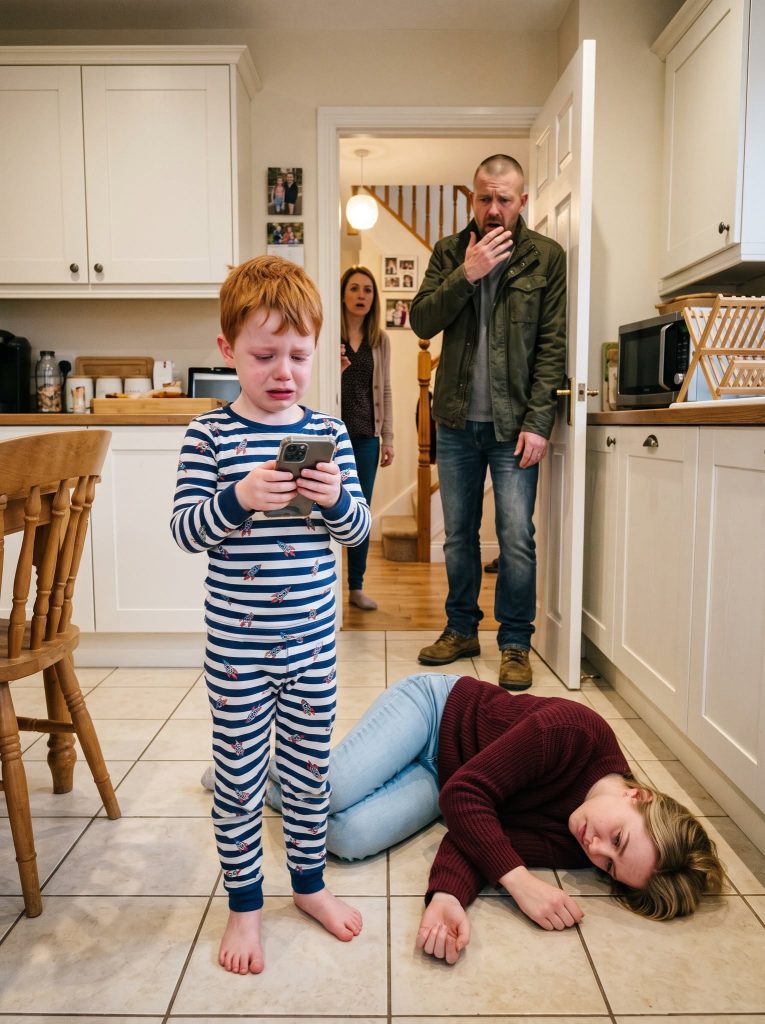
After my husband hurt me, I lay on the kitchen floor while our five-year-old son watched. My little boy grabbed my phone and called the person his father had tried to keep out of our lives. “Grandpa, please come. Mom needs help.” Minutes later, my husband returned and spotted the phone. “Who did you call?” he demanded. My father’s voice answered through the speaker: “Me.”

Part 1: The Number My Son Remembered
After my husband hurt me and drove away, my five-year-old son found my phone beside an overturned kitchen chair. Noah held it carefully, searching for the one person he knew would help.
“This is why we have Grandpa,” he whispered.
Our split-level home in Tacoma, Washington, had become a place where Evan controlled nearly everything. The car keys hung beside the door, but he decided when I could use them, how money was spent, and where I was allowed to go.
Seven years into our marriage, I had learned to anticipate his reactions. That evening, the argument began over seventy-three dollars.
I had slowly saved the money in a separate account, adding grocery change and birthday gifts from my sister. It wasn’t enough to leave, but it gave me a small sense of possibility.
At 8:17 p.m., Evan noticed the banking app on my screen. The confrontation left me injured on the kitchen floor.
“Planning to walk out on me?” he demanded.
I said no, afraid of making things worse. In the hallway, Noah stood in his dinosaur pajamas, holding his stuffed toy.
Evan told me to straighten up, took my keys, and left. Noah came to my side, then selected the contact marked with a fishing-boat emoji.
Dad answered after two rings. “Grandpa, come quickly. Mom needs help.”
He asked Noah what had happened and told him to bring the phone closer to me. When Dad asked whether Evan was responsible, I tapped the floor once.
My father was a retired dock foreman, accustomed to handling emergencies. He stayed composed, though his silence told me he understood how serious this was.
“I’m calling 911,” he said. “I’m on my way. Stay near your mother.”
For years, I had described my life as stressful or exhausting rather than admit what was happening. Now someone outside our house finally knew.
Then Evan’s truck returned. The door opened, and his attention went straight to the phone.
“Who have you been calling?”
Noah stepped back toward me. Before he could answer, my father spoke through the speaker.
“Me.”
PART 2 — THE HOUSE HE THOUGHT I WOULD NEVER LEAVE
My father’s voice came through the speaker before Evan could take another step.
“Me.”
Evan stopped.
For years, I had watched him dominate rooms simply by entering them.
His anger changed the temperature.
His silence made everyone calculate.
Even the way he put his keys on a table could become a warning.
But that night, standing in the kitchen doorway while I lay on the floor and Noah crouched beside me in dinosaur pajamas, something different passed across his face.
Fear.
Not guilt.
Not concern for me.
Fear that someone outside the house finally knew.
“Give me the phone.”
he said.
Noah clutched it against his chest.
“No.”
My heart stopped.
“Noah.”
I could barely get his name out.
I did not want my five-year-old standing between me and a grown man’s anger.
Dad heard too.
His voice became firm.
“Noah, buddy.”
My son looked down at the phone.
“Grandpa?”
“Put the phone beside your mom.”
Noah obeyed immediately.
“Then go sit by the front window where I can hear you.”
Evan’s jaw tightened.
“Frank, stay out of my marriage.”
My father answered:
“Police are already coming.”
Everything changed.
Evan looked at me.
It was astonishing how quickly his face rearranged itself.
The anger disappeared.
Concern replaced it.
The same expression he wore when neighbors came over.
When teachers spoke to us.
When doctors asked how things were at home.
“Megan.”
My name sounded gentle in his mouth.
“What did you tell him?”
I said nothing.
“You fell.”
He looked toward Noah.
“Mom slipped.”
Noah stared at him.
Evan repeated it.
“She slipped, buddy.”
There are sentences you recognize only after hearing them too many times.
Not lies exactly.
Instructions about reality.
Evan had spent years doing that to me.
You are overreacting.
That isn’t what happened.
I didn’t say that.
You always make things worse.
You’re tired.
You’re too sensitive.
Now he was trying to teach our son the same language.
Something inside me broke.
Or perhaps something finally came back together.
“No.”
I whispered.
Evan looked at me.
My voice was weak.
But it existed.
“I didn’t fall.”
His face hardened.
“Megan.”
“I didn’t fall.”
The second time was louder.
Noah began crying.
Evan took one step toward me.
Then headlights swept across the front windows.
Blue lights followed.
Evan stopped.
Dad’s voice came through the phone.
“That’ll be them.”
For the first time in seven years, Evan had no private room left in which to explain me away.
Two Tacoma police officers entered first.
An ambulance arrived behind them.
My father’s truck pulled in less than two minutes later.
He did not storm through the door.
That is something I remember clearly.
Dad was sixty-seven.
Retired dock foreman.
Two replaced knees.
Hands thick from decades of ropes, steel, rain, and loading schedules.
I had spent years afraid that if he ever learned what Evan was doing, he would come through the wall.
Instead, he stopped on the porch because an officer told him to wait.
He waited.
Shaking.
But he waited.
That may have saved everything.
The officers separated us.
One spoke with Evan in the living room.
Another knelt beside me until the paramedics took over.
Noah stayed with Dad once the officers allowed it.
Nobody demanded that my five-year-old give a perfect account of what he had seen.
Nobody sat him under a bright light and made him carry the case.
One officer asked only enough to understand whether Noah was safe.
Then a child specialist would handle anything else appropriately later.
I was grateful.
Noah had already done enough.
More than enough.
The paramedic asked me questions.
Name.
Date.
Pain.
Whether I had lost consciousness.
Whether I could move my fingers.
Whether my neck hurt.
Then:
“Did your husband cause these injuries?”
I looked through the doorway.
Evan was talking to the other officer.
Gesturing calmly.
Explaining.
He had always been good at explanations.
My father stood outside holding Noah.
Our son’s arms were around his neck.
Dad was staring at me through the glass.
He did not nod.
Did not tell me what to say.
He simply stayed there.
For the first time, the answer belonged completely to me.
“Yes.”
I whispered.
The paramedic leaned closer.
“Sorry?”
“Yes.”
I said again.
“My husband did this.”
The world did not end.
That surprised me.
The ceiling stayed above us.
The refrigerator kept humming.
The porch light remained on.
I had spent years believing that saying those words aloud would destroy my family.
But the family was already hurt.
The sentence merely stopped protecting the person hurting it.
At the hospital, a nurse asked Dad to take Noah home.
My son refused.
“I stay with Mom.”
I touched his hair.
“Grandpa needs a helper.”
Noah frowned suspiciously.
Dad understood.
“I’m old.”
he said solemnly.
“I need somebody who knows where the snacks are.”
Noah looked at me.
“You coming?”
“Yes.”
“When?”
“As soon as the doctors say.”
He considered.
Then held out his pinky.
I hooked mine around it.
“Promise?”
I swallowed.
“I promise I’m coming to Grandpa’s house.”
Specific.
Achievable.
I had started learning that promises should be built like bridges.
Only as far as you know the ground will hold.
Once Noah left, the room became quiet.
A nurse named Tanya closed the curtain.
She had the exhausted kindness of someone who had seen people lie about stairs, doors, bathtubs, cabinets, and every other household object adults blame when they are not ready to name another human being.
She did not ask:
Why didn’t you leave sooner?
She asked:
“Has this happened before?”
I stared at the blanket.
“Yes.”
First time.
There it was.
Not the first time Evan had frightened me.
Not the first time he had taken keys.
Not the first time he had blocked a doorway.
Not the first time he had thrown something near me.
Not the first time he had grabbed me.
Just the first time I had answered honestly when somebody asked.
Tanya nodded.
“Thank you for telling me.”
No pity.
No shock.
Thank you.
I cried.
The injuries were documented.
Photographs with my consent.
Notes.
Questions.
A domestic-violence advocate came.
Her name was Priya Shah.
She did not hand me a checklist and order me to become brave before sunrise.
She explained options.
Emergency protective measures.
Safety planning.
Housing.
Financial resources.
How to preserve messages.
How to handle school pickup.
What changing passwords could protect and what could accidentally create problems if accounts were joint.
She kept saying:
“You decide.”
At first, I almost hated her for it.
I was exhausted from deciding.
For years, Evan had slowly made decisions smaller.
Which grocery store.
Which friends.
Which shifts.
Which bills.
Which car.
Which parent.
Now suddenly everyone was handing my life back at once.
It was heavy.
“I want to go to my father’s house.”
I said.
“Good.”
“And I want Noah with me.”
“Good.”
“I don’t want Evan knowing exactly where we sleep.”
Priya nodded.
“We’ll discuss what can legally and practically be done.”
Then she asked:
“Does Evan control the finances?”
“Yes.”
“Do you have access?”
“To checking.”
“Anything else?”
“I don’t know.”
That embarrassed me.
Priya did not react.
“What about the mortgage?”
“Evan handles it.”
“Retirement?”
“I have mine through work.”
“His?”
“I don’t know.”
“Credit cards?”
“One joint card.”
“Any lines of credit?”
“I don’t think so.”
She wrote something down.
Then looked at me.
“Tomorrow, when you are safer and rested, you need independent financial information.”
I thought of seventy-three dollars.
My secret account.
My tiny rebellion.
I began crying again.
“He did all this over seventy-three dollars.”
Priya’s expression softened.
“No.”
I looked at her.
“He did this because you had something he did not control.”
The sentence stayed with me.
Evan was not permitted to come into my hospital room.
He called instead.
Fourteen times before midnight.
Then the messages began.
Megan, this is getting out of control.
We need to talk before your dad poisons this further.
Noah needs both parents.
I barely touched you.
Then:
You know how you get when you’re emotional.
Then:
If you ruin my life over one argument, that’s on you.
There it was.
The old architecture.
His decision.
My consequence.
His action.
My responsibility.
Priya told me not to delete anything.
So I did not.
I muted the conversation.
Preserved it.
And stopped answering.
It was the first night in years I let Evan be angry without treating his anger like an emergency I had to solve.
Dad’s house had not changed much since I was eighteen.
Same ugly brown couch.
Same clock that chimed too loudly every quarter hour.
Same photographs on the hallway wall.
My mother had been gone six years.
Dad still kept her gardening gloves in the garage.
Noah slept in my old bedroom.
I slept beside him.
The first night, every passing car woke me.
At 2:11 a.m., Noah rolled over.
“Mom?”
“I’m here.”
“Is Dad coming?”
“No.”
“How do you know?”
I stared into the darkness.
“Because Grandpa locked the doors, and we have people helping us.”
He thought.
Then:
“Dad gets mad when doors lock.”
The sentence cut through me.
A five-year-old should not know that.
The next morning, Dad made pancakes.
Badly.
Mom had always cooked.
Dad believed every recipe could be improved by turning the heat higher.
Noah ate two burned pancakes without complaint.
Then asked:
“Grandpa, did I do bad calling you?”
Dad put down the spatula.
He did not say:
You saved your mother.
I was grateful.
Noah did not need that weight.
He said:
“No.”
“Why?”
“Because when somebody needs help, you call a safe grown-up.”
Noah thought.
“Dad says family stuff stays in family.”
Dad’s face changed.
Very slightly.
Then he knelt.
“I’m family too.”
Noah nodded.
“And firefighters?”
“Safe grown-ups.”
“Police?”
“When you need them, yes.”
“Ms. Kelly?”
His kindergarten teacher.
“Yes.”
Noah smiled.
“That’s a lot.”
Dad touched his shoulder.
“That’s the point.”
I turned away before either of them saw me cry.
Isolation had taught us that safety was one person.
Recovery began with a list.
My sister Emily came that afternoon.
Evan had spent four years telling me Emily was jealous of our marriage.
Too dramatic.
Always starting trouble.
She lived in Portland and had finally stopped visiting after one Thanksgiving when Evan told her she was not welcome in “his” house.
I defended him afterward.
That memory made me sick now.
Emily walked into Dad’s living room.
Saw me.
Stopped.
Then whispered:
“Can I hug you?”
Not:
Oh my God.
Not:
What did he do?
Can I?
I nodded.
She held me.
Carefully.
I cried into her coat.
“I’m sorry.”
I said.
“For what?”
“For not believing you.”
Emily pulled back.
Her eyes filled.
“Megan, I didn’t know this.”
“You knew enough.”
“I knew he was controlling.”
“I didn’t know—”
She stopped.
Then corrected herself.
“I knew I didn’t like how small you got around him.”
That sentence broke me more than accusation would have.
Small.
That was exactly it.
Evan had not locked me in a room.
He had reduced the room one inch at a time.
Dad waited until Noah was watching cartoons before he told me something else.
“Evan contacted me two years ago.”
I stared.
“What?”
Dad went to his desk.
Brought out a folder.
My stomach tightened.
Apparently everyone older than sixty-seven stores important truths in manila folders.
He placed it on the table.
Inside were printed emails.
Texts.
Dates.
Evan to Dad.
Stop giving Megan money behind my back.
Another:
She needs to learn how to budget with her husband instead of running to Daddy.
Another:
If you undermine me again, you won’t see Noah.
I looked up.
“Why didn’t you tell me?”
Dad’s face folded.
“I tried.”
“When?”
“The Christmas you stopped coming.”
I remembered.
Dad called.
I ignored him.
Evan had said Dad was trying to interfere with our marriage.
“I thought you were angry because we stayed home.”
“I was scared.”
Dad looked toward the room where Noah sat.
“He used my grandson.”
His voice broke.
“I thought if I pushed too hard, he’d cut me out completely.”
So he waited.
Birthday calls.
Short visits.
No surprise appearances.
He made himself smaller too.
That was Evan’s gift.
Everyone around him learned reduction.
“Why print these?”
I asked.
Dad shrugged.
“Habit.”
He had spent thirty-eight years supervising a dock where undocumented mistakes became injuries.
“Your mother used to call me paranoid.”
Then he opened another section.
Receipts.
Money orders.
Checks.
“After your mom died, I sent you birthday money.”
I remembered some.
Not all.
“Every year?”
“Yes.”
“I didn’t get all of these.”
“I know.”
My stomach turned.
“How?”
“Because a few were deposited.”
“To where?”
Dad looked at me.
“That’s what I couldn’t figure out.”
Several checks had been payable to me.
Endorsed.
Deposited.
I stared at the signature.
It resembled mine.
Not perfectly.
Enough.
“Did Evan do this?”
Dad raised one hand.
“We don’t know.”
Good.
Even now.
Facts first.
“But when you told me last year you never got the five hundred I sent, I stopped mailing checks.”
I stared.
“You told me you forgot my birthday.”
Dad’s face went white.
“What?”
“Evan said you forgot.”
For a long moment, neither of us spoke.
Then Dad looked down.
“He kept us mad at each other.”
Yes.
That was the genius of it.
Isolation works better when everyone believes the distance belongs to someone else.
My family-law attorney was Nina Patel.
I met her four days after the hospital.
Noah stayed with Emily.
Dad came with me but waited outside until I asked him in.
That mattered.
Nina reviewed the police report.
Hospital documentation.
Messages.
Financial control.
The separate seventy-three-dollar account.
Dad’s emails.
The old checks.
She did not promise me the house.
Full custody.
A quick divorce.
A ruined husband.
She promised process.
That felt more trustworthy.
Temporary orders first.
Safety.
Parenting arrangements.
Financial disclosures.
Then the larger case.
“We also need your credit report.”
she said.
“Why?”
“Because you have told me you do not know what debts exist.”
My stomach tightened.
“I would know if we had debt.”
Nina looked at me kindly.
“Would you?”
The question hurt.
Because I no longer knew.
We pulled the reports.
The first unfamiliar item was a credit card.
Opened three years earlier.
Balance:
$8,412.
I stared.
“I don’t have this.”
Nina wrote it down.
“Dispute later after we understand ownership and access.”
The second was a personal line of credit.
Joint.
Balance:
$14,600.
My name appeared.
“I never signed for this.”
“Maybe electronic.”
“I never applied.”
“We will request records.”
Then came the mortgage section.
Primary home loan.
Expected.
Then a second entry.
Home-equity line.
Original limit:
$165,000.
Current balance:
$151,284.
I stopped breathing.
“What is that?”
Nina looked up.
“A home-equity line secured by the property, based on this report.”
“No.”
I shook my head.
“No.”
“We don’t have one.”
Her expression became careful.
“The report indicates one.”
“I would know.”
Then I heard my own words.
Would you?
I covered my mouth.
Our home had equity.
Dad helped with the down payment before Mom died.
Thirty thousand dollars.
I had spent years proud of that house.
Not fancy.
Three bedrooms.
Small backyard.
Mortgage we could manage.
Or so I believed.
“When was it opened?”
I asked.
“Two years and eight months ago.”
My skin turned cold.
That was around the time Evan started insisting all bank mail go paperless.
He said he was tired of clutter.
Around the same time he changed the household passwords because we had “too many security risks.”
Around the same time he told me Dad was interfering.
The walls narrowed again in my memory.
This time I could see when.
“Where did the money go?”
I asked.
“We don’t know yet.”
Nina closed the report.
“Do not call the lender alone while you are upset.”
“I’m not upset.”
She looked at me.
I was shaking.
Fine.
“I want records.”
“You’ll get them.”
“Today.”
“As quickly as the process allows.”
I hated that answer.
Then trusted it.
Dad came into the office.
I showed him.
He stared at the figure.
$151,284.
His face hardened.
But he did not swear.
Did not threaten Evan.
He asked Nina:
“Can I check public property records?”
She looked at him.
“Public records are public.”
He nodded.
Dock foreman.
Procedure.
Always.
That evening Dad sat at his desktop computer.
The machine sounded like it had survived the Cold War.
He searched the county recording index.
Our property.
My address.
Then stopped.
“There.”
A recorded deed of trust associated with a home-equity line.
Evan’s name.
My name.
A lender.
Dad printed it.
I looked at the acknowledgment page.
A signature appeared beside mine.
It looked wrong.
But familiarity is not forensic evidence.
“I didn’t sign that.”
Dad’s jaw tightened.
“I believe you.”
Not:
That bastard forged it.
Not yet.
Just:
I believe you.
It was enough.
The lender file took time.
While we waited, court happened.
Evan arrived in a gray suit.
He looked exhausted.
For years I had imagined that if I ever saw him publicly exposed, I would feel powerful.
I felt sick.
This was Noah’s father.
The man who held my hand while our son was born.
The man who once drove two hours at midnight because I told him I missed a particular diner’s apple pie.
People are not monsters every minute.
That is part of what makes leaving difficult.
A person can make you afraid and still possess memories in which you felt loved.
The good moments do not cancel the harm.
The harm does not magically delete the good memories either.
You carry both until one stops controlling the other.
Evan’s attorney argued for contact with Noah.
My attorney did not argue that he should disappear forever.
The court maintained protective conditions and ordered a structured, supervised arrangement while allegations were reviewed.
Noah was not handed over alone.
No dramatic permanent ruling after one hearing.
Temporary.
Careful.
Evan looked at me across the courtroom.
I expected hatred.
Instead, he mouthed:
Please.
My heart broke.
I looked away.
Love had kept me in danger once.
I was not going to use it as legal evidence.
Noah’s first supervised visit lasted less than an hour.
He came back quiet.
I did not interrogate him.
His counselor had taught me that.
“How was it?”
“Okay.”
“Want a snack?”
“Yes.”
Five minutes later:
“Dad cried.”
I kept my face neutral.
“Oh.”
“He said he misses us.”
“I’m sure he does.”
“Do you miss him?”
Five-year-olds ask impossible questions while eating crackers.
“Yes.”
Noah looked surprised.
“Then why can’t we go home?”
There it was.
The equation I had spent seven years making too.
Missing equals returning.
Love equals access.
I sat beside him.
“Because we can miss somebody and still need to be safe from choices they made.”
He thought.
“Dad made bad choices?”
“Yes.”
“Is Dad bad?”
My throat tightened.
“I’m not going to tell you what kind of person Dad is.”
“What?”
“I’m going to tell you what he did was not safe.”
Noah nodded.
That was enough for today.
Evan’s messages changed after the court order.
Fewer.
Probably because his attorney told him to stop.
One arrived through the approved communication app:
I know I scared you. I’m getting help. I don’t expect you to trust me.
I read it six times.
Then another:
I was wrong about your dad. I felt like he judged me and I kept trying to prove I didn’t need anyone.
That one hurt.
Then:
Please don’t let Noah grow up thinking I never loved him.
I did not respond emotionally.
Parenting logistics only.
That boundary felt cruel.
Then necessary.
Evan’s feelings were not mine to manage anymore.
The lender sent the home-equity documents eleven days later.
Nina called me into her office.
Dad came.
A representative from a forensic document firm would review signatures separately if necessary.
For now, we looked only at records.
Application.
Income.
Property valuation.
Electronic consent.
Closing packet.
A notarized acknowledgment.
My name.
My Social Security number.
My employer at the time.
My salary.
All accurate.
An email address.
Not mine.
It resembled mine.
One additional dot and an extra initial.
A phone number.
Evan’s second work phone.
My stomach turned.
“So nobody called me.”
Nina pointed.
“We’re still reviewing lender procedures.”
Then the closing certificate.
It stated that I had participated remotely.
I stared.
“I didn’t.”
Dad looked at Nina.
“Can they tell where?”
“Technical logs have been requested.”
Again.
Process.
Then we reached the disbursement page.
$165,000 available.
Initial draw at opening:
$119,500.
My breath disappeared.
“What did we buy?”
Nobody answered.
The funds went into our joint checking account.
Stayed there six hours.
Then $108,000 transferred to an account at another bank.
Account holder:
Everline Restoration LLC.
I had never heard of it.
“Who owns that?”
Nina had already obtained the state business-registration record.
She slid it toward me.
Organizer:
Evan Mercer.
Registered agent:
Evan Mercer.
Principal address:
A post-office box.
I stared.
“Evan owns a company?”
“According to the filing.”
“He has never owned a company.”
Dad whispered:
“Apparently he did.”
The business had been formed three weeks before the home-equity line.
I tried to remember that year.
Noah had just turned two.
I worked part-time at a dental office then because childcare cost almost as much as my paycheck.
Evan constantly complained we were broke.
I stopped buying coffee.
Canceled my gym membership.
Bought Noah’s clothes at consignment shops.
I remember asking whether we could replace the dishwasher.
Evan became furious.
“We don’t have seven hundred dollars every time something inconveniences you.”
Meanwhile, one hundred eight thousand dollars had moved out of our house and into a company I did not know existed.
I felt physically ill.
“What was Everline?”
I asked.
Nina turned another page.
Bank records were incomplete.
But public court searches showed the company had been named in a civil dispute involving a renovation project.
No criminal accusation.
A business dispute.
Contractor claims.
Materials.
Failed project.
Settlement.
The dates aligned.
My stomach tightened.
“He borrowed against our house to fund a business.”
“Potentially.”
Nina corrected.
“We need complete records before characterizing the transactions.”
“Without telling me.”
“The documents suggest you were represented as having participated.”
“But I didn’t.”
“Then that is one of the central issues.”
I stared at my signature.
Someone had built consent on paper again.
Dad was silent for so long that I looked at him.
He had gone pale.
“What?”
“Megan.”
“What?”
“I know that company name.”
My pulse jumped.
“How?”
Dad stared at the registration.
“Evan asked me for money three years ago.”
I froze.
“What?”
“He said he had a business opportunity.”
“You never told me.”
“You told me not to lend him anything.”
I frowned.
“I did?”
“On the phone.”
“I don’t remember that.”
Dad’s expression changed.
“He called me first.”
“Said you both wanted to invest in a renovation company.”
“I told him I’d speak to you.”
“Twenty minutes later, you called.”
My skin went cold.
“What did I say?”
“You said absolutely not.”
“That you were already worried about money.”
“That Evan was embarrassed and I shouldn’t bring it up again.”
I stared.
“I never called you.”
Dad stopped breathing.
Nina leaned forward.
“Mr. Carter.”
“Yes?”
“Do you have the number that call came from?”
Dad’s eyes widened.
“Maybe.”
He had old phone bills.
Of course he did.
That night, we found the statement.
Incoming call.
Twenty-two minutes after Evan’s call.
Not my number.
A blocked caller identification entry.
Could have been anyone.
No recording.
No proof of voice.
Dad had simply assumed it was me.
Because the caller knew enough.
My schedule.
Our finances.
The amount Evan wanted.
“She sounded like you.”
Dad whispered.
I felt cold.
“Who?”
“I don’t know.”
There it was.
A new question.
I had assumed Evan had acted alone.
Maybe he still had.
Voice imitation did not require technology.
Someone could simply have pretended.
A relative.
A friend.
A coworker.
Or Dad’s memory after three years could be imperfect.
Facts.
Stay with facts.
The lender’s technical records arrived two weeks later.
The remote signing session had not originated from our home.
It came from a small office building in Federal Way.
The notary listed on the file had used a third-party signing service.
The signing company had already gone out of business.
One archived appointment log remained.
Borrowers listed:
Evan Mercer.
Megan Mercer.
Contact phone:
Evan’s work phone.
Email:
the fake address.
And one appointment note:
Wife unable to appear on camera due to illness; documents signed prior to session, identity confirmed by husband and ID copies.
Nina stared at the note.
“That should not have happened.”
My stomach twisted.
“But it did.”
“Yes.”
The lender had relied on a flawed process.
That did not automatically erase the debt overnight.
Lawyers would dispute validity, responsibility, lender procedures, and signatures.
More waiting.
More records.
But for the first time, the possibility that I had not legally consented was not simply my memory against Evan’s paperwork.
The process itself had holes.
Then came the biggest question.
Where had the rest of the money gone?
Everline’s bank records finally arrived through the financial case.
The $108,000 funded renovation deposits.
Legal fees.
Equipment.
Payments to subcontractors.
A business that failed.
Not gambling.
Not an affair.
Not a secret second family.
Almost worse.
Because it was so ordinary.
Evan had wanted to become more than an employee.
He tried a business.
It went badly.
Then he hid the loss.
He borrowed more to cover old obligations.
Used household money.
Moved balances.
Controlled mail.
Reduced my access.
And every new lie required a smaller version of me.
A wife who did not ask about passwords.
A daughter who did not speak to her father.
A woman who needed permission to drive.
A mother who believed seventy-three dollars was dangerous to possess.
The violence had not started the control.
The control had been protecting something for years.
Nina found another transfer.
$21,000 from the home-equity proceeds had eventually returned to our household account.
That money covered mortgage payments during a period when Evan had been laid off.
He told me his unemployment and savings were carrying us.
I thanked him.
I remembered hugging him in the kitchen.
“You always take care of us.”
I had said.
Now I stared at the statement.
He had been paying our mortgage with debt secured against the same house.
Then accepting gratitude for saving us.
I left Nina’s office and vomited in the parking lot.
That night, I sat at Dad’s kitchen table.
The original seventy-three dollars still sat in my private account.
I had not touched it.
Priya had helped me open a new account at a different bank for my current income after legal advice.
But I kept looking at that seventy-three.
Such a tiny number.
For weeks, I had thought it caused everything.
Dad sat across from me.
“Noah asleep?”
“Yes.”
He nodded.
Then:
“You know it wasn’t the money.”
“I know.”
But I did not.
Not emotionally.
I still felt guilty.
As though secretly saving grocery change had been a betrayal that provoked catastrophe.
Dad seemed to read my face.
“He wasn’t scared of seventy-three dollars.”
“What was he scared of?”
Dad looked at me.
“You finding out you could have seventy-four.”
I started crying.
Then laughing.
Then both.
Because that was it.
Seventy-three dollars was not an escape fund.
It was evidence that I could have something outside Evan’s permission.
Another account.
Another key.
Another phone call.
Another opinion.
Another life.
Control rarely fears the size of the first boundary.
It fears the possibility of a second one.
Weeks became months.
The criminal case moved separately.
The financial dispute moved separately.
The family case moved separately.
I learned not to ask one system to solve every injury.
The assault did not automatically decide every property issue.
The questionable loan did not automatically decide parenting.
Evan’s business failure did not prove every bad thing I had ever suspected.
But together, the records changed my understanding of my marriage.
The secrecy had a history.
So did the isolation.
So did his fear of my father.
One afternoon, Dad handed me another paper.
“I didn’t want to give you this until Nina looked at it.”
“What is it?”
“Public record.”
He had searched our property again.
Not because anyone asked.
Because Dad had become obsessed with knowing what his daughter’s house had been made to carry.
There was the original mortgage.
The home-equity deed of trust.
Then another recorded instrument.
Newer.
Eight months old.
I stared.
“What is this?”
Dad did not answer.
I read the heading.
Assignment of Rents and Security Agreement.
My stomach tightened.
“What rents?”
Our home was not a rental.
Nina reviewed it the next morning.
Her expression changed.
“This is connected to another loan.”
“No.”
“We don’t know the full structure yet.”
“How much?”
She turned the page.
A commercial lender.
Borrower:
Everline Property Group LLC.
Not Everline Restoration.
A second company.
Guarantor:
Evan Mercer.
Collateral description referenced an investment property.
My breathing slowed.
“Investment property?”
Nina nodded.
“It appears Everline Property Group acquired a duplex.”
I stared.
“When?”
“About eleven months ago.”
“We don’t own a duplex.”
“The LLC may.”
“Where?”
She slid the property record toward me.
An address in Tacoma.
Eleven minutes from our house.
Purchase price:
$392,000.
My head started spinning.
“How did he buy this?”
“We’re tracing it.”
“Did he use the house again?”
“We don’t know.”
Then I saw the mailing address on the LLC registration.
Not our home.
A post-office box.
Same one Everline Restoration used.
I thought of every time Evan said we had no money.
Every birthday when he told me a gift was irresponsible.
Every grocery receipt he checked.
Every time he asked why milk cost five dollars.
Every time I apologized for spending thirty-two dollars on Noah’s shoes.
There was a duplex eleven minutes away.
I had not known.
“Who lives there?”
I asked.
Nina looked at me.
“Tenants.”
No mistress.
No secret family.
Just rent.
Income.
An asset.
A part of our financial life held outside my knowledge.
That somehow hurt differently.
Evan had not merely been hiding losses.
He had also been building ownership.
For himself.
While teaching me scarcity.
“Is the duplex marital?”
I asked.
“Do not assume characterization yet.”
Nina said.
“We need purchase funds, dates, title history, operating agreements, and applicable law.”
Always careful.
Fine.
“Was my name used?”
She hesitated.
“That is what concerned me.”
My stomach dropped.
“What?”
“The lender’s loan package lists Evan as guarantor.”
“Only Evan?”
“Yes.”
Relief arrived.
Then Nina continued.
“But the source-of-funds schedule shows a contribution from a joint household account.”
“How much?”
“Forty-eight thousand dollars.”
My mouth went dry.
“We never had forty-eight thousand.”
“At least not where you were looking.”
The transfer came from our joint checking account.
But it had entered the account only one day earlier.
Source:
A life-insurance policy loan.
I stopped.
“What policy?”
Nina looked at me.
“A permanent life policy.”
“Whose?”
Her silence answered first.
Mine.
I stared.
“I don’t have one.”
“The records show a policy insuring your life.”
“I never bought that.”
“Evan may have purchased it.”
“Can he do that?”
“There are rules around life-insurance applications, consent, insurable interest, and signatures.”
“I’m not going to guess before we have the file.”
My skin turned cold.
“How much is it?”
“Death benefit?”
“Yes.”
She looked at the document.
“Five hundred thousand dollars.”
The room disappeared.
I heard Priya’s voice from months earlier.
Independent financial information.
Dad’s voice.
I believe you.
Noah’s.
This is why we have Grandpa.
Five hundred thousand dollars.
A policy on my life I did not know existed.
With a loan taken against its accumulated value and used toward property I did not know existed.
I could barely speak.
“Beneficiary?”
Nina turned one page.
Her face went still.
“What?”
I whispered.
Primary beneficiary:
Evan Mercer.
That alone would not have been unusual for a married couple.
Spouses name spouses every day.
Except I had never knowingly applied.
Never discussed it.
Never signed anything I remembered.
Then Nina pointed to the application date.
Four years earlier.
I knew that month.
My mother had just died.
I had been barely functioning.
Dad and I were grieving.
Evan handled almost everything.
Insurance.
Mail.
Bills.
Meals.
He told me:
“Let me carry the boring stuff.”
I had thought it was love.
Maybe some of it was.
That was the unbearable part.
“Was there a medical exam?”
I asked.
“Apparently a simplified application.”
“Signature?”
“Electronic.”
“Email?”
Nina looked at me.
The same false email address used later.
My name.
Not my inbox.
My identity had not been stolen in one dramatic night.
Someone had been wearing pieces of it for years.
“Do not tell Dad yet.”
I said.
Nina studied me.
“Why?”
“Because he will think the worst.”
“What is the worst?”
I looked at the $500,000 figure.
Then hated myself for thinking it.
Nina understood.
Her voice became firm.
“A life-insurance policy is not evidence that Evan intended physical harm.”
I nodded.
She continued.
“Spouses commonly insure each other.”
“The application and authorization issues may be serious.”
“The financial concealment may be serious.”
“But do not connect facts that the evidence has not connected.”
I closed my eyes.
“Thank you.”
That was why I had a lawyer.
Fear loves straight lines.
Evidence often refuses them.
Then Nina placed one final document beside the policy summary.
“The policy loan itself is not what worries me most.”
I opened my eyes.
“What does?”
She pointed to the beneficiary history.
A change request had been submitted six months earlier.
Primary beneficiary remained Evan.
Contingent beneficiary changed.
Originally:
Noah.
Now:
Everline Property Group LLC.
I stared.
“Why would his company be beneficiary after him?”
“I don’t know.”
“Did the change take effect?”
“It appears to have.”
“Who signed?”
Nina turned the page.
My name.
Again.
Electronic acknowledgment.
Again.
The false email.
Again.
I stopped breathing.
The original seventy-three dollars flashed through my mind.
Evan staring at my phone.
Planning to walk out on me?
For months, I had believed he was terrified I might leave because he could not tolerate losing control of me.
Now I was looking at documents suggesting there had been something else at risk if I left.
A house.
A hidden business.
A duplex.
A loan.
An insurance policy.
An entire financial structure built partly around my identity while keeping me too frightened to examine it.
Nina closed the folder.
“We need complete records before drawing conclusions.”
I nodded.
But something inside me had already changed.
Not because I believed the worst.
Because I finally understood the size of what I did not know.
Evan had not been protecting a marriage.
He had been protecting a system.
And the seventy-three dollars in my secret account had frightened him because, for the first time in years, I had created one thing in our life that he could not see from the inside.
One small account.
One private choice.
One door.
Then Noah picked up my phone and opened another.
Now the records were arriving.
And somewhere inside them was the answer to a question I had never known I needed to ask:
How much of my life had Evan quietly put his name on while teaching me that nothing belonged to me?
PART 3 — THE DOOR NOAH OPENED
The life-insurance policy did not prove Evan wanted me dead.
That was the first thing Nina made me understand.
I needed that sentence because fear had already written a much darker story in my head.
Five hundred thousand dollars.
My husband as beneficiary.
His hidden company as contingent beneficiary.
A signature I did not remember making.
After everything else, my mind wanted to draw a straight line between those facts and the night I ended up on the kitchen floor.
Nina refused to let me.
“Concern is reasonable.”
she said.
“Assumption is not.”
So we requested the full file.
Application.
Consent records.
Electronic signature logs.
Payment history.
Beneficiary changes.
Policy loans.
Every document the insurer still had.
Then we waited.
I had become very good at waiting for paperwork to tell me what marriage had not.
The policy was four years old.
Evan had purchased it during the months after my mother died.
That part fit my memory.
I had barely been functioning.
Mom’s death hollowed out the middle of my days.
I worked.
Fed Noah.
Cried in parking lots.
Forgot laundry in the machine until it smelled wrong.
Evan handled nearly everything else.
At the time, I thought he was saving me.
Some of what he did probably was care.
That complicated the story.
People want abusive marriages to be ugly every day.
Mine wasn’t.
Sometimes Evan cooked.
Sometimes he rubbed my shoulders.
Sometimes he handled paperwork because grief made reading a utility bill feel impossible.
The problem was that somewhere along the way, help became authority.
And authority became secrecy.
The insurer’s records showed that the original policy application contained my medical history and employment information.
Accurate.
Too accurate.
My doctor’s name.
Medications.
Height.
Weight.
Employer.
All things Evan knew.
The electronic signature had been completed through the fake email address that later appeared in the home-equity file.
The phone number attached to the application belonged to Evan.
The application marked me as participating electronically.
I had not.
At least not knowingly.
The insurer had not required a full medical exam because of the policy structure and coverage level.
A third-party verification vendor had attempted contact once.
The call went to Evan’s number.
A note stated:
Spouse unavailable. Husband confirms applicant completed online forms.
Again.
His voice standing where mine should have been.
The insurer opened an internal review after receiving my dispute.
No one canceled anything overnight.
No one announced fraud after one phone call.
They reviewed authentication procedures.
Compared records.
Requested statements.
My attorney provided the fake-email history from the other financial documents.
The pattern mattered.
The same false address had been used to represent me in multiple transactions.
That did not prove Evan created it for each one.
But it narrowed the questions considerably.
Then came the beneficiary change.
Six months before the kitchen incident.
The request moving contingent beneficiary status from Noah to Everline Property Group.
The insurer’s own records showed no independent verification from me.
Only the false email.
Again.
“Why would he do that?”
Dad asked.
We were sitting at his dining table.
Noah was at kindergarten.
Nina had warned me not to speculate too far, but Dad needed an answer that was at least structurally possible.
“If Evan died before me, he was primary beneficiary.”
I said slowly.
Dad nodded.
“If I died while Evan was already gone, the contingent beneficiary would matter.”
“So the company gets it.”
“If the change was valid.”
Dad stared at the table.
Then:
“That’s cold.”
Maybe.
But there were ordinary business reasons people use life insurance in complicated financial arrangements.
Buy-sell planning.
Loan collateral.
Business continuity.
The problem was not automatically that a company appeared.
The problem was that I had apparently never agreed to it.
Consent again.
Always that word.
Eventually, the insurer concluded that it could not substantiate that I had authorized the disputed beneficiary change.
The change was reversed while the broader policy dispute was addressed.
The original contingent beneficiary—Noah—was restored.
Then, after reviewing the application authentication itself, the insurer offered a resolution through counsel rather than pretend the original process had been clean.
The policy was terminated.
Loan value and premiums were accounted for.
Any remaining disputes involving payments and household funds became part of the divorce accounting.
There was no dramatic check for five hundred thousand dollars.
No secret murder plot.
No corpse waiting inside an insurance file.
Just another document showing that Evan had treated my identity like a tool he could use if I was too tired, too frightened, or too uninformed to object.
That was serious enough.
I did not need it to be worse.
Everline Property Group was easier to understand.
The duplex existed.
So did tenants.
So did rent.
Evan had bought it through the LLC with money connected to our household finances and later refinanced part of the property.
Some funds were legitimate business borrowing.
Some came from marital accounts.
Some traced back through the life-policy loan.
The exact legal characterization took accountants months.
I learned a phrase I came to hate:
commingled funds.
Money from different sources moving together until nobody could honestly point at one dollar and say exactly whose life it belonged to anymore.
The forensic accountant, Laura Chen, did not dramatize.
She traced.
Dates.
Transfers.
Purchase documents.
Loan records.
Tax returns.
Depreciation schedules.
Rent deposits.
Every spreadsheet said what Evan had never told me.
He had not merely been failing financially.
He had been taking financial risks without letting me know I was standing underneath them.
Everline Restoration had failed.
The duplex had not.
That mattered.
The property produced rent.
Not much after mortgage, taxes, insurance, repairs, and vacancies.
But it had value.
Evan had spent years telling me we were one surprise expense away from disaster while quietly owning an interest in an appreciating asset.
That was the part I struggled to understand.
“Why make me live like we were broke if he was building something?”
I asked Laura.
She did not pretend to know his mind.
“Control and cash flow are different questions.”
she said.
“He may have felt financially insecure even while acquiring assets.”
That made sense.
A person can have property and still feel afraid.
Fear does not become harmless simply because it has a spreadsheet.
The business records also explained the grocery receipts.
The shoe arguments.
The dishwasher.
Evan had been pushing every available household dollar toward debt service and business recovery.
He did not see it as taking from me.
At least that was his later explanation.
He saw himself as building security.
He believed if he could repair the failed company, stabilize the duplex, and expand property income, eventually everything would be worth the sacrifice.
Except I had never agreed to sacrifice.
That was the pattern beneath all of it.
He kept building futures with resources that belonged partly to other people.
Then treating questions as attacks on the future.
His criminal case for the assault moved slowly.
The prosecutor did not need Noah to become the centerpiece.
That mattered to me more than almost anything.
There was my statement.
Hospital documentation.
The 911 call.
Dad’s contemporaneous call.
Police observations.
Evan’s messages afterward.
Noah was evaluated by professionals trained to speak with children.
He was not marched repeatedly into adult proceedings to prove what he had seen.
The system was imperfect.
Slow.
Sometimes frustrating.
But one good decision kept returning:
Noah had already carried enough.
Evan eventually entered a negotiated resolution related to the assault.
There were court-ordered conditions.
Treatment.
Supervision.
Restrictions.
No cinematic sentence.
No judge declaring him evil.
I learned that accountability often looks less satisfying than anger imagines.
Paper.
Appointments.
Rules.
Review hearings.
The absence of drama did not mean the event disappeared.
It simply meant consequences belonged to a legal system rather than my fantasy.
That was healthier.
The financial issues were different.
Some went through the divorce.
Some through lender and insurer disputes.
Some were reviewed separately because my identity had been used in ways I denied authorizing.
Not every questionable document produced a criminal charge.
Digital signatures are complicated.
Authentication histories are imperfect.
Proof standards matter.
But the fake email account, repeated across several transactions, became difficult to explain innocently.
So did the remote home-equity signing that never involved me directly.
So did the impersonation-like phone call Dad remembered, though that memory alone was treated cautiously.
Evan’s lawyers advised him.
Mine advised me.
Eventually there were negotiated financial resolutions that accounted for debts, property value, and disputed transactions without requiring every ugly part of the marriage to become a criminal conviction.
I learned not to confuse incomplete prosecution with incomplete truth.
The divorce took almost eighteen months.
By then, I no longer lived at Dad’s.
I rented a two-bedroom apartment near Noah’s school.
First-floor unit.
Small balcony.
Terrible carpet.
Mine.
The first night there, I sat on the living-room floor because I had not bought a couch yet.
Noah ate pizza from the box.
Then looked around.
“Where’s Grandpa?”
“At his house.”
“Where’s Dad?”
“At his.”
He thought.
“So this one is ours?”
“Yes.”
He smiled.
Then:
“Can I have the big room?”
“No.”
“Why?”
“Because I pay rent.”
He considered this injustice deeply.
Then accepted the smaller bedroom after I promised glow-in-the-dark stars.
That was one of the first arguments in years I did not fear.
A five-year-old complained.
I said no.
Nobody broke anything.
Nobody took keys.
Nobody punished anyone.
Normal conflict felt almost sacred.
I bought a used car.
Nothing impressive.
Seven years old.
Silver.
One dent near the rear wheel.
Dad came with me because I asked.
That distinction mattered.
The salesperson started talking mostly to Dad.
Dad interrupted.
“She’s buying it.”
The man redirected.
I test-drove it.
Read the financing papers myself.
Asked three questions.
Changed one optional warranty.
Signed.
When the salesperson handed me the keys, I stared at them longer than was normal.
Dad noticed.
“You okay?”
“Yes.”
Then I laughed.
“They’re mine.”
Dad’s eyes filled.
“Yeah.”
No one kept a spare unless I chose to give one.
I gave Dad one.
For emergencies.
Because a spare key freely given is not the same thing as a key taken.
Evan’s parenting relationship with Noah became the hardest part.
I could divorce a husband.
Noah could not divorce a father.
At first, visits stayed supervised.
Then, over time, professionals reviewed Evan’s progress.
He completed programs.
Attended counseling.
Followed rules.
Not perfectly.
But enough for gradual changes to be considered.
I did not control every step.
Neither did he.
That was exactly why the structure existed.
Noah’s safety mattered.
So did reality.
A father is not erased because he failed as a husband.
But fatherhood does not excuse making a home frightening.
Both truths had to stand beside each other.
One evening, when Noah was six, he came home from a visit carrying a paper airplane.
“Dad made it.”
“That’s good.”
“He cried again.”
I kept folding laundry.
“Okay.”
“He said he’s sorry he scared you.”
My hands stopped.
Evan should not have been using Noah to send messages.
That became something addressed through the parenting professionals.
But in that moment, I looked at my son and answered only the part that belonged to him.
“How did that make you feel?”
Noah shrugged.
“Sad.”
“Anything else?”
“I don’t know.”
“That’s okay.”
He played with the airplane.
Then:
“Do I have to be mad because you are?”
I sat down.
“No.”
His eyes lifted.
“You can love Dad.”
“You can be angry.”
“You can miss him.”
“You can have fun with him.”
“You can feel different things on different days.”
“That doesn’t hurt me.”
He studied me.
“Really?”
“Really.”
I hoped he believed me.
Children should not have to choose which parent’s pain to protect.
My own anger took longer.
I began therapy.
At first, I thought I would talk mostly about Evan.
Instead, I spent months talking about myself.
Why I apologized before asking questions.
Why I believed being low-maintenance made me lovable.
Why I described fear as “stress.”
Why I let the word difficult frighten me more than unhappiness.
None of this caused Evan’s behavior.
That distinction mattered.
Therapy was not about discovering the secret flaw that made me responsible for being controlled.
It was about learning which parts of myself I had abandoned while adapting.
There is a difference.
I returned to work full-time.
Nothing glamorous.
Billing coordinator at a dental practice.
Spreadsheets.
Insurance codes.
Patients who forgot appointments.
Lunch breaks.
A paycheck deposited into an account only I controlled.
The first time my direct deposit hit, I checked the balance four times.
Then transferred seventy-three dollars into savings.
Exactly seventy-three.
I stared at the number.
The original account had become evidence in the court process, then eventually folded into my new financial setup.
But I wanted the number again.
Not as a secret.
As a marker.
Seventy-three dollars.
The amount Evan thought proved I was planning to leave.
Maybe part of me had been.
Not consciously.
Maybe every saved dollar was a tiny vote for the idea that my future still belonged partly to me.
The next payday, I added fifty.
Then one hundred.
Then nothing because Noah needed new glasses.
Then twenty.
The balance grew.
Slowly.
Boringly.
No dramatic escape fund.
No suitcase hidden in a closet.
Just savings.
A normal adult thing.
The first time it crossed one thousand dollars, I called Dad.
“You’ll never guess.”
“Lottery?”
“No.”
“Did Noah finally learn to put socks in the hamper?”
“Be serious.”
“I am serious.”
I told him.
Dad became quiet.
Then said:
“Your mom would be proud.”
I cried after hanging up.
Grief does not care whether the milestone is large.
Sometimes one thousand dollars can carry three generations.
The financial settlement eventually treated the duplex as part of the marital accounting based on the tracing, ownership structure, timing, and negotiated terms.
I did not receive the building.
I did not want to become a landlord because my husband had secretly become one.
The property was sold as part of the resolution.
Debt was paid.
Costs came out.
Remaining value was accounted for in the broader division.
The home-equity dispute was resolved through a combination of lender negotiations, property accounting, and settlement terms.
I did not walk away with every dollar I believed I deserved.
Evan did not walk away empty.
Fairness in divorce is rarely as emotionally symmetrical as betrayal.
I learned to stop asking the settlement to tell me who was right.
It was there to end financial entanglement.
Not write the moral.
The house itself was sold.
Our house.
The kitchen.
The hallway.
The hooks where the keys once hung.
I did not go inside after the final move-out.
Dad and Emily helped retrieve what remained while I waited outside.
Nina had recommended clear logistics and witnesses because emotions were still complicated.
When the realtor placed the sold sign, I felt nothing at first.
Then relief.
Not because the building was bad.
Because it no longer had the power to make me relive one night every time I pictured home.
A house is wood.
Drywall.
Loan documents.
Memories.
It does not get to decide which ones follow you.
Evan asked to speak to me in person after the divorce became final.
I said no first.
Then months later, after discussing it with my therapist, I agreed to a structured conversation in a counselor’s office.
Not because he deserved closure.
Because I wanted to ask one question without lawyers translating everything.
He looked different.
Thinner.
Older.
Not broken.
Not redeemed.
Just human.
That was almost harder.
He sat across from me.
For a long time, neither of us spoke.
Then he said:
“I’m sorry.”
I had heard those words through messages.
Attorneys.
Parenting apps.
Never like this.
I waited.
He continued.
“I kept thinking if I could fix the money, I could fix everything before you knew how bad it was.”
I stared.
“The business?”
“Yes.”
“The debt?”
“Yes.”
“The loan?”
He nodded.
“The duplex?”
“Yes.”
“The insurance?”
His face changed.
“I didn’t buy it because I wanted anything to happen to you.”
“I know.”
He looked surprised.
That was not the question anymore.
“Why use my name?”
I asked.
Evan looked down.
“At first, because we were married.”
“That isn’t an answer.”
“I know.”
He rubbed his hands together.
“I thought our finances were ours.”
“They were.”
I said.
“That still didn’t make my signature yours.”
He closed his eyes.
“I know that now.”
“Did you?”
He looked at me.
“I knew it somewhere.”
There.
The closest thing to truth.
He had not believed using my identity was completely innocent.
He had believed necessity made it forgivable.
“The home-equity line?”
I asked.
He swallowed.
“The company was failing.”
“You could have told me.”
“I thought you’d say no.”
The same sentence.
Every story seemed to arrive there eventually.
“So you didn’t ask.”
“No.”
“Dad’s phone call?”
His face changed.
“I didn’t make that call.”
I studied him.
“You didn’t?”
“No.”
“Then who did?”
He looked ashamed.
“My sister.”
I stopped breathing.
Evan’s younger sister, Carrie.
I had barely spoken to her in years.
“She called my father pretending to be me?”
“She didn’t exactly pretend.”
“What does that mean?”
“I told her Dad would ask you.”
“She called from a blocked number and said she was helping you while you were busy.”
“That is pretending enough.”
Evan nodded.
“She thought she was helping.”
Of course.
Everyone helping.
Always.
“Why?”
“Because she had money in the business too.”
That was new.
“How much?”
“Twelve thousand.”
“She lost most of it.”
I sat back.
So even the impersonation was not part of some elaborate campaign against me.
It was a small conspiracy of frightened people trying to preserve a failing business without letting the one person whose household secured the risk know how deep it went.
Somehow that was sadder.
“Did Carrie know about the home-equity line?”
“Not at first.”
“Later?”
“Yes.”
“Did she know I hadn’t agreed?”
Evan looked down.
“She knew you hadn’t been involved directly.”
I closed my eyes.
Another person deciding my actual participation was optional.
“Why isolate me from Dad?”
Evan’s answer took longer.
“Because he asked questions.”
There it was.
Simple.
Dad noticed money.
Not getting birthday checks.
Evan’s business request.
My lack of knowledge.
He asked questions.
And people who depend on secrecy experience questions as threat.
“He made me feel like a failure.”
Evan whispered.
“So you made me think he didn’t love me.”
Evan started crying.
“Yes.”
I looked away.
Not because I wanted to punish him.
Because I could not comfort him through the confession of how he hurt me.
That boundary still felt unnatural.
I kept it anyway.
Then I asked:
“The seventy-three dollars.”
His face collapsed.
I had waited for that.
“What happened in your head?”
He pressed both hands over his eyes.
“I thought you were leaving.”
“So?”
“I panicked.”
“No.”
I shook my head.
“Go deeper.”
He looked at me.
I had spent years receiving his shallow explanations.
Stress.
Pressure.
Money.
Disrespect.
I wanted the truth underneath.
Evan took a long breath.
“If you left, you would start looking.”
I stopped.
“There.”
He nodded.
“You would need accounts.”
“Passwords.”
“Records.”
“You’d talk to your dad.”
“You’d find out about Everline.”
“The loan.”
“The duplex.”
“The policy.”
His voice cracked.
“I had spent years telling myself I was going to fix it before you ever needed to know.”
“And seventy-three dollars told you I might start needing to know.”
“Yes.”
That was the answer.
Not money.
Discovery.
I sat back.
The kitchen finally made sense.
Not justified.
Never justified.
But understood.
The violence was not caused by seventy-three dollars.
It was caused by a man who had built his life around control losing confidence that control would hold.
The account did not create his behavior.
It exposed what the behavior had been protecting.
I felt something inside me loosen.
Not forgiveness.
Clarity.
Sometimes clarity is enough.
Evan whispered:
“I loved you.”
“I know.”
His eyes filled.
“You always say that like it doesn’t matter.”
“It matters.”
I answered.
“It just doesn’t erase anything.”
He looked down.
“I thought loving you meant I had to keep everything from collapsing.”
“No.”
“You thought loving us meant you got to decide what we were allowed to know.”
He nodded.
Then I said the thing I had learned slowly.
“Support is carrying something with someone.”
“Control is taking it out of their hands because you don’t trust their answer.”
He cried.
I did not.
Not then.
We spoke for forty-seven minutes.
No reunion.
No promise of friendship.
We talked about Noah.
Schedules.
Therapy.
Boundaries.
At the end, Evan asked:
“Will you ever forgive me?”
I thought.
“I don’t know.”
His face tightened.
Old Megan would have softened.
Added:
But probably.
Someday.
I didn’t.
“I don’t know.”
That answer was mine.
He nodded.
For once, no one tried to improve it.
Years passed.
Slowly enough that I sometimes forgot recovery was happening.
Noah turned seven.
Then eight.
His memories of that night changed.
At first, he remembered everything.
Then pieces.
The phone.
The floor.
Dad’s truck.
Grandpa’s voice.
Later, the details blurred.
His counselor said that was not a betrayal of me.
Children are allowed to outgrow emergencies.
I was grateful.
I did not want the most important thing my son ever did at five years old to be calling 911-adjacent help for his mother.
He deserved soccer.
Science projects.
Broken crayons.
Bad jokes.
A childhood larger than one night.
Dad aged too.
He became slower.
The stairs bothered his knees.
Noah eventually became tall enough to help him lift things.
One Saturday, when Noah was ten, they went fishing.
I came to pick him up afterward.
Dad sat on the porch.
Noah ran inside to grab his backpack.
Dad looked at me.
“Remember that night?”
I knew immediately.
“Yes.”
“I still hear his little voice.”
Me too.
This is why we have Grandpa.
Dad wiped his eyes.
“I hate that he had to know how to call me like that.”
“So do I.”
Then Dad smiled.
“But I’m glad he knew.”
That was the difference.
We could wish the emergency never happened.
Still be grateful that the path to help existed.
Evan remained in Noah’s life.
Under clearer boundaries.
The visits eventually became unsupervised after sustained progress and court review.
That decision terrified me.
Then it went fine.
Not perfect.
Fine.
Noah came home from one weekend complaining that Evan made him clean his room.
Normal.
Beautifully normal.
Another weekend they went to a baseball game.
Another time Noah called me because Evan raised his voice during an argument.
We addressed it.
No secrets.
No:
Family business stays in family.
Noah learned something I hoped would follow him forever:
Privacy is allowed.
Secrecy that protects harm is different.
When Noah was twelve, he asked me:
“Why did Dad do that stuff?”
I thought about giving a simpler answer.
Then decided he was old enough for something honest but not cruel.
“Your dad was scared.”
Noah frowned.
“Of Grandpa?”
“No.”
“Of losing control.”
He looked confused.
I continued.
“He made financial choices he was ashamed of.”
“Then he tried to keep people from finding out.”
“And when I started making choices he couldn’t see, he panicked.”
Noah looked down.
“Does that mean it was because you had the money?”
“No.”
I answered immediately.
“That money did not cause what he did.”
“Nothing I did made it okay.”
Noah nodded.
That sentence mattered enough to repeat.
“Nothing I did made it okay.”
He became quiet.
Then:
“I remember calling Grandpa.”
“I know.”
“Did I save you?”
My heart stopped.
I had known that question might come one day.
I took my time.
“You helped me.”
He frowned.
“That’s different?”
“Yes.”
“You were five.”
“You were not responsible for saving me.”
“You did one very smart thing.”
“You called a safe adult.”
“That helped everyone get to us.”
Noah thought.
“So Grandpa saved you?”
“No.”
I smiled.
“Grandpa helped too.”
“Police helped.”
“Doctors helped.”
“Aunt Emily helped.”
“Lawyers helped.”
“Therapists helped.”
“And I had to make choices too.”
He nodded.
“A lot of people.”
“Exactly.”
That was the point I wanted him to keep.
Nobody should grow up believing love means becoming one person’s rescue plan.
Safety works best as a network.
Dad died when Noah was sixteen.
A heart attack.
Quick.
Terribly ordinary.
At the funeral, Noah stood beside me.
Almost as tall as Evan by then.
Evan attended.
Stayed respectfully back.
Afterward, Noah asked whether he could keep Grandpa’s old fishing boat emoji contact on his phone.
The number no longer worked.
“Of course.”
He changed the contact name himself.
From:
Grandpa 🚤
to:
Grandpa — call someone safe
I cried when I saw it.
“Why did you write that?”
Noah shrugged.
“So I remember.”
“Remember what?”
He looked at me like the answer was obvious.
“That if something’s wrong, you call somebody.”
Dad would have loved that.
I kept the silver car until the transmission failed.
By then, Noah was learning to drive.
He complained that I cried when the tow truck took it away.
“It’s literally a car.”
“I know.”
“It had a dent.”
“I know.”
“You said the air-conditioning smelled weird.”
“It did.”
“Then why are you sad?”
I held up the keys before handing them to the tow driver.
“Because these were the first ones nobody could take from me.”
Noah went quiet.
Then hugged me.
Teenagers make affection seem accidental.
I accepted it anyway.
My savings account eventually held more than seventy-three dollars.
Much more.
Not because I became wealthy.
Because years accumulated.
Paychecks.
Small raises.
Tax refunds.
Emergency fund.
Retirement contributions.
Boring adult money.
The balance mattered less as time passed.
What mattered was that I knew every account.
Every password.
Every loan.
Every beneficiary.
Every signature.
Not because trust had become impossible.
Because knowing your own financial life should never have been treated as distrust in the first place.
Information is not betrayal.
Questions are not betrayal.
A separate thought is not betrayal.
A no is not betrayal.
I wished I had learned that before forty.
I was still glad I learned it.
Eventually, I bought a small townhouse.
Two bedrooms after Noah left for college.
A little patio.
No dramatic dream home.
At closing, the attorney handed me document after document.
I read every page.
The poor man checked his watch twice.
I did not care.
When we reached the deed, I signed slowly.
My name.
Only where I understood it.
Only where I agreed.
Then the closer handed me the keys.
I laughed.
Apparently keys would always make me emotional.
That night, I sat on the floor because the furniture had not arrived.
History repeating in a better direction.
I ordered takeout.
Placed my phone beside me.
No missed calls.
No one tracking how much I spent.
No one asking why I needed privacy.
No one deciding whether I could drive somewhere tomorrow.
I opened my banking app.
Then transferred seventy-three dollars into a new savings bucket.
I named it:
Choice.
Cheesy.
I kept it anyway.
Years later, Noah found out.
“Mom.”
“What?”
“You literally have a savings category called Choice?”
“Yes.”
“That’s embarrassing.”
“You called your grandfather ‘call someone safe.’”
“That was meaningful.”
“So is this.”
He rolled his eyes.
Then smiled.
He understood more than he admitted.
People sometimes ask what finally made me leave Evan.
They expect me to say the night he hurt me.
That was the rupture.
But leaving had been beginning much earlier.
In grocery change.
Birthday money.
A secret account.
A phone number Noah remembered.
Dad keeping old emails.
Emily refusing to pretend I had become happy just because I stopped calling.
Every small thing that existed outside Evan’s version of reality made leaving more possible.
The seventy-three dollars was not enough to escape.
But it was proof I still knew how to choose.
Noah’s phone call did not single-handedly rescue me.
But it carried my private reality into another person’s hearing.
That changed everything.
For years, Evan had taught me that safety meant keeping him calm.
If Evan was calm, the house was calm.
If I asked less, spent less, drove less, spoke less, needed less—
then everyone would be okay.
I know now that is not safety.
That is maintenance.
Safety is being allowed to exist fully without calculating whether your existence will provoke someone.
Safety is a bank account you can see.
A key you can hold.
A father you can call.
A child who knows secrets about harm are not promises he has to keep.
A door you are allowed to open.
The last time I saw the old kitchen was in a real-estate photograph online after the new owners renovated.
White cabinets.
New flooring.
Different light fixture.
The wall where the chair had fallen was gone.
They opened the kitchen into the living room.
For a moment, I stared.
Then closed the page.
The room existed differently now.
So did I.
That was enough.
Noah is grown now.
When he calls, my phone still lights up with a little dinosaur beside his name.
I put it there years ago.
He thinks it is ridiculous.
He has never changed it.
Sometimes he calls because he needs something.
Sometimes just to tell me a joke.
Once, after moving into his first apartment, he called and said:
“Mom, where should I hide my emergency cash?”
I smiled.
“Why hide it?”
He paused.
“Good point.”
We talked about banks instead.
That conversation felt like an ending too.
I never forgot the sound of Dad’s voice through the speaker that night.
Me.
One word.
Evan asked who Noah had called.
Dad answered before fear could.
That word did not mean:
I will fix everything.
Dad could not.
It meant:
You are no longer alone in the room.
Sometimes that is where escape really begins.
Not with a suitcase.
Not with enough money.
Not with certainty.
With one other person knowing the truth.
I used to think the seventy-three dollars was pathetic.
Now I think it may have been one of the bravest things I ever owned.
Not because of the amount.
Because it belonged to a part of me Evan had not convinced to disappear.
The part that still believed I might someday need a choice.
The part that still saved.
Still remembered Dad’s number.
Still knew a key should open a door in both directions.
And when Noah picked up that phone, he did not create that part of me.
He found it.
He handed it back.
My son once whispered:
“This is why we have Grandpa.”
He was right.
But not only about Grandpa.
This is why we have sisters who keep asking questions.
Nurses who close curtains.
Advocates who explain options.
Attorneys who separate fear from evidence.
Teachers children can trust.
Friends who answer late.
Accounts in our own names.
Keys in our own pockets.
And voices we are allowed to use before someone else tells us what happened.
No one person saved me.
What saved me was finally learning I was allowed to reach outside the walls Evan had built around my life.
Noah opened the first door.
I walked through the rest.
And I never gave anyone else the key.
THE END STORIES! THANK YOU FOR READING GOOD LUCK !❤️
Related Posts