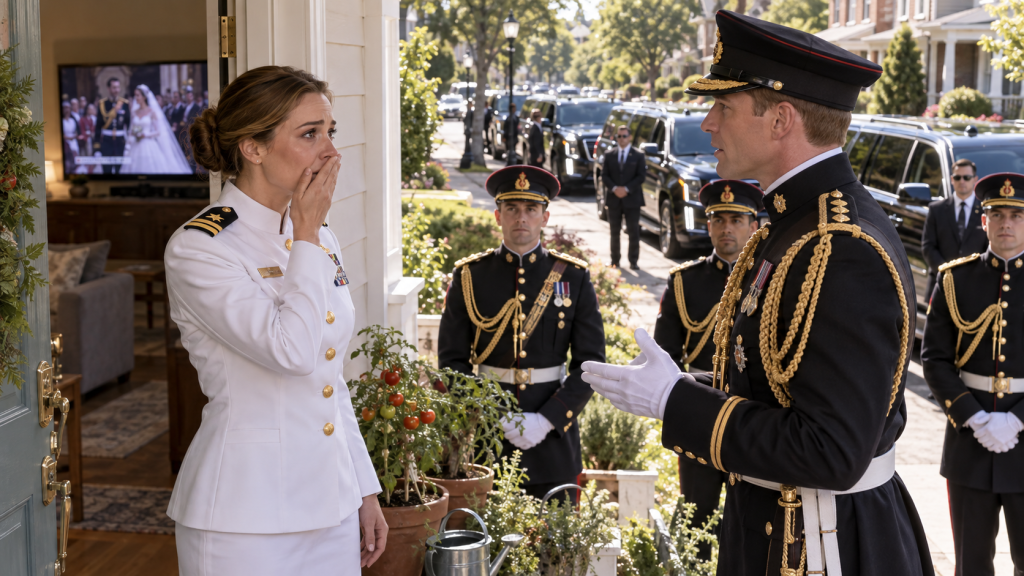
My sister said my Navy uniform would disgrace her royal wedding, so she left me off the guest list. Then the king asked, “Why isn’t her sister here?” Within hours, six royal SUVs pulled up around my home. A guard approached my door. “His Majesty is expecting you.” When my sister discovered our destination, the color drained from her face.

Part 1: Left Off the Guest List
My sister feared my Navy uniform would embarrass her at her royal wedding. In the end, Rachel decided it was easier to exclude me altogether.
She knew nothing about the stranger I had helped during a humanitarian mission six years earlier. I had assisted him after a transport accident, unaware that he would eventually become king.
Three weeks before the ceremony, I called to ask about my missing invitation. Rachel hesitated before claiming that only close relatives would attend.
“I’m your sister,” I reminded her.
“You wouldn’t fit in, Emily. Please don’t argue.”
When I pressed her, she called me an embarrassment. I remembered defending her as a child in Ohio, mowing lawns at thirteen to fund her leadership program, and sending rent money when she struggled in New York.
None of that seemed to matter anymore.
On her wedding morning, I wore my dress uniform to a veterans’ memorial service. By two, I was back at my Norfolk townhouse, where the television showed Rachel beside Prince Alexander beneath white flowers overlooking Chesapeake Bay.
For a moment, I simply felt proud of my sister. Then Alexander turned toward our parents, looking puzzled.
Dad shifted uncomfortably, and Mom appeared close to tears. I muted the broadcast, sensing trouble without knowing its cause.
Later, I learned Alexander had asked why I wasn’t there. Rachel blamed military duties, but Dad corrected her.
“She didn’t invite Emily.”
Rachel hadn’t realized that the royal family had spent two years hoping to meet me.
I switched off the television and returned to my tomato plants. Outside, damp earth and familiar garden chores gave me something ordinary to focus on.
Then several engines approached.
Six black SUVs entered my street and stopped outside the house. Curtains moved in neighboring windows as a formally dressed man walked toward my porch.
When the doorbell rang, I opened it to find six royal guards waiting. The tallest stepped forward.
“Commander Emily Carter?”
I confirmed my name, wondering what could possibly have brought them here.
He stood straight. **“His Majesty asks that you accompany us immediately
PART 2 — THE GUEST THEY HAD BEEN WAITING FOR
For several seconds, I simply stared at the man standing on my porch.
Behind him, six black SUVs occupied nearly every inch of curb in front of my townhouse.
My neighbors had stopped pretending not to watch.
Mrs. Alvarez from number fourteen stood behind her curtains with one hand pressed to the glass.
A teenage boy across the street was openly filming.
And the royal guard in front of me looked as though arriving with half a motorcade on a quiet Norfolk street was an entirely normal way to spend a Saturday afternoon.
“His Majesty is expecting me where?”
I asked.
“At the Harrington residence, Commander.”
That meant nothing to me.
He seemed to realize it.
“The royal family’s private residence during the visit.”
My stomach tightened.
“The wedding reception is at Ashbourne House.”
“Yes, ma’am.”
“So we’re not going to the wedding?”
“No.”
That somehow frightened me more.
I looked down at myself.
I had removed my jacket after the veterans’ memorial service but had not changed completely.
White uniform shirt.
Dark trousers.
Black shoes.
My ribbons and insignia were still on the jacket hanging over the dining chair behind me.
“I need five minutes.”
The guard inclined his head.
“His Majesty specifically requested that you come as you are.”
I almost laughed.
“That is not a sentence people say to women with royal convoys outside their homes.”
For the first time, the guard’s mouth moved slightly.
Almost a smile.
“You may take five minutes.”
Good.
Even kings could wait for someone to find her cover.
I closed the door.
Then leaned against it.
My heart was pounding.
Six years earlier, during a humanitarian mission in the Indian Ocean, I had helped hundreds of people.
Sailors.
Aid workers.
Local families.
A pregnant woman who refused evacuation until her elderly father was loaded first.
A teenage boy with a fractured arm who kept trying to go back for his dog.
And one quiet man with blood running down the side of his face after a transport vehicle overturned on a flooded road.
I remembered him.
Of course I did.
But not as royalty.
I remembered him because he had argued.
Not arrogantly.
Calmly.
Persistently.
“Take the woman first.”
he had told me.
“I can wait.”
“You may have a head injury.”
“She has a child.”
“Sir, unless you have suddenly become medically qualified, I need you to stop reorganizing my casualties.”
He actually smiled.
Even with blood on his collar.
Then said:
“That seems fair.”
I did not know I had just ordered the future King of Valoria to sit down and wait his turn.
His name then had been Elias Varen.
At least that was the name written on the aid manifest.
No title.
No palace security.
No entourage.
He was traveling with a small humanitarian delegation assessing damage after Cyclone Mara tore through the eastern islands.
His vehicle had gone off a washed-out section of road.
Two members of the group were badly hurt.
Elias had a concussion, several stitches, and a fractured wrist.
I stabilized him.
Helped organize evacuation.
Then went back to work.
Forty-eight hours later, our ship sailed.
I never saw him again.
Three years afterward, I was drinking coffee in a base cafeteria when his face appeared on television.
Crown Prince Elias assumes throne following sudden death of King Henrik IV.
I nearly dropped my mug.
Then life moved on.
Apparently his had remembered me longer than mine had expected.
I put on my uniform jacket.
Checked myself in the mirror.
For one ugly second, Rachel’s voice entered my head.
You wouldn’t fit in.
I looked at the ribbons over my chest.
The gold warfare insignia.
The service stripes.
The uniform she said would embarrass her.
Then I heard my own voice answer from somewhere older and steadier.
I was not dressing for Rachel.
I was already dressed for who I was.
I picked up my phone.
Locked the door.
And walked outside.
The rear door of the second SUV opened.
A woman in a navy suit introduced herself as Lady Celeste Armand, deputy private secretary to King Elias.
She shook my hand.
Not delicately.
Firm grip.
Focused eyes.
“Commander Carter.”
“Lady Armand.”
“Thank you for coming on such short notice.”
“I’m still not sure why I’m coming.”
“That is fair.”
She waited until we were moving before continuing.
The convoy pulled away from my street.
My tomato plants disappeared behind us.
Six SUVs carrying royal security left my tiny yard looking impossibly ordinary.
I was grateful for that.
Lady Celeste sat across from me.
“His Majesty has been trying to locate you for some time.”
“So I’ve heard.”
“Approximately two years.”
I stared.
“Two years?”
“Yes.”
“Why?”
“He wished to thank you personally.”
“For doing my job six years ago?”
“For several things.”
“What several things?”
She studied me.
Then apparently decided directness would work better.
“After the accident, His Majesty asked who had coordinated the evacuation.”
“The mission report would have listed the medical team.”
“It did.”
“There were twelve of us.”
“Yes.”
“So why me?”
Celeste’s expression softened.
“Because he remembered what you said to him.”
That made me nervous.
“I said many things during that mission.”
“He remembers.”
Oh God.
She opened a slim folder.
Inside was a photocopy of an old mission report.
My name highlighted.
LT EMILY CARTER — Medical Logistics Liaison
I had not seen that title in years.
Then another page.
A handwritten note.
Elias’s handwriting, apparently.
American naval officer. Carter. Would not move me ahead of injured civilians despite pressure from delegation. Find her after mission.
I stared.
“He wrote that?”
“Yes.”
“He was annoyed?”
Celeste smiled.
“Quite the opposite.”
I looked out the tinted window.
“He wanted special treatment?”
“No.”
“He wanted to know whether you would give it.”
My head turned back.
“What?”
Celeste closed the folder.
“Commander, King Elias traveled anonymously during several humanitarian missions before he ascended the throne.”
“I knew he traveled without titles.”
“He had become concerned that people behaved differently around him once they knew who he was.”
Fair problem for a future king.
“He later told our family that during the cyclone response, almost everyone who learned his identity tried to move him ahead.”
“Transportation.”
“Medical care.”
“Food.”
“Secure accommodation.”
I remembered officials hovering after someone eventually whispered who he was.
By then he had already been treated.
Celeste continued.
“You did not know at first.”
“No.”
“When you found out?”
I remembered that too.
One of his security advisers had quietly pulled me aside.
That man is Prince Elias of Valoria.
My response had been:
Then Prince Elias can hold pressure on his own bandage until I finish here.
My face heated.
Celeste smiled.
“That sentence has been repeated in the royal family for six years.”
Wonderful.
“I hope respectfully.”
“Not particularly.”
I laughed.
For the first time since the SUVs arrived, I relaxed.
Then Celeste said:
“Prince Alexander was there when Elias told the story.”
My smile faded.
Rachel’s new husband.
“Alexander knew my name?”
“Yes.”
“For six years?”
“Yes.”
That did not make sense.
“Rachel never mentioned it.”
Celeste looked away briefly.
“She may not have known how significant His Majesty considered the encounter.”
“But Alexander knew I served.”
“Yes.”
“Did he know I was Rachel’s sister?”
Celeste hesitated.
There.
The first uncomfortable answer.
“Not initially.”
“When did he find out?”
“Eleven months ago.”
My stomach dropped.
Rachel and Alexander announced their engagement nine months ago.
Two months after he knew.
“How?”
Celeste folded her hands.
“During routine family background discussions after the relationship became serious.”
I knew royal marriages probably involved more paperwork than normal ones.
Security.
Diplomatic concerns.
Press strategy.
Family history.
Apparently sisters came up somewhere between wedding venues and constitutional expectations.
“When your name appeared in the family information, Prince Alexander recognized it.”
“And?”
“He told His Majesty.”
My heart began beating faster.
“Elias knew I was Rachel’s sister before the engagement?”
“Yes.”
“Did Rachel know that?”
Again, a pause.
“His Royal Highness mentioned wanting to meet you.”
I stared.
“When?”
“Several times.”
The inside of the SUV suddenly felt very small.
“Rachel told me only close relatives were invited.”
Celeste’s expression changed.
“Commander.”
“Yes?”
“You were on the original family list.”
The words did not land immediately.
“What?”
“Prince Alexander submitted your name as immediate family.”
“No.”
“He did.”
“My sister told me I wasn’t invited.”
Celeste said nothing.
I felt the old hurt return.
Sharper now.
Not because a royal family wanted me there.
Because Rachel had apparently worked to remove me from somewhere I had already belonged.
“What happened to my name?”
I asked.
“We were told you declined.”
My entire body went still.
“I did what?”
Celeste opened another folder.
This one was newer.
Wedding correspondence.
Not everything.
Selected pages.
A palace liaison had emailed Rachel’s wedding planner eight weeks earlier.
Please confirm Commander Emily Carter’s preferred mailing address and uniform protocol for the ceremony.
The response came from Rachel herself.
Emily will not be attending. Her naval duties make travel impossible. She has asked not to be contacted because she finds formal family events emotionally difficult.
I read it twice.
My house was less than thirty miles from the wedding venue.
Travel impossible.
That almost made me laugh.
Then I saw the next email.
The palace liaison:
Prince Alexander believed she was currently stationed in Norfolk. Should we contact Commander Carter directly?
Rachel:
Please don’t. Emily and I have a complicated relationship, and direct contact may upset her. She has been struggling since deployment and prefers privacy.
My stomach turned.
Deployment.
Privacy.
Struggling.
She had not merely excluded me.
She had constructed an explanation that made contacting me seem unkind.
“Was there more?”
I asked.
Celeste did not answer immediately.
“Yes.”
I closed my eyes.
“Show me.”
The next page was worse.
Rachel wrote:
Emily has difficulty with ceremonial environments and has occasionally reacted strongly when she feels judged. I really want the wedding to remain peaceful.
There it was.
A version of me I had never met.
Unstable.
Embarrassed.
Fragile.
Potentially disruptive.
Not technically an accusation.
Just enough suggestion to make polite people step back.
I handed the pages to Celeste.
“My sister said my uniform would embarrass her.”
Celeste’s brows drew together.
“Your uniform?”
“Yes.”
“That is not what we were told.”
Of course it wasn’t.
The convoy exited the highway.
Historic homes appeared behind stone walls and old trees.
The Chesapeake glittered through the distance.
My phone vibrated.
MOM
I stared at the screen.
Declined.
Immediately it rang again.
DAD
I answered.
“Emily.”
His voice sounded strained.
“Where are you?”
“In a car.”
“With whom?”
“The King of Valoria’s security detail.”
Silence.
Then:
“Oh.”
It was such a Dad answer that I almost smiled.
“What happened?”
I asked.
“Rachel knows.”
My stomach tightened.
“Knows what?”
“That they went to get you.”
I looked at Celeste.
She watched politely without pretending not to listen.
“How?”
“Alexander told her.”
“What exactly did he tell her?”
Dad exhaled.
“That his brother had postponed the private family reception until you arrived.”
I closed my eyes.
There.
That was why the color drained from Rachel’s face.
Not because six SUVs were coming to humiliate her at her own wedding.
Because the royal family had stopped moving forward without the sister she had tried to erase.
Dad continued.
“Emily, she’s panicking.”
“That sounds like something she should work through.”
“I know.”
Good.
At least he had learned something in the last several hours.
Then his voice lowered.
“There’s something else.”
“What?”
“Alexander asked her why she told the palace you refused to attend.”
I went silent.
“What did she say?”
“That you would have felt uncomfortable.”
My jaw tightened.
“And?”
“He asked whether you actually said that.”
“And?”
“Rachel walked out.”
Of course.
“Dad.”
“Yes?”
“Did you know I was on the original guest list?”
“No.”
“Did Mom?”
“I don’t think so.”
That was not comforting.
Then Dad said:
“I should have told you sooner that something felt wrong.”
I looked out the window.
“What felt wrong?”
“Alexander asked about you at the rehearsal dinner.”
My eyes closed.
“When?”
“Last night.”
“What did you say?”
“That you were working.”
My stomach dropped.
“Dad.”
“I know.”
He sounded ashamed.
“Rachel told us that was what she’d told everyone.”
“So you covered for her.”
“Yes.”
It hurt.
Not like Rachel.
Differently.
“You knew I wasn’t working.”
“Yes.”
“Why?”
Dad was quiet.
“Because I didn’t want to ruin her wedding.”
There it was.
The great family religion.
Do not ruin the moment.
Even if the moment requires somebody else to disappear.
“I’m going to hang up.”
“Emily.”
“I love you.”
His breath caught.
“I love you too.”
“But I need to get through this without managing how everyone else feels.”
Then I ended the call.
My hands were shaking.
Celeste waited.
Finally she said:
“That was well done.”
I almost laughed.
“You people train for diplomatic crises.”
“Yes.”
“Families are worse.”
“Frequently.”
That helped more than it should have.
We arrived at Harrington House twelve minutes later.
It was not a palace.
Thank God.
A restored waterfront estate temporarily secured for the royal family during the wedding visit.
Stone facade.
Tall windows.
Security everywhere.
But also flowerpots.
A child’s bicycle near one side entrance.
Someone had left a coffee cup on a windowsill.
Royalty apparently generated clutter too.
The convoy stopped.
My door opened.
I stepped out.
For one second, the uniform felt unbearably visible.
Then I remembered Rachel’s words.
You wouldn’t fit in.
I straightened my shoulders.
Maybe fitting in was not the goal.
King Elias was waiting inside a library.
Not on a throne.
Not surrounded by trumpets.
He stood by a window overlooking the water wearing a dark suit with no crown and no visible decorations.
Older than I remembered.
More gray at the temples.
The same eyes.
When I entered, he smiled.
“Commander Carter.”
I saluted before my brain remembered he was not part of my chain of command.
He looked delighted.
“I wondered whether you would still do that.”
“Old habits.”
“So is refusing to let me cut a medical line, apparently.”
I laughed.
Then he stepped forward and held out his hand.
I took it.
His expression became serious.
“I have wanted to thank you for six years.”
“You already did.”
His eyebrows rose.
“When?”
“You listened when I told you to sit down.”
He laughed.
Loudly.
A king laughed because I remembered ordering him into a folding chair.
The world had become strange.
Then Elias said:
“You did more than treat my injury.”
I waited.
“You protected the order of the evacuation when people around me were prepared to distort it because of my name.”
“That was my job.”
“Yes.”
He smiled slightly.
“That is what people say when they have done something worth remembering.”
I did not know what to say.
He rescued me.
“You were very unpleasant, by the way.”
I blinked.
“Your Majesty.”
“You told my security chief that if he moved one more injured civilian to create space for me, you would have him removed from the treatment area.”
I winced.
“That sounds possible.”
“It was magnificent.”
I laughed.
Then another man entered.
Prince Alexander.
My brother-in-law of approximately three hours.
Tall.
Dark-haired.
Still wearing his wedding formalwear, though the ceremonial jacket had been replaced by a simpler coat.
He looked at me for several seconds.
Then said:
“So you actually exist.”
I stared.
“That depends what Rachel has told you.”
His expression fell.
Good.
He had not earned humor yet.
“Commander Carter.”
“Your Highness.”
“I owe you an apology.”
That surprised me.
“For what?”
“For believing what I was told instead of insisting on speaking to you directly.”
The sentence was better than excuses.
I appreciated that.
Alexander continued.
“When I discovered Rachel’s sister was Emily Carter, I thought it was extraordinary.”
“I suppose statistically.”
He almost smiled.
“My brother has been telling that mission story for years.”
“So I’ve discovered.”
“I asked Rachel if you might stand with my family during one of the humanitarian foundation events while we were here.”
My heart tightened.
“What did she say?”
“That you hated attention.”
Fair enough.
I did.
“That military life had made large social gatherings difficult for you.”
Not fair.
“And eventually that you had declined the wedding itself.”
I looked away.
Alexander added:
“I should have contacted you.”
“Yes.”
He accepted it.
“Yes.”
King Elias walked toward a side table.
There was a small velvet case there.
I immediately became uncomfortable.
“Your Majesty.”
He looked at me.
“If there is jewelry in that, I’m leaving.”
Alexander laughed.
Elias smiled.
“No jewelry.”
He opened it.
Inside was a medal.
Not enormous.
Silver and blue ribbon.
I stared.
“What is that?”
“The Order of Civil Courage.”
My eyes widened.
“No.”
Elias’s smile vanished.
“This is not because of the wedding.”
“Still no.”
“You have not heard the citation.”
“I did my job.”
“Yes.”
“I was one officer among hundreds.”
“Yes.”
“Then honor the mission.”
“We are.”
His tone remained calm.
“This commendation recognizes the humanitarian team as well.”
I shook my head.
“I don’t want my sister’s wedding turned into a ceremony about me.”
Something changed in Elias’s face.
Approval.
Not offense.
“Good.”
he said.
“Neither do I.”
He closed the case.
“The presentation was never intended for today.”
I stared.
“What?”
“It was scheduled for tomorrow morning at Naval Station Norfolk.”
My breath caught.
“What presentation?”
“A small joint event with the humanitarian foundation and several members of your former mission team.”
I looked at Celeste.
She said nothing.
Elias continued.
“We had hoped Rachel’s wedding would provide the first opportunity for us to meet you privately.”
“So tomorrow…”
“Is about the mission.”
Not Rachel.
Not revenge.
Relief moved through me.
Then confusion.
“Why wasn’t I told about tomorrow?”
Alexander’s expression changed.
Elias looked at him.
Then at me.
“We believed you had declined that as well.”
The room became silent.
“What?”
Celeste opened another folder.
I was beginning to hate royal stationery almost as much as manila folders.
An invitation had been sent through the wedding liaison six weeks earlier because the family did not have a direct personal address they trusted.
The note asked whether Commander Emily Carter could attend a private recognition ceremony the morning after the wedding.
Rachel responded.
Emily does not want any connection drawn between her military service and the royal family. She considers the mission private and would be uncomfortable being singled out. Please respect her wishes and do not contact her chain of command.
I stared.
That one hurt differently.
Rachel had not just kept me from her wedding.
She had answered on my behalf about my own service.
My own work.
My own decision.
“Why?”
Alexander whispered.
Not to me.
Almost to himself.
King Elias’s face had become very still.
Not furious.
Worse.
Disappointed.
I handed the paper back.
“I don’t know.”
But maybe I did.
Rachel had spent years reinventing herself.
New York.
Fundraisers.
Charity galas.
Then Alexander.
She wanted to become someone who looked inevitable beside royalty.
And somewhere in that transformation, my uniform became a reminder of a family history she could not control.
Ohio.
Lawn mowing.
Rent money.
An older sister who remembered her crying in a laundromat because she could not afford detergent.
Maybe I was not embarrassing because I had served.
Maybe I was embarrassing because I remembered.
A knock sounded.
Celeste answered the door.
Then turned.
“Your Majesty.”
“Yes?”
“Her Royal Highness is asking whether she may come in.”
My stomach tightened.
Rachel.
Already called Her Royal Highness.
Three hours married.
Elias looked at me.
“Commander?”
The choice surprised me.
He was asking whether I wanted her admitted.
I appreciated that more than the medal.
“Yes.”
Let the person whose presence was being discussed answer for herself.
Imagine that.
Rachel entered.
She had changed from her ceremony gown into a pale ivory reception dress.
The tiara was gone.
Her hair still looked perfect.
Her face did not.
She saw me.
Stopped.
Then looked at the medal case.
Then at Elias.
Then Alexander.
The blood drained from her face.
Not because I was being crowned.
Not because her title was disappearing.
Because she finally understood where the convoy had brought me.
Not to crash her wedding.
Not to embarrass her in front of guests.
To the private room where the royal family had been waiting to thank the sister she had spent months insisting should not be contacted.
“Emily.”
she whispered.
“Rachel.”
Her eyes moved over my uniform.
For the first time, there was no contempt in them.
Only fear.
Alexander spoke first.
“Did Emily decline tomorrow’s ceremony?”
Rachel opened her mouth.
Then closed it.
“Rachel.”
His voice was quiet.
“No.”
The word barely existed.
Alexander looked at the floor.
King Elias said nothing.
That made the room worse.
Rachel continued.
“She would have hated it.”
I laughed once.
Everyone looked at me.
“You never asked.”
Rachel’s eyes filled.
“I know you.”
“No.”
I said.
“You know what answer you needed.”
She flinched.
“You hate being displayed.”
she said.
“True.”
“You hate formal attention.”
“Also true.”
“You would have said no.”
“Maybe.”
I took one step closer.
“But maybe was mine.”
That silenced her.
Alexander looked at me.
Then at Rachel.
Something in his expression changed.
Not love disappearing.
Trust taking damage.
Those are different things.
Rachel whispered:
“I just wanted one day.”
I stared.
“One day without what?”
Her face crumpled.
“Without being your little sister.”
The room went still.
There.
Not the uniform.
Not military embarrassment.
Something older.
I waited.
Rachel wiped her face.
“Do you know what everyone did when I got engaged?”
I said nothing.
“They asked about you.”
“Mom said you were commanding something.”
“Dad told stories about your deployments.”
“Alexander told me about Elias wanting to meet you.”
“And suddenly the biggest thing that had ever happened to me still had you inside it.”
Her voice broke.
“I wanted one room where nobody looked past me and saw Emily first.”
The honesty hurt because I understood it.
Not enough to excuse it.
Enough to see her.
“Then you could have said that.”
I whispered.
“I know.”
“No.”
“You could have told me you were jealous.”
“That you were tired of being compared.”
“That you wanted something separate.”
“I could have handled ugly truth better than a beautiful lie.”
She cried.
Alexander looked away.
I continued.
“You didn’t just exclude me.”
“You spoke for me.”
“You told people I was unstable.”
“I never said unstable.”
“You said deployment made formal events difficult.”
“That I might react strongly.”
“That people shouldn’t contact me.”
Rachel’s face collapsed.
“I was trying to make them stop asking.”
“Yes.”
“And you used my mental health as a story because it sounded polite.”
She said nothing.
That answer was enough.
King Elias finally spoke.
“Rachel.”
She looked at him.
His voice was not angry.
“I have spent much of my life around people who believe kindness means avoiding uncomfortable truth.”
Rachel started crying harder.
“I’m sorry.”
“I believe you are.”
Then he added:
“But apologies are not erasers.”
I looked at him.
Apparently kings occasionally said useful things.
Alexander stepped toward Rachel.
“We need to talk privately.”
Her face went white.
“Alexander—”
“Not about ending anything.”
He said it firmly.
Interesting.
No instant annulment.
No theatrical rejection at the wedding.
Good.
“But we are going to talk about why you thought you could answer for your sister.”
Rachel nodded.
Then looked at me.
“I’m sorry.”
I believed she was.
That did not make me ready.
“I know.”
Her face fell.
I had spent my whole life giving Rachel the reassurance after difficult truths.
It’s okay.
I understand.
Don’t cry.
Not this time.
“I’m not ready to tell you it’s okay.”
She nodded slowly.
“That’s fair.”
Maybe marriage had taught her something in three hours.
Or maybe consequences had.
Then Elias surprised all of us.
“The family reception begins in forty minutes.”
Rachel looked at him.
“Yes, Your Majesty.”
He turned to me.
“You are invited.”
I almost laughed.
“Is that an order?”
“No.”
“Good.”
“It is an invitation.”
Everyone waited.
The old Emily would have looked at Rachel.
Asked with her face:
Will this make things worse?
Will my presence ruin your day?
I did look at her.
But not for permission.
Just because she was my sister.
Then I answered for myself.
“No.”
Rachel blinked.
Alexander looked surprised.
Elias smiled.
“Good.”
I stared at him.
“You’re pleased I refused?”
“Very.”
“Why?”
“Because I have been trying to meet the officer who told a prince that his title did not alter the rules.”
His smile deepened.
“I would have been disappointed if she suddenly attended a royal reception merely because a king asked.”
I laughed.
So did Alexander.
Even Rachel.
Through tears.
The room loosened.
Just slightly.
“I would like to go home.”
I said.
“To my tomatoes.”
Elias nodded solemnly.
“A pressing national obligation.”
“Absolutely.”
“But tomorrow?”
I looked at the medal case.
Then at the mission report.
Tomorrow was not Rachel’s wedding.
Not royal theater.
It belonged to the work.
The team.
People who had stood in floodwater beside me six years ago.
“Yes.”
I said.
“I’ll come tomorrow.”
Elias held out his hand.
“Then tomorrow.”
I was nearly at the door when Celeste spoke quietly.
“Commander Carter.”
I turned.
Her expression had changed.
Formal again.
“There is one matter we should address before you leave.”
Rachel froze.
I noticed.
So did Alexander.
“What matter?”
Celeste held the final folder.
She looked at Rachel.
Then at me.
“During the wedding security review, we received information regarding you that did not originate from the wedding planner.”
My stomach tightened.
“What information?”
Celeste opened the file.
“There was a request that your name be flagged if you attempted to approach the wedding venue without an invitation.”
Rachel went completely white.
I stared at her.
“What?”
Alexander turned toward his wife.
“You did what?”
Rachel shook her head quickly.
“No.”
“I didn’t—”
Celeste raised one hand.
“The request did not come directly from Her Royal Highness.”
Rachel stopped.
Everyone did.
“Then from whom?”
I asked.
Celeste’s gaze remained on the page.
“Your mother.”
The room went silent.
My mother.
The woman who nearly cried during the ceremony.
The woman who had known I was sitting alone in Norfolk while the family watched Rachel marry into royalty.
The woman who had called me thirty minutes earlier asking where I was.
I felt suddenly cold.
“What exactly did she tell you?”
Celeste hesitated.
Then read:
Emily has difficulty accepting boundaries where Rachel is concerned. If she arrives unexpectedly in uniform, please do not allow her presence to distract from the ceremony. Rachel has worked too hard for this day.
I could not breathe.
Rachel whispered:
“I didn’t know.”
I looked at her.
For once, I believed her immediately.
Alexander’s face hardened.
King Elias looked deeply tired.
And suddenly the story was no longer only about a jealous younger sister trying to step out of my shadow.
Someone had been helping her build the shadow.
I thought of childhood.
Mowing lawns for Rachel’s program.
Driving her to interviews.
Sending rent.
Mom always saying:
“Emily, you’re stronger.”
“Emily, let her have this one.”
“Emily, she needs you.”
Maybe Rachel had spent her whole life hearing the other half.
Emily can handle it.
Emily doesn’t need anything.
Emily will understand.
Emily can be excluded because Emily survives.
My anger changed.
Again.
Became older.
Heavier.
I looked at Celeste.
“Was my mother the one who suggested the deployment explanation too?”
Celeste did not answer immediately.
Then she turned one more page.
An email chain.
Rachel’s wedding planner.
My mother.
Rachel copied only on the first message.
The later correspondence happened without her.
Mom wrote:
Please do not push Rachel about Emily. Their relationship has always been difficult because Emily tends to dominate family milestones without intending to. Rachel deserves one day where the focus remains entirely on her.
My hands went cold.
There it was.
Not one wedding decision.
A family role.
Rachel fragile.
Emily strong.
Rachel deserving protection.
Emily able to absorb exclusion.
Years of favoritism disguised as emotional logistics.
And I had participated too.
Every time Mom said:
“Let your sister have this.”
I had.
Until apparently there was nothing left in the room that belonged to me except the uniform Rachel was ashamed to see.
My phone vibrated again.
MOM
Nobody moved.
I looked at the screen.
Then at Rachel.
Her eyes were wide.
Afraid.
Not of the king.
Not anymore.
Of what we were both beginning to understand.
“Did Mom tell you I was always trying to outshine you?”
I asked.
Rachel’s lips parted.
“She said…”
“What?”
Rachel’s voice became almost inaudible.
“She said you pitied me.”
My chest hurt.
“I never pitied you.”
Rachel started crying again.
“I know that now.”
“How long?”
“Since we were teenagers.”
The room seemed to recede.
Two sisters standing twenty feet apart.
Both apparently raised inside different versions of the other.
I looked at the phone.
Still ringing.
Then I answered.
“Mom.”
She exhaled.
“Oh, thank God. Emily, where are—”
“I’m with Rachel.”
Silence.
I watched my sister.
She watched me.
Then I said:
“And we need to talk about what you told both of us.”
The line went completely quiet.
For the first time all day, my mother had no answer ready.
And standing there in the uniform my sister said would embarrass royalty, I finally understood that tomorrow’s ceremony was not going to be the hardest thing I faced.
The hardest thing would be learning how much of the distance between two sisters had actually belonged to us—
and how much had been handed to us by someone who kept calling it love.
PART 3 — THE SISTER I NEVER NEEDED TO OUTSHINE
My mother stayed silent on the phone for so long that I could hear her breathing.
Behind me stood a king, a prince, my newly married sister, and three members of a royal household who had just learned far more about the Carter family than any diplomatic briefing should ever have contained.
But none of them mattered in that moment.
Only Mom.
Only Rachel.
Only me.
“Emily.”
Mom finally whispered.
I looked directly at my sister.
“What did you tell Rachel about me?”
Another silence.
Then Mom tried the sentence she always used when truth became inconvenient.
“It’s complicated.”
“No.”
I said it gently.
“That’s the sentence people use when they want more time to rearrange the facts.”
Rachel’s face changed.
Something almost like recognition passed through it.
Maybe she had heard that sentence too.
Mom sighed.
“I never wanted you girls to hate each other.”
Rachel laughed.
A small, broken sound.
“Well.”
There was no humor in it.
Mom’s voice sharpened.
“Rachel, this is your wedding day.”
And there it was.
Even now.
The emergency was not what had happened.
The emergency was that Rachel might feel something unpleasant on a special day.
Rachel went very still.
Then she said:
“Mom.”
“What?”
“Stop.”
Our mother stopped talking.
I had never heard Rachel use that voice with her.
Neither had Mom, apparently.
Rachel looked at me.
Then at the phone in my hand.
“Put her on speaker.”
I hesitated.
Not because I wanted to protect Mom.
Because the room was full of people who did not belong inside this conversation.
King Elias seemed to understand before I said anything.
He turned to Alexander.
“We should give them the room.”
Alexander looked at Rachel.
Not possessively.
Questioningly.
She nodded.
“Please.”
Elias left first.
Celeste followed.
The guards stepped outside.
Alexander touched Rachel’s hand once.
“I’ll be nearby.”
Then he left too.
No royal audience.
No witnesses.
Just two sisters and the mother who had spent years telling each of us who the other one was.
I put the call on speaker.
Mom said:
“Are you both there?”
“Yes.”
I answered.
Rachel folded her arms.
“Start with the email.”
Mom exhaled.
“I was trying to protect your wedding.”
“From Emily?”
Rachel asked.
“From tension.”
“What tension?”
“You know how things have always been.”
Rachel stared at me.
I stared back.
Neither of us did.
Not really.
That was suddenly the problem.
“What have things always been?”
I asked.
Mom became defensive.
“Emily, you have always been strong.”
I almost laughed.
There it was.
The compliment that had functioned like a waiver form my entire life.
Strong.
Meaning:
You can take less.
You can wait.
You can forgive.
You can absorb.
“Rachel needed more support.”
Mom continued.
“She was sensitive.”
“I was a child.”
Rachel said.
Mom paused.
“Yes.”
“And Emily was a child too.”
Another pause.
The room felt colder.
Rachel continued.
“You made it sound like she came out of the womb thirty-five years old.”
“I never said that.”
“You didn’t have to.”
Rachel’s voice cracked.
“You told me she was tougher.”
“More confident.”
“Better at school.”
“Better with people.”
“You said I shouldn’t compare myself to her, but then you explained every problem I had by comparing me to her.”
Mom began to cry.
I felt something strange.
Not satisfaction.
Grief.
Rachel had apparently been wounded by the same system that rewarded me.
Just from the opposite direction.
When I was twelve, Rachel was eight.
She refused to perform in the school talent show after seeing me win a regional speech competition.
Mom told me:
“Emily, don’t talk about the trophy this week.”
I obeyed.
At fourteen, I got invited to a science camp the same summer Rachel failed math.
Mom asked me not to put the acceptance letter on the refrigerator.
I obeyed.
At seventeen, I got into Annapolis.
Rachel was struggling with college applications.
Mom asked me to wait three days before telling extended family.
I obeyed.
At twenty-six, I was promoted.
Rachel had just lost a job.
Mom asked me not to mention it at Thanksgiving.
I obeyed.
At the time, every request seemed kind.
A tiny kindness.
One sister making room for another.
I had never realized what Rachel heard on her side.
Your sister’s success is dangerous to you.
Your happiness requires hers to become quieter.
Rachel wiped her face.
“Did you tell Emily I hated when she wore her uniform?”
Mom became quiet.
My chest tightened.
“Mom.”
“I may have said you felt overshadowed by it.”
Rachel stared at the phone.
“When?”
“Years ago.”
“Why?”
“Because every time Emily came home in uniform, everybody made such a fuss.”
My stomach dropped.
Rachel shook her head.
“I used to brag about her.”
I looked at her.
She looked at me.
“What?”
I whispered.
Rachel gave a watery laugh.
“In college.”
She wiped her face.
“I told everybody my sister was a naval officer.”
I had not known that.
Mom spoke quickly.
“You did, but later it became complicated.”
“No.”
Rachel said.
“You made it complicated.”
I sat down.
The room suddenly felt too large.
“Rachel.”
She looked at me.
“Why did you tell me my uniform would embarrass you?”
Her face collapsed.
For a moment, she looked exactly like the little girl who used to stand outside my bedroom after nightmares.
“Because by then I believed it.”
The answer hurt more than anger would have.
She continued.
“Mom kept saying the royal family was traditional.”
“That military uniforms had protocol.”
“That people would ask about your service.”
“That the press might focus on the story about Elias.”
“And every time she said it, it sounded like she was warning me.”
Mom interrupted.
“I was trying to help you manage attention.”
Rachel laughed sharply.
“You were teaching me to be afraid of it.”
Mom started crying harder.
“I thought you wanted one day of your own.”
“I did.”
Rachel answered.
“But that didn’t mean Emily had to disappear.”
There it was.
The distinction nobody in our family had ever learned.
Someone else being present is not the same thing as stealing your place.
Someone else being accomplished does not reduce your accomplishment.
Love is not a spotlight with room for one face.
I asked Mom:
“Did you really believe I would show up uninvited and cause trouble?”
“No.”
The answer came immediately.
At least that.
“Then why ask security to flag me?”
“I didn’t think they would treat it so seriously.”
I stared.
“You wrote to a royal security office.”
“I thought they would simply redirect you if—”
“If what?”
“If I tried to attend my sister’s wedding?”
Mom did not answer.
“Mom.”
My voice shook.
“Did you actually think I would crash a wedding I knew I wasn’t invited to?”
“No.”
“Then why?”
Finally, she whispered:
“Because I was afraid Rachel would change her mind if she saw you.”
The room went still.
I looked at my sister.
She looked equally stunned.
“What?”
Rachel whispered.
Mom continued, voice breaking.
“I knew you were conflicted.”
“You kept asking whether excluding Emily was too much.”
“I thought if she appeared, you would invite her in.”
“Then all the questions would start.”
“Why wasn’t Emily originally invited?”
“What happened between the sisters?”
“And the wedding would become about the conflict.”
Rachel covered her mouth.
“So you made sure she couldn’t come.”
“I thought I was protecting you.”
There was that word again.
Protecting.
I had heard enough stories in my life to know how much damage people can hide beneath it.
Rachel lowered herself into a chair.
“I didn’t ask you to do that.”
“I know.”
“Did Dad know?”
“No.”
Mom said.
“Your father would never have agreed.”
That sounded true.
Dad had failed by covering Rachel’s lie at the rehearsal dinner.
But not this.
Different failures deserve different names.
I appreciated the distinction even while angry.
Mom continued.
“I thought Emily could handle being hurt.”
That sentence ended something.
Not my relationship with her.
Something older.
The assumption that strength meant unlimited capacity for pain.
I stared at the speaker.
“Mom.”
“Yes?”
“That is not what strength means.”
She sobbed.
“I know.”
“No.”
I shook my head even though she could not see me.
“You know now because everything became public.”
“I need you to understand what you did before we start talking about apologies.”
Silence.
Then:
“You spent years treating my ability to survive something as permission to do it.”
Rachel closed her eyes.
Mom whispered:
“I’m sorry.”
I believed she meant it.
I also knew sorry was not a reset button.
Rachel leaned toward the phone.
“And you did the opposite to me.”
Mom breathed.
“What?”
“You treated me like I was too fragile to survive Emily existing.”
That sentence hit all three of us.
Rachel continued.
“You kept protecting me from feeling jealous.”
“From feeling insecure.”
“From failing.”
“From looking ordinary next to her.”
“And every time you protected me, you taught me I really was less.”
Mom started saying:
“That’s not what I—”
“I know.”
Rachel interrupted.
“That’s not what you meant.”
“But it’s what happened.”
For the first time that day, my sister and I were not standing on opposite sides of our mother’s story.
We were looking at it together.
We ended the call after twenty more minutes.
No reconciliation.
No dramatic forgiveness.
Mom apologized.
Rachel cried.
I asked Mom not to contact royal staff again for any reason.
She agreed.
Rachel asked her not to make excuses to relatives.
She agreed to that too.
Then I said:
“We’ll talk again.”
Not tonight.
Not tomorrow.
Again.
Someday.
That was enough.
When I ended the call, Rachel and I sat in silence.
Outside the library doors, an entire royal household was probably trying very hard not to appear curious.
Rachel looked exhausted.
“So.”
she said finally.
“So.”
“You hate me.”
“No.”
Her eyes lifted.
That surprised her.
“I’m furious with you.”
“Oh.”
“I don’t trust you right now.”
She winced.
“But I don’t hate you.”
Rachel stared at her hands.
“I think I might deserve it.”
“That isn’t how this works.”
“What?”
“You don’t get to decide what I feel because you think punishment would make things simpler.”
She gave a tiny laugh.
“Apparently our family has a control problem.”
“Apparently.”
Then she looked at my uniform.
For years, I had thought that if Rachel ever apologized for insulting it, I would feel vindicated.
Instead I felt tired.
“I never hated it.”
she whispered.
I said nothing.
“I hated what happened around it.”
“What?”
“People asked questions.”
“Where were you stationed?”
“What missions?”
“What rank?”
“Mom would light up.”
“Dad would tell stories.”
“Then somebody would turn to me and ask what I was doing.”
Her voice cracked.
“And whatever I said sounded smaller.”
I understood.
That did not excuse what she had done.
But I understood.
“You know what’s funny?”
I said.
“What?”
“I used to think your life sounded glamorous.”
Rachel blinked.
“What?”
“New York.”
“Events.”
“Fashion.”
“Working with charities.”
“Meeting Alexander.”
She stared.
“You were commanding ships.”
“Not ships.”
“Whatever.”
I smiled.
“Exactly.”
Then I continued.
“You saw the parts of my life people applauded.”
“I saw the parts of yours that looked free.”
Rachel swallowed.
“We were jealous of edited versions.”
“Looks like it.”
She began crying again.
“I’m sorry I excluded you.”
I nodded.
“I’m sorry I lied.”
I nodded again.
“I’m sorry I told people you were struggling.”
That one hurt.
“I know.”
“And I’m sorry I made your service sound like something shameful because I was ashamed of how I felt next to it.”
I breathed slowly.
“Thank you.”
Her face tightened.
“That’s all?”
“For now.”
She nodded.
Fair.
We were learning.
The library door opened a few minutes later.
Alexander appeared.
Only him.
“Can I come in?”
Rachel looked at me.
I almost laughed.
Everyone asking permission now.
“Yes.”
I said.
He entered.
Sat beside his wife.
Not touching at first.
Then Rachel reached for his hand.
He let her.
Their marriage had not ended in three hours.
Good.
Life is usually less theatrical than that.
Alexander looked at me.
“Are you all right?”
“No.”
He nodded.
“Reasonable.”
Then he turned to Rachel.
“We need to decide what we tell people tonight.”
I watched her face tighten.
The reception.
Press.
Guests.
Royal family.
A newly married woman whose first hours as a princess had somehow become a family intervention.
Rachel inhaled.
“The truth.”
Alexander studied her.
“What truth?”
“That Emily was not absent because of Navy duties.”
My stomach tightened.
Rachel continued.
“She was not invited because I made a selfish decision and then misrepresented it.”
I immediately said:
“No.”
Both of them looked at me.
Rachel frowned.
“You don’t want me to admit it?”
“I don’t want tonight turned into a public confession about me.”
She went quiet.
“The guests do not need our family autopsy.”
I continued.
“You can correct the lie without feeding it to a room.”
Alexander nodded.
“So perhaps simply that there was a private family misunderstanding and Commander Carter’s absence should not be interpreted as duty-related.”
I smiled.
“That sounds royal.”
“It is a disease.”
Rachel laughed.
A real laugh this time.
Small.
But real.
I went home.
The royal SUVs brought me back.
All six.
Apparently security did not scale down merely because the passenger wanted to water tomatoes.
Mrs. Alvarez was still watching.
When I stepped out in uniform, she opened her front door.
“Emily?”
“Yes?”
“Why are there kings at your house?”
I laughed for the first time all day.
“There aren’t.”
She pointed at the convoy.
“Close enough.”
Fair.
I went inside.
Changed clothes.
Watered the tomatoes.
Ate cereal for dinner.
Then cried in the shower until the water went cold.
Not because I had been excluded.
Not only.
Because for the first time I understood how long Rachel and I had spent reacting to one another without actually speaking.
The naval ceremony began at nine the next morning.
It was small.
Nothing like a royal spectacle.
A reception room on base.
Rows of chairs.
Flags.
Coffee in paper cups.
Members of my old humanitarian team.
People I had not seen in years.
Lieutenant Commander Ortiz, who had once slept twenty-six minutes in three days and still claimed it counted as rest.
Chief Daniels, who had carried two injured children through waist-high floodwater.
Dr. Priya Nair, who delivered a baby in the back of a cargo truck because the road to the clinic disappeared.
Seeing them changed everything.
This was not my ceremony.
It never should have been.
It belonged to a mission.
A group.
People who had done difficult work and moved on without expecting a king to remember.
King Elias arrived without theatrical announcement.
Prince Alexander came too.
Rachel did not.
I was relieved.
Not because I wanted her excluded.
Because she had finally recognized the difference between being invited and inserting herself into something that belonged to someone else.
She texted me that morning.
I hope today is beautiful. I won’t come unless you want me there.
I stared at the message for a long time.
Then replied:
Thank you.
That was all.
She did not push.
Another good beginning.
Elias spoke for eleven minutes.
I know because military people notice things like that.
He did not tell the story as:
A brave American saved a prince.
Thank God.
He told it as a story about triage under pressure.
A multinational humanitarian response.
People who maintained order when status threatened fairness.
He named several members of the team.
Then he described the accident.
“My delegation attempted, somewhat aggressively, to move me ahead of more seriously injured civilians.”
Several people laughed.
Elias smiled.
“One American officer objected.”
Chief Daniels whispered behind me:
“That’s one word for it.”
I elbowed him.
Elias continued.
“She did not know who I was.”
More laughter.
“Then someone told her.”
He looked directly at me.
“And to my great education, this changed absolutely nothing.”
The room laughed again.
My face burned.
Then Elias became serious.
“Institutions are tested most clearly when rules become inconvenient for powerful people.”
The room quieted.
“The officer before you did not demonstrate courage because she treated a prince.”
“She demonstrated courage because she refused to treat a prince as more valuable than the people beside him.”
I stopped breathing.
That was the part I had never understood.
He was not grateful that I helped him.
He was grateful I did not place him above anyone else.
The commendation recognized the team’s humanitarian service.
Several members received individual acknowledgments tied to specific acts already documented in mission reports.
Mine was one of them.
The medal Elias had shown me the day before was presented.
I accepted it.
Not because I suddenly believed I was exceptional.
Because refusing purely to prove humility would have made the moment about me too.
Sometimes accepting recognition is another way of respecting everyone who shared the work.
I shook the king’s hand.
He whispered:
“You clean up well.”
I whispered back:
“You still talk too much for a former concussion patient.”
His eyes widened.
Then he laughed loudly enough that half the room heard.
Excellent diplomacy.
Afterward, reporters were permitted a few questions.
Most focused on humanitarian cooperation.
One asked why I had not attended the royal wedding.
There it was.
The question everyone wanted.
I could have destroyed Rachel with one sentence.
She excluded me because she was ashamed of me.
True enough.
Incomplete.
I looked at the reporter.
“The wedding was my sister’s day.”
I said.
“There were private family circumstances around attendance.”
“Those are being handled privately.”
Then I added:
“I’m happy to talk about the mission.”
The reporter tried once more.
King Elias intervened smoothly.
“Commander Carter has just given you the boundary.”
That ended it.
I almost smiled.
A king enforcing my no.
Rachel would appreciate the irony someday.
Dad found me after the ceremony.
He had driven from Ohio overnight.
I stared when I saw him.
“Dad.”
He looked exhausted.
“I should’ve called.”
“Yes.”
“I thought you’d say no.”
“Probably.”
He smiled sadly.
“Figured I should risk it.”
Progress.
I hugged him.
Then hit his shoulder.
Not hard.
“That was for lying at the rehearsal dinner.”
“I deserved that.”
“You did.”
He looked at my medal.
“Your mother would’ve loved this.”
Our grandmother, his mother, not Mom.
I knew what he meant.
Then he grew serious.
“I’m sorry I went along with Rachel’s story.”
“Why did you?”
He sighed.
“Because your mother said if I corrected her, the rehearsal would become a scene.”
“And?”
“I chose peace.”
I looked at him.
“No.”
He nodded.
“I chose quiet.”
Better.
We were all learning vocabulary.
Dad stayed for lunch.
Alexander joined us briefly.
Apparently princes can eat club sandwiches like ordinary people.
Dad called him “son” once by accident.
Alexander seemed delighted.
Then Dad asked something that made me want to disappear.
“So what does your family call Emily?”
I stared.
“Dad.”
“What?”
“Commander?”
“Hero?”
“Woman who yelled at the king?”
Alexander laughed so hard he nearly choked.
I considered leaving.
Instead, for the first time in years, I let a family story be embarrassing without interpreting embarrassment as danger.
Maybe that was progress too.
Rachel called that evening.
“I saw the ceremony.”
“How?”
“It was streamed internally.”
“Of course it was.”
She hesitated.
“You looked beautiful.”
I glanced at my uniform hanging over the chair.
“Thank you.”
Then she said:
“I’m sorry I ever made you think that uniform was something to hide.”
This time, the apology landed differently.
Less dramatic.
More specific.
I could accept the sentence without accepting everything around it.
“Thank you.”
She exhaled.
“Alexander and I are postponing our honeymoon.”
I frowned.
“Why?”
“We need time.”
“That sounds ominous.”
“It’s not.”
Then:
“He said he loves me.”
“But he also said he married someone he thought was more honest than this.”
I winced.
Rachel continued.
“He’s right.”
“What are you going to do?”
“Counseling.”
I almost laughed.
“Royal counseling?”
“Apparently it has chairs like regular counseling.”
“Disappointing.”
She laughed.
Then became serious.
“I want to stop lying when I’m ashamed.”
That was a better goal than becoming perfect.
The first year after the wedding was not easy.
Rachel and I did not become best friends overnight.
Sometimes we went weeks without speaking.
Sometimes one conversation reopened an old wound.
Mom tried several times to hurry us.
Neither of us let her.
That may have been the healthiest thing we had ever done together.
Mom entered therapy too.
Her idea.
Eventually.
At first, she wanted to explain why she had favored Rachel’s feelings.
Her own mother had compared daughters constantly.
One sister beautiful.
One smart.
One difficult.
One easy.
Mom believed she had improved on that by protecting the daughter who seemed less confident.
Instead, she had built another hierarchy.
Understanding the origin helped.
It did not erase the effect.
One afternoon, Mom said something I still remember.
“I thought fairness meant giving the more fragile child more.”
I answered:
“Sometimes it does.”
She looked surprised.
“But?”
“But you also have to ask whether you’re helping someone become stronger or teaching everybody else to become smaller.”
Mom cried.
So did I.
That conversation did more for us than a hundred apologies.
Rachel’s marriage survived.
Not because Alexander ignored what happened.
Because they treated it as real damage instead of a scandal to hide.
There were difficult conversations about trust.
About public image.
About what Rachel had told palace staff.
About why she had used mental-health language to discourage contact.
Alexander made one thing very clear:
“Nobody in our marriage speaks for the other person when the other person is capable of speaking.”
Rachel told me that later.
I laughed.
“Sounds familiar.”
“Yes.”
Apparently my family drama became a constitutional principle.
Rachel also changed her royal work.
Before the wedding, she had planned to focus on ceremonial patronages.
Arts.
Fashion.
Cultural events.
Nothing wrong with those.
But after everything, she became interested in military-family mental health.
I hated the idea at first.
It felt too convenient.
Then she called.
“I won’t do it if you think I’m using you.”
I considered.
“You don’t need my permission.”
“I know.”
“Then why ask?”
“Because I care what you think.”
Different.
I told her:
“If you do it, learn first.”
She did.
No speeches for six months.
She met families.
Clinicians.
Spouses.
Veterans.
She listened.
When she finally gave a public address, she never mentioned me.
That meant more than if she had.
Two years after the wedding, Rachel visited Norfolk without royal security inside my house.
One vehicle stayed down the street.
Apparently princesses never entirely escape logistics.
She came wearing jeans.
Brought wine.
Looked at my tomato plants.
“These are pathetic.”
“Leave.”
“I crossed an ocean.”
“They’re heirlooms.”
“They’re diseased.”
I stared.
“You were nicer before royalty.”
She laughed.
Then we spent three hours pulling weeds.
At one point, she sat back in the dirt and said:
“I used to think you had everything figured out.”
I almost dropped the trowel.
“Me?”
“Yes.”
“I was terrified half my twenties.”
“You never looked it.”
“That’s because Mom rewarded me for not looking it.”
Rachel went quiet.
Then:
“She rewarded me for looking fragile.”
I nodded.
There we were.
Two adults finally comparing notes.
“I’m sorry about the rent money.”
she said.
“What?”
“The money you sent me in New York.”
“I don’t regret helping you.”
“I know.”
“That’s worse.”
I frowned.
Rachel continued.
“I treated your help like evidence you had more to give.”
“That isn’t your fault alone.”
“No.”
“But it became mine when I stopped being grateful.”
I looked at her.
The sister who once wore a tiara while excluding me from her wedding.
Now sitting in dirt with tomato leaves stuck to her knee.
“I was never keeping score.”
“I know.”
She smiled sadly.
“That was another thing I used against you.”
The capable person’s generosity often becomes invisible because everyone assumes it costs them nothing.
Rachel finally saw the cost.
I finally saw I had helped teach people to ignore it by never mentioning one.
We both adjusted.
When Mom turned seventy, Rachel and I planned the dinner together.
Small.
No palace.
No military ceremony.
No surprise emotional ambushes.
Mom asked whether she should invite extended family.
Rachel said:
“Ask Emily too.”
Mom did.
That sounds trivial.
It was not.
I said yes to some people.
No to others.
No explanation.
Mom accepted every answer.
At dinner, Dad made a toast.
He looked at both of us.
Then said:
“To my daughters.”
No adjectives.
Not the strong one.
Not the sensitive one.
Just daughters.
I cried before the champagne even touched my lips.
Rachel saw.
She cried too.
Dad muttered:
“Oh, for God’s sake.”
Perfect family moment.
King Elias and I remained in occasional contact.
Not friendship exactly.
Correspondence.
Once a year, usually around the cyclone anniversary, his office sent updates on the humanitarian foundation.
I advised on one disaster-response logistics project after retiring from active-duty operational work.
Not because I became royal staff.
Because the project made sense.
The first email Elias sent personally contained only one sentence:
We continue to treat people in the correct order, Commander.
I replied:
Good. I remain available to yell if standards decline.
Diplomacy survived.
The medal stayed in a drawer for years.
Not hidden.
Protected.
There is a difference.
I did not hang it in the living room because I did not need visitors asking about a king every time they came over.
My service had existed long before royalty noticed it.
It remained mine afterward.
That mattered.
On Rachel and Alexander’s fifth anniversary, they renewed their vows privately.
Not because the first marriage was invalid.
Because Rachel wanted to mark the difference between promises made before she understood herself and promises made after years of learning to tell the truth faster.
Twenty people.
I was invited.
Personally.
By Rachel.
She called.
No planner.
No palace secretary.
“Emily.”
“Yes?”
“I want you there.”
A pause.
“But I need you to know you’re allowed to say no.”
I smiled.
“What should I wear?”
She laughed.
“Anything except that terrible green dress you had in college.”
“Uniform it is.”
There was a beat.
Then she said:
“If you want.”
That was all.
No flinch.
No fear.
I wore a navy-blue civilian dress.
My choice.
During the small ceremony, Rachel looked across the garden at me.
For one second, we were girls again.
Before comparisons became identities.
Before strength and sensitivity were assigned to us like permanent jobs.
She smiled.
I smiled back.
Nobody vanished.
Nothing was stolen.
Two sisters occupied the same photograph.
Amazing what happens when nobody believes one has to become smaller for the other to be visible.
Years later, after I retired from the Navy, I packed away my dress uniform.
Slowly.
Jacket.
Ribbons.
Cover.
Shoes.
Every piece carried a memory.
Some proud.
Some terrible.
Some boring.
I held the jacket longer than necessary.
Then Rachel, who had come to help me move, leaned against the doorframe.
“You going to cry?”
“No.”
“You’re already crying.”
“Dust.”
“You’re holding a dry-cleaned uniform.”
“Royal people are very judgmental.”
She smiled.
Then walked closer.
“Can I?”
I looked at her.
She pointed toward the jacket.
“Touch it.”
I handed it to her.
Rachel held the uniform she once said would disgrace her wedding.
Her fingers moved carefully over the ribbons.
Then she whispered:
“I’m sorry.”
I had heard the apology before.
Many times.
But sometimes the same sentence means something different after years of changed behavior.
I touched her shoulder.
“I know.”
This time, I added:
“We’re okay.”
Not because the past changed.
Because the present finally had enough evidence of its own.
I did not keep the uniform in a box forever.
I donated part of my service collection to a military history center years later.
The medal from Valoria went with it.
The curator asked what description I wanted beneath it.
I could have written:
Awarded by King Elias for courage during Cyclone Mara.
Accurate.
Too simple.
Instead, the plaque eventually read:
Presented in recognition of humanitarian triage and evacuation service performed as part of an international disaster-response team.
Team.
That mattered.
No prince.
No royal wedding.
No sister.
Just the work.
Exactly where the story should have begun.
People who heard the shortened version always preferred the royal part.
My sister excluded me.
The king demanded to know where I was.
Six SUVs appeared.
Very satisfying.
Almost fairy-tale justice.
But that was never the important part.
The king did not rescue me.
He did not strip Rachel of a title.
Alexander did not abandon her at the altar.
Nobody bowed to me while my sister wept.
Real healing is rarely that theatrical.
The harder thing happened afterward.
Rachel had to admit she was jealous.
I had to admit I had spent years mistaking self-erasure for generosity.
Mom had to admit that protecting one daughter often meant using the other as padding.
Dad had to admit that quiet is not always peace.
And all of us had to learn that love does not require controlling the story someone else is allowed to tell.
The last time Rachel and I talked about the wedding, we were both much older.
Sitting on my porch.
Still tomatoes.
Better tomatoes.
She looked toward the garden and said:
“You know, I really did think your uniform would take attention away from me.”
I laughed.
“Finally.”
“I was insecure.”
“Yes.”
“And shallow.”
“A little.”
She nudged me.
“You’re supposed to be gracious in retirement.”
“Not in the regulations.”
She smiled.
Then became serious.
“I wish you had been there.”
That sentence once would have shattered me.
Now it felt softer.
“I do too.”
I answered.
“But I’m glad you understand why wishing doesn’t change it.”
She nodded.
“I do.”
Then:
“I’m glad you didn’t come to the reception after.”
“Really?”
“Yes.”
“Why?”
“Because if you had, I would’ve spent years telling myself I hadn’t really excluded you.”
I looked at her.
That was wise.
“No clean rescue.”
she said.
“No.”
I smiled.
“We had to live with what happened.”
“And then do better.”
“Exactly.”
The royal wedding photograph still exists.
Rachel and Alexander beneath white flowers.
Mom and Dad nearby.
No Emily.
For years, relatives seemed uncomfortable displaying it.
As though my absence made the picture shameful.
I told them to stop.
It is a beautiful photograph.
My sister looks happy.
The day happened.
I was not there.
Both things are true.
We do not need to crop history until everyone appears innocent.
There are later photographs.
Rachel at my retirement ceremony.
Me at her anniversary.
Mom between us at seventy.
Dad asleep in a chair while we both laugh behind him.
A hundred images after the missing one.
That is what repair looks like.
Not inserting yourself into the old photograph.
Taking better ones later.
My sister once believed my uniform would disgrace her royal wedding.
Years later, she stood beside me while I packed that same uniform away.
She did not look ashamed.
She looked proud.
Not because a king had admired it.
Not because a prince knew my name.
Because somewhere along the way, Rachel finally learned that my accomplishments did not reduce her.
And I learned something too.
I had spent most of my life making myself easy to stand beside.
Less demanding.
Less celebratory.
Less wounded.
I thought that was kindness.
Sometimes it was.
Sometimes it was surrender wearing good manners.
I do not do that anymore.
If Rachel shines, I let her shine.
If I succeed, I do not apologize for the light.
If Mom worries one of us will feel left behind, we let that daughter speak for herself.
If Dad wants peace, we remind him that peace can survive an uncomfortable conversation.
And if someone asks whether I belong in a room—
royal, military, family, or otherwise—
I no longer look around for the person authorized to decide.
I answer.
For myself.
That was the real lesson hidden inside those six black SUVs.
Not that a king could make my sister regret excluding me.
Kings cannot repair sisters.
Only sisters can do that.
What mattered was that after a lifetime of being told I was strong enough to absorb whatever everyone else needed from me, I finally understood something simpler.
Strength is not agreeing to disappear.
And love is not asking someone to.
THE END STORIES! THANK YOU FOR READING GOOD LUCK !❤️
Related Posts