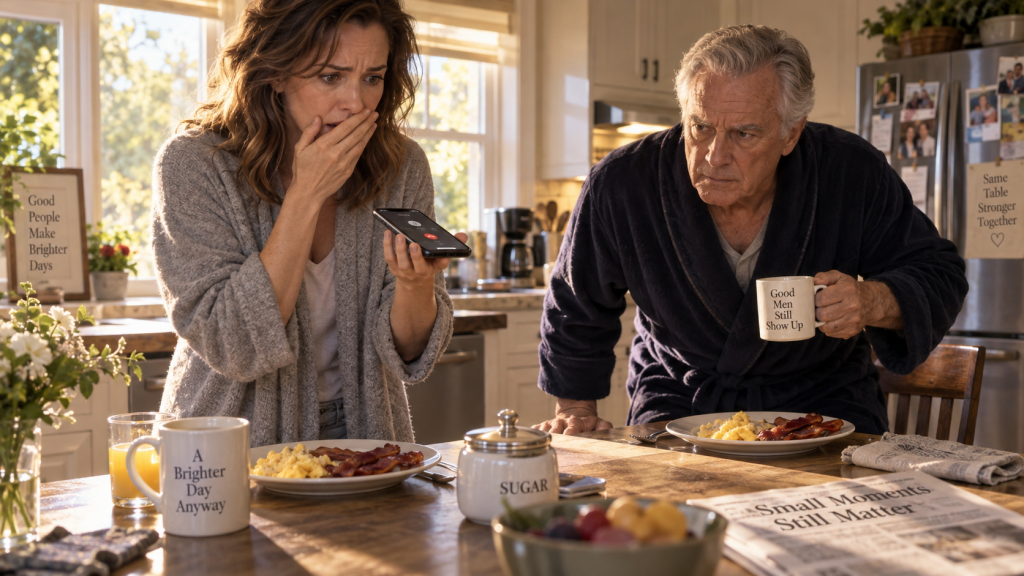
My sister called at 6:30 a.m. and said, “Dad died last night.” I looked across the kitchen—Dad was sitting three feet away, drinking my coffee and eating my bacon.

I stared at the glowing name on my phone.
Vanessa Cole.
My older sister almost never called before noon, so I immediately assumed something terrible had happened.
I had no idea she was about to invent it.
Dad reached across the kitchen table for another strip of bacon as I answered.
“Vanessa?”
For two seconds, all I could hear was the hum of a car engine and the steady clicking of a turn signal.
Then she said:
“Natalie, Dad died last night.”
My hand froze around my coffee mug.
Across from me, Dad stopped chewing.
I looked at him.
He looked at me.
Then I pressed speaker and placed the phone beside the sugar bowl.
“When?” I asked.
“Sometime during the night. Harold found him.”
That got Dad’s attention.
Harold Pike had been his closest friend for more than forty years.
They had fished together.
Gone to football games together.
Carried each other through marriages, illnesses, and decades of questionable decisions.
Harold had also owned the town’s funeral home before retiring.
For one uncomfortable second, Vanessa’s lie almost sounded believable.
“What happened?” I asked.
Vanessa sighed.
She didn’t cry.
She didn’t sniffle.
She sighed like I was wasting her time.
“Does it matter? He’s gone.”
Dad slowly lowered his fork.
Then Vanessa continued.
“Grant and I are handling everything. There’s really no reason for you to come to the house.”
Dad’s eyes narrowed.
“The locks are being changed this morning,” she added.
I heard Grant laughing somewhere in the background.
“Why are you changing the locks?”
“Because Grant and I found Dad’s papers. He left the house to us. The truck too. The accounts. Everything else.”
Dad and I stared at one another.
Then Vanessa delivered the sentence she had clearly been waiting to say.
“You were specifically excluded.”
Grant’s laughter grew louder.
A second later, his voice moved closer to the phone.
“You’re finally out of the family.”
Dad’s fingers tightened around his coffee mug.
Grant kept talking.
“No more showing up every few months pretending you’re the devoted daughter.”
For years, Vanessa had called me the daughter who ran away because I moved three states away for work.
Apparently, the phone calls didn’t count.
The plane tickets didn’t count.
Everything I had quietly done for Dad didn’t count either.
Especially what I had done during the last forty-eight hours.
I could have defended myself.
I didn’t.
Because Dad very carefully set his mug down on the table.
That worried me more than if he’d shouted.
My father became quieter when he was truly furious.
Vanessa continued as though nothing unusual was happening.
“Grant already has someone coming to evaluate the truck. We contacted the bank, and we’re going through Dad’s office today.”
Dad raised one eyebrow at the word office.
“And the house?” I asked.
“Obviously we’re keeping it.”
From the background, Grant shouted:
“Might renovate the kitchen!”
They both laughed.
Dad didn’t.
Vanessa told me she would pack whatever remained in my old bedroom into boxes and have Grant leave them beside the garage.
Then Grant took over again.
“Don’t make this difficult. Don’t challenge the will or start demanding things that aren’t yours. Vanessa stayed close to home. She deserves this.”
I stared through the kitchen window at the frost covering my backyard.
Grant continued.
“You made your choice years ago.”
Then he said the one thing that completely changed Dad’s expression.
“Your father obviously knew who really loved him.”
Dad went perfectly still.
I reached toward the phone, ready to end the call.
He stopped me with one raised hand.
Then he pointed toward himself.
I hesitated.
He pointed again.
Vanessa’s voice sharpened through the speaker.
“Natalie? Are you still there?”
“Oh, I’m here.”
“Good. Then understand this clearly. Dad made his decision. Everything belongs to Grant and me now.”
Grant laughed again.
“Finally.”
Dad stood up.
He tightened the belt of his navy robe and slowly walked around the kitchen table.
Vanessa was still talking about funeral arrangements, property, bank accounts, and everything she believed she had inherited from the man who was now standing three feet from my phone.
Dad bent toward the speaker.
Grant was still laughing.
Then my supposedly dead father opened his mouth.
“Vanessa.”
Silence.
Complete silence.
I heard something drop on the other end.
Dad’s voice remained calm.
“Before you renovate my kitchen, sweetheart, I think you and Grant should hear what I did with the house yesterday.”
And just like that, nobody was laughing anymore.
PART 2 — THE HOUSE HE REFUSED TO DIE FOR
For several seconds, nobody spoke.
Not Vanessa.
Not Grant.
Not me.
Even the turn signal clicking through the phone seemed to stop.
Dad stood over the kitchen table in his navy robe, one hand resting beside the sugar bowl.
His voice remained almost gentle.
That was how I knew my sister was in trouble.
Vanessa finally whispered:
“Dad?”
“Yes.”
Another silence.
Then Grant said somewhere farther from the phone:
“What the hell?”
Dad looked at me.
Raised one eyebrow.
I had to bite the inside of my cheek to keep from laughing.
Not because any of this was funny.
Because my father had apparently risen from the dead before breakfast, and Grant sounded personally offended by the inconvenience.
Vanessa found her voice first.
“What are you doing there?”
Dad looked at the phone.
“Eating bacon.”
“That’s not what I mean.”
“It was the question you asked.”
“No, Dad. Why are you at Natalie’s?”
He straightened.
“Because I drove here.”
“You drove three states away without telling anyone?”
“I told Harold.”
“That’s not family.”
Dad’s face changed.
Only slightly.
Harold had sat beside my father when Mom died.
Had driven him to radiation appointments.
Had repaired his porch twice without charging him.
Grant had borrowed Dad’s truck for nine months and returned it with a dent.
But apparently blood had begun issuing membership cards.
Dad replied:
“Interesting definition.”
Vanessa spoke faster.
“We were worried sick.”
I looked at Dad.
Dad looked at me.
Then I glanced down at the phone.
“You called me and said he was dead.”
Silence.
Grant muttered something.
Vanessa immediately said:
“There was confusion.”
Dad pulled out the chair beside me and sat.
“What confusion?”
“Harold called.”
Dad’s expression hardened.
“No, he didn’t.”
“He texted.”
“No.”
“Dad, I’m telling you—”
“I spoke to Harold at five forty-five this morning.”
That ended it.
Vanessa went quiet.
Dad continued.
“He is currently at my house.”
My stomach dropped.
Vanessa said nothing.
Dad looked at the clock.
“He was supposed to meet the locksmith.”
That produced a sound from the other end.
Not Vanessa.
Grant.
A low curse.
I stared at Dad.
“You sent Harold to the house?”
He nodded.
“Yesterday.”
Vanessa’s voice sharpened.
“What locksmith?”
“The one changing the locks.”
“You can’t do that!”
Dad actually smiled.
“My house.”
A pause.
Then:
“Actually, that needs updating.”
He leaned closer to the phone.
“The house is now held in my trust.”
No one spoke.
Grant finally said:
“What trust?”
Dad’s smile disappeared.
“The one you don’t control.”
Vanessa inhaled sharply.
“Dad, what did Natalie make you sign?”
The accusation came so quickly that I almost admired the efficiency.
There it was.
The story she needed.
Dad was alive.
Dad had changed something.
Therefore Natalie must have manipulated him.
Anything was better than admitting he had made a decision she disliked.
Dad’s face became very still.
“Natalie made me sign nothing.”
“Then why are you there?”
“Because she was the only one who answered honestly when I asked for help.”
That was not entirely fair.
He had not asked Vanessa.
Not in the same way.
I knew that.
So did he.
I touched his arm.
He looked at me.
“I didn’t do anything.”
I said softly.
He nodded.
“I know.”
Then turned back to the phone.
“That is why an attorney handled it.”
Vanessa laughed nervously.
“What attorney?”
“Mine.”
“You don’t have an attorney.”
“I do now.”
“Who?”
Dad looked at me.
I could see he was deciding how much to say.
Then:
“Marian Bell.”
Grant swore again.
Even I knew the name.
Marian had practiced elder law and estate planning in Dad’s county for more than thirty years.
She had represented families with farms, small businesses, second marriages, nursing-home crises, and every species of sibling war that can grow around an aging parent.
She was also famous for refusing to meet with adult children in the room when she was evaluating what the parent wanted.
Dad had met with her two days earlier.
Alone.
I waited in the parking lot.
That had been deliberate.
Vanessa said:
“You went to Marian Bell?”
“Yes.”
“Why?”
Dad’s eyes hardened.
“Because someone tried to use an old power of attorney at my bank.”
The kitchen went silent.
Even I had not heard him phrase it that plainly.
I knew there had been a problem.
I did not know someone had actually tried to use it.
Vanessa’s breathing changed.
Grant stopped making noise.
Dad continued.
“The bank called me Tuesday.”
I stared at him.
Tuesday.
Forty-eight hours earlier.
The day he called me and said:
“Nat, I need you to come get me.”
No explanation.
Just that.
I had booked the first flight I could.
By Wednesday morning we were sitting in Marian Bell’s office.
Vanessa spoke carefully.
“What old power of attorney?”
Dad laughed once.
“Amazing.”
“What?”
“You knew exactly what drawer to search after I supposedly died, but suddenly you don’t remember paperwork you asked me to sign three years ago.”
My skin prickled.
Dad had mentioned an old document.
I assumed it was something routine.
Apparently not.
Vanessa said:
“That was for emergencies.”
“Yes.”
“After your surgery.”
“Yes.”
“You asked me to help.”
“I did.”
Her voice strengthened.
“There. Exactly.”
Dad nodded slowly.
“And then I recovered.”
Silence.
“And then I told you last year I didn’t want you using it anymore.”
“You never revoked it.”
Dad looked almost sad.
“I have now.”
Grant moved close to the phone.
“This is ridiculous.”
Dad’s expression changed at once.
Grant continued.
“Vanessa was trying to protect you.”
“From what?”
“You’re eighty-one.”
“Correct.”
“You forget things.”
Dad’s eyes narrowed.
“I forgot where I left my glasses last week.”
“That is not the same as forgetting who owns my house.”
Grant ignored him.
“You can’t just disappear, start signing trusts, and pretend nobody should be concerned.”
Dad replied:
“I didn’t disappear.”
“You didn’t tell Vanessa.”
“That is apparently what disappearance means now.”
Then Vanessa said the thing she would later deny saying.
“We were trying to get things organized before something happened.”
Dad’s voice dropped.
“Before I died?”
Silence.
I felt something move through him.
Not anger this time.
Pain.
The real thing.
He had heard his daughter announce his death.
He had heard her husband laugh.
He had listened while they divided his truck, his accounts, his house, and my old bedroom.
Now he was being told it was preparation.
There are injuries money cannot explain.
This was one of them.
Dad asked:
“Who told you I died?”
Vanessa said nothing.
“Vanessa.”
“We misunderstood Harold.”
“No.”
His voice sharpened.
“Harold has not spoken to you since Sunday.”
I looked at him.
“How do you know?”
“He showed me the call log.”
Of course he did.
Dad had arrived at my house with two grocery bags, a duffel bag, and the energy of a man quietly building a criminal case against his own children.
Not literally.
But close enough.
Vanessa finally said:
“I called Harold yesterday.”
Dad waited.
“He didn’t answer.”
“Yes.”
“So when you weren’t home…”
“You decided I was dead?”
“You weren’t answering.”
Dad looked at his phone on the table.
He had turned it off after Marian’s office.
At my suggestion.
Because Vanessa had called fourteen times in two hours after finding out he had missed lunch with her.
At the time, I thought she was worried.
Maybe some of it had been worry.
Maybe some of it had been panic because a man she expected to control had suddenly become unavailable.
Motives are rarely tidy enough to hate cleanly.
Dad asked:
“When did you go into my house?”
Vanessa hesitated.
My stomach tightened.
“What?”
Dad asked again.
“When did you go inside?”
Grant answered this time.
“Last night.”
“How?”
“We have a key.”
“I changed that lock eighteen months ago.”
Silence.
Dad’s eyes moved toward me.
There it was.
Something new.
“How did you get in?”
Vanessa snapped:
“You gave me a spare.”
“No.”
“I did not.”
Grant said:
“The back door.”
Dad’s face changed.
“What about it?”
“The latch never catches right.”
I saw the realization hit him.
They had let themselves in.
Not after his death.
Before even inventing his death.
Dad leaned back slowly.
“So you entered my house last night because I wasn’t answering.”
“We were concerned.”
“And then searched my office.”
No response.
“And found papers you believed were my estate documents.”
Silence.
“And this morning, before checking whether I was alive, you called Natalie to tell her she was disinherited.”
The quiet on the phone became unbearable.
I closed my eyes.
There it was.
The whole thing.
They had not discovered Dad dead.
They had discovered him absent.
And somehow absence became permission.
Permission to enter.
Search.
Interpret.
Claim.
Then erase me.
Dad’s voice was no longer angry.
That frightened me more.
“Vanessa.”
She whispered:
“Yes?”
“I need you and Grant to leave my house.”
“We’re already outside.”
Good.
Harold and the locksmith had apparently done their jobs.
Dad nodded.
“Then stay outside.”
“You can’t keep us from your house.”
“I can keep you from mine.”
“Dad.”
“No.”
He looked at the phone.
“You do not enter again unless I invite you.”
Then he ended the call.
For ten seconds, none of us moved.
Then Dad picked up his coffee.
It was cold.
He drank it anyway.
I stared at him.
“You knew they might go there.”
“I suspected.”
“You set up a locksmith.”
“Yes.”
“Harold is standing there right now.”
“Yes.”
“And you didn’t tell me?”
He looked at me.
“I’m sorry.”
That was one thing Dad did better than most people.
He could apologize without immediately dragging an explanation behind it.
Then he added:
“I wanted to keep you out of the middle as much as possible.”
I laughed.
“Dad, they just told me you were dead.”
“Fair.”
I stood and poured him fresh coffee.
My hands were shaking now that the call was over.
He noticed.
“You okay?”
“No.”
“Good.”
I looked at him.
“What?”
“I’d worry if that felt normal.”
I sat again.
“Tell me everything.”
Dad looked toward the window.
Frost still covered the yard.
Then he nodded.
Two weeks earlier, Dad had gone to his bank to renew a certificate of deposit.
He had banked there since before ATMs.
One of the assistant managers asked whether his daughter would continue “helping with his accounts.”
Dad asked what she meant.
That was when he learned Vanessa had been asking questions.
Not stealing money.
Not yet.
Questions.
Whether Dad’s accounts could be consolidated.
Whether she could be added as an authorized signer under a power of attorney.
Whether his checking could be linked to an account she was opening “to simplify bills.”
The bank employee did what she was supposed to do.
She checked the document.
It was real.
A power of attorney Dad had signed three years earlier before a major heart procedure.
Broad authority.
Legitimate at the time.
Still technically in their files because nobody had delivered a revocation.
But something about Vanessa’s request bothered the assistant manager.
She called Dad.
“What did Vanessa say when you asked her?”
I asked.
Dad rubbed his forehead.
“She said she was planning.”
“For what?”
“My future.”
I winced.
He smiled without humor.
“Apparently everyone is very interested in my future except me.”
“What did you tell her?”
“To stop.”
“And?”
“She cried.”
That surprised me.
“Vanessa?”
“Yes.”
“Said I didn’t trust her.”
Dad stared into the coffee.
“The annoying part was that I did.”
He had trusted Vanessa.
That was why she had the power of attorney.
She lived twenty minutes away.
She drove him to a few appointments after surgery.
She helped file insurance claims when his hands shook.
She organized prescriptions.
For a while, she had done exactly what the document was intended to let her do.
Then Dad recovered.
He returned to driving.
Paying bills.
Managing his own investments.
The emergency ended.
The authority remained.
That was the danger.
Temporary power has a way of becoming emotionally permanent for the person holding it.
Dad asked Vanessa to return copies of the document.
She said she would.
Then apparently didn’t.
A week later, the bank called again.
This time, she had asked whether the power of attorney would allow her to open a safe-deposit box in Dad’s name.
The bank refused to move forward without additional review.
That was when Dad called Harold.
Then me.
“Why me?”
I asked.
His face softened.
“Because you don’t live there.”
I almost laughed.
“For years Vanessa said that was proof I abandoned you.”
“I know.”
“And now it’s a qualification?”
“It made you inconvenient.”
That sounded like Dad.
Then he grew serious.
“I needed someone outside the argument.”
“You weren’t asking what I should do.”
“No.”
“You were asking for a ride.”
“Yes.”
“To a lawyer.”
“Yes.”
I nodded.
That distinction mattered.
He had not summoned me to take sides.
He had asked me to help him get somewhere he could make his own decisions.
Forty-eight hours earlier, I had flown home.
Harold picked me up at the airport.
Dad packed a bag.
Then all three of us drove to Marian Bell’s office.
Marian asked Harold and me to wait outside.
Dad stayed inside for ninety minutes.
Afterward, a second attorney from the firm met with him briefly regarding capacity documentation and execution procedure.
Not because Dad was confused.
Because Marian was cautious.
If an eighty-one-year-old man changed his estate plan after conflict with one adult child, somebody would eventually say he had been manipulated.
Marian wanted a clean record.
Dad agreed.
“What did you change?”
I asked.
He looked at me.
“Enough.”
“Dad.”
He smiled.
“You sound like Vanessa.”
“Take that back.”
That got the first real laugh of the morning.
Then he told me.
He revoked every prior financial power of attorney.
He named a professional fiduciary as first financial agent if he became incapacitated, with Harold as a limited backup for certain practical matters.
Not me.
That surprised me.
“You didn’t name me?”
“No.”
“Why?”
“Because I love you.”
I blinked.
“That makes no sense.”
“It will.”
He had spent the previous year watching siblings in town stop speaking over parents’ accounts.
Who paid bills.
Who moved money.
Who “borrowed” from the house.
Who deserved reimbursement.
He did not want either daughter placed in a position where the other could accuse her of controlling everything.
“So neither of us gets the keys.”
“Correct.”
I smiled.
“Annoyingly sensible.”
“I had expensive advice.”
Apparently everyone had lawyers now.
His healthcare paperwork was different.
He named me first for medical decisions.
Vanessa second.
I stared.
“Why me?”
“Because you ask questions.”
“Vanessa asks questions.”
“She asks until people say what she wants.”
Ouch.
Then Dad added:
“But I kept her on it.”
That mattered.
Despite everything.
He had not erased her.
Then came the house.
The sentence he had used on the phone.
“What did you do yesterday?”
Dad sat straighter.
“I signed a new trust.”
“Revocable?”
He smiled.
“Look at you.”
“I’ve watched television.”
“Yes.”
“A revocable living trust.”
He remained trustee while competent.
The house had been deeded into the trust.
His primary accounts were being retitled appropriately.
Not because the trust made him immortal.
Because it created continuity and made the instructions clearer.
He still owned and controlled everything through the trust structure.
Nobody inherited because they found a folder.
Nobody became owner because he missed breakfast.
“And who gets the house?”
I asked.
Dad looked at me.
“No.”
“No what?”
“No fishing.”
“I’m not fishing.”
“You’re holding an imaginary rod.”
I rolled my eyes.
Then he softened.
“The house is not going entirely to either of you.”
That surprised me.
“The trust says it should be sold after my death unless both of you agree on another arrangement.”
“Then what?”
“Expenses first.”
“Some charitable gifts.”
“Then family distributions.”
“Equal?”
He looked at me.
“Natalie.”
“Fine.”
I stopped.
It was his money.
That was the point.
He had also added a no-contest-related provision his attorney considered appropriate under the governing law and circumstances, though Dad admitted Marian had spent ten minutes explaining why such clauses were not magical shields.
The more important protection was documentation.
Independent lawyer.
Clear instructions.
Capacity notes.
Witnesses.
No child in the room.
No secret midnight deed.
Boring.
Clean.
Harder to rewrite after he died.
Then Dad opened the leather folder he had brought with him.
Inside was a copy of the old will Vanessa thought she had discovered.
I recognized Dad’s signature.
Date:
nine years earlier.
Before Mom died.
Before Dad’s heart surgery.
Before almost everything.
He tapped the page.
“This is what they found.”
I read.
The old will left most tangible property between both daughters.
Not Grant.
Not Vanessa alone.
Both daughters.
I frowned.
“She told me I was specifically excluded.”
Dad nodded.
“She lied.”
“Why?”
“I assume she thought you couldn’t see the document.”
My chest tightened.
So even the inheritance she claimed was not real.
Not only because Dad was alive.
Because the paper itself contradicted her.
“What about the truck?”
Dad snorted.
“Truck isn’t even in the will.”
“Then why did she say—”
“Because people hear ‘estate’ and apparently develop creative-writing skills.”
I laughed.
Then stopped.
“What were they doing in your office?”
Dad looked tired.
“That is what I intend to find out.”
Harold called at eight-fifteen.
Dad put him on speaker.
“House secure?”
Harold replied:
“Fort Knox, assuming Fort Knox had a dog door and your terrible porch.”
Dad ignored that.
“Vanessa?”
“Gone.”
“Grant?”
“Also gone.”
“Did they take anything?”
Harold hesitated.
Dad’s face hardened.
“What?”
“Your office is a mess.”
My stomach dropped.
“Mess how?”
“Desk drawers open.”
“File cabinet.”
“Closet.”
“Safe?”
Harold paused.
Dad stood.
“What about the safe?”
“Open.”
Dad went pale.
I had never seen my father look afraid of losing possessions.
Not even after a burglary when I was fourteen.
He cared about certain documents.
Mom’s jewelry.
Old photographs.
Insurance records.
The safe mattered.
“What’s missing?”
Harold said:
“I don’t know.”
Dad closed his eyes.
“I need to come back.”
I stood.
“You’re not driving.”
He opened one eye.
“I have a license.”
“You have blood pressure.”
“I had that yesterday too.”
“Dad.”
Harold interrupted:
“Natalie’s right.”
Traitor.
Dad muttered something.
We packed before nine.
The drive back took almost six hours.
Dad slept for one.
The rest of the time, he stared through the window.
Finally he said:
“I should have seen it.”
I kept my eyes on the highway.
“What?”
“Vanessa.”
“Don’t do that.”
“Do what?”
“Rewrite every year because of one morning.”
He looked at me.
I continued.
“She helped after surgery.”
“Yes.”
“She brought groceries.”
“Yes.”
“She drove you.”
“Yes.”
“Those things were real.”
“So was this.”
“Yes.”
Both.
Life again refusing simplicity.
Dad stared at his hands.
“I spoiled her.”
“You helped all of us.”
“Not the same.”
He told me things I had forgotten.
When Vanessa was twenty-three, he covered rent for eight months.
When Grant’s landscaping business failed, Dad paid their mortgage twice.
When they needed a down payment for their current home, Dad gave them money.
Not loaned.
Gave.
He had also helped me.
Graduate school.
My first apartment after divorce.
A furnace replacement.
Neither daughter was innocent of parental rescue.
Maybe that was why inheritance had become emotionally dangerous.
Gifts remembered by the giver often become invisible to the receiver.
“I think she started seeing the house as hers years ago.”
Dad said.
“Maybe.”
“I let her.”
“Maybe.”
He looked irritated.
“You’re not being helpful.”
“I’m driving.”
“That’s apparently your qualification.”
I smiled.
There he was.
We reached the house shortly before three.
Harold sat on the porch.
Beside him was Marian Bell.
That surprised me.
She stood as Dad approached.
“Do not enter yet.”
Dad stopped.
“What happened?”
“We need to document the condition.”
Of course.
Dad looked at me.
“Lawyers have ruined trespassing for everyone.”
Marian ignored him.
A photographer hired by the firm had already taken pictures.
Not because this was a crime scene.
Because if documents later turned up missing, everyone needed a record of what the office looked like before people started rearranging it.
We entered together.
The house smelled like Dad.
Coffee.
Old wood.
Cedar from the hall closet.
Home.
The office looked wrong.
Drawers open.
Papers on the floor.
Desk chair pushed back.
A framed picture of Mom lying face down beside the printer.
Dad walked over.
Picked it up.
That was the first thing he fixed.
Not the safe.
Not the files.
Mom.
He wiped dust from the glass.
Set her upright.
Then whispered:
“Idiots.”
I did not know whether he meant Vanessa and Grant or all of us.
The safe door hung open.
Dad knelt.
I crouched beside him.
“Combination?”
“Vanessa knew the old one.”
“You changed it?”
“Apparently not enough.”
Inside remained:
Mom’s wedding ring.
Property documents.
A small stack of cash.
Military papers from Dad’s brother.
Some old bonds.
Dad moved things one by one.
Then stopped.
“What?”
I asked.
He reached deeper.
Nothing.
“Dad.”
He sat back.
“The blue envelope.”
Marian stepped closer.
“What was in it?”
Dad looked at her.
“My updated beneficiary list.”
My stomach tightened.
“What kind?”
“Accounts.”
Dad swallowed.
“Insurance.”
“Approximate balances.”
Marian’s face changed.
That was serious.
Not because the paper itself transferred anything.
Because it contained a roadmap.
“What else?”
Harold asked.
Dad looked through the safe again.
“One checkbook.”
“Which account?”
“My old household account.”
“Active?”
“Yes.”
Marian immediately asked him not to use the account until the bank could review.
Dad looked furious.
Not panicked.
Violated.
There is a particular humiliation in discovering someone has gone through the private drawer where you keep the small structure of your life.
I knew that look.
It hurt to see on him.
Then Harold found something under the desk.
A yellow sticky note.
Three numbers.
One account ending.
One phone number.
And:
MONDAY 10:00
Dad frowned.
“That’s Vanessa’s handwriting.”
Marian photographed it.
“Do you recognize the phone number?”
Dad did not.
Harold did.
He stared.
“That’s Martin Hayes.”
Dad looked at him.
“Who?”
“Real-estate auction company.”
My stomach dropped.
Vanessa had already told me Grant had someone coming to evaluate the truck.
Apparently the house may not have been far behind.
Dad sat in his desk chair.
For a long time, he said nothing.
Then:
“She thought I was dead before she bothered to confirm it.”
I leaned against the desk.
“Dad.”
“No.”
He looked at me.
“That is the part I cannot get past.”
Not the documents.
Not the house.
Not the bank.
“She wanted it to be true badly enough that she acted like it was.”
I did not know what to say.
So I did something I had learned from Mom.
Nothing.
I stood beside him.
Sometimes grief needs a witness more than advice.
Vanessa arrived twenty minutes later.
Of course she did.
Grant drove.
Marian saw them through the window and said:
“No shouting.”
Dad looked offended.
“I am eighty-one.”
“That is not a defense.”
Harold laughed.
I almost did.
Then the doorbell rang.
Vanessa stood outside crying.
Real tears this time.
Grant behind her.
No laughter.
Dad opened the inner door but kept the storm door locked.
“Dad.”
Vanessa pressed one hand against the glass.
“I’m sorry.”
He stared.
“For which thing?”
She cried harder.
“The call.”
“The house.”
“Everything.”
Grant said:
“We panicked.”
Dad looked at him.
“You burgled my office.”
“We didn’t steal anything.”
Dad’s face changed.
“The blue envelope is gone.”
Grant went still.
Vanessa turned toward him.
That reaction was enough to make every adult on our side of the door notice.
Dad asked:
“Grant?”
He shook his head.
“I didn’t take it.”
Vanessa looked at him.
“Then where is it?”
“I don’t know.”
“You had it.”
Silence.
My heartbeat changed.
Dad’s voice became quiet.
“You saw the envelope?”
Grant realized too late what he had done.
He looked away.
Vanessa closed her eyes.
“Grant.”
“What?”
“You said you put it back.”
The porch went completely silent.
There it was.
Not speculation anymore.
He had handled it.
Dad unlocked the storm door.
Marian immediately said:
“Walter.”
He ignored her.
Not wisely.
But he did not step outside.
“Give me my papers.”
Grant folded his arms.
“I don’t have them.”
“Where are they?”
“I made copies.”
Vanessa stared.
“You what?”
Grant turned toward her.
“Because we needed to know what he had.”
Dad’s face went white.
Not with age.
Rage.
“You needed to know nothing.”
Grant answered:
“We’ve been taking care of you.”
Dad laughed.
It sounded broken.
“You mowed my lawn twice.”
Grant’s jaw tightened.
“You know what I mean.”
“No.”
Dad said.
“I don’t think I do anymore.”
Vanessa whispered:
“Grant, where are the copies?”
He hesitated.
That was the worst possible response.
Marian stepped closer to the door.
“Mr. Cole, do not destroy anything.”
His eyes moved toward her.
“Who are you?”
“Walter’s attorney.”
He looked at Dad.
Then Vanessa.
The room shifted.
Grant finally understood this was no longer a kitchen-table inheritance fantasy.
There were records now.
Dates.
Banks.
Lawyers.
A man who was not dead and could still speak for himself.
“I emailed them.”
Grant said.
Dad’s hand tightened on the doorframe.
“To who?”
No answer.
“Grant.”
Vanessa’s voice broke.
“To who?”
He swallowed.
“Martin.”
The auction man.
My stomach dropped.
“And?”
Grant looked at Dad.
“A financial adviser.”
“What adviser?”
A pause.
Then he named Derek Sloan.
Dad went still.
I did not recognize the name.
Vanessa did.
Her face changed.
“That’s the guy from Heritage Senior Planning.”
Marian’s expression sharpened.
She knew the firm.
Not approvingly.
Dad looked at her.
“What?”
She spoke carefully.
“They market financial and estate-planning services to older clients.”
“Some legitimate.”
“Some arrangements require very careful review.”
Dad stared at Grant.
“You sent my account information to someone I have never met?”
Grant said:
“We were trying to figure out how to protect everything.”
Dad almost whispered:
“From me?”
No one answered.
Marian ended the conversation.
Not dramatically.
Professionally.
She told Vanessa and Grant not to enter the property.
Asked them to preserve all copies, emails, texts, and documents.
Told them future questions involving Dad’s property should go through counsel until he decided otherwise.
Vanessa cried.
Grant became angry.
Dad closed the door.
Then leaned against it.
Old.
For the first time all day, simply old.
I reached for him.
He let me.
That evening, Dad sat at his kitchen table.
Same kind of table as mine.
Different bacon.
No appetite.
He stared at Mom’s photograph.
Then said:
“I don’t want to disinherit her.”
I looked at him.
“Okay.”
He seemed surprised.
“You’re not going to tell me I should?”
“No.”
“Why?”
“Because it’s not my will.”
There.
The sentence all of us needed.
He nodded slowly.
Then started crying.
“I’m angry.”
he whispered.
“I know.”
“I don’t trust her.”
“I know.”
“She lied about my death.”
“I know.”
“But she’s still my daughter.”
“I know.”
He wiped his face.
“Your mother would know what to do.”
“No.”
He almost smiled.
“Mom would tell you what to do.”
“Different.”
That made him laugh through tears.
Good.
The following week was paperwork.
Again.
Bank reviews.
New account safeguards.
Canceled checks.
Password changes.
Credit monitoring.
Updated mailing instructions.
Marian contacted the adviser Grant had emailed.
The documents had been received but no transaction completed.
Good.
The auction company had only scheduled a preliminary visit based on Grant’s representation that he was helping settle an estate.
That appointment was canceled.
Dad was very much alive.
That helped.
The checkbook was recovered.
Grant had taken it.
He claimed only to check outstanding expenses.
No checks had cleared.
Again:
Important distinction.
Bad judgment.
Unauthorized access.
But not every feared theft had become an actual loss.
Facts mattered.
Even when anger wanted more.
The copied beneficiary list was recovered too.
Not magically.
Through lawyers.
Dad’s bank changed account-access procedures.
Marian replaced certain documents that had been compromised.
Dad’s professional fiduciary received updated information.
Harold learned where the spare house key lived.
I received nothing except Dad’s emergency medical folder.
That was enough.
Vanessa did not speak to Dad for twelve days.
Then she wrote a letter.
Actual paper.
Not text.
Dad read it alone.
Afterward he handed it to me.
I shook my head.
“No.”
“You don’t want to?”
“It’s yours.”
His eyes softened.
He folded it again.
Good.
A boundary.
We were all learning.
He told me only what he wanted.
Vanessa apologized for the death lie.
Admitted she and Grant had entered the house because they believed Dad was becoming secretive.
Admitted the “death” story began when Grant said:
“If Natalie thinks he’s gone, maybe she’ll tell us what he’s been saying.”
I stared.
“So they knew you weren’t dead.”
Dad nodded.
There it was.
Worse.
Cleaner.
They had never actually believed it.
The death was bait.
They wanted to know whether I had information.
Whether Dad had changed documents.
Whether I planned to challenge them.
Vanessa called me not to report a death.
She called to see what the supposedly excluded daughter knew.
“That hurts more.”
I said.
“Yes.”
Dad stared out the window.
“She killed me in conversation to see who would grab the furniture.”
I had no answer for that.
Then he said:
“She says Grant pushed it.”
“Do you believe her?”
“Partly.”
That was Dad.
Not simple.
Not absolving.
Not flattening.
“Grant is greedy.”
he said.
“Vanessa is afraid.”
“Of what?”
“Being less important.”
That surprised me.
Dad continued.
“She stayed near home.”
“You left.”
“She built her identity around being the one who stayed.”
“So when I asked you to help me with the lawyer…”
“She thought staying had stopped guaranteeing first place.”
I looked at him.
“Families are exhausting.”
“Yes.”
“And people wonder why I like fishing.”
Dad met Vanessa alone three weeks later.
Public place.
Harold nearby but not at the table.
Grant not invited.
Vanessa cried.
Dad listened.
He did not restore the power of attorney.
Did not give her the key.
Did not promise anything about inheritance.
He also did not cut her off forever.
He told her:
“You may be my daughter without being my manager.”
When he repeated that sentence to me later, I wrote it down.
Some sentences deserve preservation.
Grant took longer.
Dad refused contact for months.
Not as punishment.
Because he did not trust him.
That was consequence.
Different.
Vanessa eventually separated from Grant for a time.
Not because Dad demanded it.
Because, according to her, the morning on the porch made her realize how quickly Grant had begun speaking about property as though it were already theirs.
Whether she had done the same mattered too.
Dad told her so.
She did not like hearing it.
Good.
And then Marian found something in the old estate file.
A note.
Not from Grant.
Not Vanessa.
From Dad.
Written two years earlier.
After one of our family Christmases.
It said:
Need to simplify. Girls will fight if I leave ambiguity. Natalie assumes Vanessa gets everything because she is local. Vanessa assumes Natalie deserves less because she left. Both wrong.
I stared.
“You knew?”
Dad smiled tiredly.
“I raised you.”
Fair.
Then beneath it:
House is not proof of love. Money is not attendance. Distance is not abandonment. Proximity is not devotion. Need plan that does not reward competition.
I swallowed.
“When did you write that?”
“After Vanessa complained you only visited twice that year.”
“I flew in twice.”
“I know.”
“And called every week.”
“I know.”
“Then why didn’t you defend me?”
Dad looked ashamed.
“I should have.”
That small apology mattered more than a house ever could.
The trust remained.
Dad changed one thing after the incident.
Not who received the biggest percentage.
Not some dramatic revenge clause.
He added a professional executor-equivalent role under the trust structure so neither daughter would be responsible for dividing property after his death.
The house would be sold.
The truck too, unless Dad sold it first.
Personal items would be handled through a written memorandum he updated himself.
Mom’s ring went to Vanessa.
Her recipe box went to me.
Harold got Dad’s fishing boat.
That one caused actual outrage.
I objected.
“So did Vanessa.”
Dad smiled.
“Excellent.”
Apparently fairness sometimes means making both children equally annoyed.
Then he did something I did not expect.
He moved.
Not to me.
Not to Vanessa.
To a smaller townhouse twenty minutes from Harold.
One floor.
Less maintenance.
He sold the old house while he was alive.
That solved more than any trust clause ever could.
Vanessa cried when the sign went up.
I did too.
That house held Mom.
Christmas.
Our height marks on the basement door.
The stain where Grant spilled red wine the first year he met us.
Dad stood in the empty kitchen on closing day.
Touched the counter.
Then said:
“Good house.”
Nothing more.
Some grief does not need decoration.
He used part of the proceeds for himself.
A crime, according to adult children everywhere.
New truck.
Hearing aids he had delayed buying.
A ridiculous fishing trip with Harold.
He sent us a photograph from Montana holding a trout and wearing a hat that made him look ninety.
Vanessa texted:
Tell Dad to spend my inheritance slower.
I replied:
His money.
She sent back:
I know. Working on it.
That was progress too.
But that came later.
The week after the fake-death call, none of us knew how any of this would end.
All I knew was that my father was alive.
Angry.
Embarrassed.
And sitting at his own table while two attorneys, one banker, and Harold Pike helped untangle what other people had begun arranging around him.
Then, on Friday afternoon, Marian called.
Dad answered.
His face changed.
“What?”
I looked up.
He listened.
Then:
“Are you sure?”
Another pause.
His eyes moved toward me.
Not fear.
Something harder to read.
When he hung up, I asked:
“What happened?”
Dad stared at the phone.
“Marian found out why Grant sent my beneficiary list to that adviser.”
My stomach tightened.
“Why?”
He leaned back.
“Because Vanessa and Grant had already met with him.”
“When?”
“Three weeks ago.”
Before the bank call.
Before Dad came to me.
Before the fake death.
“What did they discuss?”
Dad swallowed.
“My house.”
“My accounts.”
“And whether I could be declared incapable of managing them.”
The room went cold.
I stared.
Dad’s voice lowered.
“They weren’t waiting for me to die.”
He looked toward the window.
“They were trying to figure out what they could control while I was still alive.”
And suddenly Vanessa’s lie about his death no longer felt like the beginning.
It felt like the first thing we happened to hear.
PART 3 — THE MORNING HE REALLY DIED
For a long time after Dad hung up with Marian, neither of us spoke.
The kitchen clock ticked.
The refrigerator hummed.
Somewhere outside, a truck passed over wet pavement.
Ordinary sounds.
That was the strangest part.
The world had not changed at all.
And yet my father had just learned that his own daughter and son-in-law had sat across from a stranger three weeks earlier and discussed whether he could be declared incapable of managing his own life.
Dad finally said:
“Well.”
I looked at him.
“Well?”
“I always wanted children who planned ahead.”
I laughed despite myself.
Then immediately cried.
Dad did not.
Not yet.
Marian arrived forty minutes later.
She brought a copy of the adviser’s intake notes.
Not because he had voluntarily handed over everything.
Because after Dad’s attorney contacted him, he agreed—through his own counsel—to preserve the records and provide what he lawfully could regarding Dad’s information and the meeting held about him.
His name was Derek Sloan.
The irony of having another Derek in another family would have amused me under different circumstances.
Today, nothing amused me.
Marian sat at Dad’s table.
Harold came too.
Dad insisted.
“I want one person here who has known me since Nixon.”
Harold replied:
“That does not improve your credibility.”
Dad almost smiled.
Good.
Marian placed the notes on the table.
“Walter, I want to start with something important.”
Dad nodded.
“No adviser can simply declare you incapacitated.”
“I know.”
“I need Natalie to hear it too.”
I leaned forward.
She continued.
“Aging is not incapacity.”
“Forgetting a name is not incapacity.”
“Needing help with one task is not incapacity.”
“Making a decision your children dislike is certainly not incapacity.”
Dad looked at me.
“Put that on a T-shirt.”
Marian ignored him.
“Any legal process that would remove significant decision-making authority from you would require proper proceedings, evidence, and procedural protections.”
“So they couldn’t just walk in and take over?”
I asked.
“No.”
“Good.”
Dad leaned back.
“Then why am I still angry?”
“Because people you trusted were discussing how to prove you unable to manage yourself.”
Exactly.
Legal impossibility did not erase personal betrayal.
The notes were careful.
That made them worse.
Nothing said:
We want Walter’s money.
Nothing said:
Help us take the house.
People rarely write their ugliest motive in complete sentences.
Instead:
Client family concerned re aging parent.
Increasing secrecy.
Unilateral financial decisions.
Resistance to assistance.
Possible cognitive decline.
Dad read that phrase twice.
Then looked at me.
“Possible cognitive decline.”
Harold snorted.
“You still beat me at gin.”
“That proves you’re stupid, not that I’m healthy.”
They glared at each other.
Marian waited.
She understood old men better than I did.
The notes continued.
Vanessa had reported that Dad sometimes misplaced bills.
True.
He had.
Dad admitted it.
She said he repeated stories.
Also true.
He was eighty-one.
Half his stories deserved repeating.
She said he had become “suspicious about finances.”
That was technically true too.
Because she had been attempting to use his power of attorney.
Grant had reportedly raised concerns about Dad “changing long-standing estate intentions under outside influence.”
Outside influence apparently meant me.
A daughter living three states away who did not even know what his estate plan said.
I stared at the page.
“They were building a story.”
Marian nodded.
“Yes.”
“Does that mean every concern was invented?”
“No.”
Dad looked at her.
That answer mattered.
Marian continued.
“Vanessa may genuinely have been concerned about changes in your behavior.”
Dad’s jaw tightened.
“She may also have interpreted ordinary aging through a lens that benefited her.”
“Both can be true.”
There it was again.
The sentence families hate because it refuses to give anyone the clean role of villain or victim.
Dad stared at the notes.
“What did Grant say?”
Marian hesitated.
Then read:
Spouse reports father-in-law has become resistant to family oversight and may be vulnerable to daughter residing out of state.
Dad laughed.
Not happily.
“Family oversight.”
Harold said:
“You’re a bridge inspection now.”
Dad flipped him off.
Marian pretended not to see.
Then we reached the part that changed everything.
Grant had asked:
If Walter were found unable to manage property, could Vanessa assume control under existing documents?
Derek Sloan had apparently told them the old power of attorney might matter depending on validity, scope, revocation, and Dad’s actual condition.
He also told them they needed legal advice, not financial-sales advice, before making assumptions.
That mattered.
The adviser had not encouraged them to seize anything.
He had answered a hypothetical.
Then Grant asked:
Would transferring house before formal incapacity make things easier?
I stopped breathing.
Dad went still.
Marian turned the page.
Sloan’s note beneath it read:
Advised no transaction should occur without Walter’s informed authorization and independent legal counsel.
Good.
Very good.
At least one person in the room had understood the difference between helping an old man and replacing him.
Dad stood.
Walked to the sink.
Stared out the window.
Then whispered:
“They were waiting for me to become convenient.”
I rose.
He lifted one hand.
Not now.
So I stayed seated.
That was becoming my own lesson.
Love does not always mean approaching.
Sometimes it means letting a person stand at the sink without being comforted before they are ready.
After several minutes, Dad returned.
“What happens now?”
Marian folded her hands.
“Whatever you choose.”
Dad stared at her.
“No dramatic courtroom?”
“Not unless someone creates one.”
“No declaration that my daughter is greedy?”
“No.”
“No jail?”
“Walter.”
“Worth asking.”
Harold laughed.
Marian continued.
“You already revoked the power of attorney.”
“The bank has been notified.”
“The trust is valid.”
“Your accounts are being secured.”
“What I recommend now is independent medical documentation of your current cognitive status.”
Dad grimaced.
“I don’t need a doctor to tell me I know my own name.”
“No.”
“But if someone later alleges incapacity, a contemporaneous evaluation can help establish what your condition was when you made these decisions.”
Dad looked irritated.
Then:
“Fine.”
He had spent his life telling people to plan for storms.
Apparently legal weather counted.
Two days later, Dad sat through a full geriatric evaluation.
He hated every minute.
Memory questions.
Medication review.
Functional assessment.
Conversation.
His physician documented mild age-related forgetfulness.
No evidence of dementia.
No inability to understand finances or consequences.
No basis for concluding he lacked capacity to make his own decisions.
Dad came out of the appointment furious.
“They asked me to draw a clock.”
I tried not to laugh.
“Could you?”
“Perfectly.”
“Then what’s the problem?”
“I have a watch.”
Fair.
The evaluation did not prove Dad would remain sharp forever.
Nothing could.
It proved something simpler.
At the time Vanessa and Grant were discussing his incapacity, Walter Cole understood exactly what he owned, what he wanted, and what he was signing.
That mattered.
Not only legally.
Emotionally.
Because age had not turned him into open property.
Vanessa asked to see him again.
Dad said no.
Then yes.
Then no.
Finally Marian suggested something Dad hated because it sounded therapeutic.
A structured family meeting.
Neutral office.
No Grant.
Me only if Dad wanted.
He did.
“Why?”
I asked.
“Because if she starts rewriting history, I need a witness who shares some of it.”
That was not entirely healthy.
Still.
I went.
Vanessa looked ten years older when she walked into Marian’s conference room.
No makeup.
Hair tied back.
No Grant.
She sat across from Dad.
Did not reach for him.
Good.
Dad asked one question.
“Did you think I had dementia?”
Vanessa began crying.
Dad waited.
Eventually she said:
“I didn’t know.”
“That’s not an answer.”
“I noticed things.”
“What things?”
“You forgot my anniversary dinner.”
Dad frowned.
“That was because I hate Grant.”
Harold would have applauded.
I looked down.
Vanessa almost smiled.
Then cried harder.
“You forgot where you put your insurance forms.”
“Yes.”
“You paid the electric bill twice.”
“Yes.”
“You called me twice one morning and told me the same story.”
Dad nodded.
“All true.”
Then:
“Did any of that mean I couldn’t decide where my house goes?”
She looked down.
“No.”
“Did it mean you could ask the bank to move my accounts?”
“No.”
“Did it mean Grant could send my beneficiary information to strangers?”
“No.”
Good.
No defense.
Dad leaned forward.
“Then what were you afraid of?”
Vanessa took a long time.
Finally:
“You changing everything.”
There it was.
Not dementia.
Not safety.
Change.
Dad asked:
“Why?”
Her face crumpled.
“Because I stayed.”
The room became quiet.
She continued.
“I stayed after Mom got sick.”
“I came over.”
“I drove you.”
“I handled things.”
“Natalie left.”
I flinched.
Dad lifted a hand toward me.
Not to silence.
To keep me from answering.
This was his question.
Vanessa continued.
“I thought…”
She swallowed.
“I thought staying meant something.”
Dad’s face softened slightly.
“It did.”
She looked up.
“Then why did you go to her?”
“Because I needed someone who wasn’t already trying to decide for me.”
That landed.
Hard.
Vanessa whispered:
“I didn’t know how to stop being responsible for you.”
Dad stared.
“You weren’t.”
“I felt like I was.”
“Why?”
“Because every doctor called me.”
“Because I had the power of attorney.”
“Because you asked me to organize medication.”
“Because Grant kept saying if we didn’t manage things, Natalie would show up one day and get everything.”
My stomach turned.
There it was.
Grant again.
Not the cause.
Fuel.
Vanessa had her own fear.
Grant knew where to pour it.
Dad said:
“Your husband has spent years telling you your sister is coming for something.”
Vanessa nodded.
I had not known that.
“He said because I live close, I deserved more.”
Dad replied:
“And you liked hearing it.”
She closed her eyes.
“Yes.”
That was the first moment I believed she might actually change.
Not because she apologized.
Because she admitted she had enjoyed a story that made her morally superior.
Families survive on stories like that.
The responsible daughter.
The selfish daughter.
The successful son.
The difficult one.
Roles become easier to protect than relationships.
Then Dad asked:
“Why fake my death?”
Vanessa covered her face.
“I wanted to know what Natalie knew.”
“I know.”
“I thought if she believed you were gone, she would reveal whether you’d changed the will.”
“You told her she was excluded.”
“I know.”
“You told her Grant and you owned everything.”
“I know.”
“You let Grant laugh.”
She began sobbing.
Dad’s voice shook.
“Did you want me dead?”
Her head snapped up.
“No.”
“Then why did you sound so happy dividing me?”
That question destroyed her.
Not theatrically.
Quietly.
Her shoulders folded inward.
She whispered:
“I don’t know.”
Dad nodded.
“That may be the first honest answer you’ve given me.”
The meeting lasted two hours.
Nobody hugged.
That mattered.
Stories often rush to physical reconciliation because it looks better than people leaving separately.
Real forgiveness needs room.
Dad told Vanessa she could call.
She could visit if invited.
She would not regain the power of attorney.
She would not have account access.
She would not receive a house key for now.
He did not discuss inheritance.
When she asked once, indirectly, Marian stopped the conversation.
Good.
Vanessa left crying.
Dad sat in the conference room for another fifteen minutes.
Then said:
“I hate this.”
I asked:
“What?”
“Boundaries.”
I smiled.
“Everyone does.”
“They’re very inconvenient.”
“Yes.”
Grant did not get a meeting.
Not then.
Dad sent him a letter through Marian.
Three sentences.
You entered my home without permission.
You copied and shared private financial information.
Do not contact me except through counsel until I say otherwise.
Grant responded with six pages.
Dad read one.
Stopped.
“Too many adjectives.”
Then put it away.
Sometimes peace begins when you stop reading every defense someone writes about hurting you.
Vanessa and Grant separated four months later.
Not because Dad ordered it.
Not because inheritance disappeared.
At least not only because of that.
According to Vanessa, Grant became obsessed with proving Dad was being manipulated.
Every conversation came back to the trust.
The house.
Me.
Money.
She finally asked him:
“If Dad had nothing, would you still care this much?”
Grant answered badly.
I never learned exactly how.
I did not need to.
The separation became a divorce the following year.
Grant blamed Dad.
Then me.
Then Marian.
Never Vanessa.
That told me enough.
Dad did not celebrate.
Neither did I.
A broken marriage is still a broken marriage even when the person leaving needed to leave.
Vanessa moved into a small apartment.
For the first time in twenty-five years, she managed her own finances entirely.
Dad helped with nothing.
Not because he was cruel.
Because she did not ask.
That mattered even more.
Something changed between my sister and me too.
Slowly.
Painfully.
At first our calls sounded like diplomatic negotiations.
“How are you?”
“Fine.”
“You?”
“Fine.”
“Dad okay?”
“Yes.”
“Good.”
Then one day Vanessa called and said:
“I hate my apartment.”
I laughed.
“Why?”
“The upstairs neighbor bowls at midnight.”
“Maybe he has hobbies.”
“I hope he dies.”
We both froze.
Then started laughing.
Darkly.
Too hard.
Because death had become the worst joke between us.
Sometimes families reclaim dangerous words by surviving them.
She apologized to me separately.
Not for everything.
Specifically.
“I’m sorry I told you Dad excluded you.”
“Thank you.”
“I wanted you to feel what I had felt for years.”
“What?”
“Replaceable.”
That hurt.
Because I understood.
Not agreed.
Understood.
“I never wanted your place.”
“I know that now.”
“You could have called me.”
“I know.”
“Not after he died.”
“Before.”
Vanessa nodded.
“I know.”
That was as close to reconciliation as we got that year.
Enough.
Dad sold the house eighteen months after the fake-death call.
By then everyone had accepted that the old house had become more emotional burden than asset.
He moved into the townhouse.
One floor.
Wide doors.
Small garden.
Garage big enough for his truck and exactly none of Grant’s opinions.
Harold lived twenty minutes away.
Vanessa forty.
I still lived three states away.
Dad liked it that way.
“I finally have children at a safe radius.”
he said.
He spent his money.
Beautifully.
Not recklessly.
Deliberately.
Hearing aids.
A new recliner that cost an obscene amount.
The Montana fishing trip.
A cruise he complained about for nine months before admitting he liked it.
He gave money to the volunteer fire department.
Set up a modest scholarship at the high school where Mom had worked.
Paid for Harold’s cataract surgery deductible after Harold refused three times.
That last one started an argument.
Dad won.
Rare.
He also began giving away personal objects while alive.
That was Marian’s idea.
Mom’s ring went to Vanessa on what would have been their fifty-eighth anniversary.
Vanessa cried so hard she nearly dropped it.
Dad said:
“Your mother would haunt me if you lost that.”
The recipe box came to me.
I opened it that night and found Mom’s handwriting on index cards.
Meatloaf.
Peach cobbler.
A terrible tuna casserole no one should preserve.
I cried over all three.
Harold got the fishing boat.
I objected on principle.
Dad said:
“You hate fishing.”
“I could learn.”
“You’ve had fifty years.”
Fair.
The truck caused the only real fight.
Vanessa wanted it because Dad had taught her to drive in an older version.
I wanted it because Dad once drove me to college in it.
Dad listened.
Then sold it.
Kept the money.
Sent us both a photograph of the empty driveway.
Caption:
Problem solved.
I called him a tyrant.
He sounded delighted.
Four years passed.
Dad grew slower.
Not confused.
Just older.
Then, at eighty-five, he had a small stroke.
Nothing like the catastrophe everyone feared.
But enough.
Speech slowed.
Left hand weakened.
Rehabilitation.
For the first time since the power-of-attorney fight, he genuinely needed help.
The irony was not lost on any of us.
His professional fiduciary handled finances.
Exactly as planned.
No daughter controlled the accounts.
No one argued.
I handled medical decisions while Dad could not communicate clearly for several days, following the documents he had chosen.
Vanessa sat beside me in the hospital.
At one point, a doctor asked:
“Who is the decision-maker?”
Vanessa pointed toward me.
“Natalie.”
No bitterness.
No:
I live closer.
No:
I stayed.
Just the answer.
I almost cried.
Later I told her.
She shrugged.
“It’s what Dad wanted.”
There.
Growth in five words.
Dad recovered enough to return home.
Vanessa became the one who visited most often.
Again.
But differently.
She brought groceries.
Did laundry.
Drove him to therapy.
Did not open his mail unless he asked.
Did not call the bank.
Did not use help as evidence that she deserved ownership.
That distinction changed everything.
One afternoon, Dad called me.
“Your sister is driving me crazy.”
“Good.”
“She labels leftovers.”
“That monster.”
“She also keeps asking before throwing things away.”
I went quiet.
Dad did too.
We both understood what he was actually saying.
Vanessa had learned.
Not perfectly.
Enough.
Grant never returned to the family.
He sent Dad a Christmas card twice.
Dad did not answer.
When Grant remarried, Vanessa told us.
Dad said:
“Hope he likes her kitchen.”
That was the end of it.
Some relationships do not need redemption.
They need distance.
Dad lived three more years after the stroke.
Good years.
Uneven years.
He forgot names sometimes.
Repeated stories more often.
Once accused Harold of stealing his flashlight while holding the flashlight.
Harold laughed so hard he nearly fell.
Dad’s memory changed.
That frightened all of us.
But because the legal and financial structures were already in place, nobody needed to turn every forgotten word into a fight over control.
That was one of the smartest things he had done.
Planning did not prevent aging.
It prevented aging from becoming a family land grab.
When Dad was eighty-eight, congestive heart failure worsened.
The doctors stopped talking about fixing.
Started talking about comfort.
Dad listened.
Asked questions.
Then chose hospice at home.
His choice.
Still.
Always.
I came back.
Vanessa moved onto his couch for the last week.
Harold visited every afternoon until walking became too hard for him too.
Dad’s townhouse filled with medications, oxygen tubing, casseroles, and people speaking softly when there was no need.
Dad hated that.
“If I’m dying, you can still shut cabinets normally.”
So we did.
On his second-to-last night, I sat beside him.
Vanessa slept in the living room.
Dad’s eyes opened.
“Natalie?”
“I’m here.”
“Your sister?”
“Here too.”
He smiled faintly.
“Good.”
Then:
“You two okay?”
I thought about the years.
The fake death.
The bank.
The office.
The letter.
The apartment.
The hospital.
The recipe box.
“We’re trying.”
Dad nodded.
“That’s usually the most you get.”
Then he closed his eyes.
At 6:30 a.m. two days later, my phone rang.
I was asleep in the guest room.
The name on the screen:
Vanessa Cole.
For one terrible second, time folded.
I was back in my kitchen years earlier.
Dad alive across the table.
Bacon.
Coffee.
The lie.
My hand began shaking before I answered.
“Vanessa?”
This time, she was crying.
Not performing.
Not calculating.
Just crying.
“Natalie.”
My heart stopped.
“Dad died.”
I closed my eyes.
No one sat across from me.
No bacon.
No raised eyebrow.
No impossible joke waiting three feet away.
Only the quiet hum of the oxygen machine down the hall.
And my sister’s broken breathing.
“When?”
I whispered.
“About ten minutes ago.”
“Were you with him?”
“Yes.”
That mattered.
“Was he scared?”
“No.”
Her voice broke.
“He woke up once.”
“Asked for Mom.”
“Then he squeezed my hand.”
“And then he just…”
She could not finish.
She did not need to.
I walked into Dad’s room.
Vanessa sat beside the bed holding his hand.
The oxygen machine was still running.
I turned it off.
The silence that followed was enormous.
Dad looked smaller.
Not gone exactly.
But no longer occupying his body in the way that had always made every room slightly more argumentative.
I sat on the other side.
Vanessa looked at me.
For a second, neither of us knew what to do.
Then we both started laughing.
Quietly.
Through tears.
Dad would have hated all the solemn whispering.
So I said:
“He finally got out of renovating that kitchen.”
Vanessa covered her face.
Laughed harder.
Then cried into my shoulder.
And I held her.
We did not touch the office.
There wasn’t much of one anymore.
No rushing drawers.
No opening safes.
No calling banks before breakfast.
At eight-thirty, we called Marian’s office.
At nine, hospice handled what hospice handles.
At ten, the funeral home came.
Not Harold’s.
He had retired years earlier and died the previous winter.
Dad had chosen another local funeral home himself.
Of course he had.
Everything written down.
Everything clear.
No competition required.
The trust worked exactly as intended.
Professional administration.
Bills paid.
Taxes handled.
Townhouse sold months later.
No drama.
Mom’s remaining personal things already distributed.
The scholarship funded.
Charitable gifts made.
Then family distributions.
Vanessa and I received equal shares of the residual estate.
Dad had never changed that.
Not after the fake death.
Not after the bank.
Not after Grant.
When Marian told us, Vanessa started crying.
“I thought he’d cut me out.”
I looked at her.
“He didn’t.”
“Why?”
Marian handed her a letter.
Dad had written one to each of us.
Private.
No shared reading.
No posthumous courtroom.
I opened mine later.
Alone.
It began:
Natalie,
You never needed to prove you loved me by living close. I should have told you that more often.
I stopped.
Cried.
Then continued.
Distance made some things harder. It did not make you less my daughter.
Then:
You helped me when I asked without trying to become the person in charge of me. I noticed.
And:
Do not turn that into a reason to feel superior to your sister. She stayed through things you did not see. You left to build a life I was proud of. Both were true.
Dad, still correcting us from beyond the grave.
Annoying man.
The last paragraph said:
The house was never the inheritance. Neither was the money. The inheritance is that I hope both of you become old women who still know the difference between being loved and being managed.
I read that sentence three times.
Then folded the letter.
Vanessa never showed me hers.
I never asked.
Years earlier, maybe I would have wanted proof that Dad had scolded her sufficiently.
Not anymore.
Whatever he needed to say to his daughter belonged to the two of them.
That was one of the last lessons he left us.
Privacy is not secrecy.
Boundaries are not rejection.
And access is not love.
After the funeral, Vanessa and I went to Dad’s townhouse one final time.
Empty rooms.
Nail holes.
Faint square on the wall where Mom’s photograph had hung.
We stood in the kitchen.
Vanessa opened a cabinet.
Nothing.
Then she laughed.
“What?”
I asked.
“Grant really wanted to renovate Dad’s kitchen.”
I started laughing too.
Soon we were both leaning against the counter, crying and laughing so hard we could barely stand.
Families are indecent in grief.
One minute you are mourning.
The next you are remembering something stupid and laughing as if death has briefly misplaced the address.
Maybe that is survival.
Vanessa looked at me.
“I’m glad he answered the phone that morning.”
“What?”
“The fake-death morning.”
I stared.
“He didn’t answer.”
“He spoke.”
“Same difference.”
I smiled.
Then she grew serious.
“I think about what would have happened if he hadn’t been at your house.”
“So do I.”
“I might have kept going.”
“Yes.”
She swallowed.
“I might have become exactly what I was pretending Grant had made me.”
That was honest.
I reached for her hand.
“You stopped.”
“Eventually.”
“Eventually counts.”
Not always.
Sometimes.
Here, it did.
We locked the townhouse.
Handed the key to the realtor.
Walked outside.
No inheritance drama.
No hidden drawer.
No surprise beneficiary.
Just two daughters standing in a parking lot after their father’s life had been reduced to boxes, memories, and paperwork designed years earlier to stop us from turning grief into a contest.
Dad had succeeded.
Mostly.
That was probably as much success as any parent gets.
Years later, people still ask me about that first phone call because Vanessa eventually told the story at a family gathering.
They laugh at the image.
A daughter being told her father died while the dead man sits across the kitchen eating bacon.
It is funny.
Now.
A little.
But that morning was never really about inheritance.
It was about something more dangerous.
The belief that loving an aging parent gives you ownership over the life they still have left.
It doesn’t.
Helping is not controlling.
Proximity is not entitlement.
Distance is not abandonment.
And concern becomes something uglier the moment it stops asking what the person concerned actually wants.
Vanessa learned that.
So did I.
Dad probably learned it too.
He had spent years letting one daughter help too much and the other stay emotionally convenient at a distance.
Then, when the balance finally broke, he chose something difficult.
Not one daughter over the other.
Himself.
His lawyer.
His trust.
His doctors.
His decisions.
His life.
That was the part I admired most.
At eighty-one, after decades of being somebody’s husband, father, boss, friend, patient, and future estate, Walter Cole remembered he was still a person before he was anyone’s inheritance.
The morning he really died, nobody changed the locks.
Nobody called the bank first.
Nobody searched the office.
We sat beside him.
Held his hands.
Called the people he had chosen.
Waited.
That difference was everything.
Because by then, Vanessa no longer needed to prove she had stayed.
I no longer needed to prove leaving had not meant abandoning him.
And Dad no longer needed to defend his right to own the life he was living.
He had lived it.
Fully.
Stubbornly.
On his own terms.
I still make bacon the way he liked it.
Too crisp.
Almost burned.
Sometimes, very early in the morning, I sit at my kitchen table with coffee and look at the empty chair across from me.
For one foolish second, I can almost see him there.
Navy robe.
Eyebrow raised.
Reaching for one more strip before anyone else gets it.
And I think about the first time my sister called to tell me he was gone.
Then the last.
One was a lie told to gain control.
The other was the truth none of us could control.
Between those two phone calls, our family finally learned the difference.
THE END STORIES! THANK YOU FOR READING GOOD LUCK !❤️
Related Posts