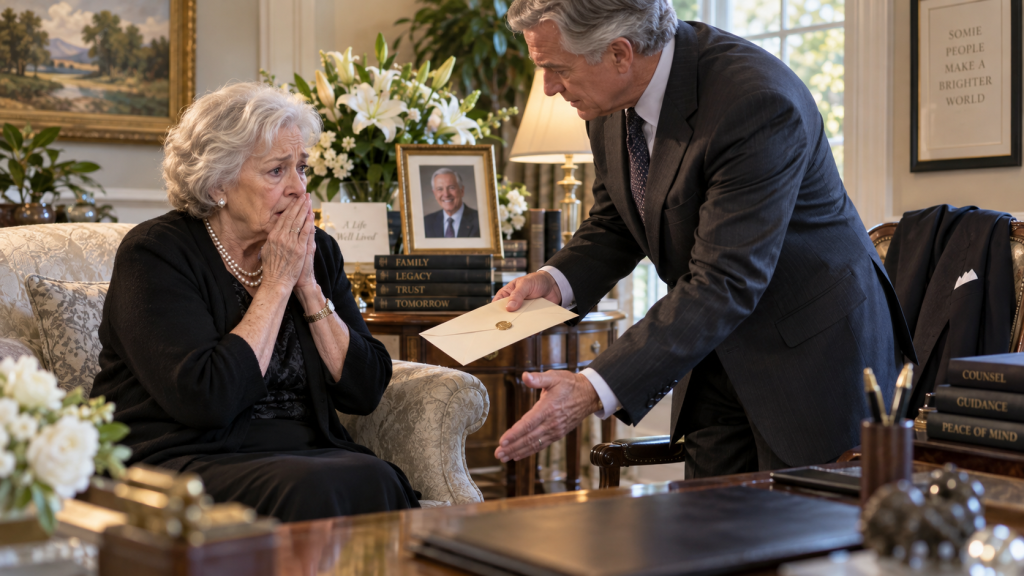
A wealthy widower from a nursing home asked me to marry him so his family couldn’t control his final days — after his funeral, his lawyer handed me an envelope and said, “Please, sit down. The truth inside may be difficult to process.”

I (78F) lived in the state-funded wing of our nursing home. I shared a cramped room, ate soggy food, and survived on a tiny pension. Arthur (82M) lived in a different universe. He occupied the VIP penthouse suite with a private chef and 24/7 nurses.
Despite the class divide, we met in the courtyard. Bonding over chess, we quickly became inseparable. We spent countless hours under the old oak tree, drinking imported tea, listening to jazz, and talking about our deepest regrets.
Arthur was a widower. Despite having three kids, his suite was painfully empty. “They don’t care about me. They’re just waiting for me to die,” he confessed one afternoon over the chessboard.
When Arthur’s health declined, his children abruptly appeared. They brought lawyers to seize his medical power of attorney and quietly hasten his end. Terrified, Arthur asked me to marry him so his family couldn’t dictate his final days. I agreed without hesitation.
We spent two beautiful years as husband and wife. He moved me into his lavish suite, and neither of us felt lonely. We spent his final months reading to each other and watching sunsets from his balcony. Last week, Arthur passed away peacefully, holding my hand.
At his funeral, his children barely acknowledged me as they whispered among themselves and watched me with open hostility.
A week after the funeral, Arthur’s lawyer came to see me. He handed me an envelope and looked at me with quiet concern.
“Please, sit down. The truth inside may be difficult to process.”.
PART 2 — THE LETTER ARTHUR COULD NEVER READ ALOUD
Arthur’s lawyer did not let me open the envelope immediately.
That frightened me.
For two years, I had watched Miriam Hale handle everything with the composure of a woman who had spent four decades watching families turn love, fear, money, and death into paperwork.
She had been there before Arthur and I married.
She had met with him alone.
Then with me alone.
Then with us together.
She had insisted on an independent medical evaluation before Arthur changed a single healthcare document.
At the time, I thought she was being overly cautious.
Later, I understood.
When an eighty-two-year-old wealthy widower marries a seventy-eight-year-old woman from the state-funded wing of his nursing home shortly after fighting with his adult children, people do not say:
How romantic.
They say:
Who manipulated whom?
Miriam had wanted the answer documented before anyone asked.
Now she sat across from me in Arthur’s former suite, the envelope resting between us.
His chair remained by the window.
His chessboard remained on the table.
One white knight was still lying on its side from the last game we never finished.
I could not bring myself to put it away.
“Before you read Arthur’s letter,” Miriam said, “I need you to understand three things.”
My fingers tightened in my lap.
“Am I being evicted?”
Her expression softened.
“No.”
I breathed.
I had not realized how frightened I was until the fear loosened.
“The suite?”
“Provided for as long as you choose to remain here.”
“And if I don’t?”
“There are other arrangements available under Arthur’s estate plan.”
I stared.
“His children can’t change that?”
“No.”
“Challenge it?”
“They can challenge almost anything if they are determined enough.”
She gave me a tired little smile.
“That does not mean they will succeed.”
Then she leaned forward.
“Second, the envelope is not a will.”
“What is it?”
“Arthur’s explanation.”
My stomach tightened.
“And third?”
Miriam looked toward the empty chair beside the window.
“The man you loved was telling you the truth about many things.”
Then she looked back at me.
“But not everything.”
I stared at the envelope.
Arthur had written my name across the front.
His handwriting had deteriorated during the final months.
The A leaned awkwardly.
One of the letters in my name barely closed.
Still his.
I traced it with my thumb.
“What did he lie about?”
Miriam shook her head.
“He asked me not to summarize the letter.”
“Why?”
“Because he said if I explained it first, I would make him sound more reasonable than he deserved.”
That was Arthur.
Even his guilt came with quality control.
I almost smiled.
Then the grief returned.
It had become like weather.
No warning.
No manners.
A moment earlier, I was discussing legal documents.
Then suddenly I remembered his hand going slack inside mine.
I looked down.
“Did you know?”
“Some of it.”
“Did his children?”
“Yes.”
That hurt.
People I had spent two years regarding as enemies knew things about my husband that I did not.
Miriam must have seen the thought on my face.
“Marriage does not make two histories become one history.”
she said gently.
“Arthur had eighty-two years before you married him.”
“You had seventy-eight before him.”
“You loved the last chapter of each other without having lived every page that came first.”
I swallowed.
Then opened the envelope.
The first line was exactly what I expected.
My dear girl,
He had called me that from the second month we knew each other.
I used to tell him a woman pushing eighty should not be called anybody’s girl.
He said:
“Then stop smiling when I do it.”
I never managed.
Now the words blurred.
I kept reading.
If Miriam has given you this, then I finally managed to leave a room before you did. I know you hate when I win.
I laughed.
Out loud.
Then covered my mouth.
Miriam looked toward the window.
Giving grief privacy without leaving.
Arthur continued.
You are going to hear several things about me after I am gone. Some will be exaggerated. Some will be cruel. Some will be true.
My chest tightened.
The true ones are the reason I am writing.
He began with his children.
Daniel. Elise. Robert.
I knew those names.
Of course I did.
Daniel was fifty-eight.
An orthopedic surgeon.
Always perfectly dressed.
Always checking his watch.
Robert was fifty-four.
Ran an investment firm.
He could enter a room without greeting me and somehow still make me feel he had inspected my value.
Then there was Elise.
Fifty-six.
The only daughter.
She had come to Arthur’s funeral in black wool, stood in the second row, and left without speaking to me.
I had assumed her silence was contempt.
Arthur had encouraged that assumption.
That was the first truth that hurt.
I have allowed you to believe Elise hated you because you married me.
I stopped reading.
Looked at Miriam.
She said nothing.
I continued.
That is not entirely true.
My hands started trembling.
Elise was angry about the marriage. But long before you entered my life, she was angry with me. She had reasons.
Arthur told me about his first wife.
Margaret.
Not “my late wife.”
Not “their mother.”
Margaret.
A woman who had occupied his life for fifty-one years before death made room for me.
I had never been jealous of her.
How could I compete with half a century?
Arthur had spoken of her kindly.
Sometimes tenderly.
But vaguely.
He told me she had died after a long neurological illness.
He said the children had become difficult near the end.
Too many opinions.
Too many lawyers.
Too much fighting about treatment.
He had always said:
“Death makes greedy people impatient.”
I believed him.
Now I learned the sentence had another history.
Margaret developed vascular dementia in her late seventies.
For several years, Arthur remained her primary decision-maker.
She had signed a healthcare proxy naming him first.
Elise second.
Daniel and Robert were not named.
As Margaret worsened, Arthur became convinced that continuing repeated hospitalizations was cruel.
Elise disagreed.
Not forever.
Not irrationally.
She wanted a second neurological opinion.
A swallowing evaluation.
More time before hospice.
Arthur thought she was refusing reality.
They fought.
Bitterly.
Then, according to his letter, Arthur did something he had never told me.
He changed Margaret’s care facility without telling Elise until the transfer was complete.
I lowered the paper.
My mouth had gone dry.
Arthur.
The man who had later been terrified that his own children would make medical decisions without him.
Arthur had done something painfully similar to his daughter years earlier.
I read on.
At the time I called it decisiveness.
Elise called it control.
She was closer to the truth.
I closed my eyes.
There are confessions you expect from the dead.
Infidelity.
Money.
Secret resentment.
I had not expected moral symmetry.
Arthur had spent his final years describing control as the thing other people did to him.
He had once worn it himself.
Margaret entered hospice.
She died twelve days later.
Arthur did not say hospice caused her death.
Miriam had already taught me enough not to leap into that kind of story.
Margaret had been very ill.
Her physicians had documented advanced disease.
Comfort care was a medically supported option.
The wound was not simply what decision Arthur made.
It was how he made it.
Elise believed her mother had been moved before the family had honestly discussed what Margaret had wanted.
Arthur believed his wife had suffered enough.
Both could be true.
But only one of them held legal authority.
Arthur.
And he used it.
His letter continued.
Elise did not speak to me for eleven months after her mother died.
Daniel and Robert sided with me.
I enjoyed that more than I should admit.
I swallowed.
That sentence sounded like the Arthur I knew when he was being mercilessly honest.
I told myself one child had become hysterical while the others understood responsibility. What actually happened was more complicated. Daniel and Robert understood that agreement with me kept them close to me. Elise refused to purchase peace that way.
I sat back.
For two years, I had heard a different version.
Elise difficult.
Elise resentful.
Elise “always looking for a fight.”
Now the story had furniture rearranged inside it.
Same house.
Completely different room.
After Margaret’s death, Arthur revised parts of his estate plan.
Not to disinherit Elise.
But he removed her as successor healthcare agent.
Replaced her with Daniel.
That decision became important years later.
Very important.
Because Daniel eventually became the child Arthur feared most near the end.
I remembered the day Arthur first told me his children were “trying to take over.”
We had been playing chess under the oak tree.
He moved a bishop.
Then said:
“Daniel wants authority over my medical decisions.”
I laughed because I thought he meant ordinary meddling.
He did not.
Daniel had produced an old healthcare document.
One naming him as successor agent.
Arthur’s health had worsened.
He was recovering from pneumonia.
For several days he had been confused.
Daniel believed the confusion showed Arthur could no longer manage complex decisions.
Robert agreed.
Their lawyer requested a meeting with the facility.
They discussed guardianship if necessary.
Arthur panicked.
He told me:
“They want me declared incompetent.”
Then:
“They’ll put me on comfort care the moment it becomes convenient.”
I believed him.
The terror in his eyes was real.
Now I understood why.
He remembered Margaret.
He remembered being the person on the other side of that authority.
Fear is often memory wearing tomorrow’s clothes.
I read faster.
Arthur explained that Daniel and Robert had indeed overreached.
That part had not been invented.
They had begun contacting physicians without Arthur’s permission.
Robert had asked questions about moving assets into a family-managed structure.
Daniel had asked whether Arthur still needed certain aggressive treatments if his quality of life declined.
Some questions were reasonable.
Others crossed lines.
Their lawyer explored guardianship.
That happened.
But what Arthur had never told me was that someone else stopped the process before our marriage.
Elise.
I froze.
Read the paragraph again.
The person who called Miriam when Daniel began treating my temporary confusion as permanent incapacity was Elise.
I looked up so suddenly that the paper slipped.
“Miriam.”
She nodded.
“Yes.”
“Elise called you?”
“Yes.”
“Why didn’t anyone tell me?”
“Arthur asked me not to disclose family communications that were not mine to disclose.”
My chest tightened.
“He let me think she was part of it.”
“Yes.”
Miriam’s voice was quiet.
“He did.”
I felt angry.
Not widow-angry.
Not grief-angry.
Alive angry.
The kind that warms your face and sharpens the room.
“Elise came to the nursing home with them.”
“She did.”
“She was there when the lawyers came.”
“Yes.”
“She didn’t speak to me.”
“No.”
“So how was I supposed to know she was helping him?”
“You weren’t.”
That answer hurt more than defense.
Arthur had controlled the narrative.
Even then.
The old habit had survived longer than the old body.
Elise had contacted Miriam privately.
She said:
“My father can be arrogant, secretive, and impossible. That does not make him incompetent.”
I laughed despite my anger.
That sounded like someone who knew him very well.
She insisted Arthur be evaluated by an independent geriatric specialist before anyone pursued control over him.
Miriam arranged it.
The physician found Arthur had experienced delirium related to infection and medication.
His cognition improved.
He retained decision-making capacity.
Arthur then revoked the old healthcare proxy that named Daniel.
Created a new one.
First agent:
Me.
Alternate:
A professional geriatric care advocate.
Not one of the children.
The marriage happened afterward.
Not as the legal device that magically gave me control.
The documents did that.
The marriage did something else.
It made clear, publicly and personally, whom Arthur wanted beside him.
I had misunderstood the order.
Maybe because Arthur let me.
I looked at Miriam.
“So when he asked me to marry him…”
“He already had the legal ability to name you.”
“Yes.”
“Then why marriage?”
Miriam smiled sadly.
“I think that answer belongs to Arthur.”
I looked back at the letter.
There it was.
I told you I needed to marry you so they could not control my final days.
That was only partly true.
My breath caught.
I had already signed the documents.
I had already passed the capacity evaluation.
Miriam had already built the wall.
Then:
I asked you to marry me because I was afraid that if I simply asked whether you loved me enough to become my wife, you might say no out of kindness.
I stopped.
Tears came immediately.
Arthur continued.
You would have told me I was sick.
That I should think of my children.
That people would misunderstand.
That you did not need my money.
All true.
Every word.
So I made the proposal sound like a rescue mission.
My throat closed.
That manipulative old man.
Even his proposal.
I laughed through tears.
“You bastard.”
Miriam pretended not to hear.
Arthur’s letter continued.
For that, I am sorry.
I did need protection. But I also wanted you. Those are not the same statement, and you deserved both of them separately.
I pressed the page to my chest.
Two years.
Two years of marriage.
Sunsets.
Jazz.
Chess.
His cold feet against mine in bed.
Arguments about whether hospital pudding qualified as food.
He had loved me.
That did not erase manipulation.
Manipulation did not erase love.
Human beings insist on making grief complicated.
Then came the money.
Of course.
Arthur wrote:
Now Miriam is probably wondering whether you have reached the part you are most likely to hate.
I looked at her.
She almost smiled.
Arthur knew us both too well.
You are not inheriting my fortune.
I stared.
Read it again.
Nothing.
Then, strangely, relief.
I had never wanted it.
Maybe part of me feared the children had been right about me simply because money existed near my name.
I looked at Miriam.
“I’m not getting it?”
“You are being provided for.”
she said.
“But no, Arthur did not leave the bulk of his estate outright to you.”
“How much was there?”
She hesitated.
“Approximately forty-three million dollars across trusts, investment entities, and other assets.”
I almost dropped the letter.
Forty-three million.
I had known wealthy.
I had not understood how wealthy.
The VIP suite suddenly looked less like luxury and more like pocket change.
Most of Arthur’s wealth had already been placed into trusts years before we met.
Some for grandchildren.
Some charitable.
Some for his children.
The marriage did not rewrite all of it.
He updated specific provisions after we married.
I would receive a lifetime annuity sufficient to live comfortably.
Housing of my choice.
Medical and care expenses.
A personal bequest.
Not millions dumped into my hands.
More than I had ever imagined.
Less than gossip would assume.
I laughed.
“What?”
Miriam asked.
“Paula from the third floor thinks I married him for forty million dollars.”
Miriam smiled.
“Paula has always lacked restraint.”
“You know Paula?”
“Everyone knows Paula.”
Fair.
Then Arthur’s letter changed tone again.
The money is not the difficult truth.
My stomach tightened.
Of course not.
Apparently forty-three million dollars was the easy section.
The difficult truth is Elise.
I kept reading.
Arthur had reconciled with her privately during our first year of marriage.
Not fully.
But enough.
She visited him three times when I was at physical therapy appointments.
Once when I was in the hospital for a minor procedure.
He never told me.
I stared at the paper.
“Why?”
Miriam’s face became sad.
“Read.”
I did not tell you because I was ashamed.
If I admitted Elise had protected my autonomy, I would also have to admit I had exaggerated her role in threatening it.
If I admitted she had reasons to distrust me, I would have to explain Margaret.
And if I explained Margaret, I feared you would look at me differently.
I whispered:
“I would have.”
The room felt colder.
Then:
“I still would have loved you.”
Miriam looked at me.
Arthur would never hear that sentence.
That was the punishment of posthumous honesty.
It arrives after the possibility of conversation has closed.
Arthur wrote that Elise had never trusted our marriage.
Not because she thought I was a gold digger.
At least not primarily.
She believed Arthur had once again made a major family decision privately and expected everyone else to accept it afterward.
That was what angered her.
The pattern.
Arthur had changed his medical agent.
Married me.
Altered estate provisions.
All legally his right.
But he told his children after everything was complete.
I knew that version too well now.
A person can have the right to decide and still hurt people by deciding in secret.
Another complication.
Elise said something to me that I could not forgive because I knew it was true.
Arthur wrote.
She said: “Dad, you only call something control when somebody else is holding it.”
I lowered the letter.
There are sentences that explain entire families.
That was one.
I thought of Arthur under the oak tree.
Complaining his children wanted to run his life.
Arthur ordering the chef to remake soup because the carrots were “emotionally overcooked.”
Arthur telling nurses exactly when to open blinds.
Arthur deciding our wedding would happen in three weeks because “at our age, long engagements are arrogance.”
I smiled despite myself.
Then cried.
He had been controlling.
Charming.
Generous.
Selfish.
Terrified.
Funny.
Wrong.
Mine.
All at once.
“What does Elise know about the letter?”
I asked.
Miriam shook her head.
“Not its contents.”
“Does she know he told me the truth?”
“She knows Arthur intended to.”
“Why didn’t she tell me herself?”
Miriam leaned back.
“Because she did not owe you an indictment of her father.”
That silenced me.
“She also believed, correctly in my opinion, that if Arthur wanted the record corrected, Arthur should correct it.”
I nodded.
Fair.
Painfully fair.
I returned to the letter.
Arthur told me he did not want me to confront his children.
Did not want me to become his defender.
Especially after death.
Do not spend your remaining years prosecuting my case.
I had lawyers for that while alive.
I laughed.
Then:
Daniel frightened me near the end.
Robert worried too much about money.
Elise frightened me in a different way because she remembered the things I preferred to forget.
That was perhaps the kindest thing he wrote about her.
Then Arthur gave me a request.
Not an instruction.
He underlined that.
If you are willing, meet Elise once.
Not for me.
For yourself.
I looked up.
Miriam was watching.
“Did he arrange that?”
“No.”
“Does she want to?”
“I don’t know.”
Good.
No ambush.
Arthur had learned something, at least by the end.
I finished the letter slowly.
The final page was not about money.
Or children.
Or Margaret.
It was about me.
You were not a nurse I married.
You were not a shield I placed between myself and my children.
You were not a poor woman I rescued from the state wing.
That line made me flinch.
People had said all three.
Sometimes to my face.
You were the woman who beat me at chess and refused to let me blame the board.
You drank terrible tea because I liked it.
You made me listen to Ella Fitzgerald when I wanted Coltrane.
You put lotion on my hands when my skin cracked and pretended not to notice I was embarrassed.
My eyes blurred.
You gave me two years in which I was neither a patient nor an estate.
That broke me.
I folded forward.
The letter shook in my hands.
Miriam came around the table.
She did not hug me.
She rested one hand between my shoulder blades.
Exactly enough.
When I could read again, I reached the last lines.
I wish I had given you the same gift.
I wish I had let you love me without making you carry the version of me I preferred.
I am sorry that the truth arrives after I do not have to watch your face.
Then:
If there is justice, I hope wherever I am, Margaret is already telling me I told you so.
I laughed and sobbed at the same time.
Finally:
Finish the chess game. You were winning.
Arthur
For nearly ten minutes, neither Miriam nor I spoke.
Then I looked at the board.
White knight down.
My queen threatening his rook.
He was right.
I had been winning.
Of course the old cheat had died before admitting it.
“What happens now?”
I asked.
Miriam returned to her chair.
“Legally?”
“Yes.”
“You remain here if you want.”
“The trust covers your care.”
“If you prefer independent living, assisted living elsewhere, or a private residence, we can review options.”
“My pension?”
“Still yours.”
“The annuity?”
“Begins next month.”
“The children?”
“They receive what their father’s documents provide.”
“Can they contest my support?”
“They can try.”
“Will they?”
Miriam paused.
“Daniel’s attorney has requested copies of certain nonprivileged estate information.”
“Robert has made inquiries.”
“Elise has not.”
Of course.
I stared at Arthur’s letter.
“What did Arthur leave them?”
“I cannot discuss every beneficiary’s private details without authorization.”
I smiled faintly.
“Arthur trained you too well.”
“I trained Arthur.”
That was probably true.
Then Miriam’s expression changed.
“There is something else.”
I groaned.
“No.”
“I’m afraid so.”
“What?”
“This does not come from Arthur’s letter.”
My stomach tightened.
“Then what?”
“Three days before he died, Robert requested an emergency meeting with the facility administrator.”
I went still.
“Why?”
“He claimed Arthur’s marriage had isolated him from his family and that his medication regimen might be impairing judgment.”
“That again?”
“Yes.”
“But Arthur was dying.”
“Yes.”
“What did Robert want?”
Miriam looked directly at me.
“He wanted the facility to reconsider who could receive medical information and whether you should remain involved in end-of-life discussions.”
Anger rose immediately.
“There was a valid healthcare directive.”
“Yes.”
“Naming me.”
“Yes.”
“So they couldn’t just remove me.”
“No.”
“Then why—”
Miriam lifted a hand.
“Robert did not succeed.”
I stopped.
“Arthur never knew?”
“He knew there had been an inquiry.”
“Not all the details.”
Good.
At least his last three days had not contained one more family battle.
“Was Daniel involved?”
“We don’t know.”
“Elise?”
“No.”
That answer came immediately.
Something in me shifted again.
Elise.
The enemy who kept becoming less convenient as an enemy.
That afternoon, I left Arthur’s old suite for the first time since the funeral.
Not moved out.
Simply walked.
Courtyard.
Oak tree.
Our chess table.
Someone else had placed two plastic cups there.
I almost became irrationally angry.
Then remembered Arthur did not own the courtyard simply because he had died in my arms.
I sat on the bench.
Held his letter.
And tried to understand what grief does when the person you miss becomes more complicated after death.
People say:
Don’t speak ill of the dead.
Maybe because the dead cannot defend themselves.
But the dead also cannot be allowed to become saints simply because they have lost the ability to interrupt.
Arthur had done good things.
He had done selfish things.
He had been frightened.
He had frightened others.
He had wanted control.
Then hated losing it.
He had manipulated my proposal.
Then loved me beautifully inside the marriage that followed.
What was I supposed to do with all of that?
Apparently the same thing I had done with him when he was alive.
Sit beside it.
Argue with it.
Refuse to simplify.
Two days later, I asked Miriam for Elise’s number.
She did not hand it over.
Of course.
She called Elise first.
Asked permission.
Good.
That evening, my phone rang.
Unknown number.
I answered.
“Hello?”
Silence.
Then a woman said:
“This is Elise.”
My chest tightened.
Her voice sounded like Arthur’s when she was trying not to sound like him.
“Hello.”
Another silence.
Neither of us knew what kind of conversation we were in.
Finally she said:
“Miriam said you read the letter.”
“Yes.”
“Everything?”
“I assume so.”
Elise exhaled.
Then:
“I’m sorry.”
That surprised me.
“For what?”
“My brothers.”
“Your father.”
“The funeral.”
She paused.
“For not speaking to you.”
I sat down.
“You were angry.”
“Yes.”
“At me?”
“Some.”
Fair.
“At him?”
“Mostly.”
More fair.
Then she asked:
“Did he tell you about my mother?”
“Yes.”
Silence.
“How much?”
“Enough that I no longer think you were unreasonable.”
A bitter little laugh.
“I was unreasonable sometimes.”
“That would make you related to Arthur.”
She laughed again.
A real one this time.
It startled both of us.
We spoke for almost an hour.
Not warmly.
Not cruelly.
Carefully.
Elise told me things Arthur had not.
I told her things she had not known.
She had believed I persuaded Arthur to marry quickly.
I told her I had nearly refused.
She had believed I pushed him to remove Daniel from the medical proxy.
I told her the documents were already being changed before the proposal.
I had believed Elise attended the guardianship meeting to support her brothers.
She told me she attended because she wanted the lawyers to understand Arthur could be infuriating without being incompetent.
At one point she said:
“I spent ten years wanting Dad to admit he was wrong about Mom.”
I asked:
“Did he?”
“Not to me.”
That hurt.
He confessed to me after death.
She had wanted the confession alive.
Again, posthumous honesty arriving in the wrong hands at the wrong time.
“Would you like to read his letter?”
I asked.
The question surprised both of us.
Elise was silent for a long time.
Then:
“No.”
I blinked.
“No?”
“That letter is to you.”
“But parts involve you.”
“I know.”
She breathed.
“If Dad wanted to apologize to me, he had my number.”
There was no bitterness in the sentence.
Only fact.
I respected her for it.
Then she said something that changed the conversation.
“There is one thing you need to know.”
My stomach tightened.
Apparently nobody in Arthur’s family could end a conversation without creating another disaster.
“What?”
“Robert’s meeting with the nursing home.”
“You knew?”
“I learned yesterday.”
“Was Daniel involved?”
“No.”
She hesitated.
“At least not in the way you think.”
“What does that mean?”
Elise took a breath.
“Robert has been moving money.”
I went still.
“What money?”
“Not yours.”
“I know.”
“Dad’s family-office accounts.”
“I don’t understand.”
Neither did she fully.
But Arthur’s investment structure included accounts Robert helped oversee through a family management company.
After Arthur became ill, Robert apparently began shifting funds among entities.
Some transfers could be legitimate.
Tax management.
Trust funding.
Investment rebalancing.
Others had raised questions.
Arthur’s accountants had already been reviewing them.
Robert knew.
And three days before Arthur died, he had tried to argue that Arthur’s medications made him unreliable.
My skin went cold.
“You think he wanted Arthur declared incompetent because of the money?”
“I think we need evidence before saying that.”
I closed my eyes.
Arthur would have liked her answer.
Facts first.
Even inside a family.
“Why are you telling me?”
“Because Robert may assume you received more control over the estate than you actually did.”
“I didn’t.”
“I know.”
“He may not.”
I looked toward Arthur’s chessboard across the room.
“What do you want me to do?”
“Nothing.”
That surprised me.
“Nothing?”
“Miriam and the trustees are handling it.”
“Then why tell me?”
Elise’s voice softened.
“Because if Robert comes to you angry, I don’t want you believing his anger proves Dad left you everything.”
I swallowed.
Again.
Narrative.
Everyone trying to control the story before someone else filled the empty space.
The next morning, Miriam called before breakfast.
“Elise spoke to you?”
“Yes.”
“Did she mention Robert?”
“Yes.”
A pause.
“Of course she did.”
“Was she wrong?”
“No.”
My heart tightened.
“What happened?”
Miriam’s voice became formal.
“The trustees identified several transactions requiring explanation.”
“Illegal?”
“We do not know that.”
“Improper?”
“We do not know that yet either.”
“Then what do we know?”
“Robert authorized approximately $1.8 million in transfers from one family entity into an investment vehicle he controls.”
I nearly dropped the phone.
“Arthur knew?”
“That is the question.”
There it was.
The next battlefield.
“Does this affect me?”
“Not financially in the immediate sense.”
“Then why do I need to know?”
“Because one of the authorization documents appears to bear Arthur’s electronic approval.”
“That sounds normal.”
“It would.”
Miriam paused.
“Except the approval timestamp is from a night Arthur was in intensive care.”
My skin turned cold.
I remembered that night.
I had been there.
Arthur had been barely conscious.
Oxygen mask.
Sedation.
He could squeeze my fingers.
Nothing more.
“He couldn’t have approved anything.”
Miriam’s voice was careful.
“That is exactly what must now be determined.”
I looked toward the chessboard.
At the fallen white knight.
At the empty chair.
At the letter in my lap.
For two years, Arthur had told me his children were waiting for him to die.
I had just learned that statement was unfair to one of them.
Maybe more complicated with another.
But as I sat there listening to his lawyer explain a seven-figure transaction authorized while my husband could barely open his eyes, one terrible possibility remained.
Arthur had distorted parts of his family story.
He had hidden his own failures.
He had used fear to make me say yes to marriage.
But that did not mean every fear had been imaginary.
Sometimes a flawed man can still be right about the danger at the door.
And now that he was gone, the people left behind would have to separate his paranoia from the things he had actually seen coming.
PART 3 — THE TRUTH ARTHUR LEFT BEHIND
Miriam came to my room that afternoon with two trustees, a forensic accountant, and the sort of expression that told me nobody had arrived to discuss jazz.
Arthur’s chessboard was still open beside the window.
The fallen white knight had not moved.
Neither had I.
For two years, that suite had felt like the safest room in the building.
Now every document seemed capable of opening a door beneath my feet.
Miriam sat across from me.
“The first thing I want you to understand,” she said, “is that Robert did not have unrestricted access to Arthur’s estate.”
I nodded.
“Good.”
“The second is that the $1.8 million transfer was not simply stolen cash moved into Robert’s personal checking account.”
I breathed again.
Slightly.
“What was it?”
The accountant introduced himself as Leonard Price.
He spoke slowly.
Not because I was old.
Because the subject was complicated.
I appreciated that distinction.
“The funds were moved from a family investment entity into a private real-estate fund controlled by Robert’s company.”
“Was that allowed?”
“Possibly in part.”
Of course.
Nothing in Arthur’s family could apparently be answered with one clean word.
Arthur had invested with Robert before.
Legitimately.
For years.
Some investments performed well.
Others did not.
Arthur had even signed an investment framework allowing Robert to propose transactions within certain limits.
That mattered.
Robert had not appeared from nowhere and begun looting accounts.
He had been part of the financial structure because Arthur had invited him in.
The problem was the final transfer.
The amount exceeded the standing authority Robert had been given.
And the electronic approval attached to it carried Arthur’s credentials.
At 11:42 p.m.
While Arthur was in intensive care.
I knew that night.
I had sat beside him.
He had been delirious.
Then sedated.
At 11:42, he could not have approved a menu.
Much less seven figures.
My stomach turned.
“So Robert forged his signature?”
Leonard lifted one hand.
“We are not using that word yet.”
I almost laughed.
Facts first.
Again.
Miriam continued.
“Robert says Arthur approved the investment orally weeks earlier.”
“Did he?”
“We don’t know.”
“Is there evidence?”
“There are notes showing they discussed the fund.”
“Do the notes say one point eight million?”
“No.”
“Do they show approval?”
“No.”
There it was.
Not nothing.
Not enough.
Robert’s explanation was that Arthur had always hated electronic systems.
True.
Arthur once spent twenty minutes complaining that passwords were a conspiracy invented by people under forty.
Robert said he had often entered transactions after verbal discussions and then helped Arthur complete the digital approval.
Also plausible.
The trustees confirmed there had been occasions when Arthur asked staff to prepare documents for later signature.
But this time there was no later signature.
No email.
No recorded instruction.
Only a digital approval created while he was unconscious.
“Who entered it?”
I asked.
Leonard looked at Miriam.
She answered.
“The login originated from Robert’s office.”
The room went quiet.
I looked toward Arthur’s chair.
Then whispered:
“He was right.”
Elise’s warning echoed in my head.
Sometimes a flawed man can still be right about the danger at the door.
Miriam shook her head slightly.
“About what?”
“Robert.”
“Maybe.”
The answer irritated me.
“Arthur said Robert cared about the money.”
“That may have been true.”
“He said his children were waiting for him to die.”
“That was not true of all three.”
I stopped.
Miriam leaned forward.
“This is exactly the trap Arthur asked you not to fall into.”
“What trap?”
“Turning one true fear into proof that every story he told you was true.”
That silenced me.
Arthur, even dead, remained difficult.
The trustees had already frozen the questioned investment position.
Not seized.
Frozen.
Robert’s company was instructed not to move or distribute the funds until the authorization issue was resolved.
Independent counsel had been engaged.
The other beneficiaries were being notified as required.
No police arrived.
No prosecutor knocked on my door.
No cinematic collapse.
Just attorneys, accountants, emails, and people suddenly discovering that money leaves footprints even when memory does not.
“What happens to Robert?”
I asked.
“That depends on the evidence.”
Miriam replied.
“And on what the trustees decide is necessary to protect the estate.”
“What about me?”
“You do nothing.”
I frowned.
“Nothing?”
“You are not a trustee.”
“Not an owner of that entity.”
“Not responsible for solving Arthur’s family office.”
She looked at me pointedly.
“You are also not responsible for defending Arthur.”
That sentence landed harder.
Because some part of me had already begun preparing.
A speech.
A case.
A list of reasons why Arthur had feared them.
Why he had chosen me.
Why everyone should understand.
Miriam saw it before I did.
“You loved him.”
she said.
“Yes.”
“That does not appoint you curator of his innocence.”
I looked away.
Robert called that evening.
Of course he did.
I almost did not answer.
Then I remembered Arthur’s letter.
Do not spend your remaining years prosecuting my case.
So I picked up.
“Hello.”
Silence.
Then Robert’s voice.
“You’ve spoken to Miriam.”
“Yes.”
“I assume Elise has been filling your head too.”
“No.”
That answer came sharper than I intended.
He exhaled.
“I want to explain.”
“Then explain your part.”
Another silence.
Good.
Maybe he understood the boundary.
Robert said the investment had been discussed with Arthur multiple times.
He said Arthur liked the fund.
Wanted exposure to real estate outside public markets.
Had even joked that Robert should “put serious money in if the numbers are good.”
“Serious money is not one point eight million.”
I said.
“I know.”
“Did he approve that amount?”
Robert hesitated.
There.
The part everyone eventually reaches.
“I believed he would.”
Not yes.
I closed my eyes.
“Did he?”
“I don’t have a signed instruction.”
“Then why did you approve it after he was unconscious?”
“I thought we were carrying out what he had already decided.”
I heard strain in his voice.
Not greed exactly.
Maybe fear.
Maybe self-justification.
Maybe both.
Robert continued.
“The fund had a deadline.”
“Allocation was closing.”
“If we missed it, Dad would have complained that I cost him the opportunity.”
I almost laughed.
That sounded like Arthur.
Unfortunately.
“So you made the decision for him.”
“I completed a decision I believed he had made.”
“That is not the same thing.”
“No.”
He sounded tired.
Then:
“No. It isn’t.”
At least he could say it.
I asked the question I had been afraid to ask.
“Was the guardianship talk about this?”
Silence.
Long enough that my answer arrived before his.
“Partly.”
he said.
My stomach tightened.
“Explain.”
“Dad had become erratic about money.”
“Or you thought he had.”
“He was moving things.”
“Changing trustees.”
“Changing access.”
“Changing beneficiary structures.”
“He married you.”
There it was.
I almost snapped.
Then stopped.
He was telling me what it looked like from his side.
Robert continued.
“We had spent decades managing assets together.”
“Then suddenly he stopped trusting me.”
“I thought someone was influencing him.”
“Me.”
“Yes.”
“Did you ever ask him?”
“He told me it was none of my business.”
I smiled sadly.
Also very Arthur.
“Did you think he was incompetent?”
“At moments.”
“Permanently?”
Robert paused.
“No.”
That mattered.
“Then why explore guardianship?”
His voice cracked for the first time.
“Because I was scared.”
“Of what?”
“That he would destroy everything.”
I nearly laughed at the absurdity.
Arthur.
Forty-three million dollars.
Business empire.
Decades of investing.
But families are not logical when power changes hands.
Robert continued.
“I told myself I was protecting the estate.”
“Maybe I was protecting my place in it.”
That was more honest.
I said nothing.
“Does that make you happy?”
he asked bitterly.
“No.”
He went quiet.
Good.
Then I asked:
“Did you want your father dead?”
He inhaled sharply.
“No.”
“Were you waiting for him to die?”
“No.”
“Did you think about what would happen after?”
Silence.
Then:
“Yes.”
Of course.
Everyone does.
Especially in wealthy families where death is followed by entities, trusts, taxes, boards, and attorneys.
Thinking about inheritance is not the same as wishing for death.
Arthur had blurred those things.
Robert had given him reasons to.
Both.
Again.
Always both.
“I won’t defend what I did.”
Robert said.
“That’s between me and the trustees now.”
“Good.”
“But I want you to know something.”
“What?”
“I loved him.”
His voice broke.
“I hated him sometimes.”
“I was afraid of him.”
“I wanted his approval long after I was old enough to know better.”
“But I loved him.”
I stared at Arthur’s empty chair.
“I believe you.”
Robert went silent.
Maybe nobody had said that to him since the funeral.
Maybe he expected me to call him a thief.
Instead I said:
“Loving someone doesn’t make every choice you make around them loving.”
He whispered:
“I know.”
That ended the call.
Daniel came three days later.
He asked first.
Through Miriam.
I almost said no.
Then I remembered how many assumptions had already shaped this family.
So I agreed.
We met in the nursing home café.
Not Arthur’s suite.
Neutral ground.
Daniel looked older than he had at the funeral.
Grief had removed some of his polish.
He sat.
Ordered coffee.
Did not drink it.
“I owe you an apology.”
I almost smiled.
Arthur’s children apparently came with opening lines.
“For what?”
Daniel stared at the table.
“For treating you like an intruder.”
“That’s one.”
He looked up.
“You sound like Elise.”
“Apparently she has a point sometimes.”
A tiny smile.
Gone quickly.
Daniel told me his side.
After Margaret died, he became terrified of making the same mistake twice.
At first that sounded absurd.
Arthur had been the controlling decision-maker.
Not Daniel.
But children inherit fear even when they do not inherit guilt.
Daniel had watched his mother decline.
Watched his father decide.
Watched Elise accuse Arthur of taking too much control.
Then years later, Daniel became Arthur’s successor healthcare agent.
He told himself he would do better.
Listen more.
Plan earlier.
Then Arthur got pneumonia.
Became confused.
Started refusing things he had accepted weeks earlier.
Daniel panicked.
“I thought it was happening again.”
“What?”
“That someone was going to make decisions too late because nobody wanted to admit he was declining.”
I looked at him.
“Except this time you were the one pushing.”
“Yes.”
Good.
No argument.
He admitted calling doctors without Arthur’s permission.
Admitted discussing comfort-focused treatment too early.
Admitted asking whether aggressive hospitalization made sense if Arthur’s health deteriorated.
“Did you want him to die?”
“No.”
His eyes filled.
“I wanted him not to become Mom.”
That sentence hurt.
Not because Margaret’s life had been worthless.
Because Daniel’s grief had turned one person’s decline into a future he was desperate to prevent repeating.
Fear made him rush.
Arthur experienced rushing as threat.
Both understandable.
Neither harmless.
“Did you know Elise called Miriam?”
“Yes.”
“Did you resent her?”
“Furiously.”
“Why?”
“Because she was right.”
I almost laughed.
This family had spent decades punishing truth for arriving through the wrong person.
Daniel continued.
“She said Dad was difficult, not demented.”
“I thought she was defending him because she still wanted his approval.”
“She thought I was trying to become him.”
“Were you?”
He looked at me.
“Yes.”
One word.
No defense.
That was enough.
Before leaving, Daniel reached into his coat.
I tensed.
Another letter would have finished me.
Instead, he placed an old photograph on the table.
Arthur and Margaret.
Young.
Maybe forty.
At a beach.
Arthur had more hair than I thought possible.
Margaret wore sunglasses and a scarf.
They were laughing.
“That was my mother.”
Daniel said.
“I thought you should see her happy.”
My throat tightened.
“Why?”
“Because Dad mostly told you how she died.”
I looked at the photograph.
He was right.
Arthur had made Margaret part of an argument.
A cautionary tale.
A shadow over medical decisions.
Daniel had given her a summer day.
Alive.
That mattered.
I took the photograph.
“Thank you.”
Elise came last.
Not because Arthur asked.
Because I did.
We met under the oak tree.
The same chess table where Arthur and I first became friends.
She arrived carrying two paper cups.
“Tea.”
she said.
“What kind?”
“Not the imported nonsense Dad liked.”
I laughed before I could stop myself.
She sat.
For a few minutes we said nothing.
Then I asked:
“Did you hate me?”
Elise considered.
“Sometimes.”
“Fair.”
“You?”
“I thought you hated me first.”
“I probably did.”
At least she was consistent.
I showed her the beach photograph.
Her face changed.
“Daniel gave you this?”
“Yes.”
“That was Mom’s favorite scarf.”
She touched the edge.
Then smiled.
“Dad hated the beach.”
“Why?”
“Sand.”
Of course.
Arthur hated any substance that refused to remain where it belonged.
I laughed so hard I cried.
Elise did too.
For one strange minute, we grieved the same man from different decades.
Then I said:
“He told me he was sorry.”
She looked at me.
“In the letter?”
“Yes.”
“About Mom?”
“Yes.”
Elise looked away.
“I’m glad.”
Not bitter.
Just tired.
“I thought you would be angry he told me instead of you.”
“I was.”
She sighed.
“Then I realized I spent ten years wanting him to admit it.”
“Whether he admitted it to me or to you doesn’t change that he finally knew.”
That was generous.
Maybe more generous than Arthur deserved.
But forgiveness is allowed to be chosen.
Not owed.
“Do you want to know exactly what he wrote?”
I asked.
Elise thought.
“No.”
Same answer.
Still.
She looked at me.
“But tell me one thing.”
“What?”
“Did he say he loved Mom?”
I swallowed.
“He didn’t need to.”
Elise’s face tightened.
“That is not what I asked.”
Fair.
I thought back through the letter.
Arthur had not written the sentence directly.
But everything around Margaret carried grief.
Regret only hurts that much where love once lived.
“Yes.”
I said.
“I think he did.”
Elise nodded.
That was enough.
The Robert matter took almost a year.
Long enough for gossip to exhaust itself.
The forensic review concluded that Robert had exceeded the authority clearly documented in the family investment structure.
The disputed $1.8 million had been placed into his real-estate fund without sufficient written authorization from Arthur.
The electronic approval could not reasonably be treated as Arthur’s direct act while he was in intensive care.
Robert insisted Arthur had verbally approved the investment concept.
The trustees did not accuse him of stealing the full amount.
They did demand that the transaction be unwound.
Robert’s company repurchased the estate’s interest.
Fees were reversed.
Legal and accounting costs were negotiated.
Robert resigned from his formal role in the family office.
There was no dramatic prison sentence.
No handcuffs.
No headline.
There were lawyers.
Money returned.
Control reduced.
Trust damaged.
Real consequences.
I learned something from that too.
People often want wrongdoing to end with a punishment large enough to make the moral obvious.
Life is rarely that polite.
Sometimes accountability looks like reimbursement.
Resignation.
Loss of authority.
A relationship that never becomes what it was.
No orchestra.
Still real.
Robert did not visit me for months.
Then one Christmas card arrived.
No long apology.
Just:
I hope you are well. Dad was happier with you than I knew how to admit.
I read it twice.
Then put it in a drawer.
I did not answer immediately.
A month later, I sent:
Thank you. I hope you are well too.
That was all.
Some relationships do not need expansion.
Only an end to hostility.
Daniel changed more visibly.
He started visiting once every few weeks.
Not me, exactly.
The nursing home.
He volunteered with a family-support group for caregivers of people with dementia and delirium.
The first time he mentioned it, I raised an eyebrow.
“Redemption project?”
He sighed.
“Probably at first.”
“And now?”
“Now I like helping families slow down before they start making decisions out of fear.”
That sounded useful.
Arthur would have mocked the group name.
Then secretly approved.
Elise became the person I saw most.
That surprised everyone except Miriam.
We did not become mother and daughter.
Absolutely not.
I was four years older than some of Elise’s friends.
But we became companions of a strange sort.
Two women who had loved Arthur differently and been hurt by some of the same habits.
She played chess terribly.
That disappointed me.
“You’re his daughter.”
“I inherited the stubbornness.”
“Not the strategy.”
“Clearly.”
I beat her often.
She accused me of enjoying it.
Correct.
One afternoon, she asked:
“Do you regret marrying him?”
The question stayed between us.
I looked toward the oak tree.
Two years.
Sunsets.
His fingers tapping jazz rhythms against the armrest.
The way he said my name when pain woke him at night.
The manipulative proposal.
The hidden truth about Margaret.
The children.
The letter.
The fear.
The laughter.
“No.”
I said.
Elise nodded.
“Even knowing everything?”
“I don’t know everything.”
That was the point.
Then:
“I regret that he thought love required managing what I knew.”
Elise looked down.
“So do I.”
I moved out of Arthur’s VIP suite six months after his death.
Everyone assumed Daniel or Robert had forced it.
They had not.
Miriam reminded me repeatedly that I could stay.
The trust would cover it indefinitely.
But the room had become a museum.
Arthur’s chair.
Arthur’s balcony.
Arthur’s private chef.
Arthur’s view.
I had entered that suite because I loved him.
I did not want to remain there because he was gone.
That distinction mattered.
I chose a small independent-living apartment in a different wing.
Not the state-funded room I had once shared.
Not the penthouse.
Something in between.
One bedroom.
A balcony with enough room for two chairs.
A kitchen I barely used.
Books.
Chessboard.
My own furniture.
Arthur’s annuity paid more than enough.
The trust covered my medical needs.
I was comfortable.
Not transformed into a heiress.
Good.
I had spent seventy-eight years learning who I was without money.
I did not need forty-three million dollars to interrupt the lesson.
People still talked.
Of course.
Some said Arthur left me nothing.
Others said millions.
Paula from the third floor claimed I secretly owned three houses in Connecticut.
I have never even been to Connecticut.
Eventually I stopped correcting anyone.
People who need a widow to be either gold digger or saint are not really asking for facts.
They are asking for a simpler story.
I had stopped giving those away.
On the first anniversary of Arthur’s death, Miriam called all three children and me together.
Not for drama.
Estate administration.
Signatures.
Final accounting.
Robert came.
Daniel.
Elise.
Me.
The first time all four of us had sat in one room since the funeral.
Nobody shouted.
Progress.
The trustees reviewed distributions.
Grandchildren’s trusts.
Charities.
Family holdings.
My support arrangement.
Everything had been structured long before Arthur met me except the provisions that protected my housing, care, annuity, and personal bequest.
My outright bequest was $450,000.
More money than I had ever expected to possess.
Less than one percent of Arthur’s fortune.
I laughed when Miriam told me.
Robert looked confused.
“What?”
I smiled.
“People said I married him for forty million.”
Elise muttered:
“You negotiated badly.”
I laughed so hard I had to wipe my eyes.
Even Robert smiled.
Arthur would have loved that moment.
Possibly because he would have taken credit.
Then Miriam produced one final item.
My heart sank.
“No.”
She smiled.
“Not another confession.”
“Good.”
“A charitable directive.”
Arthur had left five million dollars to a fund supporting residents in state-assisted long-term care.
Dental care.
Eyeglasses.
Hearing aids.
Transportation.
Small comforts not always covered.
Private rooms when medically necessary.
Books.
Music programs.
Things Arthur had learned mattered after spending time with people from my wing.
I stared.
“When did he do that?”
“Four months after your marriage.”
My throat tightened.
He never told me.
Good.
Some generosity does not need witnesses.
The fund was named for Margaret.
Not me.
The Margaret Hale Dignity Fund.
I looked at Elise.
She had gone pale.
“Did you know?”
“No.”
Miriam handed her the document.
Elise started crying.
Robert looked away.
Daniel covered his mouth.
I sat very still.
Arthur had not written Elise the apology she wanted.
Maybe naming a fund after Margaret was not enough.
Maybe money cannot apologize.
Usually it cannot.
But it was evidence that he had finally understood something about dignity.
About care.
About control.
Perhaps too late.
Still understood.
Elise whispered:
“He should have told me.”
I reached for her hand.
“Yes.”
No defense.
No:
But look what he did.
She deserved the truth of the hurt.
Arthur kept learning things and then hiding the evidence because admission frightened him.
Even his good choices suffered from secrecy.
I understood that now.
After the meeting, Robert stopped me in the hallway.
“I’m sorry.”
I looked at him.
“For the transfer?”
“For a lot.”
He laughed bitterly.
“I’m still sorting which parts.”
“That may take time.”
He nodded.
Then:
“Dad always said you were the only person who told him no without trying to win.”
That surprised me.
“When?”
“Before you married him.”
I smiled.
“He hated losing at chess.”
“He hated losing at everything.”
“Yes.”
Robert’s eyes filled.
“Maybe that was the problem.”
“Maybe.”
Then we walked in opposite directions.
No embrace.
No promise.
Enough.
Years passed.
Not many.
At seventy-eight, one learns not to pretend time is endless.
I made friends.
Lost some.
Attended memorials more often than weddings.
My knees worsened.
My chess improved.
Elise kept visiting.
Daniel called on Sundays.
Robert sent cards.
The three siblings remained complicated with one another.
Arthur’s death did not heal them.
That was never his power.
They had to decide what to do with one another afterward.
Sometimes they chose badly.
Sometimes better.
Like everyone.
I made one change to my own estate plan.
My $450,000 bequest, what remained of it when I died, would go partly to a niece of mine and partly to Arthur’s dignity fund.
Not because I owed him.
Not because I owed Margaret.
Because I remembered the state-funded wing.
The woman beside me who waited three months for dentures.
The man whose hearing aid worked only when he held the battery cover closed.
The residents who had families.
The residents who did not.
Poverty at the end of life is still poverty.
Loneliness at the end of life is still loneliness.
Arthur’s money could do something about pieces of that.
So could mine.
One afternoon, three years after his death, Elise and I carried Arthur’s old chessboard into the courtyard.
The pieces had remained inside my apartment.
I had never finished our final game.
Could not.
Every time I looked at the position, I heard him.
You were winning.
Elise sat across from me.
“Whose turn?”
“Mine.”
“How do you know?”
“Because your father cheated whenever no one remembered.”
“Fair.”
I studied the board.
The white knight still down.
My queen threatening his rook.
I could not reconstruct the exact strategy anymore.
Too much time.
Too much grief.
Finally, I picked up the pieces.
One by one.
Reset the board.
Elise looked surprised.
“You’re not finishing it?”
“No.”
“Why?”
I smiled.
“Because that game belonged to us.”
“And?”
“And I don’t need to beat a dead man to prove I was winning.”
She laughed.
“Dad would hate that answer.”
“Good.”
We started a new game.
Elise lost in nineteen moves.
Terrible player.
But while we played, we talked about Margaret.
Arthur.
Her brothers.
My first husband.
The nursing home.
Old age.
Bad tea.
Things no letter could resolve.
At sunset, Elise leaned back.
“I think I finally understand why he loved you.”
I looked at her.
“Why?”
“You never let him be only one thing.”
I swallowed.
Then smiled.
“Neither did you.”
Maybe that was why he feared us both.
Maybe that was why he needed us.
I stopped calling Arthur’s proposal a rescue.
That word no longer fit.
He did not rescue me from the state wing.
He gave me companionship.
Comfort.
A different final season.
I gave him the same.
He did not marry me only to protect himself.
He wanted me.
He also manipulated the circumstances because he feared I would say no.
Both.
I stopped choosing between the truths.
Love is not cleaner because we simplify the dead.
It becomes more honest when we stop needing them to have been perfect.
Arthur’s children were not vultures around a bed.
Not exactly.
Robert crossed financial lines.
Daniel crossed medical ones.
Elise carried an old wound sharp enough to cut anyone who approached carelessly.
All three loved him.
All three resented him.
All three wanted something from him.
Approval.
Authority.
Money.
Apology.
Those wants did not make them monsters.
The choices they made with those wants mattered more.
That became my final judgment.
Not on them.
On all of us.
Arthur had spent his life believing control could protect him from loss.
Control of business.
Money.
Medical decisions.
Family stories.
Even his proposal to me.
But control is a poor substitute for trust.
It can organize an estate.
Not a heart.
It can protect assets.
Not relationships.
It can keep people from taking your choices.
But if you use it too tightly, it can also keep the people who love you from knowing who you really are.
Arthur learned that at eighty-two.
Almost too late.
Not completely.
I still have his letter.
Folded inside the same envelope.
The handwriting fading slightly.
I read it less often now.
That is how I know grief changed.
At first I needed the words because they were the only place Arthur remained capable of speaking.
Later I stopped needing him to keep speaking.
I could remember without reopening the wound every time.
The last time I read it, one line stayed with me.
You gave me two years in which I was neither a patient nor an estate.
That, more than the money, became the thing I treasured.
Arthur had spent his final years surrounded by people asking:
What does he own?
What can he decide?
Who has authority?
What happens when he dies?
With me, sometimes, he was simply an annoying old man who moved his bishop too early.
And with him, I was not the poor woman in the state-funded wing.
Not the widow on a tiny pension.
Not a charity case.
Just a woman drinking tea beneath an oak tree.
Maybe love is often nothing more mystical than being allowed to exist outside the role everyone else assigns you.
Years after his funeral, Miriam visited me one final time before retiring.
We sat on my balcony.
She drank coffee.
I drank the terrible imported tea Arthur used to order.
I had developed a taste for it.
Tragic.
Miriam asked:
“Do you think Arthur would be satisfied with how everything turned out?”
I laughed.
“Absolutely not.”
She smiled.
“Why?”
“He would want to revise something.”
“Probably.”
“He’d want Robert to apologize more dramatically.”
“Daniel to worry less.”
“Elise to forgive faster.”
“Me to move back into the penthouse.”
Miriam laughed.
Then I said:
“That was always the problem.”
“What?”
“He wanted everybody’s ending to happen on his schedule.”
We sat quietly.
Then I added:
“I think he would understand that now.”
“Do you?”
“No.”
I smiled.
“But I like believing it.”
When I eventually leave this place, there will be no forty-three-million-dollar mystery.
No children fighting over my estate.
No penthouse.
No business empire.
Just a few pieces of jewelry.
Books.
Chessboard.
Some money.
Arthur’s letter.
My instructions are simple.
Elise gets the chessboard.
Daniel gets the beach photograph of Arthur and Margaret because he was the one who gave it to me.
Robert gets Arthur’s old silver fountain pen, because money complicated their relationship enough and I like the idea of leaving him something valuable only because it writes.
The letter stays private.
Mine until the end.
Then destroyed.
Not every truth has to become inheritance.
And under the oak tree, where Arthur first asked if I knew how to play chess, there is now a small brass plaque.
Not placed by me.
By the nursing home.
It says:
ARTHUR HALE
1939–2024
HE LOVED MUSIC, CHESS, AND ARGUMENTS HE WAS CERTAIN HE HAD WON.
Elise wrote it.
Perfect.
No mention of wealth.
No mention of power.
No mention of family office structures.
Just the man.
Or one version of him.
Enough for a plaque.
Not enough for a life.
That is what I finally learned.
A human being cannot fit inside one person’s version of them.
Arthur was not the lonely victim he sometimes made himself out to be.
He was not the tyrant Elise had once believed him to be.
Not merely Robert’s wealthy father.
Not Daniel’s difficult patient.
Not my rescuer.
Not my manipulator.
Not my husband alone.
He was all of it.
And more.
The truth was difficult to process because truth usually is.
It refuses the comfort of one clean verdict.
The day Miriam handed me that envelope, I thought the hardest thing inside would be learning Arthur had lied.
It wasn’t.
The hardest thing was learning that loving him meant letting the lie and the love exist in the same memory.
Not cancelling each other.
Not competing.
Simply true.
He had wanted control over how I saw him.
In the end, his final gift was losing that control.
The letter let me see him clearly enough to love him without protecting him from the truth.
And perhaps that was the only honest legacy any of us can leave.
Not perfection.
Not innocence.
Not even forgiveness.
Just enough truth that the people who remain can finally choose what to do with the love.
THE END STORIES! THANK YOU FOR READING GOOD LUCK !❤️
Related Posts