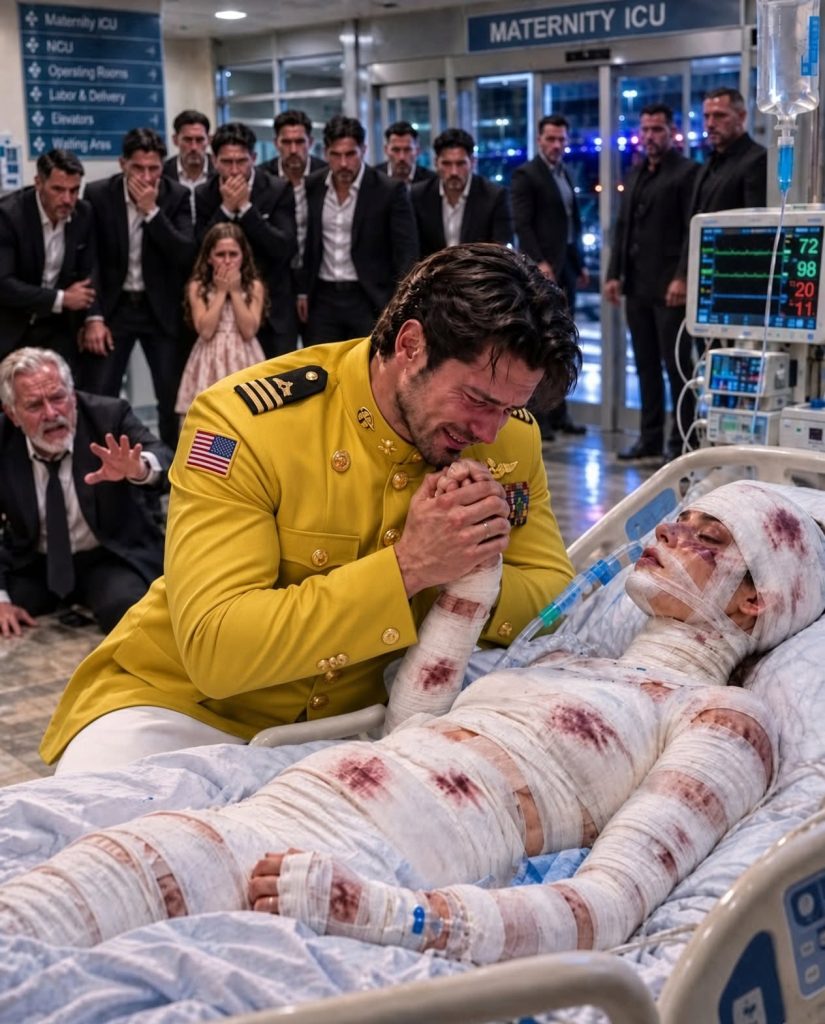
My pregnant wife’s father and eight brothers beat her so brutally that our unborn child died, then stood outside her ICU room laughing while they told me I wasn’t powerful enough to touch them. They thought I was merely Clara’s wealthy businessman husband, until I sent one message and nine phones began ringing at once, exposing how completely I controlled the world they believed protected them.

The hospital called me at 12:17 a.m.
“Your wife survived.”
Survived.
I drove there with those words repeating in my head.
Then I saw Clara.
Her face was swollen. One shoulder was fractured. Bruises covered her arms, and machines surrounded the woman who had kissed me goodbye that morning.
Her hand rested over her stomach.
The surgeon quietly closed the door.
“Three broken ribs. Internal bleeding. A fractured collarbone.”
Then he paused.
“We couldn’t save the baby.”
Something inside me went cold.
“How many people attacked her?”
“At least nine.”
I already knew their names.
Clara had been raised by a father who considered obedience more important than love and eight brothers who treated his cruelty like law.
They’d hated our marriage.
Tonight, they’d finally punished her for refusing to leave me.
I walked into the hallway.
All nine were there.
Laughing.
One brother looked at me and smirked.
“Maybe next time you’ll control your wife.”
Another laughed.
Her father stepped closer.
“You’ve got money, Adrian. Don’t confuse that with power.”
For six years, I’d allowed them to believe exactly that.
Clara knew I owned companies.
She didn’t know why senators returned my calls before their own donors did.
She didn’t know why men who controlled ports, banks, and private security called me before making certain decisions.
I’d hidden that world to protect her.
Now that secrecy felt like my greatest mistake.
I removed my phone.
Typed six words.
Protocol Black. Execute every standing order.
Then I pressed send.
The first phone rang within seconds.
One brother’s accounts had been frozen.
Another learned federal investigators were entering his offices.
A third discovered his largest investor had withdrawn.
Then their father’s phone rang.
His political protection was gone.
Outside, black SUVs filled the hospital entrance.
Men in dark suits stepped onto the pavement.
Nobody in the hallway was laughing anymore.
Clara’s father stared at me.
“What are you?”
I stepped closer.
“The reason nobody touched your family for six years.”
His face drained.
Then my phone vibrated again.
A security report.
I opened it expecting confirmation that Clara’s attackers had been identified.
Instead, I saw hospital surveillance from two hours earlier.
One of Clara’s brothers was handing an envelope to the trauma surgeon.
My eyes lifted toward the ICU.
The surgeon had told me Clara was stable.
But suddenly, I wasn’t sure that was true.
Because the attack on my wife might not have ended when they brought her to the hospital.
PART 2 — THE PAPER THEY NEEDED HER TOO INJURED TO READ
For three seconds, I forgot how to breathe.
On my phone screen, Clara’s brother Marcus stood beside the trauma surgeon near a service elevator.
The timestamp read 10:46 p.m.
Clara had been inside the hospital less than forty minutes.
Marcus glanced down the corridor.
Then pushed a thick white envelope toward the doctor.
The surgeon did not open it.
Not on camera.
He stared at Marcus.
Said something.
Marcus moved closer.
The surgeon stepped back.
Then the video ended.
I looked toward the ICU doors.
The doctor who had just told me Clara was stable had taken something from one of the men who nearly killed her.
For the first time that night, anger gave way to something worse.
Fear.
Not fear of Clara’s father.
Not of her brothers.
Fear that I had brought my wife into a building where I no longer knew whom I could trust.
I typed one message to my security director.
Find the surgeon. Do not approach him. Verify first.
The distinction mattered.
I had spent years surrounded by men who thought speed was a substitute for accuracy.
It is not.
Especially in hospitals.
Especially when the woman you love is connected to machines behind a locked door.
I walked toward the nurses’ station.
One of the black-suited security men outside started following me.
I stopped.
“Stay there.”
“Sir—”
“This is a hospital.”
He hesitated.
Then nodded.
Good.
The last thing Clara needed was her husband turning an ICU into a private occupation zone because he was frightened.
I was already frightened enough for everyone.
A nurse named Leah came toward me.
She had been with Clara since surgery.
“You need something?”
“The surgeon.”
“Dr. Levin?”
“Yes.”
“He stepped away.”
“Where?”
Her expression changed.
Not suspicious.
Protective.
“I can page him.”
“Please.”
She looked at my face.
Then quietly asked:
“Is something wrong?”
I almost told her no.
The automatic lie adults use when truth feels too large.
Instead I said:
“I don’t know yet.”
Her eyes softened.
“That’s fair.”
Then she reached toward my arm but stopped before touching me.
“Your wife is still stable.”
I closed my eyes.
“Thank you.”
At least one fact still stood.
My phone vibrated.
A message from my head of security, Elias Ward.
Surgeon voluntarily delivered envelope to hospital security at 10:51 p.m. Hospital counsel has possession. He requested law enforcement notification.
I stared.
Read it again.
The cold inside me shifted.
Not disappeared.
Changed direction.
The surgeon had not hidden the envelope.
He had reported it.
My shame arrived immediately afterward.
I had seen twelve seconds of video and nearly turned a doctor into an enemy in my own mind.
Fear makes conclusions fast.
Evidence makes them slower.
I needed slower.
Clara needed slower.
Dr. Levin appeared at the end of the hall five minutes later.
He looked exhausted.
Blue scrubs.
Gray hair flattened beneath a surgical cap he had apparently forgotten to remove.
He stopped when he saw me.
“Mr. Vale.”
“Can we speak privately?”
He glanced toward the ICU.
“Yes.”
A hospital attorney joined us.
So did a uniformed detective.
That told me enough before anyone spoke.
We entered a small consultation room.
No windows.
Three plastic chairs.
A box of tissues.
Rooms like that are designed for truths nobody wants delivered standing.
Dr. Levin closed the door.
“You saw the surveillance.”
It was not a question.
“Yes.”
He sighed.
“I was told your security requested preservation of external hallway footage.”
“I didn’t authorize anyone to interfere with hospital systems.”
“They didn’t.”
Good.
“Then tell me what Marcus gave you.”
Dr. Levin glanced toward the detective.
The detective nodded.
The surgeon folded his hands.
“Money.”
My jaw tightened.
“How much?”
“Fifty thousand dollars.”
The room became very quiet.
Not cash.
Cashier’s checks.
Five of them.
Ten thousand each.
Made payable to a medical consulting company Dr. Levin had never heard of.
Inside the envelope was also a typed letter.
Three paragraphs.
No signature.
“What did it say?”
I asked.
Dr. Levin’s expression hardened.
“It suggested that if I was asked about your wife’s injuries, I should avoid stating that trauma caused the pregnancy loss until all other medical possibilities had been excluded.”
I went still.
He continued.
“It suggested emphasizing the possibility of an accidental fall.”
My hands curled.
The detective watched me.
I noticed.
Slowly, I opened them again.
“What else?”
Dr. Levin hesitated.
Then:
“It asked me to document that Mrs. Vale was not presently capable of making complex medical decisions.”
I stared at him.
“Why?”
“That was my question.”
The hospital attorney slid a photocopy toward me.
At the bottom was one more sentence.
The family will provide appropriate legal documentation regarding substitute decision-making authority shortly.
I read it twice.
Then looked up.
“What legal documentation?”
Nobody answered immediately.
The detective finally said:
“That is one of the things we are investigating.”
Something inside me went colder.
They had not simply attacked Clara.
They had arrived at the hospital with a plan for what happened after.
A narrative.
An incapacity finding.
Authority.
The beating had not been an explosion of rage that stopped when Clara fell.
Someone had thought beyond it.
Someone expected her to survive long enough to be controlled.
“Did Marcus say anything?”
I asked.
Dr. Levin nodded.
“He said the family wanted to avoid ‘unnecessary legal confusion.’”
I laughed once.
There was no humor in it.
“Did he threaten you?”
“No.”
“Offer the money directly?”
“He called it compensation for an independent medical review.”
“Did you agree?”
Dr. Levin’s face changed.
Not offended.
Tired.
“I walked the envelope to security.”
“Yes.”
“I called hospital counsel.”
“Yes.”
“And then I operated on your wife for nearly three hours.”
I looked at him.
Fair.
Very fair.
“I’m sorry.”
He studied me.
“For what?”
“For seeing the video and deciding what it meant before I knew.”
Something softened in his face.
“You’ve had a difficult night.”
“That does not make you corrupt.”
“No.”
“It doesn’t.”
He stood.
“Your wife is stable.”
Then, more gently:
“Stay focused on that.”
He left.
I watched the door close.
For the first time that night, somebody had told me what to do and I was grateful.
The detective remained.
She introduced herself properly this time.
Detective Naomi Reyes.
Major Crimes.
Calm eyes.
No interest in my reputation.
I liked her immediately.
“Mr. Vale,” she said, “I need something from you.”
“What?”
“Cooperation.”
“You have it.”
“Real cooperation.”
I almost smiled.
“Meaning?”
“You have private security personnel outside.”
“They are not armed inside the clinical areas.”
“You have attorneys making calls.”
“Yes.”
“Financial institutions are suddenly reviewing accounts linked to members of Clara’s family.”
I said nothing.
“And several men in that hallway believe you can ruin them with one text.”
I looked at her.
“Some of them believed worse things about what they could do to my wife.”
“That is not my question.”
Good.
She was not intimidated.
“What exactly did you trigger?”
she asked.
So I told her.
Not everything about my companies.
Not because it was secret.
Because most of it did not matter.
Six years earlier, after Clara and I married, I discovered that her father and brothers were entangled in businesses that depended heavily on relationships with companies I controlled or influenced.
Shipping contracts.
Credit facilities.
Security vendors.
Construction financing.
Insurance placements.
Data services.
Nothing illegal about overlap.
Wealthy commercial worlds are smaller than people imagine.
Clara asked me for one thing.
Do not destroy my family because they hate you.
So I did not.
More than that, sometimes I quietly prevented conflicts from escalating.
I discouraged counterparties from retaliating over insults.
Kept my own companies from cutting relationships simply because I disliked the men involved.
Once, I helped restructure a loan that probably would have failed without introductions I made.
I never told Clara the details.
I did not want gratitude becoming another form of dependence.
And I never told her family.
They mistook the absence of consequences for evidence of their own power.
“What is Protocol Black?”
Detective Reyes asked.
“A withdrawal plan.”
She raised an eyebrow.
“That dramatic?”
“My general counsel named it.”
“Lawyers have imaginations.”
“Unfortunately.”
I continued.
Protocol Black did not command federal agents.
It did not order banks to steal anyone’s money.
It did not send men to break kneecaps.
It did something much less cinematic.
And much more effective.
It removed every discretionary support my companies had provided to Clara’s family.
Called loans subject to existing contractual provisions where defaults already existed.
Terminated guarantees I was legally entitled to terminate.
Suspended voluntary investment commitments.
Activated compliance reviews on accounts already carrying unresolved flags.
Preserved records.
Released outside auditors from confidentiality restrictions where lawful reporting obligations applied.
And informed independent boards that I would no longer oppose actions they had previously recommended.
“So the federal investigators?”
Reyes asked.
“Already existed.”
“Before tonight?”
“Yes.”
“One of Clara’s brothers has been under investigation for procurement fraud for almost a year.”
“And you knew?”
“My counsel knew there were subpoenas.”
“Did you obstruct them?”
“No.”
Her eyes remained on mine.
“Did you delay cooperation?”
“No.”
“Our companies complied with every lawful request.”
“Then what changed tonight?”
“I stopped extending voluntary support to a business that was already collapsing under scrutiny.”
Reyes nodded slowly.
“And the frozen accounts?”
“Not mine to freeze.”
“Then why did they freeze after your message?”
“Because our compliance team submitted information it was already required to submit once certain relationships ended and transaction flags were reviewed.”
Reyes watched me carefully.
I added:
“If you discover my people crossed a line, prosecute them.”
That finally changed her expression.
Barely.
But enough.
“You mean that?”
“Yes.”
“Even tonight?”
“Especially tonight.”
I looked toward the ICU wall.
“If I become the kind of man who thinks pain gives me permission to ignore law, then Clara wakes up married to the same thing she ran away from.”
Detective Reyes said nothing.
Then closed her notebook.
“Good answer.”
“I wasn’t giving one for you.”
“I know.”
That was why she believed it.
The nine men in the hallway did not leave together.
Police separated them.
Took statements.
Photographed clothing.
Collected phones under warrants that arrived later.
Two were released that morning pending further investigation.
Three were detained after evidence linked them directly to the assault.
The others remained under questioning.
Clara’s father, Victor, demanded his attorney.
He got one.
That is how law works.
Even for men you want to see punished.
Especially for them.
I watched him leave the hallway under police escort.
Not handcuffed yet.
He looked at me.
The arrogance had returned in pieces.
“You think this is over?”
he said.
Detective Reyes immediately stepped between us.
I did not answer.
Victor smiled.
Then:
“She always comes back to her family.”
That hurt more than the threat.
Because some part of him still believed Clara was a possession that had temporarily escaped.
I walked back to the ICU.
Leah stopped me before the doors.
“She’s waking.”
My heart stopped.
“Can I see her?”
“In a moment.”
“What does waking mean?”
“Opening her eyes.”
“Following simple commands.”
“She’s in pain.”
“We’re managing it.”
“Will she remember?”
“We don’t know yet.”
“Can she speak?”
“Maybe a little.”
I hated every uncertain answer.
Then remembered uncertainty was not incompetence.
Sometimes medicine cannot give grief a schedule.
I washed my hands.
Put on the gown they gave me.
Walked inside.
Clara looked smaller than she had that morning.
Impossible.
She had always filled every room for me.
Not loudly.
Clara was never loud.
But some people carry presence the way lamps carry light.
Now tubes and monitors seemed to occupy more space than she did.
Her eyes opened when I said her name.
“Clara.”
Slowly.
They found me.
Something in my chest broke.
“Hey.”
I whispered.
Her lips moved.
No sound.
I leaned closer.
“What?”
Again.
This time I heard it.
“Adrian?”
“I’m here.”
Her fingers moved against the sheet.
I took her hand carefully.
“You’re safe.”
Her eyes closed.
Then opened again.
She looked down.
Toward her abdomen.
I knew.
Before she asked.
I knew exactly what she was trying to find.
Her hand trembled.
“The baby?”
There are moments when money is useless.
Power.
Influence.
Security.
Every contact in my phone.
Every plane.
Every lawyer.
Every person who had ever answered me on the first ring.
All of it became worthless beside two words.
I lowered my forehead against her hand.
“I’m sorry.”
Her eyes stared at me.
Then filled.
“No.”
My voice broke.
“I’m so sorry.”
“No.”
She said it again.
As though refusing the sentence could change the body.
Then her face crumpled.
Not dramatically.
Her whole expression simply gave up trying to hold itself together.
I had imagined rage would be the worst feeling of that night.
I was wrong.
There is nothing rage can do against the sound of the woman you love learning that the child she had already begun speaking to is gone.
Clara turned her face toward the pillow.
A thin sound came from her throat.
I held her hand.
Nothing else.
No promise of justice.
No speech about revenge.
No:
I’ll make them pay.
Those words would have made her grief about me.
So I sat.
And let the worst truth in our lives remain exactly where it belonged.
Between us.
After several minutes, she whispered:
“Girl?”
I blinked.
“What?”
“Was she…”
I understood.
“No.”
My throat closed.
“We didn’t know yet.”
Clara cried harder.
We had called the baby Little Star because we refused to argue about names before the anatomy scan.
A private joke.
Now even the joke hurt.
“I wanted…”
She stopped.
“What?”
“I wanted to tell you tonight.”
“What?”
Her eyes closed.
“I felt movement.”
My face broke.
I kissed her hand.
“I’m here.”
She cried.
“I felt it yesterday.”
I had no answer for that.
There are memories grief turns into sacred objects the instant it arrives.
That would be one of hers.
A nurse eventually increased her pain medication.
Clara drifted.
Then suddenly tightened her fingers around mine.
“Wait.”
“I’m here.”
“Dad?”
“What about him?”
“Did he…”
She swallowed.
“Did he get it?”
I leaned closer.
“Get what?”
Her eyes moved quickly.
Fear.
Real fear.
“The blue folder.”
My entire body went still.
“What blue folder?”
Clara looked confused.
Maybe from medication.
Maybe because she thought I knew.
“I hid it.”
“Where?”
She tried to sit up.
Pain stopped her.
Leah moved immediately.
“Mrs. Vale, please don’t move.”
Clara ignored her.
“Adrian.”
“I’m listening.”
“Don’t let them get it.”
“What is in it?”
Her breathing quickened.
Leah looked at me.
I lowered my voice.
“Clara, you are safe.”
“No.”
She stared directly at me.
“You don’t understand.”
Then her eyes closed.
The medication pulled her under before she could finish.
I walked out of the ICU and called Elias.
“Find a blue folder.”
A pause.
“Where?”
“I don’t know.”
“That narrows it down beautifully.”
“Clara says she hid it.”
“Home?”
“Maybe.”
“Office?”
“Maybe.”
“Her father’s house?”
My stomach tightened.
“Maybe.”
Elias stopped joking.
“I’ll work the lawful options.”
“Good.”
“No entry anywhere without permission or warrant.”
“Yes.”
He knew me too well.
I hated that he needed to say it tonight.
I was grateful he did.
Detective Reyes was still at the hospital.
I told her what Clara had said.
She immediately asked:
“Could it be at the assault scene?”
“I don’t know.”
“We’re already holding the house under a search warrant application.”
“Tell your team.”
“I will.”
I started to leave.
She stopped me.
“One more thing.”
“What?”
“We located the vehicle that brought your wife here.”
My stomach tightened.
“Whose?”
“Her brother Peter’s.”
“Was he the driver?”
“According to hospital cameras.”
I remembered Peter.
The youngest of the eight.
Thirty-one.
The brother who rarely spoke when Victor was present.
He had stood in the hallway laughing too.
Or at least smiling.
I thought he had.
Now I was no longer certain.
“What did you find?”
Reyes looked toward an interview room.
“Peter says he did not participate in the beating.”
I laughed bitterly.
“They all say that.”
“Maybe.”
She did not react.
“He says he found Clara afterward.”
“Then why was he laughing outside the ICU?”
“He says he wasn’t.”
I stared.
“I saw him.”
“You saw nine men together.”
“Yes.”
“Were all nine laughing?”
I opened my mouth.
Stopped.
Memory returned.
Victor smiling.
Marcus laughing.
Two brothers whispering.
Peter near the wall.
Head down.
Had I placed the whole family inside the same expression because I hated all of them equally?
Facts.
Again.
Damn facts.
“What is Peter saying?”
I asked.
“That he called an ambulance from two blocks away using a prepaid phone because Victor ordered everyone not to call police or emergency services.”
My skin went cold.
“He says he put Clara in his vehicle first because he thought she was dying.”
“Why not drive her straight here?”
“He says Marcus took his keys.”
“What?”
“Peter eventually got them back.”
Reyes watched me.
“He says he left the house after the beating, drove Clara toward the hospital, then saw the ambulance he had called and transferred her to EMS at a gas station.”
My mind raced.
“Can you verify any of that?”
“We’re trying.”
“Why come here afterward?”
“He says Victor ordered him to.”
“And he obeyed?”
“Families built around fear are rarely simple.”
That sentence stayed with me.
“Do you believe him?”
I asked.
“I believe evidence.”
Of course.
I almost smiled.
Then Reyes continued.
“Peter also says the assault was not supposed to happen tonight.”
“What does that mean?”
“He claims they brought Clara to the house to make her sign something.”
My blood turned cold.
“What?”
“He doesn’t know the title.”
“Then what does he know?”
“Victor called it a reconciliation agreement.”
I stared.
Reconciliation.
Families can make violence sound almost holy if they choose the right noun.
“What was in it?”
“According to Peter?”
“Yes.”
“Clara would publicly accuse you of isolating her from her family.”
My jaw tightened.
“She would agree to separate from you for sixty days.”
I stopped breathing.
“And?”
“She would appoint Victor temporary agent over several personal matters while she was ‘recovering from marital coercion.’”
The room blurred.
“They planned to take her before they beat her.”
Reyes corrected me.
“They planned to pressure her into signing something.”
“Then the violence escalated.”
“We still need evidence for sequence and intent.”
Right.
Facts.
But my hands were shaking.
“Why now?”
I asked.
Reyes looked at me.
“Peter says Clara found something.”
“The blue folder.”
“Maybe.”
“What?”
“He doesn’t know.”
“How can he not know?”
“Victor stopped discussing business around him months ago.”
“Why?”
“Peter wanted out.”
Of course.
Every family empire eventually has one son who gets tired of being a soldier.
Sometimes too late.
Reyes continued.
“Peter says Clara went to the family house yesterday because Victor told her he had boxes belonging to her mother.”
I closed my eyes.
That explained it.
Clara’s mother, Eleanor, had died four years before our marriage.
Clara had almost nothing of hers.
Victor claimed most belongings were lost during a move.
Clara never believed him.
If Victor suddenly offered her one box, she would go.
Even if I begged her not to.
Especially if she believed taking me would guarantee conflict.
“She went alone.”
I whispered.
“Yes.”
“Did she tell anyone?”
“Apparently not.”
Of course not.
She had been trying to keep peace.
Even now.
Always protecting everyone from the explosion until she ended up standing in the middle of it.
My phone rang.
General counsel.
I almost ignored it.
Then answered.
“Adrian.”
His voice was urgent.
“We have a problem.”
“Join the line.”
“Your wife’s father filed something in civil court yesterday afternoon.”
My stomach tightened.
“What?”
“An emergency petition.”
“For what?”
“Temporary guardianship over Clara.”
For one second, the hospital disappeared.
“What did you say?”
“The petition was electronically filed at 4:18 p.m.”
“That was before the attack.”
“Yes.”
My blood went cold.
“What grounds?”
He hesitated.
“Alleged incapacity arising from coercive control in your marriage.”
I laughed once.
I could not help it.
The cruelty of the symmetry was too perfect.
Victor, who had spent Clara’s entire life controlling her, had asked a court to protect her from me.
“Was there evidence?”
“A declaration.”
“Whose?”
“Victor’s.”
“Anyone else?”
“Two brothers.”
“Medical?”
A pause.
“Yes.”
My skin turned cold.
“From whom?”
“Not Dr. Levin.”
“Then who?”
“A physician I don’t recognize.”
“Does Clara know him?”
“We’re checking.”
The declaration claimed Clara had demonstrated paranoia, emotional instability, and inability to make independent decisions.
It also claimed she feared me but was too financially dependent to leave.
I stared through the hospital window toward the parking lot.
Black SUVs.
Police cars.
Reporters beginning to gather at the street.
From the outside, maybe Victor’s story could be made to look convincing.
Powerful husband.
Private security.
Political contacts.
Pregnant wife estranged from family.
Every protection I had built around Clara could be rearranged into evidence that I controlled her.
They had understood that.
Maybe better than I had.
“Did a judge grant it?”
“No.”
The air returned.
“The court requested supplemental evidence.”
“When?”
“This morning.”
“After Clara was hospitalized?”
“Yes.”
My voice turned cold.
“What supplemental evidence?”
“A current physician certification of incapacity.”
I closed my eyes.
Marcus’s envelope.
Dr. Levin.
There it was.
Not random bribery.
A missing piece.
They needed a doctor.
They had come to the hospital prepared to buy one.
I immediately called Detective Reyes back.
She was twenty feet away.
Her phone rang.
She looked at me.
Then answered.
“This is strange.”
“Come here.”
She did.
I handed her my phone with counsel still connected.
He explained everything.
Reyes listened.
Asked for the case number.
Court.
Filing attorney.
Documents.
Then she hung up.
Her expression was no longer neutral.
Still controlled.
But harder.
“If the petition preceded the assault, that matters.”
“Yes.”
“If the envelope was intended to supply the court with a medical certification after the assault, that matters more.”
“Yes.”
“But we prove it.”
“I know.”
She looked at me.
“Do you?”
I stared at her.
Then nodded.
“Yes.”
The hospital attorney joined us again.
Within an hour, Clara’s previously executed medical directive was located and confirmed.
It named me.
Not because I was her husband.
Because Clara had chosen me by name.
Three years earlier.
Signed.
Witnessed.
Stored with her physician.
Victor had no medical authority.
None.
The emergency guardianship petition had not changed that.
No judge had appointed him.
No court had found Clara incapacitated.
The document Marcus wanted Dr. Levin to sign could not magically give Victor control either.
But it could have strengthened the petition.
Could have created delay.
Confusion.
Enough room for Clara’s family to argue that I should be restricted.
Enough room to separate us while she was least able to object.
Sometimes control does not require winning.
Sometimes it only requires creating enough uncertainty that the other person cannot act.
Hospital security immediately tightened access rules.
Not because of my influence.
Because someone had attempted to interfere with patient decision-making.
Visitor list:
Me.
Clara’s designated attorney if needed.
No one else without Clara’s consent once she could give it.
Peter remained in police custody.
The other brothers were barred.
Victor was barred.
The hospital did not care who donated to what political campaign.
For once, I loved bureaucracy.
That evening, Clara woke again.
More alert.
Still exhausted.
I told her nothing about the guardianship petition yet.
Not until the doctors agreed she could handle it.
I told her only:
“Your family cannot come in.”
Her eyes closed in relief.
Then:
“Peter?”
“What about him?”
“He tried.”
My heart tightened.
“Tried what?”
“To stop them.”
I leaned closer.
“Clara, did Peter hit you?”
She shook her head.
Pain crossed her face.
“No.”
“Did all the others?”
Her eyes filled.
“Dad.”
“Marcus.”
“Joel.”
“Caleb.”
“Simon.”
“Bennett.”
“Rowan.”
She stopped.
Seven brothers.
Plus Victor.
Eight attackers.
Not nine.
“What about Ethan?”
Her brow tightened.
“Ethan held the door.”
There it was.
Complicity without a fist.
Still complicity.
“And Peter?”
“He called for help.”
I closed my eyes.
The number changed.
Not the horror.
But the truth mattered.
Clara looked at me.
“Where is he?”
“With police.”
“Don’t hurt him.”
The words cut through me.
I almost laughed.
“Clara.”
“Promise.”
“I’m not hurting anyone.”
She searched my face.
Even after everything.
She needed to hear it.
“I sent a message.”
I said.
Her eyes changed.
“What message?”
“Protocol Black.”
She stared.
“You told me that was an emergency business plan.”
“It is.”
“What did you do?”
“I withdrew every discretionary protection and financial support my companies were giving your family.”
Her face went pale.
“How much?”
“Enough that they noticed.”
“Adrian.”
“No violence.”
“No illegal seizure.”
“No bought police.”
“I promise.”
Tears filled her eyes.
“Why were you protecting them?”
There it was.
The question I had avoided for six years.
“Because you asked me not to destroy your family.”
She stared.
“I asked you not to retaliate.”
“I know.”
“That isn’t the same thing.”
I closed my eyes.
She was right.
Even half-broken in an ICU bed, Clara could still find the moral line I had blurred.
“I thought keeping them stable kept them away from you.”
I whispered.
She shook her head.
“No.”
“I know that now.”
“Did you know what they were doing?”
“Some of it.”
Her eyes hardened.
“How much?”
“Financial trouble.”
“Political favors.”
“Bad contracts.”
“Investigations around Marcus.”
“Did you hide anything from police?”
“No.”
“Regulators?”
“No.”
“Did you stop anyone from investigating them?”
“No.”
“Then what did you do?”
“I made sure my companies didn’t become their enemies.”
Clara looked away.
“That still protected them.”
“Yes.”
I hated the word.
Because it was true.
She cried quietly.
Then whispered:
“You should have told me.”
“I know.”
“You keep secrets to protect me.”
“I know.”
“You don’t get to decide what I can survive knowing.”
There it was.
The sentence I deserved.
“I know.”
And this time, I meant it.
No defense.
No:
I was trying to help.
Intentions are cheap beside consequences.
After a while, she asked:
“The blue folder?”
“Police are looking.”
Her eyes opened wider.
“They need it.”
“What is inside?”
She stared toward the door.
Then back at me.
“Mom’s records.”
My stomach tightened.
“What records?”
“Not medical.”
She swallowed.
“Company.”
I frowned.
“Your father’s company?”
She nodded.
“Mom owned part of it.”
I stared.
Clara had never told me her mother owned anything substantial.
“She had shares?”
“Twenty percent.”
“What happened to them?”
Clara’s eyes filled.
“Dad said she sold them before she died.”
“And?”
“She didn’t.”
My blood chilled.
“How do you know?”
“I found the original trust statement.”
There it was.
The blue folder.
Clara’s mother had placed her shares into a trust years earlier.
The beneficiaries after her death were not Victor.
They were Clara and the children.
All nine of them.
Equal portions.
Victor served as temporary manager until the youngest child reached thirty.
Peter had turned thirty-one three months ago.
Management should have ended.
It had not.
Clara discovered old correspondence in Eleanor’s belongings showing she intended each child to receive independent voting rights and income.
Instead, Victor continued controlling everything.
Some distributions had apparently been redirected.
Some signatures looked wrong.
Clara had no idea how much money was involved.
Neither did I.
But enough that Victor had panicked when she confronted him.
“You confronted him yesterday?”
“Yes.”
“Alone?”
Her eyes closed.
“I thought…”
Her voice broke.
“I thought if I showed him the papers, he’d explain.”
My heart shattered for reasons beyond the bruises.
Even after a lifetime under Victor’s cruelty, some child inside Clara had still walked into that house hoping her father might finally explain himself instead of hurting her.
Hope can be more dangerous than fear.
“What happened?”
I asked gently.
“He said Mom changed her mind.”
“I asked for proof.”
“He said you put me up to it.”
“Then?”
“He brought out the separation paper.”
“The reconciliation agreement?”
Her eyes opened.
“You know?”
“Peter told police.”
Clara cried.
“He said if I signed it, we could handle the trust privately.”
“And if you refused?”
She looked away.
I already knew.
“They took my phone.”
she whispered.
“Marcus locked the door.”
“Peter started yelling.”
“Dad told him to leave.”
“Then Dad…”
She stopped.
Her breathing changed.
I pressed the call button.
“No.”
she whispered.
“You don’t have to tell me.”
“I need you to know.”
“You need to survive.”
That was all.
Whatever details existed could wait for detectives.
For prosecutors.
For a courtroom.
She did not owe me a complete description of the worst hour of her life simply because I loved her.
Leah came in.
Adjusted medication.
Checked monitors.
Clara drifted again.
Before sleep took her, she whispered:
“Mom knew.”
I leaned closer.
“Knew what?”
“About them.”
“What?”
Her eyes struggled to stay open.
“She left something else.”
“Where?”
“Blue folder.”
Then sleep won.
At 3:41 the next morning, Detective Reyes called me from the hallway.
“We found the folder.”
I stood so fast the chair scraped.
“Where?”
“Your wife’s car.”
My heart jumped.
“They took her car.”
“Apparently Peter moved it.”
“Where?”
“He parked it in a public garage three blocks from the family house before taking Clara to meet the ambulance.”
“Why?”
“He says Victor ordered Marcus to search it.”
“So Peter moved it first.”
“Yes.”
“Did he know about the folder?”
“No.”
“Then how—”
“Clara hid it under the spare tire.”
Of course she did.
My wife.
Bruised.
Terrified.
Still thinking.
Reyes did not let me see the originals.
Correctly.
They were evidence now.
But she told me enough.
Trust documents.
Corporate statements.
Copies of letters from Eleanor.
Handwritten notes.
Several pages documenting disputes over money.
And one sealed envelope addressed to Clara.
In her mother’s handwriting.
The envelope had never been opened.
Clara apparently found it with the rest but had not had time.
Reyes paused.
“There is one other document.”
“What?”
“A notarized statement from Eleanor dated six weeks before her death.”
My stomach tightened.
“About the trust?”
“Partly.”
“What else?”
Reyes looked toward the ICU.
“About Victor.”
Something in her face made the hallway feel colder.
“What does it say?”
She hesitated.
Then:
“It says if anything happened to her unexpectedly, Clara was not to accept Victor’s explanation without reviewing her medical records.”
I stopped breathing.
“Eleanor died of cancer.”
“That is what the death certificate says.”
“Then what does she mean?”
“I don’t know.”
“Does the statement accuse him of something?”
“No.”
“Then why—”
Reyes lifted a hand.
“There is more.”
Of course.
Always more.
“Eleanor wrote that Victor had been pressuring her to surrender control of the trust.”
“Did she?”
“No.”
“Was she afraid of him?”
The detective’s eyes held mine.
“She wrote, ‘If Clara ever discovers these papers, tell her the trust was not the only thing her father tried to make me sign.’”
My skin turned cold.
“What else?”
“The next page is missing.”
I stared at her.
“Missing?”
“Torn out.”
The blue folder preserved almost everything.
Except the page that explained what Eleanor meant.
My phone vibrated.
Elias.
I almost ignored it.
Then saw the words:
Urgent. Clara hospital access review.
I opened the message.
A photograph appeared.
Not from tonight.
Older.
Hospital visitor records.
Four years before Clara and I married.
The week Eleanor died.
Victor had visited.
Marcus too.
That was expected.
Then one more name appeared.
A physician.
The same physician whose declaration now supported Victor’s emergency guardianship petition over Clara.
I looked at Reyes.
She saw my face.
“What?”
I turned the screen toward her.
She read the name.
Then looked at me.
“Do not call him.”
“I wasn’t going to.”
“Do not send anyone to him.”
“I won’t.”
“Give me this.”
I forwarded the record.
Her expression hardened.
The doctor who had declared Clara mentally unstable without apparently treating her recently had also been involved around the time her mother died.
Maybe innocently.
Maybe not.
We did not know.
Yet.
But coincidence had just become evidence worth examining.
Reyes walked away to make calls.
I remained outside Clara’s room.
Through the glass, I could see her sleeping.
One hand resting beside her stomach.
The place our child had been.
I pressed my palm against the wall.
For six years, I had believed secrecy was how I kept Clara safe.
I did not tell her which of her family’s businesses depended on mine.
Did not tell her what investigators suspected.
Did not tell her how often people called me asking whether I wanted her father cut off.
I chose quiet.
Because I thought love meant building a wall around her.
Now I understood something I should have learned much earlier.
A wall can keep danger out.
It can also keep truth away.
And if the person inside does not know where the exits are, protection begins to resemble another kind of control.
Victor had spent Clara’s life deciding what she was allowed to know.
I had done it more gently.
For better reasons.
Still without asking.
That realization sickened me.
At dawn, Clara woke once more.
I sat beside her.
No security reports.
No calls.
No attorneys.
Just me.
She looked at my face.
“What happened?”
“We found the folder.”
Relief moved through her.
“Good.”
“Your mother left a statement.”
Clara became still.
“What statement?”
“I haven’t read the original.”
“Police have it.”
“What did she say?”
I hesitated.
Then stopped myself.
No more deciding what she could handle.
“She said your father pressured her to surrender control of the trust.”
Clara’s eyes closed.
“I knew it.”
“And she said there was something else he tried to make her sign.”
Her eyes opened.
“What?”
“The page explaining that is missing.”
She stared at me.
Then something changed in her face.
Not surprise.
Recognition.
“Clara?”
She whispered:
“The clinic.”
“What clinic?”
“Mom called me once.”
“When?”
“Before she died.”
Her breathing quickened.
“She was crying.”
“What did she say?”
“I thought it was the medicine.”
I took her hand.
“Tell me.”
Clara looked toward the ceiling.
Then whispered:
“She said Dad wanted her declared incompetent.”
Everything inside me stopped.
The guardianship petition.
The physician.
The medical declaration.
The bribed surgeon.
It was not a new strategy.
It was a family method.
Used before.
“Did you tell police?”
Clara asked.
“Not yet.”
“Tell them.”
“I will.”
She tightened her fingers around mine.
Then looked directly at me.
“And Adrian?”
“Yes?”
“No Protocol Black.”
I stared.
“What?”
“No more secrets.”
“No private wars.”
“No fixing this without me.”
Her voice was weak.
But every word landed.
“If I survive this…”
“You will.”
“Don’t.”
I stopped.
She continued.
“If I survive this, I choose what happens to my life.”
I lowered my head.
“You do.”
“My father doesn’t.”
“No.”
“My brothers don’t.”
“No.”
“And you don’t.”
That one hurt.
Because it needed saying.
I nodded.
“No.”
Her eyes filled.
“Promise.”
I brought her hand to my lips.
“I promise.”
She closed her eyes.
Then whispered one final sentence before sleep took her again.
“Mom tried to leave too.”
I froze.
“What?”
But Clara was already drifting.
I leaned closer.
“Clara?”
No answer.
Only the monitor.
Steady.
Alive.
I sat there as sunrise spread thin gray light across the hospital window.
Behind me, Detective Reyes was reopening the death of a woman everyone had buried years ago under the word cancer.
In another part of the city, investigators were searching Victor’s house.
Lawyers were moving to dismiss his emergency guardianship petition.
Banks, boards, and regulators were discovering how much of the family’s strength had depended on doors I had quietly kept open.
And in the bed beside me, the woman all of us had spent years trying to protect had finally made something clear.
This story was never going to end with me destroying her family.
It was going to end with Clara getting back the one thing they had all kept trying to take from her.
Her own life.
But before that could happen, we needed to understand what she meant when she said her mother had tried to leave.
Because Eleanor Vale had been dead for ten years.
And according to the newly recovered records, three days before her final hospitalization, she had secretly signed a lease on an apartment in another state.
A place Victor had never mentioned.
A place she never lived long enough to reach.
PART 3 — THE LIFE CLARA CHOSE
By noon, Detective Reyes had confirmed something I desperately needed to hear.
Eleanor had not been murdered.
Not according to anything they had found.
Her original oncology records still existed.
So did scans.
Lab results.
Hospice notes.
She had been gravely ill with metastatic cancer, developed an infection during her final hospitalization, and died from complications physicians had documented long before Victor could have manufactured a different story.
I sat beside Clara’s ICU bed while Reyes explained it.
Relief should not have hurt.
It did.
Because proving Victor had not killed Eleanor did not mean he had treated her with love.
It only narrowed the kind of cruelty we were looking at.
Sometimes that is the most truth gives you.
Not innocence.
Definition.
The physician who had signed Victor’s declaration about Clara was named Dr. Malcolm Keene.
He was seventy-one.
Semi-retired.
Private consulting practice.
And ten years earlier, during Eleanor’s final months, he had also produced a written opinion stating that she showed signs of “impaired executive judgment.”
He had not been Eleanor’s oncologist.
He had not been her neurologist.
According to the records, he met her twice.
Both appointments were arranged by Victor.
Both invoices were paid by a company Victor controlled.
That alone proved nothing criminal.
People hire consulting physicians.
Families seek second opinions.
But then investigators found the current declaration about Clara.
Dr. Keene had signed it three days before the assault.
He had never examined my wife.
Never spoken to her.
Never reviewed her current medical records.
His statements about Clara’s supposed paranoia and inability to make independent decisions had been based almost entirely on information supplied by Victor.
That mattered.
A great deal.
When Detective Reyes interviewed him, Keene initially called the document “a preliminary family consultation.”
Then she showed him the guardianship petition.
His language changed.
He said he never intended the declaration to be filed as a definitive medical assessment.
Victor’s attorney had apparently disagreed.
The medical board opened an inquiry.
Prosecutors began reviewing whether false statements had knowingly been submitted to the court.
Keene retained counsel.
No handcuffs.
No dramatic confession.
Just a man discovering that attaching your name to someone else’s story can become dangerous when the story enters a courthouse.
The missing page from Eleanor’s statement surfaced four days later.
Not beneath a floorboard.
Not inside some secret vault.
In a lawyer’s archived file.
Her name was Karen Holt.
Elder-law attorney.
Retired now.
Living in Arizona.
The apartment lease Eleanor had secretly signed listed Karen as the person who had reviewed it.
Investigators found her through the notary information.
Karen had digitized her old client files before retiring.
Eleanor’s was still there.
Including a complete copy of the statement Victor’s folder had contained only in part.
Detective Reyes asked Clara whether she wanted to read it immediately.
Clara was out of intensive care by then.
Still bruised.
Still in pain.
Still waking some mornings with one hand moving instinctively toward a stomach that no longer carried our child.
But awake.
Clear.
Herself.
She said:
“Yes.”
Then:
“But Adrian reads it with me.”
She chose that.
I did not assume.
That mattered now.
We sat together in her hospital room.
Clara’s shoulder was immobilized.
One side of her face remained yellow-purple beneath the swelling.
The paper trembled in my hand because she could not comfortably hold it herself.
Eleanor had written the statement six weeks before she died.
The missing page began:
I am not confused about my marriage.
Clara closed her eyes.
I continued.
Victor has begun telling people that illness has affected my judgment whenever my decisions differ from his.
My throat tightened.
I have cancer. I am frightened. I am tired. None of those facts mean I have surrendered my mind.
Clara started crying.
Quietly.
I stopped reading.
She shook her head.
“Keep going.”
So I did.
Eleanor wrote that Victor wanted her to sign an amendment allowing him permanent managerial authority over the family trust.
The existing arrangement had always been temporary.
He would manage until their youngest child reached thirty.
Then the children were to receive direct information, separate voting rights, and independent representation concerning their interests.
Victor wanted that transition removed.
He told Eleanor the children were irresponsible.
That they would destroy what he built.
That Clara would eventually marry someone he could not control.
That sentence made my hand stop.
Clara stared at me.
“He said that before he knew you.”
I whispered.
She gave me the saddest smile I had ever seen.
“He never needed to know you.”
Then she looked back at the page.
“Keep reading.”
Eleanor refused the amendment.
Victor responded by arranging Dr. Keene’s “capacity consultation.”
He also began telling banks, advisors, and relatives that Eleanor had become confused.
She wrote:
If Victor says I agreed to make his authority permanent, I did not.
Then:
If anyone produces such a document after I can no longer speak for myself, it should be examined carefully.
My skin turned cold.
Not because we had found a murder plot.
We had found something more ordinary.
And, in its own way, uglier.
A husband preparing to make his wife’s disagreement look like incapacity.
Then came the paragraph Clara remembered.
I am leaving.
Clara made a sound beside me.
Half sob.
Half breath.
I continued.
I have rented an apartment near my sister in Savannah. I do not know whether I have six months, six weeks, or six years. I would rather spend whatever time remains as myself than live longer as evidence in Victor’s argument that I am too sick to choose.
Clara covered her mouth.
I could barely see the page.
Then the final lines:
Clara, if you ever read this, please learn earlier than I did that love does not require obedience.
And do not replace one person who controls you with another person who promises to control things on your behalf.
I stopped breathing.
Clara looked at me.
Not accusing.
That was worse.
Because I knew exactly why the sentence hurt.
Protocol Black.
My hidden protections.
My decisions about what Clara could safely know.
Different intentions.
A familiar shape.
I lowered the page.
“Your mother never met me.”
“No.”
“She still managed to yell at me.”
Clara laughed.
Then cried harder.
I moved closer carefully.
Her ribs still hurt when she breathed too deeply.
“I’m sorry.”
she whispered.
“For what?”
“For not seeing it.”
I shook my head.
“No.”
“My dad.”
“My brothers.”
“The money.”
“Mom.”
“I kept thinking if I stayed calm enough, everybody else would eventually become reasonable.”
Her tears fell.
“I thought not fighting was the same as peace.”
I touched her hand.
Only where she was not bruised.
“My love…”
She looked directly at me.
“No.”
I stopped.
She continued.
“Don’t tell me I couldn’t have known.”
“Some of it, yes.”
“But I knew what Dad was.”
“I knew what Marcus was.”
“I knew every family dinner made me feel fourteen years old again.”
“And I kept going back because part of me still wanted one of them to say I belonged.”
Her voice cracked.
“I took our baby into that house because my father said he found Mom’s things.”
The sentence destroyed her.
I leaned closer.
She whispered:
“I walked us into it.”
“No.”
This time I said it firmly.
“No.”
“They attacked you.”
“You did not cause what they chose.”
She stared.
“Going there was a decision.”
“Yes.”
“The violence was theirs.”
Both could exist.
Accountability without stealing guilt that did not belong to her.
We never called our baby anything except Little Star.
We had not known whether we were having a son or daughter.
After the hospital social worker brought us the small memory box, Clara held it against her chest for nearly an hour.
Inside were ultrasound photographs.
A card with the date.
A tiny knitted blanket donated by someone we would never meet.
I hated that box.
Then loved it.
Then hated myself for loving something that proved what we had lost.
Grief has no respectable order.
A week later, Clara said:
“I don’t want them using the baby in every conversation.”
I understood.
She meant prosecutors.
Family.
News.
Me.
“Our child is not evidence.”
she whispered.
I kissed her forehead.
“No.”
“The case can have medical records.”
“The court can have facts.”
“But Little Star is ours.”
“Ours.”
That boundary became sacred.
The guardianship petition died quickly once the court received Clara’s valid medical directive, evidence of her current capacity, and questions about Keene’s declaration.
There was no courtroom revelation.
No judge calling Victor evil from the bench.
The emergency request was denied.
Later filings were withdrawn.
Clara retained her own attorney.
Not mine.
That was her decision.
Her attorney’s name was Nadia Ross.
Sharp.
Patient.
Completely unimpressed by me.
Excellent.
The first time we met, Nadia asked me to leave the room so she could speak privately with Clara.
For one humiliating second, my instincts objected.
Then I remembered Eleanor.
I stood.
“Of course.”
Clara watched me leave.
Later she said that was the moment she started believing my promise.
Not when I made it.
When it cost me something small.
Nadia helped Clara petition for independent information regarding Eleanor’s trust.
A forensic accountant was appointed through proper channels.
An independent fiduciary eventually replaced Victor as manager pending review.
Not me.
I offered resources.
Clara refused.
Then corrected herself.
“I’ll use your money to pay my lawyer if I choose.”
I almost smiled.
“Good.”
“But you don’t select the lawyer.”
“No.”
“You don’t direct the accountant.”
“No.”
“You don’t call trustees behind my back.”
“No.”
She studied me.
“I am not escaping my father by becoming your protected asset.”
That sentence hurt.
It was supposed to.
I nodded.
“You’re my wife.”
“Not your asset.”
“No.”
“Say it.”
“You are not my asset.”
She cried.
So did I.
Marriage survives some things by tenderness.
Other things by saying the sentence exactly right.
The trust audit took months.
Victor had not emptied it.
That would have been easier to understand.
He had done something more sophisticated.
Management fees routed through companies he controlled.
Loans to businesses owned by sons who obeyed him.
Delayed distributions.
Votes cast through proxies the beneficiaries did not fully understand.
Properties purchased by related entities.
Some transactions were legitimate.
Others were not.
The accountants spent hundreds of hours separating them.
Clara hated that the truth refused to become one clean theft.
Nadia told her:
“Complexity does not make wrongdoing innocent.”
That helped.
The direct assault case was simpler.
Not emotionally.
Factually.
House security footage had been partially deleted.
But backups existed in a cloud account one brother apparently forgot.
Neighbors heard shouting.
Clara’s blood was found in the room where Peter said the attack occurred.
Hospital injuries were documented.
Peter’s prepaid emergency call was recovered.
Gas-station video showed his vehicle meeting the ambulance.
And Clara, once physically able, gave a statement.
She did it without me in the room.
Her choice.
I waited outside.
For four hours.
I have closed billion-dollar agreements with less anxiety.
When she came out, her face was colorless.
I stood.
She lifted one hand.
I stopped.
Then she walked into my arms.
That was also her choice.
The final picture was not what I believed in the hallway that first night.
Victor and six sons—Marcus, Joel, Caleb, Simon, Bennett, and Rowan—were accused of directly participating in the beating.
Ethan had not struck Clara.
He had stood at the door.
Prevented her from leaving.
Ignored her pleas.
His role was different.
It was not innocent.
Peter was different again.
Evidence supported his claim that he objected before the violence, attempted to intervene, secretly called for emergency help, moved Clara’s car before Marcus could search it, and got her out once the beating stopped.
He was not charged as an attacker.
Investigators still examined everything else he knew and failed to report over the years.
Truth did not require turning him into a hero.
He had helped that night.
He had also been silent for a long time before it.
Both mattered.
Clara asked to see him.
I did not like it.
I said:
“Okay.”
Growth is irritating.
Peter came to the rehabilitation wing alone.
No lawyer.
No family.
He looked older than thirty-one.
There was a healing cut over his eyebrow I had not noticed the night of the attack.
Clara sat in a wheelchair.
Her collarbone still healing.
I remained across the room because she asked me to stay.
Peter stopped six feet away.
Started crying.
No greeting.
Just:
“I’m sorry.”
Clara looked at him.
“For which part?”
He flinched.
Good question.
“For telling you Dad had Mom’s boxes.”
Clara’s face tightened.
“I thought he did.”
Peter continued.
“He told me he’d found them in storage.”
“I believed him.”
“Then when you came…”
His voice broke.
“I realized he’d used me.”
Clara said nothing.
Peter wiped his face.
“And I’m sorry for every year before that.”
“For watching.”
“For laughing when I should have stopped them.”
“For acting like Dad’s rules were weather.”
“Like nobody could change them.”
Clara’s eyes filled.
“You called the ambulance.”
“Yes.”
“You got me out.”
“Yes.”
“That matters.”
Peter cried harder.
Then Clara said:
“It does not erase everything else.”
He nodded immediately.
“I know.”
That was why she let him sit.
They talked for an hour.
Peter had known some of Eleanor’s trust concerns.
Not all.
He remembered their mother asking him, shortly before her death:
“When you turn thirty, are you going to let your father keep deciding what belongs to you?”
At twenty-one, he thought she was talking about money.
Now he understood she had been talking about adulthood.
Peter had spent most of his life as the youngest brother.
The one everyone called weak.
The one Victor excluded from serious business.
He resented it.
And depended on it.
Being underestimated had protected him from some of the family’s worst conduct.
It had also become his excuse for silence.
Clara did not forgive him that day.
She did not cut him off either.
She said:
“If you want to be my brother, testify honestly.”
He did.
Protocol Black ended two weeks after Clara left the hospital.
Not because her family had recovered.
They had not.
Several businesses lost financing because independent lenders reviewed risk.
Political allies withdrew after arrests and public filings.
Investors left.
Regulators kept investigating.
Some companies survived.
Some did not.
That was no longer my decision.
I instructed my general counsel in writing:
No action involving Clara’s family beyond ordinary contractual rights, compliance duties, legal preservation, and independent board decisions. No retaliation. No discretionary intervention without Clara’s knowledge where legally permissible.
My lawyer called.
“You realize that removes flexibility.”
“Yes.”
“Some of that flexibility protected your interests.”
“I know.”
“Are you sure?”
I looked at Clara asleep on our sofa at home.
“Yes.”
Then I deleted the shortcut on my phone.
Six words had once made nine phones ring.
They had made me feel powerful for approximately five minutes.
After that, they mostly reminded me how easy it is to confuse control with safety when fear is holding the phone.
The criminal cases took almost two years.
I hated that.
Clara understood it better.
“Fast is what Dad always wanted.”
she said.
“Fast decisions.”
“Fast obedience.”
“Fast consequences.”
“Let the court be slow.”
So I tried.
Victor went to trial.
Marcus too.
Several brothers entered pleas to serious charges.
Ethan eventually pleaded guilty to his part in unlawfully keeping Clara from leaving.
His sentence was not identical to the men who beat her.
It should not have been.
Marcus faced additional consequences over the attempted interference at the hospital.
The false medical declaration became part of a separate investigation.
Dr. Keene eventually surrendered his license during disciplinary proceedings rather than continue practicing.
I did not celebrate.
Clara did not either.
Consequences are not birthdays.
Victor was convicted.
Not of every allegation prosecutors brought.
Enough.
The judge spoke about violence.
Coercion.
Abuse of family authority.
I remember almost none of it.
What I remember is Victor looking at Clara as she left the courtroom.
He said:
“You did this to the family.”
Quietly.
Almost tenderly.
Like an old lesson.
Clara stopped.
For one terrible second, I thought she might answer as his daughter.
Apologize.
Explain.
Beg him to understand.
Instead she looked at him and said:
“No.”
One word.
Victor frowned.
Clara continued.
“You did.”
Then she walked away.
I followed.
Not beside her.
Half a step behind.
That placement mattered to me.
The financial case involving Eleanor’s trust ended differently.
Much less satisfying to anyone who likes revenge.
The court removed Victor permanently from management.
Independent trustees took over.
Certain transactions were unwound.
Some management fees were repaid.
Several related-company loans were restructured or offset against distributions where legally appropriate.
Tax issues took forever.
The siblings remained beneficiaries according to Eleanor’s documents, including brothers Clara never wanted to see again.
At first I hated that.
Clara did not.
“Mom did not write her trust knowing what they would do to me.”
she said.
“So?”
“So I’m not rewriting her wishes to punish them.”
“You could challenge.”
“Maybe.”
She looked at me.
“But then Dad’s entire system wins anyway.”
“What system?”
“Love means control.”
I had no answer.
She smiled sadly.
“I want my share.”
“I want accurate accounting.”
“I want independent management.”
“I do not want to become him.”
There it was.
Eleanor’s daughter.
Finally leaving.
Clara’s eventual share was significant.
Enough that the woman who once thought I was the only wealthy person in our marriage laughed for ten straight minutes when Nadia explained it.
“What?”
I asked.
She wiped her eyes.
“My brothers spent six years calling me a gold digger.”
“Technically you married richer.”
“That is not helping.”
I laughed.
She threw a pillow at me.
Her shoulder had healed by then.
The pillow had force.
I was grateful.
We did not try for another child immediately.
People asked.
God, people ask terrible questions with kind faces.
“Are you going to try again?”
As though pregnancy were a replacement order.
Clara learned to say:
“That is private.”
I learned not to answer for her.
Sometimes she cried afterward.
Sometimes she did not.
Little Star remained Little Star.
No replacement.
No lesson.
No reason.
Just our child.
Lost because people chose violence.
We planted a small magnolia behind our house.
No plaque.
No full name.
One little metal star beneath the soil where nobody could see it.
Ours.
A year after the trial, Clara visited Savannah.
The apartment Eleanor had rented no longer existed as she had known it.
The building had been renovated.
Different paint.
Different tenants.
But Karen Holt gave us the old leasing brochure from her file.
Two bedrooms.
Balcony.
Small kitchen.
Clara stood on the sidewalk holding the faded paper.
“She chose this.”
“Yes.”
“She was going to leave.”
“Yes.”
Clara cried.
Not because Eleanor failed.
Because for the first time, she could imagine her mother not only as the woman who died inside Victor’s world.
But as a woman reaching for a door.
That mattered.
Intentions do not always get time to become lives.
They still reveal who someone was trying to become.
Karen also gave Clara one final item.
A note Eleanor had written but never mailed.
Not hidden.
Simply retained in the legal file with instructions that apparently became irrelevant after her sudden hospitalization.
It was addressed:
To my children.
Clara read it alone first.
Then asked me to read.
Eleanor wrote:
I am leaving your father, not leaving you.
Then:
Some of you will be angry because he has taught you that disagreement is betrayal. I helped teach you that too by staying quiet. For that I am sorry.
Clara sat down.
I continued.
You are allowed to love him.
You are allowed to love me.
You are allowed to love neither of us for a while if that is what becoming yourself requires.
Then the last paragraph:
A family is not a country. It does not need one ruler to survive.
I stopped.
Clara smiled through tears.
“Mom would have hated Protocol Black.”
“Yes.”
“She would have hated Dad more.”
“Probably.”
“She would have hated both answers.”
I looked at her.
“What answer would she have liked?”
Clara folded the letter.
“That I got to choose.”
We came home from Savannah different.
Not healed.
I distrust that word now.
Some wounds become integrated rather than erased.
Clara still woke from nightmares.
Still disliked locked doors.
Still froze if several men laughed behind her unexpectedly.
Trauma survived conviction.
So did she.
Both facts.
She found a therapist who specialized in family violence and traumatic loss.
She joined no inspirational campaign.
Gave no speeches.
Started no foundation in her own name.
She wanted a smaller life for a while.
Gardening.
Reading.
Swimming.
Therapy.
Me.
Sometimes Peter.
Eventually, cautiously, one of the brothers who had not struck her but had spent years enforcing Victor’s rules wrote an apology from prison.
She did not answer.
That was also a choice.
Three years after the attack, Clara walked into my office while I was on a call.
She placed a document on my desk.
Then sat.
I ended the call.
“What is this?”
“My new healthcare directive.”
I looked at her.
She smiled.
“You’re still first.”
My throat tightened.
“But?”
“Nadia is second.”
“Good.”
“And Peter is not on it.”
“I didn’t ask.”
“I know.”
She laughed softly.
Then:
“I wanted you to see it because this time I chose it after everything.”
I stared at her signature.
Clear.
Steady.
Clara Vale.
Not evidence of capacity.
Not proof for a court.
Not permission extracted by family.
A name placed where she wanted it.
I handed the paper back.
She shook her head.
“Keep the copy.”
I did.
Our marriage changed after the attack.
Of course it did.
There were fights we should have had years earlier.
Clara wanted to know which businesses I owned.
So I showed her.
All of them.
She wanted to know which politicians called.
I told her.
Which banks.
Which security relationships.
Which board seats.
Which favors I had done for her family.
That conversation took weeks.
She became furious more than once.
“You paid Marcus’s company through a crisis?”
“My company bought receivables at market terms.”
“You introduced Dad to a lender?”
“Yes.”
“You stopped a supplier from terminating Joel?”
“I asked them to reconsider.”
She stared.
“You kept them standing.”
“Yes.”
“Why?”
“Because I thought if they weren’t desperate, they wouldn’t come after you.”
She cried.
“Adrian, men like them don’t stop controlling people when they are comfortable.”
I knew that now.
Comfort had simply given them more room.
Then she asked the hardest question.
“Would you have told me any of this if they had never attacked me?”
I wanted to lie.
Could not.
“I don’t know.”
She nodded.
Not satisfied.
But respected.
Truth is often a poor comfort and a good foundation.
We made rules.
Actual ones.
No hidden interventions involving her family.
No security changes around Clara without telling her unless there was an immediate emergency.
She could veto any nonessential protection.
My companies would not do business with relatives simply to keep peace.
Her financial life would have independent advisors.
She would have accounts I could not access.
Not because we distrusted marriage.
Because autonomy does not insult love.
It strengthens it.
That was the lesson both our families had paid too much to learn.
Peter rebuilt a relationship with Clara slowly.
Very slowly.
He testified.
Cooperated with the trust audit.
Returned money Victor had improperly routed through a company in his name.
Moved away.
Found ordinary work.
No empire.
No political dinners.
When his daughter was born five years later, he asked Clara whether she wanted to meet her.
Not:
You’re her aunt.
Not:
Family comes first.
Would you like to?
Clara said yes.
That little girl grew up knowing us.
I never told her what her grandfather had done.
Not my story to hand to a child.
One day she would learn.
From people who loved her enough not to turn history into inheritance before she was ready.
Victor died in prison.
Not violently.
Heart failure.
Clara received the call while we were eating breakfast.
She put down her spoon.
Then stared out the window.
I said nothing.
Eventually she whispered:
“I thought I’d feel free.”
I reached toward her hand.
Stopped before touching.
She noticed.
Placed her hand in mine.
“I’ve been free for years.”
she said.
Then she cried.
Not because she wanted him back.
Because the father she had wanted at seven years old had finally become impossible forever.
Death ends even imaginary chances.
That grief is real too.
We did not attend the funeral.
Peter did.
So did several brothers.
Clara sent no flowers.
No statement.
No final message.
When someone asked whether she had forgiven Victor, she answered:
“Forgiveness is not the same thing as giving someone another opportunity to hurt you.”
Then she changed the subject.
Good.
Ten years after the hospital night, the magnolia behind our house was taller than both of us.
Every spring, it flowered.
Clara sometimes sat beneath it with tea.
Never turned it into a shrine.
Never called our child an angel sent to teach us something.
Little Star did not die to improve us.
I hate stories that make loss useful in order to make it bearable.
Some things are simply terrible.
Meaning comes from what the living choose afterward.
Not from pretending tragedy was assigned.
One spring evening, Clara and I sat beneath that tree.
She had Eleanor’s letter in her lap.
The original was protected elsewhere.
This was a copy.
She looked older.
So did I.
Thank God.
Growing older together had once become something we were no longer certain we would get.
Now even gray hair felt extravagant.
She said:
“Do you remember what Dad told you?”
“Which time?”
“When he said you weren’t powerful enough to touch them.”
I laughed softly.
“Yes.”
“And then you sent your message.”
“Yes.”
“Do you regret it?”
I thought.
Parts.
Not all.
“I regret believing power meant making phones ring.”
She looked at me.
“What does it mean now?”
I looked at the woman beside me.
The woman who had survived an ICU.
A courtroom.
A trust audit.
Her father.
Me, in some ways.
“Being able to stop yourself when someone you love says no.”
Clara smiled.
“That took you long enough.”
“Your mother was very persuasive.”
“She was dead.”
“Still persuasive.”
We laughed.
Then Clara looked toward the magnolia.
“Dad had eight sons.”
“And me.”
“Yes.”
“He thought numbers meant loyalty.”
I waited.
She continued.
“He thought if enough people repeated his version, it became truth.”
Her fingers rested on Eleanor’s letter.
“Mom died with one lawyer’s file and a lease she never got to use.”
“She looked powerless.”
I nodded.
“But ten years later, her papers survived him.”
“Yes.”
Clara smiled sadly.
“That’s strange.”
“What?”
“The loudest person in our family spent his whole life controlling everyone.”
“And in the end, the person who changed everything was the woman who quietly wrote down what happened.”
I looked at the house.
At Clara.
At the tree.
At the life nobody had successfully decided for her.
“Maybe that is power too.”
“No.”
She shook her head.
“What?”
“That was truth.”
I smiled.
“Better.”
That night, before bed, Clara opened the little safe where we kept our important papers.
Her directive.
Eleanor’s letters.
Trust documents.
Little Star’s hospital card.
She placed the copy of her mother’s statement inside.
Then turned to me.
“Adrian.”
“Yes?”
“If anything happens to me before you…”
“Don’t.”
She gave me a look.
I stopped.
“If anything happens to me first, I don’t want you turning me into a saint.”
I laughed.
“I am serious.”
“I know.”
“Tell the truth.”
“That you hate mushrooms?”
“Yes.”
“That you once threw a shoe at me?”
“You deserved it.”
“You missed.”
“Age has improved my aim.”
I smiled.
Then she became serious.
“Tell people I loved you.”
“I will.”
“And that I fought with you.”
“I will.”
“That I made mistakes.”
“Yes.”
“That I was scared.”
“Yes.”
“And that nobody saved me.”
My chest tightened.
“Clara—”
She stepped closer.
“You helped me.”
“Peter helped me.”
“Doctors helped me.”
“Lawyers helped me.”
“Mom helped me after she was gone.”
“But nobody saved me.”
She touched her own chest.
“I came back to myself.”
I could not speak.
So I kissed her.
Carefully.
Even after all those years, some part of me still remembered bruises that were no longer there.
The world Clara’s father thought protected him eventually disappeared.
Not because I controlled it.
Because much of it had never truly belonged to him.
Businesses withdrew when risk became unacceptable.
Politicians distanced themselves when association became costly.
Banks followed contracts.
Regulators followed records.
Courts followed evidence.
People he thought were loyal turned out to be loyal to convenience.
That is the weakness of power built on fear.
It feels enormous until everyone discovers they are allowed to walk away.
As for me, I never used Protocol Black again.
The phrase stayed buried in an old legal file until our counsel finally asked whether the contingency plan should be retired completely.
I said yes.
He deleted the active protocol.
Then asked:
“What should replace it?”
I thought about Clara.
Eleanor.
The hospital.
All the things control had broken.
“Nothing with a dramatic name.”
He laughed.
“I’m serious.”
“What do you want?”
“A normal crisis plan.”
“Compliance.”
“Security.”
“Legal preservation.”
“Clear authority.”
“And?”
I smiled.
“Consent where consent belongs.”
He stared at me.
“That is a terrible title.”
“Good.”
We kept it untitled.
Years later, I still remember the hallway.
Nine men.
Victor smiling.
Marcus laughing.
My wife behind an ICU door.
My dead child reduced to two sentences from a surgeon.
And me believing for one furious moment that the answer was to become more powerful than everyone who had hurt us.
I was wrong.
Power helped.
Money helped.
Lawyers helped.
Security helped.
Anyone who says resources do not matter has probably never needed them urgently.
But none of those things gave Clara back her life.
The turning point came later.
In a hospital bed.
Her voice barely strong enough to cross the space between us.
No more secrets.
No private wars.
I choose what happens to my life.
That was the message that changed everything.
Not mine.
Hers.
Victor once told me:
“You’ve got money, Adrian. Don’t confuse that with power.”
For years, I thought the irony was that I possessed more power than he knew.
Now I understand the deeper irony.
Victor had never understood power either.
He thought power meant people were afraid to refuse you.
Clara taught me the opposite.
Real power is being allowed to say no and remain loved afterward.
It is a hospital honoring the directive you chose.
A husband leaving the room when your lawyer asks for privacy.
A brother testifying against the family that raised him.
A woman with cancer signing a lease because she still believes the remaining days of her life belong to her.
A daughter walking away from the father who taught her obedience and discovering the world does not end when she stops obeying.
That is power.
Quiet.
Unimpressive.
Difficult to photograph.
And almost impossible to take from someone once they truly understand it is theirs.
Eleanor never reached the apartment she rented.
Little Star never reached our arms.
Those are two endings I cannot make beautiful.
I do not try anymore.
But Clara reached the life her mother had been trying to find.
A life where family did not mean surrender.
Where protection did not mean secrecy.
Where love could survive the word no.
And every spring, beneath a magnolia tree planted for a child we still miss, Clara sits with her mother’s letter and watches white flowers open against the sky.
No guards.
No brothers.
No father telling her what she owes.
No husband deciding what truths she can bear.
Just Clara.
Alive.
Choosing.
And after everything that tried to take that from her, there is no ending more powerful than that.
THE END STORIES! THANK YOU FOR READING GOOD LUCK !❤️
Related Posts