I married a stranger from a hospital waiting room so he wouldn’t d!e alone — after our one-week marriage, his lawyer handed me his backpack, saying, “He wanted you to know the truth.”
I was twenty-nine and still trying to find my way through the grief of losing my mother.
Volunteering at a hospital became the only thing that made that pain feel like it had some purpose.
For almost a year, I spent time with patients who had no family beside them during their final days.
That’s how Julian came into my life.
He was seventy-two, frail, and dying from heart failure.
He always looked exhausted, but somehow he still smiled gently whenever I came to see him.
We began talking.
And within just a few days, our conversations became something both of us looked forward to.
Then one afternoon, Julian reached for my hand.
“Marry me, Nora,” he whispered.
My heart started pounding.
“Julian… you’re seriously ill. We barely know each other.”
“I don’t want the state handling my final hours,” he said, touching my fingers. “My last wish is to leave this world as a husband, not as a nameless file.”
I knew how strange the request was.
Still, two days later, a hospital chaplain married us.
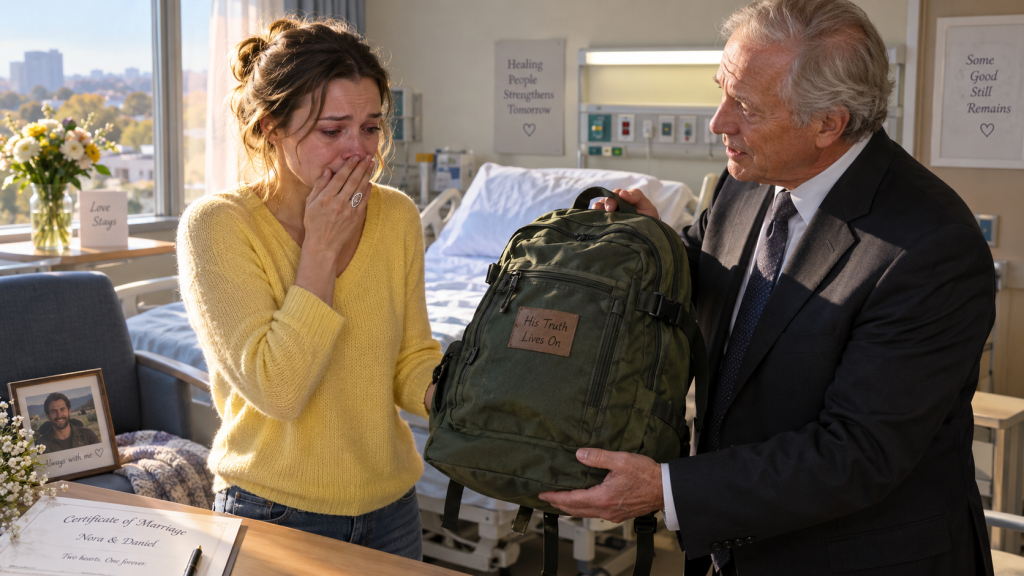
I wore a yellow sweater.
We didn’t have a wedding ring, so Julian slipped a soda can pull tab onto my finger instead.
For the next seven days, I never left his side.
I held his hand through every difficult breath until his heart stopped.
Afterward, I sat alone in his empty room, stunned by how much silence someone I’d known for such a short time could leave behind.
Then an elderly man walked in carrying a green backpack.
“Nora?” he asked. “I’m your husband’s attorney. He left this backpack for you.”
He placed it in my hands.
I immediately noticed how heavy it was.
The lawyer watched my face for a moment, then lowered his voice.
“Julian wasn’t who you thought he was, Nora,” the old man whispered. “He wanted you to know the truth.”…
PART 2 — THE BACKPACK JULIAN CARRIED UNTIL THE END
The lawyer’s name was Henry Lawson.
He was seventy-six, thin, silver-haired, and dressed in the kind of dark suit that looked as though it had spent most of its life sitting beside hospital beds and conference tables.
He did not hand me Julian’s backpack and leave.
That should have warned me.
Instead, Henry pulled the visitor’s chair closer to Julian’s empty bed and sat down.
The green backpack remained on my knees.
“He wanted you to open it with me here.”
I stared at him.
“Why?”
Henry looked toward the bed.
The sheets had already been changed.
That offended me more than it should have.
A person could spend seven days becoming someone’s husband, breathe his final breath into a room, and less than an hour later the pillows were smooth again.
Hospitals know how to continue.
Grief does not.
“Because some of what Julian told you was true,” Henry said.
My fingers tightened around the canvas strap.
“And some wasn’t?”
Henry nodded.
“Yes.”
I felt suddenly cold.
“What did he lie about?”
“Several things.”
The answer came without decoration.
I looked toward the soda-can tab still looped around my finger.
The absurd little ring Julian had slipped onto me while the chaplain tried not to cry.
For one week, I had believed I understood exactly what our marriage had been.
A strange kindness.
A dying man’s final request.
Two lonely people pretending, briefly, that loneliness did not get the final word.
Now a lawyer was telling me even that story had missing pages.
“Was Julian married?”
I asked.
“No.”
“Did he have another wife?”
“No.”
“Did he have children?”
Henry hesitated.
That was enough.
My stomach dropped.
“He did.”
“One.”
“A daughter.”
I stared.
“He told me there was nobody.”
Henry corrected me gently.
“He told you he did not want to die as a nameless file.”
“That is not the same statement.”
I hated him for being right.
“What is her name?”
“Rebecca.”
“Where is she?”
“About forty minutes away.”
My mouth went dry.
Forty minutes.
I had held Julian’s hand every night because I believed there was nobody else.
Forty minutes.
Not another country.
Not some impossible distance.
“Did she know he was dying?”
“Yes.”
The room tilted.
“Did she know I married him?”
“Yes.”
That hurt worse.
I stood.
The backpack slid toward the floor.
Henry caught it before it fell.
“I need to leave.”
“Nora.”
“No.”
I wiped my face angrily.
“I spent seven days sleeping in that chair.”
“I know.”
“I cancelled work.”
“I called the chaplain.”
“I married a dying man because he told me he didn’t want the state deciding everything after he became too sick.”
Henry’s expression changed.
There it was.
Something else.
“What?”
I demanded.
He looked down.
“Nora, Julian already had valid advance directives.”
Silence.
I stared.
“What?”
“He had a healthcare proxy.”
“A financial power of attorney.”
“Funeral instructions.”
“Disposition instructions.”
“Everything.”
My hand moved to my mouth.
“Then why did he need to marry me?”
Henry closed his eyes briefly.
“He didn’t.”
That sentence hurt more than finding out about Rebecca.
Maybe because the marriage was the only part I thought I understood.
I sat again because my knees stopped cooperating.
“He lied to me.”
“Yes.”
“Why?”
Henry looked toward Julian’s bed.
“His letter explains his reason.”
“I don’t want his letter.”
That came out too fast.
Too angry.
Henry nodded.
“Then don’t read it.”
I looked at him.
“You’re not going to tell me I owe him that?”
“No.”
“He’s dead.”
“That doesn’t make his wishes commandments.”
Something inside me softened by one degree.
Henry placed the backpack on the chair between us.
“You can leave it with me.”
“Take it tomorrow.”
“Burn it.”
“Keep it.”
“That is your decision.”
There it was.
A word Julian had apparently known more about than I thought.
Decision.
I stared at the backpack.
Green nylon.
Frayed zipper.
One small stain near the bottom.
Julian had kept it beneath his bed.
I had seen it every day.
I assumed it contained clothing.
Maybe a shaving kit.
Old paperwork.
I never opened it.
Because it belonged to him.
The smallest form of respect.
Now it felt like the bag had been watching me the entire week.
“What’s inside?”
I asked.
Henry almost smiled.
“That defeats the point of opening it.”
“I’m not in the mood for lawyer humor.”
“That wasn’t humor.”
He was apparently naturally irritating.
Julian would have liked him.
Maybe that was why they had been friends for thirty-four years.
I pulled the zipper.
The first thing inside was not money.
Not a will.
Not jewelry.
A pair of worn brown slippers.
I stared.
Then laughed.
Of course.
Julian had spent three days accusing a nurse of stealing those slippers.
Apparently he had packed them himself.
Beneath them was a folded navy sweater.
A toothbrush.
A paperback copy of The Old Man and the Sea covered with notes in the margins.
A cracked leather wallet.
Then my hand hit something hard.
A wooden box.
I lifted it out.
No lock.
Inside was a wedding ring.
Not mine.
Gold.
Plain.
Worn almost smooth.
I looked at Henry.
“His first wife?”
“Yes.”
“Her name?”
“Evelyn.”
Julian had mentioned Evelyn.
Not often.
He said she died sixteen years earlier.
He described her as funny.
Stubborn.
A terrible cook.
Someone who could make silence feel like company.
He never told me how she died.
I assumed grief made the subject difficult.
Apparently there were other reasons.
Beneath the ring was a photograph.
Julian and Evelyn.
Maybe in their forties.
Standing beside a lake.
Julian had thick dark hair.
I laughed despite myself.
I had accused him of being born bald.
On the back, in blue ink:
Evelyn, Lake George, 1989.
I touched the photograph.
This was the part of Julian that existed before his hospital bracelet.
Before oxygen tubes.
Before I knew his tea order.
An entire marriage.
A life.
Someone else had once held his hand through years instead of seven days.
I suddenly felt embarrassed for having thought our week made me the expert on him.
“What happened to Evelyn?”
I asked.
Henry was quiet.
“Cancer.”
“What kind?”
“Pancreatic.”
“Was Julian with her?”
“Yes.”
“Until the end?”
A pause.
“Yes.”
That pause mattered.
I looked at him.
“What aren’t you saying?”
Henry folded his hands.
“The backpack.”
I almost threw one of the slippers at him.
Instead I kept digging.
A thick envelope sat beneath the sweater.
Written across it:
NORA — FIRST
I stared.
Julian’s handwriting.
Weak but recognizable.
I did not open it.
Not yet.
Beside it was a leather notebook.
Old.
The first twenty pages contained dates and numbers I did not understand.
Then names.
Doctors.
Hospitals.
Attorneys.
The later pages were more personal.
Short sentences.
Fragments.
One page read:
Do not let fear become authority.
Another:
There is no dignity in forcing someone to stay because you are frightened to let them go.
Another:
Evelyn forgave me for things I had not earned forgiveness for. I mistook that for innocence.
My stomach tightened.
“What did he do?”
Henry looked at the notebook.
“Keep reading.”
I turned pages.
Then found my name.
Nora.
Nothing else on the first line.
My hands began to tremble.
Beneath it:
She has Marian’s eyes.
The notebook slipped out of my hand.
Henry caught it before it hit the floor.
“What did he write?”
I whispered.
Henry’s face changed.
So he knew.
Of course he knew.
I took the notebook back.
Read the sentence again.
She has Marian’s eyes.
My mother’s name was Marian Ellis.
Not Marianne.
Not Mary.
Marian.
And she had green-gray eyes everyone said I inherited.
I looked at Henry.
“How did he know my mother?”
Henry exhaled slowly.
“That is the truth he was most afraid of telling you.”
The room became very quiet.
“You knew my mother?”
“I met her.”
My stomach turned.
“When?”
“Sixteen years ago.”
I stared.
My mother had never mentioned Julian.
Not once.
I opened the envelope marked NORA — FIRST.
Five handwritten pages.
The first line made me stop breathing.
Nora, I recognized your mother’s name the second week we knew each other.
Second week.
We had barely known each other two weeks before he asked me to marry him.
I kept reading.
I did not approach you because of Marian. When you first sat beside me in the waiting room and asked why I was arguing with the vending machine, you were simply the volunteer with the yellow badge and terrible coffee.
I almost smiled.
He had been trying to buy peanut M&M’s.
The machine ate three dollars.
Julian called it “institutional theft.”
I told him three dollars did not constitute an organized conspiracy.
That was our first argument.
Our first conversation.
His letter continued.
You told me your mother’s name days later. You told me she had died the previous spring, and when you said Marian Ellis, I thought perhaps coincidence was playing a cruel joke. Then I looked at you properly.
There was no coincidence.
My chest hurt.
I knew your mother.
I stopped again.
Henry remained silent.
That helped.
Some truths become smaller when someone rushes to explain them.
Julian wrote:
Marian was a hospital social worker when Evelyn was dying.
I frowned.
My mother had been a social worker.
She worked in hospitals for much of my childhood.
But she rarely talked about individual patients.
Confidentiality mattered deeply to her.
When I was little, I once asked whether she helped famous people.
She said:
“When someone is sick, famous is usually the least interesting thing about them.”
That sounded like Mom.
Of course she would never have come home talking about Julian.
According to the letter, Marian became involved in Evelyn’s care during the last five weeks of her life.
Not as her primary social worker at first.
As part of an ethics consultation.
I looked up.
“Ethics consultation?”
Henry nodded.
“Keep reading.”
My stomach tightened.
Julian wrote:
Evelyn wanted to stop treatment.
There it was.
The first fracture.
Evelyn’s cancer had progressed despite chemotherapy.
She was exhausted.
In pain.
Hospitalized repeatedly.
Her doctors told the family that more treatment might buy time but would also carry burdens.
Evelyn decided she had enough.
Julian did not.
I loved my wife so much that I became convinced love meant refusing to accept her answer.
My eyes blurred.
I called every specialist I knew.
I arranged consultations she did not ask for.
I argued with physicians when they used the word hospice.
I told myself I was fighting for her.
Then:
Marian told me I was fighting with her.
I covered my mouth.
My mother.
I could hear her saying it.
Not loudly.
She rarely needed loudness.
Julian wrote about their first meeting.
He had been furious.
Evelyn had refused another procedure.
Julian demanded the hospital assess whether pain medication was impairing her judgment.
A familiar idea.
If someone you love chooses something you cannot tolerate, question whether they are capable of choosing.
Marian attended the ethics meeting.
Julian described her as “a small woman with a green notebook who somehow made six physicians nervous.”
That made me laugh through tears.
Mom carried green notebooks her entire life.
Grocery lists.
Appointments.
Everything.
I still had three in a box at home.
Marian asked Julian one question:
If Evelyn agreed with you, would you still be questioning her competence?
He hated her for it.
His words.
Not mine.
He wrote:
I wanted her removed from the case.
My heart sank.
He filed a complaint.
Against my mother.
Said she was biased.
Unprofessional.
Interfering with family decision-making.
The complaint triggered an internal review.
Marian was temporarily removed from Evelyn’s case while supervisors evaluated it.
I stopped reading.
“What happened to my mother?”
I asked.
Henry’s voice was quiet.
“She kept her job.”
“But?”
“There was a formal review.”
“Did Julian know what that could do to her career?”
“Yes.”
My anger returned.
Hot.
Immediate.
I looked at Julian’s empty bed.
“You coward.”
Henry did not defend him.
Good.
The complaint was ultimately dismissed.
Other clinicians supported Marian’s conduct.
Evelyn herself requested that Marian return.
That was the part Julian said shamed him most.
His dying wife had asked for the woman he tried to remove.
Marian returned.
She helped Evelyn document her wishes.
Not against Julian.
For Evelyn.
Comfort-focused care.
No further invasive treatment.
Clear instructions about what she wanted if she could no longer speak.
Julian eventually stopped fighting.
Not nobly.
Not immediately.
He wrote:
I stopped because Evelyn took my face in both hands and said, “You are making me spend my last days comforting you about my death.”
I had to put the letter down.
That sentence hurt.
Maybe because grief had made me do smaller versions of the same thing to my mother.
Please eat.
Try another doctor.
Don’t talk like that.
Please don’t leave yet.
We call it hope when sometimes it is bargaining with someone else’s body.
Evelyn died twelve days later.
Julian was beside her.
Marian came by after.
Not because she had to.
She sat with him.
He apologized.
Not beautifully.
Not enough.
Marian apparently said:
“You can spend the rest of your life feeling guilty or you can spend it becoming easier for the next frightened person to deal with.”
That sounded so much like my mother that I began crying before I reached the next line.
I chose guilt for several years because guilt is strangely comfortable. It lets you suffer without changing.
I stared.
That sentence belonged somewhere inside me too.
Eventually Julian changed.
He joined a hospital patient-rights board.
Donated to palliative-care programs.
Funded independent patient advocates.
Worked with Henry to revise his own advance directives.
That explained the notebook.
The phrases.
The obsession with autonomy.
The dying man who told me he did not want the state handling his final hours had once been the husband who tried to override his dying wife’s choices.
People are rarely frightened of things randomly.
Sometimes fear is memory facing the opposite direction.
Then I reached the part about my mother’s death.
Julian learned Marian had died because I told him.
He had not stayed in contact with her.
They had exchanged perhaps five letters after Evelyn’s death.
Then nothing for years.
Marian never asked him for money.
Never became his friend.
Never joined his foundation.
But Julian kept every letter.
They were inside the backpack.
Bundled beneath the notebook with a red string.
My mother’s handwriting.
I recognized it instantly.
My chest stopped working properly.
I had not seen new words from her in almost a year.
Dead people’s handwriting is dangerous.
It makes the body forget time for a second.
The first letter began:
Mr. Vale,
Not Julian.
Of course.
My mother could maintain boundaries through punctuation.
She told him she accepted his apology but did not want him turning her into “the saintly social worker who taught a rich man a lesson.”
I laughed aloud.
Henry smiled.
“She was formidable.”
“Yes.”
I whispered.
“She was.”
Marian wrote:
If you change, change because Evelyn deserved better from you, not because you want me to tell you you’re a good person now.
I pressed the paper against my chest.
I missed her so much it felt physical.
There were five letters.
In the final one, written thirteen years ago, Mom thanked Julian for funding independent patient advocates.
Then warned him:
Be careful not to make your regret into another form of control. Giving money to people does not give you ownership over the good they do with it.
Julian had underlined that sentence.
Twice.
Of course he had.
I looked at Henry.
“So he recognized me.”
“Yes.”
“And said nothing.”
“Yes.”
“Why?”
Henry nodded toward Julian’s letter.
I kept reading.
When I realized who you were, I should have told you immediately.
I did not.
At first, I told myself Marian’s history with me was private. That was partly true.
Then I told myself I did not want you treating me differently because of your mother. Also partly true.
The ugliest truth is that I was afraid you would stop visiting me.
I closed my eyes.
There it was.
Not conspiracy.
Not hidden nobility.
Fear.
Selfishness.
Loneliness.
The things people usually hide behind more flattering explanations.
You sat beside me because you thought I was simply an old man with no one.
For the first time in years, somebody looked at me without seeing my last name, my money, my mistakes, or the people angry with me.
I became greedy for that.
My anger weakened.
I did not want it to.
I should have trusted you with the truth.
I did not.
For that, I am sorry.
Then came the marriage.
I braced.
Now the part where you will want to throw the backpack out a window.
I almost laughed.
There was no window that opened.
Julian had always complained about that.
I did not need marriage to keep the state from making my medical decisions. Henry and I had completed the necessary documents long before I met you.
My jaw tightened again.
I said that because I knew what you would say if I asked the honest question.
The next line blurred.
“Nora, I have perhaps a week left. I have known you less than a month. Will you marry me because I am lonely, because I love the way you read bad mystery novels aloud, because you remind me that I am still a man instead of a diagnosis, and because I would like to die having belonged to someone one last time?”
I stopped.
Covered my eyes.
That bastard.
That lonely, frightened, manipulative bastard.
You would have said no.
He knew me.
I would have.
Not because I did not care.
Because I would have thought marriage was too big a word for what we were.
Too permanent for something measured in days.
You would have told me friendship was enough.
Yes.
You would have told me I was frightened.
Yes.
You would have kissed my forehead and gone back to your volunteer desk.
Probably.
So I gave you a reason you could not easily refuse.
My anger returned.
Good.
He deserved some of it.
Then:
That was unfair.
I stared at the words.
No excuse.
I took your compassion and put weight on it.
My throat tightened.
I turned my wish into an emergency because I was afraid my wish would not be enough.
That sentence hurt because it was true.
He had not forced me.
But he had shaped the question.
He made my refusal feel like leaving a dying man alone.
That was not nothing.
I looked at Henry.
“Why did you let him do it?”
He did not flinch.
Fair question.
“I argued with him.”
“Apparently badly.”
“Yes.”
That surprised me.
Henry continued.
“I told him he had no right to make you believe marriage was required for his medical autonomy.”
“What did he say?”
“That he would tell you.”
“He didn’t.”
“No.”
“Why didn’t you?”
“Attorney-client confidentiality.”
I laughed bitterly.
“Convenient.”
“Yes.”
He looked ashamed.
“Sometimes legal duties are convenient for cowards too.”
That shut me up.
He was not pretending innocence.
Good.
“Was the marriage legal?”
I asked.
“Yes.”
“No problem with his capacity?”
“No.”
“Mine?”
Henry’s eyebrow lifted.
“Legally competent adults are permitted to make strange decisions.”
“Comforting.”
“Julian had been evaluated because of his illness and medication.”
“He understood the marriage.”
“He understood its legal consequences.”
“So did the chaplain follow the proper process?”
“Yes.”
“Then I was actually his wife.”
“Yes.”
“For seven days.”
“Yes.”
I looked at the pull tab.
The silly silver circle.
“Did he love me?”
Henry’s face softened.
“That is the one question no document can answer for you.”
I hated lawyers.
I looked back at Julian’s letter.
Maybe the answer was there.
Not in declarations.
In details.
You snore when you sleep in hospital chairs.
I laughed.
You put too much sugar in coffee.
Rude.
You pretend not to cry during old songs.
True.
You call your mother’s voicemail even though you know no one will answer.
My breath caught.
I had done that twice while sitting beside Julian.
I thought he was asleep.
Apparently not.
I knew I could never replace your mother and never wanted to.
I also knew the fact that she once protected Evelyn would make my affection for you look suspicious if you learned it too late.
Yes.
Exactly.
That is why you are learning it too late.
I almost threw the letter.
Then read on.
Cowardice often understands itself perfectly and changes nothing.
Damn him.
Then Julian wrote about his daughter.
Rebecca.
He had not seen her in person for almost two years.
Not because she wanted his money.
Not because she abandoned him.
Because they were angry with each other.
Rebecca believed Julian’s late-life obsession with patient autonomy had become another way of refusing family.
After Evelyn died, Julian changed.
He stopped letting people help.
Refused to move closer to Rebecca.
Refused assisted living.
Refused to discuss finances.
Then his heart worsened.
Rebecca begged him to move into her home.
Julian said no.
She accused him of romanticizing independence because he was terrified of needing anyone.
He accused her of treating him like a patient before he was one.
They stopped speaking.
Two stubborn people.
Related beyond dispute.
Six months before I met him, Rebecca tried again.
She came to the hospital after his first serious heart-failure admission.
Julian refused to see her.
My stomach turned.
“He refused?”
Henry nodded.
“Yes.”
“Why?”
“He was ashamed.”
“Of what?”
“Many things.”
That was not an answer.
The letter supplied one.
Rebecca knows me too well.
She can tell when my dignity is pride wearing a good coat.
I smiled sadly.
I did not want to spend my last months apologizing for becoming exactly the lonely old man she warned me I would become.
So he chose loneliness rather than admitting his daughter was right.
Human beings will do astonishing things to avoid one uncomfortable sentence.
Rebecca knew he was dying.
Henry informed her when Julian entered hospice-level care.
She asked whether she should come.
Julian said no.
Then he met me.
When Henry told Rebecca her father intended to marry a twenty-nine-year-old hospital volunteer, Rebecca’s reaction was apparently:
“Of course he does.”
I laughed despite myself.
“What does that mean?”
Henry smiled faintly.
“She said Julian had always required his final acts to contain unnecessary theater.”
That sounded fair.
Rebecca did not challenge the marriage.
Did not accuse me.
Did not come storming into the hospital.
She told Henry:
“If she is kind to him, leave her alone.”
That made me cry unexpectedly.
I had imagined a wealthy daughter furious that a stranger had married her father.
Instead she had protected me from the drama Julian created.
“Did she come to the funeral?”
I asked.
“He has not had one yet.”
Right.
It had been hours.
Grief had compressed time.
“Will she?”
“Yes.”
“Does she hate me?”
“I don’t believe so.”
“Does she know about my mother?”
“Yes.”
I stiffened.
“How?”
“Julian told her after the wedding.”
So his daughter knew.
His lawyer knew.
Dead Julian knew.
I did not.
Excellent.
I returned to the backpack.
Beneath the letters from my mother was a folder.
Financial statements.
Trust documents.
I immediately pushed them away.
“I don’t want his money.”
Henry did not move.
“Then don’t make a decision today.”
“I married him for a week.”
“I know.”
“People are going to think—”
“What?”
“That I did it for money.”
“Some will.”
The bluntness startled me.
Henry continued.
“Others will think you were manipulated.”
“Some will call the marriage beautiful.”
“Some grotesque.”
“Some ridiculous.”
“None of those people were in this room at three in the morning when Julian couldn’t breathe.”
I stared.
“Were you?”
“No.”
“Then you weren’t either.”
He nodded.
“Fair.”
Good lawyer.
Annoying man.
I finally asked:
“How much money did he have?”
Henry took off his glasses.
That was never a good sign.
“Julian’s net estate is approximately twenty-six million dollars.”
My stomach dropped.
I stared at the green backpack.
Then at Julian’s slippers.
“Twenty-six million?”
“Yes.”
“He wore socks with holes.”
“Yes.”
“He argued about a four-dollar pudding cup.”
“Constantly.”
“He let me buy him coffee.”
Henry smiled.
“He probably enjoyed that more than the coffee.”
I felt sick.
Not because of the amount.
Because the imbalance changed the meaning of every small thing retroactively.
At least temporarily.
“Did he leave it to me?”
“No.”
Relief came so quickly I almost laughed.
“Thank God.”
Henry actually smiled.
“Julian expected that reaction.”
“Who gets it?”
“Most was already in trust.”
“Rebecca?”
“Partly.”
“A foundation?”
“Substantially.”
“Anything for me?”
“Yes.”
My relief disappeared.
“How much?”
“Not twenty-six million.”
“I gathered that.”
Henry looked at the backpack.
“Julian left you $180,000 outright.”
I stared.
That was still more money than I had ever seen.
“And?”
“A separate educational and charitable fund you may direct but not use personally.”
“How much?”
“Two million.”
I nearly choked.
“For what?”
“Volunteer programs for unaccompanied patients.”
I closed my eyes.
Of course.
The thing that brought us together.
“I don’t want control of two million dollars.”
“You would not control investments.”
“A professional foundation administers it.”
“You would help select grants.”
“I’m twenty-nine.”
“Yes.”
“I barely understand my own taxes.”
“That is why accountants exist.”
“I don’t want this.”
“Then resign from the advisory role.”
I stared.
“I can?”
“Yes.”
“You are not being punished with philanthropy.”
That was possibly the most lawyer sentence ever spoken.
There was also one personal provision.
The soda-can pull tab.
Julian had instructed Henry to have it mounted inside a proper ring.
I started laughing.
“No.”
Henry frowned.
“What?”
“He planned jewelry for garbage?”
“He described it as ‘industrial silver.’”
I laughed so hard I cried.
Then cried so hard the laughter disappeared.
Grief is humiliatingly efficient at changing direction.
The final item in the backpack was another folder.
Older.
Hospital letterhead.
Sixteen years old.
EVELYN VALE — PATIENT ADVOCACY / ETHICS REVIEW
My stomach tightened again.
“I don’t want to read this.”
Henry’s expression became serious.
“You do not have to.”
“Why did Julian leave it?”
“Because he wanted you to know exactly what happened.”
“Did my mother know he kept it?”
“No.”
I looked at the folder.
Something about it frightened me more than the money.
More than Rebecca.
More than the manipulated proposal.
Because Julian’s guilt had spent sixteen years inside those pages.
And my mother was dead.
There would be no asking her whether his version was fair.
I opened it.
Committee notes.
Complaint records.
Statements.
My mother’s name.
Marian Ellis, LCSW.
Her supervisor’s statement defended her.
Evelyn’s physician supported her.
Another nurse wrote that Marian had appropriately advocated for the patient’s expressed wishes.
Julian’s original complaint was there too.
Four pages.
Angry.
Precise.
Self-righteous.
He accused my mother of “creating unnecessary division between a terminal patient and her spouse.”
I wanted to tear it.
Then stopped.
Mom had survived the accusation without needing me to destroy the paper afterward.
I kept reading.
At the bottom of the file was a photograph.
Not medical.
Probably from some hospital event.
A patient-rights committee gathering after Evelyn died.
Julian stood at one end.
My mother stood several people away.
Younger.
Dark hair.
Green notebook tucked under one arm.
I touched her face.
“Mom.”
The word left me before I could stop it.
I had never seen this photograph.
Henry looked away.
Behind the photograph was one final sheet.
Not typed.
My mother’s handwriting.
I recognized it immediately.
A photocopy of a note she had written during the ethics review.
At the top:
PRIVATE — FOR CLINICAL FILE IF NEEDED
I read.
The first paragraphs were ordinary.
Evelyn understood her illness.
Understood the consequences of stopping treatment.
Expressed consistent preference for comfort-focused care.
Then Mom wrote about Julian.
Not cruelly.
Clinically.
Spouse appears deeply distressed and has difficulty distinguishing his own fear of loss from patient’s stated goals.
That sentence alone could have explained the entire man I married.
Then the final paragraph.
I stopped.
Read it again.
My heart began pounding.
Henry noticed.
“What is it?”
I did not answer.
Because beneath my mother’s handwriting was a sentence Julian had underlined in red.
Mrs. Vale privately reports that this is not the first time Mr. Vale has attempted to override her decisions by questioning her judgment. She requests that certain financial and legal documents be kept outside his access until she can speak with counsel.
I looked up.
Henry had gone very still.
“You knew about this?”
“Not that page.”
“What financial documents?”
“I don’t know.”
My pulse quickened.
I turned the page.
Nothing.
The file ended.
“That’s it?”
“Yes.”
“Where’s the rest?”
“I don’t know.”
I stared at him.
“Julian had twenty-six million dollars.”
“Yes.”
“Evelyn was hiding legal papers from him.”
“Apparently.”
“And then she died twelve days later.”
Henry immediately raised a hand.
“Nora.”
“What?”
“Evelyn died from advanced pancreatic cancer.”
“I am not suggesting Julian killed her.”
“Then what are you suggesting?”
“I’m not.”
He looked at the page.
“But this changes what we understood about their marriage.”
Yes.
It did.
Again.
A dead person becoming more complicated after the funeral had not even happened.
Then my eyes landed on something written at the bottom of my mother’s note.
Not by Marian.
By Julian.
Much later.
Different pen.
Shaking handwriting.
Henry has the other envelope. Give it to Nora only after she reads this.
I looked at the lawyer.
His face drained.
“Henry.”
He closed his eyes.
So he knew about that.
“What envelope?”
He did not answer immediately.
“Henry.”
Slowly, he reached inside his briefcase.
Removed a thin sealed envelope.
Yellowed with age.
My mother’s handwriting was on the front.
Not Julian’s.
Not Evelyn’s.
My mother’s.
And across it were four words:
FOR JULIAN’S DAUGHTER, REBECCA.
I stopped breathing.
“Why do you have something my mother wrote to his daughter?”
Henry looked at the envelope.
Then at me.
“Because Marian gave it to Julian sixteen years ago.”
“Did Rebecca ever get it?”
“No.”
“Why?”
“Julian couldn’t bring himself to give it to her.”
My anger came back instantly.
“What is inside?”
“I don’t know.”
“You expect me to believe that?”
“It has been sealed since Marian handed it to him.”
“Why would he keep it?”
Henry’s voice became quiet.
“Because whatever Marian wrote in there concerned the night Evelyn died.”
The room seemed to shrink.
I stared at my mother’s handwriting.
A message she had written to a woman I had never met.
Sixteen years before I married that woman’s father.
And suddenly the stranger I had chosen to keep from dying alone no longer felt like a stranger at all.
He had been carrying a piece of my mother’s truth for almost half my life.
A truth he had been too afraid to deliver while he was alive.
And now, somehow, he had left the choice to me.
PART 3 — THE LETTER JULIAN WAS TOO AFRAID TO DELIVER
For a long time, I did not touch the envelope.
My mother’s handwriting sat three feet away from me.
FOR JULIAN’S DAUGHTER, REBECCA.
Sixteen years old.
Still sealed.
Still waiting.
My mother had been dead almost a year.
Julian had been dead less than a day.
And somehow the two of them had left me sitting in a hospital room with a message that belonged to a woman I had never met.
I looked at Henry.
“You said Julian wanted me to know the truth.”
“Yes.”
“This isn’t my truth.”
Henry’s expression softened.
“No.”
“It’s Rebecca’s.”
“Yes.”
“Then why did he leave it with me?”
Henry looked uncomfortable.
“Because Julian was still Julian.”
That answer almost made me laugh.
“What does that mean?”
“It means even while trying to correct something he had done wrong, he found a way to make the correction unnecessarily complicated.”
I stared at him.
“You really were his friend.”
“For thirty-four exhausting years.”
Despite everything, I smiled.
Then the smile vanished.
“Am I supposed to deliver this?”
“You are not required to.”
“Did Julian ask?”
“Yes.”
“Of course he did.”
I covered my face.
“He manipulates me into marrying him, dies, and somehow still gives me errands.”
Henry almost smiled.
Then became serious.
“If you choose not to meet Rebecca, I will make sure she receives the letter.”
“Good.”
“She should have received it sixteen years ago.”
“Yes.”
That answer carried no defense.
I appreciated that.
I picked up the envelope.
It was surprisingly light.
People imagine truth should weigh more.
It rarely does.
Paper is paper.
Ink is ink.
The weight arrives somewhere else.
“What did Julian tell you about it?”
I asked.
Henry removed his glasses.
“Very little until three weeks ago.”
“Three weeks?”
“Before you married.”
I looked at him sharply.
“He knew he was dying.”
“Yes.”
“He asked me to bring several old files to the hospital.”
“This was one?”
Henry nodded.
“He held it for almost twenty minutes.”
“What did he say?”
Henry looked toward Julian’s empty bed.
“He said, ‘I have spent sixteen years hoping the problem would become too old to matter.’”
My throat tightened.
“And?”
“I told him time does not work that way.”
“What did he say?”
“That time had disappointed him in several areas.”
That sounded so much like Julian I had to look away.
Henry continued.
“Then he told me who your mother was.”
“He knew?”
“Yes.”
“He said meeting you had forced him to look at the envelope again.”
“Because my mother wrote it.”
“Yes.”
“And because?”
Henry hesitated.
“Because he realized he was doing to you, in a gentler way, what he had once done to Evelyn and Rebecca.”
I became still.
“What?”
“Controlling information because he was afraid of what another person would choose if she had all of it.”
The sentence hurt.
Because it was true.
Julian had hidden my mother.
His daughter.
His money.
His medical directives.
Then shaped his proposal so that saying no felt cruel.
Not violence.
Not malice.
But control wearing loneliness as an excuse.
I looked down at the soda-can tab still around my finger.
“What did he say about that?”
Henry’s voice became quiet.
“He said, ‘Apparently repentance without practice is just vanity.’”
I closed my eyes.
That old man.
Even his self-awareness irritated me.
I took the backpack home that night.
Not to my apartment at first.
To my mother’s house.
I still called it that, even though legally it belonged to me now.
Her coat remained on the hook beside the kitchen.
Her chipped blue mug sat behind two others because I could not use it and could not throw it away.
Grief had turned ordinary objects into negotiations.
Keep.
Move.
Touch.
Don’t touch.
I placed Julian’s backpack on Mom’s kitchen table.
Then placed the sealed envelope beside it.
Two dead people.
One table.
Me in the middle.
I sat until sunrise.
At 6:13 a.m., I finally opened one of my mother’s green notebooks.
Not because I expected a secret about Julian.
Mostly grocery lists.
Appointments.
A reminder to buy batteries.
Then, halfway through, I found a sentence Mom had written months before she became ill.
People think boundaries are walls. Most of the time they are doors with handles on both sides.
I stared at it.
That was Mom.
Turning something complicated into a sentence I would spend years understanding.
I pressed my thumb against the ink.
Then cried.
Not about Julian.
Not Evelyn.
Not Rebecca.
My mother.
Sometimes grief gets annoyed when you bring new people into it.
It wants its original seat back.
Henry called at nine.
“I spoke to Rebecca.”
My stomach tightened.
“What did you tell her?”
“That her father died.”
“Nothing else?”
“I told her he left something that belonged to her.”
Silence.
Then:
“What did she say?”
“She asked whether it was another apology.”
That hurt, and I did not even know her.
“What did you say?”
“I told her no.”
“Does she know I have it?”
“Yes.”
“And?”
Henry paused.
“She would like to meet you.”
My heart started pounding.
“Why?”
“Nora.”
“I’m serious.”
“She knows you were with him.”
“That doesn’t explain wanting to meet.”
Henry sighed.
“She knows her father well enough to understand that if he married someone after knowing her three weeks, you probably have questions.”
“Less than three.”
“What?”
“We knew each other less than three weeks.”
“Somehow worse.”
“Thank you.”
We arranged to meet the next afternoon at a small café near the hospital.
Neutral ground.
No law office.
No deathbed.
No green backpack between us.
I brought only the envelope.
I arrived twenty minutes early.
Rebecca arrived fifteen minutes after that.
The first thing I noticed was Evelyn.
I had seen one photograph.
It was enough.
Rebecca had her mother’s mouth.
Same slight downward curve at the corners.
But Julian’s eyes.
Gray.
Sharp.
Evaluating.
She was forty-six.
Dark hair threaded with silver.
No makeup except lipstick.
She wore jeans and a navy coat.
I stood.
She stopped beside the table.
“Nora?”
“Yes.”
“I’m Rebecca.”
“I know.”
Obviously.
Excellent beginning.
We sat.
For several seconds neither of us spoke.
Then Rebecca looked at my left hand.
The pull tab was still there.
I had tried taking it off that morning.
Couldn’t.
Her expression changed.
Not judgment.
Something closer to disbelief.
“He actually used that?”
I looked down.
“You knew?”
Rebecca laughed.
A real laugh.
The first one.
“When I was eight, Dad forgot my mother’s birthday and made her a bracelet out of telephone wire in his office.”
I stared.
“She wore it for three years.”
I started laughing too.
The tension cracked.
Only slightly.
Enough.
Rebecca looked at me more carefully.
“Were you with him when he died?”
“Yes.”
“Was he afraid?”
The question came immediately.
No accusation.
No money.
No marriage.
Was he afraid?
I swallowed.
“A little.”
She looked down.
“Did he suffer?”
“Not at the end.”
“Are you sure?”
“The nurse was there.”
“They adjusted his medication.”
“He was breathing hard for a while.”
“Then it got quieter.”
My voice trembled.
“He knew I was holding his hand.”
Rebecca’s eyes filled.
“Did he say anything?”
I hesitated.
Then smiled faintly.
“He told me my hands were cold.”
She laughed through tears.
“That sounds right.”
“He complained until the end?”
“Almost impressively.”
Rebecca covered her mouth.
For a moment she was not the estranged daughter.
I was not the one-week wife.
We were simply two women missing the same difficult man.
From different distances.
Then she looked at the envelope.
Everything changed.
“Is that it?”
“Yes.”
I pushed it toward her.
Rebecca did not touch it.
“Henry said your mother wrote it.”
“Yes.”
“Did you read it?”
“No.”
She looked surprised.
“It has my name on it.”
“It still does.”
Her eyes held mine.
“Dad had it all these years?”
“Yes.”
“Why?”
“I think we both know the answer is somewhere inside.”
Rebecca stared at the handwriting.
Then whispered:
“I spent sixteen years wondering whether my mother died angry with me.”
My heart broke.
There it was.
The cost of Julian’s fear.
Not abstract.
Sixteen years of one unanswered question.
“Rebecca…”
She lifted a hand.
“No.”
Not angry.
Protective.
“If I open this, I need you to stay.”
I nodded.
“I will.”
She finally picked it up.
Her fingers shook as she broke the seal.
Inside were three pages.
My mother’s handwriting.
Rebecca read silently at first.
Then stopped after the first paragraph.
Her face crumpled.
She pressed the paper against the table.
“I can’t.”
I waited.
After several breaths, she looked at me.
“Will you read it?”
I hesitated.
“It was written to you.”
“I know.”
“Are you sure?”
She nodded.
So I took the letter my dead mother had written to the daughter of my dead husband and began.
Dear Rebecca,
Your mother asked me to write because holding a pen has become difficult for her and because there are things she is afraid other people may explain differently after she can no longer correct them herself.
I had to stop.
Mom.
I could hear her voice inside every sentence.
Rebecca nodded for me to continue.
First, Evelyn understands that she is dying. She understands the consequences of stopping disease-directed treatment. She has discussed those consequences repeatedly with her physicians and has consistently requested comfort-focused care. This decision belongs to her.
Rebecca closed her eyes.
A tear rolled down her cheek.
I kept reading.
Second, your mother asked to see you.
Rebecca made a sound.
Small.
Broken.
I stopped.
She stared at me.
“What?”
I looked back at the letter.
My hands had started trembling.
“She asked to see you.”
Rebecca shook her head.
“No.”
I did not know what to say.
She whispered:
“He told me she didn’t.”
There it was.
The lie.
Rebecca had called the hospital two days before Evelyn died.
She and Julian had fought earlier that week.
Rebecca had accused him of pressuring Evelyn to continue treatment.
Julian told her she was upsetting her mother.
Rebecca left.
Then regretted it.
She called.
Julian answered.
According to Rebecca, he said:
“Your mother needs peace. She does not want you here right now.”
So Rebecca stayed away.
Because she thought respecting her mother meant swallowing the urge to return.
“She asked for me?”
Rebecca whispered.
I looked at the letter.
“Yes.”
She pressed both hands against her mouth.
For sixteen years, one sentence had lived inside her.
She did not want you.
Now another had arrived.
She asked for you.
Some truths heal by first making the wound hurt correctly.
“Keep reading.”
Rebecca said.
I did.
She knows you are angry with your father. She is not asking you to stop being angry. She also does not want the last days of her life turned into a contest over which of you loves her more.
Rebecca laughed once through tears.
“That sounds like Mom.”
I smiled.
Then continued.
She says both of you are exhausting.
Rebecca laughed harder.
So did I.
My mother had underlined both.
Of course she had.
Then came the part Julian could not bear to deliver.
Evelyn asked me to tell you that she does not blame you for leaving the hospital after the argument. She knows you were trying to defend her. She also knows Julian was frightened. Fear explains some of his behavior. It does not make every choice acceptable.
I swallowed.
My mother had somehow written the moral center of the entire story sixteen years before I entered it.
Your mother does not want you inheriting the job of judging your father for the rest of your life.
Rebecca became very still.
She wants you to decide what relationship, if any, you have with him after her death. She specifically asked that no one tell you forgiveness is something you owe because he is your father.
My throat tightened.
I kept going.
She also wants you to know she loved him.
Rebecca looked away.
Both things can be true.
There it was.
Again.
The sentence people resist because life would be easier if love and harm always lived in separate houses.
The financial documents appeared next.
Evelyn had revoked Julian’s authority over her separate inheritance.
Not because she believed he planned to steal it.
Because Julian had been paying consultants, arranging experimental opinions, and moving money freely in his fight to keep treatment going.
Evelyn wanted certain assets protected from being spent on medical decisions she had already refused.
She named Rebecca and an independent attorney as co-agents for those assets.
The documents had been properly signed.
Henry later confirmed they were honored after Evelyn’s death.
Nothing was stolen.
No secret fortune disappeared.
The secrecy had been about control.
Not theft.
I felt strangely relieved.
The truth was painful enough without needing a crime added for decoration.
The final paragraph was not clinical.
It was Mom.
Rebecca, your mother asked me to write one sentence exactly as she said it.
I stopped.
Rebecca grabbed my hand.
“Read it.”
So I did.
“Tell my daughter she did not abandon me. Tell her I knew she loved me even when we were angry. And tell Julian that if he keeps her away because he is afraid of being blamed, I will haunt him.”
Rebecca laughed.
Then sobbed.
I started crying too.
Because it was funny.
Because it was terrible.
Because Evelyn had died.
Because my mother had written the sentence.
Because Julian had kept it.
Because dead women sometimes speak with unbearable clarity when the living finally stop interrupting them.
There was one last line in Marian’s handwriting.
I will give this letter to Julian today because he has Rebecca’s current address and has promised he will deliver it if you are unable to speak with her directly.
Beneath that, in different ink, was Evelyn’s shaky signature.
Evelyn Vale
Rebecca touched it.
Once.
Very gently.
Then folded over the table.
I moved around and sat beside her.
Not touching at first.
Then she leaned into me.
So I held her.
A stranger.
My husband’s daughter.
A woman whose mother had needed my mother.
Life had apparently decided subtlety was unnecessary.
After a long time, Rebecca sat up.
Her eyes were swollen.
“He promised.”
“Yes.”
“He promised my mother.”
“Yes.”
“And kept it.”
“Yes.”
“Sixteen years.”
“Yes.”
Anger entered her face.
Not explosive.
Older than that.
More tired.
“I asked him so many times.”
My chest hurt.
“Asked what?”
“Whether Mom wanted me there.”
“What did he say?”
“That by the end she was too sick to know who was in the room.”
Rebecca shook her head.
“He would always say, ‘It wouldn’t have changed anything.’”
That sentence had probably protected Julian from himself.
If Rebecca’s presence would not have changed Evelyn’s death, then perhaps withholding it did not matter.
Except presence is not always meant to prevent death.
Sometimes it is simply how people say goodbye.
Julian had known that.
Eventually.
Maybe that was why he asked a stranger to become his wife.
Rebecca stared at the letter.
“Why now?”
“Because he met me.”
“That’s not enough.”
“No.”
I took a breath.
“He recognized my mother.”
Rebecca looked at me.
Then I told her everything.
Julian’s complaint against Marian.
The ethics review.
The letters.
His regret.
The backpack.
His manipulated proposal.
His advance directives.
My anger.
All of it.
Not defending him.
Not prosecuting him.
Just setting the pieces on the table.
When I finished, Rebecca laughed softly.
“My father married Marian Ellis’s daughter.”
“Yes.”
“For a week.”
“Yes.”
“With a soda tab.”
“Yes.”
She shook her head.
“That is the most Julian thing I have ever heard.”
I smiled through tears.
“Apparently.”
Then she asked:
“Did you love him?”
The question frightened me more than anything Henry had asked.
“I don’t know.”
Rebecca waited.
I looked at the silver tab on my finger.
“I loved something.”
“That week.”
“The way he looked for me when I entered the room.”
“The way he pretended not to be afraid when he was.”
“The way he complained about pudding.”
“The way he squeezed my hand.”
I swallowed.
“I knew him too briefly to love everything that was true about him.”
Rebecca’s expression softened.
“None of us know everything that is true about anyone.”
That sounded like someone who had spent sixteen years learning it the hard way.
“Did he love you?”
she asked.
“I don’t know.”
Rebecca smiled sadly.
“He probably did.”
“How can you know?”
“Because Dad was selfishest around the people he was most terrified to lose.”
I stared.
“That is not reassuring.”
“It wasn’t meant to be.”
Fair.
We sat there for nearly three hours.
Rebecca told me about Julian before Evelyn got sick.
Sunday pancakes.
Terrible singing.
Driving three hours because Rebecca once called from college with a flat tire.
The father who attended every school play.
The man who cried at her wedding.
Then the other Julian.
The one who could not accept Evelyn’s illness.
The one who needed solutions.
Who treated fear like a problem money could solve.
Who believed persistence was always love until Evelyn’s dying made persistence cruel.
“He changed after Mom.”
Rebecca said.
“How?”
“He became obsessed with not controlling anyone.”
I thought about the irony.
“He still controlled people.”
“Yes.”
She smiled sadly.
“People can learn the lesson and still fail the exam.”
I liked that.
It gave Julian neither acquittal nor condemnation.
Only humanity.
“Why did you stop speaking?”
I asked.
Rebecca looked down.
“Because six months ago I told him to move in with me.”
“He told me.”
“He did?”
“Yes.”
“What version?”
“That you treated him like a patient.”
She laughed bitterly.
“Of course.”
Then she explained.
Julian fell twice.
Forgot medication.
Collapsed once in his kitchen and lay there almost two hours before reaching his phone.
Rebecca panicked.
Wanted him closer.
Julian heard only control.
Their final argument ended with Rebecca shouting:
“You would rather die alone than admit someone else might know what you need.”
Julian replied:
“Maybe I would.”
Then he did almost exactly that.
Except he met me.
Rebecca wiped her face.
“I thought Henry would call eventually and tell me he died alone.”
Instead Julian died with me holding his hand.
I looked at her.
“I’m sorry.”
She shook her head.
“No.”
“Don’t.”
“What?”
“Don’t apologize for being there.”
Her voice broke.
“I’m angry he wouldn’t let me be.”
“That is not the same thing as wishing nobody was.”
Then she reached across the table and touched my hand.
“Thank you.”
I started crying again.
It had been a very inefficient day for mascara.
Julian’s funeral happened four days later.
Small.
No newspaper spectacle.
No long parade of business associates.
Rebecca controlled the arrangements.
Exactly as Julian’s documents instructed.
He had requested cremation.
Jazz.
No open casket.
And, written in capital letters:
NO ONE IS TO DESCRIBE ME AS A VISIONARY.
Rebecca showed me.
I laughed until I had to sit down.
Apparently Julian hated corporate funerals almost as much as pudding cups.
I did not know where to sit.
That sounds trivial.
It wasn’t.
Front row belonged to family.
Legally, I was his widow.
Emotionally, I felt like an accidental footnote.
I chose the second row.
Rebecca found me before the service.
“What are you doing?”
“Sitting.”
“Here?”
“Yes.”
She stared.
Then pointed to the empty chair beside her.
“Dad married you.”
“For a week.”
“He was always impatient.”
“Rebecca.”
She softened.
“You were holding his hand when he died.”
I hesitated.
Then sat beside her.
Not replacing Evelyn.
Not replacing a daughter.
Not claiming thirty years I did not live.
Simply taking the seat someone offered.
There is dignity in knowing the difference.
Henry spoke briefly.
Rebecca spoke longer.
She did not turn Julian into a saint.
I admired that.
She said her father was generous.
Funny.
Impossible.
That he had spent much of his life believing every problem could be solved if he stayed in the room long enough.
Then:
“Near the end of my mother’s life, that belief hurt people.”
The room became still.
Rebecca continued.
“He spent many years trying to become someone who understood that love is not the same thing as authority.”
She looked toward me.
“I think he succeeded sometimes.”
Then smiled.
“And failed spectacularly other times.”
A few people laughed.
So did I.
That was the most honest eulogy he could have received.
Afterward, Henry approached with paperwork.
I nearly ran.
“No.”
He laughed.
“This is not another secret letter.”
“Are you sure?”
“Unfortunately, yes.”
We still had to deal with Julian’s bequest.
The $180,000.
The two-million-dollar patient-companion fund.
My first instinct remained refusal.
I told Rebecca.
She looked at me like I had announced plans to eat the table.
“Why?”
“Because people will think I married him for money.”
“People already think things.”
“I don’t want—”
She interrupted.
“If you refuse money Dad freely chose to leave you because strangers might call you a gold digger, those strangers are still making the decision.”
I became quiet.
Damn.
She sounded like my mother.
I hated when good arguments arrived through inconvenient people.
“What would you do?”
I asked.
“With the $180,000?”
“Yes.”
“It isn’t mine.”
“Pretend.”
Rebecca thought.
“Pay your debts if you have any.”
“Save some.”
“Do something stupid with a little.”
“Something stupid?”
“Dad would approve.”
That was probably true.
“And the fund?”
She became serious.
“That one I think you should at least consider.”
“Why?”
“Because what you were doing when you met him mattered.”
“You sat with people nobody else was sitting with.”
“That isn’t nothing.”
I looked toward the hospital across the street.
“I started volunteering because Mom died.”
Rebecca nodded.
“I know.”
“Then Julian.”
“I know.”
“I don’t want to turn all of this grief into some inspirational project.”
“Then don’t.”
She shrugged.
“Help people because it helps people.”
“It doesn’t have to justify what happened to you.”
That sentence freed something.
Meaning does not have to redeem pain.
Sometimes it can simply stand beside it.
I accepted the bequest.
Eventually.
Not because our seven-day marriage suddenly became worth $180,000.
No marriage has a price.
I paid off my student loan.
Put most of the rest into savings.
Then spent eight hundred dollars on an absurd yellow armchair I had wanted for years.
Rebecca laughed when she saw it.
“Dad would hate that color.”
“Good.”
It remains one of my favorite purchases.
I also accepted the advisory role for the fund.
With conditions.
Professional administrators handled money.
Hospital ethics experts helped design grants.
Former patients and caregivers held seats equal to donors.
And no program was named after Julian.
That was my requirement.
Henry asked why.
“Because he does not get to become the hero of something that grew partly from his regret.”
Henry smiled.
“Marian would approve.”
That was enough.
The fund eventually supported volunteer companion programs, patient advocates, transportation, and training for people sitting with patients who had nobody else.
Quiet work.
No gala photographs required.
Rebecca and I stayed in each other’s lives.
Not because Julian ordered it.
He didn’t.
Not because grief automatically makes family.
It doesn’t.
We simply kept talking.
Sometimes about him.
Often not.
She met me for coffee on my mother’s birthday.
I visited her on Evelyn’s.
Once we spent an entire afternoon arguing about whether Julian’s annotated copy of The Old Man and the Sea belonged to her or me.
She won.
Then returned it at Christmas.
Inside she wrote:
He would be delighted two women argued over one of his books. Don’t give him the satisfaction. Keep it.
I did.
There was one thing Rebecca never did.
She never read Julian’s final apology.
Henry had one.
Julian had written it after giving him Marian’s envelope.
Henry offered it.
Rebecca said:
“Not yet.”
Months passed.
Then a year.
Still not yet.
I once asked whether she ever planned to read it.
She said:
“Maybe.”
“Aren’t you curious?”
“Yes.”
“Then why wait?”
Rebecca looked toward the lake where we were sitting.
“Because for sixteen years, Dad controlled when I learned the truth.”
She smiled sadly.
“I want one thing from him to happen on my schedule.”
I understood completely.
I never asked again.
Two years later, she read it.
She called me afterward.
“What did he say?”
I asked.
She was quiet.
Then:
“The right things.”
“Did that help?”
“Some.”
“Did it fix anything?”
“No.”
That was all.
Apologies do not resurrect missed goodbyes.
They do not rewind hospital corridors.
They do not create sixteen new years.
But sometimes they remove one stone from a road.
That can still matter.
As for Julian and me, people continued asking questions I could not answer neatly.
“Why did you marry him?”
Because he asked.
Because I was grieving.
Because he was frightened.
Because I cared.
Because he manipulated the circumstances.
Because I chose yes anyway.
All true.
“Was it romantic?”
Sometimes.
“Was it appropriate?”
Not always.
“Did you regret it?”
That answer took years.
No.
I regretted not knowing the truth before I agreed.
That is different.
I regretted that Julian thought affection needed a trapdoor underneath it to keep me from leaving.
I regretted that he had not simply asked:
Will you stay?
Because I think I might have.
Maybe not as his wife.
But as Nora.
Perhaps that should have been enough.
I kept the soda-can ring.
Henry offered to have it mounted, just as Julian requested.
I refused.
It is still exactly what it was.
Bent aluminum.
Sharp on one side.
Worth almost nothing.
For a while, I wore it on a chain.
Then one day I put it inside my mother’s blue mug.
That is where it lives now.
Not because the marriage meant nothing.
Because it does not need expensive metal to become more legitimate.
Julian tried all his life to make frightening things safer by adding structure.
Money.
Lawyers.
Treatment.
Marriage.
Sometimes structure helps.
Sometimes it merely disguises fear.
The pull tab is honest.
It says:
This was improvised.
Brief.
Strange.
Real.
On the third anniversary of Julian’s death, I visited the hospital courtyard.
The vending machine was still there.
Different prices.
Same criminal personality.
I bought peanut M&M’s.
The machine actually dispensed them.
Julian would have been furious I received no struggle.
I sat beneath the tree where volunteers sometimes took patients for air.
A young woman in a hospital gown sat nearby with an older volunteer.
They were not saying much.
They did not need to.
Presence is often quieter than people imagine.
I thought of Mom.
Evelyn.
Julian.
Rebecca.
All the things we try to do when someone we love is dying.
Fix.
Argue.
Protect.
Explain.
Promise.
Sometimes the harder act is simply to sit beside a person without making their fear belong to you.
My mother knew that.
Evelyn learned it.
Julian learned it late.
I am still learning.
Before leaving, I called Rebecca.
She answered:
“Everything okay?”
“Yes.”
“I’m at the hospital.”
Silence.
Then:
“Vending machine?”
“Yes.”
“Still stealing?”
“Not today.”
“Dad would be disappointed.”
We laughed.
Then I looked at the waiting room where I first met Julian.
Someone else sat in his old chair.
Naturally.
Rooms continue.
People continue.
Even grief, eventually, stops demanding that the world preserve every empty seat.
“Rebecca?”
“Yeah?”
“I’m glad I gave you the letter.”
She was quiet for a long time.
Then:
“I’m glad Mom wrote it.”
Not:
I’m glad Dad kept it.
Important distinction.
Then she added:
“And I’m glad he finally gave it up.”
That was fair too.
Julian’s last good act did not erase sixteen years of cowardice.
But neither did sixteen years erase the fact that, at the end, he finally chose not to take the truth with him.
People should not receive full credit for returning what they should never have kept.
But returning it still matters.
Both.
Always both.
I walked outside.
The afternoon was cold and bright.
I slipped my hand into my coat pocket and felt the edge of my mother’s old green notebook.
I carried one sometimes now.
Not hers.
A new one.
Same color.
On the first page, I had copied a sentence from Mom’s old notebook:
People think boundaries are walls. Most of the time they are doors with handles on both sides.
Beneath it, I had added one of my own:
Love should never require hiding the handle.
Maybe that was what Julian finally taught me.
Not because he always practiced it.
Because he didn’t.
He had asked me to marry him because he was afraid of dying alone.
I said yes because I was afraid grief had made my own life useless.
Neither of us entered that little hospital ceremony with perfectly clean motives.
Maybe almost nobody enters love that way.
But for seven days, we gave each other something real.
I read to him.
He teased me.
I held his hand.
He listened when I talked about Mom.
We watched rain crawl down the hospital window.
I slept badly in a chair.
He died knowing somebody would notice when the room became quieter.
That mattered.
It simply was not the whole story.
And now I no longer need it to be.
Julian was not the helpless old man I first imagined.
Not merely the wealthy stranger Henry revealed.
Not only the husband who failed Evelyn.
Not only the father who lied to Rebecca.
Not only the patient who manipulated me into a marriage.
He was all of those men.
He was also the man who eventually admitted enough of the truth to stop carrying it into the grave.
A week of tenderness cannot erase a lifetime of mistakes.
A lifetime of mistakes does not make every tender moment false.
That is the difficult mercy of remembering people honestly.
Sometimes, late at night, I still turn the soda-tab ring between my fingers.
I think about the chaplain smiling.
Julian looking exhausted and absurdly pleased.
The way he whispered:
“Mrs. Vale.”
And I said:
“Don’t get used to it.”
He laughed.
Seven days later, he was gone.
Sixteen years after my mother wrote a letter, it finally reached the woman it belonged to.
And nearly a year after Marian died, one of her final lessons reached me too.
Love is not proven by how tightly you hold someone.
Sometimes it is proven by whether you can place the truth in their hands and let them decide what happens next.
Julian learned that too late for Evelyn.
Too late for much of Rebecca’s life.
Almost too late for me.
But not completely.
In the end, he gave me the backpack.
I gave Rebecca the letter.
And for the first time in sixteen years, nobody tried to decide what another person was allowed to know.
Maybe that was not redemption.
Maybe redemption is too large a word.
Maybe it was simply one door finally opening from the correct side.
That was enough.
THE END STORIES! THANK YOU FOR READING GOOD LUCK !❤️
Related Posts