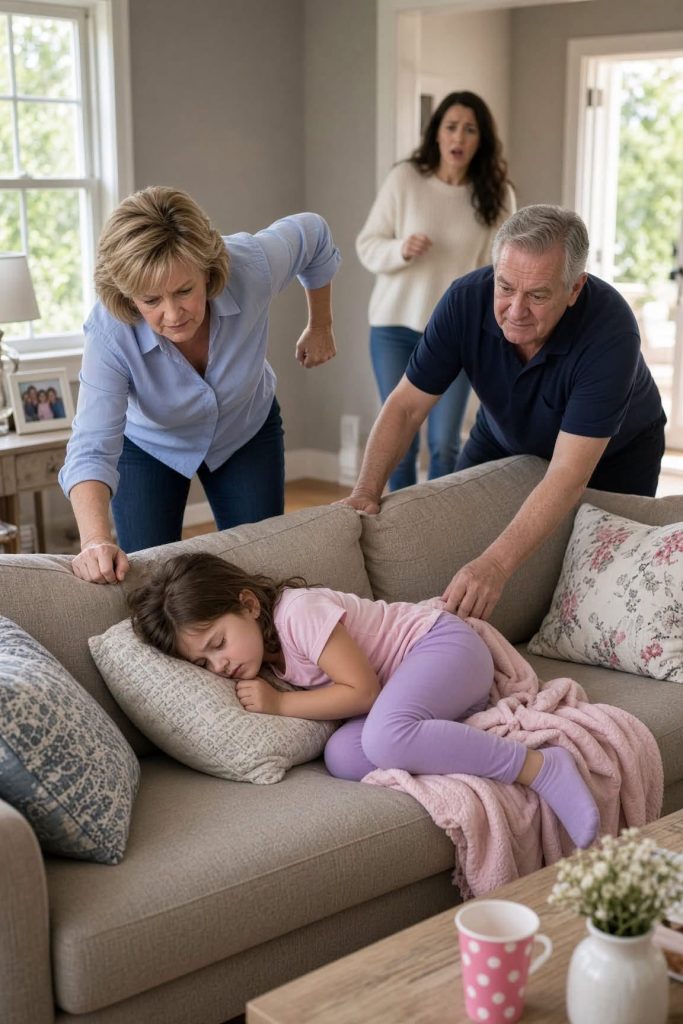
My own parents beat my sleeping six-year-old and smashed her face for my niece’s birthday photos. They clinked glasses and laughed, “Finally she’ll look as worthless as she is.” I didn’t argue — I called 911 while their perfect front lawn filled with sirens.

The first responders reached my daughter before my parents seemed to understand that I wasn’t bluffing. Her little blanket was still twisted around one ankle. Her cheek was swelling, and she kept trying to pull my sleeve over her face because she didn’t want anyone looking at her.
I crouched beside her. “You don’t have to hide from me.”
My mother tried to come closer, but an EMT raised one hand and stopped her.
That changed everything.
My parents had always controlled the room. They decided which family story was funny, who was being “too sensitive,” and which child deserved praise. If anyone objected, my father lowered his voice and calmly explained why we’d misunderstood what we’d just watched happen.
He tried it again on the lawn.
“She fell,” he told an officer. “This is getting blown completely out of proportion.”
I looked straight at him. “Then why did Mom say, ‘Finally she’ll look as worthless as she is’?”
My mother’s head snapped toward me.
My father answered first. “You heard that out of context.”
He had just admitted the sentence had been said.
Through the open doorway, the birthday setup was still waiting. My niece stood inside dressed for the pictures, crying so hard she could barely speak. She kept shaking her head like she thought somehow this had happened because of her.
“Sweetheart, none of this is because of you,” I called.
My mother immediately cut in. “Don’t drag her into this. Today is supposed to be her day.”
Her day.
My six-year-old was being examined on the grass, and my mother was still worried about a birthday photo session.
The responders told my parents to remain near the porch while the EMTs prepared to take my daughter for a full evaluation. I climbed into the back beside her. She caught two of my fingers and pressed them against her chest.
“Are Grandma and Grandpa mad at me?” she whispered.
“No. And even if they are, you never earn what they did to you. Ever.”
My father heard me.
“You’re poisoning her against us.”
For years, that sentence would have worked. I would’ve explained myself. I would’ve worried about Thanksgiving, birthdays, who would call whom, and whether I was being unfair.
Not this time.
I gave the officer my parents’ exact words, where I’d found my daughter, and what I’d seen. Nothing extra. Nothing dramatic. Just facts.
Then a car pulled hard against the curb.
My niece’s mother got out before the engine had fully gone quiet. She looked at my daughter, then at my parents, and whatever she’d planned to say vanished behind one sharp breath.
My mother hurried toward her. “Please. Before you hear some ridiculous version of this—”
She walked right past her.
My niece’s mother crossed the lawn, unlocked her phone, and placed it in the officer’s hand.
➡️## PART 2 — THE VIDEO THEY DIDN’T KNOW EXISTED
My niece’s mother crossed the lawn without even looking at my parents.
Her name was Rachel.
She was usually the kind of woman who apologized when someone else bumped into her at the grocery store.
That afternoon, there was nothing apologetic about her.
She stopped in front of the officer, unlocked her phone, and held it out.
“You need to see this.”
My mother immediately stepped forward.
“Rachel, whatever she told you—”
Rachel turned so sharply that my mother actually stopped.
“Don’t.”
One word.
Quiet.
Cold.
For once, Mom listened.
The officer took the phone.
I was still kneeling beside my daughter while the EMT checked her pupils and gently examined the swelling beneath her eye.
“What is it?” I asked.
Rachel looked at me.
Her face broke.
“A video.”
Something inside me went still.
“What video?”
She swallowed.
“Emma recorded it.”
Emma was my niece.
The birthday girl.
The six-year-old still standing inside the house in her pink dress, crying so hard her shoulders shook.
Rachel looked toward her.
“She sent it to me before I got here.”
My father suddenly spoke.
“She’s six years old. She doesn’t understand what she saw.”
The officer looked up from the phone.
“Sir, stay where you are.”
Dad’s mouth closed.
That alone would have seemed impossible an hour earlier.
The officer pressed play.
The recording shook wildly.
For a moment all I could see was hallway carpet and the edge of a doorframe.
Then Emma’s whisper came through.
“Mommy?”
My heart stopped.
“I think Grandma’s mad.”
A door opened somewhere in the recording.
My mother’s voice.
“Don’t wake her yet.”
Then Dad:
“Just do it quickly. Pictures start at eleven.”
I stopped breathing.
The camera shifted.
Through a narrow crack in the doorway, my daughter was visible asleep beneath her blanket.
Then my parents walked into the room.
The image dropped suddenly.
Emma must have lowered the phone.
What happened next was mostly sound.
A thud.
My daughter crying out.
Then another sound I will never forget.
My mother laughing.
And her voice:
“Finally she’ll look as worthless as she is.”
A man laughed too.
My father.
Not confusion.
Not horror.
Laughter.
Then Emma whispered through tears:
“Mommy, please come get us.”
Rachel covered her mouth.
I looked toward the house.
Emma was watching us.
Her birthday dress glittered in the doorway.
She looked terrified.
Not guilty.
Terrified.
I stood as carefully as I could while the EMT remained beside my daughter.
“Emma.”
She began crying harder.
“I’m sorry.”
“No.”
I crossed the grass toward her.
“You have nothing to be sorry for.”
“They hurt her because of my pictures.”
“No.”
I crouched in front of her.
“They hurt her because they chose to hurt her.”
“But it was my birthday.”
“That does not make it your fault.”
Behind me, my mother said:
“This is ridiculous.”
Rachel turned.
“No.”
Her voice shook now.
“What’s ridiculous is that I kept thinking your favoritism was harmless.”
My mother’s expression changed.
Rachel took her phone back from the officer and opened something else.
A message thread.
Then another.
Screenshots.
Months of them.
Comments I had never seen.
My daughter was “awkward.”
“Too plain for the family photos.”
“Always sulking.”
“Bad for the aesthetic.”
My niece was praised as the pretty one.
The elegant one.
The granddaughter who “photographed properly.”
Rachel had repeatedly told them to stop comparing the girls.
They never had.
Then she showed me the message from three weeks earlier.
My mother had written:
Sooner or later, her mother needs to understand that only one of these girls belongs in the picture.
My hands went cold.
I read it twice.
Then I looked across the lawn at my daughter.
She was six.
Six years old.
And the people who were supposed to be her grandparents had somehow looked at two little girls and decided love was a competition with only one winner.
The ambulance doors opened.
An EMT helped my daughter inside.
She reached for me.
I went immediately.
Before I climbed in, I looked at my parents one last time.
Dad was talking rapidly to another officer now.
Mom was crying.
Neither of them looked powerful anymore.
Not because I had defeated them.
Because the family story was no longer theirs to edit.
There was a video.
There were messages.
There were witnesses.
And, for once, there was no room left for the words:
You misunderstood.
I climbed into the ambulance beside my daughter.
She took my hand.
“Mom?”
“Yes, baby?”
“Will they make me take pictures?”
My throat closed.
“No.”
I pulled the blanket gently around her shoulders.
“No one gets to make you stand in anybody’s picture ever again.”
The doors closed.
And for the first time in my life, I understood that protecting my child might mean stepping completely out of the family portrait they had spent years trying to control.
PART 3 — THE PICTURE THEY COULD NEVER TAKE AWAY
The ambulance doors closed before my parents understood that this was no longer a family argument.
That sound stayed with me.
Two metal doors coming together.
One firm click.
Then my mother disappeared from view.
My father disappeared.
The perfect lawn disappeared.
The birthday decorations disappeared.
All that remained was my daughter lying beneath a white hospital blanket, holding two of my fingers against her chest because she seemed to believe that if she let go, I might disappear too.
Her name is Sophie.
She was six years old.
And while the ambulance pulled away from the house where my parents had spent years teaching everyone who mattered and who did not, Sophie whispered the question that tore something open inside me.
“Mom?”
“I’m here.”
“Is my face bad?”
I looked at her.
Her cheek was swollen.
One eye was beginning to discolor.
There was dried blood beneath one nostril.
The sight made every part of me want to break something.
Instead, I moved closer.
“What do you mean by bad?”
She swallowed.
“Ugly.”
There are moments when a parent realizes a child has been carrying something you never knew was placed on their shoulders.
That was mine.
“Who told you that?”
Sophie looked away.
I knew before she answered.
“Grandma says Emma is the pretty one.”
My chest tightened.
“How many times?”
She shrugged.
That was worse than a number.
Enough that it had become ordinary.
“Sometimes she says I look grumpy in pictures.”
Her voice grew smaller.
“And Grandpa says I make weird faces.”
The EMT across from us paused.
Not obviously.
Just enough that I knew she had heard.
I breathed slowly through my nose.
“Sophie.”
She looked at me.
“There is nothing wrong with your face.”
Her eyes filled.
“Even now?”
“Especially now.”
I touched her hair, nowhere near the bruising.
“Your face is yours.”
“No one gets to decide what it is worth.”
She stared at me.
Then whispered:
“Grandma does.”
“No.”
I said it immediately.
“No, baby.”
“She doesn’t.”
Sophie began to cry.
Not loudly.
She had already learned to cry quietly around my parents.
That realization hurt almost as much as the injuries.
At the hospital, they separated what had happened into manageable pieces.
Medicine first.
Questions later.
That order mattered.
A pediatric emergency physician examined Sophie while a nurse explained every touch before making it.
“I’m going to look at your eye.”
“Okay?”
“I’m going to feel very gently along your cheek.”
“Tell me if anything hurts.”
For the first ten minutes Sophie answered everything with a whisper.
Then the doctor asked:
“May I look inside your mouth?”
Sophie glanced at me.
I nodded.
Only then did she open it.
Consent.
Such a small thing.
The adults who had hurt her were her grandparents.
The strangers helping her understood more about permission.
The scans came back slowly.
No brain bleed.
No injury to her eye.
No major facial fracture.
A small, nondisplaced fracture at the bridge of her nose.
Soft-tissue injuries.
Significant bruising.
A mild concussion.
Painful.
Serious.
Treatable.
The doctor said the word fortunate.
I hated it.
Then loved it.
Because he was right.
It could have been worse.
That did not make what happened small.
Those truths were allowed to exist together.
Sophie fell asleep after they gave her pain medicine.
I sat beside her bed and watched her breathe.
Her blanket was pulled up to her chin.
One hand rested outside it.
Tiny.
Ordinary.
The same hand that still had purple marker on one fingernail from school two days earlier.
A child should not look brave in a hospital bed.
People say that about children all the time.
So brave.
So strong.
I did not want Sophie to need either word.
I wanted her home complaining about vegetables.
I wanted her arguing about bedtime.
I wanted her asking whether she could wear rain boots when there was no rain.
Strength was not a gift my parents had given her.
It was simply what she had needed after they took safety away.
Rachel arrived twenty minutes later.
Emma was not with her.
Child services had arranged for Emma to stay temporarily with Rachel’s sister while the police completed interviews and decided whether anyone else needed to be separated from the investigation.
Rachel stood in the doorway of Sophie’s hospital room.
Her face looked hollow.
“Can I come in?”
I nodded.
She entered.
Then stopped beside the wall rather than approaching the bed.
“She sleeping?”
“Yes.”
Rachel’s mouth trembled.
“I’m so sorry.”
I shook my head.
“No.”
“I should have—”
“No.”
She looked at me.
“Do not do what Emma is doing.”
“What?”
“Make yourself responsible for what they chose.”
Rachel covered her face.
“I knew they were cruel.”
“That isn’t the same as knowing they would do this.”
“I knew they compared them.”
“So did I.”
That hurt to say.
Because it was true.
I had heard comments.
Not these.
But enough.
Emma photographs so beautifully.
Sophie always looks uncomfortable.
Emma has your mother’s eyes.
Sophie takes after her father’s side.
Why doesn’t Sophie smile properly?
Why does she always wear her hair that way?
Small sentences.
Little scratches.
I had answered some.
Ignored others.
Changed subjects.
Once, after Mom called Emma “our little model,” I joked:
“Good thing children aren’t entering a pageant.”
Everyone laughed.
I thought laughter had defused it.
It had not.
Laughter sometimes just gives cruelty permission to stay in the room.
Rachel sat down.
“I started saving screenshots because I thought one day I’d need proof that I wasn’t imagining it.”
I looked at her.
“Why?”
“Because whenever I challenged your mother, she would say I was jealous.”
“Jealous of what?”
“That Emma was prettier.”
I stared.
Rachel’s eyes filled.
“She made it sound disgusting even saying that sentence.”
“I told her I didn’t want Emma raised thinking appearance made her better than Sophie.”
“And?”
“She said I was being dramatic.”
Of course.
The family’s favorite diagnosis.
Rachel looked at Sophie.
“She said something to Emma last month.”
“What?”
“Your mother?”
“Yes.”
Rachel hesitated.
“Tell me.”
“She told Emma she had inherited the ‘good genes.’”
I closed my eyes.
“What did Emma say?”
“She asked what Sophie inherited.”
My stomach tightened.
Rachel whispered:
“Your mother laughed.”
That was all.
She did not need to tell me the answer.
The damage lived in the laugh.
I looked at my sleeping child and realized something terrible.
My parents had not begun hurting Sophie that morning.
They had simply stopped keeping the harm invisible.
Before fists, there had been hierarchy.
Before bruises, there had been words.
Before a birthday photo session turned into an ambulance ride, there had been years of adults teaching two little girls that one was supposed to stand in the center and one should learn to disappear gracefully from the edge.
The violence was new.
The belief behind it was not.
A detective named Alvarez came in that evening.
He sat far enough away from Sophie that she would not wake.
He spoke to me first.
Then Rachel.
The officers had preserved Emma’s video.
The family group messages.
Photographs from the scene.
My statement.
The first responders’ observations.
My parents had been transported separately for questioning.
Not arrested immediately.
That frustrated me.
I wanted handcuffs.
Then felt guilty for wanting them.
Detective Alvarez seemed to read my face.
“This takes time.”
he said.
“I know.”
“We have serious evidence.”
“Then why aren’t they in jail?”
“Because my job is to build something that survives after today.”
That sentence stayed with me.
I had spent my childhood surviving arguments.
He was talking about evidence surviving court.
Different goal.
Better one.
“What are they saying?”
I asked.
He hesitated.
Then:
“Your father says he did not intend to injure her seriously.”
My stomach turned.
“That is not what I asked.”
Alvarez nodded.
“He acknowledges entering the room.”
“Your mother acknowledges being there.”
“They both dispute parts of what happened physically.”
“Emma’s recording captures some of it.”
“Not every action.”
“What does Sophie say?”
“We have not interviewed her substantively yet.”
“Good.”
I meant it.
My daughter was medicated and concussed.
Truth did not need to be extracted from her before she was ready.
“What did they say about the words?”
I asked.
Alvarez looked down at his notes.
“Your mother initially denied saying them.”
“Then she was told there was a recording.”
“And?”
“She said it was sarcasm.”
I laughed once.
The sound frightened even me.
“Of course.”
“Your father said the statement was taken out of context.”
“He said that on the lawn.”
“I know.”
Alvarez paused.
“Then when officers asked him to explain the context in which saying a six-year-old looked worthless would be appropriate…”
I waited.
“He stopped answering.”
For the first time all day, something in me felt almost calm.
Not joy.
Not revenge.
Relief.
Someone had finally asked my father the question we never had.
Explain it.
Do not lower your voice.
Do not rename it humor.
Do not call everyone sensitive.
Explain exactly why it was acceptable.
He couldn’t.
That night, Sophie woke crying.
Not from pain.
From sleep.
Her eyes opened wide and unfocused.
“No.”
she whispered.
“No, no, no.”
I stood immediately.
“You’re at the hospital.”
She looked at me.
“Mom?”
“I’m here.”
Her breathing came fast.
“Is Grandma here?”
“No.”
“Grandpa?”
“No.”
“They can’t come in.”
“How do you know?”
The question broke me.
Children understand promises differently after adults violate them.
I pointed toward the doorway.
“See that sign?”
A small security notice was attached beside her room number.
“People have to ask before they come in.”
“And the nurses know Grandma and Grandpa are not allowed.”
Sophie stared at it.
“What if Grandma says she’s sorry?”
I swallowed.
“She still doesn’t come in.”
“Why?”
“Because sorry doesn’t make someone safe right away.”
She thought about that.
Then asked:
“Does sorry make bruises go away?”
“No.”
“What does?”
“Time.”
Her lower lip trembled.
“How much?”
“I don’t know.”
Honest.
“But I’ll be here while it happens.”
That answer seemed to satisfy her.
She took my hand.
Then fell asleep again.
The forensic interview happened two days later.
Not with me in the room.
That was hard.
A specialist trained to interview children spoke with Sophie while I waited behind another door.
I wanted to hear every word.
Wanted to protect every answer.
Wanted to correct anything she misunderstood.
That impulse scared me.
Because controlling a child’s story in the name of protecting them was still control.
So I sat outside.
Hands clasped.
Waited.
Rachel sat beside me.
Emma was being interviewed separately that afternoon.
Neither of us spoke much.
When it ended, Sophie came out holding a sticker.
A glittery green star.
She looked exhausted.
I crouched.
“You okay?”
She nodded.
“Can we get fries?”
“Yes.”
That was all.
I did not ask what she said.
Did not say:
Did you tell them Grandma hit you?
Did you remember Grandpa?
Did you tell them everything?
She had done enough.
The adults could handle the rest.
Later, Alvarez told me what I was allowed to know.
Sophie’s account was consistent with the physical evidence and Emma’s video.
My mother had struck her first.
My father had participated.
Sophie remembered waking confused.
Remembered trying to cover her face.
Remembered my mother saying she “ruined pictures anyway.”
Remembered my father telling her to stop crying because she was “making it worse.”
Those were facts.
Enough.
My parents were arrested that evening.
I learned through the victim advocate.
Not television.
Not neighbors.
No dramatic call from Dad.
They faced serious charges related to child abuse and assault.
The exact legal labels would be determined as prosecutors reviewed evidence.
Protective orders prohibited contact with Sophie.
They were also barred from unsupervised contact with Emma while child-welfare authorities assessed the broader environment.
Rachel cried when she heard.
Not because she wanted them free.
Because Emma loved them.
That part was complicated.
Children can love unsafe people.
Adults can too.
Love is not a safety certification.
I wish families understood that earlier.
My mother tried to call me from the detention center.
I did not answer.
Then Dad.
Did not answer.
Then my aunt Linda called.
I answered because I was tired enough to make mistakes.
“What have you done?”
she said.
I almost laughed.
“What have I done?”
“Your parents were arrested.”
“I know.”
“Your mother is beside herself.”
“My daughter has a fractured nose.”
Silence.
Then:
“I’m not saying what happened was right.”
Whenever someone begins there, something ugly follows.
“But prison?”
I closed my eyes.
“I did not sentence anyone.”
“You called police.”
“Yes.”
“Family should have handled this privately.”
I looked at Sophie coloring at the kitchen table.
We had been home less than twelve hours.
One side of her face still looked unlike itself.
“Linda.”
“What?”
“Two adults attacked my sleeping six-year-old.”
She inhaled sharply.
“I know what you’re saying.”
“No.”
My voice became quiet.
“You know the version that allows you to keep everyone invited for Christmas.”
“I know the version that happened.”
Then I hung up.
I blocked her number.
The world did not end.
Christmas survived.
More relatives contacted me.
Some horrified.
Some supportive.
Some determined to find a middle.
There is always someone looking for the middle between a child and the adult who harmed them.
They call it fairness.
Usually it is discomfort.
I stopped participating.
I sent one message:
Sophie is recovering. There is an active criminal case. I will not debate what happened or discuss reconciliation. Please do not contact Sophie directly.
Then silence.
It felt like breathing.
Emma struggled differently.
Rachel called me a week later.
“She’s asking to see Sophie.”
My chest tightened.
“Does Sophie want to?”
“I haven’t asked her.”
“Good.”
Rachel understood immediately.
Neither girl would be forced into healing for the adults’ comfort.
A therapist recommended waiting until both children wanted it.
So we did.
Three weeks.
Then one afternoon, Sophie asked:
“Is Emma mad at me?”
I almost dropped the laundry.
“No.”
“Are you sure?”
“Yes.”
“Why hasn’t she come?”
Because we were trying to protect you.
But to a six-year-old, protection can look like absence.
I sat beside her.
“Emma wants to see you.”
Sophie blinked.
“Then why can’t she?”
“We were waiting to see if you wanted to see her.”
Her face changed.
“You mean I get to pick?”
“Yes.”
A small sentence.
Huge effect.
“Tomorrow?”
“If Rachel says tomorrow works.”
“Okay.”
Then:
“Can we not talk about Grandma?”
“Yes.”
“Can we watch cartoons?”
“Yes.”
“Can she sleep over?”
“Not yet.”
Sophie frowned.
Boundaries apparently remain annoying even when healthy.
Good.
Emma arrived carrying Mr. Sprinkles, a stuffed cat she had owned since toddlerhood.
The girls stood five feet apart in my living room.
No one knew what to do.
Rachel and I remained near the kitchen.
We did not script it.
Emma looked at Sophie’s fading bruises.
Her eyes filled.
“I’m sorry.”
Sophie immediately said:
“You didn’t do it.”
Emma started crying.
“But it was my birthday.”
Sophie frowned.
“That doesn’t make sense.”
I almost laughed.
Six-year-old logic coming to the rescue.
Emma wiped her face.
“They wanted pictures because of me.”
“No.”
Sophie picked up a crayon from the coffee table.
“They’re weird.”
Rachel covered her mouth.
I turned away because I was about to laugh during a moment that deserved dignity.
Then Sophie added:
“You called your mom.”
Emma nodded.
“You helped me.”
That was it.
No speech.
No complicated family therapy language.
One child gave another the sentence every adult had been trying to build.
You helped me.
Emma crossed the room.
“Can I hug you?”
Sophie thought.
Then:
“Yes.”
They hugged.
Rachel cried.
So did I.
The girls released each other within three seconds and immediately argued over which cartoon to watch.
Children are merciful that way.
They do not always need moments to remain sacred.
Sometimes healing wants snacks.
Sophie stopped wanting mirrors for a while.
That frightened me.
Before the assault, she liked choosing hair clips in the bathroom.
Afterward, she turned away when I brushed her hair.
One morning, I noticed she had covered the small mirror in her bedroom with a sweatshirt.
I sat beside her bed.
“Do you want the mirror gone?”
She shrugged.
I almost removed it immediately.
Then remembered.
Ask.
“Would you rather cover it?”
“Yes.”
“Okay.”
We left the sweatshirt there.
Three weeks later, it was on the floor.
I did not mention it.
A child therapist named Dr. Patel began seeing Sophie.
The first appointment, Sophie refused to speak for twenty minutes.
Dr. Patel did not push.
They built a tower.
Knocked it over.
Built another.
Eventually Sophie said:
“Grandma thinks Emma is prettier.”
Dr. Patel placed another block carefully.
“What do you think pretty means?”
Sophie shrugged.
“People like looking at you.”
“And what happens if people don’t?”
“They don’t take your picture.”
There it was.
Pictures had become proof of worth.
I hated my parents for that.
Then Dr. Patel asked:
“Do you like taking pictures?”
Sophie shook her head.
“Okay.”
No correction.
No:
But you’ll want memories someday.
Just okay.
That became part of our healing.
We stopped photographing Sophie unless she agreed.
Birthday?
Ask.
First day of school?
Ask.
Family dinner?
Ask.
Sometimes she said no.
We honored it.
Nothing terrible happened.
Memory survived.
Rachel did the same with Emma.
That mattered because Emma had been praised through photographs.
She needed freedom from the other side.
At her delayed birthday celebration six weeks later, Rachel asked:
“What do you want?”
Emma said:
“Pancakes.”
Not balloons.
Not portraits.
Not coordinated dresses.
Pancakes.
So ten of us met at a diner on Saturday morning.
No photographer.
No grandparents.
Emma wore mismatched socks and a unicorn sweatshirt.
Sophie came wearing a baseball cap because her nose was still slightly tender and she liked the way the brim made her feel hidden.
Halfway through breakfast, the waitress offered:
“Want me to take a picture of everyone?”
Both Rachel and I looked at the girls.
Emma shrugged.
Sophie said:
“No.”
The waitress smiled.
“No problem.”
Then walked away.
That simple.
The world did not collapse because a child declined a picture.
My parents had built an entire hierarchy around something strangers could respect in two seconds.
The criminal case moved slowly.
Months.
Discovery.
Hearings.
Motions.
Psychological evaluations.
Statements.
My parents hired separate attorneys.
Separate.
That told me more than any phone call could.
Their united front cracked as soon as survival required individual stories.
Dad claimed Mom was the primary aggressor.
Mom claimed Dad encouraged her.
Dad said he tried to stop things.
Emma’s recording contradicted parts of that.
Mom said Dad laughed because he was nervous.
Dad said Mom said the worst words.
Both tried to reduce their own piece.
Neither could explain why two adults entered a room where a sleeping six-year-old lay and left with her injured.
Eventually, truth became less about which person was worse.
Both had chosen.
That was enough for me.
The prosecutor met with me before plea discussions.
She was careful.
“We can pursue trial.”
she said.
“But I want you to understand the burden.”
“Would Sophie testify?”
“Possibly.”
My stomach turned.
“There are ways to limit that depending on admissible recordings and rulings.”
“But possibly.”
“Yes.”
I looked at the table.
“What do the pleas involve?”
She explained.
Serious convictions.
Custodial time.
Probation afterward.
Mandatory treatment.
No-contact protections.
Restrictions around children.
Not the maximum sentence.
Not nothing.
“What do you want?”
she asked.
I laughed without humor.
“I want the morning not to have happened.”
She nodded.
“I know.”
That answer mattered.
Then:
“What do you want now?”
I thought about Sophie sitting in a courtroom while defense attorneys questioned a six-year-old’s memory.
I thought about punishment.
Justice.
Anger.
Protection.
“I want her not to have to prove it again if the evidence already can.”
The prosecutor nodded.
That became my position.
Not mercy for my parents.
Mercy for my child.
My father accepted a plea first.
Of course he did.
All my life, Dad had known when a room was turning against him.
He accepted responsibility for participating in the assault and child cruelty.
The precise charge names mattered to lawyers.
To me, the important part was his statement.
He stood in court.
Said:
“I harmed my granddaughter.”
Not:
A situation got out of hand.
Not:
I disciplined her too harshly.
I harmed my granddaughter.
I cried when I heard it.
Not because I forgave him.
Because I had waited my whole life to hear my father use a sentence without hiding behind context.
My mother held out longer.
She wanted language softened.
Wanted reference to “reckless conduct” rather than intentional harm.
The prosecutor refused certain changes.
More hearings.
More money.
Eventually she pleaded too.
Her statement was less clean.
She said:
“I deeply regret the injuries suffered.”
My stomach turned.
Passive language.
Injuries had apparently materialized by weather.
The judge noticed.
He asked:
“Who caused those injuries?”
Mom looked at her lawyer.
Then answered:
“I did.”
“And?”
She swallowed.
“My husband did.”
There.
No weather.
No context.
People.
Choices.
They both received time in custody, followed by probation and mandated counseling.
The sentences were not identical because their charges and admitted conduct differed.
The court continued no-contact orders protecting Sophie.
Any future request for modification would require legal review and evidence of changed circumstances.
Rachel obtained her own protections around Emma.
I did not celebrate.
I thought I would.
Instead I went home and made grilled cheese because Sophie wanted triangles, not squares.
That was justice too.
Returning to ordinary life.
On the evening of sentencing, Sophie asked:
“Where are Grandma and Grandpa?”
I had prepared for this with Dr. Patel.
“They have to stay somewhere because they broke serious rules and hurt you.”
“Jail?”
Children hear everything.
“Yes.”
She became quiet.
“Because of me?”
“No.”
“Because they hurt you.”
She looked worried.
“What if they’re sad?”
“They probably are.”
“Should I feel bad?”
There are no perfect answers to that.
“You can feel however you feel.”
She frowned.
“Can I feel bad and still not want them here?”
“Yes.”
Her shoulders relaxed.
“Okay.”
Then:
“Can we have ice cream?”
“Yes.”
Healing, again, demanded dessert.
My parents’ house eventually went up for sale.
I learned accidentally.
A cousin sent me the listing with:
So sad after everything.
I almost deleted it.
Then curiosity won.
There it was.
The perfect front lawn.
Fresh mulch.
White porch.
Inside, the rooms had been staged.
Neutral pillows.
Flowers on the dining table.
The birthday room looked empty.
The bedroom where Sophie had been sleeping had been painted beige.
No trace.
Real estate photography is designed to erase history.
I looked through the images once.
Then closed the page.
A house can be beautiful and unsafe.
A family too.
Appearances had always been my parents’ strongest language.
I no longer trusted fluency.
A strange thing happened after they were gone.
Stories began reaching me.
Not dramatic secrets.
Patterns.
A cousin remembered Mom mocking my weight when I was thirteen.
An aunt remembered Dad making a child cry at Thanksgiving, then telling everyone the child “couldn’t take a joke.”
Rachel remembered the first time Diane repositioned the girls during a Christmas photograph.
Emma in front.
Sophie behind.
At the time, it seemed trivial.
Now every old moment wanted to become evidence.
I had to stop.
Trauma can turn memory into prosecution.
Not everything needed reclassification.
Some things were rude.
Some manipulative.
Some cruel.
One morning was criminal.
Precision mattered.
I did not want my life to become a courtroom where every childhood moment demanded a verdict.
I started therapy too.
Not because people told me to.
Because I noticed I was becoming afraid of kindness from older adults.
A neighbor offered to watch Sophie for ten minutes while I carried groceries.
My entire body said no before my mind understood why.
A teacher touched Sophie’s shoulder while speaking to her and I watched the hand until it moved.
At birthday parties, I scanned adults instead of talking.
Hypervigilance can disguise itself as excellent parenting.
My therapist, Maria, asked:
“What are you afraid will happen if you relax?”
I answered:
“I’ll miss something.”
“You think you missed something before?”
There it was.
Guilt.
“I heard comments.”
“Yes.”
“I knew they favored Emma.”
“Yes.”
“I still let Sophie sleep there.”
My voice broke.
“I left her in that house.”
Maria waited.
Then:
“Did you know they would physically assault her?”
“No.”
“Did Rachel?”
“No.”
“Did Emma?”
“No.”
“Then what exactly are you accusing yourself of failing to predict?”
I hated the question.
Because the answer was:
The future.
I had turned hindsight into a standard no parent could meet.
That did not mean there were no lessons.
There were.
I stopped requiring obvious danger before taking discomfort seriously.
If Sophie said:
“I don’t like going there.”
I listened.
If she did not want to hug someone:
No hug.
If an adult complained:
They could survive.
But I also learned not to make Sophie responsible for managing my fear.
She should not have to identify every unsafe person correctly at six.
That was still my job.
Protection and control are neighbors.
I learned to check which house I was entering.
Emma developed her own complicated response.
She stopped liking compliments about appearance.
Rachel told me one afternoon:
“A woman at school said she has beautiful hair and Emma started crying.”
Poor child.
Praise had been poisoned too.
So her therapist worked on separating appreciation from ranking.
Beautiful does not mean better.
Pretty does not mean worthy.
Another child’s beauty does not reduce yours.
And none of it decides who deserves safety.
Things adults should understand without therapy.
Six-year-olds had to learn them because our parents did not.
A year after the assault, Sophie’s nose had healed completely.
The bruises had disappeared months earlier.
The concussion symptoms were gone.
The harder parts moved slower.
She still disliked sleeping at other people’s houses.
Fine.
She still asked twice whether doors were locked.
We answered once.
Then redirected.
She sometimes covered her face when cameras came out.
We did not force it.
One afternoon at school, her teacher called.
My heart stopped when I saw the number.
Everything had become emergency-coded in my body.
“Nothing bad.”
the teacher said immediately.
I nearly cried from gratitude.
Then she explained.
Class picture day was coming.
Sophie had asked whether she could stand at the back.
The teacher told her she could stand wherever the photographer assigned.
Sophie became upset.
Not because she feared the back.
Because choice had disappeared.
I went to the school the next morning.
Not furious.
Prepared.
The teacher apologized.
“I didn’t know.”
“You couldn’t.”
Then we made a plan.
Sophie could decide whether to participate.
If she participated, she could ask for a specific place.
If the photography setup could not accommodate that, she could skip it.
Simple.
On picture day, Sophie chose the second row.
Emma was not at her school.
No comparison.
Just Sophie.
When the photograph came home, she looked serious.
Not smiling.
I loved it.
Because nobody made her change her face.
Two years after the assault, my mother sent her first letter.
Not directly.
Through her attorney.
I did not read it for three months.
Then one evening, after Sophie went to bed, I opened it.
The first sentence:
I am sorry for what happened.
I almost stopped.
What happened.
Again, weather.
Then:
I understand that you may never want contact.
Better.
She wrote about therapy.
Her own childhood.
Her mother comparing sisters.
Her belief that appearance determined social value.
Her obsession with presenting a successful family.
She tried to explain how she had repeated what was done to her.
Some of it was probably true.
None of it changed the central fact.
Then I reached the line that mattered.
I hit Sophie. I degraded her. I used Emma as a standard against which to diminish her, and in doing so I harmed both girls.
I read it twice.
Both girls.
Finally.
Emma had not benefited from being the favorite.
Not really.
She had been handed a crown made of fear.
Stay pretty.
Stay special.
Do not fall.
Do not become the other girl.
Favoritism is not love.
It is a competition children never asked to enter.
Mom continued.
I believed praising Emma required diminishing Sophie because I saw worth as scarce. That belief was cruel.
Then:
When you called police, I thought you betrayed me. I understand now that I had already betrayed the role I expected you to protect.
That one hurt.
I folded the letter.
Not forgiveness.
Recognition.
I did not answer.
Not yet.
Dad wrote six months later.
Shorter.
Cleaner.
I told myself I was the calmer parent because your mother said the worst things. That allowed me to ignore the fact that I laughed, participated, and then lied to police. I harmed Sophie. I also spent years teaching you that if I spoke calmly enough, your pain became debatable. I am sorry.
I cried harder at his letter than Mom’s.
Because he understood the voice.
That low, reasonable voice.
The one that had made me doubt my own memory.
He named it.
Power sometimes disguises itself as composure.
I did not answer Dad either.
Apologies do not create deadlines for the injured.
I kept both letters in a drawer.
Not displayed.
Not destroyed.
Then lived.
Sophie turned nine.
Emma too, months apart.
They remained close.
Not best friends in the dramatic storybook way.
Real close.
Sometimes inseparable.
Sometimes annoyed.
They argued over games.
Clothes.
Whose turn it was.
Wonderful.
Ordinary conflict felt holy after adults had tried to turn them into symbols.
One summer afternoon, I overheard Emma say:
“You always get better grades.”
Sophie replied:
“You run faster.”
I froze.
Comparison.
Then Emma said:
“Okay.”
And they went back to eating popsicles.
No winner.
No hierarchy.
Children can compare without building a caste system.
Adults taught the poison.
They could also stop passing it on.
Rachel and I became closer too.
Not because trauma automatically creates friendship.
It can also destroy it.
We worked.
She once apologized for not showing me the screenshots earlier.
I told her:
“I would have explained them away.”
She looked surprised.
“I would have.”
“Why?”
“Because admitting they hated Sophie that way would have forced me to change holidays.”
Rachel understood.
Sometimes we ignore warning signs not because we are stupid.
Because believing them carries a cost.
That did not excuse ignoring.
It explained why courage often arrives late.
We created new holiday traditions.
At first, aggressively cheerful.
Too many decorations.
Too much food.
A desperate attempt to prove we were fine.
Eventually we relaxed.
One Christmas we ordered pizza.
One Thanksgiving Emma wore pajamas until dinner.
Nobody coordinated colors.
No formal portrait.
Dad’s old camera tripod never appeared.
The family survived being undocumented.
When Sophie was eleven, she found one of the old birthday photographs.
Not the day of the assault.
Earlier.
She and Emma were four.
Emma stood in front holding balloons.
Sophie stood slightly behind.
My mother had printed it.
Sophie looked at the picture for a long time.
Then asked:
“Did Grandma already not like me?”
My throat tightened.
“I don’t know exactly what she felt.”
“But she liked Emma more.”
“I think she treated Emma as though Emma’s appearance gave her special value.”
Sophie frowned.
“That’s stupid.”
“Yes.”
Then:
“Was Emma prettier?”
I took a breath.
There are traps parents walk into because the obvious reassurance still accepts the premise.
I could have said:
No, you were prettier.
Or:
You were equally pretty.
Both kept beauty as the score.
So I said:
“You were two children.”
She looked at me.
“That’s not an answer.”
“It is.”
I sat beside her.
“You were two little girls who deserved love that did not depend on which one photographed better.”
Sophie considered.
Then nodded.
“Okay.”
She put the picture down.
That was all.
By then, my parents had completed the custodial portions of their sentences and remained under supervision.
The no-contact orders protecting Sophie remained in place for years.
Eventually, legally, there were pathways for them to request changes.
They did not.
At first I assumed their lawyers told them not to.
Then Rachel heard through a victim liaison that both had been advised any request would require substantial evidence and could reopen detailed review.
Maybe that deterred them.
Good.
Later, their letters suggested something else.
They understood access was not theirs to demand.
At least on paper.
Time would tell.
When Sophie was twelve, she asked whether she could read Grandma’s apology.
I said no.
She became angry.
“It’s about me.”
“Yes.”
“Then why not?”
“Because it contains adult explanations that I don’t think you should have to carry yet.”
“That’s unfair.”
“Maybe.”
She stared.
“I’m not trying to hide what happened.”
“Then let me read it.”
I thought.
Parenting a child with trauma creates a strange temptation to make every decision perfectly democratic.
But children are still children.
“I’ll tell you what matters.”
She crossed her arms.
“Fine.”
So I told her:
Grandma admitted hitting her.
Admitted insulting her.
Admitted treating Emma as more valuable because of appearance.
Admitted that harmed both girls.
Admitted police should have been called.
Sophie listened.
Then asked:
“Did she say she loves me?”
“Yes.”
“Do you believe her?”
Hard question.
“I believe she feels love.”
Sophie frowned.
“That sounds weird.”
“It is.”
I took a breath.
“People can love someone and still behave in ways that are unsafe or cruel.”
“Love doesn’t cancel what they did.”
She stared at the carpet.
“Do I have to love her?”
“No.”
“Do I?”
I smiled sadly.
“That one I can’t answer.”
She thought.
“I think I do a little.”
“That’s allowed.”
“And I hate her a little.”
“That’s allowed too.”
She looked relieved.
Children deserve emotional complexity without moral grading.
Emma had similar questions.
She loved her grandparents differently.
Her memories included praise.
Gifts.
Special outings.
Then guilt attached itself to every good memory.
Rachel told her:
“You are allowed to remember being loved by people who harmed someone else.”
Emma asked:
“Was it real?”
Rachel answered:
“The good parts happened.”
That became our language.
Not everything good was fake because something terrible was true.
Not everything terrible disappeared because good memories existed.
Families become dangerous when they require one story.
We allowed many.
When the girls were fourteen, they became interested in photography.
Of course.
Life has a strange sense of humor.
Emma wanted a camera for her birthday.
Rachel called me before buying it.
“Do you think this is a bad idea?”
I laughed.
“Because cameras are cursed?”
“You know what I mean.”
“Yes.”
Then:
“What does Emma want?”
“To take pictures of buildings.”
“Then buy the camera.”
So she did.
Emma became obsessed.
Bridges.
Old storefronts.
Shadows.
Dogs.
She hated portraits.
Then Sophie started going with her.
Sophie liked photographing hands.
Shoes.
Backs of people walking.
Never faces.
At first.
One autumn afternoon, the girls asked me to drive them to a botanical garden.
They spent two hours photographing leaves.
Then Emma said:
“Sophie, stand there.”
Sophie froze.
I felt it from thirty feet away.
Emma immediately lowered the camera.
“Sorry.”
Sophie looked at the flowers behind her.
Then at Emma.
“What were you going to do?”
“Take your picture.”
“Why?”
“Because the light looks cool.”
Not:
Because you look pretty.
Not:
Because we need memories.
The light looks cool.
Sophie hesitated.
Then:
“Can I see it after?”
“Yes.”
“And delete it if I hate it?”
“Yes.”
“Okay.”
Emma raised the camera.
Waited.
Sophie nodded.
Click.
One photograph.
Sophie walked over.
Looked.
I stayed away.
Their moment.
After several seconds Sophie said:
“I like it.”
Emma grinned.
“Can I keep it?”
“Yes.”
I turned away because I was crying.
Teenagers are brutal if they catch adults being emotional in public.
That photograph changed nothing legally.
Nothing medically.
It did not erase the old images.
It simply belonged to Sophie.
She had chosen it.
That difference made the whole thing beautiful.
At sixteen, Sophie asked if she could meet my parents someday.
The question frightened me more than the original sirens.
I had spent ten years protecting her from contact.
Suddenly protection required considering her agency.
“What makes you want to?”
I asked.
“I don’t know.”
“Curiosity?”
“Maybe.”
“Do you miss them?”
She shrugged.
“I miss who I thought they were.”
That sentence was too old for sixteen.
I hated them for giving it to her.
Then Sophie added:
“I don’t want them back as grandparents.”
“I just want to see what happens in my body if they’re in the same room.”
Therapy language.
Useful and terrifying.
We talked with Dr. Patel, who had remained part of her support intermittently over the years.
She did not say yes or no.
She asked Sophie what she wanted from a meeting.
“An apology?”
Sophie shrugged.
“They already wrote one.”
“Answers?”
“Maybe.”
“What if their answers disappoint you?”
“They probably will.”
“What if they cry?”
“I don’t want to comfort them.”
“What if they ask for another relationship?”
“I’ll say no.”
“What if you change your mind?”
Sophie thought.
“Then I decide later.”
Good.
No promises.
Legally, contact was possible by then with protections and agreement.
I still hesitated.
Then realized something painful.
If I refused forever solely because I was afraid, I might become another adult deciding Sophie could not be trusted with her own boundaries.
She was not six anymore.
Protection had to evolve.
So we arranged one meeting.
Therapist’s office.
One hour.
Me present.
Professional present.
No Emma.
No Rachel.
No photographs.
No physical contact unless Sophie initiated.
My parents agreed to every condition.
The night before, I did not sleep.
Sophie slept fine.
Infuriating.
At breakfast she said:
“Mom.”
“What?”
“You’re making that face.”
“What face?”
“The one where you’re trying to predict every possible disaster.”
“I don’t have that face.”
“You absolutely do.”
Then she stole half my toast.
Children keep you humble.
My parents entered separately.
They had divorced after the criminal case.
That did not surprise me.
A marriage built partly on maintaining a shared family image did not survive when each person needed the other to carry more blame.
Dad came first.
Older.
Thin.
Gray.
Mom five minutes later.
I almost did not recognize her.
Age had softened nothing important.
It simply made them look human.
That was unsettling.
Villains are easier when they look like monsters.
My parents looked like grandparents.
That was why boundaries mattered more than appearances.
Sophie sat beside me.
My father looked at her.
His face crumpled.
He did not approach.
Good.
My mother started crying immediately.
Also stayed seated.
Good.
The therapist said:
“Sophie decides how this hour is used.”
My father nodded.
Mom whispered:
“Of course.”
Sophie looked at them.
For almost a minute, she said nothing.
Then:
“Why?”
The oldest question.
Mom inhaled.
Dad looked at her.
Then away.
Sophie said:
“Don’t look at each other.”
They froze.
“Answer for yourself.”
I almost smiled.
My daughter had learned things.
Dad spoke first.
“I was cruel.”
“That’s not why.”
He swallowed.
“I cared too much about your grandmother’s approval and about keeping peace with her.”
Sophie frowned.
“So you hurt me?”
“No.”
He shook his head.
“That explains why I went along with things before.”
“What I did that morning was because I chose to treat you as less important than my anger and my need to keep control.”
Sophie stared.
“Did you think Emma was better than me?”
Dad’s eyes filled.
“No.”
“Then why did you laugh?”
There was no good answer.
He gave the true one.
“Because I had become the kind of person who laughed when someone else was being humiliated.”
Sophie looked down.
“That’s worse.”
“Yes.”
Dad whispered.
“It is.”
Then Sophie looked at Mom.
Mom’s hands shook.
“Did you think Emma was prettier?”
My mother started crying harder.
“I thought appearance mattered far more than it should.”
“That’s not what I asked.”
Mom closed her eyes.
“Yes.”
Sophie’s face did not change.
I wanted to interrupt.
Could not.
This was why we came.
Then Mom said:
“And I turned that preference into a judgment about worth.”
“I was wrong.”
Sophie asked:
“Do you think I’m pretty now?”
Mom looked confused.
Then seemed to understand the trap.
“I think that is no longer a question I should use to measure you.”
Sophie nodded once.
Good answer.
Late.
Still good.
“Do you love me?”
Sophie asked.
“Yes.”
Mom answered immediately.
Dad too.
Sophie looked at them.
“Then why wasn’t love enough?”
No therapist can prepare adults for children who understand the real question.
My father cried openly.
Mom stared at Sophie.
Finally she said:
“Because love without character can still hurt people.”
The room went quiet.
Sophie nodded.
Then:
“I don’t want you in my life.”
Mom’s face collapsed.
Dad lowered his head.
I held my breath.
Sophie continued.
“Maybe when I’m older I’ll change my mind.”
“But I don’t want birthdays.”
“No holidays.”
“No calls.”
“No gifts.”
“I don’t want pictures.”
My mother whispered:
“I understand.”
Sophie looked at her.
“Do you?”
“Yes.”
“If you send me things anyway, that means you still don’t.”
Mom nodded.
“You’re right.”
Then Sophie stood.
“We’re done.”
Thirty-one minutes.
Not an hour.
Her choice.
We left.
In the car, I did not ask how she felt.
She stared out the window.
Ten minutes passed.
Then:
“I thought I’d feel bigger.”
“What do you feel?”
“Tired.”
“That makes sense.”
Another minute.
Then:
“They looked old.”
“Yes.”
“I hated that.”
“Why?”
“Because I wanted them to look scary.”
I understood.
Scary people are easier to reject.
Old people crying across a therapist’s office make boundaries feel cruel even when they are necessary.
I said:
“They can look sad and still have done what they did.”
Sophie nodded.
Then:
“Can we get fries?”
Some things never change.
“Yes.”
My parents respected the boundary.
That mattered.
No letters.
No birthday cards.
No indirect messages through relatives.
Years.
I did not interpret that as proof of transformation.
It was simply correct behavior.
Sometimes the most respectful thing someone can do is remain outside the life they once harmed.
Sophie graduated high school.
Emma photographed the ceremony.
Not officially.
She brought her camera.
Sophie allowed exactly three pictures.
One with me.
One with Rachel and Emma.
One alone.
No posed perfection.
In the solo picture, Sophie’s cap is crooked.
Her eyes are half closed because she is laughing.
Technically terrible.
My favorite photograph of her.
Because nobody told her to fix her face.
After graduation, Emma gave Sophie a framed print.
Not the solo graduation photo.
The botanical-garden portrait from years earlier.
The first one Sophie had chosen.
On the back Emma had written:
You asked before I took this. You said yes. That’s why I kept it.
Sophie cried.
So did I.
Emma said:
“Oh my God, both of you are exhausting.”
Then cried too.
Perfect.
When Sophie left for college, I struggled.
Not because she was unsafe.
Because my identity had quietly become organized around protecting her.
For twelve years, every boundary felt purposeful because it protected my child.
Then she moved three hours away.
Made decisions without me.
Walked alone at night sometimes despite my opinions.
Dated someone I disliked briefly.
Ate badly.
Forgot to text.
Normal adulthood.
I had to learn the final lesson.
Protection has an expiration date if it becomes control.
My daughter’s life was hers.
Even after everything.
Especially after everything.
One evening during her sophomore year, Sophie called.
“Mom?”
“Yes?”
“I joined a photography elective.”
I laughed.
“Of course you did.”
“It’s mostly documentary stuff.”
“Okay.”
“We have to make a final project about family.”
My stomach tightened.
“What are you thinking?”
She paused.
Then:
“Us.”
I stayed quiet.
“Not Grandma and Grandpa.”
she clarified.
“Okay.”
“Me.”
“Emma.”
“You.”
“Rachel.”
“Maybe the lawn.”
My heart stopped.
“Their old house?”
“Not inside.”
“Just the street.”
“Why?”
“I don’t know yet.”
Important.
“Do you want me to tell you what I think?”
She laughed.
“Look at you asking.”
Progress.
“Yes.”
I said:
“I think if you do it, make sure the project belongs to your life now.”
“Not only to what they did.”
Silence.
Then:
“That’s good.”
“Thanks.”
“Don’t get smug.”
The project was called Who Gets to Be Seen.
I cried when she told me the title.
She photographed empty spaces.
A chair beside another chair.
Two pairs of shoes by a doorway.
A child’s drawing taped crookedly to a refrigerator.
The front lawn of my parents’ old house, now owned by strangers who had planted hydrangeas.
No violence.
No bruises.
No recreation.
Then portraits.
Emma first.
Not posed.
Her camera in her own hands.
Rachel cooking.
Me reading on a sofa.
Sophie photographed herself using a timer.
Half her face in shadow.
Not hidden.
Chosen.
For the final image, Sophie asked Emma to stand beside her.
Two young women.
No matching clothes.
No perfect posture.
Emma taller.
Sophie smiling.
Both looking directly at the camera.
Before the timer started, Emma asked:
“Ready?”
Sophie answered:
“Yes.”
Click.
That was the photograph they used.
Not because they looked equally beautiful.
Not because one was prettier.
Not because either needed comparison.
Because both chose to be there.
The gallery exhibition was small.
Students.
Families.
Cheap cheese.
Plastic cups.
I stood in front of the final photograph for a long time.
A professor came beside me.
“Are you their mother?”
“One of them.”
I said.
Then laughed.
“Sophie’s.”
He smiled.
“Powerful project.”
I nodded.
He probably thought I meant the art.
I meant survival.
Sophie joined me.
“What do you think?”
I looked at her.
At Emma.
At the image.
At the little paragraph printed beneath it.
A photograph should record presence, not determine worth.
My throat closed.
“I think it’s beautiful.”
Sophie raised an eyebrow.
“The photograph?”
“No.”
I smiled.
“The choice.”
She understood.
Of course she did.
Years passed.
My parents grew older.
My father died first.
A stroke.
I was notified through an attorney because he had left instructions not to contact Sophie directly.
I sat at my kitchen table holding the letter.
I felt grief.
Anger.
Relief.
Sadness for the father I had.
Sadness for the father I never had.
No final reconciliation.
No bedside forgiveness.
That happens sometimes.
A relationship can end before a life does.
I went to a private memorial service after speaking with my therapist.
Sophie chose not to.
I supported her.
No guilt.
At the cemetery, I stood beside his grave and said nothing.
There was nothing left that required saying aloud.
My mother lived longer.
She continued therapy, according to occasional updates through legal channels.
She never requested renewed contact with Sophie.
Years later, when Sophie was an adult, Mom sent one final letter after asking permission through me first.
Sophie said she wanted it.
The letter contained no request.
Just an apology.
Then one sentence:
I spent my life trying to arrange people into a photograph that made me look successful. By the time I understood that people are not props, I had already lost the right to stand beside many of them.
Sophie read it.
Then folded it.
“Do you want to answer?”
I asked.
“No.”
“Okay.”
She looked at me.
“You?”
“No.”
That was enough.
Mom died when Sophie was twenty-eight.
Sophie attended the funeral.
Her choice.
Emma went with her.
I watched the two of them stand together near the back.
No one arranged them.
No one told them where to stand.
No photographer.
At the reception afterward, an older relative tried to say:
“At least everything is forgiven now.”
Sophie looked at her.
“No.”
The woman seemed shocked.
Sophie continued calmly.
“Everything is over.”
“That’s different.”
I almost applauded.
Did not.
She would have hated that.
Later that evening, we returned home.
Emma found an old box of photographs in my closet.
Some from childhood.
Some holidays.
Some taken by my parents.
We sat on the floor.
For years, I had avoided them.
Now they were just paper.
In one, Sophie and Emma were three.
Both covered in frosting.
Mom had written on the back:
Emma — our little beauty. Sophie being silly.
Sophie read it.
Then laughed.
“What?”
I asked.
She held up the picture.
“They both look ridiculous.”
She was right.
Two toddlers covered in blue frosting.
No hierarchy could survive honest observation.
Emma looked at the photo.
Then said:
“Can I have this?”
Sophie shrugged.
“Sure.”
“Why?”
Emma smiled.
“Because we look stupid.”
They laughed.
I did too.
Something ancient loosened.
The photograph from the botanical garden eventually ended up in my hallway.
Not because Sophie asked.
Because one Christmas she gave me a copy.
“You can hang it if you want.”
I looked at her.
“Are you sure?”
“Yes.”
“Anywhere?”
“Not over the toilet.”
“Reasonable.”
I framed it.
Beside it, years later, I placed the gallery photograph of Sophie and Emma together.
Two images.
One girl learning she could consent to being seen.
Two women choosing visibility together.
That was the family portrait I wanted.
Not perfect.
Voluntary.
People sometimes ask whether I forgave my parents.
I never know what they mean.
Did I stop imagining what I should have said on the lawn?
Yes.
Did I stop wishing different adults had raised me?
Mostly.
Did I understand more about why they became who they were?
Yes.
Did understanding make what they did smaller?
No.
Did I restore the relationship?
No.
Did I spend the rest of my life hating them?
Also no.
If that is forgiveness, perhaps.
If forgiveness requires reunion, then no.
Words matter less than peace.
I found mine.
Sophie carries a faint ridge along the bridge of her nose.
Almost invisible.
She notices it.
Others rarely do.
When she was twenty-three, she once told me:
“I used to think it was the first thing people saw.”
“What changed?”
“I realized people are mostly thinking about themselves.”
True.
Then:
“And even if they see it, it doesn’t belong to them.”
That sentence meant everything.
Her face.
Her story.
Her body.
Hers.
Emma became a professional photographer.
Of all things.
Not weddings.
She hates posed family portraits.
She photographs architecture and public spaces.
Occasionally people.
Her rule is simple.
She asks.
She shows.
She deletes without argument if someone changes their mind.
Once I teased her:
“You built an entire career around consent.”
She smiled.
“Could’ve built worse things.”
True.
Sophie became a school counselor.
Also unsurprising in hindsight.
She works with children who are far too young to know how adults can make them feel small.
She never tells them:
You’re so strong.
Unless they tell her they want to hear it.
She says:
“I believe you.”
“I’m glad you told me.”
“You didn’t cause this.”
Simple sentences.
Heavy doors opening.
On her thirtieth birthday, Sophie asked Emma to take a photograph of us.
All three.
Me in the middle.
Emma on one side.
Sophie on the other.
I laughed.
“You sure?”
“Yes.”
“Do I need makeup?”
“No.”
“Can I fix my hair?”
“If you want.”
Emma set the camera.
Then walked over to join us.
Timer blinking.
Ten seconds.
We had no coordinated clothes.
No staging.
My eyes watered before the picture was taken.
Sophie noticed.
“Mom.”
“What?”
“If you cry, I’m leaving.”
“I carried you.”
“Thirty years ago.”
“Still counts.”
Emma groaned.
“Five seconds.”
We laughed.
Click.
That was the photograph.
Later, Emma sent it to us.
I opened it alone.
Three women laughing.
Not looking perfect.
Not even looking directly at the camera.
Sophie had turned toward me.
Emma’s eyes were closed.
My mouth was open mid-laugh.
My mother would have hated it.
That thought came.
Then left.
The picture did not belong to her.
Nothing did anymore.
I printed it.
Framed it.
Placed it between the other two photographs.
Three images.
A girl learning she had choice.
Two girls reclaiming the frame.
Three women laughing because nobody cared whether the picture came out perfect.
That was the whole story.
Not sirens.
Not courtrooms.
Not the sentence my mother said on the lawn.
Those things mattered.
But they were not allowed to become the final image.
For years, my parents believed worth could be arranged.
One child in front.
One behind.
One praised.
One diminished.
One face preserved.
One hidden.
They thought if they controlled the picture, they controlled the truth.
They were wrong.
The truth was never inside the photograph.
It was inside the people standing there.
Emma had never needed Sophie to be less.
Sophie had never needed Emma to be less.
Both girls had deserved to take up space without competing for permission.
It took the worst morning of our family’s life for the adults around them to finally understand that.
I wish the lesson had come cheaper.
It did not.
But I refused to waste what we learned.
The day my parents hurt Sophie, she tried to pull my sleeve over her face.
I remember that more clearly than almost anything else.
Her small fingers.
The fabric.
Her whisper.
She did not want anyone looking at her.
I thought then that my job was to convince her she was beautiful.
I know better now.
My job was never to teach Sophie that everyone should want to look at her.
My job was to teach her that she could decide when to be seen.
That she could step into a photograph.
Step out.
Smile.
Not smile.
Cover her face.
Show it.
Change her mind.
And that none of those choices changed her worth.
So when people ask me where the story truly ended, I do not think of prison doors.
I do not think of the old house being sold.
I do not think of apologies.
I think of Sophie at thirty years old standing beside Emma while a camera timer flashed.
Emma asked:
“Ready?”
And Sophie laughed.
“Yes.”
One word.
Not forced.
Not assumed.
Chosen.
Then the shutter clicked.
And this time, every person in the picture belonged there because she wanted to.
That was enough.
More than enough.
It was everything my parents never understood.
A family picture is not proof of love.
The love is in whether everyone was free to step into the frame.
And free to leave it.
THE END STORIES! THANK YOU FOR READING GOOD LUCK !❤️
Related Posts