➡️ PART 3 — THE SILENCE THAT FINALLY CHANGED SIDES
The officer heard her.
So did I.
My mother-in-law stood at the far end of the hospital corridor with one hand wrapped around her purse and the other resting against the wall.
My husband was beside her.
For years, that arrangement had meant something simple.
He hurt me.
She explained him.
He shouted.
She prayed.
He apologized.
She reminded me that marriage required patience.
Then the house became quiet until the next time.
But that afternoon, the old pattern failed.
Because between us stood a police officer holding my sister’s phone.
And inside that phone was a version of the truth neither of them had been allowed to edit.
“Don’t say anything.”
my mother-in-law had whispered.
The officer turned toward her.
“Ma’am, please remain where you are.”
Her face changed.
Not guilt.
Not yet.
Offense.
She was accustomed to being the older woman in the room.
The mother.
The one whose age made contradiction feel rude.
She straightened.
“I’m only trying to keep my son from saying something while he’s upset.”
The officer looked at my husband.
Then back at her.
“That would be wise.”
My husband opened his mouth anyway.
Of course he did.
“This is ridiculous.”
he said.
His voice carried down the hall.
Several nurses looked up.
My daughter shrank deeper into the chair beside my bed.
My sister moved immediately.
Not toward him.
Toward my child.
She stood between my daughter and the door without making a performance of it.
That small movement broke something open inside me.
Protection could be quiet too.
I had almost forgotten.
My husband pointed toward the phone.
“She recorded me without permission.”
The officer did not answer immediately.
Neither did my sister.
Then my husband added:
“She’s a child. She doesn’t understand what she saw.”
My daughter looked up.
For the first time since arriving at the hospital, anger appeared beneath her fear.
“I saw you tie Mom up.”
The room went still.
My husband’s face hardened.
“Don’t talk to me like that.”
My sister stood.
“Do not speak to her.”
He laughed once.
“Who do you think you are?”
“My sister.”
she answered.
“And her aunt.”
Nothing dramatic.
No threat.
Two roles.
Enough.
A second officer arrived.
Then hospital security.
The doctor spoke quietly with them in the hallway.
I could not hear everything.
I heard words.
Documented injuries.
Older wounds.
Possible repeated assault.
Minor child witness.
Video.
Safety concern.
Each phrase sounded clinical.
Almost impersonal.
I loved them for that.
For years, violence had belonged to our family vocabulary.
Temper.
Marriage problems.
Private matters.
Stress.
Disrespect.
Now strangers were using words that did not protect him.
That alone felt revolutionary.
One of the officers entered my room.
She was a woman about my age.
Maybe younger.
Hair pulled tightly back.
No softness in her expression.
No cruelty either.
She pulled a chair beside my bed.
“My name is Officer Ramirez.”
I nodded.
“I need to ask you some questions.”
My husband shouted something from the hallway.
Security moved him farther away.
I flinched.
Officer Ramirez noticed.
She did not say:
Don’t be afraid.
Instead:
“Would you like the door closed?”
I looked at it.
“Yes.”
My sister closed it.
That was better.
A choice.
Not reassurance.
A door.
Officer Ramirez asked whether I felt safe going home.
I nearly laughed.
The answer was so obvious it became difficult to say.
“No.”
“Do you believe your husband would hurt you again?”
I stared at my hands.
My wrists were wrapped.
The skin beneath the bandages burned.
“Yes.”
“Has he threatened to kill you?”
My throat closed.
Not recently.
Not with those exact words.
But once, two winters earlier, after I tried to leave the house during an argument, he had pinned me against the refrigerator and whispered:
“You walk out that door and I swear you’ll wish you were dead.”
At the time, I had decided that was not technically a death threat.
Fear makes very precise lawyers out of trapped people.
“Yes.”
I said.
Her pen stopped.
“When?”
I told her.
My sister began crying behind me.
I turned.
She wiped her face immediately.
“Sorry.”
“No.”
I whispered.
“You don’t have to be sorry.”
Then I realized how strange the sentence was.
All of us apologizing for the wrong things.
Officer Ramirez asked about weapons.
There was a hunting rifle in a locked cabinet.
A handgun in his truck.
I told her.
She wrote everything down.
Then asked about my mother-in-law.
“Does she live with you?”
“Yes.”
“Does she ever participate physically?”
“No.”
The answer came fast.
Then I stopped.
“Not physically.”
Officer Ramirez waited.
I continued.
“She brings him things sometimes.”
“What things?”
“Belts.”
“Rope.”
My sister made a sound.
I closed my eyes.
It looked different spoken aloud.
“She tells the girls to stay inside.”
“Does she ever help treat your injuries afterward?”
“Yes.”
“Why?”
“So nobody sees.”
I stared at my own hands.
“She says hospitals ask too many questions.”
The officer’s face did not change.
But the pen stopped again.
My mother-in-law had not merely stood near the violence.
She had managed its aftermath.
Ice.
Long sleeves.
Makeup.
A scarf once in July.
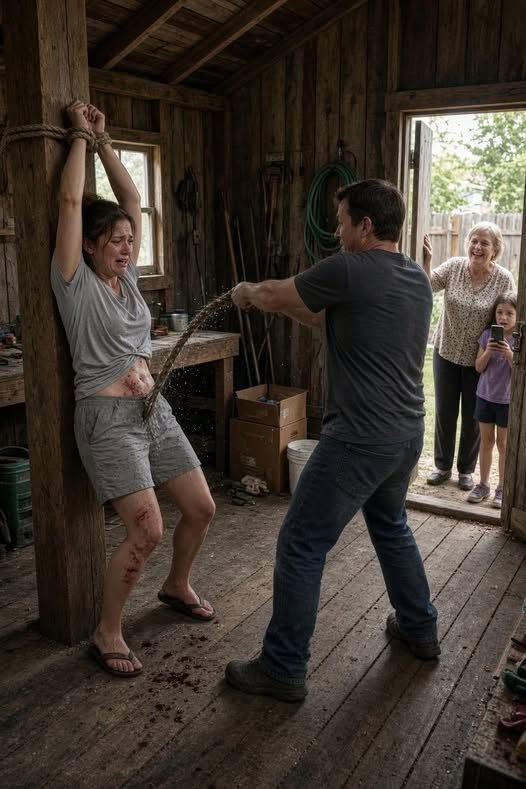
She had washed blood from the shed floor before.
I had not thought of that as participation.
Not because it wasn’t.
Because naming it would have destroyed the last illusion that one adult in that house might someday choose me.
Officer Ramirez asked if I wanted to make a report.
That question scared me more than the others.
My husband existed in the future of yes.
His rage.
His family.
The house.
Money.
The girls’ school.
Everything.
My body responded before my mind.
My hands shook.
My heart began pounding.
My daughter reached for me.
Then stopped just before touching my arm.
“Can I?”
she asked.
I started crying.
“Yes.”
She placed her hand over mine.
Then whispered:
“Please tell.”
Not:
Please arrest Dad.
Not:
Please make him disappear.
Just:
Please tell.
So I did.
“Yes.”
I told Officer Ramirez.
“I want to make a report.”
My voice was almost inaudible.
She heard it.
That mattered.
My husband was removed from the hospital.
I was not told every detail immediately.
That was deliberate.
The advocate who arrived later explained that I did not need to manage his process while lying injured in a hospital bed.
Another concept that felt foreign.
I did not need to manage him.
The hospital brought in a forensic nurse.
She asked permission before every photograph.
Every examination.
Every touch.
“Can I move the blanket?”
“Yes.”
“Can I look at the injury near your shoulder?”
“Yes.”
“Would you like your sister to stay?”
“Yes.”
The repetition affected me more than I expected.
Can I?
Would you like?
Is this okay?
I had lived so long inside a home where my no was treated as provocation that simple consent felt almost ceremonial.
They documented the newer injuries.
Then older scars.
Some pale.
Some raised.
Some overlapping.
The nurse never gasped.
Never called them horrible.
Never asked why I stayed.
She simply recorded.
Location.
Approximate age.
Size.
Appearance.
Clinical language again.
A map of pain without judgment.
When she reached a scar near my ribs, she asked:
“Do you remember how this happened?”
“Yes.”
“What happened?”
I opened my mouth.
Then closed it.
My daughter looked away.
That was enough.
“I don’t want to say it in front of her.”
The nurse nodded.
“Okay.”
No pressure.
My sister took my daughter to get something to eat.
After they left, I told the nurse.
Not every detail.
Enough.
When I finished, she handed me water.
Then said:
“You do not need to convince me.”
I cried so suddenly I choked.
Because convincing had become my entire life.
Convincing myself.
Convincing my sister things were fine.
Convincing teachers the girls were tired.
Convincing doctors bruises were accidents.
Convincing my mother-in-law I would try harder.
Convincing my husband I respected him.
Convincing the world nothing was wrong.
And now someone was telling me I could stop presenting evidence for my own pain.
My sister stayed that night.
My youngest daughter slept curled in the chair.
My older daughter arrived after dark.
She had been at a friend’s house when everything happened.
My sister had picked her up.
The second she saw me, she froze.
Then her eyes went to the bandages.
Then the IV.
Then my face.
“Mom?”
I smiled.
Badly.
“Hi, sweetheart.”
She did not come closer.
Instead:
“Is Dad here?”
“No.”
“Grandma?”
“No.”
Her shoulders dropped.
Only slightly.
But enough for me to see something I had never wanted to see.
Relief.
My daughter was relieved her father and grandmother were gone.
What had I thought I was preserving?
A family?
Or merely a shared address?
She sat beside her younger sister.
Then asked:
“Are we going home?”
I looked at my sister.
Then back at her.
“No.”
Her face changed.
Fear first.
Then something else.
Hope.
“Ever?”
I could not promise.
The house contained their clothes.
Schoolbooks.
Photographs.
Everything we owned.
But I understood the question was not about furniture.
“Not to live the way we were living.”
I said.
That promise I could make.
My older daughter started crying.
Not because she wanted home.
Because she didn’t.
Children should not have to feel guilty for being relieved to leave their own father.
Mine did.
The first protective order came quickly.
Temporary.
Emergency.
Not permanent truth carved in stone.
A legal pause.
Enough to prevent him from contacting me directly while the next steps were arranged.
His mother was included in restrictions after investigators reviewed evidence of her role in facilitating contact and concealment.
My lawyer later explained the details carefully.
At the time, all I understood was:
They cannot come here.
Good.
The video became important.
But not in the magical way television makes evidence important.
It did not end the case in one afternoon.
Investigators copied it.
Preserved metadata.
Interviewed my daughter in a child-sensitive setting.
Compared what could be seen and heard with my injuries.
Matched my mother-in-law’s voice through witness familiarity and later admissions.
The recording did not show every second.
It did not need to.
It corroborated.
That word became another one I loved.
Corroborated.
The truth no longer stood alone.
My sister had more too.
I had forgotten.
Or perhaps refused to understand.
For almost three years, I had sent her messages after bad nights.
Never direct.
Can you take the girls Saturday? I’m tired.
Do you still have that concealer you liked?
Do you know anything for rib pain?
Please don’t call tonight. Things are tense.
She had kept them.
All of them.
Not because she was building a case.
Because she had been afraid for me.
Once, two years earlier, I had sent:
If something happens to me, take care of the girls.
I had deleted it from my own phone.
She had not.
When investigators showed me the screenshot, I stared at it.
I had written my own fear into the world, then erased my copy.
My sister had kept a witness.
My husband’s attorney initially said the video lacked context.
Context.
That word angered me.
What context improves tying your wife to a beam?
What context turns blood into misunderstanding?
Still, law requires precision.
So investigators kept working.
They searched the shed with a warrant.
I did not go.
Thank God.
They photographed the beam.
Collected sections of rope.
Documented stains.
Found an old rag with my blood on it.
Several belts.
A broken buckle.
Things I had seen for years without allowing myself to see together.
There were photographs on my husband’s phone too.
Not of the assaults.
Of the shed after.
He had sent one to his mother months earlier complaining:
She got blood everywhere again.
Her response:
I’ll clean it before the girls get home.
When my lawyer read that aloud, I stopped hearing for several seconds.
Again.
Not an isolated event.
Not a private marital problem.
Again.
Another message.
His mother:
You need to stop hitting where people can see.
My husband:
Then she needs to stop making me angry.
His mother:
I know. Just be smarter.
That was the sentence that ended my hope for her.
Not because I had expected goodness.
Because some foolish part of me had believed her laughter outside the shed might have been nervousness.
Shock.
Something complicated.
It wasn’t.
She knew.
She advised concealment.
She helped preserve the conditions.
When detectives interviewed her, she denied encouraging him.
Then they showed messages.
Her story changed.
She said she had been trying to reduce harm.
If she advised him where not to hit, she claimed, it was because she could not stop him entirely.
If she cleaned blood, it was to protect the children.
If she told me to cover injuries, it was to protect the family.
Protection.
The word made me sick.
Everyone who controls someone else eventually discovers a noble noun for it.
My husband’s story changed too.
First, he denied tying me.
Then he said it was consensual.
That argument disappeared quickly when confronted with my injuries and the recording.
Then he said he had lost control.
Then he blamed alcohol.
Then stress.
Then me.
His explanations multiplied.
Truth did not.
The girls and I moved into confidential housing after I was discharged.
I had imagined shelters as bleak places because that was how people spoke about them.
As though needing one were the shameful part.
Our room was small.
Two narrow beds.
One pullout sofa.
A lamp with a crooked shade.
A dresser with a drawer that stuck.
It was the safest room I had slept in for years.
That made it beautiful.
The first night, my daughters argued about blankets.
I almost laughed.
Not because it was funny.
Because ordinary sibling irritation sounded like music after fear.
“No, I had the blue one first.”
“You always take everything.”
“Mom!”
I raised one hand.
Then stopped.
I had been about to say:
Keep your voices down.
Richard hates noise.
My husband was not there.
I lowered my hand.
“Figure it out.”
They stared at me.
Then continued arguing.
I went into the bathroom and cried.
Safety did not feel peaceful immediately.
It felt loud inside my body.
I woke at every hallway sound.
Could not sit with my back to doors.
Kept checking windows.
Sometimes I smelled rope that was not there.
My therapist later explained that leaving danger does not mean the nervous system receives the update instantly.
Bodies believe repetition.
Mine had years of practice.
We would have to teach it something new.
My youngest daughter had nightmares.
Always the same theme.
She was holding the phone.
It would not turn on.
She would press the button.
Nothing.
Her father would turn toward her.
Then she woke screaming.
I hated the phone.
I hated that she had needed it.
I hated that everyone called her brave.
She was brave.
But children should not have to earn praise by becoming evidence technicians inside their own homes.
One night she asked:
“If I didn’t record it, would you still be there?”
The question destroyed me.
I sat beside her.
“I don’t know.”
Her face fell.
I corrected myself.
“But listen.”
She looked up.
“You did not become responsible for saving me because you recorded something.”
“But it worked.”
“Yes.”
“What you did helped.”
“That does not make what happened your job.”
She frowned.
I continued.
“Adults were supposed to protect you.”
“Me.”
“Dad.”
“Grandma.”
“Other adults who knew something was wrong.”
“You were the child.”
Tears filled her eyes.
“I was scared.”
“You were allowed to be.”
“I hid.”
“Good.”
She stared.
“Good?”
“Yes.”
“You stayed where he couldn’t see you.”
“You sent the video to someone safe.”
“You did not go into that shed.”
“That was the right choice.”
She cried.
I held her.
“Never believe loving me means you should put yourself between me and someone violent.”
That sentence became one of the most important things I ever taught either daughter.
My sister became our bridge to ordinary life.
She brought clothes.
Medication.
School materials.
She went to our old house with police accompaniment to retrieve documents and essential belongings after arrangements were approved.
She came back with two suitcases and a box.
“What’s that?”
I asked.
“Photos.”
My throat tightened.
“Why?”
“Because I didn’t know which ones you’d want.”
She had taken nearly every family album.
Even photographs containing my husband.
I almost told her to throw those away.
Then stopped.
My daughters’ childhood belonged to them too.
We would not erase their father from every image because he had tried to erase reality.
History does not become safer by becoming false.
The criminal case took more than a year.
That surprised me.
I had assumed video meant speed.
Video means evidence.
Courts still mean process.
Hearings.
Discovery.
Motions.
Medical experts.
Interviews.
Continuances.
The slow machinery frustrated me until my attorney said:
“You survived years. Do not let a calendar make you feel the truth is disappearing.”
I wrote that down.
My husband remained under restrictions.
His contact with the girls was tightly controlled and later suspended for a period after evaluators found that he kept blaming me during supervised conversations.
He told our older daughter:
“If your mother hadn’t gotten outsiders involved, we could have fixed this privately.”
She answered:
“You mean hidden it.”
The supervisor documented that.
My daughter came home shaking.
I held her.
She said:
“I sounded brave.”
“You were scared?”
“Terrified.”
Another lesson.
Bravery is often fear with a sentence attached.
My mother-in-law tried contacting the girls indirectly through relatives.
Birthday cards.
Messages through cousins.
One card to my youngest said:
I hope someday you understand that families should forgive.
My daughter brought it to me.
“What do I do?”
“Whatever you want.”
“Can I throw it away?”
“Yes.”
“Will that make me bad?”
“No.”
She tore it in half.
Then cried.
Boundaries can hurt even when they are correct.
My mother-in-law eventually faced charges related to her role in facilitating and concealing some of the assaults.
Not every morally terrible act fit neatly into a criminal statute.
That frustrated people.
Her messages and conduct supported charges connected to obstruction and assistance after specific incidents.
Other behavior remained evidence rather than separate crimes.
I learned to separate what the law could punish from what I knew she had done.
Courts are not designed to measure every betrayal.
Sometimes the heart must keep its own records.
She entered a plea.
My husband did not.
Not at first.
He wanted trial.
Or said he did.
Then pretrial rulings allowed significant portions of the video, medical evidence, digital messages, and testimony.
His lawyer changed strategy.
Weeks before jury selection, he accepted an agreement.
Serious assault.
Unlawful restraint.
Domestic-violence-related offenses.
Other counts resolved as part of the plea.
He received substantial prison time followed by restrictions after release.
Not forever.
Long enough that my youngest daughter would be an adult before he could reasonably appear near her without layers of legal scrutiny.
When I heard the sentence, I felt nothing.
Then nausea.
Then sleep.
Fourteen hours.
Longest I had slept in years.
My mother-in-law received a shorter sentence.
Some confinement.
Probation afterward.
Mandatory conditions.
People in the community said things.
Of course.
She was elderly.
Religious.
A mother.
Some called the punishment cruel.
Others called it insufficient.
I stopped listening.
Age does not transform participation into innocence.
Neither does prayer.
At sentencing, I was allowed to speak.
My sister asked whether I wanted her beside me.
I said no.
Not because I did not need her.
Because I wanted to discover what it felt like to stand alone without being isolated.
Different thing.
I walked to the front.
My husband sat several feet away.
No ropes.
No shed.
No mother at the doorway laughing.
A courtroom.
A judge.
People writing everything down.
I unfolded my statement.
Then did not read most of it.
I looked at him.
“For years, you told me pain was supposed to teach me my place.”
His face changed.
I continued.
“You were right about one thing.”
“I learned my place.”
Silence.
“My place is not tied to a beam.”
“It is not beneath your anger.”
“It is not inside a house where my daughters have to hide phones.”
My voice shook.
I let it.
“My place is wherever I am allowed to be human without being punished for it.”
Then I looked toward his mother.
“And being older, being family, and saying prayers afterward did not make watching harmless.”
She began crying.
I kept going.
“My daughters will not grow up believing silence is respect.”
“They will not grow up believing suffering is marriage.”
“They will not grow up learning that a woman’s job is to make violence easier for everyone else to live beside.”
Then I sat down.
My hands shook for twenty minutes.
I was still proud.
My husband apologized.
Sort of.
He said he had “allowed anger to control him.”
I hated the sentence.
Anger had not tied knots.
Anger had not selected a rope.
Anger had not dragged someone across a yard.
He had.
Later, after years of mandated programs and his own counseling, his language changed.
But that first apology did nothing for me.
Good.
Not every apology should.
The divorce happened separately.
Again, process.
Money.
House.
Retirement.
Custody.
Debt.
People imagine leaving an abusive marriage means walking out and becoming legally free.
Sometimes freedom comes attached to fifteen forms and a property appraisal.
Still freedom.
I had not worked full-time for years.
My husband controlled most accounts.
That scared me more than I admitted.
My sister helped me create a budget.
A domestic-violence advocate connected me with legal aid and financial counseling.
We opened an account in my name.
Only mine.
The first time I deposited money into it, I stared at the receipt.
Thirty-six dollars.
Cash my sister insisted I keep after buying groceries.
Thirty-six dollars made me cry.
Not because it was enough.
Because nobody else could spend it without asking me.
I found part-time work at a medical billing office.
Not glamorous.
Perfect.
I knew enough about insurance from years of handling family claims.
The manager did not ask why there was a gap in employment with suspicion.
She asked:
“Are you ready to come back to work?”
“Yes.”
Then:
“Good.”
No interrogation.
No pity.
I worked four-hour shifts at first because sitting hurt.
Then six.
Then eight.
My body changed.
My bank account changed.
My daughters watched.
Important.
The divorce became final eighteen months after the hospital.
We sold the old house.
I could not keep it.
Did not want it.
Someone asked whether leaving the house felt like letting him win.
No.
A building is not a medal.
I did not need to sleep beside the hallway leading to that shed to prove anything.
The proceeds were divided according to the court’s orders.
I took my share.
Nothing more symbolic than that.
The shed was demolished before the property sold.
Not by me.
The realtor said buyers would view it as unsafe.
When she told me, I sat quietly.
Then laughed.
Unsafe.
Yes.
Finally, the property description and I agreed.
We rented a small apartment.
Two bedrooms.
My daughters shared.
They complained.
I loved the complaints.
“No privacy.”
“She steals my charger.”
“She breathes too loud.”
Normal problems.
Blessed problems.
I bought each girl a desk.
Secondhand.
Different colors.
My younger daughter covered hers in stickers.
My older daughter kept hers painfully neat.
Two children returning to childhood in different ways.
Therapy became part of our week.
Mine too.
At first, I thought therapy would teach me why I stayed.
I dreaded that.
I had already spent years blaming myself.
Instead, my therapist asked:
“What helped you survive?”
I stared.
“That’s not the same question.”
“No.”
she said.
“It isn’t.”
So we began there.
I had learned to read footsteps.
Tone.
Doors.
I knew when to move the girls.
When to stay silent.
Where to hide emergency cash.
How to make pain look like fatigue.
These were survival strategies.
Not evidence that I liked being controlled.
Once they were no longer needed, we could replace them.
But first, she made me respect the woman who had invented them.
Me.
That was harder than hating my husband.
My older daughter carried anger.
Huge anger.
At him.
At Grandma.
At me.
Especially me.
One night she shouted:
“Why didn’t you leave when I was little?”
The question I feared.
I sat at the kitchen table.
Did not defend.
“I was afraid.”
“So were we!”
“I know.”
“You were the mom!”
“I know.”
She cried.
I did too.
“I needed you.”
“I know.”
Then she said:
“You keep saying you know.”
“What else can I say?”
“I don’t know!”
Neither did I.
Sometimes there is no sentence that fixes a childhood.
So I did the thing I wished adults had done for me.
I stayed while she was angry.
I did not punish her.
Did not call her disrespectful.
Did not tell her family loyalty required silence.
I sat there.
Eventually, she came around the table.
Not for forgiveness.
For a hug.
That was enough.
Later, I told her:
“I am sorry I could not get us out sooner.”
Not:
I’m sorry your father made me stay.
Not:
I did my best, so you cannot be angry.
Simply:
“I’m sorry.”
She needed that.
Years later, she told me it was the moment she started trusting that our new home really had different rules.
My youngest daughter’s anger went inward.
That scared me more.
She became perfect.
Homework early.
Room clean.
Never argued.
Never asked for anything expensive.
One evening I found her washing dishes at midnight.
“Why are you awake?”
“You worked late.”
“So?”
“I wanted everything done.”
“Sweetheart.”
She froze.
The fear in her eyes told me everything.
She thought usefulness created safety.
I knew that belief intimately.
I turned off the water.
“You do not have to earn peace in this house.”
She stared.
“What?”
“You can leave a plate in the sink.”
“You can get a bad grade.”
“You can make me angry.”
“You can be annoying.”
She smiled slightly.
“I’m already good at that.”
“Excellent.”
Then I hugged her.
“You still get to belong.”
That became another family rule.
Belonging was not wages for good behavior.
Years passed.
Slowly enough to be real.
My scars softened.
Some stayed.
The girls grew.
My husband became a person discussed through paperwork less often.
Then hardly at all.
Freedom sometimes arrives when somebody’s name stops being the first explanation for your day.
My mother-in-law wrote letters.
The first was mostly justification.
She had been raised differently.
Marriage was sacred.
Her husband had been strict.
She believed keeping families together mattered.
She had been afraid of her son.
She prayed.
She thought I would leave if things got too bad.
I read it once.
Then put it away.
Years later, I understood something.
Every sentence contained her experience.
Almost none contained mine.
That is not apology.
That is autobiography wearing regret.
Her second letter came after she completed a counseling program.
Different.
I told myself I was powerless because admitting I had choices would make me responsible for not using them.
I stopped.
Read it again.
Better.
Then:
I could have called the police.
I could have taken the girls.
I could have told your sister.
I could have refused to clean the shed.
I could have stopped telling you to hide marks.
I could have told my son that if he touched you again, I would testify against him.
I did none of those things.
No prayer mentioned.
No upbringing.
Good.
Then:
I laughed because I wanted him to know I was on his side.
That sentence hurt the most.
Not fear.
Alignment.
She had chosen.
At least she finally knew it.
I did not forgive her then.
I did not visit.
I did write:
I received your letter.
I believe this is the first time you have described what happened without asking me to carry your reasons.
I am not ready for contact.
She never replied directly.
For once, she respected no.
That mattered.
The daughters made their own decisions.
My older daughter never saw her grandmother again.
My younger daughter did, once, as an adult.
A therapist’s office.
Neutral.
She came home quiet.
“What happened?”
I asked.
“She cried.”
“And?”
“I didn’t comfort her.”
I understood why that was important.
“Good.”
My daughter looked at me.
“Is that mean?”
“No.”
“Did you want to?”
“Yes.”
“What stopped you?”
She thought.
“Because her sadness wasn’t an emergency.”
I nearly cried.
Exactly.
We were learning not to confuse other people’s emotions with commands.
My husband wrote too.
Years after sentencing.
The first letter I rejected unopened.
The second I read.
He had stopped writing things like:
I lost control.
Instead:
I used violence because it gave me control.
That sentence was at least honest.
He wrote:
I knew the girls were afraid. I told myself children should fear their father enough to obey him.
I felt sick.
Then:
I believed being obeyed meant being respected.
There it was.
The disease beneath everything.
Not anger.
Entitlement.
He apologized for the shed.
For older assaults.
For frightening the girls.
For letting his mother help hide them.
He said he did not expect an answer.
Good.
I did not send one.
His understanding belonged to his recovery.
My response did not need to become its reward.
When he was eventually eligible for release years later, I received formal notice.
By then both daughters were adults.
The protective conditions were reviewed.
We updated safety plans.
Not because I lived terrified.
Because preparedness and fear are not the same thing.
I had spent too many years confusing denial with peace.
He requested contact with the girls.
My older daughter said no.
My younger one said:
“Maybe someday.”
Both answers were valid.
I did not influence either.
Family members asked how I could let them choose differently after what he had done.
Because they were not extensions of my trauma.
They were people.
The opposite of what he had treated all of us as.
He never came to my home.
Never showed up at work.
Never violated the later boundaries.
I am grateful for that.
It does not erase anything.
It made later years easier.
Both facts can stand.
I eventually bought a little house.
Nothing grand.
Two bedrooms upstairs.
A tiny guest room.
A kitchen with terrible cabinets.
A backyard.
That part nearly stopped me.
The first time the realtor opened the back door, my body froze.
Grass.
Fence.
A storage building at the edge.
Different shed.
Still.
“I don’t think I can.”
I whispered.
The realtor misunderstood.
“Price?”
“No.”
Then I laughed.
“No, not the price.”
I almost walked away.
Then my younger daughter, twenty-one by then, looked outside.
“We could tear it down.”
I stared.
She shrugged.
“Or paint it pink.”
I laughed so hard I cried.
We bought the house.
Painted the shed pale yellow.
Not pink.
Compromise.
It became a gardening shed.
No lock on the outside.
That part was deliberate.
The first thing I planted was lavender.
My sister asked why.
“I don’t know.”
Maybe because it smelled clean.
Maybe because purple felt peaceful.
Maybe because I wanted the yard to contain something that existed only because I chose it.
The plants struggled the first year.
Then came back stronger.
Predictable metaphor.
Still beautiful.
I went back to school at forty-six.
Bookkeeping certification.
Then payroll.
Eventually I managed accounts for a local physical-therapy practice.
Numbers were soothing.
They did not change because someone shouted.
Two plus two remained four whether a man approved or not.
I liked that.
My sister remained my closest friend.
We fought too.
Important.
Healthy relationships include disappointment without punishment.
Once she accused me of shutting everyone out.
I snapped:
“You don’t understand.”
She answered:
“I understand enough to tell you I’m tired of being pushed away.”
I froze.
Old me expected abandonment after conflict.
Instead, she came back the next day with coffee.
“You still mad?”
“Yes.”
“Me too.”
We drank coffee anyway.
That taught me more about safe love than any poem ever could.
My older daughter became a social worker.
I worried she chose it because of us.
She rolled her eyes.
“Mom, you don’t own the concept of helping people.”
Fair.
She worked mostly with teenagers aging out of foster care.
Nothing to do with domestic violence.
Good.
Children deserve futures not entirely shaped by what happened to them.
My youngest daughter became a photographer.
The child who once hid behind a cracked phone learned to make images because she wanted to.
For years, I worried cameras would always mean danger to her.
Instead, she photographed weddings.
Babies.
Graduations.
People choosing to remember good things.
I cried when she told me.
She laughed.
“You cry at furniture commercials.”
True.
On her twenty-fifth birthday, she handed me the old phone.
The one she had used in the shed.
Screen still cracked.
Battery swollen and removed years before.
“I found it in a box.”
I stared.
“Do you want it?”
“No.”
“What should we do with it?”
I did not know.
Evidence procedures had long been completed.
Copies existed where required.
The original device belonged to our family again.
For a moment, I wanted to smash it.
Then stopped.
Violence had made enough decisions.
“I think you should decide.”
She looked at it.
Then said:
“Recycle it.”
That simple.
Not shrine.
Not weapon.
Electronic waste.
We laughed.
Before handing it over, she removed the old memory card.
“Why?”
I asked.
“Not the video.”
she said quickly.
“That was copied years ago.”
“What then?”
She inserted it into an adapter.
Photographs appeared.
Blurry childhood things.
Her sister asleep in the car.
A birthday cake.
Our dog.
A terrible selfie.
Then one picture of me.
I was standing in the kitchen, years before leaving.
Back turned.
Washing dishes.
Sunlight on my hair.
No bruises visible.
No fear visible.
Just a woman at a sink.
My daughter stared.
“I took that.”
“I know.”
“You look sad.”
I looked closer.
Maybe.
Then:
“I was.”
She leaned against me.
We kept that photograph.
Deleted nothing.
History did not need cleaning.
My mother-in-law died when I was sixty-one.
Her attorney contacted me because she had left something for the girls.
Not money.
Two letters.
No conditions.
My older daughter refused hers.
My younger daughter read hers alone.
Then gave me one page.
“You should see this.”
I hesitated.
She nodded.
So I read.
I spent most of my life believing a woman who endured was stronger than a woman who left.
Your mother taught me, too late, that endurance without choice can become another name for captivity.
I sat quietly.
Then the final sentence:
I hope the women after me inherit less silence.
That one I kept.
Not because she earned a place back in my heart.
Because truth can be useful even when spoken by someone who failed to live it.
My former husband died years later.
Illness.
My daughters were informed.
Neither attended the funeral.
I did not either.
I sat in my yellow-shed backyard.
Drank tea.
Felt something complicated.
Not relief exactly.
Not grief exactly.
The end of vigilance.
Even after years without contact, some part of my body had known he existed somewhere.
Then he didn’t.
I cried.
For who?
Maybe the young woman who married him.
The daughters who deserved another father.
The man he might have become if he had questioned power before using it.
Grief sometimes visits wasted possibilities.
I let it.
Then it left.
I am seventy now.
My daughters have lives larger than that house.
That sentence gives me peace.
My older daughter has a partner and one son.
My youngest has decided she may never have children.
No one in our family asks when she will change her mind.
Another inheritance broken.
My grandson once asked why I have scars on my wrists.
He was seven.
His mother looked at me.
My choice.
I answered:
“Someone hurt me a long time ago.”
His eyes widened.
“Did they go to jail?”
“Eventually.”
He thought.
“Did you fight him?”
I smiled.
“Not the way you mean.”
“Then how?”
I looked toward my daughter.
Then back at him.
“I told the truth.”
He accepted that.
Children often understand moral architecture faster than adults.
Then he asked:
“Were you scared?”
“Yes.”
“Can you be scared and still do stuff?”
I laughed softly.
“Yes.”
“That happens a lot.”
He nodded.
“Okay.”
Then ran away because a bird landed on the fence.
Conversation over.
Life continuing.
For years, I thought my story ended in the shed.
Then I thought it ended at the hospital.
Then court.
Then divorce.
Then the little apartment.
Then buying the house.
I kept searching for the moment when everything would become after.
There wasn’t one.
Healing does not announce the final chapter.
It simply becomes the life you are already living.
The real ending came quietly.
One summer morning, decades after the hospital, I woke before everyone else.
My daughter and grandson were visiting.
The house was silent.
I made coffee.
Walked outside.
Bare feet on cool grass.
The yellow shed stood at the edge of the yard.
Door open.
Garden gloves hanging from a hook.
A watering can beside tomatoes.
Sunlight entering completely.
I sat on the back step.
For several minutes, I could hear birds.
Nothing else.
Then I realized something.
I had not thought about the old shed.
Not when opening the door.
Not when seeing the beam inside this one.
Not when walking across the yard alone.
My body had stopped confusing every wooden building with danger.
I began to cry.
Not hard.
Just enough.
My younger daughter found me.
“Mom?”
“I’m okay.”
She looked suspicious.
“You’re crying.”
“I know.”
She sat beside me.
“What happened?”
I pointed toward the shed.
She stared.
Then understood.
“Oh.”
We sat quietly.
After a while, she smiled.
“Paint still looks terrible.”
“It does not.”
“It’s baby-food yellow.”
“You chose the color.”
“I was twenty-one.”
“Then blame yourself.”
We laughed.
That was what healing sounded like.
Not silence.
Laughter in a place where fear once expected screaming.
I still have nightmares sometimes.
Rare.
The body keeps old files.
But when I wake, I know where I am.
That matters.
I open my eyes.
See my room.
My curtains.
My door.
No one standing over me.
No rope.
No waiting footsteps.
Then I breathe until the past returns to the correct tense.
Was.
Not is.
Was.
People have asked whether I forgive my former husband.
I stopped answering.
Forgiveness became too crowded a word.
I stopped wanting revenge.
Stopped wishing suffering on him.
Never trusted him again.
Never invited him back.
Never believed remorse entitled him to relationship.
If someone wants to call that forgiveness, fine.
If someone wants to call it something else, also fine.
Peace does not need a theological label.
My mother-in-law was harder.
Because he had been violent.
She had watched.
Witnesses create a different wound.
But eventually I stopped asking:
How could she?
I knew.
Fear.
Belief.
Misogyny.
Loyalty distorted into obedience.
A lifetime of thinking sons must be protected from consequences and wives must protect marriages from truth.
Understanding the machinery did not excuse the outcome.
It just stopped the question from devouring me.
And myself?
That took longest.
I had to forgive myself for surviving badly.
That phrase came from therapy.
Surviving badly.
Lying.
Hiding.
Canceling plans.
Telling my sister everything was fine.
Telling daughters Daddy was tired.
Cleaning my own blood.
Cooking dinner afterward.
Smiling in photographs.
None of those things made me complicit in my abuse.
They made me trapped.
Once I understood that, shame began losing oxygen.
The daughter who recorded the video once asked me:
“Do you wish I had sent it sooner?”
I answered carefully.
“No.”
She frowned.
“Really?”
“I wish none of it had happened.”
“I wish adults had protected you before you ever needed that phone.”
“But I do not wish you had been more responsible than a child should be.”
She thought.
Then nodded.
That answer released something in both of us.
My sister still has the first message.
The video itself is stored where legal records belong.
She does not watch it.
Neither do I.
But she kept the text my daughter sent with it.
Three words.
Please help Mom.
My sister showed it to me once.
I cried.
Then asked her to put it away.
Because the sentence had been answered.
Help came.
Late.
Imperfect.
But it came.
Sometimes that is enough for a life to turn.
Not justice descending perfectly.
Not courage arriving without fear.
One child presses send.
One sister believes.
One nurse documents.
One officer listens.
One lawyer files.
One judge draws a boundary.
One woman finally says:
Yes.
That happened.
Yes.
He did it.
No.
I am not going back.
A new life is often built from sentences that small.
For years, my husband wanted me to remember my place.
His mother laughed while saying it.
Let her remember her place.
I did.
Eventually.
My place was never beneath him.
Never inside that shed.
Never inside his mother’s silence.
My place was beside my daughters.
Inside my own name.
At my own table.
In a home where nobody needed permission to laugh too loudly.
In a backyard where the shed held garden tools.
In a body that belonged to me even after someone treated it like property.
That was my place.
It had been waiting for me all along.
And the strangest thing?
Once I found it, I stopped needing either of them to understand.
That was freedom.
Not making them agree with me.
Not making them suffer enough.
Not hearing the perfect apology.
Not being believed by every person in the community.
Freedom was waking up and realizing their version of me had become irrelevant.
My grandson is twelve now.
Last month he helped me repaint the yellow shed.
The old color had faded.
He wanted blue.
I said green.
We compromised on white.
Terrible compromise.
While painting, he accidentally splashed my shirt.
He froze.
“Sorry!”
I looked down.
White paint.
Then at him.
He looked genuinely worried.
For one second, I saw generations.
A child bracing for an adult’s anger.
Maybe every child does that sometimes.
I smiled.
“You owe me a shirt.”
He laughed.
“That’s not how gifts work, Grandma.”
“It is now.”
We kept painting.
No fear.
No punishment.
A mistake remained a mistake.
Not disrespect.
Not provocation.
Not evidence that someone deserved pain.
Just paint.
I cannot explain how much that meant.
At sunset, we stepped back.
The shed looked clean.
Ordinary.
He said:
“Looks better.”
I nodded.
Then remembered another shed.
Another doorway.
Another woman laughing.
Another child hiding with a broken phone.
For a moment, grief passed through me.
Then my grandson handed me the brush.
“Second coat tomorrow?”
“Tomorrow.”
I said.
And tomorrow was exactly what I wanted.
Not revenge.
Not explanation.
Tomorrow.
A day no one had already decided for me.
That is where my story ends.
Not with blood on a shed floor.
Not with my husband in handcuffs.
Not with his mother crying in court.
Not with a judge.
Not even with the hospital phone in my hand.
It ends with white paint on my shirt.
A child laughing.
A door left open.
And me standing in a backyard where nobody is afraid.
For years, silence belonged to the people who hurt me.
They used it to hide.
To excuse.
To rewrite.
Then one day, my daughter pressed send.
And the silence changed sides.
After that, it no longer protected them.
It became the quiet I had been denied for years.
Peace.
Mine.
THE END STORIES! THANK YOU FOR READING GOOD LUCK !❤️
Related Posts