My husband sold my mother’s ring while I was away at a conference and told me the house needed decluttering.

I said it was fine and asked him for the buyer’s name.
He gave me one. The listing is still up, and he does not know I called the number under it, or what the woman who answered said before she
“It sat in a drawer for nine years, babe,” he said. “It was doing nothing.”
“It was doing what rings do.”
“You never wore it.”
“No.”
“So what’s the problem?”
“There isn’t one,” I said, and I went and got my laptop.
My name is Rachel. I am 39. I photograph houses for a real estate office, which means I look at other people’s kitchens forty hours a week and I am paid to notice what is in them.
I endured “it was doing nothing.”
I endured the box of my mother’s things in the garage getting smaller every spring.
I endured being told I am sentimental like it is a diagnosis.
I endured him telling his sister that I hoard grief.
And I endured one thing since the twelfth of June that I have never said out loud to anybody.
The listing went up Tuesday at 6:40 in the morning. One photograph. My mother’s ring lying on a countertop.
Not my countertop.
The tile behind it is green, four-inch square, the kind nobody has installed in thirty years.
The outlet cover has a smear of white paint on one corner.
The window is on the left of the sink. Ours is on the right.
And I know that kitchen, because I am the one who photographed it.
It was a listing on Cedar Road. I shot it in the rain and I had to towel off the tile.
The file is still on my work drive with the address in the folder name.
I messaged the seller from my work account at eleven that night.
“Is this still available?”
The answer came back in four minutes.
“Sold. Went to family.”
I sat on the edge of the tub and read that last word about twenty times.
Wednesday I took the photograph to a jeweler.
Mr. Ruhl put down his loupe before I finished my sentence.
“I know this ring. It has been in twice.”
“Twice.”
“Once in the spring for a cleaning and a sizing. Then again last week.”
“Sized to what?”
“Down two. Small hands.”
My mother’s ring has been on my dresser at a size seven since the day we buried her.
“Who brought it in?”
“A woman. She signed the intake both times.”
“Was the name mine?”
He looked at me a second too long. “No, ma’am.”
“Can I see the slip?”
“I can’t hand you that. I can tell you the phone number on it is not the one we have for the insurance rider.”
That night my husband had cat hair on the sleeve of his jacket. We have never had a cat.
“How was the drive?”
“Long.”
“Where’d you eat?”
“Some place off the highway.” He stopped. “Rachel. Are we doing this because of the ring?”
“I asked you about dinner.”
“You’re doing the thing where you build a case out of nothing.”
“All right.”
He put his phone in his pocket. He has laid it face up on that counter every night for eleven years, and Wednesday he put it in his pocket.
Thursday my daughter climbed in the back seat with a sticker on her hand.
“Where did you get that, Ellie?”
“The lady gave it to me.”
“What lady, baby?”
“At the house with the green kitchen. She has a cat and his name is Biscuit.”
I kept both hands on the wheel and my voice where it was.
“When were you at that house?”
“When Daddy took me for ice cream.” She thought about it. “He said it’s a surprise for you, so it’s a secret until it isn’t.”
Friday I drove to the storage place where the rest of my mother’s boxes are.
My code did not open the gate.
The girl in the office looked it up twice.
“The unit’s current, ma’am. Paid every month.”
“By who?”
“Cash. A lady comes in. She doesn’t have to leave a name and she doesn’t.”
“Since when?”
“Says here since the twelfth of June.”
I stood in that office and did arithmetic I did not want the answer to.
The ring was sized down in the spring, and it was photographed on a counter I toweled off myself, and a woman has been paying cash for my mother’s boxes since the twelfth of June, and my husband told me he sold a ring to a collector in another state.
If the house on Cedar Road belongs to the family I think it belongs to, then he did not sell anything. He moved it.
And if he moved it, then he has had somewhere to move it to since June, and my daughter has been there, and she has a name for it.
Saturday morning I put the photograph on the passenger seat and drove out to Cedar Road.
There was a car in that driveway I have seen before. I have seen it in the pickup line at my daughter’s school at 2:40.
I knocked.
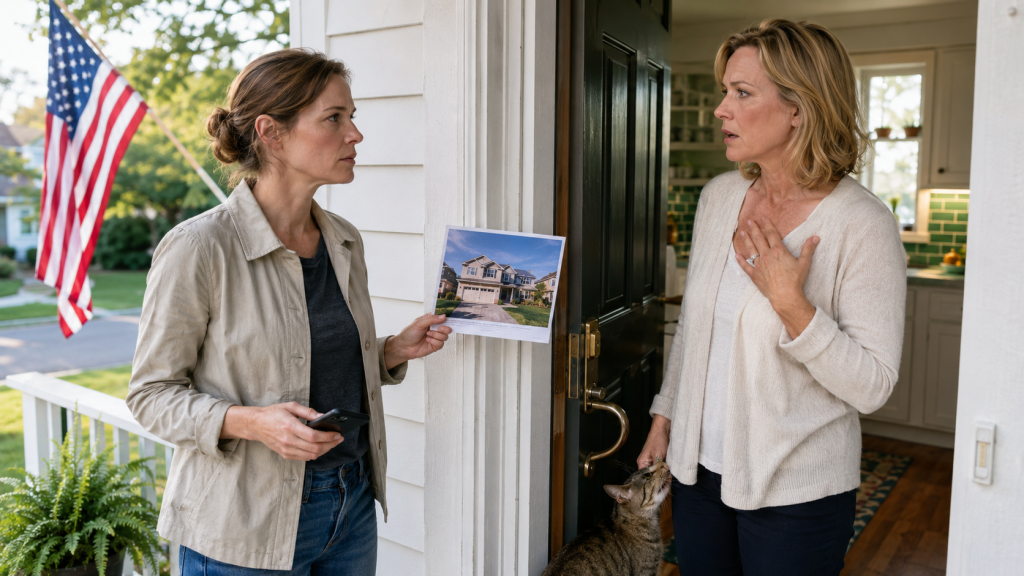
The woman who opened the door had my mother’s ring on her right hand and a cat winding around her ankles, and before I said one word she smiled at me and said, “Oh — you’re early. He told me you were coming on.
PART 2: THE HOUSE WITH THE GREEN KITCHEN
“Oh—you’re early. He told me you were coming on Sunday.”
The woman smiled when she said it.
Then her smile disappeared.
Because she looked at my face.
And I looked at her hand.
My mother’s ring was on her right ring finger.
The pale oval sapphire.
The four tiny diamonds.
The thin white-gold band my father had saved six months to buy in 1978.
My mother wore that ring every day for thirty-four years.
Gardening.
Cooking.
Driving me to school.
Holding my hand in hospital waiting rooms.
The stone had a tiny scratch near the lower setting because she once caught it against the brick wall outside our first house.
I knew every flaw in it.
I knew that ring better than I knew some people.
And now it was sitting on the hand of a woman I had never met.
She had dark hair pulled into a loose knot.
Bare feet.
A gray sweater.
No makeup.
Behind her, a large orange cat circled her ankles.
Biscuit.
My daughter had told me his name.
The woman looked toward my car.
Then back at me.
“You’re Rachel.”
It was not a question.
My stomach went cold.
“Yes.”
Her hand moved instinctively toward her chest.
The ring caught the light.
I stared at it.
She noticed.
Her fingers curled.
“Oh.”
That one syllable told me everything.
She knew.
Maybe not everything.
But enough.
I looked past her.
Green kitchen tile.
Four-inch squares.
Window to the left of the sink.
White paint smeared across the corner of the outlet cover.
The same kitchen I had photographed six months earlier for work.
Except it did not look empty anymore.
There were mugs beside the sink.
A red dish towel hanging from the oven.
A bowl of lemons on the counter.
Children’s crayons in a ceramic cup.
A man’s navy jacket hanging over one of the dining chairs.
I recognized that jacket.
I bought it for my husband’s birthday two years ago.
I heard my own voice from somewhere very far away.
“What did he tell you was happening Sunday?”
The woman did not answer.
Her face had gone pale.
“What did he tell you?”
She glanced toward the driveway again.
“He said…”
Her voice faltered.
“He said you were coming over to go through the rest of your mother’s things.”
I did not move.
“The rest?”
She swallowed.
“Yes.”
My pulse began pounding so hard I could feel it behind my eyes.
“How much of my mother’s property is inside this house?”
She looked down.
The cat rubbed against her ankle.
Neither of us moved.
Finally she stepped backward.
“You should come in.”
I almost laughed.
No.
Not because anything was funny.
Because I had spent eleven years being told by my husband that I made too much of things.
That I dramatized.
That I built cases.
That I held on too tightly.
And now I was standing outside a stranger’s house while she wore my dead mother’s ring and invited me inside to see how much of my life my husband had moved there without telling me.
“I’d rather you answer.”
She looked at the ring again.
Then at me.
“A lot.”
My throat closed.
“How much is a lot?”
“I don’t know what belonged to her and what belonged to you.”
That sentence hurt strangely.
Because there should never have been confusion.
Those things had a home.
Our home.
My mother’s china.
Her cedar jewelry box.
Her recipe cards.
The old photographs.
The crocheted blanket from the hospital room where she died.
Things my husband called clutter because grief was untidy and took up shelf space.
“When did he start bringing it here?”
The woman folded both arms across herself.
“June.”
The twelfth of June.
Of course.
I thought of the storage clerk.
A lady comes in. Pays cash.
Since June twelfth.
I looked at the woman.
“Have you been paying for my storage unit?”
Her face changed.
“Yes.”
For one second, I could not hear anything.
Not the wind.
Not the leaves.
Not even the traffic behind me.
“Why?”
“He asked me to.”
“My husband asked you to pay cash for a storage unit in my name?”
“Yes.”
“Why cash?”
She whispered:
“He said you monitored the accounts.”
I almost smiled.
Of course he did.
He had prepared her too.
Built a version of me for her.
Suspicious Rachel.
Controlling Rachel.
Sentimental Rachel.
The woman who monitored bank statements and hoarded grief and probably made ordinary life impossible for everyone around her.
“What’s your name?”
“Claire.”
“Claire what?”
“Claire Lawson.”
I knew the name.
Not personally.
But I had seen it.
Once.
Maybe twice.
School email list.
Pickup line.
Parent volunteer schedule.
Claire Lawson.
Her son was in Ellie’s grade.
That explained the car.
I had seen it at school.
My daughter had not been taken to some random woman’s house.
She had been taken to the home of another school parent.
A woman my husband could encounter without raising questions.
Soccer events.
Birthday parties.
Pickup.
Drop-off.
Everything respectable enough to hide inside.
“How long have you known Daniel?”
Claire’s eyes filled.
There it was.
She did not ask which Daniel.
My husband’s name was Daniel.
Eleven years married.
Fourteen years together.
Daniel, who slept on the left side of our bed.
Daniel, who hated mayonnaise.
Daniel, who rubbed circles on my back when I could not sleep after Mom died.
Daniel, who called my grief clutter when he got tired of looking at it.
Claire answered quietly.
“Two years.”
My knees almost weakened.
I put one hand against the porch railing.
“Two years?”
“We met through school.”
“Of course.”
“Rachel…”
“How long have you been sleeping with my husband?”
She closed her eyes.
That was the answer.
I waited.
When she opened them, tears had gathered.
“About eighteen months.”
Eighteen months.
The human mind does a strange thing when a number like that enters it.
It builds a calendar.
Christmas.
My fortieth-birthday plans he said he was too busy to discuss yet.
His conference in Baltimore.
The weekend he spent “helping his brother move.”
Ellie’s school carnival.
My mother’s death anniversary.
Our anniversary dinner, where he held my hand and told me we needed to stop living around old sadness.
Eighteen months.
I let go of the railing.
Claire stepped forward.
“Are you okay?”
I stared at her.
Then I laughed.
She stepped back.
“I’m sorry.”
“Don’t.”
“I didn’t know—”
“Please don’t say you didn’t know he was married.”
Her face crumpled.
“I knew.”
That answer surprised me enough that I stopped.
She wiped beneath one eye.
“I knew he was married.”
I stared.
“But I didn’t know what he was telling you.”
“What does that mean?”
“He said you were separated.”
I laughed again.
Sharper this time.
“We slept in the same bed last night.”
Claire went completely white.
“He said you were living in the house temporarily for Ellie.”
“Did he?”
“Yes.”
“And the wedding ring?”
“He said you both still wore them because you didn’t want Ellie asking questions.”
I looked at her hand.
My mother’s ring.
“And that?”
Claire stared down at it.
My voice barely worked.
“What did he tell you about that ring?”
She slowly slid it off.
The sight of it moving over her knuckle almost made me sick.
“He told me it belonged to his grandmother.”
I closed my eyes.
For a second, my mother was alive again.
Sitting at the kitchen table.
Turning the ring around her finger while she talked.
She had a habit of doing that when she was worried.
Rachel, remember to water the hydrangeas.
Rachel, don’t let me forget your aunt’s birthday.
Rachel, I know you think you’re fine, but you look tired.
Mom had died nine years ago.
And somehow Daniel had taken one of the last things she touched every day and turned it into a love gift for another woman.
Claire held it toward me.
“Take it.”
I could not.
Not yet.
My hand would not move.
She looked horrified.
“I swear I didn’t know.”
“He sized it for you.”
Her eyes filled.
“I thought it was his.”
“Twice.”
She frowned.
“What?”
“The jeweler said it came in twice.”
Claire looked confused.
“The first time was because it was too big.”
“And the second?”
She hesitated.
“I changed my mind.”
“About what?”
“Wearing it.”
I stared.
“Why?”
Her face crumpled again.
“Because I told him I wasn’t comfortable wearing a family ring until things were final with you.”
The porch seemed to tilt.
Things were final.
With me.
My husband had been discussing a future with her.
Not merely an affair.
Not hotel rooms.
Not secret lunches.
A future.
And my mother’s ring was part of it.
“What exactly has Daniel told you is supposed to happen?”
Claire looked back into the house.
Then said:
“You really should come inside.”
This time, I did.
Not because I trusted her.
Because I needed to see.
The cat sniffed my shoes.
Biscuit.
Ellie had probably knelt right there and touched his orange fur.
My child had been inside this house.
That detail was worse than the affair.
Maybe because I could understand adults lying to each other.
I could not understand bringing my daughter into the lie.
The living room was warm.
Pretty.
Simple.
There were framed pictures along a shelf.
I looked automatically.
Occupational hazard.
Photographers notice framing.
Light.
Composition.
Who is included.
Who is not.
Claire and a boy I assumed was her son.
Claire with friends.
Her parents.
One recent photograph made me stop.
Daniel.
Claire.
Ellie.
Her son.
All four of them standing at an apple orchard.
My husband’s arm was around Claire’s shoulders.
My daughter was holding a bag of apples.
Everyone was smiling.
My stomach rolled.
“When?”
Claire saw where I was looking.
“October.”
I stared at her.
“Daniel told me he took Ellie to his brother’s that Saturday.”
Claire’s face collapsed.
“Rachel…”
“Does my daughter know you’re sleeping with her father?”
“No.”
“Does your son?”
She looked down.
“He thinks Daniel and I are dating.”
I turned.
“He thinks my husband is your boyfriend.”
“Yes.”
“And Ellie?”
“Daniel told her we were friends.”
I thought of Ellie’s sticker.
The lady gave it to me.
Daddy said it’s a surprise for you, so it’s a secret until it isn’t.
My hands began shaking.
“What surprise?”
Claire stared at me.
“You don’t know.”
“No.”
She whispered something under her breath.
Then walked toward the kitchen.
“Come here.”
I followed.
My mother was everywhere.
Not metaphorically.
Actually.
Her blue ceramic mixing bowl sat on the counter.
Her yellow floral canisters were lined along a shelf.
Her wooden recipe box rested near the refrigerator.
A framed black-and-white photograph of my parents on their wedding day sat on a small sideboard.
I stopped walking.
That photograph had been in my storage unit.
I knew because I packed it myself.
I touched the frame.
My mother was twenty-three in that picture.
Beautiful.
Nervous.
My father looked at her as if nobody else existed.
“How did this get here?”
Claire’s voice came from behind me.
“Daniel said you wanted the boxes cleared out.”
I turned.
“All of them?”
“He said you couldn’t handle doing it yourself.”
My eyes burned.
“So he brought them here?”
“Some.”
“Why here?”
Claire looked ashamed.
“He said I could sort what might be donated.”
I stared at her.
“He had his mistress sorting my dead mother’s belongings.”
She flinched.
The word mistress landed.
Maybe she had managed not to call herself that.
People build softer names around ugly truths.
Complicated relationship.
Separated man.
Bad timing.
Not mistress.
Until the wife is standing in the kitchen.
Claire covered her mouth.
“Oh God.”
I opened one of the cabinets.
My mother’s wedding china.
The white set with faded gold around the edge.
I stared.
Claire said quickly:
“I never used those.”
I shut the cabinet.
“Congratulations.”
She cried.
I regretted the cruelty almost immediately.
Not because she was innocent.
She was not.
She knew Daniel was married.
But Daniel had clearly built this house out of two women’s incomplete information.
I looked at her.
“What did he tell you Sunday was?”
Claire took a breath.
“He said he was finally going to tell you he wanted the divorce.”
There it was.
I waited.
“And?”
“And after that…”
Her voice became smaller.
“…you were supposed to come here.”
“Why?”
“To choose what you wanted to keep from your mother’s things.”
I could not speak.
“He said everything else would stay here until you decided.”
I laughed softly.
“Very generous.”
Claire wiped her face.
“There’s more.”
I looked at her.
“What?”
She went to a drawer.
Pulled out a folder.
Set it on the green tile.
I recognized Daniel’s handwriting on the label.
HOUSE
I stared at it.
“What is that?”
Claire did not answer.
I opened it.
Mortgage estimates.
Renovation plans.
Insurance quotes.
A printout from a school boundary map.
A list of furniture.
Then a document from a real estate attorney.
My body went cold.
The Cedar Road house was not Claire’s.
Not entirely.
There was a purchase agreement.
Buyer:
Lawson Residential LLC.
But beneath the company documentation was another page.
Capital contribution schedule.
Claire Lawson.
Daniel Pierce.
My husband.
He had put seventy-eight thousand dollars into this house.
I looked up.
Claire was crying silently.
“Where did he get seventy-eight thousand dollars?”
“I thought it was from your separation settlement.”
I stared.
“We don’t have a separation settlement.”
She covered her mouth.
I looked at the date.
June twelfth.
The same day my access code stopped working at the storage unit.
The same day the cash payments started.
June twelfth was also the day Daniel had told me he had moved money from our joint savings into a high-yield account because our old bank was “paying basically nothing.”
I had not checked.
Why would I?
He was my husband.
I looked at the page again.
Seventy-eight thousand dollars.
My money too.
Our savings.
Part of it came from the life-insurance payment I received after my father died.
I had put it into our joint account because Daniel told me:
“We’re a family. Your safety is our safety.”
My knees finally gave way.
I sat at the kitchen table.
The chair scraped loudly.
Claire stood motionless.
I stared at the green tile I had once dried with a towel on a rainy Tuesday afternoon.
I remembered photographing this kitchen when the property was empty.
I liked the light.
I had even told my coworker:
“Someone’s going to make this place beautiful.”
Apparently my husband had heard me.
I tried to breathe.
“How did Daniel know this house was available?”
Claire’s face changed.
“You told him.”
“No.”
“You sent him the listing.”
I frowned.
Then remembered.
Six months earlier.
After the shoot.
I had texted Daniel a picture of the kitchen.
You would hate this tile. I weirdly love it.
He responded:
Looks haunted.
That was it.
One photograph.
One joke.
He had taken the address from my work metadata or looked up the listing afterward.
My husband had bought part of the house I photographed.
For another woman.
Something in me went quiet.
Not broken.
Quiet.
Those are not the same thing.
Claire sat across from me.
“I need to tell you something.”
I almost laughed.
“There are still things?”
“Yes.”
“Go ahead.”
She looked toward the hallway.
“Daniel told me this house was eventually supposed to be for all four of us.”
I stared.
“All four?”
“Me. Him. My son.”
She swallowed.
“And Ellie.”
The world stopped.
“No.”
“Rachel—”
“No.”
My voice came out sharper.
“You don’t get to say her name like that.”
Claire looked down.
“You’re right.”
I stood.
“What exactly did he tell you about my daughter?”
“That you traveled a lot.”
My stomach turned.
“I go to four conferences a year.”
“I know that now.”
“What did he say?”
“That your job was becoming more important.”
I laughed.
Of course.
The photographer who made forty-eight thousand dollars a year was apparently consumed by career ambition.
“What else?”
“He said you had been talking about moving closer to your sister.”
I stared.
“My sister lives in Vermont.”
“Yes.”
“I have never discussed moving to Vermont.”
Claire closed her eyes.
“He said you were planning to go after the divorce.”
“And leave Ellie?”
“He said you both agreed Ellie would stay in her school district.”
My blood went cold.
There it was.
This was not only about leaving me.
Daniel had been designing my replacement.
A new house.
A new woman.
A ready-made brother for my daughter.
My mother’s kitchen things on the shelves.
My mother’s ring on Claire’s hand.
Even the old photographs.
He was not simply starting another life.
He was using pieces of mine to furnish it.
I whispered:
“He wanted you to become me.”
Claire looked horrified.
“No.”
“Not literally.”
I looked around.
The china.
The recipe box.
The ring.
Ellie.
“My things.”
My voice broke.
“My daughter.”
Claire began crying.
“I didn’t see it like that.”
“I know.”
And strangely, I believed her.
Because I had not seen it either.
Daniel had spent years telling me objects were meaningless.
Sentimental.
Clutter.
Doing nothing.
Now I understood.
He did not believe they were meaningless.
If they meant nothing, he would have thrown them away.
He moved them.
Selected them.
Repurposed them.
My grief had value as long as someone else was allowed to own it.
The thought made my skin crawl.
My phone buzzed.
Daniel.
Where are you?
I stared at the message.
Another arrived.
Ellie wants to know if we’re still going to the movies.
He was using our daughter casually.
Normal Saturday.
Movies.
Popcorn.
As if I were not standing inside the house he had secretly bought with another woman.
I turned the screen toward Claire.
Her face changed.
“He doesn’t know you’re here?”
“No.”
She whispered:
“He thinks I’m at my sister’s.”
Interesting.
Daniel was lying to both of us in real time.
I looked at her.
“Call him.”
Claire froze.
“What?”
“Call Daniel.”
“Rachel…”
“Put it on speaker.”
She swallowed.
Then picked up her phone.
Her hand shook as she selected his name.
I noticed the contact.
D ❤️
I looked away.
The call connected.
Daniel answered immediately.
“Hey.”
His voice.
My husband’s familiar voice.
Warm.
Relaxed.
The same voice that asked whether we needed milk.
Claire looked at me.
I nodded.
She said:
“Hey.”
“What’s up?”
“Where are you?”
“At home.”
My stomach twisted.
Home.
Our home.
“Rachel there?”
A pause.
“No.”
Daniel sounded cautious now.
“She went out.”
Claire looked at me.
“What are you doing tonight?”
“Probably movie with Ellie.”
“Sunday still happening?”
My heart began pounding.
Daniel lowered his voice.
“Yeah.”
“What exactly are you going to tell Rachel?”
He exhaled.
“The truth.”
I nearly laughed.
Claire’s eyes filled.
“What truth?”
“That it’s over.”
Simple.
Clean.
Eleven years compressed into three words.
Claire asked:
“And Ellie?”
Another pause.
“We’ll work it out.”
“How?”
“Claire.”
“How?”
Daniel sounded irritated.
“We already talked about this.”
“I want to hear it again.”
He sighed.
“I’m going to tell Rachel that fighting over custody would hurt Ellie.”
My entire body went cold.
Claire looked sick.
“And if she fights?”
“She won’t.”
Confidence.
Pure confidence.
I knew that tone.
He used it when discussing contractors.
Insurance adjusters.
Waiters he thought he could pressure into comping a meal.
Claire asked:
“How do you know?”
“Because I know Rachel.”
I stared at the wall.
No.
He knew the woman I had been with him.
There was a difference.
Daniel continued.
“She hates conflict.”
True.
“She’s emotional about family.”
True.
“She’ll want what’s easiest for Ellie.”
True.
“So you think she’ll let Ellie live here?”
Another pause.
“Eventually.”
My hand tightened around the edge of the table.
Claire closed her eyes.
“What about the house you share with Rachel?”
“We’ll sell it.”
My head snapped up.
Claire asked:
“Does she know?”
“No.”
“And the money?”
“We split whatever’s left.”
I almost admired the casualness.
Our home was just another item on his list.
Sell.
Split.
Move on.
“What about the seventy-eight thousand you put into this place?”
Daniel went quiet.
Claire pressed.
“Does Rachel know about that?”
His voice hardened.
“Why are you asking all this?”
Claire’s hand started shaking harder.
I mouthed:
Keep going.
She swallowed.
“Because I’m nervous.”
Daniel softened.
“Hey.”
That tone.
The intimate one.
The one he used on me when Mom was dying.
“Don’t be.”
Claire started crying for real.
Daniel misunderstood.
“It’s going to be okay.”
She looked directly at me.
“No,” she whispered.
“It isn’t.”
Silence.
Daniel’s voice changed.
“What happened?”
Claire stared at the ring lying between us on the table.
Then said:
“Rachel is here.”
Nothing.
For three seconds.
Four.
Five.
Then Daniel whispered:
“What?”
I leaned toward the phone.
“Hi, babe.”
The silence that followed was almost beautiful.
Then:
“Rachel.”
I smiled.
Not because I was happy.
Because suddenly the power had shifted.
He knew it too.
“What are you doing there?”
I looked around the green kitchen.
“My job.”
“What?”
“I notice things in houses.”
He started breathing faster.
“Rachel, listen.”
“No.”
My voice was calm.
“You’ve had eighteen months to talk.”
Claire covered her face.
Daniel said:
“This is not what it looks like.”
I laughed.
There it was.
The sentence all guilty people apparently receive in a handbook.
“What part?”
“Claire and I—”
“Have been sleeping together for eighteen months.”
Silence.
“You used seventy-eight thousand dollars of marital money to buy into this house.”
“Rachel—”
“You brought my daughter here.”
“It’s not like—”
“You moved my mother’s possessions here.”
His voice rose.
“You were never going through those boxes!”
I went still.
There it was.
His real defense.
“You kept saying you would.”
My eyes filled.
“I wasn’t ready.”
“For nine years?”
“Yes.”
The word came out broken.
“Yes, Daniel. For nine years.”
He went quiet.
“My mother died.”
I stared at her wedding photograph on the sideboard.
“There isn’t a deadline for when I’m supposed to stop missing her enough to keep her things.”
“I was trying to help you.”
“No.”
I looked at the ring.
“You were trying to make my grief convenient.”
He sighed.
“You make everything sound sinister.”
I almost admired him.
Even now.
Still trying.
Still shaping reality.
“You gave my mother’s ring to your girlfriend.”
Silence.
Claire looked down.
Daniel finally said:
“I told you I sold it.”
“Yes.”
“So clearly I knew you wouldn’t want it.”
I laughed so sharply it hurt.
“No.”
“You knew I would stop you.”
He went silent.
I continued.
“That’s why you lied.”
Nothing.
“That’s why you waited until I was away.”
Nothing.
“That’s why you used a fake buyer’s name.”
Nothing.
“And that is why you never asked.”
His breathing was audible.
Then he changed tactics.
“Can we talk at home?”
“No.”
“Rachel.”
“No.”
“We have a daughter.”
My voice dropped.
“Yes.”
“We do.”
I looked toward Claire.
“And you brought her into your affair.”
“I never did anything inappropriate around Ellie.”
My whole body tensed.
“You taught her to keep your secrets.”
“That is not what happened.”
“She told me this house was a surprise and a secret until it wasn’t.”
Daniel went silent.
I continued.
“You put an eight-year-old child inside a lie between her parents and asked her to carry it without understanding what it meant.”
“Rachel, she thought we were friends.”
“That makes it worse.”
My voice cracked.
“You made her innocent participation useful to you.”
Claire was crying quietly now.
Daniel said:
“I love Ellie.”
“I know.”
That was the tragedy.
I believed him.
People can love someone and still use them selfishly.
Love does not automatically make behavior safe.
“What do you want?” he finally asked.
For years, that question would have frightened me.
Because Daniel usually asked it when he believed my answer would be unreasonable.
Emotional.
Too much.
Now I looked around the house.
At my mother’s things.
At the green kitchen.
At the life he thought was waiting for him.
And I knew exactly what I wanted.
“Nothing from you today.”
He went silent.
“I’m taking my mother’s belongings.”
“You can’t just empty Claire’s house.”
“My mother’s property.”
“Rachel, some of that stuff—”
“Belongs to me.”
Claire looked up.
Then nodded.
All of it.
Daniel heard the silence.
“What is she doing?”
Claire spoke.
“I’m giving Rachel everything that belonged to her mother.”
“Claire.”
“And the ring.”
His voice sharpened.
“Do not do anything until I get there.”
I looked at her.
She looked at me.
For the first time, we agreed without speaking.
Claire said:
“Don’t come.”
Daniel froze.
“What?”
“Don’t come here.”
“Claire.”
“You lied to me too.”
“I explained—”
“No.”
Her voice changed.
Stronger.
“You told me you were separated.”
“We were emotionally separated.”
I actually laughed.
Claire did not.
“You told me Rachel was moving to Vermont.”
“She talked about it.”
I said across the table:
“I once said Vermont was pretty in October.”
Claire looked at the phone.
Daniel went silent.
She continued.
“You told me the money was from a settlement.”
“Technically our finances—”
“Stop.”
Claire wiped her face.
“You told me the ring belonged to your grandmother.”
Another silence.
Then Daniel said:
“I was going to explain.”
Claire stared at my mother’s ring.
“No.”
She whispered:
“You were going to keep explaining things until we both stopped asking questions.”
That was it.
The clearest description of my marriage I had ever heard.
I looked at Claire.
She looked at me.
Two women who had been given different versions of the same man.
Daniel started talking faster.
“Rachel, don’t do anything stupid.”
There it was.
The old pressure point.
Stupid.
Emotional.
Sentimental.
Dramatic.
I smiled.
“Daniel?”
“What?”
“I’m hanging up now.”
“Rachel.”
“And I’m calling a lawyer.”
Silence.
Then fury.
“Are you serious?”
“Yes.”
“You’re going to blow up our entire life over a ring?”
I looked down at the sapphire.
There are moments when a marriage ends before anybody files paperwork.
That was mine.
Not the affair.
Not even the house.
That sentence.
Over a ring.
After everything, he still needed the object to be small so my reaction could be large.
I picked up my mother’s ring.
For the first time in nine years, it was warm from another person’s hand.
I closed my fingers around it.
“No.”
My voice was almost gentle.
“The ring just showed me where to look.”
Then I ended the call.
Claire and I sat in silence.
Biscuit jumped onto the windowsill.
Rain had started outside.
Soft at first.
Then heavier.
I stared through the glass.
The same kind of rain that had fallen the day I photographed that kitchen.
Finally Claire said:
“I’m sorry.”
I looked at her.
“I know that probably means nothing.”
“It doesn’t mean nothing.”
She seemed surprised.
“It just doesn’t fix anything.”
She nodded.
“I should have checked.”
“Yes.”
“I should have called you.”
“Yes.”
“I believed what I wanted to believe.”
That was honest.
I appreciated it despite myself.
She looked down at her hands.
“I was lonely.”
I did not answer.
“My husband left three years ago.”
She swallowed.
“Daniel made me feel chosen.”
I looked at her.
“And I think I wanted that feeling badly enough that I didn’t inspect the story too closely.”
I understood that more than I wanted to.
Not because I had cheated.
Because I too had spent years accepting Daniel’s explanations when part of me knew they did not fit.
We had both trusted the version of him that allowed us to keep our lives intact.
Claire whispered:
“I’m not asking you to forgive me.”
“Good.”
She nodded.
“I wouldn’t.”
Another silence.
Then she stood.
“I’ll help you pack.”
It took four hours.
Four hours to remove my mother from the life Daniel had tried to build without me.
The china.
The recipe box.
Three framed photographs.
Her sewing basket.
Two lamps.
A quilt.
The silver cake server from my parents’ wedding.
A box of Christmas ornaments.
Her old blue Dutch oven.
The ridiculous ceramic goose she loved and I had always hated.
When I saw it on a shelf in Claire’s laundry room, I started crying.
Not because the goose mattered.
Because Mom did.
Grief hides in stupid objects.
That is what Daniel never understood.
Sometimes you keep the ugly ceramic goose because your mother laughed every time your father threatened to throw it away.
Sometimes a thing is not a thing.
It is proof that a room once contained someone you loved.
Claire found cardboard boxes.
We packed everything carefully.
At one point she handed me my mother’s recipe cards.
Her handwriting covered the top one.
Rachel’s Favorite Lemon Cake
I sat on the kitchen floor.
And sobbed.
Not neat tears.
Not movie tears.
The kind that make breathing embarrassing.
Claire sat several feet away.
She did not touch me.
That was kind.
When I could speak again, I whispered:
“He told people I hoard grief.”
Claire looked at me.
“I don’t think this is hoarding.”
I laughed weakly.
“What does it look like?”
She looked around at the boxes.
“Like you loved your mother.”
Simple.
I cried again.
By late afternoon, we had loaded most of it into my car and Claire’s garage.
I would need a truck for the rest.
Then Claire said something that changed the day one more time.
“There’s another storage key.”
I froze.
“What?”
She went upstairs.
Returned with a small brass key.
A plastic tag hung from it.
B-117
“That isn’t my unit.”
“I know.”
My heart started pounding.
“Whose is it?”
“Daniel rented it.”
“When?”
“August.”
I stared.
“What’s inside?”
Claire looked terrified.
“I don’t know.”
“He never told you?”
“No.”
“Then why do you have the key?”
“He asked me to hold it.”
My stomach tightened.
“Why?”
“He said there were documents he didn’t want Rachel finding before the divorce.”
She closed her eyes the second the sentence left her mouth.
I held out my hand.
Claire placed the key in it.
Cold metal.
Tiny.
Heavy.
My phone buzzed again.
Daniel.
Then another message.
Do not involve lawyers until we talk.
Another.
You’re upset and you’re not thinking clearly.
There he was.
Still trying to tell me what my own mind was doing.
I took a screenshot.
Then turned the phone off.
Claire looked at the key.
“You’re going there.”
“Yes.”
“Do you want me to come?”
I thought about it.
Then shook my head.
“No.”
Not because I trusted her less.
Because whatever was in unit B-117 belonged to the next part of my life.
And I needed to walk into it myself.
I drove to the storage facility just before five.
Not the one where my mother’s unit was.
Another company.
Across town.
Concrete buildings.
Orange doors.
Security cameras.
I entered the code Claire had written on the back of the key tag.
It worked.
Unit B-117 was near the back.
I stood in front of the metal door for nearly a minute.
The key shook in my hand.
I thought about going home.
Calling a lawyer first.
Calling my sister.
Calling anyone.
Then I remembered Daniel Wednesday night.
Phone disappearing into his pocket.
You’re doing the thing where you build a case out of nothing.
I put the key into the lock.
Turned it.
Lifted the door.
The fluorescent light flickered overhead.
For one second, I did not understand what I was seeing.
Then I did.
Boxes.
Not my mother’s.
Files.
Bank records.
Furniture wrapped in plastic.
Two suitcases.
And against the back wall, six large framed photographs from our house.
Family photographs.
Mine.
Daniel’s.
Ellie’s.
Taken down from our walls gradually over the last few months.
Every time I asked, Daniel said he was repainting or “simplifying.”
They were all here.
Like he had already begun erasing us before I knew we were being erased.
I stepped inside.
Then I saw the desk.
A folding table covered in paperwork.
I moved closer.
Mortgage documents.
Credit statements.
Printouts from my retirement account.
Copies of my pay stubs.
Our tax returns.
Then a folder with my name.
RACHEL
I opened it.
My hands stopped shaking.
Because fear became something else.
There were printouts of emails between Daniel and an attorney.
Not divorce paperwork.
Planning.
Asset division.
Custody notes.
Property valuation.
And one line highlighted in yellow:
Client believes spouse’s documented emotional attachment to deceased mother’s belongings may support argument regarding instability and inability to maintain an uncluttered environment for minor child.
I read it three times.
My knees nearly buckled.
My grief.
He had been documenting my grief.
Photographing boxes.
Saving messages.
Building a story.
Not that I loved my mother.
That I was unstable because of it.
I turned the page.
There were photographs of my garage.
My mother’s boxes.
My closet.
A picture of the drawer where the ring had been.
Dates written beneath them.
This had started almost a year before he claimed to sell the ring.
A year.
The decluttering was never decluttering.
It was evidence.
Evidence he was creating.
My stomach turned.
Then I found another page.
A handwritten schedule.
Ellie’s school.
My work travel.
My conferences.
The days I was away.
Beside several dates:
Cedar.
He had been taking Ellie there whenever I traveled.
Maybe that was how Claire’s son became comfortable with her.
Maybe that was how Ellie learned Biscuit’s name.
Maybe my daughter had spent months quietly being introduced to her replacement family.
I put one hand over my mouth.
Then I saw an envelope.
School letterhead.
Ellie’s school.
Inside was a draft form.
Emergency Contact Change Request.
Primary:
Daniel Pierce.
Secondary:
Claire Lawson.
My name had been moved to third.
The form was unsigned.
Not filed.
Maybe.
I photographed it.
Every page.
Every folder.
My work taught me how to document a room.
Wide shot.
Medium.
Detail.
Context.
I photographed everything.
Then I called an attorney.
Not Daniel’s.
A woman my real-estate office used for property disputes named Andrea Holt.
She answered from home.
I told her enough.
Affair.
Marital funds.
Hidden property.
Child involved.
Financial records.
Potential custody planning.
She became very quiet.
“Rachel, do not remove his documents.”
“I won’t.”
“Photograph them.”
“Already doing it.”
“Good.”
“Can I take my personal papers?”
“Anything clearly yours, yes, but document the room first.”
I looked at my retirement statements.
“Should I go home?”
She paused.
“Is your daughter with your husband?”
“Yes.”
“Do you feel she is physically unsafe?”
“No.”
That was true.
Daniel was many things.
I did not believe he would physically hurt Ellie.
“Then go home calmly.”
My heart started pounding again.
“And?”
“Do not confront him further tonight.”
“Why?”
“Because right now he thinks he knows what you know.”
I looked around unit B-117.
“He doesn’t.”
“No.”
Andrea’s voice sharpened.
“And that is useful.”
I almost smiled.
“What should I do?”
“Secure your financial accounts.”
“Yes.”
“Change passwords he should not have.”
“Yes.”
“Download statements.”
“Yes.”
“And Rachel?”
“What?”
“Do not leave the marital home voluntarily tonight unless you need to for safety.”
I stared at the pictures of my family stacked against the wall.
“Okay.”
“We’ll talk first thing Monday.”
I swallowed.
“Thank you.”
I ended the call.
Then I stood alone inside the storage unit.
For eleven years, I had believed marriage meant someone knew everything about you.
Your coffee order.
Your worst fear.
The scar on your knee.
The song you skip because it reminds you of your mother.
I had confused being known with being safe.
Daniel knew me very well.
Well enough to know exactly which parts of me he could turn into evidence.
I closed the folder.
Then another one caught my eye.
No label.
Inside were bank statements from an account I had never seen.
Balance:
$126,408.
My breathing stopped.
Deposits stretched back almost three years.
Transfers from our checking.
Bonuses Daniel told me had been smaller than expected.
A tax refund I thought had gone toward the mortgage.
And one deposit that made my hands go completely numb.
Estate Distribution — Margaret Ellis
My mother.
$42,000.
I stared at the number.
When Mom died, most of her estate was simple.
House sold.
Debts paid.
My sister and I split what remained.
Daniel had handled some of the paperwork because I could barely function.
I remembered signing forms at our kitchen table.
He told me forty-two thousand had gone toward paying off a home-equity balance.
Apparently it had not.
My mother’s money had helped fund the life where another woman wore my mother’s ring.
Something inside me went absolutely still.
That was the moment I stopped crying.
I took photographs.
Every page.
Every transfer.
Every date.
Then I locked the unit.
Drove home.
The house lights were on when I arrived.
Daniel’s car was in the driveway.
For eleven years, that sight meant home.
That evening, it looked like evidence.
I walked inside.
Ellie came running.
“Mom!”
She threw both arms around me.
I held her tighter than usual.
Daniel stood in the kitchen.
Watching.
His face was carefully neutral.
“Where have you been?”
I kissed Ellie’s hair.
“Running errands.”
His eyes narrowed.
“Claire called.”
Of course she did.
Probably after I left.
“What did she say?”
“That you took the ring.”
I looked at him.
“My ring.”
He sighed.
“Rachel.”
“Ellie, baby?”
She looked up.
“Yeah?”
“Can you go pick pajamas?”
“Can I wear the purple ones?”
“Yes.”
She ran upstairs.
The second she disappeared, Daniel whispered:
“You scared her.”
I stared.
“No.”
“What happened at Claire’s is adult business.”
“Then why did you bring our child there?”
His face tightened.
“I told you—”
“No.”
I put my keys down.
“We’re not doing this tonight.”
“You called a lawyer?”
My blood turned cold.
“How do you know?”
His expression told me he did not.
He had guessed.
I smiled faintly.
Interesting.
Daniel stepped closer.
“Did you?”
“I said we’re not doing this tonight.”
“You cannot freeze me out of decisions involving Ellie.”
“I haven’t.”
“You’re acting irrational.”
There it was.
Irrational.
Another word for the file.
Another future screenshot.
I looked at him.
Then I did something he did not expect.
I smiled.
“Okay.”
Daniel blinked.
“What?”
“You’re right.”
Suspicion filled his face.
“About what?”
“I’m tired.”
I picked up my handbag.
“I’m emotional.”
He stared at me.
“So I’m going to put Ellie to bed.”
“Rachel.”
“And tomorrow…”
I looked straight into his eyes.
“…we can talk.”
His shoulders relaxed almost imperceptibly.
He thought he had time.
That was the important part.
He thought whatever I had learned ended at Cedar Road.
The affair.
The ring.
The seventy-eight thousand dollars.
He did not know about B-117.
He did not know I had photographed the custody notes.
He did not know I had seen the hidden account.
He did not know I had found my mother’s forty-two thousand dollars.
And he definitely did not know that while he stood there calculating how to manage my reaction, every photograph was already uploading automatically to the encrypted work server I used for real-estate shoots.
I went upstairs.
Ellie was sitting on her bed wearing purple pajamas.
She held out a stuffed rabbit.
“Mom?”
“Yes?”
“Are you mad at Daddy?”
Children always know.
I sat beside her.
“I’m upset about some grown-up things.”
Her face tightened.
“Because I told you about Biscuit?”
My heart stopped.
“No.”
She looked down.
“No, baby.”
I took her face gently.
“You did nothing wrong.”
“Daddy said the house was a secret.”
My eyes burned.
“Adults should never ask you to keep secrets from me.”
She looked frightened.
“Am I in trouble?”
“No.”
I pulled her into my arms.
“Never for telling me the truth.”
She leaned against me.
Then whispered:
“Is Claire going to be my other mom?”
Everything inside me shattered.
I held perfectly still.
“Who told you that?”
Ellie’s fingers twisted my sleeve.
“Daddy said maybe someday I’d have two homes.”
My pulse thundered.
“And?”
“He said Claire would help when you were busy.”
I closed my eyes.
“Did he call her another mom?”
“No.”
I exhaled.
Then Ellie said:
“Her son did.”
My eyes opened.
“What?”
“He said Daddy told him we might be brother and sister.”
I felt physically sick.
My eight-year-old daughter had been standing inside Daniel’s future while I was still washing his socks.
I pulled her closer.
“You listen to me.”
She looked up.
“Nobody is replacing anybody.”
“Okay.”
“You have one mom.”
She nodded.
“Me.”
Another nod.
“And whatever happens between Daddy and me is not your fault.”
Her eyes filled.
“Are you getting divorced?”
Children go directly to the wound.
I swallowed.
“I don’t know yet.”
A lie would have been easier.
I did not want to teach her easier.
“But something is changing.”
She began crying.
I held her.
And while she cried, I realized something.
Daniel had built his entire plan around one assumption.
That I would want peace badly enough to surrender pieces of myself for it.
Money.
Property.
My mother’s things.
Maybe even time with my daughter.
Because I hated conflict.
Because I was sentimental.
Because I wanted Ellie protected.
He was right about all three things.
He was wrong about what they meant.
I hated conflict.
But I hated being lied to more.
I was sentimental.
Which meant I knew exactly what was worth protecting.
And I wanted Ellie protected.
Especially from being taught that love meant silently accepting betrayal.
After she fell asleep, I sat on the floor beside her bed.
My phone vibrated.
Andrea.
A text.
I reviewed the images you sent. Do not discuss the storage unit with Daniel. Call me at 7:00 a.m. There is something in the financial records you need to see before he knows we found it.
My stomach tightened.
Something else.
Of course.
I opened the photograph she referenced.
Hidden bank account.
Page three.
At the bottom was a recurring transfer.
$2,850.
Every month.
Recipient:
E.P. Education Trust.
I frowned.
E.P.
Ellie Pierce.
My daughter.
At first, relief washed over me.
Maybe Daniel had been saving for her.
Then I looked at the account owner field.
It was not Daniel.
Not me.
Not Ellie.
Trustee: Claire Lawson.
I stopped breathing.
My husband had secretly created a financial trust for our daughter.
And made his mistress the trustee.
I zoomed in.
The establishment date was eleven months earlier.
There was an attached successor-trustee line.
One name.
Daniel Pierce.
My hands went cold.
Why would Claire control a trust for my child?
Unless Daniel was already building a legal and financial structure around a future where I was not expected to control Ellie’s money.
I stared at the screen.
Then a second message arrived from Andrea.
Rachel, there is one more page missing from the photographs. The trust references a custodial authorization dated March 14. Search the unit tomorrow only with counsel present. Do not alert him.
March fourteenth.
I knew that date.
I had been in Chicago photographing a luxury development for four days.
Daniel had taken Ellie to a “father-daughter weekend.”
I sat beside my sleeping child.
And suddenly I remembered something from that trip.
A video call.
Ellie eating pancakes.
Daniel smiling.
A green wall behind them.
At the time, I thought they were at a restaurant.
Now I knew.
Cedar Road.
My daughter had been inside that house while Daniel was creating documents involving her future.
My mother’s ring had not led me to an affair.
It had led me to a plan.
A plan that started months before the listing.
Maybe years.
I looked at Ellie.
Then toward the bedroom I shared with Daniel.
The man sleeping down the hall believed tomorrow would be a conversation about infidelity.
He believed he would apologize.
Explain.
Negotiate.
Maybe call me unstable when I refused.
What he did not know was that by seven the next morning, an attorney would be sitting beside me.
By eight, the hidden account would be frozen.
By nine, we would know exactly what the March fourteenth authorization said.
And for the first time in our marriage, Daniel would not be the person deciding which version of the truth I was allowed to see.
I touched my mother’s ring in my pocket.
The sapphire was cold.
For nine years, Daniel had called it useless.
Something that sat in a drawer doing nothing.
He was wrong.
That ring had done one final thing for me.
It had led me straight to the door he thought I would never open.
And somewhere inside unit B-117 was the rest of the reason he had been so sure I would eventually lose my daughter without a fight.
PART 3: THE PAGE HE THOUGHT I WOULD NEVER FIND
At 6:42 the next morning, I was already dressed.
Daniel was still asleep.
For years, I had known the sound of his breathing better than my own.
The deep exhale.
The little pause.
The faint whistle when he slept on his back.
That morning, it sounded like a stranger sleeping in my house.
I stood in the doorway and looked at him.
Eleven years of marriage.
Fourteen years of knowing his face.
And somehow, less than twenty-four hours after finding my mother’s ring on another woman’s hand, I had learned that familiarity and truth were not the same thing.
I went downstairs.
Made coffee.
Did not drink it.
At 6:58, I called Andrea.
She answered immediately.
“Are you alone?”
“Yes.”
“Good.”
Her voice was sharp, awake, already working.
“I reviewed what you sent.”
“And?”
“There is enough here that I do not want you going back to the storage unit without me.”
My stomach tightened.
“What did you see?”
“The education trust is real.”
I gripped the counter.
“And Claire is trustee.”
“Yes.”
“Can Daniel do that?”
“Not without authority he may or may not have had.”
“What does that mean?”
“It means we need the March fourteenth document.”
I closed my eyes.
March fourteenth.
The father-daughter weekend.
The green wall.
The lie hidden inside pancakes.
“What else?”
Andrea hesitated.
“Rachel, the money in that trust appears to have come partly from your joint marital funds.”
“Partly?”
“And partly from an account titled in Ellie’s name.”
I went still.
“What account?”
“A custodial account.”
“I don’t know anything about one.”
“I know.”
My pulse began racing.
“How much?”
“About thirty-four thousand before it was moved.”
I stared at the coffee cup.
My daughter had money.
Money I did not know existed.
Then I remembered.
My father.
When Ellie was born, he had opened something.
A college account, maybe.
He had joked that if he started early enough, she could one day afford “half a semester and one textbook.”
I had assumed it was small.
Then he died.
Daniel handled paperwork.
Again.
Always Daniel handling paperwork while I was grieving.
My stomach turned.
“Was that from my dad?”
“We’ll verify.”
My eyes burned.
First my mother’s estate.
Now my father’s savings for Ellie.
Daniel had not only been building another life.
He had been financing it with pieces left behind by dead people who trusted me to protect what they gave.
Something in me went very calm.
“What happens next?”
“I’ll meet you at the storage facility at eight.”
“Daniel?”
“Act normal.”
I almost laughed.
“Normal ended yesterday.”
“I know.”
“But let him think it didn’t.”
I looked upstairs.
“Okay.”
Before the call ended, Andrea said:
“And Rachel?”
“Yes?”
“If you see anything suggesting he tried to change custody or medical authority using your signature, do not confront him.”
A chill moved through me.
“Why?”
“Because then this becomes more than a bad divorce.”
At 7:15, Daniel came downstairs.
He looked tired.
Careful.
He stood in the kitchen doorway.
“Morning.”
“Morning.”
For a second, neither of us moved.
Then he said:
“Did you sleep?”
“Enough.”
“Can we talk before Ellie gets up?”
“No.”
His jaw tightened.
“Rachel.”
“I have work.”
“You’re going to work?”
“Yes.”
He stared at me.
“You found out I had an affair yesterday.”
I looked at him.
“And life is still happening.”
That seemed to bother him.
Maybe he expected collapse.
Crying.
Screaming.
Something dramatic enough to confirm the version of me he had already been documenting.
Instead, I picked up my keys.
Daniel followed me toward the hall.
“You called a lawyer.”
I turned.
“So did you.”
He froze.
Only slightly.
But I saw it.
“What are you talking about?”
I smiled.
“Have a good morning, Daniel.”
His face changed.
For the first time, fear appeared.
Real fear.
Not fear of losing me.
Fear of what I knew.
I left.
At 8:03, Andrea met me outside the storage facility.
She was shorter than I expected.
Gray suit.
Dark coat.
Hair pulled back.
She carried two phones and a legal pad.
“Show me the unit.”
We walked to B-117.
I unlocked it.
Andrea did not step inside immediately.
She photographed the door number.
The lock.
The contents from the threshold.
Then we entered.
The room looked exactly as it had the night before.
But with someone beside me, it felt less like a nightmare and more like evidence.
Andrea went straight to the folding table.
“March fourteen.”
We searched.
Folders.
Receipts.
Emails.
Then, beneath a stack of insurance papers, I found a thin blue file.
ELLIE
My hands stopped.
Andrea looked at me.
“You okay?”
“No.”
“Good.”
I frowned.
She softened.
“I mean—don’t force yourself to be.”
I opened the folder.
First page:
School records.
Second:
Medical insurance.
Third:
Emergency contacts.
Fourth:
A photocopy of Ellie’s birth certificate.
Then the document.
Temporary Parental Authorization
Date:
March 14.
My name appeared at the bottom.
Rachel Pierce.
Signed.
Except I had been in Chicago.
And that was not my signature.
My whole body went cold.
Andrea took the page gently.
“Do not touch anything else.”
I stared at her.
“What is it?”
She read carefully.
Then looked up.
“It appears to give Daniel temporary authority to designate a third party to make limited educational and medical decisions for Ellie in your absence.”
My throat closed.
“Third party.”
“Yes.”
“Claire.”
Andrea looked back at the paper.
“Likely.”
I could barely breathe.
“So he forged my name.”
“It appears that way.”
“He forged my name so his girlfriend could make decisions for my daughter.”
Andrea’s voice stayed calm.
“We need to authenticate everything before stating conclusions.”
I laughed.
A broken sound.
“Of course.”
But my eyes were already on another document.
A draft parenting plan.
Not filed.
Not signed.
Just notes.
Proposed primary residence: Cedar Road.
I stared.
Below that:
Mother granted alternating weekends initially, subject to review.
My vision blurred.
Alternating weekends.
My daughter.
My Ellie.
Reduced to every other weekend inside a draft Daniel wrote while still sleeping beside me every night.
I sat on a plastic bin.
Andrea crouched beside me.
“Rachel.”
“He was going to take her.”
“We do not know what he would have succeeded in doing.”
“He planned it.”
“Yes.”
“He thought I’d just…”
I could not finish.
Andrea waited.
I looked at the photographs of my mother’s boxes.
The notes about clutter.
The highlighted language about instability.
Then I finally saw the shape of it.
Daniel had not simply been gathering proof for divorce.
He had been creating the proof.
Moving my mother’s things into the garage.
Photographing the boxes.
Calling me a hoarder.
Pushing me to get rid of them.
Then moving them elsewhere when I resisted.
Creating a story where my grief was disorder.
Creating a house where Claire looked stable.
Organized.
Ready.
A new family already assembled.
“He wanted the contrast.”
Andrea looked at me.
“What contrast?”
“Me.”
My voice shook.
“Messy Rachel.”
“Emotional Rachel.”
“Boxes in the garage.”
“Dead mother’s things.”
Then I pointed toward the paperwork.
“And Claire.”
I swallowed.
“Clean house.”
“New start.”
“Ellie already comfortable there.”
Andrea’s face hardened.
“Yes.”
I stared at her.
“He was staging a divorce like I stage houses.”
That sentence broke something open.
Because I finally understood why it felt so familiar.
I spent my career photographing rooms to tell a story.
Open curtains.
Hide clutter.
Move a chair.
Make the light flatter.
Remove what distracts.
Daniel had done that with our life.
He had decided which parts of me would appear in the photograph.
Grief.
Mess.
Absence.
Work travel.
Then he cropped out everything else.
The school lunches.
The bedtime stories.
The dentist appointments.
The night I slept on Ellie’s floor when she had pneumonia.
The thousands of ordinary acts that make a mother.
He had edited me.
And planned to hand the edited version to a court.
My hands began shaking.
Andrea said:
“Keep going.”
So we did.
At the bottom of the blue folder was the page missing from my photographs.
Successor Custodial Authorization.
Claire Lawson listed as secondary custodian for the education trust.
Below her name was a clause.
If Daniel became primary residential parent, Claire would remain trustee until Ellie turned twenty-five.
I stared at it.
“This is why the money is there.”
Andrea nodded.
“He was building continuity.”
“Continuity?”
“For the financial structure he expected after separation.”
I laughed bitterly.
“Say it normally.”
She looked at me.
“He planned a life where Claire had long-term control over money belonging to your daughter.”
There.
Plain enough to hurt.
I stood.
“I’m done.”
Andrea shook her head.
“Not yet.”
I looked at her.
“What else could there possibly be?”
She opened the hidden-account statements.
“Follow the money.”
I sat again.
We traced transfers.
Joint savings.
Daniel’s bonuses.
Tax refunds.
My mother’s estate distribution.
Then a transfer to Lawson Residential LLC.
Seventy-eight thousand.
Another transfer covered renovations.
Twelve thousand four hundred.
Another payment to the storage facility.
Another to the jeweler.
Then something I had missed.
A recurring payment to a family-law firm.
Every month.
For fourteen months.
My stomach dropped.
“He’s been paying a divorce lawyer for over a year.”
Andrea nodded.
“Looks that way.”
Daniel had been planning to leave me while asking what I wanted for dinner.
That sentence lived in me for weeks afterward.
While I folded his laundry.
While I bought his father a birthday present.
While we watched television.
While he touched my shoulder in grocery-store aisles.
While I photographed houses for people starting new lives.
My husband had been planning mine without me.
Andrea gathered copies.
Then looked at me.
“We need to move quickly.”
“What does quickly mean?”
“Today.”
She stepped outside and began making calls.
By ten-thirty, several things happened.
The hidden account was flagged through counsel.
The trust administrator received notice disputing authority.
The school was informed that no emergency-contact changes were authorized by me.
Ellie’s pediatrician added a verification note to her file.
Andrea filed for temporary orders preserving marital assets.
And at 11:06, Daniel called.
I stared at his name.
Andrea said:
“Answer if you want.”
“Speaker?”
“Yes.”
I picked up.
“Hello?”
Daniel’s voice was shaking.
“What did you do?”
Not hello.
Not Rachel.
What did you do.
I looked at Andrea.
She nodded.
“What do you mean?”
“The bank froze transfers.”
“Did they?”
“Rachel.”
“Yes?”
“Stop pretending.”
I almost smiled.
The irony.
“I’m not pretending anything.”
“You have no right to freeze my money.”
I became very still.
“Our money.”
Silence.
Then:
“I was moving things around.”
“Yes.”
“For us.”
I laughed.
“For which us?”
He stopped.
Andrea wrote something on her pad.
Daniel lowered his voice.
“Where are you?”
“With counsel.”
His breathing changed.
“Rachel, you do not need a lawyer.”
I looked at the forged authorization lying in front of me.
“I really do.”
“This is going to get ugly.”
“No.”
I said it softly.
“It already was.”
A pause.
“Come home.”
“No.”
“We need to talk about Ellie.”
“Yes.”
His voice strengthened, as if he had found safer ground.
“Exactly. We need to put her first.”
My chest tightened.
“I am.”
“You’re blowing up her family.”
I closed my eyes.
The old trick.
Take what he did.
Place it in my hands.
Ask why I am breaking it.
“No, Daniel.”
I looked at Andrea.
She watched silently.
“You built another family before you told this one it was over.”
He said nothing.
“You brought Ellie into it.”
Silence.
“You moved my mother’s things into it.”
Nothing.
“You put my father’s money into a trust controlled by Claire.”
His breath caught.
There.
He had not expected that.
“And…”
My voice trembled now.
“…you signed my name on March fourteenth.”
Nothing.
Not even breathing.
I continued.
“I was in Chicago.”
Silence.
“So whatever speech you have prepared about me being emotional…”
I swallowed.
“…save it for your lawyer.”
Daniel whispered:
“You went through my storage unit.”
I almost laughed.
There was no denial.
Only outrage that I looked.
Andrea’s pen moved rapidly.
“You mean the unit where you stored copies of my financial records?”
“You had no right.”
“The one where you stored photographs of my belongings?”
“Rachel—”
“The one where you drafted a plan to give me alternating weekends with my own daughter?”
His voice broke.
“That wasn’t final.”
Something inside me turned to ice.
Not final.
Not false.
Not misunderstood.
Not final.
I stared at the wall.
“Thank you.”
Daniel stopped.
“For what?”
“For answering.”
I ended the call.
Andrea looked at me.
“That was useful.”
I started crying.
She slid a tissue box across the table.
“I hate him.”
Then I immediately shook my head.
“No.”
I cried harder.
“I don’t.”
Andrea waited.
“That would be easier.”
I covered my face.
“I still love parts of him.”
She said quietly:
“That’s normal.”
“I don’t want it to be.”
“It is.”
I looked at her.
She continued.
“Betrayal doesn’t erase your memory.”
That stayed with me.
Love does not always vanish when trust does.
Sometimes love becomes something homeless.
Still alive.
Nowhere safe to live.
That afternoon, I picked Ellie up from school.
Daniel was not there.
The temporary court filing meant neither of us was supposed to remove Ellie from the county without agreement.
He had not been barred from seeing her.
I did not want that.
I wanted law.
Structure.
Witnesses.
No improvisation.
Ellie climbed into the back seat.
“Can we get fries?”
“Yes.”
“Is Dad coming?”
“Not today.”
She became quiet.
I looked at her through the mirror.
“You want to ask something?”
“Are you getting divorced?”
I pulled into a parking lot.
Not because I could not drive.
Because this answer deserved my whole face.
I turned around.
“Yes.”
Her eyes filled immediately.
I reached back.
“I’m sorry.”
“Did I do something?”
“No.”
“Because of the secret house?”
My heart cracked.
“No.”
I took her hand.
“Adults made choices.”
“Me telling you didn’t make it happen.”
She stared.
“You promise?”
“I promise.”
She began crying.
I unbuckled.
Climbed into the back seat.
Held her.
She smelled like crayons and shampoo.
“I don’t want two houses.”
“I know.”
“Can’t Daddy just say sorry?”
I cried too.
“Oh, baby.”
Children think apologies fix structures.
Sometimes adults do too.
“I wish it were that simple.”
She pressed her face against me.
“Does he love Claire more?”
I closed my eyes.
“I don’t know how he feels.”
“Does he love you?”
That one hurt worse.
“I think he did.”
“Did?”
I corrected myself.
“I think he probably still does in some way.”
She frowned through tears.
“Then why?”
There are questions children ask that no honest adult can make beautiful.
“I don’t know.”
That was the truth.
Maybe Daniel wanted admiration.
Maybe escape.
Maybe Claire made him feel younger.
Maybe my grief irritated him because it reminded him there were parts of me he could not fix.
Maybe he liked being the person who organized everything.
Maybe he resented that I had emotional attachments he could not control.
Maybe all of it.
Maybe none.
The reason never became as important as the behavior.
“He made choices that hurt our family.”
I stroked her hair.
“And loving someone doesn’t make those choices disappear.”
Ellie whispered:
“Do I still get to love him?”
I broke.
“Yes.”
I held her tighter.
“Yes, sweetheart.”
“You never have to stop loving your dad to make me feel better.”
That became one of the most important promises I ever made.
I refused to use Ellie the way Daniel had.
She would not become evidence.
Or a messenger.
Or proof of who was better.
She was a child.
That was enough.
The divorce took eleven months.
Not because I wanted war.
Because truth takes paperwork.
The seventy-eight thousand dollar contribution to Cedar Road was traced.
The hidden account was traced.
My mother’s forty-two thousand dollars was traced.
Daniel’s lawyer stopped using words like sentimental instability once Andrea produced the storage photographs showing that Daniel himself had removed and relocated the belongings he later described as my hoarding.
That part mattered.
A lot.
The forged authorization mattered more.
Daniel claimed he believed I had signed a blank form before Chicago.
There was no evidence of that.
The document was never successfully used to give Claire permanent parental authority, but it became impossible to pretend his planning had been innocent.
The court did not take Ellie away from him.
I never asked it to.
We ended with shared parenting.
But primary residence remained with me.
Major decisions required both parents.
No third-party educational or medical authority without written agreement.
The education trust was restructured.
Claire was removed.
I became co-trustee with an independent financial professional until Ellie reached adulthood.
Every dollar was accounted for.
Every signature verified.
Every door Daniel had quietly built around me became transparent.
Cedar Road was sold.
Claire chose that.
Not me.
When she learned the full extent of Daniel’s planning, including the custody documents and the money taken from my mother’s estate, she ended the relationship.
She sent me one message months later.
I’m sorry I helped build a life on top of things I should have questioned. I hope Ellie is okay.
I answered once.
She will be.
That was enough.
Claire moved.
I heard through another school parent that she and her son relocated two districts over.
I never saw Biscuit again.
Strangely, sometimes I missed him.
Life is ridiculous like that.
You can remember the cat from the house where your marriage ended and still hope someone gave him treats.
Daniel rented an apartment ten minutes from Ellie’s school.
For the first few months, he was angry.
Then defensive.
Then quiet.
The first real apology came almost a year after I found the ring.
Not during mediation.
Not through lawyers.
In the school parking lot.
We had both attended Ellie’s spring concert.
Afterward, she left with a friend’s family for ice cream.
Daniel and I stood beside our cars.
He looked tired.
Older.
He said:
“I convinced myself you were impossible to talk to.”
I stared at him.
He continued.
“I told Claire that.”
“I know.”
“I told my lawyer that.”
“I know.”
“I told myself that.”
I waited.
Then he said:
“But the truth is, I didn’t want to have the conversation.”
My throat tightened.
“So I made you the reason I was avoiding it.”
That was the closest he had come to naming it.
He looked down.
“I was cowardly.”
“Yes.”
“I was cruel.”
“Yes.”
“And I used your grief because I knew it was something you were sensitive about.”
My eyes filled.
“Yes.”
He swallowed.
“That was unforgivable.”
I shook my head.
“No.”
He looked up.
“It may be forgivable.”
A tear slid down my cheek.
“But forgiveness and reunion are not the same thing.”
Daniel nodded slowly.
“I know.”
Then:
“I’m sorry about the ring.”
That almost undid me.
Not because the ring was the worst thing.
Because it was the first thing.
The thread.
The door.
The object he dismissed as useless that exposed everything.
I looked at him.
“You told me it did nothing.”
His face crumpled.
“I know.”
I smiled sadly.
“It did plenty.”
We both almost laughed.
Almost.
The ring came home with me.
I had it resized back to seven.
Mr. Ruhl did it himself.
When I picked it up, he placed the little box on the counter.
“Your mother would be glad.”
I smiled.
“You didn’t know her.”
“No.”
He shrugged.
“But people don’t bring a ring in with that face unless somebody mattered.”
I cried in the parking lot.
Then I put it on.
For years, I had not worn it because I was afraid.
That sounds strange.
But grief makes objects dangerous.
Wearing Mom’s ring felt too final.
Like admitting she was not coming back to claim it.
So I kept it in the drawer.
Safe.
Untouched.
Doing nothing.
That is what Daniel saw.
What he never understood was that leaving it there was one of the ways I survived losing her.
But after everything, I wore it.
Not every day.
Enough.
The first time Ellie noticed, she smiled.
“Grandma’s ring.”
“Yes.”
“Can I have it someday?”
I looked at her.
My chest tightened.
“Someday.”
She grinned.
“How old?”
“Ninety.”
“Mom.”
“Eighty-five.”
“Seriously.”
I laughed.
“When you understand what it means.”
She rolled her eyes.
“I understand rings.”
“No.”
I kissed her forehead.
“You understand jewelry.”
She frowned.
“What’s the difference?”
I looked at the sapphire.
“Meaning.”
Years passed.
The garage changed.
That surprised me.
For a while, I could not touch anything.
Then one spring, I opened every box.
Not because someone demanded it.
Because I was ready.
My sister came.
We spent three weekends sorting.
Some things we kept.
Some we donated.
Some made us laugh.
Some made us cry so hard we had to sit on the floor.
The ceramic goose stayed.
Obviously.
I gave my sister Mom’s blue Dutch oven.
She gave me the recipe cards.
We split the china.
And when we finished, the garage was half empty.
Not because my grief had been cured.
Because grief finally belonged to me again.
That was the difference.
No one stood over me calling it clutter.
No one photographed it.
No one turned it into evidence.
I chose.
That word became sacred.
Choose.
What to keep.
What to release.
Who enters.
Who leaves.
What forgiveness looks like.
Where memories live.
I eventually sold the marital house.
That was my choice too.
At first, I thought I would keep it forever out of principle.
Then one evening, I stood in the kitchen and realized I was defending the building more than I wanted to live in it.
So I sold.
As a real estate photographer, I knew exactly how to prepare it.
Open curtains.
Clear counters.
Fresh flowers.
Move furniture.
Remove distractions.
The photographer my office sent was twenty-four.
She apologized for taking too long.
I almost laughed.
“Take all the time you need.”
When the listing went live, I stared at the photos.
Beautiful.
Bright.
Calm.
Not one image showed what happened there.
That is the strange thing about houses.
A room can contain betrayal on Tuesday and sunlight on Wednesday.
Walls do not testify.
People do.
I used my share of the sale to buy a smaller house.
Three bedrooms.
Old maple tree out front.
No garage big enough to hide nine years of grief.
A tiny studio for my photography equipment.
Ellie chose pale green walls for her bedroom.
I almost objected because of Cedar Road.
Then I stopped myself.
Green was not theirs.
Tile was not theirs.
A color did not belong to betrayal.
So we painted.
The first night in the new house, we ate pizza on the floor.
Ellie asked:
“Is this home now?”
I looked around.
Boxes everywhere.
Mom’s recipe cards in the kitchen.
The ceramic goose sitting stupidly on a windowsill.
Her ring on my hand.
“Yes.”
I smiled.
“This is home.”
Daniel became a better father after the divorce.
I do not say that to praise what he did.
Consequences do not erase betrayal.
But people are allowed to become better than the worst version of themselves.
He went to therapy.
Stopped involving Claire or any future partner in parenting decisions without discussion.
Learned how to speak to Ellie without asking her what I was doing.
Learned to apologize without explaining why I had caused his behavior.
The first Christmas after the divorce, he brought Ellie back late.
He stood at the door holding her backpack.
Then he handed me a small box.
“I found this.”
Inside was my mother’s silver cake server.
One item we had missed at Cedar Road.
My throat tightened.
“Where?”
“In a box Claire returned.”
I touched the engraved handle.
Daniel looked ashamed.
“I’m sorry.”
I nodded.
“Thank you for bringing it back.”
Nothing more.
That was our relationship eventually.
Not warm.
Not hostile.
Functional.
Respectful.
A bridge built only wide enough for our daughter.
That was enough.
Ellie grew.
At thirteen, she finally understood more.
Not everything.
But more.
She asked me once:
“Did Dad almost try to take me from you?”
I put down my coffee.
“Who told you that?”
“Nobody.”
She looked at me.
“I remember Cedar Road.”
Of course she did.
Children remember what adults hope they won’t.
“I remember Daddy saying I might live there.”
I took a breath.
“He made plans before talking to me.”
“That’s a yes.”
I smiled sadly.
“You’re getting annoyingly perceptive.”
“Genetics.”
I almost laughed.
Then she asked:
“Were you scared?”
“Yes.”
“Did you hate him?”
“Sometimes.”
“Do you now?”
I thought.
“No.”
“Why?”
Because hate had taken too much energy.
Because years had passed.
Because Daniel became a person I no longer needed to fear.
Because indifference sometimes arrives more quietly than forgiveness.
“I don’t need to anymore.”
She nodded.
That answer seemed to satisfy her.
Then she looked at my hand.
“You’re wearing Grandma’s ring.”
“Yes.”
“Still ninety?”
I laughed.
“Eighty-five.”
“Progress.”
When Ellie turned eighteen, Daniel and I sat together at her graduation.
Not beside each other emotionally.
Just physically.
Two parents watching the same child walk across a stage.
Claire was not there.
Neither were lawyers.
No hidden documents.
No secrets.
When Ellie’s name was called, we both stood.
We both cheered.
She found us afterward.
Hugged me.
Then him.
And for a moment, I understood something I could not have understood inside B-117.
Protecting my daughter never required proving Daniel was a monster.
It required refusing to let him turn me into one.
That mattered.
A lot.
After graduation, Ellie came to my house.
She found me in the kitchen.
“Mom?”
“Yes?”
She held out her hand.
Palm up.
I stared.
“What?”
“The ring.”
I laughed.
“You are eighteen.”
“You said when I understood what it meant.”
“Do you?”
She became serious.
“I think so.”
I leaned against the counter.
“Tell me.”
She looked at the sapphire on my finger.
“It was Grandma’s.”
“Yes.”
“You kept it because you missed her.”
“Yes.”
“Dad took it because he thought if you weren’t using something, it didn’t matter.”
My throat tightened.
She continued.
“But sometimes keeping something is using it.”
I went still.
Ellie shrugged.
“Memory is a use.”
Tears filled my eyes.
My daughter.
My smart, impossible daughter.
I slid the ring off.
Held it between us.
Then closed her fingers around it.
“Not yet.”
She frowned.
“What?”
“You don’t get to keep it yet.”
“Mom!”
I laughed.
“You can wear it tonight.”
“That is unfair.”
“Life is cruel.”
She rolled her eyes.
Then carefully put it on.
Too big.
Of course.
It spun around her finger.
Just like it had on Claire.
But this time, the sight did not hurt.
Because the ring was where it belonged.
Not because of blood.
Not because of inheritance.
Because its story was being carried honestly.
Ellie looked at it.
“It’s beautiful.”
“Yes.”
“Grandma had good taste.”
“Debatable.”
She laughed.
That night, after she left to celebrate with friends, I sat alone at the kitchen table.
Mom’s ring was temporarily gone from my hand.
For the first time in years, that did not frighten me.
Because I finally understood what I had been holding so tightly.
It was never the object.
It was proof.
Proof that love existed before loss.
Proof that a person was here.
Proof that my mother’s hands once moved through the world.
Daniel thought selling the ring would remove clutter.
Instead, he exposed what he had cluttered our marriage with.
Lies.
Half-truths.
Hidden money.
A second house.
Another woman.
A future arranged without me.
For a long time, I thought the ring saved me.
It didn’t.
The jeweler didn’t.
Claire didn’t.
Andrea didn’t.
Even the documents did not save me.
They helped.
They showed me the door.
But I still had to walk through it.
That is the part people forget.
Evidence can prove what happened.
It cannot decide what you will tolerate next.
I decided.
I stopped being afraid of being called sentimental.
Sentimental means things carry meaning for me.
Good.
I stopped being afraid of being called emotional.
Emotion helped me understand when something mattered.
Good.
I stopped being afraid of being told I was building a case.
Because sometimes there is a case.
Sometimes the tile is green.
The outlet has white paint.
The window is on the left.
The ring is on the wrong hand.
And the details you have been trained to dismiss are exactly what lead you back to yourself.
Years later, I drove past Cedar Road by accident.
Different family now.
New curtains.
Green tile finally replaced.
A bicycle on the lawn.
No sign of Biscuit.
I slowed.
Only for a second.
Then kept driving.
I felt nothing dramatic.
No anger.
No shaking.
Just a strange tenderness for the woman I had been on that porch.
Rachel at thirty-nine.
Holding herself together while staring at her mother’s ring on a stranger’s hand.
She thought that was the worst thing she would discover.
She had no idea.
But she also had no idea how much she could survive.
If I could go back, I would tell her:
Do not beg him to explain.
Do not compete with Claire.
Do not become cruel because you are hurt.
Photograph everything.
Call the lawyer.
Hold your daughter.
Take back what belongs to you.
Then take back yourself.
The last time Daniel and I spoke about the ring, we were standing outside Ellie’s college dorm.
She had just started her first semester.
We were both pretending not to be emotional.
Daniel looked at my hand.
The ring was back.
He said quietly:
“I still think about that.”
I followed his gaze.
“So do I.”
“I don’t know why I did it.”
“Yes, you do.”
He looked at me.
I said:
“You thought I wouldn’t fight over something you had convinced me was small.”
His face changed.
That was it.
The truth after all those years.
He nodded.
“I was wrong.”
“Yes.”
We stood quietly.
Then he said:
“I’m glad you got it back.”
I looked at the sapphire.
“So am I.”
And that was all.
No poetic forgiveness.
No reunion.
Just two people older than the versions who hurt each other.
Sometimes closure is disappointingly ordinary.
That does not make it less real.
Today, the ring sits in a different drawer.
Not because I am afraid to wear it.
Because I choose when.
Some mornings, I put it on.
Some mornings, I don’t.
It is not doing nothing when it rests there.
It is waiting.
There is a difference.
My mother taught me that without ever saying it.
Some things do not need to perform usefulness to deserve keeping.
Objects.
Memories.
Grief.
People.
Love.
A person’s value is not measured by how efficiently they can be repurposed when somebody else gets tired of making room for them.
Daniel tried to declutter my life.
He ended up removing himself from it.
And for years, I thought that was the ending.
It wasn’t.
The ending is this:
A smaller house.
A daughter who knows she was never responsible for her parents’ choices.
A mother’s recipe cards stained with lemon juice.
A ridiculous ceramic goose on a windowsill.
A camera by the door.
A ring that still catches morning light.
And me.
No longer asking whether the things I love are useful enough to keep.
They mattered.
That was enough.
My mother’s ring sat in a drawer for nine years.
Daniel said it was doing nothing.
He was wrong.
It waited until I needed it.
Then it showed me exactly where to look.
And once I saw the truth, I never let anyone convince me not to trust my own eyes again.
THE END STORIES! THANK YOU FOR READING GOOD LUCK !❤️
Related Posts