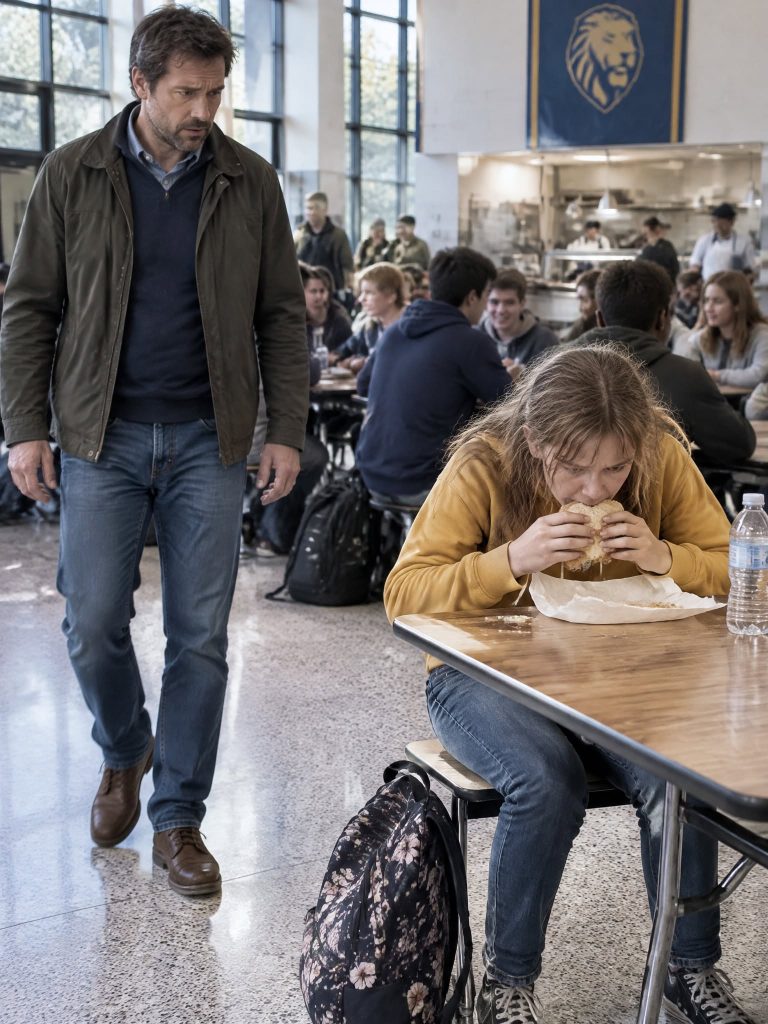
PART 3 — THE FIVE YEARS SHE STOLE FROM US
Chloe stared at the message on her phone.
Do not tell your father anything. I already know he’s at the school. Come straight home.
Her face changed before mine did.
Not fear exactly.
Recognition.
The kind of recognition that only appears when something you have lived with for years suddenly reveals its true shape.
I stood very still.
“Chloe.”
She looked up.
“Dad?”
“Yes.”
Her voice shook.
“How does Grandma know you’re here?”
Mrs. Alvarez and I exchanged a glance.
I asked gently:
“Does she usually know where you are?”
Chloe swallowed.
“Sometimes.”
“How?”
“She says because she’s responsible for me.”
“That isn’t what I asked.”
Her fingers tightened around the phone.
“She has the location app.”
My stomach turned.
“On your phone?”
“Yes.”
“Can you turn it off?”
“I’m not supposed to.”
“Why?”
“If I do, she takes the phone.”
I looked at the cracked screen in her hand.
An old model.
Cheap plastic case.
The kind of phone I had sent six hundred dollars to replace the previous spring.
I remembered my mother’s text:
Chloe dropped hers again. Kids have no respect for anything they don’t earn.
I had answered:
Get her something decent. I’ll send it now.
I had sent eight hundred.
Chloe was holding a phone worth maybe one hundred twenty.
“Who bought that?”
“Grandma.”
“When?”
“Last year.”
“What happened to the other one?”
“What other one?”
That answer hit like a fist.
I sat down.
Chloe stared at me.
“Dad?”
“I sent money for a new phone.”
Her expression hardened.
Not at Diane.
At me.
“No, you didn’t.”
“Yes.”
“Grandma said you told her I didn’t deserve one.”
I closed my eyes.
There are moments when anger is useless because shame arrives first.
I had spent five years sending money instead of asking harder questions.
I had allowed convenience to impersonate trust.
Every time Mom told me Chloe was “going through a phase,” I accepted it.
Every time she said my daughter did not want to talk, I backed off because I thought respecting a teenager’s feelings meant giving her space.
Every time Chloe answered one of my calls with a short sentence and then disappeared, I blamed adolescence.
I had never once gotten on a plane simply because something felt wrong.
Until I came to accuse her.
That truth sat inside me like broken glass.
“I did send it.”
I said.
Chloe’s jaw tightened.
“You always say that.”
I blinked.
“What?”
“When Grandma talks about you.”
She looked away.
“She says you always tell yourself you’re helping.”
My throat closed.
“What else does she say?”
Mrs. Alvarez shifted.
“Nathan, maybe we should—”
“No.”
Chloe said.
We both looked at her.
She wiped her eyes angrily.
“No.”
Her voice shook.
“I want him to hear it.”
I nodded.
“Okay.”
Chloe sat across from me.
Fifteen years old.
My daughter.
Laura’s eyes.
My chin.
Five years of growing without me in the room.
“Grandma says you moved because you couldn’t handle me after Mom died.”
My hands went cold.
“That isn’t true.”
“She says you liked working more than being a dad.”
I looked down.
That one hurt because there was enough truth around the edges to make the lie poisonous.
I had worked too much.
Fourteen-hour days.
Weekends.
Overtime.
Not because I loved being gone.
Because Laura’s cancer left bills.
Then funeral expenses.
Then debt.
Then fear.
I had believed money would create stability.
I did not realize it was buying distance.
Chloe continued.
“She said you stopped coming to school events because you were embarrassed I was failing.”
“I didn’t know you had school events.”
Her face twisted.
“You were emailed.”
Mrs. Alvarez looked toward the computer.
“We can check that.”
Chloe laughed bitterly.
“Grandma said you never answered.”
I turned to Mrs. Alvarez.
“What email is on file?”
She read it.
Not mine.
It looked almost like mine.
My first initial.
Last name.
Numbers.
A Gmail account I had never created.
My stomach dropped.
“Print that.”
I said.
Mrs. Alvarez did.
Chloe stared.
“What?”
“That isn’t my email.”
She went pale.
“It says your name.”
“It isn’t mine.”
“So who—”
She stopped.
We both knew.
Diane.
My mother had not merely blocked communication.
She had built a counterfeit version of me.
A father who ignored emails.
A father who refused fees.
A father who was tired of paying.
A father who existed just enough to disappoint.
I leaned forward.
“Chloe, listen to me.”
She looked at me reluctantly.
“I failed you.”
Her face changed.
I continued before she could interrupt.
“Not in the way Grandma said.”
“But I failed you.”
“I trusted someone else to tell me how you were doing instead of asking you directly enough.”
“I accepted short calls.”
“I accepted excuses.”
“I worked too much.”
“I thought sending money meant I was handling my responsibility.”
Tears came.
“It didn’t.”
Chloe started crying too.
“But I did not stop loving you.”
Her mouth trembled.
“I did not get tired of paying for you.”
“I was never paying for you.”
“I was supporting my daughter.”
“That is different.”
She stared at me.
“I sent money every month because I thought it was reaching you.”
Her eyes dropped to my phone.
“Can you prove it?”
That question hurt.
It also made me proud.
“Good.”
She looked confused.
“What?”
“Ask me for proof.”
I opened my banking app.
Not screenshots I could have fabricated.
The actual account history.
Transfer after transfer.
Diane Brooks.
$2,200.
$2,400.
$1,850.
$2,700.
$3,000.
$12,000.
Chloe covered her mouth.
“What’s that one?”
“Orthodontics.”
“I never had braces.”
“I know.”
The tears came harder.
I kept scrolling.
“Laptop.”
“School clothes.”
“Medical.”
“Field trip.”
“Summer program.”
Chloe whispered:
“I didn’t go to a summer program.”
I stopped.
I remembered.
Diane had told me Chloe attended a weeklong academic camp.
She sent one photograph.
A building.
No Chloe in it.
I had not noticed.
Or I had noticed and explained it away.
Working.
Tired.
Guilty.
Always accepting the easiest story.
“Dad.”
I looked at her.
She asked:
“How much?”
“I don’t know yet.”
“More than thirty-two thousand?”
“In the last year, yes.”
Her face emptied.
Then:
“I thought you sent me fifty dollars for Christmas.”
I could not speak.
“Grandma said she made you send it.”
I had sent one thousand.
Plus a gift card.
Plus a package Diane later told me Chloe refused to open because she was angry with me.
“Did you get a box?”
“What box?”
I put my face in my hands.
There are kinds of grief that do not involve death.
Laura had died once.
Now I was grieving the father I might have been if I had looked harder.
—
Mrs. Alvarez gave us privacy.
Before leaving, she said:
“I’m going to notify the principal and our social worker because there may be financial neglect and records falsification involved.”
I nodded.
Chloe looked frightened.
“Will Grandma get arrested?”
“I don’t know.”
I said.
That was the first honest answer I had given her in years that did not pass through Diane first.
“I don’t know.”
She stared at me.
Then:
“Do I have to go home?”
The word home hurt.
Diane’s house.
The house Laura once helped me paint before Chloe was born.
The house my mother had inherited from my grandfather and where Chloe had lived since she was ten.
I wanted to say no instantly.
Then I stopped.
I was still her father.
Legal guardian.
But I was not going to make another huge decision over her head.
“What do you want?”
She looked stunned.
“What?”
“What do you want?”
Her eyes filled.
“I don’t know.”
“That’s okay.”
“I don’t want Grandma yelling.”
“Okay.”
“I don’t want her taking my phone.”
“Okay.”
“I don’t want to sleep at a hotel with you if you’re going to fly back tomorrow.”
That sentence cut straight through me.
I leaned back.
“I’m not flying back tomorrow.”
“When?”
“I don’t know.”
She looked suspicious.
“My job—”
“There it is.”
She turned away.
I stopped.
Fair.
“My job will have to adjust.”
I said.
She looked back.
“Can you do that?”
“I should have done it years ago.”
Silence.
Then:
“Can I stay with Mrs. Alvarez?”
The counselor was not family.
We needed lawful arrangements.
But what Chloe was really asking was whether she could avoid both the grandmother who had lied and the father she did not yet trust.
That hurt.
I respected it.
“We’ll ask the social worker what is possible.”
I said.
“You do not have to prove anything to me tonight.”
Her shoulders lowered slightly.
Good.
One small thing.
—
The school social worker was named Teresa Kim.
She had the calm expression of someone who had spent twenty years walking into rooms where adults were already shouting.
She reviewed the situation.
I showed proof of legal guardianship.
My identification.
Laura’s death certificate.
The existing authorization Diane had for school pickups and medical decisions.
Not custody.
Never custody.
A limited caregiving authorization I had signed when I moved for work.
I had never surrendered parental rights.
That fact mattered.
So did Chloe’s safety.
Teresa asked Chloe separately whether she felt physically unsafe with Diane.
Chloe said no.
Then added:
“Except when she gets mad.”
My blood went cold.
“What happens when she gets mad?”
Chloe looked at the floor.
“She throws things sometimes.”
“At you?”
“No.”
“Has she hit you?”
“No.”
“Threatened you?”
“She says if I make her life harder, she’ll send me to Dad.”
The room went silent.
A punishment.
I had been used as a threat.
Teresa’s eyes shifted toward me.
I did not react.
Not visibly.
Inside, something broke again.
She asked:
“Why would going to your father be a punishment?”
Chloe whispered:
“Because he doesn’t want me.”
I stood up.
Not angry at Chloe.
I needed air.
Teresa understood.
“Take a minute.”
I went into the hallway.
Pressed both hands against the wall.
Breathed.
Laura would have destroyed me for this.
No.
That was unfair to the dead.
I had to stop invoking Laura every time I hated myself.
She was not here to judge.
I was.
Too much.
I heard her voice anyway.
Nathan, look at what is in front of you.
She used to say that when I spiraled.
Not what might happen.
Not what should have happened.
What is here?
What was here?
Chloe.
Alive.
Hurting.
Still willing to ask me questions.
That was what was in front of me.
I went back inside.
—
We arranged for Chloe to spend the night with the mother of her best friend, Maya, someone the school knew well and Chloe trusted.
I hated it.
My daughter had a father three feet away and wanted someone else’s mother.
I let that hurt without turning it into pressure.
Before she left, I bought her dinner.
Not expensive.
She chose tacos.
At the counter, she pulled out coins.
I gently stopped her.
“I’ve got it.”
She stiffened.
“Grandma says you keep track.”
“Track what?”
“Everything you spend.”
I stared.
“She says one day you’ll ask for it back.”
“No.”
Chloe’s face was guarded.
So I did something that felt stupidly formal.
I took out my phone.
Opened Notes.
Typed:
Anything I spend supporting Chloe as her father is not a loan and will never be requested back.
Then I showed her.
She almost laughed.
“You’re weird.”
“I work in numbers.”
“You work too much.”
Fair.
“I do.”
Then:
“I’m changing that.”
She looked away.
“We’ll see.”
Those two words hurt.
They were also deserved.
Trust is not rebuilt by promising.
It is rebuilt by being there when the promise gets boring.
—
Diane called forty-three times that evening.
I answered none.
Then she texted.
You are upsetting Chloe for no reason.
Then:
I have raised that child while you played businessman in Dallas.
Then:
You have no idea what she costs.
That one made me laugh.
Not because it was funny.
Because apparently neither did she.
Then:
You will destroy her stability.
And finally:
Laura would be ashamed of you.
I stared at that message for a long time.
There it was.
The dead again.
My mother had always known exactly where to press.
After Laura died, Mom became indispensable.
She attended funeral meetings.
Stayed with Chloe.
Cooked.
Washed laundry.
Sat beside me when I could not stop crying.
When the Dallas job came, she said:
“Go.”
“I’ll take care of Chloe until you get settled.”
The phrase until you get settled became five years.
Every time I tried to change it, something happened.
Chloe has exams.
Chloe is angry.
Chloe needs continuity.
Your schedule is terrible.
You live in an apartment.
She has friends here.
You can’t uproot her after losing her mother.
All plausible.
All partly true.
Convenient for Diane.
Convenient for me too.
That was the hardest thing.
She built the cage.
I kept renewing the lease.
—
I stayed at a hotel.
Not the expensive one.
I had stopped caring what Diane said about money.
I opened my laptop and made a spreadsheet.
Every transfer.
Every note.
Every request.
Five years.
It took until 2:17 in the morning.
By then, the preliminary total was one hundred seventy-eight thousand four hundred dollars.
I stared.
Then added transfers made directly to vendors Mom gave me.
Another nineteen thousand.
Then school-related expenses paid separately.
Five thousand.
Over two hundred thousand dollars.
Not all stolen.
Some surely paid Chloe’s housing.
Food.
Utilities.
Transportation.
But Chloe had been receiving free lunch.
Waived fees.
Donated supplies.
School transportation assistance.
She owned almost nothing I had explicitly sent money to buy.
Where had it gone?
I opened Diane’s texts.
Searched words.
Laptop.
Orthodontist.
School trip.
Coat.
Phone.
Emergency.
There they were.
Requests.
Stories.
Urgency.
Then something else.
Photographs.
Receipts.
At least I thought they were receipts.
I zoomed in.
One dental estimate had Chloe’s name.
But not the clinic Diane told me.
I searched the practice.
Closed four years ago.
The estimate date was two years ago.
My hands went cold.
Fabricated.
I checked another.
Laptop invoice.
The product number did not match the model Mom claimed.
I had never checked.
Because why would I investigate my own mother?
That question would eventually become less shameful.
At 3:06, I created a folder.
DIANE—DOCUMENTS
I hated myself for naming it that.
Then I started saving everything.
—
The next morning I called an attorney.
A former colleague in Dallas recommended Rebecca Sloan, an Austin lawyer who handled guardianship, elder and family financial disputes, and fraud-adjacent civil matters.
She listened.
Then said:
“You need three lanes.”
“What does that mean?”
“Your daughter.”
“Your money.”
“Potential criminal conduct.”
“In that order.”
I liked her immediately.
“First, stabilize Chloe.”
“Second, preserve evidence and secure your accounts.”
“Third, let law enforcement and the relevant agencies decide what statutes apply.”
No revenge plan.
No dramatic confrontation.
Good.
“What about the properties?”
“Do not confront Diane about them yet.”
“Why?”
“Because people destroy records when they realize records matter.”
I knew that from business.
Should have known it from family.
Rebecca asked:
“Does your mother have access to your banking credentials?”
“I don’t think so.”
“Think isn’t enough.”
Fair.
I changed everything.
Passwords.
Security questions.
Two-factor authentication.
I froze my credit even though no evidence yet suggested Diane had used my identity.
Then we contacted the bank’s fraud and records department and began preserving transfer records.
Rebecca also advised me not to remove anything from Diane’s house without proper authority.
I hated that.
Half my daughter’s childhood was in there.
Still.
Law.
Evidence.
Do it correctly.
—
At ten, Maya’s mother brought Chloe to school.
I waited outside.
Chloe saw me.
Hesitated.
Then walked over.
“You’re still here.”
My throat tightened.
“Yes.”
She shrugged as though it did not matter.
It mattered.
“What happened with Grandma?”
“Nothing yet.”
“You didn’t call her?”
“No.”
Chloe looked surprised.
“She hates being ignored.”
“I’m discovering that.”
Tiny smile.
There.
Gone.
I asked:
“Can we talk after school?”
“About what?”
“Whatever you want.”
“That sounds fake.”
“Fair.”
She adjusted her backpack.
The zipper was held with a paper clip.
I had sent two hundred dollars for a backpack before school started.
Do not react.
Not now.
“Can I take you shopping?”
Her face hardened immediately.
“No.”
I stopped.
“Okay.”
She blinked.
Probably expected argument.
“I need shoes.”
She looked down at the separating sole.
“But I don’t want you buying everything and then disappearing.”
I nodded.
“Then we’ll buy shoes.”
“One thing.”
“One thing.”
“And I pick.”
“Obviously.”
She walked away.
Then turned.
“Dad?”
“Yes?”
“Don’t talk to Grandma without me.”
I paused.
“Are you sure?”
“I want to hear what she says.”
Fear and strength in one fifteen-year-old face.
“Okay.”
I said.
“But we’ll have someone else there.”
“Why?”
“Because we’re not doing private versions of truth anymore.”
Chloe stared at me.
Then nodded.
Good.
—
Mrs. Alvarez had more records.
Five years.
Every annual hardship renewal.
Every emergency-contact change.
The false email.
Three prepaid telephone numbers.
Notes.
In sixth grade:
Student reports father could not pay for orchestra rental. School assistance approved.
I had sent nine hundred dollars.
Seventh grade:
Grandmother states father no longer participates in regular school expenses.
I had sent over twenty-four thousand that year.
Eighth grade:
Student reluctant to contact father regarding vision exam; says father becomes upset when asked for money.
I had never once been asked.
Freshman year:
Student reports grandmother advised not to “bother” father during work week.
That one was partly true.
Diane always told people my schedule was impossible.
I had accepted it as respect for my career.
Now it looked like isolation.
Then we found the detail that proved planning beyond theft.
Emergency contacts changed repeatedly.
Why repeatedly?
Because schools periodically verified information.
Each time, Diane submitted a slightly altered fake number.
The false email remained active.
Mrs. Alvarez sent a test email.
A response came within six minutes.
This is Nathan. Please direct all school issues through Diane Brooks due to my work schedule.
I stared at the screen.
Someone was actively monitoring it.
Not an abandoned setup from years ago.
Active.
Present.
Intentional.
We preserved it.
Then my phone buzzed.
Diane:
I know you’re still at the school. Stop embarrassing us.
I looked at Rebecca.
She had joined by then.
“How does she know?”
Chloe went pale.
“My phone.”
We turned off location sharing.
Then powered it down.
Diane called me thirty seconds later.
There it was.
Confirmation.
The instant tracking stopped, she noticed.
None of this had been an accident.
—
The confrontation happened that afternoon in a conference room at the school.
Not Diane’s house.
Not my hotel.
Neutral.
Mrs. Alvarez.
Teresa Kim.
Rebecca.
Me.
Chloe.
Diane arrived fifteen minutes late wearing pearls.
My mother always wore pearls when she expected to win.
She entered.
Saw Rebecca.
Stopped.
“What is this?”
I stood.
“Sit down.”
Her eyes flashed.
“Do not speak to me like that.”
For forty-two years, that sentence would have worked.
Not today.
“Sit down.”
She did.
Then looked at Chloe.
“You turned off your location.”
Chloe folded her arms.
“Yes.”
“You know the rule.”
“No.”
I said.
“She knows your rule.”
Diane turned toward me.
“Stay out of it.”
The entire room went quiet.
Even Diane heard the absurdity.
My daughter.
My mother telling me to stay out of it.
Rebecca spoke calmly.
“Mrs. Brooks, I’m Rebecca Sloan. I represent Nathan.”
Diane stared.
“You hired a lawyer?”
“Yes.”
“This is unbelievable.”
Chloe muttered:
“Not really.”
I almost smiled.
Diane heard.
Her expression changed.
“Chloe, honey—”
“No.”
My daughter’s voice shook.
“Don’t honey me.”
Diane went still.
I had never been prouder and sadder at the same time.
I pushed copies of the transfer statements across the table.
“Explain.”
She glanced down.
Then at me.
“What is this?”
“You know.”
“I managed your daughter’s household.”
“Two hundred thousand dollars.”
“That is not all for Chloe.”
“No.”
I nodded.
“Some of it was explicitly for her.”
“Laptop.”
“Phone.”
“Orthodontics.”
“School programs.”
“Where are they?”
Diane’s jaw tightened.
“You have no idea what it cost to raise her.”
Chloe flinched.
I noticed.
“So tell me.”
I said.
“Show receipts.”
“I don’t need to provide receipts to my own son.”
“You do now.”
She looked at Rebecca.
Rebecca said nothing.
That silence did more than any threat.
Diane leaned back.
“I gave up five years of my life.”
There it was.
Not denial.
Compensation.
“You think caregiving is free?”
“No.”
I said.
“I would have paid you.”
She laughed bitterly.
“You did.”
Chloe looked at her.
“Then why did you tell me Dad sent nothing?”
Diane’s face changed.
For the first time, she had to answer the person whose life existed between the numbers.
“Because you needed to learn not to depend on him.”
Chloe stared.
“What?”
“Your father lives three hours away.”
Diane’s voice sharpened.
“He works constantly.”
“He sends money and thinks that makes him a parent.”
I felt the hit.
Because there was truth inside it.
Again.
That was my mother’s talent.
Wrap manipulation around one real flaw.
Chloe’s eyes filled.
“So you lied?”
“I protected you.”
“From what?”
“Disappointment.”
“You made me disappointed!”
Chloe’s voice broke.
“You told me he didn’t want me.”
“I told you not to expect things he could not give.”
“He gave money!”
“Money is not love.”
“No.”
Chloe shouted.
“But neither is starving me while you buy houses!”
Diane went white.
The room froze.
There.
The duplex.
The second rental.
She knew we knew.
She turned to me.
“You investigated my property?”
“I checked public records.”
“You had no right.”
I almost laughed.
“Public.”
Rebecca put a hand lightly on the table.
Stay calm.
I did.
“The account ending in 4417 received both my transfers and your rental income.”
I said.
“Your second property was purchased during the month you told me Chloe needed twelve thousand dollars in emergency orthodontic work.”
Diane looked at Chloe.
Then away.
Chloe whispered:
“I never had braces.”
“I know.”
Diane’s voice became low.
“You have no idea what I sacrificed.”
I stared at my mother.
There it was.
The moral accounting she had kept privately.
She believed sacrifice created a debt.
She believed because she had raised my daughter while I worked, she could decide what I owed.
Maybe she even believed the rentals were retirement security she deserved.
But none of that explained the lie to Chloe.
The fake email.
The fake phone numbers.
The sentence:
Your father is tired of paying for you.
I leaned forward.
“Why did you make her think I abandoned her?”
Diane looked at me.
For the first time, something uglier than greed appeared.
Resentment.
“Because you did.”
Chloe gasped.
I went still.
Diane continued.
“You left.”
“After Laura died, you left.”
“You chased a salary.”
“You sent checks.”
“You let me do the hard part.”
My throat tightened.
“I asked you to help while I got stable.”
“Five years, Nathan.”
“I know.”
“You called when convenient.”
“I know.”
“You missed birthdays.”
“Two.”
“Too many.”
“I know.”
Each admission seemed to anger her more.
Because I was not defending the indefensible.
She could not fight me if I agreed where I had failed.
Then she said:
“So yes.”
“I wanted Chloe to understand who actually stayed.”
The room went quiet.
Chloe started crying.
That was it.
Not just money.
Competition.
My mother had wanted credit for being the parent who stayed.
And instead of asking me to come back, instead of demanding a formal caregiving arrangement, instead of telling me she resented me, she built a version of reality where my daughter could only love her safely by distrusting me.
Diane continued:
“I was the one cooking.”
“I was at parent conferences.”
“I sat up when she had the flu.”
“I dealt with teenage moods.”
“You were in Dallas.”
I swallowed.
“You’re right.”
She stopped.
“What?”
“You did those things.”
Her face shifted.
“I should have been here more.”
“I should have checked.”
“I should have come home.”
“I should have talked directly to my daughter no matter what you said.”
Tears came.
“That failure is mine.”
Diane stared.
Then I continued.
“But you stole money.”
“You falsified records.”
“You lied to Chloe.”
“You impersonated me.”
“And you taught my daughter that my absence meant I did not love her.”
My voice broke.
“That failure is yours.”
No one spoke.
Then Chloe asked quietly:
“Did you love me?”
Diane turned.
“What kind of question is that?”
“A real one.”
“Of course I love you.”
“Then why didn’t you feed me enough?”
Diane’s face collapsed slightly.
“I fed you.”
“I saved lunch because dinner was sometimes cereal.”
“You were picky.”
“I wore shoes with holes.”
“You grow constantly.”
“I asked for tampons at school.”
Diane closed her eyes.
Chloe’s voice cracked.
“You made me feel expensive.”
That sentence ruined whatever defense Diane had left.
Not poor.
Not needy.
Expensive.
A child calculating whether hunger cost too much.
I covered my mouth.
Diane whispered:
“I never meant—”
“I know.”
Chloe wiped her face.
“That’s the problem.”
—
The school filed its reports.
Rebecca helped me make mine.
The police became involved after the false records and impersonation were documented.
The benefits program reviewed the hardship applications.
The bank provided records through proper channels.
No one dragged Diane from the school in handcuffs.
Real life moved slower.
That was good.
Chloe needed stability, not spectacle.
I rented a furnished apartment in Austin.
Two bedrooms.
Nothing impressive.
I called my employer and requested leave.
At first, two weeks.
Then a month.
Eventually, I arranged a transfer to Austin.
It cost me a promotion.
I accepted that.
When my manager asked whether I was sure, I said:
“I’ve spent five years choosing work because I told myself I was doing it for my daughter.”
I swallowed.
“It’s time to choose my daughter directly.”
That sentence became the beginning of a different life.
—
Chloe did not move in immediately.
That hurt.
She stayed with Maya’s family for six days while social workers, attorneys, and school staff worked through what was safest and while she decided what she wanted.
I visited.
Not every hour.
Every day.
We ate dinner.
Sometimes she talked.
Sometimes she did homework and ignored me.
I learned not to fill silence.
On the seventh day, she said:
“I’ll try your apartment.”
Try.
Not move home.
There was no home between us yet.
Try.
I took it.
Her first night, she stood in the bedroom doorway.
I had bought almost nothing.
A bed.
Desk.
Lamp.
Plain comforter.
I had learned.
“Do you want to pick the rest?”
I asked.
She looked suspicious.
“The furniture?”
“Whatever you need.”
“Budget?”
I smiled.
“Reasonable.”
“How reasonable?”
We negotiated.
That became our first normal father-daughter argument.
She wanted a chair that cost too much.
I said no.
She rolled her eyes.
I almost cried from happiness.
Then she caught me.
“Are you crying because I’m mad about a chair?”
“Yes.”
“That’s pathetic.”
“Correct.”
She smiled.
Barely.
Enough.
—
I bought her shoes.
Only shoes.
As promised.
She chose black sneakers.
At the register, I paid.
She said:
“Keep the receipt.”
“Why?”
“In case I have to pay you back.”
I looked at her.
“No.”
She looked embarrassed.
I took the receipt.
Wrote on the back:
Gift from Dad. No debt.
Then handed it to her.
“You’re still weird.”
“Yes.”
She kept the receipt for years.
I found out later.
—
The forensic accounting took months.
The total amount I had sent for Chloe and household-related support over five years was just over two hundred eleven thousand dollars.
Some paid legitimate expenses.
Property taxes on Diane’s house.
Utilities.
Groceries.
Medical copays.
Transportation.
Chloe’s actual needs.
But a large portion—well over one hundred thousand—had moved into savings, renovation expenses, and property acquisitions controlled by Diane.
The pattern was deliberate.
My transfers landed.
Within twenty-four to forty-eight hours, large portions moved.
Same rhythm.
Month after month.
There was even a spreadsheet.
That was the piece that finally removed any fantasy of misunderstanding.
Police found it during lawful evidence collection.
A simple file.
Columns.
Nathan
House
Chloe
Reserve
Reserve.
My daughter’s money had been converted into reserve.
In one month:
Nathan sent $2,600.
House: $800.
Chloe: $240.
Reserve: $1,560.
Another:
Nathan sent $3,100.
House: $950.
Chloe: $300.
Reserve: $1,850.
The reserve later became property down payments.
Diane had not lost track.
She had tracked every dollar.
That spreadsheet destroyed something in me.
Also freed me.
Intent matters when you have spent months asking whether you are overreacting.
There was no accident to forgive.
There was a choice to understand.
—
The false email account contained years of school messages.
Unread at first.
Then opened.
Responded to selectively.
Diane had written as me.
Thanks, I’ll discuss this with Diane.
Unfortunately, I’m unable to contribute to the fee at this time.
Please use available assistance if possible.
My hands shook reading them.
She made me sound polite.
That was almost worse.
A deadbeat father with good punctuation.
Then we found messages from Chloe.
Three.
Sent through the school system directly to the fake address.
One when she was twelve.
Dad, Grandma says you’re busy. I got first chair in orchestra. You don’t have to come. Just wanted you to know.
I left the room.
Could not breathe.
I had never seen it.
Another:
Are you mad I got a C in math? Grandma says that’s why you didn’t call.
I had called.
Diane told me Chloe was asleep.
The third:
I miss Mom too.
Four words.
I sat on the floor and cried until Rebecca came in.
That message had been sitting inside an account created to impersonate me.
My daughter had reached for me.
A woman pretending to be me had allowed the reaching to fall into silence.
I would have preferred she stole every dollar and left those four words alone.
—
Chloe did not want to see the emails at first.
Then she did.
Dr. Patel, her therapist, suggested we read only what she felt ready for.
So we did.
The orchestra message.
She stared.
“You never got this?”
“No.”
“You swear?”
“I swear.”
“Why didn’t you come?”
“I didn’t know.”
She looked away.
“I kept looking at the auditorium door.”
My chest broke.
“I’m sorry.”
“I know.”
Then:
“That doesn’t fix it.”
“No.”
I swallowed.
“It doesn’t.”
Good.
No fake redemption.
No:
But I would have.
The child at twelve had looked at a door.
The father had not walked through.
The reason mattered.
The absence still happened.
We had to hold both.
—
Diane was eventually charged with offenses related to theft, fraud, falsifying records, and misuse of assistance programs.
I will not pretend I understood every statute.
I understood the facts.
She entered a plea after lengthy negotiations.
She avoided the harshest possible outcome partly because she cooperated, had no violent history, and began repaying money through the sale of one rental property.
She spent some time in custody, followed by supervision and restitution requirements.
The second property was sold.
The first duplex remained tied up for a while, then part of its value went toward restitution.
I did not pursue every possible civil dollar.
Rebecca asked:
“Are you sure?”
“Yes.”
“Why?”
“Because I want enough accountability to close the financial wound.”
“I do not want the rest of Chloe’s adolescence spent watching me chase Grandma’s furniture.”
Rebecca nodded.
Reasonable.
Money mattered.
Time mattered more now.
I had learned.
—
Diane blamed me first.
Of course.
Her earliest letters said:
You destroyed this family because you were embarrassed you weren’t the father you thought you were.
I kept that one.
Not because it hurt.
Because it contained a truth beside the manipulation.
I had not been the father I thought.
I thought sending money made absence responsible.
It did not.
But Diane wanted that truth to excuse hers.
No.
Two failures can exist without canceling each other.
Eventually, her letters changed.
Therapy perhaps.
Consequences.
Time.
One said:
I started believing the money belonged to me because I was doing the parenting you should have been doing.
I read that twice.
Then:
At first I took what I thought was fair. Then I took what I wanted.
There.
Then:
When Chloe began asking why you didn’t call more, I was afraid if I helped her reconnect with you, she would leave me.
My throat tightened.
That was the emotional center.
Not greed alone.
Fear of abandonment.
Possession.
My mother had lost my father years earlier.
Then Laura.
Then me to work.
She clung to Chloe.
And because fear without boundaries can become cruelty, she built dependence.
She made herself necessary by making me absent.
Understanding did not excuse it.
But it made her human again.
That mattered eventually.
—
Chloe hated her for almost a year.
Then missed her.
That scared her.
“Does that mean I’m stupid?”
“No.”
“She lied.”
“Yes.”
“She stole.”
“Yes.”
“She also made soup when I was sick.”
“Yes.”
Chloe cried.
“She brushed my hair after Mom died.”
“I know.”
“She went to every school thing.”
“I know.”
“How am I supposed to hate someone who did good things too?”
“You’re not supposed to do anything.”
She looked at me.
“I miss her.”
“Okay.”
“Are you mad?”
“No.”
That surprised her.
“She hurt you.”
“Yes.”
“And you’re okay if I love her?”
That question took everything I had.
“Yes.”
I said.
“Because I do not want anyone else deciding who you are allowed to love.”
Chloe sobbed.
Then came into my arms.
That was the first time she hugged me without me asking.
I held her carefully.
Not like someone recovering lost property.
Like a father being trusted with a moment.
—
We started family therapy.
Just Chloe and me.
At first, terrible.
She would say:
“You chose work.”
I would explain debt.
Dr. Patel would interrupt.
“She did not ask why.”
Right.
Again.
“I chose work.”
I would say.
“That hurt you.”
“Yes.”
“Was I trying to abandon you?”
“No.”
“Did it feel like abandonment?”
“Yes.”
Both.
That became our vocabulary.
Both.
I loved you.
And I was absent.
I sent support.
And I failed to verify it reached you.
Diane cared for you.
And she exploited you.
Laura’s death broke us.
And it did not excuse what came after.
Healing became less about finding the one true villain and more about refusing simple stories.
Except the fake email.
That was simply awful.
We allowed one thing to remain uncomplicated.
—
I learned practical parenting at forty-three.
Embarrassing.
Homework schedules.
Permission slips.
Tampons.
Parent portals.
Doctor appointments.
Which yogurt Chloe hated.
Which shampoo she used.
The difference between:
“I’m fine.”
“I’m fine.”
And:
“I’m fine.”
Apparently there were seventeen versions.
I learned not to solve every problem with money.
That was harder than expected.
Chloe would mention needing something and I would immediately open my wallet.
One day she snapped:
“Can you just listen?”
I stopped.
“Yes.”
She told me about a friend who had betrayed her.
I reached for advice.
Stopped.
She noticed.
“What?”
“I’m trying not to fix.”
She laughed.
“Painful?”
“Extremely.”
“Good.”
Progress.
—
I went to her orchestra concert.
Second chair now.
She had stopped playing for a year because Diane said instrument rental was too expensive.
The school lent her one.
After she moved in with me, she considered quitting permanently.
Then changed her mind.
The night of the concert, I arrived forty minutes early.
Front section.
Not front row.
She would hate that.
I sat.
Every time the door opened behind me, I thought about twelve-year-old Chloe looking for me.
I could not change that door.
I could sit by this one.
When Chloe walked onstage, her eyes scanned the room.
Found me.
She did not smile.
Too cool.
But her shoulders dropped.
I saw it.
Afterward she said:
“You came early.”
“Yes.”
“Why?”
“Traffic.”
She rolled her eyes.
We both knew.
—
I met the boy Diane had accused her of seeing.
His name was Mateo.
He did attend a different school.
That part was true.
He was sixteen.
Polite.
Terrified of me.
Good instincts.
Chloe had met him at the library.
They were not doing anything dangerous.
They studied.
Sometimes he bought her food.
That was the part that hurt.
“Why didn’t you tell Grandma?”
Chloe laughed bitterly.
“She called me a slut when she saw his name.”
My jaw tightened.
“What?”
Chloe looked away.
“Not exactly.”
“Exactly what?”
“She said girls who chase boys because their fathers leave turn into cheap women.”
I closed my eyes.
Some sentences do not deserve nuance.
“Okay.”
“What?”
“I’m allowed to be angry about that one without therapy vocabulary.”
Chloe laughed.
Good.
Then:
“Mateo knew I didn’t have money.”
“How?”
“He noticed.”
Of course.
Other teenagers had noticed what I didn’t.
“He used to bring two sandwiches and say his mom packed too much.”
My throat tightened.
“Did she?”
“No.”
Chloe smiled.
“His mom knew.”
I met her.
Lucia.
She hugged me after five minutes.
I cried in her kitchen.
She pretended not to notice.
Good woman.
—
One year after I found Chloe counting coins, she had her sixteenth birthday.
I asked what she wanted.
“Nothing expensive.”
“Okay.”
“I mean it.”
“Okay.”
She thought.
“Can we go somewhere Mom liked?”
Laura.
My chest tightened.
“Yes.”
We drove to a botanical garden outside Austin.
Laura loved it.
She used to photograph flowers badly.
Half the pictures were fingers.
We walked.
Chloe carried Laura’s old camera.
At one point she said:
“I barely remember her voice.”
I stopped.
“I do.”
She looked at me.
“Can you tell me things?”
That became my gift.
Not an object.
Stories.
Laura burning garlic bread.
Laura singing the wrong lyrics.
Laura crying when Chloe started kindergarten, then denying it.
We sat under an oak tree.
Chloe said:
“Grandma used to tell me Mom asked her to raise me if anything happened.”
My stomach turned.
“Did she?”
“No.”
Laura and I had wills.
Guardianship choices.
Diane was one option only if both of us died.
Not if I lived.
I told Chloe.
She closed her eyes.
“Another lie.”
“Yes.”
Then:
“Do you think Grandma loved Mom?”
“Yes.”
I believed that.
“Then why use her?”
I looked at Chloe.
“Because sometimes people use the person everyone misses to make their own wishes sound sacred.”
That was what Diane had done.
Maybe what I had done too when I told myself Laura would understand why I worked.
The dead are easy to recruit.
They cannot object.
We stopped doing that.
—
Diane saw Chloe again when Chloe was seventeen.
Supervised at first.
Chloe’s choice.
I did not attend the first meeting.
I wanted to.
Dr. Patel asked:
“Why?”
“To protect her.”
“From what?”
I had no clean answer.
Diane could no longer take her.
The meeting was structured.
Professionals nearby.
Chloe was old enough to leave.
Maybe I wanted to protect myself.
So I stayed away.
When Chloe came home, she looked exhausted.
“How was it?”
“She cried.”
“Did you?”
“Yes.”
“Do you regret going?”
“No.”
Then:
“She said she kept the blue dress.”
I frowned.
“What blue dress?”
“Mom’s.”
Laura had a blue dress she wore to our tenth anniversary dinner.
I thought it was lost after we cleared the house.
Diane had it.
Chloe asked for it.
Diane gave it back later.
No manipulation.
Good.
The dress did not fit Chloe.
She kept it anyway.
Sometimes repair begins with returning what should never have been kept.
—
My relationship with Diane never returned to what it was.
Good.
The old relationship required me not to look.
We wrote.
Occasionally spoke.
After her supervision ended, we met twice.
Public places.
Chloe joined once.
The second time, just Diane and me.
She looked older.
I did too.
She said:
“You hate me.”
“No.”
That surprised her.
“I did.”
“When?”
“Every time I opened the spreadsheet.”
She looked down.
“Fair.”
“I don’t hate you now.”
“Why?”
I thought.
“Because hatred kept you in the center.”
Her eyes filled.
“I’m trying to put Chloe there.”
She nodded.
Then:
“Do you forgive me?”
There it was.
Every family story eventually reaches that word.
I looked at her.
“Some of it.”
She laughed sadly.
“That’s honest.”
“You stole money.”
“Yes.”
“You stole communication.”
“Yes.”
“You stole years.”
She started crying.
“Yes.”
“I do not know how to forgive time.”
She covered her face.
I continued.
“But I don’t need you punished every day anymore.”
She lowered her hands.
“That may be all I have.”
“That’s all I’m offering.”
For once, she accepted it.
—
Chloe graduated high school with honors.
Not perfect grades.
Real ones.
She invited Diane.
I did not object.
Diane sat three rows behind me.
Not beside.
Appropriate.
When Chloe’s name was called, we both stood.
For one second, I heard my mother cheering behind me and remembered all the concerts, conferences, illnesses she had actually attended.
Love did exist.
So did harm.
The human brain hates both.
Life insists.
Afterward, Chloe took pictures.
With me.
With Diane.
With Mrs. Alvarez.
With Mateo, who had somehow survived my suspicion and was still around.
Then she said:
“One together.”
I froze.
“Who?”
“You and Grandma.”
Diane looked equally startled.
Chloe sighed.
“Just stand there.”
We did.
One daughter between us.
Not choosing.
Not forgiving for us.
Simply refusing to split herself.
The photograph sits in my office now.
Not because we look happy.
We look uncomfortable.
Because honesty sometimes looks like three people standing close without pretending closeness has been restored.
—
Chloe chose a university in San Antonio.
Not Austin.
Not Dallas.
Her own place.
That mattered.
When the financial-aid forms came, she brought them to me.
“I want to see everything.”
I smiled.
“Good.”
Tuition.
Scholarships.
Housing.
We made a spreadsheet together.
Not Diane’s kind.
Transparent.
Chloe had access.
Every account involving her education was visible to her.
If I sent money, it went to an account in her name or directly to the institution.
Not because I did not trust family anymore.
Because good systems reduce the burden trust has to carry.
That was a lesson worth keeping.
Before she left for college, she asked:
“Are you going to work all the time again?”
I smiled sadly.
“Probably more than you like.”
She frowned.
Then I said:
“But not instead of calling.”
Better.
She nodded.
“Tuesday nights?”
“Tuesday nights.”
We scheduled a call.
Not romantic.
Effective.
For four years, Tuesday nights were ours.
Sometimes ten minutes.
Sometimes an hour.
Sometimes she forgot.
Sometimes I did.
But we kept returning.
Trust loves routine.
—
Mateo did not last.
College.
Distance.
Ordinary.
Thank God.
Not every relationship in our family needed betrayal to end.
Chloe cried.
I brought ice cream.
She said:
“Don’t say you knew.”
“I didn’t.”
“You didn’t like him.”
“I eventually did.”
“He was nice.”
“Yes.”
She cried harder.
“Why does normal heartbreak hurt this much?”
I smiled.
“Because normal still hurts.”
Good lesson.
No one stole anything.
No fake email.
No property.
Two young people changed.
The simplicity was almost beautiful.
—
I left Dallas permanently.
Transferred.
Then eventually changed companies for a role that required less travel.
Lower pay.
People assumed I regretted it.
I didn’t.
I had enough.
That word changed.
Enough used to mean:
enough to pay bills.
enough to send Mom money.
enough to outrun debt.
Now it meant:
enough time to have dinner with my daughter.
enough energy to answer when she called.
enough humility to admit money could not substitute for presence.
Laura’s medical debt was finally gone.
Not because I worked myself into the ground.
Because time and planning eventually did what panic could not.
I wish I had learned that earlier.
—
Years later, Mrs. Alvarez retired.
Chloe and I attended her small reception.
The counselor who had turned a computer screen toward me and quietly changed our lives.
I brought flowers.
Chloe brought a card.
Mrs. Alvarez hugged her.
Then me.
“You look different.”
she said.
“Older.”
“That too.”
She smiled.
“What changed?”
I looked at Chloe across the room.
“Information.”
Mrs. Alvarez laughed.
“Very assessor-like answer.”
Wrong profession. I wasn’t assessor in this story. Different prior story. Need correct: I’m Nathan Brooks, business/work. Let’s replace mentally: “Very accountant-like?” He works unknown. Better: “Very Nathan answer.” Let’s continue without profession references.
“Very Nathan answer.”
I smiled.
Then:
“I stopped accepting reports from other people about my own daughter.”
Mrs. Alvarez’s face softened.
“Good.”
Before we left, she said:
“Do you know what I remember most?”
“What?”
“The first day.”
“Chloe looked at you like she wanted you to prove every sentence.”
I swallowed.
“Yes.”
“She doesn’t anymore.”
I looked at my daughter.
Mrs. Alvarez was right.
That was worth more than every recovered dollar.
—
Diane paid restitution for years.
Not all of it.
Some losses do not return fully.
I stopped checking the balance.
Not because money stopped mattering.
Because I had learned to distinguish recovery from restoration.
The bank could document transfers.
The court could order repayment.
No judge could return sixth-grade orchestra night.
No property sale could return the Christmas Chloe believed I sent fifty dollars because I was tired of her.
Those losses belonged to grief.
Not accounting.
So I grieved them.
Then tried not to make Chloe grieve them forever with me.
—
When Chloe was twenty-three, she asked me a question over dinner.
“Why didn’t you take me with you after Mom died?”
I had answered versions before.
Never this directly.
I put down my fork.
“Because I was scared.”
She waited.
“Of what?”
“Failing.”
“I had a new job.”
“Debt.”
“A child grieving.”
“I thought Grandma’s house gave you stability.”
I swallowed.
“And because part of me wanted one part of life I could control.”
“Work.”
She nodded slowly.
“That’s messed up.”
“Yes.”
“I used work to avoid grief.”
“Yes.”
“Did you know?”
“Not then.”
She looked at me.
“Would you do it again?”
“No.”
The answer came instantly.
She nodded.
“Good.”
Then:
“I needed to hear that.”
That was all.
Children do not always need parents to explain why the mistake was reasonable.
Sometimes they need to know you would choose differently now.
—
Chloe became a school counselor.
Of course she did.
Life has jokes.
When she told me, I laughed.
“What?”
“Nothing.”
“You think it’s obvious?”
“A little.”
She smiled.
“I want to be the person who notices.”
My throat tightened.
“Mrs. Alvarez?”
“Partly.”
Then:
“And me.”
She became very good.
Not because trauma makes people automatically wise.
Because she trained.
Worked.
Learned boundaries.
Did not try to rescue every child.
Important.
One day, years into her career, she called.
“Dad?”
“Yes?”
“A student said something that reminded me of me.”
My chest tightened.
“Are you okay?”
“Yes.”
Then:
“I didn’t assume.”
I smiled.
“What did you do?”
“I asked.”
There it was.
The whole lesson.
Ask.
Do not let the easiest adult story replace the child in front of you.
—
Diane died when Chloe was thirty-one.
Stroke.
She had been living quietly for years.
We were not estranged exactly.
Not close.
Something in between.
Chloe visited more than I did.
Her choice.
I never made her feel disloyal.
That was important.
When Diane entered hospice, Chloe called.
“Do you want to come?”
I did not know.
Then went.
Diane looked small.
The woman who once seemed capable of controlling entire systems reduced to thin hands and oxygen.
She saw me.
“Nathan.”
“Mom.”
Chloe sat on the other side.
For a while, nobody spoke.
Then Diane whispered:
“I’m sorry.”
I nearly laughed.
Dying people love concise apologies after decades of complicated harm.
“I know.”
She looked at Chloe.
“I loved you.”
Chloe began crying.
“I know.”
Then Diane looked back at me.
“I loved you too.”
My throat tightened.
“I know.”
That was the tragedy.
None of this required absence of love.
If she had never loved us, the story would have been simpler.
She loved us possessively.
Fearfully.
Selfishly in places.
Generously in others.
Love is not automatically safe.
Behavior decides that.
Diane whispered:
“Did you ever forgive me?”
I looked at Chloe.
Then at my mother.
“Enough.”
Her mouth trembled.
“Enough?”
“Enough that I came.”
Tears rolled down her cheeks.
She nodded.
That was enough for her too.
Diane died two days later.
Chloe held one hand.
I held the other.
No one mentioned money.
Good.
—
After the funeral, we cleaned Diane’s house.
Boxes.
Photos.
Receipts.
So many receipts.
One drawer contained every card I had sent Chloe over five years.
Unopened.
Some still sealed.
Birthday cards.
Christmas cards.
One with a photograph of Laura tucked inside.
Chloe sat on the floor.
I sat beside her.
Neither of us spoke.
Then she opened the first.
She was twenty-one? No, thirty-one then. But the card was addressed to eleven-year-old Chloe.
Happy 11th birthday, kiddo. I know this year is hard. Mom would be proud of how brave you’re trying to be. You don’t have to be brave for me. Love, Dad.
Chloe cried.
I did too.
Card after card.
Proof.
Too late.
Still proof.
Then we found a small envelope.
Inside were cash gifts I had mailed over the years.
Unspent.
Not all.
Some.
Diane had not even taken those.
She had simply withheld them.
That hurt differently.
Money was not the only goal.
Narrative was.
She needed Chloe to believe I had not sent anything.
That drawer was perhaps the purest evidence of all.
No financial justification.
No household expense.
Just control.
Chloe whispered:
“She could have given me these.”
“Yes.”
“She chose not to.”
“Yes.”
Then she looked at me.
“I believe you.”
My heart stopped.
She had believed me for years by then.
Still.
Those words returned us to the guidance office.
Fifteen-year-old Chloe.
Can you prove it?
Thirty-one-year-old Chloe.
I believe you.
I cried harder than I had at the funeral.
—
We kept the cards.
Not the money.
Chloe donated it to the school hardship fund where she once received lunch assistance.
Her idea.
I asked:
“Are you sure?”
“Yes.”
Then:
“I want some kid to eat without feeling like they owe anyone.”
That sentence contained the whole story.
We donated anonymously.
No plaque.
No Brooks Family Fund.
No redemption branding.
Just money going where it was supposed to go.
Imagine that.
—
I am fifty-nine now.
Chloe is thirty-one.
She has a little boy named Eli.
My grandson.
He is four.
He eats like every meal is his last and thinks coins are treasure.
Last month, I took him to lunch.
He lined up three quarters beside his plate.
“What’s that?”
“My money.”
“For what?”
“Dessert.”
I almost stopped breathing.
Concrete planter.
Faded clothes.
Bread in hot water.
Chloe counting coins.
The body remembers.
I looked across the table at my daughter.
She saw my face.
“Dad.”
“I’m fine.”
“No, you’re doing the thing.”
“What thing?”
“Time traveling.”
Accurate.
Eli pushed one quarter toward me.
“You need money, Grandpa?”
I laughed.
Then cried.
Of course.
Chloe shook her head.
“He’s going to think lunch makes you emotional.”
“It does.”
“Everything makes you emotional now.”
“I earned it.”
She smiled.
Then told Eli:
“Keep your money.”
“Grandpa’s buying dessert.”
I looked at her.
She grinned.
“Gift. No debt.”
The receipt.
The shoes.
Twenty years later.
I laughed.
—
There is still a spreadsheet on my computer.
Not Diane’s.
Mine.
It tracks something different.
Birthdays.
Calls.
Trips.
Not to measure love.
To protect attention.
People laugh when I say that.
I know myself.
Work expands.
Years disappear.
So yes.
I schedule what matters.
Tuesday call.
Eli’s school play.
Chloe’s birthday.
A weekend away.
Some people think spontaneity proves affection.
I disagree.
Sometimes putting someone on your calendar is how you refuse to let the world steal them quietly.
—
I never recovered every dollar.
I recovered my daughter.
That sentence sounds too clean.
I did not recover the fifteen-year-old exactly.
She grew while I learned her.
She did not become the little girl I lost when Laura died.
I had to stop expecting reunion to mean reversal.
We built a new relationship.
Adult eventually.
Honest.
Sometimes strained.
Real.
No one stood between us interpreting the other.
That was the miracle.
Not that Diane was punished.
Not that properties were sold.
Not that records proved I paid.
The miracle was that one day Chloe called me because she had good news and did not first wonder whether I wanted to hear it.
—
If I could return to that Tuesday before I flew to Austin, I would stop myself before anger hardened.
Diane on the phone:
Come deal with her.
She wasted the laptop money.
She’s seeing some boy.
I would ask:
“Can I speak to Chloe?”
Not later.
Not after work.
Now.
I would call the school myself.
I would check the records.
I would ask why my daughter never thanked me for a laptop she apparently received.
I would notice the missing photographs.
The too-convenient excuses.
The distance.
But regret becomes narcissistic if you let it pretend you had information you did not have.
I did not know.
I should have known more.
Both.
That is the mature version.
Not absolution.
Not self-destruction.
Responsibility.
—
People who hear the story always focus on the money.
Thirty-two thousand.
Then two hundred thousand.
The rentals.
The forged hardship forms.
But money was the easiest thing to document.
The real theft had no ledger.
Diane took my presence and translated it into absence.
She took my daughter’s needs and translated them into shame.
She took my checks and translated them into:
Your father is tired of paying for you.
She took Chloe’s messages and translated silence into rejection.
That was the crime that mattered most to us, even where law had no perfect name for it.
And I helped unintentionally by letting communication become indirect.
That is the part I own.
I will never outsource love like that again.
—
The last thing I kept from Diane’s house was the old spreadsheet.
Not the cards.
Chloe kept those.
The spreadsheet.
Nathan / House / Chloe / Reserve
I printed one page.
Folded it.
Put it in my desk.
Years later, Chloe saw it.
“Why do you still have this?”
I thought.
Then:
“I used to think it reminded me what she did.”
“And now?”
“It reminds me to ask where things are going.”
“Money?”
“Everything.”
Time.
Attention.
Stories.
Love.
Where is it going?
Who is deciding?
Who actually receives it?
Chloe nodded.
Then:
“Can you throw it away now?”
I looked at the page.
The numbers had done their work.
“Yes.”
We shredded it together.
No ceremony.
No fire.
Just paper becoming strips.
Then we went to dinner.
Paid for dessert.
No coins required.
—
My mother once told Chloe:
“Your father is tired of paying for you.”
She was wrong.
I did get tired.
Not of paying.
Of mistaking payment for fatherhood.
There is a difference.
Money can feed a child.
Clothe her.
Educate her.
Keep lights on.
It matters.
But money cannot look through a study-hall window and notice a girl softening bread with hot water.
Money cannot hear hesitation.
Money cannot ask:
Are you okay?
And then stay long enough for the first lie to become the second answer.
I learned that five years too late.
But not forever too late.
That matters.
—
Last Tuesday, Chloe called.
Still Tuesday.
Still ours.
“Dad?”
“Yes?”
“Eli starts kindergarten next month.”
“I know.”
“You’re coming?”
I pretended to think.
“Hm.”
“Dad.”
“I’m checking my calendar.”
“Do not.”
I laughed.
“Of course I’m coming.”
She went quiet.
Then:
“You always do now.”
Four words.
Not dramatic.
No music.
No courtroom.
No recovered money.
Just four words that closed a wound more gently than I thought wounds could close.
You always do now.
Not:
You always did.
I didn’t.
Not:
Nothing happened.
It did.
Now.
That is what we had.
Now.
And now was enough to build a life on.
So yes.
I flew to Austin ready to accuse my daughter of wasting thirty-two thousand dollars.
By lunchtime, I learned she had been listed as low income for five years.
By evening, I learned my mother had created a father who never existed and forced both of us to live with him.
It took months to uncover the money.
Years to understand the damage.
Longer to forgive myself without excusing myself.
But eventually, Chloe stopped counting coins.
Eventually, she stopped asking whether gifts were loans.
Eventually, she stopped wondering whether calling me would be expensive.
And eventually, I stopped trying to prove love through bank receipts.
Now, when my daughter needs me, she calls.
When I miss her, I call.
No intermediary.
No fake email.
No prepaid number.
No one translating.
Just:
“Dad?”
“Yes?”
That simple.
That precious.
That direct.
The money was never the thing I wanted back most.
I wanted my daughter to know I had never stopped wanting her.
It took years.
But she knows.
And this time, nobody else gets to tell her otherwise.
THE END STORIES! THANK YOU FOR READING GOOD LUCK !❤️
Related Posts