“Ethan… what does that mean?” For the first time since I had known him, my husband looked afraid of giving me good news. His fingers tightened around mine. Across the table, Vanessa had gone completely still.
Mark stared into his coffee as if the answer were somewhere at the bottom of the cup. And between us sat our ridiculous little eighteen-dollar wedding cake—a tower of glazed donuts with two sugar flowers leaning slightly to the left. Five minutes earlier, my sister had laughed at it.
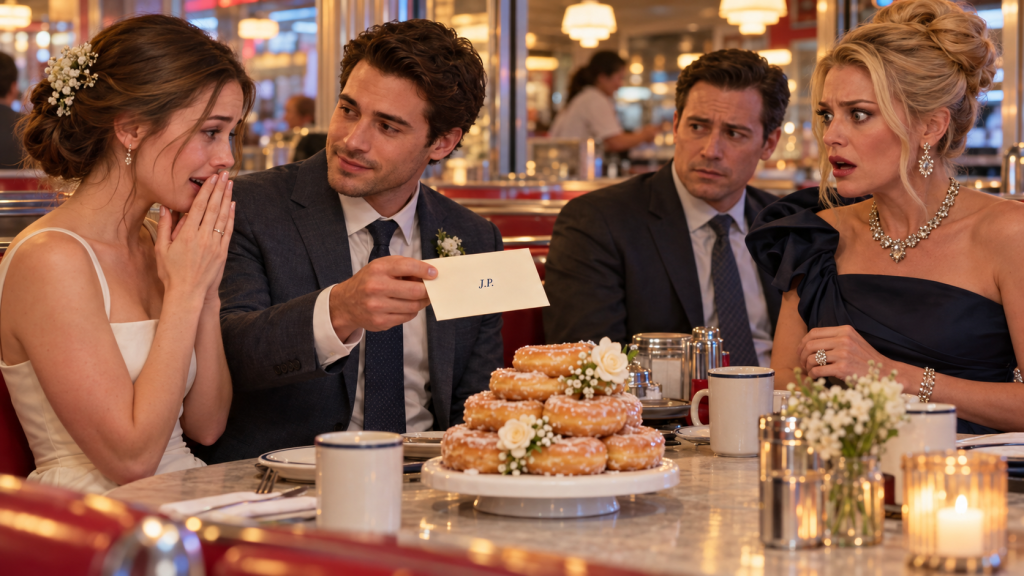
Now nobody was laughing.
Ethan looked at Mark.
“You should tell her.”
Vanessa slapped both palms against the table.
“No.”
Every head turned toward her.
“Mark, don’t.”
Her voice had changed.
The superiority was gone.
So was the polished smile she wore whenever she wanted people to believe her life was more expensive and therefore more successful than everyone else’s.
She looked frightened.
Mark finally raised his eyes.
“I’ve been protecting you long enough.”
Vanessa’s face crumpled.
“Protecting me?”
“You lied to me for almost three years.”
“I was fixing it.”
“You were trying to marry your sister to the man you owed money to.”
A woman at the counter stopped stirring her coffee.
Our courthouse wedding reception had officially become dinner theater.
I whispered:
“Mark.”
He looked at me.
“Who is the second beneficiary?”
He reached inside his coat.
Vanessa made a broken sound.
“Please.”
Mark ignored her.
He placed a folded document beside Julian’s letter.
Then he looked at Ethan.
“You.”
I laughed.
Not because anything was funny.
Because sometimes a sentence is so impossible that laughter is the body’s first attempt to reject it.
“What?”
Ethan shook his head.
“I didn’t know until this morning.”
I looked at him.
“You’re a beneficiary of my grandmother’s trust?”
“Not exactly the part Vanessa was trying to get.”
Mark unfolded the document.
“Your grandmother created two separate provisions.”
My chest tightened.
“Grandma Evelyn?”
“Yes.”
“She never told me.”
“She wasn’t supposed to.”
Vanessa whispered:
“Because she was manipulative.”
Mark turned toward her.
“No.”
“She knew you.”
That silenced my sister.
I looked down at the document.
At the top was my grandmother’s name.
Evelyn Rose Whitmore Living Trust — Amendment Four.
Dated eighteen months before she died.
I remembered that period.
Grandma had been eighty-one.
Sharp as broken glass.
She kept butterscotch candies in crystal bowls and could spot dishonesty before the liar finished the sentence.
She adored Vanessa.
But she never trusted her hunger for appearances.
Once, after Vanessa bought a twelve-thousand-dollar dining table, Grandma asked:
“Does supper taste different?”
Vanessa did not speak to her for two weeks.
I almost smiled at the memory.
Then Mark pointed to the paragraph.
“Read it.”
My hands shook.
I read aloud.
“Upon the lawful marriage of my granddaughter Leah Whitmore…”
I stopped.
Ethan squeezed my hand.
I continued.
“…a separate stewardship bequest shall become effective in favor of the spouse whom Leah freely chooses, provided that before such spouse receives notice of this provision, he or she has signed a complete waiver of control, management, claim, or beneficial interest in Leah’s primary trust…”
My voice disappeared.
I stared at Ethan.
He stared back.
“What waiver?”
Mark answered.
“The one Ethan signed at the courthouse this morning.”
I turned toward my husband.
“You signed away rights to my trust?”
Ethan looked almost embarrassed.
“I thought it was a normal prenup.”
“You never told me.”
“You never told me you had a trust.”
I opened my mouth.
Closed it.
Fair.
I had never told Ethan.
Not because I didn’t trust him.
Because Grandma’s money had always made me uncomfortable.
She had left me a trust that became fully mine at thirty-five.
I was thirty-four.
Vanessa knew because she had helped Mom organize Grandma’s estate after the funeral.
Ethan knew only that Grandma had “left me something.”
I had avoided details because I never wanted money sitting between us like a third person.
This morning, Mark had pulled Ethan aside before the courthouse ceremony and told him Grandma’s attorney required one final signature to keep our finances separate.
Ethan had signed.
Without asking what I was worth.
Without asking what he might be giving up.
I whispered:
“You didn’t even read the amount?”
He smiled slightly.
“There was no amount on the waiver.”
“You didn’t ask?”
“No.”
“Why?”
He looked confused by the question.
“Because it was yours.”
The room went very quiet.
My sister had spent three years telling me Ethan could never give me security.
And the man had apparently signed away any legal pathway to my future money before marrying me because he believed it belonged to me.
I looked down again.
“What does he receive?”
Mark hesitated.
Ethan said:
“Leah.”
“No.”
I looked at Mark.
“What does he receive?”
Mark turned the page.
“A property.”
Vanessa gave a bitter laugh.
I looked at her.
She said:
“Tell her which property.”
Mark ignored her.
“The old Briarwood building.”
I stared.
Grandma’s building.
Four stories of brick and stone downtown.
The building had belonged to my grandmother for decades.
There were medical offices upstairs, a bakery, two small retail spaces, and a nonprofit counseling center.
I had assumed it was sold when she died.
“How much is it worth?”
Mark answered softly.
“About one point eight million now.”
My hand went numb.
I looked at Ethan.
He looked like he wanted the floor to swallow him.
“You own a building?”
“No.”
Mark corrected.
“Technically the transfer becomes effective after your marriage is documented and the trust administrator completes the conditions.”
I stared at the man sitting beside me in a suit we bought on clearance.
He had driven to our wedding in a twelve-year-old Honda with a cracked passenger mirror.
He still owed money from his sister’s medical expenses.
And apparently, because he had signed away any claim to my inheritance before learning what was inside it, Grandma had left him a building worth nearly two million dollars.
Vanessa laughed again.
Not happily.
“Congratulations, Ethan.”
Her eyes were wet.
“You finally became good enough.”
Ethan’s chair scraped backward.
I had never seen anger move through him that quickly.
He stood.
“Don’t.”
Vanessa blinked.
“What?”
“Do not do that.”
His voice remained quiet.
That made it worse.
“Do not turn this into proof that you were right to measure me in dollars.”
Vanessa looked away.
Ethan continued.
“Yesterday I was the same man I am right now.”
“This morning too.”
“The building does not improve me.”
“The donut cake does not diminish her.”
His eyes shifted toward me.
Then back to Vanessa.
“If your opinion of me changes because someone wrote a larger number beside my name, keep the old opinion.”
My throat closed.
Vanessa had no answer.
Neither did I.
Mark did.
“That isn’t even the part you’re going to care about most.”
I looked at him.
“There’s more?”
My husband groaned.
“Apparently your family never learned to put everything in one envelope.”
Despite myself, I laughed.
It lasted one second.
Then Mark turned the next page.
“The building has a condition.”
Vanessa whispered:
“Of course it does.”
“What condition?”
I asked.
Mark read:
“The net rental income from the Briarwood property shall be divided, with fifty percent payable to the designated spouse and fifty percent committed to the Evelyn Whitmore Family Medical Relief Fund for a minimum period of fifteen years.”
Ethan stopped breathing.
I knew before Mark finished.
I looked at my husband.
His eyes filled.
“No.”
Mark nodded.
“What?”
I whispered.
Ethan pushed his chair back farther.
“Leah…”
Mark continued.
“The medical relief fund provides emergency grants to families caring for children or siblings undergoing long-term cancer treatment.”
Ethan covered his mouth.
His sister.
Rachel.
The hospital bills.
The truck he sold.
The years of debt.
I looked at Mark.
“Did Grandma know?”
He nodded.
“She knew everything.”
“How?”
Ethan whispered:
“I never met her more than twice.”
Mark looked at him.
“You met her three times.”
Ethan frowned.
“No.”
“Yes.”
“Before Leah.”
The color left Ethan’s face.
I stared at Mark.
“What are you talking about?”
Mark reached into the envelope again.
He pulled out an old photocopy.
A letter.
At the top was the logo of a charitable foundation Grandma had quietly funded for years.
The Whitmore Family Relief Foundation.
I barely knew anything about it.
Grandma hated public recognition.
She once said if you had to put your name on a giant check to help someone, you were buying advertising, not mercy.
Mark handed the letter to Ethan.
His hands shook.
He read the first line.
Then sat.
I touched his arm.
“What?”
He looked at me.
“My sister.”
His voice cracked.
“When Rachel was sick…”
He swallowed.
“There was one month I couldn’t cover the experimental medication.”
“I applied to a dozen programs.”
“One approved us.”
He looked down at the paper.
“This one.”
My eyes filled.
“The foundation?”
He nodded.
“Grandma paid for Rachel’s treatment?”
“Part of it.”
Mark said.
Ethan stared at the letter.
“There was no name.”
“We never knew who funded it.”
He laughed through tears.
“Rachel got six more months because of this.”
I covered my mouth.
Ethan continued reading.
Then stopped.
His face changed.
“What?”
I asked.
He handed me the page.
At the bottom was a handwritten note from my grandmother.
Applicant repaid $4,200 voluntarily after the patient’s death, despite no repayment obligation. Please retain correspondence. Character is what people do after nobody can reward them. — E.W.
I could barely see through my tears.
Ethan whispered:
“I sent the money back.”
I looked at him.
“You repaid a charity after Rachel died?”
“Not all at once.”
“Why?”
He shrugged helplessly.
“They helped us.”
“I thought somebody else might need it.”
There it was.
The whole man.
The man Vanessa had spent three years calling poor.
My sister stood abruptly.
Her chair almost fell.
“I’m leaving.”
Mark did not move.
“No.”
She stared at him.
“What do you mean, no?”
“You’re finally going to sit through the part everyone else had to live through.”
Her face hardened.
“Mark.”
“You spent three years humiliating Leah.”
“You insulted Ethan.”
“You lied to me.”
“You emptied our retirement account.”
“You let Julian believe he could use your sister.”
“I think you can survive ten more minutes in a diner.”
Vanessa stared at him.
Then slowly sat.
Her face was wet now.
No makeup-perfect tears.
No delicate sadness.
She looked wrecked.
And for the first time that afternoon, my anger made room for one question.
“Why?”
She looked at me.
“Don’t.”
“Why, Vanessa?”
“I said I was desperate.”
“That isn’t enough.”
She looked down.
I continued.
“You wanted me to marry a man I didn’t love.”
“You spent years telling me Ethan was a failure.”
“You laughed at my wedding.”
“You mocked an eighteen-dollar cake five minutes before I found out you gambled forty-eight thousand dollars you didn’t have.”
Her shoulders shook.
“Why?”
She finally whispered:
“Because I couldn’t let you become happier than me.”
The diner went silent.
Even Mark looked surprised.
Vanessa covered her face.
“I know how that sounds.”
I whispered:
“It sounds honest.”
She cried harder.
When Vanessa and I were children, everyone called her the beautiful one.
I was the easy one.
She was five years older.
Perfect grades.
Perfect hair.
Perfect posture.
Grandma bought her piano lessons.
Mom entered her in pageants.
People expected Vanessa to marry well.
She did.
Mark came from money.
Not Prescott money.
But enough.
He owned a successful accounting firm.
They bought a large house.
Joined a country club.
Vacationed in places where the hotel staff handed you cold towels when you arrived.
I never envied her.
At least I thought I didn’t.
But apparently she had been measuring herself against me anyway.
Vanessa wiped her cheeks.
“When you were twenty-two and living in that awful apartment, I felt sorry for you.”
I almost laughed.
“Thank you.”
She shook her head.
“I’m serious.”
“You didn’t care about clothes.”
“You worked at that little bookstore.”
“You drove Grandma’s old Corolla.”
“I thought…”
She hesitated.
“What?”
“I thought you were behind.”
The sentence should have hurt.
Instead, it sounded pathetic.
Vanessa continued.
“Then you met Ethan.”
“And you were happy.”
My throat tightened.
“You were just…”
She searched for the word.
“Peaceful.”
Her voice broke.
“You never looked at my house the way I wanted you to.”
I stared.
“What does that mean?”
“I wanted you to be jealous.”
There it was.
Ugly.
Small.
Human.
She cried.
“I wanted you to walk into my kitchen and think, Vanessa won.”
Mark closed his eyes.
My sister continued.
“But you would come over wearing thrift-store jeans and talk about some ridiculous picnic Ethan planned.”
“You’d laugh.”
“You’d leave early because the two of you were going to watch a movie at home.”
“And I would stand in a kitchen that cost eighty thousand dollars wondering why I felt like I was the one missing something.”
I had no words.
Vanessa looked at Ethan.
“So I decided he was the problem.”
He stared back.
She whispered:
“If he was poor enough, ordinary enough, beneath you enough… then your happiness didn’t mean anything.”
Ethan said nothing.
Neither did I.
My sister continued.
“Julian made sense.”
“He had the right house.”
“The right car.”
“The right friends.”
“If you married Julian, then I could understand your life.”
“And I wouldn’t have to wonder why you had less than me and somehow seemed…”
She stopped.
Mark finished.
“Happier.”
Vanessa nodded.
I looked at Julian’s letter.
“So where did the investment come in?”
Vanessa wiped her face.
“Two years ago, Julian bought a building in Miami.”
“A luxury rental project.”
“He told us investors would double their money.”
Mark laughed bitterly.
“He told you.”
She nodded.
“I put in twenty thousand.”
“Without telling Mark.”
“Yes.”
“It went badly.”
“How badly?”
“I lost it.”
“Then I put in more trying to recover it.”
Mark stared at her.
“You put in another twenty-eight thousand.”
“Yes.”
I closed my eyes.
Classic desperation.
Throwing money after money because admitting the first loss felt worse.
Vanessa whispered:
“Julian covered some expenses.”
“He told me I could repay him later.”
“Then he found out about your trust.”
“How?”
She looked ashamed.
“I told him.”
My stomach tightened.
Of course.
“What exactly did you tell him?”
“That Grandma left you money.”
“That you gained control at thirty-five.”
“And that she had rules around marriage.”
My chest tightened.
“You gave a man information about my inheritance.”
“I was desperate.”
I laughed bitterly.
“There’s that word again.”
She flinched.
“I thought if you married Julian…”
“You thought he could get my money.”
“He told me he only wanted you to invest.”
“After the wedding.”
“Yes.”
“And you believed that?”
Her silence answered.
Mark said:
“She wanted to believe it.”
Vanessa looked at him.
He continued.
“Because if Leah invested, Julian could repay you.”
“And if Julian repaid you, I would never find out what you did.”
Vanessa whispered:
“Yes.”
I felt sick.
“So my marriage was supposed to become your accounting correction.”
She started crying again.
“I’m sorry.”
I looked at her.
The words sounded too small.
Sometimes they are.
Ethan reached for my hand.
I squeezed it.
Julian’s letter still had two pages.
I picked them up.
Vanessa whispered:
“You don’t need to read the rest.”
“That sentence has had a terrible day.”
I continued.
Julian admitted that he had encouraged Vanessa.
He had enjoyed the idea of me.
Not loved me.
Enjoyed me.
Granddaughter of Evelyn Whitmore.
Quiet.
Educated.
Potential access to capital.
A respectable wife.
A new investor.
He wrote:
Vanessa made you sound practical enough to persuade and sentimental enough to trust family.
I stopped.
Ethan’s jaw tightened.
I kept reading.
Julian claimed that six months ago he had begun to realize Vanessa’s plan was becoming unstable.
Not morally wrong.
Unstable.
Important distinction.
He had discovered Grandma’s trust restrictions were stricter than Vanessa believed.
Marriage would not give him control.
Even if I invested voluntarily, trustees could review large transfers until age thirty-five.
So he backed away from actively pursuing me.
I thought about it.
That was true.
Julian’s flowers had become less frequent in the past six months.
Vanessa’s pressure had become stronger.
Because the escape route was closing.
Then came the line that made Mark finally speak.
“I found messages between them last week.”
I looked up.
“What messages?”
Mark looked at Vanessa.
She shut her eyes.
“Messages where Julian told Vanessa the only remaining chance was to stop your wedding.”
My stomach dropped.
Ethan squeezed my hand harder.
“How?”
I asked.
Mark hesitated.
Vanessa whispered:
“Nothing happened.”
“Not what I asked.”
She looked at Ethan.
Then me.
“I called your landlord.”
My skin went cold.
“What?”
“You told me you were moving into Ethan’s apartment after the wedding.”
“Yes.”
“I called the property manager and said there might be an unauthorized occupant issue.”
My mouth fell open.
“That complaint last month?”
Ethan stared at her.
“You did that?”
She nodded.
I remembered Ethan calling me worried because the property manager suddenly requested new documentation.
It had been resolved in a day.
I had thought it was routine.
Vanessa continued.
“I also called the diner.”
Our diner.
The place where we were sitting.
The owner, Mr. Sal, looked over from behind the counter.
His face changed.
He had been listening.
“What did you tell me?”
he asked.
Vanessa stared.
Mr. Sal stepped closer.
“You called and said there might be a problem with their reservation.”
She nodded.
His expression hardened.
“I thought you were the wedding planner.”
“I know.”
I stared at her.
“You tried to cancel our reception?”
“I thought if enough things went wrong…”
“You thought I’d decide Ethan couldn’t even manage a diner.”
Tears slipped down her face.
“Yes.”
Ethan leaned back.
His expression was no longer angry.
It was sad.
That was worse.
He asked:
“Did you mess with Leah’s car?”
Vanessa jerked her head up.
“No.”
My stomach turned.
“What about my car?”
Ethan looked at me.
“The week before the wedding, your tire pressure warning came on twice.”
“That was a nail.”
“I know.”
He looked at Vanessa.
“I’m asking.”
She shook her head violently.
“No.”
Mark spoke.
“That was why I confronted Julian.”
I looked at him.
“What?”
“One of the messages said Vanessa needed ‘something undeniable’ to make you postpone.”
Mark’s face tightened.
“I didn’t know what that meant.”
“I panicked.”
He looked at Vanessa.
“She swore nothing dangerous was planned.”
“It wasn’t.”
she said.
Mark continued.
“I went to Julian.”
“And?”
“He laughed.”
That told me something about Julian I had not wanted confirmed.
Mark’s mouth tightened.
“He said Vanessa was losing perspective.”
“He claimed he was done.”
“Then he gave me this letter and copies of everything.”
“Why?”
“Because I told him if he didn’t, I would take what I had to a lawyer.”
I looked down at Julian’s neat handwriting.
Cowardice can have excellent stationery.
“Where is Julian?”
I asked.
Nobody answered immediately.
Then a familiar voice came from behind me.
“Outside.”
I turned.
Mr. Sal was standing by the front window.
Every head followed his gaze.
A black Mercedes was parked across the street.
Of course.
Vanessa went white.
Mark stood.
“He followed us?”
She whispered:
“I didn’t tell him.”
Ethan rose beside him.
I grabbed his sleeve.
“No.”
He looked at me.
“I’m not going to hit him.”
“Your face has not signed that agreement.”
That almost made him smile.
Mark walked toward the door.
I stood too.
“Wait.”
Everyone looked at me.
This was my wedding day.
My sister’s scheme.
My inheritance.
My marriage.
My decision.
“Tell him to come in.”
Vanessa stared at me.
“Leah.”
“No.”
I looked at her.
“He spent years letting you advertise him to me like a luxury appliance.”
“If he came here, he can speak.”
Ethan looked at me carefully.
“Are you sure?”
“No.”
I took a breath.
“Do it anyway.”
Mark opened the door.
Julian walked in.
He looked exactly as he always did.
Tailored navy suit.
Perfect watch.
Dark hair cut every two weeks.
The kind of man restaurant hosts recognize before he gives his name.
He glanced at the donut cake.
Then at me.
“Congratulations.”
Ethan laughed.
Not kindly.
Julian looked at him.
“Ethan.”
“Julian.”
The contrast was almost ridiculous.
Two men Vanessa had spent years placing on opposite sides of an imaginary scale.
Julian looked at the envelope.
“So you read it.”
“Yes.”
“Good.”
I stared.
“Good?”
He pulled out a chair.
Nobody invited him to sit.
He remained standing.
“I should have told you earlier.”
“Yes.”
“I’m sorry.”
“Why are you here?”
He looked at Vanessa.
“Because she called me.”
Vanessa stood.
“I did not.”
His expression changed.
Mark pulled out his phone.
“My phone.”
Vanessa stared.
Julian nodded.
“She called from Mark’s number thirty minutes ago.”
Mark’s face hardened.
“You took my phone?”
Vanessa’s silence answered.
She whispered:
“I was scared.”
Mark looked devastated.
Not angry.
Done.
There is a difference.
He slowly sat again.
Vanessa saw it too.
“Mark.”
He shook his head.
“Not now.”
I looked at Julian.
“What did she say?”
“That everything was falling apart.”
“Accurate.”
“She asked me to tell you the letter was fake.”
I looked at my sister.
She cried.
I turned back to Julian.
“And what were you going to do?”
He hesitated.
Then:
“I came to refuse.”
That surprised me.
“Why?”
“Because I’ve spent two years making increasingly bad decisions in service of avoiding one bad decision.”
“What was the first?”
“Investing in that property.”
He glanced at Mark.
“It failed.”
“I hid the extent.”
“I took money from other projects to keep it alive.”
“Vanessa invested.”
“She lost money.”
“I covered part of it.”
“Then I thought your trust could solve liquidity problems.”
He said it so clinically.
Liquidity problems.
As though my life were a column.
I asked:
“Did you ever actually want to marry me?”
He looked uncomfortable.
“I liked you.”
Ethan laughed bitterly.
Julian ignored him.
“You were intelligent.”
“Kind.”
“You didn’t care about status.”
“Apparently that made me ideal for a plan built entirely around status.”
Julian accepted the blow.
“Yes.”
“Did you love me?”
“No.”
“Thank you.”
He looked surprised.
“I mean it.”
I said.
“At least one man at this table knows the difference between wanting access and calling it love.”
Julian looked down.
Then he glanced at Ethan.
“You should know something.”
My husband’s expression hardened.
“What?”
“The Briarwood building has debt.”
Mark turned.
“What?”
Julian almost smiled.
Not happily.
“Evelyn refinanced it before she died.”
My heart sank.
“How much?”
“Four hundred thousand.”
Vanessa let out a small, vindictive laugh.
There it was.
A fragment of the old sister.
As though debt made Ethan poor again and therefore restored order.
I looked at her.
She stopped immediately.
Julian continued.
“But the property generates enough rent to service it comfortably.”
“Why do you know?”
“I researched the trust.”
Of course he did.
He knew my grandmother’s assets better than I did.
Ethan sat.
“Good.”
Julian stared.
“Good?”
“Yes.”
“The medical fund gets half the net income.”
“If the building had no obligations and threw off ridiculous cash, I’d be uncomfortable.”
Julian looked genuinely confused.
“You don’t care that the asset has debt?”
Ethan shrugged.
“My life already had debt yesterday.”
“I still married Leah.”
I started crying.
Again.
I was beginning to understand why people paid for waterproof wedding makeup.
Julian looked at me.
“There’s something else Vanessa doesn’t know.”
My sister closed her eyes.
“Oh, for God’s sake.”
For once, I agreed.
Julian continued.
“The primary trust isn’t accessible to you at thirty-five automatically.”
I frowned.
“What?”
Mark stared.
Julian reached for the trust copy.
“Read section nine.”
Mark flipped pages.
His eyes widened.
Vanessa leaned forward.
“What?”
Mark read silently.
Then looked at me.
“Your grandmother changed the distribution.”
“How?”
“Instead of releasing everything outright at thirty-five…”
He looked at Julian.
Julian finished.
“It becomes fully discretionary until age forty unless you complete a financial education requirement and sign independent management documents.”
Vanessa stared.
“That can’t be right.”
Mark looked at her.
“It is.”
Her face emptied.
All those years.
All the pressure.
All the plotting around my thirty-fifth birthday.
Based on an incomplete copy of Grandma’s trust.
I started laughing.
Vanessa stared at me.
I laughed harder.
Ethan joined.
Then Mark.
Even Mr. Sal behind the counter covered his mouth.
Julian did not laugh.
Vanessa certainly did not.
I wiped tears from my face.
“You tried to rearrange my entire life around money I couldn’t even hand over if I wanted to.”
Vanessa whispered:
“I didn’t know.”
“No.”
I looked at her.
“That has been the problem all day.”
Julian left first.
Before he did, he placed a flash drive beside Mark.
“Everything.”
Mark looked at him.
“Messages?”
“Transfers.”
“Contracts.”
“Account records.”
“Everything I have.”
Vanessa whispered:
“You’re destroying me.”
Julian looked at her.
“No.”
His voice was surprisingly soft.
“We did that ourselves.”
Then he walked out.
I never saw him socially again.
That did not mean the consequences ended.
They were just beginning.
Our wedding lunch did not recover.
How could it?
Mr. Sal refused to charge us for anything except the donuts.
Ethan argued.
Mr. Sal pointed toward Vanessa.
“I’ve had enough arguing today.”
We paid eighteen dollars.
That made the story better later.
At the time, it simply felt surreal.
Before Mark left, he pulled Ethan aside.
They spoke quietly.
Then Mark hugged him.
Not a polite brother-in-law hug.
A real one.
I had never seen them hug.
Mark whispered something.
Ethan shook his head.
Mark insisted.
I learned later what he said.
“Thank you for signing the waiver.”
Ethan replied:
“I didn’t do it for you.”
Mark said:
“I know.”
That was why it mattered.
Vanessa stood near the diner door.
Alone.
Mark had gone outside to call a lawyer.
Not a divorce lawyer.
Not yet.
An accountant and attorney to secure their accounts.
I walked toward her.
She looked at me.
“You hate me.”
I thought about it.
“No.”
She looked surprised.
“I’m too tired.”
Her mouth trembled.
“That’s worse.”
“Probably.”
She looked at my dress.
Simple cream-colored courthouse dress.
Seventy-nine dollars on sale.
She whispered:
“You really are happy with this.”
I looked around.
Vinyl booths.
Coffee pots.
A crooked donut tower.
My new husband gathering leftover napkins because he hated waste.
“Yes.”
“I don’t understand.”
“I know.”
She cried.
“That’s what makes me so angry.”
I stared.
She continued.
“I did everything right.”
“School.”
“Marriage.”
“House.”
“Connections.”
“And?”
“And I still wake up afraid someone is going to discover I’m not as successful as I look.”
There it was.
The prison.
Not money.
Image.
I said:
“Then stop performing.”
She laughed bitterly.
“For who?”
“Start with yourself.”
She looked at Mark through the window.
“What if he leaves?”
“I don’t know.”
“What if everyone finds out?”
“They probably will.”
She winced.
I continued.
“You spent years telling me security meant having enough money that nothing could touch you.”
“But look at you.”
She cried silently.
“Your life is expensive.”
I said.
“It isn’t secure.”
Then I walked away.
Not dramatically.
My husband had donuts.
Priorities.
That night, Ethan and I went home to his apartment.
Our apartment now.
No honeymoon suite.
No rose petals.
A stack of unopened mail on the kitchen counter.
His sister Rachel’s photograph on the bookshelf.
He took off his tie.
I sat on the edge of the couch.
For ten minutes, neither of us spoke.
Then I said:
“One point eight million dollars.”
He groaned.
“Please don’t.”
“You own a building.”
“Not yet.”
“You might own a building.”
“I own six forks.”
“Seven.”
“One has a melted handle.”
“It remains legally a fork.”
He laughed.
I did too.
Then suddenly I started crying.
Hard.
Ethan sat beside me.
“Hey.”
I covered my face.
“I’m sorry.”
“For what?”
“This was supposed to be simple.”
He looked around.
“It still is.”
I laughed through tears.
“My sister tried to arrange me into an inheritance scheme.”
“Complicated.”
“My grandmother secretly tested you.”
“A little invasive.”
“You apparently knew her charity before you knew me.”
“Very weird.”
“You own six usable forks.”
“Now you’re just hurting me.”
I laughed.
Then leaned into him.
He kissed my forehead.
I whispered:
“Are you angry I never told you how much Grandma left me?”
He thought.
“A little.”
My chest tightened.
“Why?”
“Not because of the money.”
“Then why?”
“Because you thought knowing might change me.”
I looked down.
“I was scared it would.”
He nodded.
“That hurts.”
“I’m sorry.”
He was quiet.
Then:
“Did Vanessa influence that?”
The question hit.
Yes.
Years of Vanessa telling me men cared about wealth.
Julian.
Security.
Status.
I had wanted one part of my life untouched by it.
So I had hidden the trust.
“Yes.”
Ethan nodded.
“Okay.”
“Just okay?”
“We’ll talk about it.”
“Tonight?”
“No.”
“Why?”
He leaned back.
“Because I got married six hours ago, discovered my wife is secretly wealthy, learned I may inherit a building from a woman whose charity helped my dead sister, and watched my new sister-in-law confess to a financial conspiracy over donuts.”
I stared.
He continued.
“I would like to shower.”
I laughed until I cried again.
The next morning, the Briarwood trust attorney called.
Her name was Eleanor Shaw.
She was seventy if she was a day.
Sharp voice.
Sharper glasses.
She asked Ethan and me to come to her office.
Mark joined us.
Vanessa did not.
Eleanor looked at Ethan.
“You signed the waiver before learning the value of Leah’s trust?”
“Yes.”
“Did anyone tell you there was a separate bequest?”
“No.”
“Did anyone promise you compensation?”
“No.”
“Did you sign voluntarily?”
“Yes.”
She nodded.
Then looked at me.
“Your grandmother would be extremely smug.”
I almost laughed.
“That sounds like her.”
Eleanor handed Ethan a letter.
His name on the front.
Grandma’s handwriting.
He did not open it.
He looked at me.
“You first.”
“No.”
“It’s yours.”
He shook his head.
“Apparently not.”
Eleanor sighed.
“Your grandmother did enjoy theater.”
Ethan opened it.
He read silently.
Then his face broke.
I touched his arm.
“What?”
He handed it to me.
I read.
Dear Ethan,
If you are reading this, either you married Leah or my lawyer has made an impressive clerical error.
I laughed through tears.
Grandma.
I knew your name before Leah brought you to Sunday supper. Years earlier, my foundation helped your sister Rachel. You later repaid money you were never asked to repay. People reveal themselves most clearly when obligation has ended.
Ethan covered his eyes.
I kept reading.
When Leah introduced you, I recognized the name and requested the old file. I did not tell her because I wanted to watch both of you without making gratitude part of the relationship.
Typical.
You never asked me what Leah would inherit. You asked me whether the porch railing needed fixing.
I started laughing.
Ethan remembered.
“I fixed that railing.”
“I know.”
You spent three hours repairing it and refused payment. You also ate four slices of lemon cake, which I considered less admirable.
Ethan whispered:
“Five.”
I laughed harder.
Then continued.
I am leaving you Briarwood for two reasons. First, I believe you understand that money is useful only when it is moving toward something worth protecting. Second, Leah has a sister who thinks wealth is proof of value. Leah needs a husband who knows better.
The room went silent.
Even Eleanor’s face softened.
Do not become impressed with yourself. The building has a mortgage, aging plumbing, and a tenant on the third floor who will call you every winter about a radiator that works perfectly well.
Ethan laughed through tears.
Half the income will support families facing medical crises. The other half is yours. Use it to build a life, pay your debts, save, travel, or buy a better car. Rachel’s illness taught you sacrifice. Do not make sacrifice your identity. Living matters too.
Ethan stopped breathing.
That line destroyed him.
For years, he had carried his sister’s death like a debt no payment could clear.
Grandma had seen it after meeting him three times.
I finished.
Take care of Leah, but do not rescue her from every difficult thing. She is stronger than people mistake her for. Let her take care of you sometimes too.
With confidence and mild concern,
Evelyn Whitmore
Ethan lowered his head to the table.
I wrapped my arms around him.
He cried for Rachel.
For Grandma.
For years of debt.
For the strange mercy of being seen by someone he barely knew.
Eleanor waited quietly.
Then said:
“She also left an addendum.”
Ethan lifted his head.
“Is it about the radiator?”
“No.”
“Then I’m done.”
Even Eleanor laughed.
The addendum required Ethan to serve with a professional property manager for the first three years.
Grandma trusted character.
Not inexperience.
Smart woman.
The building’s debt was real.
So were repairs.
So was income.
Ethan did not wake up rich the next morning.
That mattered.
He still went to work Monday.
Still packed lunch.
Still complained about gas prices.
The first distribution from Briarwood came three months later.
After expenses, debt service, taxes, and the medical fund contribution, Ethan’s share was far less glamorous than Vanessa would have imagined.
He used most of it to pay down the medical debt he still carried from Rachel.
Then bought himself something extravagant.
A used truck.
Eight years old.
I laughed when he drove it home.
“You could buy a new one.”
“I could.”
“You bought this.”
“Yes.”
“Why?”
“It has heated seats.”
Apparently wealth had corrupted him.
Mark separated from Vanessa two weeks after our wedding.
Not divorced.
Separated.
He moved into an apartment.
She stayed in the house.
Their accounts were frozen and reconstructed.
Forensic accountants discovered that the forty-eight thousand was only the beginning.
Vanessa had also used a home-equity line for another thirty-two thousand dollars.
Some had gone toward the failed investment.
Some toward maintaining the appearance that nothing was wrong.
Country-club dues.
A designer handbag.
A vacation.
She had borrowed to look wealthy while mocking us for being broke.
That truth became impossible to ignore.
Mark called me one evening.
“I feel stupid.”
The word again.
I said:
“You trusted your wife.”
He laughed bitterly.
“Your family should stop saying that like it’s noble.”
“It isn’t noble.”
“It’s normal.”
That was different.
Julian’s financial problems became public.
Not scandalously public.
No dramatic arrest at a gala.
Just lawsuits.
Investors.
Restructuring.
Properties sold.
Business pages reported that Prescott Development had liquidity issues.
I read one article.
Then stopped.
Watching another person collapse did not rebuild anything in me.
Julian emailed me once.
I am sorry for treating your life like financing.
Strange apology.
Accurate.
I replied:
I accept that you understand what you did. Please do not contact me again.
He didn’t.
Boundary.
Clean.
Vanessa contacted me constantly at first.
Calls.
Texts.
Voicemails.
I ignored most.
Then one night, three months after the wedding, she appeared at our apartment.
Not dressed like Vanessa.
No perfect coat.
No heels.
Jeans.
Sweater.
Hair tied back.
She looked younger.
And older.
Ethan opened the door.
He did not invite her in.
“Leah?”
he called.
I came from the kitchen.
Vanessa looked at me.
“Can we talk?”
I hesitated.
Then:
“Ten minutes.”
We sat at the tiny kitchen table.
The same one she once told me was “cute if you like temporary furniture.”
She touched the scratched wood.
“I was awful.”
I waited.
“I started therapy.”
I raised an eyebrow.
She almost smiled.
“I know.”
“What does the therapist say?”
“That I use achievement as emotional anesthesia.”
“Expensive sentence.”
“Very.”
We both almost laughed.
Then she cried.
“Mark filed for divorce.”
My chest tightened.
“I’m sorry.”
“I’m not asking you to fix it.”
Good.
“He said he doesn’t know if he can ever trust me again.”
“That makes sense.”
She winced.
“I know.”
Silence.
Then she looked toward the living room.
Ethan was deliberately giving us privacy.
“I owe him an apology too.”
“Yes.”
“I don’t know if he’ll accept it.”
“That isn’t why you apologize.”
She looked at me.
I continued.
“You apologize because it is true.”
“Acceptance belongs to him.”
Her eyes filled.
“That sounds like Grandma.”
“Terrifying.”
She smiled faintly.
Then became serious.
“Why didn’t you tell me about the trust?”
I stared.
“Really?”
“No.”
She shook her head.
“I don’t mean why didn’t you tell me the amount.”
“I mean…”
She stopped.
“Why didn’t Grandma tell me?”
There it was.
Not greed.
Old hurt.
I softened slightly.
“Maybe because she knew what money did to you.”
Vanessa cried.
“I think she thought I was shallow.”
“She thought you were scared.”
My sister looked up.
“How do you know?”
“Because Grandma thought almost everyone’s worst behavior was fear dressed badly.”
Vanessa laughed through tears.
“That sounds exactly like her.”
I reached across the table.
Not to forgive everything.
Just to touch her hand.
She squeezed mine.
For the first time in years, neither of us was comparing anything.
Healing with Vanessa was not quick.
That is important.
People love stories where one honest conversation repairs decades.
It doesn’t.
She lied again.
Not about money.
About whether she had contacted Julian after promising Mark she wouldn’t.
Mark found out.
Their divorce proceeded.
Vanessa lost the house.
Not because Mark “took it.”
Because selling it was part of dividing debt and assets.
She moved into a two-bedroom condo.
The first time I visited, she said:
“My closet is smaller than your old apartment.”
I stared.
She sighed.
“Working on it.”
Progress.
She got a job.
That surprised everyone.
Vanessa had worked before marriage but stopped after Mark’s business grew.
Now she joined an interior design firm.
Turns out decades of expensive taste can become employable when separated from competition.
She was good.
Really good.
She learned to work with budgets.
That may have been divine comedy.
Once, a client wanted a seventy-thousand-dollar kitchen on a twenty-five-thousand-dollar budget.
Vanessa called me afterward.
“I wanted to tell her happiness wasn’t stored in marble countertops.”
I smiled.
“Did you?”
“No.”
“What did you say?”
“We can do quartz.”
Professional growth.
Ethan and I moved slowly.
We did not buy a mansion.
We bought a modest house two years after the wedding.
Three bedrooms.
Old maple tree.
Small workshop.
Ethan wanted a garage.
I wanted a window over the kitchen sink.
We both won.
The down payment came partly from Briarwood income and partly from savings.
Not my trust.
I did not gain full management of that until later.
When I finally did, the first thing I did was nothing.
For six months.
Grandma would have approved.
Then Ethan and I hired separate financial advisers.
Separate.
That mattered.
Love is not weakened by independent advice.
Sometimes trust is stronger when nobody has to prove it by being reckless.
The medical relief fund became the heart of Briarwood.
Ethan volunteered with it.
Not to approve his own distributions.
The trust prohibited that.
But he met families.
Delivered grocery cards.
Sat with brothers in hospital cafeterias.
Men who looked exactly like he had once looked.
Exhausted.
Guilty.
Trying to calculate whether they could afford another week of hope.
One evening he came home and sat on the kitchen floor.
I found him there.
“What happened?”
He looked at me.
“There’s a kid.”
My heart dropped.
“Seven years old.”
“Leukemia.”
I sat beside him.
“Her brother sold his motorcycle.”
Ethan laughed through tears.
“Of course he did.”
I took his hand.
He whispered:
“I wanted to tell him not to.”
“Why?”
“Because I know how it ends.”
I squeezed his fingers.
“You know how Rachel’s story ended.”
“Not his sister’s.”
He looked at me.
That was the line.
He cried.
Then got up the next morning and kept helping.
Grandma had been right.
Sacrifice could not become his identity.
But compassion remained part of it.
On our first anniversary, I ordered donuts.
Eighteen dollars.
Same diner.
Same table.
Mr. Sal had saved the receipt from our wedding.
He framed it.
Underneath he wrote:
MOST EXPENSIVE $18 CAKE IN CITY HISTORY.
Ethan laughed for ten minutes.
Vanessa came too.
That surprised me.
She sat across from us.
Looked at the donut tower.
Then at me.
“May I say something?”
I raised an eyebrow.
“Dangerous opening.”
She smiled.
“I’m sorry I laughed.”
Silence.
She continued.
“Not just because I was wrong about Ethan.”
“I’m sorry because you were happy, and instead of joining you, I needed to make your happiness smaller so I could feel bigger.”
My throat tightened.
That was a real apology.
Specific.
No excuse.
I said:
“Thank you.”
She looked at Ethan.
“And I’m sorry I measured you by what you couldn’t buy.”
He nodded.
“I appreciate that.”
Not:
It’s okay.
Because it wasn’t.
He continued.
“For what it’s worth, I thought your purse was ugly.”
Vanessa gasped.
I nearly choked.
“My Dior?”
“Especially that one.”
She stared.
Then laughed.
Really laughed.
No status.
No defense.
Just my sister.
Mark did divorce her.
That was sad.
Also understandable.
Years later, they became civil.
Not friends.
Not enemies.
They had no children, so there was less forced contact.
Eventually Mark remarried.
Vanessa attended no wedding.
Good boundary.
She sent a card.
Better.
Vanessa dated again too.
The first man was wealthy.
Very.
She ended it after four months.
I asked why.
“He was rude to waiters.”
I stared.
“Who are you?”
She laughed.
The second man was a high-school principal named David.
Divorced.
Two teenagers.
Drove a Subaru.
Vanessa initially complained that his house had “aggressively beige carpet.”
Then fell in love with him.
When she told me, she looked almost embarrassed.
“He clips coupons.”
I smiled.
“Thoughts and prayers.”
She threw a pillow at me.
They eventually married.
Small ceremony.
No yacht.
I brought the cake.
Donuts.
Vanessa saw them and started crying.
“You’re terrible.”
“I learned from the best.”
She hugged me.
That wedding cost more than eighteen dollars.
But not much more.
Grandma’s primary trust never became the center of my marriage.
That may have been her greatest success.
When I turned forty and all restrictions ended, Ethan knew the exact amount.
By then, it was just another financial fact.
Not a test.
Not seduction.
Not a secret.
We used some to fund the flower studio I had always wanted.
Not because Ethan “allowed” it.
Not because Grandma intended it.
Because I chose.
Ethan used Briarwood income to expand the medical fund’s partnerships.
Again, his choice.
Two people.
Two assets.
One marriage.
No ownership disguised as intimacy.
Years after our wedding, Mark gave me the original cream envelope.
I had assumed it disappeared into lawyer files.
He had kept it.
Julian’s initials still on the flap.
J.P.
I held it.
“Why?”
Mark shrugged.
“Thought you might want it.”
I looked at Ethan.
He was standing across the kitchen, making coffee.
The envelope had once contained proof of my sister’s betrayal.
Financial manipulation.
Julian’s plan.
The clue that led to Grandma’s surprise.
I tore it in half.
Then again.
Mark blinked.
“No sentimental value?”
“No.”
Ethan said from the counter:
“She kept the donut receipt.”
“Correct.”
Priorities.
The original wedding photo hangs in our hallway.
My favorite one.
Not the courthouse steps.
Not the kiss.
Not the rings.
The diner.
Ethan and me sitting side by side.
An uneven donut tower between us.
My mascara slightly smudged.
His tie crooked.
Vanessa blurred in the background looking furious.
We considered cropping her out.
Then didn’t.
Not as punishment.
History does not improve because you edit the frame.
She is part of what happened.
So are we.
When Rachel’s birthday came each year, Ethan used to become quiet.
After Briarwood, he began doing something different.
He bought a cake.
Not a fancy one.
Chocolate.
Rachel’s favorite.
Then he delivered it to the pediatric oncology nurses at the hospital.
One year I went with him.
A nurse asked:
“Birthday?”
Ethan smiled.
“My sister’s.”
“Is she a patient?”
“No.”
He paused.
“She died a long time ago.”
The nurse’s expression softened.
“I’m sorry.”
Ethan looked at the cake.
Then said:
“She had more time than we expected.”
My heart broke.
Because Grandma’s foundation had helped give her part of that time.
A woman Ethan did not know.
Years before he met me.
Life had tied the thread long before any of us saw the pattern.
One afternoon, nearly ten years after our wedding, a letter came to the Briarwood office.
A young man named Caleb.
His mother had received a medical-relief grant when he was a child.
He wrote:
I don’t remember much about treatment, but my mom remembers the month someone paid our rent. She said it meant she could sit beside my hospital bed instead of taking extra shifts. I’m starting medical school this fall. Thank you for buying us time.
Ethan brought the letter home.
He placed it beside Rachel’s photograph.
Then cried.
I stood behind him.
He whispered:
“That’s what Grandma bought us.”
“What?”
“Time.”
I wrapped my arms around him.
He nodded toward Caleb’s letter.
“And now it keeps moving.”
That was the real inheritance.
Not the building.
Not the rent.
Movement.
Money traveling toward something more useful than admiration.
Vanessa once asked me whether I believed Grandma deliberately structured everything to teach her a lesson.
I laughed.
“Grandma was dramatic.”
“So yes?”
“No.”
I thought.
“I think she structured it to protect me.”
Vanessa nodded.
“From me?”
“Partly.”
She winced.
I continued.
“But also from myself.”
“What do you mean?”
“I was afraid of money.”
She stared.
“You?”
“Yes.”
“You worshipped it.”
“I distrusted it.”
“Both give money too much power.”
Vanessa thought about that for a long time.
Then whispered:
“Grandma really was annoying.”
“Deeply.”
We laughed.
The old version of my sister would have hated where her life ended up.
Smaller house.
Normal car.
Career.
Coupon-clipping husband.
Stepchildren who left cereal bowls everywhere.
The new Vanessa once sent me a photo of David asleep on the couch with his daughter’s dog sprawled across his chest.
Caption:
Yacht still available, I assume.
I replied:
Tragic.
She sent:
I’m happier. Don’t tell anyone.
I saved that message.
Ethan never became impressed with owning Briarwood.
Grandma would have been pleased.
He did, however, become obsessed with the broken radiator she mentioned.
The tenant on the third floor called every winter.
Mrs. Kowalski.
“Mr. Hale, it is freezing.”
Ethan would drive across town.
The radiator was always hot enough to fry an egg.
Mrs. Kowalski would insist:
“It was cold before you arrived.”
Every year.
Ethan replaced the entire system eventually.
The next winter she called.
“What now?”
he asked.
“My window is drafty.”
He came home muttering:
“Your grandmother cursed me.”
I laughed for twenty minutes.
Money has a wonderful way of becoming mundane once it meets property maintenance.
Twenty years after our wedding, Briarwood was worth more.
So was the medical fund.
So was my trust.
Those numbers matter on paper.
They matter for security.
They matter for choices.
I will never pretend money does not matter.
I watched Ethan suffer because he did not have enough when Rachel was sick.
I watched Vanessa destroy pieces of her life trying to appear as though she had more.
Money matters.
What I learned was that it cannot answer the question Vanessa kept asking it.
Am I enough?
No bank account knows.
No yacht knows.
No house knows.
No eighteen-dollar donut cake knows.
People spend fortunes asking objects questions only character can answer.
On our twenty-fifth anniversary, Ethan and I returned to the diner.
Mr. Sal had retired.
His daughter ran it.
The framed wedding receipt still hung near the register.
She had added another frame beneath it.
A photograph from Vanessa’s small wedding.
Donuts again.
The caption:
RUNS IN THE FAMILY.
I laughed.
Ethan ordered coffee.
I ordered tea.
We split one glazed donut.
Age.
Metabolism.
Cruelty.
He looked at me across the table.
“Do you ever think about Julian?”
“Only when someone says yacht.”
“Vanessa?”
“All the time.”
He smiled.
“Grandma?”
“Every time the market drops.”
He laughed.
Then:
“Do you regret the wedding?”
I looked around the diner.
The same counter.
Different stools.
Same windows.
Different paint.
“No.”
“Even the disaster?”
I thought.
“If Vanessa had kept quiet, Julian’s scheme might have lasted longer.”
“If Mark hadn’t given you that envelope, we might not have known what she was doing.”
“If she hadn’t mocked the cake…”
I smiled.
“You might never have pulled it out.”
Ethan shook his head.
“I was always going to show you.”
“When?”
“After dessert.”
I stared.
“So my sister’s cruelty actually improved the schedule.”
“Technically.”
I laughed.
Then he reached across the table.
Same hand.
Older.
Wedding ring scratched.
I took it.
For years, Vanessa had tried to convince me Julian could give me a better life.
She listed everything.
Properties.
Cars.
Travel.
Security.
What she never understood was that I had already seen the thing I valued most.
Ethan had once been offered a choice between keeping his money and giving his sister more time.
He chose time.
Even after she died, he did not regret the money.
That told me more than any credit report.
Then, years later, Grandma’s trust turned out to contain the same lesson.
Money was not meaningful because you had it.
It became meaningful in what you were willing to do with it.
Julian wanted access.
Vanessa wanted proof.
Ethan wanted his sister to live.
Grandma wanted strangers to have more time with people they loved.
Those were not equal relationships with money.
They never had been.
The funniest part?
Our eighteen-dollar cake was terrible.
I can admit that now.
The donuts were slightly stale.
The sugar flowers tasted like chalk.
Ethan dropped one onto his shirt.
Vanessa had not been wrong about the cake being cheap.
She was wrong about what cheap meant.
Cheap is a price.
It is not a measure of joy.
We ate those donuts while every expensive lie in the room began collapsing.
And somehow, the cheapest thing at our wedding was the only thing that had never pretended to be worth more than it was.
Years later, when my niece—Vanessa’s stepdaughter, Emma—got engaged, she asked me for advice.
“Big wedding or small?”
I smiled.
“Whichever you can afford without lying to yourself.”
She laughed.
“Cake?”
“Donuts.”
“Seriously?”
“No.”
I leaned closer.
“Get good cake.”
Some lessons do not need repetition.
Vanessa overheard.
“Mine was better.”
“Your second one.”
“Yes.”
“First marriage had six tiers.”
“And tasted like drywall.”
We laughed.
David looked confused.
Mark was no longer part of our daily lives, but he had found peace elsewhere.
Julian disappeared from our social circle entirely.
Grandma was gone.
Rachel was gone.
Life kept moving.
That is another thing money cannot stop.
On the thirtieth anniversary of Rachel’s death, Ethan and I stood outside Briarwood.
A new sign had gone up near the entrance.
Not Ethan’s name.
Not mine.
RACHEL HALE FAMILY SUPPORT CENTER
We had converted part of the ground floor into offices for the medical relief program.
Families could meet social workers there.
Get help applying for grants.
Find housing assistance.
Childcare.
Transportation.
Things Ethan had once spent nights figuring out alone.
He stood beneath the sign.
Speechless.
I had arranged it with the trustees.
He looked at me.
“You did this?”
“Partly.”
“Leah.”
“Don’t get mad.”
“I am absolutely getting mad.”
His voice broke.
“Why her name?”
“Because Grandma already got a building.”
He laughed through tears.
Then touched the letters.
Rachel.
His little sister.
The girl I never met.
The reason he once became poor enough for Vanessa to dismiss him.
The reason I understood him.
The reason Grandma had known his name.
He whispered:
“She would hate this.”
“What?”
“Attention.”
I smiled.
“Family trait.”
He hugged me.
People walked around us.
Nobody knew our story.
That was fine.
Not every meaningful thing requires an audience.
Vanessa came to the opening.
She stood beside me.
Older now.
Silver at her temples.
Still elegant.
Just less armed.
She looked at Ethan speaking with a family near the entrance.
Then whispered:
“I was so wrong about him.”
I smiled.
“Yes.”
“I deserve that.”
“Yes.”
She laughed.
Then became serious.
“I thought money showed you who had succeeded.”
I looked at her.
“What do you think now?”
She watched Ethan kneel to speak with a little boy in a hospital mask.
“I think it shows you what someone can reach.”
I turned.
She continued.
“The question is what they reach for.”
My throat tightened.
“Grandma would have liked that.”
Vanessa smiled.
“Don’t tell her.”
A habit.
Even death did not make us stop arguing with Grandma.
That evening, Ethan and I went home.
No mansion.
No yacht.
Our comfortable house.
The old truck long gone.
A better one in the driveway.
Briarwood statements on the desk.
My flower sketches on the kitchen counter.
Photographs everywhere.
Rachel.
Grandma.
Vanessa and David.
Mark’s Christmas cards.
Our wedding.
The donut cake.
Life.
Ethan opened the refrigerator.
“Leftover pasta?”
“Yes.”
He stared.
“Twenty-five years married and this is what wealth looks like?”
“Heat it yourself.”
He grinned.
I watched him.
Gray hair.
Same eyes.
Still the man who had signed away money he didn’t know existed because he never believed marrying me entitled him to it.
Still the man my sister had mocked for not being rich enough.
He caught me staring.
“What?”
“Nothing.”
“Dangerous.”
I walked over.
Wrapped my arms around him.
He kissed my forehead.
And I thought about that wedding day again.
Vanessa laughing.
Mark silent.
Julian’s initials.
The envelope.
Grandma’s trust.
All the ways a family can confuse money with love until both become almost unrecognizable.
Then I thought about the eighteen-dollar donut tower.
Crooked.
Cheap.
Perfect.
If I could go back to the woman sitting in that diner, holding Julian’s letter with shaking hands, I would tell her something simple.
Do not let the size of the secret make you forget what you already knew.
You knew Ethan’s character before you knew Grandma’s plan.
You knew your sister’s contempt hurt before you understood its jealousy.
You knew Julian’s attention felt like a transaction long before you saw the numbers.
You knew love did not feel like being appraised.
The documents did not create the truth.
They only gave it paperwork.
And that became the strangest gift of the entire day.
Not the building.
Not the trust.
Not finding out Julian had been using my sister.
Not even discovering that Grandma had known Ethan’s name years before I did.
The gift was clarity.
Vanessa had spent years telling me I was settling.
That love without luxury was childish.
That security came with expensive addresses and men who knew which wine to order.
She thought an eighteen-dollar cake proved I had lost.
Then the envelope opened.
Her perfect marriage was drowning in hidden debt.
Her wealthy friend wanted access to my inheritance.
The poor man she mocked had signed away any claim to my money before knowing its value.
And my grandmother—the sharpest woman I ever knew—had trusted him precisely because money had already tested him when nobody was watching.
Vanessa once asked me, years later:
“If Ethan hadn’t inherited Briarwood, would you still think you made the right choice?”
I stared at her.
Then laughed.
“Vanessa.”
“What?”
“That is still the wrong question.”
She looked embarrassed.
“Right.”
I took her hand.
“The building was never evidence that Ethan deserved me.”
“It was evidence Grandma understood him.”
She nodded.
“And if the trust had contained nothing?”
“I would still have gone home with my husband.”
“To the tiny apartment.”
“Yes.”
“With the broken mirror on his car.”
“Yes.”
“And the six forks.”
“Seven.”
“Debatable.”
I smiled.
“Yes.”
She squeezed my hand.
“I believe you now.”
I looked at my sister.
“That’s because you finally learned happiness can’t be reverse-engineered from somebody else’s receipts.”
She laughed.
“Okay, Grandma.”
I threw a napkin at her.
My grandmother left money.
A building.
Rules.
Letters.
But her best inheritance was not financial.
It was the question hidden underneath everything:
What do you do when money stops being able to impress anyone?
Ethan had answered years earlier.
He spent what he had on Rachel.
Repayed what he could to strangers.
Signed away rights he did not believe belonged to him.
Fixed Grandma’s porch railing without charging her.
And ate five slices of lemon cake.
Vanessa spent years answering differently.
Then, to her credit, she learned.
So did I.
Money can expose character.
It can distort it.
It can hide fear.
It can buy comfort.
It can buy time.
It cannot buy the courage to tell the truth.
It cannot make somebody stay.
It cannot make somebody good.
Our donut cake cost eighteen dollars.
For years, Vanessa could not stop laughing about that.
By the end of our wedding day, she was no longer laughing.
But not because my husband turned out to be worth more money than she thought.
That would make this the exact kind of story she used to believe.
No.
Her smile disappeared because an envelope forced her to face something no amount of wealth could soften:
The man she called poor had spent his life giving.
The man she called rich had spent his life taking.
And the sister she thought was settling had chosen the only person at the table who never needed her inheritance to see her value.
That was why I married Ethan.
Not because Grandma approved.
Not because of Briarwood.
Not because he eventually became financially secure.
I married him because years before anyone knew what money would come our way, he looked at the debt left behind by his dying sister and said:
“I wish she’d had more time. I don’t wish I’d kept the money.”
I believed him then.
I believe him still.
And after all these years, I know exactly what our ridiculous eighteen-dollar wedding cake was worth.
Everything it needed to be.
THE END STORIES! THANK YOU FOR READING GOOD LUCK !❤️
Related Posts