I read the message twice. Then a third time. Eleanor isn’t the only person involved. I found David’s authorization on every transfer. For a few seconds, the restaurant disappeared around me.
The clinking glasses. The soft jazz playing through the ceiling speakers. The servers moving between tables. The laughter from the bar. All of it seemed to drift somewhere far away.
I could hear only my own heartbeat.
David.
My husband.
The man who had kissed me goodbye that morning and told me he had an early meeting.
The man who had spent months telling me his company was simply going through a difficult quarter.
The man who had rolled his eyes every time I questioned an unfamiliar expense.
He had authorized every transfer.
Four hundred and seventeen thousand dollars.
From my restaurant.
Into a company owned by his mother.
I slowly lifted my eyes.
Eleanor was watching me.
And suddenly I understood why the fear on her face looked different from embarrassment.
She wasn’t afraid of paying $14,800.
She was afraid I had discovered something much larger.
“Sarah?”
Caroline’s voice sounded distant.
I looked at Eleanor.
“Sit down.”
She tightened her grip on her handbag.
“I beg your pardon?”
“I said sit down.”
Her expression hardened.
“You don’t speak to me that way.”
“Then leave.”
She blinked.
“But before you walk through that door, understand something.”
I held up my phone.
“My accountant has just traced $417,000 in unauthorized transfers from this restaurant to a company registered in your name.”
Several women gasped.
Eleanor’s face drained completely.
“That’s absurd.”
“Is it?”
“Yes.”
“Then you won’t mind explaining it.”
“This is neither the time nor the place.”
“You made it the place when you walked into my restaurant with thirty-eight people and announced that it practically belonged to you.”
A few women lowered their eyes.
Caroline remained standing.
She looked horrified.
“Eleanor, what company?”
“Sit down, Caroline.”
“No.”
Eleanor turned toward her.
“I said sit down.”
Caroline stared at her.
“Did you take money from Sarah?”
“Of course not.”
“Then answer her.”
Eleanor looked around the table.
The confidence that had filled the room three hours earlier was evaporating.
“Sarah is upset,” she said. “Clearly there has been some accounting misunderstanding.”
I almost laughed.
“Four hundred and seventeen thousand dollars is quite a misunderstanding.”
“It could be reimbursements.”
“For what?”
“Business expenses.”
“What business?”
She opened her mouth.
Nothing came out.
I stepped closer.
“Your company is called Whitmore Strategic Hospitality.”
Her eyes flickered.
“You’ve never worked in hospitality.”
Silence.
“You’ve never provided this restaurant with consulting.”
Nothing.
“You’ve never supplied food.”
Nothing.
“You’ve never supplied equipment.”
Still nothing.
“So tell me what my restaurant bought from you for $417,000.”
Eleanor glanced toward the exit.
Marcus moved subtly toward the host stand.
Not blocking her.
Simply watching.
Then my phone rang.
David.
I stared at his name.
Eleanor stared too.
“Answer it,” she said.
There was something almost desperate in her voice.
I accepted the call.
“Sarah.”
His voice was breathless.
“Where are you?”
“At the restaurant.”
“Is Mom still there?”
“Yes.”
“Don’t say anything else to her.”
I laughed once.
It sounded strange even to me.
“You’re about three minutes late.”
“Sarah, listen carefully.”
“No. You listen carefully.”
I turned away from the table.
“My accountant found the transfers.”
Silence.
“All of them.”
More silence.
“Four hundred and seventeen thousand dollars.”
“Sarah—”
“And your authorization is attached to every one.”
I heard him exhale.
Not surprise.
Defeat.
That told me everything.
“You knew.”
“It’s complicated.”
There it was.
The favorite phrase of guilty people everywhere.
Complicated.
“Did you authorize those transfers?”
“I can explain.”
“Yes or no?”
“Sarah—”
“Did you authorize them?”
He went quiet.
Then:
“Yes.”
Something inside me broke.
Not loudly.
There was no dramatic explosion.
Just a small internal sound.
Like a lock turning.
I had spent months wondering whether my marriage was in trouble.
Now I realized I had been asking the wrong question.
The marriage wasn’t in trouble.
It had been used as camouflage.
“Why?”
“I need to talk to you in person.”
“Why?”
“Please.”
“David, why did you transfer nearly half a million dollars from my business into your mother’s company?”
Eleanor whispered:
“Don’t.”
I looked at her.
David heard her.
“Is that Mom?”
“Yes.”
“Take me off speaker if I’m on speaker.”
“You aren’t.”
“Good.”
I almost smiled.
He still thought he could control the room.
“You have thirty seconds,” I said.
“Sarah, my company had cash-flow problems.”
“I know.”
“No, you don’t.”
His voice cracked.
“It was worse than I told you.”
“How much worse?”
He hesitated.
“David.”
“We were insolvent.”
My stomach tightened.
“For how long?”
“Almost a year.”
I closed my eyes.
His logistics company employed forty-six people.
I had believed it was successful.
“How much did you owe?”
“At the worst point?”
“Yes.”
“About two million.”
My knees felt weak.
I grabbed the back of a chair.
“Two million dollars?”
“I thought I could fix it.”
“With my money?”
“With our money.”
My eyes opened.
“No.”
“Sarah—”
“No.”
My voice became surprisingly calm.
“The restaurant is not our money.”
“You built it while we were married.”
“I built it using the inheritance my grandmother left me.”
“I helped.”
“You installed shelves in the office.”
“That isn’t fair.”
I laughed.
“Neither is stealing $417,000.”
“I didn’t steal it!”
Several diners looked toward me.
I lowered my voice.
“Then what would you call taking money without the owner’s permission?”
“I was going to replace it.”
Of course.
That sentence.
The universal anthem of people caught taking what was never theirs.
“When?”
“When the company recovered.”
“Did it?”
Silence.
“David?”
“No.”
My stomach dropped again.
“Then where is the money?”
“Gone.”
One word.
Gone.
Four hundred and seventeen thousand dollars.
Gone.
I looked around the restaurant.
At the polished walnut bar I had saved three years to install.
At the dining room where I had worked fourteen-hour days.
At the kitchen where I had spent Christmas mornings when equipment broke.
At the staff who depended on this place to pay rent, buy groceries, raise children.
David hadn’t simply taken money from an account.
He had taken from all of this.
“Why Eleanor?”
He hesitated.
“David?”
“Because if I transferred money directly into my company, your accountant would notice.”
I looked at Eleanor.
She looked away.
“So you routed it through her.”
“Yes.”
“And she knew?”
Another silence.
“David.”
“Yes.”
Eleanor stood abruptly.
“I am not going to sit here and be interrogated.”
Caroline stared at her.
“You knew?”
Eleanor grabbed her coat.
“It wasn’t theft.”
I ended the call with David.
Then I looked at her.
“What was it?”
She lifted her chin.
“A temporary family arrangement.”
I couldn’t believe it.
“Family arrangement?”
“Yes.”
“You created a fake vendor.”
“It wasn’t fake.”
“What service did it provide?”
She said nothing.
“Exactly.”
Her cheeks flushed.
“David was desperate.”
“And that entitled him to my business?”
“You’re his wife.”
The sentence was delivered as if it explained everything.
I stared at her.
Then she said something even worse.
“You had plenty.”
There it was.
Not remorse.
Entitlement.
“You had plenty,” I repeated.
“Yes.”
“And because I had something your son needed, he was entitled to take it?”
“He was trying to protect his employees.”
“No.”
I stepped closer.
“He was trying to protect himself.”
“You don’t understand business.”
That almost made Marcus choke.
I looked around my packed restaurant.
Then back at Eleanor.
“I don’t?”
Her face reddened.
“You know what I mean.”
“No. Please explain.”
She didn’t.
Caroline picked up her handbag.
“I think I’m going home.”
Another woman stood.
Then another.
Eleanor looked around in disbelief.
“Ladies, don’t be ridiculous.”
Caroline stared at her.
“You brought us here because you said you owned part of this restaurant.”
My head snapped toward Eleanor.
“What?”
Caroline looked at me.
“She told us David had transferred ownership to her.”
Eleanor hissed:
“Caroline.”
But Caroline continued.
“She said this lunch was a celebration.”
I felt cold.
“A celebration of what?”
Caroline hesitated.
Then:
“Taking control.”
The room seemed to narrow around Eleanor.
I looked at her.
“What did you tell them?”
She didn’t answer.
Caroline did.
“She said you were going to be bought out.”
My heart stopped.
“She said David had finally convinced you to sell your controlling interest.”
“I never agreed to anything.”
“I know that now.”
Caroline looked sick.
“She told us the paperwork was being finalized today.”
Today.
The strange transfers.
David’s secret calls.
His mother’s confidence.
The lunch.
The sentence:
This place is practically mine anyway.
It hadn’t been arrogance.
At least, not entirely.
Eleanor believed it.
“Marcus.”
He immediately came over.
“Office.”
We moved quickly.
I locked the door behind us.
My hands were shaking.
“Get the corporate records.”
He pulled open the cabinet.
The ownership documents were there.
I started flipping through them.
Restaurant corporation.
Operating agreement.
Lease.
Liquor license.
Insurance.
Nothing looked different.
Then Marcus said:
“Sarah.”
He was staring at my desk.
“What?”
“That drawer.”
The lock was scratched.
I wheeled my chair closer.
I kept original corporate seals and notarized documents inside.
The drawer opened.
A folder was missing.
My stomach dropped.
“Share certificates.”
“What?”
“The original share certificates are gone.”
Marcus stared at me.
“Could David have taken them?”
“He knew where they were.”
My phone rang again.
Not David.
My CPA.
Rachel.
I answered immediately.
“Tell me.”
“Sarah, are you somewhere private?”
“Yes.”
“I found another problem.”
Of course she had.
“What?”
“There was an attempt this morning to amend the company ownership records.”
I sat down.
Marcus leaned closer.
“What kind of attempt?”
“An electronic filing showing a transfer of forty-nine percent of the restaurant corporation.”
“To whom?”
She hesitated.
“Whitmore Strategic Hospitality.”
Eleanor’s company.
I stopped breathing.
“Was it successful?”
“No.”
Relief hit me so hard I nearly cried.
“Why?”
“Because your operating agreement requires your notarized consent.”
I closed my eyes.
Then Rachel continued.
“But Sarah…”
“What?”
“They submitted a notarized consent.”
My eyes opened.
“I never signed one.”
“I know.”
“How?”
“That’s why I called.”
Her voice lowered.
“The signature appears to be yours.”
I looked at Marcus.
“No.”
“Sarah, I need you to stay calm.”
“Rachel, somebody forged my signature.”
“Yes.”
“Who notarized it?”
“I’m pulling that now.”
Marcus whispered:
“David?”
I shook my head.
Then Rachel said:
“I have the notary.”
“Who?”
A pause.
“Patricia Lane.”
The name meant nothing to me.
Then Marcus went pale.
“What?”
He whispered:
“Sarah, that’s Eleanor’s sister.”
I closed my eyes.
Of course.
Aunt Patricia.
Retired real-estate agent.
Notary public.
The woman who hugged me every Christmas and called me sweetheart.
My phone almost slipped from my hand.
Rachel continued:
“I’ve already preserved the filing and contacted corporate counsel.”
“Good.”
“Sarah, there’s more.”
I almost laughed.
“There always is.”
“Someone also attempted to use the restaurant as collateral for a commercial loan.”
My blood went cold.
“How much?”
“Three point two million dollars.”
I couldn’t speak.
“Sarah?”
“Who?”
“The borrower is David’s company.”
I pressed my palm against my forehead.
“And guarantor?”
“The filing claims your restaurant corporation.”
My voice disappeared.
Marcus pulled over a chair.
“Sit back.”
I did.
Rachel continued.
“The loan hasn’t funded.”
“Why?”
“Compliance review.”
I breathed again.
“But you need to act immediately.”
“I will.”
“Do not confront David alone.”
I stared through the office window.
Eleanor was still in the dining room.
Most of her friends were leaving.
Her magnificent celebration had turned into a public collapse.
“Too late for confrontation.”
Rachel sighed.
“Of course it is.”
Despite everything, I almost smiled.
“I’ll call the attorney.”
“I’m sending everything now.”
We disconnected.
Marcus looked at me.
“What do you want me to do?”
I stared at the wall.
There were photographs there.
Opening night.
Our first review.
The staff Christmas party.
A photograph of David kissing my cheek on the restaurant’s fifth anniversary.
I had loved that photograph.
Now it looked like evidence from someone else’s life.
“Print Eleanor’s check.”
Marcus blinked.
“The restaurant bill?”
“Yes.”
“Sarah…”
“She still owes $14,812.63.”
A tiny smile appeared on his face.
“I’ll get the terminal.”
When I returned to the dining room, only eleven of Eleanor’s friends remained.
Some were waiting for rides.
Others were whispering among themselves.
Eleanor sat rigidly at the head of the table.
I placed the check in front of her again.
She stared at it.
“You cannot possibly be serious.”
“I’ve never been more serious.”
“My card won’t cover that.”
“That sounds like a problem you should have considered before ordering nine bottles of wine.”
“You told them to give us whatever we wanted.”
“Yes.”
“And you signed responsibility for the bill.”
She glared at me.
“You’re enjoying this.”
“No.”
And surprisingly, I wasn’t.
“I’ve known you for fifteen years, Eleanor.”
My voice softened.
“I wanted you to respect me.”
Something flickered in her face.
“Instead, you mistook my patience for weakness.”
She looked away.
I continued.
“Pay the bill.”
“I can’t.”
“Then we’ll follow the same procedure we would follow for any customer.”
Her eyes snapped toward me.
“You wouldn’t.”
“Try me.”
Caroline stepped forward.
“I’ll pay my portion.”
I looked at her.
“You don’t have to.”
“I ate the food.”
One by one, the remaining women began doing the same.
Some paid $200.
Some $400.
One woman insisted on covering an entire bottle of wine.
Eleanor looked humiliated.
But I noticed something.
Nobody blamed me.
The shame Eleanor had expected me to carry was returning to its rightful owner.
Eventually, the remaining balance was $6,920.
Eleanor reluctantly handed Marcus two credit cards.
The first declined.
Her face went crimson.
The second processed.
Marcus placed the receipt before her.
“Tip is optional.”
I nearly laughed.
Eleanor signed without adding one.
Then she stood.
“This isn’t over.”
I looked at her.
“No.”
I thought about the forged ownership documents.
“It definitely isn’t.”
David arrived at 6:17.
I knew because I watched him enter through the security cameras from my office.
He looked terrible.
Tie crooked.
Hair disheveled.
Face gray.
He came directly upstairs.
Marcus stopped him outside.
“I need to see my wife.”
“She’ll let you know when she’s ready.”
“This is ridiculous.”
I opened the door.
“Let him in.”
David entered.
The door closed.
For a moment, neither of us spoke.
Then he said:
“I’m sorry.”
I almost admired the efficiency.
No greeting.
Straight to the apology.
“What exactly are you sorry for?”
“Everything.”
“That’s vague.”
“Sarah.”
“Be specific.”
He looked exhausted.
“The transfers.”
“What else?”
He hesitated.
“The ownership filing.”
My chest tightened.
“So you knew.”
“Yes.”
“Did you forge my signature?”
“No.”
“Did your mother?”
“No.”
“Then who did?”
“Patricia handled the documents.”
I stared at him.
“Your aunt forged my signature?”
“I don’t know exactly what she did.”
“Stop.”
He flinched.
“No more sentences containing I don’t know exactly.”
I stood.
“You knew I hadn’t agreed.”
“Yes.”
“You knew the signature wasn’t mine.”
“Yes.”
“You submitted it anyway.”
His eyes filled.
“Yes.”
I nodded slowly.
“And the $3.2 million loan?”
He looked away.
“That was supposed to save the company.”
“With my restaurant as collateral.”
“We were going to pay it back.”
“Your company is insolvent.”
“I had a new contract coming.”
“Had?”
“It fell through.”
“When?”
He said nothing.
“When, David?”
“Last week.”
I laughed.
A terrible, hollow sound.
“So even after the contract failed, you still tried to pledge my restaurant?”
“I panicked.”
“No.”
I shook my head.
“You planned.”
He stared at me.
“Panic is calling me and saying, ‘Sarah, I’m in trouble.’”
I pointed toward the documents.
“This required forms.”
“Meetings.”
“Signatures.”
“A notary.”
“A shell company.”
“Eighteen months of transfers.”
My voice cracked.
“That isn’t panic.”
He began crying.
“I didn’t know how to tell you I’d failed.”
And there it was.
Not greed.
Not entirely.
Pride.
David had been willing to risk everything I built rather than admit that something he built was collapsing.
“You could have told me.”
“I was ashamed.”
“I was your wife.”
“Exactly.”
I stared at him.
“What does that mean?”
“You were successful.”
His voice cracked.
“Every year the restaurant grew.”
I couldn’t believe what I was hearing.
“You resented me?”
“No.”
“Yes.”
“I admired you.”
“Those things can coexist.”
He looked down.
I knew immediately that I was right.
He whispered:
“Every time someone asked what I did, I felt like they were comparing me to you.”
My anger shifted.
Not into sympathy.
Into sadness.
Because this was so much smaller than I expected.
So painfully human.
He had risked our marriage and my life’s work because he couldn’t bear feeling less successful than his wife.
“Why your mother?”
“She offered to help.”
“By laundering money?”
“Don’t call it that.”
“What would you prefer?”
He had no answer.
“She said you wouldn’t notice.”
That hurt.
More than it should have.
I whispered:
“She said that?”
“Yes.”
“And you believed her?”
He looked at me.
“No.”
“Then why?”
“Because I needed to believe her.”
I turned toward the window.
The dinner crowd was arriving downstairs.
My restaurant continued.
Reservations.
Birthdays.
Anniversaries.
First dates.
Business dinners.
Life moving forward while mine seemed to be standing still.
Then David said:
“Sarah, I can fix this.”
I closed my eyes.
“No.”
“I can.”
“No.”
“Give me thirty days.”
I turned.
“David, you’ve had eighteen months.”
He began crying harder.
“Please don’t end our marriage over money.”
I stared at him.
“This isn’t about money.”
“It is.”
“No.”
I walked closer.
“If you had come to me eighteen months ago and told me your company was failing, I might have helped you.”
His face crumpled.
“If you had lost every dollar we had honestly, I would have stood beside you.”
“Sarah—”
“If we had ended up in a one-bedroom apartment eating noodles every night, I would have stayed.”
Tears filled my eyes.
“But you looked at everything I built and decided your fear gave you the right to take it.”
He covered his face.
“And then you tried to give part of it to your mother.”
“I was never actually going to—”
“You filed the papers.”
Silence.
“That is the part you still don’t understand.”
I removed my wedding ring.
David stared at it.
“Don’t.”
I placed it on the desk.
“Go home.”
“Sarah.”
“Go.”
“Can we talk tonight?”
“No.”
“Tomorrow?”
“My attorney will contact you.”
He stared at me.
“Attorney?”
“Yes.”
“Are you divorcing me?”
I looked at the man I had loved for fifteen years.
I wanted to remember our wedding.
Instead, I remembered forged documents.
“I don’t know yet.”
That was the truth.
“But tonight, I don’t trust you.”
And somehow those words hurt both of us more than divorce would have.
David left.
I waited until the door closed.
Then I sat down.
And cried.
The next morning brought the first real twist.
Rachel called at 7:10.
“I found where some of the money went.”
I sat up in the hotel bed.
I hadn’t gone home.
“David’s company?”
“Some.”
“How much?”
“About $260,000.”
“And the rest?”
“That’s where this gets strange.”
My stomach tightened.
“Where?”
“Personal accounts.”
“Eleanor?”
“One belongs to her.”
“How much?”
“Seventy-two thousand.”
I closed my eyes.
“And the rest?”
“A trust.”
“What trust?”
“The Whitmore Family Education Trust.”
I frowned.
“I’ve never heard of it.”
“Neither had I.”
“Beneficiary?”
Rachel hesitated.
“Someone named Lily Whitmore.”
The name meant nothing to me.
“Who is Lily?”
“I was hoping you knew.”
“No.”
“She’s nineteen.”
I went still.
David had no nineteen-year-old relatives named Lily.
“Who created the trust?”
“Eleanor.”
“When?”
“Nineteen years ago.”
My stomach dropped.
Exactly nineteen.
“Rachel…”
“I know.”
“Find out who she is.”
“I already started.”
By noon, I had the answer.
Lily Whitmore was David’s daughter.
Not mine.
She had been born four years before David and I met.
Her mother was a woman named Rebecca Cole.
David had never told me.
Not once.
I sat in my attorney’s office staring at the birth certificate.
Father:
David James Whitmore.
I thought I had reached the bottom.
I was wrong.
David had a daughter.
A nineteen-year-old daughter.
And Eleanor had been quietly supporting her with money from my restaurant.
I called David.
He answered immediately.
“Sarah.”
“Who is Lily?”
Silence.
It lasted so long I knew.
“Sarah…”
“Who is Lily?”
“My daughter.”
The words entered me like ice.
I closed my eyes.
“How long were you planning to wait before mentioning her?”
“It’s not what you think.”
I laughed.
“I’m developing an allergy to that sentence.”
“She was born before I knew you.”
“That isn’t the problem.”
“I was twenty-two.”
“That isn’t the problem either.”
“I wasn’t ready to be a father.”
“Still not the problem.”
I opened my eyes.
“The problem is that we’ve been married fifteen years and you never told me she existed.”
“My mother handled it.”
There it was again.
Eleanor.
Always Eleanor.
“What does that mean?”
“Rebecca didn’t want me involved.”
“Did Lily know about you?”
Silence.
“David.”
“Yes.”
My chest tightened.
“She knows you’re her father?”
“Yes.”
“Have you met her?”
“Yes.”
“How many times?”
He didn’t answer.
“How many?”
“Over the years?”
“Yes.”
“Maybe thirty.”
Thirty.
Thirty meetings.
Thirty lies.
Thirty days when my husband left our home and entered another part of his life I didn’t know existed.
“Did Eleanor know?”
“Yes.”
“Of course.”
I rubbed my forehead.
“Did you use my restaurant’s money for Lily?”
“I wanted to help with college.”
“Then you should have used your money.”
“I didn’t have any.”
“Exactly.”
He went quiet.
Then I asked:
“Does Lily know where the money came from?”
“No.”
“Good.”
That mattered.
She was innocent.
Whatever David had done, I would not make a nineteen-year-old girl responsible for her father’s deception.
“Sarah, please don’t contact her.”
“I won’t.”
He exhaled.
“Thank you.”
“Don’t thank me.”
My voice hardened.
“I’m protecting her, not you.”
Three days later, Lily contacted me.
Not the other way around.
She walked into the restaurant at four in the afternoon.
I knew immediately.
She had David’s eyes.
That almost knocked the breath out of me.
“Sarah?”
“Yes.”
“My name is Lily.”
I set down the menu I was reviewing.
“I know.”
Her face fell.
“So you found out.”
“Yes.”
She looked close to tears.
“Can I talk to you?”
I led her upstairs.
She sat across from me.
“I didn’t know about the money.”
“I believe you.”
Her eyes filled.
“Grandma Eleanor told me she had an investment account for my college.”
Grandma.
Hearing Eleanor called that was strange.
“How much did you receive?”
“Tuition.”
“Anything else?”
“She paid my apartment deposit.”
Lily twisted her hands together.
“I can give it back.”
“No.”
She looked up.
“No?”
“You didn’t steal it.”
“But it was yours.”
“What happened between the adults is not your debt.”
She began crying.
“I’m sorry.”
“You have nothing to apologize for.”
She wiped her eyes.
Then she said:
“My dad told me you didn’t know about me because you wouldn’t accept me.”
I went still.
“What?”
“He said you knew.”
The betrayal found a new depth.
“He said you didn’t want children from outside the marriage around.”
I stared at her.
“That is a lie.”
She looked confused.
“I didn’t know you existed until three days ago.”
Lily covered her mouth.
“Oh my God.”
“I am sorry.”
“He lied to both of us.”
“Yes.”
She cried quietly.
Then she reached into her bag.
“I think you need this.”
She handed me a small flash drive.
“What is it?”
“Emails between Dad and Grandma.”
My heart began pounding.
“Why do you have them?”
“Grandma accidentally left her email logged into my laptop last month.”
I stared at the drive.
Lily whispered:
“I think they were planning to force you out of the restaurant.”
They were.
The emails destroyed whatever remained of my marriage.
Eleanor had been pressuring David for almost two years.
She believed the restaurant should eventually belong to “the Whitmore family.”
Not me.
Them.
In one message, she wrote:
Sarah has no children. Who exactly does she imagine she’s building all this for?
Another:
Once you control enough of the company, Lily will have something real to inherit.
And David replied:
I just need time. Sarah notices everything.
That sentence hurt most.
Because he knew.
He knew I would notice.
He knew it was wrong.
And he continued.
But then I found an email that changed my understanding of Eleanor.
It had been sent six months earlier.
David wrote:
I want out. No more transfers. I’m telling Sarah.
Eleanor responded:
Absolutely not. If you tell her now, we all lose everything.
David:
I can’t keep doing this.
Eleanor:
Then remember whose name is on the vendor account and whose signature is on the filings. If this falls apart, you will not leave me holding the bag.
I sat back.
David was guilty.
Completely.
But at some point, he had tried to stop.
And Eleanor had threatened him.
It did not absolve him.
But truth matters even when it complicates anger.
The legal fallout took months.
The attempted ownership transfer was voided.
The commercial loan never funded.
My restaurant survived.
David’s company did not.
It entered bankruptcy.
The fake vendor payments became the subject of civil claims and a financial investigation.
Patricia lost her notary commission and faced consequences for her role in the forged documents.
Eleanor hired an expensive attorney.
For the first time since I had known her, she stopped attending charity luncheons.
Stopped hosting garden parties.
Stopped pretending nothing could touch her.
David cooperated.
Fully.
He provided emails.
Bank records.
Passwords.
Everything.
One afternoon, six months after that lunch, he asked to meet me.
We sat in the restaurant before opening.
He looked older.
Not dramatically.
Just humbled.
“I’m not going to ask you to forgive me.”
“Good.”
He smiled sadly.
“I deserve that.”
“Yes.”
He looked around.
“You made this place beautiful.”
“I know.”
He laughed softly.
“That sounded arrogant.”
“No.”
I shook my head.
“It took me a long time to learn that acknowledging what you’ve built isn’t arrogance.”
He nodded.
Then he placed an envelope on the table.
Divorce papers.
Signed.
I stared at them.
“I thought you were going to fight.”
“I was.”
“What changed?”
“Lily.”
I looked at him.
“She asked me why I lied to her about you.”
His eyes filled.
“I didn’t have an answer that didn’t make me sound exactly like the man I was.”
He wiped his face.
“I spent my entire life terrified of disappointing people.”
“My mother.”
“You.”
“My employees.”
“Lily.”
“So instead of disappointing anyone honestly, I lied to everyone.”
I said nothing.
He looked at me.
“I’m sorry.”
No excuse followed.
For the first time, it sounded like an apology.
“I believe you.”
Hope flickered across his face.
I stopped it gently.
“That doesn’t mean I’m staying.”
He nodded.
“I know.”
I signed the papers.
Fifteen years ended with the scratching of a pen.
No screaming.
No broken plates.
No dramatic walkout.
Just grief.
And relief.
Sometimes those two emotions hold hands.
Eleanor came to see me once more.
Nearly a year after the lunch.
She arrived alone.
No cream pantsuit.
No friends.
No grand entrance.
Marcus approached me.
“She’s here.”
“I know.”
“Want me to ask her to leave?”
I considered it.
“No.”
Eleanor sat at the same table where the $14,800 check had been placed.
I walked over.
“Sarah.”
“Eleanor.”
She looked around.
“You’ve changed things.”
“New chairs.”
“They’re nice.”
“Thank you.”
Silence.
Then she said:
“I lost my house.”
I said nothing.
“The legal bills…”
She stopped.
“I had to sell.”
I still said nothing.
“I suppose you’re pleased.”
“No.”
That surprised her.
“I’m not pleased.”
“Why not?”
“Because your suffering doesn’t return anything you took from me.”
She looked down.
“I thought you’d enjoy seeing me humbled.”
“I wanted accountability.”
I pulled out the chair opposite her.
“Humiliation is different.”
Her eyes filled.
For the first time, I saw not the woman who had tormented me for years.
Just an aging mother who had confused control with love until she nearly destroyed her family.
“I wanted David to succeed.”
“I know.”
“I thought you made him feel small.”
“No.”
I shook my head.
“David felt small beside me. There’s a difference.”
She absorbed that.
“I was jealous of you.”
That surprised me.
“Why?”
“Because you never needed anyone’s permission.”
I almost laughed.
“You spent fifteen years trying to make me feel as though I needed yours.”
“I know.”
She looked toward the windows.
“When David was little, his father left us.”
I had heard the story.
“I promised myself my son would never feel powerless.”
She smiled bitterly.
“So I taught him that losing was unbearable.”
There it was.
Not an excuse.
An explanation.
Sometimes understanding how a person became harmful helps you stop taking their harm personally.
It does not make the harm acceptable.
“I owe you an apology.”
“Yes.”
She looked at me.
“I stole from you.”
“Yes.”
“I lied about you.”
“Yes.”
“I helped David deceive you.”
“Yes.”
“I treated your success as though it belonged to my family simply because you married my son.”
“Yes.”
Tears slid down her cheeks.
“And I am sorry.”
I waited.
Then I said:
“Thank you.”
She blinked.
“That’s all?”
“What were you expecting?”
“I don’t know.”
“Forgiveness?”
She looked embarrassed.
“Maybe.”
I considered it.
“I don’t hate you, Eleanor.”
She began crying.
“But we aren’t going to be family again.”
She nodded.
“I understand.”
“And you will never have financial involvement in this restaurant.”
“Of course.”
“And you will pay whatever restitution the court orders.”
“Yes.”
I stood.
She looked up.
“Sarah?”
“Yes?”
“Was the lunch really $14,800?”
For the first time, I laughed.
“Yes.”
She almost smiled.
“I don’t remember half of it.”
“You ordered enough Cabernet to erase several memories.”
She laughed.
A tiny laugh.
Sad.
Human.
Then she left.
I never saw her in the restaurant again.
Two years passed.
The restaurant grew.
Not because scandal is good for business.
Because I finally stopped dividing my attention between building something and defending it from people who thought my success belonged to them.
Marcus became a minority partner.
He had earned it.
When I handed him the paperwork, he stared at me.
“You’re serious?”
“Completely.”
“Sarah, I can’t afford this percentage.”
“You can earn it over time.”
His eyes filled.
“Why me?”
“Because when thirty-nine women invaded my dining room and ordered half the wine cellar, you enforced the large-party policy.”
He laughed.
“That is an unusually specific qualification.”
“It saved me $14,800.”
“Fair.”
More importantly, Marcus had protected the restaurant without ever treating it as his.
There is a profound difference between someone who helps you build something and someone who believes helping means they own part of you.
Lily remained in my life.
That surprised everyone.
Especially David.
She finished college.
On graduation day, she invited me.
I almost didn’t go.
Then she texted:
You were the first adult who told me the truth when lying would have been easier. I want you there.
So I went.
David sat several rows away.
We nodded to each other.
No bitterness.
No longing.
Just recognition.
Lily crossed the stage.
Eleanor was there too.
Older.
Quieter.
When Lily received her diploma, all three of us stood.
Me.
David.
Eleanor.
Three people who had once been tied together by deception.
Now connected only by our love for a young woman who had done nothing wrong.
Afterward, Lily hugged me.
“Thank you.”
“For what?”
“For not hating me.”
My heart hurt.
“Oh, sweetheart.”
I held her face.
“You were never responsible for what they did.”
She started crying.
“So many people punish children for their parents’ mistakes.”
“I know.”
“But I wasn’t going to.”
She hugged me again.
Across the lawn, David watched.
Our eyes met.
He nodded.
I nodded back.
That was enough.
Three years after the infamous lunch, Caroline called.
“Are you busy Friday?”
“Always.”
“Excellent. I need a table for twelve.”
I laughed.
“Should I be afraid?”
“Very.”
She brought several women who had attended Eleanor’s lunch.
Not thirty-eight.
Thank God.
At the end of dinner, Marcus brought the check.
Caroline grabbed it.
“Mine.”
One woman laughed.
“Are you sure?”
Caroline looked across the dining room toward me.
“Absolutely.”
Then she called:
“Sarah!”
I walked over.
She raised her glass.
“We have a rule now.”
“What rule?”
“Nobody says the restaurant is practically theirs unless they’re prepared to buy it.”
The table erupted in laughter.
Even I laughed.
Then Caroline handed Marcus her card.
“And we pay our bills.”
I smiled.
“That rule I like.”
After closing, I sat alone at the bar.
The dining room was quiet.
The lights dimmed.
The chairs perfectly aligned.
I thought about the woman I had been three years earlier.
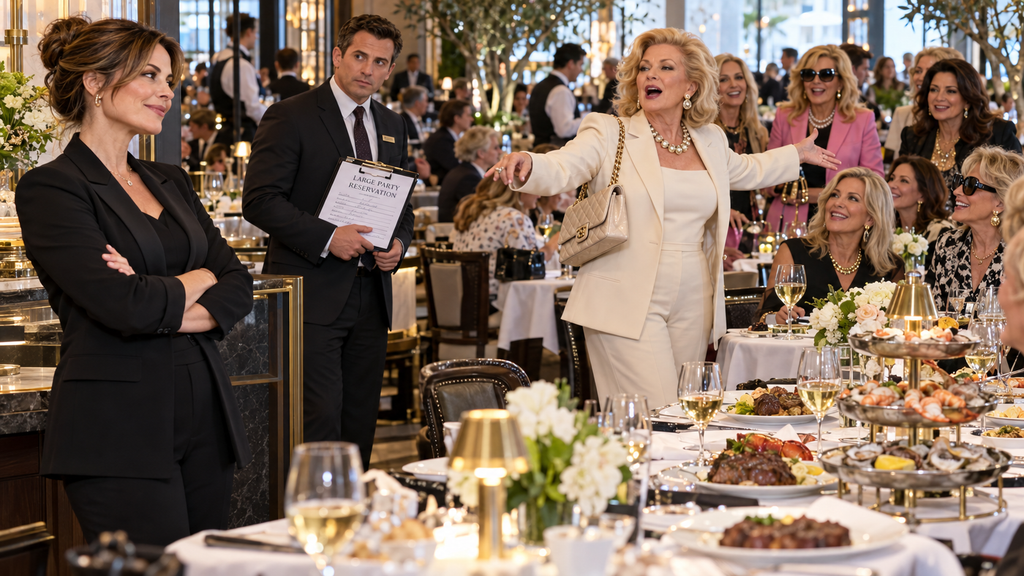
The woman standing near the kitchen pass watching her mother-in-law march in with thirty-eight friends.
I remembered how tired I had been.
Not physically.
Emotionally.
Tired of being called difficult whenever I defended something I built.
Tired of David telling me to keep the peace.
Tired of Eleanor treating generosity as an obligation.
Tired of shrinking my boundaries so other people would not accuse me of selfishness.
Then I remembered telling Marcus:
Give them whatever they desire.
At the time, I thought I was teaching Eleanor a lesson about a restaurant bill.
I had no idea the bill would become the thread that unraveled my entire marriage.
Sometimes one boundary reveals every person who benefited from you having none.
That lunch cost $14,812.63.
But it exposed $417,000 in unauthorized transfers.
A fraudulent ownership scheme.
A forged signature.
A hidden daughter.
A failing company.
And fifteen years of secrets.
Strangely, I no longer wished it hadn’t happened.
Painful truths are expensive.
But lies charge interest.
Eventually, the bill arrives.
On the restaurant’s fifteenth anniversary, we held a celebration.
Not extravagant.
Employees.
Regular customers.
Old friends.
Lily came.
Rachel came.
Caroline came.
Marcus gave a speech that embarrassed me terribly.
Then someone handed me a microphone.
I hadn’t prepared anything.
I looked around the room.
At the servers.
The bartenders.
The cooks.
The dishwashers.
The customers who had supported us.
At the people who helped build this place without ever claiming it belonged to them.
I smiled.
“When I opened this restaurant, I thought success meant filling every table.”
People listened.
“Then I thought it meant awards.”
I looked toward the framed reviews near the entrance.
“Then revenue.”
A few people laughed.
“But eventually I learned that success is knowing what belongs to you.”
The room became quiet.
“Not just property.”
“Your work.”
“Your dignity.”
“Your choices.”
“Your boundaries.”
I felt tears forming.
“And knowing that loving someone does not require handing those things over.”
Marcus lifted his glass.
Others followed.
I continued.
“Generosity should be given.”
“Not extracted.”
“Family should support you.”
“Not invoice your soul.”
A few people laughed through tears.
“And anyone who orders nine bottles of premium wine…”
The room erupted.
I grinned.
“…should expect a check.”
Applause filled the restaurant.
I laughed.
For once, I didn’t shrink from being celebrated.
I had earned this room.
Not alone.
Nobody builds anything meaningful alone.
But collaboration is not ownership.
Help is not entitlement.
Marriage is not permission.
Family is not a blank check.
That took me fifteen years to learn.
Late that night, everyone left.
I walked through the empty dining room.
At the table where Eleanor once sat, I paused.
I could almost see her.
Cream pantsuit.
Wine glass raised.
Thirty-eight women surrounding her.
Order whatever you want, ladies. This place is practically mine anyway.
I smiled.
Then I whispered into the empty room:
“No, Eleanor.”
I switched off the lights.
“It was always mine.”
I walked toward the front door.
Marcus was waiting outside.
“Ready?”
“Yes.”
He locked up.
I looked through the glass one final time.
The restaurant glowed softly behind us.
My restaurant.
Not because my name appeared on corporate documents.
Not because a court had protected my ownership.
Because I had poured years of my life into creating something worth protecting.
There had been a time when I believed protecting my marriage meant overlooking Eleanor.
Then I believed protecting David meant not asking too many questions.
Then I believed protecting peace meant swallowing disrespect.
I had been wrong about all of it.
Peace purchased with silence is not peace.
It’s delayed conflict.
Love purchased with self-erasure is not love.
It’s surrender.
And family loyalty that only travels in one direction is not loyalty.
It’s exploitation.
I had lost a marriage.
David had lost a company.
Eleanor had lost the illusion that she could control everyone around her.
But something had survived.
Truth.
And from truth, something better had grown.
Not the life I planned.
The life that was actually mine.
Marcus started walking toward the parking lot.
“You coming?”
“In a second.”
I looked at the restaurant sign.
Fifteen years earlier, David had stood beside me while workers installed it.
I remembered being terrified.
“What if nobody comes?” I had asked.
David had kissed my forehead.
“Then we’ll eat everything ourselves.”
That memory no longer made me angry.
Not every good moment becomes false because something ends badly.
David had loved me once.
I believed that.
Maybe part of him loved me even while he betrayed me.
Human beings are complicated enough to carry love and selfishness in the same heart.
But love alone is not enough.
It needs honesty.
Respect.
Boundaries.
Without them, love becomes a word people use while doing things love should have prevented.
I finally turned away.
My phone buzzed.
A message from Lily.
A photograph.
She had started her first job that week.
She was standing in a small office holding an employee badge and smiling.
Underneath she wrote:
First paycheck! Dinner is on me next time. And YES, I will actually pay the bill.
I laughed out loud.
I replied:
I’m holding you to that.
Then another message arrived.
From David.
We rarely texted.
Congratulations on fifteen years. I know I don’t have the right to say this, but I’m proud of what you built.
I stared at it.
Years earlier, I might have analyzed every word.
Searched for regret.
Hope.
A hidden invitation.
Now I simply wrote:
Thank you.
And meant it.
No anger.
No reopening doors.
No pretending.
Just thank you.
I put my phone away.
Then I walked toward my car.
A week later, I found something in my office.
An old receipt.
Faded.
Folded behind the desk.
I opened it.
$14,812.63.
The lunch.
Apparently Marcus had kept a copy.
At the bottom, someone had written:
PAID IN FULL.
I laughed.
Then I framed it.
Marcus saw it the next morning.
“You’re not seriously hanging that.”
“Absolutely.”
“Customers will ask.”
“Good.”
“What will you tell them?”
I thought about it.
Then smiled.
“I’ll tell them it was the most valuable bill I ever handed anyone.”
He shook his head.
“You’re strange.”
“I own the place. I’m allowed.”
He laughed.
Then went downstairs.
I hung the frame beside my desk.
Not as a trophy.
Not as revenge.
As a reminder.
Because there will always be people who confuse your kindness with access.
People who believe loving them means paying their bills.
Cleaning up their mistakes.
Absorbing their disrespect.
Ignoring their lies.
Giving one more chance.
Then another.
Then another.
Sometimes the strongest thing you can do is stop arguing.
Stop explaining.
Stop rescuing.
And simply hand them the bill for what they chose.
Not because you hate them.
Because their choices belong to them.
That Friday afternoon, Eleanor had expected me to pay.
For the wine.
The steaks.
The seafood.
The desserts.
The humiliation.
David’s failures.
Her entitlement.
Their secrets.
For years, in one way or another, I had.
That day, I stopped.
And that was when everything changed.
I touched the framed receipt.
Then I went downstairs.
The restaurant was filling for dinner.
A young couple sat near the window holding hands.
A family celebrated a birthday.
Two old friends laughed over wine.
The kitchen bell rang.
“Sarah!” Marcus called.
“We need you.”
I smiled.
“I’m coming.”
And I walked toward the noise.
Toward the work.
Toward the life I had almost allowed other people to claim.
Behind me, the old receipt remained on the wall.
PAID IN FULL.
And for the first time, so was the past.
THE END STORIES! THANK YOU FOR READING GOOD LUCK! ❤️
Related Posts



