My attorney, Rebecca Hale, placed the folder on the table as carefully as if it contained something explosive. In a way, it did. Oliver stared at her. Sarah stared at me.
And nearly two hundred wedding guests sat in such complete silence that I could hear the faint hum of the speakers behind us. Rebecca opened the folder. “Sharon,” she said, “when you called me last night, you asked me to review the documents Oliver had been encouraging you to sign.”
“Yes.”
“I did.”
Oliver stepped forward.
“This is ridiculous. Those were standard marital planning documents.”
Rebecca looked at him.
“No, they weren’t.”
His face tightened.
“They were prepared by an attorney.”
“Yes.”
“Then what’s the problem?”
“The problem,” Rebecca said calmly, “is what those documents actually did.”
Sarah suddenly stood.
“We’re not discussing private family matters in front of everyone.”
I looked directly at her.
“Yesterday, you seemed perfectly comfortable discussing my private finances when you thought I couldn’t hear you.”
Her mouth snapped shut.
A murmur passed through the room.
Oliver looked at me.
“Sharon, please.”
“No.”
“Can we talk privately?”
“You had your private conversation.”
His eyes flickered.
“This is different.”
“It certainly is.”
I turned toward Rebecca.
“Continue.”
She removed several pages.
“The first document would have created a joint financial-management arrangement.”
Oliver interrupted.
“That’s normal for married couples.”
Rebecca didn’t even look annoyed.
“It can be.”
Then she lifted another page.
“This one is not.”
Sarah moved toward Oliver.
I noticed it immediately.
She wasn’t trying to comfort him.
She was trying to see what Rebecca was holding.
Rebecca continued.
“This document authorized Oliver to act on Sharon’s behalf in several financial matters.”
A few guests whispered.
Oliver shook his head.
“She knew that.”
“No,” I said. “You told me it was emergency paperwork in case something happened to me.”
“That is what it was.”
Rebecca looked at him.
“Then why does it permit asset transfers?”
Silence.
Oliver’s mouth opened.
Closed.
My stomach tightened.
Even after everything I had overheard, hearing the truth stated so plainly hurt.
Rebecca placed another page beside it.
“And this document would have changed the beneficiary structure on one of Sharon’s accounts.”
I froze.
“What?”
Oliver looked at me quickly.
“That wasn’t final.”
I stared at him.
“You told me that was an insurance form.”
“It was part of the same package.”
“You told me it protected the children.”
“It would have.”
Rebecca’s voice became firmer.
“No, Oliver.”
He turned toward her.
“You don’t know what we discussed.”
“I know what the document says.”
Then she looked at me.
“Sharon, under the version you were given, Oliver would have gained substantially more control than you were led to believe.”
My knees almost weakened.
Harry stood from the front row.
“Mom?”
I looked at him.
He was sixteen.
Old enough to understand enough.
Too young to be sitting ten feet away while the man who had promised to become his stepfather was exposed as someone who had been planning to use us.
“I’m okay.”
I wasn’t.
But mothers sometimes say those words because their children need them before we do.
Oliver took another step toward me.
“Sharon, I can explain every document.”
“Then explain.”
He looked around.
“Not here.”
“Why?”
“Because this is our wedding!”
“No.”
My voice trembled.
“This was supposed to be our wedding.”
That distinction silenced him.
I looked at the chairs.
The flowers.
The candles.
The blush-colored runners I had chosen less than twenty-four hours earlier.
Everything was beautiful.
That almost made it crueler.
I had spent months designing a celebration for a future that had never existed.
“You stood here this morning knowing what you said yesterday.”
Oliver’s face changed.
“I was angry.”
“At what?”
He hesitated.
“Nothing.”
“Then why were you talking about leaving me?”
“I wasn’t.”
The room stirred.
I pointed toward the speakers.
“We heard you.”
“You heard part of a conversation.”
“Then give me the missing part.”
He swallowed.
“What context makes ‘once everything is shared, I won’t have to stay’ sound loving?”
No answer.
I stepped closer.
“What context makes pretending to care about my children acceptable?”
“I care about them.”
Harry looked away.
That movement broke something inside me.
I had watched Oliver teach Harry to drive.
I had watched him sit beside my nieces at school performances.
He knew their favorite foods.
Their fears.
Their birthdays.
He knew one of the twins still slept with the stuffed rabbit my sister had given her before she died.
He had been allowed into sacred places in our family.
Places I did not open easily.
And he had treated access like strategy.
My voice cracked.
“Don’t say you care about them.”
Oliver’s expression softened.
“Sharon.”
“Don’t.”
“I do care.”
“Then why did you talk about them like they were obstacles you had successfully managed?”
His eyes dropped.
There it was.
Not an answer.
Something worse.
Shame.
Sarah suddenly spoke.
“This has gone far enough.”
I turned.
She came down the aisle.
Her face was rigid.
“You’re destroying a good man because you overheard one stupid conversation.”
A laugh escaped me.
“A good man?”
“Yes.”
She pointed toward Oliver.
“He took care of you.”
“I took care of myself.”
“He helped with those children.”
Those children.
I saw Harry’s head lift.
My nieces sat beside him.
One of them reached for the other’s hand.
I stepped toward Sarah.
“Those children are my family.”
“You know what I mean.”
“No.”
I stared at her.
“I finally know exactly what you mean.”
She lowered her voice.
“Sharon, you’re forty-three years old.”
Several people gasped.
Sarah continued anyway.
“You have three children depending on you. Oliver accepted responsibilities most men wouldn’t.”
I almost couldn’t believe what I was hearing.
“You think I should be grateful he wanted me?”
“I think you should appreciate what he was willing to take on.”
Harry stood.
“Don’t talk to my mom like that.”
“Harry.”
He looked at me.
His eyes were wet.
“No, Mom.”
He turned toward Sarah.
“She doesn’t need him.”
My heart broke and healed in the same second.
Sarah looked uncomfortable.
Harry continued.
“She was taking care of us before he showed up.”
My niece Emily stood beside him.
“So was Aunt Sharon.”
Then Grace stood.
Three children.
Three wounded faces.
Standing together.
Oliver looked at them.
“Guys—”
Harry immediately said:
“Don’t.”
One word.
Oliver stopped.
Harry’s jaw tightened.
“You told me you wanted to be my dad.”
Oliver looked devastated.
“I meant that.”
“Then why were you planning to leave?”
“I wasn’t planning—”
“We heard you.”
Harry’s voice cracked.
The anger disappeared.
For one second, he was just a boy.
“You said you wouldn’t have to stay.”
Oliver couldn’t answer.
Harry sat down.
I wanted to run to him.
Hold him.
Take all three children home.
Lock the door.
Undo the past year.
But Rebecca touched my arm.
“There is more.”
Oliver looked at her sharply.
“What more?”
Rebecca’s gaze settled on Sarah.
“This isn’t the first time documents like these have been used.”
Sarah went completely still.
I noticed.
So did Rebecca.
Oliver frowned.
“What are you talking about?”
Rebecca pulled another file from her bag.
“When Sharon contacted me last night, I reviewed the attorney listed on the paperwork. That led me to several public records involving a company connected to your mother.”
Sarah’s face lost color.
“That’s irrelevant.”
“What company?” I asked.
Rebecca answered.
“Briarstone Family Consulting.”
Oliver looked confused.
“Mom?”
Sarah shook her head.
“It’s an old company.”
Rebecca nodded.
“Very old.”
“How old?”
“Fourteen years.”
I stared at Sarah.
“What does it do?”
Rebecca looked at me.
“Officially? Financial consulting.”
“And unofficially?”
“That’s where things become complicated.”
Oliver stepped toward his mother.
“What is she talking about?”
Sarah hissed:
“She’s trying to frighten you.”
Rebecca continued.
“Briarstone has been connected to multiple property transactions involving people who married into or became romantically involved with members of Sarah’s extended family.”
The room erupted into whispers.
Oliver looked genuinely shocked.
For the first time that morning, I wondered whether there were pieces even he didn’t know.
“That’s not possible.”
Rebecca handed him a page.
“See for yourself.”
He read.
His face changed.
“Mom?”
Sarah didn’t answer.
“Mom.”
“Not here.”
He laughed bitterly.
“That’s apparently everybody’s favorite sentence today.”
Rebecca looked at me.
“One transaction involved Oliver’s cousin Nathan.”
Oliver stared at her.
“Nathan?”
“Yes.”
Nathan was sitting near the back.
I had met him twice.
He slowly stood.
“What does this have to do with me?”
Rebecca looked toward him.
“Were you aware Briarstone received a consulting fee after your divorce?”
Nathan’s face hardened.
“What consulting fee?”
Sarah closed her eyes.
That told me enough.
Rebecca continued.
“Your former wife transferred proceeds from a property sale into an account connected to Briarstone.”
Nathan looked stunned.
“I never knew that.”
Sarah snapped:
“This is completely unrelated!”
Nathan stepped into the aisle.
“How much?”
“Nathan.”
“How much?”
Rebecca checked the document.
“Approximately eighty-six thousand dollars.”
His face went white.
“My divorce settlement was short by almost exactly that amount.”
Sarah grabbed her purse.
“We’re leaving.”
I stepped in front of her.
“No.”
Her eyes narrowed.
“You cannot hold me here.”
“I’m not.”
I moved aside.
“But if you leave, everyone here will know you left the moment someone started asking about the money.”
She stared at me.
Then at the guests.
She stayed.
What happened over the next twenty minutes destroyed every illusion that remained.
Rebecca was careful.
She didn’t accuse anyone of crimes.
She simply explained what she had found.
Transactions.
Companies.
Property records.
Repeated patterns.
Not enough to tell the entire story.
More than enough to ask questions.
Oliver looked increasingly sick.
Finally he turned toward Sarah.
“Did you know?”
She stared at him.
“Know what?”
“About Nathan.”
“No.”
“You’re lying.”
“I am your mother.”
“That wasn’t my question.”
The room went silent again.
Oliver stepped closer.
“Did you know?”
Sarah’s composure cracked.
“I handled some financial arrangements.”
Nathan laughed bitterly.
“Financial arrangements?”
“You were going through a difficult divorce.”
“So you took money?”
“I protected family interests.”
Nathan started toward her.
Two relatives stopped him.
Oliver stared at his mother.
Then at me.
Something shifted in his face.
For a dangerous moment, I almost felt sympathy for him.
Then I remembered the call.
Whatever Sarah had done did not erase what Oliver had said.
He had participated.
He had planned to gain my trust.
He had discussed my children as leverage.
He had planned to leave.
“Sharon.”
“No.”
“Please.”
“You don’t get to turn into another victim because your mother has secrets.”
His face fell.
“I know.”
“Do you?”
“Yes.”
He looked around.
Then, slowly, he removed the boutonnière from his jacket.
“I knew what the documents did.”
The confession landed softly.
But it hit harder than every shout.
Sarah turned.
“Oliver.”
He ignored her.
“I knew.”
My eyes burned.
“Thank you.”
He looked confused.
“For what?”
“For finally telling the truth.”
His voice broke.
“I wasn’t going to take everything.”
I almost smiled.
The absurdity of the sentence was unbearable.
“Was that supposed to comfort me?”
“No.”
“What were you going to take?”
He stared at the floor.
“Oliver.”
“Enough to start over.”
“With what?”
“I had debts.”
My stomach sank.
“What debts?”
He closed his eyes.
“Business debt.”
“You told me your company was doing well.”
“It was.”
“When?”
“Two years ago.”
“How much?”
Silence.
“How much, Oliver?”
“About six hundred thousand.”
Gasps moved through the room.
Sarah said:
“You don’t have to answer this.”
Oliver turned on her.
“Stop.”
She froze.
“Just stop.”
He looked back at me.
“I thought I could fix it.”
“With my money?”
He didn’t answer.
“Say it.”
His eyes filled.
“Yes.”
The word nearly knocked the air from my lungs.
I nodded.
At least the truth was finally clean.
Ugly.
But clean.
“You were going to marry me to solve your debts.”
“At first, no.”
I laughed.
“That’s a terrible defense.”
“I loved you.”
“Loved?”
“I love you.”
“Don’t.”
“I do.”
“You can love someone and still exploit them.”
He looked as though I’d struck him.
Maybe because he knew it was true.
“When did this become a plan?”
He looked toward Sarah.
Then back at me.
“About six months ago.”
Six months.
Christmas.
Harry’s birthday.
Emily’s school recital.
Grace’s hospital visit when she broke her wrist.
Our engagement photographs.
Six months of smiling.
Six months of kisses.
Six months of telling my children we were becoming a family.
Six months of planning how to extract himself afterward.
I couldn’t breathe properly.
Rebecca leaned closer.
“Do you want to stop?”
I shook my head.
“No.”
I looked at Oliver.
“What happened six months ago?”
“My biggest investor pulled out.”
“And?”
“I couldn’t meet several obligations.”
“And?”
“Mom said marriage could give me time.”
I looked at Sarah.
She didn’t deny it.
“What does that mean?”
Oliver answered.
“She said once we combined finances, I could refinance.”
“My house?”
He closed his eyes.
“Yes.”
There it was.
The center of it.
The house.
The one I had bought after my divorce.
The one where I had raised Harry.
The one where my nieces moved after my sister died.
The one where we had painted Grace’s room yellow because she said it looked like morning.
The one where Emily had cried herself to sleep for months after losing her mother.
The one Oliver knew represented safety.
He hadn’t seen a home.
He had seen collateral.
I removed my engagement ring.
Oliver watched.
“Sharon.”
I placed it on the table.
Beside his paperwork.
“I hope whatever you owe was worth this.”
“It wasn’t.”
“No.”
I looked toward my children.
“It wasn’t.”
The ceremony ended without vows.
But the day did not end.
I had made one additional change the night before.
The reception food had already been paid for.
The venue was paid.
The flowers were paid.
People had traveled.
My children had dressed beautifully for a day they thought would change our family.
I refused to let Oliver take every piece of it.
So after he and Sarah left, I walked back into the reception room.
Everyone became quiet.
I stood near the dance floor.
Still wearing my wedding dress.
Still wearing my veil.
No ring.
I picked up the microphone.
“I imagine this is the part where everyone wonders whether they should leave.”
A few nervous laughs.
I looked at Harry.
Emily.
Grace.
“No.”
My voice trembled.
“Please stay.”
People looked surprised.
“The food is already here.”
Laughter.
Real laughter this time.
“And after the morning I’ve had, somebody is eating that cake.”
People applauded.
I started crying.
My best friend, Monica, rushed forward and hugged me.
Then Harry came.
Then the twins.
Soon I was standing in the middle of what should have been my wedding reception, surrounded not by the future I had planned, but by the people who had been real all along.
We ate.
We cried.
We laughed.
I cut the wedding cake with my children.
The photographer asked whether I wanted pictures.
For a moment, I nearly said no.
Then I looked at my children.
“Yes.”
So we took them.
Not bride-and-groom photographs.
Family photographs.
Me in my wedding dress.
Harry in his suit.
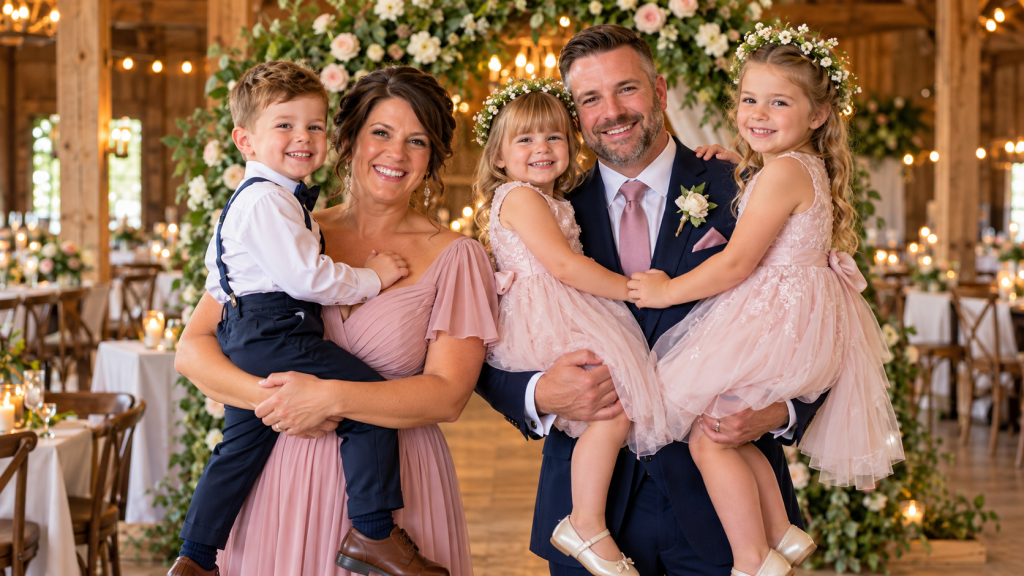
The twins in blush-colored dresses.
In one photograph, all four of us are laughing so hard that Grace has her eyes closed.
That photograph still hangs in my hallway.
People sometimes ask why I’m wearing a wedding dress without a groom.
I tell them:
“Because that was the day I chose my family.”
Three days later, Oliver came to my house.
I saw him through the camera.
I didn’t open the door.
He called.
I answered.
“Please let me explain.”
“You explained.”
“I need to see you.”
“No.”
“Sharon.”
“No.”
He went quiet.
“I returned the ring.”
“I don’t care about the ring.”
“I know.”
“Then why are you here?”
“I don’t know.”
For once, I believed him.
He sounded broken.
Not dangerous.
Not angry.
Just lost.
But I had learned something important.
Someone else’s pain does not automatically create an obligation for you.
“I need you to leave.”
“Can I say goodbye to the kids?”
My heart hardened.
“No.”
“Please.”
“They’re hurting.”
“I know.”
“You don’t get to ask them to comfort you for something you did to them.”
Silence.
Then:
“Do they hate me?”
I looked toward the living room.
Harry was helping Grace with homework.
Emily was asleep on the couch.
“No.”
I answered truthfully.
“They’re grieving you.”
Oliver started crying.
That was harder to hear than anger would have been.
“I really did love them.”
“Maybe you did.”
“I did.”
“Then love them enough to leave them alone.”
He stayed outside for another minute.
Then walked back to his car.
I watched him drive away.
I cried after he was gone.
Not because I wanted him back.
Because sometimes the person you miss never actually existed.
And there is a special kind of grief in realizing you cannot even properly mourn someone because the version you loved was partly invented.
Rebecca continued investigating the documents.
The deeper she looked, the uglier things became.
Oliver’s financial problems were real.
Worse than he had admitted.
The six hundred thousand dollars was only business debt.
There were personal guarantees.
Credit lines.
Unpaid taxes.
Private loans.
By the time everything was counted, his exposure was closer to nine hundred thousand dollars.
But another discovery surprised me.
Oliver had not begun dating me because of money.
Rebecca found photographs, emails and business records confirming his financial collapse started well after we met.
That mattered to me.
Not because it saved him.
It didn’t.
But because I had tortured myself with one question:
Was every single moment fake?
Apparently not.
We had begun honestly.
Somewhere along the way, fear became desperation.
Desperation became rationalization.
And rationalization became betrayal.
That was somehow sadder.
He had not entered my life as a monster.
He had become someone willing to sacrifice me to save himself.
People often want villains to be villains from the beginning.
Life is rarely that convenient.
Sometimes the person who betrays you once loved you sincerely.
That doesn’t make the betrayal smaller.
It makes it more tragic.
Sarah’s story became even more complicated.
Briarstone Family Consulting had indeed been involved in several questionable family transactions.
Nathan pursued his own legal action.
Another former in-law came forward.
Then another.
I stayed out of most of it.
My concern was protecting my family.
Rebecca made sure every account remained secure.
I changed passwords.
Updated beneficiaries.
Reviewed my estate plan.
Changed emergency contacts.
Canceled every authorization Oliver had ever possessed.
I created additional protections for the children.
And for the first time in years, I read every financial document connected to my life.
Not because I became paranoid.
Because trust and paperwork are not opposites.
Healthy trust survives clarity.
Manipulation depends on confusion.
Six months passed.
The wedding dress remained in my closet.
I couldn’t bring myself to touch it.
Then one Saturday, Grace walked into my bedroom.
“Aunt Sharon?”
“Yes?”
“Are you ever going to wear that again?”
I laughed.
“I certainly hope not.”
She smiled.
“Can we do something with it?”
“Like what?”
She shrugged.
“Something not sad.”
That sentence stayed with me.
Something not sad.
We eventually donated the dress to an organization that helped brides who couldn’t afford one.
Before sending it away, the twins asked me to put it on one final time.
I did.
Harry came downstairs, saw me, and stopped.
“Oh.”
“What?”
“Nothing.”
His eyes filled.
I hugged him.
“I’m okay.”
“I know.”
“You?”
He nodded.
Then shook his head.
Then laughed.
“I don’t know.”
“Fair.”
He looked at the dress.
“I’m glad you didn’t marry him.”
“So am I.”
“But I miss him.”
My heart tightened.
“You’re allowed.”
Harry looked ashamed.
“I feel stupid.”
“No.”
“He lied to us.”
“Yes.”
“Then why do I miss him?”
“Because your memories didn’t disappear when you learned the truth.”
He looked at me.
“You can miss someone and still know they shouldn’t be in your life.”
His eyes filled.
“That sucks.”
I laughed.
“Very eloquent.”
“Thanks.”
Then he hugged me.
“I don’t need another dad.”
I closed my eyes.
“You never did.”
“I know.”
He pulled away.
“But if you date again, pick someone less weird.”
I laughed so hard I nearly ruined my makeup.
A year after the wedding that wasn’t, I received a letter.
Not an email.
Not a text.
A handwritten letter.
From Oliver.
I almost threw it away.
Instead, I opened it.
It wasn’t long.
He didn’t ask me back.
That surprised me.
He wrote that his business had closed.
He had sold almost everything he owned.
He was working again, slowly paying creditors.
He had started therapy.
He had stopped speaking to Sarah for several months.
He wrote:
I used fear as permission to become dishonest. I kept telling myself I was protecting my future while destroying the people I wanted in it.
I had to stop reading.
Then:
I won’t ask you to forgive me. I won’t ask the children to forgive me. I only want you to know that none of you failed me. I failed all of you.
I cried.
For a long time.
Then I folded the letter.
Put it away.
And did not answer.
An apology can be meaningful without becoming an invitation.
Two years later, Harry graduated from high school.
I sat between Emily and Grace while he crossed the stage.
He looked taller than I remembered.
Older.
For one strange second, I saw him as the little boy who used to crawl into my bed during thunderstorms.
Then his name was called.
I screamed louder than anyone.
He was mortified.
Perfect.
Afterward, we took pictures.
He hugged me.
“You did it.”
I laughed.
“I did what?”
“Got me here.”
“No.”
I squeezed him.
“We did.”
He looked at the twins.
“Mostly me.”
They attacked him.
I laughed until I cried.
On the drive home, I thought about Oliver.
He had once told me stability meant everything to me.
He was right.
But he misunderstood what stability was.
He thought it meant having a man in the house.
Two incomes.
Shared property.
A husband.
It didn’t.
Stability was knowing nobody could threaten my children’s home.
Knowing the people inside it told the truth.
Knowing love did not come with hidden paperwork.
Knowing that when life broke something, we would rebuild without pretending it hadn’t hurt.
Three years after the canceled wedding, I met someone.
His name was Daniel.
Not my attorney.
That would have been too complicated.
Daniel Brooks was a widowed father I met through a school fundraiser.
Our first date was coffee.
Our second was dinner.
Our third was canceled because Grace got sick.
I expected disappointment.
Instead, he texted:
Family first. I’ll be here next week.
No grand declaration.
No performance.
He simply was.
Next week came.
So did he.
We dated slowly.
Painfully slowly, according to Monica.
I didn’t introduce him to the children for five months.
I didn’t discuss finances.
I didn’t give him keys.
I didn’t apologize for any of that.
One evening, about a year into our relationship, I told him the entire Oliver story.
He listened.
When I finished, he said:
“That must have been brutal.”
“That’s it?”
“What else should I say?”
“I don’t know.”
He thought.
“I’m glad you heard the call.”
I stared at him.
Nobody had ever said that.
Most people told me they were sorry I had overheard it.
Daniel wasn’t.
“So am I.”
He reached across the table.
Didn’t grab my hand.
Just placed his palm there.
I chose to take it.
That difference mattered.
I eventually heard from Sarah too.
Four years after the wedding.
She asked to meet.
I almost refused.
Then curiosity won.
We met in a quiet café.
She looked older.
Not dramatically.
Just softer somehow.
Less armored.
She sat across from me.
“Thank you for coming.”
“You have ten minutes.”
A faint smile.
“Still direct.”
“More than ever.”
She nodded.
“I owe you an apology.”
I waited.
“I treated your life as something Oliver was entitled to access.”
My expression didn’t change.
“I told myself I was helping my son.”
“You were.”
“Not in the way a mother should.”
That surprised me.
She continued.
“I thought his debt justified things that should never have been justified.”
“Why?”
She looked down.
“Because I had spent my entire life solving problems for the men in my family.”
There was no pride in her voice.
“My husband.”
“My brother.”
“My nephew.”
“My son.”
She looked at me.
“I became very good at making consequences disappear.”
“And people paid for it.”
“Yes.”
I thought about Nathan.
About his former wife.
About me.
Sarah’s eyes filled.
“I don’t expect forgiveness.”
“Good.”
She nodded.
“I just wanted to say that what happened was wrong.”
“It was.”
“And the things I said about your children…”
Her voice broke.
“I am ashamed of them.”
I looked out the window.
Then back at her.
“You should be.”
She accepted that.
No defense.
No excuses.
That mattered.
“Is Oliver okay?” I asked.
Her face softened.
“He’s better.”
“Good.”
“He still asks about you sometimes.”
I said nothing.
“And the children.”
“Don’t tell him anything.”
“I won’t.”
I stood.
Sarah looked up.
“Sharon?”
“Yes?”
“I’m sorry.”
I believed her.
That didn’t mean I wanted her in my life.
“I believe you.”
Her eyes filled.
Then I left.
Sometimes closure isn’t reconciliation.
Sometimes closure is simply reaching the point where someone can finally say the truth and you no longer need anything else from them.
Five years after my canceled wedding, Daniel proposed.
Privately.
In my kitchen.
No photographers.
No hidden family.
No dramatic speech.
He held out the ring.
I stared at him.
Then I laughed.
He looked terrified.
“That’s not the response I rehearsed.”
“Sorry.”
“Is that a good laugh?”
“Yes.”
“Because there are several possible interpretations.”
I kissed him.
Then I said:
“Yes.”
Harry found out first.
He hugged Daniel.
Then whispered something.
Daniel laughed.
“What did he say?” I asked.
“Nothing.”
“Harry.”
My son grinned.
“I told him to disconnect every phone call properly.”
I nearly fell over laughing.
Daniel turned red.
The twins thought it was hilarious.
Eventually, so did he.
This time, before the wedding, Daniel and I sat with independent attorneys.
We discussed finances.
Property.
Inheritance.
The children.
His daughter.
My house.
His assets.
My savings.
Everything.
Nothing hidden.
Nothing rushed.
Nothing disguised as “routine paperwork.”
At one point Daniel looked across the conference table.
“Are you okay?”
I smiled.
“Yes.”
And I was.
Because transparency didn’t feel unromantic anymore.
It felt safe.
We signed a fair prenuptial agreement.
Not because we expected divorce.
Because love does not require pretending risk doesn’t exist.
When we finished, Daniel handed me my copy.
“Romantic?”
“Extremely.”
“I’ll put it in a heart-shaped frame.”
“Please don’t.”
Our wedding was small.
Forty-two guests.
Backyard ceremony.
Simple flowers.
No giant screen.
No surprise attorney.
Monica complained that it lacked drama.
“I’ve had enough wedding drama for several lifetimes.”
Harry walked me down the aisle.
Halfway there, he whispered:
“You sure?”
I looked at Daniel waiting beneath the trees.
“Yes.”
Harry smiled.
“Good.”
Then he added:
“Because I checked his pockets for paperwork.”
I burst out laughing.
Everyone turned.
Daniel looked confused.
When we reached him, Harry shook his hand.
“She’s your problem now.”
I slapped his arm.
Daniel said:
“Absolutely not. We’re a package deal.”
Harry looked at him for a moment.
Then smiled.
That sentence meant more than Daniel knew.
When the officiant asked whether I took Daniel as my husband, I didn’t think about Oliver.
Not even for a second.
That surprised me afterward.
For years, I thought the betrayal would always stand beside every future happiness.
It didn’t.
Healing had quietly moved it farther away.
Not erased.
Just no longer central.
I said:
“I do.”
And this time, I meant it without fear.
At the reception, Grace found the old photograph from my canceled wedding.
The one with me in the wedding dress and all three children laughing.
She had secretly framed it.
She placed it beside our new family photograph.
Daniel’s daughter stood beside Emily.
Harry towered over everyone.
Grace was laughing again.
Two photographs.
Two weddings.
Only one marriage.
I stood looking at them.
Daniel came beside me.
“What are you thinking?”
“That I don’t regret the first one.”
He looked surprised.
“Really?”
“No.”
I touched the old frame.
“That day hurt.”
“But?”
“But it taught me that losing the wrong future can save the right one.”
He kissed my temple.
Across the room, Harry yelled:
“Stop being gross!”
Everyone laughed.
I looked around.
At my children.
At Daniel.
At friends who had stayed through humiliation and heartbreak.
At the life I once thought needed Oliver to be complete.
It had never been incomplete.
That was perhaps the greatest lie I had believed.
Not Oliver’s lie.
Mine.
I had thought love arriving meant someone was coming to rescue me from carrying so much alone.
But I had already carried it.
For years.
I had raised my son.
Taken in my sister’s daughters.
Protected their home.
Built savings.
Survived grief.
Kept birthdays joyful when I wanted to cry.
Paid bills.
Fixed broken appliances.
Sat through parent-teacher conferences.
Stayed beside hospital beds.
Made lunches.
Signed permission slips.
Held children who missed a mother they would never get back.
Oliver had mistaken exhaustion for weakness.
Sarah had mistaken responsibility for desperation.
They believed I would surrender control because I wanted help.
But needing help is not the same as being helpless.
And wanting love is not the same as accepting its counterfeit.
Years later, the twins asked me about that FaceTime call.
We were sitting around the kitchen table.
Emily said:
“What do you think would have happened if Oliver had disconnected?”
The question stopped me.
I had wondered that many times.
“I probably would have married him.”
Grace frowned.
“And signed the papers?”
“Maybe eventually.”
Harry, now a grown man, shook his head.
“That’s terrifying.”
“Yes.”
Emily looked thoughtful.
“So the mistake saved you.”
I smiled.
“In a way.”
Oliver had forgotten to disconnect a call.
One tiny mistake.
One dark screen.
One conversation he thought I couldn’t hear.
And my entire future changed.
But I had learned not to give accidents too much credit.
Hearing the truth had given me information.
What happened next had been choice.
I could have ignored it.
Confronted him privately and accepted excuses.
Married him because guests had traveled.
Stayed because deposits were nonrefundable.
Signed because I was embarrassed to admit the relationship had failed.
Instead, I changed direction.
That was the part I was proud of.
Not overhearing him.
Listening to myself afterward.
I still have the unsigned paperwork.
Rebecca once asked why.
“Evidence?”
“No.”
“Sentiment?”
“Definitely not.”
Then why?
Because sometimes I take it out when life makes me doubt myself.
I look at the blank signature line.
There is something beautiful about it.
A place where my name could have gone.
But didn’t.
A future that could have happened.
But didn’t.
An empty line that protected a house.
Savings.
Children.
Years of work.
And eventually, a different future.
My future.
One evening, long after everything had settled, I sat on the porch while Daniel made dinner inside.
My phone rang.
Harry.
I answered.
“Hey.”
“Hey, Mom.”
We talked about ordinary things.
Work.
Traffic.
Dinner.
His girlfriend.
Then before hanging up, he said:
“Love you.”
“Love you too.”
The call ended.
I looked at the dark screen.
For a second, I remembered another call.
Oliver’s voice.
Sarah’s laughter.
The sentence that had once shattered me.
Once everything is shared, I won’t have to stay.
For years, those words sounded cruel.
Eventually, they sounded distant.
And finally, they sounded almost ironic.
Because Oliver had believed gaining control of my life would give him permission to leave.
Instead, hearing his plan gave me permission to choose myself.
The wedding had changed.
My future had changed.
My family had changed.
But the most important things remained exactly where they belonged.
My home was safe.
My children were safe.
My savings were safe.
My dignity was intact.
And my heart, though badly bruised for a while, had learned something I wish I had understood much earlier:
Love should never require you to become less protected in order to prove you trust someone.
Love can ask for vulnerability.
It should not demand blindness.
It can ask two people to build something together.
It should not require one person to quietly surrender what they built alone.
And anyone who truly wants to join your family will not treat the people you love as steps toward something they want from you.
I once thought my wedding day was ruined.
It wasn’t.
The marriage was prevented.
There is a difference.
That morning, I walked into the venue believing I was about to lose the future I had spent months planning.
Years later, I understood what actually happened.
I saved it.
Not the wedding.
Not the relationship.
Something far more important.
I saved the home my children trusted.
I saved the security my younger self had worked so hard to build.
I saved myself from waking up years later and wondering why I had ignored the truth when it was finally spoken clearly enough for me to hear.
And whenever I look at that photograph of four people laughing beside a wedding cake with no groom anywhere in sight, I no longer see humiliation.
I see the exact moment our family discovered that being abandoned by the wrong person was not the same thing as being left alone.
We still had each other.
And, as it turned out, that was more than enough to begin again.
THE END STORIES! THANK YOU FOR READING GOOD LUCK! ❤️
Related Posts