The photograph shook between my fingers. At first, I couldn’t understand what I was looking at. Dark wood. A narrow cavity. Dust. Old insulation.
Then I saw the metal. Several electrical wires had been twisted together inside the wall and wrapped with strips of brittle black tape. But beside them was something else. A small plastic container.
Melted along one side.
Inside it were several scorched batteries connected to a crude bundle of wires.
I looked at Julian.
“What is that?”
His expression had lost every trace of warmth.
“Something that should never have been inside a bedroom wall.”
Mr. Keller stepped forward.
“Give me that picture.”
Julian moved between us.
“No.”
“This is my building.”
Julian’s voice became cold.
“And that’s her child’s bedroom.”
Keller pointed toward the door.
“Get out.”
“Not until the fire department sees this.”
Keller froze.
That reaction frightened me more than the photograph.
“Fire department?”
I looked from one man to the other.
Julian nodded.
“I called them before you got home.”
“You what?”
“I wasn’t going to wait.”
Keller exploded.
“You had no permission to open those walls!”
Julian stared at him.
“The outlet plate was loose. I removed it because it was hot.”
“You’re trespassing!”
“I slept here with permission.”
“Not today!”
“Then call the police.”
Keller’s face changed.
Julian stepped closer.
“Go ahead.”
Silence.
“Tell them exactly why you’re angry.”
Keller looked at me.
“Claire, this man is manipulating you.”
My heart pounded.
“I want to know what’s behind my son’s wall.”
“Nothing.”
I held up the photograph.
“This isn’t nothing.”
“Old wiring.”
“Then why are you scared?”
“I’m not scared.”
“You’re sweating.”
His face hardened.
“It’s an old building.”
Julian shook his head.
“Old buildings don’t explain that.”
He pointed toward the photograph.
“Someone concealed an electrical modification inside that wall.”
Keller scoffed.
“You don’t know what you’re talking about.”
Julian calmly reached into his backpack.
He removed a worn leather wallet.
Opened it.
And held out an identification card.
“State electrical license.”
Keller stopped talking.
Julian continued.
“Expired three months ago because I couldn’t renew while recovering.”
Then another card.
“Journeyman certification.”
Another.
“Former contractor registration.”
He put them away.
“I know exactly what I’m looking at.”
I stared at him.
“You really were an electrician?”
“Yes.”
“Why didn’t you tell me?”
“You didn’t ask for my résumé before offering me your couch.”
Despite everything, a tiny laugh escaped me.
It lasted less than a second.
Then we heard sirens.
Keller’s face drained of color.
Two fire department vehicles arrived.
Then a city inspector.
Then, because Keller had called them himself in an attempt to remove Julian, two police officers.
Within thirty minutes, my tiny apartment was full of uniforms.
Leo sat beside me at the kitchen table.
His hand was wrapped around mine.
“Mom?”
“Yes?”
“Are we in trouble?”
“No.”
“Is Julian?”
I looked across the room.
He was speaking quietly with an inspector.
“No.”
At least I hoped not.
The inspector entered Leo’s bedroom with Julian.
Ten minutes passed.
Then fifteen.
Then twenty.
Finally, the inspector came out.
His face told me everything.
“Ms. Parker?”
“Yes?”
“You and your son cannot stay here tonight.”
My stomach dropped.
“What?”
“The unit isn’t safe for occupancy.”
Keller immediately protested.
“This is ridiculous.”
The inspector turned.
“Mr. Keller, I’m speaking to the tenant.”
“But—”
“Please step back.”
Keller went silent.
I looked at the inspector.
“What did you find?”
He took a breath.
“Multiple electrical hazards.”
“How bad?”
“Bad.”
That one word emptied the room of air.
He continued.
“Several circuits appear to have been modified without proper junction boxes. There are signs of overheating inside at least two wall cavities.”
I pulled Leo closer.
“What about the thing in his bedroom?”
“We’re still determining exactly what it was used for.”
“Was it dangerous?”
“Yes.”
My throat tightened.
“How dangerous?”
The inspector looked at Leo.
Then back at me.
“Dangerous enough that I’m glad someone found it.”
I looked across the room.
Julian was standing near the hallway.
He didn’t smile.
He simply lowered his eyes.
Keller began shouting.
“This is insane! She’s lived here for years without a problem!”
Julian turned toward him.
“That’s your defense?”
Keller glared at him.
“Nobody asked you.”
“No.”
Julian looked at Leo.
“He did.”
Leo stared at him.
Something inside me cracked.
One question from my nine-year-old son outside a grocery store had brought this man into our apartment.
One night.
One couch.
One loose outlet.
And suddenly the walls around us were telling secrets.
The city inspector found more.
Much more.
The apartment had been renovated eleven years earlier after what Keller had described in property records as “minor smoke damage.”
It hadn’t been minor.
There had been a significant electrical fire.
The repairs were supposed to include rewiring several units.
According to the permits, they had.
According to our walls, they hadn’t.
Cheap repairs had been hidden behind new drywall.
Old wiring had been spliced into newer circuits.
Overloaded lines ran through deteriorated insulation.
And the strange battery device?
That mystery took another hour.
It had once powered a hidden alarm sensor connected to an old illegal basement rental.
When the basement unit was closed, someone apparently disconnected parts of the system but left energized components buried throughout the building.
Julian stared at the inspector.
“You’re saying this isn’t just her unit.”
The inspector shook his head.
“No.”
My stomach turned.
“How many?”
“We don’t know yet.”
Keller interrupted.
“This is getting completely blown out of proportion.”
The inspector looked at him.
“I’m ordering an inspection of the entire building.”
Keller’s face went white.
There were twelve apartments.
Families.
Children.
An elderly couple.
A newborn baby on the third floor.
Suddenly, my late rent felt very small.
That night, Leo and I stayed with my coworker Denise.
Julian refused to come.
“Where are you going?”
He shrugged.
“I’ll figure it out.”
“No.”
“Claire.”
“You just found something that may have saved my son’s life.”
“I found a hot outlet.”
“You stayed.”
He looked uncomfortable.
“I shouldn’t have.”
“No.”
I surprised myself.
“I’m glad you did.”
He looked at me.
For the first time, I saw how exhausted he was.
Not ordinary tired.
The kind of exhaustion that comes from surviving too many days without certainty.
“Come with us.”
He shook his head.
“Your friend doesn’t know me.”
“Neither did I yesterday.”
“Exactly.”
Leo spoke.
“You can have my sleeping bag.”
Julian smiled.
“You’re a dangerous negotiator.”
“Is that a yes?”
Julian looked at me.
I nodded.
“One night.”
He laughed softly.
“We seem to be good at those.”
Denise did not love the idea.
She pulled me into her kitchen.
“You brought the homeless guy?”
“He may have prevented our apartment from burning down.”
“That’s excellent.”
She lowered her voice.
“He is still a stranger.”
“I know.”
“Claire.”
“I know.”
She looked toward the living room.
Julian was showing Leo how to tighten a loose screw on a toy robot.
Denise sighed.
“You have terrible boundaries.”
“I locked my bedroom.”
“Congratulations.”
I laughed despite myself.
Then she became serious.
“You okay?”
That question almost destroyed me.
Because until then, I had been busy.
Fire department.
Police.
Inspector.
Landlord.
Leo.
Julian.
Photographs.
Forms.
Now someone asked if I was okay.
I started crying.
Denise hugged me.
“I can’t afford another apartment.”
“We’ll figure it out.”
“My rent is already late.”
“We’ll figure it out.”
“I have forty-seven dollars until Friday.”
“We’ll figure it out.”
“What if they condemn the building?”
“Claire.”
She held my shoulders.
“We’ll figure it out.”
I nodded.
Sometimes hope is not believing everything will be fine.
Sometimes it’s simply having someone willing to stand beside you while it isn’t.
The next morning, I woke to the smell of coffee.
Julian was already awake.
Of course.
He had repaired Denise’s toaster.
She stood in the kitchen holding it.
“I like him now.”
I laughed.
Julian looked embarrassed.
“It was just the cord.”
Denise pointed at him.
“You’re staying until something else breaks.”
He smiled.
Then his expression changed.
“Claire, we need to talk.”
My stomach tightened.
“What?”
“The inspector called.”
“How does he have your number?”
“I gave it to him.”
“And?”
“They found the same wiring issue in four more units.”
I sat down.
“Oh God.”
“He wants me to come back and show him exactly what I saw.”
“Will you?”
“Yes.”
He didn’t hesitate.
I studied him.
“You don’t have to.”
“I know.”
“Then why?”
His eyes moved toward Leo.
“Because somebody should.”
That afternoon, I learned something about Julian that he had not told us.
His last name was Mercer.
He had owned a small contracting company.
Not worked for one.
Owned one.
At its peak, Mercer Electrical & Restoration employed eleven people.
I found out accidentally when one of the city inspectors recognized him.
“Julian Mercer?”
Julian stopped.
The inspector stared.
“I thought that was you.”
Julian looked uncomfortable.
“Hey, Mark.”
“What happened to you?”
The question was innocent.
But Julian flinched.
Mark immediately regretted it.
“Sorry.”
“It’s fine.”
No.
It wasn’t.
That evening, I asked.
“You owned a company?”
“Once.”
“What happened?”
He stared out Denise’s window.
“Life.”
“That’s not an answer.”
“No.”
He looked at me.
“But it’s the one I have tonight.”
I let it go.
Kindness does not entitle you to someone else’s pain.
The building inspection lasted three days.
Six units were declared unsafe.
Two more required immediate repairs.
The basement was worse.
Much worse.
There were signs Keller had been renting it illegally years earlier.
Improvised electrical lines.
Blocked exits.
Unpermitted partitions.
Old heaters.
The city records did not match reality.
Then came the discovery that changed everything.
The building had received money for repairs after the old fire.
Insurance money.
A substantial amount.
Enough to replace the dangerous wiring.
The work had been certified as completed.
But it hadn’t been.
Someone had submitted invoices.
Someone had signed inspection paperwork.
Someone had been paid.
And one name appeared repeatedly.
Keller Property Restoration.
Owned by Mr. Keller’s brother.
Julian read the document twice.
Then looked at me.
“This wasn’t neglect.”
“What do you mean?”
“Neglect is not fixing something.”
He placed the paper down.
“This looks like somebody got paid to fix it and didn’t.”
My stomach turned.
Keller stopped calling me.
Instead, his attorney sent a letter.
It claimed I had allowed an unauthorized person to damage the property.
I stared at it in disbelief.
“They’re blaming me?”
Rebecca, a legal-aid attorney Denise helped me contact, shook her head.
“They’re trying.”
“For what?”
“For letting Julian remove an outlet cover.”
“He found a fire hazard!”
“I know.”
“They should be thanking him!”
“I know.”
“Can they evict me?”
She paused.
That pause frightened me.
“Not legally for reporting safety problems.”
“But?”
“Landlords sometimes try other routes.”
“My rent.”
She nodded.
My stomach dropped.
I was three weeks behind.
Keller knew it.
He had leverage.
Or so he thought.
Then Rebecca asked:
“Do you have records of repair requests?”
I stared at her.
“What?”
“The dripping faucet.”
“Yes.”
“The door.”
“Yes.”
“Electrical complaints?”
I thought.
Then remembered.
Eight months earlier, Leo’s bedroom light had flickered repeatedly.
I had texted Keller.
He replied:
Old building. Stop overloading outlets.
I showed Rebecca.
Her expression changed.
“Anything else?”
I searched.
Another message.
Outlet by couch feels warm. Is that normal?
Keller’s response:
Probably heater use. Don’t worry about it.
My blood went cold.
I had warned him.
Months ago.
He knew.
Julian had been right.
The case became bigger than me.
Other tenants found messages.
Complaints.
Requests.
Photos.
One woman had reported sparks from an outlet.
Keller told her to “stop being dramatic.”
An elderly tenant had complained about a burning smell.
He had been told it came from cooking.
A family upstairs had lost power in half their apartment three times.
Keller repeatedly reset something in the basement instead of hiring an electrician.
Suddenly, twelve separate stories became one.
People who had felt powerless alone became evidence together.
Julian remained at the center of it.
Not because he wanted to.
Because he understood the systems.
He helped tenants photograph outlets safely.
He explained electrical terms.
He showed them which documents mattered.
He never charged anyone.
One evening I found him sitting on Denise’s back steps rubbing his knee.
“You’re hurting.”
“I’m fine.”
“You’re terrible at lying.”
“Occupational hazard.”
I sat beside him.
“What happened to your leg?”
He was quiet.
Then:
“Scaffolding collapse.”
“At work?”
“Yes.”
“Your company?”
He nodded.
I waited.
“One of my guys made a mistake.”
“What kind?”
“Removed a support too early.”
He stared at the ground.
“I fell about fourteen feet.”
I winced.
“Destroyed my knee.”
“That’s why the brace?”
“Yes.”
“What happened to the company?”
“Couldn’t work.”
He rubbed his hands together.
“Insurance dispute.”
“Medical bills.”
“Payroll.”
“Lost contracts.”
He laughed without humor.
“You’d be amazed how quickly ten years of building something can disappear.”
I said nothing.
“My wife left.”
That surprised me.
“I’m sorry.”
“Don’t be.”
He looked toward the yard.
“She stayed longer than most people would have.”
“Children?”
His face changed.
“One daughter.”
My chest tightened.
“Where is she?”
“With her mother.”
“Do you see her?”
“Not anymore.”
“Why?”
He looked ashamed.
“Because I couldn’t stand having her see me like this.”
My heart hurt.
“How old?”
“Twelve.”
“What’s her name?”
“Lily.”
I smiled.
“Pretty.”
“Yeah.”
His eyes filled.
“She’s pretty great.”
I hesitated.
“Does she know you’re homeless?”
“No.”
“Does she know you love her?”
He looked at me.
“Of course.”
“Are you sure?”
His expression hardened slightly.
“That isn’t fair.”
“No.”
I looked toward Leo through the window.
“But children don’t always understand silence the way adults hope they will.”
Julian said nothing.
Two days later, I found him staring at his phone.
“Everything okay?”
“No.”
He handed it to me.
A message.
From Lily.
Dad, Mom said you might not have a place to live. I don’t care. I just want to know you’re alive.
I looked at Julian.
His face collapsed.
He sat at Denise’s kitchen table and cried.
Not quietly.
Years of shame came out of him at once.
Leo entered.
Stopped.
Then walked over and hugged him.
Julian froze.
Slowly, he put one arm around my son.
“I messed up, buddy.”
Leo said:
“Then fix it.”
Julian laughed through tears.
Children can be brutal in the most merciful ways.
That evening, Julian called his daughter.
He stepped outside.
We gave him privacy.
He talked for almost two hours.
When he returned, his eyes were swollen.
But he was smiling.
“Good?”
He nodded.
“Good.”
Three weeks after I let a freezing stranger sleep on my couch, the city temporarily closed our building.
Every tenant had to relocate.
Keller was furious.
The rest of us were terrified.
But the city and local organizations helped arrange temporary housing.
My rent dispute was paused while legal issues were reviewed.
For the first time in months, I slept without wondering which bill I could ignore.
Julian entered a transitional housing program.
He hated accepting help.
I told him:
“You accepted my couch.”
“That was different.”
“How?”
“You needed me gone the next morning.”
“True.”
He smiled.
Then I said:
“Help is help.”
He looked away.
“You don’t have to earn every meal by repairing something.”
His eyes returned to mine.
“I know.”
“Do you?”
“No.”
At least he was honest.
The biggest twist came two months later.
Julian received a call from Mark, the city inspector.
They needed contractors for emergency remediation work in several older buildings.
Not Keller’s building.
Others.
Mark asked if Julian knew anyone qualified.
Julian laughed.
“I used to.”
Mark said:
“I wasn’t asking about your old employees.”
Silence.
“You’re still licensed in the system pending renewal.”
“My knee—”
“You don’t need to climb ladders to supervise.”
Julian stared at me.
I smiled.
He turned away.
“I don’t have tools.”
“We have tools.”
“No truck.”
“We have vehicles.”
“No company.”
“Then work for us.”
Julian sat down.
For a man who had survived losing almost everything, hope seemed to frighten him more than disaster.
“What if I can’t?”
Mark answered:
“Then you’ll find out.”
Julian accepted.
Six months later, I walked into a renovated apartment.
Our renovated apartment.
Same building.
Different walls.
New wiring.
New outlets.
New smoke detectors.
A front door that closed without using my shoulder.
The city had required extensive repairs before tenants could return.
Keller no longer managed the property.
His legal and financial troubles had become serious enough that control shifted during the proceedings.
I didn’t celebrate his downfall.
I celebrated our safety.
Leo ran into his room.
“Mom!”
“What?”
“My light doesn’t flicker!”
I laughed.
“That should not be exciting.”
“It is!”
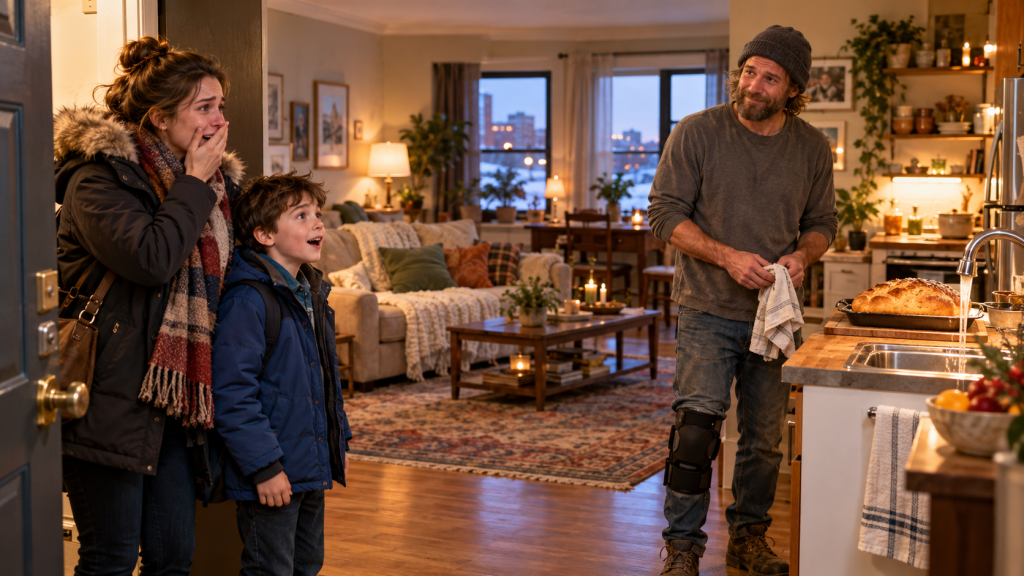
Then I walked into the kitchen.
The faucet didn’t drip.
I almost cried.
On the counter sat a loaf of bread.
I stopped.
“Leo?”
“Nope.”
I looked toward the doorway.
Julian stood there.
No brace.
He still walked with a slight limp.
But he was standing straighter.
Clean jeans.
Work boots.
Heavy jacket.
And an employee badge clipped to his belt.
“You.”
He smiled.
“Me.”
“You broke into my apartment?”
“Leo let me in.”
“Traitor.”
Leo shouted from his room:
“He brought bread!”
“Understandable.”
Julian laughed.
Then he handed me something.
A small brass washer.
I frowned.
“What is this?”
“The washer from your old dripping faucet.”
“You kept it?”
“Apparently I’m sentimental.”
I stared at the tiny piece of metal.
“That faucet was horrible.”
“Exactly.”
He smiled.
“Thought you might want proof some things can actually be fixed.”
My eyes filled.
“You’re getting annoyingly philosophical.”
“City employment.”
“Terrible influence.”
Julian saw Lily again.
The first visit lasted four hours.
The second lasted a weekend.
Then every other weekend.
He rented a small one-bedroom apartment and gave Lily the bedroom whenever she stayed.
He slept on the couch.
When I found out, I laughed.
“You really have a relationship with couches.”
“Apparently.”
Lily eventually met Leo.
They argued immediately about music.
That was how I knew they would be fine.
A year passed.
Then another.
People sometimes asked how Julian and I became friends.
I never knew how to answer simply.
My son saw him freezing.
I offered him a couch.
He found a hot outlet.
That outlet exposed a wall.
The wall exposed a building.
The building exposed years of neglect.
And somewhere inside all of that, four lives changed.
Mine.
Leo’s.
Julian’s.
Lily’s.
But there was one question people always asked eventually.
“Were you scared letting a stranger into your home?”
Yes.
Of course I was.
And I should have been careful.
Kindness does not erase risk.
I had locked my bedroom.
Kept my phone nearby.
Set boundaries.
I would never tell someone that opening their home to a stranger is always the right choice.
It isn’t.
But on that particular freezing night, I made one imperfect human decision.
And Julian made one too.
He stayed longer than promised.
Technically, he broke our agreement.
And thank God he did.
Three years later, Leo had to write an essay for school.
The topic was:
Describe a moment when someone changed your life.
I expected him to write about me.
Mother ego.
Instead, he wrote about Julian.
I pretended to be offended.
“You carried me for nine months,” he said. “That’s biology.”
“Excuse me?”
“Julian found electrical fire stuff.”
“I feed you.”
“Frequently.”
“I gave you life.”
“Very dramatic.”
Teenagers are ungrateful.
But then he handed me the essay.
The final paragraph read:
I used to think helping someone meant the person who had more gave something to the person who had less. But Julian taught me that’s not always true. Sometimes you give someone a couch, and they give you back your home.
I couldn’t finish reading.
“Mom?”
“I’m fine.”
“You’re crying.”
“Allergies.”
“In January?”
“Severe.”
He hugged me.
Julian framed that essay.
Lily made fun of him.
He didn’t care.
By then, he had become a supervisor.
He was helping train apprentices.
One of them had been homeless too.
When Julian told me, I smiled.
“You planned that.”
“Maybe.”
“Why?”
He shrugged.
“Someone gave me a couch.”
I laughed.
“You are never going to stop saying that, are you?”
“Nope.”
Mr. Keller eventually sold the building as part of resolving his financial problems.
A new company bought it.
Rents went up somewhat.
But repairs happened.
Requests were answered.
Safety inspections became routine.
I stayed another four years.
Then something happened I never expected.
I bought a house.
Small.
Two bedrooms plus a converted attic.
Nothing fancy.
A little yard.
Old maple tree.
Front porch.
The first night there, Leo and I ate pizza on the floor because the table hadn’t arrived.
He looked around.
“This is ours?”
“Ours.”
“No landlord?”
“Mortgage company.”
He frowned.
“That’s less exciting.”
I laughed.
Then the doorbell rang.
Julian and Lily stood outside.
Julian carried a toolbox.
I groaned.
“No.”
“What?”
“You are not inspecting my walls.”
“Absolutely inspecting your walls.”
“I paid for an inspection.”
“Was the inspector me?”
“No.”
“Then it doesn’t count.”
He spent three hours checking outlets.
Everything was safe.
Mostly.
He found one loose switch.
Fixed it.
Of course.
That winter, Minneapolis got another brutal cold snap.
One evening, Leo and I were leaving a grocery store.
Same chain.
Different neighborhood.
A woman stood near the entrance.
She had two bags.
A child beside her.
They looked cold.
Leo stopped.
I knew that look.
“Leo.”
He looked at me.
“Mom.”
“No strangers on the couch.”
“I didn’t say anything.”
“You were about to.”
He smiled.
We bought them hot food.
I called a local outreach line.
We waited until transportation arrived.
There are many ways to help.
That was another thing I had learned.
Compassion doesn’t have to mean ignoring safety.
You can be generous and wise at the same time.
Before the woman left, she hugged me.
“Thank you.”
I shook my head.
“My son noticed you.”
She looked at Leo.
He shrugged.
“I notice people.”
That sentence nearly broke my heart.
Because he did.
In a world where people learn to look away for survival, my son still noticed.
I hoped he always would.
Years later, I asked Julian what he had been thinking that first night.
“When?”
“Outside the grocery store.”
He smiled.
“That you were crazy.”
“Fair.”
“Then I thought you were setting me up.”
“For what?”
“No idea.”
“Very logical.”
“I was cold.”
He laughed.
Then became serious.
“I hadn’t eaten since morning.”
“You never told me.”
“You fed me.”
“Spaghetti.”
“Best spaghetti I’ve ever had.”
“It came from a jar.”
“Didn’t matter.”
He looked away.
“I had been invisible for months.”
My chest tightened.
“People looked through me.”
He paused.
“Leo looked at me.”
I smiled.
“He does that.”
“No.”
Julian looked at me.
“He actually saw me.”
That distinction stayed with me.
I once thought the most important moment of that story happened when I opened my apartment door and discovered Julian was still inside.
It wasn’t.
It happened outside the grocery store.
When Leo stopped walking.
When I wanted to keep going.
When he asked:
“Where is he going to sleep?”
Children ask questions adults train themselves not to hear.
Sometimes because we are busy.
Sometimes because we are tired.
Sometimes because the answers frighten us.
Sometimes because we know we cannot fix everything.
And we can’t.
I couldn’t fix homelessness.
I couldn’t repair Julian’s knee.
I couldn’t restore his company.
I couldn’t reunite him with his daughter by myself.
I couldn’t repair the whole building.
But I could give him one safe night.
Julian couldn’t fix my finances.
He couldn’t make my landlord responsible.
He couldn’t make my life easy.
But he could notice a warm outlet.
He could remove a plate.
He could look inside a wall.
He could refuse to walk away when something was wrong.
That was enough.
One thing.
Then another.
Then another.
Lives rarely change because someone fixes everything.
They change because someone does the next decent thing.
Julian still limps.
Especially when it’s cold.
Lily is in college now.
Leo is taller than both of us.
He no longer eats chocolate cereal.
He claims he “outgrew it.”
I suspect he’s embarrassed.
The old brass faucet washer sits in a small frame in my kitchen.
Underneath it, Leo made a label:
THE MOST EXPENSIVE WASHER MOM NEVER BOUGHT.
Julian thinks it’s hilarious.
I think it’s ridiculous.
But I never take it down.
Because when I look at it, I remember the apartment.
The cold.
The fear.
The hot outlet.
The photograph.
The landlord’s pale face.
The inspectors.
Denise’s kitchen.
Julian calling Lily.
Leo telling a grown man to fix what he had broken.
I remember how close we came to a fire we never knew was waiting inside our walls.
And I remember something else.
The morning I left for work, I expected Julian to disappear.
Part of me wanted him to.
I wanted the uncomfortable act of kindness to be finished.
I wanted my life to return to normal.
Instead, I opened my door that evening and found him still there.
At first, I was afraid.
Then I saw the repaired faucet.
The straight cabinet.
The fixed door.
The bread.
And finally, the wall.
For a few terrible hours, I thought I had made the biggest mistake of my life by letting a stranger inside.
Years later, I understood the truth.
The mistake would have been assuming that because someone had lost his home, he had nothing left to give.
Julian had lost money.
Work.
Housing.
Confidence.
Time with his daughter.
But he had not lost his knowledge.
His conscience.
His ability to notice danger.
Or his willingness to protect a child who wasn’t his.
Leo had looked at a freezing man and seen someone worth helping.
Julian had looked at my broken apartment and seen a family worth protecting.
And I had stood somewhere between them, terrified, exhausted, broke, uncertain, doing the best I could.
Maybe that’s what most of us are doing.
Trying to keep the heat on.
Trying to raise good children.
Trying not to become hardened by how difficult life can be.
Trying to know when to protect ourselves and when to open a door.
I don’t believe every stranger is safe.
I don’t believe kindness guarantees a beautiful ending.
Life isn’t that simple.
But I do believe people are more than the worst circumstances in which we meet them.
A homeless man can still be an electrician.
A struggling mother can still offer shelter.
A nine-year-old boy can notice what hundreds of adults ignore.
And sometimes the person you think you’re rescuing is standing much closer to the thing that will save you than either of you realizes.
On the coldest night of that winter, I thought I gave Julian a couch.
What I actually gave him was one night in which somebody trusted that his life was not over.
And what he gave us in return was impossible to measure.
He found the danger inside our walls.
He helped expose years of neglect.
He found his daughter again.
He rebuilt a career.
He became family.
And Leo?
Leo kept noticing people.
Of everything that happened, I think that would have made me proud even if nothing else had changed.
Because apartments can be repaired.
Wiring can be replaced.
Doors can be fixed.
Money can sometimes be earned again.
But a heart that has learned not to look away?
That is something worth protecting.
Even now, whenever winter arrives and the temperature drops low enough to make the windows tremble, I think about that grocery store.
I see Julian sitting against the brick.
I see myself carrying groceries, exhausted and worried about bills.
And I see nine-year-old Leo stop walking.
“Mom.”
“What?”
“Where is he going to sleep?”
At the time, I thought my son was asking me to save a stranger.
I had no idea the stranger was about to save us too.
THE END STORIES! THANK YOU FOR READING GOOD LUCK! ❤️
Related Posts