Roy stopped moving. Sandra stopped breathing. And I sat on my little stool beside the copier with Arthur’s red envelope resting in my lap. For nine years, his children had called me the nurse.
For twenty-two months, they had believed I was driving their dying father to physical therapy. And now Arthur’s voice had just told them that I was the person he had chosen to leave in charge of everything.
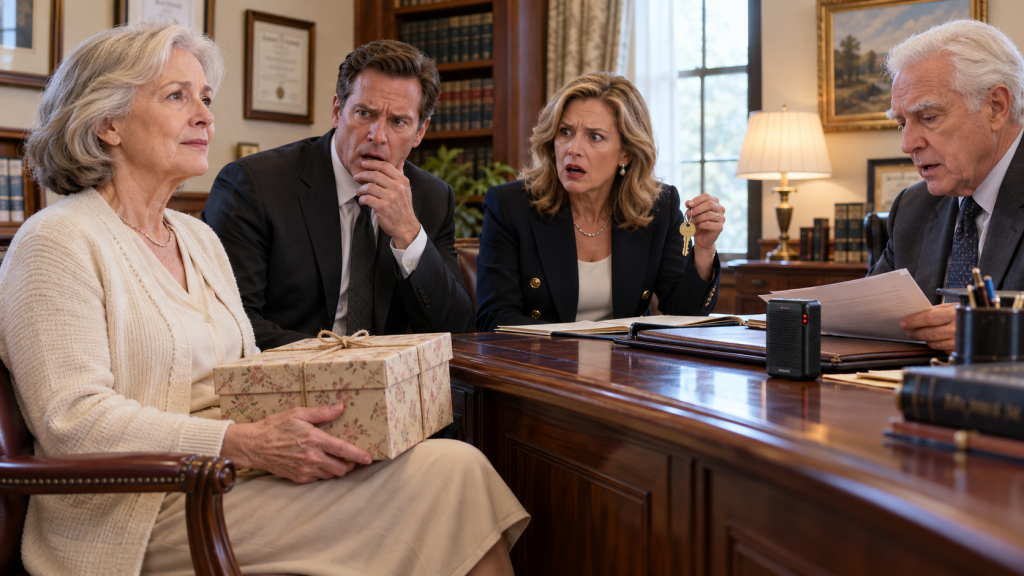
Roy recovered first.
He laughed.
It was the wrong kind of laugh.
Too loud.
Too quick.
Desperate.
“This is ridiculous.”
Mr. Katz folded his hands.
“Which part?”
“My father was dying.”
“Yes.”
“He had cancer.”
“Yes.”
“He was taking morphine.”
“At hospice, near the end.”
“He wasn’t competent.”
Mr. Katz raised one white eyebrow.
“That is an interesting argument.”
“It’s the truth.”
“Then perhaps you can explain why you attempted to have him sign legal documents.”
Roy’s mouth closed.
Sandra looked at her brother.
Mr. Katz continued.
“If Arthur lacked capacity to revise his estate with independent counsel, he certainly lacked capacity to transfer his home to you while heavily medicated.”
Roy stared at him.
“You’re twisting my words.”
“No.”
Mr. Katz opened another folder.
“I’m organizing them.”
Arthur’s recorded voice filled the room again.
“Roy, you always were impatient. When you were twelve, you opened your Christmas presents on December twenty-third and tried to tape them closed again.”
Roy’s face tightened.
“I knew.”
Despite everything, I almost smiled.
That was Arthur.
Even from beyond the grave, he knew exactly where to place the knife.
Not deep.
Just accurately.
Arthur continued.
“Sandra, you were better at waiting. You could hide a secret for six months if you thought there was something in it for you.”
Sandra whispered:
“Turn it off.”
Mr. Katz didn’t.
“No.”
Her head snapped toward him.
“This is my father.”
“Yes.”
“And these are his instructions.”
Sandra looked at me.
“You did this.”
I stared back.
“Did what?”
“Turn him against us.”
There it was.
The accusation I had expected for years.
Not grief.
Not confusion.
Not even regret.
Me.
The nurse.
The outsider.
The woman who had supposedly stolen their father by caring for him when they were too busy resenting him for remarrying.
“I didn’t turn Arthur against anyone.”
“You married a patient.”
“I married a man.”
“You were paid to take care of him.”
“For six months.”
“And then?”
“And then I stopped being his nurse.”
Her mouth twisted.
“How convenient.”
I looked at her.
“You know what was convenient?”
She said nothing.
“Showing up after his cancer returned and suddenly remembering where he lived.”
Roy slammed his palm against the table.
“Enough.”
I didn’t flinch.
“No.”
His eyes widened.
I had spent nine years trying to be polite to Arthur’s children.
That day, politeness finally exhausted me.
“You measured his garage while he was dying.”
Roy stood.
“I was checking dimensions.”
“For your boat.”
“It was a conversation.”
“You brought a tape measure.”
His jaw tightened.
I turned to Sandra.
“And you took his mother’s silver.”
She folded her arms.
“Dad told me years ago I could have it.”
“Then why did you wait until he was in hospice?”
“It was mine.”
“Interesting.”
Mr. Katz opened another folder.
“Arthur had something to say about that too.”
Sandra sat down.
The recording continued.
“The silver belongs to Sandra.”
She blinked.
For half a second, relief crossed her face.
Then Arthur added:
“Or it did.”
Sandra’s relief vanished.
“On October seventeenth, Sandra removed twelve place settings, two serving trays, the tea service, and your grandmother’s candlesticks from the dining room without asking me.”
Sandra turned toward me.
“You told him?”
I almost laughed.
“He lived there.”
Arthur continued.
“I asked Sandra about it. She said she was protecting the silver from Helen.”
Sandra whispered:
“I was.”
Arthur’s voice hardened.
“From my wife.”
Silence.
“I told her to bring it back.”
Sandra stared at the machine.
“She didn’t.”
Arthur paused.
“So I changed my mind.”
Sandra stood again.
“What?”
Mr. Katz reached into a cabinet and removed a document.
Arthur’s recording continued.
“The silver now goes to my granddaughter, Emily, when she turns thirty, provided Sandra returns every piece within thirty days of my death.”
Sandra’s daughter, who had been sitting quietly in the corner, suddenly looked at her mother.
“Mom?”
Sandra turned.
“This doesn’t involve you.”
Apparently, it did.
Mr. Katz looked at Sandra.
“Twenty-six days remain.”
Her daughter whispered:
“You told me Grandma wanted you to have it.”
Sandra’s face burned.
“She did.”
Arthur’s recorded voice seemed almost to answer her.
“And before Sandra says her mother wanted her to have it, that is true. Your mother did. I did too. Until Sandra decided inheritance meant she could take things while I was still alive.”
Sandra lowered herself into the chair.
Her daughter looked away.
That was the first crack.
There would be more.
Mr. Katz stopped the recording.
Roy pointed at the deed in my lap.
“Fine. Let’s get to the house.”
Mr. Katz nodded.
“Gladly.”
“The 1998 will leaves the house to Sandra and me.”
“Yes.”
“So whatever this is—”
He pointed at my envelope.
“—doesn’t matter.”
Mr. Katz looked almost amused.
“Why?”
“Because Dad’s will controls his estate.”
“Correct.”
Roy spread his hands.
“Then we’re done.”
“No.”
“Why not?”
“Because the house wasn’t part of Arthur’s probate estate when he died.”
Roy stared.
“What?”
Mr. Katz looked at me.
“Helen?”
My fingers trembled slightly as I removed the deed.
I had seen it once before.
Arthur had shown it to me on our nineteenth Tuesday.
I had cried then too.
The house had been transferred into the Arthur Bennett Family Trust fourteen months before his death.
Not to me personally.
Into a trust.
I was the successor trustee.
I also had the right to live in the house for the rest of my life.
Roy and Sandra were remainder beneficiaries.
If anything remained after my death and after certain charitable gifts Arthur had specified, they would eventually inherit portions.
Arthur had not disinherited them.
He had done something far more deliberate.
He had prevented them from throwing me out.
Roy snatched the deed from the table.
Mr. Katz immediately took it back.
“You may inspect copies.”
Roy glared.
“You’re telling me she owns the house?”
“No.”
“Then who does?”
“The trust.”
“And she controls it?”
“As trustee.”
“For how long?”
“As long as she is competent and willing to serve.”
Sandra looked at me as if she had never seen me before.
I almost wanted to apologize for disappointing her expectations.
Almost.
Roy shook his head.
“Dad would never do this.”
Arthur’s voice came from the machine.
“Yes, Roy. I would.”
Mr. Katz had pressed play again.
Roy spun toward it.
I felt goosebumps rise on my arms.
Arthur continued.
“If you’re arguing with Katz right now, stop. You never won an argument with him when I was alive, and I doubt death has improved your odds.”
Mr. Katz smiled.
“I miss him.”
I covered my mouth.
So did I.
God, I did.
Arthur continued.
“Helen gets to live in our home for as long as she wants.”
Our home.
Not his.
Ours.
“If she wants to sell it and move somewhere smaller, she may. If she needs money for medical care, she may use trust assets according to the terms Katz has explained to her. If she remarries, she still has her rights.”
Sandra muttered:
“Of course.”
Arthur’s voice immediately sharpened.
“And Sandra, if you just said something unpleasant, remember that the machine cannot hear you, but I could predict you.”
Her daughter covered her mouth.
Even Roy almost smiled.
Sandra did not.
Arthur continued.
“When Helen dies, whatever remains will be distributed according to the trust.”
Roy leaned forward.
“To us?”
Arthur paused.
“To the people who remember that inheritance is a gift, not wages for waiting.”
Roy’s expression darkened.
Mr. Katz said:
“There are conditions.”
“What conditions?”
“Several.”
Roy looked at me.
“You knew?”
“Some.”
“How much?”
“Enough.”
“You sat at the funeral smiling.”
“No.”
I shook my head.
“I smiled when you told me to pack a bag.”
His face reddened.
“Same thing.”
“No.”
“It was the first time I realized Arthur had been right.”
“About what?”
“That eventually, you would tell me exactly who you were.”
Roy turned toward Mr. Katz.
“What conditions?”
Mr. Katz opened the trust.
“Neither you nor Sandra can receive a distribution while there is an unresolved allegation that you attempted to obtain trust property through fraud, coercion, or undue influence.”
Sandra went pale.
“What allegation?”
Mr. Katz looked at her.
“The forged transfer.”
Roy laughed.
“You can’t prove that.”
I reached into the shoebox.
One more envelope.
Roy watched me.
I placed it on the table.
“What is that?”
I untied the string.
Inside were copies of the hospice medication logs.
Photographs.
A pharmacy printout.
A handwritten calendar.
And one tiny plastic medication cup.
Sandra looked confused.
Roy didn’t.
His eyes fixed on the cup.
I saw it.
So did Mr. Katz.
Arthur had taught me something during those final months.
People reveal themselves in the half-second before they remember to lie.
Mr. Katz asked:
“Do you recognize this?”
Roy scoffed.
“A plastic cup?”
I looked at him.
“You do.”
“No.”
“You looked at it before he finished asking.”
“So?”
I removed a photograph.
It showed Arthur’s bedside table.
The date was visible on the hospice whiteboard behind it.
Three pills in the cup.
Another photograph from later that evening showed the cup empty.
Roy shrugged.
“He took his medicine.”
“No.”
I shook my head.
“He didn’t.”
Sandra looked at me.
“What are you talking about?”
Arthur had been suspicious by then.
So had I.
The hospice team had instructed us carefully.
Certain medications were scheduled.
Others were only as needed.
Arthur was meticulous.
Even while dying.
Especially while dying.
He hated feeling foggy.
The night Roy and Sandra brought the papers, Arthur had asked me to leave the room.
Not because he wanted privacy from me.
Because he wanted to see what they would do.
I had gone to the family lounge.
Before leaving, I photographed the medication cup.
When I returned, the pills were gone.
Arthur was far sleepier.
Roy had claimed the nurse had given them.
The nurse hadn’t.
Sandra stared at her brother.
“Roy?”
He looked at her.
“What?”
“Did you give Dad medication?”
“No.”
“You said the nurse did.”
“I assumed.”
Mr. Katz opened another document.
“The hospice nurse provided a sworn statement.”
Roy’s face changed.
“She remembers leaving the room at 8:14 p.m. Arthur had not received the optional sedative.”
“That proves nothing.”
“She returned at 8:47.”
“So?”
“By then, he was heavily drowsy.”
“He was dying.”
“Yes.”
Mr. Katz leaned forward.
“But somebody had administered medication from his bedside supply.”
Roy stood.
“This is insane.”
Sandra remained seated.
“Roy.”
He turned.
“What?”
Her voice was different.
“Did you give him the pills?”
“No.”
“Don’t lie to me.”
“I didn’t.”
“You told me he needed to relax.”
His face froze.
There it was.
The second crack.
Mr. Katz did not speak.
Neither did I.
Sandra stared at her brother.
“You said the hospice nurse told you to give them.”
Roy’s voice dropped.
“She had.”
“No.”
Sandra shook her head.
“You said she had.”
“I misunderstood.”
“You told me to get the papers.”
“Sandra.”
“You told me Dad would be calmer after the medicine.”
“Sandra, shut up.”
Her daughter gasped.
Mr. Katz’s voice became very quiet.
“Mr. Bennett, I strongly recommend you stop instructing anyone in this room to remain silent.”
Roy looked at him.
“Why?”
“Because Arthur instructed me to provide the relevant records to the appropriate authorities if evidence suggested medication had been administered without authorization in connection with an attempted property transfer.”
Roy’s face emptied.
“What authorities?”
Mr. Katz didn’t answer.
He didn’t need to.
I felt sick.
Not victorious.
Not satisfied.
Sick.
For months, I had suspected something.
Arthur had suspected something.
But hearing Sandra say it aloud made the room tilt.
I looked at Roy.
“Why?”
He stared at the floor.
“Nothing happened.”
“That isn’t an answer.”
“He wasn’t hurt.”
“You don’t know that.”
“It was his prescribed medication.”
“Prescribed does not mean you get to decide when he takes it.”
“He was agitated.”
“He was refusing to sign your papers.”
Roy looked at me.
“You poisoned him against us.”
I stood.
The stool scraped backward.
“No.”
My voice shook.
“Do not do that.”
Roy stopped.
“Do not put this on me.”
I could feel nine years of swallowed words rising.
“I washed your father’s body when he couldn’t stand.”
Sandra looked away.
“I changed dressings.”
“I held the basin when chemotherapy made him vomit.”
“I slept on a chair beside him because he was afraid he would stop breathing during the night.”
My eyes burned.
“I learned every medication.”
“Every appointment.”
“Every doctor.”
“Every food he could tolerate.”
“Every expression on his face when the pain was worse than he admitted.”
I pointed toward Roy.
“And you came with a tape measure.”
Then Sandra.
“You came for silver.”
I could barely breathe.
“Do not stand there and tell me I turned your father against you.”
Silence.
“You did that yourselves.”
Sandra began crying.
Roy did not.
He became angry.
Anger was easier.
“So that’s it?”
He looked at Mr. Katz.
“She gets everything?”
“No.”
“Then what?”
Mr. Katz turned a page.
“Arthur divided his estate into several components.”
I sat again.
This part I did not know.
Arthur had refused to tell me everything.
“You shouldn’t have to carry the burden of knowing,” he’d said.
At the time, I thought he was protecting me from arguments.
Now I understood.
He had been protecting his final decisions from everyone.
Including me.
The first component was the house trust.
My lifetime occupancy.
Trustee authority.
After my death, the house—or its replacement value—would be divided among several beneficiaries.
Roy.
Sandra.
Their children.
And a local hospice foundation.
Not equally.
But fairly enough that no one could honestly say Arthur had forgotten his children.
The second component was Arthur’s retirement and investment accounts.
Roy leaned forward.
“How much?”
Mr. Katz ignored him.
Arthur’s voice answered.
“Roy, if you just asked how much before asking where it goes, thank you for proving my point.”
Sandra’s daughter let out an involuntary laugh.
Roy glared at her.
She looked down.
Arthur continued.
“I worked forty-six years. I saved. I invested. Helen had her own retirement. We lived below our means.”
I smiled.
That was generous.
Arthur had owned three shirts he considered “good shirts.”
One had a paint stain.
“Together, excluding the house, the trust assets were approximately one million eight hundred thousand dollars when this recording was made.”
Nobody moved.
I stared at Mr. Katz.
I hadn’t known.
Arthur and I had never lived like millionaires.
We clipped coupons.
We complained about cable prices.
He once drove twelve miles because another gas station was seven cents cheaper.
I whispered:
“Arthur, you ridiculous man.”
Mr. Katz smiled.
“He anticipated that reaction too.”
The recording continued.
“Helen, stop calling me ridiculous.”
I burst into tears.
Everyone stared.
I laughed through them.
“That stubborn old fool.”
For a moment, he was alive again.
Sitting beside me.
Teasing me.
Arthur had created four beneficiary accounts.
One for each grandchild.
Education.
Medical needs.
First homes.
Protected from their parents.
Sandra looked offended.
“You don’t trust me with my daughter’s money?”
Her daughter finally spoke.
“Mom.”
Sandra looked at her.
“Please.”
One word.
Enough.
Sandra fell silent.
Arthur had also made a substantial gift to the hospice.
Another to the cardiac rehabilitation program where we had first met.
That made me cry harder.
Then Mr. Katz reached the final portion.
A separate investment account.
Approximately six hundred thousand dollars.
Roy straightened.
Sandra wiped her eyes.
I knew what they were thinking.
Finally.
Their part.
Mr. Katz pressed play.
Arthur said:
“Roy and Sandra, this money was intended for you.”
Both went still.
“Three hundred thousand each.”
Roy exhaled.
Sandra closed her eyes.
“But.”
Roy’s face tightened.
Arthur continued.
“I changed those terms on the nineteenth Tuesday.”
Roy stood.
“Of course he did.”
Mr. Katz held up a hand.
“Listen.”
“I’ve heard enough.”
“No.”
It was Sandra.
Everyone turned toward her.
She looked at her brother.
“Sit down.”
Roy stared.
“Excuse me?”
“For once in your life, sit down and listen.”
He did.
Slowly.
Arthur continued.
“I did not remove you as beneficiaries.”
Roy frowned.
“I placed your shares in conditional trusts.”
Mr. Katz explained.
Neither child would receive unrestricted cash immediately.
Any distribution required certification that neither had unlawfully interfered with Arthur’s medical care, forged documents, or attempted to seize trust property.
If those matters were resolved without findings against them, distributions could begin.
If wrongdoing were established, portions could be redirected to their children and charities.
Roy looked furious.
Sandra looked terrified.
I felt neither.
I felt tired.
So terribly tired.
Arthur’s voice softened.
“I don’t want revenge.”
That silenced everyone.
“I wanted children.”
A pause.
“Not heirs.”
Sandra covered her mouth.
“I wanted you to visit because you missed me.”
Roy stared at the floor.
“I wanted you to ask Helen how she was doing.”
My tears fell.
“I wanted you to sit beside my bed without checking your watch.”
Sandra sobbed.
“I wanted one afternoon where nobody asked what would happen to the house.”
Even Mr. Katz looked away.
“And perhaps that was partly my fault.”
Roy looked up.
Arthur continued.
“I worked too much when you were young.”
Sandra whispered:
“Dad.”
“I thought paying for everything was the same as being there.”
His voice weakened slightly.
“I taught you that money was how I loved you.”
The room had changed.
No longer a courtroom.
No longer a battlefield.
Just a father admitting something too late.
“Maybe I shouldn’t be surprised that money became the language you used with me.”
Roy’s eyes filled.
For the first time, he looked less angry than broken.
Arthur continued.
“But you are grown now.”
“You know better.”
“And what you did near the end was your choice.”
Mr. Katz stopped the recording.
Nobody complained.
Sandra’s daughter was crying silently.
Sandra reached for her.
The girl hesitated.
Then allowed her mother to hold her hand.
Roy stared at the table.
Finally, he whispered:
“I didn’t forge his signature.”
Mr. Katz looked at him.
“Who did?”
“I don’t know.”
Sandra looked at him.
“Roy.”
“I didn’t.”
“You brought the papers.”
“Yes.”
“You arranged them.”
“Yes.”
“You told me the lawyer had approved them.”
“I thought—”
“No.”
Sandra pulled her hand from her daughter and stood.
“You told me.”
Roy’s eyes flashed.
“Don’t start pretending you were innocent.”
“I didn’t say I was.”
“You took the silver.”
“Yes.”
“You wanted the house too.”
“I wanted what I thought Dad intended us to have.”
“You wanted half.”
“So did you!”
“Yes!”
Sandra shouted it.
Her voice cracked.
“Yes, I did.”
Then quieter:
“And I was wrong.”
Roy stared at her.
Sandra began crying again.
“I was wrong.”
That sentence seemed physically difficult for her.
She turned to me.
“I hated you.”
I didn’t answer.
“I hated you from the day Dad married you.”
“I know.”
“I thought you took Mom’s place.”
“I never tried.”
“I know.”
That surprised me.
She swallowed.
“I know that now.”
I waited.
“I kept thinking if you disappeared, everything would go back.”
Her voice became small.
“To when Mom was alive.”
There it was.
Under the greed.
Under the silver.
Under the insults.
A daughter who had never forgiven time for moving.
“I know it doesn’t make sense.”
“It makes sense.”
She looked at me.
“It doesn’t excuse it.”
“No.”
She nodded.
“I’m sorry.”
I believed she meant it.
I didn’t forgive her yet.
Both things could be true.
Roy remained silent.
Mr. Katz returned to the forged documents.
The signature had been notarized.
That was the problem.
Arthur had never signed.
Yet someone had certified that he had.
Mr. Katz had hired a forensic document examiner months earlier.
Arthur’s authentic signatures from that period showed tremors caused by weakness.
The signature on the transfer was unusually smooth.
The examiner concluded it was likely traced or simulated.
Then came the twist none of us expected.
Roy hadn’t forged it.
Sandra hadn’t forged it.
The notary had.
At least, that was what the evidence suggested.
Roy had hired a man named Douglas Pierce to prepare the documents.
A “family friend.”
Except Pierce wasn’t a lawyer.
He operated a financial services business.
He was also the notary.
And according to bank records Arthur had obtained before his death, Roy had paid Pierce $7,500 two days after the transfer documents were filed.
Sandra stared at her brother.
“What was the payment?”
Roy looked stunned.
“Consulting.”
“For what?”
“Estate planning.”
Mr. Katz frowned.
“For your father’s estate?”
“For mine.”
“Do you have an invoice?”
Roy said nothing.
“Engagement agreement?”
Nothing.
“Correspondence?”
Nothing.
Roy whispered:
“I didn’t ask him to forge anything.”
For the first time, I believed him.
Not because he deserved trust.
Because his fear looked different now.
He had expected pressure.
He hadn’t expected fraud.
“What did you ask him to do?” I said.
Roy rubbed his face.
“Protect the house.”
“From me?”
“Yes.”
At least he finally said it.
“I thought Dad was going to leave everything to you.”
“So you tried to transfer the house before he died.”
Roy nodded once.
“I thought Dad would sign.”
“But he didn’t.”
“No.”
“And then?”
“I left.”
“Without the papers?”
He closed his eyes.
“No.”
Sandra stared.
“Roy.”
“I left them with Pierce.”
Mr. Katz wrote something down.
That was the moment Roy understood how serious this had become.
The meeting lasted almost four hours.
No realtor appointment happened.
Nobody cared.
By the end, Mr. Katz had explained what would happen next.
The attempted transfer was already frozen.
The house remained in Arthur’s trust.
The questionable power of attorney had never taken effect because Arthur had executed a newer one through independent counsel.
The medication issue would be reviewed.
The signature issue would be reviewed.
No one in that room was going to decide criminal guilt.
That would be for investigators and, if necessary, a court.
Arthur had been careful about that too.
He had not turned his final recording into a revenge fantasy.
He had created evidence.
Then he left decisions to people whose job was to make them.
Before we left, Mr. Katz pressed play one final time.
Arthur’s voice filled the room.
“Helen.”
I closed my eyes.
“Go home.”
My chest broke open.
“It is still your home.”
I cried silently.
“Make tea.”
I laughed.
Of course.
“Sit in my chair if you want.”
Never.
That chair was his.
“And for God’s sake, throw out the yogurt in the back of the refrigerator. It was expired when I recorded this.”
Even Sandra laughed through her tears.
Then Arthur became quiet.
“Helen, you gave me nine years I didn’t expect to have.”
My hand went to my mouth.
“I know what they called you.”
I froze.
Sandra looked at me.
“The nurse.”
My tears came harder.
“You were my nurse once.”
A pause.
“Then you were my friend.”
“Then my stubborn girlfriend.”
I laughed.
“Then my wife.”
His voice softened.
“And at the end, you were the person who made dying less frightening.”
I bent forward.
I couldn’t hold myself upright.
“Thank you.”
Two words.
I had heard him say them thousands of times.
For coffee.
For medicine.
For finding his glasses when they were on his head.
Never like that.
“Now go live.”
The recording clicked off.
I stayed in Mr. Katz’s office after everyone left.
Sandra hugged her daughter in the parking lot.
Roy walked alone to his car.
He looked ten years older.
Mr. Katz sat across from me.
“You knew about the house.”
“Yes.”
“But not the money.”
“No.”
“Arthur wanted that.”
“I know.”
“He worried you’d argue.”
“He was right.”
Mr. Katz smiled.
“He usually was.”
I looked at the shoebox.
“Why twenty-two meetings?”
Mr. Katz leaned back.
“Because he kept changing things.”
“Because of the children?”
“Not always.”
“What else?”
“You.”
I frowned.
“He worried about leaving too much responsibility on you.”
My eyes filled again.
“He worried you would spend the rest of your life managing his death instead of living your own life.”
That sounded like Arthur.
“What did you tell him?”
“That you were capable of making your own decisions.”
Mr. Katz smiled.
“He called me an overpriced nuisance.”
“That also sounds like Arthur.”
The next few months were ugly.
Truth doesn’t become beautiful just because it is necessary.
Investigators interviewed me.
Hospice staff.
Roy.
Sandra.
Douglas Pierce.
The medication issue was complicated.
There was no evidence that Roy intended to physically harm Arthur.
The medication had been prescribed.
But he had no authority to administer it when he did, and the circumstances surrounding the attempted signing raised serious concerns.
The forged signature was clearer.
Evidence eventually indicated that Pierce had created it after Arthur refused to sign.
Roy maintained that he never asked Pierce to forge Arthur’s name.
Records supported parts of Roy’s account and contradicted others.
In the end, Pierce faced the most serious legal consequences.
Roy faced civil liability related to the attempted transfer and his role in arranging it.
I did not celebrate.
Arthur wouldn’t have.
Consequences were not confetti.
They were simply what remained after choices.
Sandra returned the silver.
Every piece.
She brought it herself.
I opened the door one rainy afternoon and found her standing on the porch with three boxes.
“I counted twice.”
I stepped aside.
She carried them into the dining room.
We unpacked everything.
Forks.
Spoons.
Serving pieces.
Candlesticks.
Her mother’s tea service.
Sandra held one spoon for a long time.
“Mom used this at Christmas.”
“I know.”
“You never met her.”
“No.”
“Dad told you?”
“Yes.”
She looked at me.
“What did he say?”
I smiled.
“That she made terrible coffee.”
Sandra laughed unexpectedly.
“She did.”
“He said she sang while cooking.”
“Badly.”
“He didn’t mention that.”
“He was being polite.”
We both smiled.
Then the smile faded.
Sandra whispered:
“I thought loving you meant he loved her less.”
I looked at her.
“Arthur never stopped loving your mother.”
Her eyes filled.
“He talked about her.”
“To you?”
“Often.”
“Didn’t that bother you?”
“No.”
“Why?”
“Because she was part of him.”
Sandra cried.
I let her.
Eventually, she said:
“I wasted so much time.”
“Yes.”
She looked at me, startled by my honesty.
I touched the silver spoon.
“But you’re still alive.”
Roy did not come around so quickly.
For almost a year, I heard from him only through lawyers.
Then one morning, I found him sitting on the front steps.
He had no tape measure.
That detail mattered more than it should have.
I opened the door.
“What do you want?”
“To talk.”
“About money?”
“No.”
I waited.
“Then come in.”
He stepped into the house.
His eyes moved toward Arthur’s chair.
I had never moved it.
Roy stared.
“He used to sit there when I was a kid.”
“I know.”
“He told you?”
“Yes.”
Roy sat on the couch.
Not Arthur’s chair.
Good.
“I hated you.”
“So did Sandra.”
“She told you?”
“Yes.”
He nodded.
“Figures.”
Silence.
Then:
“I thought you were waiting for him to die.”
I almost laughed.
“I was praying he wouldn’t.”
“I know that now.”
He looked at his hands.
“When Mom died, Dad fell apart.”
“I know.”
“He stopped cooking.”
“I know.”
“He stopped seeing friends.”
“I know.”
“I thought he was supposed to stay that way.”
That surprised me.
Roy looked ashamed.
“Some part of me thought if he became happy again, it meant Mom hadn’t mattered.”
I sat opposite him.
“So when he married me…”
“It felt like betrayal.”
“Of your mother.”
“Yes.”
“And instead of telling him?”
“I punished you.”
“Yes.”
“And him.”
“Yes.”
He swallowed.
“I almost took his house.”
“Yes.”
“I didn’t ask Pierce to forge it.”
“I believe you.”
His eyes lifted.
“You do?”
“Yes.”
Relief crossed his face.
I continued.
“But you created the situation.”
It disappeared.
“You brought legal papers to a dying man.”
He looked down.
“You gave him medication without authorization.”
His jaw tightened.
“You wanted his signature while he was impaired.”
“I know.”
“You don’t get innocence just because somebody else went further.”
He nodded.
“I know.”
That was the first time I believed Roy might change.
The conditional inheritance remained frozen for almost two years.
When the legal matters were finally resolved, Mr. Katz called another meeting.
Same office.
Same chairs.
I took one of the front ones this time.
Sandra noticed.
She smiled.
Roy sat beside her.
Mr. Katz explained the outcome.
Pierce’s actions triggered the trust protections.
Roy’s conduct also violated certain conditions.
Arthur’s plan did not eliminate Roy entirely.
Instead, much of Roy’s share remained in trust for controlled distributions.
Some went directly to his children.
Sandra’s share was treated differently because she had cooperated, returned property, and had not participated in the forged signature.
She still did not receive everything outright.
Arthur had designed the trust to protect everyone from their worst impulses.
Including me.
I was required to have an independent co-trustee for major transactions.
When I first learned that, I had been offended.
Then I laughed.
Of course Arthur hadn’t trusted me completely either.
He knew I was terrible at saying no to people I loved.
The old man had protected me from my own softness.
After the meeting, Roy stopped me in the parking lot.
“Helen.”
I turned.
He held out something.
A key.
My house key.
The one Sandra had taken from the kitchen hook on the day of the funeral.
I stared.
“Sandra gave it to me after the funeral.”
“Why?”
“She thought I’d need it for the realtor.”
I took it.
Roy looked ashamed.
“We really thought we’d have you out by the weekend.”
“I know.”
“I don’t know what kind of people do that.”
I closed my hand around the key.
“Grieving people.”
He looked surprised.
“And greedy people.”
His face fell.
“And frightened people.”
He nodded.
“People can be more than one thing.”
He looked at me.
“Do you forgive me?”
I considered lying.
It would have been easier.
“No.”
He looked down.
“Not yet.”
He nodded.
“But I’m trying.”
His eyes filled.
“That’s more than I deserve.”
“Probably.”
He laughed.
It sounded a little like Arthur.
That hurt.
And helped.
I stayed in the house.
At first, every room felt like a museum.
Arthur’s slippers beside the bed.
His coffee mug.
His reading glasses.
The little dent in the couch cushion where he sat.
For weeks, I couldn’t touch anything.
Then one morning, I threw away the expired yogurt.
I stood in front of the garbage can and cried so hard I had to sit on the floor.
Grief is strange.
You survive the funeral.
The lawyers.
The accusations.
The paperwork.
Then a container of strawberry yogurt destroys you.
I began walking every morning.
Arthur had ordered me to live.
So I tried.
I joined a gardening club.
Terrible mistake.
Everyone had opinions about tomatoes.
I volunteered twice a week at the cardiac rehabilitation center.
The same place where Arthur and I had met.
Patients sometimes asked how long I had been a nurse.
“Forty-three years,” I would say.
Then one day, an older man asked:
“Did you ever marry a patient?”
I laughed so hard I frightened him.
“Once.”
“Good idea?”
“The best bad idea of my life.”
Sandra started visiting.
Not every week.
That would have been too much for both of us.
Once a month.
Usually Sunday afternoon.
She brought pastries.
I made coffee.
Eventually, she stopped asking permission to sit in Arthur’s chair.
Not because she was entitled to it.
Because one day I told her:
“That was your father’s chair before it was my husband’s.”
She cried.
Then sat.
Sometimes we talked about Arthur.
Sometimes her mother.
Sometimes nothing important.
That was healing too.
Ordinary conversation.
No wills.
No property.
No silver.
Just two women who had loved the same difficult man in different ways.
Roy took longer.
Then one spring afternoon, he appeared with a toolbox.
“The porch railing is loose.”
I looked at him.
“You noticed?”
“Dad would haunt me if I didn’t.”
I stepped aside.
He spent three hours repairing it.
When he finished, I asked:
“How much?”
His face changed.
“Nothing.”
“Roy.”
“No.”
He looked at the railing.
“Dad fixed my house for thirty years.”
His voice broke slightly.
“Let me fix something of his.”
I didn’t correct him.
Something of his.
Something of mine.
Something of ours.
All could be true.
Years passed.
Mr. Katz retired.
His daughter took over the firm.
The shoebox remained in my closet.
I couldn’t throw it away.
It had once held evidence.
Eventually, it held memories.
Arthur’s watch.
His hospital bracelet.
A photograph of us at Niagara Falls.
A receipt from the diner where he proposed.
He hadn’t planned to propose there.
He dropped the ring into his mashed potatoes.
I said yes anyway.
One Thanksgiving, five years after Arthur died, Roy and Sandra came to my house.
Together.
Roy brought turkey.
Sandra brought the silver.
Not to take.
To use.
She set the table with her mother’s place settings.
I watched her polish each fork.
Her daughter arrived with a baby.
Arthur’s first great-grandchild.
They named him Arthur James.
Nobody warned me.
When Sandra told me, I sat down and cried.
Roy stood awkwardly beside me.
“Don’t make a thing out of it.”
I looked up.
“I’m making a thing out of it.”
He smiled.
“Dad would too.”
“Yes.”
“He’d pretend he wasn’t.”
“Yes.”
“And then he’d buy the kid something ridiculous.”
“Absolutely.”
We laughed.
Before dinner, Sandra placed an extra setting at the table.
I frowned.
“Who’s coming?”
She looked at the empty chair.
“No one.”
I understood.
Arthur.
I touched the back of the chair.
For years, his children had fought over what he would leave behind.
That evening, what mattered most was the empty seat.
Funny how death rearranges value.
A house once worth fighting over became walls.
Money became numbers.
Silver became utensils.
But a chair no one could fill?
Priceless.
Roy raised his glass.
“To Dad.”
Sandra raised hers.
“To Dad.”
I lifted mine.
“To Arthur.”
Then Roy looked at me.
“And Helen.”
I frowned.
“What did I do?”
He smiled sadly.
“You stayed.”
Three words.
That was all.
I had stayed.
Through cancer.
Through anger.
Through hospice.
Through children who called me nurse like it was an insult.
Through twenty-two Tuesdays.
Through funeral casseroles.
Through the Friday when they thought they were coming to collect a house.
I stayed.
Years later, I finally sold the house.
Not because Roy wanted it.
Not because Sandra wanted it.
Because I was ready.
The stairs had become difficult.
The garden was too much.
And every winter I worried about the roof.
I moved into a smaller place near the river.
The trust purchased it according to Arthur’s instructions.
On moving day, Roy carried boxes.
Sandra wrapped the silver.
Her daughter labeled everything.
At the end, I stood alone in the empty living room.
Arthur’s chair was gone.
The walls were bare.
I touched the place where our wedding photograph had hung.
“I’m going,” I whispered.
For one foolish second, I expected him to answer.
He didn’t.
But I heard him anyway.
Go live.
So I did.
I kept one key from the old house.
The same one Sandra had taken from the hook.
The same one Roy returned.
It sits in the shoebox now.
Not because I miss the building.
Because that key reminds me of something Arthur understood better than any of us.
A house is not an inheritance.
Neither is money.
Neither is silver.
The real inheritance is what remains inside people after you are gone.
For a while, Arthur’s children inherited his money badly.
Eventually, they inherited something better.
His stubbornness.
His humor.
His ability to admit when he had failed.
His belief that people could become better than their worst choices.
I inherited those things too.
On the tenth anniversary of Arthur’s death, Sandra asked if we could listen to the recording again.
I hesitated.
Then agreed.
Roy came.
So did their children.
We sat in my smaller living room.
Mr. Katz’s daughter had transferred the old audio to a digital file years earlier.
I pressed play.
Arthur’s voice filled the room.
“Hello, Roy. Hello, Sandra.”
Everyone smiled.
“If you are hearing this…”
Roy interrupted.
“He sounds smug.”
Sandra laughed.
“He was smug.”
I whispered:
“He earned it.”
We listened.
The house.
The silver.
The papers.
The pills.
The mistakes.
The apologies he never got to hear.
Then his voice reached me.
“Helen, my love…”
I closed my eyes.
Even ten years later, those words could find the exact place grief lived.
“Go home.”
My eyes filled.
“It is still your home.”
I looked around my little apartment.
Photographs everywhere.
Arthur.
Roy.
Sandra.
Grandchildren.
Great-grandchildren.
Life.
He had been wrong about one thing.
The house had never been my home.
Not really.
He was.
And when he left, I had to learn how to build another one inside myself.
After the recording ended, nobody spoke.
Then Roy said:
“I wish I could tell him I was sorry.”
I looked at him.
“You can.”
He frowned.
“How?”
“Say it.”
“To who?”
“To him.”
He looked embarrassed.
Then toward Arthur’s photograph.
“Dad.”
His voice broke.
“I was a selfish bastard.”
Sandra laughed through tears.
“Accurate.”
Roy smiled.
Then continued.
“I thought your death was something happening to me.”
Silence.
“I didn’t understand it was happening to you.”
That sentence hurt all of us.
“I was scared.”
He wiped his eyes.
“And instead of being your son, I became your heir before you were even gone.”
Sandra began crying.
Roy looked at the photograph.
“I’m sorry.”
Then Sandra spoke.
“I’m sorry too.”
Finally, both looked at me.
I understood the question.
Ten years earlier, Roy had asked whether I forgave him.
I had said no.
Not yet.
Now I looked at the man who repaired my railing.
The woman who brought pastries once a month.
The children who had returned what they took.
The adults who had spent years trying to become different from the people who walked into that lawyer’s office.
“Yes.”
Roy whispered:
“Yes what?”
I smiled.
“I forgive you.”
Sandra covered her mouth.
Roy cried.
So did I.
Forgiveness had taken ten years.
That didn’t make it weaker.
It made it honest.
Arthur once told me that people think wills are about money.
“They aren’t,” he said.
“What are they about?”
“Fear.”
I laughed.
“That’s cheerful.”
“Think about it.”
He counted on his fingers.
“Fear of being forgotten. Fear of being cheated. Fear your children will fight. Fear your spouse won’t be safe. Fear everything you worked for will disappear.”
“And your twenty-two Tuesdays fixed all that?”
“No.”
He smiled.
“But Katz charges enough that he better try.”
I had laughed then.
Now I understood.
Arthur hadn’t spent twenty-two Tuesdays deciding who deserved his money.
He had spent them deciding what kind of mess he wanted to leave behind.
And despite everything, he had left us a path out.
Not an easy one.
A path.
If Arthur had simply disinherited Roy and Sandra, they would have hated me forever.
If he had left them everything, they would have thrown me out.
Instead, he protected me without erasing them.
He protected his grandchildren from their parents’ worst decisions.
He protected his own wishes with documents, witnesses, recordings, doctors, lawyers, and dates.
And then he left room for people to change.
That was Arthur.
Practical even in death.
I am older now.
Older than Arthur was when we married.
My hands shake sometimes.
I forget why I walked into rooms.
I keep my medications in one of those ridiculous plastic organizers with the days printed on top.
Sandra calls every Tuesday.
Not the first Tuesday.
Every Tuesday.
The irony is not lost on either of us.
Roy visits twice a month.
He still checks the house for things that need repairing.
Last week he replaced a cabinet hinge.
I told him it was fine.
He said:
“Dad would’ve fixed it.”
I replied:
“Your father would have complained about it for six months and then fixed it.”
Roy laughed.
“Also true.”
Sometimes people still introduce me as Arthur’s second wife.
I don’t mind.
Second doesn’t mean lesser.
It means later.
Arthur had a whole life before me.
A wife he loved.
Children.
A career.
Mistakes.
Memories I never witnessed.
Then I arrived.
A nurse carrying a clipboard into a cardiac rehabilitation room.
He complained that I walked too fast.
I told him he complained too much.
He asked me for coffee three months later.
I refused.
He asked again.
I refused.
The third time, he brought two coffees and said:
“This saves us both time.”
I married him two years later.
Nine years after that, I held his hand while he died.
And years after his death, he was still teaching all of us how to live.
The shoebox is still with me.
The string is frayed now.
Inside are no medication logs anymore.
Those went where they needed to go.
No copies of forged documents.
No evidence.
Only memories.
His watch.
The key.
The photograph.
A birthday card.
A dried flower.
And a note I found months after his death tucked inside an old book.
It wasn’t legal.
It wasn’t witnessed.
It wasn’t notarized.
It didn’t control a dollar.
It simply said:
Helen,
If you’re reading this, you finally cleaned my bookshelf. Miracles happen.
Below that:
Thank you for making the last chapter my favorite.
I still cannot read it without crying.
Roy once told me that he used to think I stole his inheritance.
“What changed?” I asked.
He looked around my little apartment.
“Dad left me something you couldn’t steal.”
“What?”
“A chance to become somebody he would’ve wanted to know.”
I smiled.
“Are you?”
“Getting there.”
That’s all any of us can say.
And whenever someone asks me about those twenty-two Tuesday drives, I remember Arthur sitting beside me.
Cane across his knees.
Seat belt fastened.
Looking weaker each month.
Yet somehow walking out of Mr. Katz’s office stronger.
I understand why now.
He wasn’t planning his death.
He was reclaiming the part of dying that still belonged to him.
Choice.
His children tried to decide who counted as family.
Arthur decided for himself.
They tried to decide where I belonged.
Arthur made sure nobody could remove me.
They thought weakness meant helplessness.
They were wrong.
A dying man can still think.
Still choose.
Still love.
Still protect.
Still see.
Arthur saw everything.
The tape measure.
The silver.
The papers.
The pills.
My shoebox.
My fear.
My loyalty.
His children’s anger.
Their grief hidden underneath it.
He saw all of us clearly.
And somehow, even after seeing the worst, he still left the door open for something better.
At his funeral, Roy gripped my wrist and told me:
“Pack a bag, Helen.”
I remember the pressure of his fingers.
The certainty in his voice.
“This house goes to real family, not his nurse.”
At the time, I smiled.
Not because I knew I had won.
There was nothing to win.
Arthur was dead.
The person I loved most was gone.
No deed could compensate for that.
No trust.
No money.
No legal victory.
I smiled because I knew something Roy didn’t.
His father had spent twenty-two Tuesdays answering the question Roy had just asked.
Who was real family?
Arthur’s answer wasn’t written only in a trust.
It was in the life we had lived.
I had been his nurse.
Then his friend.
Then his wife.
Then his advocate.
Then his caregiver again.
Then the person holding his hand when he took his final breath.
And Roy and Sandra?
They were still his children.
Even after everything.
Arthur protected me.
But he didn’t erase them.
Eventually, I understood why.
Family is not proved by what you inherit when someone dies.
It is proved by what you become after they are gone.
And on that Friday in Mr. Katz’s office, with a shoebox on my lap and Arthur’s voice filling the room, none of us knew yet whether his children would become better.
Arthur had given them the chance.
Years later, they took it.
That was the final gift hidden inside all those papers.
Not the house.
Not the money.
Not the silver.
A chance.
For me to live without fear.
For Sandra to let go of resentment.
For Roy to stop confusing inheritance with love.
For all of us to sit at one table years later and remember a difficult, stubborn, funny man without fighting over what he left behind.
Arthur was right.
It took a while.
But eventually, there wasn’t much left for anyone to say.
So we stopped arguing.
And finally became the family he had hoped we might be.
THE END STORIES! THANK YOU FOR READING GOOD LUCK! ❤️
Related Posts