I stepped off the porch before anyone could stop me. Behind me, Cynthia’s phone kept ringing. Once. Twice. Three times. She finally answered just as I reached the driveway. “David?” My father’s voice was loud enough that I heard it through the open front door.
“What did you do?” I stopped. Eight years. For eight years, I had imagined my father asking Cynthia that question. What did you do? Not what did Maya do? Not why is Maya making things difficult?
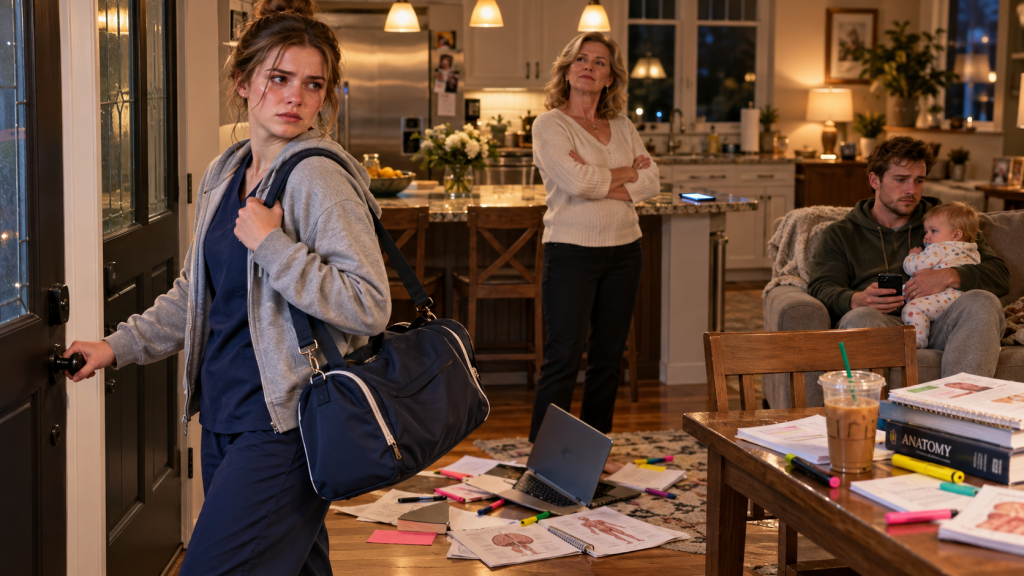
Not why can’t everyone get along? What did you do? Cynthia’s voice changed instantly. Soft. Confused. Almost wounded. “David, I don’t know what Maya told you, but she’s upset because I asked her to help with Mason.”
I closed my eyes.
There it was.
The version that always arrived first.
Except this time, mine already had.
Dad said something I couldn’t hear.
Cynthia answered quickly.
“She was being disrespectful. She refused to help, and then she started packing dramatically like she wanted everyone to chase her.”
Brandon appeared in the doorway.
Our eyes met.
He looked ashamed.
I didn’t care.
Not yet.
Cynthia continued.
“I never threw her out.”
I turned around.
“You told me to leave.”
She covered the phone.
“Maya, stop.”
“You said if I couldn’t help the family, I should find somewhere else to live.”
“I was frustrated.”
“You knocked my laptop onto the floor.”
“It slipped.”
Brandon finally spoke.
“No, it didn’t.”
Silence.
Cynthia slowly turned toward him.
“What?”
Brandon stood beside the couch.
His face had gone pale.
“You knocked it off.”
She stared at him.
“Brandon.”
“You did.”
Her expression sharpened.
“Stay out of this.”
He gave a short, humorless laugh.
“I think that’s what got us here.”
For the first time that night, I looked at my brother and saw something besides anger.
Regret.
It wasn’t enough.
But it was something.
Dad’s voice came through the phone again.
“Put Brandon on.”
Cynthia hesitated.
“David—”
“Put him on.”
She handed over the phone.
Brandon took it.
“Dad.”
A pause.
“Yes.”
Another pause.
He looked at me.
“Yes, she was studying.”
His eyes lowered.
“Yes, Mason was my responsibility.”
Another pause.
“Yes.”
Then his face crumpled slightly.
“No. I didn’t say anything.”
That answer hurt more than I expected.
Because there it was.
Simple.
Honest.
He had watched.
He had understood.
He had stayed silent.
Dad asked another question.
Brandon swallowed.
“No, this isn’t the first time.”
Cynthia stepped forward.
“Give me the phone.”
Brandon moved away.
“No.”
Her mouth opened.
He continued speaking to Dad.
“She watches him a lot.”
Pause.
“No, Dad. More than she should.”
Cynthia hissed:
“Brandon!”
He looked at her.
“My son is my responsibility.”
“She’s his aunt.”
“And I’m his father.”
The room went silent.
Mason began crying again.
This time Brandon immediately walked toward him.
He lifted his baby from the playpen.
No one asked me.
No one even looked at me.
It was such a small thing.
And somehow it nearly made me cry.
I turned toward my car.
“Maya.”
Brandon called after me.
I kept walking.
“Maya, wait.”
I opened the passenger door and put my duffel bag inside.
He came onto the porch with Mason against his shoulder.
“I’m sorry.”
I looked at him.
“For tonight?”
His face tightened.
“For everything.”
“That’s a lot of everything.”
“I know.”
“No, Brandon.”
My voice shook.
“I don’t think you do.”
He said nothing.
“I missed three study groups this semester because you needed someone to watch Mason.”
“I know.”
“I called out from the clinic twice.”
“I know.”
“I took him to his pediatric appointment because you said work was busy.”
“I know.”
“I’ve bought diapers.”
His eyes filled.
“Formula.”
“I know.”
“Medicine.”
“I know.”
“I was waking up at four-thirty with your child while you slept.”
“I know.”
“Then why did you let her throw my laptop on the floor?”
He looked away.
I waited.
Finally he whispered:
“Because if she was angry at you, she wasn’t angry at me.”
That answer was so ugly and so honest that I couldn’t speak.
He looked at me again.
“After Jenna left, I didn’t know how to handle anything.”
Jenna was Mason’s mother.
She and Brandon had separated when Mason was only six weeks old.
Their relationship had collapsed quickly and painfully.
Brandon moved back home.
And somehow, without anyone formally deciding it, I became the person filling every gap.
“I was exhausted,” he continued. “Cynthia kept saying you didn’t mind helping.”
“I minded.”
“I know that now.”
“I told you.”
He closed his eyes.
“I know.”
“So you knew then.”
“Yes.”
There it was again.
I nodded.
“Goodnight, Brandon.”
“Maya—”
“My anatomy final is in fourteen hours.”
He looked down at Mason.
“You should go.”
“I am.”
“I mean… go study.”
I looked at him.
He seemed smaller somehow.
Not physically.
Morally.
Like the older brother I had spent years looking up to had finally stepped down from the pedestal I had built for him.
“Take care of your son.”
“I will.”
“And don’t let Cynthia blame Mason for this.”
His face changed.
“What?”
“She’ll say everything happened because I wouldn’t change a diaper.”
I looked toward the house.
“It didn’t.”
Brandon nodded slowly.
“I know.”
I got into my car.
Cynthia came rushing outside.
“Maya!”
I almost drove away.
Then she slapped her palm against my window.
“Your father says he’s coming home.”
I lowered the window two inches.
“That’s what he told me.”
“You need to tell him you’re okay.”
“I am okay.”
“No.”
Her voice lowered.
“You need to tell him this was a misunderstanding.”
“It wasn’t.”
“You were emotional.”
“I wasn’t.”
“You have an exam tomorrow. You’re exhausted. You interpreted things incorrectly.”
“I have the recording.”
Her face changed.
Only slightly.
But I saw it.
“You don’t have permission to record private conversations.”
“I documented what happened in the house where I live. I’ll let the appropriate people decide what matters.”
She stared at me.
“What appropriate people?”
I didn’t answer.
That frightened her.
Good.
“Maya.”
I started the engine.
“Maya, what else did you send?”
I looked at her through the narrow opening.
“Enough.”
Her hand moved from the glass.
I drove away.
I did not look in the mirror.
Not until I reached the stop sign.
Then I did.
Cynthia stood in the middle of the driveway.
Brandon remained on the porch holding Mason.
The house behind them looked exactly the same as it always had.
Brick.
White shutters.
Warm kitchen light.
From the outside, nothing was wrong.
That had always been Cynthia’s greatest advantage.
Everything looked normal from the road.
Beth lived twenty minutes away.
I cried for eighteen of them.
Not loudly.
Not dramatically.
Tears simply kept slipping down my face while I drove.
At a red light, I wiped them away with my sleeve.
“You have an exam tomorrow,” I whispered.
It sounded ridiculous.
My family was cracking apart behind me.
My father was turning an eighteen-wheeler around somewhere three states away.
My brother had admitted he let me become unpaid childcare because it made his own life easier.
My stepmother was probably constructing a new version of events.
And I was worried about cranial nerves.
But that exam mattered.
That was the point.
For years, there had always been a family emergency more important than my future.
A grocery run.
A ride.
A baby.
A chore.
A favor.
A crisis.
Something always needed me more than I was apparently allowed to need myself.
Not tonight.
Beth opened her front door before I reached the porch.
She wore pajama pants covered in tiny yellow ducks.
Her gray hair was twisted into a messy knot.
She looked at my face.
Then at the duffel bag.
“Come in.”
That was all.
No questions.
No pity.
No speech.
I stepped inside.
She locked the door behind me.
“Guest room is upstairs.”
“Beth—”
“Bathroom is across the hall.”
“I don’t know how long—”
“Breakfast is at six.”
“Please let me explain.”
She turned.
“Maya.”
I stopped.
“Did you hurt anyone?”
“No.”
“Steal anything?”
“No.”
“Set anything on fire?”
Despite myself, I almost laughed.
“No.”
“Then the explanation can wait until after your exam.”
My eyes filled.
“I don’t want to be a burden.”
Beth’s expression changed.
“Who taught you to say that?”
I couldn’t answer.
She stepped closer.
“A guest needing a bed for a few nights is not a burden.”
My throat tightened.
“Thank you.”
“Don’t thank me yet. My mattress is terrible.”
I laughed through tears.
“There.”
She pointed at me.
“Better.”
Then she held out her hand.
“Phone.”
“What?”
“You need to study.”
“I need it for my notes.”
“Fine. Put it on Do Not Disturb except for your father and emergency contacts.”
I did.
“Now laptop.”
My stomach dropped.
“It might be broken.”
Beth looked at the computer under my arm.
“What happened?”
“Cynthia knocked it off the table.”
Her face went completely still.
“On purpose?”
“Yes.”
She took it carefully.
“Turn it on.”
I pressed the button.
Nothing.
Again.
Nothing.
My chest tightened.
“My notes.”
“You said you backed up important things.”
“The family stuff. Not all my class files.”
Beth thought.
“What program does your school use?”
I told her.
“Can you access lecture slides online?”
“Yes.”
“Good.”
“My study guides were on the laptop.”
“Do you have classmates?”
“Yes.”
“Text them.”
I hesitated.
“I hate asking.”
Beth raised an eyebrow.
“Tonight is apparently about breaking bad habits.”
I texted three classmates.
Within ten minutes, I had photographs of review sheets, shared notes, and a message from my friend Lila:
YOU ARE NOT FAILING THIS EXAM. CALL ME IF YOU NEED ANYTHING.
I cried again.
Beth handed me tissues.
“You’re leaking everywhere.”
“Sorry.”
“Stop apologizing.”
“Sorry.”
She stared.
I laughed.
“Okay.”
For the next four hours, I studied.
Not perfectly.
My mind wandered.
Dad called once.
I answered.
“Maya?”
His voice broke on my name.
“Hi, Dad.”
“Where are you?”
“Beth’s.”
“Your nurse friend?”
“Yes.”
“Are you safe?”
“Yes.”
“Do you need money?”
“No.”
“Hotel?”
“No.”
“Do you want me to call the police?”
“No.”
Silence.
Then:
“I watched the videos.”
My hand tightened around the phone.
“All of them?”
“Yes.”
“Okay.”
Another silence.
“I listened to the voicemails too.”
I closed my eyes.
“Okay.”
“Maya…”
His voice cracked.
“I didn’t know.”
I stared at Beth’s guest-room wall.
The old me would have comforted him.
I would have said:
It’s okay.
You were working.
Cynthia hid it.
I should have explained better.
Instead, I said:
“I tried to tell you.”
Dad went quiet.
“I know.”
“I was seventeen.”
“I know.”
“You told me not to make things harder.”
His breathing changed.
“I remember.”
“I needed you to believe me.”
“I know.”
Tears slipped down my face.
“You didn’t.”
“No.”
His voice was barely audible.
“I didn’t.”
We sat inside that truth together.
He did not defend himself.
That mattered.
Not enough to erase anything.
But it mattered.
“Where are you?”
I asked.
“About nine hours away.”
“You shouldn’t drive exhausted.”
“I pulled over.”
“Good.”
“I’ll be home tomorrow afternoon.”
“My exam is at eight.”
“I know.”
“Dad.”
“Yes?”
“Don’t come to the school.”
He paused.
“I wasn’t—”
“You were thinking about it.”
A tiny laugh escaped him.
“You know me.”
“I used to.”
That silenced him.
I regretted the words immediately.
Not because they were false.
Because they were true.
Dad whispered:
“That’s fair.”
I closed my eyes.
“I need to study.”
“Of course.”
“Don’t let Cynthia destroy anything.”
“I’ve already told Brandon.”
That surprised me.
“What?”
“He’s putting your things somewhere safe.”
I looked at the duffel bag.
Most of what mattered was already with me.
“Okay.”
“Maya?”
“Yes?”
“Take your exam.”
I waited.
“I’ll handle home.”
For the first time in years, those words did not mean:
I’ll decide what’s best and expect you to accept it.
They sounded like:
This is not your problem tonight.
I whispered:
“Okay.”
I studied until 1:17 a.m.
Beth finally appeared in the doorway.
“Sleep.”
“I need the brachial plexus.”
“You need a functioning brain.”
“Five more minutes.”
“Three.”
“Four.”
“Three.”
I smiled.
“Fine.”
At 6:00, she made eggs.
At 6:40, I showered.
At 7:10, she drove me to campus because she said my hands were shaking too much.
At 7:48, I sat outside the exam room.
My phone buzzed.
Brandon.
I almost ignored it.
Then I opened the message.
A photograph.
My bedroom.
Boxes stacked neatly.
My books.
My mother’s framed photograph.
My scrubs.
Everything.
Below it:
Cynthia tried to go into your room after you left. I stopped her. Door is locked. I have the key. Take your exam.
I stared.
Then typed:
Thank you.
Not forgiveness.
Not yet.
Just truth.
Thank you.
At 8:00, the exam began.
The first question was about the femoral nerve.
I almost laughed.
Fourteen hours earlier, my stepmother had knocked my laptop onto the floor.
Now I was labeling nerves.
Life can be absurdly ordinary while changing completely.
I answered question one.
Then two.
Then three.
By question twelve, Cynthia disappeared from my mind.
By question thirty, so did Brandon.
By question fifty, even Dad was gone.
There was only anatomy.
Knowledge.
Work.
Years of it.
Mine.
When I clicked Submit, my hands trembled.
The score appeared.
92%.
I stared.
Then covered my mouth.
Ninety-two.
I had done it.
Not perfectly.
I didn’t need perfect.
I needed enough.
Outside the building, I called Beth.
“Well?”
“Ninety-two.”
She screamed so loudly I held the phone away.
A student walking past laughed.
“I knew it!”
“I thought I failed.”
“You always think you failed.”
“I had reasons this time.”
“You had chaos. Different thing.”
I smiled.
Then another message arrived.
Dad.
I’M HOME. CALL ME WHEN YOU’RE READY. DO NOT COME HERE ALONE IF YOU DON’T WANT TO.
My smile disappeared.
Beth heard the silence.
“He’s home?”
“Yes.”
“Do you want me with you?”
I looked at the campus.
Students crossed the quad.
The nursing building stood at the far end.
In a few months, I would leave.
Four hours away.
A different city.
A dorm-style graduate housing arrangement initially, then an apartment.
A life Cynthia could not schedule.
“Yes.”
Beth didn’t hesitate.
“I’ll come.”
We arrived at the house just after noon.
Dad’s truck sat along the curb.
The enormous blue cab looked ridiculous on our quiet suburban street.
Seeing it made me feel fifteen again.
Waiting for him to come home.
Believing his arrival would fix everything.
I reminded myself:
He had arrived many times before.
Nothing changed because someone came home.
Things changed when people acted differently after they arrived.
Beth parked.
“You ready?”
“No.”
“Good.”
I looked at her.
“What?”
“Only idiots are completely ready for family confrontations.”
I laughed nervously.
We walked toward the house.
The front door opened before I knocked.
Dad stood there.
He looked exhausted.
Jeans.
Work boots.
Plaid shirt.
Gray at his temples that I didn’t remember.
For several seconds, neither of us spoke.
Then he saw Beth.
“You must be Beth.”
“Yes.”
He held out his hand.
“David.”
She shook it.
“I’m here because Maya asked me.”
Dad nodded.
“Then I’m glad you’re here.”
He looked at me.
“Can I hug you?”
The question broke something inside me.
Dad had never asked before.
He was my father.
Hugs were assumed.
But now he was asking permission.
I nodded.
He wrapped his arms around me.
For one second, I became fifteen.
Mom was dead.
Dad smelled like diesel and coffee.
I wanted him to fix everything.
Then I remembered I was twenty-three.
And some things could not be fixed by holding them.
I stepped back.
“Where’s Cynthia?”
“Kitchen.”
“Brandon?”
“Upstairs with Mason.”
I entered.
Cynthia sat at the kitchen table.
Her eyes were swollen.
In front of her were printed pages.
My documentation.
Dad had printed it.
Dates.
Messages.
Photographs.
Transcripts.
She looked at Beth.
“Why is she here?”
Dad answered.
“Because Maya wants her here.”
Cynthia’s mouth tightened.
“This is a family matter.”
Beth said calmly:
“Then pretend I’m a lamp.”
I almost laughed.
Cynthia did not.
Dad pulled out a chair.
“Maya, sit.”
I remained standing.
“No.”
He nodded.
“Okay.”
That tiny response mattered too.
No command.
No insistence.
Cynthia folded her arms.
“I’ve already explained everything.”
Dad looked at her.
“No. You’ve explained each individual incident.”
“Because she’s compiled years of normal family disagreements and made them look sinister.”
Dad picked up one page.
“March fourth. Maya asked you not to schedule a dental appointment for yourself during her chemistry midterm because you expected her to watch Mason.”
“That was one time.”
Another page.
“March eighteenth. You told her she was selfish for working a Saturday shift instead of staying home because Brandon wanted to go to a basketball game.”
“David—”
“April second. You took forty dollars from the envelope in her dresser.”
Cynthia stiffened.
“That was household money.”
I spoke.
“It was mine.”
“You owed for groceries.”
“I buy my own groceries.”
“You eat food here.”
Dad raised a hand.
“Let her finish.”
Cynthia stared at him.
He had never said that before.
I continued.
“I started buying my own food after she began charging me $60 a week for groceries.”
Dad slowly turned.
“What?”
Cynthia sighed.
“She is an adult.”
“So you charged her?”
“She lives here.”
I laughed softly.
“You told Dad I was saving rent-free.”
Dad looked at me.
“She told me you weren’t paying anything.”
“I paid $400 a month.”
His face changed.
“What?”
Cynthia sat straighter.
“For household expenses.”
Dad stared.
“Where?”
“What?”
“Where is the money?”
“In the household account.”
“We don’t have a household account.”
Silence.
Beth looked at me.
I looked at Dad.
Cynthia’s face changed.
Dad repeated:
“Where did Maya’s four hundred dollars a month go?”
Cynthia stood.
“This is ridiculous.”
“Sit down.”
“Don’t speak to me like I’m a child.”
“Then answer like an adult.”
I had never heard Dad speak to her that way.
She remained standing.
“It’s expensive having another adult in the house.”
“How long?”
“What?”
“How long has she been paying you?”
I answered.
“Twenty-two months.”
Dad did the math.
His face hardened.
“Eight thousand eight hundred dollars.”
Cynthia waved a hand.
“Over almost two years.”
“Maya makes fifteen dollars an hour at the clinic.”
“She’s twenty-three!”
“And she’s in school!”
“She still needs to contribute.”
Dad looked at me.
“Did you know I was sending Cynthia extra money every month because she told me household expenses increased after you started college?”
I stopped breathing.
“What?”
Cynthia went pale.
Dad turned toward her.
“I’ve been sending an additional $350 a month.”
“David—”
“For Maya.”
I stared at him.
“You were sending money?”
“Yes.”
“To help me?”
“Yes.”
“I never got it.”
Dad’s face crumpled.
“I know that now.”
Cynthia stepped backward.
“It went toward bills.”
“Which bills?”
“Food. Utilities. Mason. Gas.”
“Mason is Brandon’s child.”
“Everyone contributes!”
Dad slammed his palm against the table.
“No.”
We all jumped.
Mason cried upstairs.
Dad immediately lowered his voice.
“No. Stop saying everyone when you mean Maya.”
Cynthia stared.
Dad continued.
“She paid you four hundred dollars a month.”
Silence.
“I sent you three hundred and fifty.”
Silence.
“You were collecting seven hundred and fifty dollars every month supposedly because of Maya.”
“That isn’t fair.”
“Fair?”
His voice broke.
“You told me she was living here for free.”
“I was managing the household!”
“With her money?”
“I gave up things too!”
“What?”
“My privacy! My freedom! I have spent years dealing with your children!”
There it was.
Your children.
Not our family.
Not Maya and Brandon.
Your children.
Dad went still.
Cynthia heard herself.
Too late.
She tried to recover.
“You know what I mean.”
“Yes.”
Dad’s voice became frighteningly calm.
“I finally do.”
Brandon came downstairs carrying Mason.
“What happened?”
Dad looked at him.
“Did you know Maya was paying Cynthia four hundred a month?”
Brandon froze.
“No.”
Cynthia interrupted.
“It’s none of his business.”
Dad ignored her.
“Did you know?”
“No.”
“Did you know I was sending Cynthia money for Maya?”
“No.”
Brandon looked at me.
“You were paying rent?”
“I thought it was household contribution.”
“Why didn’t you tell me?”
I laughed bitterly.
“When?”
He looked ashamed.
“Between changing your son’s diapers and going to class?”
He closed his eyes.
“Right.”
Dad turned toward Cynthia.
“Show me the account.”
“No.”
Silence.
“What?”
“I said no.”
Dad stared.
“Why?”
“Because you came home angry and you’re not thinking rationally.”
He almost smiled.
Not because anything was funny.
Because the manipulation was suddenly visible to him.
“Show me the account.”
“It’s my personal account.”
“Then you admit the money went into your personal account.”
Cynthia’s face changed.
Dad leaned back.
“How much is left?”
She didn’t answer.
“How much?”
“I don’t have to justify every dollar I’ve spent keeping this family together.”
I looked at her.
“You didn’t keep it together.”
She turned.
“This is because of you.”
Dad stood.
“No.”
Cynthia stared at him.
“No, it isn’t.”
His voice shook.
“This is because I spent eight years choosing the easiest explanation.”
My eyes filled.
Dad looked at me.
“She told me you were difficult.”
Cynthia scoffed.
“You were.”
Dad continued.
“She told me you resented her because she wasn’t your mother.”
I swallowed.
“She told me you were dramatic.”
Tears blurred my vision.
“She told me you needed discipline.”
He looked down.
“And every time you tried to tell me something, I thought I was choosing peace.”
His voice broke.
“I was choosing convenience.”
Nobody spoke.
“I didn’t want another failed family after your mom died.”
He wiped his face.
“So I kept telling myself every problem was normal.”
I whispered:
“Normal for who?”
He looked at me.
“Not you.”
“No.”
“No.”
He nodded.
“Not you.”
Cynthia grabbed her purse.
“I am not sitting here while you all attack me.”
Dad looked at her.
“Where are you going?”
“Somewhere I’m respected.”
He nodded.
“Okay.”
She stopped.
That was not the answer she expected.
“What?”
“I said okay.”
“You’re letting me leave?”
“You’re an adult.”
Her face tightened.
“This is my house too.”
Dad looked at her.
Something passed across his face.
Then he said:
“We’ll talk about the house later.”
Cynthia froze.
I noticed.
So did Beth.
“What does that mean?”
Dad looked toward me.
“Not today.”
Cynthia’s expression changed from anger to alarm.
“David.”
“Go cool down.”
“What did you do?”
“Nothing.”
“What did you find?”
Dad’s jaw tightened.
“Go.”
She stared at him.
Then at me.
And suddenly I knew.
There was something else.
Something Dad had not told us.
Cynthia knew it too.
She left without another word.
The front door slammed.
Brandon looked at Dad.
“What was that?”
Dad rubbed both hands over his face.
“There’s something we need to discuss.”
I stared.
“What?”
“Not before your exam.”
“My exam is over.”
He looked surprised.
“How did you do?”
“Ninety-two.”
His entire face changed.
Pride.
Pain.
Something like grief.
“Ninety-two?”
“Yes.”
He started crying.
Not loudly.
Just suddenly.
“Your mom would have called everybody.”
That almost broke me.
“She would have told strangers.”
He laughed through tears.
“She would’ve told the cashier at Walmart.”
“Probably.”
For one fragile moment, we were father and daughter again.
Then I remembered Cynthia’s expression.
“What about the house?”
Dad sat down.
“Your mother helped buy it.”
I stared.
“What?”
“This house.”
He looked around.
“Your mom and I bought it twelve years before she died.”
“I know.”
“What you don’t know is where the down payment came from.”
I waited.
“Your grandmother.”
“Mom’s mother?”
“Yes.”
Grandma Elena died when I was thirteen.
“She gave your mother money from the sale of her parents’ farm.”
“How much?”
“Enough for most of the down payment.”
I frowned.
“What does that have to do with anything?”
“When your mother got sick, she wanted to make sure you and Brandon would always have a home.”
Brandon slowly sat.
Dad continued.
“We met with an attorney.”
My heart began pounding.
“What did Mom do?”
“She changed the deed structure and created an estate provision.”
I stared.
“Dad.”
His eyes filled.
“When she died, her interest in the house didn’t simply become mine.”
Silence.
“It went into a trust.”
I couldn’t breathe.
“For who?”
Dad looked at Brandon.
Then me.
“For you two.”
Brandon whispered:
“What?”
“The trust holds your mother’s share.”
“How much of the house?”
“Half.”
I stared at the walls.
Mom’s sunflower mug.
Cynthia throwing it away.
We’re starting fresh.
Except it had never been hers to erase.
“Why didn’t you tell us?”
Dad looked ashamed.
“You were children.”
“I’m twenty-three.”
“I know.”
“So why didn’t you tell me when I became an adult?”
“I should have.”
“That isn’t an answer.”
He nodded.
“No.”
I waited.
“Cynthia hated the arrangement.”
There it was.
My stomach dropped.
“She knew?”
“Yes.”
“How long?”
“Before we married.”
I laughed once.
Cold.
“She knew Mom owned half this house through us.”
“Yes.”
“And she still threw away Mom’s things.”
Dad closed his eyes.
“Yes.”
“Why?”
“I don’t know.”
“I do.”
Everyone looked at me.
I thought about eight years.
The sunflower mug.
Photographs moved into boxes.
Mom’s Christmas ornaments disappearing.
Cynthia complaining that I treated the house “like a museum.”
Her insistence that I move into the smaller bedroom after Brandon returned with Mason.
Her constant reminders that adults should eventually move out.
The night she finally said:
Leave.
“She wanted me gone.”
Dad looked sick.
“Maya—”
“No.”
I stood.
“She wanted both of us gone eventually.”
Brandon looked at me.
“What?”
“Think.”
He did.
His face changed.
Cynthia had complained constantly about Brandon returning.
But after Mason arrived, she tolerated him because Mason gave her leverage over me.
I looked at Dad.
“If Brandon and I moved out, what happened to the trust?”
“Nothing. Ownership remains.”
“Could she force a sale?”
“Not easily.”
“Could you?”
Dad hesitated.
“That depends.”
“On what?”
“The trust terms.”
Beth finally spoke.
“Do you have the documents?”
Dad nodded.
“I called the attorney last night.”
“Why?”
“Because one of Maya’s screenshots included a message from Cynthia.”
He pulled out his phone.
I knew the message.
Three weeks earlier.
Cynthia had texted me after I said I needed Saturday to study.
If you can’t contribute to this household, maybe we need to make some permanent changes around here. Your father and I have discussed selling once Brandon gets back on his feet anyway.
At the time, I thought it was another threat.
Dad looked at me.
“I never discussed selling the house.”
My skin went cold.
“She lied.”
“Yes.”
“Why?”
“I asked myself the same question.”
He opened another message.
One I had never seen.
From Cynthia to Dad.
Sent four months earlier.
Once the kids are fully independent, maybe we can finally sell this place and buy something that’s ours instead of living in your past forever.
Dad continued.
“I told her we couldn’t sell without dealing with the trust.”
“What did she say?”
“That once you and Brandon moved away permanently, you’d probably agree.”
Brandon whispered:
“No.”
Dad nodded.
“She’d been pushing me to convince both of you to sign documents releasing certain trust restrictions.”
My heart pounded.
“Did you?”
“No.”
“Did she ever ask us?”
Brandon suddenly stood.
“Oh my God.”
We turned.
“What?”
He looked at me.
“Last year.”
“What?”
“Cynthia gave me papers when I was applying for the apartment with Jenna.”
Dad’s face drained.
“What papers?”
“She said they were family estate updates.”
“Did you sign?”
“I don’t remember.”
Dad stood.
“Brandon.”
“I was signing lease documents, insurance, everything. She put papers in front of me.”
“What did they say?”
“I don’t know!”
Dad grabbed his phone.
He called the attorney.
That afternoon, we learned Cynthia had sent an email to the trust attorney eleven months earlier asking how a beneficiary could voluntarily disclaim or transfer certain property interests.
The attorney refused to advise her because she was not a beneficiary.
She never told Dad.
She had tried again through another firm.
That did not prove she had forged anything.
It did prove something else.
She had been thinking about our ownership.
While telling me I should be grateful she allowed me to live there.
I felt sick.
Brandon sat with his head in his hands.
“I signed something.”
Dad paced.
“What?”
“I don’t know.”
“Think.”
“I can’t!”
Mason startled.
I reached instinctively toward him.
Then stopped.
Brandon noticed.
He picked up his son.
“It’s okay.”
He whispered to Mason.
“I’ve got you.”
I watched.
Good.
Dad spent the next hour with the attorney.
Fortunately, Brandon had not successfully transferred his trust interest.
Whatever Cynthia had given him either had never been submitted or was insufficient.
But the possibility changed the entire situation.
This was no longer only about chores.
Or babysitting.
Or my laptop.
For years, Cynthia had been trying to create a family where my mother’s presence became smaller and smaller.
And eventually, perhaps, where my brother and I became financially irrelevant to the home she wanted to control.
When Cynthia returned that evening, Dad was waiting.
So was her suitcase.
She stopped inside the doorway.
“What is that?”
Dad stood.
“We need time apart.”
She stared.
“You packed my things?”
“Some.”
“You can’t throw me out of my own home.”
“I called an attorney.”
Her face changed.
Dad continued.
“We’re going to handle this legally.”
“You called an attorney?”
“Yes.”
“Because Maya had a tantrum?”
I stood.
Dad didn’t look at me.
“No.”
He looked directly at Cynthia.
“Because I learned my wife was collecting money from my daughter while telling me she lived here for free.”
Cynthia’s mouth tightened.
“Because you took additional money from me supposedly to support Maya.”
“That money paid bills.”
“Then produce records.”
“I don’t have receipts for every grocery purchase!”
“Because you tried to get information about my children’s trust interests without telling me.”
Her face drained.
I watched.
Dad had his answer before she spoke.
“That was estate planning.”
“Without me?”
“You avoid financial conversations.”
“You asked how Brandon could transfer his interest.”
“I was gathering information.”
“Why?”
“For our future.”
“Our?”
“Yes!”
Her voice rose.
“David, I have spent eight years living in a house where every room belongs to a dead woman!”
Silence.
I stopped breathing.
Cynthia pointed toward the hallway.
“Her pictures.”
There were two.
“Her furniture.”
One antique cabinet.
“Her children.”
Dad’s face changed.
Cynthia heard it too late.
But now that she had started, years of resentment poured out.
“I have never been first here.”
Dad whispered:
“You weren’t competing with her.”
“Of course I was!”
“No.”
“Yes!”
She pointed at me.
“She looks at me like I’m trespassing.”
I laughed in disbelief.
“You threw away my mother’s mug the week you moved in.”
“It was broken!”
“It was mine.”
“It was garbage!”
“It was mine!”
My voice cracked through the room.
For eight years, I had never shouted at her.
Now I did.
“You didn’t have to understand why I loved it!”
Cynthia stared.
“You only had to understand it wasn’t yours!”
Silence.
Tears burned my eyes.
“You threw away her Christmas apron.”
“It was stained.”
“Her garden gloves.”
“They were falling apart.”
“The recipe cards disappeared.”
“I don’t know anything about those.”
“You moved her photographs.”
“I was trying to make room for a new family!”
“No.”
I shook my head.
“You were trying to make room by erasing the old one.”
Cynthia looked at Dad.
“Say something.”
He did.
“I should have stopped you.”
Her face changed.
“What?”
“I should have stopped you the first time.”
“David.”
“I thought Maya needed to accept change.”
He looked at me.
“She was a grieving child.”
My throat tightened.
“And I made her responsible for making my second marriage comfortable.”
Cynthia stepped backward.
“You’re blaming me for everything?”
“No.”
Dad’s voice was quiet.
“I’m finally taking responsibility for my part.”
That was different.
Blame throws everything outward.
Responsibility turns inward too.
He looked at Cynthia.
“I failed Maya long before last night.”
Tears filled his eyes.
“But last night is where it stops.”
Cynthia laughed bitterly.
“So what? You’re choosing her?”
Dad stared.
“She is my daughter.”
“And I’m your wife.”
“Yes.”
“Then choose your marriage.”
He shook his head.
“No.”
The word landed softly.
Cynthia went still.
Dad continued.
“I spent eight years believing I had to choose between being a good husband and listening to my daughter.”
He swallowed.
“That was a lie.”
“You’re ending our marriage?”
“I don’t know yet.”
For the first time, he looked uncertain.
Honest.
“I know we cannot keep living like this.”
Cynthia turned toward me.
“This is what you wanted.”
I shook my head.
“No.”
“Don’t lie.”
“I wanted to take my anatomy final.”
The simplicity of it silenced her.
“I wanted one night.”
My voice broke.
“One night where my future mattered more than whether Brandon wanted to get off the couch.”
Brandon lowered his head.
“I didn’t plan this.”
I continued.
“I didn’t make you take my money.”
“I didn’t make you lie to Dad.”
“I didn’t make you contact trust attorneys.”
“I didn’t make you throw my laptop.”
“You did those things.”
Cynthia grabbed her suitcase.
“You’ll regret this.”
I looked at her.
Maybe the old Maya would have been frightened.
The new one was simply tired.
“No.”
I said it quietly.
“I think I’m done regretting things you did.”
She left.
This time, nobody chased her.
The front door closed.
Dad sat down.
Brandon rocked Mason.
Beth remained near the window.
And I stood in the middle of the living room where eight years of my life had just cracked open.
No one celebrated.
That surprised me.
I thought victory would feel louder.
Instead, the house felt exhausted.
Like it had been holding its breath for years.
Dad looked at me.
“What do you want to do?”
I understood the question.
Stay?
Move back?
Leave?
Forgive?
Fight?
I looked at my duffel bag.
“I’m going back to Beth’s.”
Dad nodded.
“Okay.”
“You’re not angry?”
“No.”
“You’re not going to tell me this is my home?”
“It is.”
He swallowed.
“But that doesn’t mean you have to sleep here tonight.”
That answer meant more than he knew.
I returned to Beth’s.
One night became a week.
A week became a month.
Dad offered money.
I refused at first.
Then Beth sat me down.
“Why?”
“Why what?”
“Why won’t you accept help from your father?”
“I don’t want to owe anyone.”
She studied me.
“Did he say it’s a loan?”
“No.”
“Did he attach conditions?”
“No.”
“Then perhaps learning to receive healthy help is part of this too.”
I hated when she was wise.
Dad repaid every dollar I could document paying Cynthia.
$8,800.
He also calculated the extra money he had sent Cynthia “for me.”
He put that amount into a savings account under my control.
I told him I didn’t want money as an apology.
He said:
“It isn’t.”
“What is it?”
“Returning what should have supported you in the first place.”
I accepted.
Cynthia moved in with her sister.
Dad filed for legal separation.
Eventually, divorce.
The process uncovered more.
Not dramatic hidden millions.
Real life rarely organizes itself that neatly.
But there were secret credit cards.
Personal purchases.
Money transferred into an account Dad didn’t know about.
Nothing that made Cynthia a criminal mastermind.
Everything that confirmed the same pattern.
Control.
Secrecy.
Resentment.
The trust remained intact.
Brandon and I retained our interests.
Dad kept his share of the house during his lifetime.
The arrangement was complicated.
But for the first time, we understood it.
Knowledge changed the atmosphere.
Cynthia had used uncertainty as power.
Once the documents were on the table, the fear became smaller.
My nursing program began in August.
Four hours away.
The morning I left, Dad stood beside my car.
This time, the duffel bag was joined by six boxes.
A desk lamp.
Bedding.
Books.
A small coffee maker Beth insisted I needed.
Brandon arrived with Mason.
My nephew was walking by then.
Badly.
He toddled across the driveway and hugged my knee.
“Ma-ya.”
I nearly cried.
“Hey, little man.”
Brandon smiled.
“He says your name more than mine.”
“That seems like a parenting problem.”
He laughed.
Our relationship had not magically healed.
He attended counseling.
So did Dad.
So did I.
Not together at first.
Brandon learned to stop treating helplessness like an excuse.
He arranged reliable childcare.
Changed shifts.
Learned how to handle fevers without calling me first.
Learned which diapers caused Mason a rash.
Learned bedtime.
Learned pediatric appointments.
Learned that being tired did not mean someone else automatically owed him relief.
One afternoon, months earlier, he had called me.
“Mason has a fever.”
Old instinct surged through me.
“How high?”
“101.3.”
“Any—”
I stopped.
Brandon waited.
Then said:
“I’m not calling for you to fix it.”
“Oh.”
“I called the pediatrician.”
“Good.”
“He’s drinking fluids.”
“Good.”
“I just wanted to tell you because I’m scared.”
That was different.
I could be his sister without becoming his solution.
“You’re doing okay,” I told him.
“Thanks.”
“And if it gets worse, follow the pediatrician’s instructions.”
“I will.”
He laughed.
“Look at us.”
“Growth.”
“Terrible.”
Now, in the driveway, he handed me an envelope.
“What is this?”
“Open later.”
I raised an eyebrow.
“Not another trust document?”
“Too soon.”
I laughed.
He hugged me.
Then whispered:
“I’m sorry.”
I closed my eyes.
He had apologized before.
Many times.
But this one felt different because months of changed behavior stood behind it.
“I know.”
“Do you forgive me?”
I pulled back.
“Some of it.”
He nodded.
“Fair.”
“I’m still angry.”
“Fair.”
“I love you.”
His eyes filled.
“Fair.”
I laughed.
“Idiot.”
Dad loaded the final box.
Then stood awkwardly.
“Maya.”
“Yes?”
“I want to say something without making you responsible for making me feel better.”
That was new language.
Therapy language.
I smiled slightly.
“Okay.”
“I failed you.”
My smile disappeared.
He continued.
“When your mother died, I was drowning.”
His eyes filled.
“I thought marrying Cynthia meant I could rebuild something quickly enough that none of us would have to feel how broken we were.”
I listened.
“I ignored things because acknowledging them meant admitting the family wasn’t fixed.”
His voice shook.
“You paid for that.”
I swallowed.
“Yes.”
“I know.”
He wiped his face.
“I cannot ask you to erase it.”
“Good.”
“I can only try to be different now.”
I nodded.
“That’s enough for today.”
He smiled through tears.
“Okay.”
Then he handed me something wrapped in newspaper.
“What?”
“Found it in the garage.”
I opened it.
A coffee mug.
Chipped.
White ceramic.
Yellow sunflowers.
I stopped breathing.
Mom’s mug.
“No.”
My hands shook.
“Dad.”
“I thought Cynthia threw it away.”
“So did I.”
“Where was it?”
“In a box behind the old paint cans.”
I touched the chipped rim.
“Did she hide it?”
“I don’t know.”
Maybe Cynthia had intended to throw it away and Dad moved it.
Maybe someone rescued it.
Maybe memory had blurred.
It didn’t matter.
The mug existed.
I held it against my chest and cried.
Dad cried too.
“Your mom drank terrible coffee out of that thing.”
I laughed.
“She put six sugars in it.”
“Six.”
“Basically syrup.”
“Exactly.”
For a moment, Mom was there.
Not physically.
Not magically.
In the way people remain inside stories.
A mug.
A joke.
A habit.
A yellow flower painted on cheap ceramic.
Cynthia had spent years trying to convince me that moving forward required throwing old love away.
She was wrong.
You can carry what mattered without living backward.
I packed the mug carefully in my car.
Then Dad hugged me.
“Call when you arrive.”
“I will.”
“Check your oil.”
“I did.”
“Tires?”
“Yes.”
“Don’t drive if you’re tired.”
“Dad.”
“Right.”
He stepped back.
I got into the car.
Mason waved.
Brandon lifted his little hand.
Dad stood beside them.
The house behind them no longer looked like a prison.
But it didn’t look like my future either.
That distinction mattered.
I drove away because I wanted to.
Not because anyone told me to leave.
Nursing school was brutal.
Beautiful.
Exhausting.
I loved it.
The first semester nearly destroyed me.
Pharmacology.
Pathophysiology.
Clinical rotations.
Care plans.
Coffee.
More coffee.
Then panic about how much coffee I was drinking.
There were nights I slept four hours.
There were exams where I walked out convinced I had failed.
There were patients I never forgot.
One elderly woman held my hand during clinicals and said:
“You have kind eyes.”
I cried in the supply closet afterward.
Not because it was sad.
Because for years, home had taught me usefulness was the price of belonging.
Nursing taught me something different.
Care could be skilled.
Boundaried.
Compassionate.
You could help someone without surrendering yourself.
Beth called every Sunday.
Dad called Wednesday evenings.
Brandon sent pictures of Mason.
Slowly, family became something I chose to participate in instead of something that consumed me automatically.
Cynthia contacted me twice.
The first time was an email.
Long.
Defensive.
She wrote that she had made mistakes but had been under tremendous pressure.
She said I never appreciated how difficult it was to become a stepmother to teenagers.
She said Dad had emotionally abandoned her.
She said Brandon took advantage of everyone.
She said she had only tried to create structure.
At the end:
I hope someday you can look at this situation with adult perspective instead of seeing yourself only as a victim.
I read it once.
Then forwarded it to my therapist.
My therapist asked:
“Do you want to respond?”
“No.”
“Then don’t.”
Revolutionary.
I didn’t.
The second message came a year later.
I found a box of your mother’s recipe cards. Would you like them?
My heart stopped.
I replied immediately.
Yes. Please send them to Dad.
She did.
No note.
No apology.
Just cards.
Mom’s handwriting.
Chicken soup.
Peach cobbler.
Meatloaf.
A ridiculous gelatin dessert nobody liked except Brandon.
I cried for an hour.
Then called him.
“Guess what Cynthia found.”
“What?”
“Mom’s recipes.”
Silence.
Then:
“Green gelatin?”
“Yes.”
“Oh God.”
We laughed.
Healing arrived strangely.
Sometimes through therapy.
Sometimes through legal documents.
Sometimes through terrible gelatin.
Two years into nursing school, Dad sold his trucking route.
Not the house.
His route.
He wanted to be home more.
“I missed too much.”
He told me.
“You can’t redo my childhood.”
“I know.”
“Good.”
“I can show up now.”
He did.
Not perfectly.
But consistently.
He attended my pinning ceremony.
Arrived three hours early.
Sat in the front row.
Cried before anything happened.
Beth sat beside him.
Brandon came with Mason, now old enough to shout:
“AUNT MAYA!”
during a quiet moment.
Everyone laughed.
I wanted to disappear.
Then I saw Dad laughing.
Beth crying.
Brandon covering Mason’s mouth.
And I laughed too.
After the ceremony, Dad handed me a small box.
Inside was a pin.
Mom’s nursing pin.
I stared.
“What?”
“She started nursing school before we had Brandon.”
I looked at him.
“What?”
“She never finished.”
“Why didn’t I know?”
“Life.”
He smiled sadly.
“Money. Kids. Your grandmother got sick.”
I touched the pin.
“She wanted to be a nurse?”
“Yes.”
My eyes filled.
“She would’ve lost her mind today.”
I laughed.
“She would’ve told strangers.”
“Every stranger.”
I pinned it inside my jacket.
Not visible.
Close.
Three months later, I passed the NCLEX.
I found out while sitting in my apartment.
I stared at the screen.
Then screamed.
My roommate came running.
“What happened?”
“I passed!”
We jumped around the kitchen like children.
My first call was Beth.
My second was Dad.
My third was Brandon.
That order would once have made me feel guilty.
It didn’t anymore.
Love is not a ranking.
Gratitude is not betrayal.
Beth answered:
“Well?”
“I’m a nurse.”
She screamed.
Dad answered:
“Baby?”
I cried.
“I passed.”
He started sobbing.
Brandon shouted so loudly Mason began shouting too.
That night, I took Mom’s sunflower mug from the cabinet.
I didn’t drink from it.
The crack was too deep.
Instead, I placed my new nursing badge inside.
MAYA VANCE, RN.
I took a photograph.
Sent it to Dad.
He replied:
SHE KNOWS.
I stared at those words.
Maybe she did.
Maybe she didn’t.
I didn’t need certainty.
Love had already traveled far enough.
I accepted a position at a pediatric hospital forty minutes from where I had attended school.
The first time my badge opened the employee entrance, I thought about Cynthia saying:
If you can’t help the family, leave.
She thought leaving was punishment.
It became direction.
That irony was not lost on me.
But I refused to build my entire success as revenge against her.
That would still make my life revolve around Cynthia.
I became a nurse because I wanted to.
Because children frightened in exam rooms deserved someone patient.
Because parents needed explanations without judgment.
Because I liked science.
Because I liked care.
Because I was good at it.
My success belonged to me.
Not to the woman who tried to stop me.
Dad’s divorce became final shortly before my first year as an RN ended.
Cynthia received what she was legally entitled to.
The house remained subject to the existing ownership and trust arrangements.
Dad stayed there for a while.
Then, unexpectedly, he called me.
“I’m thinking about moving.”
I froze.
“Selling?”
“Maybe.”
“What about Mom’s trust?”
“We would follow the terms. Your and Brandon’s interests would be protected.”
I thought about the house.
My childhood bedroom.
Mom’s garden.
The kitchen table.
Eight years with Cynthia.
The laptop hitting the floor.
My duffel bag waiting under the bed.
“Do you want to sell?”
Dad was quiet.
“I think I’ve been living inside guilt.”
That surprised me.
He continued.
“Your mother loved that house.”
“Yes.”
“But she didn’t ask me to turn it into a monument.”
I smiled.
“No.”
“She wanted you two protected.”
“Yes.”
“I think we can protect what she gave us without keeping every wall.”
I looked at the sunflower mug.
“What does Brandon think?”
“He cried.”
I laughed.
“Of course.”
“Then he said yes.”
“What do you want from me?”
“The truth.”
I thought.
“Sell it.”
Dad exhaled.
“You sure?”
“No.”
He laughed softly.
“Good answer.”
“I love that house.”
“So do I.”
“But I don’t want us making decisions because we’re afraid moving forward means losing Mom.”
Silence.
Then Dad whispered:
“When did you get so wise?”
“Expensive therapy.”
He laughed.
We sold the house the following spring.
Before closing, I returned alone.
Almost alone.
Beth waited outside.
I walked through every room.
The kitchen.
The hallway.
My bedroom.
The living room where Cynthia told me to leave.
I stood at the exact spot.
Nothing happened.
No dramatic rush of pain.
Just memory.
I went upstairs.
Inside my old bedroom closet, there were pencil marks on the doorframe.
Maya, age 8.
Maya, age 10.
Maya, age 13.
Then nothing.
Mom died when I was fifteen.
Growing continued.
Recording it stopped.
I touched the marks.
Then took a photograph.
In the garage, Dad had left one thing for me.
A small wooden box.
Inside were Mom’s recipe cards.
Her nursing pin case.
Photographs.
And a note from Dad.
Homes are supposed to protect people. When this one stopped protecting you, I should have noticed. I’m sorry. Take the good memories. Leave the walls. Love, Dad.
I sat on the garage floor.
Cried.
Then folded the note.
Put it back.
Before leaving, I went into the kitchen.
I imagined Mom standing there.
Six sugars in terrible coffee.
Laughing.
I imagined fifteen-year-old me.
Twenty-three-year-old me.
The duffel bag.
The laptop.
Cynthia’s smile.
You’ll be back.
She had been wrong.
I never moved back.
But I did return.
There is a difference.
One is surrender.
The other is choice.
I locked the door behind me.
Beth stood beside her car.
“Ready?”
I looked at the house.
“Yes.”
We left.
The sale proceeds were distributed according to the legal ownership structure.
My share was more money than I had ever possessed.
I paid off my student loans.
Not all at once.
I met with an adviser first.
Dad insisted.
“Your mother would haunt me if you wasted it.”
“You don’t believe in ghosts.”
“I believe in your mother’s ability to make exceptions.”
I laughed.
I kept enough for an emergency fund.
Invested some.
And used part as a down payment on a small townhouse near the hospital.
Two bedrooms.
Tiny kitchen.
Little patio.
Mine.
The first night, I sat on the floor eating takeout because I owned no dining table.
My phone rang.
Brandon.
“Homeowner.”
“Shut up.”
“Need anything?”
“A table.”
“I have a folding one.”
“No.”
“Why?”
“Because you used it for Mason’s first birthday and there’s frosting permanently stuck underneath.”
“Character.”
“Disease.”
He laughed.
Then became serious.
“I’m proud of you.”
I looked around.
“Thanks.”
“Maya?”
“Yeah?”
“I know I said sorry before.”
“You did.”
“I think I understand more now.”
I waited.
“When Cynthia treated you like your time didn’t matter, I benefited.”
My throat tightened.
“I kept telling myself I wasn’t responsible because I wasn’t the one asking.”
I said nothing.
“But every time I stayed quiet, I was asking too.”
That sentence mattered.
“Yes.”
“I’m sorry.”
“I know.”
This time, I said something else.
“I forgive you.”
Silence.
Then a shaky breath.
“All of it?”
“No.”
He laughed through tears.
“Fair.”
“Enough to keep going.”
“I’ll take it.”
That was what forgiveness became for me.
Not forgetting.
Not pretending.
Not restoring everything exactly as it was.
Enough to keep going.
Three years after I became a nurse, I was working a night shift when a teenage girl came into our unit.
Seventeen.
Exhausted.
She was caring for her younger siblings while trying to finish school.
Different circumstances.
Different family.
But something in her face felt familiar.
She apologized every time she asked for anything.
Water.
Blanket.
Charger.
Finally I sat beside her.
“You don’t have to apologize for needing things.”
She looked at me.
“I know.”
But she didn’t.
Not yet.
Neither had I.
Later, I found Beth in the break room.
She had transferred to the same hospital after cutting her clinic hours.
“You stole my line.”
“What?”
“You told that girl not to apologize for needing things.”
I smiled.
“Good teachers get copied.”
She sipped coffee.
“Are you calling me old?”
“Yes.”
“Disrespectful.”
“Write me up.”
She laughed.
I looked at her.
“Beth?”
“What?”
“Why did you help me?”
She frowned.
“Which time?”
“The beginning.”
“You looked tired.”
“Lots of people look tired.”
“You looked like you were disappearing.”
That silenced me.
She continued.
“I’ve seen it before.”
“What?”
“People who become so useful to everyone else that they stop existing in their own plans.”
I looked down.
“You didn’t know me that well.”
“I knew enough.”
“Why the notepad?”
She smiled.
“Because memory gets bullied.”
I looked up.
“What?”
“When somebody constantly tells you you’re overreacting, you start editing your own memories.”
She tapped the table.
“Writing things down gives reality somewhere to live.”
I never forgot that.
Reality needs somewhere to live.
For me, it lived in screenshots.
Dates.
Voicemails.
A flash drive.
A packed duffel bag.
Not because documentation magically saved me.
Because it helped me trust myself.
Cynthia’s power had never only been that Dad believed her.
It was that eventually I began doubting whether my own pain was important enough to name.
The notebook changed that.
So did leaving.
So did taking the exam.
So did getting ninety-two percent while my family was exploding.
For years, people asked what the turning point was.
They expected me to say the laptop.
Or the trust.
Or Dad coming home.
It wasn’t.
The turning point happened three weeks earlier.
When I packed the bag.
Nobody knew.
Nothing dramatic happened.
I folded three shirts.
Two pairs of jeans.
Scrubs.
Toothbrush.
Documents.
Flash drive.
Then pushed the duffel under my bed.
That was the moment I began believing my own exit was possible.
Everything afterward was timing.
Five years after that night, Dad invited us to dinner.
His new apartment.
Small.
Clean.
No long-haul route.
No second marriage.
He had dated a little.
Nothing serious.
He seemed okay.
Brandon arrived with Mason.
Mason was six.
Loud.
Funny.
Obsessed with dinosaurs.
He ran toward me.
“Aunt Maya!”
I caught him.
“You’re heavy.”
“No I’m not.”
“You weigh eighty-seven pounds.”
“I weigh forty-two!”
“Impossible.”
He giggled.
Brandon carried food inside.
“Don’t rile him up.”
“Parent your own child.”
We both stopped.
Then burst out laughing.
The sentence had once carried pain.
Now it was a joke because Brandon did parent his own child.
He was good at it.
Not perfect.
Good.
Dad served dinner.
Afterward, he disappeared into his bedroom.
“Got something.”
He returned with a small cardboard box.
“What?”
He placed it on the table.
“I found this when I moved.”
Inside were old family videos.
Mom.
Real video.
Not just photographs.
We watched one.
Christmas.
I was nine.
Brandon twelve.
Mom stood in the kitchen wearing the stained apron Cynthia had thrown away.
Or claimed to.
She danced badly while stirring something on the stove.
Dad’s younger voice came from behind the camera.
“Laura, you’re burning it.”
Mom turned.
“Then stop filming and help.”
Brandon laughed.
Six-year-old Mason stared at the screen.
“Who’s that?”
I looked at him.
“Your grandma.”
“My grandma?”
“Yes.”
He watched.
Mom laughed on the television.
A sound I had almost forgotten.
Mason smiled.
“She’s funny.”
I cried.
“Yeah.”
Dad took my hand.
“She was.”
For years, I thought preserving Mom meant preserving objects.
Mug.
Apron.
House.
Recipe cards.
But there she was.
Laughing.
Moving.
Annoyed at Dad.
Alive in the tiny way recordings allow.
And Mason knew her now.
Not fully.
But enough.
I looked around the table.
Dad.
Brandon.
Mason.
Me.
We had not restored our old family.
That family ended when Mom died.
Then another version failed under Cynthia.
This was something else.
A family rebuilt without pretending nothing had happened.
Smaller.
Stranger.
More honest.
Dad paused the video.
“Maya.”
“Yes?”
“Do you remember the night you left?”
I laughed.
“Hard to forget.”
“I’ve been thinking about something.”
“What?”
“You turned around before you walked out.”
I nodded.
“You told Cynthia you’d already sent me everything.”
“Yes.”
“What would you have done if you hadn’t?”
I thought.
“Left anyway.”
Dad looked surprised.
“Really?”
“Yes.”
That was the most important truth.
The evidence mattered.
Dad believing me mattered.
Cynthia being exposed mattered.
The trust mattered.
But none of those things were the reason I left.
I left because I finally understood that I did not need a jury to approve my pain before I was allowed to protect myself.
Dad looked down.
“I wish I had made it easier.”
“So do I.”
He nodded.
Then looked at me.
“I’m glad you left.”
My eyes filled.
“So am I.”
That night, I drove home.
My townhouse porch light was on.
Inside, the sunflower mug sat behind glass on a shelf.
Mom’s nursing pin was framed beside mine.
On the wall hung my diploma.
Not because degrees define worth.
Because I wanted to remember the morning I earned ninety-two percent after someone tried to convince me my future could wait for a diaper.
I changed into pajamas.
Made tea.
Sat on my couch.
My phone buzzed.
For a split second, some old part of me expected a demand.
Can you come over?
Can you watch Mason?
Can you help?
Can you make yourself smaller so everyone else can remain comfortable?
Instead, it was Brandon.
A photograph.
Mason asleep holding a plastic dinosaur.
Caption:
He says Aunt Maya needs to know T. rex had tiny arms but was still “extremely dangerous.” Important medical information.
I laughed.
I replied:
Documented in patient chart.
Then another message.
Dad.
Good seeing you tonight. Proud of you.
I stared at it.
There had been a time when I would have given anything to hear those words.
Now they felt good.
But they no longer determined whether I believed in myself.
That was the difference.
I replied:
Love you too.
Then I put the phone down.
Years earlier, Cynthia told me:
You’ll be back.
She believed leaving was impossible because she thought I had nowhere to go.
What she never understood was that I had been building somewhere to go for years.
First in my savings account.
Then in my classes.
Then in the nursing application.
Then in the notebook.
Then in the flash drive.
Then in the duffel bag.
Then in myself.
Beth gave me a room.
My program gave me a destination.
Dad eventually gave me an apology.
Brandon gave me changed behavior.
But the first door had been opened before any of them knew I was leaving.
I opened it.
That matters.
Sometimes people imagine escape as one dramatic moment.
A slammed door.
A confrontation.
A final speech.
Mine began quietly.
Five dollars saved.
Twenty dollars saved.
One application submitted after midnight.
One screenshot.
One note.
One bag.
Small acts.
Almost invisible.
Until the night Cynthia knocked my laptop onto the floor and told me to leave.
She thought she had finally won.
I remember her smile.
Certain.
Satisfied.
She believed she was removing the problem from her house.
She had no idea I had already sent the evidence.
She had no idea Dad was about to turn his truck around.
She had no idea Beth had a room waiting.
She had no idea I had been accepted into a nursing program four hours away.
She had no idea I knew about the trust documents.
Neither did I, yet.
Most importantly, she had no idea the girl standing in front of her had already changed.
The old Maya would have apologized.
Changed the diaper.
Picked up the laptop.
Studied until two.
Failed from exhaustion.
Then blamed herself.
That Maya had survived by being useful.
The woman who walked out survived by becoming unavailable.
Unavailable for manipulation.
Unavailable for unpaid obligations disguised as love.
Unavailable for arguments about whether her exhaustion counted.
Unavailable for a family structure that required her silence.
I still help people.
Every day.
I’m a nurse.
Helping people is literally part of my job.
But now I know the difference between care and erasure.
Care has boundaries.
Care can say no.
Care can rest.
Care does not demand that one person bleed quietly so everyone else can call the room peaceful.
And family?
Family is not whoever can make you feel guilty fastest.
Family is not a debt.
It is not free childcare.
It is not automatic access to your time.
Family is the people who learn to respect the word no without translating it into rejection.
Dad learned.
Brandon learned.
I learned too.
Especially me.
On the sixth anniversary of the night I left, Beth sent me a photograph.
A blank notepad.
Underneath she wrote:
Need to keep track of anything?
I laughed.
Then replied:
Actually, yes.
I took out a notebook.
Not the old one.
A new one.
On the first page, I wrote:
Things I want.
Not things that happened.
Not evidence.
Not dates.
Not incidents.
Things I wanted.
Travel.
Graduate school someday.
A dog.
Maybe marriage.
Maybe not.
A bigger garden.
More sleep.
Learn Spanish properly.
Take Dad somewhere he doesn’t have to drive.
Teach Mason how to make Mom’s peach cobbler.
I stared at the list.
For most of my young adulthood, planning had meant escape.
Now planning meant life.
That might have been the greatest victory.
Not Cynthia leaving.
Not Dad apologizing.
Not the money being returned.
Not the trust.
Not the nursing license.
The future stopped looking like somewhere I needed to run.
It became somewhere I wanted to go.
I closed the notebook.
Outside, evening settled over my little townhouse.
My home.
My rules.
My quiet.
I walked into the kitchen.
On the refrigerator was a photograph from my nursing-school graduation.
Dad stood on one side.
Beth on the other.
Brandon behind me holding Mason.
We were all laughing because Mason had just sneezed during the picture.
Not perfect.
Real.
Beside it was a photograph of Mom.
Sunflower mug in her hand.
I touched the corner.
“Hey, Mom.”
I smiled.
“I made it.”
Maybe that sentence was too simple.
I hadn’t arrived at some final place.
There would be difficult shifts.
Heartbreak.
Bills.
Mistakes.
People I trusted who disappointed me.
Days when old habits returned.
But I knew something now that fifteen-year-old Maya did not.
I could leave rooms that required me to disappear in order to belong.
I could love people without becoming responsible for every consequence of their choices.
I could accept help without surrendering control.
I could forgive without forgetting.
I could remember Mom without living in the past.
I could love Dad while acknowledging he failed me.
I could love Brandon while refusing to mother him.
And I could remember Cynthia without allowing anger at her to become another house I lived inside.
That was freedom.
Not winning.
Not revenge.
Space.
Space to become myself.
I turned off the kitchen light.
My nursing badge lay beside my keys.
Tomorrow’s shift began at seven.
I would probably complain when the alarm rang.
Beth would probably bring terrible coffee.
A frightened child might cry.
A tired parent might need reassurance.
Somewhere during the shift, someone would probably need a diaper changed.
I laughed at the thought.
The difference was simple.
At work, I had chosen the responsibility.
I was trained for it.
I was paid for it.
And when my shift ended, I could go home.
Home.
The word no longer meant a place where I had to earn the right to stay.
It meant somewhere I was allowed to exist without auditioning for love.
I walked upstairs.
Before bed, I checked my phone.
No emergencies.
No demands.
One final message from Dad.
A photograph of his kitchen counter.
He had tried making Mom’s peach cobbler.
It looked terrible.
Caption:
Something went wrong.
I replied:
Everything.
Three dots appeared.
Then:
Your mother would agree.
I laughed so loudly I startled myself.
And that was how the night ended.
Not with a confrontation.
Not with Cynthia.
Not with old pain.
With laughter.
Years earlier, my stepmother had knocked my laptop onto the floor and told me that if I couldn’t help the family, I should leave.
So I did.
I took the bag I had packed three weeks earlier.
I walked through the front door.
And I discovered something no one in that house had ever taught me.
Leaving people who mistreat you does not mean you failed to love your family.
Sometimes it is the first time you love yourself enough to stop teaching them that hurting you has no consequences.
Cynthia thought she was throwing me out.
She was wrong.
She was watching me walk toward the life I had already chosen.
The phone began ringing behind me.
Dad turned his truck around.
The truth finally reached home.
But I kept driving.
Because for once, I did not need to be there when everyone else finally understood what I had known for years.
I had an exam in the morning.
And my future had waited long enough.
THE END STORIES! THANK YOU FOR READING GOOD LUCK! ❤️
Related Posts



