The house he called his was owned by my company. His purchase option had lapsed. His unpaid balance exceeded $96,000. And attached to the final notice was a moving deadline three days away.
He had never told Chloe. I sat alone in my office and stared at the red folder. For years, I had kept it because I believed documentation prevented confusion. Now I understood that confusion had never been the problem. Silence had.
I had allowed Marcus to live inside a version of his life that I financed. Then I helped him hide the seams. Whenever Chloe asked why her father never seemed worried about money, I said his business must be improving.
Whenever she admired the backyard, the new furnace, or the roof repair, I let Marcus nod as though he had provided them.
Whenever she came home saying, “Dad says you care too much about money,” I swallowed the truth that I had been paying his housing costs for years.
I told myself I was protecting her relationship with him.
What I had really protected was his reputation.
And every lie I told on his behalf became another piece of evidence he could later use against me.
At 12:14 a.m., Chloe sent:
You seriously took my car because I told the truth?
Then:
Dad says you can’t legally do that because it was gifted in front of witnesses.
Then:
If you loved me, you wouldn’t use money to control me.
That sentence hurt most.
Not because it was true.
Because it sounded like Marcus.
I typed several responses.
Deleted each one.
Finally, I wrote:
The car title is still in my name. The transfer was scheduled after the driving course and insurance agreement, exactly as we discussed. You told me publicly that you wished I had never been your mother and that you wanted to choose your family. I am respecting what you said. I will not argue with you tonight.
Three dots appeared.
Disappeared.
Returned.
Then:
You’re proving my point.
I put the phone down.
At 12:28, Marcus called.
I let it ring.
Again.
Again.
Finally, I answered.
“What?”
His voice was already sharp.
“You need to fix this.”
“Fix what?”
“Chloe is hysterical.”
“She publicly said she wished I had never been her mother.”
“She’s eighteen.”
“Yes.”
“She was emotional.”
“So was I.”
“You’re her mother. You’re supposed to be the adult.”
“I was.”
I looked at the Mercedes key on my desk.
“I quietly asked for the key and left.”
“You humiliated her.”
“No, Marcus.”
I spoke carefully.
“She humiliated me.”
Silence.
Then:
“You don’t get to withdraw gifts because your feelings are hurt.”
“The vehicle was not legally transferred.”
“You bought it for her.”
“I intended to give it to her under conditions she already knew about.”
“Conditions.”
He laughed bitterly.
“There it is.”
“What?”
“Everything with you has conditions.”
I stared at the red folder.
“Interesting choice of word.”
“What does that mean?”
“Nothing yet.”
He paused.
“Don’t play games.”
“I’m not.”
“You’re upset. I understand. But you don’t get to retaliate against Chloe because she finally told you how she feels.”
“I’m not retaliating.”
“You took her car.”
“She chose independence.”
His voice changed.
Not louder.
Colder.
“Then give her the trust.”
I went still.
“What?”
“She’s eighteen now.”
“Yes.”
“The money is hers.”
“No.”
“It’s called a trust for a reason.”
“Yes.”
“And the reason is that it is governed by legal terms, not whatever story you told her.”
A pause.
Then:
“She knows you’ve been hiding it.”
My pulse quickened.
“Hiding what?”
“How much is in it.”
I leaned back in my chair.
“How much did you tell her?”
“I don’t know the exact balance.”
“Then what did you tell her?”
Marcus exhaled.
“That you’ve put enough aside that she doesn’t need to worry about college or housing.”
That part was broadly true.
But I heard the trap.
“And?”
“And that when she turned eighteen, it became available.”
I closed my eyes.
There it was.
“No.”
“What?”
“The trust does not become available at eighteen.”
Silence.
Then he said:
“Well, that’s what she understands.”
“Because you told her.”
“I told her what I thought.”
“You never saw the trust documents.”
“I’m her father.”
“That does not make you the trustee.”
His voice sharpened.
“You’ve always loved paperwork more than people.”
“No.”
I looked at the red folder.
“I’ve simply learned that paperwork remembers what people later pretend they forgot.”
He hung up.
At 8:02 the next morning, my brother David called.
Not Marcus.
Not Chloe.
David.
He had been at the party.
He had watched my daughter say it.
He had watched me ask for the key.
He said:
“Are you okay?”
I almost cried because nobody had asked me that yet.
“Yes.”
“No, you’re not.”
“No.”
“That’s better.”
I laughed weakly.
He continued.
“Sarah wants to come over.”
“No.”
“Why?”
“Because if she comes over, she’ll bring food.”
“She already made muffins.”
“Of course she did.”
“You want us there?”
“Not yet.”
“Okay.”
No argument.
No guilt.
Just okay.
Then David said:
“I heard what Marcus said after you left.”
My skin prickled.
“What did he say?”
“He told Chloe not to worry.”
“That you always overreact.”
“That by morning you’d be begging her to take the car.”
I closed my eyes.
Of course.
“He also said once she had access to the trust, none of this would matter.”
I stared at the wall.
“What exactly did he say?”
David hesitated.
“That she could buy her own car.”
“And?”
“He said something about finally getting her out from under your financial thumb.”
My jaw tightened.
“Anything else?”
“Yes.”
“What?”
“He told Brittany the house would be fine because ‘she won’t actually enforce it.’”
My breath caught.
“The house?”
“You know what he meant?”
“Yes.”
David went quiet.
Then:
“Oh.”
“Exactly.”
“Do you need me?”
“Yes.”
“When?”
“Three days.”
“What happens in three days?”
I looked at the folder.
“Marcus learns what a deadline means.”
David arrived that afternoon without Sarah.
He brought no muffins.
I appreciated the restraint.
We sat in my office.
The red folder between us.
He opened it.
Read the original occupancy-and-purchase agreement.
Read the payment history.
Eight months paid.
Then partial payments.
Then nothing.
He stared at the balance sheet.
“Ninety-six thousand?”
“That’s unpaid occupancy payments, maintenance obligations, and contractual costs.”
“You covered all this?”
“Yes.”
“For how long?”
“Years.”
“Why?”
“For Chloe.”
He leaned back.
“No.”
I looked at him.
“What?”
“You did it because you didn’t want Chloe to know her father was failing again.”
“That too.”
“That is different.”
I felt defensive immediately.
“She loved that house.”
“I know.”
“She needed stability.”
“I know.”
“Marcus didn’t have it.”
“I know.”
“Then what should I have done?”
David’s voice softened.
“Told her the truth appropriate to her age.”
I looked away.
He continued.
“You kept paying so she could believe he was reliable.”
“Yes.”
“Then he used that reliability to become the fun parent.”
My eyes filled.
“Yes.”
“That’s cruel.”
“He didn’t ask me to cover everything at first.”
“He accepted it.”
“Yes.”
“And then he let Chloe believe it came from him.”
I nodded.
David tapped the folder.
“Does Chloe know the company owns the house?”
“No.”
“Did she ever?”
“She knew my company purchased properties.”
“She did not know this one was one of them.”
“Why?”
“Because when she was eleven, I thought it would embarrass Marcus.”
David stared at me.
“That man has lived seven years inside your silence.”
“Yes.”
The truth hurt more when someone else said it.
At 4:30, Rachel Morrison, my attorney, arrived.
Not the same Rachel from some other story.
This Rachel had represented my company for nine years and had the kind of calm voice that made people underestimate how thoroughly she prepared.
She placed a second folder beside the red one.
“Everything is ready.”
David looked at her.
“What happens?”
Rachel said:
“Marcus’s purchase option expired at midnight on Chloe’s eighteenth birthday because he failed to satisfy the payment terms and never executed an extension.”
“He was sent notices at ninety, sixty, and thirty days.”
“He acknowledged two of them electronically.”
“He did not cure the defaults.”
“His occupancy also ends under the agreement.”
David frowned.
“So you’re evicting him?”
Rachel looked at me before answering.
“We’re enforcing the agreement.”
Important distinction.
I said:
“Could he have stayed if he asked for another lease?”
“Yes.”
Rachel nodded.
“But he didn’t.”
“No.”
“He assumed I’d continue?”
“Yes.”
David shook his head.
“Why a moving truck?”
I looked at Rachel.
She answered.
“Because Marcus requested in writing six months ago that, if his purchase option ended, the company arrange removal of company-owned furnishings.”
David stared.
“Company-owned?”
“The house was sold furnished when the company bought it.”
“He never purchased the furniture.”
I had forgotten that detail until Rachel reminded me.
Sofas.
Dining set.
Guest beds.
Patio furniture.
Even the large television cabinet.
All property-company inventory.
Marcus had lived among it for years as though it were his.
The moving truck would remove only company assets.
Not his clothes.
Not Brittany’s belongings.
Not Chloe’s possessions.
Not personal items.
But visually?
It would feel enormous.
I almost canceled it.
Rachel saw my expression.
“You’re allowed to delay.”
“Would that help?”
“No.”
“Then no.”
The next morning, Chloe came to my house.
Unannounced.
I saw her through the security camera.
Silver party makeup gone.
Hair in a messy bun.
Sweatshirt.
Angry.
Young.
So young.
Eighteen is adulthood legally.
Emotionally, it can still be a doorway with one foot on each side.
I opened the door but did not invite her inside immediately.
She stared at me.
“You changed the garage code.”
“Yes.”
“Why?”
“You said you didn’t consider me family.”
Her face tightened.
“I was angry.”
“I know.”
“So you’re punishing me.”
“No.”
“That’s what this is.”
“No.”
“Then give me the key.”
“No.”
Her eyes filled.
“You’re unbelievable.”
I almost reached for her.
Stopped.
The old version of me would have comforted first, clarified second, abandoned the boundary third.
I stayed still.
“Do you want to come in?”
She hesitated.
Then nodded.
We sat in the kitchen.
She looked toward the garage door.
“The car is here?”
“Yes.”
“Can I see it?”
“No.”
“Why?”
“Because right now you’re not here to talk to me.”
“You’re here to negotiate for the car.”
“That’s not fair.”
“Isn’t it?”
She crossed her arms.
“Dad said the gift was mine.”
“Your father was not part of the purchase agreement.”
“There was no purchase agreement.”
“Exactly.”
Her expression hardened.
“You love legal technicalities.”
“No.”
“I love clarity.”
“You’re so cold.”
That one hurt.
I let it.
“Maybe.”
She blinked, surprised.
I continued.
“But cold would have been screaming at you in front of your friends.”
“Cold would have been cancelling your party halfway through.”
“Cold would have been publishing every sacrifice I ever made and demanding gratitude.”
“I did none of those things.”
“You took the car.”
“I paused a gift that had not legally transferred after you publicly ended our relationship.”
Her eyes filled.
“I didn’t mean it like that.”
“What did you mean?”
She opened her mouth.
Stopped.
Good.
I waited.
Eventually:
“I wanted you to understand how I feel.”
“You wanted to hurt me enough that I would finally understand.”
She looked down.
“Yes.”
That was honest.
I nodded.
“It worked.”
Her face crumpled.
For one second, I almost folded.
Then she whispered:
“Dad said you’d make it about you.”
There he was again.
I sat back.
“Did your father tell you I was hiding your trust?”
She looked up.
“Yes.”
“What did he say?”
“That you control it.”
“I do.”
“You just admitted it.”
“I am one of the trustees.”
“That’s not the same as personally owning the money.”
Her expression changed slightly.
“How much is in it?”
“Why is that the first question?”
“Because it’s mine.”
“Eventually.”
Her jaw tightened.
“He said there’s at least two million.”
I went still.
There it was.
The number.
Not correct.
But close enough to be dangerous.
“What else did he say?”
“That I get it at eighteen.”
“No.”
“That you can stop me from getting it if I don’t do what you want.”
“No.”
“That you’re trying to force me to work for your company.”
“No.”
“That if I don’t go to the college you picked, you’ll cut me off.”
“No.”
Each answer made her look less certain.
Then she snapped:
“Well, why wouldn’t he know?”
“Because he has never seen the trust.”
“He’s my father.”
“He is not a trustee.”
“That doesn’t mean he knows nothing.”
“Correct.”
“He knows what I told him years ago.”
“Which was that the trust was created for education, housing, health, and later-life distribution.”
She stared.
“Later-life?”
“Yes.”
“What does that mean?”
I stood.
“Come with me.”
She followed me to the office.
I unlocked the cabinet.
The red folder sat inside.
I placed it on the desk.
Chloe’s eyes narrowed.
“What is that?”
“The thing your father should have told you existed.”
She sat.
I opened the trust summary first.
Not the house documents.
One truth at a time.
“The trust was created when you were five.”
“By you?”
“Partly.”
“My parents also contributed.”
“You mean Grandma and Grandpa?”
“Yes.”
“And later, profits from one of my company investments funded additional contributions.”
She looked at the pages.
“How much?”
“Current assets fluctuate.”
“Last quarter, approximately $1.7 million.”
Her eyes widened.
“That’s mine.”
I held her gaze.
“It is held for your benefit.”
“What’s the difference?”
“A major one.”
I showed her the schedule.
Tuition and qualified educational expenses could be paid directly.
Health expenses.
A first-home down payment under specified conditions.
Business or graduate-school funding with trustee approval.
Then staged distributions:
Twenty-five.
Thirty.
Thirty-five.
She stared.
“I don’t get all of it now?”
“No.”
“Why?”
“Because you were five when it was created.”
“And because handing an eighteen-year-old seven figures seemed unwise.”
Her cheeks flushed.
“You don’t trust me.”
“I did not trust five-year-old you to predict eighteen-year-old you.”
“That is why trusts exist.”
She looked at the clauses.
“What if I don’t go to college?”
“Then education funds are not forced.”
“What if I want trade school?”
“Covered.”
“What if I want to travel?”
“Not automatically.”
“So you do control me.”
“No.”
“The trust has a purpose.”
“You are free to travel.”
“You may need to fund that choice yourself.”
Her face hardened.
“That’s the same thing.”
“No.”
“It is not.”
I leaned forward.
“Freedom does not mean every choice must be financed by someone else.”
Silence.
She looked away.
Then:
“Dad said you were holding it over me.”
“I have never threatened the trust.”
“Never.”
“Have I?”
She thought.
No answer.
Exactly.
Then I opened the house file.
She frowned.
“What is that?”
“The home your father lives in.”
“What about it?”
“My company owns it.”
Her face emptied.
“No.”
“Yes.”
“No.”
“He bought that house.”
“No.”
“He told me he did.”
“He did not.”
I slid the agreement toward her.
She stared at Marcus’s signature.
Occupancy-and-purchase agreement.
Original price.
Monthly payment schedule.
Purchase option.
Expiration date.
Her eighteenth birthday.
She looked up.
“You bought Dad’s house?”
“My company did.”
“Why?”
“Because when you were eleven, he was living in a small apartment and worried you would not want to visit.”
Her face flushed.
“So you bought him a house.”
“No.”
“I bought an asset through my company and gave him a path to purchase it over time.”
“He paid.”
“For eight months.”
Silence.
“What?”
“Then he stopped.”
“No.”
I showed her the payment history.
Eight green lines.
Then missed payment.
Late payment.
Partial.
Nothing.
She stared.
“All these years?”
“I covered the mortgage, taxes, insurance, furnace, roof, and major repairs.”
Her face changed.
“No.”
I said nothing.
“He told me he replaced the furnace.”
“I paid.”
“The roof?”
“I paid.”
“The kitchen appliances?”
“My company.”
Her eyes filled.
“He said…”
She stopped.
“What?”
“He said he worked overtime for that.”
I closed my eyes.
There was the damage my silence had purchased.
Not just misunderstanding.
False character.
He had used my money to create proof that he sacrificed for her.
Chloe whispered:
“Why didn’t you tell me?”
Because I loved you.
Because I was scared.
Because I thought truth would hurt your relationship.
Because I wanted you to have a father you could admire.
I answered:
“Because I made a mistake.”
She looked up.
That surprised her more than anything else.
“I thought protecting you from his failures was kindness.”
“It wasn’t.”
“It gave you a false version of him.”
“It also allowed him to present himself as the generous parent while I carried the responsibilities he ignored.”
Chloe’s eyes filled.
“Then why do it?”
“Because when you were ten and he forgot your birthday, you cried until you fell asleep.”
I swallowed.
“I bought the gift that year.”
She froze.
“What?”
I looked at her.
“The purple bicycle.”
She stared.
“He brought that.”
“No.”
“He left it on the porch.”
“No.”
“I bought it.”
“I signed his name.”
Her mouth opened.
I continued.
“The school play when he had ‘the flu’?”
“He wasn’t sick.”
“He forgot.”
“The eighth-grade camping trip he said work wouldn’t let him attend?”
“He chose a golf weekend.”
“The laptop for your fifteenth birthday?”
“I paid for half because he couldn’t afford it.”
Her face crumpled.
“Stop.”
I stopped.
Silence.
Then she whispered:
“You lied to me.”
“Yes.”
That was mine.
No excuse.
“You made me think he was better than he was.”
“Yes.”
“Why?”
“Because I could not stand watching you feel unwanted.”
Tears ran down her face.
“So instead you made me hate you.”
I inhaled sharply.
“I helped create the conditions for that.”
She looked at me.
I forced myself not to defend.
“I was stricter because somebody had to be.”
“I was the one who enforced curfew.”
“Homework.”
“Driving limits.”
“School attendance.”
“He could say yes because I absorbed the no.”
“And because I protected him from the consequences of his own failures, you had no reason to understand why I was different.”
Chloe cried quietly.
I hated every second.
But I did not rescue her from the truth.
Finally she asked:
“What happens to Dad’s house?”
“The agreement expired.”
Her face lifted sharply.
“What does that mean?”
“His option to purchase at the original price is gone.”
“Can he stay?”
“Not under the current agreement.”
She stared.
“When?”
“Three days from your birthday.”
Her face drained.
“That’s tomorrow.”
“Yes.”
“You’re throwing him out?”
“I am enforcing a contract that he knew expired.”
“You planned this because of what I said at the party.”
“No.”
I showed her the notices.
Ninety days.
Sixty.
Thirty.
Electronic acknowledgments.
Her father’s initials.
She stared at the dates.
Before the party.
Before the speech.
Before the Mercedes.
“He knew?”
“Yes.”
“And he didn’t tell me.”
“No.”
“What’s the ninety-six thousand?”
“His unpaid contractual balance.”
Her breathing changed.
I pushed a glass of water toward her.
She ignored it.
“He said you owed him money.”
My jaw tightened.
“For what?”
“He said the house increased in value because of improvements he made.”
“He said you were trying to take his equity.”
“There is no equity.”
“He never completed the purchase.”
“He told me he owned half.”
“He owns zero.”
She stared at the paperwork.
Then whispered:
“I called you a liar.”
“Yes.”
“I told Brittany you were jealous because Dad built a better family.”
That hurt.
I kept my face still.
She looked up quickly.
“I’m sorry.”
I believed she meant it.
But we were not finished.
“I accept that you’re sorry.”
She blinked.
“You do?”
“Yes.”
“Does that mean—”
“No.”
Her face tightened again.
“The car?”
“No.”
She stared at me.
“Then you don’t accept it.”
“That is exactly the kind of thinking your father encouraged.”
Her eyes narrowed.
“What?”
“That apology equals restoration.”
“It doesn’t.”
“An apology acknowledges harm.”
“Trust is rebuilt afterward.”
She looked away.
“So I lose the car forever?”
“I don’t know.”
“What does that mean?”
“It means I am not making a permanent decision today because you are upset.”
“The difference between us is that I will not turn one emotional moment into a lifelong sentence.”
That silenced her.
Then she asked:
“Can I stay here tonight?”
My heart broke.
“Yes.”
“Of course.”
She cried then.
Really cried.
Not about the Mercedes.
Not the house.
Not the trust.
About the story collapsing.
The father who had been “there when it mattered.”
The mother who had supposedly controlled everything.
The birthday gifts.
The furnace.
The roof.
The missing performances.
The bicycle.
All of it.
I held her.
Because she asked.
That distinction mattered now.
The next morning, Marcus arrived at 7:20.
He did not knock politely.
He pounded.
Chloe froze at the kitchen table.
I looked through the camera.
Marcus.
Brittany behind him.
Both furious.
I opened the door but left the chain engaged.
He shouted:
“You told her?”
“Yes.”
Chloe stood behind me.
His face changed when he saw her.
“Sweetheart.”
She did not move.
Marcus looked at me.
“You had no right.”
I almost laughed.
“No right to explain property my company owns?”
“To poison her against me.”
Chloe stepped forward.
“Did Mom buy the purple bicycle?”
He froze.
Wrong question for him.
“Chloe—”
“Did she?”
He looked at me.
I said nothing.
Chloe repeated:
“Did Mom buy it?”
Marcus exhaled.
“It was complicated.”
She started crying.
“It’s yes or no.”
“I was going through a bad time.”
“Yes or no?”
His shoulders dropped.
“Yes.”
The first brick fell.
She asked:
“Did she pay for the furnace?”
“Yes.”
“The roof?”
“Yes.”
“The laptop?”
“Some.”
“You told me you paid.”
“I was going to pay her back.”
“Did you?”
No answer.
She stared.
Then:
“Did you tell me the trust became mine at eighteen?”
Marcus looked at me.
I still said nothing.
“Yes.”
“Did you know that was true?”
He hesitated.
“I believed—”
“Did you know?”
“No.”
Her face hardened.
“Then why tell me?”
“Because your mother controls everything.”
Chloe laughed bitterly.
“I read the trust.”
Marcus stared.
“You what?”
“I read it.”
“The actual documents.”
“She showed you?”
“Yes.”
His eyes flashed.
“Of course she did.”
I almost admired the instinct.
Anything could become evidence against me.
Even transparency.
Marcus continued:
“She waits until she can bury people in paperwork.”
Chloe looked at him.
“What happens to the house today?”
He went silent.
She asked again:
“What happens?”
“It’s being worked out.”
“No.”
“Mom showed me the notices.”
“Why didn’t you tell me?”
He looked at me again.
“Because I expected your mother to be reasonable.”
There it was.
Chloe’s face changed.
“You mean keep paying.”
“No.”
“I mean renew.”
“Did you ask her to renew?”
Silence.
“Dad.”
“No.”
“Why not?”
“Because the agreement was unfair.”
I almost laughed.
The original purchase price was hundreds of thousands below current market value.
The company had carried risk for years.
He had been offered one of the most generous arrangements I had ever approved.
But Marcus had lived with generosity long enough to reinterpret it as entitlement.
Chloe whispered:
“You knew the deadline was my birthday?”
“Yes.”
“And you still let me stand up at the party and say all that?”
He stared at her.
That was the question he had not prepared for.
“You were speaking your truth.”
“No.”
She shook her head.
“I was speaking yours.”
Brittany finally stepped forward.
“That’s not fair.”
Chloe turned.
“Did you know Mom owned the house?”
Brittany froze.
Marcus said:
“Don’t drag her into this.”
Too late.
Chloe looked directly at Brittany.
“Did you know?”
Brittany’s expression crumpled slightly.
“Yes.”
Chloe stepped backward.
“You knew.”
“Only generally.”
“How generally?”
“I knew there was an agreement.”
“You let me call it Dad’s house.”
Brittany looked down.
Chloe’s voice broke.
“You helped me decorate my room and said Dad worked so hard to give me stability.”
“I was trying to support him.”
“By lying to me?”
“Chloe—”
“No.”
For the first time in eighteen years, my daughter used the word no without waiting for permission.
I almost cried.
Marcus stepped toward the door.
“Let me in.”
“No.”
I answered.
“This is between me and my daughter.”
“It is my daughter too.”
“Then speak to her from there.”
His face reddened.
“You’re enjoying this.”
“No.”
I wasn’t.
That was the tragedy.
Watching Chloe’s illusions collapse gave me no satisfaction.
I wanted truth.
Not revenge.
The moving truck arrived at 9:03.
Marcus heard it before he saw it.
A large white truck turned onto the street and stopped in front of the house he had occupied for seven years.
Two company representatives arrived behind it.
So did Rachel.
Everything was scheduled.
Documented.
Lawful.
Boring.
The most devastating things often are.
Marcus stared through my doorway.
“You actually did it.”
I looked at him.
“I told you the agreement ended.”
“You’re throwing my family into the street.”
“No.”
“You were offered transition options in writing.”
“You ignored them.”
“That doesn’t mean—”
“It means exactly what the documents say.”
Brittany whispered:
“Where are we supposed to go?”
Rachel answered calmly.
“You have thirty days to remove personal property.”
Marcus whipped around.
“What?”
I looked at Rachel.
She nodded.
The company had decided that morning to allow a thirty-day personal-property access period and short holdover window under supervision rather than force an immediate personal exit.
The truck was only for company furnishings.
Marcus stared.
“So we can stay?”
“For thirty days under a temporary holdover agreement if you sign it.”
He looked at me.
“You’re giving us thirty days?”
“No.”
“Rachel advised it.”
I wasn’t going to pretend generosity I had not originated.
He laughed bitterly.
“Of course.”
Then he saw the movers entering his house.
Our company house.
They removed the large dining table first.
Brittany had posted photographs of holiday dinners around it for years.
Next came the guest-room bed.
Patio furniture.
Two lamps.
The den bookcases.
The television cabinet.
Not personal property.
Still, each piece exposed the structure underneath the illusion.
Marcus stood on the sidewalk staring.
Chloe watched from my front window.
She whispered:
“I thought he bought that table.”
“I know.”
“The patio set too.”
“I know.”
“He told me he got it on sale.”
“I know.”
She looked at me.
“Why didn’t you ever correct him?”
I answered truthfully.
“Because I thought keeping your peace mattered more than keeping my dignity.”
Her face crumpled.
I continued.
“That was unfair to both of us.”
By noon, Marcus’s house looked different.
Not empty.
But honest.
Their personal sofa remained.
Bedroom furniture they had purchased remained.
Kitchenware.
Clothes.
Photos.
Chloe’s room stayed untouched because nearly everything in it was hers.
The movers never entered without inventory confirmation.
No one was humiliated publicly.
No neighbors gathered.
No locks were changed while belongings sat outside.
Reality was enough.
We did not need cruelty.
That evening, Marcus sent me one message:
You’ve wanted this for years.
I replied:
No. I wanted you to honor the agreement for years.
He did not answer.
Chloe stayed with me for nine days.
The Mercedes remained in the garage.
She stopped asking after the second day.
That mattered.
Instead, she asked questions.
Hard ones.
“When did Dad stop paying?”
“What did you tell him?”
“Why did you lie about the birthdays?”
“Did Uncle David know?”
No.
“Did Grandma know?”
Some of it.
“Did you ever tell Dad to stay away?”
No.
“Did you try to turn me against him?”
No.
That one hurt.
She asked:
“Did you hate him?”
“Sometimes.”
She looked surprised.
“I thought you’d say no.”
“I’m trying not to lie anymore.”
We both smiled sadly.
I explained the divorce.
The years after.
Marcus’s business collapse.
My fear that Chloe would internalize his inconsistency as proof she was unlovable.
“I kept manufacturing evidence that he loved you.”
She whispered:
“Maybe he did.”
“He did.”
I said it immediately.
“Your father loves you.”
“His failures do not prove he never loved you.”
“Love is not the same as reliability.”
She looked down.
“Did you love me when you took the car?”
“Yes.”
“That’s confusing.”
“I know.”
“Then why do it?”
“Because love is not always continuation.”
“Sometimes love says no and stays.”
She cried.
I did too.
Two weeks later, Marcus signed the holdover agreement.
He and Brittany rented a townhouse forty minutes away.
Smaller.
No yard.
No illusion.
He blamed me at first.
Then, surprisingly, stopped.
The change did not happen because he suddenly became noble.
It happened because his financial situation finally had nowhere left to hide.
The expired house agreement uncovered other problems.
Credit-card debt.
Business liabilities.
Unpaid taxes from two years earlier.
Not crimes.
Not secret embezzlement.
Just years of living beyond his means while projecting confidence.
Brittany had known about more of it than Chloe did.
She and Marcus began counseling.
Then separated six months later.
Not because of me.
Not because of the house.
Because once financial reality arrived, so did every argument they had postponed.
Chloe blamed herself for that.
I corrected her immediately.
“You are not responsible for adult relationships.”
“But my birthday started everything.”
“No.”
“Your birthday revealed things.”
“That is different.”
She nodded.
Slowly.
The trust became a larger issue.
Now that Chloe knew the truth, she wanted more independence.
Reasonable.
So I arranged for her to meet the co-trustee, a fiduciary named Helen Wu, without me in the room.
Chloe was shocked.
“You’re not coming?”
“No.”
“Why?”
“Because you should hear the terms from someone who is not your mother.”
She stared.
“That’s actually…”
“What?”
“Fair.”
Good.
Helen explained everything.
The trust could pay tuition directly.
Chloe could choose her school.
No requirement to work for my company.
No requirement to live near me.
No political conditions.
No relationship conditions.
No obedience clause.
Imagine that.
Marcus had invented control where the documents contained structure.
Afterward, Chloe asked Helen:
“Can Mom stop my distribution at twenty-five if she’s mad at me?”
Helen said:
“No.”
“What if we don’t speak?”
“No.”
“What if I marry someone she hates?”
“No.”
“What if I change careers?”
“No.”
“What if I don’t invite her to my wedding?”
Helen paused.
“Emotionally, that may create consequences.”
“Legally, it does not change the trust.”
Chloe almost laughed.
Then cried.
That meeting repaired more than anything I could have said.
Because trust is easier to rebuild when power becomes visible.
The Mercedes question returned three months later.
Not from Chloe.
From me.
She had completed the advanced driving course.
Signed up for insurance through her own part-time income contribution.
Gotten a summer job at an art museum gift shop.
Nothing dramatic.
She was still eighteen.
Still moody.
Still occasionally left dishes in the sink as if civilization had collapsed.
One evening, I asked:
“Do you still want the Mercedes?”
Her fork stopped.
She looked at me cautiously.
“Yes.”
“Why?”
She thought.
Then smiled slightly.
“Because it’s a Mercedes.”
Good answer.
I laughed.
Then she added:
“But I don’t think I’m owed it.”
That mattered more.
I said:
“I bought it to celebrate your eighteenth birthday.”
“Not to reward perfect behavior.”
Her eyes widened.
“Are you giving it back?”
“No.”
Her face fell.
I continued.
“I’m offering the original gift again.”
“On the original terms.”
“Course completed.”
“Insurance agreement.”
“Title transfer.”
“No speech required.”
She stared.
“Why?”
“Because I don’t want one terrible sentence you said at eighteen to become the permanent definition of who you are.”
She cried.
“I really am sorry.”
“I know.”
“I wanted Dad to be proud of me.”
“I know.”
“He said if I stood up to you, you’d finally respect me.”
There it was.
Another piece.
“What exactly did he tell you before the speech?”
She looked down.
“That you’d never let me become an adult unless I made a public break.”
My stomach tightened.
“He told you to say you wished I had never been your mother?”
“No.”
“That part was mine.”
She winced.
“He told me to say I was choosing my own family.”
“And that I should make it clear enough that you couldn’t talk around it.”
I closed my eyes.
Marcus had not written the speech.
But he had lit the room.
Chloe continued.
“He said you’d cry.”
“Then you’d give me the trust because you’d be scared of losing me.”
I opened my eyes.
There was the last twist.
The speech had not only been emotional.
It had been strategic.
Not necessarily in Chloe’s mind.
But in Marcus’s.
He believed public rejection would pressure me financially.
The Mercedes.
The trust.
Maybe the house.
Control the mother by threatening access to the daughter.
I felt physically cold.
“Did he say anything about the house?”
She hesitated.
“Yes.”
“What?”
“That once I had access to the trust, I could help him catch up.”
I stared.
“How much did he think you’d give him?”
“I don’t know.”
“Chloe.”
She cried.
“He said maybe a hundred thousand.”
Exactly enough.
The unpaid balance.
I stood and walked to the window.
For years, I had wondered why Marcus suddenly became so interested in the trust shortly before Chloe turned eighteen.
Now I knew.
He had not only wanted her financial independence from me.
He had planned to make her his rescue.
A child turning eighteen.
A trust he misunderstood.
A house agreement expiring.
Ninety-six thousand dollars owed.
The dates aligned too perfectly.
I turned back.
“Did he ask you directly?”
“No.”
“He said families help each other.”
Of course.
The most dangerous sentence in financially unhealthy families.
Families help each other.
Sometimes true.
Sometimes beautiful.
Sometimes used as a crowbar.
I sat.
“Listen to me.”
She wiped her face.
“You may choose to help your father someday.”
“That is your decision.”
“But you are not responsible for repairing his finances.”
“You are not his retirement plan.”
“You are not his emergency fund.”
“You are not proof that he succeeded.”
Her face crumpled.
“I almost gave him money I didn’t even have.”
“I know.”
She laughed through tears.
“That’s embarrassing.”
“No.”
“It’s young.”
She looked at me.
“Is that supposed to make me feel better?”
“A little.”
It did.
I did not confront Marcus immediately.
Chloe did.
That mattered.
She called him herself.
I sat in another room because she asked for privacy.
Later, she told me what happened.
“Did you want me to give you trust money?”
Silence.
Then:
“I wanted you to understand family responsibility.”
“What did you owe Mom?”
“That’s between adults.”
“How much?”
“Chloe.”
“Ninety-six thousand?”
He went quiet.
She continued:
“You told me she controlled me with money while you were planning to ask me for money.”
He became angry.
Then defensive.
Then emotional.
He told her he had sacrificed too.
He told her I had always made him feel inferior.
He told her the house arrangement was humiliating.
Chloe asked:
“Then why did you stay?”
He had no answer.
That conversation changed their relationship.
It did not end it.
Important.
She still loved him.
Still saw him.
Still had dinner with him.
Still called him Dad.
But she stopped using him as the authority on me.
And eventually, she stopped using me as the authority on him.
That was healthier.
At nineteen, Chloe started college in Oregon.
Her choice.
Not mine.
Not Marcus’s.
She studied environmental design.
Changed majors twice.
The trust paid tuition directly.
She worked part time because she wanted spending money beyond the trust’s educational budget.
The Mercedes went with her.
Yes.
The same one.
The title transferred properly.
She scraped the rear bumper against a concrete pillar during her second semester.
She called me crying.
I asked:
“Are you hurt?”
“No.”
“Anybody else?”
“No.”
“Then it’s a car.”
She laughed.
“You took it away once.”
“Yes.”
“You’re really not mad?”
“No.”
“Should I call Dad?”
“If you want.”
She did.
He told her not to worry.
For once, we agreed.
Progress.
Marcus’s life became quieter.
The townhouse was eventually replaced by a modest condo he actually bought.
His own.
He paid the mortgage.
No company.
No secret subsidy.
When he closed, he sent me a photograph of the keys.
No caption.
I replied:
Congratulations.
He wrote back:
Thank you.
That was all.
Years earlier, I would have wanted an apology attached.
Now the keys themselves were enough evidence that he had finally accepted the difference between access and ownership.
Brittany moved on.
Chloe stayed in occasional contact with her.
Their relationship softened once Brittany stopped playing “the understanding second mom” against me.
At twenty-three, Chloe graduated.
Marcus and I sat on opposite sides of the aisle.
Not because we hated each other.
Because we no longer performed family closeness we did not have.
After the ceremony, Chloe found us both.
She hugged him.
Then me.
Then said:
“Can I have one picture with both of you?”
We stood together.
No speeches.
No revision of history.
The photograph still sits on my desk.
Marcus looks older.
I look tired.
Chloe looks happy.
That is enough.
At twenty-five, her first trust distribution became available.
Not the whole trust.
A scheduled portion.
Helen called her.
I did not.
Chloe came to my house that weekend.
She placed a folder on my kitchen table.
I laughed.
“What is it with this family and folders?”
She smiled.
“I wanted your opinion.”
Not permission.
Opinion.
Good.
She planned to use part of the distribution as a down payment on a small condominium.
The rest would remain invested.
I reviewed the numbers.
“They look reasonable.”
She stared.
“That’s it?”
“What do you want?”
“I don’t know.”
“A lecture?”
“No.”
“Then no lecture.”
She smiled.
Then said:
“Dad asked if I could help him refinance something.”
My stomach tightened.
“What did you say?”
“No.”
I waited.
“And?”
“He said okay.”
I looked at her.
“Really?”
“Yes.”
“He didn’t guilt me.”
“He didn’t say family.”
“He just said okay.”
We both sat quietly.
That may have been Marcus’s most meaningful change.
Not earning more.
Not buying a condo.
Not apologizing.
Accepting a no without turning it into a referendum on love.
At twenty-eight, Chloe got engaged.
Her fiancé, Noah, was kind, funny, and financially boring.
I loved that.
Their first serious argument involved whether to buy a sectional sofa.
Excellent.
Normal problems.
When they started wedding planning, Chloe came to me.
“Mom.”
“Yes?”
“I want to talk about money before anything gets weird.”
I smiled.
“Good opening.”
She continued.
“Noah’s parents are paying for the rehearsal dinner.”
“We’re paying for most of the wedding ourselves.”
“I know you offered to help.”
“Yes.”
“How much were you thinking?”
I gave her a number.
She nodded.
“Is that a gift?”
“Yes.”
“Any conditions?”
“Yes.”
She tensed.
I smiled.
“You cannot use it to rent live swans.”
She stared.
“Were live swans an option?”
“Not anymore.”
She laughed.
Then:
“Seriously.”
“No relationship conditions.”
“No guest-control conditions.”
“No career conditions.”
“No speech requirements.”
She looked at me.
“Can Dad come?”
“Of course.”
That question hurt because it meant some part of her still remembered a world where love meant choosing sides.
At the wedding, Marcus sat with Brittany nowhere near him because she had remarried.
David gave a toast.
Sarah brought emergency sewing supplies because Sarah remains Sarah.
I cried before the ceremony even started.
Then Chloe took the microphone at the reception.
My body reacted before my mind did.
For half a second, I was back in the ballroom.
Silver dress.
Mercedes key.
“I wish you had never been my mother.”
Chloe saw my face.
She paused.
Then smiled gently.
“I promise this speech is better.”
Everyone laughed.
Including me.
She looked toward me.
“When I was eighteen, I confused the person who gave me the fewest rules with the person who loved me most.”
The room quieted.
“I also confused money with power.”
“And boundaries with punishment.”
She looked toward Marcus.
“And I learned those mistakes from more than one person.”
Marcus nodded.
No defensiveness.
Chloe continued.
“My mother did something wrong too.”
I blinked.
She smiled.
“She protected me from truths I had a right to grow into.”
“That made it easier for me to believe a simpler story later.”
I cried.
Because she understood the nuance.
No saint.
No villain.
Just people making choices.
Then she said:
“But when I said something cruel enough to break her heart, she did not break me back.”
My throat closed.
“She asked for a car key.”
Everyone laughed softly.
“She gave it back later.”
More laughter.
“And by then, I understood the difference between losing access to a gift and losing a mother.”
I covered my face.
Chloe continued:
“Mom, I once said I wished you had never been my mother.”
“I don’t.”
“I’m glad you were.”
“And I’m especially glad you stopped trying to make everybody else look better than they were.”
That was the sentence that healed something I had never known remained wounded.
Marcus applauded first.
I noticed.
Years later, when Chloe and Noah had a daughter, they named her Evelyn.
Not after me.
Thank God.
I already had enough emotional symbolism.
Chloe called me from the hospital.
“Mom?”
“Yes?”
“I think I understand you more now.”
I laughed.
“You’ve been a mother for nine hours.”
“Give me time.”
She did.
Motherhood changed her.
Not into me.
Into herself.
That was better.
One afternoon, when Evelyn was seven, Chloe called laughing.
“You’ll appreciate this.”
“What?”
“She told me I’m ruining her life because I said no to a sleepover.”
“Excellent.”
“Dad said I should let her go.”
“Of course.”
“Then he stopped and said, ‘Actually, it’s your call.’”
I smiled.
“How evolved.”
“Very.”
“Did you let her go?”
“No.”
“Cruel woman.”
“I learned from the best.”
At seventy, I stepped away from daily management of the property company.
I kept the red folder.
For years.
Not because I needed it legally anymore.
The house had been sold long ago to an unrelated family.
Marcus’s balance had been resolved through a settlement.
He paid a portion over time.
The rest was written off against contractual and tax considerations after attorney advice.
No dramatic $96,000 check.
No miracle repayment.
Just a pragmatic end.
One day, Chloe found the red folder while helping me reorganize the office.
“Can I look?”
She asked.
There it was.
Permission.
“Yes.”
She opened it.
Read the original house agreement.
The arrears.
Trust summary copies.
Notices.
She touched the expired Mercedes transfer paperwork.
“You kept this?”
“Yes.”
“Why?”
“I think I wanted proof.”
“Of what?”
“That I wasn’t cruel.”
She looked at me.
“Mom.”
“Yes?”
“You were angry.”
“Yes.”
“You were hurt.”
“Yes.”
“You also made some dramatic choices.”
I laughed.
“Yes.”
“But you weren’t cruel.”
I looked at her.
“How do you know?”
“Because you still gave people exits.”
That stayed with me.
Thirty days instead of the street.
Information instead of public exposure.
The car later, when trust recovered.
The trust untouched by emotion.
Marcus allowed to rebuild without me trying to ruin him.
She was right.
Boundaries are not cruelty simply because somebody dislikes the outcome.
That evening, I shredded some of the folder.
Not the legal originals required for records.
Copies.
Old notes.
Printed messages.
The parts I no longer needed to prove my own memory.
Chloe watched.
“You’re throwing it away?”
“Some.”
“Why?”
“Because evidence is useful in a dispute.”
“It is less useful as furniture.”
She smiled.
The Mercedes lasted fourteen years.
Longer than expected.
Chloe sold it herself.
She called before she did.
Not for permission.
Sentiment.
“You want the key?”
I laughed.
“No.”
“Really?”
“Yes.”
“I thought you might frame it.”
“Absolutely not.”
She mailed it to me anyway.
Of course.
Inside the envelope was a note:
This key cost our family several years of therapy. Please recycle responsibly.
I laughed until I cried.
I kept it for one week.
Then dropped it in a metal recycling bin.
Some symbols deserve release.
The photograph from her eighteenth birthday remained in an album.
The moment before everything changed.
Chloe holding the black leather box.
Me beside her.
Both of us smiling.
For years, I thought that picture was painful because the happiness in it was false.
Eventually, I understood it wasn’t.
The happiness was real.
So was the cruelty ten minutes later.
Human beings contain both.
That is why one terrible moment should not erase an entire person.
And why eighteen years of love should not be used to excuse one terrible moment either.
Both truths can stand.
Marcus eventually apologized to me without asking for anything.
We were both in our sixties.
Chloe had invited us to Evelyn’s school concert.
Afterward, he walked beside me in the parking lot.
“I owe you something.”
“If it’s ninety-six thousand dollars, inflation has been terrible.”
He laughed.
Then grew serious.
“I taught Chloe to interpret your boundaries as hostility.”
I said nothing.
He continued.
“I did it because it made me feel like the better parent.”
There it was.
No financial panic.
No excuses.
“I knew you paid for more than she understood.”
“I let her think I did.”
“Yes.”
“I knew about the trust terms more than I admitted.”
I stopped walking.
“What?”
He looked ashamed.
“I knew it didn’t distribute at eighteen.”
My chest tightened.
“How?”
“You mentioned staged distributions years earlier.”
“I didn’t remember details.”
“But I knew enough.”
“So when you told Chloe she’d have access at eighteen…”
“I was hoping pressure would make you change it.”
I stared at him.
“Why?”
“The house deadline.”
“Ninety-six thousand.”
“Yes.”
He swallowed.
“I thought if she got access, she’d help me.”
“And if she didn’t?”
“I thought I could convince her.”
My stomach turned even after all those years.
“You were going to turn our daughter into your lender.”
“Yes.”
He looked down.
“I’m sorry.”
I breathed slowly.
Then said:
“Thank you for finally saying it accurately.”
He nodded.
“I don’t expect forgiveness.”
“You have some.”
He looked surprised.
“Not all?”
I almost smiled.
“Forgiveness is not a measurable account.”
“Fair.”
We continued walking.
That was the last serious conversation Marcus and I ever needed.
By then, the real story of Chloe’s eighteenth birthday had changed in our family memory.
Not softened.
Just widened.
It was not the story of a spoiled daughter losing a Mercedes.
That version was too easy.
It was not the story of a heroic mother finally teaching everyone a lesson.
Also too easy.
It was the story of what happens when adults hide consequences from a child for too long.
Marcus hid failure.
I hid Marcus’s failure.
Brittany helped him maintain the image.
Chloe built her loyalties on incomplete information.
Then at eighteen, she acted from the world we had all helped construct.
She was responsible for her cruelty.
We were responsible for the architecture around it.
The moving truck did not fix us.
Neither did the red folder.
Neither did the trust documents.
Truth only opened the door.
Repair took years.
Apologies.
Boundaries.
Therapy.
Boring conversations.
Accepted nos.
Separate finances.
Accurate stories.
Those things saved us.
Not money.
Not property.
Not cars.
The Mercedes key mattered because it was the first thing I ever took back instead of negotiating against myself.
The moving truck mattered because Marcus finally saw that an agreement was not an insult.
The red folder mattered because Chloe finally saw the difference between what she had been told and what had been written.
And the trust mattered because it showed all of us something larger.
Money can create options.
It cannot create maturity.
It cannot purchase loyalty without poisoning it.
It cannot guarantee gratitude.
And it should never be used to make a child responsible for an adult’s fear.
On my eightieth birthday, Chloe gave me a small black leather box.
I stared at her.
“No.”
She laughed.
“Open it.”
“If this contains a car key, I’m leaving.”
“Open it.”
Inside was a simple brass house key.
I looked at her.
“What is this?”
“To our guest room.”
I frowned.
“You’re giving me a key to your house?”
She smiled.
“No.”
“I’m giving you a symbolic key.”
“The real one stays with us.”
I laughed so hard I almost dropped the box.
She continued:
“Because apparently our family has learned something about access.”
“Good.”
Then she handed me a card.
Mom,
You taught me that a door can stay locked and love can still be on the other side.
I could not speak.
She hugged me.
Evelyn, now grown, rolled her eyes.
“Are you two crying about keys again?”
“Yes.”
Chloe said.
“It’s hereditary.”
That night, after everyone left, I sat by the window looking at Puget Sound.
Different ballroom.
Different year.
Different woman.
I thought about the mother I had been when Chloe turned eighteen.
Exhausted.
Proud.
Afraid of losing her.
Too willing to pay for other people’s stability.
Too willing to protect adults from consequences because I thought children needed uncomplicated heroes.
I know better now.
Children do not need perfect parents.
They need accurate ones.
They need to know that love can survive disappointment.
That somebody saying no does not mean they are abandoning you.
That generosity is not ownership.
That boundaries are not revenge.
And that family is not defined by who always says yes.
The night Chloe said she wished I had never been her mother, I thought something had ended.
It had.
The version of motherhood where I believed love required me to absorb everything quietly.
That ended.
Something better began.
Not immediately.
Not beautifully.
But truthfully.
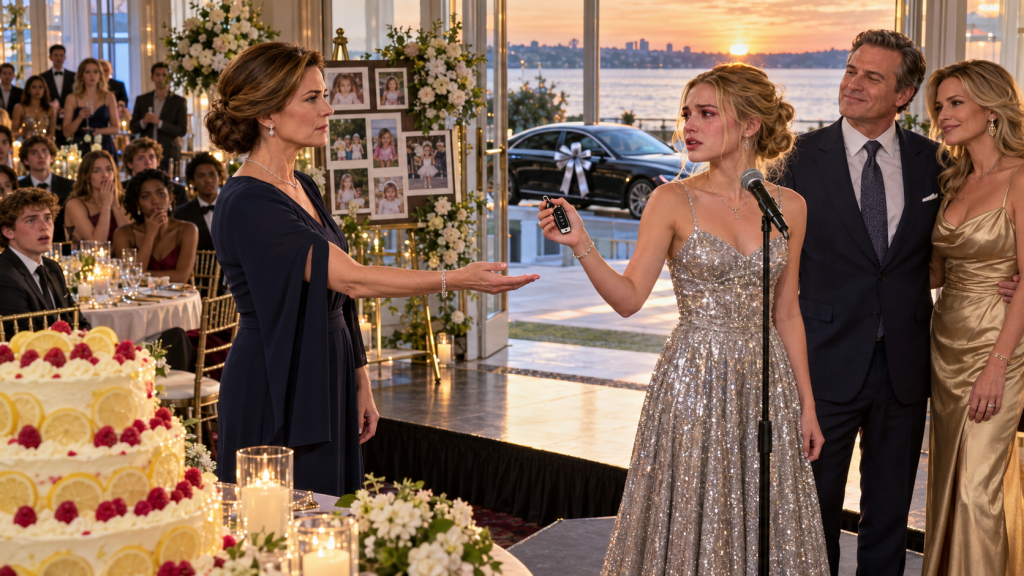
And if I could return to that ballroom now, to the moment she stood under those lights in her silver dress with Marcus’s hand on her shoulder, I would not stop her speech.
I would not grab the microphone.
I would not defend myself.
I would do exactly what I did.
Hold out my hand.
Ask for the key.
And say:
“Then I’ll respect your decision.”
Because sometimes respecting a decision is the only way someone finally learns what that decision means.
And sometimes giving the key back later means more than never asking for it in the first place.
THE END STORIES! THANK YOU FOR READING GOOD LUCK! ❤️
Related Posts