“This was never ours to accept.” My daughter-in-law turned toward her father as though he had betrayed her. “Dad.” “No.” He folded the rental list once and slipped it into his jacket pocket. “We drove up here because you told us everything had already been arranged.”
“It was supposed to be.” “That is not the same thing.” Her mother lowered her eyes. My son, Daniel, still had not moved. He stared at the transfer-on-death deed in my hand as though the paper had somehow changed the shape of the lake behind me.
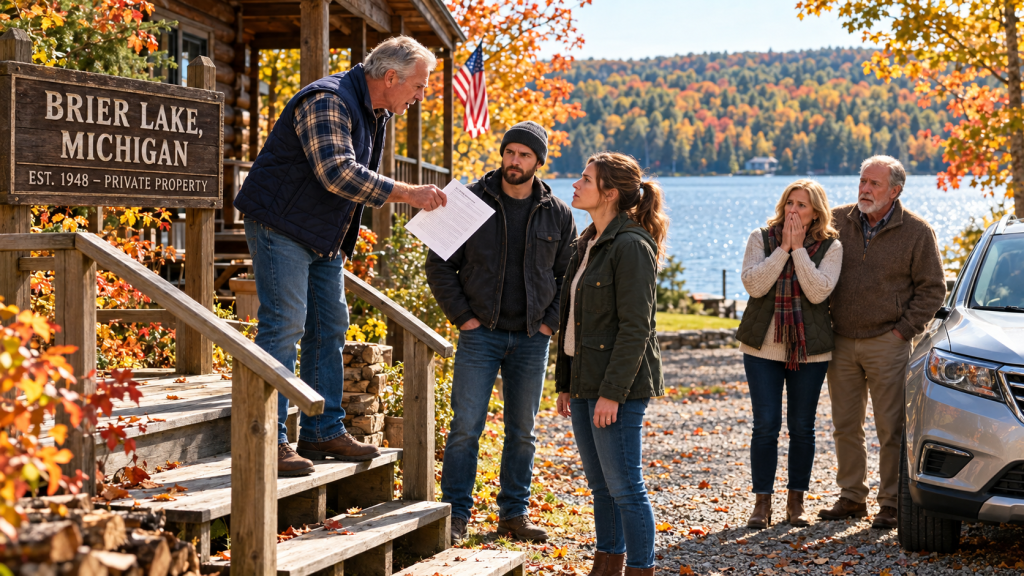
“Dad.” I looked at him. “You changed the property?” “Yes.” “Thursday?” “Yes.” “Because of this?” “Because I learned people were making plans with my home while I was still alive.” He winced. “That’s not what I meant.” “Then we should probably talk about what you did mean.”
My daughter-in-law, Vanessa, crossed her arms.
“This is cruel.”
Her father sighed.
“Vanessa.”
“No, Dad.”
She pointed toward the cabin.
“He has eleven acres.”
“He lives alone.”
“There are two bedrooms.”
“The loft can sleep four.”
“He doesn’t need all of this.”
The words settled over the porch.
Need.
As if ownership expired when someone else decided you possessed more than necessary.
I looked at her.
“How many bedrooms are in your house?”
She stared at me.
“That’s different.”
“Why?”
“Because Daniel and I have children.”
“Two.”
“Yes.”
“And your house has four bedrooms.”
Her expression hardened.
“Are you suggesting my parents live with us?”
“I suggested nothing.”
I gestured toward the rental sheet her father had taken.
“I found four places because you said they had nowhere to go.”
Her mother finally spoke.
“We never said we had nowhere to go.”
Vanessa turned.
“Mom.”
Her mother looked embarrassed.
“Our closing fell through.”
“Yes.”
“That does not mean we’re homeless.”
“You were staying in a hotel.”
“For nine days.”
Her father added quietly:
“We have savings.”
“We could have rented.”
“We thought this was temporary and already approved.”
Vanessa’s face changed.
I saw it happen.
The story she had told was beginning to separate from the people she had told it about.
She looked at Daniel.
“Say something.”
He rubbed both hands over his face.
“I told you to ask Dad.”
“You said he’d understand.”
“I said he might.”
“You said the cabin would eventually come to us.”
“No.”
His voice sharpened for the first time.
“I said Dad and I had talked generally about the property after he was gone.”
Vanessa laughed bitterly.
“Exactly.”
“No.”
Daniel stepped closer.
“That is not exactly.”
He looked at me.
“Dad.”
I waited.
“When Mom was alive, you two said maybe someday the cabin would stay in the family.”
“Yes.”
“You told me that.”
“Yes.”
“So I assumed—”
“That’s the problem.”
He stopped.
I continued.
“You assumed a conversation Carol and I had years ago was an inheritance contract.”
“I didn’t mean—”
“And then you apparently repeated that assumption to your wife until she felt comfortable promising my home to her parents.”
Daniel closed his eyes.
Vanessa snapped:
“He didn’t promise it.”
“You did.”
She looked at me.
“I was trying to solve a family problem.”
“With somebody else’s property.”
Her father said:
“That’s enough.”
Vanessa turned.
“Whose side are you on?”
He stared at her.
“There shouldn’t be sides.”
“There is a man telling us to leave.”
“No.”
I corrected her.
“I’m telling you that your parents cannot move into my home.”
“That is not the same thing.”
Her father nodded.
“He’s right.”
Vanessa looked wounded.
Her mother reached for her arm.
She pulled away.
“I cannot believe this.”
I almost asked what exactly she could not believe.
That I had said no?
That the property documents agreed with me?
That her parents had enough dignity not to participate once they understood?
Instead, I stepped aside.
“You drove a long way.”
“You’re welcome to come inside for coffee.”
Vanessa stared.
I added:
“For coffee.”
“Not to move in.”
Her father smiled faintly.
“I’d appreciate that.”
Vanessa looked as though she wanted to refuse on principle.
Her mother was already climbing the steps.
Daniel followed.
Eventually, Vanessa did too.
Inside, everything changed.
Not the cabin.
The cabin stayed exactly what it had been that morning.
Carol’s blue ceramic bowl by the sink.
My boots near the mudroom.
A stack of fishing magazines beside the fireplace.
Four mugs hanging beneath the cabinet.
But the visitors moved differently now.
Barbara—Vanessa’s mother—asked before setting her purse on the table.
Frank—her father—stood near the windows and said:
“You built this?”
“Most of it.”
“With help.”
“Beautiful work.”
“Thank you.”
Vanessa said nothing.
I poured coffee.
Daniel stood beside me.
Low voice.
“Dad, I’m sorry.”
“Not yet.”
He looked surprised.
“What?”
“Do not apologize quickly because you’re uncomfortable.”
His eyes dropped.
“We can talk later.”
He nodded.
That was something he still knew how to do.
Listen.
At least sometimes.
We carried coffee to the porch.
The lake had gone silver beneath the clouds.
Frank sat carefully.
Barbara wrapped both hands around her mug.
For several minutes nobody spoke.
Then Frank said:
“I owe you an apology.”
I looked at him.
“For what?”
“For arriving with suitcases.”
“You didn’t know.”
“I still should have called.”
“You had my number.”
“I did.”
He looked toward Vanessa.
“She said you were expecting us.”
Vanessa stared at the lake.
Frank continued.
“I should have confirmed.”
I nodded.
“Thank you.”
No speech.
No humiliation.
People who apologize plainly should not be forced to crawl.
Barbara said:
“We thought we’d be here six weeks.”
Vanessa looked at her.
“You said through spring.”
Barbara frowned.
“No.”
“You told me you needed a few months.”
“We said the builder on the new condo estimated six weeks before we could restart the purchase.”
Vanessa stared.
“That’s not what you told me.”
Frank spoke carefully.
“Honey.”
“We did not ask you to find us permanent housing.”
Vanessa’s face flushed.
“I was helping.”
“I know.”
“Then why are you making me look crazy?”
I watched Frank’s expression change.
Pain.
Recognition.
Maybe this wasn’t new.
He said:
“Nobody is making you look anything.”
Vanessa shoved her mug onto the porch railing.
“This is exactly what always happens.”
“What?”
“I try to take care of everybody and then everyone acts like I overstepped.”
Her mother said softly:
“Sometimes you do.”
Vanessa stood.
Silence.
Not anger silence.
The kind that arrives when someone hears a sentence they have been dodging for years.
Barbara continued.
“When your brother lost his apartment, you offered him our basement before asking us.”
“That was different.”
“When Aunt Claire needed help after surgery, you told her she could recover at our house.”
“She’s family.”
“We were in Florida.”
“You weren’t using the house.”
Frank closed his eyes.
There it was.
A pattern.
Not created by my cabin.
Revealed by it.
Barbara said:
“You have a good heart.”
Vanessa’s expression cracked.
“But?”
“There is always a but.”
“Yes.”
Barbara’s voice softened.
“You sometimes decide helping gives you authority over everybody else’s space.”
Vanessa stared.
“I cannot believe you’re doing this here.”
“I should have done it years ago.”
That landed.
Even I felt it.
Daniel looked at his wife.
He did not defend her.
Not yet.
That may have been the first important thing he did that day.
Vanessa whispered:
“So I’m the problem.”
“No.”
Frank answered.
“This is a problem.”
“Not your entire character.”
I liked him more by the minute.
Vanessa sat again.
Not gracefully.
She dropped into the chair.
For the next twenty minutes, nobody talked about the cabin.
We talked about the rentals.
One had a ground-floor bedroom.
One had lake access.
One allowed dogs even though Frank and Barbara’s dog had died the previous year.
Frank called the owner of the furnished cottage.
Available.
Month-to-month.
Two bedrooms.
Twenty-four minutes away.
He booked it.
Right there on my porch.
Vanessa watched him.
“You’re actually doing this.”
“Yes.”
“You could stay here for free.”
Frank looked at her.
“No.”
Her face tightened.
“Why would you waste money?”
He smiled sadly.
“Because free is not free when the person who owns the house does not want permanent guests.”
There it was.
An entire philosophy in one sentence.
By noon, they left for the rental.
I shook Frank’s hand.
Barbara hugged me only after asking:
“Would that be all right?”
“Yes.”
Vanessa reached her SUV.
Then stopped.
She looked back at me.
“What happens now?”
“With what?”
“The deed.”
I stared.
“You mean the deed transferring the property to the conservation trust when I die?”
“Yes.”
“What happens?”
“Nothing.”
“That’s it?”
“That’s it.”
“You’re really giving the cabin away because I made one mistake?”
Daniel winced.
I stepped down from the porch.
“This is not punishment.”
She laughed.
“Of course it is.”
“No.”
“I had already been thinking about the land.”
That was partly true.
Carol and I had supported the Brier Lake Conservation Trust for years.
After she died, I considered leaving them a shoreline easement.
Then perhaps several acres.
But I kept hesitating because Daniel loved the cabin too.
Or I thought he did.
Now I understood something.
Leaving land to someone because they love it is different from leaving it because they expect it.
Vanessa said:
“You changed it after I called.”
“Yes.”
“So it is because of me.”
“It was prompted by what happened.”
“That’s the same thing.”
“No.”
I held her gaze.
“Your behavior made me examine an assumption.”
“The assumption did not survive examination.”
Her eyes filled.
“What about your grandchildren?”
That hurt.
Not because she was right.
Because she knew exactly where to press.
“Eli loves fishing here.”
“I know.”
“Maya loves the loft.”
“I know.”
“They’re going to lose all this.”
“No.”
“They are going to have memories here while I am alive.”
“That is not the same as ownership.”
“They’re family.”
“Yes.”
“And family gets nothing?”
I took a breath.
“Family gets me.”
She stared.
I continued.
“While I am alive, they get weekends.”
“Fishing.”
“Campfires.”
“Christmas if we want.”
“Stories about their grandmother.”
“They get the dock.”
“The pines.”
“The lake.”
“They do not need a deed in order for those things to matter.”
Vanessa wiped beneath one eye.
Daniel spoke quietly.
“Come on.”
She got into the SUV.
He looked at me.
“I’ll call.”
I nodded.
Then they drove away.
By one o’clock, the gravel was empty.
The cabin was quiet again.
Exactly what I thought I wanted.
I went inside.
Saw five coffee mugs.
A rental list left on the table.
The transfer-on-death deed lying beside Carol’s old blue bowl.
And suddenly peace felt different.
Not peaceful.
Lonely.
That was the first thing I learned about boundaries after retirement.
A boundary can be necessary and still hurt.
The fact that silence returned did not mean I enjoyed how it returned.
I washed the mugs.
Put them away.
Then sat on the dock until sunset.
Carol had been dead four years.
Some days that felt like yesterday.
Some days like another lifetime.
I spoke to her more often than I admitted.
That evening I said:
“You would’ve handled that better.”
A loon called somewhere across the lake.
“Fine.”
“You would’ve handled it louder.”
That made me smile.
Carol liked Vanessa.
Mostly.
She also noticed things I ignored.
Three months before Carol died, Vanessa reorganized our Thanksgiving plans without asking.
Not maliciously.
Efficiently.
She created a schedule.
Assigned dishes.
Changed dinner from three to one because her parents had to drive home early.
Carol looked at the printed schedule and whispered to me:
“She manages affection like a conference.”
I laughed.
Carol didn’t.
Now I understood.
Sunday morning, Daniel called.
“Can I come up alone?”
“Yes.”
“When?”
“Tuesday.”
“Come for lunch.”
He arrived at eleven thirty.
No Vanessa.
No children.
Just my son carrying a six-pack of the beer I liked.
“Bribery?”
“Yes.”
“Accepted.”
We ate sandwiches at the kitchen table.
He looked terrible.
No sleep.
Eyes red.
I waited.
Finally:
“I said more than I admitted.”
I put down my sandwich.
“Okay.”
His eyes filled.
“Vanessa didn’t invent everything.”
I said nothing.
“She asked me what would happen to the cabin someday.”
“I told her I assumed it would come to me.”
“That was reasonable.”
“Maybe.”
“But then…”
He rubbed his hands together.
“I told her you wouldn’t want to live up here forever.”
My chest tightened.
“When?”
“Last year.”
“Why?”
“She said the kids would love spending summers here.”
“I said maybe eventually we’d use it more.”
“After I left?”
“Yes.”
“Or after I got old enough that you decided I didn’t need it?”
He closed his eyes.
“That’s what it sounds like.”
“What did you mean?”
“I don’t know.”
“Try.”
Daniel looked around.
The fieldstone fireplace.
The beams.
The windows.
“I think I started seeing the cabin as the next phase.”
I almost laughed.
“The next phase of what?”
“Our family.”
“Whose family?”
He looked at me.
“That’s a fair question.”
“No.”
“It’s the question.”
He nodded.
“Mine.”
There it was.
Not mine.
Not Carol’s.
His.
He continued.
“I never thought I was taking it from you.”
“Because in your mind, the transfer had already happened in the future.”
His face crumpled.
“Yes.”
I sat back.
“You were waiting.”
“I hate that word.”
“You should.”
Tears filled his eyes.
“Dad, I wasn’t waiting for you to die.”
“I know.”
“But part of you was waiting for the property to become available.”
He looked down.
“I think so.”
The honesty hurt.
It also mattered.
“I’m sorry.”
This time I let the apology stand.
Then asked:
“Did you tell Vanessa she could offer it to her parents?”
“No.”
“Did you imply I would agree?”
“Yes.”
“How?”
“She said you were retired.”
“That you had flexibility.”
“I said you could probably stay with me for a few months.”
I stared.
“At your house.”
“Yes.”
“While her parents stayed in mine.”
His mouth tightened.
“Yes.”
I laughed once.
Not kindly.
“So the solution to her parents needing housing was that I leave my home and move into yours.”
“When you say it like that—”
“That is how it was.”
He nodded.
“Yes.”
“Did you tell her that?”
“No.”
“Why not?”
“I knew it sounded bad.”
“Good instinct.”
He almost smiled.
Didn’t.
Then:
“Was the deed already prepared?”
“Yes.”
“When did you decide?”
“Wednesday night.”
“Before they came?”
“Yes.”
“You really weren’t bluffing.”
“No.”
He stared toward the window.
“Do you hate me?”
“No.”
He looked surprised.
“I’m disappointed.”
“That may be worse.”
“Probably.”
He laughed weakly.
Then I said:
“You are still in my will.”
His head snapped up.
“What?”
“You heard me.”
“I thought—”
“The cabin is not my entire estate.”
“I have retirement accounts.”
“Investments.”
“The Columbus house was sold years ago.”
“Cash.”
“You and your sister will inherit according to the estate plan.”
Daniel looked confused.
“My sister?”
“Your aunt Linda’s daughter is not suddenly my child.”
He laughed despite himself.
“I mean your sister Rachel.”
“Right.”
I had two children.
Daniel and Rachel.
Rachel lived in Oregon and had no interest in Michigan winters.
She loved the cabin.
But from a safe distance.
I continued.
“The trust gets the land and cabin.”
“You and Rachel receive the rest according to the will.”
“So this wasn’t disinheritance.”
“No.”
“Did Vanessa think it was?”
“Probably.”
He rubbed his face.
“She thinks you’re punishing the children.”
“She’s wrong.”
“I know.”
“Do you?”
He looked at me.
“Yes.”
Good.
Then he asked:
“What happens with the trust?”
I brought out the documents.
The transfer-on-death deed would pass the property to the Brier Lake Conservation Trust after my death, outside ordinary probate, subject to applicable legal requirements and recording.
But I had added a memorandum of understanding with the trust.
The cabin would not immediately be demolished.
The family would have scheduled memorial access for five years after my death.
Carol’s ashes—half scattered near the lake, half still in a small urn—could be interred beneath the white pine beside the dock if I chose.
The trust intended to use the property eventually as a small field station and stewardship cabin.
Daniel read quietly.
Then stopped.
“You gave us five years?”
“The trust agreed to it.”
“Why didn’t you say that Saturday?”
“Because Vanessa was arguing as though the only meaningful relationship with land was ownership.”
“I wasn’t going to reward that argument with details.”
Daniel looked at me for a long time.
Then whispered:
“Mom would like this.”
That nearly broke me.
“Yes.”
“She would.”
We sat in silence.
Then Daniel said:
“Vanessa is angry with me.”
“She should be.”
He looked surprised.
“Why?”
“You told her something was likely yours when it wasn’t.”
“You let her build expectations around that.”
“And then you let her be the only person looking entitled on my porch even though you helped create the entitlement.”
His face fell.
I continued.
“You hid behind her.”
He nodded slowly.
“Yes.”
“That is not being a husband.”
“No.”
“Or a son.”
“No.”
I sighed.
“Go home and fix your side of the marriage.”
“What does that mean?”
“Not my job.”
He laughed weakly.
“Fair.”
Before he left, he stopped near the fireplace.
“Dad.”
“Yes?”
“Can I still bring the kids up next month?”
I looked at him.
“Ask me next month.”
He nodded.
Not punishment.
Reset.
No automatic access.
No inherited calendar.
Ask.
That became the new rule.
Vanessa did not call for six weeks.
I did not chase her.
Daniel visited twice.
Once alone.
Once with Eli and Maya.
The children knew nothing about the argument.
Good.
Adults should be careful what burdens they convert into grandchildren’s inheritance.
Eli caught two perch.
Maya burned a marshmallow so completely it became structural carbon.
We laughed.
Daniel washed dishes without being asked.
Progress.
Then one Thursday, I received an envelope.
Handwritten.
Vanessa.
I considered leaving it unopened.
Then didn’t.
Inside:
I am still angry.
Interesting opening.
But I think I am angry because I am embarrassed.
Better.
My parents told me they never asked for your cabin.
They also reminded me of other times I volunteered their house, their car, and their time without asking.
I kept reading.
I thought being useful meant solving problems before anyone could say no.
When people said no, I experienced it as rejection of me instead of rejection of my plan.
That sounded like therapy.
Good.
Daniel also told me exactly what he had said about the cabin.
He had given me reason to believe it would eventually be his.
That does not excuse me telling my parents it was available while you were alive.
Plain.
No “but.”
I am sorry I called you selfish for wanting to live in your own home.
That sentence mattered.
I am also sorry I used the grandchildren when the inheritance argument did not work.
I stopped.
That mattered more.
She knew exactly what she had done.
I do not expect you to change the deed.
I am asking whether, eventually, we can start again.
Vanessa.
I read it twice.
Then set it beside Carol’s blue bowl.
I did not answer that day.
Or the next.
On Sunday, I wrote:
Thank you for the letter. We can start with lunch.
She came alone.
That surprised me.
No Daniel.
No children.
No parents.
Just Vanessa.
She stood at the porch holding a casserole.
“Can I come in?”
I almost smiled.
“Yes.”
She looked around the cabin.
Differently.
Not measuring.
Not planning.
Just seeing.
“I’ve never actually looked at the pictures.”
I followed her gaze.
Carol everywhere.
Not shrine-like.
Life-like.
Carol in muddy boots beside the future building site.
Carol holding plans upside down as a joke.
Carol sitting on the unfinished porch in a winter coat.
Vanessa stopped at one.
“You built this together.”
“In different ways.”
“She helped design it?”
“She chose the kitchen.”
“The window seat.”
“The fireplace stone.”
“Why didn’t I know that?”
“You never asked.”
The words came out more sharply than I intended.
Vanessa flinched.
I sighed.
“Sorry.”
“No.”
She shook her head.
“That’s fair.”
We sat.
She said:
“I thought of this as your retirement project.”
“It was.”
“And Carol’s dream.”
“Yes.”
“I think I separated those.”
“Why?”
“Because I barely knew her.”
True.
Carol died two years before Daniel married Vanessa.
They had met.
But briefly.
Vanessa stared toward the lake.
“My parents’ house falling through scared me.”
“Why?”
“They are getting older.”
“They downsized because Dad’s knees are bad.”
“The condo deal collapsed.”
“They were living out of a hotel.”
“I felt like I should fix it.”
“That part I understand.”
She nodded.
“The part I don’t like admitting is that I also wanted to be the daughter who solved everything.”
There it was.
Not only generosity.
Identity.
“I wanted them to say, ‘Vanessa found us this beautiful cabin.’”
I said nothing.
She continued.
“I think that’s why the rentals made me so angry.”
“Because they solved the practical problem without making you the hero.”
Her eyes filled.
“Yes.”
We sat quietly.
Then I said:
“I understand that more than you think.”
She looked at me.
“When Carol got sick, I tried to solve everything.”
“Second opinions.”
“Trials.”
“Specialists.”
“Diet.”
“Flights.”
“Every spreadsheet I could make.”
Vanessa’s expression softened.
“I’m sorry.”
“Eight weeks.”
“That’s all we had.”
I stared at the lake.
“There are problems competence cannot solve.”
“She taught me that.”
Vanessa whispered:
“I think I treat no as evidence I haven’t found the right solution yet.”
“Engineering mind.”
She almost smiled.
“Maybe I married into the right family.”
“Careful.”
We laughed.
Small.
Real.
Then she said:
“May I ask about the deed?”
“You may ask.”
“Do you think you’ll ever change it back?”
“No.”
Her face shifted.
Disappointment.
She managed it.
“Okay.”
No argument.
That was the first brick.
I continued.
“I might alter details.”
“Memorial access.”
“Conservation restrictions.”
“Family use while I’m alive.”
“But the land is going to the trust.”
She nodded.
“Can I ask why, apart from what happened?”
“Yes.”
I looked toward the shoreline.
Eleven acres.
Not huge.
But undeveloped.
Bald eagles passed through.
Loons nested nearby.
Wetland plants at the north end.
Carol loved the idea that something might remain uncut after we were gone.
“I don’t want this broken into lake lots.”
Vanessa followed my gaze.
“If Daniel and Rachel inherited it, they might sell.”
“Yes.”
“Daniel says he wouldn’t.”
“Daniel also thought I would move out temporarily so your parents could move in.”
She winced.
“Fair.”
“I’m not accusing him of bad character.”
“I’m acknowledging future pressure.”
“Taxes.”
“Repairs.”
“Children.”
“Divorce.”
“Debt.”
“Life.”
“People make promises when the pressure does not exist yet.”
Vanessa nodded.
“The trust can keep the shoreline intact.”
“That feels right.”
She looked at me.
“And the cabin?”
“They may use it for stewardship.”
“Research.”
“Maybe education.”
“Maybe it survives longer than I do.”
Vanessa smiled faintly.
“Carol would like that.”
“Yes.”
For the first time, she said Carol’s name while talking about the property.
Not cabin.
Not inheritance.
Carol.
That mattered.
My relationship with Vanessa improved slowly.
Not magically.
She still liked to organize.
At Thanksgiving she sent a proposed meal schedule.
Then immediately texted:
Suggestion only. Everyone can ignore me.
I laughed for ten minutes.
I replied:
Pie at three. Dinner at five. The republic survives.
She sent a laughing emoji.
The next summer, her parents rented a cottage near Brier Lake for two weeks.
Not mine.
They invited me for dinner.
Frank grilled trout badly.
I ate it anyway.
Afterward, he and I sat near the water.
He said:
“I was angry at Vanessa.”
“I know.”
“Then I realized we helped make her that way.”
I looked at him.
“How?”
“She was the oldest.”
“Her mother had surgeries when the kids were young.”
“I traveled.”
“Vanessa learned that getting ahead of everybody’s needs kept the household calm.”
He looked toward the cottage.
“She became useful before she learned to be asked.”
That stayed with me.
Again.
Explanation without erasure.
I said:
“She’s working on it.”
“So are we.”
Good.
My son and I had harder conversations too.
One night, Daniel and I were repairing dock boards.
He said:
“I’m glad you changed the deed.”
I looked at him.
“That’s suspicious.”
He laughed.
“I’m serious.”
“Why?”
“Because I was already budgeting around it.”
That stopped my hammer.
“What?”
“Not money exactly.”
“Future.”
He sat on the dock.
“Vanessa and I talked about retiring here someday.”
“Selling our house.”
“Maybe remodeling the cabin.”
“Adding a garage.”
I stared.
“All without asking me.”
“Yes.”
He rubbed his face.
“I didn’t understand how far I’d gone until you changed it.”
“Did you think I was going to vanish at seventy?”
He laughed painfully.
“No.”
“I think I treated your old age like a waiting room.”
That was a brutal sentence.
He knew it.
I put down the hammer.
“Thank you for saying it.”
“I hate saying it.”
“Good.”
He smiled.
Then:
“You know I love you.”
“Yes.”
“I never wanted you gone.”
“I know.”
“Both things were true?”
“Yes.”
That was the complicated part.
You can love someone deeply and still have mentally assigned their possessions to yourself.
Families do it all the time.
Jewelry.
Cars.
Land.
Furniture.
They say:
Someday this will be mine.
Usually harmless.
Until someday starts influencing today.
A year after the porch confrontation, I made another legal change.
Not to reverse the trust.
To improve it.
The conservation trust agreed to create a small annual family weekend for Daniel, Rachel, their descendants, and invited relatives for ten years after my death, subject to preservation rules.
Not ownership.
Access.
Scheduled.
Limited.
Intentional.
I did not tell anyone immediately.
Not as a test.
Because estate planning is not family entertainment.
But eventually, I showed Daniel and Rachel.
Rachel called from Oregon.
“You’re giving a research nonprofit my childhood vacation spot?”
“Yes.”
“Okay.”
That was Rachel.
Then:
“Do I still get Dad’s ugly fishing lamp?”
“It’s yours.”
“Excellent.”
Daniel laughed.
I told them about the family-use provision.
Rachel cried.
Daniel did too.
I said:
“Stop.”
Neither stopped.
Then Rachel said:
“This is better.”
“Better than what?”
“Us inheriting it together and eventually fighting over taxes.”
I smiled.
Exactly.
At seventy-four, I had enough life experience to know shared sentimental property can destroy siblings who love each other.
A cabin becomes:
Who pays the roof?
Who gets July?
Who uses more electricity?
Whose children broke the kayak?
Who wants to sell?
Who refuses?
Carol and I had seen three families collapse over inherited lake houses.
I had somehow forgotten that while imagining ours would be different.
The trust did not eliminate grief.
It eliminated one future lawsuit.
Good enough.
Vanessa eventually became one of the strongest defenders of the plan.
That surprised everyone.
Especially me.
At a family dinner, one of Daniel’s cousins said:
“Too bad the kids won’t inherit the cabin.”
Vanessa replied:
“They inherit years here.”
“And nobody has to fight over the property tax.”
I nearly dropped my fork.
Later I said:
“You rehearsed that.”
She smiled.
“A little.”
Progress.
Three years after the original confrontation, Frank died.
Heart attack.
Sudden.
Vanessa called me from the hospital parking lot.
Her voice sounded like a child’s.
“Dad’s gone.”
I drove to Indianapolis.
No question.
No condition.
No paperwork.
Some boundaries exist so generosity can be real when chosen.
I stayed in a hotel.
Barbara asked me to stay at her condo.
I declined.
Not because I was still guarding territory.
Because I liked the hotel mattress.
At the funeral, Vanessa held my hand.
Afterward, she whispered:
“I understand the cabin differently now.”
I looked at her.
“How?”
“When someone dies, you want objects to keep them still.”
I swallowed.
“Yes.”
“The watch.”
“The chair.”
“The house.”
“You start thinking if you keep the thing, you keep the person.”
“Yes.”
She cried.
“But Carol isn’t the cabin.”
“No.”
“And Dad isn’t his condo.”
“No.”
She leaned into me.
“I’m sorry it took losing him to understand that.”
I held her.
“You understood before.”
“Now you feel it.”
That is different.
Barbara sold the condo the next year and moved into a retirement community.
Her choice.
Vanessa tried to help.
Then caught herself.
She asked:
“What do you want?”
Barbara laughed.
“I’ve been waiting thirty years for you to ask that.”
They both cried.
Families can heal through sentences so ordinary no one would put them in a movie.
At seventy-eight, I had a health scare.
Chest pain.
Ambulance.
Hospital.
Not a heart attack.
Pericarditis.
Painful.
Treatable.
Daniel arrived before sunrise.
Vanessa came later.
Rachel flew from Oregon.
For twenty-four hours, everybody became weirdly polite around me.
Then I realized why.
The cabin.
I laughed.
Daniel frowned.
“What?”
“You’re all thinking about the deed.”
His face turned red.
“No.”
Rachel said:
“I absolutely am.”
I pointed at her.
“Thank you.”
She shrugged.
“You trained us to tell the truth.”
Vanessa laughed.
Daniel rolled his eyes.
I said:
“The deed still stands.”
Daniel took my hand.
“Dad, I don’t care.”
I looked at him.
This time, I believed him completely.
That was the difference four years had made.
He cared about me dying.
Not about what the paperwork would release when I did.
I recovered.
The first morning back at Brier Lake, I sat on the porch with coffee.
Daniel had stocked the refrigerator.
Vanessa had left soup.
Rachel had taped a note to the kitchen cabinet:
DO NOT CLIMB LADDERS FOR SIX WEEKS, OLD MAN.
Family.
Messy.
Annoying.
Present.
I thought about the Saturday when suitcases came up the gravel road.
At the time, I believed I was defending a building.
I wasn’t.
I was defending the difference between love and assumption.
The cabin was only where the lesson became visible.
At eighty-one, I finally scattered the rest of Carol’s ashes.
I had kept half.
Couldn’t explain why.
Maybe I wasn’t ready.
Daniel, Vanessa, Rachel, Eli, Maya, and Barbara came.
We walked to the white pine near the dock.
Nobody gave a speech until Rachel said:
“Mom would be furious we waited this long.”
I laughed.
“She liked schedules.”
Vanessa whispered:
“Not as much as I do.”
Everyone laughed.
Then I scattered the ashes.
Wind caught some.
Not dramatic.
Most fell badly into moss.
Carol would have laughed at my technique.
We put a small stone beneath the tree.
Not a gravestone.
Just:
CAROL
SHE LOVED THIS WATER
No dates.
No ownership language.
Loved.
Enough.
Afterward, Vanessa stood beside me.
“Thank you for letting us be here.”
I looked at her.
“This is family.”
She smiled.
The sentence meant something different now.
Not:
Family is entitled to the property.
It meant:
Family was invited to the moment.
Huge difference.
Eli grew up.
Went to college.
Studied forestry.
Partly because of the cabin, he claimed.
At twenty-four, he took a seasonal job with the same conservation trust that would one day receive Brier Lake.
I accused him of trying to inherit the property through employment.
He laughed.
“Long game, Grandpa.”
Maya became a teacher.
She preferred hotels to cabins.
Carol would have liked her honesty.
One summer, Eli helped survey invasive species around the north wetland.
He came back muddy and exhausted.
Said:
“You know this land is actually pretty important.”
I stared.
“Actually?”
“You know what I mean.”
“I do.”
Then:
“Are you mad it isn’t coming to you?”
He shrugged.
“When I was sixteen, yes.”
“Why?”
“Mom told us.”
I raised an eyebrow.
“She explained.”
He clarified quickly.
“She said you wanted the shoreline protected.”
“And that the cabin would eventually be used by the trust.”
“I thought it was unfair.”
“What changed?”
He looked toward the lake.
“I learned what a conservation easement is.”
Engineering grandfather.
Forestry grandson.
Paperwork saves another family.
I smiled.
“You can still be mad.”
“I’m not.”
Then he added:
“Maybe when I’m fifty and want free lakefront property, I’ll reconsider.”
Fair.
At eighty-four, I stopped living at the cabin year-round.
That sentence would have delighted the old Vanessa.
The new Vanessa never said a word.
Winter became harder.
Ice.
Snow.
Long drives.
I rented a small apartment in Marquette from December through March.
My choice.
No one pushed.
No one said:
You don’t need eleven acres anymore.
That absence mattered.
The first winter I left, Daniel asked:
“What do you want done with the cabin?”
“Nothing.”
“Heat?”
“Set to fifty-five.”
“Snow removal?”
“Ed’s nephew.”
“Checks?”
“Every two weeks.”
“Want me to come?”
“If you want.”
Not:
Take over.
Not:
Manage Dad.
Just cooperation.
One February, a pipe burst.
Daniel caught it because he had come up to ski.
Saved thousands in damage.
He called.
“See?”
“See what?”
“You need me.”
I laughed.
“Temporary usefulness does not convey title.”
He laughed for a full minute.
Family jokes are healed wounds wearing comfortable clothes.
At eighty-six, I revised my will again.
Not the cabin deed.
Still the trust.
I left Daniel and Rachel equal financial shares.
Specific personal items were assigned.
Fishing rods to Eli.
Carol’s recipe box to Maya.
The ugly lamp to Rachel.
My engineering instruments to Daniel, who had no use for them but wanted them.
The boat?
Sold after my death, proceeds to the trust for lake restoration.
Daniel protested.
“I want the boat.”
“You hate that boat.”
“It’s Dad’s boat.”
“It leaks.”
“I can fix it.”
“You said that about your first Jeep.”
He got the boat.
Fine.
Estate planning should include some irrationality.
At eighty-eight, I hosted what I suspected might be my last full family week at the cabin.
Not because I was dying.
Because stairs were becoming annoying.
Everybody came.
Daniel and Vanessa.
Rachel.
Eli with his wife.
Maya with her girlfriend.
Barbara, now ninety.
She needed a walker.
We put her in the downstairs bedroom.
By invitation.
I made sure she knew.
She laughed.
“You’re never letting that go.”
“Never.”
At dinner, she raised a glass.
“To being asked before moving in.”
Vanessa covered her face.
Everybody laughed.
Then Vanessa raised hers.
“To learning that no is a complete answer.”
Daniel added:
“To not planning Dad’s death while he’s still at the table.”
I pointed my fork at him.
“Best toast.”
We laughed until Barbara started coughing and scared everyone.
She was fine.
That week, nobody talked about who would own the cabin later.
Nobody needed to.
We fished.
Played cards.
Burned steaks.
Watched storms cross the lake.
Family memory forming without anyone trying to title it.
That is what I wanted all along.
I just didn’t know how to say it when I was younger.
Carol did.
She once told me:
“Places should hold people, not trap them.”
At the time, we were arguing about whether to build a screened porch.
I think she meant mosquitoes.
I gave it deeper meaning later.
She would forgive me.
Barbara died at ninety-two.
Vanessa asked whether she could bring a small box of her mother’s ceramic birds to the cabin for a memorial weekend.
Not leave them permanently.
Bring them.
For one weekend.
I said yes.
At the end, she packed every bird back into the box.
Then laughed.
“Look at me.”
“What?”
“Removing my own family’s belongings from your property without a court order.”
I laughed so hard I almost fell off the porch.
That was Vanessa by then.
Still intense.
Still organized.
Still capable of taking over a kitchen in twelve seconds.
But she asked.
And if I said no, she adjusted.
Not resentfully.
Not always happily.
But respectfully.
You do not need personality replacement for growth.
You need behavior change.
Daniel and Vanessa stayed married.
That surprised some relatives who thought the cabin conflict meant their marriage was broken.
It wasn’t.
It was exposed.
There’s a difference.
They went to counseling.
Daniel learned that avoiding conflict by telling different people what they wanted to hear creates larger conflict later.
Vanessa learned that anticipating needs is not the same as receiving consent.
They still argued.
Normal.
Sometimes loudly.
But I stopped being the property at the center of their marriage.
That was an improvement.
When I turned ninety, the Brier Lake Conservation Trust held a dinner honoring donors.
They invited me.
I tried to refuse.
Eli manipulated me.
Family trait.
At the dinner, a young biologist showed photographs of the shoreline.
Nesting areas.
Wetland restoration.
Native plants.
Then she displayed a map.
My eleven acres were marked as future protected property.
I stared.
Not sadness.
Not pride exactly.
Relief.
The land had a future that did not depend on whether my descendants could afford taxes.
Carol would have understood.
Daniel sat beside me.
He whispered:
“You did the right thing.”
I looked at him.
“You really mean that?”
“Yes.”
Then he smiled.
“Still keeping the boat, though.”
Greedy child.
At ninety-two, I moved permanently to a smaller place near Daniel and Vanessa.
The cabin remained mine.
I visited summers.
Sometimes weeks.
Sometimes only days.
Nobody said:
See, you don’t need it.
That was how I knew the lesson had truly landed.
Need was no longer the measure.
Choice was.
The trust helped maintain the property by agreement because transfer plans were already established.
Eli checked the shoreline.
Daniel checked the roof.
Vanessa brought groceries only after asking what I wanted.
Once she arrived with six bags.
I stared.
“You asked if I needed milk.”
“You did.”
“This is not milk.”
“I panicked.”
Some things never change.
At ninety-three, I fell on the porch.
Nothing dramatic.
Broken wrist.
Bruised pride.
Vanessa found me because she was coming for a scheduled visit.
Not unannounced.
She called an ambulance.
At the hospital, I said:
“Do not use this as evidence I can’t live there.”
She laughed through tears.
“I wouldn’t dare.”
Then:
“But can we talk about a railing?”
I thought.
“Yes.”
We installed one.
Consent.
Even safety improvements can ask first.
At ninety-four, I signed one final letter for the family.
Not secret.
I read it aloud at Christmas.
Everyone complained that I was being morbid.
I ignored them.
It said:
The cabin is not proof of how much I loved you.
Daniel cried immediately.
Weak.
If I left it to you, that would not mean I loved you more.
Because I am leaving it to the conservation trust, that does not mean I love you less.
Vanessa wiped her eyes.
The property mattered because Carol and I lived there.
You mattered because you lived with us.
Do not confuse the container with the relationship.
Rachel whispered:
“That’s annoyingly good.”
I continued.
When I die, grieve me.
Use the scheduled family weekends.
Fight over the fishing rods if you must.
But do not turn Brier Lake into evidence of who mattered most to me.
You all did.
I folded the letter.
Silence.
Then Maya said:
“So who gets the blue bowl?”
Everyone looked at the kitchen counter.
Carol’s bowl.
I had forgotten.
Chaos.
Perfect.
Rachel wanted it.
Vanessa wanted it.
Maya wanted it.
Daniel claimed sentimental rights.
I laughed until I cried.
Finally I said:
“Conservation trust.”
They booed me.
I left it to Maya.
When the end came, it was not at the cabin.
I always thought it might be.
It wasn’t.
Hospitals do not care about narrative symmetry.
I was ninety-five.
Pneumonia.
Then complications.
Daniel sat beside me.
Vanessa on the other side.
Rachel arrived the next morning.
Eli and Maya came later.
I was tired.
Not frightened.
Mostly irritated at the hospital socks.
At some point, Daniel leaned close.
“Dad.”
“Yes?”
“I want you to know something.”
“What?”
“I don’t care about the cabin.”
I looked at him.
“Liar.”
He laughed and cried at once.
“I care.”
“Good.”
“But I don’t care that I won’t own it.”
Better.
I squeezed his hand.
“Thank you.”
Then Vanessa leaned toward me.
“I’m sorry.”
“For what?”
“The porch.”
I smiled.
“That was seventy years ago.”
“Eleven.”
“Feels longer.”
She laughed.
“I really thought I was helping.”
“I know.”
“I really thought you were selfish.”
“I know.”
“I was wrong.”
“I know.”
She smiled through tears.
“You enjoy that word.”
“Very much.”
Then she said:
“Thank you for not letting my worst afternoon become my whole place in this family.”
That may have been the last sentence I remember clearly.
If this were a perfect story, I would die immediately afterward.
I did not.
I lived another nine days.
Mostly sleeping.
Mostly listening.
Then one morning, with Daniel beside me and Carol’s old photograph on the table, I was gone.
The rest I know only because they told the story later.
The transfer-on-death deed worked as intended after the legal paperwork was completed.
The conservation trust received the property.
Daniel did not contest it.
Rachel did not contest it.
Vanessa did not suggest they should.
No lawsuits.
No emergency motions.
No family war.
The trust renamed nothing.
That had been one of my conditions.
No “Henderson Memorial Cabin.”
No plaque with my face.
Just Brier Lake Stewardship Cabin.
Good.
The family used its scheduled weekends.
Eli sometimes worked there professionally.
Maya brought students once for an environmental education day.
Daniel kept the boat.
It still leaked.
Obviously.
During the first family weekend after my death, Vanessa stood on the porch where the whole conflict had begun.
Her daughter Maya asked:
“Mom, is this where you tried to move Grandma and Grandpa in?”
Vanessa groaned.
“Who told you that?”
“Everybody.”
Daniel laughed.
Vanessa looked out toward the lake.
Then said:
“Yes.”
“I thought family meant I could make decisions for people if I believed I was helping.”
Maya asked:
“And Grandpa changed the deed?”
“Yes.”
“Were you mad?”
“Furious.”
“Did you deserve it?”
Vanessa thought.
Then said:
“That’s the wrong question.”
Maya looked confused.
Vanessa continued.
“The deed wasn’t a punishment.”
“It was his decision about his property.”
“I had to learn those were separate things.”
Good.
Very good.
Then Daniel apparently said:
“He’d be insufferable if he heard you say that.”
Vanessa laughed.
“I know.”
The old porch remained.
The fieldstone fireplace remained.
Carol’s window seat remained.
The white pine beside the dock grew taller.
The trust restored part of the wetland.
Loons still called across the lake.
Families came and went.
Researchers.
Volunteers.
My grandchildren.
Later, great-grandchildren.
Nobody owned the memories.
Nobody needed to.
And the cabin did exactly what Carol and I once hoped it would do.
It gave people a quiet place beside cold water.
For a while.
Then they left.
And the lake remained.
Looking back, the day Vanessa arrived with her parents was not the day I almost lost my cabin.
Legally, I was never close to losing it.
It was the day I nearly discovered too late that my family had begun treating my future absence as a present asset.
That is a dangerous habit.
Not because inheritance is shameful.
Parents leave things.
Children receive them.
Families plan.
All normal.
The danger begins when someday quietly becomes ours.
When affection becomes expectation.
When expectation becomes permission.
When permission is assumed before the owner ever speaks.
That Saturday, I did not need to scream.
I did not need to humiliate anyone.
I did not need police waiting behind the trees.
I needed a folded rental list.
A deed.
A locked door.
And one clear sentence:
This is my home.
The locks mattered.
The lawyer mattered.
The paperwork mattered.
But not as much as what came afterward.
Daniel telling the truth.
Vanessa apologizing without demanding reversal.
Her parents refusing a gift that was never mine to give through her.
Years of asking instead of assuming.
That was the real preparation.
Not what I had waiting for them when their cars came through the pines.
What we all built after they left.
Because peace is not a cabin nobody enters.
Peace is knowing the people you love will knock first.
THE END STORIES! THANK YOU FOR READING GOOD LUCK! ❤️
Related Posts