Frank’s hand was still over my mouth. For one impossible second, I could not move. Could not breathe. Could not make my mind accept what my eyes were seeing. He was thinner. Much thinner.
His gray hair was uncombed, his cheeks hollow, and there was a purple bruise beneath his left eye. He wore sweatpants I had never seen before and a sweater that hung loosely from his shoulders.
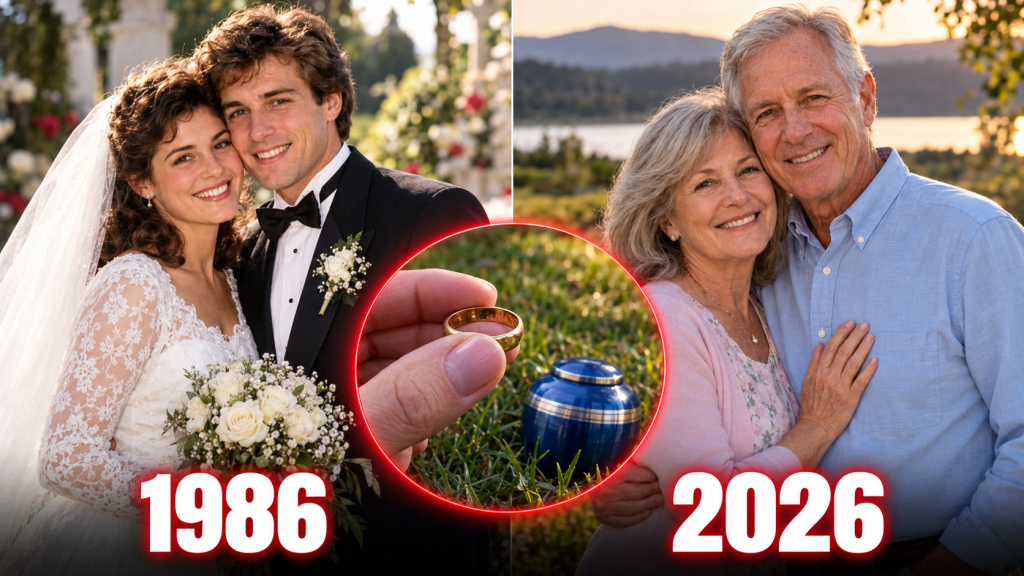
But it was Frank. My Frank. The man whose ashes I had carried beneath a willow tree. The husband I had cried over until my ribs hurt. Alive. His hand trembled against my face. “Martha,” he whispered again. “Please.”
I turned.
My knees nearly gave out.
I grabbed his sweater with both hands.
“Frank?”
His face crumpled.
“Oh, God.”
I hit him.
Not hard.
Once against the chest.
Then again.
“You’re alive.”
“I know.”
“You’re alive.”
“I know.”
“You let me think—”
“I didn’t.”
Then I threw my arms around him.
Frank nearly collapsed under the force.
He gave a strangled laugh and held me so tightly I could feel his bones through the sweater.
I buried my face against his neck.
He smelled like soap, rain, and something medicinal.
Not ashes.
Not memory.
Him.
For forty years, I had known the rhythm of that body.
The rise of his chest.
The little hitch in his breathing when he was frightened but pretending not to be.
The way his right hand always rested slightly higher on my back than his left.
Death had taken all of those things from me.
And now they were suddenly there again.
I pulled away and touched his face.
His forehead.
His jaw.
His ears.
As though Claire might have built a very convincing replica.
“You’re real.”
“I hope so.”
I started crying again.
Then fury returned.
“What is happening?”
Frank glanced toward Claire’s kitchen window.
“Not here.”
“What did she do to you?”
“Martha.”
“Why did she tell me you were dead?”
“Not here.”
“Those ashes—”
He caught my shoulders.
“We need to leave.”
His fear stopped me.
Frank was not dramatic.
In forty years, I had seen him stay calm through a burglary, a tornado warning, my emergency surgery, his own mother’s stroke, and one memorable Christmas when our kitchen caught fire because he tried to deep-fry a turkey indoors.
If Frank said run, I ran.
“Where?”
“Anywhere she can’t see us.”
We slipped through the side gate.
Frank stumbled.
I caught his arm.
“What’s wrong?”
“Sedatives.”
My blood went cold.
“What?”
“Walk.”
We crossed the street.
The café was closed.
A convenience store two blocks away still had lights on.
Frank leaned heavily against me the entire way.
I wanted to ask a thousand questions.
Instead, I counted his steps.
One.
Two.
Three.
Alive.
Four.
Five.
Alive.
Inside the store, a bored young cashier looked up from his phone.
Frank lowered himself into a plastic chair beside the window.
I bought two bottles of water.
Then I locked myself in the tiny restroom and called emergency services.
Frank had argued.
“No police yet.”
“Absolutely police.”
“Claire will say I’m confused.”
“Let her.”
“She has documents.”
“So do I.”
“You don’t understand.”
I looked at him.
“I carried your urn onto an airplane.”
He shut up.
I called.
Then I called the number the embassy website listed for emergency assistance.
Then I called the hotel I had booked under my maiden name and told them we were coming but that no information about me was to be released to anyone.
Only after those calls did I sit across from my dead husband.
My allegedly dead husband.
He drank half the water in one swallow.
I stared at his left hand.
Bare.
Then reached into my coat pocket.
The ring.
Frank looked at it.
His eyes filled.
“You found it.”
I held it between two fingers.
“DON’T BELIEVE HER.”
He nodded.
“You put this in the urn?”
“Yes.”
“How?”
His shoulders sagged.
“That part is a long story.”
“We appear to have time.”
He almost smiled.
Then his face changed.
“Martha, I thought it wouldn’t reach you.”
“What?”
“I thought she’d find it.”
I leaned closer.
“Start at the beginning.”
He looked toward the store window.
Rain streaked the glass.
Then he began.
“When Claire invited me here, I thought it was real.”
“The reconciliation?”
“Yes.”
His voice broke.
“For years I thought I’d failed her.”
I knew that.
Claire had been eleven when Frank divorced her mother, Anne.
She had lived mostly with Anne.
Weekends with Frank at first.
Then less.
At sixteen, Claire moved abroad with her mother.
At twenty-two, she stopped calling for almost three years.
When Frank and I married, she was thirteen.
She hated me immediately.
I never blamed her.
I was the woman standing in the place where she thought her mother should still be.
Children are not responsible for making sense of adult endings.
Frank always believed time would soften things.
Sometimes it did.
Then hardened again.
Over the last five years, though, Claire had called more.
Birthdays.
Christmas.
Video chats.
She sent photographs.
Asked Frank about his health.
When she invited him for three weeks, he had cried after hanging up.
He denied it.
But I saw.
“I told you to go.”
I whispered.
“I know.”
“I packed your suitcase.”
“I know.”
“You kissed me at the airport.”
Frank reached across the little store table.
His fingers closed around mine.
“That was real.”
My throat tightened.
“What happened?”
“The first four days were wonderful.”
“She took me to dinner.”
“Showed me the city.”
“We talked about old things.”
“She apologized.”
“For what?”
“For shutting me out.”
He looked down.
“I apologized too.”
“For the divorce.”
“For not fighting harder when Anne took her overseas.”
“For… all of it.”
Then his jaw tightened.
“On the fifth night, Claire brought out papers.”
“What papers?”
“A property transfer.”
My mind immediately went to the voice outside the kitchen.
Still refusing to sign.
“What property?”
Frank rubbed both hands across his face.
“The Seabrook property.”
I stared.
“What Seabrook property?”
His eyes met mine.
“I never told you.”
“Apparently.”
“Martha—”
“Frank.”
“It belonged partly to Anne.”
That silenced me.
He continued.
“Years before Claire was born, Anne’s father bought a coastal house outside Seabrook.”
“When he died, Anne and her brother inherited it.”
“Her brother sold his share.”
“Anne and I bought it.”
“Together.”
I had known Anne’s father had money.
I had not known about a house.
“How much is it worth?”
Frank hesitated.
That told me enough.
“How much?”
“About one point eight million.”
I stared at him.
“Dollars?”
“Yes.”
“You have owned a one-point-eight-million-dollar house for forty years and neglected to mention it?”
“Not forty.”
“Frank.”
“Thirty-seven.”
“Much better.”
He actually smiled.
For half a second, we were us again.
Then I remembered why we were there.
“Why didn’t you tell me?”
“Because after the divorce, the settlement was ugly.”
“Anne wanted to keep Seabrook.”
“She couldn’t refinance.”
“I bought out part of her interest.”
“But she kept a life-use arrangement for several years.”
“Later she moved abroad permanently.”
“Eventually I ended up with full title.”
“And Claire?”
“Always believed the house should have been hers through her mother.”
I sat back.
“Was she wrong?”
Frank took a long breath.
“Morally?”
“I don’t know.”
“Legally, yes.”
“In the divorce, Anne received other property and cash.”
“Seabrook came to me.”
“But Claire grew up hearing a different version.”
“What version?”
“That I took her mother’s family house.”
I closed my eyes.
Of course.
Children inherit stories long before they inherit property.
“Did you ever tell Claire your side?”
“No.”
“Why?”
“I didn’t want to call her mother a liar.”
“Anne is dead.”
“I know.”
“Frank.”
“I know.”
His voice cracked.
“By the time Anne died, Claire believed what she believed.”
“And I thought correcting her would sound like I was attacking her mother.”
“So I let it sit.”
I looked at him.
“What did you plan to do with the house?”
He swallowed.
“Give it to Claire.”
I froze.
“What?”
“In my estate plan.”
“How?”
“She gets Seabrook outright.”
My anger shifted.
“Does she know?”
“No.”
“Why not?”
“It was supposed to be in the letter Henry prepared.”
My stomach dropped.
“Our attorney?”
“Yes.”
“You changed your will?”
“Six months ago.”
“Without telling me?”
Frank winced.
“Not exactly my strongest week for honesty.”
I stared.
“What else did you change?”
“Nothing that hurts you.”
“That is not comforting.”
“Martha.”
“What happens to me?”
“You keep our home.”
“You keep the retirement accounts that already pass directly to you.”
“You receive the income from my investment trust for life.”
“Claire gets Seabrook and six hundred thousand dollars.”
“After you die, whatever remains in the trust is divided between Claire and the grandchildren.”
I just stared at him.
“You were going to leave her a million-dollar house.”
“One-point-eight.”
“Do not correct that number right now.”
“Fair.”
“And six hundred thousand.”
“Yes.”
“And she kidnapped you because she thought you were cutting her out?”
Frank looked miserable.
“She did not ask what I was leaving her.”
“What did she ask?”
“To sign Seabrook over immediately.”
“Why?”
“She said she had an investment opportunity.”
“Martin?”
“Who?”
“Sorry.”
Wrong family.
My mind was apparently so overwhelmed it was borrowing villains from other nightmares.
“Who was the investment with?”
“Her.”
Frank said.
“Her company.”
“What company?”
“A luxury rental business.”
I remembered pictures Claire had posted online.
Renovated villas.
Ocean terraces.
Champagne.
“Is it doing badly?”
“Very.”
“How badly?”
“She owes banks.”
“Private lenders.”
“Two partners.”
“She used personal guarantees.”
My hands went cold.
“She needed Seabrook as collateral.”
“Yes.”
“And you said no.”
“I said I would not mortgage or transfer a family property to rescue a failing company.”
“What did she say?”
“That I owed her.”
Frank looked away.
I could imagine it.
Forty years of stored anger opening at once.
“She told me I chose you over her.”
“Did you?”
“Not the way she thinks.”
“That is not an answer.”
He looked at me.
“Sometimes.”
I appreciated that more.
There had been years when our marriage came first.
Years when Claire’s hostility exhausted him.
Years when he stopped calling because every conversation became punishment.
Families rarely break because of one villain.
They break through accumulation.
But what Claire had done now was something else entirely.
“What happened after you refused?”
Frank continued.
“She apologized the next morning.”
“Said she’d gotten emotional.”
“We went to lunch.”
“That night, I got dizzy.”
My fingers tightened around the water bottle.
“Drugged?”
“I think so.”
“Varga?”
“Yes.”
“So he really is a doctor?”
Frank laughed bitterly.
“Was.”
“What?”
“His medical license was suspended almost three years ago.”
“For what?”
“I don’t know all of it.”
“Prescription issues.”
“Improper records.”
“Something involving a private clinic.”
“But Claire introduced him to you as a physician.”
“Yes.”
“She said he was an old family friend.”
“He examined me when I got dizzy.”
“Of course he did.”
“He said I was dehydrated.”
“What did he give you?”
“Something dissolved in water.”
“I don’t know.”
I looked at the bruises on Frank’s arms.
“They drugged you.”
“Repeatedly.”
My throat burned.
“For how long?”
His eyes met mine.
“Since the sixth day.”
The day Claire called me.
The day Frank supposedly died.
I felt nauseous.
“What do you remember?”
“Waking in a bedroom downstairs.”
“The windows had locks.”
“My phone was gone.”
“My passport too.”
“Claire told me I had suffered a neurological episode.”
“She said I was confused.”
“She showed me papers.”
“What papers?”
“Power of attorney.”
“Seabrook transfer.”
“A revised trust.”
“What revised trust?”
“One making her sole beneficiary.”
I inhaled slowly.
“All of it?”
“Most.”
“Me?”
“You would receive our house.”
“How generous.”
Frank closed his eyes.
“I kept refusing.”
“Then she told me you knew.”
I stared.
“What?”
“She told me you and she had spoken.”
“She said you agreed I had become difficult.”
“She said you thought signing would avoid public embarrassment.”
My heart cracked.
“You believed her?”
“No.”
“Not at first.”
My stomach twisted.
“At first?”
He looked ashamed.
“Martha, they kept me sedated.”
“I lost track of time.”
“They took my watch.”
“The curtains stayed closed.”
“Sometimes I woke and thought it was morning when it was night.”
“She would sit beside me and tell me things.”
“You had cried on the phone.”
“You were tired of dealing with my health.”
“You wanted her to handle everything.”
“I knew it didn’t sound like you.”
“But after enough days…”
He looked down.
“I started questioning myself.”
I reached across the table.
“Frank.”
His hand was ice cold.
“I’m sorry.”
“For what?”
“I left you there.”
“You thought I was dead.”
“But I should have come.”
“You wanted to.”
“Claire stopped you.”
“I let her.”
“Martha.”
He squeezed my hand.
“She used grief against you.”
That sentence landed hard.
He continued.
“Then one afternoon I heard her and Varga talking.”
“They thought I was asleep.”
“About what?”
“The death certificate.”
My skin prickled.
“There was no hospital?”
“No.”
“No ambulance?”
“No.”
“No collapse?”
“No.”
The entire story had been manufactured.
Claire’s crying voice.
The hospital paperwork.
The cremation.
All of it.
“What did she send me?”
Frank looked sick.
“I don’t know.”
“The ashes.”
“I don’t know.”
“What did she tell you?”
“That she had told you I was dead.”
“That an urn was being prepared.”
“She said once you scattered the ashes, you’d accept it.”
I could barely speak.
“Why fake your death before getting the signature?”
“To keep you away.”
“And to make me easier to control.”
He swallowed.
“She said if I signed, they would move me somewhere comfortable.”
“Where?”
“Private care.”
“You mean hide you.”
“Yes.”
“Forever?”
His silence answered.
My blood went cold.
“What if you never signed?”
Frank looked at me.
“I tried not to think about that.”
Neither did I.
Then I held up the ring.
“How did this get into the urn?”
His expression changed.
A tiny spark of pride appeared.
“The blue urn was in the guest room.”
“Before you supposedly died?”
“Yes.”
“Claire bought it in advance.”
I nearly laughed from the horror of it.
“Of course she did.”
“One day she left me alone for maybe ten minutes.”
“I was less drugged than usual.”
“I had heard them discussing mailing the urn.”
“I knew if it reached you, maybe I could put something inside.”
“The ring?”
“Yes.”
“How did you engrave it?”
Frank almost smiled.
“Claire has a craft table.”
“There was a little rotary engraving pen.”
“I could barely hold it.”
I looked at the tiny letters.
They were rough.
Uneven.
One N deeper than the others.
I had thought grief made my hands shake when I read them.
It had been Frank’s shaking hand that wrote them.
“I scratched the words.”
“And dropped the ring into the urn.”
“Then I heard her coming.”
“I put the empty liner back.”
“She later put the bag inside.”
“She never noticed.”
“And then told me you were cremated wearing it.”
Frank’s face hardened.
“She always hated that ring.”
“Why?”
“She thought it proved I loved you more than her mother.”
“That makes no sense.”
“Grief rarely checks its math.”
I looked at the band again.
Forty years.
My wedding ring to Frank had never been dramatic.
Simple gold.
His matched mine.
He used to twist it when thinking.
Tap it against coffee mugs.
Lose it inside work gloves.
Once accidentally drop it into pancake batter.
Now the same ring had crossed an ocean inside a fake urn to tell me my husband was alive.
I slid it onto his finger.
Frank stared at it.
Then at me.
“I thought I’d never wear it again.”
“You’re not getting rid of it that easily.”
His face folded.
I kissed his knuckles.
“Frank.”
“Yes?”
“I am going to be very angry with you about the secret million-dollar house later.”
“One-point-eight.”
I glared.
“Later.”
He laughed.
Then suddenly swayed.
I caught him.
His face went gray.
That ended the conversation.
The ambulance arrived minutes later.
This time, a real one.
I rode with him.
At the hospital, I refused to leave.
They ran blood tests.
Scans.
Heart monitoring.
A young doctor who actually displayed identification examined him.
Frank had dehydration.
Malnutrition.
Bruising consistent with restraint or falls.
And traces of sedative medication still in his system.
The physician could not say how long he had been given them.
Hair and blood samples were taken for later analysis.
Police arrived before midnight.
Then consular staff.
I repeated everything.
Frank repeated everything.
The ring was photographed.
The engraving.
The documents I had from Claire.
The original message telling me Frank had died.
The shipping label from the urn.
The photograph she sent of Varga.
By dawn, I had not slept in twenty-four hours.
Frank was asleep in a hospital bed.
A real hospital bed.
A police officer sat outside.
I stared at my husband’s chest.
Rising.
Falling.
Rising.
Falling.
There are sounds you never appreciate until somebody convinces you they are gone.
At seven in the morning, my phone rang.
Claire.
I watched her name appear.
Frank opened his eyes.
“Don’t answer.”
I looked at him.
“I want to.”
“Martha.”
“I am not going to tell her where we are.”
“What will you say?”
“I don’t know.”
That was the truth.
Then I answered.
“Hello?”
Silence.
Then Claire.
“Where are you?”
No greeting.
No concern.
No performance now.
I said:
“Who says I’m anywhere?”
Her breathing changed.
“You’re here.”
I looked at Frank.
He mouthed:
Careful.
Claire continued.
“You came here.”
“What makes you think that?”
“Because the hotel called.”
My stomach dropped.
“What hotel?”
“The one you booked.”
I had used my maiden name.
How had she—
Then I remembered.
Airline reservation.
Family contact.
Maybe she had access through Frank’s travel profile.
Maybe pure bluff.
It did not matter.
Claire’s voice sharpened.
“Where is my father?”
I almost laughed.
Your father.
As though she had misplaced him.
“Shouldn’t you know?”
Silence.
Then:
“Martha.”
“Claire.”
“He’s sick.”
“Yes.”
“You don’t understand what’s happening.”
“That sentence has been very popular lately.”
“Martha, listen to me.”
“No.”
Her voice cracked.
“My father is not well.”
“He’s confused.”
“He becomes paranoid.”
I looked at Frank.
He could hear enough to understand.
His jaw tightened.
Claire continued.
“If he found you, he probably told you terrible things.”
“He did.”
“They’re not true.”
“Which part?”
Silence.
“The part where you told me he was dead?”
Claire did not answer.
“The part where you mailed me an urn?”
Nothing.
“The part where you told me he had been cremated wearing his wedding ring?”
Still nothing.
Then I said:
“He’s wearing it now.”
A small sound came through the phone.
Not words.
Shock.
She knew.
The ring.
Claire whispered:
“You opened the urn.”
“Yes.”
“What was inside?”
“You should know.”
“Martha.”
“What was inside?”
Her voice had panic now.
I smiled without humor.
“You missed something.”
She hung up.
Frank whispered:
“She knows.”
“Good.”
“No.”
His face had gone pale.
“She’ll run.”
Police agreed.
Officers reached Claire’s house less than an hour later.
She was gone.
So was Varga.
Frank’s passport remained in a locked desk.
His phone was there too.
The fake documents.
Bottles of medication.
Copies of his financial records.
Printed emails between Claire and several lenders.
And the soft-blue urn receipt.
Dated four days before Frank arrived.
That receipt destroyed something inside me.
Because it made the plan older than the first sedative.
Older than the argument.
Claire had bought the urn before Frank even landed.
Whatever she later claimed about panic, desperation, or events “getting out of hand,” there had already been preparation.
Maybe not every detail.
But enough.
The ashes were tested weeks later.
They were bone fragments.
Human.
That revelation horrified me.
But they were not Frank’s.
Authorities traced them through Varga to a shuttered private cremation service where recordkeeping had been criminally mishandled.
The identity of the person whose remains had been placed in Frank’s urn could not be established with certainty.
I mourned that stranger.
Somebody had been reduced not only to ashes but to a prop in another family’s crime.
Eventually the remains were transferred respectfully to local authorities for proper handling.
That mattered to me.
Someone belonged to those ashes.
Even if we never learned who.
Claire and Varga were arrested at a train station the next evening.
They had tickets booked under their own names.
Apparently criminals can be both calculating and astonishingly stupid.
When police found them, Claire claimed Frank had become mentally unstable and that Varga had been helping manage a medical crisis privately to protect family dignity.
Then police showed her the forged death documentation she had sent me.
Her story changed.
The next version was that Frank had agreed to fake his death temporarily because of tax complications.
Frank laughed when told.
“I’ve hated taxes.”
he said.
“Never enough to die.”
The case became ugly.
Public.
Complicated.
Frank and I stayed abroad for nearly six weeks because investigators needed statements and Frank was not medically fit to fly immediately.
Those weeks did strange things to us.
At night, he woke shouting.
Sometimes convinced he was back in Claire’s downstairs room.
Once he ripped the hospital IV from his arm trying to get to the door.
Another time I woke in the hotel apartment to find him sitting on the floor with his suitcase already packed.
“Where are you going?”
“Home.”
“It’s three in the morning.”
“I know.”
“Frank.”
He looked at me.
“I need to know the house is still there.”
Our house.
The one we had shared for forty years.
I sat beside him.
“It’s there.”
“How do you know?”
“Because trees rarely steal real estate.”
He laughed weakly.
Then cried.
Frank almost never cried.
That frightened me more than anything.
“I thought you buried me.”
he whispered.
My throat closed.
“I almost did.”
“I imagined you under the willow.”
“I was there.”
“I talked to you.”
“What did you say?”
“Private.”
He smiled through tears.
“Forty years and now we have privacy?”
“Absolutely.”
Then I told him anyway.
I told him I had apologized for every stupid fight.
For the time I threw his fishing hat away because I thought it smelled.
For refusing to go to Arizona with him one winter.
For not telling him often enough that marrying him had made my life larger.
Frank listened.
Then whispered:
“I heard you.”
I stared.
“What?”
He touched his chest.
“No.”
“I mean…”
He smiled.
“I’d like to think I did.”
I leaned against him.
“You’re becoming sentimental.”
“Near-death experience.”
“You didn’t die.”
“Near-fake-death experience.”
“Much rarer.”
We laughed.
That laughter saved us.
Not permanently.
Nothing permanently saves anyone.
But for a few minutes.
The financial investigation revealed why Claire had been desperate.
Her business was not simply struggling.
It was collapsing.
She owed the equivalent of almost nine hundred thousand dollars.
Some loans were secured.
Others were not.
Two investors claimed she had misrepresented occupancy rates on luxury rental properties.
A tax authority had begun reviewing deductions.
One property was weeks from foreclosure.
Seabrook would have solved many immediate problems.
Not permanently.
But enough to delay collapse.
And delay is seductive when shame is chasing you.
Investigators recovered messages between Claire and Varga.
I was not permitted to see everything.
But Frank’s lawyer summarized several.
At first, Claire had discussed persuading Frank to transfer the property.
Then manipulating him while medicated.
Then making him appear cognitively impaired.
Finally, creating the story that he died.
Varga repeatedly warned:
Once wife believes death, timeline must stay consistent.
Claire replied:
She won’t come. She hates flying.
That line made me stare.
I did hate flying.
Frank knew.
Claire knew.
She had built part of her plan around my fear.
The thing that almost kept me from going to my husband when he “died” became the very thing she believed would keep me away forever.
I thought about that often.
Fear is dangerous.
But assumptions about another person’s fear can be dangerous too.
Claire did not know I would board a plane because of a wedding ring.
She did not know grief could make a frightened woman brave.
Frank eventually told investigators something he had not told me.
Claire had offered him a choice.
Sign the Seabrook transfer and revised trust.
Or she would tell me he had left me voluntarily.
I stared at him.
“When?”
“Tenth or eleventh day.”
“What exactly did she say?”
“That she could tell you I had another woman.”
My stomach twisted.
“She said you would believe it because old men become pathetic.”
I flinched.
Frank looked ashamed, as though he had spoken the insult himself.
“She said she could create messages.”
“Photographs.”
“A hotel receipt.”
“And if I ever returned home, you would think I was coming back because the affair failed.”
I sat silently.
“Would you have believed her?”
he asked.
I wanted to say no instantly.
Forty years.
Trust.
History.
But honesty mattered more.
“I don’t know.”
Frank looked wounded.
I took his hand.
“I would have wanted not to.”
“But grief is confusing.”
“And a dead man cannot defend himself.”
He nodded.
“That’s why she wanted the death story first.”
The true cruelty was not simply financial.
Claire understood narratives.
Once someone is dead, others finish their story for them.
She planned to choose Frank’s ending.
Then use it to control mine.
That realization angered me almost more than the property.
When Frank became strong enough to travel, we came home.
At the airport, I expected relief.
Instead, Frank froze at baggage claim.
People moved around us.
Announcements echoed overhead.
He gripped the suitcase handle.
“I can’t.”
“Yes, you can.”
“No.”
“Frank.”
“I can’t breathe.”
I put both hands on his face.
“Look at me.”
He did.
“Where are you?”
“With you.”
“Where?”
“Airport.”
“Which one?”
He named it.
“Are you dead?”
He blinked.
Then laughed.
“No.”
“Good.”
“Because I am not carrying another urn.”
That did it.
He breathed.
We went home.
Our front door looked exactly the same.
The rose bush needed trimming.
Someone had left three newspapers beneath the porch bench even though I had suspended delivery.
Inside, everything smelled faintly stale.
Frank stood in the living room.
Touched the back of his chair.
Ran one hand over the bookshelf.
Then walked into the kitchen.
He opened the refrigerator.
I stared.
“What are you doing?”
“Checking.”
“For what?”
“Milk.”
I started laughing.
Hard.
Uncontrollably.
He looked offended.
“What?”
“You survived a fake death and kidnapping and your first concern is milk?”
“I’ve been married to you forty years.”
“Somebody has to manage practical matters.”
I laughed until I cried.
Then Frank cried too.
We stood in the kitchen holding each other beside expired milk.
That was our real homecoming.
Henry came the next morning.
Our attorney.
Same Henry who had drafted Frank’s estate plan.
He was furious.
Not at us.
Mostly.
“You should have told Martha about Seabrook.”
he said.
Frank nodded.
“I know.”
“You should have told Claire what you planned to leave her.”
“I know.”
“You should not make major estate decisions in secret if the secrecy creates predictable misunderstanding.”
“I know.”
I looked at Henry.
“Could you insult him more?”
“I bill hourly.”
Frank almost smiled.
Then Henry turned to me.
“And you.”
“What did I do?”
“You flew internationally alone while actively grieving based on a cryptic ring inscription.”
I folded my arms.
“And found my husband.”
“Yes.”
Henry sighed.
“Annoyingly, yes.”
Then he became serious.
We reviewed everything.
Frank’s estate plan had never been changed after he left.
Claire had no authority.
No transfer was complete.
No revised trust was valid.
No power of attorney had been accepted by Frank’s institutions because several signatures raised concerns and Henry had placed precautionary alerts after receiving suspicious inquiries from abroad.
“You knew?”
I asked.
“Not enough.”
Henry said.
“Two days after Claire reported Frank dead, someone emailed me asking how quickly Seabrook could be transferred under a foreign power of attorney.”
“Who?”
“An address associated with Varga.”
“What did you do?”
“Nothing useful except refuse.”
“Why didn’t you tell me?”
Henry looked ashamed.
“Because you had just been told your husband died.”
“And the inquiry was framed as estate administration.”
“I thought Claire was being aggressive.”
“Not criminal.”
Frank muttered:
“She’s always been aggressive.”
I glared at him.
“Not helping.”
Then Henry opened the sealed letter Frank had meant Claire to receive after his death.
“Do you want to see it?”
Frank looked at me.
Then nodded.
Henry handed it over.
Frank had written it six months earlier.
Claire,
There are things I should have said while we were both alive enough to argue about them.
I swallowed.
The letter explained Seabrook.
The divorce.
Anne’s settlement.
Frank’s choice not to contradict her publicly.
Then:
You have always believed I kept Seabrook because I valued property more than your mother. The truth is less dramatic. The settlement left me responsible for debts tied to the property, and I eventually retained title. I kept it partly because selling it felt like erasing the last place where all three of us had once been happy.
I looked at Frank.
He stared at the floor.
The letter continued.
I also kept it because I hoped one day to return it to you without attaching anger to it.
My throat tightened.
Seabrook is yours after my death. Not because you are owed compensation for every mistake I made as your father. No property can do that. It is yours because part of your childhood lives there, part of your mother lives there, and I want you to decide what happens next.
Claire had risked everything to seize something Frank had already planned to give her.
That was the cruelest twist.
She never asked.
She assumed.
Assumptions had done what resentment alone could not.
Henry looked at Frank.
“Do you still want her to inherit it?”
The room went silent.
I expected an immediate no.
Frank looked old suddenly.
Older than before the trip.
“I don’t know.”
That answer was honest.
We did not decide that day.
Or that month.
The criminal proceedings abroad lasted nearly two years.
Claire eventually pleaded guilty to charges involving unlawful confinement, fraud, forged documents, and conspiracy connected to the fake death scheme.
Varga received a harsher sentence because of his role in supplying drugs, falsifying medical material, and his prior professional history.
Claire’s attorneys argued that she had acted under extreme financial pressure and had never intended physical harm.
The prosecutors argued planning began before Frank arrived.
Both things could be true.
Pressure explains.
Planning condemns.
Frank did not testify at sentencing in person.
He submitted a statement.
I helped him edit it.
The first draft was furious.
You killed me before my body was dead.
I told him to keep that line.
He did.
Then he wrote:
The hardest part is not that you wanted my property. It is that you decided my love could be measured only by whether I surrendered it. You could have asked me what I planned for you. You could have told me you were drowning financially. You could have hated me honestly. Instead, you chose to make me disappear.
Then:
I do not know whether I forgive you yet. I know only that I am alive, and from now on, I will not spend that life pretending trust survived simply because love did.
That was Frank.
Love without false comfort.
Claire was sentenced.
Not forever.
Long enough.
When she went to prison, Frank became depressed.
People found that confusing.
“She tried to ruin you.”
“Yes.”
“Why are you sad?”
“Because she’s my daughter.”
The answer should have been obvious.
Consequences do not amputate history.
Frank remembered newborn Claire sleeping on his chest.
Five-year-old Claire refusing to go to kindergarten.
Twelve-year-old Claire slamming our front door.
Twenty-year-old Claire calling for money.
Forty-year-old Claire finally saying:
“I miss you, Dad.”
All of those versions remained inside the woman who bought his urn in advance.
Human beings are inconvenient that way.
We want villains to have always been villains.
It makes us feel safer.
But Claire had been a child who loved her father.
Then an adult who carried resentment badly.
Then a desperate woman who made terrible decisions.
One truth did not erase the others.
Frank began therapy.
So did I.
Separately.
Then together.
Our therapist asked during one session:
“What are you angriest about?”
I answered immediately.
“The urn.”
Frank looked surprised.
“Not Seabrook?”
“No.”
“Not that she drugged me?”
“That happened to you.”
“I’m asking about me.”
The therapist nodded.
I continued.
“She made me mourn him.”
My voice broke.
“She made me choose clothes for a memorial.”
“I called our children.”
“I called his friends.”
“I slept with his sweater.”
“I sat under that willow apologizing to a bag of somebody else’s bones.”
Frank reached for me.
I pulled away.
Not because I was angry at him.
Because I needed to finish.
“She stole a month of my life and filled it with a death that never happened.”
The therapist asked:
“What would repair that?”
“Nothing.”
I said.
That was the right answer.
Not everything can be repaired.
Some things can only be survived and placed in the correct part of the past.
Then she asked Frank:
“What are you angriest about?”
He stared at the floor.
“That I almost signed.”
I turned.
“What?”
He had never told me that.
Frank’s voice shook.
“On day twelve.”
“They brought the Seabrook transfer.”
“I was exhausted.”
“I believed maybe you hated me.”
“I thought if I signed, they’d let me call you.”
My heart broke.
“I put the pen on the page.”
“What stopped you?”
He looked at his wedding ring.
“You.”
I swallowed.
“How?”
“I remembered our first mortgage.”
I almost laughed.
“What?”
“1984.”
“Interest rate from hell.”
“That bank officer pushed three papers toward us.”
“You read every line.”
“I wanted to sign.”
“You kicked me under the table.”
I remembered.
Frank smiled weakly.
“You said, ‘Never sign something just because somebody is making you feel slow.’”
Tears filled my eyes.
“You remembered that?”
“Apparently trauma preserves mortgage advice.”
He laughed.
Then cried.
“I put the pen down.”
That tiny memory saved him.
Not romance.
Not destiny.
A mortgage.
Forty years of marriage is mostly made of things like that.
Small sentences that wait decades to become important.
We eventually decided what to do with Seabrook.
Frank did not leave it to Claire outright.
That hurt him.
But pretending nothing had changed would have been another kind of dishonesty.
Instead, he placed the property in a trust.
Claire would receive a limited beneficial interest after release, provided she complied with financial supervision and did not attempt to encumber or sell it unilaterally.
A substantial portion would ultimately pass to her children.
The house could not be used as collateral for business debt.
Henry called the structure “cautious.”
I called it “the most expensive set of boundaries I’ve ever seen.”
Frank said:
“She is still my daughter.”
I nodded.
“I know.”
“And you’re okay with it?”
“It’s your property.”
He smiled.
“Forty years and you’re still learning.”
“Learning what?”
“It’s our life.”
That line mattered.
So he told me everything else.
Every account.
Every old investment.
Every piece of land.
There were no more mystery houses.
At least none worth more than a decent refrigerator.
I did the same.
Transparency became almost comical.
“Bought toothpaste.”
“Thank you for disclosure.”
“Moved five thousand from savings to CD.”
“Appreciate the full confession.”
“Had lunch with Susan.”
“Was there a secret villa?”
“Breadsticks.”
Healing can be boring.
Thank God.
Three years after Frank came home, Claire wrote her first letter.
He left it unopened for two weeks.
Then asked me to sit beside him.
The letter began:
Dad, I bought the urn before you arrived.
Frank stopped reading.
He closed his eyes.
“I knew.”
“Yes.”
“But seeing it…”
“I know.”
He continued.
Claire did not excuse herself.
At least not much.
She wrote about debt.
Shame.
Her mother.
Seabrook.
How every photograph of Frank and me had felt to her like evidence that he had successfully replaced her original family.
Then came a sentence that mattered:
I spent years believing you had chosen Martha over me, and eventually I gave myself permission to treat Martha as if she had stolen something. She didn’t. I was angry at decisions you and Mom made before she ever entered the room.
I cried.
Not because I needed Claire’s approval.
Because after forty years, she had finally separated me from a divorce I did not cause.
She continued:
When the business began failing, I convinced myself Seabrook was not something I wanted. I told myself it was mine already. Once I believed that, every boundary you set felt like theft.
Frank whispered:
“That’s it.”
“What?”
“The whole thing.”
Entitlement often begins by renaming desire as ownership.
Claire had wanted the house.
Then believed she deserved it.
Then believed it was already hers.
After that, Frank saying no did not feel like refusal.
It felt like theft.
That mental step allowed everything else.
The letter ended:
I do not expect forgiveness. I hope one day you believe that I know what I did.
Frank folded it.
“Do you believe her?”
I asked.
“I believe she knows more.”
“Same thing?”
“No.”
Good answer.
For years, he wrote back only occasionally.
Short letters.
No money.
No promises.
No secrecy from me.
Eventually Claire asked whether she could write to me.
I said yes.
Her first letter was six pages.
I answered with one.
Claire, I am willing to read what you send. I am not willing to debate what happened. Frank was alive. You told me he was dead. You sent me an urn. You participated in keeping him from me. Any relationship between us has to begin with those facts remaining facts.
She wrote back:
Agreed.
That single word did more than six pages of apology.
Years passed.
Frank aged quickly after the ordeal.
Not immediately.
At first he seemed almost energized by being home.
Then his body began collecting the bill.
High blood pressure.
Sleep problems.
A tremor that came and went.
He developed a fear of closed curtains.
Hotels.
Blue ceramic containers.
Once, at a friend’s funeral, he saw an urn on a table and had to leave.
We stood outside the church.
He was shaking.
“I’m ridiculous.”
“No.”
“It’s a vase.”
“It’s an urn.”
“You know what I mean.”
I took his hand.
“Your body remembers before your pride can stop it.”
He looked at me.
“When did you become wise?”
“Approximately three minutes ago.”
He laughed.
We went home.
At seventy-eight, Frank developed heart failure.
Real.
Documented.
Unforged.
He joked about insisting on three doctors.
I did not laugh the first time.
Then I did.
Claire was still incarcerated when he first became ill.
By the time she was released, he was eighty.
She asked to see him.
He said no.
Then yes.
Then no again.
For six months.
Finally:
“Yes.”
She came to our house.
No dramatic music.
No collapse.
She stood on the porch holding nothing.
Frank opened the door.
I stayed in the kitchen.
Close enough.
Far enough.
Claire looked older.
Her hair, once dark, had gone mostly gray.
She whispered:
“Dad.”
Frank nodded.
“Claire.”
Then neither moved.
She started crying.
Frank did not.
Not yet.
“I’m sorry.”
she said.
“I know.”
“I don’t know what else to say.”
“Then don’t say anything else.”
She nodded.
He stepped aside.
“Coffee?”
She began sobbing.
That was what broke him too.
Not “I forgive you.”
Coffee.
Ordinary hospitality.
The smallest door he could open without pretending the whole house was safe again.
They talked for forty minutes.
Mostly about nothing.
Weather.
Her children.
His heart medication.
At one point, she looked toward me.
“Martha.”
“Hello, Claire.”
“I’m sorry.”
“I know.”
She nodded.
No demand.
No hug.
Good.
After she left, Frank sat silently.
Then said:
“I still love her.”
“I know.”
“I still don’t trust her.”
“I know.”
“That feels terrible.”
“Maybe.”
I sat beside him.
“But love and trust are different jobs.”
He looked at me.
“Write that down.”
“I charge hourly.”
“Henry corrupted you.”
Claire visited every few months.
Never unsupervised at first.
Not because Frank expected another kidnapping.
Because trust rebuilds at the pace of the injured person, not the ashamed one.
Eventually he saw her alone.
Then at a café.
Then on walks.
She never asked about Seabrook.
Not once.
That helped.
She worked an ordinary administrative job.
Rented a small apartment.
Paid restitution.
Lived more quietly.
At one point Frank offered to help with a medical bill.
She refused.
“I need you to know I can sit across from you without reaching for your wallet.”
He cried after she left.
That sentence mattered.
When Frank turned eighty-three, we returned to the willow.
The same tree where I had almost scattered the ashes.
I had not been back since.
Frank brought a picnic.
I brought his ring.
Not because he had stopped wearing it.
He had taken it off while washing his hands and forgotten it on the bathroom sink.
Age has no respect for symbolism.
Under the willow, we sat beside the lake.
Frank looked up through the branches.
“So this is where you almost buried me.”
“Scattered.”
“Same emotional neighborhood.”
I laughed.
He touched the grass.
“What did you do with the ashes?”
“Authorities took them.”
“Good.”
“I still think about whoever they belonged to.”
“So do I.”
We sat quietly.
Then Frank said:
“When I actually die—”
“No.”
“Martha.”
“No.”
“You’re eighty-one.”
“Exactly.”
“We should discuss it.”
“You’re ruining lunch.”
He smiled.
“When I actually die, don’t use an urn.”
I laughed so hard I nearly dropped my sandwich.
“Absolutely not.”
“Cardboard box.”
“Grocery sack.”
“Coffee can.”
“Frank.”
“Anything but blue.”
I wiped my eyes.
“What do you really want?”
He looked at the lake.
“This.”
“The willow?”
“Yes.”
“You still want to be scattered here?”
“Yes.”
Then he looked at me.
“But not until somebody checks twice.”
I laughed.
“Pulse?”
“Pulse.”
“Identification?”
“Yes.”
“Witnesses?”
“At least six.”
“You’re impossible.”
“You married me.”
“Forty-three years ago.”
“Poor judgment has long consequences.”
We kissed beneath that willow.
Old people.
Wrinkles.
Bad knees.
Heart medicine.
No orchestra.
No audience.
Better than romance novels.
Real.
Frank lived four more years.
When he died, I was holding his hand.
That mattered more than I can explain.
No phone call from overseas.
No stranger’s voice.
No fake certificate.
No daughter controlling the story.
His room was quiet.
Claire sat on one side.
I sat on the other.
She had flown in three days earlier because the hospice nurse told us the end was near.
Frank had asked for her.
That surprised me.
Maybe not.
Families are strange.
He looked at Claire and whispered:
“I love you.”
She bent over his hand.
“I love you too.”
Then he looked at me.
“Well?”
I laughed through tears.
“Well what?”
“Forty years.”
“Forty-seven.”
“Show-off.”
His voice was barely audible.
Then:
“Good life.”
I pressed his fingers to my lips.
“Yes.”
“Even the weird part?”
“No.”
He smiled.
Then his eyes closed.
This time, they did not open.
The nurse checked.
Then checked again because I made her.
Frank would have approved.
“He’s gone.”
she whispered.
I believed her.
Not because love had become less fearful.
Because truth was present in the room.
I touched Frank’s face.
Warm.
Still him.
Claire cried.
I cried.
Nobody hid paperwork.
Nobody moved rings.
Nobody constructed a story.
Death is painful enough without deception.
We waited.
Then the funeral home came.
I watched everything.
Not because I distrusted them.
Because I had earned the right to know where my husband was.
When they asked whether I wanted his wedding ring removed, I said:
“Yes.”
Claire looked at me.
I slid it from his finger myself.
The engraving remained.
DON’T BELIEVE HER.
Uneven.
Rough.
A message from one terrible chapter.
I considered having it polished away.
Then decided against it.
Not because I wanted to punish Claire forever.
Because scars do not always need to be erased in order for healing to count.
I wore Frank’s ring on a chain.
The cremation happened three days later.
Real crematorium.
Real documentation.
I attended.
Claire did too.
When the ashes were placed in a plain biodegradable container, the director asked:
“Would you like an urn?”
Claire and I looked at each other.
Then, unexpectedly, both started laughing.
The poor man looked horrified.
“No.”
I said.
“Definitely not blue.”
Claire laughed harder.
For the first time since everything happened, our laughter belonged to the same moment instead of opposite sides of it.
One week later, we went to the willow.
Frank’s children.
Grandchildren.
Old friends.
Claire stood beside me.
I held the container.
My hands shook.
Not from suspicion this time.
From goodbye.
I said:
“Forty-seven years ago, Frank promised me we’d come here together one last time.”
Wind moved through the willow branches.
“I thought we had already done this once.”
A few people laughed softly.
I looked at Claire.
She cried.
Then I continued.
“The first time, grief was built on a lie.”
“This time, grief is painful because it is true.”
“That sounds worse.”
“It isn’t.”
I took a breath.
“Truth lets love mourn the right person at the right time.”
Then I opened the container.
Frank’s real ashes lifted into the breeze.
Some fell immediately.
Some caught the wind.
Some landed on my shoes.
I laughed.
“Typical.”
Claire whispered:
“He always made a mess.”
“Yes.”
We watched him disappear into water and grass and air.
No ring fell out.
I checked.
Everyone laughed.
Even me.
Especially me.
Afterward, Claire stayed beneath the willow.
Everyone else slowly left.
She came beside me.
“I don’t deserve to ask this.”
“Then maybe don’t.”
She nodded.
We stood quietly.
Then she said:
“Did he forgive me?”
I looked at the lake.
“He loved you.”
“That’s not what I asked.”
“I know.”
She waited.
I thought about Frank.
All his contradictions.
His tenderness.
His caution.
The coffee.
The supervised visits.
The medical bill she refused.
The way he had held her hand at the end.
“I think he forgave parts.”
Claire cried.
“Parts?”
“Yes.”
“He forgave the daughter who resented him.”
“The woman who got desperate.”
“The woman who eventually took responsibility.”
I looked at her.
“I don’t know if he ever completely forgave the woman who made him disappear.”
She closed her eyes.
“Okay.”
That was the right answer.
Not demanding more.
Not rewriting him after death.
Okay.
Years later, Seabrook was sold.
Claire did not receive it outright.
Frank’s trust remained.
A portion went to her children.
Another portion funded a program supporting families dealing with financial exploitation of older adults.
That had been Frank’s final amendment.
When Henry read it, I smiled.
Frank had found a way to turn property into something more useful than revenge.
Claire supported the decision.
Publicly and privately.
She even spoke once at a financial-abuse awareness event.
I did not attend.
Some stories belong to the person trying to repair what they did.
I did not need to be the audience.
Claire and I never became mother and daughter.
Not exactly.
Too much history.
Too many wrong rooms.
But we became something.
We called on birthdays.
Had lunch twice a year.
Sometimes talked about Frank.
Sometimes deliberately did not.
She once asked whether I still had the blue urn.
“No.”
“What happened to it?”
I smiled.
“I broke it.”
Her eyes widened.
“Seriously?”
“Yes.”
“How?”
“Hammer.”
Claire stared.
Then laughed.
“When?”
“The week after we came home.”
I remembered.
I had taken the empty urn into the garage.
Placed it inside an old cardboard box.
Frank stood beside me wearing safety glasses.
“Ready?”
he asked.
“No.”
“Good enough.”
I hit it.
Once.
Nothing.
Again.
Crack.
Third time.
It shattered.
Frank cheered.
We swept the pieces into the trash.
Not ritual.
Not vengeance.
Just ceramic.
Claire wiped tears from her eyes.
“Dad never told me.”
“Some things were ours.”
She nodded.
“I understand.”
And I believed she finally did.
The ring remained with me until I was old enough to begin giving things away.
One afternoon, my granddaughter Emma found it.
She turned it beneath the light.
“What does this say?”
I froze.
She read:
“Don’t believe her.”
Then looked at me.
“That is ominous.”
I laughed.
“You have no idea.”
So I told her.
Not every ugly detail.
Enough.
When I finished, Emma stared.
“Aunt Claire did all that?”
“Yes.”
“But you still talk to her.”
“Yes.”
“Why?”
I thought carefully.
“Because consequences and permanent hatred are not the same thing.”
“Did you forgive her?”
“Some parts.”
Emma smiled.
“Grandpa’s answer.”
“Yes.”
“Was he scared?”
“Terrified.”
“Were you?”
“Absolutely.”
“You still got on the plane.”
“Yes.”
She looked at the ring.
“Because of this?”
“Yes.”
Then Emma asked:
“What if you had scattered the ashes without looking?”
I thought about that.
Frank’s ring might have remained inside the urn.
Maybe eventually noticed.
Maybe lost.
Maybe the engraving never read.
Maybe Claire and Varga would have had more time.
Maybe Frank would have signed.
Maybe—
I stopped.
Life can drive you mad with alternate endings.
“I did look.”
I said.
“That’s enough.”
Emma slipped the ring back into my palm.
“Do you want me to have it someday?”
“No.”
She looked surprised.
“Why?”
“Because it belongs to my marriage.”
“Not your inheritance.”
She nodded.
Good girl.
When I die, Frank’s ring will go with my ashes.
Not inside an urn.
I have written instructions.
Very detailed ones.
Henry would be proud.
I want my ashes scattered beneath the willow too.
The ring can go into the lake separately.
Gold does not burn into meaning.
People give it meaning.
Frank gave that ring forty-seven years of ordinary love.
Then, during the worst days of his life, he turned it into a message.
Three words.
DON’T BELIEVE HER.
For a long time, I thought those words were the most important thing he ever gave me.
They saved him.
Maybe saved both of us.
But age changed my understanding.
The real lesson was not:
Never believe Claire.
People can change.
Some do.
Some don’t.
The lesson was:
Do not surrender your own judgment because someone else controls the story.
Ask.
Look.
Verify.
Listen to the thing that does not fit.
A ring in an urn.
A signature that seems wrong.
A voice that becomes too polished.
A daughter insisting there is nothing left for you to do.
Grief makes people vulnerable.
Love makes people vulnerable.
Trust makes people vulnerable.
But vulnerability is not stupidity.
And being deceived does not make you foolish.
It makes the deceiver responsible for deception.
Frank and I both learned another lesson too.
Secrecy creates empty rooms where resentment can furnish itself.
If he had told Claire about Seabrook years earlier, would none of this have happened?
I do not know.
Maybe her business would still have failed.
Maybe desperation would still have pushed her somewhere dark.
Maybe the same choices would have appeared in another form.
But Frank regretted the silence.
So did I.
Afterward, we talked about everything.
Not because spouses are entitled to every thought.
But because important truths should not have to arrive inside urns.
Our last years were more honest than our first forty.
Messier too.
We admitted resentment.
Fear.
Money.
Children.
Death.
We argued about the estate plan.
We disagreed about Claire.
Sometimes Frank thought I was too harsh.
Sometimes I thought he was too hopeful.
Neither of us won.
That was marriage.
Not winning.
Staying in the room long enough to understand what the argument is actually about.
When Frank really died, I thought my heart would break exactly as it had the first time.
It did not.
It broke differently.
The first grief had been panic.
Mystery.
Shock.
A door slammed before I understood somebody was leaving.
The second grief had tenderness in it.
Pain.
But also completion.
I had touched his hand.
He had heard my voice.
There were no secret rooms between us.
That is the goodbye I had wanted all along.
Not painless.
True.
And sometimes truth is the kindest ending life allows.
I still go to the willow.
Less often now.
I sit beneath the branches.
Watch the lake.
Talk to Frank when I feel like it.
Ignore him when I don’t.
If that sounds disrespectful, you did not know our marriage.
Sometimes I say:
“You caused an astonishing amount of trouble by owning one house.”
Sometimes:
“You still owe me an explanation for hiding it.”
Sometimes nothing.
Once, on our fiftieth wedding anniversary—the one he did not live to see—I brought two cups of coffee.
Set one beside me.
Then immediately drank both because waste would have offended him.
Wind moved across the lake.
I touched the ring on the chain around my neck.
The rough engraving pressed against my thumb.
Those words had once terrified me.
Now they reminded me of something different.
Frank had been drugged.
Confined.
Told his wife believed he was dead.
Told resistance was useless.
Yet somewhere in that fear, he found a tiny engraving tool.
Took off the ring he had worn for forty years.
And scratched a message.
Not:
SAVE ME.
Not:
CLAIRE DID IT.
Not:
I’M ALIVE.
Just:
DON’T BELIEVE HER.
Because Frank knew me.
He knew if I doubted the story, I would do the rest.
He was right.
I hated flying.
I was grieving.
I was frightened.
I was sixty-eight years old and had never traveled alone that far in my life.
I got on the plane anyway.
Not because I was brave.
Because love sometimes gives fear something more important to do.
I found him.
And years later, when people heard the story and said:
“How lucky that ring fell out.”
I always corrected them.
Luck put the ring in my hand.
Frank put the message on it.
And I chose to believe the small piece of truth that did not match the enormous lie.
That choice brought my husband home.
Not forever.
Nothing gives us forever.
But long enough.
Long enough to fight.
Heal.
Laugh.
Drink bad coffee.
Break a blue urn with a hammer.
Watch Claire become more honest than she had once been.
Return to the willow together.
And finally say goodbye the way forty years of love deserved.
With open eyes.
With no secrets.
With the truth standing beside us.
THE END STORIES! THANK YOU FOR READING GOOD LUCK! ❤️
Related Posts



