The doctor did not answer me. Not immediately. And sometimes silence is crueler than the truth. I grabbed the edge of his desk. “Is my daughter alive?” My daughter. The words sounded impossible in my mouth.
For thirty-five years, I had believed those two words belonged to a grave I was never allowed to visit. The doctor stood. “Emily survived the surgery.” My knees weakened. “But?” “She lost a significant amount of blood.” “She is in intensive care.”
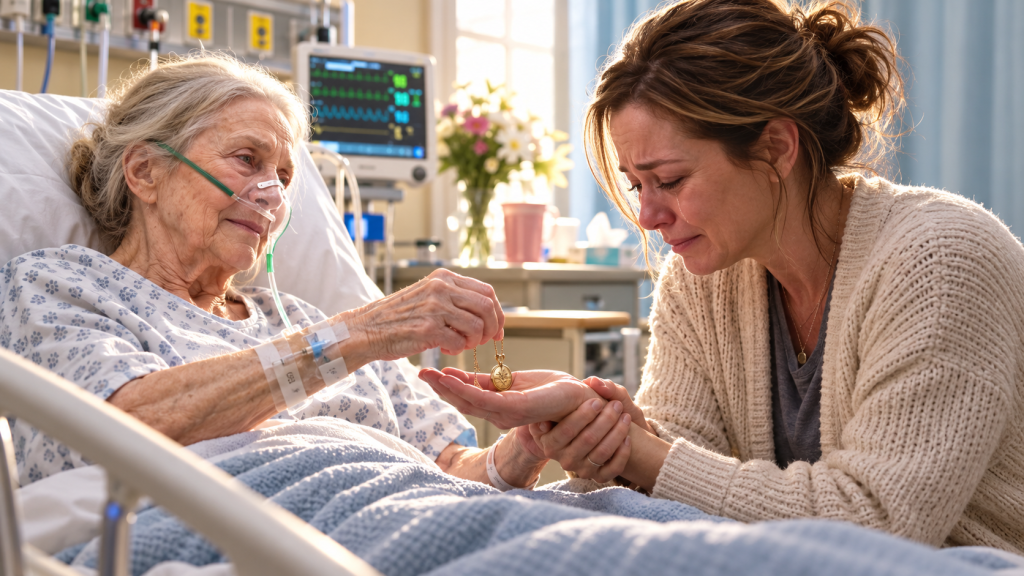
“She is unconscious at the moment.” “Is she going to wake up?” “We believe she has a good chance.” “That is not an answer.” “No.” His voice softened. “It is the most truthful answer I can give you.” I pressed both hands over my face.
Alive.
My daughter was alive.
Not the infant I had mourned.
Not the tiny pink blanket I had packed away after our third son because some old wound still made me buy things for girls.
A woman.
Thirty-five years old.
Upstairs.
Fighting for her life after giving birth to a child who had somehow been placed in my arms before I even knew who she was.
Then the office door rattled again.
“Helen.”
David.
My husband.
The man who had known for six months.
I turned toward the doctor.
“Open it.”
He hesitated.
“Please.”
The lock clicked.
David stepped inside.
He looked terrible.
Not guilty in the ordinary sense.
Terrified.
His eyes went from me to the folder on the desk.
Then he closed them.
“So he told you.”
I stared at him.
“You knew.”
“Yes.”
“For six months.”
“Yes.”
“And every morning you looked me in the face.”
His voice broke.
“Yes.”
“Every night you slept beside me.”
“Yes.”
“Every time I talked about wishing we’d had a daughter…”
“Helen.”
“No.”
I stepped toward him.
“Every time.”
He lowered his head.
“Yes.”
I slapped him.
The sound cracked through the little office.
The doctor looked away.
David did not move.
I had never slapped anyone in my life.
My palm burned.
So did my shame.
But beneath both was something bigger.
Rage.
“How could you?”
David swallowed.
“I promised her.”
“You promised my daughter?”
“Yes.”
“You knew my daughter before I did?”
His face collapsed.
“Yes.”
I hit his chest with both hands.
Not hard.
Not violence so much as grief trying to find an exit.
“You had no right.”
“I know.”
“You had no right!”
“I know.”
The doctor stepped toward us.
“Mrs. Carter—”
“I am fine.”
I was not fine.
I pointed at David.
“Start talking.”
He glanced at the doctor.
“No.”
I said.
“You wanted secrecy for six months.”
“You don’t get another minute.”
David sat.
I remained standing.
He took a breath.
“Emily contacted me in January.”
“How?”
“She had been searching for you for almost two years.”
My heart stopped.
“For me?”
“Yes.”
“She knew my name?”
“She knew yours.”
“How?”
“Her adoptive mother died three years ago.”
“She found a sealed envelope in a safe-deposit box.”
“What was inside?”
“A copy of her original birth certificate.”
I went cold.
“Original?”
“Yes.”
“The one created before the adoption.”
I could barely hear him.
“What did it say?”
“Your name.”
My chest tightened.
“And father?”
David looked at me.
“Blank.”
Of course.
I had been nineteen.
Her father had been a boy named Michael Reyes.
We had dated for eight months.
He left for college before I even knew I was pregnant.
By the time I tried to reach him, his family had moved.
My parents told me not to chase a man who had already chosen his future.
Then I gave birth.
Or thought I did.
I remembered pain.
Medication.
My mother’s hand.
Then waking and asking:
“Where is she?”
My mother had cried.
My father stood near the window.
Mom said:
“She didn’t make it.”
No baby.
No body.
No funeral.
They said the hospital would handle everything because I was too weak.
For years, that sentence had haunted me.
The hospital will handle everything.
Apparently the hospital had not.
My parents had.
I looked at David.
“What else was in the envelope?”
“A letter from Emily’s adoptive mother.”
“What did it say?”
“That Emily had been adopted privately.”
“That the adoption had been arranged through an attorney.”
“That her biological grandparents insisted the records be sealed.”
I could not breathe.
“My parents.”
“Yes.”
I whispered:
“They gave her away.”
The doctor looked down.
David said:
“Yes.”
Those three letters broke thirty-five years of memory.
I sat because my legs stopped working.
“Why?”
David hesitated.
“That part came later.”
“Tell me.”
“Emily did not know at first.”
“She had your name.”
“She searched.”
“She found an old address.”
“Then your maiden name.”
“Eventually she found our marriage announcement.”
“So she called you?”
“She found my business email.”
My hands trembled.
“What did she write?”
David looked at me.
“‘I think your wife may be my biological mother. I don’t know if she knows I’m alive.’”
I closed my eyes.
One sentence.
Imagine receiving that sentence about your wife.
Imagine keeping it.
Six months.
I whispered:
“What did you do?”
“I thought it was a scam.”
That was painfully reasonable.
“So?”
“I asked for proof.”
“Emily sent the birth certificate.”
“A picture of herself.”
“Her adoption records.”
“And?”
David looked ashamed.
“I still didn’t believe it.”
“Why?”
“Because your parents would have had to do something monstrous.”
Yes.
Exactly.
David continued.
“So I met her.”
I looked at him.
“Where?”
“Coffee shop.”
“When?”
“January nineteenth.”
I remembered January nineteenth.
I had made roast chicken.
David came home late.
Said a client meeting ran over.
I had saved him a plate.
I whispered:
“You came home from meeting my daughter and ate dinner with me.”
He began crying.
“Yes.”
That almost made me hate him.
Almost.
“What did she look like?”
He smiled through tears.
“Like you.”
My face broke.
He continued.
“Not exactly.”
“She has your eyes.”
“Your hands.”
“She talks faster when she’s nervous.”
“You do that.”
The doctor turned away as though giving us privacy inside a room he still occupied.
David continued.
“She brought a photograph of herself at twelve.”
“I thought I was looking at you.”
I wiped tears angrily.
“You should have told me that night.”
“Yes.”
“Why didn’t you?”
“Because she begged me not to.”
I stared.
“Why?”
“She wasn’t ready.”
“For what?”
“To meet you.”
I could not understand.
“She spent two years looking for me.”
“She wanted to know whether you knew.”
David’s voice softened.
“She was afraid you had given her away.”
That silenced me.
Of course.
Thirty-five years of pain had not belonged only to me.
While I believed my baby died, Emily had grown up wondering why her mother surrendered her.
Two women harmed by the same lie.
Facing opposite directions.
I whispered:
“What did you tell her?”
“The truth.”
“That you believed she died.”
“How did you know?”
“You told me before we married.”
I remembered.
One night.
Months into dating.
I had told David about the baby.
He held me.
Never judged.
Years later, after our third son, he found me crying over the pink blanket.
He knew why.
“I told her how you used to talk about her.”
David said.
“How every year around October you got quiet.”
Her birthday.
October 11.
Even after I believed she died, my body remembered.
“I told her you bought a little silver bracelet once.”
I covered my mouth.
I had.
After our second son.
It was ridiculous.
A baby bracelet.
I kept it in my jewelry box.
For the daughter who was not there.
David continued.
“She cried for almost an hour.”
I closed my eyes.
“And you still didn’t call me.”
“No.”
“Why?”
“Because Emily said she needed time.”
“Did she have a family?”
“Yes.”
“Her adoptive parents loved her.”
That brought an unexpected wave of relief.
“Both?”
“Her father died ten years ago.”
“Her mother three years ago.”
“Any siblings?”
“A brother.”
“Adopted too.”
“Is she married?”
David hesitated.
“No.”
“And Grace’s father?”
The doctor shifted.
David looked at him.
Then at me.
“That is complicated.”
I laughed through tears.
“Apparently my life has become very committed to that word.”
The doctor spoke gently.
“Grace’s father died before she was born.”
I turned.
“What?”
“Car accident.”
“When?”
“Four months ago.”
My heart hurt for a man I had never met.
“For Emily?”
“Yes.”
“His name was Aaron Wells.”
David said.
“They were engaged.”
I closed my eyes.
My daughter had lost the man she loved while pregnant.
And I had been somewhere nearby.
Alive.
Unaware.
“How did you know all this?”
“Emily kept talking to me.”
“Why you?”
“Because I was safe.”
That hurt.
David knew it.
He continued quickly.
“Not safer than you.”
“She just didn’t know you yet.”
“She was afraid meeting you would destroy the version of her life she had learned to survive.”
The sentence reached me.
I understood more than I wanted to.
For thirty-five years, I survived believing my daughter was dead.
Emily survived believing I had surrendered her.
Truth did not simply heal either version.
Truth demolished the structure first.
“When was she going to tell me?”
“After the baby.”
I looked toward the door.
“Grace.”
“Yes.”
“She wanted to meet you before the delivery originally.”
“But after Aaron died, she changed her mind.”
“Why?”
“She said she couldn’t survive another emotional earthquake while pregnant.”
Reasonable.
Painful.
Reasonable.
Then I remembered something.
“The DNA test.”
David’s expression changed.
“What?”
“The doctor had a DNA report with my name.”
His eyes lowered.
There.
Another secret.
I stood.
“How did you get my DNA?”
“Helen.”
“How?”
David looked miserable.
“I used your hairbrush.”
The room went cold.
“You what?”
“I sent a sample to the lab after Emily asked for confirmation.”
I stared.
“That was without my permission.”
“Yes.”
The doctor stepped in.
“The report you saw was a confirmatory kinship analysis commissioned privately before admission.”
“That does not make it better.”
“No.”
he said.
“It doesn’t.”
I looked at David.
“You stole my DNA.”
His eyes filled.
“Yes.”
“I thought if the result came back wrong, I could protect you from…”
“From what?”
“Hope.”
I nearly screamed.
“You do not protect someone by taking choices away from them.”
“I know.”
“Do you?”
“Now.”
Not good enough.
Maybe someday.
Not then.
I grabbed my bag.
The doctor stepped toward me.
“Mrs. Carter.”
“What?”
“Emily may wake soon.”
Everything else disappeared.
“Can I see her?”
He hesitated.
That frightened me.
“Can I see my daughter?”
“Yes.”
My daughter.
Again.
Still impossible.
He continued.
“But there is something else.”
Of course.
“What?”
“Emily left written instructions before surgery.”
“For Grace.”
My stomach tightened.
“What instructions?”
“She listed your husband as temporary emergency contact.”
I looked at David.
He nodded.
“And you?”
the doctor continued.
“You are named as the person she wanted contacted if her condition became critical.”
I stared.
“She named me?”
“Yes.”
“Before meeting me?”
“Yes.”
My throat closed.
The doctor handed me a photocopy.
Emily’s handwriting.
If I become unable to make decisions and Grace is stable, please contact Helen Carter, my biological mother. She does not yet know about me. David Carter can explain.
Below:
Please let Helen hold Grace before anyone from Aaron’s family arrives. I want Grace’s grandmother to know she exists.
I cried so hard I could not read the rest.
She had wanted me.
Not as mother.
Not yet.
But as grandmother.
A doorway.
Something.
I looked at David.
“Why did you say she was ours?”
He wiped his face.
“Emily asked me to.”
“What?”
“She said if things went badly…”
He swallowed.
“She said, ‘Give Mom the baby. Tell her Grace belongs with her family until I come back.’”
Mom.
I stopped breathing.
“She called me Mom?”
“Once.”
David whispered.
“Only once.”
“She usually called you Helen.”
My entire body shook.
“I need to see her.”
The ICU doors opened at 8:14 that morning.
I remember the exact time.
Some moments brand clocks into you.
Emily lay beneath a white blanket.
Machines around her.
Dark hair pulled away from her face.
Pale.
Too pale.
I stood in the doorway.
For thirty-five years, my daughter had existed only as weight.
Seven pounds, two ounces.
That was what a nurse told me before my parents claimed she died.
I remembered asking whether she had hair.
The nurse said:
“Lots.”
Now there she was.
Lots of dark hair.
A woman.
My woman.
My daughter.
I stepped closer.
Her face was not mine exactly.
David had exaggerated.
But I recognized pieces.
My mother’s nose.
My father’s mouth.
The tiny birthmark beneath her left ear.
I had one in the same place.
Genetics had carried a message through thirty-five years of separation.
I sat beside her.
Did not touch her at first.
I felt I had no right.
Then the nurse said:
“You can hold her hand.”
I reached.
Emily’s fingers were warm.
Long.
Strong.
I whispered:
“Hello.”
No response.
“I’m Helen.”
My voice broke.
“I suppose you know that.”
Nothing.
I cried.
Then I said the sentence I had needed her to hear since 1989.
“I did not give you away.”
The monitor continued.
Beep.
Beep.
Beep.
“I need you to know that.”
“I thought you died.”
“I asked for you.”
“I begged to see you.”
“I never stopped…”
I could not finish.
I put my forehead against her hand.
“I never stopped being your mother in the place where you were supposed to be.”
Maybe that was selfish.
Maybe too much.
But truth was all I had left.
Behind me, David stood in the doorway.
I looked at him.
“Leave.”
He flinched.
“Helen.”
“Please.”
He left.
I stayed.
For nine hours.
At noon, Grace was brought in for ten minutes.
A nurse placed her in my arms.
The same baby I had held that morning.
But now everything felt different.
I looked at her.
“Hello again.”
Grace opened her eyes.
Gray.
Aaron’s, I later learned.
Not mine.
Not Emily’s.
Her father’s.
I whispered:
“Your mother is stubborn.”
The nurse smiled.
“How do you know?”
“Genetic intuition.”
Then I laughed.
The first laugh of the day.
It felt guilty.
Then I let myself have it.
At 4:37 p.m., Emily moved.
Just a finger.
I thought I imagined it.
Then again.
I stood.
“Emily?”
Her eyelids fluttered.
A nurse came.
Then another.
I backed away.
Doctors entered.
They checked pupils.
Commands.
Squeezed hands.
Asked her name.
Emily opened her eyes.
Not fully.
A narrow gray-blue line.
She looked confused.
Then frightened.
I stayed near the wall.
I did not want her first waking moment to contain a stranger claiming motherhood.
The doctor said:
“Emily, you’re in the hospital.”
“You had complications after delivery.”
“Grace is healthy.”
Her lips moved.
“Grace?”
“Healthy.”
Her eyes filled with tears.
Then she tried to turn her head.
“David?”
I stepped back.
That hurt.
Then the doctor said:
“David is here.”
“And Helen is here too.”
Emily froze.
Her eyes moved.
Found me.
Everything in the room stopped.
Thirty-five years.
One look.
Her mouth opened.
No sound.
I took one step.
Then stopped.
“You don’t have to do anything.”
I said.
“You don’t have to call me anything.”
“You don’t have to…”
My voice broke.
“You don’t owe me a reaction.”
Emily stared.
Then whispered:
“You look older.”
I laughed.
It burst out of me before I could stop it.
“So do you.”
Her lips trembled.
“That was stupid.”
“No.”
“It was perfect.”
She started crying.
I moved closer.
Still did not touch her.
Then she lifted her hand.
Barely.
I took it.
She whispered:
“You didn’t know?”
“No.”
“Really?”
“No.”
Her face crumpled.
I leaned over the bed.
And my daughter cried in my arms for the first time thirty-five years late.
She stayed in intensive care two more days.
Then a regular room.
Recovery was slow.
Blood loss.
Weakness.
Pain.
But she was alive.
Grace was healthy.
And I discovered meeting your adult child is nothing like meeting a newborn.
You cannot simply love them into belonging to you.
Emily had history.
Habits.
Boundaries.
A mother.
Her adoptive mother’s name was Patricia.
I learned quickly not to say “your real mother.”
Patricia was real.
She was the woman who stayed up through fevers.
Packed lunches.
Argued about curfews.
Paid college tuition.
Sat front row at graduation.
Held Emily after Aaron died.
Biology did not erase her.
Nor should it.
The first time I accidentally said:
“When your mother—”
then stopped because I meant Patricia, Emily looked at me.
“You can call her Mom.”
I swallowed.
“Does that hurt?”
“No.”
She looked at me.
“You’re my mother too.”
That sentence nearly stopped my heart.
Then she added:
“I don’t know what that means yet.”
“Neither do I.”
Good.
Honest.
We started there.
David did not escape.
For the first week, Grace and Emily took all my emotional space.
Then anger returned.
I went home.
David was waiting at the kitchen table.
Three sons knew something was wrong but not everything.
Our oldest, Mark, lived two hours away.
Jonathan was thirty.
Caleb seventeen.
The age difference always amused people.
Three sons across seventeen years.
Now an adult daughter in the middle of nowhere.
I sat across from David.
“You’re going to tell me everything.”
“I already did.”
“No.”
I looked at him.
“You told me your version.”
“I want the documents.”
He had kept them.
Emails from Emily.
The first birth certificate.
Adoption records.
DNA test.
A letter Emily had written but never sent me.
I read that one alone.
Helen,
I have rewritten this so many times that I hate your name now.
I laughed through tears.
I spent most of my childhood imagining you.
Sometimes you were poor.
Sometimes famous.
Sometimes dead.
Sometimes cruel.
Sometimes sixteen and frightened.
Patricia always told me I was wanted. She said my biological mother had probably made the hardest decision of her life.
My throat tightened.
Patricia had tried to protect a stranger.
Me.
When I found the original birth certificate, I thought I would finally know which story was true. Instead I found another question.
Did you choose adoption?
Then:
David says no.
I stopped reading.
He says you thought I died.
I want to believe him so badly that I don’t trust myself.
I closed my eyes.
That explained six months.
Emily needed evidence that I had not surrendered her.
Not my tears.
Facts.
David helped her find them.
Hospital files.
Old attorney records.
An adoption petition.
My alleged consent form.
My signature.
I stared.
“That’s not mine.”
David nodded.
“We know.”
My blood went cold.
“Whose?”
“Your mother signed it.”
I looked up.
“She forged my name?”
“Yes.”
There was more.
A sworn affidavit from my father claiming I was emotionally unstable after delivery and had voluntarily delegated adoption decisions.
A lie.
A doctor’s note saying I was too sedated to participate in discharge planning.
True.
Then adoption finalized through an attorney connected to my father’s business partner.
Private.
Fast.
Wrong.
Possibly criminal even then.
But most of the people involved were dead.
Records incomplete.
Statutes long passed.
Justice, thirty-five years late, becomes mostly truth.
I whispered:
“Why did they do it?”
David handed me another document.
A letter.
My mother.
Written fifteen years before she died.
Never sent.
Addressed to me.
I opened it.
Helen,
I have carried something I do not know how to confess.
My hands shook.
Your father and I believed we were saving your future.
I stopped.
That phrase.
Saving your future.
How many lives have been rearranged by people convinced they know what another person should survive?
I kept reading.
You were nineteen. Unmarried. Michael was gone. Your father believed the pregnancy would end your education and disgrace the family.
I argued.
Tears blurred the page.
Then, after you delivered, there were complications. You lost blood. You were sedated. A social worker mentioned a couple waiting for an infant.
My stomach turned.
Your father made the decision.
I hated him.
Then the next line:
I let him.
I hated her too.
He told me you would eventually thank us.
When you woke and asked for the baby, I panicked.
I told you she died.
I made a sound that startled even me.
A wounded animal sound.
David moved toward me.
I raised one hand.
No.
I had to finish.
Once I said it, there was no way back without destroying everything.
False.
There was always a way back.
Hard.
Humiliating.
But possible.
She chose silence.
For thirty-five years.
Your father told the adoptive parents you had abandoned the child.
My vision blurred.
I watched you grieve.
That is the part I cannot forgive myself for.
I pressed the paper to the table.
My mother had held me while I cried for a living daughter.
Made tea.
Changed sheets.
Said:
“Time will soften it.”
All while knowing.
I wanted to resurrect her just long enough to ask:
How?
How did you look at me?
How did you watch me buy that pink blanket years later?
How did you let me believe my body failed my baby?
The letter continued.
I kept track of her from a distance for several years through the attorney. Her name became Emily. The family was good. They loved her. I used that to excuse myself.
At least she was loved.
Thank God.
When your father died, I nearly told you.
He died when I was forty-one.
I remembered Mom becoming strange around the funeral.
Asking if I was happy.
Asking whether I had regrets.
I thought grief made her sentimental.
She was considering confession.
She did not do it.
Then you had your boys. Your life seemed settled. I told myself truth would only cause pain.
Again.
They always used my happiness as an excuse not to give me my own history.
Then the final paragraph:
If you ever learn this, do not forgive me quickly.
That surprised me.
People ask forgiveness when what they often want is relief from seeing what they did.
I cried.
I loved you. I also betrayed you. Both are true.
Mom
I sat for a long time.
Then looked at David.
“How did Emily get this?”
“Patricia had it.”
“What?”
“Your mother mailed it to Patricia eighteen years ago.”
“Why?”
“Because she couldn’t send it to you.”
I laughed bitterly.
“So she confessed to the woman raising my daughter instead.”
“Yes.”
Patricia had kept it.
Not because she approved.
Because she believed someday Emily might need the truth.
She was right.
I whispered:
“Patricia knew I thought Emily died?”
“For the last eighteen years of her life.”
“And she never contacted me?”
David looked careful.
“Emily struggled with that too.”
“Why didn’t she?”
“According to her letter, she believed it was your mother’s responsibility to tell you.”
My anger wanted another target.
Patricia.
Easy.
Then I stopped.
She did not steal my baby.
She accepted an adoption she believed legal.
Later learned an awful truth.
She had her own fears.
Would contacting me destabilize Emily?
Would I try to reclaim a child who was already seventeen?
Would my mother deny everything?
None of that made silence perfect.
But unlike my parents, Patricia had not created the lie.
I let that anger go.
Mostly.
The boys learned over the next week.
Mark flew home.
Jonathan arrived before I even finished explaining.
Caleb stood in our living room, white-faced.
“Wait.”
He looked at David.
“You knew?”
David nodded.
“For six months?”
“Yes.”
Caleb exploded.
“What is wrong with you?”
“Caleb.”
I said.
“No.”
He pointed at his father.
“Mom cried when I was a kid because she thought she’d never have a daughter.”
David flinched.
“You knew that.”
“I know.”
“And you knew she did?”
“Yes.”
Mark stepped in.
“Calm down.”
“No.”
Caleb had inherited my temper after all.
“You stole six months.”
That sentence silenced everyone.
Exactly.
David had not stolen thirty-five years.
My parents did.
But he took six more.
He believed he had reasons.
Emily asked.
He wanted proof.
He wanted to protect me.
But six months were still gone.
David whispered:
“I know.”
Caleb walked out.
David started after him.
I stopped him.
“Let him be angry.”
“He’s seventeen.”
“He is allowed.”
Our sons handled Emily differently.
Mark, thirty-four, was cautious.
He had built a life where family surprises were usually minor.
He met her in the hospital cafeteria.
Asked practical questions.
Work.
Home.
Plans.
Then unexpectedly cried when Emily showed him a photograph of herself at age seven.
“You look like Mom.”
he said.
Emily smiled.
“I’ve heard.”
Jonathan was instantly emotional.
He hugged her too soon.
Then apologized.
Emily laughed.
“I’m fine with hugs.”
He hugged her again.
Caleb refused to meet her for three days.
I worried.
Then he admitted:
“I feel like I’m being replaced.”
I stared.
“You?”
“Yeah.”
“You always wanted a daughter.”
“I wanted a sister when I was five.”
“That’s not the same as getting a thirty-five-year-old stranger.”
Fair.
He continued.
“Everyone keeps acting like this is a miracle.”
“It is.”
“And it’s horrible too.”
That was wiser than anything I had said.
“Yes.”
I hugged him.
“Both.”
He nodded.
Then:
“Does Grace make you a grandma?”
“Yes.”
“You were already a grandma.”
Mark had two children.
“I know.”
“So she’s not special.”
I smiled.
“They’re all special.”
He rolled his eyes.
“I hate family language.”
Eventually he met Emily.
They stared at each other.
Seventeen-year age gap.
Then Emily said:
“So you’re the baby?”
Caleb frowned.
“I was until yesterday.”
That did it.
They laughed.
Family began there.
Not blood.
A joke.
Emily came home from the hospital after twelve days.
Not to my house.
To her apartment.
I wanted her with me.
Terribly.
I also understood wanting is not entitlement.
She had a friend named Maya staying with her.
Aaron’s sister came daily.
Grace had people.
I was invited.
Not installed.
That distinction mattered.
The first time I visited, I brought six casseroles.
Emily opened the refrigerator.
“Are you expecting a famine?”
“I panic-cook.”
“So does Patricia.”
That hurt.
Emily saw it.
“Sorry.”
“No.”
I smiled.
“I’m glad she fed you.”
That became one of the hardest parts.
Learning to be grateful to the woman who got the motherhood I lost.
Patricia had heard first words.
Seen first steps.
Held Emily through heartbreak.
Taught her to drive.
Helped choose college.
I could have turned every story into theft.
Instead, I tried to receive them as evidence that my daughter had been loved while I could not love her in person.
Some days I succeeded.
Some days I went home and cried.
Therapy helped.
Yes.
At fifty-four, after three sons, twenty-nine years of marriage, and discovering a secret adult daughter, I went to therapy.
I should have gone at nineteen.
Probably everyone should.
My therapist, Dr. Lewis, said:
“You are grieving two things.”
“What?”
“The daughter you thought died.”
“And the daughter who lived without you.”
I stared.
“They’re the same person.”
“Biologically.”
“Emotionally, they are not.”
That was true.
I had mourned an infant for thirty-five years.
Now I had to let that infant go differently.
Emily was not here to become the baby I lost.
She was an adult.
Mother.
Widow-before-marriage.
Graphic designer.
Hated olives.
Loved thunderstorms.
Voted differently than I did on at least three issues.
Borrowed books and forgot to return them.
She had already become someone.
My job was not to reclaim.
It was to meet.
David and I nearly divorced.
That surprised him.
It surprised me too.
For thirty years, I thought infidelity would be the thing that ended a marriage.
Or cruelty.
Addiction.
Something obvious.
Instead, ours nearly ended because David kept a secret he believed belonged to someone else.
He slept in the guest room for four months.
Not because I threw him out.
Because I could not bear his breathing beside me.
Every night, I thought:
Six months.
Every morning:
He knew.
We went to counseling.
The first session, the counselor asked David:
“Why didn’t you tell Helen?”
He answered:
“Emily asked me not to.”
The counselor said:
“That explains your conflict.”
“It does not explain your decision.”
David looked confused.
Then hurt.
He had become accustomed to the idea that keeping Emily’s confidence was honorable.
Maybe part of it was.
But there were alternatives.
He could have told Emily:
“I cannot carry this indefinitely.”
He could have encouraged her to meet me sooner.
He could have refused to steal my DNA.
He could have told me there was a serious family matter without revealing everything.
Instead, he assumed he could manage both women’s emotions.
That was his mistake.
A familiar one.
Men I loved making decisions for me because they believed knowledge would hurt.
Father.
Mother.
Now husband.
Different motives.
Same arrogance.
David cried when I told him that.
“I’m not your father.”
“No.”
“But you repeated him.”
That sentence almost ended us.
Maybe it saved us.
Over time, David stopped defending.
He apologized specifically.
Not:
“I’m sorry you’re hurt.”
Not:
“I only wanted to protect you.”
He said:
“I took your DNA without permission.”
“I was wrong.”
“I hid the existence of your daughter for six months.”
“I understand that her request put me in a difficult position, but I should have refused to keep it indefinitely.”
“I let myself believe I could control when you received your own history.”
“I was wrong.”
That mattered.
Still, forgiveness did not arrive on schedule.
Emily complicated it further.
One afternoon, she came to my house alone.
Grace was three months old.
She sat at my kitchen table.
The same table where my sons had done homework.
She said:
“You’re angry at David.”
“Yes.”
“Because of me.”
“No.”
Her face tightened.
“I asked him.”
“You did.”
“So if you’re going to blame someone—”
“No.”
I interrupted.
“I am not making you responsible for a promise between my husband and me.”
She stared.
“He betrayed your trust because I asked him to keep mine.”
“That is the complicated truth.”
“Yes.”
“But you were trying to protect yourself.”
“So was he.”
“Yes.”
“So why is he wrong and I’m not?”
Good question.
Painful question.
I thought.
“Because you had not made vows to me.”
Emily’s eyes filled.
I continued.
“You didn’t know me.”
“You were trying to decide whether I was emotionally safe.”
“That was your right.”
“David knew me.”
“He knew what that baby meant.”
“He knew the history belonged to me too.”
“He had competing obligations.”
“He chose one.”
“I’m allowed to be hurt by that.”
Emily nodded slowly.
Then whispered:
“I don’t want to be the reason you divorce.”
“You won’t be.”
“If we divorce, it will be because of decisions inside our marriage.”
I meant it.
Children—whether twelve or thirty-five—should not be made responsible for adult relationships.
Not even accidentally.
Emily looked relieved.
Then:
“For what it’s worth, I told him to tell you after the DNA result.”
I froze.
“What?”
She looked confused.
“When?”
“March.”
My chest went cold.
“That was three months ago.”
“Yes.”
“He said you were dealing with Caleb’s college applications and your brother’s surgery.”
I stared.
“He said he wanted to wait for a calmer time.”
Oh.
David.
Another layer.
When I confronted him, he did not deny it.
I stood in our bedroom.
“You told me Emily made you promise for six months.”
“She did at first.”
“At first.”
“Yes.”
“Then she changed her mind.”
“Yes.”
“And you still waited.”
He covered his face.
“I was afraid.”
“Of me?”
“Of what it would do.”
“To whom?”
“Everyone.”
I laughed bitterly.
“There it is.”
He looked up.
“What?”
“You were not protecting Emily anymore.”
“You were protecting the family arrangement.”
He sat down.
I continued.
“You liked knowing where everyone stood.”
“Three boys.”
“One wife.”
“Stable marriage.”
“Then suddenly there was a daughter.”
“A crime by my parents.”
“An adopted mother.”
“A dead fiancé.”
“A baby.”
“You were afraid truth would make everything messy.”
His silence answered.
I whispered:
“So you postponed my life until it was convenient.”
“No.”
“Yes.”
The separation happened the next week.
David moved to a furnished apartment.
Not divorce.
Space.
Caleb hated it.
Mark understood.
Jonathan took David’s side for exactly nine days before deciding there should not be sides.
Emily blamed herself again.
I told her no again.
For six months, David and I lived apart.
During that time, something unexpected happened.
He became closer to Emily.
I hated that at first.
Then I realized he had known her first.
That relationship was real too.
He was not her father.
Never tried to be.
But he had been the first person from her biological family to sit across from her and say:
“Helen thought you died.”
He had carried her through that shock.
Emily trusted him.
I could not demand she erase that because I was angry.
Again.
People are not property.
Pain kept teaching me the same lesson.
The investigation into my original adoption records went nowhere criminally.
My parents were dead.
The attorney who arranged it was dead.
The physician was dead.
The agency had closed.
But a family-law researcher helped us reconstruct enough truth.
My parents had represented me as consenting.
My signature was forged.
The adoption itself was finalized legally based on fraudulent documentation.
Undoing it thirty-five years later served no practical purpose.
Emily did not want her adoption erased.
Patricia and George had been her parents.
That history mattered.
Instead, Emily petitioned to obtain the full original court file and amend access records where possible.
Not to change who raised her.
To preserve the truth.
She gave me a copy.
I kept it beside my mother’s confession letter.
Not as weapons.
Evidence.
Proof against my own tendency to wonder whether I had imagined the injustice.
One day, Emily asked me:
“Do you hate Grandma?”
My mother.
Her biological grandmother.
I thought for a long time.
“Yes.”
Emily looked surprised.
Then I added:
“Sometimes.”
“And sometimes I miss her.”
“Both?”
“Yes.”
“I wish everyone would stop making family emotions multiple choice.”
Emily laughed.
“Same.”
Grace grew.
That baby became the bridge nobody had planned.
At six months, she hated peas.
At nine months, she crawled backward before forward.
At eleven months, she said something that sounded vaguely like “dog” despite Emily not owning one.
At thirteen months, she called me “Nana.”
I cried so hard Emily rolled her eyes.
“You knew that was coming.”
“No.”
“I hoped.”
Hope is different.
For Grace’s first birthday, I gave her the pink blanket.
The one I had packed away years earlier.
I almost didn’t.
It had belonged emotionally to another imagined child.
Then I realized it had always been waiting for this family.
Emily unfolded it.
Pale pink.
Tiny embroidered flowers.
She looked at me.
“You kept this?”
“Twenty-seven years.”
“For a daughter?”
“Yes.”
Tears filled her eyes.
Then she wrapped Grace in it.
I had to leave the room for a minute.
Not because the moment healed thirty-five years.
Nothing could.
Because it held sorrow and joy without asking either to leave.
David came to the party.
We were still separated.
He stayed near the back.
Helped clean up.
Did not press.
At the end, he asked:
“Can I talk to you?”
I hesitated.
Then sat on the porch.
He looked older.
Six months can age a marriage.
He said:
“I sold my motorcycle.”
I stared.
“What does that have to do with anything?”
“Nothing.”
I laughed.
He smiled.
“I just realized I never use it.”
“Thrilling.”
Then he became serious.
“I’ve been thinking about why I kept the secret.”
“So have I.”
“I know.”
He stared at his hands.
“I liked being necessary.”
That was new.
“What?”
“Emily needed me to connect her to you.”
“I knew things she didn’t.”
“I could solve records.”
“Make calls.”
“Arrange the DNA.”
“I told myself I was helping.”
He swallowed.
“But I also liked being the one who knew.”
That honesty hurt.
He continued.
“I felt important.”
“Then the longer I waited, the harder it became to admit I’d waited.”
There it was.
Not noble protection.
Human ego.
Fear.
Delay.
I appreciated it more than another heroic explanation.
He said:
“I don’t expect you to come home because I finally understand myself better.”
“Good.”
“I want to ask one thing.”
“What?”
“Do you still love me?”
I looked at him.
Twenty-nine years.
Three sons.
One secret daughter.
A grandchild.
Anger.
“I do.”
He cried.
“So do I.”
“That doesn’t answer whether we should be married.”
“I know.”
For the first time, we both understood love was not the only criterion.
We reconciled gradually.
Not that night.
Not after one speech.
Dating, almost.
Coffee.
Dinner.
Counseling.
David moved back after nine months apart.
Into the guest room first.
Then eventually ours.
I never forgot.
That is different from not forgiving.
Trust returned as behavior.
He stopped signing me up for things without asking.
Stopped making family decisions alone.
Stopped “protecting” me from information.
I stopped handing him every administrative task because it was easier.
We became more explicit.
Less romantic, perhaps.
More real.
Emily watched cautiously.
One day she asked:
“So you forgave him?”
“Mostly.”
“Why?”
I smiled.
“Because forgiveness is not a prize for a good apology.”
“What is it?”
“For me?”
I thought.
“A decision that I want a future with someone who understands what they did.”
She nodded.
“Does he?”
“More than he used to.”
“Good enough?”
“For now.”
Again.
Not clean.
True.
The biggest surprise came two years later.
A letter.
From Michael Reyes.
Grace’s biological maternal grandfather.
My first boyfriend.
The man who never knew I was pregnant.
Emily had found him through genealogy records.
He was seventy-one.
Retired teacher.
Married for forty years.
Two adult children.
She contacted him only after asking me.
That mattered.
Michael wrote:
Helen, I did not know.
Four words.
I believed him.
He explained that his family moved suddenly because his father lost work.
My letter never reached him.
My parents apparently received one from Michael months later asking about me.
They returned it marked:
Helen does not wish further contact.
I never knew.
Another choice made for me.
How many versions of my youth had been edited by other hands?
Michael did not ask for romance.
Thank God.
He asked to meet Emily if she wanted.
She did.
Their relationship became occasional and warm.
I met him once.
Coffee.
Two old people looking at each other across fifty-four years.
He said:
“I’m sorry.”
“You didn’t know.”
“I’m sorry I didn’t try harder.”
I thought about it.
“We were teenagers.”
“Still.”
We talked about Emily.
Grace.
His family.
Then parted.
No secret love.
No dramatic alternate life.
That mattered to me.
I loved David.
Michael was part of the road that led to Emily.
Nothing more needed to be made of it.
When Grace turned five, Emily married again.
A man named Owen.
Kind.
Patient.
Never tried to replace Aaron.
He included Aaron’s parents in the wedding.
That told me everything I needed.
I sat in the second row.
Patricia’s photograph was on an empty chair beside Emily.
A small framed picture.
Her adoptive mother.
My first reaction was pain.
Then gratitude.
Then pain again.
I leaned toward David.
“She should be here.”
“Patricia?”
“Yes.”
He squeezed my hand.
“She is.”
I rolled my eyes.
“Don’t become poetic.”
“Sorry.”
During the reception, Emily asked me to dance.
Mother-daughter dance.
I froze.
“You don’t have to.”
she said.
“Patricia would have had this.”
My throat tightened.
“Yes.”
“But she’s not here.”
Emily took my hand.
“You are.”
We danced.
Not because I replaced Patricia.
Because life had given Emily more than one mother.
One who raised her.
One who lost her.
One who found her.
I cried into her hair.
She said:
“You are ruining my makeup.”
“Good.”
“You sound like Caleb.”
“Terrifying.”
At the end of the dance, she whispered:
“I used to think finding you would answer everything.”
“Did it?”
“No.”
I laughed.
“Sorry.”
“It gave me better questions.”
That was probably healthier.
My parents’ betrayal remained the hardest wound.
Not David.
Not even the lost years.
My parents.
Because they loved me.
That is what people fail to understand about family harm.
My father paid tuition.
Taught me to drive.
Walked me down the aisle when I married David.
My mother cared for my sons.
Baked birthday cakes.
Sat beside me through illness.
And they stole my daughter.
Those truths coexist.
I refused to rewrite every good memory as fake.
I also refused to let good memories excuse what they did.
At sixty, I visited their graves.
Emily came.
We stood together.
She had never been there.
I placed my mother’s letter on the grass.
Not permanently.
Just for a moment.
I said:
“They loved me.”
Emily nodded.
“They failed you.”
“Yes.”
“They loved you too.”
“From a distance.”
“That’s not enough.”
“No.”
I looked at my mother’s name.
“I spent years thinking forgiveness meant I had to decide whether she was a good mother.”
Emily asked:
“Do you?”
“No.”
“Why?”
“Because she was my mother.”
“She did beautiful things.”
“And one unforgivable thing.”
“Maybe several.”
“I don’t need a verdict.”
Emily smiled.
“I like that.”
Then she looked at the stone.
“I don’t forgive her.”
“You don’t have to.”
“Do you?”
I thought.
“Some days.”
That became enough.
Grace eventually learned the story.
Not at five.
Not at ten.
In pieces.
Age-appropriate.
By sixteen, she knew almost everything.
She sat at my kitchen table—different house by then—and said:
“So Grandma Patricia was Mom’s mom.”
“Yes.”
“And you’re Mom’s biological mom.”
“Yes.”
“And Great-Grandma lied.”
“Yes.”
“And Grandpa David knew for six months.”
“Yes.”
Grace frowned.
“This family needs group therapy.”
I laughed for five minutes.
Then:
“We have had a lot.”
“Not enough.”
Probably true.
She asked:
“Are you glad Dad—Grandpa David—didn’t tell you immediately?”
I looked at her.
“No.”
She seemed surprised.
“Even though Mom asked him not to?”
“Yes.”
“But then Mom might not have been ready.”
“I know.”
“Then what should he have done?”
I smiled.
“That is why adult life is difficult.”
She hated that.
So I explained.
“He had two people’s trust in his hands.”
“He could not keep both promises perfectly.”
“I believe he should have told your mother he could not hide it for months.”
“He should have helped her find a safer timeline.”
“He should not have taken my DNA without permission.”
“He should not have continued hiding the truth after she told him he could tell me.”
Grace nodded.
“So you think he was wrong.”
“Yes.”
“But you stayed married.”
“Yes.”
“Adults are weird.”
“Correct.”
David died when I was seventy-nine.
Heart attack.
Sudden.
No long goodbye.
We had been married fifty-four years.
Not all easy.
Not all clean.
Real.
At the hospital, Emily stood on one side of me.
Our sons on the other.
Grace, grown now, behind us.
David had once stood between me and my daughter’s truth.
At the end, our daughter stood beside me as I said goodbye to him.
Life has strange symmetry.
After the funeral, Emily gave me an envelope.
“What’s this?”
“Dad gave it to me last year.”
Dad.
She called David Dad sometimes by then.
Not because he replaced anyone.
Because relationships earn names.
I opened it.
David’s handwriting.
Helen,
I hope this letter is unnecessary for years.
It wasn’t enough years.
There is one thing I want to say without defending myself.
I swallowed.
I stole six months from you.
Tears came instantly.
Your parents stole thirty-five years. That does not make my six months small.
Exactly.
For a long time, I hid behind Emily’s fear because it sounded nobler than my own.
The truth is that I was afraid to be the person who destroyed your understanding of your parents.
I was afraid you would collapse.
I was afraid our sons would change.
I was afraid you would look at me and ask why I had waited one day, then two, then ten.
So I kept waiting.
There it was.
Human weakness.
Not grand evil.
Still harm.
Thank you for making me earn my way home.
I laughed through tears.
You taught me that love without respect for another person’s choices can become a beautiful excuse for control.
Then:
If there is another life, I promise to tell you important things immediately.
I whispered:
“You better.”
Emily put her arm around me.
The letter ended:
And if there isn’t, I had enough life with you.
David
I kept it beside my mother’s confession.
Different secrets.
Different consequences.
One relationship repaired.
One impossible to repair because death had arrived first.
Years later, when I was eighty-two, Grace had a baby girl.
She asked me to come to the hospital.
I stood outside the maternity room.
For one terrible second, I was nineteen again.
White hallway.
Antiseptic smell.
Fear.
A nurse walked out carrying a newborn.
My body remembered before my mind did.
I began shaking.
Grace saw.
“Nana?”
“I’m okay.”
“You’re not.”
“No.”
I smiled.
“But I will be.”
Then the nurse placed Grace’s daughter in her arms.
Nobody took the baby away.
Nobody whispered.
Nobody lied.
Grace looked at me.
“Want to hold her?”
I hesitated.
Then nodded.
The baby was tiny.
Warm.
Alive.
I held her.
And suddenly I remembered the first morning when David put newborn Grace in my arms and said:
“Ours.”
I had thought he meant daughter.
Then granddaughter.
Eventually I understood he meant something else.
Family.
Not ownership.
Belonging.
Grace’s daughter yawned.
I cried.
Grace laughed.
“You always cry.”
“At my age, moisture is precious.”
She rolled her eyes.
Then asked:
“Do you ever think about what life would have been like if they hadn’t taken Mom?”
Of course.
Thousands of times.
I could imagine a hundred alternate lives.
Raising Emily.
Maybe never meeting David.
Maybe still meeting him.
Maybe fewer sons.
Different career.
Different house.
Patricia without a daughter.
Michael returning.
My parents disgraced.
Everything rearranged.
I looked at Grace.
Then at her daughter.
“I try not to.”
“Why?”
“Because the life that should have happened is not available.”
“That’s sad.”
“Yes.”
“Then what do you do?”
“I make sure the life that did happen tells the truth.”
That became the closest thing I had to peace.
I could not reclaim Emily’s first thirty-five years.
Could not hold her as a baby.
Could not hear first words.
Could not walk her into kindergarten.
Could not sit beside Patricia at graduation.
Could not meet Aaron before he died.
Could not stop my parents.
Could not make David tell me sooner.
But I could tell the truth now.
I could love without pretending love fixed theft.
I could be mother without demanding ownership of the years Patricia earned.
I could forgive David without calling his secrecy harmless.
I could remember my parents’ love without rewriting their betrayal.
I could hold Grace.
Then her daughter.
I could stay.
That was what remained.
People sometimes tell our story as a miracle.
A woman who thought her baby died discovers thirty-five years later that she lived.
Yes.
There was miracle in it.
But miracles can be violent too.
They rearrange what you know.
Finding Emily did not give me back the daughter I lost.
It introduced me to the daughter who survived.
That distinction saved us.
I stopped saying:
“I missed your childhood.”
Eventually I said:
“Tell me about it.”
And she did.
Patricia teaching her to swim.
George building a treehouse.
Her brother breaking her nose accidentally with a baseball.
Prom.
College.
First apartment.
Aaron.
Every story hurt a little.
Every story also gave me more of her.
That is how I became her mother again.
Not through blood tests.
Through listening.
And Emily became my daughter not because a doctor said 99.8%.
Because one day, years after we met, she called me after a terrible afternoon at work and said:
“Mom, I need to complain.”
No ceremony.
No announcement.
Just Mom.
I went silent.
She said:
“Hello?”
“I’m here.”
“Why are you crying?”
“I’m not.”
“You are.”
“Talk.”
She laughed.
Then complained for twenty minutes about her manager.
That ordinary call meant more to me than the DNA report.
The report proved biology.
The call proved relationship.
I had once believed that after three sons, the universe finally put a baby girl in my arms.
I was wrong.
The universe had put my granddaughter in my arms.
My daughter was upstairs.
Thirty-five years old.
Unconscious.
Waiting for both of us to wake up into the truth.
And when she did, nothing became easy.
It became real.
Which, after thirty-five years of lies, was better.
Much better.
THE END STORIES! THANK YOU FOR READING GOOD LUCK! ❤️
Related Posts