Julian stopped breathing on the phone. “I never signed that,” he whispered. Candice stared at him through the screen. Then Rebecca said, “Unfortunately, Julian, your signature appears on the next page as authorized representative.”
For several seconds, nobody moved. The sheriff’s deputy stood beside Candice’s open car. Thomas, the locksmith, remained near his truck at the curb. Rebecca held the listing agreement inside a clear evidence sleeve.
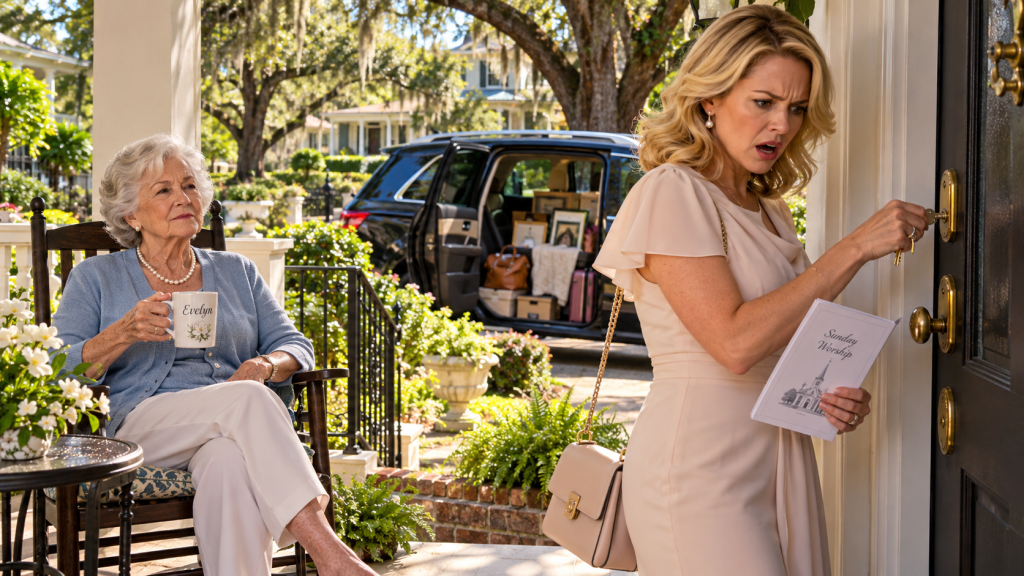
And I stood in the driveway of the house where I had lived for almost fifty years, looking at my son’s name beneath paperwork designed to sell it out from under me. Julian spoke first. “That isn’t possible.” Rebecca’s voice remained calm. “Is this your signature?”
She held the page toward Candice’s phone.
Julian squinted.
“Yes, but—”
“Then it’s possible.”
Candice snapped, “This is ridiculous.”
The deputy looked at her.
“Ma’am, I suggest you let your attorney do most of the talking from this point forward.”
“I don’t need an attorney.”
Rebecca said quietly, “You may want one.”
Candice’s eyes flashed.
“This is a family misunderstanding.”
I looked at the suitcase in her back seat.
“My passport is in your car.”
“That was for your move.”
“I’m not moving.”
“You agreed.”
“No.”
“You forgot.”
Rebecca reached into her briefcase.
“No, she documented refusing.”
Candice turned pale.
Rebecca continued.
“She also has a competency evaluation dated nine days ago.”
“A signed affidavit from her physician.”
“A fraud alert on her accounts.”
“A county recorder instruction requiring direct verification.”
“And now we have property belonging to Evelyn removed from the home without her permission.”
Candice looked at me.
For the first time in four years, there was no patience in her expression.
No sympathetic little smile.
No voice that said I was old and she was helping.
Only anger.
“You planned this.”
I almost laughed.
“No.”
She pointed toward Rebecca.
“You’ve been plotting against me.”
“No, Candice.”
I tightened both hands around my walker.
“I have been protecting myself from you.”
Those are not the same thing.
She looked toward the porch.
“You can’t prove anything.”
Rebecca gave her a sad look.
“That sentence rarely ages well.”
Then another car turned onto the street.
Too fast.
It stopped behind the deputy’s cruiser.
Julian got out.
He had driven ninety minutes from the airport.
Still wearing business clothes.
No luggage.
His face looked gray.
“Mom.”
I said nothing.
He walked toward the driveway.
Candice rushed to him.
“Tell them.”
He stared at her.
“Tell them what?”
“That Evelyn wanted to move.”
I watched my son.
He looked at me.
Then at Candice.
Then at the open car.
“What is all this?”
Candice lowered her voice.
“Things for Magnolia.”
His face changed.
“Magnolia?”
My stomach tightened.
So he knew the name.
I said:
“You know about Magnolia Gardens?”
Julian swallowed.
“Candice mentioned it.”
“When?”
“A few weeks ago.”
“She said what?”
“That it might be safer someday.”
“Someday?”
He nodded.
I pointed toward the boxes.
“She packed my belongings.”
Julian stared at Candice.
“She what?”
Candice folded her arms.
“She needed clothes.”
Julian looked back at me.
“Mom, were you moving today?”
“No.”
“Did you tell Candice to pack?”
“No.”
“Did you agree to Magnolia?”
“No.”
Candice exploded.
“She forgets conversations!”
Rebecca said:
“Careful.”
Candice turned on her.
“You don’t know her.”
“I know her medical evaluation.”
“You know one appointment.”
“I know enough to understand that declining vision is not dementia.”
Candice’s mouth closed.
Julian rubbed his forehead.
Then he looked at the listing agreement.
“Show me.”
Rebecca handed the deputy the sleeve.
The deputy allowed Julian to see it without touching.
Julian stared at his signature.
Then at another.
Mine.
His face drained.
“That isn’t Mom’s.”
Rebecca asked:
“You’re certain?”
“I’ve seen her signature my entire life.”
He pointed.
“The E is wrong.”
I felt a strange, painful relief.
My son still knew my handwriting.
Then Rebecca asked:
“And yours?”
Julian looked longer.
“That one is mine.”
Candice whispered:
“Julian.”
He ignored her.
“When did I sign this?”
Rebecca said:
“That is an interesting question.”
Candice suddenly reached for her car door.
The deputy stepped between them.
“Ma’am.”
“I need my purse.”
“I’ll retrieve it.”
“You can’t search my car.”
“I’m not searching it.”
He looked toward Rebecca.
“I’m preserving items already visible pending clarification.”
Candice turned toward Julian.
“Do something.”
He stared at her.
“What did I sign?”
She looked almost offended.
“You know what you signed.”
“No.”
“Yes, you do.”
“What did you put in front of me?”
Her face changed.
Just slightly.
I recognized it.
The look she used whenever I asked too many questions.
That patient exhaustion.
As though everyone else were making life unnecessarily difficult.
“Julian, this is not the place.”
He stepped closer.
“It became the place when my mother found her passport in your car.”
I had never heard him use that tone with her.
Candice whispered:
“I was trying to protect this family.”
I looked at the house.
Arthur’s porch.
Arthur’s oak tree.
Arthur’s china cabinet visible through the front window.
I said:
“Interesting way to do it.”
The deputy recovered the purse.
Then the plastic Magnolia Gardens folder.
Rebecca asked permission to look through items that belonged to me.
The deputy advised that we wait until his supervisor arrived.
So we waited.
Candice stood beside Julian.
He moved away from her.
That small step told me something had already broken.
The supervisor arrived twenty minutes later.
The rest happened slowly.
Real life is rarely as fast as panic wants.
Photographs were taken.
Items documented.
My passport.
Birth certificate.
Social Security card.
Jewelry case.
Arthur’s medals.
Two bank-statement folders.
A folder marked HOUSE.
Three prescription bottles.
A week of my clothing.
My favorite blue robe.
And Magnolia Gardens admission paperwork.
Rebecca opened that one only after the deputy confirmed it contained my records.
At the top was a reservation agreement.
Private room.
Long-term assisted living.
Move-in date:
Monday.
Tomorrow.
My chest went cold.
I looked at Candice.
“Tomorrow?”
She did not answer.
Rebecca continued reading.
A deposit had already been paid.
$8,700.
Julian frowned.
“With what money?”
Candice looked away.
Rebecca’s eyes moved across the page.
Then stopped.
She looked at me.
“Evelyn.”
“What?”
“The payment came from an account ending in 4421.”
I knew it.
My checking account.
The one my Social Security check entered.
I whispered:
“She used my money?”
Rebecca nodded.
Julian turned toward his wife.
“You took Mom’s money to pay for the place she said she didn’t want to go?”
Candice’s voice sharpened.
“She needed somewhere safe.”
Julian laughed.
Not happily.
“So you used her money.”
“She was going to live there.”
“She didn’t agree!”
“She doesn’t know what she needs anymore!”
I felt my whole body go still.
There.
Finally.
Not concern.
Not help.
Not convenience.
The belief underneath everything.
She had decided my age had canceled my authority.
The deputy heard it too.
Rebecca certainly did.
Candice realized too late.
She tried to soften.
“I mean she doesn’t understand how dangerous it is for her to live alone.”
I said:
“I wasn’t alone.”
“You lived here.”
She looked at me.
“And look how that turned out.”
Julian covered his face.
“God.”
Then Rebecca turned another page.
Her expression changed.
Not dramatically.
Rebecca was not dramatic.
That made it worse.
“What?”
I asked.
She looked at Julian.
“You should sit down.”
“I’m fine.”
“Sit.”
He sat on the low brick wall beside the driveway.
Rebecca held up the next page.
“This appears to be an application for bridge financing.”
Julian frowned.
“For what?”
“Secured against expected proceeds from the sale of Evelyn’s house.”
He stared.
“What?”
Candice went white.
Rebecca continued.
“The borrower is South Laurel Holdings LLC.”
I had never heard of it.
Julian clearly had.
He looked at Candice.
“That’s Heather’s company.”
There it was.
Her sister.
The voice on speakerphone.
Once the deed is recorded, it belongs to Julian. Then we can put it on the market.
Rebecca read.
“Requested amount: $175,000.”
Julian stood again.
“No.”
Candice whispered:
“Julian.”
“No.”
He looked at her.
“What is this?”
“It was temporary.”
“What is South Laurel borrowing money against Mom’s house?”
“It wasn’t against the house.”
Rebecca said:
“It references projected net proceeds.”
Candice snapped:
“Exactly.”
Julian looked at her as though she had begun speaking another language.
“You were borrowing money based on selling Mom’s house.”
“We were investing.”
“We?”
Candice froze.
Julian’s eyes narrowed.
“We?”
She tried to recover.
“Heather and I.”
I felt something cold move through me.
“How much debt are you in?”
Nobody answered.
I asked again.
“Candice.”
She glared at me.
“How much?”
Julian turned toward her.
“What is she talking about?”
Rebecca looked at me.
I nodded.
She had my permission.
“Martha and I reviewed several notices Evelyn received before Candice began intercepting the mail.”
Candice’s face changed.
Julian said:
“What notices?”
“Collection notices.”
“Not in Evelyn’s name.”
“In Candice’s.”
He stared.
Rebecca continued.
“We initially assumed they were personal and irrelevant.”
“Now they may be relevant.”
Candice said:
“You had no right to read my mail.”
I almost admired the nerve.
I answered:
“You had it delivered to my house.”
“That doesn’t mean—”
Rebecca cut in.
“The issue is not whether Evelyn read it.”
“The issue is whether undisclosed debt created motive for an attempted property transfer.”
Julian looked at his wife.
“How much?”
She said nothing.
“How much debt?”
“Julian.”
“How much?”
Her eyes filled.
“About ninety.”
“Ninety what?”
“Thousand.”
He stared.
“Ninety thousand dollars?”
She nodded.
Then shook her head.
“Maybe one-ten.”
I nearly laughed.
People become surprisingly vague around six figures when the money belongs to somebody else.
Julian looked sick.
“What did you spend a hundred ten thousand dollars on?”
Candice snapped:
“It isn’t all spending.”
“Then what is it?”
“Heather’s business.”
Julian closed his eyes.
South Laurel Holdings.
Heather owned a home-staging and short-term rental business.
Or so I had been told.
Candice continued.
“We bought two properties.”
Julian opened his eyes.
“You bought property?”
“With Heather.”
“With what money?”
“Credit.”
“Whose credit?”
Silence.
Julian whispered:
“Candice.”
She looked away.
“Mine.”
He laughed bitterly.
“You don’t qualify for that.”
Another silence.
His face changed.
“What did you use?”
Candice began crying.
“I was going to fix it.”
“What did you use?”
“Home-equity projections.”
“On what home?”
My skin went cold.
Rebecca answered before Candice could.
“Possibly Evelyn’s.”
Julian backed away from his wife.
The deputy’s supervisor said:
“We need to stop this conversation now.”
He looked at Candice.
“You should not answer further questions without counsel.”
For once, she listened.
Candice called a lawyer.
The rest of that Sunday became paperwork.
Statements.
Photographs.
Inventory.
Calls.
The kind of ordinary bureaucracy that follows extraordinary betrayal.
I sat on my porch with cold coffee.
Thomas the locksmith eventually left.
Before he did, he crouched beside my chair.
“You okay?”
“No.”
He nodded.
“Fair answer.”
I looked at him.
“Thank you for staying.”
He smiled.
“New locks are only useful if the person who owns the door gets to decide who comes through.”
That sentence stayed with me.
Julian remained after Candice left with the deputy to answer questions at the station.
She was not handcuffed.
Not then.
People expecting dramatic justice would have been disappointed.
I was grateful.
My body had survived enough drama for one day.
Julian sat on the porch step.
The same place he sat when he was eight and Arthur taught him how to tie his shoes.
We stayed silent.
Finally he said:
“Mom.”
I looked at him.
“I’m sorry.”
“For what?”
His face twisted.
“Everything.”
“No.”
He looked confused.
I said:
“Choose.”
“What?”
“Do not apologize for everything.”
“That lets you avoid looking at anything.”
His eyes filled.
I had learned that from Rebecca.
Specific apologies.
Specific truth.
He nodded slowly.
“I’m sorry I signed the affidavit.”
My chest tightened.
“Did you read it?”
His silence answered.
“How much?”
“Some.”
“What did you think it said?”
“That you were having memory problems.”
“Did you believe that?”
He looked at me.
“I thought maybe.”
“Why?”
“Candice kept telling me.”
“You could have asked me.”
“I know.”
“You could have called Martha.”
“I know.”
“You could have gone to one doctor’s appointment.”
His eyes dropped.
“I know.”
I hated his “I know.”
I wanted him not to have to know because I wanted him to have done better.
He continued.
“Candice said you had left the stove on.”
“I didn’t.”
“She said you paid the electric bill twice.”
“I didn’t.”
“She said you got lost coming home from the pharmacy.”
“I missed a turn.”
“I know that now.”
“You knew I can barely read street signs.”
He covered his face.
“I know.”
There it was again.
Then he said:
“I signed because she said it was for an assessment.”
“Not guardianship.”
“Did you read the title?”
“No.”
“Why?”
He looked at me.
“I trusted my wife.”
That hurt.
Not because trust was wrong.
Because apparently trusting his wife had required distrusting me.
He said:
“She put papers in front of me.”
“She said they were preliminary.”
“I signed.”
“How many?”
His face changed.
“I don’t know.”
I closed my eyes.
That answer frightened both of us.
For the next week, Julian and Rebecca reconstructed his signature trail.
He had signed six documents.
Not all fraudulent.
Not all harmless.
One was a request for a senior-needs evaluation.
One was an authorization to receive information from Magnolia Gardens.
One was the affidavit claiming I had become confused and unsafe.
One was the listing agreement page identifying him as representative.
One was an acknowledgment that he intended to assist with relocation.
And one was worse.
A statement saying:
My mother has repeatedly expressed the desire to transfer her residence to me as part of lifetime estate planning.
Julian stared at it.
“I never said that.”
Rebecca asked:
“Is that your signature?”
“Yes.”
“Then you signed a statement saying it.”
He went pale.
“I didn’t read it.”
Rebecca’s voice sharpened.
“Julian, that is not a defense to your mother.”
He began crying.
“I know.”
I said nothing.
Rebecca continued.
“Maybe it matters to criminal intent.”
“Maybe it matters to whether you knowingly participated.”
“But your mother experienced the same result either way.”
“You put your name under words that threatened her property.”
He looked at me.
“I’m sorry.”
This time I believed he understood more of what the apology meant.
The court hearing happened twelve days later.
Candice arrived with counsel.
Heather sat behind her.
I had not seen Heather since the Christmas before.
She could not look at me.
Rebecca presented my competency evaluation.
My documentation.
The unsigned power of attorney.
The false incapacity affidavit.
The attempted deed.
The guardianship papers.
The listing agreement.
The Magnolia Gardens reservation.
The account withdrawal.
The contents of Candice’s car.
The judge listened.
No speeches.
No gasps.
Just facts.
That felt good.
Candice’s attorney argued that she had acted from legitimate concern for an elderly relative whose vision was deteriorating.
Rebecca asked:
“Then why forge the deed?”
Candice’s attorney objected to the word forge before forensic verification.
Fair.
So Rebecca changed it.
“Why submit a deed bearing a signature Evelyn denies making?”
Silence.
“Why pay an assisted-living deposit from Evelyn’s account without her authorization?”
Silence.
“Why pack her passport, jewelry, financial records, and deceased husband’s medals while she was still living in the house?”
Candice stared at the table.
“Why prepare a listing agreement before legal ownership had transferred?”
Her attorney finally said:
“My client invokes her right not to answer.”
Good.
Rights matter.
Even for people who may have harmed you.
The judge extended the order.
Candice was barred from entering my home.
She could retrieve belongings only under supervision.
Julian was also restricted temporarily.
That hurt him.
It hurt me too.
But I did not ask Rebecca to remove it.
Not yet.
My son had not forged my name.
But he had signed words he did not read.
That mattered.
He stayed in a hotel.
Candice went to Heather’s.
Their marriage broke almost immediately.
Not because I demanded it.
I did not.
That was Julian’s life.
But once he looked at their finances, he discovered things that had nothing to do with me.
The $110,000 debt was actually closer to $164,000.
Two failed rental properties.
Tax liens.
Credit-card advances.
A business loan guaranteed by Candice.
An investment Julian had never heard of.
And one secret account where Candice had been moving money for almost three years.
Not millions.
No hidden fortune.
Just enough lies to destroy ordinary trust.
Julian filed for separation.
He told me:
“I feel like an idiot.”
I answered:
“Feeling like one is not the same as being one.”
He almost smiled.
Then I added:
“But signing documents without reading them was idiotic.”
That ended the smile.
Good.
The real-estate agent became important.
Her name was Denise Warren.
Candice had told her I was moving voluntarily.
Denise produced emails.
In one, Candice wrote:
Evelyn is sentimental and may become emotional at the transition, but Julian has authority to handle everything.
Sentimental.
Emotional.
Words used to make an old woman sound unreliable without ever saying she was incompetent.
Another email:
We need the listing active quickly before she changes her mind.
Rebecca read that one twice.
“Before she changes her mind means they knew you had a mind to change.”
That became important.
The deed was never recorded.
The county alert Rebecca placed had stopped it.
A clerk called her office when someone attempted electronic submission.
The forged signature was later confirmed by a handwriting examiner as inconsistent with mine.
The notary stamp created another problem.
The notary listed on the deed denied ever meeting me.
Her seal had been copied from another document.
That turned a family scheme into a criminal investigation.
Candice blamed Heather.
Heather blamed Candice.
Predictable.
The truth lived in text messages.
Lots of them.
People planning dishonest things should probably stop assuming phones are diaries that disappear when deleted.
Investigators recovered messages from cloud backups.
Candice to Heather:
Once she’s at Magnolia, Julian will stop feeling guilty.
Heather:
Will he sell?
Candice:
He signs anything when he’s traveling.
That sentence hurt my son more than anything I said.
Another:
We only need the house transferred long enough to get the bridge approval.
Heather:
What if Evelyn fights it?
Candice:
She can barely read. By the time she understands, it’ll be done.
I read that sentence once.
Never again.
That was enough.
The prosecution did not charge Julian.
They found no evidence he knew about the forged deed, the bridge loan, or Candice’s debt scheme.
But the district attorney was careful.
“Not being criminally responsible does not mean his conduct was harmless.”
I appreciated that.
Julian did too.
Eventually.
Candice and Heather were both charged with offenses tied to attempted elder exploitation, forgery-related conduct, and financial fraud.
The exact charges shifted.
Some counts were dropped.
Some combined.
Heather eventually cooperated.
Candice did not for a long time.
People expected me to be thrilled.
I wasn’t.
I was tired.
A trial meant testimony.
Cross-examination.
Months.
Possibly years.
I had spent enough of my life waiting for other people’s decisions.
Eventually Candice accepted a plea agreement.
She admitted participating in the attempt to transfer and monetize my property without my informed consent and using my funds for the Magnolia deposit.
She was ordered to pay restitution.
She received probation with restrictions, community service, and a suspended sentence that could become active if she violated the terms.
Heather received a lesser outcome because of cooperation and a smaller role.
Some people thought it was too little.
Maybe.
I stopped measuring healing by how miserable Candice became.
The Magnolia deposit was returned.
The fraudulent deed died.
The house remained mine.
My jewelry came home.
Arthur’s medals came home.
My passport came home.
That was enough for the law to begin making sense again.
The hardest part was Julian.
Because Candice had betrayed me.
Julian disappointed me.
Those are different wounds.
I expected little from Candice after the truth came out.
I expected better from my son.
For six months, Julian visited only with permission.
He called first.
Every time.
“Mom, can I come by?”
Sometimes I said yes.
Sometimes no.
He accepted both.
That mattered.
The first time he came alone after the court restrictions were lifted, he stood on the porch.
I opened the door.
He waited.
“Are you going to come in?”
“Do you want me to?”
That question almost made me cry.
“Yes.”
He stepped inside.
He looked around the living room.
Nothing had changed.
Then his eyes stopped on Arthur’s china cabinet.
Dad built it.
He touched the edge.
“I almost helped them sell this.”
My chest tightened.
“Yes.”
He whispered:
“I don’t know how to forgive myself.”
I sat.
“That isn’t my job.”
He looked at me.
“I thought you’d say I should.”
“No.”
“I need to forgive you.”
“You need to become someone who does not do it again.”
He sat across from me.
For a while, neither of us spoke.
Then he said:
“I was always afraid of conflict.”
I knew that.
As a boy, if Arthur and I argued, Julian disappeared into his room.
If friends fought, he changed groups.
If Candice became angry, he gave in.
He had mistaken compliance for peace.
Just as I had once mistaken silence for patience.
He said:
“When Candice said you needed help, part of me knew I should ask more.”
“Why didn’t you?”
“Because asking meant choosing between you.”
“No.”
He stared.
“Yes.”
“You thought it did.”
I leaned forward.
“You could have asked questions without choosing anyone.”
“You could have believed both of us enough to verify.”
He nodded.
“I know.”
There it was again.
But softer.
More useful.
He continued.
“I was tired.”
“That is not an excuse.”
“I know.”
“Travel.”
“Work.”
“Candice’s finances, though I didn’t know how bad they were.”
“I wanted home to be simple.”
“So when she said she had everything handled…”
“You let her.”
“Yes.”
I looked toward Arthur’s photograph.
“Your father used to say convenience charges interest.”
Julian laughed softly.
“I hated that saying.”
“You’re paying interest now.”
He nodded.
We rebuilt.
Slowly.
Not back.
Forward.
That distinction matters.
I never gave Julian a house key again.
People found that harsh.
He did not.
One Christmas, he asked:
“Do you want me to have an emergency key?”
I said:
“No.”
He nodded.
“Okay.”
That one word healed more than begging would have.
I installed a keypad lock eventually.
Rebecca had recommended it.
Large numbers.
Easy for my eyes.
My code belonged to me.
My housekeeper had a separate temporary code.
My nurse after cataract surgery had one that expired.
Julian did not.
Not because I hated him.
Because trust does not require unrestricted access.
Martha joked:
“You’ve become Fort Evelyn.”
I answered:
“Fort Evelyn has excellent tea.”
My vision worsened.
That part was real.
Candice had used it.
But she had not invented it.
I needed help.
That became another lesson.
There is a dangerous idea that protecting independence means pretending you need nothing.
No.
I hired a part-time assistant named Nia.
Three mornings a week.
She read small-print mail with me.
Helped organize medication.
Drove when I no longer felt comfortable at night.
But she asked.
Every time.
“Evelyn, do you want me to open this?”
“Do you want me in the appointment?”
“Should I call Rebecca?”
Simple questions.
Revolutionary after four years with Candice.
One afternoon Nia reached for an envelope, stopped, and said:
“May I?”
I almost cried.
She looked alarmed.
“Did I do something wrong?”
“No.”
“You did something right.”
I learned how enormous consent feels when you have gone too long without it.
Three years after the Sunday I changed the locks, Candice wrote me.
Not directly.
Through her attorney first.
As required.
Rebecca asked whether I wanted the letter.
I said yes.
It began:
Evelyn,
I almost stopped there.
Not Mom.
Never Mom.
Good.
I have written many versions of this where I explain myself.
I am trying not to do that.
Better.
I believed the house would eventually belong to Julian.
There it was.
After four years living there, I started thinking of your ownership as temporary and ours as inevitable.
I felt something cold.
That was the heart of it.
Not dementia.
Not safety.
Entitlement to the future.
Heather’s business was collapsing. I was in debt. I convinced myself that using part of the house value early was not stealing because Julian would inherit eventually.
I stopped.
Then read again.
Eventually.
As though my death were a delayed closing date.
Candice continued.
When you resisted moving, I told myself your eyesight meant you could not understand your own risk.
The truth is that your refusal threatened the plan, so I redefined refusal as confusion.
That sentence mattered.
It was the first one that sounded honest.
I used Julian’s avoidance.
I knew he did not read carefully when he was traveling.
I knew he trusted me.
I took advantage of both.
My eyes filled.
Not because I forgave her.
Because naming a thing correctly changes its shape.
I also told myself Magnolia Gardens was nice, which let me pretend I was not hurting you.
I laughed bitterly.
People can make almost anything feel moral if the destination has landscaped gardens.
The letter ended:
I am sorry I treated your age as permission.
I am sorry I turned help into control.
I am sorry I packed your life before you agreed to leave it.
I folded the letter.
Rebecca asked:
“Well?”
“She finally understands the sentence.”
“What sentence?”
“You stayed here. There is a difference.”
Rebecca smiled.
I did not respond to Candice.
Not then.
Maybe silence can be punishment.
Maybe peace.
Sometimes it is simply absence of obligation.
At eighty-five, I fell.
Not dramatically.
Kitchen.
I turned too quickly, my walker caught the edge of a rug, and down I went.
Nothing broke.
But I lay on the floor for fourteen minutes before reaching my emergency pendant.
Fourteen minutes is a long time at eighty-five.
That fall frightened me.
For the first time, I looked at my house differently.
Stairs.
Narrow bathroom.
Long hallway.
The beautiful claw-foot tub Arthur had installed and I now hated climbing into.
Julian visited the next day.
He said nothing about moving.
Nothing.
That mattered.
Finally I said:
“I think this house is getting too big.”
He looked at me carefully.
“What do you want to do?”
I smiled.
Not:
You should.
Not:
It’s time.
What do you want?
“I don’t know.”
“Then we can figure it out.”
“We?”
“If you want.”
I cried.
He looked frightened.
“Mom?”
“I’m fine.”
“You’re crying.”
“I am allowed.”
That winter, I toured three senior communities.
Not Magnolia Gardens.
Never Magnolia Gardens.
Petty?
Perhaps.
I had earned a little pettiness.
One community sat near the river.
Independent apartments.
Wide halls.
Large windows.
Transportation.
A garden.
No one took your keys because you reached a birthday.
I liked it.
I also hated it.
That was honest.
Selling the house felt like betraying Arthur.
Then one night I sat beside the china cabinet and imagined what he would say.
Probably:
“Evie, it’s lumber and nails.”
He was sentimental about people.
Not objects.
The next morning I called Rebecca.
“I want to sell.”
She paused.
“Are you sure?”
“Yes.”
“Do you want a capacity letter for the file?”
I laughed.
“Absolutely.”
We got one.
Not because anyone demanded it.
Because I wanted the record clean.
My decision.
My signature.
My price.
My closing.
The house sold for far more than Arthur and I could ever have imagined in 1974.
I rejected the first offer.
Accepted the second.
Negotiated repairs.
Complained about the commission.
Felt extremely alive.
Julian attended the closing only because I invited him.
Before I signed, the attorney pushed the documents toward me.
Large print.
Rebecca had insisted.
I read every page.
Slowly.
No one hurried.
When I reached the signature line, my hand trembled.
Not from confusion.
From history.
I signed.
Evelyn Hale.
My own name.
My own house.
My own choice.
Afterward, Julian drove me back one last time.
Empty rooms echo differently.
I walked through the living room.
The wall where Arthur measured Julian’s height.
The bedroom where my husband died.
The kitchen where Candice thought I was too blind to understand small print.
The porch where I waited with coffee after changing the locks.
I cried.
Of course.
Then Julian said:
“Do you want to stay longer?”
I looked around.
“No.”
That surprised me.
I had thought goodbye would take hours.
Sometimes a home has already finished teaching you what it came to teach.
I brought Arthur’s china cabinet to my new apartment.
It barely fit.
Worth it.
His medals went into a shadow box.
My jewelry into a drawer I could open myself.
My mail came directly to me.
Nia still visited twice a week.
Julian every Sunday when invited.
Martha complained my new community served terrible coffee.
She was right.
We brought our own.
People asked whether I regretted selling.
No.
That was the final irony.
Candice had been correct about one thing.
Eventually, I did need a different place to live.
That did not make what she tried to do right.
The difference between care and control is not whether the final decision looks sensible.
It is who gets to make it.
That is the part people miss.
Maybe Magnolia Gardens would have been safe.
Maybe selling the house was financially sensible.
Maybe I did need help with mail.
None of that entitled another person to forge my name.
Pack my belongings.
Spend my money.
Schedule my disappearance.
My age did not make my life public property.
My bad eyesight did not make my signature available.
My son’s inheritance did not begin before my death.
And help does not become kindness because someone says it with a patient smile.
Julian learned too.
At least I believe he did.
Years later, he brought me a document.
His own will.
He laughed.
“Read every page.”
“I intend to.”
He had remarried by then.
A woman named Claire.
Good woman.
Direct.
She never asked for a key.
I liked her immediately.
Julian’s will created no assumption about my assets.
No language about future inheritance.
He had also named a professional fiduciary as backup rather than automatically placing financial power in a spouse.
He said:
“I thought it was safer.”
I answered:
“Safer is good.”
Then:
“Read before you sign.”
He groaned.
“I will hear that until I die.”
“Yes.”
“That is the plan.”
Candice eventually completed restitution.
Years later, I received one final message from her.
Three sentences.
I saw the house sold.
I hope your new home was your decision.
I know now why that difference matters.
I stared at it for a long time.
Then replied:
It was.
Nothing more.
Not forgiveness.
Not friendship.
Not hatred.
Just fact.
It was.
On my eighty-ninth birthday, Julian brought me a small wooden box.
Inside was the old brass deadbolt Thomas had removed that Sunday morning.
I stared.
“You kept this?”
“He gave it to me.”
“What?”
“After you sold the house.”
Apparently Thomas had found it years earlier in his workshop.
Julian had tracked him down.
I held the old lock.
Heavy.
Scratched.
Ordinary.
The mechanism Candice’s key had once opened.
Then one Sunday, it did not.
Julian said:
“I thought you might want it.”
I smiled.
“No.”
His face fell.
Then I laughed.
“Throw it away.”
“Really?”
“Yes.”
“I don’t need the old lock.”
He looked at me.
“What about the symbolism?”
“Julian.”
“What?”
“I am eighty-nine.”
“I have limited storage for symbolism.”
He laughed.
So did I.
He threw it away.
The new key from that Sunday had disappeared years earlier too.
Lost in the move.
That felt right.
People think objects carry power because stories attach themselves to metal.
They don’t.
The key was never the important thing.
Neither was the lock.
The important thing was the morning an eighty-one-year-old woman finally stopped explaining why she deserved authority over her own front door.
I had spent months quietly gathering evidence because Candice believed I was weak.
I had let her talk over me.
Open mail.
Move papers.
Answer doctors.
She mistook my silence for surrender.
But silence can also be preparation.
At 9:15 that Sunday morning, Thomas changed two locks.
By 10:40, Candice discovered she could no longer enter.
For years afterward, people told that part of the story as if it were my victory.
It wasn’t.
The victory came much later.
At eighty-five.
Sitting in a lawyer’s office with large-print closing papers.
Reading every word.
Choosing to sell the very house I had once fought so fiercely to keep.
Signing my name.
And knowing nobody had put the pen in my hand except me.
That was freedom.
Not staying.
Not leaving.
Choosing.
THE END STORIES! THANK YOU FOR READING GOOD LUCK! ❤️
Related Posts