My father stopped breathing. Not figuratively. I watched his chest go still for a second as Grandma Evelyn held the sealed envelope bearing his name. My mother, Margaret, was standing beside the birthday table with one hand over her mouth.
Samuel remained near the fireplace.My husband stood between him and the front door. And Sophie, completely unaware that her first birthday had just become the center of a seventy-four-year-old family secret, sat in her high chair rubbing cake frosting into her hair.
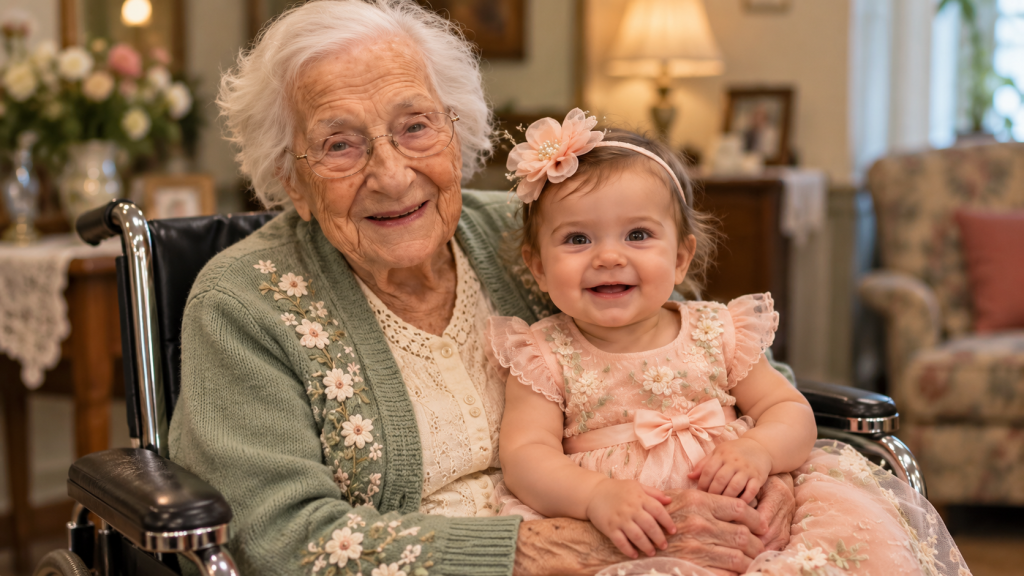
Grandma looked at my father. “Richard.” He stared at the envelope. “Evelyn, don’t.” Grandma’s expression hardened. That frightened me more than anything else. At 101, almost everything about her had become fragile.
Her wrists.
Her voice.
Her breathing.
But not that look.
“Don’t?”
she whispered.
My father took one step forward.
“This is Sophie’s birthday.”
Grandma gave a dry laugh.
“Seventy-four years ago, people used exactly that excuse.”
“What excuse?”
I asked.
Grandma looked at me.
“That it was never the right time to tell the truth.”
My mother’s face had turned white.
“Mom.”
She still called Grandma Mom.
That suddenly felt important.
“What are you saying?”
Grandma did not answer immediately.
Instead, she placed both hands on the red suitcase.
Her fingers trembled against the cracked leather.
Then she looked at Samuel.
“You came here because Richard called you.”
Samuel’s jaw tightened.
My mother looked at my father.
“You called him?”
Dad closed his eyes.
“Margaret.”
“Who is he?”
Silence.
Then Samuel spoke.
His voice was old.
Deep.
Unsteady.
“My name is Samuel Vale.”
Mom shook her head.
“I heard your name.”
She pointed toward Grandma.
“I want to know why she looks at you like she wants to throw you out a window.”
Under other circumstances, that might have been funny.
Nobody laughed.
Samuel looked at my mother for a long time.
Too long.
Something changed in his face.
Not recognition.
Grief.
A grief so old it had become part of his posture.
He whispered:
“Because my father stole you.”
My mother stared.
Then laughed once.
Sharp.
Disbelieving.
“What?”
Samuel’s eyes filled.
“My father arranged for you to be taken from St. Matthew’s Hospital.”
No one moved.
Grandma closed her eyes.
My mother looked from Samuel to Grandma.
Then to my father.
Then back again.
“You’re saying I was the baby?”
Grandma nodded.
My mother stepped backward.
“No.”
“Margaret—”
“No.”
She shook her head harder.
“You told me my parents died.”
Grandma’s mouth trembled.
“Your first adoptive parents did.”
“First?”
My mother’s voice cracked.
I felt my own stomach turn.
There were too many words in that sentence.
First.
Adoptive.
Parents.
Grandma whispered:
“You came to me when you were five.”
My mother’s knees nearly buckled.
My husband pulled out a chair.
She slapped his hand away.
“I don’t want to sit.”
Then, immediately:
“I need to sit.”
She dropped into the chair.
I moved toward her.
She held up one hand.
Not yet.
She looked at Grandma.
“I remember a blue house.”
Grandma started crying.
“Yes.”
“I remember a woman named June.”
“Yes.”
“I remember a man who smelled like cigarettes.”
“Yes.”
My mother’s face twisted.
“You told me they were friends of yours who died in an accident.”
Grandma whispered:
“They were the couple who raised you after you were taken from Rose.”
Silence.
The party decorations suddenly looked obscene.
Pink balloons.
A banner.
Half-eaten cake.
Paper crowns.
A tiny candle shaped like the number one.
All around us, thirty people stood frozen inside a family history they had not expected to enter.
My uncle slowly gathered the children and guided them into the backyard.
One by one, other guests followed.
Nobody complained.
Nobody asked questions.
Within minutes, only immediate family remained.
Grandma.
My mother.
My father.
Samuel.
My husband.
Me.
And Sophie.
Grandma looked at my husband.
“Take Sophie into the den.”
“No.”
I surprised myself.
Everyone looked at me.
I pulled Sophie from the high chair and held her against my chest.
“She stays with me.”
Grandma nodded.
Fair enough.
Then she opened the suitcase fully.
Inside were decades.
Not metaphorically.
Actual decades.
Letters tied with cotton ribbon.
Hospital records.
Photographs.
Two tiny bracelets.
A baptism certificate.
A newspaper clipping.
A child’s yellow ribbon.
And one small white baby shoe.
My mother stared at it.
Then reached forward.
Her fingers stopped inches away.
“That was mine?”
Grandma nodded.
“You wore a pair just like it when you came to us.”
“Why did you keep one?”
“Because Rose bought them.”
My mother pulled her hand back.
The name Rose seemed to hurt her physically.
“My biological mother.”
“Yes.”
“Your sister.”
“Yes.”
“Your twin.”
Grandma nodded.
My mother looked toward the photograph of the two newborn girls.
Grandma and Rose.
Same dark hair.
Same tiny mouths.
A hundred years earlier.
My mother whispered:
“What happened?”
Grandma began.
“When Rose and I were twenty-six, she fell in love with Samuel.”
Samuel lowered his head.
Grandma continued.
“The Vale family had money.”
“Old money.”
“Shipping.”
“Land.”
“A bank.”
“And Samuel’s father, Henry, believed people like us were suitable for sewing uniforms and cleaning offices.”
“Not marrying his son.”
Samuel said quietly:
“That is true.”
Grandma looked at him.
“You can speak later.”
He nodded.
She continued.
“Rose became pregnant.”
“Samuel wanted to marry her.”
“Henry refused.”
My mother looked at Samuel.
“Were you already married?”
“No.”
“Engaged?”
Samuel swallowed.
“My father had chosen someone he wanted me to marry.”
“But I had not.”
Grandma said:
“Henry offered Rose money.”
“She refused.”
“He offered our father money.”
“He nearly took it.”
“Our mother stopped him.”
Then Grandma looked down at the hospital bracelet.
“When Rose went into labor, Samuel was out of state.”
Samuel spoke.
“My father sent me to Boston.”
Grandma snapped:
“You went.”
His face tightened.
“Yes.”
There was more in that one word than apology.
Cowardice.
Regret.
Youth.
Grandma continued.
“Rose delivered a healthy baby girl.”
My mother covered her mouth.
“You.”
Grandma whispered.
“She held you once.”
Mom began crying.
Just once.
I could almost see that fact entering her.
Grandma reached into the suitcase and removed a photograph.
A black-and-white hospital image.
A young woman lying in bed.
Exhausted.
Beautiful.
Holding a bundle.
My mother stared.
“That’s her?”
“Yes.”
“She’s holding me?”
“Yes.”
Mom took the photograph.
Her fingers shook.
Grandma continued.
“Rose fell asleep after delivery.”
“When she woke, they told her you had developed breathing problems.”
“Then an infection.”
“Then…”
Grandma stopped.
Samuel finished.
“They told her the baby died.”
My mother made a sound.
Not a word.
Just pain.
Grandma nodded.
“But there was no body.”
“No funeral.”
“No death certificate that matched.”
“I knew something was wrong.”
“So did one nurse.”
She pulled a letter from the suitcase.
“Nora Finch.”
“She was twenty-two.”
“She saw a hospital administrator carry you out through a service corridor.”
“She saw Henry Vale there.”
Samuel closed his eyes.
My mother stared at him.
“Your father?”
“Yes.”
“What did he do with me?”
Samuel’s voice broke.
“He placed you with his cousin.”
“June and Walter Carr.”
The blue house.
The woman named June.
The man who smelled like cigarettes.
My mother whispered:
“They knew?”
Grandma answered.
“June knew you were adopted privately.”
“She did not know you had been stolen.”
My mother looked at the baby shoe again.
“And Rose?”
Grandma cried.
“She believed you were dead.”
That sentence destroyed the room.
For seventy-four years, my mother had lived.
Gone to school.
Fallen in love.
Married.
Had me.
Held Sophie.
And somewhere inside the past, another woman had spent years grieving a child who was still breathing.
Mom whispered:
“How long did she live?”
Grandma’s face folded.
“Five years.”
I felt my chest tighten.
“She died five years after giving birth?”
“Yes.”
“From what?”
Grandma hesitated.
Then:
“Rheumatic heart disease.”
Samuel looked at the floor.
Grandma continued.
“But grief made everything worse.”
My mother’s voice became tiny.
“Did she ever know?”
Grandma reached for another envelope.
“She knew something.”
Mom stared.
“What does that mean?”
“I found you when you were four.”
Every person in the room went still again.
My mother whispered:
“You found me?”
“Yes.”
“How?”
“Nora kept searching.”
“She had copied part of the nursery log before records disappeared.”
“She remembered the surname Carr.”
“She eventually found June.”
Grandma swallowed.
“June was dying of cancer.”
“She had begun asking questions.”
“She realized Henry had lied.”
“She contacted Nora.”
“Nora contacted me.”
My mother stared.
“Did Rose see me?”
Grandma did not answer.
Mom’s voice rose.
“Did she see me?”
“Yes.”
Everyone stopped breathing.
Grandma was crying openly now.
“Once.”
My mother stood.
The chair scraped backward.
“What?”
Grandma reached for her.
Mom stepped away.
“No.”
“Tell me.”
Grandma whispered:
“You were playing in a church courtyard.”
“You were wearing a yellow coat.”
My mother’s hands flew to her mouth.
“I remember a yellow coat.”
Samuel began crying too.
Grandma continued.
“Rose stood across the street.”
“She wanted to run to you.”
“June’s attorney said if she interfered, Henry would move you again.”
“Possibly out of the country.”
My mother’s face twisted.
“So she just watched?”
Grandma cried harder.
“She watched you play.”
“You fell.”
“June picked you up.”
“Rose took one step toward you.”
“Then stopped.”
“She said…”
Grandma’s voice disappeared.
“What?”
my mother demanded.
Grandma forced the words out.
“She said, ‘At least someone picks her up.’”
My mother sat down again.
No one spoke for a long time.
Sophie began tugging at my necklace.
Normal.
Small.
Unaware.
I kissed her hair.
Grandma continued.
“Rose wrote letters after that.”
“Not many.”
“She was ill.”
“She knew she might not live long.”
“She asked me to give them to you when you were old enough.”
My mother looked at the red suitcase.
“They’re in there.”
“Yes.”
“How old was I supposed to be?”
“Eighteen.”
My mother stared at Grandma.
“I am seventy-four.”
No one moved.
Then my mother whispered:
“You waited fifty-six years.”
Grandma closed her eyes.
“Yes.”
That was the moment the story changed.
Until then, Grandma had been the witness.
The protector.
The woman who brought the truth.
Now we saw the harm she had done too.
My mother’s voice trembled.
“Why?”
Grandma looked at her.
“At first, you were a child.”
“You had already lost June and Walter.”
“You came to me frightened.”
“You woke screaming.”
“You asked whether everybody died if you loved them.”
My mother began crying again.
Grandma continued.
“I told myself I would wait.”
“Then you turned twelve.”
“You were finally happy.”
“Then sixteen.”
“You wanted college.”
“Then eighteen.”
“You met Richard.”
Dad looked down.
Grandma whispered:
“And every year I told myself truth could wait until you were stronger.”
My mother laughed bitterly.
“Stronger than what?”
“Life?”
Grandma did not defend herself.
“No.”
Then:
“I became afraid.”
“Of me?”
“Of losing you.”
My mother stared.
Grandma’s voice cracked.
“I had raised you.”
“You called me Mom.”
“If I told you Rose was your mother, I was afraid I would become the woman who took her place.”
My mother whispered:
“You were.”
Grandma nodded.
“I know.”
That answer stopped everyone.
No excuse.
No argument.
Grandma looked toward the suitcase.
“I hated Henry Vale because he decided Rose could not be trusted with her own child.”
“He called it protection.”
“He called it family honor.”
“He called it necessity.”
Then her eyes returned to my mother.
“And I did something smaller but made from the same arrogance.”
“I decided you could not be trusted with your own truth.”
My mother began sobbing.
Grandma whispered:
“I am sorry.”
Mom turned away.
Grandma did not ask forgiveness.
Thank God.
Then my father spoke.
“Margaret.”
She looked at him.
He looked terrified.
“Don’t.”
she said.
“I need to.”
“No.”
“I need to.”
She pointed toward the sealed envelope.
“You knew.”
Dad’s eyes filled.
“Yes.”
The word landed like a stone.
My mother stared.
“How long?”
He looked toward Grandma.
Then answered:
“Thirty-seven years.”
My mother’s face emptied.
Not anger.
Nothing.
Thirty-seven years is too large for an immediate emotion.
She whispered:
“Before our thirtieth anniversary.”
“Yes.”
“Before our twenty-fifth.”
“Yes.”
“Before our twentieth.”
“Yes.”
“Before our tenth.”
“Yes.”
She looked at me.
Then back at him.
“Before she graduated high school.”
“Yes.”
I felt sick.
Before I had graduated.
Before college.
Before my wedding.
Before Sophie.
My father knew my mother’s biological mother had been Grandma’s twin.
Knew the family history.
Knew Samuel existed.
And every Christmas, every funeral, every hospital visit, he said nothing.
My mother lifted the envelope.
“Open it.”
Dad whispered:
“Please.”
“Open.”
Grandma handed it to him.
Dad’s hands shook so badly that my husband took Sophie from me and I moved closer in case he dropped it.
Inside were letters.
Dad recognized the first instantly.
His face collapsed.
My mother took it.
Read.
I watched her eyes move.
Then stop.
She looked at him.
“You wrote this?”
“Yes.”
She read aloud.
“‘Samuel, I am asking you not to contact Margaret again. Evelyn has told me the circumstances of her birth. Margaret has a good life. Telling her now would only reopen wounds she cannot heal.’”
My mother lowered the page.
“Wounds I cannot heal.”
Dad started crying.
“I was wrong.”
“You decided that?”
“Yes.”
“Why did Samuel contact you?”
Dad looked toward him.
Samuel answered.
“Because I found you.”
My mother stared.
“When?”
“1989.”
I did the math.
I had been a child.
Samuel continued.
“My father died in 1978.”
“He left papers.”
“Not because he was sorry.”
“Because he kept records of everything.”
“A man like Henry preserved proof because he believed proof was power.”
Samuel’s mouth tightened.
“I found payments to St. Matthew’s.”
“Letters from June.”
“Rose’s hospital record.”
“I realized my daughter had lived.”
He looked at my mother.
“I spent eleven years trying to find you without destroying your life.”
“Eventually I found Evelyn.”
Grandma said:
“I told him to stay away.”
Samuel nodded.
“I did.”
“For a while.”
“Then I learned Richard worked for an insurance company in the city.”
“I contacted him.”
My father whispered:
“You wrote to my office.”
“Yes.”
My mother lifted another letter.
“You answered him.”
Dad nodded.
“Several times.”
She read another.
Her expression changed.
“‘If you care about her, let her remain my wife and Evelyn’s daughter without confusing her with a past she did not choose.’”
My mother looked at him.
“Remain my wife?”
Dad’s face crumpled.
“That was badly written.”
“No.”
She shook her head.
“That was honestly written.”
Nobody moved.
Mom continued.
“You were afraid I would change.”
“Yes.”
“If I learned.”
“Yes.”
“That our marriage would change.”
“Yes.”
“That I would want him in my life.”
Dad looked toward Samuel.
“Yes.”
Samuel lowered his eyes.
My mother whispered:
“So you did not keep this secret only for me.”
Dad started crying.
“No.”
“I kept it partly for myself.”
That honesty hurt.
But it mattered.
Mom turned the page.
Then froze.
“What is this?”
Dad’s face changed.
Samuel said nothing.
My mother held up a photocopy of a bank check.
$25,000.
From the Vale Family Trust.
Payable to Richard and Margaret Hale.
Thirty-two years earlier.
My mother went white.
I looked at Dad.
“What is that?”
He covered his face.
Mom whispered:
“You took money.”
“No.”
Then:
“Yes.”
The room went silent.
Dad lowered his hands.
“It wasn’t hush money.”
Samuel spoke sharply.
“It was not.”
Grandma looked at him.
“Let him answer.”
My father swallowed.
“When you had surgery.”
Mom frowned.
“What surgery?”
“Your hysterectomy.”
Mom stopped.
I remembered that year vaguely.
Hospital.
Grandma staying with me.
Dad missing work.
Money problems.
Dad continued.
“Insurance denied part of it.”
“We were drowning.”
“Samuel offered help.”
Mom’s voice became cold.
“And you accepted twenty-five thousand dollars from the biological father I didn’t know existed.”
Dad cried.
“Yes.”
“Did you tell him where I was?”
“He already knew.”
“Did you promise anything?”
“No.”
Samuel said:
“I gave the money because she was my daughter.”
My mother turned on him.
“You did not know me.”
“No.”
“You bought access?”
“No.”
“You bought silence?”
“No.”
Samuel’s voice broke.
“I bought the only thing Richard would let me buy.”
“Help.”
My mother stared.
That was terrible in a different way.
Samuel continued.
“I asked to meet you.”
“Richard refused.”
“I asked him to give you a letter.”
“He refused.”
“I asked to at least know whether you survived surgery.”
“He told me.”
My mother looked at Dad.
Dad whispered:
“I thought I was protecting you.”
Mom laughed.
A hard, empty sound.
“Every person in this story says that.”
Nobody had an answer.
Then Samuel did something I did not expect.
He walked toward the door.
My husband moved instinctively to block him again.
Samuel stopped.
“No.”
He looked at my mother.
“I should leave.”
Mom stared.
“You waited seventy-four years and now you want to leave?”
He looked ashamed.
“I came because Richard called me.”
She looked at Dad.
“Why did you call him today?”
Dad’s face drained again.
Another secret.
Of course.
“I knew Evelyn was coming.”
“How?”
“The transport service called me.”
Grandma frowned.
Dad continued.
“She listed me as emergency contact years ago.”
“When they said she insisted on bringing the red suitcase…”
He stopped.
My mother whispered:
“You panicked.”
“Yes.”
“You called Samuel.”
“Yes.”
“What did you ask him to do?”
Dad closed his eyes.
“To help me stop her.”
I felt rage rise in me.
My mother did not move.
Samuel said:
“I refused.”
Dad looked at him.
Samuel continued.
“Richard said the truth would destroy Margaret.”
“I said the lie already had.”
My mother stared at Samuel.
“Then why did you come?”
He looked at Sophie.
Then at her left ankle.
“Because Evelyn told me last year she would speak if she lived to see another generation.”
Grandma’s eyes widened.
“You remember that?”
Samuel smiled sadly.
“I remember everything you say when you threaten me.”
A tiny, impossible laugh escaped Grandma.
Then disappeared.
Samuel looked at my mother.
“I thought if today was the day, I should be here to answer for my part.”
My mother crossed her arms.
“Your part.”
“Yes.”
“What was it?”
Samuel took a long breath.
“I loved Rose.”
Grandma’s expression sharpened.
“Do not make yourself romantic.”
“I won’t.”
He nodded.
“I loved her.”
“And when my father sent me away, I went.”
“I was twenty-seven.”
“Old enough to say no.”
“I did not.”
“I wrote.”
“I argued.”
“I threatened to leave the family business.”
“But I still boarded the train.”
Grandma looked at him.
“Rose waited.”
“I know.”
“She begged you to come.”
“I know.”
“She labored without you.”
Samuel began crying.
“I know.”
My mother watched him.
No sympathy yet.
He continued.
“When I returned, my father told me the baby died.”
“He showed me a forged certificate.”
“He told me Rose blamed me and refused to see me.”
“Did you try?”
“Yes.”
“How hard?”
Samuel stopped.
The question cut deeper than accusation.
Finally:
“Not hard enough.”
My mother nodded.
At least he knew.
Samuel continued.
“I sent letters.”
“My father intercepted most.”
“I went to Rose’s house twice.”
“Her father sent me away once.”
“Evelyn sent me away the second time.”
Grandma nodded.
“I did.”
“Why?”
I asked.
Grandma looked at me.
“Because by then Rose had spent months asking whether Samuel had chosen his father.”
“I believed he had.”
Samuel whispered:
“I had.”
Again.
No defense.
My mother sat down slowly.
Then looked at Grandma.
“I want Rose’s letters.”
Grandma’s hands trembled.
“They are yours.”
“All of them.”
“Yes.”
“No copies withheld.”
“No.”
“No more deciding.”
“No more.”
Mom pulled the ribbon bundle from the suitcase.
There were seven letters.
Only seven.
She opened the first.
Nobody tried to stop her.
The paper was yellow.
My mother began reading silently.
Then tears came.
I moved toward her.
She shook her head.
Not yet.
She read another.
Then another.
Finally, she whispered:
“She called me Maggie.”
Grandma smiled through tears.
“She did.”
“My name was Margaret.”
“Yes.”
“But she called me Maggie.”
“Yes.”
Mom laughed and cried at the same time.
“My whole life you hated when anyone called me Maggie.”
Grandma’s face broke.
“I know.”
“Why?”
“Because she did.”
The room went silent.
One tiny preference suddenly carried seventy years of grief.
Mom opened the last letter.
Her hands trembled.
She read aloud.
Not everything.
Only parts.
“‘My sweet Maggie, if Evelyn gives you this, then you grew older than I was brave enough to imagine.’”
Grandma covered her mouth.
Mom continued.
“‘You were not given away by me.’”
My father began sobbing.
“‘You were taken.’”
Samuel closed his eyes.
“‘If the people who raised you loved you, do not punish yourself for loving them back.’”
My mother stopped.
Could not continue.
She handed the letter to me.
I read the next line silently.
Then aloud because she nodded.
“‘Love is not evidence that the theft was harmless. It only means kindness found you after cruelty did.’”
Grandma cried harder.
I continued.
“‘If Evelyn became your mother, let her be your mother.’”
Every person in the room looked at Grandma.
“‘She was my sister before she was anything else, and she has spent her life fighting battles I was too tired to survive.’”
Grandma bowed her head.
Then the last lines.
“‘But make her tell you the truth.’”
I stopped.
Nobody breathed.
I looked at Grandma.
Her face collapsed.
Rose had known her.
Even then.
I continued.
“‘Evelyn loves by carrying things alone.’”
Grandma whispered:
“Oh, Rose.”
“‘Sometimes she carries them so long they become secrets.’”
I could barely read.
“‘Do not let my daughter inherit silence.’”
That sentence ended everything.
Not legally.
Not emotionally.
But spiritually, somehow.
Grandma had carried the suitcase seventy-four years.
Rose had warned against exactly that.
My mother looked at her.
“You had this.”
Grandma nodded.
“All this time.”
“Yes.”
“And she told you not to hide it.”
“Yes.”
My mother stood.
Grandma started crying harder.
“I’m sorry.”
Mom walked toward her.
For one terrible second, I thought she would turn away.
Instead, she knelt beside the wheelchair.
She took Grandma’s face in both hands.
“I love you.”
Grandma sobbed.
Then Mom said:
“And I am so angry with you.”
Grandma nodded.
“I know.”
“I don’t forgive you yet.”
“I know.”
“You don’t get forgiveness because you are 101.”
A laugh escaped Grandma through tears.
“No.”
“You don’t get forgiveness because you finally brought the suitcase.”
“No.”
“You took my right to know her.”
“Yes.”
“You took his letters.”
Grandma glanced at Samuel.
“Yes.”
“You helped Richard keep quiet.”
“Yes.”
Mom cried.
“You were my mother.”
“I am.”
Grandma’s face twisted.
“If you still let me be.”
My mother pressed her forehead against Grandma’s.
“I don’t know what you are today.”
That hurt everyone.
But Grandma nodded.
“Fair.”
It was the most honest moment I had ever witnessed between them.
Then Sophie began crying.
Not gentle fussing.
Birthday-overload screaming.
We all startled.
My husband handed her back to me.
Grandma wiped her face.
“Take off the other sock.”
I stared.
“What?”
“The other sock.”
Despite everything, I almost laughed.
“Why?”
“Because I made a century-old family crisis out of one foot.”
Mom actually laughed.
A real laugh.
Tiny.
Broken.
But real.
I removed Sophie’s right sock.
Nothing.
Normal little foot.
Grandma smiled.
“There.”
“Proof the child is still mostly ordinary.”
We needed that.
We desperately needed ordinary.
My husband brought Sophie a bottle.
The party resumed only in the smallest sense.
Nobody sang again.
The cake remained half cut.
Most guests had quietly gone home.
But those of us still there sat around the dining room table.
And for the next three hours, Grandma told the whole story.
No more performance.
No more interruptions.
She explained how June Carr died when my mother was five.
Walter, her adoptive father, had started drinking heavily after June’s illness.
He contacted Nora.
Nora contacted Grandma.
Grandma petitioned for guardianship using the private records she had gathered.
Because the original adoption had been legally finalized under fraudulent information, lawyers warned that exposing everything might create years of litigation.
Samuel’s father was still alive.
Powerful.
Threatening.
So Grandma made a bargain.
Not for money.
For custody.
Henry Vale agreed not to challenge Evelyn taking Margaret if Evelyn agreed never to publicly accuse him or the hospital.
Grandma signed.
My mother stared.
“You signed a secrecy agreement?”
“It would not hold today.”
Rebecca—my cousin who happened to be a lawyer and had stayed after the party—said quietly.
“But back then it frightened everyone enough.”
Grandma nodded.
“I was afraid if I fought publicly, Henry would take you again.”
My mother asked:
“Was that true?”
Grandma paused.
“I don’t know.”
That answer mattered.
Maybe some of the secrecy had protected.
Maybe some had only felt safer.
Grandma continued.
“Henry died believing he had won.”
Samuel said:
“He didn’t.”
Grandma looked at him.
“He did for a long time.”
Samuel accepted that.
Then Dad asked:
“What about the birthmark?”
Grandma looked at Sophie’s ankle.
“Rose had one.”
“So did our mother.”
“I had a faint one as a baby, but mine faded.”
I blinked.
“You had one too?”
“Yes.”
My mother frowned.
“Then Sophie’s mark doesn’t prove I’m Rose’s daughter.”
“No.”
Grandma smiled sadly.
“It never did.”
That surprised all of us.
“Then why did you react like that?”
I asked.
Grandma stared at the little crescent.
“Because Rose wrote about yours.”
My mother froze.
“Mine?”
Grandma nodded.
“When Rose held you after birth, she wrote that you had the same crescent under your left ankle.”
Mom looked down.
Her own ankle.
Slowly.
She removed her shoe.
Then sock.
There it was.
Faded.
Smaller than Sophie’s.
A tiny crescent.
She had lived with it seventy-four years.
Never knowing anyone had once loved that mark before she could even speak.
My mother began crying again.
Samuel turned away.
Grandma whispered:
“That is why I asked you to remove Sophie’s sock.”
“I saw Rose.”
“For one second.”
Not proof.
Memory.
That somehow made it more powerful.
The following weeks were not peaceful.
People like stories where one suitcase opens and everyone immediately cries, hugs, forgives, and becomes whole.
That is not what happened.
My mother stopped speaking to Grandma for nine days.
Not because she stopped loving her.
Because every conversation felt like standing inside two lives at once.
The mother she knew.
The aunt who had rescued her.
The woman who lied.
The woman who stayed.
All true.
She stopped speaking to Dad for longer.
He moved into our guest room for almost three months.
Not because Mom formally left him.
Because she said:
“I need one room in my life where nobody has hidden anything.”
Dad accepted it.
That helped.
He gave her every letter.
Every document.
Every bank record connected to Samuel.
There were no more secret payments after the surgery.
That mattered.
Samuel had offered many times.
Dad refused.
He had taken the $25,000 once.
Used it entirely for medical bills.
Still wrong to hide.
But not a decades-long financial scheme.
Mom said:
“I almost wish you’d stolen more.”
Dad looked confused.
“Why?”
“Because then I could hate you simply.”
He cried.
So did she.
Complicated betrayal is exhausting.
Samuel asked for nothing.
That may have been the first wise thing he did.
He gave my mother his phone number.
His address.
A box of photographs.
Then left.
No demand that she call him Dad.
No claim that biology entitled him to a relationship.
Two weeks later, my mother called.
Not because she forgave him.
Because she had questions.
What color were Rose’s eyes?
Did she sing?
What food did she hate?
Was she funny?
Did she want more children?
Samuel answered what he could.
Sometimes he said:
“I don’t know.”
Mom later told me those were the answers she trusted most.
One month after Sophie’s birthday, my mother agreed to a DNA test.
Not because she doubted Grandma.
The documents were overwhelming.
Because she wanted one fact nobody had interpreted for her.
The result came back:
Samuel Vale.
Probability of biological paternity:
99.99%.
My mother stared at the paper.
Then folded it.
No dramatic collapse.
Just:
“Well.”
I asked:
“How do you feel?”
She laughed.
“Apparently related to a very old man.”
Fair.
Their relationship developed slowly.
Coffee.
Then lunch.
Then one visit to Samuel’s house.
On the wall was Rose.
A photograph my mother had never seen.
Rose at twenty-four.
Standing beside a bicycle.
Laughing at something outside the frame.
Mom stood in front of it for almost an hour.
Samuel did not speak.
Eventually Mom whispered:
“I look like her.”
“Yes.”
“You should have told me.”
Samuel’s voice broke.
“Yes.”
“You should have fought harder.”
“Yes.”
“You should have found me sooner.”
“Yes.”
“I don’t know what to call you.”
Samuel nodded.
“You don’t have to call me anything.”
That answer saved whatever chance he had.
My mother called him Samuel for eight months.
Then one afternoon, without planning it, she said:
“Dad, can you pass the salt?”
Everyone froze.
Samuel started crying.
Mom looked horrified.
“Oh, God.”
Samuel laughed through tears.
“You can take it back.”
“I might.”
“Fair.”
She did not.
Not entirely.
Sometimes he was Samuel.
Sometimes Dad.
Family names became choices instead of commands.
Grandma Evelyn lived seven more months.
At 101, seven months can feel like an entire borrowed lifetime.
Her health declined.
But she remained mentally clear.
My mother visited.
At first, once a week.
Then more.
They did not pretend the suitcase had repaired everything.
One afternoon, I sat near Grandma’s bed while Mom read Rose’s letters aloud again.
Grandma listened with closed eyes.
When Mom finished, Grandma whispered:
“I should have given them to you.”
“Yes.”
“At eighteen.”
“Yes.”
“At twenty.”
“Yes.”
“At thirty.”
“Yes.”
Grandma opened her eyes.
“I kept thinking there would be a gentler age.”
Mom stared at her.
“There isn’t.”
“No.”
Grandma smiled faintly.
“Now I know.”
Mom took her hand.
“I forgive you for being afraid.”
Grandma began crying.
Mom continued.
“I don’t forgive every choice you made because of it.”
Grandma nodded.
“That is enough.”
And it was.
Forgiveness did not need to become acquittal.
Love did not require forgetting.
Grandma died six weeks after turning 102.
At home.
Not alone.
My mother sat beside her.
So did I.
Sophie, now nearly two, slept down the hall.
Samuel came the day before.
Grandma looked at him.
“You got old.”
Samuel laughed.
“So did you.”
“I did it better.”
“Obviously.”
They talked privately for twenty minutes.
Nobody knows everything they said.
That is one secret I am willing to leave alone.
Before Samuel left, Grandma called him back.
He turned.
She said:
“Rose loved you.”
Samuel closed his eyes.
“I know.”
Grandma shook her head.
“No.”
“She loved you.”
“Do not turn that into proof you deserved her.”
He began crying.
“I won’t.”
“Good.”
The next morning, Grandma asked for the red suitcase.
Mom brought it.
Grandma touched the lid.
Then said:
“Open it.”
Mom did.
Grandma looked inside.
“Take the lock off.”
My mother stared.
“What?”
“The lock.”
It was a tiny brass padlock.
Mom found the key.
Opened it.
Grandma whispered:
“Throw it away.”
I smiled through tears.
Mom did not throw it away.
She put it in a drawer.
Grandma rolled her eyes.
“Still dramatic.”
Mom laughed.
Then Grandma touched the letters.
“These belong to you.”
“I know.”
“The photographs.”
“I know.”
“The truth.”
Mom’s face tightened.
“Yes.”
Grandma whispered:
“No more locked boxes.”
“No more.”
She died that evening.
Quietly.
My mother held one hand.
I held the other.
Her last clear words were not profound.
She said:
“Someone turn off that television.”
It was too loud.
Very Grandma.
We laughed at her funeral when we told the story.
Rose was buried in a cemetery two states away.
My mother had never known.
After Grandma’s funeral, we went.
Samuel came.
So did Dad.
My mother stood before Rose’s grave.
The stone was simple.
ROSE BENNETT
1925–1957.
Nothing about a daughter.
Nothing about what happened.
Mom placed the tiny white baby shoe on the grass.
Not permanently.
We took it home afterward.
But for ten minutes, it rested there.
Mom said:
“Hi.”
That was all at first.
Then:
“I’m Maggie.”
Samuel began crying behind us.
Mom continued.
“I know you knew that.”
She smiled.
“I have a daughter.”
She looked at me.
“And she has Sophie.”
“You would like Sophie.”
I started crying.
Mom touched the crescent birthmark beneath her own ankle.
Then whispered:
“I’m sorry you thought I died.”
That sentence destroyed all of us.
Not:
I’m sorry you lost me.
I’m sorry you thought I died.
Because that was the deepest cruelty.
Rose had been made to mourn a living child.
The same way my mother had been made to live without knowing she had been mourned.
Afterward, we went to lunch.
Because grief eventually requires sandwiches.
That is one of the strangest things about being alive.
Dad and Mom stayed married.
Not immediately happily.
Not neatly.
They went to counseling.
Dad stopped using the word protect unless he could explain exactly what danger he meant.
Mom began answering:
“Ask me.”
Whenever he assumed.
That became their phrase.
Ask me.
Should we tell her?
Ask me.
Would this upset her?
Ask me.
Does she want Samuel invited?
Ask me.
Simple.
Decades late.
Still useful.
Dad once told me:
“I thought love meant carrying difficult knowledge so she wouldn’t have to.”
I answered:
“Grandma thought the same thing.”
He nodded.
“I know.”
“Look how that worked.”
He laughed sadly.
“Yes.”
Samuel died three years after Sophie’s first birthday.
He was 101.
My mother had just over three years with him.
Not enough to become a normal father-daughter relationship.
Enough for twenty-seven lunches.
Four holidays.
One argument over politics.
Two doctor appointments.
A hundred phone calls.
And one terrible attempt by Samuel to teach Mom how to play gin rummy.
He cheated.
She caught him.
He denied it badly.
She called him Dad while accusing him.
Maybe that was the closest they came to ordinary.
Samuel left her no giant fortune.
People expected one.
The Vale family had money once.
Much of it was gone.
What remained, Samuel divided among charities, distant relatives, and a modest trust for my mother.
$180,000.
Significant.
Not life-changing.
Mom almost refused it.
Then changed her mind.
She used part to create a small scholarship for students training in maternal nursing.
She named it:
The Rose Bennett and Nora Finch Scholarship.
Not Samuel.
He would have approved.
The rest she saved.
Not as compensation.
You cannot price seventy-four years.
My father offered to repay the $25,000 Samuel gave us decades earlier.
Mom said no.
Then changed her mind.
Not because she wanted the money.
Because she wanted the history straight.
Dad repaid the old amount, adjusted by a reasonable investment estimate, into the scholarship fund.
It hurt financially.
That was appropriate.
Not punishment.
Accounting.
He said:
“I should have told you then.”
Mom answered:
“Yes.”
No fight.
No absolution.
Truth.
The red suitcase came to me after Mom finished cataloging everything.
But she made one change.
She removed the padlock.
For years, it sat in my study unlocked.
The brass corners still scratched.
The leather still red.
Inside, we placed copies.
Not originals.
The originals went into archival storage.
We digitized every letter.
Every photograph.
Every hospital record.
Every document.
No single person would ever again be able to hide the whole story inside one box.
That mattered to me.
When Sophie turned six, she asked:
“Why is Grandma’s suitcase red?”
I said:
“Because Great-Great-Grandma Evelyn liked dramatic luggage.”
Probably true.
At nine, she asked why we kept old baby shoes.
I told her part of the story.
At twelve, more.
At sixteen, almost everything.
At eighteen, I gave her access to the entire archive.
No waiting until some imaginary gentler age.
She sat at my kitchen table reading Rose’s letters.
Then looked at me.
“People really did all this because they thought the truth would hurt too much?”
“Yes.”
She frowned.
“The lies hurt more.”
“Yes.”
“Adults are weird.”
“Correct.”
She touched the crescent mark under her left ankle.
It had faded slightly.
Still there.
“Is this why?”
she asked.
“Why what?”
“Why Great-Great-Grandma knew.”
“Partly.”
Sophie smiled.
“So technically my foot exposed everyone.”
I laughed.
“Your foot had excellent timing.”
Then she became serious.
“Do you think Great-Great-Grandma was bad?”
There it was.
The question every generation wants answered.
Good.
Bad.
Victim.
Villain.
I looked at the red suitcase.
“No.”
Sophie frowned.
“Then what?”
“She was brave.”
“She was afraid.”
“She rescued your grandmother.”
“She lied to her.”
“She loved her sister.”
“She failed her sister’s last request.”
“She protected people.”
“She controlled people.”
“She was generous.”
“She was stubborn.”
“She was human.”
Sophie stared.
“That’s a lot.”
“Yes.”
“Is Samuel bad?”
“Same answer.”
“Grandpa Richard?”
“Same answer.”
She rolled her eyes.
“You never give easy answers.”
“Easy answers caused enough trouble in this family.”
She laughed.
Then asked:
“What about Henry Vale?”
That one took longer.
The man who arranged the theft.
Bought silence.
Moved a newborn like property.
I said:
“Some choices deserve clearer judgment.”
She nodded.
Good.
Nuance does not require moral fog.
Years after everything happened, my mother told me something I had never known.
The night before Sophie’s first birthday, Grandma called her.
Not to reveal the secret.
Just to ask:
“Does the baby have a mark under her left ankle?”
Mom thought she was confused.
Said she didn’t know.
Grandma replied:
“Check tomorrow.”
Then hung up.
By the time Grandma arrived with the red suitcase, she had already decided.
The birthmark did not force her.
It gave her courage.
There is a difference.
Sometimes people say the truth came out because Sophie had that mark.
No.
The truth came out because a 101-year-old woman finally chose to stop protecting everyone from it.
Too late.
But not never.
That became the lesson I carried.
Late truth cannot restore lost years.
My mother never had childhood with Rose.
Rose never watched her grow.
Samuel got only three years.
Grandma spent her final months living with anger she had earned.
Dad spent years rebuilding trust.
Nothing reset.
But truth changed what the next generation inherited.
Sophie inherited photographs instead of rumors.
Letters instead of silence.
Names instead of blanks.
She knew Rose.
Not personally.
But truly enough.
She knew Nora Finch.
The nurse who copied one nursery page because something felt wrong.
She knew June Carr had loved the baby she did not know was stolen.
That mattered too.
We did not erase June because biology appeared.
Love is not canceled by new facts.
My mother kept a photograph of June beside one of Rose.
Two mothers.
Different roles.
Both real.
On my mother’s eightieth birthday, she put them both on the table.
Someone asked:
“Which one do you call your mother?”
Mom answered:
“Evelyn.”
Then pointed toward Rose.
“That is my first mother.”
Then toward June.
“That is the woman who kept me alive when no one knew where I belonged.”
There was no simple word.
So she stopped forcing one.
By then Dad had learned not to answer for her.
That was progress.
One Sunday, many years after the birthday party, I found the old brass padlock in Mom’s desk.
The one Grandma told her to throw away.
I held it up.
“You kept this?”
Mom smiled.
“I know.”
“She specifically said throw it away.”
“I spent seventy-four years having other people make decisions for me.”
I laughed.
“Fair.”
“What are you going to do with it?”
She thought.
Then handed it to me.
“Nothing.”
“Nothing?”
“Exactly.”
I put it in the red suitcase.
Unlocked.
The padlock remained there.
A symbol that could no longer close anything.
When my mother died at eighty-seven, Sophie was beside her.
So was I.
Dad had died two years earlier.
Before he died, he asked Mom:
“Did you forgive me?”
She answered:
“Yes.”
Then:
“I still wish you had told me.”
He smiled sadly.
“I know.”
That was their ending.
Not innocence restored.
Trust rebuilt enough to sit beside one another at the end.
After Mom died, I opened the red suitcase again.
At the bottom was one envelope I had never seen.
My name.
I panicked.
Of course.
This family and envelopes.
I opened it.
Mom’s handwriting.
If you are reading this, please do not turn the suitcase into a shrine.
I laughed through tears.
It is luggage.
That sounded like her.
The important thing was never the suitcase.
The important thing was who controlled the key.
I stopped.
For most of my life, somebody else did.
First Henry Vale.
Then Evelyn.
Then Richard.
Sometimes they acted from cruelty.
Sometimes fear.
Sometimes love.
The result was still that other people decided what I was allowed to know about myself.
My eyes blurred.
Do not do that to Sophie.
Tell her difficult things in ways she can understand, but tell her.
Let her ask.
Let her be angry.
Let her choose what the truth means.
Then:
And if she wants to throw the suitcase away, let her.
I laughed.
Sophie, now grown, found me crying.
“What happened?”
I handed her the letter.
She read.
Then looked at the suitcase.
“Can I keep it?”
I laughed harder.
“Your grandmother literally just gave you permission to throw it away.”
“I know.”
“I like it.”
“Why?”
She touched the scratched red leather.
“Because it used to hold secrets.”
“And now?”
She smiled.
“Now it holds records.”
Exactly.
That is what the suitcase became.
Not a locked thing.
An archive.
Not proof that our family was cursed.
Proof that silence could end.
My grandmother came to Sophie’s first birthday carrying the truth in a red suitcase.
At the time, I thought the most frightening thing she did was point at an old man and tell us to lock the door.
I was wrong.
The bravest thing she did was unlock what she had spent seventy-four years hiding.
The cruelest part of the story was not that one powerful man once stole a baby.
Though that was cruel enough.
It was how many people afterward continued stealing smaller choices from that same child.
When she could know.
Who she could meet.
What she could remember.
Which history she was strong enough to survive.
All in the name of protection.
My mother eventually understood something all of them had missed.
Truth can hurt you.
But being denied the truth about your own life is a different wound.
Because pain at least belongs to you.
A lie belongs to whoever controls it.
That is why, in our family, nobody locks the red suitcase anymore.
THE END STORIES! THANK YOU FOR READING GOOD LUCK! ❤️
Related Posts