For a few seconds, I thought the lawyer had to be mistaken. “A board vote?” “Yes.” “Tomorrow morning?” “At nine.” I was still sitting on my kitchen counter with the unopened ramen packet in my hand.
My wife had been dead nineteen days. Nineteen. I was still waking up some mornings reaching for her. Still checking my phone before remembering there would never be another text from Margarine complaining that hospital coffee tasted like melted cardboard.
And now an old lawyer was telling me I apparently controlled voting rights worth millions of dollars in a medical company whose executives might have been defrauding insurers. I put the ramen down.
“What exactly are they voting on?”
The lawyer hesitated.
Then said:
“My name is Samuel Greene, by the way.”
“I know.”
“No, you don’t.”
I blinked.
He was right.
Margaret had always referred to him as “Granddad’s lawyer.”
I had never met him.
“Sorry.”
“You’re grieving.”
He sighed.
“Tomorrow’s board meeting is being presented as an emergency restructuring.”
“What does that mean?”
“Margaret’s brother, Thomas Ellison, wants the board to sell the company’s reimbursement-services division to a private entity called Redwood Clinical Partners.”
“And that matters because?”
Samuel’s voice hardened.
“Because most of the questionable billing passed through that division.”
I slid off the counter.
“So he’s trying to sell the evidence?”
“Potentially the liability.”
“That sounds illegal.”
“It may be.”
“May?”
“Do not confuse suspicious with proven.”
Even over the phone, Samuel sounded like a man who had spent forty years stopping emotional people from outrunning facts.
I appreciated that immediately.
“What did Margaret find?”
He was quiet for a moment.
Then:
“Your wife found thousands of claims for services that either were never delivered, were coded at higher reimbursement levels than the underlying treatment justified, or lacked supporting patient records.”
My chest tightened.
“How much money?”
“We do not know the final number.”
“Margaret’s preliminary analysis identified approximately nine-point-four million dollars in disputed claims.”
I stared at the wall.
“Nine million?”
“Nine-point-four billed.”
“Approximately five-point-eight million appears to have actually been paid.”
“By insurers?”
“Yes.”
“Government programs too?”
Another pause.
“Some.”
That changed everything.
I knew enough from life to understand private insurance problems were serious.
Government healthcare money introduced an entirely different level of danger.
I rubbed my forehead.
“Margaret knew this while she was dying?”
“Yes.”
“How?”
“She inherited the voting shares from her grandfather.”
“That doesn’t make her an auditor.”
“No.”
Samuel almost laughed.
“Margaret was annoying in a broader range of disciplines.”
Despite myself, I smiled.
That sounded like her.
“She started looking because the company’s reported reimbursement revenue rose almost eighteen percent while patient volume was nearly flat.”
I closed my eyes.
Of course she noticed.
Margaret once found a six-dollar mistake on a restaurant bill after three margaritas.
Samuel continued.
“She asked questions.”
“Her brother told her the increase came from improved coding.”
“She asked for the coding reports.”
“They delayed.”
“She asked again.”
“They gave her summaries.”
“She requested source data.”
“That is when people started becoming uncomfortable.”
My stomach twisted.
“Who is people?”
“Thomas.”
“The chief operating officer, Martin Hale.”
“The reimbursement director.”
“Potentially others.”
“And Margaret?”
“She started collecting records.”
I thought about the last six months of her life.
The laptop open beside her hospital bed.
The calls she ended when I entered the room.
The nights she told me she was doing “boring family paperwork.”
I had believed her.
Because when someone you love is dying, you do not necessarily imagine she is secretly building a corporate fraud file between transfusions.
I whispered:
“Why didn’t she tell me?”
“That question is answered in the will package.”
“Not tonight?”
“I would rather explain it in person.”
I looked at the clock.
“What time can I see you?”
“Eight tomorrow.”
“The meeting is at nine.”
“Yes.”
“That gives me an hour.”
“Margaret believed pressure improved your listening.”
I almost laughed.
“She said that?”
“Frequently.”
I closed my eyes.
For one second, she was alive again.
Then she wasn’t.
Samuel said:
“Do not contact Thomas tonight.”
“I wasn’t going to.”
“Do not contact anyone at Ellison Medical.”
“Fine.”
“And do not sign anything if somebody arrives at your home.”
That made me stand straighter.
“Why would someone arrive?”
“Because if Thomas knows the marriage activated your voting rights, he may try to get you to waive them.”
“Does he know?”
“He knows you married.”
“That’s public.”
“He may not know Margaret updated the trust paperwork in time.”
“What trust paperwork?”
“Tomorrow.”
I exhaled sharply.
“I’m beginning to dislike you.”
“You’ll survive.”
Margaret had used that exact sentence on me.
I had proposed to her the second time during a terrible dinner.
She said no.
I said I might die of humiliation.
She said:
“You’ll survive.”
I hung up and cried over the unopened ramen.
The next morning, I arrived at Samuel Greene’s office at 7:43.
He was older than I expected.
Late seventies.
Silver hair.
Dark suit.
Soft Kentucky accent despite four decades in Illinois.
He stood when I entered.
Then did something I did not expect.
He hugged me.
Not long.
Not dramatically.
Just one firm arm around my shoulders.
“She loved you.”
That nearly ruined me before the meeting even started.
“I know.”
He nodded.
“Good.”
Then he pointed to the conference table.
Folders covered it.
A laptop.
Two sealed envelopes.
One small black flash drive.
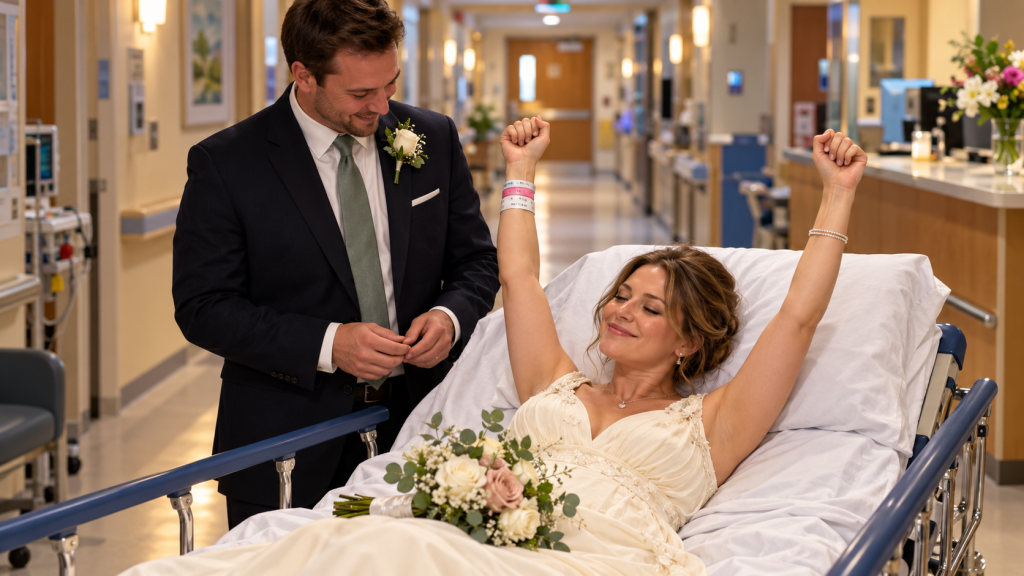
And a photograph from our hospital wedding.
Margaret was pale.
So thin the ring almost looked too heavy for her hand.
But smiling.
God, she was smiling.
Samuel sat.
“I need to explain the structure first.”
“Go ahead.”
“Margaret’s grandfather, Elias Ellison, founded Ellison Medical Technologies with two partners.”
“I knew that.”
“He eventually consolidated forty percent of the voting shares into a family trust for Margaret’s branch.”
“Why Margaret?”
“She showed up.”
I looked at him.
“That simple?”
“Mostly.”
“Thomas worked there.”
“Margaret did not.”
“But Elias believed employment and ownership were different responsibilities.”
“He distrusted giving complete control to the child who depended on the company for income.”
Smart old man.
Samuel continued.
“When Elias died, Margaret became lifetime beneficiary and voting representative for the forty-percent block.”
“And when she died?”
“Normally, those shares would remain in trust and a committee would appoint the next voting representative.”
“Who?”
“Likely Thomas would have controlled the process indirectly.”
My stomach tightened.
“But marriage changed it.”
“Yes.”
Samuel slid a document toward me.
“In 2008, after an ugly family dispute involving another heir, Elias amended the trust.”
“If a beneficiary dies married, the surviving spouse receives temporary voting authority for one year or until the shares are distributed under the trust terms, whichever comes first.”
I stared.
“So Margaret knew marrying me gave me the vote.”
“Yes.”
“And she never told me.”
“No.”
Anger moved through me.
Sharp.
Almost refreshing after weeks of pure grief.
“She used me.”
Samuel did not flinch.
“She used the legal effect of marriage.”
“That sounds like lawyer wording.”
“It is.”
I stood.
“She spent years telling me she wouldn’t marry me because she didn’t want to ruin my life.”
“Then suddenly seven days before surgery she says yes.”
“She knew this clause.”
“Yes.”
“She knew what her brother was doing.”
“Yes.”
“She knew I would get voting control.”
“Yes.”
“And you expect me not to feel used?”
“No.”
That stopped me.
Samuel folded his hands.
“Feel whatever is true.”
“But read her letter before deciding what her motive was.”
I looked at the sealed envelope.
My name.
Margaret’s handwriting.
Samuel pushed it toward me.
I opened it.
The first line was:
Dear future widower,
I laughed and cried at the same time.
Only Margaret would start that way.
If Samuel is giving you this, I assume I lost my argument with mortality. Very rude of it.
I wiped my eyes.
First, I need you to know something before anybody turns our wedding into a legal trick.
My chest tightened.
I married you because I loved you.
I stopped breathing.
I should have done it sooner.
I kept refusing because I decided, without your permission, that protecting you from grief mattered more than letting you choose me fully.
Tears hit the paper.
That was arrogant.
I laughed through them.
Yes.
It was.
You kept asking me to marry you even after you understood exactly what might happen.
I kept answering the question I wished you had asked instead.
Will marrying me hurt you?
Of course it will.
Everything worth loving eventually does.
I had to stop.
Samuel looked away.
I kept reading.
The company problem gave me urgency, but it did not create the answer.
If all I needed was your vote, I could have arranged a proxy.
I looked at Samuel.
“Could she?”
“Yes.”
“So why marriage?”
“Keep reading.”
I wanted to die as your wife because I finally understood that making you a widower was not something I had the right to prevent by refusing to become your wife.
I covered my face.
The room disappeared.
There she was again.
Hospital bed.
Dry lips.
Tiny smile.
I might not make it out of surgery.
I want to die as your wife.
I had thought it was fear.
Love.
A dying wish.
It had been all three.
And more.
I continued.
Now the ugly part.
Thomas has been pressuring me to sign over my voting authority.
I refused.
I found records that suggest Ellison Medical has billed for services patients did not actually receive.
I do not know whether Thomas created the scheme.
That mattered.
Even dying, she would not accuse beyond evidence.
I do know he knows enough to be frightened by what I found.
If he controls my shares immediately after I die, I believe he will push through a transaction that could bury the records inside another company before anyone investigates properly.
My hands shook.
You do not have to save Ellison Medical.
You do not have to run it.
You do not owe my grandfather a legacy.
But please do one thing for me.
Do not let them vote before someone independent reads the files.
That was it.
Not destroy Thomas.
Not take the company.
Pause.
Look.
Verify.
Margaret to the very end.
I finished the letter.
The shares are worth money.
Probably more than I ever admitted because money made me uncomfortable when you were already taking care of me.
The apartment is yours.
The life insurance is yours.
My savings are yours.
None of that is payment for loving me.
My throat closed.
If you ever feel like it is, give it away.
Keep only what lets you continue living.
Then one final paragraph.
And please eat something besides instant ramen after I’m gone. I know you.
I laughed so hard Samuel started crying too.
I folded the letter.
For a while, neither of us spoke.
Then I asked:
“What’s on the flash drive?”
“Margaret’s evidence.”
“What exactly?”
“Claims data.”
“Emails.”
“Meeting notes.”
“Copies of internal reimbursement policies.”
“A recorded conversation with Thomas.”
I looked up.
“Recorded legally?”
“Margaret was part of the conversation.”
“Under Illinois law, we should still be careful about use.”
“Good answer.”
Samuel nodded.
“You’re learning.”
I ignored that.
“What happens at nine?”
“You attend.”
“As what?”
“Temporary voting representative for the forty-percent block.”
“I know nothing about medical billing.”
“You do not need to.”
“What do I need to do?”
“Ask for adjournment.”
“And if Thomas refuses?”
“Vote against the transaction.”
“Is forty percent enough?”
“Not automatically.”
My stomach tightened.
“Who controls the rest?”
“Thomas personally controls twenty-eight percent.”
“Management and related family interests control another ten.”
“That gets him to thirty-eight.”
“Independent shareholders hold twenty-two.”
“So Margaret’s forty is the largest block.”
“Yes.”
“But not majority.”
“No.”
“Then he only needs thirteen percent from the outsiders.”
“Correct.”
I looked at the clock.
8:31.
“What did Margaret think would happen?”
Samuel’s expression changed.
“She thought one independent director might be willing to listen.”
“Who?”
“Dr. Evelyn Park.”
“Former hospital administrator.”
“She owns six percent and sits on the board.”
“And the rest?”
“Scattered.”
Samuel stood.
“Which is why we are leaving now.”
Ellison Medical Technologies occupied five floors of a glass building in the western suburbs.
I had been there once before.
Christmas party.
Margaret had worn a green dress.
Thomas had barely spoken to me.
That morning, security already knew my name.
That frightened me.
Samuel and I entered the boardroom at 8:56.
Thomas was standing at the far end.
He looked like Margaret around the eyes.
That hurt immediately.
Same gray-blue color.
Same sharp brow.
But where Margaret’s face had become softer during illness, Thomas looked carved from tension.
He stared at me.
“You.”
I almost smiled.
“Good morning.”
“What are you doing here?”
Samuel answered.
“Exercising the voting authority granted under the Ellison Family Trust.”
Thomas’s face changed.
So he had not known for certain.
A man beside him whispered something.
Thomas looked at Samuel.
“That’s impossible.”
“No.”
“The marriage was seven days before she died.”
“Yes.”
“She was sedated half the time.”
“Not at the time of execution.”
Samuel placed a certified document on the table.
“Margaret completed an independent capacity evaluation.”
“Her physician witnessed the trust confirmation.”
“And her marriage license was valid.”
Thomas looked at me.
“She did this to spite me.”
I felt anger rise.
But remembered her letter.
Pause.
Verify.
I sat.
“No.”
“She did it because she did not trust what you were about to do.”
The room went silent.
Thomas’s jaw tightened.
“What did she tell you?”
“Enough.”
Not true.
I knew only enough to be dangerous in a very limited way.
Samuel sat beside me.
Other directors entered.
Evelyn Park.
Two outside investors.
The company’s chief financial officer.
General counsel.
Martin Hale, the COO.
When Martin saw me, his eyes flicked to Thomas.
Tiny movement.
Auditors would call it irrelevant.
Grieving husbands notice everything.
The meeting began at 9:07.
Thomas spoke first.
He called the proposed sale “essential.”
Said Redwood Clinical Partners could absorb a noncore administrative function, reduce regulatory exposure, and allow Ellison Medical to focus on device development.
Interesting phrase.
Reduce regulatory exposure.
Not improve service.
Not cut costs.
Exposure.
The CFO presented numbers.
The reimbursement division generated revenue but increasing compliance costs.
Redwood offered $6.2 million.
I looked at Samuel.
He wrote one line on a legal pad and slid it toward me.
ASK WHO OWNS REDWOOD.
I waited until Thomas finished.
Then raised my hand.
Every face turned toward me.
I hated it.
“Who owns Redwood Clinical Partners?”
The company lawyer answered.
“A private investor group.”
“Names?”
Thomas cut in.
“That information is confidential.”
I looked at him.
“Confidential from the board?”
Evelyn Park spoke for the first time.
“That is a fair question.”
Thomas looked irritated.
General counsel shuffled papers.
“Redwood is principally backed by Arden Capital Partners.”
Samuel slid another note.
ASK RELATIONSHIP.
I did.
“Does anybody at Ellison Medical have a personal or financial relationship with Arden?”
Silence.
Then the CFO looked toward Martin.
Martin’s face tightened.
Thomas said:
“This is ridiculous.”
Dr. Park leaned forward.
“Answer him.”
Martin cleared his throat.
“One of Arden’s managing partners is my former business associate.”
“How former?”
I asked.
“Ten years.”
“Do you have a financial interest in Redwood?”
“No.”
“In Arden?”
“No.”
Samuel wrote again.
ASK ABOUT SIDE AGREEMENT.
My pulse jumped.
I looked at him.
He nodded once.
“Is there any side agreement involving Ellison executives after the sale?”
Martin froze.
Thomas said:
“Samuel, this is becoming inappropriate.”
I looked at Thomas.
“I asked Martin.”
Martin’s face went pale.
General counsel suddenly looked alarmed.
“Martin?”
He rubbed his mouth.
“There have been preliminary discussions about consulting continuity.”
Evelyn Park sat back.
“Consulting payments?”
“Potentially.”
“To whom?”
“Certain executives.”
The room changed.
Thomas slammed one hand on the table.
“This has nothing to do with the transaction’s value.”
The CFO spoke quietly.
“It does if management has undisclosed financial incentives.”
That was the first crack.
I saw it.
Not in Thomas.
In the room.
People who had entered expecting an ordinary vote suddenly understood they might be sitting inside somebody else’s problem.
I said:
“I move to adjourn the vote pending an independent review.”
Thomas laughed.
“You cannot move anything.”
Samuel said:
“He can.”
Thomas glared.
General counsel reluctantly nodded.
“As voting representative, he may request board consideration.”
Dr. Park said:
“I second.”
There.
Six percent.
Thomas’s face darkened.
He tried to force the vote anyway.
The bylaws required board approval first and shareholder ratification after.
The board vote split.
Three to three.
Deadlock.
No sale.
Thomas looked at me like he wanted to bury me beside Margaret.
The meeting recessed.
Then chaos began.
General counsel asked Samuel what evidence existed.
Samuel said:
“Enough to warrant a special committee.”
Thomas exploded.
“My sister was dying.”
“She was medicated.”
“She was paranoid.”
I stood.
“Do not.”
He looked at me.
“Do not what?”
“Use her illness as an eraser.”
His face hardened.
“You knew her for four years.”
“I knew her.”
“I grew up with her.”
“And she still did not trust you.”
That hit.
Hard.
I regretted the cruelty immediately.
Not because it was false.
Because grief makes people aim for wounds.
Margaret had asked me to stop a vote, not punish her brother.
I took a breath.
“I’m sorry.”
Thomas stared.
I continued.
“That was cruel.”
“But the records still need review.”
He said nothing.
Dr. Park requested a special committee of independent directors.
General counsel agreed.
The CFO supported it.
Thomas objected.
He lost that part.
By noon, the sale was suspended.
An outside forensic accounting firm was retained.
Separate regulatory counsel too.
I thought that would be the dramatic victory.
It wasn’t.
It was the beginning of six miserable months.
Margaret’s evidence was strong.
But not simple.
Some disputed claims came from coding errors.
Others from poorly designed automated billing rules.
Some treatments had been delivered but documented under the wrong date or provider.
Not every bad claim was fraud.
That mattered.
The forensic team eventually isolated a smaller but still serious group.
Roughly 2,100 claims over four years.
About $7.8 million billed.
Approximately $4.6 million paid.
Many lacked evidence that the reimbursed service had occurred as claimed.
A subset contained manual overrides.
Those overrides were the problem.
Someone had intentionally changed codes.
The reimbursement director said he was following pressure from above.
Martin Hale said he had told staff only to “clean the queue.”
Thomas said he understood that phrase to mean resolve documentation problems.
Emails told a darker story.
One from Martin:
We cannot carry another quarter of unbilled encounters. Push all eligible codes before Friday.
Another from Thomas:
I don’t care how reimbursement cleans it up. I want the revenue recognized.
Not proof by itself.
But ugly.
Then Margaret’s recording became important.
Samuel played it for investigators, company counsel, and eventually me.
Margaret’s voice came through first.
Weak.
Breathless.
Still sharp.
“Thomas, these patients don’t have treatment records.”
His voice:
“Because the system migration lost documentation.”
Margaret:
“For eighteen hundred claims?”
Thomas:
“Do you have any idea how messy clinical records are?”
Margaret:
“I know what missing means.”
Thomas:
“You are sick.”
Margaret:
“Yes.”
“Try using a new argument.”
I laughed through tears.
That woman.
Thomas then said:
“You’re going to destroy Granddad’s company because you found spreadsheet anomalies you barely understand.”
Margaret replied:
“No.”
“I’m trying to stop you from hiding them.”
Silence.
Then Thomas:
“Sign the proxy.”
Margaret:
“No.”
“Margaret.”
“No.”
“You won’t be here six months from now.”
I stopped the recording.
I could not breathe.
Samuel paused it.
“I’m sorry.”
“No.”
“Play it.”
The recording resumed.
Thomas said:
“I can protect the company.”
Margaret answered:
“From investigators or from what you did?”
Long silence.
Then Thomas:
“You don’t know what I did.”
Margaret:
“That is the first honest thing you’ve said.”
The recording ended soon after.
Not a confession.
But enough to show exactly why she feared giving him control.
Thomas resigned as board chair during the investigation.
Not as shareholder.
Not immediately as CEO.
The independent directors placed him on administrative leave.
Martin was terminated after investigators uncovered side negotiations with Redwood and evidence that he had received a promised consulting package worth up to $900,000 if the sale closed.
That was the clearest self-interest in the entire matter.
Thomas had known about the proposed consulting arrangement.
He claimed he believed it was routine retention.
Nobody found evidence he would personally receive Redwood money.
That distinction mattered.
The criminal investigation focused heavily on Martin and the reimbursement director.
Federal authorities also examined Thomas’s emails and certifications.
I spent months waiting for a simple answer.
Was Margaret’s brother a criminal?
Life refused.
He had pushed revenue.
Ignored warnings.
Tried to sell the division too quickly.
Pressured Margaret for her proxy.
Allowed conflicts he should have disclosed.
But investigators never proved he personally ordered staff to bill services he knew had not occurred.
Martin eventually pleaded guilty to fraud-related offenses involving falsified billing records and false statements.
The reimbursement director cooperated and received a reduced sentence after admitting he had manually overridden claims to meet targets.
Thomas was not criminally charged.
He did, however, face civil consequences.
The company’s insurers denied certain coverage.
Shareholders sued.
The board found governance failures and removed him as CEO.
He paid part of a settlement without admitting deliberate fraud.
He lost the company position he had spent twenty-three years building his identity around.
Some people called that too little.
Others called it ruin.
I stopped keeping score.
Ellison Medical voluntarily disclosed improper claims.
It repaid insurers and government programs.
Paid penalties.
Entered a compliance agreement.
Hired a real compliance department instead of three exhausted people reporting indirectly to operations.
The total cost was much larger than the amount fraudulently billed.
Lawyers.
Auditors.
Repayments.
Penalties.
Lost contracts.
Reputation.
For a year, the company’s survival was uncertain.
That surprised me.
I had imagined fraud like stolen cash.
Find the thief.
Return the money.
Done.
Real misconduct poisons trust far beyond the original amount.
Hospitals paused contracts.
Banks tightened terms.
Employees left.
The share value dropped almost sixty percent.
My supposed $3.2 million inheritance became worth less than half that on paper.
I was relieved.
That sounds strange.
But the falling number clarified something.
Margaret had not married me to make me rich.
If she had, her timing was terrible.
She married me to put a brake on a vote.
That brake worked.
Then I had to decide what came next.
The trust gave me temporary voting power for one year.
I did not want it.
Every board packet made my head hurt.
Every meeting reminded me that the woman who should have been there was dead.
Three months after the first meeting, I told Samuel:
“I want out.”
“Out of what?”
“The company.”
“The trust.”
“All of it.”
He nodded.
“Understandable.”
“I want to sell the shares.”
“To whom?”
“I don’t care.”
“Yes, you do.”
I glared.
He waited.
I hated when lawyers were right silently.
If I sold the voting block to Thomas cheaply, I might undo everything Margaret had tried to prevent.
If I sold to an outside private-equity buyer, they might break the company apart.
If I kept it, I would spend years attached to a medical company I never chose.
I said:
“What did Margaret want?”
Samuel shook his head.
“She deliberately did not say.”
“Why?”
“Because she was trying to stop controlling you.”
That hurt.
In the best way.
She had learned even while dying.
Samuel handed me another note she had left.
Short.
Do not preserve the company because I loved Granddad.
Do not destroy it because you are angry at Thomas.
Figure out what is true when I am gone.
That became harder than any romantic promise.
What was true?
Ellison Medical employed 430 people.
Its devices were real.
Useful.
The company made monitoring equipment used by small clinics and rehabilitation centers.
The fraudulent billing had happened in an administrative service layered onto the core business.
Most engineers had no idea.
Most employees had done nothing wrong.
Destroying the whole company would not resurrect Margaret.
So I voted for restructuring.
Independent chair.
New CEO.
Permanent compliance committee.
No related-party transactions without independent approval.
Mandatory claims audits.
Whistleblower hotline outside management.
And one thing Margaret had suggested in her notes:
Patient-billing transparency.
If a claim was submitted for a service, patients could access a simple record showing what had been billed in their name.
The board thought it was expensive.
I voted yes anyway.
So did Dr. Park.
Over time, enough others did too.
At the end of my one-year temporary voting authority, the trust committee had to determine what happened to Margaret’s forty-percent block.
Under the trust, part passed to family beneficiaries.
Part could be sold.
Thomas expected the family committee to return control to him.
It did not.
His removal had changed too much.
The committee appointed an independent corporate trustee to vote most of the shares for five years.
I retained the economic interest Margaret had left me under her will, but I gave up direct voting power as soon as legally permitted.
People asked why.
Because power had never belonged naturally in my hands.
Margaret gave me emergency authority.
Not a crown.
That distinction mattered to me.
The will contest arrived exactly when Samuel predicted.
Thomas challenged parts of Margaret’s estate plan.
Not the marriage itself.
That would have been uglier.
He argued that her final-week amendments had been executed while she was seriously ill and potentially influenced by me and Samuel.
I nearly exploded.
Then Samuel showed me the evidence Margaret had prepared.
Independent doctor.
Capacity assessment.
Separate attorney.
Video statement.
She had anticipated all of it.
In the recording, Margaret sat upright in a hospital chair.
Her voice was weak.
Her mind was not.
The attorney asked:
“Why are you changing your estate plan?”
Margaret answered:
“Because I am dying, not because I am confused.”
I laughed through tears.
“Do you understand the approximate value of your assets?”
“Yes.”
She listed them.
Nearly exact.
“Do you understand that marriage may give your spouse rights under both law and your grandfather’s trust?”
“Yes.”
“Has your fiancé pressured you to marry?”
Margaret smiled.
“For years.”
Everyone in the room laughed.
Then she continued:
“He does not know about the voting clause.”
“Why not?”
“Because I want him to say yes to me, not to three million dollars and a corporate disaster.”
The attorney asked:
“Why leave the shares to him economically?”
Margaret became quiet.
Then:
“Because he spent four years arranging his life around whether I could breathe.”
I stopped the video.
I could not watch more that day.
Thomas eventually withdrew most of the challenge after his attorney reviewed the capacity evidence.
The estate settled.
No courtroom confession.
No public humiliation.
He received family trust interests he was independently entitled to.
I received what Margaret left me.
The apartment.
Savings.
Life insurance.
Economic interest in shares.
Money I would have traded in an instant for one more terrible cup of hospital coffee with her.
Thomas and I did not speak for almost two years.
Then one October afternoon, he called.
I nearly ignored it.
I answered.
“What?”
His voice sounded older.
“Can we meet?”
“No.”
Silence.
Then:
“Fair.”
I almost hung up.
He said:
“I found something of Margaret’s.”
My hand tightened around the phone.
“What?”
“A box.”
“In Granddad’s old office.”
“What kind of box?”
“Letters.”
I met him the next day.
Public café.
Daylight.
No lawyers.
Thomas carried a cardboard archive box.
He looked nothing like the man from that first board meeting.
Gray at the temples.
Heavier.
Tired.
He pushed the box toward me.
“She wrote these over years.”
“To who?”
“Mostly herself.”
I opened it.
Not letters exactly.
Notes.
Journals.
Receipts with thoughts scribbled on the back.
Margaret had always written everywhere.
One page:
He proposed again. I said no. I hate myself a little.
My chest tightened.
Thomas looked down.
“She talked about you more than I realized.”
I said nothing.
He continued.
“I owe you an apology.”
I almost laughed.
“For which part?”
He accepted that.
“Several.”
“Start with the easiest.”
He looked at me.
“I was wrong about you.”
That surprised me.
“I thought you encouraged her to challenge me.”
“I didn’t know anything.”
“I know.”
“You called me an opportunist.”
“Yes.”
“You implied our wedding was fake.”
“Yes.”
“You challenged her will.”
“Yes.”
His eyes filled.
“I was furious she trusted you with the vote.”
“Why?”
“Because I had spent my whole life at Ellison Medical.”
“And she could hand forty percent to someone who didn’t know what CPT coding was.”
I almost smiled.
“I still don’t.”
He laughed once.
Then his face collapsed again.
“I thought I had earned control.”
There it was.
The disease that infects families and companies alike.
Earned control.
I asked:
“Did you know the claims were false?”
He looked down.
I waited.
He answered carefully.
“I knew there were documentation problems.”
“That isn’t my question.”
His jaw tightened.
Then:
“I knew some claims were being pushed before documentation was complete.”
“Did you know services hadn’t occurred?”
“I knew there were concerns.”
I stared.
“That is still not an answer.”
He closed his eyes.
Finally:
“I did not know the full scale.”
“I did know enough that I should have stopped and investigated.”
“And you didn’t.”
“No.”
“Why?”
“Because the company was missing revenue targets.”
“Because lenders were watching.”
“Because Granddad’s company had never had a down year under me.”
He looked sick saying it.
“And because if I slowed billing, I thought everything I had built would look weak.”
I said:
“So you chose not to know more.”
His eyes met mine.
“Yes.”
That was the answer.
Not mastermind.
Not innocence.
Willful blindness built from pride.
Sometimes that is enough to ruin thousands of decisions.
Thomas continued:
“When Margaret confronted me, I thought she was trying to destroy me.”
“She wasn’t.”
“I know.”
“She was trying to make you look.”
“I know.”
“You told her she wouldn’t be alive in six months.”
His face broke.
“I know.”
I had replayed that line in my head for two years.
I wanted to hurt him with it.
Instead, he was already carrying it.
He whispered:
“That is the sentence I hear when I wake up.”
I looked away.
Not forgiveness.
Not yet.
But punishment had already found him.
He handed me a small envelope from the box.
My name.
Margaret’s handwriting.
I opened it.
If Thomas ever becomes human again, please don’t punish him forever on my behalf.
I stared.
Then laughed.
Actually laughed.
Thomas looked confused.
I handed him the note.
He read it.
Started crying.
“She knew.”
“Yes.”
“Everything.”
“Annoyingly.”
We did not become brothers.
That would be sentimental nonsense.
But the war ended.
Thomas later became a consultant for a healthcare compliance nonprofit.
When I heard, I almost choked.
He said:
“Appropriate punishment.”
I replied:
“At least you’re finally reading the rules.”
That was the first joke we shared.
The money Margaret left changed my life, though less dramatically than strangers assume.
I paid off my student loans.
Yes.
At thirty-one, widowed and supposedly worth millions, I still had student loans.
That irony would have delighted her.
I bought a small house.
Not enormous.
No mansion.
A place with a porch and terrible plumbing.
I kept her apartment for a year.
Could not enter the bedroom without breaking apart.
Eventually I sold it.
Before closing, I found a yellow sticky note behind the refrigerator.
Her handwriting.
BUY GARLIC. STOP LETTING HIM BUY THE CHEAP KIND.
I sat on the kitchen floor laughing until the realtor thought something was wrong.
Nothing was wrong.
Everything was.
Both.
I kept the note.
The life-insurance money sat untouched for almost three years.
Then I used part of it to create the Margaret Ellison Patient Record Fund.
Not glamorous.
Not a research institute.
Not a building with her name carved into stone.
We funded patient advocates and small clinics trying to help people understand medical bills, insurance claims, and incorrect charges.
Because the thing Margaret discovered in her final months was simple and ugly:
Most patients never see what somebody bills in their name.
I thought she would approve.
Samuel said:
“She would complain the name is too long.”
He was right.
I eventually shortened it to the Margaret Fund.
Much better.
Ellison Medical recovered slowly.
Very slowly.
The stock did not magically rebound.
There were layoffs.
That hurt.
About sixty positions disappeared during restructuring.
Some through attrition.
Some not.
People who had done nothing wrong lost jobs because executives had treated revenue like a game.
That stayed with me.
We funded extended severance and placement assistance.
Not generosity.
Responsibility.
Dr. Evelyn Park became board chair.
The new CEO was Lydia Chen, previously chief financial officer at a regional medical-device company.
She gave one speech at the annual meeting that I never forgot.
“We are not rebuilding reputation.”
she said.
“We are rebuilding behavior.”
“Reputation can follow if it wants.”
Margaret would have loved her.
Five years after the scandal, revenue stabilized.
Compliance costs stayed higher.
Good.
The share value recovered, though not to its old peak.
I sold part of my economic interest gradually.
Not all.
Enough to diversify.
Enough that my life no longer rose and fell with one company.
I donated some shares to the Margaret Fund.
Some remained in trust.
Money became less symbolic over time.
That was healthy.
The wedding ring did not.
I wore mine for four years.
Then one morning I took it off.
No dramatic reason.
I was washing dishes.
Soap caught beneath it.
I removed it.
Set it on the windowsill.
Then stood staring.
I realized I did not want to put it back on.
For ten minutes, guilt crushed me.
Then I remembered Margaret’s letter.
Keep only what lets you continue living.
I put the ring in a small box.
Not because the marriage had ended emotionally.
Because widowhood did not need jewelry to remain true.
Years later, I dated again.
Badly.
Spectacularly badly.
The first woman left after three dates because I talked about Margaret too much.
Fair.
The second wanted to know how much I had inherited.
Not fair.
The third, Hannah, asked me why I called my dead wife Margarine.
I explained.
She laughed so hard coffee came out her nose.
That helped.
We were friends first.
Then something else.
When I told Samuel I was dating, he said:
“Good.”
“That’s all?”
“What do you want?”
“Approval?”
“You are thirty-six.”
“Margaret would haunt me if I tried to parent you.”
Fair.
Hannah never competed with Margaret.
That was why I eventually loved her.
She understood dead people do not occupy the same emotional real estate as the living.
Years later, when we married, I felt guilty the night before.
Not because I doubted Hannah.
Because the last time I had said vows, Margaret had been dying.
Hannah found me sitting in the kitchen at two in the morning.
She sat beside me.
“Thinking about her?”
“Yes.”
“Good.”
I looked at her.
“Good?”
“She was your wife.”
“She should be somewhere in the room.”
That was when I knew I was marrying the right person.
Margaret remained.
Not as a ghost ruining every future.
As history.
Loved history.
Thomas attended the wedding.
That would have seemed impossible once.
He came alone.
Gave no speech.
Thank God.
At the reception, he approached me.
“Margaret would hate the flowers.”
I looked around.
White roses.
“She hated roses.”
“She said they smelled like expensive lettuce.”
I laughed.
Hannah overheard.
“Who hates roses?”
“Margarine.”
Hannah grinned.
“I knew I liked her.”
Thomas stared at her.
Then at me.
Something softened in his face.
Life can become strangely generous after being unbearable.
Not fair.
Never fair.
Generous sometimes.
Samuel lived long enough to retire at eighty-four.
At his retirement dinner, he handed me a final envelope.
I stared.
“No.”
He laughed.
“What?”
“I am done with Margaret’s envelopes.”
“This one is from me.”
“Worse.”
He pushed it across the table.
Inside was a photocopy of Margaret’s marriage-license application.
At the bottom, beside her signature, she had apparently written in tiny letters:
Finally got him.
I laughed until I cried.
Samuel smiled.
“She was terrified that day.”
“I know.”
“No.”
He shook his head.
“Not of dying.”
“Of marriage.”
I stared.
“What?”
“She asked me six times whether marrying you so late would be cruel.”
“What did you say?”
“That refusing to marry you because she might die was also a decision made on your behalf.”
I smiled.
“She hated that.”
“Enormously.”
Then he told me something I had never known.
The night before our hospital wedding, Margaret had almost canceled.
Not because of the surgery.
Because she had learned the company’s board meeting might not happen until after her death.
Samuel said she worried marrying me would look like she was handing me a corporate weapon.
He told her:
“Then leave the shares elsewhere.”
She replied:
“No.”
“Why?”
“Because he’s the only person I know who doesn’t want them.”
That line stayed with me.
She trusted me with power partly because I had never asked for it.
That is not always a safe rule.
But in our case, it was true.
I did not save Ellison Medical.
That mythology grew around the story later.
People told it as:
Dying heiress marries loyal boyfriend, husband exposes fraud, rescues company.
Too clean.
Margaret found the fraud.
Samuel protected the documents.
Dr. Park stopped the board from becoming a rubber stamp.
Forensic accountants separated errors from intentional conduct.
Employees cooperated.
Regulators investigated.
Martin’s plea exposed key facts.
The board removed Thomas.
New management repaired what could be repaired.
I cast votes.
Important ones.
But I was never the hero.
Margaret had asked me for exactly one thing:
Do not let them vote before somebody independent reads the files.
I did that.
Sometimes love is not a grand rescue.
Sometimes it is holding the door closed for five minutes while the right people arrive.
When I was forty-two, the Margaret Fund helped a woman named Elena Ruiz challenge more than $90,000 in medical bills after an insurer showed treatments billed under her name during dates she had been hospitalized somewhere else.
The case was corrected.
Most of the charges disappeared.
She sent me a letter.
I thought I was stupid because I could not understand the bills. Your advocate told me the bills were confusing because they were wrong.
I read that sentence three times.
Then went to Margaret’s grave.
I had not visited in months.
I sat on the grass.
“Your annoying company scandal did something useful.”
Wind moved through the trees.
No answer.
“You still owe me for the ramen joke.”
Nothing.
“I remarried.”
Still nothing.
Then I laughed.
“You’d like her.”
That made me cry.
Grief had changed by then.
In the beginning, it was drowning.
Later, weather.
Still capable of ruining a day.
No longer the entire climate.
I placed fresh daisies beside her stone.
Not roses.
Never roses.
Thomas’s name remained complicated in my life.
He never returned to Ellison Medical.
He sold some of his shares.
Kept some.
He and I occasionally had lunch.
One afternoon, nearly ten years after Margaret’s death, he said:
“I spent most of my life thinking Granddad chose Margaret over me.”
I looked at him.
“Why?”
“He gave her the voting block.”
“I worked at the company.”
“She didn’t.”
“I thought he was insulting me.”
“Maybe he was.”
Thomas laughed.
“Probably.”
Then he became serious.
“I think now he was trying to make sure the company had one owner who wasn’t financially dependent on it.”
I remembered Samuel saying almost the same thing.
“What would have happened if you controlled everything?”
Thomas stared at his hands.
“I might have hidden more.”
That honesty mattered.
He continued.
“I used to think Margaret betrayed me by collecting evidence.”
“Now?”
“She gave me the only chance I had to stop becoming worse.”
I looked at him.
“That sounds like something from therapy.”
“It was expensive.”
“Good.”
We laughed.
He visited Margaret’s grave after lunch.
Alone.
I did not follow.
Some relationships do not need witnesses.
By the fifteenth anniversary of her death, Ellison Medical had become employee-controlled in part.
The family trust sold twelve percent into an employee ownership plan.
Independent shareholders approved it.
Thomas supported it.
So did I.
Margaret’s original forty-percent block became smaller through planned sales, but the company became less dependent on one family.
That felt appropriate.
No single Ellison could wake up and believe inherited blood entitled them to unquestioned control.
At the closing dinner, Dr. Park lifted her glass.
“To dilution.”
Everyone laughed.
Thomas said:
“Granddad is spinning in his grave.”
I replied:
“Margaret is probably helping.”
That night, I went home to Hannah.
Our daughter was asleep upstairs.
Yes.
I became a father.
That terrified me more than any board meeting.
We named her Margaret as a middle name.
Not first.
I wanted her to have something of her own.
When she was eight, she asked:
“Who was Margaret?”
Hannah looked at me.
I told her.
“She was my first wife.”
My daughter frowned.
“You had another wife?”
“Yes.”
“Did Mom know?”
Hannah nearly choked laughing.
“Yes.”
I said.
“Your mother knew.”
“Did Margaret die?”
“Yes.”
“Were you sad?”
“Very.”
“Do you still love her?”
Children ask questions adults are terrified of because they have not yet learned where society hides the traps.
I looked at Hannah.
She smiled.
I answered:
“Yes.”
My daughter nodded.
Then:
“Okay.”
That was it.
No crisis.
No betrayal.
Love had enough room.
I wished Margaret could have seen that.
Maybe she would have teased me for becoming sentimental.
Definitely.
Near the end of Samuel Greene’s life, I visited him in hospice.
Life has a strange sense of symmetry.
I sat beside another hospital bed.
Another person I loved getting smaller.
Samuel looked at me.
“Did she ruin your life?”
I knew immediately who he meant.
“Margaret?”
“Yes.”
I smiled.
“Completely.”
He grinned.
“Good.”
Then coughed.
I squeezed his hand.
“Thank you.”
“For what?”
“For making me read everything.”
He closed his eyes.
“That was her.”
“You helped.”
He nodded slightly.
Then:
“She was scared you’d think the wedding was only about the will.”
“I did.”
“Briefly.”
“How briefly?”
“Twenty minutes.”
He laughed weakly.
“That’s fair.”
I looked toward the window.
“She should’ve told me.”
“Yes.”
“You agree too?”
“Of course.”
He opened his eyes.
“Love does not make secrecy wise.”
That sentence remained with me after he died.
Margaret had hidden the corporate scandal from me because she wanted to protect me.
Dad had hidden nothing because there was no Dad in this story.
Thomas had hidden problems to protect the company.
Martin had hidden fraud to protect himself.
Different motives.
Same danger.
Once people start deciding what truths others are allowed to know, love and control begin borrowing each other’s clothes.
Margaret understood that by the end.
That was why her final documents gave me choices instead of instructions.
Stop the vote.
Then decide.
Keep the money or give it away.
Keep the shares or sell them.
Preserve the company or don’t.
Love me.
Then live.
Years later, I finally understood why she insisted on the ceremony.
Not because the marriage magically made the will valid.
Not because she needed to trick a trust.
Not because three-point-two million dollars required a wedding ring.
She married me because, after years of refusing my proposals in the name of protecting me, she finally understood that love without choice can become another kind of control.
And yes, the ceremony also placed her vote in hands she trusted for one dangerous year.
Both were true.
That was Margaret.
Romantic and practical.
Terrified and stubborn.
Dying and still making spreadsheets.
The hospital wedding lasted fourteen minutes.
Fourteen.
No first dance.
No reception hall.
No honeymoon.
No anniversary.
For years, I thought that made our marriage tragically short.
Now I think differently.
The marriage lasted fourteen minutes publicly.
The choosing had been happening for years.
Every treatment.
Every appointment.
Every terrible dinner.
Every rejected proposal.
Every night she woke me because she was afraid she might stop breathing.
Every time I stayed.
Every time she tried to send me away.
Every time I came back.
The paperwork arrived late.
The marriage did not.
I still have her wedding photograph.
It sits in my office beside no corporate awards, because I never earned any.
She is in the hospital bed.
I am leaning toward her.
Samuel is visible in the background pretending not to cry.
Thomas is there too.
That surprised me when I looked closely years later.
He was standing near the door.
Arms folded.
Unhappy.
But there.
Family can be broken and still show up.
Sometimes showing up is the first thing repaired.
On the back of the photograph, Margaret had written something before surgery.
I did not discover it until years later when the frame broke during a move.
Two sentences.
I finally said yes.
And underneath:
Make sure he keeps saying yes after I’m gone.
For a long time, I thought she meant the company.
The investigation.
The shares.
The responsibilities she left behind.
Now I know she meant life.
Yes to eating.
Yes to sleeping.
Yes to grief.
Yes to anger.
Yes to another love when it came.
Yes to selling the apartment.
Yes to taking off the ring.
Yes to becoming a father.
Yes to letting Thomas become more than his worst year.
Yes to giving away money without turning it into penance.
Yes to keeping some without shame.
Yes to remembering her without living inside a hospital forever.
She married me during the last week of her life because she wanted to die as my wife.
But she also wanted something harder from me.
She wanted me to survive as her husband without remaining only her widower.
It took years.
But eventually, I did.
THE END STORIES! THANK YOU FOR READING GOOD LUCK! ❤️
Related Posts