The courtroom went so quiet that I could hear the heating vent above the judge’s bench. Judge Mercer looked at the envelope. Then at me. “Forty-two thousand dollars?” “Yes, Your Honor.” Daniel’s attorney stood quickly.
“Objection. This hearing concerns guardianship, not allegations of financial misconduct.” Judge Mercer did not look at him. “Sit down, Mr. Hale.” The attorney hesitated. Then slowly returned to his chair. Judge Mercer looked back at me. “Colonel Vance, explain.” I opened the envelope.
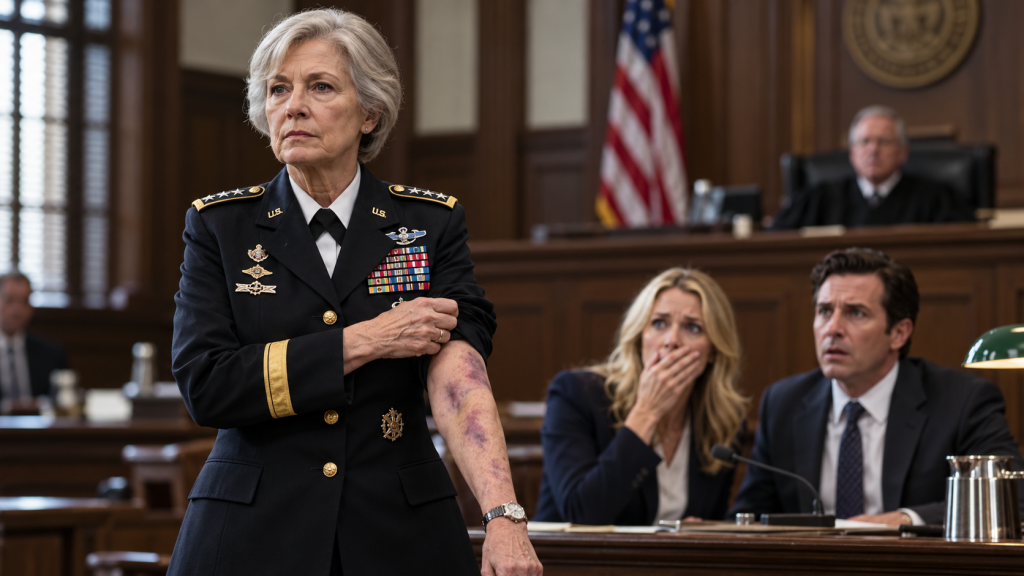
Inside were bank statements, transfer confirmations, and copies of two authorization forms. “The money left my investment account six weeks before Daniel filed the emergency guardianship petition.” Daniel’s face had gone gray. “It was divided into three transfers.”
“Twelve thousand.”
“Fifteen thousand.”
“And another fifteen.”
Judge Mercer adjusted his glasses.
“Where did it go?”
“To an account belonging to Whitmore Residential Holdings.”
Vanessa whispered something to Daniel.
I heard only one word.
“Stop.”
I continued.
“Whitmore Residential Holdings is a limited liability company created eight months ago.”
Judge Mercer looked toward Daniel.
“Who owns it?”
I answered before he could.
“Daniel owns fifty percent.”
“Vanessa owns fifty percent.”
Vanessa’s attorney shot to his feet.
“There has been no evidence—”
Judge Mercer slammed his palm against the bench.
“Counsel.”
The room froze.
“I have listened to allegations that this seventy-one-year-old woman is mentally incompetent while evidence is now being presented suggesting the petitioners may have taken money from her account and physically harmed her.”
He pointed toward the chair.
“You will sit down.”
Vanessa’s attorney sat.
I had seen men with medals behave with less discipline.
Judge Mercer turned to me.
“How did they access the account?”
“That is one of the reasons I documented everything.”
I removed another sheet.
“Three months after my husband died, I signed a limited financial authorization allowing Daniel to pay two household bills for me while I underwent cataract surgery.”
Daniel’s eyes closed.
“He was permitted to pay the property tax bill and renew my homeowner’s insurance.”
“That authority expired after sixty days.”
Judge Mercer frowned.
“And yet?”
“And yet someone later submitted a modified copy of the authorization to my brokerage firm.”
I handed the clerk the two versions.
The original.
The altered copy.
The difference was simple.
My document said:
Limited authority for specified payments through March 31.
The altered document said:
Continuing authority for financial management.
My signature was real.
Everything around it had changed.
Daniel finally spoke.
“Mom, I didn’t forge that.”
I looked at him.
For the first time that morning, my son sounded less triumphant than frightened.
Judge Mercer said,
“Mr. Vance, you will not address your mother directly.”
Daniel swallowed.
“Yes, Your Honor.”
I continued.
“The brokerage compliance department called me after the third transfer.”
“Why after the third?”
Judge Mercer asked.
“Because the first two fell beneath their internal review threshold.”
“The third did not.”
“What happened when they contacted you?”
“I told them I had authorized nothing.”
“And?”
“They froze the account.”
Daniel’s attorney leaned toward him.
Too late.
The judge asked,
“Did you report the transfers?”
“Yes.”
“To whom?”
“The bank.”
“The brokerage.”
“And law enforcement.”
That changed the room.
Vanessa whispered,
“Oh my God.”
Daniel turned toward her.
“You said she hadn’t.”
I heard him.
So did the judge.
Judge Mercer’s head lifted.
“What did you just say?”
Daniel’s attorney immediately stood.
“My client invokes his right not to answer questions that may concern a criminal investigation.”
Judge Mercer stared at him.
Then nodded once.
“Probably wise.”
I almost smiled.
Not because I enjoyed seeing my son cornered.
I didn’t.
That is the thing people misunderstand about betrayal by a child.
Even when they hurt you, part of your body remembers them at six years old.
Daniel had once fallen asleep with his head in my lap during a thunderstorm.
He had once called me from college because he could not figure out how to wash a sweater.
He had once cried when his father taught him to drive and yelled too sharply.
That boy still existed somewhere inside the man sitting across from me.
But memory does not cancel evidence.
That was another lesson the Army taught me.
You can love the person under investigation.
You still secure the records.
Judge Mercer looked toward the court-appointed guardian ad litem.
“Ms. Prescott?”
A woman in her forties stood.
She had been assigned to investigate my circumstances after Daniel filed the emergency petition.
Until that moment, she had said very little.
“Your Honor, I conducted an independent home visit with Colonel Vance three days ago.”
Daniel turned sharply.
He had not known.
Good.
Ms. Prescott continued.
“I found her oriented to time, place, and circumstance.”
“She provided complete medication information.”
“She demonstrated full understanding of her finances.”
“She produced tax returns, household records, estate documents, and recent medical evaluations.”
Judge Mercer asked,
“Any indication of cognitive impairment?”
“No.”
Daniel’s attorney stood again.
“We have photographs of repeated injuries.”
Ms. Prescott looked at him.
“Yes.”
“And Colonel Vance explained them.”
“She also gave me access to the video evidence.”
Vanessa started crying quietly.
Her attorney whispered for her to stop.
Ms. Prescott continued.
“I also interviewed Colonel Vance’s primary care physician.”
Judge Mercer nodded.
“Conclusion?”
“Her physician has no current concern regarding dementia or incapacity.”
“What about falls?”
“She uses a cane because of an old knee injury.”
I said nothing.
That injury came from a helicopter hard landing twenty-three years ago.
It hurt most when rain was coming.
Daniel knew that.
Apparently he had decided a cane looked more useful in court if it meant something else.
Ms. Prescott continued.
“There was one documented fall approximately fourteen months ago.”
“In the garden.”
“Colonel Vance tripped over a hose.”
Daniel’s petition listed seven falls.
One real fall.
Six injuries with other explanations.
They had built a diagnosis out of bruises they helped create.
Judge Mercer removed his glasses.
Then looked directly at Daniel.
“Mr. Vance, your petition states that your mother has become increasingly confused since your father’s death.”
Daniel said nothing.
His attorney whispered.
Then Daniel answered.
“Yes, Your Honor.”
Judge Mercer looked at me.
“When did your husband die?”
“Twenty-two months ago.”
“My condolences.”
“Thank you.”
“Were you ever diagnosed with depression?”
“No.”
“Placed on memory medication?”
“No.”
“Hospitalized for confusion?”
“No.”
“Missed utility payments?”
“No.”
“Lost your driver’s license?”
“No.”
“Become lost while driving?”
“No.”
“Left the stove on?”
“No.”
He looked back at Daniel.
“Then what objective evidence did you have of cognitive decline?”
Daniel’s mouth opened.
Closed.
Vanessa looked at him.
Finally he said,
“She forgot things.”
Judge Mercer waited.
“What things?”
Daniel swallowed.
“Appointments.”
“Which appointments?”
“She forgot dinner with us once.”
I spoke before I could stop myself.
“I did not forget.”
Judge Mercer glanced at me.
I said,
“I canceled.”
Daniel’s face tightened.
Judge Mercer almost smiled.
Then:
“Anything else?”
Daniel looked desperate now.
“She repeated stories.”
I laughed.
Quietly.
The judge looked at me.
“Colonel?”
“At seventy-one, Your Honor, I have earned the right to tell the same story twice.”
A few people in the gallery laughed before quickly stopping.
Even Judge Mercer smiled for half a second.
Then his expression hardened again.
“Mr. Vance, repeating a story is not legal incapacity.”
Daniel stared at the table.
Judge Mercer turned to Vanessa.
“Mrs. Vance, you maintained the injury log submitted with this petition?”
Vanessa’s attorney stood.
“My client—”
The judge raised one finger.
The attorney stopped.
Vanessa whispered,
“Yes.”
“You took the photographs?”
“Yes.”
“Did you ever take Colonel Vance to a doctor after these alleged falls?”
Vanessa hesitated.
“Sometimes she refused.”
Judge Mercer looked at me.
“Did you?”
“Never because of a fall.”
Vanessa turned toward me.
“You refused help all the time.”
I looked at her.
“When?”
Her eyes moved rapidly.
“After the bathroom incident.”
I frowned.
There had been no bathroom incident.
Judge Mercer caught it.
“What bathroom incident?”
Vanessa froze.
Daniel closed his eyes.
His attorney stared at the ceiling.
Vanessa began stumbling through an answer.
“The night she—she slipped near the tub.”
I said calmly,
“That never happened.”
Vanessa’s face went white.
I reached for another folder.
“However, on the date Vanessa listed as a bathroom fall, I was attending a veterans’ association dinner twenty miles away.”
I handed the clerk a printed event program.
“And the hotel has security footage showing me arriving without injury and leaving after ten.”
I turned a page.
“The bruise Vanessa photographed the following morning was caused later that night when she grabbed my arm in my kitchen.”
I knew exactly when because I had recorded it.
Vanessa had come over furious after I refused to add Daniel as joint owner of my savings account.
She followed me into the kitchen.
I had placed my phone face down on the counter.
Recording.
Her voice was clear.
You are making this harder than it needs to be.
Then mine.
Take your hand off me.
Then Vanessa:
Stop acting helpless.
Then my voice again.
You are the one holding my wrist.
The courtroom listened.
Vanessa’s face crumpled.
That was the moment I almost felt sorry for her.
Almost.
Then the recording continued.
Her voice:
If you bruise, maybe people will finally understand why you shouldn’t be alone.
The sympathy disappeared.
Judge Mercer leaned back.
There are moments when a courtroom changes shape.
At first, Daniel and Vanessa had arrived as caretakers.
Responsible son.
Concerned daughter-in-law.
Aging widow.
Confused mother.
By noon, the architecture of that story had collapsed.
Now every photograph they submitted looked different.
Not proof that I needed them.
Potential proof that I needed protection from them.
The judge called a recess.
Daniel stood immediately.
“Mom.”
His lawyer grabbed his arm.
“Do not.”
Daniel ignored him.
“Please.”
I turned away.
“Mom, I didn’t know Vanessa—”
Vanessa spun around.
“What?”
Daniel stopped.
She stared at him.
“You didn’t know?”
“Not all of it.”
Vanessa laughed.
A terrible, sharp sound.
“You were there.”
People in the courtroom turned.
Daniel’s attorney whispered something furious.
Vanessa continued anyway.
“You told me we needed proof.”
Daniel’s face changed.
“I said documentation.”
“You said bruises made the case stronger.”
“I didn’t mean make them.”
“Then why did you photograph them before asking if she was okay?”
Silence.
That exchange probably did more damage than anything I had recorded.
Because neither of them had planned it.
Fear loosens people.
They start trying to move guilt from their own shoulders.
And in the process, they tell the truth.
Court officers separated them.
I remained seated.
My hands were steady.
Only when everyone had gone did I realize my right knee was shaking.
Ms. Prescott sat beside me.
“You all right?”
“Yes.”
“That was not a convincing answer.”
I looked at her.
“Occupational habit.”
“Army?”
“Motherhood.”
She nodded.
Then said,
“You came alone today.”
“Yes.”
“No attorney?”
“I had one prepare me.”
“But not appear?”
“No.”
“Why?”
I looked toward the doors Daniel had just walked through.
“Because my son needed to see me speak for myself.”
She studied me.
“That sounds like something a lawyer advised you not to do.”
“He objected.”
She smiled.
“Of course.”
The lawyer I had consulted, Martin Shaw, was an old friend from the veterans’ legal clinic.
He had wanted to represent me.
I said no.
Not because I thought I knew law better.
I didn’t.
Because I knew the facts better.
And I knew Daniel.
If I arrived surrounded by legal firepower, he would tell himself somebody else was controlling me.
I wanted him to watch me stand.
Answer.
Remember.
I wanted the last excuse removed.
When court resumed, Judge Mercer did not waste time.
He denied the emergency guardianship petition.
Immediately.
But he did more.
He issued an order preventing Daniel and Vanessa from accessing my residence, accounts, or medical records.
He directed the clerk to send copies of the hearing transcript and exhibits to the district attorney’s office.
He ordered that all keys to my property be surrendered.
Then he looked at me.
“Colonel Vance, who currently occupies your home?”
“Daniel and Vanessa.”
The judge frowned.
“They changed your locks?”
“Yes.”
“You are the titled owner?”
“Yes.”
“They claim any ownership interest?”
“No.”
Daniel’s attorney stood.
“My clients believed they were protecting the property while Mrs. Vance received appropriate care.”
Judge Mercer stared at him.
“She was in a motel.”
The attorney said nothing.
The judge continued.
“They changed the locks on a seventy-one-year-old widow’s home, left her in a motel, then filed an emergency petition alleging she could not care for herself?”
Silence.
The judge turned to me.
“Do you have somewhere safe to stay tonight?”
“Yes.”
“Do you want immediate possession of the residence restored?”
I looked at Daniel.
He finally met my eyes.
For a second, he looked like the boy who once asked me not to turn off the hallway light.
Then I remembered the text.
Stop making this difficult.
“Yes, Your Honor.”
Judge Mercer nodded.
“Granted.”
Daniel whispered,
“Mom.”
The judge looked at him.
“Not another word.”
The hearing ended at 1:43 p.m.
I walked outside alone.
Reporters were not waiting.
There was no crowd.
No triumphant music.
Real accountability is often quiet.
Concrete steps.
Court orders.
Evidence bags.
Bank freezes.
A clerk stamping paper.
I stood on the courthouse steps in cold sunlight.
Then my phone rang.
My daughter, Rachel.
Daniel’s older sister.
I had not told her the whole plan.
Only enough to keep her away from the hearing.
She lived in Seattle and was flying in that evening.
“Mom?”
“Yes.”
“How did it go?”
“The petition was denied.”
Rachel exhaled so hard I heard it through the phone.
“And Daniel?”
“Still Daniel.”
She was quiet.
Then:
“Did you win?”
I looked back at the courthouse.
“No.”
“What?”
“I stopped something.”
“That’s different.”
Rachel began crying.
“Mom.”
“I’m okay.”
“No, you’re not.”
I smiled.
“Fine.”
“Better answer.”
I had spent my career teaching younger officers that stopping misconduct was not the same thing as winning.
If a soldier stole government equipment and you caught him, nobody won.
The unit had still been betrayed.
Property had still been lost.
Trust had still been damaged.
The best outcome was containment.
Truth.
Repair.
Maybe accountability.
Family was not so different.
That afternoon, two sheriff’s deputies met me at the house.
Daniel and Vanessa had ninety minutes to gather personal belongings.
They arrived separately.
That surprised me.
Vanessa went upstairs.
Daniel remained in the living room.
My late husband Thomas’s bourbon bottle was still on the side table.
Half empty.
I looked at it.
Daniel followed my eyes.
“Dad would hate this.”
I almost laughed.
“He would.”
Daniel started crying.
I did not comfort him.
That felt unnatural.
Even after everything.
He whispered,
“I didn’t mean for it to become this.”
I leaned on my cane.
“What did you mean?”
He looked away.
“I thought you’d let me help with the finances.”
“By taking them?”
“No.”
“By asking a judge to give you control?”
“You kept saying no.”
“That was my answer.”
His shoulders dropped.
“I thought you were being stubborn.”
“I was.”
He looked confused.
I continued.
“Adults are allowed to be stubborn about their own property.”
Daniel laughed once through tears.
Then:
“The business was struggling.”
I stared.
“What business?”
“My consulting firm.”
I had known Daniel’s firm had lost clients.
I had not known how badly.
“How much?”
He rubbed his face.
“Bad.”
“Numbers.”
He hesitated.
“About one hundred sixty thousand.”
“Debt?”
“Yes.”
My chest tightened.
There.
The guardianship had not been about concern.
Not primarily.
It was liquidity.
He continued.
“Vanessa thought if I became guardian, we could borrow against the house.”
I felt cold.
“Did you?”
“She said it.”
“Did you agree?”
Silence.
“Daniel.”
“Yes.”
The word barely existed.
I closed my eyes.
My home.
The house Thomas and I built in 1984.
The kitchen where Rachel did homework.
The hallway where Daniel measured his height in pencil marks.
The deck Thomas repaired every summer because he never trusted contractors.
Collateral.
That was what they saw.
“How much did you plan to borrow?”
Daniel whispered,
“Two hundred fifty.”
I opened my eyes.
“You tried to take control of a house worth almost nine hundred thousand dollars because you owed one hundred sixty?”
“It wasn’t only the business.”
“What else?”
He looked toward the stairs.
Vanessa was dragging suitcases down.
“She had debt too.”
Vanessa stopped.
“Don’t.”
Daniel laughed bitterly.
“Why?”
“You’re blaming me now?”
“You said the guardianship would solve everything.”
“You filed it.”
“You asked me to help.”
“You took the money.”
“So did you.”
I listened.
There it was again.
Fear turning partners into witnesses against each other.
I raised one hand.
“Enough.”
They stopped.
“This is my house.”
Neither spoke.
“You are leaving.”
Vanessa wiped her face.
“You always hated me.”
I stared at her.
“No.”
She laughed.
“Yes, you did.”
“I never trusted you.”
“Same thing.”
“No.”
I shook my head.
“Hate requires more energy.”
That landed.
She carried her suitcases outside.
Daniel stayed another minute.
“Mom.”
“Yes?”
“I’m sorry.”
I looked at him.
“For which part?”
He started crying harder.
I waited.
He forced himself to answer.
“For pushing you.”
“Good.”
“For taking the money.”
“Yes.”
“For the guardianship.”
“Yes.”
“For changing the locks.”
“Yes.”
“For letting Vanessa document injuries like you were… like you were disappearing.”
My throat tightened.
“Yes.”
“And for thinking being your son gave me more rights over your life than you.”
That one mattered.
I nodded.
“Good.”
He waited.
“For what?”
“Now you have somewhere to start.”
His face crumpled.
“Are you going to forgive me?”
“No.”
He looked stunned.
I continued.
“Not today.”
That was the first time I understood something I had explained to soldiers for years but never needed personally.
Forgiveness under pressure is not forgiveness.
It is surrender.
I had surrendered enough.
Daniel left.
That night, Rachel arrived.
She walked into the house, saw the missing documents, the broken desk lock, and the scuff mark on the hallway wall where Daniel had pushed me.
Then she sat on the floor and cried.
I made tea.
She stared at me.
“Why didn’t you call me?”
“Because you would have flown here.”
“Yes.”
“Exactly.”
“You say that like it’s bad.”
“You have a job.”
“You have children.”
“You have a life.”
She stared.
“I’m your daughter.”
“Yes.”
“So was Daniel your son.”
That shut me up.
Rachel wiped her face.
“You protected him.”
“No.”
“Yes.”
“You documented him.”
“That’s not the same thing.”
“You didn’t tell me.”
I looked down.
She was right.
Partly.
I had been so focused on gathering evidence that I had isolated myself.
Old habit.
When something went wrong in the Army, I collected facts before emotion contaminated the scene.
Useful professionally.
Lonely personally.
I said,
“I was ashamed.”
Rachel froze.
“You?”
“Yes.”
“Of what?”
I looked toward the wall.
“That I raised him.”
She crossed the room.
“No.”
I held up a hand.
“I know better intellectually.”
“That adult children make choices.”
“That parents don’t control every character flaw.”
“But emotionally?”
I swallowed.
“I kept asking what I missed.”
Rachel hugged me.
For once, I let her.
The criminal investigation lasted seven months.
Long enough for neighbors to invent versions.
Long enough for relatives to choose sides.
Long enough for Vanessa’s sister to call me vindictive.
Long enough for Daniel’s old friends to stop calling him.
The $42,000 transfer turned out to be only part of it.
There had been attempted withdrawals totaling another $68,000.
They failed after the account freeze.
There was also a draft home equity application using my property.
Not completed.
Not funded.
But prepared.
The proposed amount:
$275,000.
Daniel’s consulting firm had tax debts.
Vanessa had nearly $54,000 in credit card balances hidden from him until months before the guardianship filing.
He had hidden business losses from her.
They were not mastermind criminals.
They were two frightened adults trying to solve financial collapse by converting an elderly widow into an asset under management.
That ordinary greed hurt more than if they had been brilliant villains.
They did not hate me enough to plan my destruction.
They valued my autonomy less than their need.
That was worse.
The recordings helped.
The security footage helped more.
But the strongest evidence was financial.
People like to imagine dramatic confessions decide cases.
Often, bank records do.
The altered authorization.
Transfer timestamps.
Company documents.
The guardianship filing.
Draft loan paperwork.
The chronology built itself.
First debt.
Then requests for money.
Then my refusals.
Then bruises.
Then photographs.
Then claims of confusion.
Then the petition.
Then control.
No jury needed a military intelligence background to see the pattern.
Daniel entered a plea.
He accepted responsibility for financial exploitation, attempted misuse of fiduciary authority, and assault-related conduct tied to pushing me.
Vanessa entered her own plea involving financial exploitation, false documentation, and assault connected to the physical incidents.
Neither received the decades in prison some relatives expected.
Daniel served a custodial sentence followed by probation.
Vanessa’s sentence was somewhat shorter but included strict financial restrictions and restitution.
The $42,000 was recovered in part because the receiving account had been frozen before most of it moved again.
Some had already paid debts.
The restitution took years.
I stopped counting after a while.
Not because money stopped mattering.
Because I did not want every monthly check to reopen the case.
The house was restored to me immediately.
My accounts remained mine.
I changed every password.
Every lock.
Every emergency contact.
Then I did something that surprised Rachel.
I hired a financial manager.
She laughed when I told her.
“After all this, you’re letting someone manage your money?”
“Assist.”
“Difference?”
“Enormous.”
The adviser had no unilateral withdrawal authority.
No property-transfer authority.
No secret passwords.
I received every statement.
Rachel received emergency access only if two physicians certified incapacity.
A professional trust company served as backup.
Daniel received nothing.
Not because I was punishing him.
Because love is not an internal control.
I knew that professionally.
It had taken family betrayal to teach me personally.
The guardianship case disappeared from the court calendar.
But the bruises took longer to disappear.
The physical ones faded first.
Yellow.
Green.
Nothing.
The emotional marks were less obedient.
For months, when someone reached toward my wrist unexpectedly, I flinched.
The first time a nurse at my doctor’s office gently touched my arm, I pulled away so fast she apologized.
I felt ridiculous.
Then angry at myself for feeling ridiculous.
My therapist said,
“Your body learned before your mind did.”
I disliked therapy language.
Still do.
But she was right.
I had spent thirty-two years walking into investigations and asking victims to recount details precisely.
I thought I understood trauma.
I understood reports.
That is different.
One afternoon, I found the navy coat I had worn to court.
I almost donated it.
Then changed my mind.
I kept it.
Not as a trophy.
As evidence of something for myself.
I had walked into that courtroom appearing exactly as they described me.
Silver hair.
Cane.
Bruises.
No attorney beside me.
What they misunderstood was not my military rank.
That made a good dramatic moment.
But rank had nothing to do with legal capacity.
A retired colonel can develop dementia.
A woman who never worked outside the home can remain perfectly capable at ninety.
The real mistake Daniel and Vanessa made was assuming vulnerability and incompetence were the same thing.
I could be hurt.
And capable.
Aging.
And observant.
In pain.
And credible.
Those things coexist.
Judge Mercer later told me something similar.
I saw him at a veterans’ legal fundraiser eight months after the case.
He approached.
“Colonel Vance.”
“Judge.”
“Eleanor, today.”
He smiled.
“Adrian, then.”
We stood awkwardly near the coffee.
He said,
“I hope you know my recognition of your military background did not determine my ruling.”
“I know.”
“I was concerned afterward that it might appear—”
“I know.”
“You won on evidence.”
“I know.”
He relaxed.
“Good.”
Then I said:
“But watching their faces when you called me Colonel was enjoyable.”
He laughed.
“So was mine.”
That was the last time we discussed the hearing.
Rachel wanted me to sell the house.
At first.
“Too many memories.”
she said.
“Yes.”
“Bad ones.”
“Some.”
“Why stay?”
I looked around the kitchen Thomas and I designed.
“Because Daniel does not get to convert my home into the scene of his crime forever.”
So I stayed.
I repaired the desk.
Painted the hallway.
Replaced the bourbon bottle with flowers.
I did not erase Thomas’s life because Daniel mishandled what remained.
In the backyard, one of the fence posts still carried Daniel’s height marks from childhood.
Age seven.
Nine.
Twelve.
Fifteen.
I stood there one afternoon touching them.
Rachel found me.
“You going to sand those off?”
“No.”
“Why not?”
“Because he was my son before he became a man who hurt me.”
“He’s still your son.”
“I know.”
“Does that make it harder?”
“Yes.”
She stood beside me.
“Do you hate him?”
“No.”
That answer surprised her.
Then I added:
“I don’t trust him.”
She nodded.
People often think love and trust must travel together.
They don’t.
You can love someone and not give them a key.
That became my rule.
Daniel wrote from prison.
At first, I did not open the letters.
I stored them in a box.
Not from cruelty.
Because I was rebuilding a life where his emotions no longer dictated my schedule.
Six months later, I opened the first.
Mom,
I keep trying to find one moment when I became someone who could do this.
I nearly stopped reading.
Then:
I don’t think there was one.
Better.
It was small decisions.
I lied to Vanessa about the business.
Then I borrowed.
Then I needed more.
Then I told myself you had money you were not using.
My jaw tightened.
I started thinking of your house as an inheritance I was going to get eventually instead of your home now.
That sentence hurt.
There it was.
The entitlement beneath the guardianship.
Not:
Mom has a house.
But:
That house is mine later.
Why not sooner?
He continued.
When you refused to give me access, I told myself Dad would have helped me.
Thomas probably would have.
That did not matter.
Dead people are convenient co-signers.
They never correct you.
Daniel wrote:
Vanessa said if you were declared incapable, I could manage things responsibly.
I knew you were not incapable.
I stopped.
Read it again.
I knew.
That was the line I needed.
I told myself you were becoming difficult, then stubborn, then unsafe.
Each word made the next thing easier.
Tears filled my eyes.
When I pushed you into the wall, I knew immediately what I had done.
Instead of apologizing and stopping everything, I became afraid you would tell Rachel.
That fear made me worse.
Then:
I am sorry that I made your age into a weapon against you.
I folded the letter.
Did not answer.
Not yet.
The second letter was about Thomas.
Daniel wrote that he dreamed about his father refusing to speak to him.
The third was about the house.
The fourth said:
I don’t expect you to forgive me because I am sorry.
That was when I wrote back.
One page.
Daniel,
Remorse is not a bargaining chip.
Do the work because it is the work.
Do not perform improvement for access to me.
If you become a better man, let the first person who benefits be you.
Mom
Rachel read a copy.
“You sound like a colonel.”
“I was a colonel.”
“You also sound like Mom.”
“That was harder.”
Daniel wrote less often after that.
Better letters.
No requests.
No self-pity.
He took financial counseling.
Anger management.
A restorative justice program.
He worked in the prison library for a while.
Then maintenance.
When he was released, he did not ask to move back.
He rented a small apartment.
Worked as an estimator for another company because his own business was gone.
Vanessa did not return to him.
Their marriage collapsed during the case.
Not because either became noble.
Because once each started blaming the other, there was not enough trust left to rebuild.
They divorced before Daniel completed his sentence.
Years later, Vanessa sent me a letter.
Only one.
I opened it because curiosity eventually beats discipline.
She wrote:
I resented you before I ever hurt you.
Good opening.
At least honest.
You had a house.
Savings.
A pension.
A husband who had loved you for forty-six years.
I had debt and a marriage built on pretending we were doing better than we were.
She continued.
Every time you said no, I heard judgment.
You were not judging me.
You were setting a boundary.
That distinction was important.
Then:
I helped create injuries and then photographed them as evidence of your weakness.
No euphemism.
That is the ugliest thing I have ever done.
I believed her.
I am sorry.
I did not respond.
Some apologies repair relationship.
Some only restore truth.
Hers belonged to the second category.
Daniel and I did not see each other for nearly four years after his release.
We spoke by phone twice.
Short conversations.
Weather.
Rachel’s children.
Nothing deep.
Then I needed knee surgery.
The old military injury finally deteriorated enough that walking became painful.
Rachel planned to fly in.
Daniel heard through her.
He sent me one message.
I know I’m not the person you call for help anymore. I just want you to know I hope surgery goes well.
No request.
No guilt.
I stared at it for a long time.
Then answered:
Thank you.
That was how contact resumed.
In inches.
Never miles.
After surgery, he sent soup.
Not personally.
Delivery.
The receipt showed he paid.
I laughed.
Old habits.
Then he texted:
I remember you hate tomato. It’s chicken.
I wrote:
Correct.
Two weeks later:
Need groceries?
I answered:
Rachel has it covered.
He replied:
Okay.
No:
But I’m your son.
No:
Let me prove something.
Just okay.
That mattered.
Six months later, I agreed to lunch.
Public restaurant.
My choice.
Daniel arrived early.
He looked older.
Gray at the temples.
He stood when I approached.
Then seemed uncertain whether to hug me.
I appreciated the uncertainty.
“Hi, Mom.”
“Hello, Daniel.”
We sat.
He did not apologize again immediately.
Good.
We ordered.
Then he said:
“I was thinking about Dad.”
“Dangerous habit.”
He smiled.
“You still say that.”
“Yes.”
Daniel looked down.
“I used Dad as an excuse.”
“I know.”
“I kept telling myself he would want the house to help me.”
“I know.”
“But he also left the house to you.”
“Yes.”
“And I treated inheritance like a countdown clock.”
My throat tightened.
He continued.
“I’m ashamed of that.”
I nodded.
We ate.
Halfway through, he asked:
“Do you still have the bourbon?”
“No.”
He almost laughed.
“Fair.”
“I kept the glass.”
“What glass?”
“Your father’s heavy tumbler.”
Daniel looked surprised.
“Why?”
“Because he liked it.”
That simple.
One person’s wrongdoing did not require purging every object connected to family.
We spoke for forty minutes.
When lunch ended, Daniel paid for his own meal.
I paid for mine.
He did not insist.
Another small thing.
He stood outside.
“Can I hug you?”
That question nearly undid me.
I nodded.
“Yes.”
He hugged me gently.
No gripping.
No entitlement.
Then stepped back.
I cried in my car afterward.
Not because everything was repaired.
Because once, my son had taken my wrist hard enough to bruise through his wife’s hand.
Now he asked permission before touching me.
Growth can be heartbreakingly ordinary.
We rebuilt a limited relationship.
That word matters.
Limited.
He did not regain access to my accounts.
Ever.
He did not get a house key.
For seven years, he did not stay overnight.
He came for lunch.
Helped trim trees once.
Fixed a loose railing after asking.
Rachel remained cautious.
She never fully trusted him.
That was her right.
Daniel accepted it.
When I turned eighty, both children came.
So did grandchildren.
We ate on the deck.
The same house they once tried to control through court.
Daniel brought a cake.
Rachel brought flowers.
At one point my oldest granddaughter asked:
“Grandma, is it true you were a colonel?”
Daniel laughed.
“Very true.”
She looked at him.
“Did you know?”
His smile disappeared.
“Yes.”
“Then why did you think she couldn’t take care of herself?”
The table became silent.
Children have no respect for convenient family editing.
Daniel looked at me.
I said nothing.
He answered.
“Because I wanted something she had.”
My granddaughter frowned.
“That’s not a reason.”
“No.”
Daniel said.
“It’s an excuse.”
She nodded thoughtfully.
Then went back to cake.
I looked at him.
“That was well done.”
He shrugged.
“Practice.”
Later that evening, after everyone left, Daniel stayed behind to carry folding chairs inside.
He stopped near the hallway.
The wall had been repainted years earlier.
He stared at it.
“I still see it.”
I knew what he meant.
“I don’t.”
He looked at me.
“What?”
“I don’t see the wall you pushed me into every day.”
His eyes filled.
“How?”
“Because I refused to make that moment the most important thing that ever happened in this house.”
He started crying.
I continued.
“It was important.”
“It was not everything.”
He nodded.
That was the difference between healing and forgetting.
I never forgot.
I simply stopped giving the memory the largest room.
Judge Mercer retired two years later.
At his retirement ceremony, someone invited me.
I almost did not go.
Then I did.
He recognized me from across the room.
“Colonel.”
“Judge.”
“Still impossible?”
“Mostly.”
He smiled.
Then asked:
“How’s your son?”
That surprised me.
“Better.”
“Relationship?”
“Limited.”
He nodded.
“Probably wise.”
I looked at him.
“You know what bothered me about that day?”
“What?”
“When you recognized my rank, everyone suddenly treated me differently.”
He became serious.
“I’ve thought about that.”
“I know you did not mean harm.”
“No.”
“But if I had been Eleanor Vance, retired school cafeteria worker, the evidence should have meant the same thing.”
“Yes.”
He nodded slowly.
“You’re right.”
“That is why I speak about it now.”
After the case, I had begun volunteering with a legal aid organization focused on elder financial exploitation.
Not as a lawyer.
As a speaker.
A witness.
Sometimes an adviser on evidence preservation.
I told groups the same thing:
“Do not rely on looking competent.”
“Do not rely on your professional history.”
“Do not assume family will be believed less because they are family.”
“Document.”
“Tell someone.”
“Get medical care.”
“Preserve messages.”
“Ask for independent counsel.”
And I always added:
“Do not wait as long as I did.”
That was my part.
I had documented well.
I had not asked for help quickly enough.
Strength can become another disguise for isolation.
That is something no military training taught me.
At eighty-three, I finally sold the house.
Not because Daniel wanted it.
Not because Rachel insisted.
Because the stairs annoyed me.
I bought a smaller place with one level and too many windows.
At closing, the attorney asked whether I wanted the proceeds deposited into my primary account.
“No.”
I smiled.
“Split according to the trust instructions.”
The estate plan had changed years earlier.
Rachel and Daniel remained beneficiaries.
Not equally.
That was deliberate.
Not punishment.
Context.
Rachel had taken on years of caregiving, travel, and administrative help.
Daniel received something.
He was still my son.
But he did not receive automatic reward for biology.
The largest portion went into trusts for grandchildren and a fund supporting elder legal services.
When Daniel learned, he did not argue.
He said:
“That makes sense.”
Ten years earlier, that sentence would have been impossible.
I knew then that his growth was real.
Not perfect.
Real.
I kept one thing from the old house.
The front door key.
Useless now.
Different locks.
Different owner.
I put it in the same box as the navy coat.
Rachel laughed when she saw it.
“You collect weird trophies.”
“They are not trophies.”
“What are they?”
“Reminders.”
“Of what?”
“That property and control are not the same thing.”
She rolled her eyes.
“Very Colonel.”
“Very mother.”
Daniel visited me in the new place once a month.
Always called first.
Always knocked.
Never used the word “ours” about anything I owned.
Small language.
Big meaning.
When I turned eighty-six, he brought me a birthday card.
Inside he had written:
Mom,
The worst thing I ever did was treat your vulnerability as permission.
Thank you for surviving me long enough to teach me the difference.
I read it twice.
Then told him:
“Bad sentence.”
His face fell.
“What?”
“‘Surviving me’ makes you sound more important than you were.”
He stared.
Then laughed so hard he cried.
“Still correcting me.”
“Yes.”
“What should I have written?”
I thought.
“Thank you for giving me a chance to become better without pretending I deserved one.”
He nodded.
“That’s better.”
“I know.”
I kept the card anyway.
Years after the courtroom hearing, people still told the story wrong.
They loved the moment Judge Mercer called me Colonel.
They loved imagining Daniel’s face.
They loved the recordings.
The bank transfer.
The video.
The reversal.
They called it revenge.
It was not.
Revenge would have required me to care about hurting Daniel as much as he had hurt me.
I did not.
I cared about stopping him.
Protecting what remained.
Restoring truth.
That was enough.
The rank did not save me.
The cane did not weaken me.
The bruises did not prove what Daniel hoped they proved.
The judge did not rescue me.
Evidence did.
Preparation did.
People who were willing to look past a convenient story did.
And eventually, strangely, even Daniel’s own honesty helped.
He spent years learning the lesson he should have known from childhood.
My love did not make my life his property.
My age did not make my voice smaller.
My widowhood did not make me incomplete.
And being my son did not make him my guardian.
At ninety, I no longer walk with the old cane.
I use a newer one.
Much better grip.
Rachel says I should use a walker.
I tell her to mind her business.
She says:
“You know this is how the guardianship story started.”
I threaten to remove her from the will.
She laughs.
That is family now.
Jokes.
Boundaries.
Permission.
Truth.
Daniel never again touched my money.
Never again entered my home without asking.
Never again used concern as a disguise for control.
And I never again mistook silence for strength.
Sometimes strength is documentation.
Sometimes it is calling your daughter.
Sometimes it is hiring counsel.
Sometimes it is admitting a son you love has become unsafe.
Sometimes it is letting him become safer without handing him the same keys.
The morning I walked into that courtroom, Daniel and Vanessa thought they had already won because they had photographs of an old woman covered in bruises.
They believed appearance would do the work for them.
Frail.
Confused.
Dependent.
They forgot that a bruise records contact.
A bank records movement.
A camera records behavior.
And a person who has spent thirty-two years investigating misconduct learns something more important than how to fight.
She learns how to wait until lies have finished talking.
Then she lets the evidence answer.
THE END STORIES! THANK YOU FOR READING GOOD LUCK! ❤️
Related Posts