“There is another deed.” Mr. Sterling said it quietly. Too quietly. That somehow made the words worse. Mark lifted his head. “What other deed?” Barbara stopped crying. Not gradually. Instantly. Her whole face went still.
That was the moment I knew whatever came next was not going to be another misunderstanding. Mr. Sterling opened the manila envelope and removed a thick stack of papers. “The second property is a three-bedroom house in Oak Park.” Mark frowned.
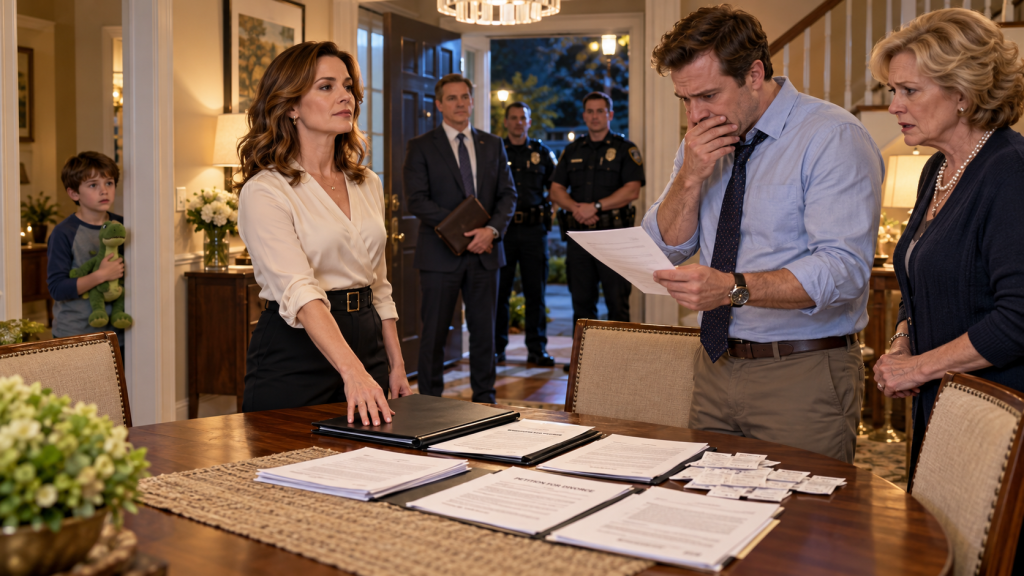
“My mother doesn’t own a house in Oak Park.” Mr. Sterling looked at him. “She does.” Barbara whispered, “No.” One of the officers shifted beside the door. Mark stared at his mother. “You told me Dad lost that house before he died.” Barbara’s eyes darted toward me.
That was interesting.
Not toward Mr. Sterling.
Not toward the police.
Toward me.
As if I were the dangerous person in the room.
I folded my arms.
“Keep going.”
Mr. Sterling placed the deed on the table.
Mark took it.
His hands began shaking.
The property had belonged to his father.
Apparently, everyone in the family believed it had been sold during his final years to cover medical expenses.
It had not.
Barbara had refinanced it.
Then transferred it into an LLC she controlled.
Then rented it out.
For nearly seven years.
Mark’s mouth opened.
“You told me the bank took it.”
Barbara’s voice came out thin.
“I was trying to protect you.”
I almost laughed.
That sentence again.
It followed liars everywhere.
Protect you.
Protect the family.
Protect the children.
Protect the marriage.
Somehow protection always seems to require the protected person knowing less than the person claiming to help them.
Mark stared at the deed.
“How much rent?”
Barbara looked away.
Mr. Sterling answered.
“Current rent appears to be thirty-two hundred dollars a month.”
The room went quiet.
Mark looked at his mother.
“Three thousand two hundred?”
Barbara said nothing.
“Every month?”
Nothing.
“For seven years?”
She snapped,
“It wasn’t all profit.”
I laughed.
There it was.
Not denial.
Accounting.
Mark slowly sank back into the chair.
His face looked almost gray.
“You kept telling me you were broke.”
“I had expenses.”
“You told me you couldn’t afford medication.”
“I do have medication.”
“You told me your apartment landlord was raising the rent.”
Barbara started crying again.
“It was complicated.”
“No.”
Mark shook his head.
“No, Mom.”
“Complicated is when a bill is confusing.”
“You lied to me.”
Her face hardened.
“I raised you.”
I felt Ethan’s fingers tighten around mine.
There it was again.
The old family currency.
I raised you.
I sacrificed.
I am your mother.
As if motherhood creates a permanent line of credit.
Mark looked at her.
“You told me Sarah didn’t care about family.”
Barbara flinched.
“You said she was selfish.”
Her eyes shifted.
“You said she made enough money that helping you shouldn’t matter.”
“Mark—”
“You said I was the only one who really loved you.”
Barbara’s face crumpled.
“I was lonely.”
Mark laughed once.
Painfully.
“So you made me pay for your loneliness.”
Barbara slapped one hand against the table.
“I needed security.”
I looked at her.
“You owned two properties.”
“You received rent.”
“You had a pension.”
“And you were taking money from your son.”
She glared at me.
“You don’t understand.”
“I understand perfectly.”
I nodded toward the folder.
“You had assets.”
“You had income.”
“And you still let your son believe you were one emergency away from homelessness.”
Her eyes narrowed.
“You’ve always resented me.”
“No.”
I shook my head.
“I resented being billed for you.”
That landed.
Mark rubbed both hands over his face.
Then asked the question I had been waiting for.
“How much?”
Barbara said nothing.
He looked at Mr. Sterling.
“How much money has she taken?”
Mr. Sterling remained careful.
“We can document at least eighty-four thousand through transfers linked to Mark.”
“And approximately forty-six thousand more connected to accounts or cash advances associated with Sarah’s identity.”
Mark looked at me.
I said nothing.
He whispered,
“One hundred thirty thousand?”
Mr. Sterling nodded.
“Potentially more.”
Barbara snapped,
“That makes it sound like I stole everything!”
One officer said calmly,
“Ma’am, nobody asked you a question.”
Barbara went silent.
The officer’s tone was not threatening.
That made it more effective.
Mark looked at me.
“Forty-six thousand in your name?”
“Yes.”
“How?”
I slid another page across the table.
“Three credit cards.”
“One retail line.”
“One personal loan application that was rejected.”
His eyes widened.
“You knew?”
“I discovered the first card six weeks ago.”
“And you didn’t tell me?”
“No.”
His face tightened.
I continued.
“I wanted to know whether it was an isolated account or a system.”
“You thought I did it?”
“At first, yes.”
That hurt him.
Good.
Not because I wanted revenge.
Because betrayal should not be sterilized for the person who helped create the conditions for it.
“I checked the statements.”
“Your mother’s apartment deposit.”
“Furniture.”
“Repairs.”
“A property-tax payment.”
“Cash advances.”
“Then I found the Oak Park address.”
Barbara whispered,
“You had no right to dig through my finances.”
I looked at her.
“You opened credit in my name.”
“That made them my finances.”
She looked away.
Mark stood.
“Did you open the cards?”
Barbara stared at him.
“Mom.”
Nothing.
His voice broke.
“Did you?”
She whispered,
“Some.”
Mark closed his eyes.
I felt something shift in the room.
For years, Barbara had been an annoyance.
A cruel one.
A demanding one.
But still, in Mark’s mind, fundamentally his mother.
A difficult woman he had to rescue.
Now he was seeing the difference between need and manipulation.
That realization looked uglier on him than anger.
He whispered,
“How?”
Barbara’s shoulders sagged.
“You left documents at my house.”
“What documents?”
“Tax forms.”
“Insurance.”
“You used my wife’s Social Security number?”
She started crying.
“I didn’t think it would become this.”
I laughed softly.
Again.
The same prayer.
I didn’t think it would become this.
As though consequences are strangers that arrive uninvited.
Mark looked at me.
“Sarah…”
I raised one hand.
“No.”
He stopped.
“Not now.”
He looked destroyed.
But I was finished centering his shock.
He had spent years sending money out of our household.
Years treating my labor as the default cushion beneath every decision.
Years believing Barbara’s emergencies before he ever asked whether I was drowning.
He may not have known about the cards.
But he knew he contributed almost nothing to our shared life while demanding I remain grateful for the privilege of carrying it.
That part belonged to him.
Mr. Sterling cleared his throat.
“The second property matters for another reason.”
Nobody moved.
He continued.
“Barbara applied for a home equity line against the Oak Park property eight months ago.”
Mark frowned.
“So?”
“She listed Mark as co-borrower.”
Mark went completely still.
“I never signed anything.”
Barbara’s face went white.
Mr. Sterling slid another document across the table.
“Exactly.”
I watched Mark read the page.
His lips moved silently over the signature.
Then he looked up.
“That’s not mine.”
Mr. Sterling nodded.
“The lender appears to have flagged inconsistencies during verification.”
“The line never funded.”
“But the application exists.”
Mark stared at Barbara.
“You forged me too?”
Her face twisted.
“I was trying to keep the property.”
“You told me it was gone!”
“I was trying to save what your father left.”
“For who?”
“For the family.”
I laughed.
This time I could not stop.
Barbara glared at me.
“What is so funny?”
“You.”
I shook my head.
“Every time money moves toward you, it becomes ‘family.’”
“Every time responsibility moves back toward you, suddenly it becomes complicated.”
Her mouth tightened.
“You’re cruel.”
“No.”
I looked at her.
“I’m finished.”
That was different.
The officers asked Barbara to step aside.
Mark tried to follow.
One officer stopped him.
“We need to speak with her separately.”
“She’s my mother.”
“Exactly.”
He stepped back.
For once, being her son gave him no special access.
Barbara looked at him.
I watched for guilt.
For tears.
For some final maternal connection.
Instead she said,
“You’re really going to let them do this to me?”
That was when Mark broke.
Not loudly.
He just stared at her.
Then said,
“You mean investigate what you did?”
Barbara’s face changed.
“After everything I sacrificed for you?”
Mark laughed through tears.
“There it is.”
He looked at me.
“That’s what she always says.”
I nodded.
“I know.”
He turned back to Barbara.
“You never gave anything without keeping the receipt in your head.”
She started sobbing.
“I’m your mother.”
Mark whispered,
“And Sarah was my wife.”
The word was.
Past tense.
He heard it too.
So did I.
Neither of us corrected him.
Barbara was taken to the station for further questioning.
Not thrown into a squad car dramatically.
Not dragged away screaming.
She went with the officers after they explained the process.
Real consequences rarely look satisfying in the moment.
Mostly they look administrative.
Forms.
Phones.
Statements.
Waiting rooms.
Fear.
After the front door closed, the house became silent.
Ethan stood beside me.
Still holding the stuffed T-Rex.
Mark looked at him.
“Buddy…”
Ethan stepped backward.
That one movement did more damage than any lawyer could have.
Mark stopped.
His face crumpled.
“Okay.”
He sat down.
No reaching.
No demand for affection.
Good.
Ethan looked at me.
“Can I go to Liam’s room?”
“Yes.”
Liam was not there.
But Ethan liked sitting on his older stepbrother’s bed when he was upset.
He disappeared down the hall.
Then Mark and I were alone.
My attorney stood nearby.
Mr. Sterling quietly said,
“I’ll wait in the living room.”
He understood.
This part was not legal.
Not yet.
Mark looked at me.
“I didn’t know.”
I sat across from him.
“I believe you.”
His eyes widened.
“You do?”
“Yes.”
“I believe you didn’t know she opened cards in my name.”
“I believe you didn’t know she owned both properties.”
“I believe you didn’t know she forged the loan application.”
Relief crossed his face.
Too soon.
I continued.
“But you knew you weren’t paying the mortgage.”
His relief vanished.
“You knew you weren’t buying groceries.”
“You knew Ethan’s tuition came out of my account.”
“You knew I paid your car after the accident.”
“You knew I paid your credit-card debt.”
“You knew your mother’s prescriptions kept appearing on our statements.”
“You knew every month your paycheck somehow disappeared into somebody else’s need.”
He lowered his eyes.
“I thought you could handle it.”
That sentence hurt more than I expected.
Not:
I thought it was fair.
Not:
I thought we agreed.
I thought you could handle it.
I laughed softly.
“That has been the story of my life.”
Mark looked up.
“What?”
“People see a capable woman and assume she has no breaking point.”
“I don’t know when that started.”
“Maybe nursing.”
“Maybe motherhood.”
“Maybe my first marriage.”
“But somewhere along the way, everyone decided that because I could carry more, I should.”
He started crying.
“I’m sorry.”
“I know.”
“I really am.”
“I know.”
“I can fix it.”
“No.”
“Sarah—”
“No.”
He stared.
“That phrase is done.”
“I can’t fix what I did?”
“You can fix yourself.”
“You can fix your relationship with Ethan.”
“You can repay debt.”
“You can learn boundaries with your mother.”
“You can become honest.”
“But you cannot fix us back into what we were.”
His shoulders collapsed.
“So that’s it?”
I thought about it.
Not dramatically.
Honestly.
“Yes.”
He covered his face.
I let him cry.
I did not comfort him.
That may sound cruel.
It wasn’t.
For years, every difficult emotion in that house eventually became my assignment.
His stress.
Barbara’s fear.
Ethan’s hurt.
His sister’s emergencies.
His nephew’s needs.
Bills.
Meals.
Appointments.
Clean clothes.
I had become the emotional and financial janitor of everyone’s consequences.
That night, Mark’s grief belonged to Mark.
I let him have it.
Mr. Sterling helped me complete the next steps.
The restraining order had been requested because of the fraudulent credit accounts, repeated unauthorized access to my financial information, and Barbara’s threats during previous confrontations.
It was temporary.
Subject to review.
Not a magical document permanently banishing people with one signature.
The police report began an investigation.
The credit bureaus froze my files.
The fraudulent accounts were disputed.
The apartment deposit charge was flagged.
The Oak Park records were preserved.
Mark gave a statement.
To his credit, he did not protect Barbara.
That mattered.
But it did not save our marriage.
The next month was ugly.
Barbara called relatives.
Of course she did.
According to Aunt Denise, I had “set her up.”
According to Mark’s sister, I had “criminalized family support.”
According to one cousin I barely knew, I was using my salary to control Mark.
I did not respond publicly.
I did not post screenshots.
I did not build a campaign.
My attorney told me to preserve evidence and stop talking.
Excellent advice.
Mark’s sister called me directly.
“You know Mom would never intentionally hurt you.”
I laughed.
“She opened cards in my name.”
“She was desperate.”
“She owned rental property.”
“She had bills.”
“So do I.”
“She’s old.”
“So am I compared to someone.”
“Sarah—”
“No.”
I interrupted.
“If your defense requires pretending facts are emotions, call someone else.”
She hung up.
Two days later, she asked me to babysit her son.
I stared at the text for a full minute.
Then replied:
No.
Nothing else.
That felt fantastic.
Not because her child had done anything wrong.
Because no is a complete sentence when people have mistaken your reliability for permanent availability.
The financial investigation uncovered more.
Not millions.
No secret international scheme.
Something more ordinary.
More believable.
Barbara had spent years treating Mark as a backup account.
Whenever rent income was short, she called him.
Whenever property taxes came due, she called him.
Whenever she wanted renovations, she called him.
Whenever she wanted to preserve cash, she created an emergency somewhere else.
Then, when Mark’s salary was not enough, she began using information from our home.
First, one store card.
Then another.
She made minimum payments.
That allowed the fraud to stay quiet.
Then the balance grew.
Then she needed new credit to service old credit.
A familiar cycle.
She was not a criminal mastermind.
She was entitled.
Entitlement is less glamorous.
It is also more common.
She believed access to her son extended through him into me.
My identity.
My income.
My credit.
My house.
All became available because she considered me part of the family when resources were needed.
And an outsider whenever respect was requested.
The second property eventually explained the ugliest piece.
Barbara had not needed Mark’s entire paycheck for a new apartment.
She wanted cash to renovate the Oak Park rental before increasing rent.
The so-called apartment crisis was manufactured urgency.
Mark had handed her his paycheck.
She intended to use it on flooring.
Countertops.
Appliances.
Then raise the rent by nearly seven hundred dollars a month.
He thought he was saving his mother from homelessness.
She was improving an investment.
When he learned that, he vomited.
Literally.
He called me from the downstairs bathroom.
I almost didn’t answer.
Then did.
“She used me.”
His voice sounded hollow.
“Yes.”
“Do you know what the money was for?”
“Yes.”
“She told me the landlord was going to put her out.”
“I know.”
“She owns it.”
“Yes.”
He started crying.
“I’m so stupid.”
I closed my eyes.
“Don’t do that.”
“What?”
“Turn accountability into self-hatred.”
He was silent.
I continued.
“You were not stupid for loving your mother.”
“You were irresponsible for refusing to verify anything because questioning her felt disloyal.”
“That is different.”
He breathed shakily.
“I don’t know how to tell the difference anymore.”
“Then learn.”
That was all.
Our divorce took eleven months.
The house remained mine.
The prenup was clear.
I had bought it before marriage.
Maintained title.
Paid the overwhelming majority of mortgage and major improvements.
Mark received credit for certain documented contributions.
He did not leave with nothing.
He also did not receive half.
The law was less dramatic than either family expected.
The fraudulent debts were unwound gradually.
Not every charge vanished immediately.
Some took months.
Some required affidavits.
One creditor initially denied my dispute because payments had been made from a household account.
We appealed.
Won.
The credit score recovered.
Slowly.
Real financial harm does not disappear because the villain gets exposed in chapter three.
It leaves paperwork.
Phone calls.
Anxiety every time your bank sends an alert.
I changed every password.
Closed accounts.
Opened new ones.
Removed myself from family-plan obligations.
Changed beneficiaries.
Updated my will.
Replaced the locks.
The first night Mark slept elsewhere, the house felt enormous.
Ethan came into my bedroom around midnight.
“Is Mark gone forever?”
I sat up.
“No.”
He frowned.
“What does that mean?”
“He isn’t living here anymore.”
“But you might see him?”
“Yes.”
“Do I have to?”
I looked at him.
“No.”
That answer surprised him.
Mark was not Ethan’s biological father.
He had entered his life when Ethan was four.
For years, they had been close.
Soccer.
Science projects.
Saturday pancakes.
Then Barbara’s comments began.
Little comments.
About “real family.”
About blood.
About how Mark had responsibilities to Chloe first.
I had dismissed them.
So did Mark.
Until the afternoon Barbara told Ethan, directly, that he was not really one of them.
Mark had not been present.
That was true.
But afterward, when Ethan told him, Mark said:
“Grandma is old-fashioned.”
Not:
That was wrong.
Not:
You are my family because I chose this family.
Old-fashioned.
A cowardly little phrase.
Ethan remembered it.
Children always remember the words adults use to minimize pain.
I said,
“If you want a relationship with Mark later, that will be your choice.”
“What if he says sorry?”
“You can still say no.”
“What if I miss him?”
“You can miss someone and still be mad.”
Ethan thought about that.
Then climbed into my bed.
At eight years old, he still slept like a starfish.
Some things are universal.
Mark entered therapy.
Not because I demanded it.
Because the first month alone forced him to hear himself think.
He also attended financial counseling.
Sold his car.
Moved into a modest apartment.
Started paying me back for one agreed portion of the fraudulent obligations his transfers had helped create.
Not because the court ordered him to repay all of Barbara’s crimes.
Because some expenses were his.
We documented everything.
No handshakes.
No “family understanding.”
I had become deeply romantic about written agreements.
Barbara’s criminal case took longer.
She eventually pleaded to identity-theft-related offenses, forgery connected to the attempted home equity application, and financial fraud.
She did not go away for twenty years.
She was an older first-time offender with documented medical conditions.
Some charges carried serious exposure, but her eventual sentence included a shorter period of incarceration than my anger initially wanted, followed by probation, restitution, and strict financial restrictions.
At first, I was furious.
Then Mr. Sterling asked me:
“What outcome do you actually need?”
I answered immediately.
“My name cleared.”
“It is.”
“My credit restored.”
“In progress.”
“Her access stopped.”
“Yes.”
“Repayment.”
“Restitution order.”
“Ethan safe.”
“Yes.”
“Then maybe I don’t need her destroyed.”
That surprised me.
Justice felt less cinematic once I stopped using punishment as proof that what happened mattered.
It mattered regardless.
The Oak Park property was sold as part of Barbara’s financial resolution.
The apartment remained hers, though she had to restructure debt and restitution obligations.
She complained to anyone who would listen that I had “taken her house.”
I had not.
Records had.
Debt had.
Consequences had.
I stopped correcting people.
Let them believe whatever version helped them survive Thanksgiving.
Mark visited Ethan for the first time four months after the separation.
Only because Ethan asked.
We met at a park.
Neutral.
I sat far enough away to give them privacy, close enough to intervene.
Mark looked nervous.
Ethan looked angrier than nervous.
They sat on a bench.
I could not hear everything.
Later, Ethan told me the important part.
He asked Mark:
“Did you think Grandma was right?”
Mark said:
“No.”
“Then why didn’t you tell her to stop?”
Mark had no excuse.
He said:
“Because standing up to her was harder for me than asking you to ignore it.”
That answer mattered.
Specific.
Ugly.
True.
Ethan asked:
“Do you think I was your son?”
Mark started crying.
“Yes.”
“Then why did you let her say I wasn’t family?”
Mark said:
“Because I was weak.”
Ethan replied:
“That’s not a good reason.”
Mark said:
“No.”
That was the beginning.
Not forgiveness.
Beginning.
For the next year, Mark showed up carefully.
No surprise gifts.
No promises.
No trying to buy back affection.
Baseball game.
School concert.
Birthday lunch.
Only when Ethan wanted him there.
At nine, Ethan started calling him Mark again instead of Dad.
Mark accepted it.
At eleven, “Dad” returned once by accident.
Mark did not react.
Smart.
A few months later, it returned naturally.
Not every relationship broken by divorce dies.
Some become more honest after the marriage that contained them ends.
Chloe was furious with me at first.
Mark’s daughter was twenty-three by then.
She called me three weeks after he moved out.
“You ruined him.”
I let the sentence sit.
Then asked,
“How?”
“He can barely sleep.”
“He sold his car.”
“He’s in some tiny apartment.”
“He’s ashamed.”
I said,
“That sounds painful.”
“You don’t care?”
“I care.”
“Then why divorce him?”
“Because caring about someone does not require staying married to them.”
She was silent.
Then:
“Grandma says you planned all of this.”
“Your grandmother says many things.”
“She says you hated her.”
“I disliked her.”
“That is not the same as setting up a fraud investigation.”
Chloe started crying.
“Dad says Grandma lied.”
“Yes.”
“He says she used him.”
“Yes.”
“Did he use you?”
That question surprised me.
I thought carefully.
“Yes.”
She inhaled sharply.
“Did he mean to?”
“Sometimes people benefit from you before they consciously decide they are using you.”
“What does that mean?”
“It means your father knew I would cover the mortgage.”
“He knew I would cover groceries.”
“He knew I would pay Ethan’s school costs.”
“He knew he could give money away without asking because he trusted me to absorb the consequences.”
“He did not wake up every morning plotting against me.”
“But he chose his comfort over fairness repeatedly.”
She went quiet.
Then asked:
“Do you hate him?”
“No.”
“Grandma?”
I thought longer.
“No.”
That surprised even me.
“I don’t trust her.”
“I don’t want a relationship with her.”
“But hate is expensive.”
“I already paid enough.”
Chloe did not speak to me again for six months.
Then she called on my birthday.
“Happy birthday.”
“Thank you.”
“I sent flowers.”
“They’re beautiful.”
Pause.
“Dad says you helped him when he was in debt after the accident.”
“Yes.”
“I didn’t know.”
“I know.”
“He says you paid Grandma’s prescriptions.”
“Yes.”
“I didn’t know.”
“I know.”
“He says Grandma called you a gold digger.”
“Frequently.”
Chloe groaned.
“That makes no sense.”
“I agree.”
She almost laughed.
Then:
“I’m sorry I believed everything.”
“You were her granddaughter.”
“She helped raise you.”
“Loyalty is complicated.”
“That sounds like an excuse.”
“No.”
“It’s context.”
“You still choose what you do with it.”
She was quiet.
Then:
“I think I understand.”
Years later, that would become one of the healthiest relationships left from the marriage.
Not mother and daughter.
Not stepmother and child.
Two women who had survived the same family system from different positions.
Barbara had taught Chloe that love meant loyalty without questions.
I taught her something else.
Questions are not betrayal.
Boundaries are not cruelty.
And helping family should never require financial blindness.
Three years after the divorce, Mark asked to meet me for coffee.
He looked different.
Older.
Less polished.
More peaceful.
“I finished restitution.”
“What portion?”
“My court-assigned and settlement portion.”
I smiled.
“Congratulations.”
“Thank you.”
He stirred his coffee.
“I also paid Mom’s last property-tax bill.”
I stared.
His face changed.
Then he laughed.
“Kidding.”
I nearly threw my napkin at him.
He smiled.
First real joke between us in years.
Then he became serious.
“I wanted to tell you something.”
“Okay.”
“I used to think being a good son meant never saying no.”
I nodded.
“And being a good husband meant assuming you would understand.”
I looked at him.
“That sentence explains a lot.”
“I know.”
He continued.
“Mom trained me to feel guilty when she struggled.”
“You trained yourself to hide from conflict.”
“And you…”
He hesitated.
“What?”
“You trained yourself to be so capable nobody ever had to ask whether you were exhausted.”
That one landed.
I sat back.
“You’re not wrong.”
He nodded.
“I think we all built the disaster.”
“No.”
I corrected him.
“Careful.”
He looked at me.
“We all contributed to unhealthy patterns.”
“That is not the same as sharing equal responsibility.”
“Your mother opened credit in my name.”
“You gave away money that should have supported our household.”
“I enabled too much.”
“Those are not equal acts.”
He nodded slowly.
“You’re right.”
Good.
False equality is another way people dilute accountability.
We can all have work to do without pretending every harm weighs the same.
Mark married again eventually.
Not quickly.
A woman named Dana.
Before they combined finances, he asked her to meet with an independent financial adviser.
She laughed when he told her why.
Then agreed.
Separate disclosures.
Clear household contributions.
Written support boundaries involving adult family.
No secret loans.
No cosigning without both knowing.
Barbara did not receive a key to their home.
That one made me smile.
She was still alive.
Still complicated.
Mark maintained limited contact after her probation ended.
He helped her in ways he could see.
A ride to a doctor.
Groceries once after surgery.
Time.
Not blank checks.
When she asked for cash, he said:
“What is the bill?”
That one question changed everything.
Receipts destroy a surprising amount of emotional manipulation.
I never reconciled with Barbara.
She sent one letter five years later.
I nearly threw it out.
Then read it.
She wrote:
I told myself you had so much that taking from you wasn’t taking.
I stopped.
That sentence was almost identical to something I had suspected for years.
She continued:
You made money look easy because you were good at managing it.
I hated that you could provide what I could not.
I hated that Mark listened to you about things he once asked me.
There it was.
Not poverty.
Position.
She had not only wanted money.
She wanted to remain necessary.
My competence threatened her role.
So she converted need into control.
Then called me selfish whenever I resisted financing it.
The letter ended:
I am sorry I used your identity.
I am sorry I told Ethan he was not family.
I am sorry I let my son believe rescuing me was his duty.
That last apology mattered.
I did not respond.
Some apologies do not require a new relationship.
They are still valuable.
They stop the lie.
Ethan grew.
At fourteen, he asked me why I stayed with Mark as long as I did.
Teenagers are merciless interviewers.
I answered:
“Because there were good years.”
He looked skeptical.
“There were.”
“Mark made me laugh.”
“He loved you.”
“He helped when my schedule was impossible.”
“He was gentle when my mother died.”
“He cooked terrible pancakes.”
“He danced badly.”
“People aren’t only the worst system they participate in.”
Ethan nodded.
“Then why leave?”
“Because eventually the good things stopped being enough to make the structure safe.”
That became one of the most important lessons I gave him.
Do not rewrite love into hate just because a relationship ends.
If we do that, we teach ourselves we can only leave people after proving they were monsters.
Sometimes they are not monsters.
Sometimes they are simply no longer safe partners for us.
That is enough.
At eighteen, Ethan graduated high school.
Mark attended.
So did Dana.
So did Chloe.
Barbara did not.
Her health had declined, and Ethan had never rebuilt a relationship with her.
That was his choice.
After the ceremony, Ethan hugged Mark.
Not long.
But real.
He said,
“Thanks for coming, Dad.”
Mark cried.
Naturally.
I looked away to give him dignity.
Then Chloe took pictures.
Dana handed me a bottle of water.
“Your family is complicated.”
I laughed.
“You married into it.”
She smiled.
“I had disclosures.”
Excellent answer.
The house changed after Mark left.
Not immediately.
For a while, it still felt like the place where everyone had drained me.
Then I started making small changes.
I replaced the dining table.
Not because the old one was cursed.
Because it was too large.
I painted the kitchen cabinets.
Removed the chair Barbara always claimed.
Moved Ethan’s artwork into the hallway.
Bought groceries for two people.
The first month, I kept overbuying.
Years of feeding everyone do that to you.
Eventually, the refrigerator looked calmer.
So did I.
I stopped picking up overtime unless I wanted it.
That was strange.
I had spent years telling myself the extra shifts were “smart.”
In reality, many existed because other adults had quietly transferred their financial instability onto me.
Once that stopped, I discovered something shocking.
My salary was enough.
More than enough.
I had simply never been allowed to feel it.
I traveled.
Nothing extravagant.
A week in Vancouver.
A long weekend in New Orleans with my sister.
A beach trip where I read three terrible novels and felt no guilt.
For the first time in years, money stopped being proof I could save everyone.
It became a tool for my own life too.
That was difficult.
Women who are trained to provide often feel selfish the first time they spend money without explaining it.
I bought an expensive winter coat.
Stood in the store for twenty minutes.
Then almost returned it.
Ethan said,
“Mom.”
“What?”
“You literally pay taxes.”
“That’s not relevant.”
“You can buy a coat.”
I kept it.
Progress.
Years after the divorce, I found the black folder again.
The original one.
Deed.
Statements.
Prenup.
Receipts.
Fraud reports.
Divorce documents.
I sat at the dining table and opened it.
For years, that folder had represented proof.
Proof that I was not crazy.
Proof that I paid.
Proof that Barbara lied.
Proof that Mark took.
Proof that my anger had numbers underneath it.
Then I realized I did not need it emotionally anymore.
Legally?
Some documents stayed in secure storage.
But the duplicate receipts?
Old printouts?
Highlighted statements?
I shredded them.
Page after page.
Mark’s car payment.
Barbara’s prescriptions.
Apartment deposit.
Card minimums.
School fees.
Mortgage.
The machine hummed.
Paper disappeared into strips.
Ethan walked in.
“What are you doing?”
“Cleaning.”
He looked at the pile.
“That’s the divorce folder.”
“Was.”
He stared.
“You sure?”
“Yes.”
He smiled.
“Good.”
I looked at him.
“Why?”
“Because every time you looked at that thing, you got this face.”
“What face?”
“Lawyer face.”
“I don’t have lawyer face.”
“You absolutely do.”
I laughed.
Then kept shredding.
The final page was the spreadsheet.
The one showing how much I had paid while Mark handed his paycheck elsewhere.
I held it for a moment.
Then fed it into the machine.
That was the day I understood something.
The folder saved me.
But I did not have to live inside it.
Years later, when Ethan got married, he asked me for advice about joint finances.
I said,
“Talk before you’re angry.”
He rolled his eyes.
“Actual advice.”
“That is actual advice.”
Then I gave him the boring version.
Know incomes.
Know debts.
Know accounts.
Agree on household contributions.
Do not call secrecy privacy when it affects both people.
Do not loan family money you cannot afford to lose.
Do not cosign because somebody cries.
And if one person carries more because circumstances require it, name the imbalance so generosity does not silently become entitlement.
Ethan nodded.
Then asked,
“What if her mom asks us for money?”
I smiled.
“Ask for the bill.”
He laughed.
Good.
Barbara died many years later.
Mark called me.
Not because I was family.
Because he knew her death might stir something.
“She’s gone.”
I sat quietly.
“I’m sorry.”
And I meant it.
He cried.
I listened.
He told me she was peaceful.
Chloe had been there.
He had been there.
He said:
“I kept waiting to feel only angry.”
“But I don’t.”
“Of course not.”
“She was my mother.”
“I know.”
“She hurt us.”
“Yes.”
“I loved her.”
“I know.”
All of it fit.
After the funeral, Mark gave me a small envelope.
Inside was a copy of Barbara’s will.
I frowned.
“Why?”
“Read the note.”
She had left me nothing.
Thank God.
But attached was one handwritten page.
Sarah,
I spent too many years believing that because you were stronger than me, you owed me more.
You did not.
I confused your ability with permission.
I stopped reading.
That sentence was the entire story.
Not money.
Not deeds.
Not credit cards.
Ability with permission.
Because I could pay, they assumed I would.
Because I could work more, they assumed I should.
Because I could forgive, they assumed forgiveness would come.
Because I could carry people, they forgot to ask whether I wanted to.
I finished the letter.
You were never a gold digger.
I said that because I was ashamed you had more gold to dig from than I did.
I laughed.
Even dead, Barbara could be sharp.
Then:
I am sorry.
That was all.
I folded the page.
Put it back in the envelope.
Mark asked,
“You okay?”
“Yes.”
“Do you forgive her?”
I thought about it.
“Enough.”
He smiled.
“What does that mean?”
“It means I don’t need anything else from her.”
That was forgiveness for me.
Not forgetting.
Not reunion.
Not pretending the damage was smaller.
Simply no longer needing the person who hurt me to provide the final sentence.
I already had it.
Years earlier, Mark had walked through my door beaming because he had handed his entire paycheck to his mother.
He expected me to praise him.
Expected dinner.
Expected a bed.
Expected electricity.
Expected the mortgage to be paid.
Expected my money to behave like gravity.
Invisible.
Reliable.
Always there.
So I asked him:
“What are you planning to eat tomorrow?”
“And where exactly are you sleeping tonight?”
He thought I was being sarcastic.
I wasn’t.
I was finally asking the question our entire marriage had been designed to avoid.
What happens when the woman carrying everything puts it down?
Nothing exploded.
Nobody died.
Nobody became homeless.
Mark learned to pay his own bills.
Barbara met the consequences of her choices.
Chloe learned that family support is not infinite access.
Ethan learned that blood is not the only thing that makes someone family—and that blood does not excuse disrespect either.
And me?
I learned that love does not become more authentic because it is expensive.
Sometimes the most loving thing you can do for yourself is stop financing the people who insist your limits are selfish.
I did not lose a family when I closed the folder.
I stopped subsidizing a system that required me to disappear inside it.
There is a difference.
THE END STORIES! THANK YOU FOR READING GOOD LUCK! ❤️
Related Posts