Thomas’s phone was still pressed to his ear. Neither of us moved. The man on the other end repeated himself. “If Clara found you, neither of you is safe.” Thomas’s eyes locked on mine. “Dr. Rhodes,” he said slowly, “Clara isn’t in the hospital.”
Silence. Then the doctor’s breathing changed. “What?” “She’s standing in front of me.” Another silence. Longer this time. Thomas looked at me as though he was afraid I might disappear if he blinked.
“She says she’s been living at home.” The doctor swore. I grabbed Thomas’s wrist. “Put him on speaker.” Thomas hesitated. “Now.” He obeyed. “Doctor,” I said, “my name is Clara Bennett. Five months ago, your signature appeared on my husband’s death certificate.”
The voice on the phone became very quiet. “I know.” “And Thomas has a death certificate with my name on it.” “Yes.” I felt my stomach twist. “Did you sign both?” Another pause. “Yes.” The word hit me harder than shouting would have.
I whispered,
“You declared two living people dead?”
“Mrs. Bennett—”
“No.”
My voice broke.
“Do not call me Mrs. Bennett like you get to be polite now.”
Thomas touched my arm.
I pulled away.
Not because I hated him.
Because I could not bear to be touched while my life was splitting open again.
Dr. Rhodes spoke quickly.
“I can explain, but not over the phone.”
“Then explain enough.”
“You need to leave that building.”
Thomas frowned.
“Why?”
“Because someone accessed Clara’s old hospital file eleven minutes ago.”
I looked at Thomas.
He looked at me.
The doctor continued.
“That file has been dormant for months. It only gets opened when somebody is checking whether the story is still intact.”
“What story?” I demanded.
“The one where Thomas Bennett is dead.”
His voice shook.
“And the one where Clara Bennett is too damaged to contradict anyone.”
My skin turned cold.
Thomas stepped toward a metal desk and opened a drawer.
Inside was an old prepaid phone, cash, and a set of keys.
He started gathering them.
I stared.
“You knew this could happen?”
“I knew somebody might find me.”
“How long?”
“Clara—”
“How long have you been hiding here?”
“Four months.”
My entire body went still.
Four months.
I had cried myself to sleep for five.
He had been alive for four of them.
A dead man hiding six miles from our house.
I whispered,
“You were here?”
“Not the whole time.”
“You were in Chicago?”
“Mostly.”
“While I lit candles for you?”
His face folded.
“I thought you were dead.”
“At first?”
He looked away.
That one movement told me everything.
My heart began pounding.
“At first?”
Thomas closed his eyes.
Dr. Rhodes said through the speaker,
“This is not the place for that conversation.”
I snapped,
“You do not get to decide where I have conversations.”
Silence.
Then Thomas whispered,
“He’s right about one thing.”
I stared at him.
“We have to move.”
I almost slapped him.
Not because I wanted to hurt him.
Because after five months of mourning, the first thing my supposedly dead husband was asking me to do was trust him.
Again.
But then I heard a vehicle stop outside the warehouse.
Thomas heard it too.
His face changed.
He killed the lights.
I froze.
A door slammed outside.
Then another.
Thomas grabbed my hand.
This time I did not pull away.
He whispered,
“Back stairs.”
We moved through a narrow storage room and down a metal staircase.
My legs shook so hard I nearly missed the second step.
A noise came from the front of the warehouse.
Metal.
The outer door.
Someone trying the lock.
Thomas pulled me toward a rear exit.
“What is happening?”
“I’ll explain.”
“You’ve had four months to practice.”
“Clara.”
“What?”
“For thirty seconds, please hate me quietly.”
Despite everything, a hysterical laugh escaped me.
“Still bossy when dead.”
His mouth almost smiled.
Almost.
Then the front door opened.
We ran.
Not through some secret tunnel.
Not into a waiting helicopter.
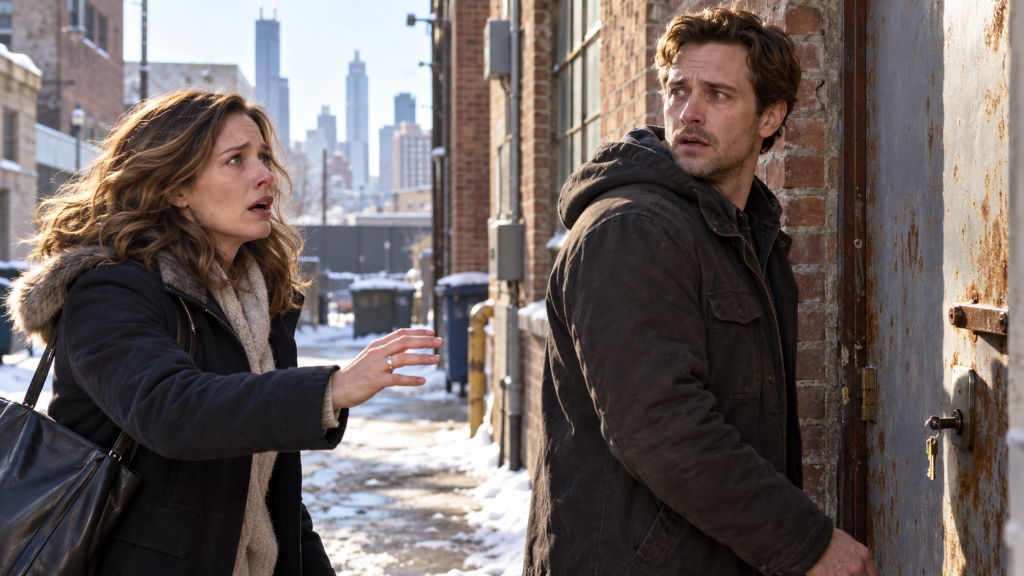
We ran into a filthy Chicago alley behind a warehouse that smelled like old snow, exhaust, and wet brick.
Thomas unlocked an ancient blue Ford parked behind a dumpster.
I stared.
“This is what you drive now?”
He looked offended.
“We’re being hunted and you’re criticizing the car?”
“It looks like tetanus with headlights.”
“Get in.”
We did.
He drove.
Fast enough to scare me.
Slow enough not to attract attention.
My phone began ringing.
Thomas looked at the screen.
“Who is it?”
“My sister.”
“Don’t answer.”
I stared at him.
“Absolutely not.”
“Clara—”
“I spent five months letting other people decide what I’m allowed to know.”
I answered.
“Rachel?”
My sister’s voice burst through immediately.
“Where are you?”
That stopped me.
“What?”
“Two men came to your house.”
Thomas looked over.
I put the call on speaker.
Rachel continued.
“They said they were from the hospital’s insurance office and needed to speak to you about Thomas’s final claim.”
I felt sick.
“Did you let them in?”
“No.”
“Good.”
“They knew you were out.”
Thomas tightened his grip on the steering wheel.
Rachel said,
“Clara, what’s happening?”
I looked at Thomas.
Then out the window.
Then back at the phone.
How do you tell your sister that the brother-in-law she helped bury is driving beside you?
“Rachel.”
“Yes?”
“I found Thomas.”
Silence.
“I don’t understand.”
“He’s alive.”
The sound she made was half laugh, half gasp.
“Clara, where are you?”
“I’m with him.”
“Clara.”
Her voice changed instantly.
The careful tone people use with someone they think grief has finally broken.
I hated it.
“He called me Firefly.”
Silence again.
Rachel knew the nickname.
Not where it came from.
Nobody did.
But she knew Thomas called me that when he thought no one could hear.
Then Thomas spoke.
“Hi, Rachel.”
My sister screamed.
Not a dignified sound.
A real one.
Thomas winced.
“I probably deserved that.”
She cried for almost a minute.
Then asked,
“Where are you?”
“We’re going somewhere safe.”
“Where?”
Thomas shook his head.
I said,
“I’ll call you.”
Rachel snapped,
“No, you will not disappear after saying your dead husband is driving you around Chicago.”
Fair.
Thomas said,
“Rachel, go to your neighbor’s house. Do not go into Clara’s home. Call the police if those men return.”
She whispered,
“Oh my God.”
Then:
“Thomas?”
“Yes?”
“I went to your funeral.”
“I know.”
“I watched them lower you into the ground.”
His face changed.
“I know.”
“You were alive?”
He swallowed.
“Yes.”
Rachel started crying again.
So did I.
Thomas pulled into an underground parking garage.
He switched cars.
Of course he did.
The second vehicle was an ordinary gray sedan.
I stared at him.
“Who are you?”
He stopped.
The question was meant sarcastically.
It did not land that way.
Thomas looked at me for a long moment.
Then said:
“I’m still your husband.”
I almost broke.
“You don’t get to tell me what you still are.”
His face tightened.
“No.”
“You’re right.”
That was the first correct thing he said all morning.
We drove to a small church on the West Side.
Not the dramatic kind.
No stained-glass cathedral.
Just brick.
A narrow side entrance.
A tired sign promising COMMUNITY DINNER THURSDAYS.
Dr. Evan Rhodes was waiting in the basement.
I recognized him immediately.
That was the worst part.
He had stood beside my hospital bed five months earlier.
He had held a clipboard.
He had spoken in that soft medical voice.
He had told me Thomas’s infection was progressing too quickly.
He had told me I could not see my husband because the isolation protocols were strict.
He had told me Thomas died at 2:14 in the morning.
I had thanked him.
Thanked him.
Dr. Rhodes looked older now.
His hair had gone mostly gray.
He stood when we entered.
I crossed the room and slapped him.
The sound echoed off the concrete walls.
Nobody moved.
I stared at my own hand.
I had never slapped anyone in my life.
Dr. Rhodes touched his cheek.
“I deserved that.”
“Don’t make me feel better about it.”
“I won’t.”
I wanted to hit him again.
Instead, I said,
“Tell me what happened.”
Thomas started to speak.
I turned.
“Not you.”
He stopped.
I looked at Dr. Rhodes.
“You.”
He nodded.
Then began.
The story started seven months earlier.
Not with a virus.
With a building.
Thomas had been supervising mechanical upgrades for a private contractor working on a major hospital expansion near the Loop.
He was not an engineer.
He was a senior site coordinator.
The man who tracked subcontractors, inspections, deliveries, safety reports.
The man nobody notices until something goes wrong.
One afternoon, Thomas discovered that fireproofing certificates had been duplicated.
Same inspection number.
Different floors.
Then he found steel-bracing invoices for material that had never arrived.
At first he assumed accounting mistakes.
Then a ceiling section failed in an unfinished service corridor.
A worker named Miguel Santos was badly injured.
The contractor called it an installation accident.
Thomas inspected the area afterward.
The missing reinforcement was not accidental.
It had been billed.
Paid for.
Certified.
Never installed.
Thomas started asking questions.
His direct supervisor told him:
“Stop trying to be a detective.”
Thomas did not.
That sounded like him.
He copied invoices.
Inspection reports.
Internal emails.
Photographs.
Then he discovered the hospital’s chief operating officer, Malcolm Voss, had approved emergency change orders worth almost eleven million dollars to a group of companies connected to the same contractor.
I stared at Thomas.
“You never told me.”
“I told you there were problems at work.”
“You told me your supervisor was an idiot.”
“He was.”
“That is not the same thing.”
“No.”
He looked ashamed.
I turned back to Dr. Rhodes.
“What does that have to do with us being declared dead?”
“Thomas was going to meet a city inspector.”
Thomas corrected him.
“And a reporter.”
I stared.
“When?”
“The night of the crash.”
My breath stopped.
“What crash?”
Thomas looked at me.
“The one you don’t remember.”
Dr. Rhodes opened his bag and removed a photograph.
Our car.
Or what remained of it.
The passenger side crushed.
Windshield shattered.
Front end folded around a concrete divider.
I stared.
Nothing.
No memory.
Not even a flash.
Dr. Rhodes continued.
“You were both brought to St. Anne’s Trauma Center.”
“I remember a hospital.”
“Not that one.”
I looked at him.
“What?”
“You remember the rehabilitation unit later.”
The room tilted.
Thomas pulled out a chair.
I sat because my knees were no longer trustworthy.
Dr. Rhodes continued.
“Thomas regained consciousness first.”
Thomas stared at the floor.
“I asked for you.”
Dr. Rhodes nodded.
“You were in surgery.”
“How bad?”
“Internal bleeding.”
“Concussion.”
“Fractured ribs.”
“A small brain bleed that stabilized.”
My hand went to my head.
I suddenly remembered waking for weeks with headaches.
I had been told those were caused by the viral illness and stress.
Dr. Rhodes said,
“You were sedated on and off for several days.”
I whispered,
“But I was told Thomas became sick.”
Dr. Rhodes looked away.
“That was fabricated.”
I felt nauseated.
“Why?”
“Because Malcolm Voss knew what Thomas had copied.”
Thomas looked at me.
“The truck that hit us belonged to a subcontractor tied to the project.”
My skin turned cold.
“You think someone crashed into us intentionally?”
Dr. Rhodes said,
“The driver was paid ten thousand dollars two days before the collision.”
I stopped breathing.
Thomas added,
“And disappeared after.”
Dr. Rhodes shook his head.
“Not disappeared.”
Thomas looked up.
“What?”
The doctor took out another paper.
“He was arrested yesterday in Indiana on an unrelated warrant.”
Thomas stared.
Dr. Rhodes continued.
“His name is Curtis Hale.”
“Investigators have him now.”
I whispered,
“Investigators?”
Thomas glanced at me.
“There are people looking into this.”
I laughed bitterly.
“Wonderful.”
“Does anyone want to tell the widow who is apparently not a widow?”
Dr. Rhodes flinched.
Good.
He continued.
“The collision was supposed to frighten Thomas.”
Thomas laughed once.
“That is not what a forty-mile-an-hour side impact does.”
“No.”
Dr. Rhodes looked ashamed.
“When both of you survived, Voss panicked.”
“He controlled hospital administration.”
“Security.”
“Electronic access.”
“Transfer authorization.”
“And he had already been using falsified records to conceal billing irregularities.”
I stared.
“So he just declared us dead?”
“No.”
The doctor looked at me.
“It happened in stages.”
Thomas was told I had deteriorated after surgery.
Then that I had died.
He was concussed.
Medicated.
Grieving.
Dr. Rhodes signed a death summary.
Another administrator generated the certificate.
Thomas was shown a sealed casket.
I turned toward him.
“You really buried me?”
His eyes filled.
“Yes.”
“Whose body?”
He shook his head.
“I didn’t know.”
Dr. Rhodes answered.
“A woman named Elena Marquez.”
Thomas went still.
“So there was a body.”
“Yes.”
“Who was she?”
“A sixty-nine-year-old patient who died without immediate next of kin.”
I covered my mouth.
Dr. Rhodes’s voice cracked.
“Her identification was deliberately altered before transfer to the funeral home.”
I whispered,
“You used a dead woman as a prop.”
“I didn’t arrange the body.”
“But you signed the paperwork.”
“Yes.”
I stood.
I could not sit anymore.
“Did Elena have family?”
“A niece was eventually located.”
“Did she know where her aunt was?”
“No.”
My stomach turned.
Thomas whispered,
“Jesus.”
Dr. Rhodes continued.
“You attended a private burial because you were told there had been an infectious complication.”
Thomas nodded slowly.
“They told me viewing wasn’t allowed.”
I looked at him.
“You believed them?”
He looked at me with such pain I immediately regretted the question.
“My wife was dead.”
His voice broke.
“I was drugged.”
“I had twelve stitches in my head.”
“A doctor stood in front of me and told me touching the body might expose other people.”
“What was I supposed to do?”
Nothing.
There was nothing useful I could say.
Dr. Rhodes continued.
“Thomas started asking questions two days later.”
Thomas wiped his eyes.
“Your wedding ring wasn’t returned.”
I looked at my hand.
The ring was there.
Of course.
“The hospital said it had been sent with the body.”
Thomas looked at me.
“You never took it off.”
“Not for surgery.”
“Not for anything unless someone forced you.”
“I knew something was wrong.”
He demanded medical records.
Voss refused.
Thomas contacted a police officer he knew.
Before the officer could meet him, Thomas was sedated again.
He woke in a private rehabilitation facility under the name Daniel Brooks.
I stared.
“You were kidnapped.”
Thomas hesitated.
“That word makes it sound simpler than it was.”
“Were you free to leave?”
“No.”
“Then I’m comfortable with the word.”
Dr. Rhodes nodded.
“They told staff he had neurological complications and violent confusion.”
“I did not.”
Thomas said.
“I was angry.”
“Apparently anger looks very similar to neurological confusion when the people writing the chart need it to.”
That sentence chilled me.
Then I asked:
“What about me?”
Dr. Rhodes looked at me.
“You woke eleven days after the crash.”
I tried to remember.
Fragments came.
Bright ceiling.
A nurse asking my name.
My own voice saying Thomas.
Someone telling me to rest.
Dr. Rhodes continued.
“Your memory of the collision was gone.”
“Retrograde and post-traumatic memory loss.”
“You remembered your life before it.”
“You remembered Thomas.”
“But not the crash.”
“That made the false story easier.”
“What false story?”
“That Thomas had developed an aggressive viral infection after you were admitted.”
I stared at him.
“They told me I had been exposed too.”
“Yes.”
“They isolated me.”
“Yes.”
“They wouldn’t let me see him.”
“Yes.”
“Because he wasn’t there.”
“Yes.”
Every yes felt like a nail.
I whispered,
“For three weeks you made me believe my husband was dying ten doors away.”
Dr. Rhodes closed his eyes.
“Yes.”
I started crying.
Not loudly.
That would have been easier.
The kind of crying where your body shakes while your voice refuses to come.
Thomas stepped toward me.
Then stopped.
He had learned.
He waited until I reached for him.
I hated that I wanted him.
I hated that my body recognized his chest before my mind knew what to do with him.
I buried my face against him and sobbed.
He held me.
Alive.
Warm.
Real.
Then I remembered the question.
I pulled away.
“How long have you known I was alive?”
Thomas froze.
Dr. Rhodes looked toward the floor.
I stared at my husband.
“How long?”
He whispered,
“Thirteen days.”
The room disappeared.
“Thirteen?”
“Clara—”
“You knew for thirteen days?”
“I didn’t know where you were.”
“You knew I wasn’t dead.”
“Yes.”
“And you did not come home.”
His face crumpled.
“Rhodes told me you’d been moved into a secured neurological unit.”
I turned toward the doctor.
He shook his head.
“That is what the records showed.”
“Records you knew were falsified?”
“Not all of them.”
I laughed in disbelief.
Thomas spoke quickly.
“I thought you were being watched.”
“You were.”
Rhodes interrupted.
“I am sorry, but she was.”
I turned on him.
“Stop helping.”
He shut up.
Thomas said,
“I was trying to find out where they had taken you.”
“I thought if I walked into the wrong building, they would move you again.”
“So you hid.”
“I gathered evidence.”
“You hid.”
“Yes.”
I stared at him.
“You let me think you were dead.”
“I thought you thought I was—”
“Dead?”
I laughed through tears.
“Yes.”
“I did.”
“For five months.”
He whispered,
“I know.”
“No.”
I shook my head.
“You know numbers.”
“You do not know what five months felt like.”
His eyes closed.
“I lit a candle every night.”
His face broke.
“I slept with your T-shirt under my pillow for six weeks because it smelled like you.”
“Clara—”
“I talked to your photograph.”
He cried silently.
“I left a cheeseburger in front of it.”
That actually made Dr. Rhodes glance up.
Thomas let out a broken laugh.
I hated the sound because it was familiar.
I had missed it.
“I’m sorry.”
He whispered.
I shook my head.
“Every person in this story keeps deciding what truth I can survive.”
Nobody spoke.
I looked at Dr. Rhodes.
“Voss decided.”
“At least that’s what you say.”
“You decided.”
“Thomas decided for thirteen days.”
I turned toward my husband.
“Do not tell me you were protecting me.”
He swallowed.
“I was.”
I laughed.
“Of course.”
Then I said the words that became the spine of everything afterward.
“Protection without my consent is just control wearing kinder clothes.”
Thomas looked as if I had struck him.
Good.
He needed to hear it.
So did Dr. Rhodes.
So did I.
Because there had been times in my life when I had hidden things from Thomas to “spare him.”
Smaller things.
Bills.
Test results until I knew more.
Family problems.
We all do it.
We call it love.
Sometimes it is.
Sometimes it is fear.
The trick is knowing when we have crossed the line from helping someone carry pain into deciding they are not entitled to their own life.
Dr. Rhodes opened his folder.
“There is more.”
I laughed.
“There is always more.”
He removed a hospital access log.
“When Clara was discharged, she was not considered harmless.”
I stared.
“What does that mean?”
“Voss believed Thomas had hidden copies of the project records somewhere outside work.”
Thomas nodded.
“I had.”
“Where?”
He looked at me.
“Home.”
I felt sick.
“They let me go home because they thought I would find them.”
“Yes.”
I stepped backward.
“The condolence cards.”
“The people checking on me.”
“The calls from hospital social services.”
Rhodes looked miserable.
“Some were legitimate.”
“Some?”
“Not all.”
I thought of Melissa.
A grief counselor who called every Friday.
Soft voice.
Always asking whether I had started going through Thomas’s belongings.
Whether I had found anything unexpected.
Whether there were work documents I wanted help disposing of.
My blood turned cold.
“Melissa Crane.”
Dr. Rhodes nodded.
“She worked for hospital risk management.”
“She told me she was a bereavement counselor.”
“She had counseling credentials.”
“That isn’t the question.”
“No.”
“She was reporting what you said to Voss.”
I had told that woman things I had not told my sister.
How lonely the bed felt.
How angry I was at Thomas for dying.
How guilty that anger made me.
I whispered,
“I hope she never sleeps comfortably again.”
Thomas reached toward me.
Stopped.
Good.
I was learning to appreciate restraint.
Dr. Rhodes continued.
“Voss expected you to search Thomas’s things.”
“You didn’t.”
I laughed bitterly.
“I packed his clothes.”
“Everything else stayed exactly where he left it.”
Thomas looked at me.
“Silver frame.”
My eyes moved to him.
“What?”
“The photograph on the shrine.”
My chest tightened.
“How do you know about the shrine?”
“Rachel posted a picture after the memorial.”
I stared.
“You looked at my sister’s social media?”
“Once.”
“Thirteen days ago?”
“Three days ago.”
My anger rose again.
Thomas looked ashamed.
“I wanted to see you.”
“And instead of calling—”
“I know.”
I held up my hand.
“Silver frame.”
He nodded.
“Before the crash, I hid a memory card inside the backing.”
I stared.
“The picture frame?”
“The one from our tenth anniversary.”
The silver frame had originally held a photograph of us standing on Navy Pier.
After Thomas “died,” I removed that photograph and replaced it with one of him laughing at our favorite diner.
I had never noticed anything hidden inside.
Thomas whispered,
“The card contains everything.”
Dr. Rhodes said,
“If Voss realizes Clara has found Thomas, they will assume the two of you are going home for it.”
I grabbed my coat.
“Then let’s go get it.”
Both men said,
“No.”
I stared at them.
Thomas immediately corrected himself.
“We should let law enforcement retrieve it.”
Better.
I nodded.
“Excellent.”
Dr. Rhodes made a call.
For the first time that day, nobody asked me to wait somewhere without telling me why.
Two Chicago detectives arrived.
Then a federal investigator whose agency title I promptly forgot because exhaustion had turned my brain into soup.
Detective Elena Ruiz listened without interrupting.
She had the calm face of someone who had learned not to look shocked until people finished talking.
When Thomas placed both death certificates on the table, she stared at them.
Then at us.
Then back at the certificates.
“I have been doing this nineteen years.”
She looked at Thomas.
“This is new.”
“Glad we could help.”
She almost smiled.
Then she looked at me.
“Mrs. Bennett, I’m going to ask something unpleasant.”
“Today has been competitive.”
“Did you receive life-insurance proceeds after your husband’s reported death?”
“Yes.”
My heart dropped.
A payment.
$140,000 through his employer.
I had barely touched it.
I had used some for funeral expenses and mortgage payments.
I suddenly felt sick.
“Am I in trouble?”
“No.”
She answered immediately.
“You were a victim relying on official documentation.”
“Do not move the remaining funds until your attorney speaks with the insurer.”
“Okay.”
Thomas stared.
“You got my insurance?”
I looked at him.
“You were dead.”
“Right.”
“That sounded accusatory.”
“It wasn’t.”
“It sounded extremely accusatory.”
“I’m sorry.”
The absurdity almost made me laugh.
Detective Ruiz said,
“This is going to produce a complicated financial unwind.”
Understatement of the century.
She sent officers to my house.
Not us.
They found the silver frame exactly where I had left it.
White candle beside it.
Glass of water.
And yes.
The cheeseburger.
One officer apparently asked whether it was evidence.
I was informed later that the other officer said:
“Everything is evidence until somebody tells us otherwise.”
Thomas found that hilarious.
I did not.
Not then.
Inside the backing of the frame, beneath the felt lining, investigators found a microSD card wrapped in electrical tape.
Thomas looked at me.
“I’m sorry.”
“For hiding evidence in our living room?”
“Yes.”
“That apology is number four hundred today.”
“I’m keeping count.”
“Good.”
The card contained hundreds of photographs.
Inspection sheets.
Emails.
Invoices.
Recorded conversations Thomas had legally made during meetings in which he participated.
One audio file changed the entire case.
Malcolm Voss.
Thomas’s supervisor.
And contractor Graham Larkin.
Three voices.
Voss said:
“The deficiencies can be corrected after opening. We cannot delay certification over paperwork.”
Thomas’s supervisor answered:
“It isn’t paperwork if the material isn’t installed.”
Then Larkin said:
“Everybody wants to be ethical until payroll is due.”
There was laughter.
Then Voss:
“Bennett is becoming a problem.”
Thomas’s voice appeared.
Because he had walked into the room unexpectedly.
“What kind of problem?”
The recording ended moments later.
That alone did not prove attempted murder.
The money did.
Investigators traced a payment from one of Larkin’s shell subcontractors to the driver who hit us.
Ten thousand dollars.
Another thirty promised after Thomas’s “problem” disappeared.
The driver, Curtis Hale, eventually admitted he had been told to force us off the road.
Not necessarily kill us.
He said Larkin told him:
“Scare the man enough to make him forget he’s a hero.”
He did not know I would be in the car.
That fact did not make me feel better.
Curtis panicked after the crash.
Voss panicked more.
Then the hospital cover-up began.
But the biggest shock came three days later.
Dr. Rhodes had lied to us too.
Again.
Detective Ruiz asked me to come in.
Thomas was already there.
Dr. Rhodes sat in another room.
Ruiz placed a bank record on the table.
A payment of forty thousand dollars.
From a consulting company tied to Malcolm Voss.
To Dr. Evan Rhodes.
Seven days after my false death certificate was created.
My mouth went dry.
Thomas whispered,
“You said they threatened you.”
Ruiz nodded.
“He says they did.”
“Then what is this?”
“Payment.”
I laughed.
Of course.
Nothing in this story could simply be terrible.
It had to become worse first.
Dr. Rhodes eventually admitted the truth.
Voss had pressured him.
Yes.
Threatened to expose a medication error from years earlier.
Yes.
Threatened his position.
Yes.
But Rhodes also took the money.
He told himself it was severance.
Then hush money.
Then compensation for being forced into something.
People are extraordinarily creative when naming money they know they should not accept.
I met him once more before prosecutors took over.
Through glass.
With lawyers present.
He looked exhausted.
“I am sorry.”
I stared at him.
“Why warn us?”
“Because I couldn’t keep doing it.”
“That doesn’t answer the question.”
He swallowed.
“My daughter asked me last Christmas whether I thought I was a good doctor.”
I waited.
“I realized I didn’t know.”
I shook my head.
“You want me to feel sorry for you?”
“No.”
“Good.”
He leaned closer.
“I falsified records.”
“I signed documents I knew were false.”
“I accepted money.”
“I told myself nobody was actually dying because of what I did.”
His voice cracked.
“Then I learned about Elena Marquez.”
The woman whose body had been buried as me.
“I understood that once you turn people into paperwork, eventually somebody becomes disposable.”
That sentence stayed with me.
Dr. Rhodes cooperated.
It did not erase what he did.
He lost his medical license.
He pleaded guilty to charges connected to falsifying records and obstruction.
His cooperation reduced his sentence.
Some people online later called him a hero for coming forward.
I never did.
A hero acts before the damage becomes unbearable to himself.
Rhodes became useful.
That mattered.
He was also guilty.
Both things fit.
The exhumations were worse than I expected.
Thomas’s grave contained a body.
Not his.
The man was eventually identified as Raymond Pike, a fifty-eight-year-old patient who had died after being brought to the hospital without identification.
His sister had spent four months searching for him.
Four months.
While I visited a grave with Thomas’s name on it, another woman was searching shelters and emergency rooms for her brother.
When she learned the truth, she asked to meet me.
Her name was Denise.
We sat in a police-family room.
She looked at me for a long time.
Then said,
“I hate that I’m angry at you.”
I nodded.
“You should be angry.”
“Not at you.”
“I know.”
“But I went to that cemetery.”
“So did I.”
“You put flowers on him?”
“Yes.”
Her face crumpled.
“What kind?”
“White lilies.”
She started crying.
“He hated lilies.”
I almost laughed.
“Thomas hated them too.”
She looked at me.
For the first time, something softened.
“What did he like?”
“Cheeseburgers.”
She laughed through tears.
“Raymond too.”
Of course.
Perhaps the dead are simpler than we make them.
Feed them something greasy.
Tell a good story.
Don’t let paperwork erase their names.
Raymond was returned to his family.
Elena Marquez’s niece received her aunt’s remains.
I attended neither second funeral.
Those belonged to their families.
But I sent letters.
No excuses.
Just:
I am sorry your loved one was used in a lie that harmed all of us.
Denise wrote back.
One sentence.
None of us should have had to bury strangers under the wrong names.
Exactly.
Malcolm Voss was arrested six weeks after Thomas found me.
Graham Larkin followed.
So did the funeral director who had accepted payments to bypass identification procedures.
Thomas’s former supervisor cooperated after investigators showed him the payment trail.
The hospital board claimed it had no knowledge of the conduct.
Maybe most of them did not.
It did not matter to me.
Systems do not become innocent merely because wrongdoing was concentrated in a few offices.
The hospital entered years of oversight.
Audits.
External review.
Record-verification reforms.
New rules around death certification and body identification.
None of that gave me back five months.
But it might keep someone else from being handed the wrong coffin.
The construction project was shut down for inspection.
Several floors had to be partially rebuilt.
Miguel Santos, the worker injured before all this started, survived.
He walked with a cane afterward.
When Thomas apologized for not coming forward sooner, Miguel looked at him and said,
“You tried.”
Thomas started crying.
Miguel shrugged.
“Try earlier next time.”
Fair.
The criminal cases took almost three years.
That surprised people.
They expected arrest to equal ending.
It doesn’t.
Arrest is paperwork beginning.
Depositions.
Motions.
Hearings.
Plea negotiations.
Forensic reviews.
Doctors.
Engineers.
Financial analysts.
Digital experts.
Defense attorneys doing exactly what defense attorneys are supposed to do.
I learned patience against my will.
Curtis Hale, the driver, pleaded guilty and testified.
Larkin admitted arranging the collision and financial fraud.
Voss went to trial on several counts and was convicted on the most serious conspiracy and obstruction charges, though not every charge prosecutors brought.
The funeral director pleaded guilty.
Dr. Rhodes served a limited custodial sentence followed by supervised release and could no longer practice medicine.
No one received the dramatic hundred-year sentence strangers on the internet demanded.
Real justice did not look like revenge.
It looked incomplete.
Structured.
Slow.
Necessary.
Thomas and I brought civil claims.
So did Raymond’s family.
Elena’s family.
Miguel.
Several whistleblowers.
Eventually there were settlements.
I cannot discuss every number.
Lawyers love sentences like that.
What I can say is this:
Thomas and I used part of ours to establish a fund supporting patients whose medical records are compromised by identity errors or institutional fraud.
Not because we became saints.
Because I discovered how terrifying it is when official paperwork tells the world something you know is false.
A death certificate has enormous power.
Banks believe it.
Courts believe it.
Insurers believe it.
Employers believe it.
Government systems believe it.
For five months, paper was considered more trustworthy than Thomas’s heartbeat.
For four months, paper said I was dead in systems he accessed.
Correcting our identities took nearly a year.
My first trip to the Social Security office was almost funny.
Almost.
The employee looked at me.
Then at the screen.
Then at me again.
“According to this, you’re deceased.”
“I’ve been told.”
She did not laugh.
Apparently they discourage that.
Thomas had trouble reopening accounts.
His driver’s license was invalidated.
His employer health insurance had terminated.
A credit card company rejected his application because:
Applicant reported deceased.
He framed that letter.
Of course he did.
I told him it was not funny.
He said:
“It will be.”
Eventually, he was right.
But none of that was the hardest part.
The hardest part was coming home.
Together.
The first evening police allowed us back into the house, Thomas stopped in the living room.
He saw the shrine.
His photograph.
The candle burned halfway down.
The glass of water.
And the cheeseburger.
Five months old.
Wrapped in paper.
Probably capable of violating several public-health codes all by itself.
Thomas stared.
Then looked at me.
“You really left me a cheeseburger?”
I folded my arms.
“Someone at the wake said dead people liked offerings.”
He looked offended.
“Five months?”
“I was grieving.”
“That burger died after I did.”
I laughed.
I did not mean to.
The sound came out wrong.
Half laugh.
Half sob.
Then Thomas started crying.
He picked up his photograph.
“I watched your funeral.”
I whispered.
“I stood over that box and told you I forgave you for dying.”
He closed his eyes.
“I’m sorry.”
“I know.”
“I would change it.”
“I know.”
He placed the photograph down.
Then reached for me.
I stepped back.
His hand stopped.
That hurt him.
It hurt me too.
But returning from the dead did not return us to marriage automatically.
Thomas slept in the guest room.
For three months.
People found that strange.
Friends said:
“You got him back.”
As if grief had been a lost-luggage claim and Thomas had finally arrived at baggage services.
I did not “get him back.”
I got a living man carrying four months of fear, captivity, guilt, and secrecy.
He got a wife who had learned to sleep alone, speak to photographs, and distrust official reality.
We loved each other.
That did not mean our nervous systems understood we were safe.
The first week, I woke at 2:14 every morning.
The time printed on his false death report.
I would walk into the guest room to check whether he was breathing.
Sometimes he was awake.
The first time, he whispered,
“I’m here.”
I started crying.
The fourth time, he said,
“Firefly.”
I screamed.
Not because I hated the nickname.
Because the last time I had heard it before our reunion was in our bedroom.
Before the crash I couldn’t remember.
Now the word belonged to a Chicago alley and a dead man’s face.
Thomas never used it again without asking.
That may sound small.
It wasn’t.
Consent returns through small doors.
One evening he asked:
“Can I call you Firefly again someday?”
I stared at him.
“Not yet.”
He nodded.
“Okay.”
Six months later, I said it for him.
We were in bed.
Not touching.
Just lying there.
I whispered,
“You can say it.”
Thomas’s eyes filled.
“Are you sure?”
“Yes.”
He moved closer.
“Firefly.”
I cried.
Then laughed.
Then buried my face against his chest.
Healing is rarely dignified.
We went to therapy.
Together.
Separately.
A lot.
Our therapist, Dr. Miriam Klein, once asked Thomas:
“What do you think Clara needed most during the thirteen days you knew she was alive?”
He answered:
“Protection.”
I nearly left the room.
Then he stopped himself.
“No.”
He looked at me.
“Choice.”
That mattered.
He continued.
“She needed the choice to decide whether the danger was worth seeing me.”
I nodded.
Dr. Klein asked:
“And what did you do?”
“I made the choice for her.”
“Yes.”
Thomas looked at me.
“I’m sorry.”
That apology was different from the first hundred.
Because now he understood the actual offense.
Not surviving.
Not hiding before he knew I was alive.
Not being afraid.
Deciding for me.
I eventually forgave him.
Not quickly.
Not because he suffered too.
Not because our marriage history entitled him to it.
I forgave him because he stopped defending the choice.
There is an enormous difference between:
I hurt you, but here’s why I was right.
And:
I understand why I did it, and I was still wrong.
The second one can rebuild something.
The first usually cannot.
My memory of the crash never fully returned.
Fragments did.
Rain on glass.
Thomas cursing at a truck.
His hand crossing my chest before impact.
A terrible metallic sound.
Then nothing.
For a while, I obsessed over remembering.
Dr. Klein asked why.
“Because it belongs to me.”
Fair.
Then she asked:
“Does not remembering mean someone else owns it?”
I hated therapy.
Useful questions are extremely annoying.
Eventually, I stopped forcing the memory.
My body remembered enough.
I flinched around large trucks for two years.
I hated hospital elevators.
The smell of antiseptic made me nauseated.
Thomas could not tolerate locked doors.
If a hotel room had a deadbolt he could not immediately understand, his breathing changed.
We learned each other again.
Not the people we had been before the crash.
The people who survived after it.
That was harder.
Also more honest.
One night, almost a year after I found him, we went to our old diner.
The one that sold the cheeseburger I had left beside his photograph.
Thomas stared at the menu.
“No.”
I smiled.
“What?”
“I know what you’re thinking.”
“You don’t.”
“You’re going to order me the cheeseburger.”
“I am.”
“I refuse.”
“Coward.”
“It has emotional associations.”
“It has pickles.”
“Worse.”
I ordered it.
He ate the whole thing.
Halfway through, I said:
“If you fake your death again, I’m not saving you fries.”
He nearly choked.
The waitress stared.
We laughed until people looked over.
That was the first evening our story became ours again instead of evidence.
Years passed.
The warehouse where I found Thomas was eventually demolished.
Before it came down, he asked if I wanted to see it once more.
I almost said no.
Then went.
The rusted door was still there.
Same alley.
Different season.
Summer this time.
Sunlight on the bricks.
Traffic in the distance.
I stood exactly where I had stood the morning he turned and called me Firefly.
Thomas stayed several feet away.
He knew better than to turn the moment into something romantic.
Nothing about that morning had been romantic.
I had been terrified.
He had been terrified.
We had both been living inside manufactured grief.
I looked at the door.
“Why were you smiling?”
He frowned.
“What?”
“The day I saw you.”
“You were standing outside the sporting goods store.”
“You checked your phone.”
“You smiled.”
Thomas stared at me.
Then his face changed.
“Oh.”
“What?”
“That was Rhodes.”
My stomach tightened.
“What did he say?”
Thomas took out his phone.
He still had a screenshot.
Of course he did.
The message had arrived at 8:42 that morning.
I found confirmation. Clara Bennett is alive. Records show a current neurological placement. I’m verifying location. Do not move yet.
I stared.
“That was why you smiled.”
“Yes.”
His voice cracked.
“For the first time in five months, somebody told me you might be alive.”
I started crying.
Thomas did too.
Then I laughed through tears.
“You idiot.”
“What?”
“I was twelve yards behind you.”
“I know that now.”
“I could have saved you a text message.”
He smiled.
Then looked toward the spot where I had stood.
“I thought I had been given a miracle.”
“You had.”
He looked at me.
“I just didn’t know it was following me through traffic.”
That line should have annoyed me.
Instead, I kissed him.
The first time we had kissed in that alley.
The last.
Afterward, we walked away.
No looking back.
Rachel eventually forgave Thomas too.
That took longer.
She said:
“You let my sister mourn you.”
He answered:
“I know.”
“I helped her pick out a dress for your funeral.”
“I know.”
“I hate that you have an explanation.”
Thomas looked confused.
“Why?”
“Because explanations make anger inconvenient.”
Fair.
They rebuilt slowly.
My sister never stopped checking whether Thomas was real at family dinners.
She would poke his shoulder.
He eventually started saying:
“Confirmed corporeal.”
Thanksgiving improved.
There was another unexpected consequence.
People began writing to us.
Lots of them.
Patients who found errors in medical records.
Families struggling with mistaken death declarations.
People whose identities had been mixed with someone else’s.
People asking whether we could expose hospitals for them.
We were not investigators.
We learned to say that.
We referred people to attorneys, patient advocates, government agencies, legal-aid groups.
I refused to become someone whose trauma was permanently converted into a public job.
That was another boundary I learned late.
Thomas occasionally spoke about construction whistleblower protections.
Miguel joined him once.
They talked less about bravery and more about documentation.
“Do not keep the only copy at work.”
“Do not confront people alone.”
“Use proper reporting channels.”
“Get legal advice.”
“Tell your spouse more than ‘my boss is an idiot.’”
That last one was mine.
Thomas added it permanently.
Our settlement did not make us rich.
After taxes, legal costs, therapy, lost income, and the general financial insanity of becoming legally dead, what remained was meaningful but not magical.
We repaired the house.
Paid debts.
Helped Raymond’s family establish a small memorial scholarship.
Contributed to Elena’s niece’s campaign for stronger identification protocols in funeral transfers.
Then we saved.
Because after watching your identity disappear in a database, retirement accounts become strangely comforting.
The silver frame stayed.
For years.
But I removed Thomas’s funeral photograph.
We put our wedding picture back inside.
Navy Pier.
Both of us younger.
Thomas with too much hair.
Me with an ugly red jacket I insisted was fashionable.
Behind the picture, there was no memory card anymore.
I checked.
Twice.
Thomas said:
“You don’t trust me?”
“Not with picture frames.”
Reasonable.
The white candle stayed too.
Not as a shrine.
On anniversaries of the crash, we lit it for Raymond and Elena.
Two people we never knew whose deaths were used to manufacture ours.
The first year we did that, Thomas asked:
“Do you think that’s strange?”
“Yes.”
“Should we stop?”
“No.”
So we continued.
I never again left a cheeseburger beside it.
There are limits to ritual.
Five years after I found Thomas, the city finally completed repairs on the hospital expansion project.
A plaque honoring construction workers and whistleblowers was proposed.
Thomas refused to have his name on it.
“Why?”
I asked.
“Because Miguel got hurt.”
“And?”
“I found the paperwork and kept investigating quietly instead of reporting it outside the chain immediately.”
“You were trying to prove it.”
“I was also afraid of losing my job.”
That was Thomas.
He had stopped rewriting himself as a hero.
I loved him more for that.
The plaque eventually named workers affected by the project.
Miguel agreed.
Thomas did not.
He stood in the crowd beside me.
Alive.
Ordinary.
Exactly where I wanted him.
On our thirtieth wedding anniversary, Rachel gave us a ridiculous present.
Two framed copies of our corrected death certificates.
Stamped:
VOID — PERSON LIVING
I stared at her.
“You spent money framing these?”
She smiled.
“Art.”
Thomas loved them.
Of course.
They now hang in the basement.
Not the living room.
I have standards.
Sometimes people ask whether I ever stopped being angry.
Yes.
No.
Both.
I stopped waking every morning furious.
I stopped looking at hospitals as buildings full of conspirators.
I stopped checking Thomas’s pulse every night.
But some anger became part of my moral architecture.
I am glad.
Certain anger teaches you where the boundary is.
I am angry that powerful people thought records could erase living human beings.
I am angry that frightened professionals obeyed.
I am angry that Thomas chose silence for thirteen days after learning I was alive.
I am angry that I thanked the doctor who lied to me.
None of that poisons my life now.
It clarifies it.
Forgiveness does not require forgetting what the lesson cost.
Thomas and I are older now.
His right shoulder still tilts slightly when he walks.
The first time I noticed it after everything was over, I cried.
He asked why.
“Because that’s how I recognized you.”
He looked confused.
“Not my face?”
“No.”
“Not my scar?”
“No.”
“Not my devastatingly handsome profile?”
“Your crooked shoulder.”
He was deeply offended.
Good.
Marriage survived.
The scar on his jaw is still there.
I still kiss it sometimes.
But he no longer automatically puts his hand on the back of my neck when we cross streets.
Not because I hate it.
Because after the crash, surprise touch near traffic made me panic.
Now he asks:
“Hand?”
I give it to him.
We cross together.
That tiny change says more about what happened to us than the court cases ever could.
Before, love meant:
I know what keeps you safe.
Afterward, love became:
Tell me what safety feels like to you.
One evening, long after the trials ended, Thomas asked me a question.
“If you had known I was alive from the beginning, do you think we would have survived everything?”
I looked at him.
“What do you mean?”
“The danger.”
“The investigation.”
“The fear.”
“Yes.”
He seemed surprised.
“You’re sure?”
“No.”
I smiled.
“But I should have been allowed to choose.”
He nodded.
“Right.”
Then I asked:
“If you had known I was home instead of supposedly locked in a hospital, would you have come back?”
“Immediately.”
“Even if it put us at risk?”
“Yes.”
“Why?”
He looked at me.
“Because I finally understand the difference between keeping someone safe and keeping them uninformed.”
I smiled.
“Therapy was expensive.”
“Worth every dollar.”
“Debatable.”
He laughed.
Then took my hand.
I let him.
The strangest part of all is that people still sometimes say:
“You must feel like you got a second chance.”
I understand why.
But that is not quite right.
A second chance sounds clean.
Like life reset.
Ours did not.
The five months remained.
The funerals remained.
Raymond and Elena remained dead.
The crash remained real.
The betrayal remained.
The fear remained.
We did not start over.
We continued.
Scarred.
Better informed.
Less innocent.
More deliberate.
That is different from a second chance.
Maybe it is more valuable.
The morning I saw Thomas walking through Chicago, I believed I had seen a ghost.
I had not.
The ghosts came later.
Paperwork.
False diagnoses.
Closed caskets.
People telling us they had acted for our own good.
Those were the things that haunted us.
Thomas was only a man.
My man.
Flawed.
Terrified.
Alive.
And when he turned around in that alley and whispered,
“Firefly… who let you out of the hospital?”
neither of us understood that we had both been imprisoned by the same lie.
He thought the hospital still held me.
I thought the grave held him.
Both prisons had locked doors made of paper.
It took doctors, detectives, lawyers, forensic accountants, grieving families, and years of court proceedings to tear those doors down.
But the first crack appeared in an alley.
When a widow refused to believe her own eyes were wrong.
When a dead man recognized his wife.
When two people stood face-to-face and realized official truth had failed them.
I still have the silver frame.
I still have the candle.
But now the photograph inside shows both of us.
Thomas is laughing.
I am pretending not to.
Sometimes, before bed, I look at it.
Not because I am afraid he will disappear.
Not anymore.
I look because I remember the woman who once kissed a photograph goodnight because she believed it was all she had left.
I wish I could tell her:
Follow him.
Ask questions.
Do not let anyone call your confusion madness simply because their paperwork looks more respectable than your instincts.
And when the truth arrives, do not confuse finding someone alive with getting your old life back.
You will have to build another one.
Thomas and I did.
Piece by piece.
Truth by truth.
Choice by choice.
And now, whenever we pass that old diner, he always asks the same thing.
“Cheeseburger?”
I roll my eyes.
“Only if you promise not to die.”
He smiles.
“No promises.”
I glare.
He corrects himself immediately.
“Terrible joke.”
“Very.”
Then he reaches out his hand.
He waits.
I take it.
And together, very much alive, we cross the street.
THE END STORIES! THANK YOU FOR READING GOOD LUCK! ❤️
Related Posts