“The beneficiary is the Hill Country Agricultural Trust.” For a moment, nobody outside the gate moved. Not Michael. Not Sarah. Not David. Not my youngest daughter, Rebecca. Not their spouses. Not even the grandchildren old enough to understand that something important had just shifted beneath their feet.
Michael stared at me as if I had suddenly begun speaking another language. “The what?” “The Hill Country Agricultural Trust.” I held Thomas’s notebook against my chest. “It’s a charitable land trust Thomas and I helped establish years ago.”
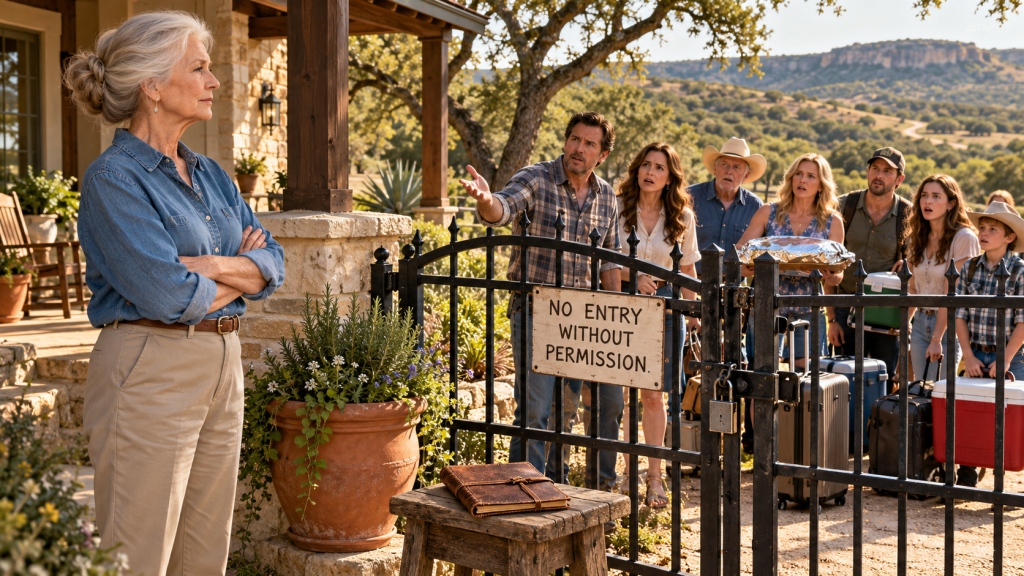
Sarah’s face went pale. “You’re giving away the ranch?” “No.” I said it calmly. “I am deciding what happens to my property.” “That’s the same thing!” “No, sweetheart.” I looked directly at her. “It only feels the same because somewhere along the way, all of you began treating my future death like a transfer date.”
That sentence landed harder than I expected.
Rebecca looked down.
David shifted the cooler he was holding.
Michael stepped closer to the iron gate.
“Mom, open this.”
“No.”
“We drove four hours.”
“You should have called.”
“You knew we were coming.”
“I found out because Sarah instructed me where to leave the key.”
Sarah’s mouth tightened.
“I didn’t mean it like that.”
I looked at her.
“How did you mean it?”
She opened her mouth.
Nothing came out.
Michael gripped one of the iron bars.
“This is ridiculous.”
I almost smiled.
A week earlier, I might have opened the gate just to stop him sounding angry.
That was the old me.
The one who mistook peace for love.
The one who believed the fastest way to prove she belonged was to inconvenience herself.
I had finally met the cost of that habit.
And I was done paying.
Michael said,
“You can’t just lock us out.”
I tilted my head.
“Of my house?”
His jaw tightened.
“Our family home.”
“No.”
I shook my head.
“It was your childhood home.”
“It is my home.”
“There is a difference.”
David finally spoke.
“Mom, nobody is trying to take the ranch from you.”
Sam, standing several yards behind me, coughed.
Not dramatically.
Just enough.
David looked toward him.
I did too.
Sam had known Thomas longer than any of my children realized.
He had helped us repair fences before Michael had even learned to drive.
He knew how much this place cost.
Not just money.
Years.
Back injuries.
Failed crops.
Drought.
Debt.
Heat.
Marriage arguments conducted over broken irrigation lines.
David looked at him.
“What?”
Sam shrugged.
“Nothing.”
“You clearly have something to say.”
Sam took off his hat.
“I work for your mother.”
“That’s all I need to say.”
I nearly hugged him.
Michael’s voice rose.
“Mom, open the gate.”
I looked at him.
“No.”
“Then what are we supposed to do?”
I glanced at the twelve people, the coolers, the overnight bags, the briskets, the foldable chairs, the inflatable pool toys, the speakers.
“You could go home.”
Silence.
Then one of my grandsons snorted.
He tried to turn it into a cough.
I pretended not to notice.
Michael did not.
“This is funny to you?”
The boy looked terrified.
“No, sir.”
I hated that.
This was not the children’s fault.
They had simply watched their parents treat my ranch like family property and assumed the same rules applied.
I called toward them.
“Kids.”
Several heads lifted.
“You haven’t done anything wrong.”
Michael stared at me.
“Don’t undermine me in front of my children.”
I almost laughed.
“Michael, your children are standing outside a locked gate because you planned a weekend in another adult’s home without asking.”
“If you feel undermined, you might want to examine the foundation.”
Sarah muttered something under her breath.
I heard enough.
“Say it louder.”
She looked at me.
“I said this is insane.”
“Possibly.”
I nodded.
“But the gate is still locked.”
Michael stepped away.
He pulled out his phone.
“Fine.”
“What are you doing?”
“Calling the sheriff.”
That actually made me laugh.
He stared.
“You think this is funny?”
“Yes.”
I nodded toward my land.
“Please call law enforcement and explain that your seventy-six-year-old mother refuses to let twelve uninvited people into her legally owned ranch.”
Nobody spoke.
Then Sam coughed again.
This time it was definitely a laugh.
Michael shoved his phone back into his pocket.
“Mom, why are you doing this?”
There it was.
Not:
What did we do?
Why are you doing this?
The language people use when consequences arrive before accountability.
I lifted the notebook.
“Because yesterday you threw this in the trash.”
His face reddened.
“It’s an old notebook.”
“It is.”
“It’s not legal.”
“I know.”
“Then why are you acting like it controls anything?”
“I’m not.”
I opened it.
“I am acting like it reminded me of something I had forgotten.”
“What?”
“That your father and I spent forty-three years recording what everything cost us.”
“Fence posts.”
“Feed.”
“Roofing.”
“Medical bills.”
“Your college tuition.”
“David’s first truck.”
“Rebecca’s divorce lawyer.”
“Sarah’s emergency loan.”
Sarah flinched.
“That was private.”
“It was.”
“So was my house.”
She went quiet.
I continued.
“And yet privacy only seems sacred when it protects you.”
Michael rubbed his forehead.
“This is getting ugly.”
“No.”
“It has been ugly.”
“You just arrived late.”
Then Rebecca stepped forward.
She had barely spoken.
“Mom.”
Her voice was softer than the others.
I looked at her.
“Yes?”
“Who exactly gets the ranch?”
I answered honestly.
“If I die under the plan currently in place, the land trust receives the majority interest.”
A stunned silence followed.
“The main house and twenty acres surrounding it are placed into a life-use arrangement for family gatherings under specific conditions.”
Michael blinked.
“What conditions?”
“Scheduled access.”
“Advance notice.”
“Maintenance contributions.”
“No one treating the place like a free resort.”
His jaw tightened.
Rebecca asked,
“And the rest?”
“Protected from subdivision.”
“What does that mean?”
“It cannot be carved into luxury lots and sold off one acre at a time.”
Michael looked away.
That was all I needed.
I stared at him.
“Michael.”
He did not look at me.
“Michael.”
Finally, he met my eyes.
“What?”
“How long have you been talking about subdividing the ranch?”
Nobody moved.
Sarah turned toward him.
Even she looked surprised.
“What?”
Michael snapped,
“I haven’t.”
I held up the notebook.
“Your father wrote something else on the final page.”
His face changed.
I read aloud.
If the children ever begin talking about selling sections after we are gone, remember what happened to the Morrison place. Once the land is broken, it never comes back together.
Thomas had written that eleven years earlier.
Three months before he died.
My voice shook slightly.
Then I added:
“Last week, I asked my accountant why the county appraisal office had received an inquiry about parcel access on the south field.”
Michael went completely still.
David looked at him.
“Mike?”
Sarah’s mouth dropped open.
I said,
“The inquiry came from a real estate consultant in Austin.”
Michael stared at me.
“I was just asking questions.”
“For what?”
“Planning.”
“For what?”
He clenched his jaw.
“For the future.”
There it was.
The future.
A polite word for my absence.
I felt something inside me settle.
Not anger.
Clarity.
“How far into my future were you planning?”
He stared.
“Mom.”
“No.”
“Answer.”
He looked around at everyone.
Then said,
“You’re seventy-six.”
The words hung there.
Rebecca whispered,
“Michael.”
He ignored her.
“We all need to be realistic.”
“About?”
“The ranch.”
“Your age.”
“Maintenance.”
“Taxes.”
“Everything.”
I smiled faintly.
“There it is.”
“What?”
“The meeting I wasn’t invited to.”
Nobody breathed.
I continued.
“The working adults.”
Michael’s face tightened.
“That’s not fair.”
“Apparently, you discussed my property.”
“You don’t know that.”
I held up my phone.
His eyes narrowed.
“What?”
“Your cousin Emily was still in the group when you removed me.”
Michael’s expression changed.
“She sent me screenshots.”
Sarah looked at him.
“Screenshots of what?”
I had not planned to expose all of it.
But we were already here.
I unlocked the phone.
I read:
Michael: Mom can’t manage that place forever. We should start thinking about the next five years.
David: She’ll never sell while she’s alive.
Michael: Nobody said sell everything. South acreage could fund repairs and taxes.
Sarah: Plus weddings or rentals could pay for the main house.
Rebecca: Does Mom even want that?
At least Rebecca had asked.
I looked at her.
She looked ashamed.
I kept reading.
Michael: Mom wants everyone to get along. If we present it as taking responsibility, she’ll come around.
Then the message that had hurt most.
Sarah: Better to decide among ourselves first. Too many details confuse her.
Sarah went white.
I locked the phone.
Nobody spoke.
Then I said,
“That was the real reason I was removed.”
Michael shook his head.
“No.”
“Yes.”
“You don’t understand the context.”
I almost laughed.
“What context makes ‘too many details confuse her’ respectful?”
Sarah started crying.
“I didn’t mean you were stupid.”
“No.”
“You meant I was inconvenient.”
She looked down.
I continued.
“You wanted agreement before I could object.”
“You wanted to call it a family plan.”
“And then you wanted me to sign whatever made your plan easier.”
Michael snapped,
“We were trying to protect the ranch!”
“From whom?”
Silence.
“From me?”
His face hardened.
“From neglect.”
That hurt.
I did not show it.
He continued.
“You can’t keep doing everything yourself.”
“I agree.”
“Then why are you fighting us?”
“Because helping me is not the same as planning around me.”
That silenced him.
I opened the notebook again.
Thomas had written one sentence in the back after a particularly bad summer drought.
Never confuse someone needing help with someone surrendering ownership.
I read it aloud.
Michael stared at the dirt.
Sarah wiped her eyes.
Then one of my granddaughters, Grace, asked:
“Grandma, can we still come here?”
Her voice was small.
I looked at her.
“Yes.”
Michael looked up.
I continued.
“When invited.”
Grace nodded.
That was all she needed.
Children understand boundaries faster than adults when adults stop making them emotional.
David sighed.
“So what happens now?”
I looked at the coolers.
“You take the food home.”
“We bought three briskets.”
“Freeze them.”
Michael laughed bitterly.
“This is unbelievable.”
Then I said:
“No.”
“What is unbelievable is that you thought twelve people could arrive at my home with luggage after excluding me from decisions about my own property.”
“You are angry.”
“Yes.”
“You’re punishing everyone because your feelings were hurt.”
“No.”
I looked at the gate.
“I’m changing a pattern because my dignity was.”
That was different.
I needed them to hear that.
Then I turned and walked back toward the house.
Behind me, Michael called:
“Mom!”
I did not stop.
The gate stayed locked.
They left forty minutes later.
Not gracefully.
Cars reversed.
Coolers slammed.
Someone cursed.
One of the little ones cried because she had been promised swimming.
That hurt me.
I cried after they were gone.
Not because I regretted the boundary.
Because boundaries can still hurt innocent people around the people who made them necessary.
Sam found me on the porch.
He sat without asking.
After a while he said:
“You want tea?”
“No.”
“Coffee?”
“No.”
“Whiskey?”
I looked at him.
“It’s ten in the morning.”
He shrugged.
“Strong feelings ignore clocks.”
I laughed despite myself.
Then I cried harder.
Sam waited.
Finally, I whispered,
“Thomas would hate this.”
Sam shook his head.
“No, ma’am.”
“You don’t know that.”
“I knew him forty years.”
“He’d hate the fighting.”
“Yes.”
“But he’d hate them circling the land worse.”
I stared at the notebook.
“You really think so?”
Sam pointed toward it.
“He wrote it down.”
That evening, I called my attorney.
Her name was Julia Cortez.
She was fifty-one, sharp, patient, and completely unimpressed by family drama.
Perfect.
I told her what happened.
She listened.
Then said:
“Good.”
I blinked.
“Good?”
“You enforced a boundary before we changed anything else.”
“I felt terrible.”
“That does not mean it was wrong.”
I hated how much lawyers sound like therapists when they are expensive.
I asked,
“Can Michael challenge the trust?”
“Anyone can challenge almost anything.”
“Will he win?”
“That depends on what you sign, your capacity, process, documentation, and whether anyone can show coercion.”
I sat straighter.
“Coercion?”
“Your children may eventually argue Sam influenced you.”
I stared toward the barn.
“Sam?”
“He benefits from anything?”
“No.”
“Good.”
“Does the land trust?”
“Yes.”
“Then we make sure your decision is independently documented.”
She arranged a medical capacity evaluation.
Not because I was confused.
Because she wanted no one later claiming I had been.
I was annoyed.
Then I understood.
If my children wanted to use age as a reason to exclude me, I wanted the record to show exactly what my mind could still do.
The doctor asked me the date.
The president.
My medications.
Three words to remember.
He asked me to explain the ranch plan in my own language.
I said:
“I want my children to inherit memories, some financial value, and access under rules.”
“I do not want them to inherit the right to break the land apart.”
The doctor nodded.
“And why?”
“Because once the land is sold in pieces, nobody can undo it.”
“And why does that matter to you?”
I thought about Thomas.
The first pecan sapling.
Our first calf.
Our children running barefoot behind the barn.
“Because land can hold a family’s history without becoming a family’s entitlement.”
He wrote something down.
I passed.
Apparently I remained legally capable of knowing when my own gate should be locked.
Julia updated everything.
The trust.
The will.
The power of attorney.
The beneficiary designations.
And one more document.
A family-use agreement.
That had been my idea.
The ranch would not become a museum.
Or punishment.
I wanted birthdays.
Christmas.
Children under the oak trees.
But not automatic access.
The agreement was simple.
No one entered without invitation or scheduled permission.
Large gatherings required advance notice.
Family using the ranch contributed toward utilities and cleanup.
No permanent storage without approval.
No commercial event.
No subletting.
No making development inquiries on my behalf.
No pretending future inheritance created present ownership.
I loved that last sentence.
Julia laughed when she read it.
“That is unusually specific.”
“It has been an unusually educational week.”
Two weeks passed before Michael called.
I let it ring.
He called again.
I answered.
“Hello.”
“Mom.”
“Yes.”
“We need to talk.”
“We are talking.”
“Not like this.”
“What do you mean?”
“In person.”
I looked out at the pasture.
“When?”
“Sunday.”
“Who?”
“Just me.”
I considered it.
“Fine.”
He arrived Sunday at noon.
Alone.
No cooler.
No suitcase.
He knocked.
That mattered.
I opened the door.
He stood there holding a paper sack.
“What’s that?”
“Lunch.”
“Did I ask you to bring lunch?”
“No.”
He hesitated.
“Can I come in?”
Better.
“Yes.”
We sat at the kitchen table.
He unpacked sandwiches.
For several minutes, neither of us spoke.
Then Michael said:
“I was wrong.”
I stared at him.
It was not enough.
But it was a beginning.
“About what?”
He looked irritated.
Good.
Specific apologies cost more.
“About removing you.”
“What else?”
“Planning things without asking.”
“What else?”
He sighed.
“Mom.”
I waited.
He looked at me.
“About the ranch.”
“What exactly?”
“I started thinking of it as ours.”
I nodded.
“When?”
He thought.
“After Dad died.”
That surprised me.
“Why?”
He looked toward the window.
“I think because everything felt unstable.”
“Dad was gone.”
“You were alone.”
“The ranch was still here.”
He swallowed.
“I think I turned it into proof that something permanent remained.”
My anger softened slightly.
Not disappeared.
Softened.
He continued.
“Then property values went up.”
Of course.
There was always the emotional explanation.
Then money arrived to test it.
“How much did the consultant say the south acreage was worth?”
Michael looked down.
“Between nine hundred thousand and 1.2 million.”
I exhaled.
There it was.
Not enough to make us rich beyond imagination.
Enough to make adult children start using words like strategy.
“How did you contact him?”
“A friend knew him.”
“Did you tell him you owned the land?”
Michael hesitated.
My heart tightened.
“What did you tell him?”
“That it was family property.”
I sat back.
“It is not.”
“I know.”
“No.”
“You know now because I locked a gate.”
He winced.
Fair.
I continued.
“Did you send him maps?”
“Yes.”
“Tax records?”
“Public ones.”
“Photos?”
He said nothing.
“Michael.”
“Yes.”
I stood.
I needed distance.
“Did you ask about access roads?”
“Yes.”
“And utilities?”
“Yes.”
“Did you speak to anyone about buyers?”
“No.”
“Developers?”
He hesitated too long.
I stared.
“One.”
My stomach dropped.
“Who?”
“Just an exploratory conversation.”
“Who?”
“A developer outside Fredericksburg.”
I closed my eyes.
Not because I thought he had sold anything.
He could not.
But because Thomas’s warning had been right.
My son was already imagining cuts through land his father had fought to keep whole.
I whispered,
“You had no right.”
“I know.”
“Say it properly.”
He looked at me.
“I had no right to plan development on your land.”
That was better.
I sat again.
“Why didn’t you tell me?”
“Because I knew you’d say no.”
I nodded.
There it was.
The simplest truth.
Not because I was too old.
Because he wanted to bypass my answer.
Michael’s eyes filled.
“I’m sorry.”
I believed he meant it.
That did not repair everything.
But it mattered.
Then he said:
“Are you really giving all of it away?”
I smiled sadly.
“You are still asking the wrong question.”
“What should I ask?”
“What kind of relationship do you want with me while I’m alive?”
He looked stunned.
I continued.
“Everyone keeps asking what happens to the ranch when I die.”
“I am still here.”
“You should be asking what happens to us now.”
He cried then.
My sixty-year-old son.
Crying at the kitchen table where he had once done homework.
For one wild moment, I saw the eight-year-old boy inside him.
The one who brought frogs into the house.
The one Thomas taught to saddle a horse.
The one who crawled into my bed during thunderstorms.
That memory made forgiveness tempting.
But memory can become another way mothers abandon themselves.
So I did not rush.
I reached across the table and held his hand.
That was enough for that day.
He asked:
“Can I come back?”
“Yes.”
“With the family?”
“Eventually.”
“What do I have to do?”
I thought.
“Stop asking me for requirements like this is a performance review.”
He laughed through tears.
Then I said:
“Call.”
“Ask.”
“Listen.”
“Do not plan my future in rooms where I am not invited.”
He nodded.
“And if I say no?”
“I accept no.”
“That’s the hard one.”
“I know.”
He squeezed my hand.
“I’ll try.”
“Try better.”
He smiled weakly.
“Okay.”
David came three weeks later.
Not alone.
He brought his wife and an apology letter.
That was unnecessary.
But sweet.
He admitted something I had not known.
The group chat had originally been created for coordinating work schedules and grandchildren pickups.
Then slowly it became the place where “serious family planning” happened.
I had not been removed immediately.
They had created a second thread.
Then another.
Eventually, I became someone they updated after decisions.
The removal was simply the final visible act of exclusion that had been developing for years.
David said:
“We told ourselves we were making things easier for you.”
I looked at him.
“Did I ever ask?”
“No.”
“Then it was easier for you.”
He nodded.
“Yes.”
Rebecca came next.
She cried before she even sat down.
“I should have defended you.”
“You did ask whether I wanted the plan.”
“That’s not enough.”
“No.”
“But it was more than some.”
She shook her head.
“I saw where it was going.”
“Why didn’t you stop it?”
“Because Michael gets so certain.”
I smiled.
“That is a family disease.”
She laughed.
Then cried again.
“I didn’t want everybody mad at me.”
I looked at my daughter.
“Now you understand how I lived.”
That hurt her.
Good truths often do.
We hugged.
Sarah took longer.
Much longer.
She did not come for almost four months.
When she finally did, she brought nothing.
No food.
No apology card.
Just herself.
She stood on the porch.
“Can I come in?”
“Yes.”
She sat across from me.
Her hands shook.
“I was awful.”
I waited.
“I was embarrassed.”
“About what?”
“That you saw the messages.”
“Which ones?”
“The ones where I said details confuse you.”
I nodded.
“I’m sorry.”
“Why did you say it?”
She looked at me.
“I didn’t think you were stupid.”
“You said that already.”
She swallowed.
“I thought you were sentimental.”
“About the ranch?”
“Yes.”
“That isn’t the same as confused.”
“I know.”
“So why write it?”
She looked down.
“Because calling you confused made it easier to dismiss your opinion.”
That was honest.
I respected it more than a prettier lie.
She continued.
“I wanted the property plan.”
“Why?”
Her eyes filled.
“Money.”
There it was.
Clean.
Simple.
“I have debt.”
I knew some.
Not all.
“How much?”
“Almost eighty thousand.”
My breath caught.
“Why?”
“Credit cards.”
“A bad investment.”
“Private school.”
“Living beyond what we earn.”
She covered her face.
“I looked at the ranch and thought…”
I finished for her.
“Someday.”
She nodded.
“Yes.”
I sat quietly.
Then she whispered:
“I was counting on your death financially.”
That sentence took courage.
It also hurt.
I looked out the window.
The oak branches moved in the wind.
Thomas used to say money makes people confess what they worship.
I never liked that sentence.
Too harsh.
That day, I understood it better.
Sarah continued.
“I hated myself after the gate.”
“Not immediately.”
I looked at her.
She gave a wet laugh.
“No.”
“Immediately, I hated you.”
“I know.”
“Then Michael told me about the developer.”
“I got scared.”
“For him?”
“For all of us.”
She wiped her face.
“We were becoming people I did not recognize.”
I nodded.
“That is usually how entitlement works.”
“Slow enough to feel normal.”
She looked at me.
“Are you going to forgive me?”
I thought carefully.
“Yes.”
Her shoulders dropped.
“Thank you.”
I held up a hand.
“Do not confuse forgiveness with restored access.”
She nodded.
“I understand.”
Good.
That was the sentence I needed to hear.
Not everyone came around.
One son-in-law remained furious.
He claimed I was “using inheritance to control the family.”
I responded once.
“An inheritance is a gift after death.”
“You cannot use a gift you have not received as evidence that I control you.”
He stopped speaking to me for almost a year.
The ranch survived.
So did I.
That may sound obvious.
But there had been a time when I truly believed family anger could kill me.
It could not.
Loneliness hurt.
Silence hurt.
But I discovered something strange.
The house became peaceful.
Not empty.
Peaceful.
Sam and I developed a Thursday breakfast habit.
Nothing romantic.
Everyone assumed.
People are ridiculous.
He had loved his wife.
I had loved Thomas.
We were two old people eating eggs and arguing about fence repairs.
That was enough.
I joined a local quilting group.
I hated quilting.
The women were wonderful.
I stayed for them.
I volunteered twice a month at the library.
I traveled to Santa Fe with Rebecca.
I replaced the ancient mattress in the guest room because apparently I had been making people sleep on something manufactured during the Reagan administration.
I stopped stocking the refrigerator for imaginary emergencies.
I stopped keeping twelve sets of sheets ready.
That was harder than expected.
Useful women often discover that “being prepared for everyone” becomes a form of identity.
Who am I if nobody needs me today?
It took time to answer.
A person.
Still a person.
Even when nobody needs dinner.
A year after the gate incident, we held our first family gathering.
Invited.
Scheduled.
Everyone brought food.
Everyone cleaned.
Nobody entered my bedroom without asking.
Nobody opened the shed because “we needed folding chairs.”
Nobody treated Sam like staff.
Michael arrived early and knocked.
I opened the door.
He smiled.
“Habit now.”
“Good.”
He held up a bag.
“Coffee?”
“Yes.”
“And I brought the expensive kind.”
“Bribery?”
“Respect.”
“Acceptable.”
The grandchildren swam.
Someone burned corn.
David forgot ice.
Rebecca brought too much dessert.
For the first time in years, I did not spend the entire weekend cooking.
I sat.
That was revolutionary.
Sarah washed dishes.
Without being asked.
I watched from the porch.
She looked over.
“What?”
“Nothing.”
“You’re staring.”
“I’m enjoying retirement.”
She laughed.
Later that evening, Michael asked me to walk with him.
We went toward the south pasture.
The same acreage he had imagined subdividing.
He stopped near the old stone wall.
“I met with the developer again.”
I stared.
His eyes widened.
“To tell him I was done.”
I exhaled.
“Lead with that next time.”
“Sorry.”
He smiled.
Then:
“I told him not to contact you.”
“Good.”
“He said he never would have without the owner.”
I looked at him.
“That should have told you something.”
“It did.”
He nodded toward the field.
“I was thinking about houses here.”
I said nothing.
“Six-acre lots.”
“Maybe eight.”
“A road through there.”
He pointed.
“I had numbers in my head.”
“Your dad and I had numbers too.”
“What kind?”
“How many years until the well was paid.”
“How many calves we could lose in a drought and survive.”
“How much fencing we could replace each spring.”
Michael looked at the land.
“I forgot you had a whole life here before it became an asset.”
I smiled sadly.
“You did not forget.”
“You never learned it.”
He looked at me.
That hit him.
Then I handed him Thomas’s notebook.
Not permanently.
Just to hold.
He opened it.
The first pages were from 1979.
Feed costs.
Truck repair.
Market income.
A handwritten note:
Martha sold thirty-two jars. Best Saturday yet.
Michael smiled.
“You kept all this?”
“Your father did.”
He flipped pages.
Then found a later entry.
Michael’s tuition — paid. He says he’ll repay. Do not ask. Let him begin without debt if we can afford it.
Michael stopped.
He read it again.
Then sat on the stone wall.
“Dad never told me.”
“He didn’t want you carrying gratitude like a bill.”
His eyes filled.
I sat beside him.
“That was the point.”
“We helped because we chose to.”
“We did not help so you would owe us forever.”
“Then why keep the notebook?”
“Because memory needs facts.”
I looked at him.
“Generosity should not become leverage.”
“But it also should not disappear so completely that recipients begin believing nothing was ever given.”
Michael wiped his eyes.
“I was ungrateful.”
“Sometimes.”
He laughed.
“Thanks.”
“You were also loved.”
He closed the notebook.
“I miss him.”
“So do I.”
We sat there until sunset.
That was the first time the ranch felt like family again.
Not because I reopened the gate.
Because we finally understood what the gate was protecting.
Not land.
Consent.
Two years later, the Hill Country Agricultural Trust finalized the conservation easement.
That caused another round of family panic.
Not because the ranch was transferred immediately.
It wasn’t.
I remained owner.
The easement simply restricted certain future development permanently.
Michael signed a statement acknowledging he understood.
So did David and Rebecca.
They did not legally need to.
I wanted them to.
Sarah cried during the signing.
Not from anger.
Relief.
She had begun paying down her debt.
Slowly.
She later told me:
“Knowing the ranch isn’t my retirement plan forced me to fix my actual life.”
I smiled.
“Imagine that.”
She rolled her eyes.
Progress.
I also changed the trust structure.
The original plan had sent almost everything to the land trust.
That had been written when I was angry.
Not impulsively.
But defensively.
Over time, once my children stopped treating inheritance as entitlement, I reconsidered.
Not because they pressured me.
Because I wanted the estate to reflect my values, not my worst week.
The agricultural trust would receive the conservation interest and stewardship funding.
The children would receive financial assets separately.
The house and surrounding acreage would remain in a family trust.
No single child could force a sale.
No one could live there permanently without agreement.
Family gatherings would continue.
A local agricultural scholarship would be funded in Thomas’s name.
Sam would have lifetime housing rights in his cottage.
That one nearly caused him to quit.
“I don’t need charity.”
“It’s not charity.”
“You’re giving me a house.”
“I’m giving you the right not to be thrown out by my children after I die.”
He stared at me.
“That’s very specific.”
“I know my audience.”
He laughed.
Then cried.
Then called me stubborn.
Fair.
Michael eventually asked:
“Did you change the beneficiary because we behaved better?”
“No.”
“Then why?”
“Because once I stopped being afraid of all of you, I could plan from love instead of defense.”
He nodded.
That answer mattered.
Inheritance should not become a behavior chart.
I did not want adult children performing affection for acreage.
That would poison everything differently.
The final plan was never secret.
I called all three children and their spouses to the ranch.
At the kitchen table, Julia explained every major provision.
No surprises after death.
No sealed envelope creating war.
No child wondering whether another manipulated me.
Michael asked:
“What if somebody disagrees later?”
Julia smiled.
“They can disagree.”
“Can they change it?”
“Not while Martha is competent and chooses otherwise.”
I said:
“And after I’m dead, I plan to become extremely difficult to negotiate with.”
Everyone laughed.
Even the son-in-law who still thought I was controlling.
Good.
The family group chat changed too.
Not because I demanded reentry.
I had no interest in returning to the same structure.
Rebecca created a new one.
She named it:
ASK MOM FIRST
I hated the name.
Everyone loved it.
The first message was Michael:
Can we come to the ranch June 14–16? Six adults, four kids. We’ll bring food and clean.
I replied:
Yes.
Then:
Please stop counting me as staff.
He replied:
Noted.
I smiled for an embarrassingly long time.
Years passed.
The gate rusted slightly.
Sam repainted it.
The wooden sign remained in the barn.
I did not keep it hanging permanently.
I did not want the ranch defined by the worst weekend.
But I kept it.
Not because I enjoyed the memory.
Because old women are allowed trophies too.
The brown notebook remained in my bedroom.
Not under the floorboards.
On the shelf.
Visible.
One Thanksgiving, Grace—now sixteen—asked if she could read it.
I hesitated.
Then handed it to her.
She spent nearly an hour turning pages.
Finally she said:
“Grandpa wrote everything down.”
“Yes.”
“He even wrote how much Grandma’s peach preserves made.”
“Your grandma?”
I raised an eyebrow.
She laughed.
“You.”
“Correct yourself while I’m alive.”
She grinned.
Then she read one line aloud:
Love given freely should never become entitlement.
She looked at me.
“Is that why you locked everybody out?”
“Partly.”
“Dad says he deserved it.”
“He says that now.”
She smiled.
“Did you want to scare them?”
“Yes.”
I answered honestly.
“Did you want to hurt them?”
I thought.
“A little.”
Her eyes widened.
“At the beginning.”
I continued.
“Hurt people sometimes want witnesses.”
“I wanted them to feel what exclusion felt like.”
“Was that good?”
“No.”
“Was the boundary good?”
“Yes.”
She nodded.
“So sometimes you can do the right thing for messy reasons.”
I smiled.
“Now you sound seventy-six.”
She rolled her eyes.
Then asked:
“Will this ranch be mine someday?”
I looked at her.
“Part of it may be yours to care for.”
“That isn’t the same.”
“Exactly.”
She thought about that.
Good.
That was the lesson I wanted to survive me.
Not:
Never sell land.
Not:
Family must stay close.
Not:
Old people always know best.
The lesson was simpler.
Ownership is not love.
Access is not love.
Inheritance is not love.
Care is love when it is chosen, respectful, and honest.
Several years after all this began, Michael came to the ranch alone again.
He had gray in his beard now.
More than Thomas ever had at the same age.
He sat with me on the porch.
“Mom.”
“Yes?”
“Do you remember what I said?”
“Unfortunately, you have said many regrettable things.”
He laughed.
“The group chat.”
I knew.
“It was for working adults.”
His face tightened.
“I still hear it.”
“So do I.”
“I was cruel.”
“Yes.”
“I thought I was being efficient.”
“That is how cruelty often introduces itself.”
He nodded.
Then:
“I’m retiring next year.”
I smiled.
“Welcome to the useless people.”
He laughed so loudly Sam looked out from the barn.
Michael wiped his eyes.
“I deserve that.”
“Yes.”
He looked across the land.
“I used to think work made me important.”
“I know.”
“And I think that’s why I treated you like you stopped understanding life when you stopped having a job.”
I looked at him.
“That sentence is closer to the truth than anything you’ve said before.”
He sighed.
“I’m scared.”
“Of retirement?”
“Yes.”
“Of becoming invisible?”
He looked at me.
Exactly.
I reached over and took his hand.
“Then learn from me.”
“What?”
“Do not wait for people to need you before you believe you matter.”
He started crying.
So did I.
Mothers and sons spend strange lives teaching each other the same lesson at different ages.
When Thomas died, I thought my greatest fear was losing him.
I was wrong.
Years later, I understood another fear had been hiding beneath it.
Becoming unnecessary.
That fear made me overfeed.
Overhost.
Overgive.
Leave keys out.
Accept disrespect.
Because every packed guest room whispered:
They still need me.
Every empty casserole dish said:
I still belong.
But belonging built on service is fragile.
The moment you stop serving, people become confused about why you are still in the room.
I had trained my family too.
That mattered.
They were responsible for their entitlement.
I was responsible for making endless access feel normal.
Both truths could stand.
The iron gate fixed neither overnight.
It simply marked where change began.
One spring morning, I found Michael at the gate replacing a broken hinge with Sam.
I walked down.
“What are you doing?”
Michael looked up.
“Working.”
I smiled.
“Adult stuff?”
He froze.
Sam laughed so hard he had to sit down.
Michael dropped his wrench.
“I will never escape that sentence.”
“No.”
“Good.”
We all laughed.
Then he said:
“Can you hand me the socket set?”
I did.
Not because he needed me.
Because I wanted to help.
That difference felt like freedom.
By eighty-two, I no longer drove at night.
By eighty-four, I hired someone to help with heavy housework.
By eighty-five, I gave Sam more operational authority over the ranch and made sure he was paid accordingly.
A younger version of my family might have used each change as evidence that I was “declining.”
The new version asked:
“What do you want us to take over?”
That question preserved my dignity.
I answered honestly.
“Taxes are Michael.”
“Insurance is David.”
“Holiday scheduling is Rebecca.”
“Sarah coordinates groceries because she overbuys anyway.”
She objected.
Correctly.
Grace eventually handled the family calendar.
I remained decision-maker while I could.
Help became help.
Not takeover.
That was all I had wanted from the beginning.
When I was eighty-six, I moved from the main bedroom into the smaller downstairs room because stairs had become ridiculous.
Michael came over to help.
He looked around the old bedroom.
“Are you okay giving it up?”
I stared at the floorboards.
The place where Thomas and I had hidden important papers.
The deed.
Cash during lean years.
Our children’s birth certificates.
A letter Thomas wrote me during a drought because he was apparently incapable of saying sentimental things out loud while alive.
I smiled.
“I’m not giving it up.”
“I’m moving twenty feet.”
He laughed.
Then I removed one loose board.
Michael stared.
“You still hide things under there?”
“Of course.”
I pulled out Thomas’s notebook.
Michael smiled.
“That thing survived everything.”
“Yes.”
Then I handed it to him.
He looked startled.
“What?”
“Keep it.”
His eyes widened.
“Mom.”
“Not as an inheritance.”
“As a job.”
“What job?”
“Read it to the grandchildren.”
“All of it?”
“Maybe skip the page where your father complains about hemorrhoids.”
Michael burst out laughing.
Thomas truly had written that.
Unnecessarily.
Then Michael’s face softened.
“You trust me with it?”
“Yes.”
He held the notebook against his chest.
Just as I had at the gate years earlier.
That image nearly broke me.
I said:
“Don’t throw it away this time.”
His face crumpled.
He whispered,
“I’m sorry.”
“I know.”
Some apologies need repeating because some wounds leave an echo.
That was okay.
I hugged him.
He hugged me back.
Years after the locked-gate weekend, our family still told the story.
Naturally, everyone improved their own role.
David claimed he had always been neutral.
False.
Rebecca claimed she had opposed everything.
Exaggerated.
Sarah claimed the brisket was excellent even though nobody got to cook it.
Impossible to verify.
Michael simply said:
“Mom locked us out because we were acting like idiots.”
Accurate.
The grandchildren loved the story.
Especially the notebook in the weatherproof box.
Grace once asked:
“Was there really a sign?”
“Yes.”
“What happened to it?”
I pointed toward the barn.
She found it.
Held it up.
FAMILY DOES NOT MEAN FREE ACCESS.
She laughed.
“Can I have this someday?”
I raised an eyebrow.
“Ask first.”
She groaned.
I smiled.
Good.
Lesson learned.
I do not know how many more years I will have.
At seventy-six, I thought about death because everyone else seemed to.
Now I think about life more.
Funny.
The closer death comes, the less interesting other people’s inheritance plans become.
What matters is who calls.
Who knocks.
Who asks.
Who listens when you answer no.
The ranch will outlive me.
Perhaps not forever.
Nothing does.
But long enough.
The oaks will shade children who never met Thomas.
The pecan trees will drop nuts into grass walked by grandchildren and great-grandchildren.
Some parts of the property will support agricultural conservation.
Some will hold family dinners.
Some will remain exactly as useless and beautiful as land is allowed to be when people stop demanding maximum profit from every acre.
And the notebook?
It will survive until somebody spills coffee on it, loses it, or decides to digitize the whole thing despite my objections from beyond the grave.
Fine.
The point was never the leather.
The point was remembering.
What things cost.
Who sacrificed.
Who helped.
Who belonged.
Not so debts could be collected forever.
So gratitude would not evaporate.
That was Thomas’s genius.
He wrote down numbers, but what he was really tracking was effort.
Love.
Work.
Time.
The things families consume so easily when nobody names them.
The morning my son told me the group chat was for working adults, I felt old.
Small.
Dismissed.
A week later, when twelve people stood outside my locked gate, I thought I was finally teaching them what it felt like to be excluded.
But that was not the most important lesson.
The important lesson came later.
For them.
And for me.
I learned that saying no does not mean love has ended.
Sometimes it is the first honest thing love has said in years.
Michael learned that planning for someone’s property while excluding them from the conversation is not responsibility.
It is entitlement with spreadsheets.
Sarah learned that future inheritance cannot rescue present financial habits.
David learned that silence inside an unfair group is still participation.
Rebecca learned that avoiding family conflict often protects the loudest person.
And I learned that being useful is not the same as being valued.
That one took seventy-six years.
I wish I had learned it sooner.
But late truth is still truth.
The ranch remained mine.
The family remained mine too.
Not owned.
Chosen.
Invited.
Loved.
And whenever they come now, they stop at the gate.
Even when it is open.
They call.
They ask.
Sometimes I say yes.
Sometimes I say no.
And nobody dies from it.
That may be the greatest discovery of my old age.
Love survives locked gates.
Entitlement does not.
THE END STORIES! THANK YOU FOR READING GOOD LUCK! ❤️
Related Posts