Vanessa was staring at my phone. Not at me. Not at her parents. At the message from Jared. MOM, DO NOT LET VANESSA SEE THE MIAMI FILE. DAD LEFT ME A SECOND LETTER. Her face had gone completely still. That frightened me more than anger would have.
People shout when they are offended. They go silent when they are calculating. I lowered the phone. “Why are you afraid of a file you claim you’ve never seen?” Vanessa recovered quickly. Too quickly. “I’m not afraid.” “You look afraid.” “I’m annoyed.”
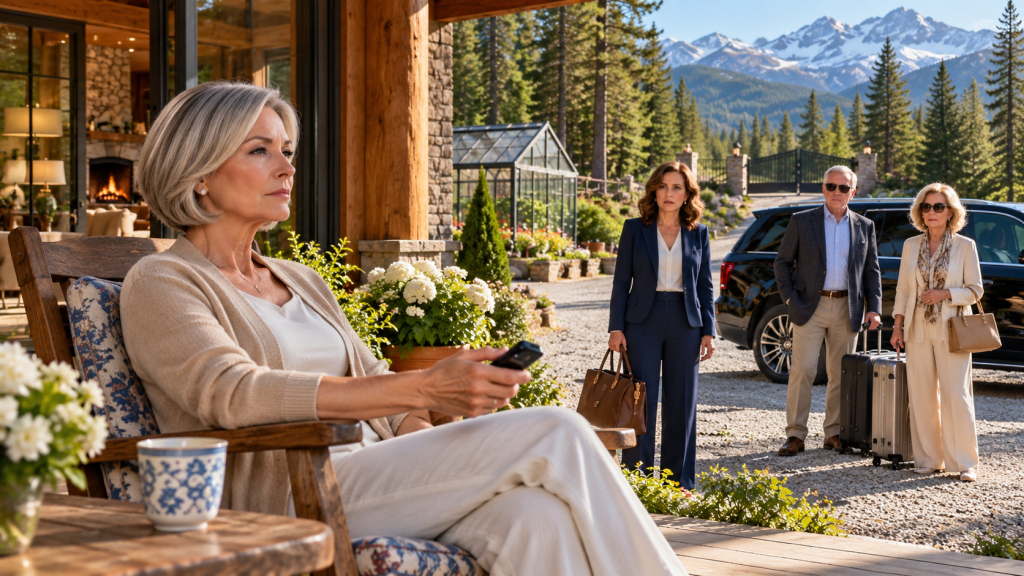
Her father cleared his throat. “Leah, perhaps everyone should calm down.” I looked at him. “I am seventy-three years old, sitting on my own porch with coffee.” “I am the calmest person here.” Vanessa’s mother shifted beside the SUV. “Vanessa, what is this about?”
“Nothing.”
I watched her.
That one word told me everything.
Not:
I don’t know.
Not:
Thomas was probably being dramatic.
Nothing.
The word people use when they know there is something and want everyone else to stop looking at it.
My phone rang.
Jared.
This time, I answered.
“Hello.”
“Mom.”
His breathing sounded fast.
“Where is Vanessa?”
I looked directly at her.
“Standing ten feet from me.”
“Her parents?”
“Also here.”
He swore softly.
Vanessa stepped forward.
“Give me the phone.”
I turned my shoulder.
“No.”
Jared said,
“Mom, please listen to me.”
“I’m listening.”
“Dad left me another envelope inside the penthouse safe.”
My pulse quickened.
“When did you find it?”
“This morning.”
“Why this morning?”
A pause.
“Because Vanessa finally gave me the safe code.”
I looked at her.
Her face changed.
There it was again.
Fear.
I asked,
“Why did she have the code?”
Jared did not answer immediately.
Then:
“Because she changed it.”
I closed my eyes.
Of course.
Vanessa snapped,
“That is not what happened.”
I held up one finger.
“You can have your turn.”
Then I said into the phone,
“Continue.”
Jared swallowed.
“Dad’s letter said if I ever started complaining that the penthouse was too expensive, I should open the blue folder hidden behind the false back panel.”
I looked toward Thomas’s notebook beside my chair.
“What was in it?”
Jared’s voice changed.
“Records.”
“What kind?”
“Mortgage documents.”
Vanessa shouted,
“There is no mortgage!”
Jared went silent.
I stared at her.
Then slowly raised the phone again.
“No mortgage?”
She folded her arms.
“That penthouse was transferred free and clear.”
Jared said through the speaker,
“No, Vanessa.”
Her head snapped toward the phone.
“There is.”
Her father looked between them.
“What exactly did Thomas leave you?”
Jared continued.
“The title is mine.”
“Yes.”
“But there’s a private note secured against the property.”
My stomach tightened.
“How much?”
Jared’s voice dropped.
“Eight hundred and forty thousand dollars.”
Nobody moved.
Even the mountains seemed to go quiet.
Vanessa’s mother whispered,
“What?”
Jared continued.
“The payment schedule starts in six months.”
Vanessa said quickly,
“That’s impossible.”
Jared’s voice hardened.
“You knew.”
She laughed.
“No, I didn’t.”
“You knew the numbers.”
“Of course I knew the numbers. I looked at the HOA.”
“No.”
He sounded different now.
Not weak.
Not apologetic.
For the first time in years, my son sounded like a man speaking instead of a husband asking permission to breathe.
“You knew about the note.”
Vanessa’s father looked at her.
“Did you?”
She said nothing.
Jared continued.
“And Dad knew you knew.”
My hand tightened around the phone.
“What did Thomas write?”
There was a long silence.
Then Jared read:
Son, a luxury property is not automatically wealth. Sometimes it is simply an expensive obligation wrapped in marble.
I closed my eyes.
Thomas.
Even dead, he could lecture in complete paragraphs.
Jared continued.
If you are reading this because you and Vanessa cannot afford the penthouse, then the lesson has arrived exactly when I expected it to.
Vanessa’s face went red.
Her mother whispered,
“Oh my God.”
Jared kept reading.
The property has substantial equity, but it also carries an $840,000 private note created during the acquisition. I arranged it deliberately. You can keep the penthouse if you are willing to pay for the life attached to it. Or you can sell it and keep what remains after the debt and costs are satisfied.
I sat very still.
That sounded like Thomas.
Not punishment.
A choice.
A costly one.
But still a choice.
Then Jared said:
“That isn’t the bad part.”
Vanessa closed her eyes.
I stared at her.
“Then what is?”
Jared inhaled.
“The note is payable to the Bennett Family Holding Trust.”
I frowned.
“What trust?”
“Dad created it.”
“For who?”
He hesitated.
“For you.”
Vanessa’s father swore.
I stood.
“What?”
Jared continued quickly.
“The trust owns the note.”
“It receives the payments.”
“If I sell the penthouse, the trust gets paid first.”
“And you’re the lifetime beneficiary.”
For a moment, I could not process the words.
I looked at the cabin.
The restored timber.
The porch.
The greenhouse.
The mountains.
Then back toward Vanessa.
Thomas had not just given me a home.
He had quietly attached part of my financial future to the luxury property everyone had celebrated more loudly.
Vanessa whispered,
“That old bastard.”
I stared at her.
Her father turned sharply.
“Vanessa.”
“No.”
She pointed toward me.
“He planned this.”
“Yes.”
I said it calmly.
“He appears to have.”
She looked almost wild now.
“He knew.”
“What did he know?”
She stopped.
Too late.
Jared’s voice came through the phone.
“Mom, go to the storage unit.”
Vanessa looked at me.
“No.”
I almost smiled.
Now I understood the fear.
The Miami file was not about the mortgage.
Not only.
There was something else.
Jared said,
“Dad’s letter says the complete trust documents and financial records are in that unit.”
Vanessa stepped forward.
“You are not going anywhere.”
I stared at her.
“This is my driveway.”
Her father grabbed her arm.
“Enough.”
She yanked away.
“You don’t understand!”
Her mother asked,
“Then explain.”
Vanessa’s breathing became shallow.
“I was trying to protect Jared.”
I laughed.
There it was.
That sentence again.
Protect.
The word people use when they have been making decisions for adults who never asked them to.
I said,
“From what?”
She looked at me.
“From being trapped.”
“By a luxury penthouse?”
“By his father.”
I stared.
“Thomas is dead.”
“He controlled everything before he died.”
I felt anger rise.
Not because Thomas was perfect.
He wasn’t.
He could be stubborn.
Secretive.
Proud.
He liked solving problems without asking whether anyone wanted his solution.
That included me sometimes.
But I also knew Thomas.
If Vanessa had reason to fear a file he left behind, I wanted the file.
I said:
“Get in your car.”
She stared at me.
“What?”
“You’re leaving.”
“We came all this way.”
“That was your decision.”
Her father looked embarrassed.
“Leah, may we at least use the restroom?”
I nodded toward the detached workshop.
“There is one in the side building.”
“Thank you.”
Vanessa glared at him.
He ignored her.
Good.
Twenty minutes later, the SUV left my driveway.
The gate opened.
Then closed behind them.
I stood watching until the vehicle disappeared around the bend.
Only then did my knees start shaking.
I sat.
Thomas’s notebook rested beside me.
I opened it again.
Near the back, one sentence had been underlined twice.
People reveal what they think belongs to them when they believe you have stopped paying attention.
I whispered,
“You were exhausting.”
Then I started crying.
Because I could hear him laughing.
That afternoon, Jared drove back to the cabin.
Alone.
He looked worse than he had two weeks earlier.
Wrinkled shirt.
No tie.
Dark circles beneath his eyes.
He knocked.
I opened the door.
“Where’s Vanessa?”
“At her parents’ hotel.”
“Good.”
He stepped inside.
His eyes moved over the cabin again.
The first visit had shocked him because it was beautiful.
This time, he looked at it differently.
Maybe because now he understood the penthouse was not simply better.
Just louder.
He sat at the kitchen island.
I poured coffee.
He wrapped both hands around the mug.
Then said:
“I’m sorry.”
“For what?”
He looked at me.
“For all of it.”
“That is too large an apology.”
He swallowed.
“I’m sorry I stayed silent when Vanessa told you to pack.”
Good.
Specific.
“I’m sorry I let her treat your help like it was something we were entitled to.”
Better.
“I’m sorry that when Dad died, I looked at the penthouse and thought I had won.”
I sat across from him.
“Won against who?”
His eyes dropped.
“You.”
There it was.
Painful.
Honest.
I waited.
He continued.
“When Dad said he had divided things differently, I thought…”
He struggled.
“I thought the penthouse meant he trusted me more.”
“That he thought I was successful.”
“That he saw me as the one who had built something.”
“And the cabin…”
I smiled sadly.
“Looked like the leftover.”
He nodded.
“I’m ashamed.”
“Good.”
He looked startled.
I continued.
“Shame is useful if you don’t build a house inside it.”
He almost smiled.
“That sounds like Dad.”
“It probably came from him.”
Then I asked:
“What did Vanessa know?”
Jared became still.
“I don’t know everything yet.”
“Tell me what you do know.”
He exhaled.
“About six months before Dad died, Vanessa asked him whether he planned to leave the Miami property to me.”
I frowned.
“How did she even know he owned it?”
“Dad mentioned it.”
“To her?”
“Not directly.”
“She overheard something when we were visiting.”
I remembered.
Thomas had purchased the unit several years earlier through a holding company.
He called it “an investment in a building full of people who enjoy paying too much for elevators.”
I had never cared enough to ask more.
Jared continued.
“Vanessa became obsessed with it.”
“That word is doing a lot of work.”
“I know.”
“She looked up the building.”
“The sale prices.”
“The amenities.”
“The association.”
“She told me that if Dad left it to us, we could finally live the life we were supposed to.”
I stared.
“What life were you living?”
Jared gave a broken laugh.
“Apparently not enough of one.”
He continued.
“She contacted Dad.”
“Without telling me.”
I sat straighter.
“About what?”
“The estate.”
My stomach tightened.
“She asked whether the penthouse had debt.”
“And?”
“Dad told her that anything left to me would be mine to manage.”
“That answer made her suspicious.”
“As it should have.”
Jared nodded.
“Then she started digging.”
“How?”
“Public records.”
“Emails.”
“Questions.”
“She found a reference to the holding trust.”
“Not the full documents.”
“Enough to know some obligation existed.”
I stared toward the window.
“So she knew the penthouse wasn’t free and clear.”
“Yes.”
“And still demanded I sell this place to fund it.”
He looked down.
“Yes.”
“Why?”
His eyes filled.
“Because she thought if you sold the cabin, you’d give us enough to clear the private note.”
There it was.
Simple.
Ugly.
Not a complicated conspiracy.
Entitlement.
Vanessa had seen my inheritance and immediately calculated how it could be converted into hers.
I whispered,
“She threw me out the same day.”
Jared’s face crumpled.
“I know.”
“You said nothing.”
“I know.”
“Why?”
He covered his face.
“Because I was a coward.”
I waited.
He lowered his hands.
“And because part of me agreed.”
That hurt more.
But I appreciated the truth.
“Go on.”
“I thought you’d move to something smaller.”
“I thought you didn’t need a big place.”
“I thought the cabin was probably barely livable.”
“And I thought…”
His voice cracked.
“What?”
“That helping us made more sense than keeping something you didn’t need.”
I looked around.
The stone fireplace.
The windows.
The floor Thomas had sanded himself.
“Interesting how quickly people decide what an older woman needs.”
Jared cried.
I did not comfort him.
Not yet.
Then he said:
“Dad knew exactly what I was becoming.”
I frowned.
“What do you mean?”
He pulled out the second letter.
The paper was creased from being opened too many times.
He slid it toward me.
Thomas had written:
Jared, if you resent your mother for receiving the cabin, you have missed the point.
My throat tightened.
I kept reading.
Your mother spent decades choosing durability over display. She repaired before replacing. Saved before borrowing. Worked before complaining. The cabin rewards that life because it asks very little and gives much.
Then:
You and Vanessa prefer things that announce themselves. That is not automatically wrong. But announced things usually send invoices.
Despite myself, I laughed.
Jared smiled faintly.
I continued.
I am leaving you the penthouse because I want you to decide whether you own the image or the image owns you.
Then:
Do not ask your mother to sell peace so you can continue financing appearance.
I stopped.
My eyes blurred.
Thomas had known.
Not every detail.
But enough.
Then I saw the final paragraph.
If Vanessa pressures Leah for money, open the blue file before agreeing to anything.
I looked at Jared.
“He named her.”
“Yes.”
“Why?”
“That’s what’s in the storage unit.”
We went the next morning.
Not alone.
My attorney came.
So did the trustee Thomas had appointed years earlier.
Her name was Marisol Vega.
Apparently, Thomas had met with her for almost six years.
Six years.
My husband had built an entire parallel administrative world while I thought he was replacing cabin gutters.
I was furious.
And impressed.
Mostly furious.
The storage facility was in a small town nearly an hour away.
The unit was climate-controlled.
Inside were labeled boxes.
Tax records.
Property files.
Photographs.
Receipts.
And one steel cabinet.
Marisol unlocked it.
Inside was a blue accordion folder.
MIAMI
Jared stared.
I opened it.
The first documents were ordinary.
Purchase agreement.
Association disclosures.
Private note.
Insurance.
Appraisal.
Then came printouts of emails.
Vanessa’s emails.
To Thomas.
Dozens.
At first polite.
Hi Dad, Jared mentioned the Miami property. Just curious how you see it fitting into the family plan.
Then more direct.
It would make more sense for Jared to receive the Miami asset than Leah, since she has no interest in city property.
Then:
Leah has always preferred simple living, so a cabin or smaller property would probably suit her better.
I stopped.
My hands tightened.
She had been lobbying for my inheritance while Thomas was dying.
Jared whispered,
“I didn’t know.”
I believed him.
I kept reading.
Months later:
If the property has financing, perhaps Leah could cover the note from the joint savings you’ve built over the years. It would all stay in the family.
Marisol watched me carefully.
I asked:
“Did Thomas respond?”
“Yes.”
She handed me another page.
His email:
Vanessa, Leah’s assets are not a family reserve. Do not bring this up again.
I laughed softly.
There he was.
Then another email from Vanessa:
I think you’re misunderstanding me. I’m thinking about Jared’s future.
Thomas:
So am I. That is why I am not teaching him that his mother’s money exists to protect him from adult expenses.
I closed my eyes.
“God, I miss that man.”
Jared stared at the email.
His face collapsed.
“He knew.”
“Yes.”
“He knew exactly what she thought.”
“Yes.”
Then Marisol said:
“There is more.”
Of course.
There is always more.
She opened a second envelope.
Inside was a copy of a proposed family investment agreement.
Drafted by an attorney I did not recognize.
Vanessa’s name appeared in the metadata.
The proposal assumed that after Thomas’s death:
Jared would own the penthouse.
I would sell the cabin.
A portion of my proceeds would be “loaned” to Jared and Vanessa to retire the Miami debt.
The loan would carry no fixed repayment date.
Then I would move into a condominium near them.
The guest room in their house would become available for “personal use.”
I read it twice.
Then asked:
“When was this drafted?”
Marisol answered.
“Three months before Thomas died.”
Jared stood so abruptly his chair scraped backward.
“No.”
He stared at the document.
“No.”
He looked at me.
“I swear to you, I have never seen that.”
I believed him.
Again.
That did not make me feel better.
It made everything worse.
I asked Marisol:
“Did Thomas know?”
“Yes.”
“How?”
“He discovered the draft after Vanessa emailed a version to an adviser he also used.”
“Did he confront her?”
“Yes.”
“What happened?”
Marisol handed me a handwritten note from Thomas.
His handwriting had become shakier by then.
Vanessa says she was only planning possibilities. Jared appears unaware. I believe her first instinct is to secure lifestyle, not family. Do not punish Jared for what he does not know. Give him enough rope to choose.
I cried.
Because that was Thomas too.
He could have cut Jared out.
Could have changed everything.
Instead he created a test.
Not to humiliate him.
To reveal him to himself.
Marisol continued.
“The note against the penthouse was deliberate.”
I looked at her.
“Thomas could have paid it off?”
“Yes.”
“How easily?”
She paused.
“Easily.”
Jared closed his eyes.
“He left the debt on purpose.”
“Yes.”
“Why?”
She looked at him.
“Because he wanted the property to be valuable without being effortless.”
Then she looked at me.
“And because he wanted Leah protected if pressure came.”
The Bennett Family Holding Trust would receive the note payments.
If Jared sold the penthouse, the note would be paid from sale proceeds first.
If he defaulted, the trust had remedies.
But Thomas had inserted something unusual.
A cure provision.
If Jared sold within one year and paid the note in full, the trust would forgive a portion of accrued interest.
The penthouse was not a trap.
It was a decision point.
Keep the luxury life and pay for it.
Or sell, walk away with substantial equity, and live within reality.
I whispered,
“He really did know what would happen.”
Marisol smiled sadly.
“He hoped he was wrong.”
That hurt more.
People talk about being proven right as if it feels good.
Sometimes being right about someone you love is miserable.
Jared sat in silence.
Then asked:
“What else is in the file?”
Marisol looked at me first.
I nodded.
She opened the final envelope.
Inside was a letter addressed to me.
Leah,
My vision blurred before I read another word.
If you are seeing this, then Jared has probably come asking you to save the penthouse.
I laughed through tears.
“Impossible man.”
I continued.
Please do not.
Then:
Not because he deserves pain.
Because he deserves adulthood.
I stopped.
Jared looked away.
I continued.
We helped him for years because we could. There is no shame in helping your children. The danger comes when help quietly becomes the architecture of their lives.
Tears slid down my cheeks.
I worry that after I am gone, you will continue paying simply because refusal will feel like abandonment.
He knew me.
God, he knew me.
Leah, saying no is not abandoning Jared.
It may be the first time you stop abandoning yourself.
I could not keep reading.
I sat down.
My attorney put a hand on my shoulder.
Jared was crying openly now.
I handed him the letter.
“Finish it.”
He read aloud.
The cabin is yours because it costs almost nothing to keep and because I rebuilt every part I could before my hands stopped cooperating.
His voice broke.
The property has no debt.
The solar system is paid.
The well is sound.
The greenhouse leaks slightly in the northeast corner because I got tired and lied to myself that I would fix it next spring.
I laughed.
Thomas had absolutely done that.
Jared continued.
You should not have to spend widowhood asking permission to live.
That sentence destroyed me.
He kept reading.
If Jared chooses wisely, love him.
If Jared chooses poorly, love him without financing the choice.
Then:
And if Vanessa gets angry, remember that anger is sometimes just entitlement hearing the word no.
Even my attorney laughed.
The final line:
Go plant tomatoes.
I cried so hard I could not breathe.
That afternoon, Jared called Vanessa.
Not from my cabin.
From his lawyer’s office.
He told her he was selling the penthouse.
She refused.
Not legally.
Emotionally.
According to Jared, she screamed for almost an hour.
She accused him of wasting Thomas’s gift.
Of humiliating her.
Of ruining their future.
Jared said:
“The penthouse is our future only if we can afford it.”
She replied:
“Your mother can.”
That ended something.
Not the marriage that day.
But the illusion.
Jared later told me he had spent years believing Vanessa was simply more ambitious than he was.
More stylish.
More decisive.
Better at imagining a larger life.
Now he understood that every larger life she imagined had someone else quietly paying underneath it.
The penthouse went on the market.
Vanessa fought the listing at first.
Then discovered the title was Jared’s separate inherited property.
She had no ownership interest merely because she liked the view.
The sale took five months.
The market had softened.
They did not get the fantasy price Vanessa expected.
After the private note, costs, taxes, and fees, Jared still walked away with a significant amount.
More than enough to stabilize his life.
Not enough to pretend expenses did not matter.
That seemed appropriate.
He bought a comfortable townhouse.
Not on the ocean.
No doorman.
No rooftop pool.
Vanessa refused to move in.
Instead, she went to stay with her parents.
Three months later, she filed for divorce.
A year earlier, that news would have broken Jared.
Instead, he called me and said:
“I think she loved what we looked like more than what we were.”
I asked:
“Did you love her?”
“Yes.”
“Then do not rewrite the whole marriage because it ended.”
He went quiet.
I continued.
“She can have loved you and still treated money terribly.”
“She can have had good parts and still become unsafe around entitlement.”
“People do not have to become monsters for you to leave.”
He cried.
“Dad would have said that.”
“No.”
I smiled.
“Your father would have called her a peacock with a mortgage.”
Jared laughed for the first time in weeks.
The divorce was not simple.
Vanessa tried to argue that marital funds had been spent maintaining the penthouse.
That was true.
Her lawyer raised reimbursement claims.
Jared’s lawyer responded.
They negotiated.
No one left with everything.
No one left with nothing.
Real divorce rarely matches the revenge fantasies people post online.
Vanessa received her share of marital property.
Jared kept what the agreements and law entitled him to.
The penthouse sale was accounted for properly.
The trust received its payment.
My trust.
I hated calling it that.
It sounded like I had suddenly become a railroad heiress.
In reality, it produced enough income to cover my property taxes, insurance, healthcare supplement, and some travel.
That was what Thomas intended.
Not luxury.
Independence.
I did not give Jared the money back.
That surprised him.
It surprised me too.
For years, my first instinct had been:
He needs it more.
Thomas’s letter stayed in my kitchen drawer.
Every time guilt rose, I reread:
Love him without financing the choice.
So I did.
When Jared’s divorce became expensive, I listened.
I did not pay the legal fees.
When his townhouse needed a new air-conditioning unit, he complained.
I sympathized.
Then he financed it.
When his car broke down, he bought a used replacement.
No call asking me to transfer money.
No emergency.
Just adulthood.
The first time he visited the cabin after the divorce was final, he brought groceries.
Not flowers.
Groceries.
He set them on the counter.
“I bought salmon.”
I looked at the price tag.
“You were robbed.”
He laughed.
“Hello to you too.”
We cooked together.
Badly.
Thomas had always handled fish.
At dinner, Jared looked around the room.
“I understand why he left you this.”
I smiled.
“Because I’m rustic?”
He winced.
“Please never let me forget I married a woman who called your inheritance ‘perfect for you’ as an insult.”
“I plan to mention it at holidays.”
“Fair.”
Then he looked toward the fireplace.
“I thought this place meant less.”
I nodded.
“I know.”
“I think that says more about me than the cabin.”
“Yes.”
He smiled sadly.
“You could pretend otherwise.”
“I’m your mother, not your publicist.”
He laughed.
Then became serious.
“I was ashamed of being ordinary.”
The sentence surprised me.
“Why?”
He looked down.
“I don’t know.”
“Dad built everything slowly.”
“You built everything slowly.”
“I thought if I had the right address, the right car, the right vacations, I had proven I did better.”
“Better than who?”
He thought.
“Maybe better than where we started.”
I looked around the cabin.
“Where we started was not a failure.”
“I know that now.”
I reached across the table.
“Ambition is not the problem.”
“Pretending cost does not exist is.”
He nodded.
Then said:
“I miss Vanessa.”
I squeezed his hand.
“I know.”
He looked ashamed.
“After everything?”
“Missing someone is not a legal endorsement.”
He laughed through tears.
Good.
That became our new relationship.
Not me solving.
Me sitting beside him while he solved.
It took practice.
For both of us.
Vanessa contacted me once after the divorce.
I almost ignored the call.
Then answered.
“Hello.”
Her voice sounded smaller.
“Leah.”
“Yes?”
“I need to ask you something.”
“No money.”
Silence.
Then:
“That isn’t why I’m calling.”
“Good.”
Another pause.
“I want to know what Thomas thought of me.”
I sat down.
That was not the question I expected.
“Why?”
“Because Jared said there were letters.”
“There were.”
“Did he hate me?”
I thought carefully.
“No.”
She sounded surprised.
“What?”
“He did not trust your relationship with money.”
“That’s not the same as hating you.”
She began to cry.
“He thought I was a gold digger.”
“I never saw him use those words.”
“He built a trap around me.”
“No.”
I corrected.
“He built a boundary around Jared.”
She was silent.
I continued.
“The penthouse had value.”
“Jared had choices.”
“You wanted my inheritance used to remove those choices.”
“That was the problem.”
Her voice sharpened.
“I was trying to protect our life.”
“No.”
“You were trying to preserve a lifestyle.”
Silence.
Then she whispered:
“What’s the difference?”
“That may be the question you need to answer next.”
She cried quietly.
I did not comfort her.
Not because I hated her.
Because some grief belongs to the person learning from it.
Then she said:
“I was horrible to you.”
“Yes.”
“I’m sorry.”
I waited.
She continued.
“I threw you out because I thought once you owned the cabin, you no longer had a reason to stay.”
I looked around the kitchen.
“That was true.”
“What?”
“I no longer had a reason to stay.”
She inhaled.
“But that doesn’t mean you had the right to throw me out.”
“I know.”
I appreciated that.
Then she said:
“I thought the guest room should be useful.”
I almost laughed.
“More useful than housing the woman cooking your meals?”
She groaned.
“I deserved that.”
“Yes.”
Another silence.
Then:
“Do you forgive me?”
I thought.
“Somewhat.”
She gave a weak laugh.
“What does that mean?”
“It means I no longer spend emotional energy being angry with you.”
“It does not mean I want you sleeping in my cabin.”
She laughed.
Actually laughed.
Then cried again.
“Fair.”
That was the last personal conversation Vanessa and I had for several years.
Jared eventually dated again.
Slowly.
Painfully slowly.
His new partner, Claire, was a school administrator.
The first time she visited the cabin, she arrived with a pie.
I stared at it.
She looked nervous.
“Jared said you like peach.”
“I do.”
Then I asked:
“Do you know anything about Miami real estate?”
Her eyes widened.
Jared groaned.
“Mom.”
Claire laughed.
“I own a condo with a reasonable fee.”
I nodded.
“Promising.”
Jared buried his face in his hands.
Excellent.
Claire never tried to impress me.
That impressed me.
She asked about Thomas.
About the greenhouse.
About the solar system.
Not what the cabin was worth.
Not whether the land could be developed.
Not whether I planned to leave it to Jared.
One afternoon she helped me replant herbs.
She got dirt under her nails and did not photograph it.
I liked her immediately.
That worried me.
I have been wrong before.
But over time, she remained exactly as boringly decent as she seemed.
Wonderful trait.
Jared married her four years later.
Small ceremony.
No oceanfront ballroom.
No champagne wall.
No violinist hanging from the ceiling.
Vanessa would have hated it.
I mean that without cruelty.
Different people want different lives.
Claire and Jared got married in the meadow behind the cabin.
Thomas’s cabin.
My cabin.
Our family’s memory.
They paid for everything themselves.
At the reception, Jared stood to give a toast.
He looked at me.
Then toward the mountains.
“My father left me a penthouse and my mother a cabin.”
Everyone laughed softly.
He continued.
“I thought that meant he valued me more.”
My throat tightened.
“I was wrong.”
He smiled.
“He gave me the thing I thought I wanted and gave Mom the thing she actually needed.”
Then:
“The difference nearly cost me my marriage.”
A few people shifted.
He continued.
“But it also taught me something Dad apparently spent his final years trying to teach without having to say directly.”
He looked at Claire.
“Some gifts ask whether you can afford them.”
“Other gifts make your life more affordable.”
Then he raised his glass toward me.
“Mom got the better inheritance.”
I started crying.
Claire took my hand.
I whispered:
“He better not ask for it.”
She laughed.
Years went by.
The cabin remained.
The northeast corner of the greenhouse still leaked.
Eventually I fixed it.
Mostly to spite Thomas.
I paid a carpenter.
Then stood inside during the next rainstorm and said aloud:
“There.”
No answer.
Typical.
I kept Thomas’s notebook on the bedside table.
I added pages of my own.
Not financial instructions.
Stories.
The morning I first saw the restored cabin.
The day Jared returned with the second letter.
The penthouse sale.
The first tomato harvest.
The wedding.
I wanted whoever opened it after me to understand that property without story becomes only price.
And price is the least interesting thing about a home.
At seventy-eight, I added one entry:
Jared offered to pay for the new roof. I let him pay half.
That mattered.
Not because I needed his money.
Because helping me had become something he offered, not something I demanded.
And accepting help had become something I could do without surrendering control.
Thomas would have appreciated that.
At eighty, I finally visited Miami again.
Not the penthouse.
That belonged to someone else now.
Jared came with me.
We stood across the street from the building.
He looked up.
“Do you miss it?”
He shrugged.
“The view.”
“Not the bill?”
“No.”
I smiled.
Then he said:
“I used to think this building proved I mattered.”
“And now?”
“I think it proved I had a building.”
I laughed.
Progress.
We had lunch near the water.
Then drove away.
No bitterness.
That surprised me.
Places do not betray us.
People assign meaning to them.
The penthouse had never been evil.
It had simply exposed arithmetic everyone wanted to ignore.
The final surprise came years later.
After Thomas’s trust had fully stabilized.
Marisol called.
“There is one remaining letter.”
I groaned.
“Did that man spend his entire illness writing?”
“Apparently.”
She mailed it to me.
The envelope read:
OPEN ONLY AFTER YOU NO LONGER HATE THE PENTHOUSE.
I laughed for five straight minutes.
Then opened it.
Thomas wrote:
Leah, if you are reading this, either enough time has passed or you have become impatient. Both are believable.
Correct.
I owe you an apology.
That got my attention.
I should have told you more.
My smile vanished.
I convinced myself that surprising you with security was romantic. It was also controlling.
I stared.
There it was.
The flaw underneath his plan.
The thing I had felt but not named.
Thomas continued.
You deserved to know what I was doing with our assets while I was alive.
I made choices I believed would protect you, but protection is not the same as partnership.
My eyes filled.
Even Thomas had learned it too late.
If you are angry, be angry.
Do not turn me into a saint just because I died first.
I laughed through tears.
Impossible man.
I loved you.
I also hid too much because I wanted the pleasure of solving problems without the discomfort of disagreement.
That sentence hit deeply.
Because yes.
Thomas had rebuilt the cabin for me.
Prepared the trust.
Designed the note.
Watched Vanessa.
Protected me.
But he had also denied me the opportunity to argue.
And I would have argued.
Loudly.
Maybe changed things.
Maybe not.
But it should have been ours to decide.
I kept reading.
If I could do it again, I would still leave you the cabin.
I would simply tell you why before I died.
Tears dropped onto the page.
Love should provide shelter.
It should not hide the blueprint.
I stopped.
That became my favorite line he ever wrote.
Not because it excused him.
Because it admitted exactly what he had done.
The final paragraph said:
If Jared learned what I hoped he would learn, then love him without reminding him forever.
I frowned.
“Now you’re asking too much.”
Then:
And if Vanessa learned anything, give her the dignity of letting the lesson belong to her.
I sat for a long time.
That was harder.
Because part of me still enjoyed the story where Vanessa was simply the villain.
Designer sunglasses.
Demanding money.
Throwing out an old widow.
Trying to inspect my cabin.
Easy.
Clean.
But life became less clean with time.
Vanessa eventually built a career of her own.
No rich second husband.
No dramatic downfall.
She started a staging business.
Then a small interior-design firm.
Years later, I heard through Jared that she had bought a modest condo.
Cash down payment she earned herself.
I smiled.
Not because we became friends.
We didn’t.
Because consequences are most useful when they create a different person, not merely a punished one.
Jared and Vanessa eventually became civil.
No children had complicated their divorce.
That helped.
They exchanged occasional messages about old mutual friends.
Nothing more.
One Christmas, a package arrived for me.
Inside was a set of gardening gloves.
No designer label.
No expensive presentation.
A card:
Leah, I saw these and remembered the greenhouse. I hope it no longer leaks. — Vanessa
I laughed.
Then wrote back:
It does not.
That was enough.
By then, I understood the inheritance differently.
Thomas had not left Jared a penthouse and me a cabin.
Not really.
He left Jared a lesson about cost.
He left me a lesson about worth.
And unintentionally, he left both of us a lesson about secrecy.
A beautiful plan can still be flawed if the person it protects is never invited into the room.
A luxury property can still be a burden if the numbers beneath it are ignored.
A humble cabin can still be wealth if it gives a person freedom instead of status.
I still live here.
The porch boards creak slightly now.
The leather sofa is softer.
The solar batteries have been replaced once.
The greenhouse grows more basil than any sane widow could use.
Jared visits often.
He always asks first.
Claire brings books.
Not pie anymore.
Apparently she realized I cannot eat an entire pie every visit.
They use the guest room.
I kept one.
Not because anyone demanded it.
Because I wanted one.
There is a difference.
Sometimes, on cold evenings, I sit by the stone fireplace and open Thomas’s notebook.
I still get angry with him.
Then I miss him.
Then I laugh.
Marriage does not become uncomplicated because one person dies.
Memory just loses the ability to argue back.
So I argue for both of us.
The night Vanessa told me to pack, I believed I had been pushed out of my family.
I had not.
I had been pushed out of a house.
Those are not the same thing.
Family had to be rebuilt.
Slowly.
With boundaries.
With apologies.
With financial independence.
With one adult son learning that silence can become participation.
With one widow learning that generosity without limits eventually teaches people the wrong lesson.
And with one dead husband whose final gift was not nearly as simple as anybody first believed.
The penthouse was glamorous.
The cabin was quiet.
The penthouse came with an $840,000 obligation.
The cabin came with tomatoes.
In the end, Thomas knew me very well.
Maybe too well.
When people ask which inheritance was worth more, I tell them the truth.
On paper?
The penthouse.
In life?
Not even close.
Because this cabin never asked me to sell my peace to keep it.
THE END STORIES! THANK YOU FOR READING GOOD LUCK! ❤️
Related Posts



