For several seconds, I could not move. The officer held the photograph by its edges. My house. My porch. My hydrangeas. My living room window. Taken from the passenger seat of a car parked across the street.
On the back, in neat black handwriting, was one word. Tonight. My mouth went dry. “What does that mean?” The officer looked toward the front window. “I don’t know yet.” “That isn’t good enough.” “I understand.” “No, you don’t.”
My voice cracked. “That is my house.” He softened. “I know.” The radio on his shoulder hissed. A voice spoke too quickly for me to catch every word. The officer listened. Then his expression changed. “What?”
I asked.
He pressed the radio.
“Repeat that.”
The answer came.
Two juveniles had been located near the drainage trail behind the elementary school.
A boy and a girl.
The neighbor’s children.
Alive.
Safe.
But frightened.
I should have felt relieved.
Instead, the next sentence turned my stomach over.
“They say an adult is looking for them.”
I stared at him.
“Who?”
He hesitated.
“Their father.”
That confused me immediately.
I had lived next door to their mother, Melissa, for almost four years.
I had never seen a husband.
Never seen a father dropping them off.
Never heard the children mention one.
The older girl, Ava, was maybe thirteen.
Her little brother, Caleb, looked nine.
They lived quietly.
Melissa worked from home, drove a silver minivan, planted tomatoes every spring, and waved whenever she saw me.
There had never been a man next door.
At least not one I had noticed.
“Melissa told me their father lived in another state.”
The officer looked at me.
“She may have had a reason to say that.”
Something cold moved through me.
Outside, another cruiser pulled up.
Then another.
My quiet street, where the biggest Sunday drama was usually someone forgetting trash day, suddenly looked like a crime scene.
Neighbors began appearing behind curtains.
Phones lifted.
Doors opened halfway.
The officer pointed toward my house.
“Until we know what ‘tonight’ means, I need you to stay inside.”
I almost laughed.
“Inside the house someone photographed for tonight?”
He paused.
“Fair point.”
That was how I ended up sitting in the back of a patrol car parked three houses away while police searched my home.
Not because they expected to find a burglar.
Because they wanted to know whether someone had already been inside.
The silver key from beneath the bush matched my back door.
That was the part I could not stop thinking about.
I had lost it two months earlier.
At least, I thought I had lost it.
I remembered leaving groceries on the porch.
Remembered unlocking the door.
Remembered juggling bags.
Then, sometime after that, the spare key from the little ring in my purse disappeared.
I had assumed it had fallen somewhere.
Now I wondered whether it had been taken.
The officer returned twenty minutes later.
“No one inside.”
I exhaled.
“But your rear window latch has been tampered with.”
My stomach tightened.
“What does that mean?”
“It appears someone tested it.”
“Today?”
“Hard to tell.”
I looked toward the photograph again.
Tonight.
The officer sat in the front passenger seat and turned toward me.
“I need to ask you something.”
“Okay.”
“Did you ever give those children permission to enter your property?”
“No.”
“Your house?”
“No.”
“Have they ever been inside?”
“Ava brought over cookies once. Caleb came with her.”
“When?”
“Christmas.”
“Anything else?”
“No.”
He nodded.
“Did either child ever ask questions about your schedule?”
I opened my mouth to say no.
Then remembered.
Three Sundays ago.
Caleb had been standing near my mailbox.
He smiled and asked,
“Do you always go to church?”
I thought it was small talk.
I had said,
“Most Sundays.”
He asked,
“What time do you get home?”
I laughed and told him usually around noon.
At the time it felt harmless.
Now my skin crawled.
“Yes.”
The officer wrote it down.
“What did he ask?”
I told him.
Then another memory came.
Ava once asked whether my sister still stayed with me on weekends.
I had said no, my sister had moved to Florida.
The officer stopped writing for a moment.
“Anything else?”
I thought harder.
A month ago, Ava complimented my security camera.
I told her it was mostly decorative because the battery kept dying.
I felt sick.
“I told her my camera barely worked.”
The officer wrote that too.
My stomach dropped.
Had those children been collecting details about me for months?
Then I remembered the way Caleb had placed the packet beneath my bush.
Carefully.
Secretly.
And another thought appeared.
“If they wanted to rob me, why leave the list?”
The officer looked up.
“What?”
“They hid evidence under my window.”
He nodded slowly.
“Yes.”
“And the key.”
“Yes.”
“Why would they leave me the key if the goal was to use it?”
He did not answer immediately.
Then said,
“That is something we’re trying to understand.”
An hour later, they let me return home.
Two officers remained outside.
Every door was checked.
Every window locked.
I made coffee and did not drink it.
At 1:14 p.m., there was a knock.
I nearly jumped out of my skin.
One of the officers called through the door.
“It’s us.”
With him was a woman in plain clothes.
Detective Ruiz.
She sat at my kitchen table.
The same table where I had praised Melissa’s children a month earlier.
She placed a small recorder between us.
“The children gave us a statement.”
I gripped my mug.
“Are they okay?”
“Physically, yes.”
“Where is Melissa?”
“At the station.”
“Is she under arrest?”
“No.”
Something in me loosened slightly.
Detective Ruiz continued.
“She told us the children’s father is named Grant Mercer.”
I waited.
“He and Melissa divorced five years ago.”
“Was he abusive?”
Ruiz looked at me carefully.
“Yes.”
That single word rearranged everything.
“Melissa had a protection order for a time.”
“Had?”
“It expired.”
My chest tightened.
“Why didn’t she renew it?”
“We’re still sorting through that.”
She continued.
“Grant disappeared from their lives for almost three years.”
“Then he came back about eight months ago.”
I remembered when the Sunday cleaning started.
Around seven months ago.
My stomach turned.
“He made them do this.”
Ruiz did not answer immediately.
Then:
“That appears to be part of it.”
I sat straighter.
“What does part mean?”
She folded her hands.
“Grant owes a significant amount of money.”
“To whom?”
“People we are still identifying.”
“Gambling?”
“Some.”
“Drugs?”
“Possibly.”
“Other criminal activity?”
“Yes.”
I stared at her.
“What did he make the children do?”
Ruiz took a breath.
“He used the Sunday routine as cover.”
My hands went cold.
“They were instructed to observe which homes were empty.”
“Which doors were left unlocked.”
“Which residents traveled.”
“Where spare keys were hidden.”
“Whether security cameras worked.”
“Whether dogs were inside.”
I pressed my fingers against my mouth.
The children really had been casing houses.
But something in Ruiz’s face told me there was more.
“And the bag?”
“Sometimes litter.”
“Sometimes items taken from yards.”
“Keys.”
“Garage remotes.”
“Small valuables.”
“Mail.”
My stomach twisted.
“Mail?”
“Bank statements.”
“Credit-card offers.”
“Anything Grant believed might be useful.”
I felt nauseated.
“How many houses?”
“Potentially twelve in this neighborhood alone.”
I looked toward the window.
Twelve.
My street had nineteen houses.
“What did Melissa know?”
Ruiz’s expression changed.
“That’s complicated.”
“Tell me.”
“Melissa knew Grant was contacting the children.”
I stared.
“But she says she did not initially know what he was making them do.”
“Initially?”
“She discovered it about two months ago.”
“And didn’t call police?”
“No.”
Anger shot through me.
“Why?”
Ruiz held my gaze.
“Because Grant threatened to take the children.”
I frowned.
“He can’t just take them.”
“No.”
“But fear doesn’t always follow family court procedure.”
That shut me up.
Ruiz continued.
“He threatened Melissa’s mother.”
“Threatened her job.”
“And threatened to tell police that Melissa had participated in the thefts.”
“Had she?”
“We’re investigating.”
My heart sank.
Then Ruiz said,
“But the children told us something important.”
I waited.
“They said their mother begged them to stop.”
“Then why did they keep going?”
“Because Grant told Ava that if they didn’t help him, he would hurt Caleb.”
The room went silent.
My anger disappeared.
Not completely.
But enough to make room for horror.
“Ava is thirteen.”
“Yes.”
“She thought she was protecting her brother?”
“Yes.”
“And Caleb?”
“He thought he was protecting his mother.”
I closed my eyes.
Two children.
Each thinking the other needed saving.
Dragging a garbage bag down our street every Sunday while adults waved and called them responsible.
I had praised them.
Told their mother she should be proud.
Now I understood that strange little smile.
Not pride.
Shame.
Fear.
Maybe a plea I had been too comfortable to recognize.
I whispered,
“Why my house tonight?”
Detective Ruiz looked at me.
“That’s where the story changes.”
My stomach tightened again.
She took a photograph from her folder.
Not the one of my house.
Another.
Ava and Caleb.
Standing behind the abandoned garage.
The black trash bag beside them.
Ava’s face pale.
Caleb crying.
Ruiz said,
“They did not accidentally leave the packet beneath your bush.”
I stared.
“They meant me to find it?”
“Yes.”
My eyes filled.
Ruiz continued.
“Ava said they had been trying to figure out how to ask for help without Grant finding out.”
My throat tightened.
“They chose you.”
“Why?”
Ruiz looked at me.
“Because you sit on your porch Sunday mornings.”
I blinked.
“What?”
“Ava said most adults either ignore them or compliment them and go back inside.”
I felt ashamed.
Ruiz continued.
“But she noticed you watch the street.”
“You wave.”
“You know people’s names.”
“And one time when Caleb fell off his bicycle, you brought him inside and cleaned his knee.”
I remembered.
Last summer.
A scraped palm.
A bleeding knee.
A popsicle afterward.
Nothing.
To me.
Apparently not nothing to him.
Ruiz said,
“Ava told Caleb that if they ever needed an adult who would actually notice something strange, you were probably the safest choice.”
My eyes burned.
“They put the list there for me.”
“Yes.”
“The key?”
“Yes.”
“Why?”
“To prove it.”
I stared.
“Prove what?”
“That Grant had been inside your property.”
My stomach dropped.
“What?”
Ruiz’s voice lowered.
“The key wasn’t taken two months ago by the children.”
I stopped breathing.
“Grant took it.”
“When?”
“We don’t know.”
“How?”
“According to Ava, he entered your home at least once.”
I stood so quickly my chair scraped backward.
“No.”
Ruiz remained calm.
“Ava saw your key in his possession three weeks ago.”
“No.”
“He told her your house would be ‘easy.’”
I walked toward the back door.
Looked at the lock.
Suddenly every room felt touched.
My bedroom.
Kitchen.
Desk.
Closets.
“Was anything stolen?”
“Possibly not yet.”
“Then why enter?”
“To assess.”
I felt sick.
Ruiz continued.
“He may have looked for documents.”
“Medication.”
“Valuables.”
“Your schedule.”
“What was he planning tonight?”
She hesitated.
“Police believe he intended a burglary.”
“Believe?”
“There may have been more.”
My skin turned cold.
“What does that mean?”
Ruiz looked at my face.
“You live alone.”
I stared.
“So?”
“He may have believed you would be at your sister’s.”
“My sister lives in Florida.”
“We know that.”
“He apparently did not.”
Then I remembered something.
Two weeks earlier, I had told Ava I was considering visiting my sister.
I never booked the trip.
Maybe she had repeated it to Grant.
Maybe he believed I was gone.
Ruiz continued.
“The word ‘Tonight’ appears on three other property photographs.”
“Three?”
“Yes.”
“One house was burglarized last month.”
“The other two attempts were interrupted.”
I whispered,
“What happened to the people?”
“The first family was away.”
“The second homeowner returned unexpectedly.”
“The third had a dog.”
I swallowed.
“What about me?”
“We don’t know what Grant would have done if he found you home.”
That was the first time I truly became afraid.
Not curious.
Not unsettled.
Afraid.
Ruiz continued.
“But Ava did.”
I looked at her.
“What?”
“She believed he might hurt you.”
My knees weakened.
“Why?”
“Because Grant told her yesterday, ‘If the old woman sees me, I’ll handle it.’”
I sat again.
Old woman.
I was fifty-nine.
Under different circumstances, I might have been offended.
Instead, I started shaking.
Ruiz leaned closer.
“That is why Ava changed the plan.”
“What plan?”
“She and Caleb were supposed to bring the key to Grant this afternoon.”
“Instead, Caleb placed it under your bush.”
“Yes.”
“And the list.”
“Yes.”
“And then?”
“They walked away.”
“To where?”
“To the drainage trail.”
“They planned to hide until police came.”
“How did they know I’d call?”
Ruiz gave me the faintest smile.
“Ava said, ‘She calls the city if somebody leaves a broken refrigerator by the curb. She’ll call somebody.’”
I laughed.
Then cried.
I could not help it.
Ruiz let me.
After a moment, I asked,
“Where is Grant now?”
Her expression changed.
“We don’t know.”
That answer erased the warmth instantly.
“What do you mean?”
“He did not return to the location where the children were supposed to meet him.”
“His vehicle was found abandoned.”
“Where?”
“Two miles from here.”
I looked at my doors again.
“He knows the children betrayed him.”
“We believe so.”
“And he knows where they live.”
“Yes.”
“And where I live.”
“Yes.”
My mouth went dry.
“Is Melissa going home?”
“No.”
“Good.”
I looked at Ruiz.
“Where are they staying?”
“I can’t tell you.”
“Of course.”
I nodded.
“Are they together?”
“Yes.”
That mattered.
“Good.”
Ruiz stood.
“We are recommending you stay elsewhere tonight.”
I looked around my living room.
My mother’s cabinet.
My books.
The blue chair I had reupholstered myself.
My home.
“Where?”
“With family or friends.”
My sister was in Florida.
My closest friend lived forty minutes away.
I could go.
But I hated being chased from my own home.
Then I remembered Ava.
Thirteen years old.
Walking down a street every Sunday because a grown man had taught her fear before algebra was even finished teaching her equations.
I stopped feeling stubborn.
“I’ll leave.”
“Good.”
I packed a bag.
Then the doorbell rang.
Every officer outside moved at once.
A man stood on the porch.
Tall.
Baseball cap.
Work jacket.
Hands visible.
One officer ordered him to stay still.
He did.
Detective Ruiz looked through the window.
Her face hardened.
“Do you know him?”
I stared.
Something about him was familiar.
Then I remembered.
Three months earlier.
A man had knocked on my door claiming to be from the gas company.
He said there had been reports of leaks on the street.
I had let him stand inside my front hall while I looked for my utility bill.
My blood turned to ice.
“That’s him.”
Ruiz looked at me.
“Grant?”
“I don’t know.”
“He came here before.”
She went outside.
Through the window, I watched officers turn the man around.
Hands behind his back.
Handcuffs.
He did not resist.
He looked toward my house once.
Our eyes met through the glass.
I knew immediately.
Grant.
He smiled.
Not kindly.
Not nervously.
Just enough to tell me he remembered me.
I stepped backward.
Ruiz returned ten minutes later.
“You were right.”
“He was the gas-company man?”
“Yes.”
My stomach turned.
“He entered my house.”
“Yes.”
“Why did he come back?”
Ruiz looked almost confused herself.
“He claims he came to retrieve property.”
“What property?”
“His key.”
I stared at her.
“He thinks my back-door key belongs to him?”
“He is not making particularly good decisions right now.”
For the first time all day, I laughed without crying afterward.
Grant was arrested.
Not because the story magically ended there.
It did not.
Police searched his vehicle.
His storage unit.
A rented garage.
What they found expanded the case far beyond our street.
Mail.
Keys.
Jewelry.
Electronics.
Prescription medication.
Social Security statements.
Checkbooks.
Garage-door openers labeled by address.
Photographs of homes.
Lists of schedules.
And dozens of black garbage bags.
The Sunday routine had not been invented for Ava and Caleb.
Grant had used similar methods before.
Sometimes teenagers.
Sometimes girlfriends.
Sometimes people who owed him money.
People who looked harmless.
People no one would question for walking slowly along a sidewalk.
The children had been one piece of a larger burglary operation.
That realization made me sick.
Ava and Caleb had not become criminals because they were bad children.
They had been recruited into fear.
There is a difference.
A huge one.
Melissa was not charged with the burglaries.
But that did not mean she escaped consequences entirely.
Investigators learned she had discovered more than she first admitted.
She had found stolen mail in Ava’s backpack six weeks earlier.
She confronted Grant.
He threatened her.
She stayed silent.
I understood the fear.
I also understood that silence had allowed the danger to continue.
Both things could be true.
Melissa entered a family support program.
She obtained a new protection order.
She worked with child services.
She moved temporarily.
The children started therapy.
For almost four months, the house next door sat dark.
No minivan.
No tomato plants being watered.
No children walking the street.
Sunday mornings became unnaturally quiet.
I hated them.
That surprised me.
For months, I had thought the black bag meant responsibility.
Then I learned it meant danger.
Afterward, its absence felt like grief.
My neighbors reacted in every possible way.
Some became angry.
Some became frightened.
Some blamed Melissa.
Some blamed the children.
One man three houses down said,
“Those kids stole from us. I don’t care who made them.”
I looked at him.
“How old were you the first time an adult threatened someone you loved?”
He did not answer.
I continued.
“They should be accountable for what they understand.”
“But they should not carry an adult man’s guilt because it is more convenient than recognizing what happened.”
He looked away.
We did not become closer after that.
I was fine with it.
The stolen property slowly returned to people.
My spare key was evidence for months.
I changed every lock anyway.
Installed cameras.
Motion lights.
A security system that actually worked.
The first week after Grant’s arrest, every nighttime sound woke me.
A branch against siding.
A car door.
A raccoon knocking over someone’s bin.
Fear is strange after your home becomes part of someone else’s plan.
The house does not change.
But your relationship to it does.
My living room window used to mean afternoon light.
For a while, it meant someone watched me from outside.
My back door used to mean the garden.
Then it meant someone had a key.
It took months for ordinary objects to become ordinary again.
Grant eventually accepted a plea deal covering multiple burglaries, identity-related offenses, possession of stolen property, violations connected to Melissa, and other charges.
I attended one hearing.
I did not plan to.
Then Ava’s therapist told Melissa that Ava was terrified Grant would look at her and know she had helped expose him.
Melissa asked whether I would sit nearby.
Not speak.
Just sit.
So I went.
Ava wore a navy dress.
Her hair was braided.
She looked thirteen.
Painfully thirteen.
Grant looked smaller than he had on my porch.
No baseball cap.
No fake utility badge.
No control over the room.
When he entered, Ava gripped Melissa’s hand.
Then she saw me.
I smiled.
Barely.
Her shoulders lowered.
Grant noticed.
His eyes moved from Ava to me.
For a second, I felt the same coldness I had felt through my living-room window.
Then the bailiff told him to face forward.
And he did.
That was when I understood something.
Fear thrives on private spaces.
Alleys.
Kitchens.
Cars.
Closed doors.
Once dragged into a room where everybody sees it, fear changes shape.
Not disappears.
But shrinks.
A little.
After the hearing, Ava approached me.
She stopped several feet away.
“Hi.”
“Hi.”
She looked at the floor.
“I’m sorry.”
My heart tightened.
“For what?”
“Your key.”
“You returned it.”
“I helped take other things.”
I nodded.
“Yes.”
Her eyes filled.
“I knew it was wrong.”
“Yes.”
“I still did it.”
“Yes.”
She started crying.
Melissa moved toward her.
I lifted one hand gently.
Not stop.
Just wait.
I looked at Ava.
“You did something wrong.”
She nodded.
“That does not mean you are something wrong.”
Her face crumpled.
I continued.
“You understand the difference?”
She wiped her cheek.
“I think so.”
“You may understand it better later.”
She nodded.
Then whispered,
“I picked your house because I thought you’d help.”
I smiled sadly.
“You were right.”
She cried harder.
Then asked,
“Were you mad?”
“Yes.”
Her eyes widened.
I continued.
“I was scared.”
“Confused.”
“And angry.”
“At me?”
“At everybody.”
She looked down.
“But not forever.”
She looked up.
“No.”
I opened my arms.
She hesitated.
Then hugged me.
Thirteen-year-olds try very hard to seem grown until they are held.
Then suddenly they are children again.
She cried into my shoulder.
“I’m sorry.”
“I know.”
“I didn’t want him to hurt Caleb.”
“I know.”
“I thought if I did what he said, he’d stop.”
“I know.”
I pulled back.
“That is how people like him keep people trapped.”
“They keep moving the point where they promise they’ll stop.”
Her lip trembled.
“He always said one more Sunday.”
My heart broke.
One more Sunday.
One more house.
One more key.
One more secret.
There is always one more when fear is doing the negotiating.
Caleb took longer to speak to me.
For months, he hid behind Melissa whenever they visited.
He had been the one who physically placed the packet beneath my bush.
The one who returned my key.
The bravest act in the whole story had been performed by a nine-year-old boy with dirt on his knees.
Yet he believed he had caused everything.
Children do that too.
One afternoon, almost a year later, Melissa brought them over with cookies.
Real cookies this time.
We sat on my porch.
Caleb stared at the bush.
The same bush.
Then asked,
“Did you find it fast?”
“The bag?”
He nodded.
“Yes.”
“How fast?”
“About thirty seconds after you left.”
He smiled a tiny smile.
“I told Ava you would.”
I laughed.
“How?”
“You’re nosy.”
Melissa gasped.
“Caleb!”
I started laughing so hard I nearly spilled my lemonade.
He turned red.
“I didn’t mean bad nosy.”
“I know.”
He looked relieved.
“You notice stuff.”
That was different.
I liked that better.
Then he grew serious.
“Were you scared when you read ‘Tonight’?”
“Yes.”
“I’m sorry.”
“You did not write it.”
“But I knew.”
“You also warned me.”
He nodded.
I leaned closer.
“Caleb, courage doesn’t always look like fighting somebody.”
“Sometimes it looks like putting the right evidence under the right bush.”
He smiled.
“That sounds weird.”
“It is weird.”
We both laughed.
Melissa did not move back into the house next door.
Eventually, she sold it.
She said the children could not sleep there.
Too many memories.
Too many windows.
Too many Sundays.
They moved twenty minutes away to a smaller place near Melissa’s mother.
I helped pack.
So did several neighbors.
Not everyone.
That was okay.
Forgiveness is not a community requirement.
Before leaving, Ava stood in the empty bedroom where she had lived.
She looked around.
“I used to watch for his car from this window.”
Melissa’s face broke.
I asked,
“Do you still?”
Ava thought.
“Sometimes.”
“Even though he can’t come?”
“Yes.”
I nodded.
“That may take time.”
She looked at me.
“Do you still check behind your bush?”
I smiled.
“Sometimes.”
She smiled too.
Maybe healing is partly realizing other people still check windows too.
Years passed.
The street changed.
Families moved.
Children grew.
My hydrangeas nearly died one winter and came back better in spring.
I eventually stopped checking every Sunday morning for black bags.
Then, one Sunday, there was a knock.
I opened the door.
Ava stood there.
Seventeen.
Tall.
Hair shorter now.
She held a black trash bag.
For half a second, my whole body remembered fear.
Then she grinned.
“Relax.”
I laughed.
“What are you doing?”
“Community cleanup.”
I stared.
She lifted the bag.
“Actual trash this time.”
Behind her stood Caleb, now thirteen, wearing gloves and holding one of those long metal grabbers.
He said,
“We’re doing the whole block.”
I looked toward Melissa’s car at the curb.
She waved.
I almost cried.
Ava saw.
“Oh no.”
“What?”
“You’re doing the face.”
“What face?”
“The emotional neighbor face.”
“I do not have an emotional neighbor face.”
Caleb said,
“You definitely do.”
I grabbed a pair of gardening gloves.
“Move over.”
We spent two hours cleaning the street.
Real wrappers.
Cans.
Old flyers.
One single shoe nobody claimed.
At the end, the black bag was heavy.
But for the first time, there were no secrets inside.
Ava tied the top.
Then looked at me.
“You know something?”
“What?”
“For a long time, I hated trash bags.”
I nodded.
“Me too.”
“Now they’re just bags.”
“That’s progress.”
She smiled.
“Therapy says that too.”
“Therapy is stealing my lines.”
She laughed.
When they left, I stood in my yard watching them walk away.
Same street.
Same Sunday.
Same kind of bag.
Completely different meaning.
That is what healing sometimes looks like.
Not erasing the object.
Changing what it means.
When Ava graduated high school, Melissa invited me.
I sat beside her mother.
Caleb complained about the heat.
Ava walked across the stage and accepted her diploma.
The principal announced that she had received a scholarship to study social work.
I cried.
Melissa cried harder.
Afterward, Ava found us.
She hugged her mother.
Then Caleb.
Then me.
“I got something for you.”
She handed me an envelope.
Inside was a photograph.
My house.
Taken from across the street.
For one terrible heartbeat, I froze.
Then I turned it over.
On the back, Ava had written:
SAFE.
My eyes filled instantly.
She watched me.
“I thought maybe we should replace the old one.”
I could not speak.
She continued.
“The police said the other photo is still evidence somewhere.”
I nodded.
“So I took a new one.”
My house looked beautiful.
Morning light on the porch.
Hydrangeas blooming.
Front door open.
No hidden watcher.
No black handwriting saying tonight.
Just:
SAFE.
I hugged her.
“That may be the best gift anyone has ever given me.”
She laughed.
“It cost thirty-eight cents to print.”
“Still.”
Years later, I framed that photograph.
It hangs beside my front door.
People ask about it.
Most assume I like the lighting.
Sometimes I tell the story.
Sometimes I do not.
Not every visitor needs every scar.
But I always read the word on the back in my mind.
Safe.
Not perfectly safe.
There is no such thing.
But safe enough to live.
Safe enough to sleep.
Safe enough to leave a window cracked on a spring afternoon.
Safe enough to stop seeing danger in every child carrying a garbage bag.
Caleb eventually became an electrician.
He jokes that crawling under houses is easier than therapy.
Melissa still apologizes sometimes.
I stop her when it turns into self-punishment.
She made mistakes.
Serious ones.
Fear made her hide too much for too long.
But she also rebuilt.
Took parenting classes.
Went to counseling.
Testified.
Worked two jobs for a while.
Learned to ask for help before silence became dangerous.
That matters.
Grant remained out of our lives.
His sentence was long enough that the children became adults before release became a question.
When it eventually did, both Ava and Caleb had choices.
Actual choices.
Neither wanted contact.
Melissa did not decide for them.
Neither did I.
That was important.
Ava once asked me whether I hated him.
I thought before answering.
“No.”
She looked surprised.
“Why not?”
“Because hate is expensive.”
She smiled slightly.
“That sounds like something on a mug.”
“It probably is.”
Then I continued.
“I think what he did was cruel.”
“I think he was dangerous.”
“I think consequences mattered.”
“But I don’t need to spend the rest of my life feeling him inside my chest.”
She nodded.
“I’m not there yet.”
“You don’t have to be.”
That was the answer she needed.
Not forgive.
Not move on.
Not be bigger.
Just:
You don’t have to be there yet.
I am older now.
Older than Grant thought I was when he called me “the old woman.”
I still live in the same house.
Still drink coffee on the porch when the weather is good.
Still notice too much.
Apparently that is my reputation.
New neighbors occasionally laugh and say,
“You always know what’s happening on this street.”
I smile.
They have no idea.
Every Sunday, around nine, the city feels quieter.
Church bells.
Lawnmowers.
Children on bicycles.
Normal sounds.
Sometimes I think back to those months when I watched Ava and Caleb dragging that enormous black bag from house to house.
I thought responsibility looked like children cleaning up after adults.
Now I understand something deeper.
Children should not have to clean up adult messes.
Not literal ones.
Not emotional ones.
Not criminal ones.
Adults are supposed to make the world safer for children.
Not use children to make themselves safer from consequences.
That was what Grant had done.
He turned Ava’s love for her brother into leverage.
He turned Caleb’s love for his mother into obedience.
He took the best parts of them and tried to use those parts against them.
But he made one mistake.
He underestimated what those same qualities could become when aimed toward freedom.
Ava’s protectiveness became courage.
Caleb’s loyalty became trust.
And two frightened children who had been taught to watch everyone else finally found one adult they believed might watch back.
That still humbles me.
Because I was not heroic.
I did not notice quickly enough.
I complimented them.
I praised the behavior.
I missed the fear in their mother’s face.
The truth is, evil does not always hide because nobody is looking.
Sometimes it hides inside behavior everyone has already decided looks good.
Responsible children.
Helpful neighbors.
Polite fathers.
Quiet mothers.
Clean streets.
That is why I no longer ask only whether something looks admirable.
Sometimes I ask whether it makes sense.
Why are children doing this every Sunday?
Why did their mother look uncomfortable when I praised them?
Why is a child watching over his shoulder while picking up trash?
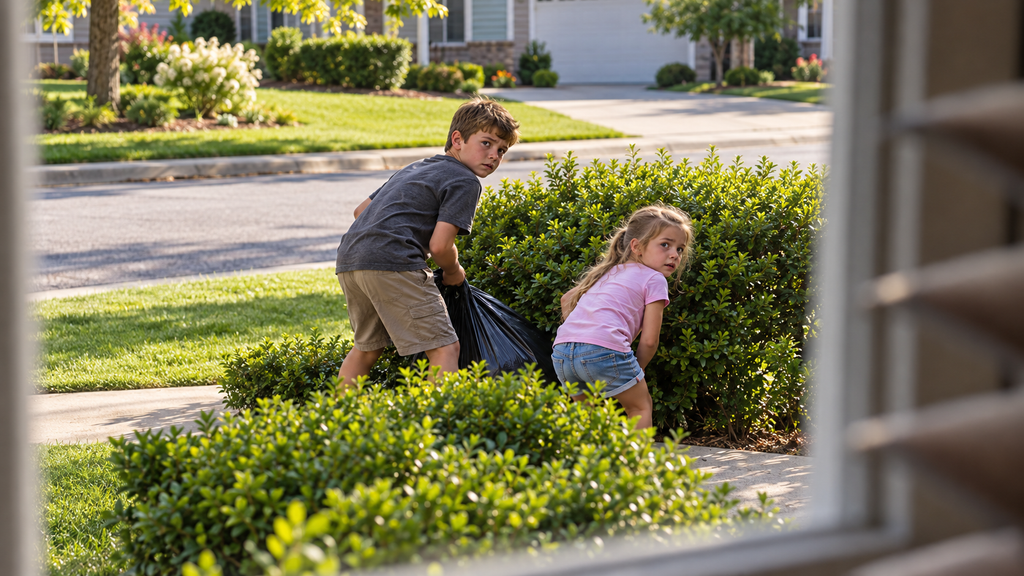
Why is there actual garbage beside the driveway, but he is placing something beneath a bush instead?
Questions are not accusations.
They are doors.
And sometimes asking one in time is enough to let someone escape.
The silver back-door key is gone.
Police returned it years ago.
I did not keep it.
I had already changed the lock.
But I kept the first list.
A copy.
The one with house numbers.
Dates.
Red Xs.
Circles.
And beside mine:
Window unlocked Sunday.
At first, I kept it because I thought I needed proof.
Then I realized I did not.
Everyone believed me.
The case existed.
Grant was convicted.
The children told the truth.
So why keep it?
I asked myself that for years.
Then one afternoon I finally understood.
The list reminds me that information is not power by itself.
What matters is who controls it.
Grant used knowledge to find vulnerability.
Ava used the same knowledge to create warning.
One list.
Two purposes.
That is true of so many things.
A key can open a house.
Or expose a crime.
A photograph can mark a target.
Or say SAFE.
A trash bag can hide stolen property.
Or carry litter from a street that belongs to everyone.
A child can be used by fear.
Or become the person who ends it.
Years ago, when I told Melissa she had raised thoughtful children, I was wrong about almost everything I thought I understood that morning.
But I was not wrong about that.
They were thoughtful.
Brave too.
They had simply been carrying more than any child should.
And on the Sunday Caleb crouched beneath my living-room window and slid that packet under the leaves, he finally put some of that weight down.
I picked it up.
The police picked it up after me.
Then the courts.
Then therapists.
Then their mother.
Then time.
That is how rescue often works.
Not one heroic person lifting everything.
A frightened person sets down one piece where someone else might notice.
Then someone notices.
Then someone calls.
Then the weight starts moving from the shoulders where it never belonged.
So now, whenever I see children doing something that seems unusually grown-up, I still admire them.
But I also wonder:
Who asked them to be this strong?
Sometimes the answer is harmless.
Sometimes it is beautiful.
And sometimes, hidden beneath a pile of leaves, there is a message waiting for somebody to care enough to look.
I am grateful I looked.
Not because I solved the mystery.
I did not.
Ava and Caleb did.
They had been solving it one frightened Sunday at a time.
All I did was finally understand what they were trying to say.
THE END STORIES! THANK YOU FOR READING GOOD LUCK !❤️
Related Posts