The room went so quiet that I could hear the refrigerator humming. Aaron stared at his mother. Brenda stared at the recorder. The notary stared at the papers he had almost been asked to stamp. And I stared at Eleanor.
My seventy-nine-year-old mother-in-law sat in her wheelchair with both hands trembling in her lap, yet somehow she looked stronger than anyone else in that room. I asked the question nobody else wanted answered. “What forged caregiver receipts?”
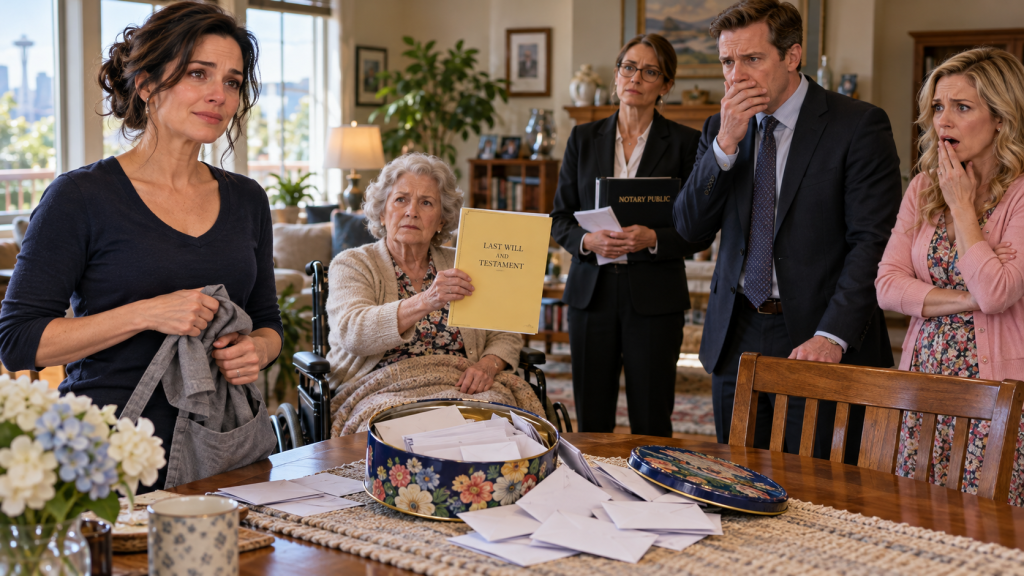
Aaron spoke first. “Lucy, don’t listen to her.” I turned toward him. “Wrong answer.” His face tightened. Brenda stepped forward. “Mom is confused.” Eleanor laughed. Not loudly. Just enough. “Funny.” She lifted the recorder. “I sound very clear on this.”
Brenda went pale.
The notary carefully placed Aaron’s unsigned transfer papers back on the table.
“I think this meeting is over.”
Aaron immediately changed his tone.
“Mr. Levin, please.”
“No.”
The notary took one step back.
“I was brought here under the impression that Mrs. Eleanor Mitchell wanted to transfer an interest in the property voluntarily.”
“She does.”
Eleanor looked directly at him.
“No, I don’t.”
That ended it.
The notary began gathering his briefcase.
Aaron blocked him.
“Wait.”
The notary looked down at Aaron’s hand.
“Move.”
Something in his voice made Aaron obey.
He stepped aside.
Mr. Levin looked at me.
“Do not sign anything.”
“I wasn’t planning to.”
Then he looked at Eleanor.
“Neither should you.”
“I know.”
“I’m going to document what happened here.”
Brenda snapped,
“You can’t accuse us of anything.”
He closed his briefcase.
“I haven’t.”
Then he looked at the forged page carrying my signature.
“But someone else probably will.”
He left.
The front door clicked shut.
And the family performance ended with him.
Aaron turned on me.
“What did you do?”
I almost smiled.
It was such a revealing question.
Not:
What did I do?
Not:
Is that signature really forged?
Not:
Mom, are you okay?
His first instinct was to ask what I had done.
As if truth itself were an attack.
I crossed my arms.
“I took care of your mother.”
“For twelve years.”
“That’s what I did.”
He pointed toward the cookie tin.
“You lied about that woman.”
“Yes.”
“For months.”
“Yes.”
“So don’t stand there acting innocent.”
I stared at him.
“Do you really want to compare lies?”
His mouth closed.
Brenda stepped in.
“This is getting ridiculous.”
I turned toward her.
“Good.”
She blinked.
“What?”
“If it feels ridiculous, leave.”
“This is my mother’s house.”
Eleanor immediately said,
“No.”
Brenda froze.
Eleanor’s voice was weak, but there was no confusion in it.
“This is Lucy’s house.”
Aaron’s expression twisted.
“She’s my wife.”
Eleanor looked at him.
“That does not make you her owner.”
The sentence landed so hard that even Aaron flinched.
I looked down at the yellow folder.
My name.
The trust.
The deed.
The property I had spent twelve years repairing while being told it was family heritage.
I had painted the upstairs bedrooms.
Paid for the furnace.
Replaced the leaking roof with money from my savings.
Put in grab bars for Eleanor.
Installed the ramp Aaron said was “too ugly.”
And through all of it, I believed I was improving something that belonged to his family.
Apparently, my father-in-law had seen exactly who was doing the caring.
Then Eleanor pressed play again.
Aaron’s voice came through the recorder.
“Brenda, the agency invoices need to look real.”
My skin went cold.
Brenda answered on the recording.
“I know.”
Aaron:
“Use weekly amounts. Nothing too neat.”
Brenda:
“And the tax ID?”
A pause.
Then Aaron laughed.
“Use the dormant company.”
I looked at them.
Neither met my eyes.
The recording continued.
Brenda said,
“If Lucy ever checks?”
Aaron replied,
“She won’t.”
My throat tightened.
“She trusts me with the bills.”
Then laughter.
Their laughter.
The same kind of laughter I had heard when he told Brenda I would probably waste the caregiver money.
Except now I understood that joke differently.
The caregiver money had not been the scam.
It had been camouflage.
I turned to Eleanor.
“What company?”
Her hands trembled.
“I don’t know.”
Aaron rushed toward the recorder.
I stepped between them.
“Don’t.”
He stopped.
For the first time in our marriage, I saw uncertainty in him.
Not anger.
Not superiority.
Uncertainty.
Because the woman he thought had no money had a house.
The maid he thought did not exist had receipts.
The mother he thought was too weak to fight had six months of recordings.
And the notary he brought to make everything legal had walked out holding evidence that nothing about his paperwork was clean.
Aaron lowered his voice.
“Lucy.”
“No.”
“Let me explain.”
“No.”
“You don’t understand the finances.”
I almost laughed.
“Apparently neither do you.”
His face reddened.
Brenda snapped,
“You think you’re so clever because you played dress-up in an apron?”
I turned.
“No.”
“I think I’m tired.”
That silenced her.
I continued.
“I am tired of carrying your mother to the bathroom while both of you debate what happens to her house.”
“I’m tired of paying for insulin while you talk about nursing homes like storage units.”
“I’m tired of being called useless in a house my name is apparently attached to.”
“And I am especially tired of hearing people who never changed one bedsheet discuss what caregiving is worth.”
Eleanor started crying.
Aaron looked at her.
“Mom.”
She turned away.
That hurt him.
I could see it.
Good.
Not because I wanted revenge.
Because for the first time, the consequence belonged to the person who caused the damage.
I picked up the cookie tin.
Then the yellow folder.
Then Eleanor’s recorder.
“I’m calling an attorney.”
Aaron laughed once.
“With what money?”
I looked at him.
Then at the sealed envelopes in the tin.
His smile disappeared.
“I guess Margaret saved.”
I walked Eleanor back to her room.
Aaron shouted after me.
“Lucy!”
I did not turn around.
For twelve years, I had turned around every time he called my name with that tone.
Not that day.
That day, I kept walking.
The attorney’s name was Rachel Kim.
A woman from a legal-aid eldercare clinic gave me her number after I explained the situation.
Rachel specialized in trusts, elder exploitation, and financial abuse.
She arrived the next morning carrying two laptops and absolutely no patience for family excuses.
She met with Eleanor separately first.
That mattered.
Not me in the room.
Not Aaron.
Not Brenda.
Just Eleanor and independent counsel.
For forty-five minutes, I sat in the kitchen with the cookie tin.
Aaron had stayed at Brenda’s overnight after I told him I was not discussing anything without a lawyer.
He called nineteen times.
I answered none.
Rachel finally came out.
She sat across from me.
“Your mother-in-law understands what she signed, what she owns, and what she wants.”
I exhaled.
“Good.”
“She also wants you present for the rest.”
I nodded.
Eleanor rolled herself in behind her.
Rachel placed the original will and trust documents on the table.
“The first thing you need to understand is that the house transfer appears valid.”
My heart pounded.
“To me?”
“Yes.”
I stared at Eleanor.
She smiled weakly.
“Your father-in-law did it without telling Aaron?”
Rachel answered.
“Not exactly.”
I frowned.
“What does that mean?”
“He notified Aaron.”
My stomach dropped.
“When?”
“Two years ago.”
I stared.
“No.”
Rachel slid a document toward me.
Certified-mail receipt.
Aaron’s signature.
My husband had signed for notice that the house had been transferred into a trust naming me as beneficiary.
Two years.
He knew.
The room tilted.
I sat back.
“He knew the house was mine.”
Rachel nodded.
“Or at minimum, he received formal notice.”
Eleanor whispered,
“He knew.”
I turned.
“How?”
“He came into my room furious that night.”
My chest tightened.
“What did he say?”
Eleanor looked ashamed.
“He said his father had humiliated him.”
“By giving me the house?”
“Yes.”
I could barely speak.
“And you never told me?”
“I thought you knew.”
I laughed.
Not because it was funny.
Because apparently everyone assumed someone else had told me the truth.
Rachel continued.
“The trust does not give you unrestricted power while Eleanor is alive.”
I focused.
“What does it give?”
“You hold title through the trust.”
“Eleanor retains lifetime occupancy and certain decision rights.”
“She cannot be removed merely because you own the property.”
I nodded.
“Good.”
“And Aaron?”
“No ownership interest.”
My pulse jumped.
“None?”
“Not based on the documents I’ve reviewed.”
Rachel leaned closer.
“And there is something else.”
Of course there was.
“Your father-in-law included a no-contest and misconduct provision.”
I frowned.
“In plain English?”
“If a beneficiary or potential heir attempts to coerce Eleanor, forge documents, manipulate her placement, or interfere with the trust, certain benefits can be suspended or forfeited.”
I looked at Eleanor.
“Benefits?”
Rachel opened another folder.
“There is more than the house.”
Aaron had not mentioned that.
Neither had Brenda.
Rachel continued.
“Your father-in-law left an investment account that pays Eleanor’s care expenses.”
My throat tightened.
“How much?”
“Originally around six hundred thousand dollars.”
My jaw dropped.
I thought about insulin.
Grab bars.
Home repairs.
The weeks I postponed my own dental work because we were short.
“Aaron told me there was no care fund.”
Eleanor started crying.
“I thought he was using it.”
Rachel’s face hardened.
“That is what we need to determine.”
The next three weeks changed everything.
Not dramatically.
Not in one giant reveal.
Truth came in folders.
Statements.
Cancelled checks.
Tax filings.
Bank records.
Agency invoices.
Rachel hired a forensic accountant named Marcus Hale.
He was soft-spoken and wore sweaters that made him look more like a librarian than someone who followed money for a living.
After six days, he called me.
“Lucy, do you know a company called Evergreen Companion Services?”
“No.”
“Does Eleanor?”
“No.”
“Does Aaron?”
“Probably.”
Marcus sighed.
“That’s what I expected.”
Evergreen Companion Services had billed Eleanor’s care account every month for almost three years.
Cleaning.
Bathing assistance.
Medication management.
Meal preparation.
Transportation.
Exactly the things I had done.
I stared at the invoices.
“Who owns it?”
Marcus looked at me.
“Brenda.”
I closed my eyes.
Of course.
The dormant company.
Not a caregiver agency.
A shell.
Brenda had registered it years earlier for a small home-organizing business that failed.
Then Aaron and Brenda revived the name.
They created invoices.
They charged Eleanor’s care fund.
They made it look as though professional caregivers were coming into the house.
No one came.
I did the work.
They took the money.
Marcus turned another page.
“Total paid to Evergreen is one hundred eighty-seven thousand four hundred dollars.”
I stopped breathing.
“What?”
“Over thirty-four months.”
My hands shook.
“I never saw a dollar.”
“I know.”
“Where did it go?”
“Some to Brenda.”
“Some transferred into an account jointly controlled by Aaron and Brenda.”
“And then?”
He hesitated.
“Personal expenses.”
My stomach turned.
“What kind?”
“Credit cards.”
“Travel.”
“A vehicle lease.”
“Mortgage arrears on Brenda’s condo.”
“And approximately forty-two thousand dollars transferred to an investment account controlled by Aaron.”
I stood up.
I needed air.
I walked to the back porch.
Seattle rain fell beyond the railing.
Cold.
Fine.
Endless.
For years, Aaron had told me:
“We can’t afford help.”
So I lifted his mother.
Bathed her.
Missed work.
Reduced my hours.
Skipped vacations.
Wore out my back.
And while I did it, he and Brenda had been paying themselves as if professionals were doing the work.
I laughed once.
Then cried.
Rachel followed me outside.
“Lucy.”
“They charged for my hands.”
She said nothing.
“They took money because I washed her hair.”
My voice broke.
“They billed her trust for meals I cooked.”
“Transportation I provided.”
“Medication I paid for.”
Rachel nodded.
“Yes.”
I covered my face.
I had never felt so invisible.
Not because caregiving was beneath me.
Because they had turned my invisible labor into visible money for themselves.
Aaron did not merely refuse to value what I did.
He monetized it while telling me it was worthless.
That was the betrayal I had not known how to name.
Rachel waited until I stopped crying.
Then said,
“There’s more.”
I almost laughed again.
“Of course there is.”
She handed me a copy of one invoice.
Caregiver: Margaret Doyle.
I stared.
My grandmother’s name.
The false name I had chosen months earlier.
My blood went cold.
“No.”
Rachel nodded.
“You chose Margaret recently.”
“Yes.”
“These invoices use that name starting three years ago.”
I looked at her.
“How?”
Then I remembered.
Aaron knew my grandmother’s name.
He had attended her funeral.
He knew I had always said she was the hardest-working woman I ever knew.
He had used her name.
Before I ever invented the caregiver.
A shiver ran through me.
“So when I told him the caregiver was Margaret…”
Rachel finished.
“He probably thought you had somehow seen the invoices.”
My stomach dropped.
That explained his strange expression the first time I said it.
Not amusement.
Fear.
I had accidentally named the ghost employee he and Brenda had already created.
I whispered,
“That’s why he kept asking whether she had come yet.”
Rachel nodded.
“Possibly.”
Everything shifted.
My little private act of dignity—the gray apron, the name Margaret—had not been entirely mine.
I had unknowingly stepped into the identity they created to steal from Eleanor.
That made me angry at first.
Then something else happened.
I looked at the invoice again.
Margaret Doyle.
Fake caregiver.
Fake hours.
Fake wages.
But the care was real.
Because I did it.
They stole the name.
They did not steal the work.
I took a breath.
“Can we prove no caregiver worked those hours?”
Marcus answered from the doorway.
“We already can.”
“How?”
“Doorbell footage.”
I stared.
“The camera?”
“You installed it four years ago.”
I had.
After packages kept disappearing.
Marcus continued.
“No regular caregiver entered during the billed periods.”
“Occasional nurses.”
“Delivery people.”
“Family.”
“But no Margaret Doyle.”
“And your employment schedule, pharmacy receipts, medical logs, and Eleanor’s statements align with you providing most of the care.”
I swallowed.
Evidence.
The work that nobody valued had left a trail.
Not because I planned it.
Because real work always leaves something behind.
A receipt.
A glucose log.
An appointment.
A repaired rail.
A pharmacy pickup.
A calendar note.
Truth does not always shout.
Sometimes it accumulates.
Aaron hired a lawyer.
Then another.
The first withdrew after discovering how much he had not disclosed.
The second sent formal letters telling me not to “interfere” with marital property.
Rachel wrote back one sentence:
Please identify the marital property you believe your client owns.
No reply came for nine days.
Then Aaron asked to meet.
I refused at first.
Then Eleanor surprised me.
“Meet him.”
I stared.
“Why?”
“So you can hear him without me in the middle.”
“You don’t owe him anything.”
“No.”
She looked tired.
“But I owe myself the truth.”
So we met at Rachel’s office.
Separate rooms first.
Then a conference room.
Aaron looked terrible.
Not tragic.
Just smaller.
He sat across from me.
For a long moment, neither of us spoke.
Then he said,
“I never meant for it to go this far.”
I almost smiled.
That phrase.
The anthem of people caught halfway through a plan.
“How far did you mean it to go?”
He looked down.
“I wanted Mom in better care.”
“No.”
He looked up.
“I did.”
“You wanted her somewhere cheaper.”
His jaw tightened.
“She needs professional supervision.”
“Then why did you steal the money set aside for professional supervision?”
Silence.
I leaned back.
“Try again.”
He swallowed.
“My business was failing.”
There it was.
Finally.
“What business?”
“The consulting firm.”
“You told me it was doing well.”
“It wasn’t.”
“How bad?”
He rubbed his face.
“I owed almost two hundred thousand.”
I stared.
“So you stole from your mother.”
“I borrowed.”
“You forged caregiver invoices.”
He flinched.
“Brenda handled the invoices.”
“You signed payment approvals.”
Silence.
“Did you know the house was mine?”
“Yes.”
The answer came so quietly I almost missed it.
Something inside me went cold.
“How long?”
“Since Dad died.”
“Two years.”
“Yes.”
“And you never told me.”
“I thought he was manipulating us.”
“By giving me property?”
“He wanted to punish me.”
I stared.
“Why would he?”
Aaron looked ashamed.
“Because he knew about the care account.”
My pulse jumped.
“He knew you were stealing?”
“He suspected.”
“Before he died?”
“Yes.”
Eleanor made a sound from the adjoining room.
She had chosen to listen through the open door.
Aaron turned.
“Mom.”
She said nothing.
I asked,
“What did your father know?”
Aaron closed his eyes.
“He found an invoice.”
“For Evergreen?”
“Yes.”
“He asked me who Margaret was.”
My skin crawled.
“Margaret.”
Aaron nodded.
“Dad thought she was a real caregiver.”
“At first.”
I felt sick.
“And what did you tell him?”
“That she had stopped working.”
“When he asked to meet her?”
“Yes.”
My hands clenched.
“He was dying.”
Aaron snapped,
“I know.”
“Do you?”
The room went quiet.
I leaned forward.
“Your father was dying, and you were lying to him about stealing your mother’s care money.”
Aaron’s eyes filled.
“Yes.”
For the first time, he did not defend himself.
I sat back.
That mattered.
Not enough.
But it mattered.
Then he said,
“I thought I could replace it.”
The classic excuse.
“I thought the business would recover.”
“It didn’t.”
“No.”
“And Brenda?”
“She had debt too.”
“So the two of you used your mother.”
He shook his head.
“No.”
I laughed.
“Aaron.”
“We paid her bills.”
“With whose money?”
Silence.
“Her trust.”
Silence.
“Who did the actual care?”
He looked at me.
“You.”
There.
Finally.
I had waited twelve years to hear the obvious.
Not:
You helped.
Not:
You complained.
Not:
You stayed home.
You.
I looked at him.
“And what did you pay me?”
His face crumpled.
“Nothing.”
“Exactly.”
He began crying.
That surprised me.
Not because I thought he had no feelings.
Because for years, his tears had been rare enough to feel like evidence of something sacred.
That day, they were simply tears.
Human.
Real.
Not controlling my decision.
He whispered,
“I was ashamed.”
“Good.”
He looked up.
I continued.
“You should be.”
“But shame is not repayment.”
His face tightened.
“I know.”
“No.”
“You are beginning to.”
That meeting ended with no reconciliation.
No hug.
No promise.
Just information.
Aaron moved out permanently.
Brenda stopped calling me after Rachel warned her that harassment would be documented.
Eleanor stayed.
Her house.
My house.
Our home.
Whatever legal language called it, the daily truth was simpler.
She was safe there.
That was enough.
The criminal investigation came later.
Not immediately.
Rachel reported suspected elder financial exploitation.
The trust company conducted its own review.
The forensic records were preserved.
Law enforcement became involved.
So did tax authorities eventually.
I hated that part.
Not because I wanted to protect Aaron.
Because once a case begins, your life becomes dates.
Amounts.
Statements.
Attachments.
People ask you to explain years of pain in chronological order.
Human memory does not live that way.
It lives in moments.
The night Eleanor’s blood sugar dropped and I sat beside her until dawn.
The afternoon Aaron told me I was “playing nurse” instead of working more.
The winter I repaired the upstairs bathroom because he said we could not afford a contractor.
The Monday envelopes.
The cookie tin.
The gray apron.
The name Margaret.
Investigators wanted receipts.
Good.
I had them.
Every Monday envelope remained sealed.
That became unexpectedly important.
Aaron had tried to create another story.
His lawyer initially suggested I had been taking caregiver money personally.
Technically, I had received it.
But the envelopes were untouched.
Every one.
Dates.
Amounts.
His handwriting.
The cookie tin became evidence.
That ridiculous floral tin Eleanor used to keep ginger snaps in became a record of the only money Aaron voluntarily set aside for caregiving.
I remember the investigator lifting it.
“Why did you keep all of this?”
I answered honestly.
“Because I wanted proof the work mattered.”
He looked at me.
“It does.”
I cried afterward.
Not in front of him.
In the bathroom.
Because sometimes three words arrive twelve years too late and still heal something.
The legal consequences unfolded slowly.
Brenda’s company records showed false caregiver billing.
Aaron’s approval logs showed he knowingly authorized payments.
Bank transfers traced the money.
Some had been spent.
Some remained.
Assets were frozen.
Civil claims were filed on Eleanor’s behalf.
The trust invoked the misconduct clause.
That part destroyed Aaron emotionally.
His father had left him a smaller investment share after Eleanor’s death.
Not the house.
Not control.
Just a future inheritance.
The misconduct clause suspended it pending legal findings.
Aaron called Eleanor once after that.
She put the phone on speaker.
He cried.
“Mom, Dad already punished me.”
Eleanor stared at the wall.
Then said,
“No.”
Aaron stopped.
“Your father protected me.”
Silence.
“You are experiencing the difference.”
Then she hung up.
I looked at her.
“That was cold.”
She smiled faintly.
“I’m seventy-nine.”
“I’m conserving warmth.”
I laughed so hard I snorted.
She looked delighted.
Healing sometimes sounds like that.
Not wisdom.
Snorting at the kitchen table.
The biggest twist came five months later.
Marcus found another account.
Not Aaron’s.
Mine.
At least, it had my name.
I stared at the paperwork.
“What is this?”
“A sole-proprietor business account.”
“I never opened this.”
“I know.”
The name:
Margaret Home Support.
My heart stopped.
No.
Marcus continued.
“It was opened online using your Social Security number and an old address.”
I felt sick.
“Who?”
“We traced the login activity.”
He looked at me.
“Brenda’s home internet.”
I stood.
My hands shook.
“They opened a business in my identity?”
“Yes.”
“Why?”
Marcus turned the laptop.
Deposits.
Withdrawals.
Care payments.
Tax documents.
I stared.
“They were routing some of the caregiver money through me?”
“On paper.”
My breathing changed.
That was their protection.
If anyone investigated Evergreen, they could point toward Margaret Home Support.
Toward me.
Toward my identity.
The invisible caregiver had become me without my permission long before I chose to play Margaret.
I whispered,
“They were going to blame me.”
Marcus did not soften it.
“That is one possibility supported by the structure.”
I thought about Aaron’s joke.
With what money? With the salary of a maid who doesn’t even exist?
Except on paper, the maid did exist.
She was me.
A fake business.
A stolen identity.
A scapegoat waiting quietly.
I sat down.
For the first time since everything began, I felt genuinely afraid.
Not of losing the house.
Of how carefully they had prepared a version of reality where I looked guilty.
Rachel sat beside me.
“Lucy.”
“They used my name.”
“Yes.”
“I thought the envelopes protected me.”
“They still help.”
“I thought the receipts protected me.”
“They do.”
“But they made a business.”
“Yes.”
I closed my eyes.
“Could they have made it look like I stole from Eleanor?”
Rachel answered carefully.
“They could have tried.”
That was enough.
I started crying.
Not softly.
I buried my face in my hands.
For months, I had thought the cruelty was that Aaron undervalued me.
Then I learned he profited from my work.
Now I understood something worse.
He had prepared to sacrifice me if the scheme collapsed.
A wife.
A caregiver.
A convenient signature.
I remembered the way he used to kiss my forehead when leaving for work.
The way he brought flowers on anniversaries.
The way he told people I was “the heart of the family.”
And somewhere inside that same marriage, documents existed that could have turned the heart of the family into the thief.
Rachel waited.
Then said,
“This is why we build cases from evidence, not stories.”
I looked at her.
“They have a story.”
“So do you.”
“No.”
She shook her head.
“You have records.”
That sentence steadied me.
Records.
The envelopes.
Doorbell footage.
Care logs.
Pharmacy receipts.
Medical appointments.
Tax returns.
Work schedules.
Eleanor’s testimony.
The recordings.
The real trust.
The forged signature.
The false company.
Their own messages.
I did not need to out-story them.
I needed truth organized.
That became my job.
Not revenge.
Organization.
For weeks, I built binders.
Color-coded.
I laughed at myself.
Then kept going.
Care expenses.
House repairs.
Income.
False invoices.
Bank statements.
Messages.
Recordings.
I wrote dates on sticky notes.
Eleanor watched me from the kitchen.
“One day you’re going to label the cat.”
“We don’t have a cat.”
“Exactly.”
Even then, she made me laugh.
Aaron eventually admitted the identity setup.
Not immediately.
But under the pressure of digital records and Brenda’s own statements, the truth became difficult to escape.
Brenda blamed Aaron.
Aaron blamed Brenda.
The usual dance.
Then, eventually, both stopped.
The plea agreements came more than a year after that Christmas.
There were charges related to financial exploitation, fraud, and identity misuse.
I will not pretend the courtroom gave me satisfaction.
It did not.
Aaron stood before the judge in a suit I had bought him.
That detail nearly broke me.
I remembered choosing the tie.
He looked at me once.
Then at Eleanor.
Then down.
During his statement, he said:
“I turned my mother’s care into an account I believed I could borrow from.”
Eleanor’s mouth tightened.
He continued.
“I turned my wife’s labor into invoices.”
My throat burned.
“And when I became afraid the scheme would be discovered, I helped create paperwork that could have made Lucy look responsible.”
There.
The truth.
Public.
Under oath.
No metaphor.
No excuse.
I cried silently.
Not because I forgave him.
Because I no longer had to carry the burden of proving to myself that it was real.
He admitted it.
Brenda admitted her part too.
Restitution was ordered.
Not all money returned at once.
Some through asset liquidation.
Some over time.
Some losses remained.
Real cases leave residue.
There was no magic check making Eleanor whole overnight.
But the care fund was restored enough to support her properly.
That mattered.
We hired help.
A real caregiver.
Her name was Denise.
The first afternoon Denise arrived, I almost cried.
She wore navy scrubs.
A badge.
Gloves.
A calm smile.
She said,
“Mrs. Mitchell, I’m here to help with your shower and medications.”
Eleanor looked at me.
Then said,
“Lucy, sit down.”
I laughed.
“I’m fine.”
“No.”
She pointed at the chair.
“You have been Margaret long enough.”
That sentence broke me.
I sat.
Denise helped Eleanor.
I stayed in the living room.
At first, I felt guilty.
My body wanted to get up every time I heard movement.
What if Denise needed help?
What if Eleanor slipped?
What if the towel was wrong?
Then I realized something.
That was not responsibility.
That was conditioning.
I had spent so many years believing good care meant doing everything myself that receiving help felt like neglect.
So I practiced sitting.
At first five minutes.
Then ten.
Then an entire afternoon.
Eleanor noticed.
“You’re improving.”
“At sitting?”
“Yes.”
“High praise.”
She smiled.
“It is a skill.”
My back began hurting less.
I returned to more hours at work.
Then full-time.
I bought myself new shoes before buying anyone else anything.
That felt scandalous.
I started therapy.
At the first session, my therapist asked,
“What do you want?”
I answered automatically.
“To make sure Eleanor is okay.”
She nodded.
“And for you?”
Silence.
I hated the question.
I had built an identity around being useful.
Wife.
Caregiver.
Cook.
Cleaner.
Medication manager.
Financial patch.
The person who could be counted on.
Take those roles away and I did not know what I wanted.
So I started small.
“I want one night without anyone asking me for anything.”
We laughed.
Then I did it.
Hotel room.
One night.
Alone.
Takeout noodles.
A ridiculous movie.
No medication alarms.
No laundry.
No Aaron.
I slept nine hours.
When I came home, Eleanor asked,
“Did you have fun?”
“Yes.”
“Did you miss me?”
“No.”
She burst out laughing.
“Good.”
That was love.
Not needing to be needed every second.
Aaron wrote letters.
The first few were terrible.
I was under pressure.
Brenda convinced me.
Dad always favored you.
I returned them unread after the first paragraph.
Months later, another came through his attorney.
Rachel asked whether I wanted it.
I said yes.
This one began:
I keep trying to explain myself because explanation feels less shameful than confession.
I kept reading.
The truth is simple.
I knew you were doing the work.
My eyes filled.
I knew Mom trusted you more.
I resented both facts.
I breathed.
When Dad left you the house, I felt replaced.
Instead of asking what my behavior had done to my family, I decided you had taken something that belonged to me.
That was the sentence.
Belonged.
The house.
The money.
The caregiving.
Me.
He had believed all of it belonged to him.
The letter continued.
I used caregiver invoices because your work was easy to hide behind.
I started crying.
You did so much that nobody questioned whether someone was being paid for it.
That hurt.
Because it was precise.
Then I used your identity because I believed if everything collapsed, people would assume the person providing the care also controlled the money.
My hands shook.
That was not panic.
It was preparation.
I closed my eyes.
Finally.
No minimizing.
No accident.
Preparation.
Then:
I am sorry that I spent years calling your work small while secretly depending on it to make my theft possible.
That sentence healed something I did not know was still bleeding.
I did not write back.
A good apology is not an invoice.
It does not require payment.
Years passed.
Eleanor grew weaker.
Not because of anything Aaron did.
Age.
Diabetes.
Heart trouble.
Life.
She remained in the house.
Her choice.
Denise came four days a week.
Another caregiver covered weekends.
I helped because I wanted to.
Not because nobody else would.
That difference changed everything.
One afternoon, I found Eleanor holding the gray apron.
The original one.
Margaret’s apron.
I had forgotten it existed.
She smiled.
“Remember this?”
“Yes.”
“You looked ridiculous.”
I laughed.
“Thank you.”
She ran her fingers over the fabric.
“I knew what you were doing.”
“What?”
“From the first day.”
I stared.
“No, you didn’t.”
“Yes.”
“How?”
“You changed your hair.”
“So?”
“You forgot to take off your wedding ring.”
I looked at my hand.
Then burst out laughing.
“I was terrible at undercover work.”
“Terrible.”
She smiled.
Then grew serious.
“But I liked Margaret.”
My throat tightened.
“Why?”
“Because when you called yourself Margaret, you stopped apologizing for being tired.”
I stared.
Eleanor continued.
“You stood straighter.”
“You wrote down your hours.”
“You gave the work a name.”
Tears filled my eyes.
“I thought it was silly.”
“It wasn’t.”
She held out the apron.
“You needed to see that care was labor before you could see they were stealing it.”
That stayed with me.
Not just Aaron.
Me too.
I had treated my own labor as endless and free.
Not because caregiving should always be transactional.
But because love does not erase cost.
Time is cost.
Sleep is cost.
Back pain is cost.
Lost wages are cost.
Care can be freely given and still valuable.
That became the lesson I carried forward.
Eleanor died at eighty-four.
At home.
In the bedroom where I had changed thousands of sheets.
Denise was there.
So was I.
Aaron was not.
He had asked through counsel whether he could visit.
Eleanor said no.
That was her decision.
I did not influence it.
Near the end, she was awake only in short windows.
One afternoon, she opened her eyes and looked at me.
“Lucy?”
“I’m here.”
“Margaret?”
I laughed through tears.
“She retired.”
Eleanor smiled.
“Good.”
Then she whispered,
“You kept the house warm.”
My throat closed.
“I tried.”
“No.”
She shook her head.
“You did.”
Her eyes closed again.
She died two days later.
After the funeral, Rachel came by with the final trust documents.
The misconduct provision had fully activated based on the legal findings.
Aaron and Brenda forfeited the remaining inheritance tied to the trust.
Not because I demanded it.
Because their father had written the condition years earlier.
Rachel slid the final accounting toward me.
The house remained mine.
A portion of the recovered care funds passed into a small residual trust.
I looked at the amount.
Then asked,
“What happens if I don’t want it?”
Rachel smiled.
“You decide.”
That was the answer I needed.
I used part of it to create the Eleanor Mitchell Caregiver Relief Fund through a local nonprofit.
Small.
Nothing grand.
It offered short-term respite grants to unpaid family caregivers.
A few hours of professional help.
A hotel night.
Transportation.
Meal delivery.
Things that seem small until you have gone months without rest.
The application form included one question:
What would make you feel human again this week?
Not:
Prove you are suffering enough.
Not:
Explain why your family cannot help.
Just:
What would help?
The first grant went to a woman caring for her husband after a stroke.
She used it for eight hours of respite care and went to her granddaughter’s school play.
When she sent a thank-you note, I cried.
That was better than revenge.
The cookie tin sat on my desk for years.
Empty.
I considered throwing it away.
Then I changed my mind.
I filled it with receipts from the relief fund.
Real ones.
Real caregivers.
Real hours.
Real names.
Nothing forged.
Once a year, I opened it.
Not because paper was magical.
Because accounting had once been used to erase labor.
Now accounting proved support existed.
The house changed too.
After Eleanor died, I could not sleep in it for months.
Every room contained memory.
Her wheelchair near the window.
Aaron’s chair at the dining table.
The mattress where the will had been hidden.
The bathroom where I had washed Eleanor’s hair.
I considered selling.
People expected me to.
“Fresh start.”
“Too many memories.”
“Take the money.”
I almost did.
Then one rainy afternoon, I walked through the living room.
The furnace clicked on.
The same furnace I once paid to repair.
The walls were the color I had chosen.
The ramp outside remained.
The kitchen drawer still stuck in winter.
And I realized something.
Aaron had spent years telling me the house represented his family.
Then I learned it belonged to me.
But ownership alone did not make it mine.
The years did.
My hands were in that house.
My money.
My paint.
My meals.
My care.
My grief.
My recovery.
So I stayed.
But I changed it.
Aaron’s office became a guest room for visiting caregivers from the nonprofit.
Brenda’s favorite sitting room became my reading room.
I removed the huge family portrait from the stairwell.
Not because I wanted to erase the past.
Because it was ugly.
That felt healthier.
I replaced it with a photograph of Eleanor laughing in the garden.
No wheelchair.
No illness.
Just her holding a tomato like she had grown gold.
The gray apron hung framed beside the laundry room.
Denise thought that was hilarious.
“You framed an apron?”
“Yes.”
“Why?”
“Long story.”
She looked at me.
“I worked here three years.”
“Fair.”
So I told her.
She laughed until she cried.
Then said,
“You know Margaret deserves back pay.”
I stared.
“Don’t start.”
We became friends.
Real ones.
Years later, Aaron was released after serving the custodial portion of his sentence.
He remained under financial restrictions and restitution obligations.
I learned through official channels.
He did not contact me immediately.
A year passed.
Then a letter arrived.
One page.
Lucy,
I used to think losing the house was the biggest consequence.
I almost stopped.
Then read.
It wasn’t.
The biggest consequence was learning that the person who actually made that house a home no longer wanted me inside it.
My eyes filled.
I used to think Dad chose you over me.
Now I think he recognized who was already doing the choosing every day.
I breathed.
You chose Mom.
You chose the house.
You chose responsibility.
I chose entitlement.
No excuses.
Good.
I do not ask to come back.
Better.
I only want to say that I understand now why the house was left to you.
I folded the letter.
For the first time, I replied.
One sentence.
Thank you for finally understanding. Please continue respecting the distance between us.
He did.
That mattered.
Brenda never apologized as clearly.
She wrote once.
Mostly explanations.
Debt.
Fear.
Resentment.
Believing her brother would protect her.
I read it.
Then put it away.
Not every relationship needs repair.
Some simply need an ending.
I divorced Aaron.
Of course.
The process took time.
The house remained outside the marital division based on the trust and estate structure, though other assets were divided according to law.
I did not “take everything.”
I did not want everything.
I wanted what was mine.
And I wanted peace.
People confuse those sometimes.
I went back to full-time work.
Then changed careers entirely.
I trained as a geriatric-care coordinator.
That surprised even me.
After years of caregiving, I thought I would run from anything involving medication schedules.
Instead, I realized I knew the system.
The gaps.
The exhaustion.
The forms families misunderstand.
The places where unpaid women disappear into the sentence:
“She helps out.”
No.
Sometimes she does twenty hours a week.
Sometimes forty.
Sometimes eighty.
Sometimes she quits a job.
Sometimes she ruins her back.
Sometimes she becomes Margaret because nobody will admit Lucy is already doing the work.
I became very good at asking one question:
“Who is actually providing the care?”
Families often went quiet.
That told me plenty.
At fifty-eight, I met Thomas.
He was widowed.
Retired electrician.
Terrible cook.
Excellent listener.
We met because his sister needed home care and he kept arguing with the insurance company.
I helped him understand the paperwork.
Six months later, he asked me to dinner.
I said no.
He smiled.
“Fair enough.”
Three months later, he asked again.
I said yes.
That difference mattered.
No sulking.
No pressure.
No claim.
Just another invitation.
We dated slowly.
He never moved into the house.
Not because I forbade it.
Because one evening he said,
“This place already has a history.”
I tensed.
Then he added,
“I don’t need to own it to be welcome in it.”
My eyes filled.
He looked alarmed.
“What did I say?”
“Nothing.”
“Apparently something.”
I laughed.
We eventually married.
Small ceremony.
Denise came.
Rachel came.
Marcus somehow came and talked about tax law during cake.
Thomas signed a prenuptial agreement without drama.
He read every page.
Then looked at me.
“Anything else you want protected?”
I smiled.
“My cookie tin.”
He frowned.
“You own a very aggressive cookie tin.”
“You have no idea.”
Years later, one Monday morning, I woke early.
Thomas was making coffee badly.
Rain tapped the kitchen windows.
I walked past the dining table.
An envelope sat there.
My heart stopped.
White.
Plain.
For one second, I was back in the old days.
Aaron.
Monday.
Caregiver money.
The entire past returned through a rectangle of paper.
Thomas looked over.
“What?”
I pointed.
“The envelope.”
He blinked.
“Oh.”
He opened it.
Inside were two tickets.
Weekend trip.
He smiled.
“I thought we could go somewhere if you want.”
If you want.
I touched the envelope.
Then laughed.
“What?”
“Nothing.”
I picked it up.
“Monday envelopes have improved.”
He did not understand.
I told him later.
Not that morning.
That morning, we drank coffee.
That was enough.
I kept the original yellow folder too.
The will.
The deed.
The paper that changed everything.
For years, I thought the most important sentence in it was my name.
The legal transfer.
The proof that the house belonged to me.
Then one day, while organizing old papers, I found a handwritten note from my father-in-law tucked behind the notarized page.
I had never noticed it.
It was addressed to me.
Lucy,
Property is easier to measure than care.
I sat down.
That does not make property more valuable.
My eyes filled.
I have watched you do for Eleanor what her children should have helped you do.
This house cannot repay you.
I covered my mouth.
It is not payment.
It is protection.
I kept reading.
If Aaron ever tells you that love requires you to leave with nothing, remember that love does not erase what you built.
I cried for an hour.
There it was.
The difference.
The house was never a reward for being a good caregiver.
I did not earn shelter by serving.
My father-in-law understood that.
He was protecting me from the exact argument Aaron later made.
Leave with the clothes on your back.
No.
Not because I scrubbed enough floors.
Because nobody should spend years building a life and then be told love erased their contribution.
I framed that note.
Not the deed.
The note.
It hangs below the gray apron.
Visitors sometimes ask about them.
I usually smile.
“Family accounting.”
They think I am joking.
Mostly.
I am sixty-four now.
The house is quieter.
Thomas snores upstairs.
The garden belongs mostly to squirrels.
The caregiver fund has helped more than three hundred families.
Not huge.
But real.
Every grant still uses that same question.
What would make you feel human again this week?
Sometimes the answers are heartbreaking.
A haircut.
Three hours of sleep.
Lunch with a friend.
A massage.
A church service.
One night not listening for a fall.
Caregivers rarely ask for castles.
They ask for rest.
I understand.
I keep one envelope from Aaron.
The very first caregiver envelope.
Still sealed.
Not because I need evidence anymore.
Because it reminds me of the woman I was when he placed it on the table.
She thought money meant help.
Then she discovered it was a trap.
Then she created Margaret.
Then she found the will.
Then she learned the trap was bigger.
Then she left.
Then she rebuilt.
I do not look at that woman with embarrassment.
Not anymore.
She was tired.
Not stupid.
Used.
Not useless.
And when she finally understood what was happening, she did something simple.
She kept the receipts.
People underestimate receipts.
They think power lives in loud moments.
Courtrooms.
Arguments.
Doors slamming.
Sometimes power is a dated pharmacy slip.
A glucose log.
A bank statement.
A sealed envelope.
A recorder under a wheelchair cushion.
A gray apron.
A cookie tin.
Small things become a wall when enough of them stand together.
That is how Aaron’s story collapsed.
Not because I screamed louder.
Because facts accumulated until there was nowhere left for his version to stand.
For years, he told me I was just a wife who did not contribute enough.
Then the records showed how much the house depended on my labor.
He told me I had no money.
Then the envelopes showed what I refused to spend.
He told me the house was his family heritage.
Then the will showed my name.
He told me Margaret did not exist.
That part, technically, was true.
But he misunderstood what made that funny.
Margaret did exist.
Every afternoon.
In my hands.
My back.
My patience.
My time.
She existed because I finally gave a name to work everyone else pretended was invisible.
And once I could see her value, I could finally see mine.
That was the inheritance that mattered most.
Not the house.
Not the trust.
Not the money Aaron lost.
The moment I stopped believing care had to be invisible to be love.
The moment I understood that generosity without boundaries becomes a resource selfish people will gladly exploit.
The moment Eleanor looked at me and said:
“You have been Margaret long enough.”
She was right.
I retired her.
But I kept the apron.
Because sometimes the version of yourself you invent to survive deserves to be remembered after you no longer need her.
And every Monday morning, when sunlight falls across the dining table where Aaron once placed those envelopes, I make coffee, sit down, and let the house remain quiet.
No one is assigning me a task.
No one is calculating what my care is worth behind my back.
No one is planning to remove an old woman from her home.
No one is waiting for me to become powerless enough to sign something.
Just quiet.
A house protected by truth.
And a life that finally belongs to the woman who spent so many years caring for everyone else.
THE END STORIES! THANK YOU FOR READING GOOD LUCK !❤️
Related Posts