The headlights stopped at the edge of the empty lot. For one long second, nobody moved. I sat on the folding chair beside the old concrete foundation with my phone still pressed to my ear.
Dylan was breathing on the other end. “Mom?” “I’m here.” A black rental SUV rolled forward another ten feet. Then stopped. The driver’s door flew open. Richard stepped out. Still tan from Maui.
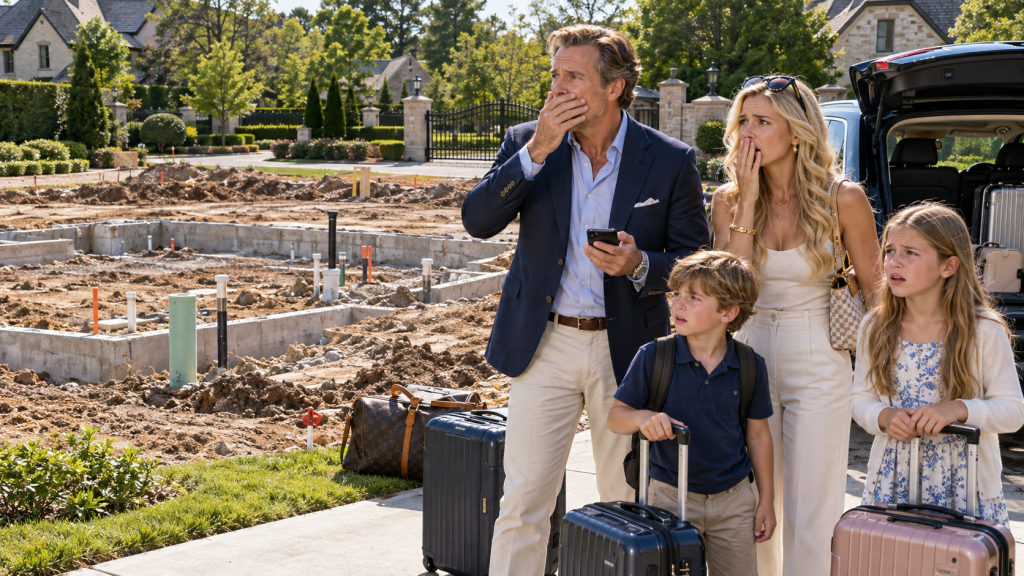
Still wearing the expensive linen shirt I had packed for him before I knew he planned to marry another woman in it. He stared at the dirt. At the exposed utility lines. At the rectangle where our house had stood for seventeen years.
Then he looked at me.
His face emptied.
“What did you do?”
I ended the call with Dylan.
“I moved.”
His mouth fell open.
For the first time in nineteen years, Richard Stone had no prepared sentence.
No polished explanation.
No executive voice.
No way to turn cruelty into procedure.
He looked around again as though the house might reappear if he found the correct angle.
“Where is it?”
I stood.
“Somewhere safe.”
“You moved the house?”
“Yes.”
“You moved my house?”
There it was.
My house.
I almost smiled.
“The land is mine, Richard.”
He walked toward me.
Fast.
Angry.
“You had no right.”
I held up my phone.
“Careful.”
He stopped.
I had already started recording.
His eyes dropped to the screen.
Then narrowed.
“You think this is funny?”
“No.”
“Do you understand what you’ve done?”
“I understand exactly what I’ve done.”
He pointed toward the foundation.
“You destroyed our marital property.”
“No.”
I shook my head.
“I dismantled a modular structure that was legally movable, under permit, with counsel, after confirming ownership rights and preservation requirements.”
His face changed.
Gloria had taught me that sentence.
It was less satisfying than screaming.
Much safer.
Richard stared at me.
Then at the empty lot.
“Where are Dylan and Chloe?”
“Maui.”
His jaw tightened.
“They were supposed to fly back with us.”
“Us?”
He froze.
Valerie stepped out of the passenger side.
She looked different than in the photos.
Smaller.
Younger.
Uncertain.
Her white dress was wrinkled from travel.
A new ring glittered on her finger.
For a moment, none of us spoke.
The absurdity of it almost made me laugh.
My husband.
His new bride.
My missing house.
The foundation between us like a grave.
Valerie whispered,
“Richard, you told me she had already moved out.”
I looked at him.
Interesting.
Richard snapped,
“Not now.”
Valerie looked at me.
“You were supposed to be gone.”
I felt no anger toward her in that moment.
Only exhaustion.
“Apparently.”
She glanced toward the empty lot.
“Where is the house?”
Richard exploded.
“Why does everyone keep asking that?”
Because it was easier than asking why his life had stopped obeying him.
I folded my arms.
“You came back two days early.”
He stared at me.
“How do you know when we were supposed to return?”
“The itinerary went to our shared email.”
He closed his eyes.
Careless.
Again.
Then he said,
“I came back because the bank called.”
My body went cold.
“What bank?”
He looked at me.
There was panic now.
Real panic.
“The lender.”
I said nothing.
He stepped closer.
“The collateral verification failed.”
I stared at him.
“Interesting.”
His face flushed.
“Don’t do that.”
“Do what?”
“Pretend you don’t know.”
“I know someone submitted forged ownership documents using my name.”
Valerie’s head snapped toward him.
Richard went still.
Behind him, the SUV engine was still running.
The headlights illuminated his face.
I continued.
“I know Dylan was tricked into signing as a witness.”
“Mom told you?”
“No.”
“Dylan did.”
Richard’s expression hardened.
“He shouldn’t have called you.”
That sentence told me everything.
Not:
He misunderstood.
Not:
I can explain.
He shouldn’t have told you.
I whispered,
“You used our son.”
“I did not use him.”
“You gave a seventeen-year-old a document and told him it was insurance paperwork.”
“He witnessed a signature.”
“A signature that wasn’t mine.”
Richard looked away.
Valerie took one step backward.
“Richard.”
He ignored her.
I said,
“Who forged it?”
Silence.
“Was it you?”
No answer.
“Your mother?”
Still nothing.
Then Valerie spoke.
“His mother has copies of everything.”
Richard spun toward her.
“Valerie.”
She shook her head.
“No.”
Her face had gone pale.
“You told me Alexandra signed those papers.”
“She did.”
I laughed.
“No, I didn’t.”
Valerie stared at him.
“You told me the land was already being transferred.”
Richard’s jaw tightened.
I looked at her.
“What else did he tell you?”
He stepped between us.
“This conversation is over.”
I smiled.
“No.”
It felt good to say that.
Small word.
Huge door.
I repeated,
“No.”
His face changed.
“You don’t get to end conversations anymore just because you dislike them.”
He stared at me.
Then his phone rang.
He glanced at the screen.
Did not answer.
It rang again.
And again.
I noticed the name.
BANK COUNSEL
Richard silenced it.
I almost pitied him.
Almost.
He looked at me.
“Alexandra, listen to me.”
I waited.
“If you withdraw whatever objection your lawyer filed, I can fix this.”
“What objection?”
“The title challenge.”
“I didn’t file one.”
His face drained.
That was Gloria.
Or the bank.
Maybe both.
Richard whispered,
“Then how did they know?”
I smiled sadly.
“Because fraud leaves paperwork too.”
He looked toward the foundation again.
As if the dirt had betrayed him.
Then he said the sentence that finally made me understand just how desperate he was.
“I need that land back on the balance sheet by Monday.”
Valerie stared at him.
“Balance sheet?”
I stayed quiet.
Let him talk.
He rubbed both hands over his face.
“The agency is in restructuring.”
I felt something inside me drop.
“What restructuring?”
He said nothing.
“Richard.”
He looked at me.
“Our largest client left in March.”
March.
Eight months earlier.
He had never told me.
“We took a credit line.”
“How much?”
No answer.
“How much?”
“Four-point-two million.”
Valerie actually gasped.
I stared at him.
His advertising agency looked successful.
Glass offices.
Client dinners.
Awards.
Luxury car.
Trips.
His entire identity rested on being the provider.
The successful one.
The man who worked harder than everyone else.
Four-point-two million dollars.
“Is that why you refinanced?”
“We needed runway.”
“We?”
“My partners.”
“And the house?”
He clenched his jaw.
“The lender wanted additional security.”
“So you gave them mine.”
“It was supposed to be temporary.”
I laughed.
There it was.
The word people use when they need you to accept something they never had the right to take.
Temporary.
I asked,
“Why the divorce?”
He looked away.
Valerie looked at him too.
That question mattered.
Richard had announced his new life with almost theatrical certainty.
Maui.
Young bride.
Family.
New beginning.
But now the timeline was changing.
The agency was failing before he left.
The collateral fraud happened before the wedding.
His mother knew.
I whispered,
“You weren’t just leaving me.”
He said nothing.
“You were reorganizing your finances.”
His eyes flickered.
There.
I had it.
I continued.
“You wanted me out of the house before the title review.”
“No.”
“You wanted me gone before the bank called.”
“No.”
“You wanted a divorce structured after the debt was secured.”
“Alexandra—”
“And you planned to claim the land as marital property once I left.”
He shouted,
“I built that house too!”
His voice echoed across the empty lot.
Finally.
The truth he believed.
Not legal truth.
Emotional entitlement.
He pointed at the dirt.
“I paid for renovations.”
“I paid the mortgage on the structure.”
“I paid taxes.”
“I supported this family.”
I stared at him.
“And I raised this family.”
“That’s not the same.”
I went still.
Valerie closed her eyes.
Richard realized too late what he had said.
Nineteen years.
School lunches.
Fevers.
Parent-teacher conferences.
Appointments.
Bills.
His mother’s surgeries.
His father’s funeral.
His clothes.
His dinners.
His children.
His home.
Not the same.
I smiled.
“You’re right.”
He looked confused.
“It wasn’t the same.”
I stepped closer.
“You got applause.”
I got used.
Then I walked to my car.
Richard followed.
“Where are you going?”
“Home.”
He laughed harshly.
“You don’t have one.”
I turned.
That was the old Richard.
Cruel when cornered.
I smiled.
“Yes, I do.”
And for the first time, I told him.
“The house is on my father’s second parcel outside Galena.”
His face changed.
“What second parcel?”
Exactly.
My father had left me eighteen acres nearly three hours west of Chicago.
Wooded.
Quiet.
With an old barn and a small creek.
Richard had always considered it worthless.
He had never even visited.
Called it “Arthur’s sentimental acreage.”
The house had been moved there in sections.
Not perfectly.
Not completely.
But legally.
Safely.
And every wall that mattered was still standing.
Richard stared.
“You moved it there?”
“Yes.”
“You’re insane.”
“No.”
I opened the car door.
“I finally listened to my father.”
Then I left.
I did not sleep that night.
At 4:17 a.m., Gloria called.
“Are you awake?”
“Yes.”
“Good.”
That is not something you want your lawyer to say before sunrise.
She continued.
“The lender contacted us.”
“What do they want?”
“Cooperation.”
My stomach tightened.
“Meaning?”
“They’ve frozen further advances on Richard’s business credit line.”
I sat up.
“Because of the forged deed?”
“Partly.”
“There’s more.”
Of course.
“What?”
“The collateral package also included a marital-property affidavit.”
My throat tightened.
“What did it say?”
“That you had abandoned the marital residence and consented to disposition.”
I felt sick.
“Signed?”
“Yes.”
“By me?”
“Purportedly.”
I stared into the darkness.
Another forged signature.
Gloria continued.
“And there’s a notarization.”
“By who?”
Pause.
Then:
“Richard’s mother.”
I closed my eyes.
Marjorie Stone.
My mother-in-law.
The woman who spent nineteen years calling my father paranoid.
The woman Dylan said knew Arthur’s deed was supposed to disappear.
“She notarized a forged signature?”
“That appears to be the allegation.”
Marjorie had been a notary for her church and several local businesses for years.
Trusted.
Neat handwriting.
Blue stamp.
Sweet smile.
The kind of woman who brought casseroles to funerals and remembered everyone’s birthday.
My stomach turned.
“Can she do that?”
“No.”
Gloria’s voice became precise.
“A notary confirms identity and execution.”
“She cannot lawfully notarize a signature she did not witness.”
I whispered,
“She knew.”
“We need evidence before we say that.”
Right.
Facts.
Always facts.
I asked,
“What happens now?”
“Now we preserve everything.”
“Your texts.”
“Dylan’s statement.”
“Chloe’s statement.”
“The travel timeline.”
“The deed records.”
“The moving permits.”
“And Alexandra?”
“Yes?”
“Do not meet Richard or Marjorie alone.”
I looked toward the window.
Dawn had not yet arrived.
“Okay.”
The next surprise came from Chloe.
She called at 7:03.
Crying.
“Mom?”
“I’m here.”
“Are you mad at me?”
My heart broke.
“No.”
“Why would I be mad?”
“Because I knew Dad was marrying her.”
I closed my eyes.
“Chloe, you’re fifteen.”
“He made us promise not to tell you things.”
“What things?”
Silence.
Then:
“He said if we upset you, you might try to take his money.”
I almost laughed.
Not because it was funny.
Because the man trying to mortgage my land had convinced our daughter I was after his money.
I asked,
“What else?”
“He said you were unstable.”
My throat closed.
“What?”
“He said that’s why we shouldn’t tell you about the house plan.”
“What house plan?”
Her breathing shook.
“He told Grandma that once you left, they could fix the deed.”
I sat completely still.
“Did you hear that?”
“Yes.”
“When?”
“Two weeks before Maui.”
“Where?”
“At Grandma’s.”
“Was anyone else there?”
“Valerie.”
Interesting.
“Did Valerie hear?”
“I think so.”
“Did she say anything?”
“No.”
Chloe hesitated.
“Mom?”
“Yes?”
“I recorded some of it.”
My heart stopped.
“What?”
“Dad kept telling me I remembered things wrong.”
“So I started recording.”
Children should not have to become archivists of adult lies.
That thought crushed me.
I whispered,
“Send everything to Gloria.”
“Okay.”
“And Chloe?”
“Yes?”
“You never have to prove your memories to me before I listen.”
She started crying harder.
So did I.
The recording changed everything.
Not because it was dramatic.
Because it was clear.
Marjorie’s kitchen.
Cups clinking.
Richard’s voice.
“We only need Alex out before the valuation.”
Marjorie:
“And the old deed?”
Richard:
“Once the refinance closes, we can sort title later.”
Then Marjorie:
“Arthur always complicated things.”
Richard laughed.
“He’s dead.”
My hands trembled listening.
Then Valerie’s voice.
Soft.
“What if Alexandra contests it?”
Silence.
Richard answered:
“She won’t.”
“How do you know?”
“Because she hates confrontation.”
My stomach turned.
He knew me too.
Like so many people who confuse kindness with weakness.
Then Marjorie said:
“She’ll cry, sign whatever Gloria puts in front of her, and move on.”
Richard corrected her.
“Gloria is her lawyer.”
Marjorie laughed.
“Then get another one.”
They all laughed.
Except Valerie.
Then Chloe’s recording ended.
I listened three times.
Not because I needed more pain.
Because I needed certainty.
The final recording was worse.
Richard:
“Once the business survives, I can clean up the ownership issue.”
Marjorie:
“And if it doesn’t?”
Long silence.
Then Richard:
“Then Alexandra still takes the divorce hit with me.”
There.
That was the plan.
He was going to pull my property into his failing business.
If the gamble worked, he kept the upside.
If it failed, he hoped to spread the loss across our divorce.
Not love.
Risk transfer.
I stared at the wall for a long time.
Then I did something I had not done in months.
I cried loudly.
No shower.
No closed door.
No pretending.
Grief does not become dignity just because nobody hears it.
I cried for the man I thought I married.
For the children dragged into adult deceit.
For myself.
For nineteen years of invisible work.
For my father.
Then I washed my face.
And called Gloria.
The legal process moved slowly.
Much slower than rage wanted.
Richard’s company was audited.
The lender pursued the validity of the collateral documents.
The forged signatures became part of a criminal investigation.
Marjorie surrendered her notary commission voluntarily before formal action could finish.
Her attorney called it “an administrative decision.”
Gloria called it what it was.
Panic.
Dylan gave a formal statement.
That was one of the hardest days of my life.
He sat beside me in Gloria’s office.
Seventeen.
Tall.
Trying to look like his father.
Trying not to shake.
The investigator asked,
“Did you see your mother sign the document?”
“No.”
“Why did you sign as witness?”
“Dad told me she already had.”
“Did you read the page?”
“No.”
“Why not?”
Dylan looked down.
“Because he’s my dad.”
Three words.
That was all.
Because he’s my dad.
Trust.
Weaponized.
I took his hand.
He squeezed mine.
Afterward, in the parking garage, he broke down.
“I’m so stupid.”
I grabbed his face.
“No.”
“I signed it.”
“You were deceived.”
“I should’ve read it.”
“Yes.”
He looked shocked.
I continued.
“You should read what you sign.”
“That’s a lesson.”
“But the person who lies to you is still responsible for the lie.”
He cried into my shoulder.
That distinction mattered.
Responsibility without shame.
I wanted him to learn caution.
Not self-hatred.
Chloe refused to speak to Richard for months.
I did not encourage it.
I did not discourage it.
Her relationship with her father belonged to her.
Eventually, Richard asked through attorneys for supervised family counseling.
Chloe agreed to one session.
She came home furious.
“What happened?”
“He cried.”
I waited.
“He said he never meant to hurt us.”
I nodded.
“And?”
“I told him that’s not the same as not hurting us.”
I almost smiled.
Fifteen.
Already wiser than half the adults in our story.
Dylan continued seeing him occasionally.
That was harder for Chloe.
She accused him of betrayal.
Dylan shouted back.
“He’s still my dad!”
Then both cried.
I sat between them at the kitchen table of the relocated house.
Same kitchen cabinets.
Same scar on the countertop where Richard once dropped a cast-iron pan.
Different view outside.
Trees instead of manicured Oak Brook lawns.
I said,
“You two are allowed to love him differently.”
They looked at me.
“You are also allowed to change your minds.”
Silence.
“But neither of you gets to punish the other for how they survive this.”
That became one of our family rules.
No loyalty tests.
Divorce creates enough without children being forced to choose the winner.
Valerie surprised me.
Three weeks after returning from Maui, she asked to meet.
I almost refused.
Then Gloria said:
“She may know things.”
So I agreed.
Public café.
Lawyer nearby.
Valerie arrived without her ring.
I noticed immediately.
She sat down.
“I left him.”
I said nothing.
“He lied to me.”
Still nothing.
She laughed bitterly.
“I know how that sounds.”
“Yes.”
She looked at me.
“You hate me.”
I thought.
“No.”
That surprised both of us.
“I don’t know you well enough.”
Her eyes filled.
“I knew he was married.”
“There it is.”
She nodded.
“I knew.”
No excuses.
Good.
“He told me you’d been emotionally separated for years.”
“We hadn’t.”
“I know that now.”
“You went to Maui anyway.”
“Yes.”
“Helped take my children.”
Her face twisted.
“He said you agreed.”
I almost laughed.
She looked down.
“I wanted to believe him.”
There it was.
Not innocence.
Not full knowledge.
Convenient belief.
I understood that more than I wanted to.
She continued.
“I heard some conversations about the land.”
“Chloe recorded you.”
“I know.”
“You asked what would happen if I contested.”
“Yes.”
“So you knew something was wrong.”
“I knew something was strange.”
I leaned forward.
“You were about to marry a man who was trying to use his wife’s land as collateral.”
She swallowed.
“Yes.”
“Why didn’t you walk away?”
She cried.
“Because I thought once he was divorced, everything would become legitimate.”
That answer was ugly.
And human.
She wanted the future badly enough to ignore the method creating it.
I asked,
“Why are you here?”
She wiped her eyes.
“Because I have emails.”
My heartbeat changed.
“What emails?”
“Between Richard and his mother.”
“And some between Richard and the bank broker.”
“Why do you have them?”
“He used my laptop in Maui.”
Careless again.
She slid a flash drive across the table.
“I copied them.”
I did not touch it.
“Why?”
“Because the night after the wedding, he got drunk.”
“He said if the agency survived, he’d never have to depend on ‘old assets’ again.”
Old assets.
Me?
The house?
His first family?
Maybe all of us.
Valerie continued.
“Then he said something about your father’s property.”
“What?”
“He said, ‘Arthur was smart enough to protect the dirt, but not smart enough to protect Alex from marriage.’”
I went cold.
My father had been dead six years.
And Richard had been thinking about his deed.
For how long?
Valerie slid the drive closer.
“I’m sorry.”
I finally touched it.
“Being sorry doesn’t erase what you chose.”
“I know.”
“But telling the truth matters.”
She nodded.
That was enough.
The emails showed Richard had discussed the land with a private lender almost ten months before announcing the divorce.
He had described it as “family-controlled residential property with clean title.”
Clean title.
Except it was mine.
The lender had asked whether his spouse consented.
Richard responded:
She will.
Two words.
The arrogance of a man planning to turn another person’s future yes into present collateral.
The emails with Marjorie were worse.
She had found my father’s original estate file years earlier when helping us reorganize documents after his death.
She knew exactly how the land was titled.
Richard asked whether there was “another path.”
Marjorie replied:
After nineteen years, surely equity matters more than Arthur’s paper.
Arthur’s paper.
The deed.
The thing Richard mocked.
The thing my father told me never to surrender.
I remembered him on the porch.
Thin from cancer.
Hands trembling.
Still fierce.
The house might fall down, sweetheart. But you never give the land to someone who confuses your love with obedience.
I used to think he was talking about Richard.
Maybe he was.
Maybe he was talking about life.
The agency collapsed anyway.
Not overnight.
Over nine months.
Two partners bought portions of the client portfolio.
Employees were laid off.
Some found other jobs.
Some did not.
That part hurt.
Because Richard’s gambling with the business did not only affect him.
People lost stability because leadership hid debt and extended risk.
I refused to celebrate that.
Failure has collateral too.
The lender pursued Richard personally for portions of the guaranteed debt.
Insurance covered some losses.
Assets were sold.
Cars.
Investment accounts.
His share in a vacation property.
The divorce court treated the disputed business obligations separately from my inherited land after extensive tracing and legal argument.
Not every dollar was cleanly divided.
Not every issue went my way.
That mattered.
Real legal outcomes are messy.
But the central point survived.
My father’s land remained mine.
The relocated house remained mine subject to appropriate accounting for marital contributions to the structure itself.
Gloria warned me early:
“You may owe Richard value related to certain improvements.”
I stared at her.
“After everything?”
“Yes.”
“That’s insane.”
“No.”
She was calm.
“Property rights do not become revenge rights.”
I hated her for ten minutes.
Then respected her more.
We negotiated.
Appraisals.
Credits.
Offsets.
Debt claims.
Eventually, Richard received a financial credit for some documented marital contributions to the movable structure.
Not the land.
Not ownership.
Value.
I paid what was legally owed through settlement.
The day I signed, I cried.
Gloria asked,
“Regret?”
“No.”
“Then what?”
“I hate giving him anything.”
She nodded.
“Understandable.”
Then:
“But paying what is actually owed keeps you from becoming him.”
I signed.
That sentence stayed with me.
Justice is not taking everything because someone tried to take yours.
It is drawing the line accurately.
Richard eventually pleaded guilty to offenses connected to the forged collateral package and fraudulent submissions.
Not every allegation became a charge.
Marjorie’s role was resolved separately.
Her age, cooperation, lack of prior record, and degree of involvement mattered.
She received probation, financial penalties, and permanent loss of her notary privileges.
Richard faced a more serious outcome.
Restitution.
Professional restrictions.
A period of incarceration.
Not twenty years.
Not dramatic.
Enough.
When the sentence came down, Dylan cried.
Chloe did not.
Then later I found her crying in the relocated house’s pantry.
I did not mention it.
I simply sat on the floor beside her.
After a while she whispered,
“I wanted him punished.”
I nodded.
“Now I hate that he’s going.”
“Both can be true.”
“He deserves it.”
“Yes.”
“I still love him.”
“I know.”
She leaned into me.
That was the part people rarely understand.
Consequences can be correct and still hurt the innocent people attached to the person receiving them.
Richard went away.
Our children lost daily access to their father.
I lost the fantasy that punishment would feel clean.
Marjorie wrote me a letter after her case ended.
I left it unopened for two months.
Then read it on my father’s porch.
The house had been reassembled on his second parcel by then.
It looked almost the same.
Almost.
The front steps were new.
The kitchen window faced west instead of east.
Sunset entered the room now.
I liked that.
Marjorie’s letter began:
Alexandra, Arthur was right about me.
I stopped.
Read it again.
I thought his insistence on separate property meant he did not trust Richard.
What I never admitted was that I resented him because his caution limited what my son could reach.
My stomach tightened.
At least she understood.
She continued.
I did not wake up planning to steal your land.
I told myself the property had become part of the family because you had lived there with Richard for nearly two decades.
Then I told myself using it to save his company would eventually help Dylan and Chloe.
There it was.
The language people use when they want theft to sound intergenerational.
For the children.
For the family.
For stability.
Every step sounded temporary when I took it.
That line hurt.
The fake notarization did not feel like theft to me when I stamped it. It felt like helping my son survive a crisis.
She continued:
That is the sentence I am most ashamed to write.
Good.
Because shame only becomes useful when it identifies the choice accurately.
The final paragraph said:
You spent nineteen years caring for people I thought my son supported. I see now that I treated his salary as evidence of contribution and your unpaid work as atmosphere.
I covered my mouth.
Atmosphere.
That was it.
Richard was provider.
I was atmosphere.
Always there.
Invisible.
Necessary.
Uncounted.
Marjorie wrote:
I am sorry.
I did not forgive her immediately.
But I kept the letter.
Years later, I answered with three sentences.
I believe you understand more now. I do not want a close relationship. I will not interfere with whatever healthy relationship you build with the grandchildren.
Then:
Respect that boundary and we will be all right.
She did.
Sometimes change is proven by what someone stops asking for.
Richard wrote from prison.
The first letters were terrible.
Blame.
Excuses.
Agency pressure.
Valerie.
His mother.
Me.
Arthur.
The economy.
One said:
If you had supported the refinance, none of this would have happened.
I burned that one.
Not ceremonially.
In the fireplace because it annoyed me.
The second year, the tone changed.
Therapy, perhaps.
Humility, perhaps.
Consequences.
He wrote:
I spent my life thinking provision purchased authority.
I paused.
I believed because I earned more cash, I had earned more vote.
That sentence mattered.
I never understood how often you had already paid for my life in time.
School pickups.
Meals.
Appointments.
Emotional labor.
Family calendars.
Waiting.
So much waiting.
He continued:
When the agency started failing, I was terrified that without success I would become ordinary.
My eyes filled.
There it was.
Not Valerie.
Not the house.
Not age.
Fear.
Valerie did not make me young. She made me feel admired before she knew where the cracks were.
I stared at the page.
You knew me too well to admire me without asking questions. I called that unhappiness.
That was brutally honest.
Then I treated you as old because I was frightened of becoming old myself.
I remembered the 2:13 a.m. text.
I hate old things. I deserve a new life.
He finally understood.
His cruelty had been projection wearing confidence.
The letter ended:
I do not expect you to forgive me.
Good.
Because I did not.
Not then.
Maybe not ever in the way people imagine.
But I eventually stopped needing him to suffer.
That was enough.
The house became our home again.
Dylan helped rebuild the back deck.
The first board he installed was crooked.
I said nothing.
He stared at it.
“Mom.”
“Yes?”
“It’s crooked.”
“I noticed.”
“Why didn’t you say anything?”
“You seemed confident.”
He laughed.
“I hate you.”
“No, you don’t.”
We pulled it up and fixed it.
Chloe painted her room dark green.
Richard had always hated dark walls.
That was not why she chose it.
At least that is what she claimed.
I believed half of that.
We kept the kitchen table.
The same one where Richard told me about Valerie.
For months, I wanted to throw it away.
Then one morning, Dylan sat there filling out college applications.
Chloe ate cereal across from him.
Sunlight came through the new west-facing window.
I realized furniture does not belong to the worst conversation it witnessed.
So I kept it.
The table later held birthday cakes.
College acceptance letters.
A vase of wildflowers.
A new life.
That mattered.
Dylan went to college in Wisconsin.
Business, ironically.
He became obsessed with compliance.
I blamed Richard.
He laughed.
“Trauma with spreadsheets.”
Good kid.
Chloe studied documentary filmmaking.
Of course she did.
The girl who recorded adults because nobody believed her eventually built a career around preserving truth.
At twenty-four, she made a short documentary about children caught inside financial abuse between parents.
She did not use our story directly.
She did not need to.
The theme was there.
One scene showed a teenage boy signing a paper he did not understand.
I cried through the entire film.
Afterward, Dylan hugged her.
“You owe me royalties.”
She told him to shut up.
Healing.
Richard returned after serving his sentence.
Older.
Quieter.
He asked to see the children.
They chose separately.
Dylan met him first.
Chloe waited nine months.
I did not attend either meeting.
Then Richard asked to see me.
I said no.
He asked again a year later.
I said no.
Five years later, I said yes.
Not because he deserved it.
Because I wanted to know whether I could sit across from him without becoming nineteen years younger and smaller.
We met at a coffee shop halfway between Chicago and Galena.
He looked sixty.
Because he was.
So was I.
The great insult of his text—old things—had caught him too.
Time is wonderfully impartial.
He stood when I entered.
“Alex.”
“Alexandra.”
He nodded.
Right.
Boundaries.
We sat.
For a while neither spoke.
Then he said,
“I’m sorry.”
I looked at him.
“For?”
His eyes filled.
Good question.
Not one apology.
Many.
“For leaving you cruelly.”
“For involving the kids.”
“For trying to use the land.”
“For the forged documents.”
“For making Dylan witness something false.”
“For telling Chloe you were unstable.”
“For putting my mother between us.”
“For making Valerie believe things that weren’t true.”
“For treating your father’s caution like an insult.”
“For acting like my paycheck made your life mine.”
He stopped.
Then:
“And for that text.”
I stayed still.
“I meant to hurt you.”
Honesty.
“At 2:13 in the morning, I knew exactly what I was doing.”
My throat tightened.
He continued.
“I wanted you to feel discarded before I came home.”
“Why?”
He looked down.
“Because I was afraid you would look at me and see a failure.”
I laughed sadly.
“So you made sure I saw something worse.”
He nodded.
“Yes.”
There was nothing more powerful to say.
He had ruined himself trying to avoid looking weak.
I asked,
“Are you happy?”
He looked surprised.
Then thought.
“Sometimes.”
Good answer.
“You?”
I smiled.
“Sometimes.”
He laughed softly.
That was the first human moment between us in years.
Not reunion.
Not romance.
Recognition.
Before we left, he asked:
“Is the house still standing?”
I looked at him.
“Yes.”
“Same house?”
“Mostly.”
He smiled faintly.
“I always thought moving it was the craziest thing you ever did.”
I stood.
“It was.”
He looked surprised.
I continued.
“Crazy doesn’t mean wrong.”
Then I left.
I never married again.
People assumed that meant Richard destroyed my ability to love.
He did not.
I dated.
Had companionship.
Laughed.
Traveled.
Loved people in quieter ways.
I simply discovered I liked the life I built.
Marriage was no longer proof that I had been chosen.
I had chosen myself.
Not in the shallow slogan sense.
In the practical sense.
I chose where I lived.
How I spent money.
Who entered my home.
What I tolerated.
Whom I cared for.
What belonged to me and what I freely shared.
That was enough.
Years later, when my father’s second parcel became too much land for me to maintain, I placed part of it into a conservation easement.
Dylan asked why I did not sell everything.
I smiled.
“Grandpa would haunt me.”
He laughed.
Probably true.
The house itself went into a family trust with clear rules.
Not because I wanted to control my children from the grave.
Exactly the opposite.
The trust gave them options.
Sell.
Keep.
Rent.
One could buy the other out.
Independent appraisal.
No emotional blackmail.
No secret leverage.
Choice.
That word became sacred to me.
When Chloe had her first child, she brought the baby to the house.
A little girl named Arthur.
Actually, Artemisia.
But we called her Artie.
My father would have been unbearable about it.
I stood on the porch holding my granddaughter.
Same porch boards.
New paint.
Different land beneath us.
That thought moved me.
The house had survived because it was never the land.
The land had survived because it was never Richard’s.
And I had survived because eventually I understood I was not the role he assigned me.
Not wife.
Not old thing.
Not obstacle.
Not property.
I was Alexandra.
Years after everything ended, Dylan found the original text while helping me organize old digital records.
He stared at the screen.
Disappear before we get back. I hate old things, and I work too hard not to deserve a new life.
He looked at me.
“Why did you keep this?”
I thought.
“Evidence at first.”
“And now?”
I smiled.
“Perspective.”
He shook his head.
“If he hadn’t sent that…”
I knew what he meant.
Maybe I would have stayed slower.
Moved cautiously.
Accepted explanations.
Been persuaded to leave.
The cruelty had clarified what years of smaller disrespect had blurred.
I said,
“Don’t give the text too much credit.”
Dylan looked at me.
“It didn’t save me.”
“I did.”
He smiled.
“Okay.”
That distinction mattered too.
Cruelty does not deserve thanks because someone becomes stronger afterward.
Pain is not a gift.
Survival is the achievement of the person who survives it.
On my seventieth birthday, both children came home.
Grandchildren.
Friends.
Too much food.
Too many shoes at the door.
The house groaned with life.
After dinner, Chloe brought out an old framed photograph.
The original Oak Brook house before we moved it.
Same front windows.
Same porch.
Different foundation.
She placed it beside the current photo.
Everyone laughed.
Dylan raised his glass.
“To Mom.”
I groaned.
“No speeches.”
“Too late.”
He smiled.
“To the only woman I know who got divorced and took the house literally.”
Everyone laughed.
Even me.
Then Chloe added:
“She didn’t take it.”
The room quieted.
“She saved it.”
My throat tightened.
That was the truth.
For years, people who heard the story focused on the empty lot.
The revenge.
The shock.
Richard returning from Maui and finding dirt.
But I never moved the house to destroy him.
I moved it because he told me to disappear.
And I finally realized the only thing that needed to disappear was his assumption that everything I built would remain waiting for him.
The house was not revenge.
It was rescue.
Mine first.
Then eventually, ours.
My children’s.
My grandchildren’s.
A structure can be lifted.
Separated.
Moved.
Reassembled.
It will crack.
Some boards will not fit exactly where they did.
Some walls need reinforcement.
Some windows face a new direction.
But that does not mean it is ruined.
Sometimes it simply means it has been given ground that belongs beneath it.
The same was true of me.
For nineteen years, I had mistaken endurance for loyalty.
Silence for peace.
Service for love.
Richard confused my love with obedience exactly as my father warned.
But Arthur had missed one thing.
You can love someone and still lose your footing.
The important part is learning where your ground ends and theirs begins.
I know now.
I know exactly where my ground is.
It is eighteen acres outside Galena.
It is recorded under my name.
It has a creek.
An old barn.
A crooked maple tree Dylan climbed even after I told him he was too old.
A west-facing kitchen window.
A dark green bedroom Chloe still claims whenever she visits.
A porch where my father’s chair sits.
And a house that once stood somewhere else.
Every now and then, I wake up at night.
2:13.
That time stayed with me.
Not painfully anymore.
Just as a number.
Sometimes I walk downstairs.
Make tea.
Stand at the window.
The land is quiet.
No gated-community sprinklers.
No distant motorcycles.
Only wind.
Trees.
Darkness.
Peace.
I think about the woman sitting on that bed years ago, staring at Richard’s message.
Phone trembling.
Heart breaking.
She believed everything was ending.
She did not know an engineer would walk through her living room two days later.
She did not know her children would eventually understand.
She did not know forged documents would expose the deeper betrayal.
She did not know Richard’s new life was built on debt, panic, and fantasy.
She did not know Valerie would become evidence instead of competition.
She did not know Marjorie would someday admit Arthur was right.
She did not know a house could be moved.
She did not know she could either.
If I could sit beside her now, I would not tell her to be strong.
People say that too quickly.
I would say:
Read everything.
Save everything.
Call Gloria.
Protect the children.
Do not retaliate illegally.
Do not let rage make decisions your future self must defend.
Do not sign because someone says love requires it.
Do not leave what is yours merely because another person is louder.
And when they tell you to disappear, ask yourself a better question.
What deserves to remain?
For me, the answer was simple.
My children.
My father’s land.
My house.
My name.
My dignity.
My future.
Richard got the new life he said he deserved.
Eventually.
Just not the one he imagined.
And I got something far quieter.
Something better.
I stopped living like someone who could be removed from her own story.
The empty dirt in Oak Brook shocked him because he believed home was a place I maintained for his return.
It was never that.
Home is the place where you are allowed to exist without earning permission.
It took me nineteen years, a forged deed, one brutal text, two terrified children, an attorney named Gloria, and an entire house lifted from its foundation to understand that.
But I understand it now.
My father was right.
The house might fall down.
The marriage might too.
But you never give your ground to someone who mistakes your love for obedience.
And when I look through my west-facing kitchen window as the sun sinks behind the trees, I no longer think about the hole Richard found when he came home.
I think about what was missing from that dirt.
Me.
The children.
The house.
His control.
Everything he assumed would still be waiting.
Gone.
Not destroyed.
Moved.
And finally, finally, placed somewhere safer.
THE END STORIES! THANK YOU FOR READING GOOD LUCK !❤️
Related Posts