Mark finally looked at me, and the fear in his eyes told me this was not the first lie he had told his family about my property. Suddenly, I needed to know what else he had promised. I kept my voice quiet. That seemed to frighten him more than shouting would have.
“What else?” Mark blinked. “Claire—” “What else did you tell them?” Diane stared at her son. Lisa still held her phone, but she was no longer recording confidently. Her arm had lowered until the camera pointed somewhere near the porch floor.
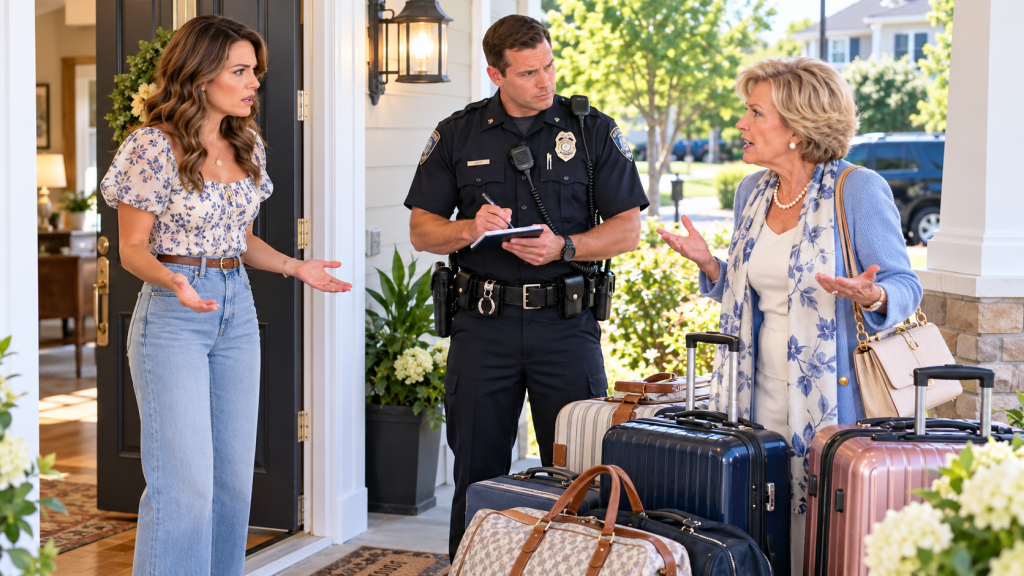
Sergeant Morales glanced between us. “Ma’am,” he said to me gently, “if you feel unsafe, we can remain while everyone gathers their belongings and leaves.” Diane snapped toward him. “Leaves?” Then she looked at me. “I’m his mother.”
I didn’t answer her.
I looked only at Mark.
“What else?”
He rubbed one hand across his mouth.
“Can we talk inside?”
“No.”
“Claire.”
“No.”
My voice didn’t rise.
It hardened.
“We’re going to talk exactly where your mother chose to make this public.”
Diane flinched.
For the first time since arriving with three suitcases, two plastic storage tubs, a houseplant, and enough entitlement to occupy a small country, she looked uncertain.
Mark glanced toward the neighbors.
Several curtains had moved.
Mr. Alvarez from across the street was pretending to retrieve his mail for what had become the longest mail collection in American history.
Mark lowered his voice.
“I may have let Mom believe I had more ownership in the house than I actually do.”
Diane stared at him.
“More ownership?”
Her laugh was short and strange.
“You told me you bought this house.”
Mark closed his eyes.
Diane stepped toward him.
“You told me Claire moved in after the wedding.”
My stomach tightened.
That was new.
Lisa whispered, “Mark…”
But Diane kept going.
“You told us you put the down payment on it.”
Mark said nothing.
“You showed me pictures when you supposedly closed.”
My head snapped toward him.
“What pictures?”
His face changed.
It was only a flicker.
But I saw it.
And suddenly I remembered something.
Four years earlier, two months before Mark and I married, he had asked me to send him photographs of the house.
Not selfies.
Not pictures of us.
Pictures of the kitchen.
The living room.
The front porch.
The backyard.
At the time, he said he wanted to show a coworker the renovation I had done.
I had been proud of that renovation.
Proud of every painted cabinet.
Every refinished floorboard.
Every Sunday afternoon I had spent carrying lumber through that front door while my friends were at brunch.
So I had sent him twelve pictures.
Maybe fifteen.
Mark had apparently been building another version of my life from them.
One in which he was the owner.
One in which I was the accessory.
I stared at him.
“You used pictures of my house to tell your family you bought it?”
“Claire, it wasn’t like that.”
Sergeant Morales gave him a look.
Even Officer Patel, who had mostly remained silent, raised an eyebrow.
Diane’s lips parted.
“I congratulated you.”
Mark looked miserable.
“I know.”
“I gave you five thousand dollars for furniture.”
I turned to him.
“What?”
He looked away.
Diane’s voice shook.
“When you said closing costs left you short, I sent you five thousand dollars.”
My heart began beating harder.
Not because of the amount.
Because Mark and I had never been short on furniture money.
Not once.
I had owned almost everything inside that house before we married.
The couch.
The dining table.
The bedroom set.
The appliances.
Even the stupid blue armchair Mark complained about but secretly fell asleep in every Sunday afternoon.
“Where did that money go?” I asked.
Mark didn’t answer.
Lisa finally lowered her phone completely.
“Mark.”
He turned toward her.
She looked frightened now.
Not angry.
Frightened.
“What?”
Lisa swallowed.
“What about the eighty thousand?”
Everything stopped.
There are moments when the world doesn’t become silent.
It becomes distant.
Cars still pass.
Trees still move.
Someone’s dog still barks three houses away.
But all of it seems to happen behind thick glass.
I heard Diane whisper, “Lisa.”
But I was already looking at Mark.
“What eighty thousand?”
Nobody answered.
I stepped off the porch.
“What eighty thousand dollars?”
Mark’s shoulders collapsed.
Lisa looked at her mother.
“I thought she knew.”
Diane’s face had gone gray.
“Knew what?”
Lisa began shaking her head.
“Mom, you told me Claire knew.”
Diane suddenly became interested in the driveway.
I felt something cold spread through my chest.
“Diane.”
She looked up.
“What eighty thousand dollars?”
Her mouth opened.
Closed.
Mark stepped forward.
“Claire, this isn’t something we should discuss with police standing here.”
Sergeant Morales answered before I could.
“Then maybe you should have considered that before your family called us.”
Mark looked at him.
The officer’s expression didn’t change.
I almost loved him for that.
I folded my arms.
“Talk.”
Diane finally spoke.
“After Robert died…”
Her voice cracked.
Robert.
Mark’s father.
He had passed away eighteen months earlier.
A heart attack at sixty-four.
He had been quieter than Diane.
Kinder.
The sort of man who always washed the dishes at family dinners while everyone else talked in the living room.
I had liked him.
After his death, Diane sold the large house she and Robert had owned for thirty-seven years and moved into a condominium.
At least, I thought she had moved into a condominium.
Diane stared at Mark.
“I gave him eighty thousand dollars.”
My throat tightened.
“For what?”
“For the addition.”
I stared at her.
“What addition?”
Diane’s eyes filled with tears.
“The apartment.”
Lisa whispered, “Oh God.”
I turned toward Mark.
“What apartment?”
Diane pointed toward the side of my house.
“He said you were adding a mother-in-law suite.”
A laugh escaped me.
It wasn’t amusement.
It was disbelief breaking under pressure.
“There is no mother-in-law suite.”
“I can see that,” Diane snapped.
Then her anger disappeared almost as quickly as it came.
She looked at Mark again.
“He said construction had been delayed.”
I shook my head slowly.
“What construction?”
“He said permits were taking longer than expected.”
“There were no permits.”
“He said materials had doubled in price.”
“There were no materials.”
“He said your contractor quit.”
“There was no contractor.”
Diane stopped speaking.
Her eyes moved from me to her son.
Something inside her finally cracked.
“Mark?”
He looked down.
“Where is my money?”
He whispered, “I was going to replace it.”
That was the moment the entire situation changed.
Until then, Diane had been an invading mother-in-law.
A woman attempting to bulldoze her way into my home because she believed her son owned it.
Now she looked smaller.
Older.
Not innocent.
But deceived.
And I realized something I hadn’t expected.
Mark hadn’t simply lied about me.
He had constructed different realities for everyone around him.
And somehow, for years, none of us had compared notes.
Diane stepped closer.
“You took Robert’s money?”
Mark’s face tightened.
“It wasn’t like that.”
“That was his life insurance.”
I closed my eyes.
Eighty thousand dollars.
Her husband’s life insurance.
Money she had probably guarded because it was one of the last tangible things Robert had left behind.
She had handed it to her son because she believed she was paying for a place beside him.
And Mark had taken it.
Diane slapped him.
The sound cracked across the driveway.
Lisa gasped.
Officer Patel stepped forward immediately.
“Ma’am.”
Diane pulled her hand back.
“I’m sorry.”
Her voice broke.
She looked at Mark.
“I am sorry.”
But she wasn’t apologizing to him.
She was apologizing to herself.
To Robert.
Maybe even to me.
Mark touched his cheek.
“Mom—”
“Don’t.”
It was the first time I had ever heard Diane tell Mark not to speak.
He obeyed.
Sergeant Morales looked at me.
“Mrs. Carter, do you want these individuals to remain on the property?”
“No.”
I answered immediately.
Mark looked at me.
“Claire.”
“You heard me.”
“This is my home too.”
I almost laughed again.
Not because the question of marital occupancy was simple.
It wasn’t.
We were married.
He lived there.
He had belongings there.
I knew enough to know that a deed wasn’t some magical wand that erased every other legal issue.
But I also knew something else.
There are moments in a marriage when the house stops being the important thing.
This was one of them.
I looked at Sergeant Morales.
“I want the incident documented. And I want his mother and sister to leave. Mark and I will handle his living arrangements through the proper process.”
Morales nodded.
That was apparently enough.
Diane stared at the luggage she had arranged beside my doorway.
Twenty minutes earlier, those suitcases had looked like a declaration of victory.
Now they looked ridiculous.
She bent to pick one up.
Lisa took another.
Neither woman looked at me.
Mark stood frozen.
Then Diane stopped.
She turned back.
“Claire.”
I waited.
Her voice was barely audible.
“Did you know anything about the apartment?”
“No.”
“Did you ever tell him I could move here?”
“No.”
“Did you ever agree to take my money?”
“No.”
She closed her eyes.
Then she asked the question that mattered most.
“Did he ever ask you?”
“No.”
Diane opened her eyes.
There was something different in them now.
Shame.
Not enough to erase what she had done.
But enough that she could finally see it.
She nodded once.
Then she dragged her suitcase toward Lisa’s car.
Before getting inside, she turned to Mark.
“I want every dollar accounted for.”
Mark didn’t respond.
Diane’s voice sharpened.
“Every dollar.”
Then she got into the passenger seat.
Lisa followed.
The car backed out slowly.
No dramatic tires.
No shouting.
No final insult.
Just two women leaving a house they had arrived believing belonged to them.
Sometimes humiliation doesn’t roar.
Sometimes it rolls quietly down a driveway carrying three suitcases and a dying fern.
The police left ten minutes later.
Sergeant Morales gave me the incident number.
“Keep your paperwork somewhere secure,” he said.
I nodded.
Then his eyes moved briefly toward Mark.
“And you may want to speak with an attorney.”
“I will.”
Mark stood beside the porch.
His face looked hollow.
When the patrol car disappeared around the corner, he finally spoke.
“You embarrassed me.”
That sentence did something extraordinary.
It erased the last shred of confusion I had.
I looked at him.
“I embarrassed you?”
“You didn’t need to show them the deed like that.”
“Your mother called the police.”
“I know, but—”
“To remove me from my own doorway.”
“I didn’t tell her to do that.”
“No. You just spent years telling her the doorway belonged to you.”
He opened his mouth.
Nothing came out.
I walked inside.
Mark followed.
“Claire.”
I turned.
“Do not follow me around this house telling me how embarrassed you are.”
He stopped.
The living room looked exactly as it had that morning.
His shoes beside the sofa.
My coffee mug on the side table.
A throw blanket folded over the chair.
Our wedding picture on the bookcase.
It was almost offensive.
How could a room remain so normal after everything inside your life had changed?
I looked at the photograph.
Mark and I were standing beneath white string lights.
My cheek against his shoulder.
His hand around my waist.
We looked happy.
Maybe we had been.
That was what hurt.
Lies do not always mean every happy memory was fake.
Sometimes the cruelest truth is that happiness and deception existed side by side.
I picked up the photograph.
Mark watched me.
“What are you doing?”
I opened the drawer beneath the bookcase and placed the frame inside.
Then I closed it.
He winced.
“Claire.”
“Where is Diane’s money?”
“I told you, I was going to replace it.”
“That wasn’t my question.”
He sat down.
I remained standing.
“Where is it?”
He rubbed both hands over his face.
“My company got into trouble.”
“What company?”
He looked at me.
“Northline.”
Northline Strategy Group.
The consulting business Mark had started two years earlier with a former college friend named Evan.
I knew the company existed.
I knew Mark worked long hours.
I knew he often complained about cash flow.
But he had always insisted it was growing.
“Northline is failing?”
He stared at the floor.
“It hit a rough patch.”
“Eighty-thousand-dollars rough?”
“Claire—”
“How much debt?”
He didn’t answer.
“How much?”
“About one hundred and forty.”
My stomach dropped.
“One hundred and forty thousand dollars?”
He nodded.
“Business debt?”
“Mostly.”
The word mostly wrapped around my throat.
“What does mostly mean?”
He stood.
“Can we sit down and talk like adults?”
“I am talking like an adult.”
“You’re interrogating me.”
“My husband just admitted taking eighty thousand dollars from his widowed mother after inventing construction on a house he doesn’t own.”
His jaw tightened.
“When you say it like that—”
“How would you like me to say it?”
He had no answer.
I stepped closer.
“What does mostly mean?”
Mark stared at me.
Then he said, “Some of it is personal.”
“How much?”
“Thirty-seven.”
“Credit cards?”
“Yes.”
“For what?”
He hesitated.
That hesitation hurt more than the number.
“For what, Mark?”
“Expenses.”
“What expenses?”
“Travel.”
“What travel?”
“Client development.”
“Then why is it personal debt?”
He stopped.
My skin went cold.
There are certain silences in a marriage that answer questions before words arrive.
“Is there someone else?”
His head snapped up.
“No.”
I searched his face.
“Do not lie to me again.”
“There isn’t.”
“Then what?”
He walked toward the kitchen.
I followed.
“Mark.”
“I made bad decisions.”
“That sentence means nothing.”
He reached the counter and gripped the edge.
“I invested.”
“In what?”
“Crypto.”
I stared at him.
He looked ashamed.
Almost insultingly ordinary.
“Crypto?”
“And options.”
I actually closed my eyes.
For months, I had imagined marital disasters as enormous things.
Affairs.
Secret children.
Second families.
Criminal enterprises.
It had never occurred to me that my marriage might be destroyed by a man staring at a laptop at midnight convincing himself a falling number would eventually rise.
“How much did you lose?”
“I don’t know exactly.”
“Then find out.”
“Claire.”
“Find out.”
He took out his phone.
After several minutes he gave me a number.
Sixty-three thousand dollars.
Gone.
Not temporarily inaccessible.
Not tied up in an investment.
Gone.
I sat down.
Mark moved toward me.
I held up my hand.
“Don’t.”
He stopped.
A terrible calm settled over me.
“What was the eighty thousand for?”
“I used part of it to pay company vendors.”
“How much?”
“Forty.”
“And the rest?”
“Debt.”
“Your debt?”
“Yes.”
I looked at him.
“So you stole your mother’s life-insurance money to cover losses you hid from your wife.”
His eyes flashed.
“I didn’t steal it.”
“What do you call taking money for construction that never existed?”
“I intended to build the apartment.”
“Did you?”
“No.”
“Did you hire an architect?”
“No.”
“Did you request estimates?”
“No.”
“Did you apply for permits?”
“No.”
“Did you even tell the owner of the house?”
Silence.
I nodded.
“That’s what I thought.”
He leaned against the counter.
“I was trapped.”
“No. You were dishonest.”
“I was trying to fix things.”
“No. You were trying to keep everyone from discovering what you had already done.”
“That’s the same thing.”
“It is absolutely not the same thing.”
My voice finally rose.
He went quiet.
I stood.
“You know what fixing things looks like? You tell the truth when the damage is still small. You admit the company is failing. You tell your wife about the debt. You tell your mother you cannot take her money. You sell something. You close the business. You get another job. You accept embarrassment.”
I pointed toward the driveway.
“That is what you were trying to avoid.”
His face tightened.
“Embarrassment.”
I could see the truth land.
It was almost sad.
Mark had been willing to risk money.
Family.
Marriage.
Even his mother’s security.
Anything except looking unsuccessful.
I looked around the kitchen.
Suddenly every detail seemed suspicious.
Every late meeting.
Every conference.
Every payment I didn’t recognize.
Every time he had said, “Don’t worry about it.”
“What else?”
He shook his head.
“That’s everything.”
I stared at him.
He looked directly at me.
And lied.
Again.
I knew because his left thumb moved.
It rubbed against the side of his index finger.
A tiny nervous gesture I had watched for seven years.
He did it when negotiating.
When nervous.
When bluffing.
When trying to convince someone he was calm.
I felt something inside me go still.
“What else, Mark?”
“Nothing.”
His thumb moved again.
I almost smiled.
Not because anything was funny.
Because suddenly I understood the enormous advantage of no longer needing to believe him.
“All right.”
He blinked.
“That’s it?”
“For tonight.”
I walked upstairs.
“Claire?”
I stopped halfway.
“You should pack a bag.”
His face changed.
“You’re kicking me out?”
“I’m telling you that I need space.”
“This is my residence.”
“And I am not physically removing you. I’m asking my husband, who has just admitted deceiving me and taking tens of thousands of dollars from his mother, to spend several nights somewhere else while I speak to an attorney.”
He stared at me.
“If you refuse, I won’t fight with you.”
That unsettled him.
Because fighting meant engagement.
Fighting meant maybe I still wanted something from him.
I didn’t.
Not at that moment.
I was already calculating.
Not revenge.
Protection.
There is a difference.
At 10:43 that night, Mark left with a suitcase.
At 10:51, I locked the door.
Then I sat on the kitchen floor and cried so hard I could barely breathe.
Not gracefully.
Not silently.
Not like women cry in movies, where tears roll down perfect cheeks and somehow mascara remains respectful.
I cried with my palms against the tile.
I cried until my ribs hurt.
I cried for the house.
For Diane’s money.
For Robert.
For the wedding photograph in the drawer.
For every time I had defended Mark when someone called him arrogant.
For every night I had fallen asleep beside someone who had apparently been constructing a maze of lies around me.
And somewhere near midnight, I realized the worst part.
I still loved him.
Not the man from that afternoon.
The man I thought he had been.
And grief doesn’t care whether the person you are mourning is dead.
Sometimes they are simply standing in a hotel room ten miles away, alive enough to text you.
Mark sent eleven messages that night.
I read none of them.
At 1:17 a.m., my phone rang.
It was Diane.
I almost ignored it.
Then I answered.
Neither of us spoke for several seconds.
Finally she said, “I’m sorry.”
I sat on the edge of my bed.
“For what part?”
The question was harsher than I intended.
But Diane accepted it.
“All of it.”
I waited.
“I shouldn’t have come there like that.”
“No.”
“I shouldn’t have called the police.”
“No.”
“I shouldn’t have spoken to you the way I did.”
“No.”
She exhaled.
“I thought you were taking advantage of him.”
The sentence almost made me laugh.
Instead I said, “Why?”
“Because that’s what he told me.”
My hand tightened around the phone.
“What exactly did he tell you?”
Diane was silent.
Then she started talking.
And for the next forty minutes, my marriage became a story I barely recognized.
According to Mark, he had bought the house six months before our wedding.
According to Mark, I had been struggling with student loans and moved in with him to save money.
According to Mark, he paid the mortgage.
According to Mark, he had renovated the kitchen.
According to Mark, I was not on the deed because my credit score was poor.
I almost interrupted at that one.
My credit score had been over 800 when we married.
But Diane continued.
According to Mark, I wanted to add my name eventually, but he was reluctant because I was “impulsive with money.”
That one made me close my eyes.
I had been the saver.
The planner.
The person with spreadsheets.
The person who had spent six years building the down payment for the house.
Meanwhile Mark had apparently been turning my financial discipline into evidence of his.
“He said you resented me,” Diane whispered.
I laughed once.
There was no humor in it.
“He said I was jealous of your relationship.”
“He told me you didn’t like me staying over because you wanted to isolate him from his family.”
I rubbed my forehead.
“Diane, you stayed with us for seventeen days after your surgery.”
“I know.”
“I cooked for you.”
“I know.”
“I drove you to physical therapy.”
“I know.”
Her voice broke.
“I know that now.”
Something inside me softened.
Not forgiveness.
Not yet.
But recognition.
Mark had not simply manipulated one woman against another.
He had fed each of us a version of the other designed to keep us from comparing reality.
“Why were you moving in today?” I asked.
Diane hesitated.
“My condo closes Monday.”
I froze.
“What?”
“I sold it.”
I stood.
“You sold your condo?”
“He said construction was nearly finished.”
I stared at the wall.
“There is no construction.”
“I understand that.”
“Where were you supposed to live?”
There was a long pause.
“With you.”
I shut my eyes.
Diane began crying.
Quietly.
“I packed everything.”
My anger moved somewhere complicated.
She had arrived at my door acting like a conqueror because she believed she had already paid for the right to be there.
It didn’t excuse her behavior.
But it explained the certainty.
“What happened to the furniture?”
“Storage.”
“Where are you now?”
“With Lisa.”
I exhaled.
“At least you have somewhere to stay.”
“For now.”
We were silent again.
Then Diane said, “Claire?”
“Yes?”
“Do you think he stole from you too?”
I didn’t answer.
Because until that moment, I had been afraid to ask myself the same question.
At 7:03 the next morning, I was sitting at the kitchen table with my laptop open.
I had slept maybe ninety minutes.
The house was gray with early light.
Mark’s coffee mug was still in the drying rack.
His coat was gone.
His shoes were gone.
But his life was everywhere.
I started with the joint checking account.
At first, nothing looked catastrophic.
Mortgage.
Utilities.
Groceries.
Insurance.
Normal life arranged into neat columns.
Then I went backward.
Six months.
Nine months.
Twelve.
There were transfers.
Small enough that I had ignored them.
Two thousand.
Three thousand.
Fifteen hundred.
Twenty-five hundred.
Always from our joint household account into an account labeled NLSG OPERATING.
Northline Strategy Group.
I counted.
Then counted again.
Twenty-eight thousand four hundred dollars.
My hands went cold.
Our joint household account was funded unevenly.
Not because I objected.
Mark’s income fluctuated with his business, so I had often contributed more.
Sometimes much more.
I had assumed the transfers were temporary business reimbursements.
I searched my email.
Nothing.
No explanations.
No repayment.
I checked the savings account we used for taxes and home repairs.
The balance was lower than I remembered.
Much lower.
I pulled statements.
Seven withdrawals over nine months.
Total: $31,600.
Every withdrawal had been initiated from Mark’s login.
I called the bank.
The representative could confirm transaction history but not intent.
So I printed everything.
By 8:30, my dining table was covered with paper.
At 8:47, my phone rang.
Unknown number.
Normally I would have ignored it.
I answered.
“Is this Claire Carter?”
“Yes.”
“My name is Abigail Monroe. I’m calling from Harbor Federal Lending regarding an application associated with your property.”
Every hair on my arms lifted.
“What application?”
Silence.
Then the woman’s tone changed.
“You’re not aware of it?”
I stood slowly.
“No.”
She became careful.
Professional.
“I can’t discuss certain details until I verify your identity.”
We went through verification.
Then she told me.
A home-equity line application had been submitted eleven days earlier.
Amount requested:
$225,000.
Property:
My house.
Applicants:
Mark Carter.
Claire Carter.
I gripped the table.
“I did not apply for that.”
The woman went silent.
“Ms. Carter, are you saying you did not authorize this application?”
“That is exactly what I am saying.”
My knees weakened.
I sat.
She asked several questions.
Had I signed documents?
No.
Had I uploaded identification?
No.
Had I spoken with their loan department?
No.
Had I given Mark authority to apply on my behalf?
No.
The application had already been flagged because the ownership information from the county records did not match the way it had initially been represented.
That was why they had been attempting to contact me.
My personal email on the application was wrong by one letter.
My phone number had one digit changed.
Not enough to look fake.
Enough to make sure I didn’t receive anything.
Then Abigail said something that made my hands shake.
“We also received a document purporting to show a transfer of partial ownership.”
I stopped breathing.
“What document?”
“A deed.”
I stared at the actual deed lying on my dining table.
The one Sergeant Morales had held the previous afternoon.
The one showing my name.
Only my name.
“That document is false.”
She went very quiet.
I heard keyboard typing.
“Ms. Carter, I need to escalate this immediately.”
I closed my eyes.
Suddenly Mark’s words from the night before echoed through my head.
That’s everything.
His thumb rubbing his finger.
That’s everything.
I almost laughed.
Of course it wasn’t.
Liars rarely confess everything.
They confess whatever they believe you can already prove.
I spent the next three hours making calls.
Bank.
Attorney.
Credit bureaus.
Insurance company.
My employer’s benefits office because I wanted every financial account connected to me reviewed.
I changed passwords.
I preserved statements.
I downloaded documents.
I placed alerts on accounts.
I did not touch Mark’s property.
I did not destroy anything.
I did not post anything online.
I did not call him.
For the first time in two days, I felt something besides shock.
I felt methodical.
At noon, I met with a family-law attorney named Rebecca Shaw.
She was in her fifties, wore red glasses, and had the unnerving habit of letting people finish sentences without interrupting.
I told her everything.
When I finished, she removed her glasses.
“Do you love your husband?”
The question surprised me.
“Yes.”
She nodded.
“That wasn’t legal advice. I wanted to know what we’re dealing with emotionally.”
I stared at the folder in my lap.
“I don’t know who he is.”
“That’s different.”
“Yes.”
She leaned back.
“Do you want to save the marriage?”
My throat tightened.
“Can you save a marriage if one person has been living in a different version of it?”
Rebecca didn’t answer.
Maybe because she knew I wasn’t asking her.
She explained what she could do.
She explained what I should preserve.
She explained that property ownership, marital rights, debts, alleged fraud, and occupancy were separate issues and needed to be handled carefully.
Most importantly, she told me not to let rage make decisions my future self would have to clean up.
That sentence stayed with me.
When I left her office, there were twenty-three missed calls from Mark.
One message from Lisa.
Please call me. I found something.
I called her.
She answered immediately.
“Claire?”
“What did you find?”
No greeting.
No apology.
I didn’t have the energy.
Lisa inhaled.
“Mark left his old laptop at Mom’s place months ago.”
I waited.
“He gave it to her after she spilled coffee on hers. She never really used it.”
“Okay.”
“He was still logged into his email.”
My stomach tightened.
“Lisa, don’t delete or alter anything.”
“I’m not.”
“What did you find?”
“Messages between him and someone named Trevor Lane.”
I knew the name.
Trevor had worked with Mark at his previous company.
“What kind of messages?”
Lisa swallowed.
“About the house.”
I gripped the steering wheel.
“What about it?”
“He sent Trevor photos.”
My eyes closed.
Of course he did.
“He called it an investment property.”
“What?”
“He said you and he were renovating it to sell.”
“That makes no sense.”
“I know.”
“What else?”
“He told Trevor he could guarantee a loan using equity in the property.”
I felt sick.
“How much?”
“Fifty thousand.”
“Did Trevor give him money?”
“I think so.”
I stared through the windshield.
People walked across the shopping-center parking lot carrying coffee and grocery bags.
Normal life.
Again.
Always continuing.
“When?”
“Last year.”
I whispered, “Oh my God.”
Lisa’s voice cracked.
“I’m sorry.”
Then she said something else.
“I think there are more people.”
I went very still.
“What do you mean?”
“There’s a spreadsheet.”
Of course there was.
Mark loved spreadsheets.
So did I.
Perhaps that was our true marital compatibility.
Two people organizing completely different realities in columns.
“What spreadsheet?”
“It has names. Amounts. Dates.”
“How many names?”
“Six.”
I closed my eyes.
“Don’t send it around. Preserve what you found and talk to an attorney before accessing anything else.”
“I already told Mom.”
“Of course you did.”
“Claire…”
“What?”
“I owe you an apology.”
I said nothing.
“You didn’t deserve yesterday.”
“No.”
“I believed him.”
“You also enjoyed believing him.”
Silence.
That was the difference.
Diane had been deceived.
Lisa had been deceived too.
But Lisa had also taken pleasure in what she believed was my humiliation.
I remembered the way she lifted her phone.
Mom, call the police.
She had wanted footage.
Wanted drama.
Wanted proof that Claire finally got put in her place.
“I did,” she whispered.
“At least you’re admitting it.”
“I’m sorry.”
I closed my eyes.
“I’m not ready to forgive you.”
“I understand.”
That surprised me.
The Lisa I knew would have defended herself.
But maybe the last twenty-four hours had altered all of us.
I hung up.
Then I called Rebecca.
By evening, the story had become larger again.
Trevor Lane confirmed through his attorney that he had loaned Mark fifty thousand dollars.
Mark had represented that he had substantial equity in the house.
Trevor had never seen the deed.
Why would he?
He had known Mark for twelve years.
He trusted him.
There were five other names in Lisa’s spreadsheet.
Three appeared to be investors in Northline.
Two were personal acquaintances.
Altogether, the amounts listed exceeded $180,000.
That did not include Diane’s eighty thousand.
It did not include money taken from our joint accounts.
It did not include the attempted home-equity line.
It did not include credit-card debt.
By Friday afternoon, Mark’s hidden financial hole was approaching half a million dollars.
And I began to understand why he had told Diane she could move in.
Not because he wanted his mother there.
Not because he had suddenly become devoted.
He needed to maintain the lie.
Her condo had sold.
Her boxes were packed.
If she discovered there was no apartment, she would demand her money.
If she demanded her money, he couldn’t pay her.
If he couldn’t pay her, questions would start.
The home-equity application was supposed to be the answer.
Two hundred twenty-five thousand dollars.
Enough to pay Diane.
Enough to silence Trevor.
Enough to keep Northline alive a few more months.
Enough to move debts around.
Enough to postpone the collapse.
That was Mark’s entire strategy.
Not solving.
Postponing.
The next disaster always existed thirty days in the future.
Until Diane called 911.
That was the irony.
The woman who had spent years believing I was the threat to her son had accidentally detonated the lie protecting him.
Friday evening, Mark appeared at my door.
I saw him through the security camera.
He looked exhausted.
Unshaven.
He knocked.
I didn’t answer.
Then my phone rang.
I picked up.
“What?”
“I need clothes.”
“Rebecca arranged a time tomorrow for you to collect what you need.”
“I need them tonight.”
“No.”
“This is ridiculous.”
“No, Mark. What was ridiculous was attempting to use my house to borrow two hundred twenty-five thousand dollars.”
Silence.
Long.
Heavy.
“How did you know about that?”
I almost smiled.
There it was.
Not I didn’t do it.
Not what are you talking about?
How did you know?
I stared at him through the camera.
“Goodnight.”
“Claire.”
“You lied to the lender.”
“Listen to me.”
“You submitted documents I never signed.”
“I can explain.”
“You listed me as an applicant.”
“It wasn’t finalized.”
“That is not a defense.”
“I was going to cancel it.”
“When?”
“When I got other financing.”
“So after pretending I agreed to risk my house, you planned to cancel the lie if another lie worked first?”
He closed his eyes.
“I was desperate.”
“That word is becoming your favorite excuse.”
“You don’t know what pressure I was under.”
For the first time, I became truly angry.
Not hurt.
Not stunned.
Angry.
“You are right.”
I walked toward the door but did not open it.
I stood on the other side.
“You know whose pressure I understood?”
He looked toward the wood between us.
“Mine.”
My voice shook.
“The pressure of paying most of our household expenses because my husband said his business needed time.”
Silence.
“The pressure of smiling at family dinners while your mother made comments about how lucky I was to live in your house.”
He said nothing.
“The pressure of being called controlling because I wanted budgets.”
I wiped tears from my face.
“The pressure of questioning whether I was selfish every time you told me I worried too much about money.”
His forehead lowered against the door.
“Claire…”
“No.”
My voice broke.
“You do not get to stand there and tell me about pressure when your solution to pressure was to distribute it secretly to everyone who loved you.”
He stepped back.
I could see tears in his eyes through the camera.
Maybe they were real.
I think they were.
That almost made it worse.
“I love you,” he whispered.
I closed my eyes.
“I believe you.”
He stared at the door.
I surprised both of us.
Because I did believe him.
Somewhere inside all that deception, Mark probably did love me.
But love without truth is not safety.
Love without respect is not partnership.
Love used as a reason someone should tolerate betrayal becomes another form of manipulation.
“I believe you loved me,” I said.
“Then open the door.”
“No.”
“Please.”
“No.”
“Why?”
I rested my palm against the wood.
“Because loving me did not stop you.”
He began crying.
Quietly.
So did I.
There we stood.
Husband and wife.
Three inches of wood between us.
Seven years of memories behind us.
And more lies than either of us could count.
Finally, he whispered, “Can we fix this?”
I wanted to say yes.
God, I wanted to.
I wanted a world where people confessed and cried and then repaired everything.
I wanted our Sunday mornings.
I wanted our ridiculous arguments about thermostat settings.
I wanted him falling asleep in the blue chair.
I wanted the man who once drove three hours because I called him crying after my aunt died.
I wanted the version of my husband who held my hand under restaurant tables.
But wanting a person does not make them safe to build a life with.
“I don’t know,” I said.
It was the truth.
His shoulders shook.
“Please don’t give up on us.”
“I didn’t.”
He looked up.
“You did.”
Then I ended the call.
Mark stood outside another three minutes.
Then he walked away.
The following morning, he came with his attorney to collect clothes and work equipment.
I stayed upstairs.
Rebecca handled most of it.
Before leaving, Mark placed an envelope on the kitchen counter.
My name was written on the front.
Claire.
I didn’t open it until that night.
The letter was six pages.
Handwritten.
The first page apologized.
The second explained.
By the third, explanations became confessions.
Mark had begun lying about the house shortly after we got engaged.
He had felt embarrassed because I owned property and he didn’t.
His older cousins owned businesses.
Lisa had married a surgeon.
His father had always been careful with money.
Mark felt behind.
Small.
So when Diane assumed he was helping me buy the house, he didn’t correct her.
That was the first lie.
Tiny.
Almost effortless.
Then she congratulated him.
Robert told him he was proud.
And Mark discovered how easy admiration could be when nobody checked the paperwork.
So the lie grew.
He became the buyer.
Then the provider.
Then the owner.
After we married, Diane occasionally questioned why I made household decisions.
Mark told her I was controlling.
When I objected to unexpected visitors, he told her I was territorial about “his” home.
When I paid for a new roof, he told her he had paid.
When I refinanced my original mortgage into a better rate before marriage and later paid aggressively toward it, he told his family he was responsible.
Piece by piece, he moved himself into the center of achievements he had not earned.
The financial problems began later.
Northline lost two clients.
Instead of telling me, he used credit.
When the credit grew, he borrowed.
When borrowing became difficult, he exaggerated assets.
When his mother offered money after Robert died, Mark saw a bridge.
He told himself he would repay it in six months.
Then twelve.
Then after the next contract.
Then after the next investment recovered.
Then after the home-equity line.
Every lie was supposed to be temporary.
That sentence appeared three times.
Temporary.
Temporary.
Temporary.
At the end, he wrote:
I kept thinking I was protecting the version of me that everyone respected.
I didn’t understand I was destroying the only version of me that was real.
I folded the letter.
Then I cried again.
Not because it changed my decision.
Because for the first time, I understood him.
And understanding someone is dangerous when you are trying to leave.
It makes anger less clean.
There was no monster in the letter.
Just a frightened man who had chosen cowardice so many times it became character.
Two weeks passed.
Investigations began.
Attorneys spoke.
Banks requested records.
Northline stopped operating.
Mark’s business partner Evan claimed he had known the company was struggling but not about Mark’s personal borrowing.
Several people demanded repayment.
Diane hired her own attorney.
That surprised Mark more than anything.
He called her.
She didn’t answer.
He went to Lisa’s house.
Diane refused to see him.
For the first time in Mark’s life, his mother stopped rescuing him.
I learned this from Lisa.
She and I had begun exchanging occasional messages.
Only factual ones at first.
Then one evening she sent:
Mom cries every night.
I stared at the words.
Then wrote:
So do I.
Lisa replied:
I know.
Something shifted after that.
Not friendship.
Maybe honesty.
A week later, Diane asked to meet me.
I almost refused.
Then I agreed.
We met at a small café nowhere near my house.
Neutral territory.
She looked ten years older.
No perfect lipstick.
No jewelry except her wedding ring.
She sat down across from me.
For the first time since I had known her, Diane didn’t begin the conversation.
I did.
“How are you?”
She laughed bitterly.
“I sold my home and gave part of my husband’s life insurance to a son who lied to me. I’ve been better.”
Fair.
I nodded.
A waitress brought coffee.
Diane wrapped both hands around the cup.
“I owe you more than an apology.”
“You already apologized.”
“No.”
She looked at me.
“I apologized for the porch.”
Her eyes filled.
“I owe you an apology for years.”
I said nothing.
“I believed every bad thing he told me about you because it was convenient.”
That was almost exactly what I had told Lisa.
Diane continued.
“If you were controlling, then Mark wasn’t irresponsible.”
Her voice trembled.
“If you were cold, then Mark wasn’t selfish.”
She looked down.
“If you were taking advantage of him, then I could keep believing my son was the generous one.”
She wiped her cheek.
“I liked the version of the story where you were the problem.”
That honesty hurt.
But it also mattered.
“I didn’t make it difficult for him to lie,” she continued. “I made it comfortable.”
I looked at her.
“I don’t think you caused what he did.”
“No.”
She nodded.
“But I helped create a place where he never had to admit being wrong.”
That sounded true.
Diane had defended Mark through everything.
Bad grades.
Failed jobs.
Arguments.
Broken commitments.
Every mistake somehow became somebody else’s fault.
Maybe Mark had learned that confession was unnecessary if explanation came fast enough.
Diane reached into her purse.
She removed something.
A photograph.
My breath caught.
Robert.
He stood beside Mark at our wedding.
Both smiling.
Diane slid it toward me.
“This was taken before the ceremony.”
I picked it up.
On the back, Robert had written:
Proud of the man you became.
My eyes burned.
Diane looked away.
“He carried that picture in his wallet.”
I swallowed.
“I think that’s why Mark kept lying.”
“To protect that?”
She nodded.
“The version of himself his father believed in.”
For the first time, I felt something close to compassion for Mark.
Not enough to undo anything.
But enough to grieve more accurately.
Diane stared at her coffee.
“Claire?”
“Yes?”
“If you divorce him, I won’t blame you.”
I smiled sadly.
“That’s generous.”
“I mean it.”
“I know.”
She took a breath.
“If you don’t divorce him…”
I waited.
“I still won’t ask you to forgive him quickly.”
That surprised me more.
Diane looked directly at me.
“I spent his whole life teaching him that consequences were cruelty.”
Her mouth trembled.
“They weren’t.”
She pushed the photo toward me.
“Keep that.”
“I shouldn’t.”
“Please.”
I did.
Before we left, Diane stopped beside the café door.
“Claire?”
I turned.
She gave a small, embarrassed smile.
“For what it’s worth…”
“Yes?”
“You have a beautiful house.”
I almost laughed.
“So I’ve been told.”
She laughed too.
For one strange second, we were simply two exhausted women standing in a café, sharing the ruins left by the same man.
Then she said, “I finally understand why you were so protective of it.”
I looked at her.
“It was never really about the house.”
She nodded.
“I know.”
Three months later, the criminal and civil questions were still unfolding.
Some things moved slowly.
Some debts were disputed.
Some claims were settled.
The fraudulent lending application remained under investigation.
Mark cooperated.
That mattered.
Not enough to erase what he had done.
But it mattered.
He sold his car.
Liquidated what investments remained.
Closed Northline.
Moved into a small apartment.
Started working for an established firm instead of trying to rebuild another business immediately.
He entered therapy.
I knew because once a week, he emailed me a brief update.
I had told him not to send apologies every day.
Not to send flowers.
Not to appear at the house.
Not to ask friends to intervene.
If he wanted any possibility of speaking to me again, he needed to respect silence.
For once, he did.
His emails contained no pressure.
No “I miss you.”
No “come back.”
Just facts.
I met with Dr. Levin today.
I transferred another payment to Mom.
Trevor received the first repayment under the settlement.
I gave my attorney access to the remaining accounts.
I am not asking you for anything.
At first, I deleted the emails after reading.
Then I stopped deleting them.
I didn’t know what that meant.
Six months after the porch incident, I filed for divorce.
Signing the papers was harder than discovering the debt.
People imagine divorce as anger.
Mine felt like surgery.
Necessary.
Precise.
Devastating.
Rebecca placed the final page in front of me.
I held the pen.
For ten minutes, I could not move.
“You can take your time,” she said.
I looked through the conference-room window.
Cars moved along the street below.
Somewhere, somebody was getting married.
Somebody was buying a house.
Somebody was telling a tiny lie they thought would never matter.
I thought about Mark at twenty-nine, standing in my unfinished kitchen holding a paint roller.
He had paint on his cheek.
I had laughed at him.
He kissed me and left a blue streak on my nose.
That memory was real.
So was the loan application.
So was Diane’s eighty thousand.
So were the years of lies.
People become desperate to label relationships after they end.
Real or fake.
Good or bad.
Love or manipulation.
Mine had been more painful than that.
It had been real love inside an unsafe structure.
And eventually, the unsafe part became stronger.
I signed.
My hand shook.
Rebecca quietly collected the pages.
I went to my car.
Then I sat behind the wheel and screamed.
One scream.
Loud.
Ugly.
Animal.
Then I put my forehead on the steering wheel and whispered goodbye to a marriage that had ended months before the paperwork caught up.
Mark did not fight the divorce.
That was perhaps the last loving thing he did for me.
He could have made things ugly.
He could have argued over every object.
Every account.
Every technicality.
He didn’t.
Through attorneys, he acknowledged that the house was mine.
He waived any claim he might have attempted to make against it in exchange for an overall financial settlement Rebecca considered fair.
I kept the house.
He kept his personal belongings.
The debts created without my authorization remained the subject of separate legal arrangements and investigations.
The final divorce hearing lasted less than twenty minutes.
Seven years of marriage reduced to questions.
Name?
Yes.
Date?
Yes.
Irretrievably broken?
I hesitated.
Then answered.
“Yes.”
That was it.
Outside the courthouse, Mark waited near the steps.
He wasn’t supposed to.
But I didn’t mind.
Not anymore.
He looked different.
Thinner.
Less polished.
There was no expensive watch on his wrist.
No perfect haircut.
No performance.
Just Mark.
“Hi,” he said.
“Hi.”
We stood awkwardly.
Then he handed me a small box.
I frowned.
“I don’t want anything.”
“It’s yours.”
I opened it.
My breath caught.
Inside was the spare brass key to the house.
The one he had carried for years.
I looked at him.
He swallowed.
“I should have returned it earlier.”
My eyes filled.
“It’s okay.”
“No.”
He shook his head.
“It isn’t.”
He looked toward the courthouse.
“I spent so long pretending that house meant I had succeeded.”
I closed the box.
“I know.”
“I didn’t understand why you loved it.”
I looked at him.
“It wasn’t the price.”
“No.”
“It wasn’t the neighborhood.”
“No.”
“It was because you built a life there before me.”
I nodded.
He wiped his eyes.
“And I turned it into a prop.”
The words hurt because they were accurate.
“I’m sorry.”
This time he didn’t add an explanation.
No pressure.
No desperation.
Just two words.
I believed them.
“I know.”
He smiled faintly.
“Diane tells me you two had coffee.”
“She told you?”
“She tells everyone.”
I laughed.
He laughed too.
Then the laughter died.
Mark looked at me.
“I did love you.”
“I know.”
“I still do.”
My throat tightened.
“I know that too.”
He nodded.
For one dangerous second, I wanted to hug him.
Maybe he saw it.
Because he stepped backward.
That was the moment I knew therapy had changed something.
The old Mark would have stepped forward.
Would have used my emotion.
Would have tried to turn tenderness into another chance.
This Mark gave me space.
“I hope you have a good life, Claire.”
I cried.
“I hope you build one you don’t have to lie about.”
He closed his eyes.
Then nodded.
“Me too.”
He walked down the courthouse steps.
I watched him until he disappeared around the corner.
And that was the last time I saw my husband.
Not Mark.
I saw Mark again.
But the husband version of him ended there.
A year passed.
Then another.
Life became quiet.
Beautifully, wonderfully quiet.
I repainted the kitchen.
Not because it needed painting.
Because I wanted a color Mark had always hated.
Green.
Deep olive green.
When Diane saw it, she laughed for five straight minutes.
Yes.
Diane came over sometimes.
That was perhaps the strangest twist of all.
We did not become best friends.
Life is not that sentimental.
But we became something I had never expected.
Honest.
She rented a small townhouse near Lisa.
Eventually, Mark repaid a significant portion of what he owed her under a structured agreement.
She never recovered everything immediately.
Neither did the others.
Some losses took years to repair.
Some trust never came back.
Diane stopped making excuses for him.
Lisa stopped filming family arguments.
I considered that progress for civilization.
Once, during Christmas dinner, Lisa raised her phone.
Diane pointed a fork at her.
“If you record anybody without asking, I will throw that thing into the gravy.”
I laughed so hard wine came out my nose.
Families change in strange ways.
Mine certainly did.
I also learned things about myself.
For years I had believed strength meant remaining calm.
Being reasonable.
Not making scenes.
Not becoming “difficult.”
But there had been moments in my marriage when calmness had become silence.
I had noticed inconsistencies.
Mark dismissing questions.
Numbers not matching.
Stories changing.
I had let too many things go because I wanted to be trusting.
There is a difference between trust and refusing to look.
I learned that the hard way.
Two years after the divorce, I replaced the front door.
The old one was fine.
Perfectly functional.
But every time I looked at it, I remembered Diane standing there with her luggage.
Lisa holding her phone.
The police cruiser in the driveway.
Mark staring at the pavement.
It had become a monument to the worst afternoon of my life.
So I replaced it with a blue wooden door with a narrow pane of glass.
The contractor removed the old one and asked whether I wanted to keep it.
I stared at it lying in the driveway.
The doorway Mark’s family once tried to force me out of.
The door I later stood behind while my husband begged me to open it.
The door that separated my old life from the truth.
“No,” I said.
“Take it.”
And he did.
I thought I would feel something dramatic.
Instead, I made tea.
That was healing too.
Not every symbol requires a speech.
Sometimes you replace a door.
Sometimes you drink tea.
Sometimes Tuesday simply becomes Tuesday again.
Three years after the divorce, I received an envelope.
No return address.
Inside was a check.
Not to me.
A photocopy.
It showed the final repayment Mark had made to Diane.
Eighty thousand dollars, repaid over years, plus an additional amount representing what his attorney had calculated as interest.
Under the copy was a note in Diane’s handwriting.
He finished.
I sat at my kitchen table for a long time.
Then I smiled.
Not because I wanted him back.
Not because repayment erased what happened.
It didn’t.
But because consequences had finally become something Mark could survive without lying.
I texted Diane.
I’m glad.
She replied:
Me too.
Then, thirty seconds later:
Still doesn’t mean he gets Christmas dinner without bringing dessert.
I laughed.
Mark eventually moved to Colorado.
He became a financial operations manager for a manufacturing company.
Not an owner.
Not a founder.
Not a visionary entrepreneur.
An employee.
The first time Diane told me that, she sounded almost apologetic.
Then she stopped herself.
“He likes it,” she said.
“Good.”
“He says going home at five feels like being rich.”
I understood exactly what he meant.
Peace becomes luxurious after chaos.
Several years later, Mark remarried.
I learned through Diane.
She asked whether I wanted to know.
I surprised myself by saying yes.
The woman’s name was Anna.
She was a teacher.
Before they married, Mark apparently told her everything.
Not the polished version.
Everything.
Debt.
Divorce.
The house.
The forged paperwork.
The years of repayment.
All of it.
Anna called Diane to verify parts of the story.
When Diane told me that, I laughed.
“What did you say?”
“The truth.”
“All of it?”
“Every humiliating word.”
“Good.”
She smiled.
“I told her to run a credit check too.”
I nearly choked on my coffee.
Growth.
Beautiful growth.
I never met Anna.
I didn’t need to.
But I hoped Mark loved her honestly.
That was enough.
As for me, I stayed single longer than everyone thought I should.
People became nervous about it.
Friends tried matchmaking.
Coworkers suggested dating apps.
Lisa once attempted to introduce me to a divorced orthodontist at Thanksgiving.
I threatened to leave.
She immediately apologized.
Diane whispered, “He did have nice teeth.”
I kicked her gently beneath the table.
Eventually, I did date.
Slowly.
Carefully.
Not fearfully.
There is a difference.
I met someone named Daniel at a neighborhood charity event.
He was a civil engineer.
Quiet.
Funny.
Divorced.
He owned exactly one bicycle and talked about it as though it were a member of his immediate family.
Our first date lasted four hours.
Our second ended after ninety minutes because neither of us felt well.
That impressed me more than the first.
No performance.
No pretending.
By our sixth date, Daniel knew the story of the house.
Not every detail.
But enough.
He listened.
Then said, “That must have been awful.”
I waited.
For advice.
A joke.
A declaration that he was different.
None came.
He just reached across the table and held my hand.
Three years later, when we decided to marry, Daniel suggested we meet with attorneys.
Separate attorneys.
He wanted agreements.
Clear ownership.
Clear finances.
Full disclosures.
Five years earlier, I might have found that unromantic.
Instead, I kissed him.
Nothing had ever felt more romantic.
Before our wedding, Daniel moved into my house.
My house.
I told him that explicitly.
He laughed.
“Trust me, I have been briefed.”
“By whom?”
“Diane.”
I stared at him.
“You talked to Diane?”
“She gave me a forty-minute presentation.”
I groaned.
“She had slides?”
“No slides.”
He paused.
“Printed bullet points.”
I covered my face.
“What did she say?”
Daniel smiled.
“Mostly that if I ever claim I own this house, she’ll personally call Sergeant Morales.”
I laughed until I cried.
Sometimes the place where trauma began eventually becomes the place where you discover it no longer owns you.
On the morning of my wedding to Daniel, Diane arrived early.
She carried flowers.
No suitcases.
I opened the blue door.
For half a second, both of us froze.
Then we burst out laughing.
“Too soon?” she asked.
“It’s been eight years.”
“So still too soon?”
“Probably.”
She hugged me.
A real hug.
No tension.
No performance.
Then she whispered, “Thank you.”
“For what?”
“For not hating me forever.”
I pulled back.
“I hated you for a while.”
“I know.”
“You were terrible.”
“I know.”
“You called the police on me.”
“I know.”
“You tried to move into my house.”
“I was having a bad week.”
I laughed.
Then she became serious.
“Claire.”
“Yes?”
“If I hadn’t called them…”
I knew exactly what she meant.
If Diane had never called 911, Sergeant Morales would never have asked for the deed.
Mark might have kept the illusion alive.
The home-equity application might still have failed.
Maybe I would have discovered everything through the lender.
Maybe another creditor.
Maybe another lie.
Or maybe months would have passed.
More money lost.
More damage.
More deception.
Life turns on ridiculous hinges.
A phone call.
A folder.
A question.
Who is listed on the deed?
I squeezed Diane’s hand.
“You gave me the worst afternoon of my life.”
She nodded.
“Sorry.”
“And accidentally gave me the truth.”
Her eyes filled.
“I’m sorry for that too.”
“No.”
I smiled.
“Don’t be.”
The wedding was small.
Daniel and I exchanged vows beneath the oak tree in the backyard.
The same backyard Mark once photographed so he could pretend the house was his.
That thought came to me during the ceremony.
And for a moment, I worried it would ruin everything.
Instead, I looked around.
At the lights.
At the people.
At Diane crying openly in the second row.
At Lisa actually keeping her phone inside her purse.
At Daniel standing in front of me.
And I realized the house had survived all of us.
Brick.
Wood.
Glass.
Nothing more.
The meaning came from what happened inside it.
For years, I had believed keeping the house was my victory.
It wasn’t.
The victory was learning that ownership on paper meant less than ownership of my own life.
Mark had spent years pretending he owned things that were never his.
The house.
Success.
Other people’s admiration.
Even the version of me he described to his family.
But I had made a quieter mistake.
I had allowed other people’s stories about me to matter too much.
Was I generous enough?
Trusting enough?
Understanding enough?
Forgiving enough?
A good wife?
A good daughter-in-law?
A good person?
Eventually, I stopped asking.
Some questions are prisons disguised as mirrors.
After our wedding guests left, Daniel and I sat barefoot on the front steps.
It was nearly midnight.
My shoes were somewhere in the house.
His tie was draped over the porch railing.
The blue door stood open behind us.
Daniel leaned against me.
“Happy?”
I looked across the dark yard.
“Yes.”
“Good.”
Then he smiled.
“So…”
I narrowed my eyes.
“What?”
“Now that we’re married, I assume this house is mine.”
I stared at him.
He lasted exactly two seconds before laughing.
I hit him with a cushion.
“You’re sleeping outside.”
“I have documentation.”
“Daniel.”
“Diane made me a fake deed.”
I froze.
Then I heard laughter from the sidewalk.
Diane and Lisa had apparently returned because Lisa had forgotten her jacket.
Diane held up a piece of paper.
Across the top, in enormous letters, she had written:
PROPERTY OF DANIEL, OBVIOUSLY.
I laughed so hard I had to sit down.
Diane called from the sidewalk.
“Should I call the police?”
“Go home, Diane!”
“Love you!”
“GO HOME!”
Daniel was nearly crying.
Lisa shouted, “I’m recording this!”
Diane slapped her phone downward.
“No, you are not!”
Their voices faded as they walked toward the car.
I leaned against Daniel.
For a moment, I thought about that original afternoon again.
Diane at the doorway.
Mark in the driveway.
Sergeant Morales holding the deed.
The silence after Mark admitted the truth.
Back then, I thought the most important sentence had been:
Claire bought it before we married. I’m not on the title.
It wasn’t.
The most important sentence came immediately afterward.
What else?
That question changed my life.
What else had he promised?
What else had he borrowed?
What else had he hidden?
What else had I ignored?
And eventually:
What else could my life become?
That final question mattered most.
Because betrayal tries to convince you that your story ended where somebody else broke it.
It doesn’t.
Sometimes that is where your story finally becomes yours again.
The house is still standing.
The olive-green kitchen is still there.
So is the ridiculous blue chair.
I almost donated it after Mark left.
I never did.
Daniel sleeps in it now.
Every Sunday.
Without fail.
He denies this.
I have photographs.
And occasionally, usually when sunlight falls through the front window at just the right angle, I look around and remember the woman I was when Diane arrived with her bags.
She thought she was about to lose her home.
She thought her husband had chosen his mother over her.
She thought the police would have to determine who belonged there.
She had no idea that the real thing she was about to lose was the illusion holding her marriage together.
At the time, that felt like destruction.
Now I know better.
Some things fall apart because they were never strong.
Other things fall apart because the truth finally became heavier than the lie.
And sometimes, underneath everything that collapses, you find something nobody can take from you.
Your judgment.
Your dignity.
Your boundaries.
Your voice.
Your future.
That evening years ago, after everyone left and I locked the door behind Mark, I believed I was standing alone in a ruined marriage.
I wasn’t.
I was standing at the beginning of my own life.
I just couldn’t see it yet.
And perhaps that is why I no longer hate the memory of Diane calling 911.
I don’t enjoy it.
I certainly don’t recommend it.
But whenever she apologizes for the hundredth time, I remind her of one thing.
“You were trying to get me removed from my own house.”
She groans.
“I know.”
“And somehow you ended up removing the lie instead.”
She always becomes quiet then.
Because that is exactly what happened.
The police never forced me out.
Diane never moved in.
Mark never received the money against the house.
And the deed never changed.
My name remained exactly where it had always been.
But everything around that piece of paper changed.
A marriage ended.
A family learned the cost of enabling.
A mother stopped protecting a grown son from consequences.
A sister learned that humiliation should never be entertainment.
A man finally discovered that being ordinary and honest was worth more than looking successful.
And I learned that protecting a home is not the same thing as protecting a life.
One requires locks.
The other requires courage.
Years later, Sergeant Morales came back to the house.
Not because anyone called him.
He was collecting donations for a community holiday drive with several officers.
I recognized him immediately.
He didn’t recognize me at first.
Then he saw the porch.
His eyes narrowed.
“Wait.”
I smiled.
“Yep.”
His mouth dropped open.
“The deed house?”
“The deed house.”
He laughed.
“I have told that story without names about fifty times.”
“I hope I come out well.”
“You were the only calm person there.”
“That is not how I remember it.”
Daniel came outside carrying two boxes of donated toys.
Morales looked at him.
“Husband?”
“Yes.”
The sergeant pointed toward the house.
“Your name on the deed?”
Daniel didn’t hesitate.
“Absolutely not.”
Morales burst out laughing.
I stared at Daniel.
“You learned.”
“I value my life.”
We loaded the boxes.
Before leaving, Sergeant Morales turned toward me.
“Everything work out?”
I looked at the house.
At Daniel.
At the open blue door.
At the life behind it.
“Yes.”
Then I thought about Mark.
Diane.
Lisa.
All of us.
I corrected myself.
“Eventually.”
Morales nodded.
“That’s usually how it happens.”
Then he walked toward his patrol vehicle.
I stood on the porch until he drove away.
Daniel slid an arm around my waist.
“Want to go inside?”
“In a minute.”
I looked down at the threshold.
That tiny strip of wood had once divided me from people trying to tell me where I belonged.
Now the answer seemed almost embarrassingly simple.
I belonged wherever I was allowed to live truthfully.
That was home.
Not the deed.
Not the walls.
Not the mortgage.
Truth.
Peace.
Choice.
I stepped inside.
Daniel followed.
And this time, when the door closed behind me, it did not feel like I was keeping anyone out.
It felt like I had finally let myself in.
THE END STORIES! THANK YOU FOR READING GOOD LUCK !❤️
Related Posts