The name beneath the transfer was someone I believed had died years ago. My fingers tightened around the edge of the folder. For a moment, I couldn’t breathe. I knew that name. I knew it the way a person knows the sound of their mother’s voice or the shape of the house where they grew up.
Margaret Whitmore. My aunt. The woman who had raised me after my parents died. The woman who had left me the house Gavin now claimed belonged to him. The woman whose funeral I had attended seven years earlier. I stared at Caroline. “That isn’t possible.”
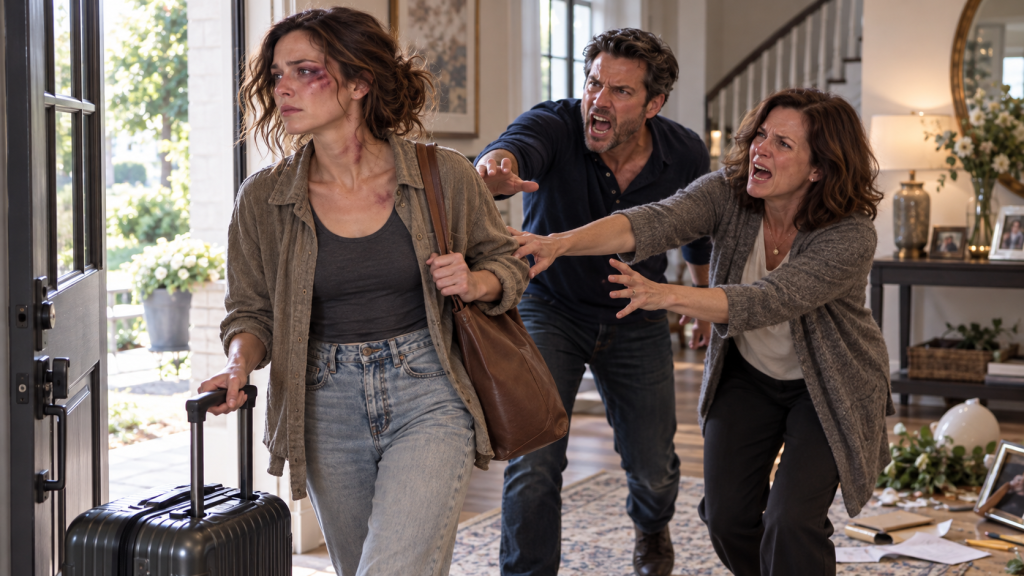
Caroline didn’t answer immediately. She turned another page. Then another. Her expression grew darker. “That’s what I thought too.” Gavin stood near the doorway, his face drained of color. Brenda’s fingers tightened around his arm. “Don’t say another word,” she whispered. But I barely heard her. I was staring at the name. Margaret Whitmore.
Beneficiary.
Transfer amount: $240,000.
My throat felt painfully dry.
“My aunt is dead.”
Caroline looked at me.
“I know.”
“She died seven years ago.”
“I’ve seen the death certificate.”
“Then why is her name on a transfer made three weeks ago?”
Caroline closed the folder.
“That,” she said quietly, “is what we’re going to find out.”
Across the driveway, Detective Harris watched Gavin carefully.
“Mr. Gavin, do you have an explanation for these documents?”
Gavin swallowed.
“I don’t know anything about them.”
Brenda immediately nodded.
“Of course he doesn’t.”
Caroline turned toward her.
“Mrs. Brenda, nobody asked you.”
Brenda’s eyes narrowed.
“You have no right to speak to me that way.”
Caroline’s voice remained perfectly calm.
“And you have no right to present a forged property transfer as if it gives you ownership of someone else’s home.”
For the first time since I’d married Gavin, I saw Brenda struggle to find a response.
Then she did what she always did.
She pointed at me.
“This is her fault!”
I almost laughed.
Of course.
It was always my fault.
When Gavin shouted, I provoked him.
When he broke things, I embarrassed him.
When he hit me, I made him angry.
And now, somehow, I was responsible for a document I had never signed.
Detective Harris stepped between us.
“Enough.”
His voice wasn’t loud.
But it stopped Brenda immediately.
He turned toward Caroline.
“We’ll need copies of those financial documents and the original property paperwork, if available.”
Caroline nodded.
“Of course.”
Then she looked at me.
“Are you all right?”
I stared at the house.
The front windows glowed with the warm yellow light I had chosen when I renovated it.
My aunt’s rosebushes stood beside the porch.
One of her wind chimes moved gently in the morning breeze.
I remembered planting flowers with her.
Remembered her laughing when I accidentally stepped into the watering can.
Remembered her telling me that a home should always be a place where someone could breathe.
I had turned that house into a place where I held my breath whenever my husband’s car pulled into the driveway.
And somehow, standing outside it now, I felt as though Margaret were watching.
Waiting.
Not for revenge.
For me to remember who I had been before Gavin taught me to be afraid.
I looked at Caroline.
“No,” I whispered.
Then I straightened.
“But I will be.”
Gavin was not arrested that morning.
Not for the suspicious transfer alone.
The investigators needed records.
Statements.
Verification of the signatures.
And a clearer picture of who had authorized the removal of furniture.
But the officers stopped the removal, documented the scene, and identified the men hired to clear the house.
Their supervisor produced a work order.
It was signed by Brenda.
The document claimed she had recently acquired the property and wanted the contents removed before renovations began.
I stared at the words.
Renovations.
She had planned to strip my home while I was hiding from her son.
The supervisor looked embarrassed.
“Ma’am, we were told this was an estate sale.”
I looked at him.
“Whose estate?”
He hesitated.
“Mrs. Brenda said the former owner had abandoned the property.”
I almost smiled.
Former owner.
Abandoned.
Those were the words they used when they needed my absence to become their permission.
Caroline took the work order.
“Do not remove anything further. My client disputes both the ownership representation and the authorization.”
The supervisor nodded quickly.
“Understood.”
Brenda began shouting again.
“You can’t tell people what to do with Gavin’s things!”
I turned toward her.
“Brenda.”
She stopped.
I hadn’t raised my voice.
I hadn’t even sounded angry.
“Those are my aunt’s dining chairs.”
Her expression twisted.
“Oh, don’t start with your sentimental nonsense.”
I stepped closer.
“Those chairs were in this house before I married your son.”
She folded her arms.
“So?”
“So you don’t get to sell them.”
Her eyes flashed.
“You ungrateful little—”
“Stop.”
One word.
Quiet.
Final.
Brenda stared at me.
I looked directly into her eyes.
“For six years, you have spoken to me as though I were a servant living in your son’s house.”
She opened her mouth.
I continued.
“You watched him hurt me.”
Her expression changed.
“You encouraged him.”
“That’s a lie.”
“You stood in my kitchen while he twisted my wrist, and you smiled.”
Gavin stared at the pavement.
I felt tears rise.
But I didn’t look away.
“You told him to remind me who the man of the house was.”
Brenda’s face went pale.
“And now you have come here with forged paperwork and strangers to empty the home my aunt left me.”
My voice broke.
“You are never going to make me feel small inside these walls again.”
For once, Brenda said nothing.
Then Gavin spoke.
“You’re destroying our family.”
I turned toward him.
The man I had once loved stood beneath our porch light wearing the same blue shirt he had worn on our last anniversary.
I remembered ironing that shirt.
Remembered choosing a restaurant.
Remembered hoping, foolishly, that a romantic evening might make things better.
Now he looked at me with resentment.
Not remorse.
Resentment.
And suddenly, I understood something.
He wasn’t sorry I had been hurt.
He was sorry I had stopped absorbing it.
“No, Gavin,” I said.
“You did that when you decided my fear was more important than my freedom.”
He looked away.
I turned toward Detective Harris.
“I want to proceed with my report about the assaults and threats. I also want the alleged forgery and removal of property investigated.”
He nodded.
“We’ll document everything and arrange for you to speak with the appropriate investigators.”
Caroline placed a hand gently on my shoulder.
“Let’s get you somewhere safe.”
I looked at my house one last time.
Then walked away.
Not because I was surrendering it.
But because I finally understood that protecting my life mattered more than winning an argument on the porch.
That afternoon, Caroline took me to a quiet office above a bookstore.
The building smelled of old paper and coffee.
Sunlight streamed through tall windows.
She placed the red folder on the conference table.
“Before we do anything else,” she said, “I want to make sure you’re safe.”
I nodded.
“I’ve been staying with my friend Natalie.”
“Does Gavin know her address?”
“No.”
“Are you certain?”
“I never told him where she moved after her divorce.”
Caroline nodded.
“Good. We’ll discuss protective-order options and safe arrangements for communication and property access.”
I looked at my wrist.
The bruises were turning yellow now.
The skin still ached when I moved my hand.
Caroline noticed.
Her expression softened.
“Did a doctor examine that?”
“Yes.”
“Good.”
I stared at the folder.
“Can we talk about Margaret?”
Caroline sat across from me.
“Of course.”
I took a breath.
“Please tell me what you found.”
She opened the file.
“The transfer came from a business account connected to Gavin’s consulting company.”
I nodded.
“I helped fund that company.”
“I know.”
She turned a page.
“The funds were sent to an entity called Whitmore Heritage Holdings.”
I frowned.
“I’ve never heard of it.”
“Neither had I until I searched the business records.”
My stomach tightened.
“Who owns it?”
Caroline looked at me.
“That is where things become interesting.”
She slid a document across the table.
The company had been formed eighteen months earlier.
Its registered manager was someone named Patricia Sloan.
I stared at the name.
“Who’s Patricia Sloan?”
Caroline hesitated.
“Do you remember the attorney who handled your aunt’s estate?”
I nodded immediately.
“Edward Sloan.”
“He had a daughter.”
My heart stopped.
“Patricia?”
“Yes.”
I stared at the paper.
Edward Sloan.
My aunt’s old attorney.
The man who had stood beside me during probate.
The man who had explained that Margaret wanted me to inherit the house without debt.
The man who had assured me that all the estate documents were in order.
He had died two years after Margaret.
I had sent flowers to his funeral.
Caroline leaned forward.
“Patricia became involved in managing some of her father’s remaining business records.”
I swallowed.
“And now she’s receiving money from Gavin?”
“An entity managed by her received the transfer. We still need to establish who ultimately controls the funds.”
My skin went cold.
“Why would Gavin send money to a company using Margaret’s name?”
Caroline turned another page.
“Possibly to create the appearance of an obligation connected to the estate.”
I shook my head.
“But there wasn’t one.”
“That’s what we’re checking.”
I stared at the documents.
Then whispered, “There’s something I never told you.”
Caroline looked up.
“What?”
I swallowed.
“Before Margaret died, she said she was worried about someone.”
Caroline became very still.
“Who?”
“She wouldn’t tell me.”
I looked toward the window.
“She just said there were people who thought her money belonged to them.”
Caroline leaned forward.
“Do you remember anything else?”
I closed my eyes.
Seven years ago.
Margaret sitting in the sunroom.
A knitted blanket over her knees.
Her silver hair tied loosely behind her head.
She had been seventy-eight.
Frail.
But sharp as ever.
She took my hand and whispered something I had never forgotten.
Sweetheart, when people discover you have something worth taking, they sometimes confuse your kindness with permission.
At the time, I thought she meant distant relatives asking for loans.
Now I wasn’t so sure.
I opened my eyes.
“She told me to keep the house.”
Caroline waited.
“She said no matter who I married, no matter how much I loved someone, I should never sign it away.”
My throat tightened.
“And she gave me the red folder.”
Caroline glanced at the documents.
“The one you’ve been carrying?”
I nodded.
“She said if anything ever felt wrong, I should look inside.”
Caroline’s expression changed.
“Did you?”
“Yes. I kept the deed and bank records there.”
“Anything else?”
I shook my head.
“Not that I remember.”
She considered that.
“Where is the original folder now?”
“In my suitcase.”
“Can we examine it?”
I hesitated.
Then nodded.
“Yes.”
That evening, Natalie sat beside me on her couch while I emptied the red folder.
She was my oldest friend.
We had met in college.
She had seen me through my parents’ deaths, my first job, my wedding, and the gradual disappearance of the woman I used to be.
When I arrived at her apartment three days earlier, bruised and shaking, she hadn’t asked why I stayed so long.
She had simply opened the door.
Then said, “You’re safe here.”
Sometimes that is the most beautiful thing one person can give another.
Not advice.
Not judgment.
Just somewhere to breathe.
Now she watched as I spread the documents across her coffee table.
Bank statements.
Property records.
Company transfers.
Medical reports.
Photographs.
Messages from Gavin.
And several old letters from Margaret.
Natalie picked up one.
“Your aunt had beautiful handwriting.”
I smiled sadly.
“She used to write everything by hand.”
“Even grocery lists?”
“Especially grocery lists.”
Natalie laughed softly.
Then her expression changed.
“What’s this?”
She held up a small cream envelope.
I frowned.
“I don’t remember that.”
It had been tucked inside the back cover of the folder.
The envelope was sealed.
Across the front, in Margaret’s handwriting, were three words.
WHEN YOU’RE READY.
My heart began pounding.
Natalie looked at me.
“Do you want to open it?”
I stared at the envelope.
For seven years, it had been there.
Waiting.
Through my wedding.
Through the first slap.
Through every apology.
Every bruise.
Every night I convinced myself things would get better.
And now, finally, I was holding it.
I nodded.
“Yes.”
My fingers trembled as I opened the flap.
Inside was a folded letter.
And a small brass key.
I unfolded the paper.
The first sentence made tears spring into my eyes.
My darling girl, if you’re reading this, I hope it means you’ve finally remembered that your life belongs to you.
I covered my mouth.
Natalie moved closer.
I continued reading.
I have watched you grow from a frightened little girl into a generous woman. You have always wanted to believe the best about people. That is one of the things I love most about you.
My vision blurred.
But kindness without boundaries can become a doorway through which the wrong people enter.
I swallowed.
There is something I have not told you about the estate. Years ago, Edward Sloan helped me establish a separate trust to protect certain assets. I became concerned when documents began appearing that I had never authorized.
My breath caught.
Documents.
Unauthorized.
The same thing happening now.
I made copies of everything. Edward assured me the discrepancies were administrative errors, but I was not satisfied.
I looked at Natalie.
She stared back.
I forced myself to continue.
The small key opens a safe-deposit box at First County Bank. The box is in my name, with you designated as an authorized successor after my death.
My hands shook.
Inside are the original records and a letter explaining why I wanted you protected.
Then came the words that made my blood run cold.
If anyone ever tells you that my estate owes money to the Sloan family, do not believe them without independent verification.
I stopped reading.
Natalie whispered, “Oh my God.”
I stared at the paper.
Patricia Sloan.
Whitmore Heritage Holdings.
Two hundred forty thousand dollars.
Suddenly, the pieces began moving.
Not fitting yet.
But moving.
There was one final paragraph.
And sweetheart, if the day ever comes when someone you love makes you afraid in your own home, please remember this: love should never require you to survive cruelty.
Tears slid down my face.
Leave.
Take your life with you.
The house can wait.
You cannot.
I pressed the letter against my chest.
And cried.
For the first time since Gavin grabbed my wrist, I cried without trying to stop myself.
Because my aunt had understood something I hadn’t.
Years before I met Gavin.
Years before the bruises.
She had known that love could become dangerous when a woman was taught to confuse endurance with devotion.
And somehow, even from beyond the grave, she had left me a way forward.
The next morning, Caroline accompanied me to First County Bank.
The bank manager examined Margaret’s death certificate, the relevant authorization records, and my identification.
There were procedures.
Signatures.
Verification.
A long wait.
I sat beside Caroline in a quiet office, holding the brass key.
The same key Margaret had hidden inside the red folder.
I rubbed my thumb across its worn surface.
“She planned for this,” I whispered.
Caroline looked at me.
“Maybe she planned for several possibilities.”
I nodded.
Then the manager returned.
“Everything is in order.”
My heart began pounding.
He guided us to the secure viewing room.
A small metal box was placed on the table.
I stared at it.
Seven years.
Seven years of secrets.
Seven years of documents no one had touched.
The manager stepped outside to give us privacy after the required access procedures were completed.
I opened the box.
Inside were three folders.
A sealed letter.
A photograph.
And a small digital storage device.
Caroline looked at the first folder.
“May I?”
I nodded.
She opened it.
Her expression changed almost immediately.
“What?” I whispered.
She turned a page.
Then another.
“Margaret, what did you discover?”
I stared at her.
Caroline looked up.
“Your aunt believed Edward Sloan was diverting money from accounts he administered.”
My stomach dropped.
“How much?”
She studied the papers.
“Over three hundred thousand dollars, according to her reconstruction.”
I covered my mouth.
The second folder contained correspondence.
Letters asking for clarification.
Copies of disputed signatures.
Records showing payments to companies linked to Edward Sloan.
The third contained legal documents.
And there, among them, was a name I recognized.
Brenda.
My heart stopped.
I stared at the page.
Brenda Collins.
Gavin’s mother.
Not a relative.
Not a close friend of Margaret.
Not someone I believed had ever met her.
Yet her name appeared in a record dated nearly twelve years earlier.
I looked at Caroline.
“What is this?”
She read the document carefully.
Then looked up.
“Brenda worked for a property-management company that handled several buildings connected to your aunt’s estate.”
I stared at her.
“No.”
“Yes.”
I shook my head.
“That can’t be right.”
Caroline showed me the page.
Brenda’s name.
Her signature.
Her former address.
Everything.
My breath caught.
I remembered meeting Brenda for the first time.
She had smiled.
Asked about my family.
Asked whether I owned my home.
At the time, I thought she was being friendly.
Now that memory changed shape.
I heard her voice again.
Your aunt left you the whole house? How fortunate.
I had laughed.
Told her Margaret was generous.
Brenda had smiled.
Some people are just born lucky.
My hands went cold.
Had she known?
All this time?
Had she recognized my name before I ever married her son?
I looked at Caroline.
“Gavin told me his mother had never heard of Margaret.”
Caroline said nothing.
I stared at the document.
Then whispered, “He lied.”
The photograph at the bottom of the box showed four people standing outside a brick office building.
Margaret.
Edward Sloan.
Brenda.
And a younger woman with dark hair.
I turned it over.
On the back, Margaret had written:
THE DAY THEY THOUGHT I WOULD SIGN.
I stared at the words.
Caroline examined the photograph.
“Do you recognize the fourth woman?”
I shook my head.
“No.”
Then something about her face caught my attention.
The eyes.
The narrow nose.
The slight tilt of her smile.
I looked closer.
And suddenly remembered.
Three years earlier, Gavin had introduced me to a woman at a company dinner.
He called her Patricia.
She was supposedly an outside financial consultant.
She wore a black dress and spoke to Gavin with the familiarity of someone who knew him well.
At one point, I had seen them standing near the balcony.
Patricia touched his arm.
He leaned close.
When I approached, they moved apart.
I remembered asking who she was.
Gavin laughed.
“Just a consultant.”
I had believed him.
Because I was his wife.
Because I wanted to trust him.
Because by then, questioning Gavin could lead to shouting, broken objects, and bruises.
I looked at Caroline.
“That’s Patricia Sloan.”
Her eyes sharpened.
“Are you certain?”
“Yes.”
I pointed.
“Gavin introduced me to her.”
“When?”
“Three years ago.”
Caroline went very still.
Then she asked, “How did he introduce her?”
“As a financial consultant.”
She took a slow breath.
“And did you ever see them together again?”
I closed my eyes.
The hotels.
The restaurants.
The unexplained purchases.
The late-night calls.
The business trips.
The sudden anger whenever I asked questions.
I opened my eyes.
“Yes.”
My voice broke.
“I think I did.”
The storage device contained scanned documents, audio recordings, and several videos.
Caroline arranged for a digital-forensics specialist to preserve and review the files.
We did not open them casually.
Everything was documented.
Everything was copied carefully.
I wanted the truth.
Not another mess of evidence someone could later claim had been altered.
Two days later, Caroline called.
“Can you come to my office?”
My stomach tightened.
“Did you find something?”
“Yes.”
“About Gavin?”
There was a pause.
“About several people.”
I closed my eyes.
“I’ll be there.”
When I arrived, Caroline wasn’t alone.
A forensic accountant named Michael Reed sat beside her.
He was a quiet man in his sixties with silver-framed glasses and a thick stack of notes.
Caroline gestured toward a chair.
“Sit down.”
I obeyed.
Michael opened a folder.
“Your aunt was investigating financial irregularities involving several estate-related entities.”
I nodded.
“And Edward Sloan?”
“He appears to have been involved in transactions she questioned.”
My throat tightened.
“What about Brenda?”
Michael turned a page.
“Brenda worked for a management company associated with some of those transactions.”
I stared.
“And Patricia?”
“She later became involved with successor entities connected to the same business relationships.”
He looked at me.
“Your husband’s consulting company has also made payments to one of those entities.”
My heart began pounding.
“The two hundred forty thousand?”
“Yes.”
“What was it for?”
Michael hesitated.
“The transfer description identifies it as repayment of a historic obligation.”
I frowned.
“Whose obligation?”
He looked directly at me.
“Your aunt’s.”
I stared at him.
“But Margaret didn’t owe them money.”
“That is what the records suggest.”
Caroline leaned forward.
“We believe someone may have tried to manufacture or revive a false estate debt.”
My skin went cold.
“Why?”
“To extract money or establish leverage over assets.”
I looked toward the folder.
“The house.”
Caroline nodded.
“Potentially.”
For several seconds, I couldn’t speak.
Then a terrible thought formed.
“Did Gavin marry me because of the house?”
Caroline’s expression softened.
“We don’t know when he became involved.”
I shook my head.
“But his mother knew Margaret.”
“Yes.”
“And Patricia knew Gavin.”
“Yes.”
“And Gavin used my inheritance to fund his company.”
Caroline nodded.
I stared at my hands.
The wedding.
Our vows.
The honeymoon.
The first apartment we shared before moving fully into Margaret’s house.
The way Gavin had insisted we should renovate.
The way he asked about the trust.
The way he pressured me to add his name to the deed.
I remembered him laughing when I refused.
“Don’t you trust your own husband?”
He had said it so often that eventually I stopped explaining.
I simply said no.
He hated that word.
Perhaps he had hated it from the beginning.
I looked up.
“Did he ever love me?”
Neither Caroline nor Michael answered.
Because that wasn’t a question financial records could solve.
And because somewhere inside me, I already knew the most important truth.
Whatever he had felt, it hadn’t stopped him from hurting me.
The first major break came from Patricia Sloan.
Three days after investigators contacted her regarding the suspicious transfer, she retained an attorney.
Then, unexpectedly, her attorney contacted Caroline.
Patricia wanted to provide information.
I didn’t understand why.
Not until I learned that Gavin had begun blaming everything on her.
According to messages later produced in the investigation, Gavin claimed Patricia had created the paperwork without his knowledge.
He said she had misled him.
That he was an innocent businessman relying on a consultant.
That Brenda had misunderstood the ownership arrangement.
Patricia apparently did not appreciate becoming the convenient explanation for everyone’s decisions.
She agreed to speak with investigators through counsel.
And what she revealed changed everything.
Gavin had known about my inheritance before we married.
Not because he had searched public records after meeting me.
Because Brenda had told him.
Brenda had once worked in a business connected to Edward Sloan.
She knew Margaret owned valuable property.
She knew Margaret had questioned certain financial transactions.
And she knew I was the intended heir to the house.
Years later, when Gavin began dating me, Brenda recognized my name.
She encouraged the relationship.
But investigators found no proof that Gavin had originally approached me solely because of the inheritance.
That uncertainty mattered.
For a while, I clung to it.
Perhaps he had loved me once.
Perhaps the greed had come later.
Perhaps the man who brought me coffee in bed during our first year of marriage had been real.
Then Patricia’s messages revealed something else.
Before our wedding, Gavin had sent Brenda a text.
If she keeps the house separate, we need another way to make the business deal work.
Brenda replied:
Marry her first. The rest can be handled later.
I read those words in Caroline’s office.
Once.
Twice.
Then a third time.
The room seemed to tilt.
Caroline watched me carefully.
“Would you like a break?”
I shook my head.
“No.”
My voice sounded far away.
“Keep going.”
She hesitated.
Then slid another page toward me.
A message from Brenda sent six months after our wedding.
Has she signed the papers yet?
Gavin replied:
No. She keeps saying Margaret told her never to change the deed.
Brenda answered:
Then make her feel guilty. She can’t say no forever.
My stomach twisted.
I remembered that period.
Gavin had been affectionate.
Almost excessively affectionate.
Flowers.
Dinners.
Promises about our future.
He told me he wanted us to be equal partners.
That it hurt him to feel like a guest in his own home.
That adding his name to the deed would prove I trusted him.
When I refused, he became distant.
Then angry.
Then cruel.
I looked at the messages again.
They had been planning around my boundaries.
Not respecting them.
Not negotiating honestly.
Planning how to wear them down.
I pressed my hand against my chest.
“It was all connected.”
Caroline’s voice softened.
“Some of it appears connected, yes.”
I shook my head.
“No.”
I looked at her.
“The affection. The arguments. His mother moving in. The paperwork.”
My voice broke.
“They were trying to make me surrender the house.”
Caroline reached for a tissue.
I didn’t take it.
I was too angry to cry.
Then she showed me the message that finally destroyed what remained of my marriage.
It was from Gavin to Patricia.
Sent the night before Brenda arrived at my house.
Once she’s out, Mom can handle the property. Get the transfer ready.
I stared at the screen.
The night before.
He had planned it.
Brenda arriving at four in the morning.
The oatmeal.
The humiliation.
The shouting.
The grabbing.
Perhaps he hadn’t planned exactly how I would react.
But he had planned to push me.
To make the house unbearable.
To get me out.
And then to use my absence as an excuse to take control.
I began shaking.
Caroline leaned forward.
“Breathe.”
I tried.
But the memory came rushing back.
Gavin’s hand around my wrist.
Brenda smiling.
The command to make breakfast.
The way he stood in the doorway.
You walk out that door, and you’re finished.
I had believed those were words spoken in anger.
Now I understood they had been part of a larger calculation.
He wanted me gone.
Just not with the red folder.
Not with evidence.
Not with the strength to fight back.
I looked at Caroline.
“He didn’t expect me to take the records.”
“No.”
“He thought I’d leave with clothes and nothing else.”
“That may have been his expectation.”
I laughed.
A terrible, broken laugh.
“He forgot Margaret taught me to keep paperwork.”
Then I began crying.
Not because I wanted Gavin back.
But because I was finally mourning the husband I thought I had married.
And learning that grief can exist even when the person is still alive.
The domestic violence investigation moved forward separately.
Detective Harris interviewed me again.
He reviewed the photographs.
The medical records.
The messages.
The recordings I had lawfully preserved.
He asked questions carefully.
Never rushing.
Never telling me how I should have reacted.
At one point, he asked, “Why didn’t you leave after the first assault?”
I looked at him.
My throat tightened.
Then he added, “You don’t have to justify staying. I’m asking because understanding the history may help establish the pattern.”
I took a breath.
“Because he cried.”
Harris waited.
“He slapped me. Then he cried harder than I did.”
My voice shook.
“He said his father had been violent and he hated himself for becoming like him.”
I looked down.
“I believed the tears meant he understood.”
Harris nodded.
“What happened next?”
“He bought me flowers.”
I laughed bitterly.
“Yellow roses.”
My eyes filled.
“They were my favorite.”
Harris remained quiet.
“I remember thinking that a man who knew my favorite flowers couldn’t really be dangerous.”
I shook my head.
“How foolish is that?”
“It’s understandable that you wanted to believe his apology.”
I stared at the table.
“The second time, he shoved me into the counter.”
My voice broke.
“He said I’d embarrassed him.”
“What happened afterward?”
“He told me if I had respected him, it wouldn’t have happened.”
“And Brenda?”
“She agreed.”
I looked up.
“She always agreed.”
Harris made a note.
Then he asked, “Were there threats if you tried to leave?”
I nodded.
“Yes.”
“What kind?”
My hands began trembling.
“He said I’d lose everything.”
I swallowed.
“The house.”
“The business.”
“My reputation.”
I looked toward the window.
“He said people would believe him because he was charming and successful.”
A tear slid down my cheek.
“He told me nobody would believe a woman who stayed after being hit.”
Harris stopped writing.
He looked at me.
Then said quietly, “You’re being heard now.”
I covered my mouth.
For a moment, I couldn’t speak.
Those four words reached somewhere inside me that Gavin had spent six years trying to destroy.
You’re being heard now.
I began crying.
Harris passed me the tissue box.
And waited.
Gavin was arrested several days later on charges related to the alleged domestic assaults and other conduct supported by the investigation.
Brenda and Patricia faced separate scrutiny over the property documents and financial transactions.
The precise charges developed as evidence was reviewed.
I did not celebrate.
That surprised Natalie.
When she told me Gavin had been taken into custody, she expected relief.
Perhaps happiness.
Instead, I sat on her couch and cried.
“Why am I crying?” I whispered.
Natalie sat beside me.
“Because this is awful.”
I shook my head.
“He hurt me.”
“I know.”
“He lied.”
“I know.”
“He tried to take my house.”
“Yes.”
“Then why do I feel sorry for him?”
She took my hand.
“Because you loved him.”
I stared at her.
“And love doesn’t always disappear the moment someone proves they don’t deserve your trust.”
I covered my face.
“I hate this.”
“I know.”
She pulled me close.
And for the first time, I allowed myself to feel something without trying to make it reasonable.
Sadness.
Anger.
Relief.
Fear.
Grief.
All of it.
Because healing wasn’t going to be one dramatic courtroom victory.
It was going to be a thousand ordinary moments in which I remembered that I deserved to feel safe.
A month later, Gavin sent me a letter through his attorney.
I almost refused to read it.
Caroline told me I was under no obligation.
But I wanted to know what he would say.
I opened it alone.
Not because I wanted secrecy.
Because I needed to hear my own thoughts without someone else’s anger filling the room.
The letter began:
I never meant for things to get this bad.
I stared at the words.
Of course.
Then:
I know I hurt you.
My throat tightened.
I know I let my mother interfere.
I almost laughed.
Let.
As though Brenda had simply wandered into our marriage and Gavin had been too polite to ask her to leave.
I continued.
I was under pressure with the company. I made mistakes. I trusted the wrong people.
There it was.
The explanation.
The pressure.
The wrong people.
Then came the sentence that made my hands go still.
But what happened between us was real.
I closed my eyes.
Maybe it had been.
The laughter.
The vacations.
The first year.
The afternoons we cooked together.
The night he held me after Margaret died.
I remembered him telling me he would never let me feel alone.
He had been warm.
Gentle.
Patient.
At least then.
But good memories did not erase bad choices.
And love did not turn violence into an unfortunate misunderstanding.
I turned the page.
I want you to know I never stopped loving you.
I stared at those words for a long time.
Then I folded the letter.
Placed it back in the envelope.
And whispered into my empty room.
“Then you should have loved me safely.”
I did not reply.
Brenda was harder to silence.
She sent messages through relatives.
Through old family friends.
Through people I barely knew.
At first, they were angry.
You’re ruining Gavin’s life.
He made mistakes, but marriage means forgiveness.
You can’t destroy a family over a few arguments.
Then, when those messages received no response, the tone changed.
Brenda is unwell.
She’s frightened.
She misses you.
That one almost made me laugh.
Brenda missed me.
The woman who once made me remake her coffee three times because the cup wasn’t warm enough.
The woman who criticized my cooking, clothes, work, and family.
The woman who had smiled while her son hurt me.
Now she missed me.
Or perhaps she missed having someone she could control.
I forwarded the messages to Caroline.
Then blocked the numbers.
Some people mistake access for love.
And when access ends, they call the boundary cruelty.
I was learning not to believe them.
The strangest message came from a woman named Diane Miller.
She had been Gavin’s executive assistant.
I knew her only casually.
She was quiet.
Professional.
Always polite.
One afternoon, she sent me an email.
I know you may not want to hear from anyone connected to Gavin, but I have something that belongs to you.
I stared at the screen.
Then called Caroline.
She reviewed the message.
“Do you want me to contact her?”
I nodded.
“Yes.”
Two days later, Diane arrived at Caroline’s office.
She carried a cardboard box.
Her hands trembled as she placed it on the table.
“I should have done this sooner,” she whispered.
Caroline sat across from her.
“What is it?”
Diane looked at me.
“Your belongings.”
I frowned.
“What belongings?”
She opened the box.
Inside were photographs.
Letters.
A silver necklace.
A small framed picture of Margaret.
And a stack of greeting cards.
I stared.
I recognized everything.
These were things that had disappeared from my home over the years.
Not all at once.
A necklace I thought I’d misplaced.
A photograph I assumed had been packed during renovations.
Birthday cards from Margaret.
Letters from my parents.
Small, sentimental things.
Things that had no financial value.
But meant everything to me.
My hands began shaking.
“Where did you get these?”
Diane’s eyes filled.
“Gavin kept them in his office.”
I stared at her.
“Why?”
She looked down.
“I don’t know exactly.”
Then she swallowed.
“But I heard him tell Brenda once that you became easier to manage when you couldn’t find things.”
My blood ran cold.
I slowly sat back.
The necklace.
The photograph.
The letters.
I remembered searching the house.
Crying.
Accusing myself of becoming forgetful.
Gavin would sigh.
“See? This is why I handle important things.”
Brenda would laugh.
“You’d lose your own head if it wasn’t attached.”
And I had believed them.
I had actually begun worrying that something was wrong with my memory.
I looked at the box.
Then at Diane.
“You’re telling me he took these?”
She nodded.
“I saw some of them in his office.”
My throat tightened.
“Did you know why?”
Diane wiped her eyes.
“I knew he wanted you to doubt yourself.”
The room became silent.
I stared at her.
Then whispered, “Thank you for bringing them.”
She began crying.
“I should have spoken up.”
I shook my head.
“You’re speaking now.”
She looked at me.
Then said something I hadn’t expected.
“There’s more.”
Caroline straightened.
“What?”
Diane reached into her bag.
She removed a small notebook.
“My work notes.”
I frowned.
“About what?”
“Meetings.”
She placed it on the table.
“Gavin had regular meetings with Patricia Sloan.”
My heart tightened.
Diane continued.
“Sometimes Brenda attended.”
Caroline opened the notebook.
Dates.
Names.
Locations.
Brief descriptions.
Then one entry caught my eye.
Property transition — final phase.
I stared at it.
The date.
The day before Brenda arrived with her luggage.
I looked at Diane.
“What does final phase mean?”
She swallowed.
“I don’t know everything.”
Her voice trembled.
“But I heard Gavin tell Patricia that once you left the house, the rest would be easy.”
I stared at the notebook.
The same plan.
The same lie.
The same cruelty.
Only now, it was written in ordinary office shorthand.
Like a business meeting.
Like a project.
Like removing me from my own life had been another task on Gavin’s calendar.
I began shaking.
Caroline gently closed the notebook.
“We’ll preserve this and provide it to investigators.”
Diane nodded.
Then looked at me.
“I’m sorry.”
I wiped my cheeks.
“For what?”
“For not realizing sooner how much danger you were in.”
I shook my head.
“You didn’t cause what he did.”
She began crying.
Then whispered, “I hope you get your life back.”
I looked at the box of photographs.
Margaret’s smiling face stared up at me.
And for the first time, I believed I might.
The financial investigation eventually established that Gavin had used company funds for unauthorized personal expenses and questionable payments connected to Patricia’s business entities.
The $240,000 transfer was not a payment to my deceased aunt.
It was a transfer to a company that had adopted her name and purported to hold a disputed claim arising from the estate.
Investigators found no legitimate basis for the supposed debt presented in the documents.
The company name had been used to make the transaction appear connected to Margaret’s affairs.
The forged property transfer was another piece of the same attempt.
Brenda had expected my absence to make the paperwork easier to present.
Gavin had expected me to be frightened into silence.
Patricia had expected the documents to withstand casual scrutiny.
None of them expected the red folder.
None expected Margaret’s safe-deposit box.
None expected Diane’s notebook.
And none expected me to stop apologizing for defending myself.
The criminal proceedings took time.
Months.
Then more months.
There were hearings.
Document requests.
Interviews.
Legal arguments.
Some charges were resolved through negotiated pleas.
Others required further proceedings.
Brenda’s role was examined separately from Gavin’s.
Patricia’s cooperation became important in establishing who prepared and approved the disputed documents.
But none of it happened like television.
There was no single dramatic moment where every villain confessed.
No judge shouting.
No thunderclap.
No instant restoration of everything I had lost.
Real consequences moved slowly.
And healing moved even more slowly.
I attended the proceedings I needed to attend.
I gave truthful statements.
I worked with my attorney.
I sought counseling.
And little by little, I began separating my life from the chaos Gavin had created.
The divorce was finalized the following spring.
I remember the day clearly.
It rained.
Not heavily.
Just a soft, steady rain that made the courthouse windows look blurred.
Caroline sat beside me.
Gavin sat across the room with his attorney.
He looked thinner.
Older.
His confidence had faded.
When our eyes met, he looked down.
For a moment, I remembered our wedding.
The way he had smiled when I walked down the aisle.
The warmth of his hands.
The promise in his voice.
I will love you and protect you.
I closed my eyes.
There are few things more painful than remembering a promise spoken by someone who later became the danger you needed protection from.
Caroline touched my arm.
“You okay?”
I nodded.
“Yes.”
And I meant it.
Not because I felt nothing.
But because I finally knew pain could exist without controlling my choices.
The judge reviewed the settlement.
The house remained mine.
The financial interests were addressed through the applicable legal process.
The protective arrangements remained separate.
And then, after a few final questions, the marriage was dissolved.
Six years.
Reduced to a few words.
When we left the courtroom, Gavin stood near the hallway.
“Can I speak to you?”
Caroline looked at me.
I took a breath.
“Only here.”
Gavin nodded.
He stepped closer.
Then stopped at a respectful distance.
For the first time in years, he seemed unsure how to speak to me without demanding something.
“I never thought we’d end up here,” he said.
I looked at him.
“Neither did I.”
He swallowed.
“I know you hate me.”
I considered that.
Then shook my head.
“No.”
He looked surprised.
“You don’t?”
“No.”
His eyes filled.
“I thought—”
“I don’t hate you, Gavin.”
My voice was quiet.
“I hate what you did.”
He began crying.
I continued.
“I hate the way you made me afraid in my own home.”
A tear slipped down my cheek.
“I hate the way you let your mother humiliate me.”
He lowered his head.
“And I hate the way you turned my love into something you could use against me.”
His shoulders shook.
“But hatred isn’t what I want to carry for the rest of my life.”
He looked up.
Hope flickered in his eyes.
I saw it.
And gently stopped it.
“That doesn’t mean I’m coming back.”
The hope vanished.
“I know.”
“It doesn’t mean we can start over.”
He nodded.
“I understand.”
I looked at him for a long moment.
Then said the words I had needed to say for six years.
“I deserved better.”
Gavin closed his eyes.
“Yes.”
His voice broke.
“You did.”
I nodded.
Then turned.
And walked away.
I didn’t look back.
The first night I slept in my house again, I couldn’t stop shaking.
The legal and safety arrangements had been handled.
The locks were changed.
A security professional had checked the property.
Gavin no longer lived there.
Brenda had no right to enter.
The furniture was returned or accounted for through the legal process.
Everything looked familiar.
The kitchen.
The hallway.
The staircase.
Margaret’s rosebushes.
The little sunroom where she used to read.
But the house felt different.
Not because the walls had changed.
Because my body remembered.
I stood in the kitchen where Gavin had twisted my wrist.
The memory arrived suddenly.
His hand.
His voice.
Brenda smiling.
The oatmeal.
The fear.
I gripped the counter.
For a moment, I was back there.
Small.
Trapped.
Unable to breathe.
Then I heard a knock.
I flinched.
My heart raced.
But it was Natalie.
She stood outside holding two grocery bags.
“Thought you might need dinner.”
I opened the door.
The moment I saw her, I began crying.
She stepped inside.
Set down the bags.
And hugged me.
“It’s okay.”
I shook my head.
“I thought I’d feel better.”
“You will.”
“But this is my house.”
“I know.”
“Why am I still scared?”
Natalie held my hands.
“Because getting safe and feeling safe don’t always happen on the same day.”
I stared at her.
She smiled gently.
“Give yourself time.”
I nodded.
Then she looked around.
“So.”
I wiped my face.
“So?”
“What color are we painting the kitchen?”
I blinked.
“What?”
She grinned.
“Because that beige has always been criminal.”
I burst out laughing.
A real laugh.
Sudden.
Unexpected.
It surprised both of us.
Natalie laughed too.
And that was how the healing began.
Not with a grand declaration.
But with paint samples.
Takeout food.
And someone reminding me that the house could become mine again.
We painted the kitchen pale blue.
The color Margaret loved.
We replaced the broken cabinet door Gavin had punched.
Repaired the wall.
Changed the bedroom curtains.
Moved the furniture.
I took down our wedding photographs.
Not angrily.
Not dramatically.
I simply placed them in a box.
Some memories could be acknowledged without being displayed.
I turned Gavin’s office into a library.
His enormous dark desk was removed.
The leather chair went into storage.
The shelves were filled with books.
I placed Margaret’s photograph above a little reading chair.
Then I hung a framed copy of her final letter beside it.
Not the entire letter.
Just one sentence.
Love should never require you to survive cruelty.
Every morning, I passed that sentence.
And every morning, I remembered.
Several months later, I received a letter from Brenda.
I almost threw it away.
Then I saw the return address.
She had moved into a small rented apartment.
No grand house.
No staff.
No son living nearby to defend every demand.
Just an ordinary apartment.
The letter was handwritten.
Her handwriting was stiff.
Uneven.
I opened it.
I know you probably don’t want to hear from me.
That was true.
I have had a great deal of time to think.
I sat down.
I told myself that everything Gavin did was because he was under pressure.
My stomach tightened.
I told myself you were difficult.
I continued.
I told myself a good wife should obey her husband.
I closed my eyes.
There it was.
The belief that had poisoned every room Brenda entered.
I don’t know when I became the kind of mother who watched her son hurt someone and called it discipline.
My breath caught.
I read the sentence again.
I don’t know when I stopped seeing you as a person.
Tears filled my eyes.
But I remember that morning.
My hands began trembling.
I remember his hand around your wrist.
A tear slid down my cheek.
And I remember smiling.
I covered my mouth.
That is the part I cannot forgive in myself.
For several seconds, I couldn’t continue.
Then I forced myself to read.
I don’t expect you to forgive me.
I don’t deserve access to your home.
I don’t deserve your kindness.
But I want you to know that I was wrong.
You were never weak because you were frightened.
You were strong because you survived us long enough to leave.
I began crying.
Not because I trusted Brenda.
Not because an apology erased years of cruelty.
But because for the first time, she had named what happened without blaming me.
At the bottom, she wrote:
I hope the house is peaceful now.
I folded the letter.
Placed it in a drawer.
And sat quietly for a long time.
Then I whispered, “It is.”
I didn’t reply.
And that was okay.
An apology does not create an obligation to reconnect.
Sometimes acknowledging the truth is enough.
A year after the divorce, I received an invitation from the hospital where I had once volunteered.
They were hosting an event for women rebuilding their lives after domestic abuse.
Natalie had suggested I attend.
At first, I refused.
“I don’t want people knowing everything.”
She nodded.
“Then don’t tell them everything.”
I looked at her.
“You can go just to listen.”
So I did.
The room was filled with women.
Young.
Older.
Married.
Divorced.
Some with children.
Some without.
Some visibly nervous.
Others smiling with the quiet confidence of people who had survived things the world would never fully understand.
A counselor spoke about boundaries.
Another woman described leaving an abusive relationship after twenty years.
Then a young woman stood.
She couldn’t have been older than twenty-three.
Her hands trembled.
“My boyfriend shoved me last week.”
The room became quiet.
She looked down.
“He cried afterward.”
My heart stopped.
“He bought me flowers.”
I closed my eyes.
Yellow roses.
The memory struck so sharply that I almost gasped.
The young woman continued.
“He said he’d never do it again.”
She began crying.
“I want to believe him.”
No one interrupted.
Then she whispered, “Am I stupid?”
My eyes filled.
I remembered asking myself the same question.
So many times.
Why did I stay?
Why did I believe him?
Why did I forgive?
Why didn’t I leave sooner?
The counselor answered gently.
“No. You’re not stupid.”
The young woman began crying harder.
And before I could stop myself, I raised my hand.
The counselor looked toward me.
“Would you like to share something?”
My heart raced.
I almost shook my head.
Then I remembered Margaret.
Her letter.
The red folder.
The brass key.
The house.
The life I had nearly lost.
I stood.
“My name is Claire.”
The room became quiet.
I took a shaky breath.
“And I stayed after the flowers.”
The young woman looked at me.
I continued.
“I stayed after the first apology.”
My voice trembled.
“Then the second.”
A tear slid down my cheek.
“And then I spent years waiting for a version of my husband who only appeared when he was afraid I might leave.”
The room was silent.
I looked directly at the young woman.
“You are not stupid for wanting someone you love to become safe.”
She began sobbing.
“But please remember something.”
I swallowed.
“An apology is not the same as change.”
Several women nodded.
“And flowers do not undo violence.”
My voice broke.
“You deserve safety before you have to prove how much pain you can endure.”
The young woman covered her face.
I sat down.
My hands were shaking.
Natalie squeezed one of them.
And for the first time, I realized the worst years of my life might help someone else recognize danger sooner.
I couldn’t change what happened to me.
But I could choose what I did with the life that remained.
Over time, I began volunteering at a local support organization.
Not as a counselor.
Not as a legal expert.
But as someone who could help with practical things.
Driving women to appointments.
Organizing donated clothes.
Preparing meals.
Helping survivors find community resources.
Sometimes I simply sat beside someone who needed a quiet companion.
I learned not to ask why they stayed.
Not to tell them what I would have done.
Not to demand that they feel brave.
I knew too well how fear could live inside a person.
How it could make every choice feel dangerous.
How leaving was sometimes the beginning of another difficult journey rather than an instant escape.
But I also learned something beautiful.
People could rebuild.
Slowly.
Imperfectly.
With support.
With safety.
With time.
Two years after the morning Gavin tore the blanket from me, I stood in my kitchen making oatmeal.
The memory made me pause.
Oatmeal.
Such an ordinary thing.
A bowl of oats.
Milk.
Cinnamon.
Honey.
For years, the smell had reminded me of Brenda’s commands.
Of Gavin’s hand around my wrist.
Of the humiliation.
But that morning, I was making breakfast for myself.
No one had ordered me downstairs.
No one had shouted.
No one had touched me in anger.
I was simply hungry.
I stirred the pot.
Added cinnamon.
A little brown sugar.
Then sat beside the kitchen window.
Sunlight fell across the table.
Birds moved through Margaret’s rosebushes.
I took one bite.
Then another.
And began crying.
Not because I was afraid.
Because I wasn’t.
Because the oatmeal tasted like freedom.
And sometimes freedom arrives in the smallest possible form.
A locked door.
A quiet room.
A morning without fear.
A meal you make because you want it.
Not because someone has demanded it.
I laughed through tears.
Then finished my breakfast.
Every bite.
Three years after the divorce, I received an email from Diane.
Gavin’s former assistant.
She had left the consulting company and started working for a nonprofit.
She wrote that the investigations had finally concluded their remaining financial matters.
Some assets had been recovered.
Some losses remained.
The consulting company no longer operated under Gavin’s control.
Diane thanked me for speaking up.
Then she added something I hadn’t expected.
I used to think powerful people were always the loudest ones in the room.
Watching you leave taught me otherwise.
I stared at the words.
Then smiled.
Because for so long, Gavin had believed power meant being obeyed.
Brenda believed power meant controlling the household.
Patricia believed power meant manipulating paperwork.
And I had believed power belonged to whoever frightened me most.
But none of us had understood it correctly.
Power could be quiet.
It could be a woman packing a suitcase.
A folder of documents.
A phone recording.
A call to a trusted friend.
A decision not to return.
Power could be refusing to explain yourself to someone committed to misunderstanding you.
It could be saying no.
And meaning it.
Four years after I left Gavin, I sold the house.
That surprised everyone.
Natalie nearly dropped her coffee when I told her.
“You’re selling Margaret’s house?”
I nodded.
“Yes.”
“But you fought so hard to keep it.”
“I know.”
“Are you sure?”
I smiled.
“Very.”
She stared at me.
“Why?”
I looked around the living room.
The beautiful old floors.
The bookshelves.
The windows.
The rosebushes outside.
The house had been my refuge.
My inheritance.
My battlefield.
My sanctuary.
But I had begun to feel something new.
I wanted a different life.
Not because the house was ruined.
Not because Gavin had won.
But because I no longer needed to prove that I belonged there.
Margaret had left me the house so I could live freely.
Not so I would spend the rest of my life protecting the same walls.
I looked at Natalie.
“I want to move near the ocean.”
She smiled.
“The ocean?”
“Yes.”
“Since when?”
I laughed.
“Since I was twenty.”
Her eyes softened.
“Then why didn’t you?”
I looked toward Margaret’s photograph.
“Because I kept waiting for the right time.”
Natalie began smiling.
“And now?”
I took a breath.
“Now I’m done waiting.”
The sale was emotional.
I walked through every room one last time.
The kitchen where Margaret taught me to make bread.
The sunroom where she read novels.
The staircase where I sat crying after my parents died.
The bedroom where Gavin and I once laughed together.
The hallway where I later learned to listen for his footsteps.
The office where I packed my suitcase.
The doorway where I finally walked out.
I touched the walls.
Not because I wanted to keep them.
Because I wanted to say goodbye.
In the sunroom, I sat in Margaret’s old chair.
The afternoon light fell across the floor.
I closed my eyes.
And imagined her beside me.
Her silver hair.
Her warm hands.
Her gentle voice.
Sweetheart, a house is only a gift if it helps you live.
I smiled through tears.
“I know, Aunt Margaret.”
Then I opened my eyes.
Stood.
And walked toward the front door.
The rosebushes were blooming.
I cut one flower.
Wrapped it carefully in paper.
And carried it with me.
When I locked the door for the last time, I didn’t feel defeated.
I felt grateful.
The house had sheltered me when I needed it.
Now I was ready to shelter myself somewhere new.
My new home was a small cottage beside the sea.
Two bedrooms.
A bright kitchen.
A porch with a view of the water.
Nothing extravagant.
Nothing impressive.
Just enough.
The first morning, I woke to the sound of waves.
I lay in bed listening.
For several seconds, I couldn’t believe it was real.
No Gavin.
No Brenda.
No footsteps in the hallway that made my heart race.
No demands.
No threats.
Just the ocean.
I got up.
Opened the curtains.
And watched the sunrise.
The sky turned pale pink.
Then gold.
Then blue.
I made coffee.
Carried it onto the porch.
And sat in a chair I had bought simply because I liked it.
For a long time, I watched the water.
Then I whispered, “I made it.”
The wind moved through my hair.
A gull cried overhead.
And I began to cry.
Not the desperate crying of a woman trapped inside an abusive marriage.
Not the exhausted crying of someone trying to understand why love had become dangerous.
These were tears of gratitude.
For the friend who opened her door.
For the attorney who believed my records mattered.
For the detective who listened.
For the strangers who helped.
For Margaret.
And for the woman I had been at 4:40 that morning.
The woman who was terrified.
Who packed a suitcase.
Who took the red folder.
Who walked out even though she didn’t know what would happen next.
I wanted to reach back through time and hold her.
To tell her she wasn’t weak.
That she hadn’t failed.
That she wasn’t destroying her family by protecting herself.
I wanted to tell her the fear would eventually become smaller.
That the nightmares would become less frequent.
That one day, she would wake up and realize she had slept through the night without listening for footsteps.
That she would laugh again.
Trust again.
Love life again.
And that she would eventually make oatmeal for herself without remembering Gavin’s voice.
Five years after leaving, I met someone named Daniel.
He was a marine biologist who worked with a coastal conservation program.
He had kind eyes.
A terrible sense of direction.
And a habit of talking to injured seabirds as though they were troublesome children.
We met during a beach cleanup.
He handed me a pair of gloves.
I handed him an empty trash bag.
And somehow, we spent the next three hours talking.
He asked about my work.
My books.
My favorite places.
He listened when I answered.
Really listened.
When I mentioned that I lived alone, he didn’t ask why.
When I told him I had been married before, he didn’t push for details.
When I said I wasn’t ready for anything serious, he smiled.
“Then we can just enjoy coffee.”
So we did.
Coffee.
Walks.
Long conversations.
Sometimes dinner.
Sometimes nothing more than a wave from across the beach.
It was strange how safe ordinary kindness could feel after years of fear.
I had forgotten that disagreements didn’t have to become arguments.
That a man could be disappointed without becoming threatening.
That someone could hear the word no and simply say, “Okay.”
The first time Daniel did that, I almost cried.
We were planning dinner.
He suggested a crowded restaurant.
I told him I didn’t feel comfortable there.
He nodded.
“No problem. Would you rather go somewhere quieter?”
I stared at him.
He looked confused.
“What?”
I shook my head.
“Nothing.”
He smiled.
“Then let’s find somewhere you like.”
Such a small moment.
Almost nothing.
But for me, it meant everything.
We didn’t rush.
I told Daniel about Gavin gradually.
In pieces.
When I was ready.
He never asked why I hadn’t left sooner.
Never told me what he would have done.
Never said he could have protected me.
He simply listened.
One evening, after I told him about the morning Brenda demanded oatmeal, he sat quietly for a long time.
Then he said, “I’m sorry someone made your home frightening.”
My eyes filled.
I looked at him.
He continued.
“You deserved peace there.”
I began crying.
He didn’t reach for me immediately.
He asked, “Would you like a hug?”
That question broke me.
Because for six years, Gavin had treated my body as something he could control.
My space.
My movements.
My silence.
Even my fear.
And now this gentle man was asking permission to comfort me.
I nodded.
“Yes.”
He held me.
And for the first time, the embrace of a man didn’t make me wonder what he would demand afterward.
Two years later, Daniel and I married.
A small ceremony.
Bare feet in the sand.
Natalie beside me.
Diane among the guests.
A few friends from the support organization.
No enormous wedding.
No grand promises about never having problems.
Just two people choosing to build a life with honesty.
During the ceremony, Daniel took my hands.
“I promise to listen when you speak.”
My eyes filled.
“To respect your no as much as your yes.”
A tear slid down my cheek.
“To never confuse love with control.”
My throat tightened.
“And to remember that your peace matters as much as mine.”
I began crying.
Not because the words were dramatic.
Because they were simple.
And because I knew how much they meant.
When it was my turn, I looked into his eyes.
“I don’t promise to be fearless.”
He smiled.
“I know.”
“I don’t promise never to struggle.”
His eyes softened.
“But I promise to be honest.”
I squeezed his hands.
“To speak when something hurts.”
“To listen when you need me.”
“And to remember that a healthy home is built by two people who are both free to be themselves.”
Daniel smiled through tears.
We kissed.
The ocean moved behind us.
And somewhere in the distance, a gull cried.
Natalie leaned toward Diane.
“Finally, a wedding where nobody’s mother demands oatmeal.”
I burst out laughing.
Daniel looked confused.
Then laughed too.
And for one beautiful moment, the past felt far away.
Not forgotten.
Not erased.
Just no longer in control.
One autumn afternoon, several years later, I received an unexpected package.
There was no return address.
Inside was a small wooden box.
And a letter.
I recognized Brenda’s handwriting.
My stomach tightened.
For a moment, I considered leaving it unopened.
Then I remembered something.
I wasn’t afraid of her anymore.
I opened the letter.
Brenda was older now.
She had been ill.
She wrote that she had spent years thinking about the harm she had helped cause.
She did not ask for forgiveness.
She did not ask to visit.
She did not ask me to contact Gavin.
She simply wrote that she had found something among old papers and believed it belonged to me.
I opened the box.
Inside was a small silver locket.
Margaret’s locket.
The one she wore in every photograph.
The one I believed had been lost after her funeral.
I stared at it.
My hands began trembling.
Inside were two tiny photographs.
One of Margaret.
One of me as a child.
On the back was a small engraving.
YOU ARE ALWAYS ENOUGH.
I began crying.
Brenda’s letter explained that the locket had been among documents Edward Sloan once held and had later passed through her possession.
She admitted she should have returned it years earlier.
At the bottom, she wrote:
I spent too much of my life teaching my son that power meant control.
I hope you know now that you were never powerless.
I closed the letter.
Then held the locket against my chest.
For a long time, I cried.
Not for Brenda.
Not for Gavin.
For Margaret.
For the woman who had raised me.
Protected me.
Taught me to work hard.
Taught me to be kind.
And somehow, even after death, left me the tools I needed to save myself.
Daniel found me sitting by the window.
He crouched beside me.
“Claire?”
I looked up.
He saw the locket.
Then gently asked, “Is that hers?”
I nodded.
He smiled softly.
“It’s beautiful.”
I opened it.
Showed him the photographs.
He read the engraving.
Then looked at me.
“She was right.”
I began crying again.
He took my hand.
“You were always enough.”
As the years passed, I stopped measuring my life by what Gavin had taken from me.
He had taken time.
Trust.
Peace.
Confidence.
Some financial security.
Some friendships.
Some memories I could never recover.
But he had not taken everything.
He had not taken my ability to love.
My ability to laugh.
My intelligence.
My courage.
My future.
And eventually, I stopped thinking of myself as someone defined by what happened to her.
I was Claire.
A woman who loved the ocean.
Who collected old books.
Who made excellent banana bread.
Who still cried at sentimental movies.
Who sometimes had nightmares.
Who sometimes needed reassurance.
Who had survived an abusive marriage and built a life beyond it.
That was enough.
More than enough.
On the tenth anniversary of the morning I left Gavin, I woke before sunrise.
The clock beside my bed read 4:40 a.m.
I stared at it.
The exact time.
Ten years earlier, Gavin had torn the blanket from me.
He had ordered me downstairs.
He had grabbed my wrist.
Brenda had smiled.
And I had decided to leave.
I sat up slowly.
Daniel stirred beside me.
“Everything okay?”
I looked at him.
The room was quiet.
Safe.
Warm.
“Yes.”
He blinked sleepily.
“You sure?”
I smiled.
“Yes.”
He reached for my hand.
“Want me to make coffee?”
I laughed softly.
“At four forty?”
He smiled.
“Why not?”
I looked toward the window.
Beyond the glass, the ocean was dark.
The first hint of morning touched the horizon.
I took a breath.
“Actually,” I said, “I’d like to make breakfast.”
Daniel smiled.
“Anything special?”
I laughed.
“Oatmeal.”
He raised an eyebrow.
“Oatmeal?”
“Yes.”
He studied me for a moment.
Then his expression softened.
“Okay.”
I leaned over and kissed his forehead.
“Go back to sleep.”
He smiled.
“Only if you promise to save me some.”
I laughed.
“Deal.”
I walked downstairs.
The house was quiet.
The kitchen smelled faintly of the flowers I had placed on the table the day before.
I filled a saucepan.
Added oats.
Milk.
Cinnamon.
A little honey.
And stirred.
The clock ticked softly.
Outside, the sky began to lighten.
I thought about the woman I had been ten years earlier.
The one who trembled whenever Gavin raised his voice.
The one who believed saying no was dangerous.
The one who thought love meant enduring whatever happened inside a marriage.
I wished I could reach back and tell her something.
Not that everything would be easy.
It wouldn’t.
Not that the road ahead would be painless.
It wasn’t.
But that one day, she would stand in a kitchen at 4:40 in the morning and feel absolutely no fear.
She would make oatmeal because she was hungry.
She would wear her aunt’s locket.
She would have friends.
A husband who respected her.
A home filled with peace.
And a life she had chosen.
I poured the oatmeal into two bowls.
Set them on the table.
Then sat by the window.
The first sunlight touched the ocean.
I closed my eyes.
And whispered, “Thank you, Margaret.”
A breeze moved through the open window.
For a moment, I could almost hear her voice.
You’re stronger than you know, sweetheart.
I smiled.
“I know that now.”
Later that morning, Daniel came downstairs.
His hair was messy.
His slippers didn’t match.
He looked at the oatmeal.
Then at me.
“Breakfast at sunrise?”
I smiled.
“Something like that.”
He sat.
Took one bite.
Then grinned.
“This is excellent.”
I laughed.
“It’s oatmeal, Daniel.”
“Exceptional oatmeal.”
I shook my head.
He reached across the table.
Took my hand.
And smiled.
“Happy anniversary.”
I blinked.
“What anniversary?”
He looked at me.
“The day you chose yourself.”
My eyes filled.
He continued.
“You told me once that ten years ago today, you walked away from a life that was hurting you.”
I nodded.
“Yes.”
He squeezed my hand.
“I think that’s worth remembering.”
A tear slipped down my cheek.
I smiled.
“Thank you.”
He lifted his spoon.
“To freedom.”
I laughed through tears.
“To freedom.”
We ate breakfast.
Talked about the garden.
Discussed whether we should repaint the porch.
Argued gently about who had forgotten to buy more coffee.
Ordinary things.
Beautiful things.
And as I sat there, I realized something.
The most extraordinary part of my life was no longer what I had survived.
It was how peaceful my ordinary days had become.
That afternoon, I visited the small community center where I volunteered.
A new woman had arrived.
She was young.
Maybe twenty-six.
She sat near the window wearing a sweater despite the warm weather.
Her hands trembled.
She looked exhausted.
A counselor introduced us.
“This is Claire. She helps with our community support activities.”
The young woman nodded.
“Hi.”
“Hello,” I said gently.
We sat together.
For a while, neither spoke.
Then she whispered, “I don’t know if I can leave.”
My heart tightened.
I remembered those words.
I had once said them to Natalie.
More than once.
I looked at her.
“You don’t have to decide everything this minute.”
She stared at me.
“He says he’ll change.”
I nodded slowly.
“He might say that.”
“He cried.”
My throat tightened.
“He bought me flowers.”
I looked down at my hands.
Then back at her.
“Can I tell you something?”
She nodded.
I took a breath.
“When I was younger, I thought flowers meant someone was sorry.”
Her eyes filled.
“And sometimes they do.”
I paused.
“But what matters is whether the behavior changes and whether you’re safe.”
She began crying.
I gently pushed the tissue box toward her.
She took one.
“I love him,” she whispered.
“I understand.”
“Does that make me stupid?”
I shook my head.
“No.”
She looked at me.
I continued.
“Loving someone doesn’t make you stupid.”
My voice softened.
“But love doesn’t mean you have to accept being hurt.”
She began sobbing.
I sat beside her.
Not telling her what she must do.
Not demanding courage.
Not turning her pain into a lesson.
Just listening.
Because sometimes the first step toward safety is being heard without judgment.
And I remembered how much that had meant to me.
That evening, when I returned home, Daniel was working in the garden.
He looked up.
“Good day?”
I smiled.
“Important day.”
He nodded.
Then stood.
“Come see something.”
He led me toward the back of the cottage.
A new rosebush stood beside the garden path.
Its leaves were bright green.
Small buds had begun forming.
I stopped.
“Daniel…”
He smiled.
“I thought we needed one more.”
I crouched beside the plant.
A little wooden marker stood in the soil.
I read it.
MARGARET’S ROSES.
My eyes filled.
Daniel knelt beside me.
“I know how much she meant to you.”
I nodded.
He continued.
“And I thought maybe we could keep something of her growing here.”
I began crying.
He wrapped an arm around my shoulders.
For a long time, we sat beside the rosebush.
Then I whispered, “She saved my life.”
Daniel looked at me.
I shook my head.
“Not by fighting Gavin.”
“Not by confronting Brenda.”
“Not even by leaving the house.”
My voice broke.
“She saved me by teaching me that I deserved better.”
Daniel kissed my forehead.
“And you listened.”
I smiled through tears.
“Eventually.”
He laughed softly.
“Eventually counts.”
Sometimes people ask whether I regret marrying Gavin.
It’s a difficult question.
I regret the harm.
The fear.
The years I spent doubting myself.
The moments when I allowed cruelty to become normal.
But I don’t spend my life imagining I can rewrite the past.
I can’t.
What I can do is recognize what happened.
Learn from it.
Protect my future.
And help others find safety when I can.
I don’t believe suffering automatically makes a person stronger.
Sometimes suffering simply hurts.
Sometimes it leaves scars.
Sometimes it takes years to recover.
But healing is possible.
And no one should have to earn safety by surviving more pain.
That is what I know now.
One evening, many years after leaving Gavin, I sat on the porch holding Margaret’s locket.
The ocean shimmered beneath the moon.
Daniel had gone inside to make tea.
The air smelled of salt and roses.
I opened the locket.
There was Margaret.
Smiling.
And beside her, a tiny photograph of me as a little girl.
I traced the engraving.
YOU ARE ALWAYS ENOUGH.
For years, I had searched for proof of that truth in other people.
In Gavin’s approval.
In Brenda’s acceptance.
In the success of our marriage.
In how much I could endure without complaining.
But worth is not something another person grants you.
And it is not something an abuser can take away simply because they refuse to recognize it.
I closed the locket.
Held it against my heart.
And looked toward the ocean.
Ten years earlier, I had walked out of a house carrying a suitcase and a red folder.
I thought I was losing everything.
My marriage.
My home.
My future.
The life I had planned.
But I hadn’t understood what was really happening.
I wasn’t losing my life.
I was reclaiming it.
I still remember Gavin’s final words that morning.
You walk out that door, and you’re finished.
He had meant them as a threat.
He wanted me to believe that everything valuable in my life depended on staying with him.
That leaving meant failure.
That freedom meant ruin.
That without him, I would have nothing.
But he was wrong.
I walked out.
And something did finish.
The fear that I would never survive without him.
The belief that his anger was my responsibility.
The habit of apologizing for having needs.
The silence I had mistaken for peace.
Those things began to end the moment I crossed the doorway.
Not instantly.
Not completely.
But enough.
Enough to begin again.
And that was all I needed.
On the morning of my sixtieth birthday, Daniel brought breakfast to the porch.
Oatmeal.
Of course.
He had added strawberries.
Cinnamon.
And a little honey.
I laughed when I saw it.
“Very funny.”
He smiled.
“Tradition.”
I took the bowl.
“Thank you.”
He sat beside me.
The ocean stretched blue and endless before us.
The roses moved in the breeze.
My aunt’s locket rested against my chest.
Daniel reached for my hand.
“Make a wish.”
I smiled.
“It’s breakfast, not birthday cake.”
He shrugged.
“Who says wishes need candles?”
I laughed.
Then closed my eyes.
For years, I had wished for Gavin to change.
For Brenda to accept me.
For my marriage to become safe.
For my fear to disappear.
For someone else to finally decide I deserved kindness.
But now, I didn’t need those wishes.
I had built a life around the truth that kindness was not something I had to beg for.
I opened my eyes.
Daniel smiled.
“What did you wish for?”
I looked toward the ocean.
Then at the garden.
Then at the man beside me.
And finally, at the little locket resting against my heart.
“More mornings like this.”
Daniel smiled.
“I think we can manage that.”
I laughed.
And for a long time, we sat together.
Not speaking.
Not needing to.
Just enjoying the extraordinary beauty of a peaceful morning.
If I could speak to the woman I was at 4:40 a.m. all those years ago, I would tell her something simple.
You do not have to prove your strength by staying where you are being hurt.
You do not have to wait for the next apology.
You do not have to convince someone that your pain matters before you protect yourself.
And you do not have to sacrifice your future to preserve someone else’s image of a perfect marriage.
You are allowed to leave.
You are allowed to ask for help.
You are allowed to keep your boundaries.
You are allowed to choose peace.
And you are allowed to begin again, even when you have no idea what tomorrow will look like.
Because sometimes the bravest thing a person ever does is not fighting.
Not shouting.
Not proving everyone wrong.
Sometimes it is quietly packing a suitcase.
Taking the documents that matter.
Calling someone trustworthy.
And walking toward safety.
That morning, Gavin believed he was showing me who controlled the house.
Brenda believed she was teaching me obedience.
But they were both wrong.
Because while they were busy proving their power, I was discovering mine.
Not the power to hurt.
Not the power to humiliate.
Not the power to control someone else.
The power to decide what happens next in my own life.
And once I discovered that, nothing was ever the same.
My aunt had left me a house.
Gavin had tried to take it.
Brenda had tried to claim it.
Patricia had tried to manipulate the paperwork.
But the most valuable thing Margaret left me was never the property.
It was the belief that I deserved a life without fear.
And in the end, that was the inheritance no one could steal.
I stood on my porch as the sun rose over the ocean.
The light touched the roses.
The windows.
The old wooden steps.
Daniel called from inside.
“Claire, coffee’s ready!”
I smiled.
“Coming!”
Then I took one last look at the water.
And whispered to the woman I used to be.
“We made it.”
Not because everything became perfect.
Not because every wound disappeared.
Not because the past could be erased.
But because we were safe.
Free.
Loved.
And finally living.
Then I went inside.
Not because someone ordered me to.
Not because I was afraid of what would happen if I refused.
But because there was warmth waiting for me.
Coffee.
Laughter.
A peaceful home.
And a future I had chosen.
The woman Gavin tried to break had finally learned something he never understood: being free was worth more than owning any house, winning any argument, or proving anything to the people who hurt her.
And the greatest victory wasn’t watching him lose everything he tried to take.
It was waking up each morning and realizing he no longer had the power to take anything from me at all.
THE END STORIES! THANK YOU FOR READING GOOD LUCK !❤️
Related Posts