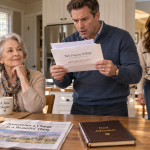
“Ask about your brother.” I read those four words again. And again. My father’s handwriting was unmistakable. The slightly crooked letters. The way he pressed too hard when writing the letter r.
The little upward curve at the end of every sentence. I remembered seeing that handwriting on birthday cards, lunchbox notes, and the last Christmas present he’d given me before he died. But the words themselves made no sense.
I was an only child. I had always been an only child. My mother had told me that for as long as I could remember. I looked at Ethan. Then at the photograph. Then back at my husband. “What brother?” Ethan’s face had gone pale.
He slowly lowered himself onto the edge of our bed.
My mother’s breathing crackled through the speakerphone.
“Olivia,” she whispered, “please don’t listen to him.”
I felt something inside me tighten.
“Mom.”
She began crying.
“Sweetheart, you don’t understand.”
“Then explain it.”
Silence.
I looked down at the photograph again.
Seven-year-old me stood outside a hospital, clutching a yellow balloon.
Beside me was a little boy.
A dark-haired boy with solemn eyes.
The boy Ethan had identified as himself.
But there was someone else in the picture.
Someone I’d barely noticed.
A small child standing partly behind the nurse.
Only one little hand was visible.
And around that wrist was a bright red hospital identification band.
My breath caught.
“Ethan.”
He looked up.
“Who’s the other child?”
His eyes filled.
And my mother made a sound that told me I’d finally asked the question she’d spent twenty years avoiding.
“Olivia,” Ethan said softly, “sit down.”
I stared at him.
“No.”
My voice trembled.
“Don’t tell me to sit down.”
He nodded immediately.
“Okay.”
I held the photograph against my chest.
“Tell me what’s happening.”
Ethan swallowed.
Then looked toward my phone.
“Linda, you have one opportunity to tell your daughter the truth yourself.”
My mother began sobbing.
“You have no right.”
Ethan’s expression changed.
“For five years, you treated me as though I wasn’t worthy of your daughter.”
His voice remained quiet.
“You mocked my work, my family, and everything I tried to build.”
I watched him.
He continued.
“I tolerated it because Olivia loved you.”
Then his voice hardened.
“But you knew exactly who my mother was.”
My heart stopped.
“What?”
Ethan turned toward me.
“Your mother recognized me before our wedding.”
I shook my head.
“That doesn’t make sense.”
He reached for my hand.
“Liv, my mother was the nurse who cared for your father during his final hospitalization.”
I stared at him.
“I know. You just told me.”
He nodded.
“But Linda knew that when she offered me the check.”
The room went cold.
My mother whispered, “Ethan, stop.”
He ignored her.
“She didn’t offer me twenty thousand dollars because I was a mechanic.”
My breath caught.
“She offered it because she knew my family had records about your father’s final days.”
I stared at my husband.
And suddenly, the insult at our wedding sounded different.
My daughter is far too good for a man like you.
I’d spent five years believing those words were about money.
But perhaps my mother had been afraid of something far more dangerous than an embarrassing son-in-law.
The truth.
I sat down slowly.
My legs no longer felt steady.
“Mom,” I whispered, “do I have a brother?”
She didn’t answer.
I closed my eyes.
“Mom.”
A shaky breath came through the phone.
Then she whispered, “Yes.”
The single word struck me harder than a scream.
I stared at the wall.
A brother.
Somewhere in the world, I had a brother.
And my mother had spent more than twenty years telling me I was an only child.
My hand moved instinctively toward my stomach.
Our baby shifted faintly beneath my palm.
I looked at Ethan.
He was crying.
“Is he alive?” I asked.
My mother began sobbing harder.
“Olivia…”
“Is my brother alive?”
“Yes.”
The room seemed to tilt.
I covered my mouth.
Then whispered, “Where is he?”
My mother’s answer came so quietly I almost missed it.
“I don’t know.”
For a long moment, nobody spoke.
I could hear music playing faintly somewhere in the background of my mother’s house.
A clock ticking.
The distant sound of traffic outside our bedroom window.
Ethan’s breathing.
My own heartbeat.
Everything seemed painfully ordinary.
Yet the world I’d known had cracked open.
I looked at the photograph again.
The yellow balloon.
The hospital doors.
The nurse.
The little child with the red identification band.
I swallowed.
“Was that him?”
Ethan leaned closer.
“Possibly. The original photograph and your father’s letter suggest it was.”
My eyes filled.
I turned toward the phone.
“Mom, why didn’t you tell me?”
She began crying.
“Because I thought I was protecting you.”
I shook my head.
“From my own brother?”
“Olivia, please.”
“From what?”
Silence.
Then she whispered, “From what happened to your father.”
Ethan reached for the envelope on the dresser.
It was cream-colored.
Old.
The corners slightly yellowed.
My name was written across the front.
OLIVIA.
Nothing more.
I recognized my father’s handwriting immediately.
My throat closed.
Ethan looked at me.
“You don’t have to read it right now.”
I stared at him.
For five years, he’d loved me.
Protected me.
Built a life with me.
And now he was holding something my father had left for me long before I became his wife.
I wanted to be angry with Ethan for waiting eighteen months.
Part of me was.
But the larger part of me was trembling with a longing so old it felt woven into my bones.
I’d spent twenty-two years wishing I could hear my father’s voice again.
And suddenly, his words were in front of me.
Waiting.
I held out my hand.
“Give it to me.”
Ethan placed the envelope in my palm.
I traced my name with one finger.
Then carefully opened it.
Inside were three folded sheets.
The paper smelled faintly of age.
The first line was enough to make my eyes fill.
My beautiful little Livvy,
I made a sound I didn’t recognize.
Livvy.
My father had called me that.
Nobody else had.
Not Ethan.
Not my mother.
Not even my childhood friends.
Just Dad.
I pressed the letter against my mouth.
And began crying.
Ethan wrapped an arm around me.
I leaned against him.
Then slowly unfolded the pages.
My beautiful little Livvy,
If you’re reading this, it means I wasn’t able to tell you everything myself.
I wish I could be sitting beside you right now, explaining this in a way that doesn’t frighten you.
I wish I could hold your hand.
I wish I could tell you that the world is still a good place, even when adults make mistakes they don’t know how to repair.
I wiped my tears.
Then continued.
First, I need you to know something.
I love you.
Not a little.
Not only when you’re cheerful or obedient.
Not only when you make good grades or remember to clean your room.
I love you because you are my daughter.
That will never change.
My shoulders began shaking.
I could barely see the words.
Ethan kissed the top of my head.
“Take your time.”
I nodded.
Then kept reading.
There’s something your mother and I should have told you earlier.
You have a little brother.
The words blurred.
His name is Benjamin.
I whispered it aloud.
“Benjamin.”
My mother began crying through the phone.
I closed my eyes.
Benjamin.
My brother had a name.
Benjamin was born when you were five years old.
He had dark hair, tiny hands, and the loudest cry I’ve ever heard.
You were very excited when we told you that you were going to be a big sister.
You wanted to name him Captain Pancake.
Despite everything, a broken laugh escaped me.
Captain Pancake.
Somewhere deep inside my memory, something stirred.
A little boy.
A blue blanket.
Me insisting on a silly name while Dad laughed.
I pressed a hand against my chest.
“Oh, God.”
Ethan held me closer.
I kept reading.
We named him Benjamin instead.
You were disappointed for approximately ten minutes.
Then you decided you liked him anyway.
My tears fell onto the paper.
For two years, you were the most devoted big sister a little boy could have.
You sang to him.
You brought him toys.
You made him pretend birthday cakes out of couch cushions.
And whenever he cried, you told your mother and me that we were doing everything wrong.
I laughed through tears.
Then stopped.
Because suddenly, an image flashed through my mind.
A small boy sitting on a kitchen floor.
A wooden spoon in his hand.
Me placing a paper crown on his head.
And a voice calling from another room.
“Livvy, leave your brother’s hair alone.”
I gasped.
Ethan immediately turned toward me.
“What is it?”
I stared at the wall.
“I remember him.”
The words trembled.
“I think I remember him.”
My mother sobbed.
“Olivia…”
I looked toward the phone.
“You told me those memories were dreams.”
Silence.
My chest tightened.
“All those years…”
I swallowed.
“The little boy in the kitchen.”
“The blue blanket.”
“The birthday cake.”
I covered my mouth.
“You told me I was imagining things.”
My mother cried harder.
“Sweetheart, you were so young.”
I stared at the phone.
“I wasn’t imagining him.”
“No.”
Her voice broke.
“You weren’t.”
I returned to the letter.
My hands trembled so badly Ethan had to help steady the pages.
When Benjamin was nearly two, he became seriously ill.
My breath caught.
His condition required specialist care, and your mother and I were frightened.
The bills grew.
We argued.
We made decisions in fear.
Some of those decisions hurt people.
I frowned.
Then continued.
I won’t pretend I handled everything perfectly.
I worked longer hours.
Your mother became exhausted.
And we accepted financial help with conditions we didn’t fully understand.
I looked at Ethan.
His face had become very serious.
Eventually, your mother and I separated.
The words stopped me.
I stared.
Separated?
My mother had always told me she’d been happily married to Dad until his death.
She’d said they’d never had a serious disagreement.
That he adored her.
That their marriage was perfect.
I looked toward the phone.
“Mom?”
No answer.
“You and Dad separated?”
A long silence.
Then she whispered, “Briefly.”
I looked down.
The letter continued.
During that separation, Benjamin stayed primarily with your mother, and you stayed with me.
We intended to work out a permanent arrangement.
But before we could, a car accident changed everything.
My throat tightened.
I turned the page.
And read the words that would alter everything I believed about my childhood.
The night of my accident, I wasn’t driving home from work.
I was driving to meet your mother and bring Benjamin back into our lives.
I stopped breathing.
My father hadn’t simply suffered a sudden heart attack.
He’d been traveling to see my brother.
I stared at Ethan.
He nodded sadly.
“I know.”
I looked toward the phone.
“Mom, where were you taking Benjamin?”
My mother didn’t answer.
I raised my voice.
“Where?”
Finally, she whispered, “To his new family.”
My heart dropped.
“What new family?”
My mother sobbed.
“Olivia, I was overwhelmed.”
I stared.
Then the terrible meaning began to settle.
“No.”
My voice shook.
“No, Mom.”
Ethan squeezed my hand.
I barely felt it.
“Did you give my brother away?”
My mother began crying so hard she couldn’t speak.
And I knew.
Before she said another word.
I knew.
I stood abruptly.
The letter slipped from my lap.
Ethan reached for it.
I walked toward the window.
Outside, our neighborhood was peaceful.
A woman pushed a stroller along the sidewalk.
Children rode bicycles.
Someone was watering roses.
Ordinary people living ordinary lives.
And I had just learned that my mother had kept an entire childhood from me.
An entire person.
My brother.
I pressed my hand against the glass.
Then whispered, “You told me I was an only child.”
My mother answered through tears.
“I know.”
“You told me Dad died instantly.”
“I know.”
“You told me there was nobody else.”
Her voice broke.
“Olivia…”
I turned.
My face was wet.
“Why?”
The word came out as a whisper.
Then again.
Louder.
“Why?”
For a long time, my mother cried.
Eventually, she began explaining.
Not everything.
Not clearly.
Not without contradicting herself.
But enough for me to begin understanding.
After Benjamin became ill, my parents had struggled financially.
My mother had grown frightened of losing their home.
She had accepted help from relatives who believed she couldn’t manage two children.
Then, during their separation, a couple connected to a family acquaintance offered to raise Benjamin.
My mother insisted the arrangement was supposed to be temporary.
But the paperwork became permanent.
And she had signed documents she later regretted.
When my father learned what she’d done, he was furious.
He tried to intervene.
He arranged a meeting.
And on the way to that meeting, he was involved in a serious automobile accident.
He survived three days.
Long enough to ask for me.
Long enough to dictate the letter.
Long enough to beg my mother to tell me about Benjamin.
Then he died.
And my mother chose silence.
I stood motionless.
My body felt cold.
“Mom.”
She sniffled.
“Yes?”
“Did Dad know the adoption was final?”
She hesitated.
Then whispered, “He knew paperwork had been signed.”
I closed my eyes.
“And did he want me to know?”
“Yes.”
My throat tightened.
“Then why didn’t you tell me?”
“Because you were already grieving.”
I shook my head.
“For twenty-two years?”
She didn’t answer.
I looked at Ethan.
His eyes were filled with tears.
Then I asked the question that had been building inside me.
“Did you stop me from seeing Dad before he died?”
Silence.
My mother began crying again.
“Olivia…”
I swallowed.
“Answer me.”
“Yes.”
The word broke something inside me.
I sank onto the bed.
For years, I’d imagined my father’s final moments.
I’d pictured him dying suddenly.
Without pain.
Without fear.
Without knowing his daughter was waiting for him.
My mother had assured me that there was nothing I could have done.
That he hadn’t suffered.
That he never knew what happened.
But now I knew he’d spent three days in a hospital.
Asking for me.
Waiting.
And my mother had refused to bring me.
I pressed my hands over my face.
Then whispered, “He thought I didn’t come.”
Ethan knelt in front of me.
“Liv.”
I shook my head.
“He asked for me.”
My voice broke.
“And I wasn’t there.”
Ethan took my hands.
“Olivia, you were seven.”
I began sobbing.
“You didn’t know.”
I shook my head harder.
“But he…”
My husband pulled me into his arms.
“You were a child.”
I clung to him.
“And you loved him.”
My mother was still on the phone.
Still crying.
Still trying to explain.
I reached for the screen.
Then stopped.
I wanted to scream.
To demand why she’d done it.
To ask how she could have watched me grow up wondering why Dad never said goodbye.
But my hands were shaking.
And the baby inside me had begun moving.
I looked down at my stomach.
Our child.
The little girl Ethan kept insisting we were having.
Suddenly, the thought of hiding a child from someone who loved her made me feel physically sick.
I took a slow breath.
Then said quietly, “Mom, I can’t talk to you right now.”
She began pleading.
“Olivia, please don’t hang up.”
I closed my eyes.
“I need time.”
“Sweetheart…”
“I need time.”
Then I ended the call.
The silence afterward felt enormous.
Ethan sat beside me.
He didn’t try to fill it.
He simply held my hand.
For a long time, I stared at my father’s letter.
Then I turned toward him.
“Eighteen months.”
He looked up.
My voice trembled.
“You’ve known about this for eighteen months?”
Ethan’s expression fell.
“Liv…”
I pulled my hand away.
“No.”
My eyes filled.
“Don’t.”
He swallowed.
I stared at him.
“You watched me have dinner with my mother.”
“Yes.”
“You watched her come to our house.”
He nodded.
“You watched her talk about my father.”
His face crumpled.
“Yes.”
I stood.
“Ethan, you knew!”
He lowered his head.
“I know.”
I began crying again.
“Why didn’t you tell me?”
He didn’t make excuses.
That almost made it harder.
He simply sat there, looking devastated.
Then he whispered, “At first, I wasn’t certain.”
I stared at him.
He continued.
“When my mother died, I inherited her personal journals and some records she’d kept from her nursing career.”
My throat tightened.
“She had preserved documents relating to your father’s hospitalization.”
Ethan swallowed.
“But some were incomplete.”
I stared.
He continued.
“I found the photograph.”
“The dictated letter.”
“And references to a child named Benjamin.”
His eyes filled.
“I didn’t know whether the records were accurate or whether the family circumstances were being described correctly.”
I looked away.
He continued.
“So I contacted an attorney.”
“And spent months trying to understand what could legally be verified.”
I turned back.
“And you didn’t think I deserved to know?”
His expression crumpled.
“Yes.”
The answer stunned me.
He nodded.
“You did.”
His voice broke.
“I should have told you sooner that I had found something.”
Tears slipped down his face.
“I was afraid of hurting you.”
I stared.
“And by waiting, I hurt you anyway.”
He lowered his head.
“Yes.”
For the first time in our marriage, I couldn’t bear to have Ethan touch me.
I stood.
Walked toward the bathroom.
And closed the door.
Not dramatically.
Not angrily.
I simply needed space.
I sat on the edge of the bathtub.
Holding my stomach.
And cried.
For my father.
For my brother.
For the little girl I’d been.
For the years I’d spent believing a story that wasn’t true.
And for the painful realization that two people I loved had made decisions about my life without allowing me to participate.
When I finally came out, Ethan was sitting on the floor beside the bed.
The letters lay carefully arranged on the blanket.
His face was wet.
He looked up.
“Liv.”
I stood in the doorway.
He swallowed.
“I’m sorry.”
I nodded.
But I couldn’t tell him everything was fine.
Because it wasn’t.
“I need you to understand something.”
He listened.
“My mother controlled what I knew about my childhood.”
His expression tightened.
“And you controlled when I learned the truth.”
Tears filled his eyes.
He nodded slowly.
“Yes.”
I swallowed.
“I know you wanted to protect me.”
He nodded.
“But I need you to trust me with my own life.”
Ethan closed his eyes.
Then whispered, “You’re right.”
We sat on opposite sides of the bed for a long time.
Eventually, I asked him about the package.
The photograph.
The check.
The letter.
And the eighteen months he’d spent preparing.
Ethan explained that he’d been tracing the circumstances surrounding my father’s death and the adoption records through lawful channels.
He’d spoken with his mother’s former colleagues.
Reviewed documents she’d preserved.
Consulted attorneys.
And attempted to locate information about Benjamin without violating anyone’s privacy.
Some records were sealed.
Others incomplete.
A few leads went nowhere.
The photograph was one of the strongest connections.
It showed me and Ethan outside the hospital.
And the small child wearing the red identification band.
The nurse who’d taken the photograph had written the date on the back.
Along with a note.
The day Olivia visited the hospital.
That detail stopped me.
“Visited?”
Ethan nodded.
“Yes.”
I stared.
“But Mom said I never went.”
He swallowed.
“According to the journal, you were brought to the hospital once.”
My heart began pounding.
“By whom?”
His eyes filled.
“My mother.”
I looked at the photograph again.
My seven-year-old face.
The yellow balloon.
The little boy beside me.
The smaller child partly hidden.
Then I remembered something.
Not clearly.
More like a feeling.
A hospital hallway.
The smell of disinfectant.
A woman kneeling in front of me.
A door I wasn’t allowed to enter.
I pressed my hand against my forehead.
“Ethan…”
He leaned forward.
“What?”
“I remember waiting.”
His eyes widened.
I swallowed.
“I remember someone telling me Dad was sleeping.”
Tears filled my eyes.
“And I remember crying because I wanted to go inside.”
Ethan nodded slowly.
His voice broke.
“My mother wrote that you kept asking for him.”
I stared at him.
Then whispered, “Did I see him?”
He shook his head.
“The journal says the visit ended before you were able to.”
I covered my mouth.
A sob escaped.
I had been there.
In the same hospital.
Just beyond a door.
While my father was dying.
That night, I couldn’t sleep.
Ethan stayed beside me.
But neither of us pretended things were normal.
Around two in the morning, I asked him another question.
“Why did you send the package on our anniversary?”
He turned toward me.
His face looked exhausted.
“Because five years ago, your mother publicly humiliated me.”
I stared.
He continued.
“And she believed she could control what happened between us.”
His voice softened.
“But that’s not the reason I sent it.”
I waited.
He swallowed.
“Last month, the attorney handling the search found a new lead.”
My heartbeat quickened.
“About Benjamin?”
Ethan nodded.
“Yes.”
I sat upright.
“What lead?”
His eyes filled.
“We found evidence that the family who adopted him moved to another state.”
I stared.
“Which state?”
“Colorado.”
My breath caught.
Ethan continued.
“And there may be a way to contact him through an intermediary.”
I covered my mouth.
A brother.
A real, living brother.
Possibly somewhere in Colorado.
I looked at Ethan.
“Is he married?”
“I don’t know.”
“Does he have children?”
“I don’t know.”
“Does he remember me?”
Ethan’s expression softened.
“I don’t know, sweetheart.”
My eyes filled.
Then I whispered the question that frightened me most.
“Does he know I exist?”
Ethan took a breath.
“I don’t know that either.”
The next morning, I called my doctor.
I explained that I’d experienced an enormous emotional shock and wanted to make sure the pregnancy was progressing normally.
The office arranged an appointment.
Ethan drove me.
Neither of us spoke much.
When the ultrasound technician showed us the baby moving, I burst into tears.
Ethan reached for my hand.
I let him hold it.
For several minutes, we watched our child.
Alive.
Growing.
Unaware of the secrets surrounding her family.
Then the doctor smiled.
“Everything looks reassuring today.”
Relief washed over me.
I looked at Ethan.
His eyes were wet.
He kissed my hand.
And whispered, “There’s our little girl.”
For the first time in twenty-four hours, I smiled.
But when we returned home, my mother’s car was parked in the driveway.
I stopped walking.
Ethan looked toward it.
Then at me.
“You don’t have to speak with her.”
I nodded.
My mother stood beside the front door.
She wore a pale blue blouse.
Her hair was carefully arranged.
But her face looked older than it had the day before.
Her eyes were swollen.
In her hands, she held a small wooden box.
“Olivia.”
I stood beside the car.
She took a step forward.
“I know you don’t want to see me.”
I swallowed.
“Then why are you here?”
Her eyes filled.
“Because I brought something you should’ve had a long time ago.”
I looked toward the box.
My stomach tightened.
“What is it?”
She began crying.
“Your father’s things.”
For twenty-two years, my mother had kept a box of my father’s belongings.
Letters.
Photographs.
A watch.
A little silver keychain.
And a small cassette tape.
I stared at it.
Then looked at her.
“What’s on that?”
She swallowed.
“Your father recorded a message.”
My heart stopped.
I reached for the box.
My hands trembled.
“Mom…”
She began sobbing.
“I couldn’t listen to it.”
I stared.
“For twenty-two years?”
She nodded.
I looked down.
The tape had a handwritten label.
FOR LIVVY.
My father’s handwriting.
Again.
I pressed a hand against my mouth.
Then whispered, “You kept his voice from me.”
My mother closed her eyes.
“Yes.”
I wanted to scream.
I wanted to ask how many times she’d watched me cry over my father’s photograph.
How many birthdays she’d listened to me say I wished I could hear him again.
How many Christmases she’d allowed me to believe there was nothing left of him except memories.
But I couldn’t speak.
I took the box.
Then looked at Ethan.
“Can we go inside?”
He nodded.
“Yes.”
My mother stepped forward.
“Olivia, please.”
I turned.
She began crying harder.
“I know I hurt you.”
I looked at her.
Then said quietly, “You didn’t just hurt me, Mom.”
My voice broke.
“You took away my chance to know the truth.”
She covered her face.
I swallowed.
“And I don’t know how to talk to you yet.”
Then I walked inside.
Ethan found an old cassette player at a secondhand electronics shop that afternoon.
He tested it carefully.
Made sure it worked.
Then placed it on our bedroom dresser.
I sat beside him.
The little wooden box rested on my lap.
My heart pounded.
Ethan looked at me.
“Ready?”
I shook my head.
Then nodded.
“I think so.”
He inserted the tape.
Pressed play.
At first, there was only static.
A faint mechanical hiss.
Then a man’s voice.
Weak.
Raspy.
But unmistakable.
“Hello, my little Livvy.”
I stopped breathing.
My father.
My daddy.
Twenty-two years after his death.
Speaking to me.
I covered my mouth.
And began sobbing.
His voice continued.
“I hope you’re being a good girl.”
A faint laugh.
Then a pause.
“I know you are.”
I pressed both hands over my face.
Ethan wrapped his arm around me.
My father’s voice grew quieter.
“I wish I could be there to tuck you in.”
I was shaking.
“I wish I could read you another story.”
A pause.
Then the sound of breathing.
“I wish I could see how tall you’re going to grow.”
Tears streamed down my face.
“Daddy,” I whispered.
The tape continued.
“But if I can’t, I want you to remember something.”
A long pause.
Then his voice returned.
“You are loved.”
I began sobbing harder.
“Always.”
For several seconds, there was only static.
Then Dad spoke again.
“And there’s something important I need you to know about your little brother.”
My heart stopped.
Ethan leaned closer.
I stared at the cassette player.
“His name is Benjamin.”
Dad’s voice trembled.
“You were so excited when he came home.”
“You wanted to hold him all the time.”
A faint laugh.
“And you tried to feed him birthday cake before he had any teeth.”
I laughed through tears.
Then Dad’s voice changed.
More serious.
“I don’t know exactly what will happen next.”
A long pause.
“But if you ever have the chance to find him, I hope you’ll know that none of this was your fault.”
I closed my eyes.
He continued.
“Sometimes adults make mistakes because they’re frightened.”
“Sometimes those mistakes are very serious.”
“But children should never have to carry the blame.”
My body shook.
Then he whispered.
“Tell Benjamin I love him.”
A pause.
“And tell him I never stopped trying to bring him home.”
The recording ended with three words.
“Love you, Livvy.”
Then the cassette clicked.
And the room fell silent.
I stared at the machine.
My father was gone again.
But for a few beautiful minutes, I’d heard his voice.
I had heard him laugh.
He’d spoken my childhood nickname.
And he’d told me he loved me.
I collapsed against Ethan.
And cried until I couldn’t breathe comfortably.
He held me.
Didn’t rush me.
Didn’t tell me to be strong.
He simply whispered, “I’m here.”
That night, I slept with the wooden box beside my bed.
The tape remained inside.
I didn’t play it again immediately.
I was afraid of how much it would hurt.
But I also felt something extraordinary.
For twenty-two years, I’d believed my father’s last moments had been empty of me.
Now I knew he’d been thinking about me.
He’d wanted me.
He’d left words behind.
And even though my mother had hidden them, she’d never been able to erase the love inside them.
A week passed before I spoke to my mother again.
During that time, I read every letter in the box.
Studied every photograph.
Looked through the documents Ethan had collected.
And began writing down questions.
Not accusations.
Questions.
I wanted facts.
Dates.
Names.
Documents.
I wanted to understand the difference between what my mother remembered, what she’d chosen to believe, and what could actually be established.
Ethan helped me organize everything.
He also gave me access to all the information he’d gathered.
Nothing hidden.
Nothing filtered.
And when I asked him a question he couldn’t answer, he admitted it.
That mattered.
Because after so many years of secrets, I needed honesty more than reassurance.
Then one afternoon, my mother called.
I answered.
“Hello?”
Her voice was quiet.
“Olivia.”
I took a breath.
“Mom.”
She hesitated.
“Can we talk?”
I looked toward Ethan.
He was sitting at the kitchen table reviewing invoices for one of his repair shops.
He glanced up.
Then gently nodded.
I took a breath.
“Yes.”
My mother came over the next day.
We sat in the living room.
Ethan offered to stay.
I asked him to give us privacy.
He kissed my forehead.
Then stepped outside.
My mother sat across from me.
She looked nervous.
For the first time in my life, I saw her without the confidence she’d always used to control every conversation.
I placed my father’s letter on the table.
Then the photograph.
Then the copy of the check.
Her face crumpled.
I looked at her.
“Mom, I need you to tell me the truth.”
She nodded.
“I will.”
I swallowed.
“All of it.”
Her eyes filled.
“Yes.”
We talked for nearly four hours.
Some of what she told me confirmed the records.
Some details remained uncertain.
And some things she admitted were worse than I’d imagined.
She confessed that after Benjamin became ill, she’d felt trapped.
My father was working long hours.
Medical bills were mounting.
Relatives were pressuring her.
She’d been afraid of poverty.
Afraid of losing her marriage.
Afraid of not being able to care for two children.
A family acquaintance introduced her to a couple who wanted to adopt.
My mother convinced herself Benjamin would have a better life with them.
She signed papers.
Then told herself it was temporary.
But when the legal process moved forward, she couldn’t undo it as easily as she’d imagined.
My father learned the truth.
He was devastated.
They separated.
And before they could resolve the situation, he was injured in the accident.
I listened.
Sometimes crying.
Sometimes feeling numb.
Sometimes so angry I had to ask her to stop.
But I kept listening.
Then I asked about the hospital.
“Why didn’t you let me see Dad?”
My mother covered her face.
“I thought it would traumatize you.”
I stared.
She lowered her hands.
“He was badly injured.”
Her voice broke.
“He looked different.”
I swallowed.
“He was still my father.”
She nodded.
“I know.”
“And he asked for me.”
Tears streamed down her face.
“Yes.”
I closed my eyes.
For a moment, I could barely breathe.
Then I whispered, “You should have let me say goodbye.”
My mother began sobbing.
“I know.”
I looked down at my stomach.
Our baby moved beneath my hand.
My mother noticed.
Her eyes filled.
“Olivia…”
I raised my gaze.
“Mom, when my daughter is born, I want her to know that she can ask difficult questions.”
My voice trembled.
“That she can tell me when she’s angry.”
“That she doesn’t have to earn my love by agreeing with me.”
My mother began crying harder.
I continued.
“And I want her to know that the truth belongs to her too.”
Then I asked about Ethan.
The check.
The wedding.
The years of insults.
My mother’s expression changed.
She looked ashamed.
“When I learned Ethan’s mother had worked at that hospital, I was frightened.”
I stared.
“How did you know?”
She swallowed.
“His mother recognized my name when we were introduced.”
My heart tightened.
“She remembered your father.”
I nodded slowly.
My mother continued.
“She asked whether you’d received the message he left.”
My breath caught.
“And what did you say?”
My mother looked down.
“I told her not to interfere.”
I closed my eyes.
Then she whispered, “When you and Ethan became serious, I was afraid he would learn everything.”
“So you offered him money.”
She nodded.
“Yes.”
I stared.
“Twenty thousand dollars.”
“Yes.”
“To leave me.”
She began crying.
“Yes.”
For a long moment, I couldn’t speak.
Then I asked, “Did you think Ethan would take it?”
My mother swallowed.
“I hoped he would.”
I looked away.
She continued.
“I told myself he wasn’t right for you.”
I laughed bitterly.
“Because he was a mechanic?”
She shook her head.
“No.”
The answer stunned me.
She looked at me.
“Olivia, I knew he was a good man.”
My throat tightened.
“I knew he loved you.”
She began crying.
“And that frightened me more.”
I stared.
She continued.
“Because if you built a life with someone who respected your choices, you might stop letting me make them.”
The room went silent.
There it was.
The truth beneath all her explanations.
My mother hadn’t simply disapproved of Ethan because he lacked money.
She’d been afraid of losing control.
Afraid that I would become independent.
Afraid that someone who loved me without conditions would help me recognize how conditional her own approval had been.
I looked down.
Then whispered, “Mom, you spent years making me feel guilty for loving a good man.”
She nodded.
“Yes.”
I swallowed.
“And you humiliated him at our wedding.”
Tears streamed down her face.
“I know.”
I looked at her.
“Why?”
Her voice broke.
“Because I wanted him to leave.”
I closed my eyes.
There was no dramatic revelation left to uncover.
No hidden excuse that could make her choices harmless.
Only a frightened woman who had made serious mistakes and then spent decades protecting herself from the consequences.
I took a slow breath.
“Mom, I don’t know what our relationship will look like after this.”
She began crying.
I continued.
“I love you.”
Her face crumpled.
“But I don’t trust you right now.”
She nodded.
“I understand.”
I looked at her.
“And I won’t pretend everything is fine because you’re sorry.”
Her eyes filled.
“I know.”
I swallowed.
“I need time.”
She nodded again.
Then whispered, “I’ll give you that.”
When she left, I sat alone for a long time.
Ethan eventually came inside.
He didn’t ask how the conversation went immediately.
He simply placed a cup of tea beside me.
Then sat down.
I looked at him.
And suddenly, I remembered our wedding.
My mother’s cruel speech.
The laughter.
The humiliation.
Ethan raising his champagne glass.
Thank you, Linda. I’ll remember that.
I’d always thought he meant he would remember being insulted.
Now I understood.
He had remembered something else.
The warning.
The check.
The fear in my mother’s eyes.
And the knowledge that she was willing to manipulate our future to protect her secrets.
I turned toward Ethan.
“Why did you keep the check?”
He looked at me.
For a moment, he seemed surprised.
Then he smiled sadly.
“Because I wanted proof.”
I stared.
“Proof of what?”
“That she offered me money to leave you.”
My eyes filled.
He continued.
“I didn’t want there to be a day when she claimed I’d misunderstood.”
I nodded slowly.
“Did you cash it?”
He shook his head.
“No.”
He reached for my hand.
“I never wanted her money.”
I smiled through tears.
“I know.”
He squeezed my fingers.
“I wanted you.”
We sat quietly.
Then I asked him something.
“Ethan?”
“Yes?”
“Were you angry when she mocked you at our wedding?”
He considered.
Then nodded.
“Yes.”
I swallowed.
“Why didn’t you say anything?”
He smiled sadly.
“Because I didn’t want the first memory of our marriage to be me fighting with your mother.”
My eyes filled.
He continued.
“But I should’ve been more honest with you about what happened before the wedding.”
I nodded.
“Yes.”
He squeezed my hand.
“And I should’ve told you sooner when I found the records.”
I looked at him.
“Yes.”
He swallowed.
“I’m sorry, Liv.”
For a moment, I stared at my husband.
The man I’d married because he made me feel safe.
The man who worked long hours repairing cars.
Who saved carefully.
Who built a business.
Who brought me coffee every morning.
And who had made a painful mistake while trying to protect me.
I wasn’t ready to pretend his silence hadn’t hurt.
But I could see the difference between someone who admitted wrongdoing and someone who spent decades rewriting it.
I reached for his hand.
Then whispered, “We have work to do.”
He nodded.
“I know.”
We began seeing a marriage counselor.
Not because our marriage was falling apart.
But because I wanted to make sure we never built our future on the same patterns that had shaped my childhood.
I needed to learn how to express anger without fearing abandonment.
Ethan needed to understand that protecting someone didn’t mean deciding what information they were allowed to receive.
We talked.
Argued sometimes.
Cried.
Listened.
And slowly, we learned to trust each other more honestly.
Meanwhile, the search for Benjamin continued.
The attorney explained that adoption records could be difficult to access, depending on the jurisdiction and circumstances.
We couldn’t simply demand someone’s private information.
My brother had his own life.
His own history.
His own rights.
If he wanted contact, it needed to be his choice.
I understood.
But every day, I woke wondering.
Where was he?
Was he happy?
Did he have a family?
Did he remember the little girl who wanted to call him Captain Pancake?
Then, six weeks after our anniversary, the attorney called.
I was sitting on the porch.
Ethan was repairing a loose board near the steps.
My phone rang.
I answered.
“Hello?”
“Mrs. Carter?”
“Yes?”
“This is Rebecca Morris.”
My heart began pounding.
Rebecca was the attorney coordinating the search.
She sounded unusually careful.
“I wanted to let you know we’ve received a response from an intermediary.”
I stood.
Ethan immediately looked up.
“What kind of response?”
Rebecca paused.
“A man whose records may match Benjamin’s has agreed to receive a letter from you.”
My knees weakened.
Ethan hurried toward me.
I gripped his arm.
“He’s alive?”
Rebecca answered carefully.
“We have a promising match, and the person has agreed to consider contact. We still need to complete verification.”
I began crying.
A man.
Somewhere.
Possibly my brother.
Had agreed to read a letter from me.
That evening, I sat at the kitchen table with a blank sheet of paper.
I stared at it for nearly an hour.
How do you introduce yourself to someone who should have known you all his life?
How do you explain twenty-two years of silence when you didn’t choose it?
How do you tell a stranger you used to put paper crowns on his head?
I wrote one sentence.
Crossed it out.
Wrote another.
Then began crying.
Ethan sat beside me.
“Want help?”
I shook my head.
“I don’t know what to say.”
He nodded.
I looked down.
Then whispered, “What if he hates me?”
Ethan took my hand.
“Then we respect how he feels.”
My eyes filled.
“And if he doesn’t want to meet?”
“We respect that too.”
I swallowed.
He smiled gently.
“But he might want to know you.”
I looked at him.
Then nodded.
And began writing.
Dear Benjamin,
I don’t know whether you remember me.
My name is Olivia.
I believe I’m your older sister.
When we were little, I used to call you Captain Pancake because I thought it was the perfect name for a baby.
I recently learned about the circumstances that separated us.
I want you to know I didn’t choose to disappear from your life.
I didn’t know where you were.
For many years, I didn’t even know you existed.
I’m sorry we lost so much time.
I don’t expect anything from you.
You don’t have to write back.
You don’t have to meet me.
But if you ever want to know the little girl who used to make you paper crowns, I’m here.
With love,
Olivia.
I folded the letter.
Placed it in an envelope.
Then cried.
Ethan held me.
We mailed it the following morning through the agreed channel.
And began waiting.
Days passed.
Then weeks.
Every time my phone rang, my heart jumped.
Every time the mail arrived, I rushed to the door.
Ethan tried to keep me grounded.
We continued preparing the nursery.
Attending appointments.
Running the business.
Living our ordinary lives.
But the waiting filled every quiet moment.
One morning, I was folding tiny baby clothes when my phone rang.
Rebecca.
I answered immediately.
“Hello?”
Her voice was warm.
“Olivia, I have some news.”
My heart stopped.
“What?”
“The match has been confirmed through the appropriate records.”
I covered my mouth.
“And?”
She paused.
“Your brother has written back.”
I began sobbing.
Ethan rushed into the room.
I held out my hand.
He took it.
Rebecca continued.
“Would you like me to send you his message?”
I could barely speak.
“Yes.”
The email arrived several minutes later.
I stared at it.
Then opened it.
The first line made me cry.
Dear Olivia,
I remember the paper crowns.
I dropped the phone onto the bed.
And covered my face.
Ethan caught me as my knees weakened.
“He remembers.”
My voice broke.
“He remembers me.”
When I could finally breathe, I picked up the phone.
The message continued.
For years, I thought those memories were dreams.
I remembered a little girl who sang loudly and called me silly names.
I remembered a kitchen with yellow curtains.
And I remembered someone telling me that my sister wasn’t coming back.
Tears streamed down my face.
My adoptive parents told me I had been loved before I joined their family.
They never spoke badly about the people who came before them.
But they didn’t know where to find you.
I’ve wondered about you for most of my life.
I pressed my hand against my mouth.
Then continued.
I don’t know what kind of relationship we’ll have.
But I would like to meet you.
And for the record, Captain Pancake is still a terrible name.
I burst out laughing through tears.
Ethan laughed too.
I looked at him.
“He sounds like Dad.”
Ethan smiled.
“Then I already like him.”
We arranged a video call first.
I was terrified.
I changed my clothes three times.
Brushed my hair.
Then brushed it again.
Ethan watched me with a fond smile.
“Liv.”
I turned.
“What?”
“You look beautiful.”
I shook my head.
“What if he doesn’t recognize me?”
Ethan smiled gently.
“Sweetheart, it’s been twenty-two years.”
I laughed nervously.
“I know.”
He stepped closer.
“Just be yourself.”
I swallowed.
Then nodded.
At seven that evening, the call connected.
A man’s face appeared on the screen.
Dark hair.
Brown eyes.
A familiar smile.
He looked about twenty-four.
For a moment, neither of us spoke.
Then he smiled nervously.
“Olivia?”
My heart broke.
“Benjamin?”
He laughed.
“Ben.”
I began crying.
He smiled through tears.
“Hi, big sister.”
I covered my mouth.
And sobbed.
Ben wiped his eyes.
“Wow.”
I laughed through tears.
“Yeah.”
He looked at me.
“You look like Dad.”
My breath caught.
“What?”
His eyes filled.
“I have a photograph of him.”
I stared.
He continued.
“My adoptive parents kept the information they were given.”
My voice trembled.
“You have pictures?”
He nodded.
“Yes.”
I began crying again.
He smiled sadly.
“I’ve wanted to meet you for a long time.”
I pressed a hand against my chest.
“Me too.”
We talked for nearly two hours.
Ben told me about growing up in Colorado.
His adoptive parents.
His school years.
His love of hiking.
His job as a physical therapist.
He’d been adopted by a couple named Thomas and Grace Whitaker.
They had loved him.
Supported him.
And encouraged him to ask questions about his past.
He spoke of them with warmth.
I felt relief flood through me.
He had been loved.
The thought didn’t erase what had happened.
But it mattered.
More than I could explain.
I told Ben about my life.
My work.
Ethan.
Our repair shops.
The house.
My pregnancy.
When I mentioned the baby, Ben’s face lit up.
“Wait.”
He leaned toward the camera.
“I’m going to be an uncle?”
I laughed.
“Yes.”
His eyes filled.
He looked stunned.
Then smiled.
“That’s amazing.”
I wiped my tears.
He grinned.
“Can I teach the kid to call me Captain Pancake?”
I burst out laughing.
“Oh, absolutely.”
And for one beautiful moment, it felt as though no time had passed at all.
We arranged to meet in person two months later.
Ben flew to our city.
I waited at the airport with Ethan.
My hands were shaking.
My stomach had grown rounder.
Our daughter kicked whenever I became nervous.
Ethan stood beside me.
Holding my hand.
Then the arrivals doors opened.
And I saw him.
My brother.
Tall.
Dark-haired.
Carrying a small backpack.
He stopped when he saw me.
For a moment, neither of us moved.
Then he smiled.
“Livvy?”
The nickname shattered me.
I began crying.
And walked toward him.
He dropped his backpack.
Then opened his arms.
I fell into them.
And we held each other.
Twenty-two years of absence.
Twenty-two years of unanswered questions.
Twenty-two years of believing the other was gone.
All folded into one trembling embrace.
“I missed you,” I whispered.
Ben held me tighter.
“I know.”
His voice broke.
“I missed you too.”
We stood there crying.
People walked around us.
Suitcases rolled past.
Announcements echoed through the terminal.
But I barely noticed.
My brother was real.
Warm.
Alive.
Standing in front of me.
And I could finally hold him.
When we pulled apart, Ben looked at my stomach.
His expression softened.
“Wow.”
I laughed through tears.
“Yeah.”
He smiled.
“Little niece?”
I nodded.
“We think so.”
He grinned.
“Already the favorite uncle.”
Ethan laughed.
“Easy there.”
Ben turned toward him.
Then held out his hand.
“You must be Ethan.”
My husband smiled.
“Yes.”
Ben shook his hand.
Then pulled him into a quick embrace.
“Thanks for helping her find me.”
Ethan’s eyes filled.
“I’m glad we did.”
We spent the weekend getting to know one another.
Not perfectly.
Not without awkward moments.
We were strangers in many ways.
We had different childhoods.
Different habits.
Different memories.
But every now and then, something familiar appeared.
Ben laughed exactly like Dad.
He wrinkled his nose when concentrating.
He loved cinnamon toast.
And he hated mushrooms.
Just like me.
At dinner one evening, he looked at my plate.
“You pick them out too?”
I stared.
Then laughed.
“Always.”
He grinned.
“Good. Genetics confirmed.”
But there were difficult conversations too.
Ben asked about our mother.
I answered honestly.
Carefully.
Without telling him how he should feel.
He listened.
Then looked down.
“I’ve wondered why she let me go.”
My heart tightened.
I reached for his hand.
“I know.”
He swallowed.
“My adoptive parents were wonderful.”
I nodded.
“But I still wanted to understand.”
His eyes filled.
I squeezed his fingers.
“You deserve answers.”
He looked at me.
“So do you.”
And for the first time, I didn’t feel alone in the confusion.
On his last evening before returning home, Ben asked whether he could visit Dad’s grave.
We went together.
The cemetery was quiet.
The grass was freshly cut.
A row of maple trees lined the path.
I carried yellow flowers.
Ben carried a small photograph.
When we reached the grave, he stopped.
His face crumpled.
DANIEL MICHAEL REED.
Our father’s name.
The dates.
The stone I’d visited every birthday and Father’s Day.
Ben knelt.
Placed his photograph beside the flowers.
Then whispered, “Hi, Dad.”
I began crying.
Ben sat beside the grave for a long time.
Finally, he looked at me.
“Do you think he loved me?”
The question broke my heart.
I knelt beside him.
Then reached into my handbag.
Inside was a carefully preserved copy of Dad’s letter.
I handed it to Ben.
He read it.
Slowly.
His eyes filled.
Then he reached the words:
Tell Benjamin I love him.
He covered his mouth.
A sob escaped.
I put my arm around him.
And we cried together.
After a while, Ben looked toward the headstone.
Then whispered, “He tried to find me.”
I nodded.
“Yes.”
Tears slid down his cheeks.
“He didn’t forget me.”
I squeezed his hand.
“No.”
My voice broke.
“He never forgot you.”
That evening, back at our house, Ben asked to hear the cassette.
I hesitated.
Then nodded.
We sat in the living room.
Ethan stayed nearby.
I placed the tape into the player.
Pressed play.
And Dad’s voice filled the room.
“Hello, my little Livvy.”
Ben began crying immediately.
He listened.
Silent.
Motionless.
Until Dad mentioned his name.
Then he covered his face.
And sobbed.
I reached for him.
He leaned against me.
And we listened together to the voice of the father we’d both lost.
When the tape ended, Ben sat quietly for several minutes.
Then he whispered, “Can I have a copy?”
I nodded.
“Of course.”
He smiled through tears.
“Thank you.”
I reached for his hand.
“There’s something else.”
He looked up.
“What?”
I smiled sadly.
“Dad left us more than a recording.”
Ben frowned.
I touched the photograph of us as children.
“He left us proof that we were loved.”
Ben’s eyes filled.
And he nodded.
Two months later, our daughter was born.
Ethan had been right.
A girl.
Beautiful.
Healthy.
With dark hair and a determined little cry.
When the nurse placed her in my arms, I began crying.
Ethan stood beside me.
His eyes were wet.
He kissed my forehead.
“Hello, sweetheart.”
I looked down at our daughter.
Then whispered her name.
Grace Elizabeth Carter.
We had chosen Grace in honor of Ben’s adoptive mother, who had welcomed him into a loving home.
And Elizabeth because it was the name of Ethan’s mother, the nurse whose preserved records helped us find the truth.
Ethan smiled through tears.
“She looks like you.”
I laughed.
“She looks angry.”
He grinned.
“Definitely your daughter.”
When Ben arrived at the hospital, he stood in the doorway looking terrified.
I laughed.
“Come in.”
He approached slowly.
“She’s tiny.”
I smiled.
“Yes.”
He looked at me.
“Can I hold her?”
I nodded.
“Of course.”
Ethan helped him settle into the chair.
Then placed Grace carefully in his arms.
Ben stared.
His eyes filled.
“Hi, little one.”
Grace opened her eyes briefly.
He laughed through tears.
“I’m Uncle Ben.”
I smiled.
He leaned closer.
“But you can call me Captain Pancake.”
I burst out laughing.
And for a moment, the room was filled with a happiness that felt almost impossible after everything we’d been through.
My mother learned about Grace’s birth through a message I sent her.
I hadn’t completely cut contact.
But our relationship had changed.
There were boundaries.
Conversations we still needed to have.
Trust that would take time to rebuild, if it could be rebuilt at all.
She called.
I answered.
“Olivia?”
“Yes, Mom.”
Her voice trembled.
“Is the baby okay?”
I looked down at Grace.
“She’s wonderful.”
My mother began crying.
“Can I see her?”
I took a breath.
“Not today.”
Silence.
Then she whispered, “I understand.”
I swallowed.
“We’ll talk about a visit when we’re ready.”
She nodded, though I couldn’t see her.
“Okay.”
And for the first time, she didn’t argue.
Over the following year, my mother began making changes.
Not dramatic ones.
Not the kind that erase decades of harm.
But real ones.
She started counseling.
She acknowledged what she’d done.
She apologized to Ben through a letter, without demanding a response.
She stopped criticizing Ethan.
And when she wanted to visit Grace, she asked rather than assumed.
It wasn’t enough to restore trust immediately.
But it was a beginning.
Ben wasn’t ready to meet her.
I respected that.
He had every right to decide what relationship, if any, he wanted with her.
I didn’t pressure him.
Didn’t tell him forgiveness was necessary.
Didn’t insist that family meant overlooking harm.
I simply let him know I would support his choices.
One afternoon, Ben called.
“Liv?”
I smiled.
“Hey, Captain Pancake.”
He laughed.
“You’re never letting that go, are you?”
“Never.”
He chuckled.
Then grew quiet.
“I’ve been thinking about Mom.”
My heart tightened.
“Okay.”
He swallowed.
“I don’t know whether I want to meet her.”
I nodded.
“You don’t have to decide now.”
He sighed.
“I know.”
Then he whispered, “Part of me wants answers.”
I looked down at Grace, who was sleeping beside me.
“And part of me is angry.”
I swallowed.
“That makes sense.”
He was silent for a moment.
Then said, “I’m glad I found you.”
My eyes filled.
“Me too.”
As the years passed, Ben became part of our everyday lives.
He visited for holidays.
Called on birthdays.
Sent Grace ridiculous gifts.
And never missed an opportunity to remind her that Uncle Ben had once been called Captain Pancake.
When Grace turned three, he bought her a little chef’s hat.
She wore it everywhere.
Even to bed.
I laughed until my stomach hurt.
Ethan claimed Ben was a terrible influence.
Ben agreed.
Proudly.
One Christmas, we sat around the dinner table.
Ethan carving turkey.
Grace singing loudly.
Ben arguing with his girlfriend about whether pineapple belonged on pizza.
And I suddenly felt something tighten in my chest.
Not pain.
Not fear.
Gratitude.
Because for most of my life, I’d believed my family consisted of my mother and me.
Then Ethan came along.
Then Grace.
Then Ben.
And the world I’d known became larger than I ever imagined.
But there was still one unfinished part of the story.
The wedding photograph.
The twenty-thousand-dollar check.
The package Ethan had mailed on our fifth anniversary.
For years, that package had represented a confrontation.
A moment when secrets finally surfaced.
But eventually, I began seeing it differently.
It wasn’t the package that changed our lives.
It was what we did after opening it.
The questions we asked.
The truth we accepted.
The boundaries we established.
And the relationships we chose to build.
On our tenth wedding anniversary, Ethan surprised me.
I woke to the smell of coffee.
Just like five years earlier.
A cup sat on my nightstand.
Ethan was sitting beside the bed.
Smiling.
“Happy anniversary, Liv.”
I laughed.
“You’re making this a tradition?”
He grinned.
“Seems to be working.”
I sat up.
Then noticed a small envelope beside the coffee.
My smile faded slightly.
Ethan immediately noticed.
“Hey.”
He took my hand.
“Nothing frightening this time.”
I laughed nervously.
“After the last anniversary envelope, I think I’m allowed to worry.”
He smiled.
“Fair.”
I picked it up.
Inside was a photograph.
Our wedding day.
Ethan holding my hand.
Both of us smiling.
The moment before my mother stood and ruined the reception.
I stared at it.
Then looked at him.
“What is this?”
He smiled gently.
“Turn it over.”
On the back, in Ethan’s handwriting, were five words.
I WOULD CHOOSE YOU AGAIN.
My eyes filled.
I looked at him.
“Ethan…”
He took my hands.
“For ten years, we’ve been through things I never imagined.”
His voice softened.
“We’ve built a business.”
“A home.”
“A family.”
“We’ve made mistakes.”
He swallowed.
“And we’ve learned from them.”
My eyes filled.
He continued.
“Your mother once said our marriage wouldn’t last a year.”
He smiled faintly.
“Turns out she was wrong.”
I laughed through tears.
He kissed my forehead.
“But I don’t want to spend our anniversaries proving anything to her.”
His eyes met mine.
“I want to spend them loving you.”
I began crying.
Then pulled him close.
That evening, we hosted a small dinner.
Not a grand party.
Not fifty relatives.
Just the people closest to us.
Ben.
His wife.
Their little boy.
Grace.
A few friends.
And, after careful thought and conversation, my mother.
She arrived with flowers.
She was quieter than she’d once been.
Less concerned with appearances.
More willing to listen.
When she entered, Ethan greeted her politely.
“Linda.”
She looked at him.
Then smiled sadly.
“Ethan.”
For a moment, they stood facing one another.
The mechanic she’d mocked.
The man she’d tried to bribe.
The son-in-law she’d spent years hoping would disappear.
Then my mother said something I’d never expected to hear.
“I owe you an apology.”
Ethan looked at her.
She continued.
“Not because you’re successful.”
His expression changed.
“Not because you own businesses.”
Her eyes filled.
“But because you were always good to my daughter.”
I stood nearby.
Holding Grace’s hand.
My mother swallowed.
“And I treated you terribly.”
Ethan was quiet.
Then he nodded.
“Thank you for saying that.”
He didn’t pretend the past hadn’t happened.
Didn’t embrace her.
Didn’t promise instant forgiveness.
But he acknowledged the apology.
And I realized how far we’d come.
Later that evening, my mother approached me.
Grace was playing with her cousins.
Ben was helping Ethan clear the table.
My mother stood beside the window.
“Olivia?”
I turned.
“Yes?”
She looked toward the kitchen.
Then whispered, “He’s a good man.”
I smiled sadly.
“I know.”
Her eyes filled.
“I was wrong about him.”
I nodded.
“Yes.”
She swallowed.
“And I was wrong about a lot of things.”
I looked at her.
For a moment, I saw the woman who had raised me.
Who packed my lunches.
Helped with homework.
Sat beside me when I was sick.
And also the woman who had hidden the truth about my father and brother.
Both things were real.
That was the hardest part.
I took a breath.
“Mom, I hope you keep working on understanding why you made those choices.”
She nodded.
“I will.”
I looked toward Ben.
He was laughing with Ethan.
My mother followed my gaze.
Her eyes filled.
Then she whispered, “He looks like your father.”
I swallowed.
“Yes.”
She began crying.
I didn’t know what to say.
So I stood beside her.
And for once, neither of us tried to control the moment.
Ben eventually chose to have a conversation with our mother.
It happened several months later.
Not at a holiday.
Not in front of the family.
Just the two of them, with arrangements that made him comfortable.
I didn’t ask him to tell me everything afterward.
That conversation belonged to him.
But when he called that evening, his voice sounded thoughtful.
“Liv?”
“Yes?”
“I met her.”
My heart tightened.
“How are you?”
He considered.
Then said, “Complicated.”
I smiled sadly.
“I understand.”
He was quiet.
Then added, “She answered some questions.”
I nodded.
“That’s good.”
He sighed.
“I don’t know what happens next.”
I looked toward the window.
“You don’t have to know.”
He laughed softly.
“That’s what my wife said.”
I smiled.
“Smart woman.”
He chuckled.
“Very.”
Our lives continued.
Ethan’s business expanded carefully.
He opened additional repair locations, but never forgot the small garage where he’d started.
He treated his employees respectfully.
Provided training.
And took pride in giving younger mechanics opportunities to develop their skills.
Sometimes people asked him whether he’d ever considered leaving the automotive industry now that he was financially successful.
He always laughed.
“Why would I?”
Then he’d smile.
“I like fixing things.”
I loved that about him.
He never became ashamed of the work my mother had mocked.
He simply built a life around something he was good at.
One afternoon, Grace visited his original garage.
She was six.
Wearing pink sneakers.
Holding a toy car.
Ethan knelt beside her.
“What’s wrong with your car, sweetheart?”
She frowned seriously.
“It won’t go fast.”
He inspected it.
Then nodded.
“Very serious problem.”
Grace giggled.
“Can you fix it?”
Ethan smiled.
“Let’s see.”
I watched from the doorway.
My heart warmed.
The man my mother once described as not good enough for me was kneeling on a garage floor, helping our daughter repair a toy car.
And I couldn’t imagine anyone better.
As Grace grew older, I told her about her grandfather Daniel.
Not all at once.
Not in ways that would burden her.
But through stories.
Photographs.
Memories.
And eventually, the cassette recording.
She loved hearing his voice.
Especially the part where he called me Livvy.
One afternoon, she looked at me.
“Mommy?”
“Yes?”
“Grandpa sounds nice.”
My eyes filled.
“He was.”
She smiled.
“Would he like me?”
I swallowed.
Then pulled her close.
“Oh, sweetheart.”
I kissed her forehead.
“He would’ve adored you.”
When Grace turned eight, she asked about Uncle Ben.
Not why he lived in Colorado.
Not why he had another family name.
But why we hadn’t known him when he was little.
I took a breath.
Then explained carefully.
“Sometimes grown-ups make decisions that separate families.”
She frowned.
“Bad decisions?”
“Sometimes.”
She looked thoughtful.
Then asked, “Did you want to find him?”
I smiled.
“Very much.”
She nodded.
“I’m glad you did.”
I pulled her close.
“Me too.”
I never told Grace that family was simple.
Because it wasn’t.
I’d learned that painfully.
But I did teach her that love should never require silence.
That questions were allowed.
That apologies mattered only when accompanied by change.
And that a person’s worth wasn’t measured by their job, their income, or the approval of someone who believed themselves superior.
One evening, Ben visited with his family.
After dinner, we sat on the porch.
The children were asleep.
Ethan was inside cleaning up.
Ben leaned back in his chair.
“Liv?”
I smiled.
“Yes?”
“Do you ever think about Dad?”
My throat tightened.
“Every day.”
He nodded.
“Me too.”
For a moment, we sat quietly.
Then he asked, “Do you think he’d be happy we found each other?”
Tears filled my eyes.
I looked toward the stars.
Then smiled.
“I think he’d be very happy.”
Ben laughed softly.
“Probably make some terrible joke about Captain Pancake.”
I burst out laughing.
“Oh, definitely.”
He smiled.
Then his expression softened.
“I wish we’d had more time with him.”
My eyes filled.
“Me too.”
We sat quietly for a while.
Then Ben reached into his pocket.
“I brought something.”
I looked at him.
“What?”
He handed me a small photograph.
It showed our father holding Benjamin as a baby.
I stood beside them.
Five years old.
Grinning.
With one hand resting protectively on Ben’s shoulder.
My breath caught.
“Where did you get this?”
Ben smiled sadly.
“My adoptive parents kept it with my records.”
I traced Dad’s face.
His smile.
His eyes.
The way he held my brother.
I began crying.
Ben leaned closer.
“Look at the back.”
I turned the photograph over.
In Dad’s handwriting were the words:
MY TWO GREATEST ADVENTURES.
I covered my mouth.
And sobbed.
For twenty-two years, I’d believed my father had died without leaving anything behind.
No final goodbye.
No last words.
No explanations.
But now I had letters.
A recording.
Photographs.
And a brother who remembered being loved.
The pain of losing Dad hadn’t disappeared.
But the shape of it had changed.
I no longer had to wonder whether he wanted me.
Whether he remembered Ben.
Whether he’d simply disappeared without thinking about us.
Now I knew.
He’d been trying to bring our family back together.
And even though he hadn’t lived long enough to do it himself, his words had helped us find each other.
One summer afternoon, Ethan and I visited my father’s grave.
Grace came with us.
She carried yellow flowers.
Ben and his family were visiting too.
We stood together beneath the trees.
Two siblings.
Their spouses.
Their children.
A family that had once been separated by secrets.
Now standing together.
Grace placed the flowers carefully.
Then looked up.
“Mommy?”
“Yes?”
“Can Grandpa hear us?”
I smiled sadly.
“I don’t know, sweetheart.”
She nodded.
Then whispered, “I hope he knows we found Uncle Ben.”
My throat tightened.
I looked toward my brother.
His eyes were filled.
Then I looked at the headstone.
And whispered, “Me too.”
Ethan slipped his hand into mine.
I squeezed it.
For a moment, I remembered our wedding.
My mother’s speech.
The humiliation.
The way Ethan raised his glass and said he’d remember her words.
I never imagined that five years later, a package would reopen the deepest wound of my childhood.
Or that the wound would eventually lead me toward a brother I’d forgotten.
A father’s voice I’d thought was lost forever.
And a more honest understanding of the people I loved.
I used to believe a happy family was one where nobody argued.
Where everyone smiled for photographs.
Where difficult subjects stayed hidden.
And where children obeyed their parents without asking questions.
That was the kind of family my mother had tried to create.
Beautiful on the outside.
Quiet on the surface.
But built around things nobody was allowed to say.
Now I know better.
A healthy family isn’t one without painful conversations.
It’s one where people can speak honestly.
Where mistakes are acknowledged.
Where boundaries are respected.
And where love doesn’t depend on pretending everything is fine.
That was the family Ethan and I tried to build.
Not perfect.
Not free of conflict.
But real.
Our marriage survived the first year.
Then the second.
The third.
The fourth.
The fifth.
And many more.
Not because Ethan became wealthy.
Not because my mother eventually apologized.
Not because we never hurt each other.
But because we learned to face difficult truths instead of hiding from them.
I sometimes think about the twenty-thousand-dollar check.
The one my mother offered Ethan before our wedding.
It sat in a drawer for years.
Uncashed.
Unspent.
A piece of paper representing how little she understood love.
She believed money could persuade a man to abandon someone he loved.
She believed financial success determined whether a marriage was worthwhile.
And she believed control was the same thing as protection.
But Ethan had never wanted her money.
He wanted a life with me.
And once he understood that he had also withheld important information, he chose to make that right through honesty rather than excuses.
The check eventually became part of the records we kept.
Not as a trophy.
Not as revenge.
But as a reminder of a boundary we would never again allow someone else to cross.
Our marriage belonged to us.
Our decisions belonged to us.
And our daughter’s future would not be controlled by someone else’s fear.
On our fifteenth wedding anniversary, Ethan surprised me with something small.
No expensive jewelry.
No extravagant trip.
Just a little wooden box.
Inside was a key.
I laughed.
“Another house?”
He shook his head.
“Not exactly.”
I raised an eyebrow.
“What does it open?”
He smiled.
“Come with me.”
He drove me to the original repair shop.
The one he’d opened after years of working overtime.
The building had been renovated.
Fresh paint.
New equipment.
A bright sign.
But beside the office was a small room I’d never noticed before.
Ethan unlocked the door.
Then stepped aside.
“Go ahead.”
I entered.
And stopped.
The room was filled with photographs.
Our wedding.
Our first apartment.
The original garage.
The day we bought our house.
Grace as a newborn.
Ben at the airport.
Family holidays.
Birthdays.
And one photograph of my father holding both his children.
My eyes filled.
“Ethan…”
He stepped beside me.
“I wanted a place to remember where we started.”
I turned toward him.
He smiled gently.
“And who helped us get here.”
On one wall hung a framed copy of our wedding vows.
Beside it was a photograph of Ethan in his old mechanic’s uniform.
His hands covered in grease.
Smiling proudly beside the first car he’d repaired after opening his own shop.
Beneath it was a small plaque.
HONEST WORK. HONEST LOVE. A LIFE BUILT TOGETHER.
I covered my mouth.
Ethan took my hand.
“Your mother once said I wasn’t good enough for you.”
His voice softened.
“For years, I thought I had to prove her wrong by becoming successful.”
My eyes filled.
He continued.
“But somewhere along the way, I realized something.”
I looked at him.
“I didn’t need to become a different man.”
He smiled.
“I needed to keep becoming a better version of the man you already loved.”
I began crying.
He pulled me close.
And whispered, “Thank you for choosing me.”
I held him tightly.
Then whispered, “Thank you for choosing me too.”
That evening, we returned home.
Grace was doing homework at the kitchen table.
Ben was visiting with his family.
The house smelled of dinner.
Someone was laughing in the living room.
Ethan slipped his arm around me.
I looked around.
At the life we’d built.
The people we’d found.
The love we’d learned to protect.
And I felt a peace I hadn’t known when I was younger.
My mother still lived nearby.
Our relationship remained different.
More careful.
Less dependent on approval.
She occasionally visited.
She respected our rules concerning Grace.
And she continued trying to repair what she’d damaged.
Some days, I felt warmth toward her.
Other days, old memories returned.
I learned that both feelings could exist.
That love didn’t erase harm.
And that rebuilding trust was something measured in years of consistent behavior rather than one dramatic apology.
Ben’s relationship with her remained limited.
That was his choice.
He sometimes asked questions.
Sometimes accepted brief contact.
Sometimes stepped back.
I supported him.
We were no longer children whose lives could be rearranged by someone else’s decisions.
We were adults.
Able to make our own choices.
And that freedom mattered.
One afternoon, my mother brought Grace a birthday gift.
A beautiful dress.
Expensive.
Carefully wrapped.
Grace opened it.
Then smiled politely.
“Thank you, Grandma.”
My mother beamed.
Later, Grace put the dress aside and returned to playing with a small wooden car Ethan had made for her.
My mother looked confused.
“She prefers that?”
I smiled.
“Yes.”
She glanced at the dress.
“But the dress was very expensive.”
I looked at her.
Then gently said, “Mom, children don’t always measure love by price.”
She was quiet.
For a moment, I worried she’d become defensive.
But then she looked toward Grace.
Watching her laugh as the little car rolled across the floor.
And slowly, my mother smiled.
“No.”
Her voice softened.
“I suppose they don’t.”
It was a small moment.
But I remembered it.
Because years earlier, she would have insisted Grace appreciate the expensive gift.
Now she simply watched her granddaughter play.
And I hoped she was learning something she’d once refused to understand.
When Grace turned twelve, she asked how Ethan and I met.
We told her the story.
The broken-down car.
The little repair shop.
The way Ethan patiently explained what was wrong.
The coffee we shared afterward.
And how he’d asked me out even though his hands were still covered in grease.
Grace laughed.
“Mom, really?”
I grinned.
“Really.”
She turned toward Ethan.
“Dad, you asked her out at work?”
He smiled.
“Best decision I ever made.”
Grace groaned.
“That’s so cheesy.”
I laughed.
Then kissed Ethan’s cheek.
“And very true.”
Grace looked at us for a moment.
Then asked, “Did Grandma like Dad?”
The room grew quiet.
Ethan glanced toward me.
I took a breath.
“Not at first.”
Grace frowned.
“Why?”
I considered.
Then answered carefully.
“She had ideas about what kind of person I should marry.”
Grace looked toward Ethan.
“But Dad’s nice.”
I smiled.
“Yes.”
She nodded firmly.
“Then Grandma was wrong.”
Ethan burst out laughing.
I smiled through tears.
“Yes, sweetheart.”
“She was.”
We didn’t tell Grace every painful detail all at once.
She was a child.
She deserved age-appropriate explanations.
But as she grew older, we spoke more openly about family history.
About mistakes.
Separation.
Grief.
And the importance of truth.
We wanted her to understand that adults could be wrong.
That she could ask questions.
And that loving someone didn’t mean accepting every decision they made.
One evening, Grace sat beside me looking through old photographs.
She found the picture from the hospital.
Seven-year-old me.
The yellow balloon.
Young Ethan.
The little child with the red identification band.
She stared.
“Mom?”
I smiled.
“Yes?”
“Is that Uncle Ben?”
I nodded.
“We believe so, yes.”
She looked closer.
“And that’s you?”
“Yes.”
Her eyes widened.
“And Daddy?”
I laughed softly.
“Apparently.”
She grinned.
“You met when you were kids?”
I smiled.
“Briefly.”
She looked delighted.
“That’s like a movie.”
I laughed through tears.
“Sometimes life is stranger than movies.”
Then Grace turned the photograph over.
She read the words aloud.
“Ask about your brother.”
Her expression softened.
“Grandpa wrote that?”
I nodded.
“Yes.”
She looked at me.
Then whispered, “I’m glad you asked.”
My eyes filled.
I pulled her close.
“Me too, sweetheart.”
Years later, when Grace graduated from high school, our family gathered in the backyard.
Ethan grilled.
Ben brought dessert.
His children played with ours.
Friends laughed beneath strings of lights.
My mother sat quietly near the garden.
For a moment, I stood on the porch watching everyone.
And I thought about the little girl I’d once been.
Seven years old.
Standing outside a hospital.
Holding a yellow balloon.
Waiting for a father she wasn’t allowed to see.
That little girl had grown up believing love could disappear without explanation.
She’d spent years trying to be good enough for her mother’s approval.
Trying to avoid conflict.
Trying not to ask difficult questions.
But now she stood in a backyard filled with people who loved her.
A husband who had learned to be honest even when honesty was hard.
A brother who had found his way back.
A daughter who knew she could speak her mind.
And a life that no longer depended on pretending.
Ethan approached.
He slipped his arm around me.
“Hey.”
I smiled.
“Hey.”
He studied my face.
“You okay?”
I nodded.
“Just thinking.”
He smiled.
“Dangerous.”
I laughed.
Then rested my head against his shoulder.
“Thank you.”
He looked down.
“For what?”
I considered.
Then smiled.
“For staying.”
His expression softened.
He kissed my forehead.
“Always.”
That night, after the guests left, I found the old anniversary package in a drawer.
The envelope.
The copy of the check.
The photograph.
And the letter Ethan had written to my mother.
I sat at the kitchen table.
Then opened his letter.
I’d read it before.
But not for years.
The first lines made my eyes fill.
Linda,
Five years ago, you stood before our wedding guests and predicted that our marriage would fail.
Before the wedding, you offered me twenty thousand dollars to leave Olivia.
I didn’t accept your money.
I accepted Olivia’s love.
I smiled through tears.
Then continued.
I kept the check because I wanted a record of what happened.
For years, I hoped you would eventually see that your daughter’s happiness wasn’t yours to control.
I also learned that my mother had preserved information concerning Daniel Reed’s final hospitalization.
I have spent eighteen months seeking professional guidance and trying to understand those records.
There are important truths Olivia deserves to know.
I am sending you copies of what I have so you can stop pretending the past never happened.
I paused.
Then read the final paragraph.
I am not asking you to admire me.
I am asking you to respect your daughter enough to tell her the truth.
If you love her, let her decide what happens next.
Ethan.
I folded the letter.
For years, I’d thought Ethan had sent the package to embarrass my mother.
To prove he’d become successful.
To show her that the mechanic she’d mocked was now financially secure.
But the package had never contained photographs of his businesses.
No bank statements.
No expensive gifts.
No evidence of wealth.
It contained the check.
A photograph.
And a request for honesty.
That realization made me cry.
Because the man my mother had called unworthy had understood something she hadn’t.
My life was mine.
My relationships were mine.
And the truth about my childhood belonged to me.
I carried the package upstairs.
Ethan was already in bed reading.
He looked up.
“Liv?”
I sat beside him.
Then placed the envelope on the nightstand.
He recognized it immediately.
His expression changed.
“Everything okay?”
I nodded.
“Yes.”
Then I smiled.
“I finally understand why you sent it.”
He closed his book.
“Why?”
I looked at him.
“Because you wanted her to stop treating me like someone who couldn’t make her own decisions.”
His eyes filled.
He nodded slowly.
“Yes.”
I took his hand.
“And you eventually learned you had to stop making those decisions for me too.”
He gave a sad smile.
“Yes.”
I squeezed his fingers.
“I’m glad we learned.”
He leaned forward.
Kissed my forehead.
“So am I.”
We sat quietly for a while.
Then Ethan smiled.
“By the way.”
I raised an eyebrow.
“What?”
“Your mother was wrong about something else.”
I laughed.
“What now?”
He grinned.
“She said we wouldn’t survive a year.”
I smiled.
“Yes.”
He took my hand.
“Look at us.”
I looked around.
The familiar bedroom.
The photographs.
The books.
The home we’d built.
Then toward the hallway, where Grace’s bedroom door stood slightly open.
I smiled through tears.
“Look at us.”
The next morning, I visited my father’s grave alone.
It was early.
The cemetery was quiet.
Sunlight moved through the trees.
I carried a small bouquet of yellow flowers.
The same color as the balloon I’d held outside the hospital.
I knelt beside the headstone.
Then placed the flowers gently.
“Hi, Daddy.”
My voice trembled.
For a moment, I couldn’t speak.
Then I smiled through tears.
“I found Ben.”
A breeze moved through the leaves.
I looked down.
“He’s wonderful.”
I laughed softly.
“He’s stubborn.”
“Funny.”
“And he still hates mushrooms.”
My eyes filled.
I touched the stone.
“He has a family.”
“Children.”
“And he remembers you.”
I swallowed.
Then whispered, “I wish you could see us.”
I sat beside the grave for a long time.
Thinking about the little girl I’d been.
The father I’d lost.
The brother I’d found.
The mother I was still learning to understand.
And the husband who had stood beside me through the most complicated journey of my life.
Finally, I reached into my handbag.
Removed a small photograph.
And placed it beside the flowers.
It showed Ben and me at the airport.
The day we met again.
Both crying.
Both smiling.
Holding each other as though we were afraid the moment might disappear.
I looked at Dad’s name.
Then whispered, “We came back together.”
My throat tightened.
“Not the way you hoped.”
“Not when you wanted.”
“But we found each other.”
I closed my eyes.
And for one brief moment, I imagined hearing his voice.
That’s my Livvy.
The words weren’t real.
Not in the way the cassette had been.
But they were familiar.
Comforting.
The kind of words I believed he’d have said.
I smiled through tears.
Then stood.
Brushed the grass from my knees.
And walked toward the car.
When I returned home, Ethan was in the kitchen.
Making coffee.
Grace was visiting for the weekend.
Ben had called earlier to discuss an upcoming family trip.
The house was filled with ordinary noise.
Dishes.
Laughter.
Music.
Life.
Ethan looked up.
“Hey, Liv.”
I smiled.
“Hey.”
He studied my face.
“How was it?”
I nodded.
“Good.”
He stepped closer.
Took my hand.
And kissed my forehead.
Then whispered, “Happy anniversary, sweetheart.”
I laughed.
“Our anniversary was last week.”
He grinned.
“Still celebrating.”
I smiled through tears.
“Good.”
For five years, my mother believed she was right about Ethan.
She thought a mechanic couldn’t provide the life I deserved.
She thought money determined whether a marriage was respectable.
She thought she could pay him to leave.
And when he refused, she tried to humiliate him in front of everyone we loved.
But the truth was never about Ethan being rich enough.
It was about whether he respected me.
Loved me.
And was willing to build a life beside me.
And he was.
He made mistakes.
He kept secrets too long.
But when those mistakes came into the light, he took responsibility.
He listened.
Changed.
And helped me reclaim the parts of my own story I’d been denied.
My mother spent years trying to preserve a perfect image of our family.
But perfection was never what I needed.
I needed honesty.
I needed the freedom to grieve my father.
To know my brother.
To ask questions.
And to decide for myself what kind of relationship I wanted with the people who had hurt me.
The package Ethan mailed on our fifth anniversary didn’t destroy my family.
It exposed the truth beneath it.
And eventually, it helped me build a family that was more honest than the one I’d believed I had.
My father wasn’t simply a man who died suddenly on his way home from work.
He was a father who had loved two children.
Who had made mistakes.
Who had struggled.
And who had spent his final days trying to make sure we knew we were loved.
My brother wasn’t a forgotten dream.
He was Benjamin.
A real person.
With a life.
A family.
A laugh that sounded like Dad’s.
And a ridiculous childhood nickname.
My husband wasn’t an unworthy mechanic.
He was Ethan.
The man who held my hand at our wedding.
Built a business through honest work.
Apologized when he was wrong.
And chose to keep growing with me.
And I wasn’t the daughter who had failed to earn her mother’s approval.
I was Olivia.
A wife.
A mother.
A sister.
A daughter.
And a woman who finally understood that love should never require the surrender of her own voice.
Sometimes, when I look at the old hospital photograph, I think about how much pain one picture can hold.
A seven-year-old girl.
A boy who would one day become her husband.
A little brother she would spend decades trying to remember.
And a father waiting somewhere beyond a hospital door.
For years, the photograph represented everything I’d lost.
But now I see something else.
A beginning.
Not a happy beginning.
Not an easy one.
But a thread connecting lives that eventually found their way back together.
I still keep the photograph.
The letter.
And the recording.
They’re stored safely.
Not hidden.
Not locked away because the truth is too painful.
But preserved so the next generation can understand where we came from.
Grace knows her grandfather loved his children.
She knows Uncle Ben was separated from me when we were young.
She knows adults sometimes make serious mistakes.
And she knows that asking questions is not a betrayal.
When she was little, she once asked me something.
“Mommy?”
“Yes?”
“Can people love you and still hurt you?”
The question made my heart ache.
I considered.
Then answered carefully.
“Yes, sweetheart.”
She frowned.
“That’s confusing.”
I smiled sadly.
“It is.”
She looked up.
“What do you do?”
I took her hand.
“You remember that love doesn’t make hurtful behavior acceptable.”
She nodded slowly.
“And you decide what boundaries keep you safe.”
Her eyes widened.
“Even with family?”
I smiled.
“Especially when you need them.”
I wish someone had taught me that when I was seven.
Or seventeen.
Or standing in a wedding dress while my mother publicly humiliated the man I loved.
But I learned.
Eventually.
And I passed that lesson on.
Years ago, when my mother raised her champagne glass and predicted our marriage wouldn’t last, I cried in a bathroom.
I was humiliated.
Frightened.
And desperate to keep the peace.
Ethan found me.
Wrapped his arms around me.
And whispered, “I married you, Olivia. Not your mother.”
I didn’t fully understand the meaning of those words then.
Now I do.
He wasn’t asking me to stop loving my mother.
He was reminding me that our marriage didn’t belong to her.
That we could build a life without needing her permission.
And that the worth of our relationship would be determined by how we treated each other, not by whether someone else approved.
The years proved that.
Not because we became wealthy.
Not because we never struggled.
But because we chose to keep showing up.
To tell harder truths.
To apologize.
To listen.
And to love each other without demanding perfection.
On our twentieth wedding anniversary, we returned to the little venue where we’d been married.
The room looked different.
New decorations.
Different furniture.
But I remembered everything.
The flowers.
The music.
The candles.
The way Ethan held my hand.
And the moment my mother stood to make her cruel toast.
This time, we had the room to ourselves.
Just us.
A quiet dinner.
No audience.
No speeches.
No expectations.
Ethan raised his glass.
I smiled.
“What are you doing?”
He grinned.
“Making a toast.”
I laughed.
“Should I be nervous?”
He shook his head.
“No.”
Then his expression softened.
“To the woman I chose twenty years ago.”
My eyes filled.
He continued.
“To every difficult conversation.”
“Every lesson.”
“Every second chance we gave each other.”
He smiled.
“And to the beautiful family we built.”
A tear slipped down my cheek.
I raised my glass.
“To the man who never needed anyone else’s approval to be worthy of love.”
Ethan’s eyes filled.
We touched our glasses together.
And smiled.
That night, as we walked out beneath the stars, Ethan slipped his arm around me.
“Liv?”
I looked up.
“Yes?”
“Do you ever regret marrying me?”
I stopped.
Then laughed.
“Ethan.”
He smiled.
“Just checking.”
I turned toward him.
Took his face in my hands.
And looked into the eyes of the man who’d been beside me through everything.
“No.”
My voice was steady.
“Not for one second.”
He smiled.
Then kissed me.
And as we walked toward the car, I thought about the old check.
The photograph.
The letter.
The hospital recording.
The brother I’d found.
The child we’d raised.
And the life that had grown from one difficult revelation after another.
My mother once believed she could decide what kind of man was good enough for me.
But in the end, the most important thing I learned was that nobody else could measure my life for me.
Not my mother.
Not my family’s reputation.
Not money.
Not fear.
I deserved honesty.
Respect.
Freedom.
And love that allowed me to remain fully myself.
So did Ethan.
So did Ben.
So did Grace.
And so had my father, whose final wish was simply that his children know they were loved.
The package that arrived on our fifth anniversary contained a twenty-thousand-dollar check, a photograph, and a letter.
But what it ultimately gave me was something no amount of money could purchase.
The truth.
Not an easy truth.
Not a painless truth.
But one that allowed me to stop living inside a story someone else had written for me.
And that truth led me to my brother.
To my father’s voice.
To a marriage built on deeper honesty.
And to a family where love didn’t have to hide behind silence.
When my mother humiliated Ethan at our wedding, he lifted his glass and said:
“Thank you, Linda. I’ll remember that.”
For years, I thought he was promising revenge.
But he wasn’t.
He was remembering the moment he understood how deeply someone could underestimate the power of honest love.
And twenty years later, as we walked hand in hand beneath the night sky, I realized something beautiful.
My mother had predicted our marriage would fail because Ethan wasn’t rich enough.
But the real treasure he’d given me wasn’t money.
It was the courage to reclaim the truth, find my lost brother, and build a life where I no longer had to earn permission to be loved.
I looked at my husband.
He smiled.
“Ready to go home?”
I nodded.
Then took his hand.
“Yes.”
And this time, when I said home, I meant more than a house.
I meant the place where truth was welcome.
Where love wasn’t measured in dollars.
Where my daughter could ask questions.
Where my brother would always have a seat at our table.
And where the little girl who once waited outside a hospital room had finally found the family she’d spent her whole life missing.
Ethan opened the car door.
I smiled.
“Thank you.”
He grinned.
“For what?”
I considered.
Then kissed him.
“For choosing me.”
His expression softened.
He brushed a strand of hair from my face.
“Always, Liv.”
And as we drove home beneath the stars, I thought of my father’s final words on the cassette.
Love you, Livvy.
For twenty-two years, I’d believed those words were lost forever.
Now I carried them with me.
Along with his letter.
His photographs.
My brother’s laughter.
My husband’s hand in mine.
And the quiet certainty that the truth, however painful, had finally given me something I’d never known I was missing.
A chance to live my own life.
The woman who once cried in a bathroom on her wedding day was gone.
In her place stood someone stronger.
Not because she never felt pain.
But because she no longer allowed fear to decide what she deserved to know.
I had been a daughter desperate for approval.
A wife afraid of conflict.
A little girl grieving a father she believed had disappeared without goodbye.
But I became a woman who could ask difficult questions.
Set boundaries.
Repair relationships when repair was possible.
And build new ones when the truth revealed they had been waiting all along.
My mother had tried to keep Ethan away because she feared what his family knew.
But by doing so, she’d underestimated the very thing that made him worthy of my love.
His willingness to stand beside me.
And eventually, to learn that standing beside someone means trusting them with the truth.
So our marriage didn’t survive because Ethan became successful.
It survived because we grew.
Because we made room for honesty.
Because we stopped confusing silence with peace.
And because when the past finally came knocking, we chose to open the door together.
That was the gift hidden inside the package.
Not revenge.
Not humiliation.
Not a victory over my mother.
But the beginning of a life where secrets no longer had the power to define us.
And if I could speak to the seven-year-old girl holding a yellow balloon outside that hospital, I would kneel beside her.
Take her little hand.
And tell her something.
“Your daddy loved you.”
“He asked for you.”
“He wanted to tell you goodbye.”
“And he never forgot your little brother.”
Then I would hold her.
And whisper:
“One day, you’ll find the truth.”
“One day, you’ll hear his voice again.”
“And one day, you’ll find Benjamin.”
I would tell her the years ahead wouldn’t be easy.
That she’d miss things she could never get back.
That the truth would hurt.
That forgiveness and trust were different.
And that love without honesty could never make her whole.
But I would also tell her that her future held beautiful things.
A husband who would learn alongside her.
A daughter who would know she was loved.
A brother whose laughter would remind her of Dad.
And a home filled with people who chose one another freely.
Most importantly, I would tell her she had never been abandoned because she wasn’t worth loving.
She’d been caught in the consequences of decisions adults made.
Decisions she couldn’t understand or control.
And none of it diminished her value.
I would tell her that her father’s love had survived in letters, photographs, and a little cassette tape.
That her brother had never forgotten the paper crowns.
And that the family she thought she’d lost could still become part of her future.
Then I would smile.
And tell her to hold on.
Not because everything would become perfect.
But because the truth would eventually give her the freedom to stop blaming herself.
On our wedding day, my mother tried to convince the world that Ethan wasn’t enough for me.
But the man she mocked became my partner through a journey neither of us could have imagined.
He helped me uncover the past.
Accepted responsibility for his own silence.
And chose to keep building a future with me.
And I chose him.
Again.
And again.
Not because he was flawless.
But because we learned to love each other without demanding that either of us disappear.
That was the marriage my mother said wouldn’t survive a year.
A marriage that endured difficult truths.
Made room for grief.
Welcomed a lost brother.
Raised a daughter.
And became something stronger than either of us understood on our wedding day.
The twenty-thousand-dollar check was never cashed.
The cruel toast was never forgotten.
And the years of secrecy could never be returned.
But the future was still ours.
And in that future, I finally understood the most important thing my father had tried to tell me.
Love isn’t proven by controlling someone else’s choices.
It’s proven by respecting their right to make them.
My mother once tried to pay Ethan twenty thousand dollars to disappear.
Five years later, he sent her a package that forced the truth into the open.
And that truth gave me something far greater than the money she offered.
It gave me back the story of my father.
The brother I’d lost.
And the freedom to decide what love meant in my own life.
So when people ask whether my mother’s prediction came true, I always smile.
No.
Our marriage didn’t fail after twelve months.
It grew through years of work, honesty, grief, laughter, and forgiveness that was never demanded.
And the man she called unworthy became the person with whom I built the life I wanted.
But the greatest surprise wasn’t his success.
It wasn’t the package.
Or the check.
Or even the photograph.
It was discovering that somewhere in the world, a little boy I’d once called Captain Pancake had grown into a man who remembered me too.
And when we finally found each other, all the money, status, and appearances my mother had valued so much seemed very small.
Because no amount of money could buy back twenty-two years.
But love, honesty, and patience could help us make something beautiful from the years we had left.
That was our real inheritance.
Not wealth.
Not approval.
Not a perfect family history.
But the chance to tell the truth, love freely, and stop allowing the past to decide who we were allowed to become.
And when Ethan reached for my hand that night, I took it without hesitation.
Because I knew, at last, what kind of marriage I wanted.
Not one that impressed everyone.
Not one that proved my mother wrong.
But one where we could face the truth together.
And still choose each other.
“Home?” Ethan asked again, smiling.
I looked at him.
Then toward the house waiting for us.
The home where our daughter laughed.
Where my brother visited.
Where my father’s voice was safely preserved.
And where love no longer depended on someone else’s permission.
I smiled.
“Home.”
And we went inside.
THE END STORIES! THANK YOU FOR READING GOOD LUCK !❤️
Related Posts