For a moment, nobody moved. The wedding venue was filled with the soft music of a string quartet, the distant laughter of arriving guests, and the delicate fragrance of white roses. Yet all I could hear was Nathan’s final sentence.
“Emma, the woman who delivered you wasn’t your mother.” I looked at him. Then at my daughter. Then at the faded hospital record trembling between my fingers. My name was printed across the top. LAURA MITCHELL. The same name I’d given the baker. The same name that had somehow become the center of a mystery threatening to destroy my daughter’s wedding.
And beneath it was a photograph of a newborn baby. A little girl wrapped in a pale pink blanket. Born two days before Emma. My stomach tightened. “What did you just say?” Nathan’s face had gone white. He looked at Emma, then at me. “Mrs. Mitchell, I didn’t mean—” “Don’t.” My voice sounded strange.
Almost unrecognizable.
“Don’t tell me what you meant.”
I lifted the paper.
“Tell me what this is.”
Emma’s eyes filled with tears.
“Mom…”
I turned toward her.
My beautiful daughter.
Twenty-six years old.
Wearing a wedding dress we’d spent three weekends choosing together.
Her hair was swept into a delicate knot, with tiny pearls pinned above her veil.
She looked exactly as she had imagined she would look on her wedding day.
Except now her hands were shaking.
And her face was drained of color.
I reached toward her.
“Sweetheart?”
She stepped back.
Not because she didn’t want me.
But because she was frightened.
And that small movement hurt more than I could explain.
David stood beside the entrance.
One hand pressed against the wall.
The other hanging uselessly at his side.
For thirty years, I’d trusted that man.
We’d built a home together.
Raised our daughter.
Survived difficult jobs, financial worries, illnesses, and the ordinary disappointments that come with a long marriage.
I knew the way he cleared his throat when he was nervous.
I knew the expression he wore when trying to hide a surprise.
I knew his favorite coffee, his least favorite holiday, and the exact sound of his footsteps on our staircase.
But in that moment, he looked like a stranger.
“David,” I whispered.
He closed his eyes.
“Laura…”
“Is that Emma?”
He opened his eyes.
I held up the photograph.
“Is that our daughter?”
He didn’t answer.
My heart began pounding.
Then I asked the question that would divide my life into everything before that morning and everything afterward.
“Did I give birth to Emma?”
David’s mouth opened.
But no words came.
And I knew.
Before he spoke.
Before anyone explained.
I knew something terrible had been hidden from me.
Emma began crying.
“Mom, please.”
I turned toward her.
“Oh, sweetheart.”
I wanted to hold her.
To tell her nothing had changed.
That the wedding could continue.
That everything would be all right.
But I couldn’t promise something I didn’t understand.
Nathan stepped forward.
“Mrs. Mitchell, the records aren’t complete. We don’t know everything yet.”
I looked at him.
“Then why did you say it?”
His eyes filled.
“Because I found the photograph with the documents concerning Michael.”
The other Laura Mitchell stood near the doorway.
She looked devastated.
“I told him not to bring the papers here,” she whispered.
Nathan turned toward her.
“Aunt Laura, Emma was about to marry me without knowing the truth about herself.”
My daughter stared at him.
“What truth?”
Nathan’s face crumpled.
And suddenly I noticed something.
He wasn’t looking at Emma like a man worried that his wedding had been interrupted.
He was looking at her as though he feared losing her forever.
“Everyone into the bridal suite,” I said.
David looked up.
“Laura, we have guests arriving.”
I turned toward him.
For years, I had been the person who kept our family calm.
Who lowered her voice.
Who smoothed over disagreements.
Who made sure nobody was embarrassed.
But something in me had changed.
“Our daughter may have been lied to about her entire life.”
My voice trembled.
“The guests can wait.”
David lowered his eyes.
I turned toward a venue coordinator.
“Please tell everyone the ceremony is delayed because of a private family matter. Don’t provide details.”
She nodded immediately.
“Of course, Mrs. Mitchell.”
Then I took Emma’s hand.
She was trembling.
I squeezed her fingers.
And together, we walked away from the wedding entrance.
The bridal suite was beautiful.
Soft pink furniture.
A wall of mirrors.
Fresh flowers.
A little table covered in champagne glasses.
On the far wall hung a sign.
TODAY, TWO FAMILIES BECOME ONE.
I stared at those words.
Then laughed once.
A small, broken sound.
Because I no longer knew what either family actually was.
Emma sat on the sofa.
Nathan knelt in front of her.
David stood near the window.
The other Laura remained beside the door.
And I placed the hospital record on the table.
“Now,” I said quietly, “someone tells me everything.”
Nobody spoke.
I looked at David.
“You first.”
He swallowed.
“Laura, I never wanted you to find out this way.”
I stared.
“Find out what?”
He looked toward Emma.
His eyes filled.
Then he whispered, “You were told that Emma’s birth was complicated.”
My chest tightened.
Of course I remembered.
How could I forget?
Twenty-six years earlier, I’d awakened in a hospital bed after a difficult delivery.
I remembered bright lights.
Pain.
The sound of someone calling my name.
Then nothing.
When I woke, David was sitting beside me.
His eyes were red.
He told me the doctors had performed an emergency procedure.
That our baby had been taken to the nursery for observation.
That everything would be all right.
Several hours later, a nurse brought Emma into my room.
A tiny baby.
Pink cheeks.
Dark hair.
The most beautiful little face I’d ever seen.
I held her.
Kissed her forehead.
And knew that whatever had happened, I had a daughter.
I looked at David.
“What about Emma’s birth?”
He lowered his head.
Then whispered, “The baby you delivered didn’t survive.”
The room went silent.
I stared at him.
“No.”
My voice was barely audible.
“No, David.”
His eyes filled.
“Laura…”
I shook my head.
“No.”
I remembered holding Emma in the hospital.
Remembered bringing her home.
Remembered the little yellow blanket she’d slept in.
Remembered nursing appointments, midnight feedings, first teeth, first steps.
I remembered everything.
“You’re lying.”
David began crying.
“I wish I were.”
I stood so quickly the chair behind me scraped the floor.
“No.”
My voice rose.
“You do not get to tell me that the baby I carried for nine months died and then hand me some story about another child.”
Emma covered her mouth.
Tears streamed down her face.
David stepped toward me.
I raised my hand.
“Don’t touch me.”
He stopped.
And for the first time in our marriage, I saw genuine fear in his eyes.
I looked at the other Laura.
“Who was she?”
The woman swallowed.
I pointed toward the newborn photograph.
“Whose baby was this?”
Her eyes filled.
Then she whispered, “Mine.”
Emma made a strangled sound.
I turned toward her.
She stared at the woman.
“What?”
The woman began crying.
“Emma…”
Nathan stood immediately.
“No.”
His face had gone pale.
“Aunt Laura, don’t.”
She looked at him.
“You found the records.”
He shook his head.
“But we didn’t confirm—”
She interrupted him.
“I carried that little girl.”
Emma’s hands began shaking.
The other Laura stepped closer.
“I gave birth two days before Laura’s delivery.”
I stared at her.
“And what happened?”
She swallowed.
Then looked toward David.
“Your husband knows.”
Every eye turned toward him.
David’s face crumpled.
For a long moment, he stared at the floor.
Then he whispered, “Michael arranged it.”
The name seemed to fall into the room like a stone.
Michael.
David’s younger brother.
The man I’d been told was dead before I met my husband.
The man who had apparently been alive in a care facility.
The man whose wife stood before us.
And the man whose disappearance was now connected to a baby who might be my daughter.
I pressed my hand against my chest.
“Start at the beginning.”
David looked up.
His voice broke.
“Michael was married to Laura.”
I stared at him.
“You told me your brother died before we met.”
He nodded.
“I know.”
“Why?”
His eyes filled.
“Because after what happened, the family decided no one should speak about him.”
I felt sick.
“The family decided?”
David closed his eyes.
Then whispered, “My father.”
I remembered David’s father.
Charles Mitchell.
A respected physician.
A stern man who believed reputation mattered more than happiness.
He’d died twelve years earlier.
I never liked him.
He corrected my pronunciation at dinner.
Criticized the neighborhood where I grew up.
And once told me that women made terrible decisions when frightened.
David always said his father was simply old-fashioned.
Now I wondered what else we’d called old-fashioned because the truth was too uncomfortable to face.
The other Laura sat down slowly.
She looked toward Emma.
Then spoke.
“When Michael and I married, his father never approved.”
Her voice trembled.
“Charles thought I was beneath their family.”
I looked at her.
“Why?”
She smiled bitterly.
“I worked at a florist.”
My stomach tightened.
She continued.
“He wanted Michael to marry someone from a wealthy family.”
David looked away.
“Michael refused.”
Her eyes filled.
“And when I became pregnant, Charles became furious.”
She paused.
“That’s when the threats started.”
Emma stared at her.
“What threats?”
The woman swallowed.
“Charles threatened to cut Michael off financially.”
She looked toward David.
“And when that didn’t work, he began interfering in our lives.”
My chest tightened.
She continued.
“Michael worked for his father’s medical practice. Charles controlled his income, his insurance, and most of the family assets.”
I looked toward David.
He nodded reluctantly.
“That’s true.”
The woman took a breath.
“Then I went into labor early.”
Her eyes filled.
“And two days later, Laura was admitted to the same hospital.”
She looked at me.
“Our babies were born under very different circumstances.”
I swallowed.
“Keep going.”
The woman stared at the table.
“My daughter was healthy.”
Her voice broke.
“But Michael was told I had complications.”
I felt my heartbeat quicken.
She continued.
“Charles came to the hospital and said there were problems with the paperwork.”
I looked at David.
He wouldn’t meet my eyes.
The other Laura began crying.
“I was heavily medicated.”
Her voice trembled.
“And when I woke up, they told me my baby had died.”
Emma made a small sound.
I turned toward her.
Her face had become white.
I reached for her hand.
She took it.
And held on tightly.
The other Laura continued.
“I buried a child I believed was mine.”
Her eyes filled.
“For twenty-six years, I believed my daughter had died.”
The room was completely silent.
Then Emma whispered, “But you think I’m her.”
The woman looked at her.
Tears streamed down her face.
“I believe you are.”
Emma began crying.
And I felt something inside me collapse.
Because suddenly, I was looking at another mother.
A woman whose child had been taken.
A woman who had lived with grief for twenty-six years.
And the child she was searching for was the same daughter I’d raised.
I turned toward David.
“What did your father do?”
He began crying.
“Laura…”
“Tell me.”
His voice broke.
“After our baby died, Dad said he could help.”
I stared.
“Help?”
David covered his face.
“He said there was another baby.”
My stomach twisted.
“Another baby?”
He nodded.
“He told me the mother was unable to care for her.”
I looked toward the other Laura.
She shook her head.
“That was a lie.”
David began crying harder.
“I know.”
I stared at him.
“You knew?”
He looked up.
His face was wet.
“Not at first.”
My throat tightened.
“When?”
He swallowed.
“Years later.”
I closed my eyes.
Then asked quietly, “How many years?”
David whispered, “Seven.”
Seven years.
He’d known something was wrong for nineteen years.
Nineteen years of birthdays.
School plays.
Family vacations.
First dances.
Graduations.
Nineteen years of allowing me to believe I had given birth to Emma.
Nineteen years of keeping a grieving mother away from the child she’d carried.
I stared at my husband.
And felt a distance open between us that I didn’t know how to cross.
Emma suddenly stood.
“No.”
Her voice trembled.
“No, this doesn’t make sense.”
Nathan reached toward her.
She stepped away.
“Don’t touch me.”
He froze.
Emma looked toward the other Laura.
Then at David.
Then at me.
“Are you telling me that my whole life is a lie?”
I shook my head immediately.
“No, sweetheart.”
Tears streamed down my face.
“Your life is real.”
I approached her.
“The love we’ve shared is real.”
She began sobbing.
“But I’m not your daughter.”
Those words broke my heart.
I took her face in my hands.
“Emma Mitchell, listen to me.”
She looked into my eyes.
“You are my daughter.”
Her lips trembled.
“Whatever happened at that hospital, whatever the records say, whatever we learn about your birth…”
My voice broke.
“You are the little girl I held through fevers.”
“The child I taught to ride a bicycle.”
“The teenager I stayed awake worrying about.”
“The woman whose wedding I’ve spent eighteen months helping plan.”
I pulled her close.
“You are my daughter.”
Emma collapsed against me.
And we cried together.
Then Nathan spoke.
“Emma.”
She pulled away.
He looked devastated.
“There is something else.”
I turned toward him.
His face had become almost gray.
“What?”
He looked toward the other Laura.
Then whispered, “Michael is my father.”
I stared.
The room seemed to tilt.
Nathan continued.
“Laura is my aunt by marriage. Michael is my biological father.”
Emma stopped breathing.
I looked at him.
Then at the woman.
Then back at Nathan.
He swallowed.
“My mother told me Michael was my father when I was sixteen.”
I pressed a hand against the table.
And suddenly, I understood why he’d been so frightened.
If Emma was the other Laura’s biological daughter…
And Nathan was Michael’s biological son…
Then Emma and Nathan could be half siblings.
The silence that followed was unlike anything I’d ever experienced.
Emma stared at Nathan.
He stared back.
Neither moved.
Then my daughter whispered, “No.”
Nathan’s eyes filled.
“Emma…”
She shook her head.
“No.”
Her voice broke.
“No, Nathan.”
He stepped toward her.
She moved backward.
And the sound that escaped her was so full of grief that I wanted to scream.
The wedding dress rustled as Emma sank onto the sofa.
Her bouquet lay forgotten near the door.
Nathan stood several feet away.
His hands trembling.
The other Laura covered her mouth.
David stared at the floor.
And I looked around the room at the people whose secrets had shattered my daughter’s wedding day.
Then something inside me became very calm.
Not because I wasn’t frightened.
Because Emma needed someone to make the next decision.
I took a breath.
“The wedding is postponed.”
Nobody argued.
I turned toward Nathan.
“You and Emma need independent advice and a reliable way to establish the biological facts before making any decisions about marriage.”
He nodded.
Tears streamed down his face.
“I know.”
I looked at Emma.
My daughter was sobbing.
I knelt beside her.
“Sweetheart.”
She looked up.
I held her hand.
“You don’t have to decide anything else today.”
She shook her head.
“I can’t…”
“I know.”
I pulled her close.
“And you won’t have to.”
I asked the venue coordinator to inform the guests that the ceremony would not take place.
We didn’t explain the family circumstances.
Emma deserved privacy.
So did Nathan.
The coordinator handled the announcement discreetly.
Some guests were confused.
Some disappointed.
A few attempted to call.
But I turned off my phone.
Because nothing mattered more than the young woman crying in my arms.
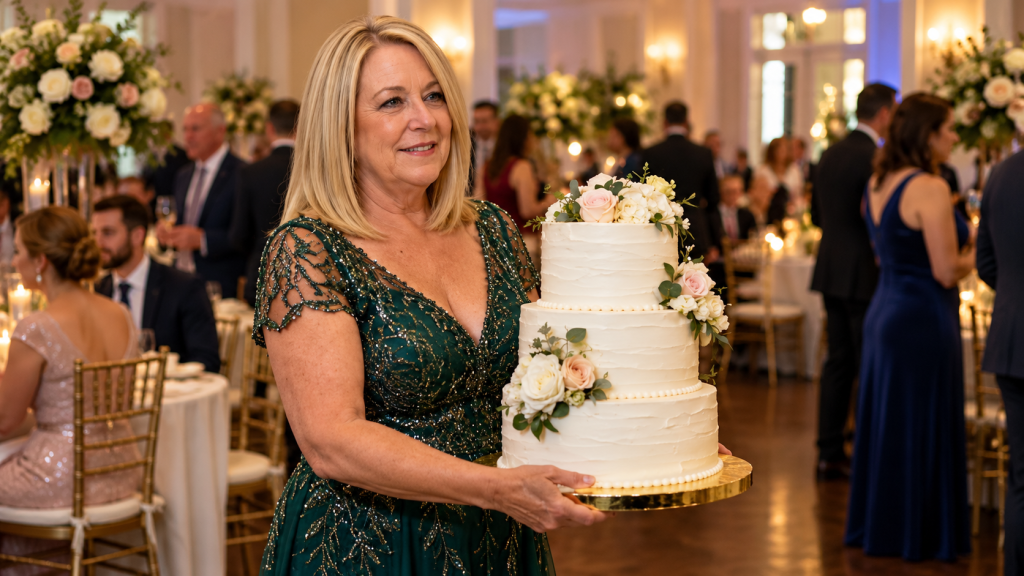
Several hours later, after the guests had left, I found Emma standing alone beside the wedding cake.
It sat on a table near the reception hall.
Three tiers.
White frosting.
Tiny sugar flowers.
A delicate topper showing two people holding hands.
The cake I’d spent the previous day fighting to collect.
The cake that had somehow led us to the truth.
Emma stared at it.
Then whispered, “Mom?”
I stood beside her.
“Yes?”
“Can you believe this started with a cake?”
My throat tightened.
I nodded.
She laughed.
A broken, disbelieving sound.
“I was worried the flowers wouldn’t match.”
Tears filled her eyes.
“And now I don’t even know who I am.”
I reached for her hand.
“You’re Emma.”
She shook her head.
“That’s not enough.”
I swallowed.
“I know it doesn’t answer everything.”
She began crying again.
I wrapped my arms around her.
“But it’s still true.”
That evening, we went home together.
Not to the house Emma shared with Nathan.
Not to the hotel where she’d planned to spend her wedding night.
To my house.
The home where she’d grown up.
The place with the old porch swing.
The kitchen where she’d learned to bake cookies.
The bedroom that still held a few childhood photographs.
I made tea.
Emma changed out of her wedding dress.
Then sat on the couch wearing an oversized sweatshirt.
For a long time, neither of us spoke.
Finally, she looked at me.
“Mom?”
“Yes?”
“Do you hate Dad?”
The question surprised me.
I stared at my wedding ring.
Then whispered, “I’m very angry with him.”
Emma nodded.
“Me too.”
I looked toward the window.
“And I need to understand exactly what he knew, what he did, and what can be proved.”
She swallowed.
“Are you going to divorce him?”
I took a breath.
“I don’t know yet.”
Emma nodded.
Then whispered, “I don’t know anything anymore.”
I moved closer.
“You know I love you.”
She began crying.
I held her.
And we stayed that way until she fell asleep.
I didn’t sleep that night.
I sat at the kitchen table while the house grew quiet.
David had gone to stay with his sister.
I’d asked him not to return until we’d spoken with an attorney.
He didn’t argue.
Perhaps because he finally understood the seriousness of what he’d hidden.
Or perhaps because he was still afraid of losing everything.
I didn’t know.
And for the first time in thirty years, I wasn’t going to spend the night trying to understand his feelings before acknowledging my own.
At three in the morning, I opened an old photograph album.
Emma’s first birthday.
Her second.
The day she started kindergarten.
A picture of her missing two front teeth.
Another of David carrying her on his shoulders at the beach.
I turned the pages slowly.
Then stopped at a photograph taken just after we brought her home from the hospital.
I was sitting in a rocking chair.
Holding a tiny baby.
My face looked exhausted.
But happy.
David stood beside me.
Smiling.
I stared at him.
Then began crying.
Because now I knew he had been carrying a secret even as that photograph was taken.
And I wondered whether every happy memory was contaminated by the lies surrounding it.
But then I looked at Emma.
The baby in my arms.
The little girl I’d raised.
And I realized something.
The circumstances of her arrival might have been dishonest.
But the love I gave her was not.
The next morning, I called a family-law attorney.
Her name was Rebecca Sterling.
She listened carefully as I explained the situation.
I expected disbelief.
Perhaps judgment.
But she remained calm.
She asked about the documents.
The hospital.
David’s admissions.
The other Laura.
Michael.
Nathan.
And the possibility of a biological relationship between the engaged couple.
When I finished, she paused.
Then said something important.
“Laura, we need to distinguish what people are alleging from what the records establish.”
I nodded.
“Yes.”
“Some information may be accurate. Some may have been misunderstood or falsified.”
My chest tightened.
She continued.
“And your daughter and Nathan should not make irreversible decisions until they have reliable answers.”
I swallowed.
“Can we get those answers?”
“We can begin with records, appropriate consent, and independent verification.”
I nodded.
“Then that’s what we do.”
Emma agreed.
Nathan did too.
Despite the devastation, he wanted the truth.
The other Laura provided the records she’d obtained.
David provided documents he’d kept hidden.
And Rebecca coordinated with the appropriate professionals to establish what could be verified.
The first step was straightforward.
DNA testing through a properly accredited laboratory.
Emma consented.
Nathan consented.
And the other Laura agreed to provide a sample.
I knew the results wouldn’t erase anyone’s pain.
But they could establish the biological relationships we’d been forced to question.
Waiting was unbearable.
Emma barely slept.
Nathan called twice, but she didn’t answer.
I didn’t pressure her.
She loved him.
That was obvious.
And if the information about their relationship was true, she was facing a kind of grief I couldn’t imagine.
I watched her move through the house like a ghost.
Sometimes she sat in the garden.
Sometimes she stared at old photographs.
Sometimes she cried in the shower.
And sometimes she simply looked at me with a question I couldn’t answer.
“Mom, what if everything is true?”
I would take her hand.
Then answer honestly.
“Then we’ll face it.”
Three days after the tests were collected, David asked to meet.
I agreed, with Rebecca’s advice about what we needed to discuss.
We met in her office.
He looked terrible.
His face was unshaven.
His eyes were swollen.
He’d always been a handsome man.
Confident.
Careful.
The kind of person who could walk into a room and make everyone feel comfortable.
Now he looked smaller.
Older.
I sat across from him.
Rebecca remained nearby.
David looked at me.
“Laura.”
I nodded.
“David.”
He swallowed.
“I don’t know where to begin.”
I looked at him.
“Try the truth.”
He began talking.
Slowly.
Haltingly.
For the first time, without interrupting me or asking that I wait until later.
He told me about his father.
Charles.
About Michael.
About the family’s obsession with reputation.
He admitted that when our baby died, Charles had taken control.
Doctors were speaking.
Nurses moving.
I was unconscious.
David was terrified.
Then Charles appeared.
He told David another baby needed a family.
That arrangements could be made.
That the mother had agreed.
And that everything would be handled legally.
David said he’d believed him.
At first.
I listened.
Then asked quietly, “Did you ever see adoption documents?”
He lowered his eyes.
“No.”
My chest tightened.
“Did you ever speak to the baby’s mother?”
“No.”
“Did you ever ask for independent confirmation?”
He shook his head.
My hands began trembling.
“David, you accepted a newborn baby from your father without asking whether her mother had consented?”
He began crying.
“I know how it sounds.”
I stared.
“It doesn’t matter how it sounds.”
My voice broke.
“It matters what happened.”
He wiped his face.
Then continued.
When Emma was seven, Michael contacted him.
At that point, David already believed Michael was dead.
Or at least permanently gone.
The message came through an intermediary.
Michael claimed that Charles had arranged the baby’s transfer without proper consent.
He said the other Laura had been told her baby died.
And he begged David to investigate.
David didn’t believe him.
He thought Michael was unstable.
That he’d become confused after an accident.
That Charles knew best.
I stared at him.
“And then?”
David swallowed.
“Dad told me Michael was lying.”
I closed my eyes.
“And you believed him.”
He nodded.
“Yes.”
I looked toward Rebecca.
She remained quiet.
Then I turned back to David.
“Why didn’t you tell me?”
His eyes filled.
“Because I was afraid you’d lose Emma.”
My throat tightened.
“David…”
He leaned forward.
“You loved her.”
His voice broke.
“She was your entire world.”
Tears streamed down his face.
“I couldn’t bear the thought of someone taking her away.”
I stared.
For one brief moment, I understood the fear.
Then I thought about the other Laura.
A woman who had been told her baby died.
A woman who had spent twenty-six years mourning a child who might have been alive.
And I felt anger rise again.
“You protected me from grief by giving another mother a lifetime of it.”
David’s face crumpled.
I continued.
“You didn’t protect Emma from the truth.”
My voice broke.
“You protected yourself from what would happen if we found out.”
He lowered his head.
And began sobbing.
I left the office without hugging him.
Without promising forgiveness.
Without telling him everything would be all right.
Because I no longer knew whether our marriage could survive what he’d done.
And for once, I wasn’t going to make that decision simply because someone else needed reassurance.
The DNA results arrived nine days later.
Emma was sitting beside me at the kitchen table.
Nathan waited separately with his own support.
Rebecca called.
Her voice was careful.
“Laura, we have the laboratory findings.”
My heart began pounding.
I looked at Emma.
She nodded.
I put the call on speaker.
Rebecca took a breath.
“The testing confirms that the woman who came to the venue, Laura Mitchell, is Emma’s biological mother.”
Emma closed her eyes.
A tear slipped down her cheek.
I reached for her hand.
She held on.
Rebecca continued.
“And the testing does not support the claim that Nathan and Emma are biological half siblings.”
For a moment, nobody moved.
Then Emma opened her eyes.
“What?”
Rebecca repeated the finding.
“They are not biological half siblings based on the tested relationships.”
Emma covered her mouth.
Then began crying.
I stared at the phone.
“But Nathan said Michael was his father.”
Rebecca paused.
“The records and additional testing raise questions about that claim. Nathan’s biological parentage will need to be established separately if he chooses.”
I looked at Emma.
Her face crumpled.
Relief.
Confusion.
Fear.
Everything at once.
She began sobbing.
And I pulled her close.
For the first time since the wedding, I felt hope.
Not certainty.
Not an easy solution.
But hope.
Because the most devastating possibility—that Emma and Nathan were half siblings—had not been supported by the test.
But the larger mystery remained.
Why had Nathan been told Michael was his father?
Who had created the hospital records?
And why had someone wanted Emma to believe a family connection that might prevent the marriage?
Nathan called that afternoon.
Emma answered.
I stayed nearby but gave her privacy.
Their conversation lasted nearly an hour.
When she came downstairs, her eyes were swollen.
But she looked steadier.
“Mom?”
I stood.
“Yes?”
“Nathan didn’t know.”
My heart tightened.
She continued.
“He thought Michael was his biological father because his mother told him so.”
I nodded.
“Then he deserves reliable answers too.”
Emma looked down.
“He’s devastated.”
I squeezed her hand.
“I know.”
She swallowed.
“But he still loves me.”
My eyes filled.
I looked at her.
“And how do you feel?”
She began crying.
“I love him.”
I pulled her close.
And for the first time since the wedding, she allowed herself to imagine that her future might not be completely lost.
The following week, another surprise arrived.
A letter from Michael.
Not a phone call.
Not a message through another relative.
A letter written in shaky handwriting.
It came through the care facility, with permission and assistance.
I stared at the envelope.
Then carefully opened it.
Inside was a short note.
Laura,
I know I have no right to ask you to trust me.
But I need you to know that my father’s story was never the whole truth.
I remember more than people think.
If you want to understand what happened at the hospital, ask the nurse who signed the transfer forms.
Her name was Margaret Ellis.
And please don’t let David destroy the photograph.
Michael.
I read the letter three times.
Then called Rebecca.
She listened.
When I finished, she said, “That may be a useful lead.”
I swallowed.
“Can we find her?”
“We can investigate whether she’s alive and willing to provide information.”
I nodded.
“Please.”
Margaret Ellis was seventy-eight.
Retired.
Living in a small town several hours away.
She had worked at the hospital when Emma was born.
At first, she declined to speak.
Then, after learning that two women were seeking answers about a possible wrongful transfer of a newborn, she agreed to meet with investigators and appropriate legal representatives.
I didn’t attend the initial interview.
Rebecca advised that it was better to preserve the process.
But when she called afterward, her voice was unusually serious.
“Laura.”
My chest tightened.
“Yes?”
“Margaret confirms there were irregularities.”
I closed my eyes.
She continued.
“And she says Charles Mitchell pressured hospital personnel.”
My heartbeat quickened.
“But she also says something we weren’t expecting.”
I swallowed.
“What?”
Rebecca paused.
“Michael wasn’t simply a victim of what happened afterward.”
My blood ran cold.
“He helped arrange the transfer.”
I stared at the phone.
“What?”
Rebecca continued carefully.
“According to Margaret’s account, Michael knew his wife’s baby was alive when the transfer occurred.”
My stomach twisted.
“He knew?”
“Yes.”
“And he let her believe their daughter died?”
“That’s what the available information suggests. We need to verify the full account.”
I closed my eyes.
For days, I’d imagined Michael as a man trying to expose his father’s wrongdoing.
A brother punished for attempting to tell the truth.
But now another possibility was emerging.
He might have helped create the lie.
Then tried to undo it years later.
When I told the other Laura, she didn’t speak for several minutes.
We had arranged to meet at Rebecca’s office.
She sat opposite me.
Her hands folded tightly in her lap.
When I finished, her face had gone pale.
“Michael knew?”
I nodded slowly.
“That is what the witness has said.”
She covered her mouth.
Then began crying.
For twenty-six years, she’d believed her husband had been grieving alongside her.
That he’d lost their daughter.
That he’d suffered just as she had.
Now she was learning he might have known the child was alive.
I moved beside her.
And placed a hand on her shoulder.
She looked at me.
Her eyes were full of heartbreak.
“Laura…”
I swallowed.
“Yes?”
“He watched me visit a grave.”
My throat tightened.
She began sobbing.
“He watched me bring flowers every year.”
I closed my eyes.
She cried harder.
“And he knew.”
For a long time, we sat together.
Two women.
Both named Laura Mitchell.
Both betrayed by men we’d trusted.
Both mothers of the same young woman in different ways.
I wanted to hate her.
For appearing at the wedding.
For interrupting the ceremony.
For bringing the truth into our lives.
But as I watched her cry, I understood something.
She hadn’t stolen anything from me.
She’d lost something too.
And perhaps more terribly, she’d spent decades believing the loss was permanent.
Eventually, she looked at me.
Then whispered, “I’m sorry.”
I stared.
“For what?”
Her eyes filled.
“For the bakery.”
I almost laughed.
Of all the things we’d been through, she was apologizing for the wedding cake.
She wiped her face.
“I didn’t know how to reach you.”
I nodded.
She continued.
“I thought if you came to the bakery, I could speak to you privately.”
I looked down.
“But David arrived.”
She nodded.
“He recognized me.”
Her expression tightened.
“And he begged me not to say anything.”
I swallowed.
“Then you called pretending to be Emma.”
She nodded.
“Yes.”
I looked at her.
“Why tell them not to release the cake to me?”
Her face crumpled.
“Because I wanted them to call you.”
I stared.
She continued.
“I thought if the order was held, you’d come personally and ask questions.”
She looked ashamed.
“It was a terrible idea.”
I took a breath.
“Yes.”
She nodded.
“I know.”
Then she whispered, “I was desperate.”
I looked at her for a long time.
Then asked, “Did you know Emma was your daughter when you went to the bakery?”
She shook her head.
“No.”
My eyebrows rose.
“I suspected.”
Her eyes filled.
“But I didn’t know.”
She continued.
“Michael had begun remembering things.”
“He mentioned a child.”
“A hospital.”
“Your husband’s name.”
She looked down.
“And Nathan found documents among his father’s belongings.”
My chest tightened.
“So you started investigating.”
She nodded.
“Yes.”
I stared.
“And when you saw Emma’s photograph?”
Her lips trembled.
“I felt something.”
She began crying.
“Something I hadn’t allowed myself to feel in twenty-six years.”
Hope.
I didn’t need her to say it.
I could see it.
The more we investigated, the clearer the pattern became.
Charles Mitchell had exercised enormous influence over his family.
He controlled money.
Employment.
And access to medical professionals within his circle.
When two babies were born close together and one died, he saw an opportunity.
A grieving son.
A vulnerable daughter-in-law.
A younger son who depended on him financially.
And a hospital system with weaknesses he believed he could exploit.
The evidence suggested that Charles and Michael had participated in arranging an unauthorized transfer of the surviving infant.
David had accepted the child without adequate verification.
And when questions arose years later, the men involved concealed the truth.
But one question remained.
Why had Michael disappeared?
And why had David been told he was dead?
The answer came from a set of insurance records.
Michael had suffered a serious accident fifteen years earlier.
The accident left him with lasting cognitive difficulties.
But the paperwork surrounding his supposed death had been falsified.
Someone had arranged for the family to believe he had died while he was living under a different surname in a care facility.
The reasons were tangled.
Financial claims.
Family conflict.
And attempts to prevent him from discussing the hospital events.
Investigators examined the records.
Some allegations could no longer be pursued in the same way because of the passage of time and the death of key participants.
Other matters remained open for appropriate authorities to review.
But the central truth was becoming undeniable.
My daughter’s identity had been concealed through a series of decisions made by adults who believed they could control the future by hiding the past.
Emma struggled with the revelations.
She loved me.
But she wanted to know the woman who had given birth to her.
At first, I was afraid.
Not because I wanted to keep the other Laura away.
But because the thought of losing my daughter’s affection terrified me.
One evening, Emma sat beside me on the porch.
The sun was setting.
Her hair was loose around her shoulders.
She wore jeans and an old sweater.
No wedding dress.
No makeup.
Just my daughter.
She looked at me.
“Mom?”
I smiled.
“Yes?”
“I want to spend time with Laura.”
My throat tightened.
I nodded.
“Okay.”
Emma studied my face.
“Are you upset?”
I took a breath.
“A little frightened.”
Her eyes filled.
“Why?”
I looked down.
“Because I love you.”
She reached for my hand.
I continued.
“And part of me is afraid that learning about your birth mother will change how you feel about me.”
Emma’s face crumpled.
“Oh, Mom.”
She moved closer.
Then hugged me.
“You’re my mother.”
I closed my eyes.
She continued.
“You raised me.”
“You loved me.”
“You were there every day.”
Her voice broke.
“But I also need to know where I came from.”
I nodded.
“I understand.”
She pulled away.
Then whispered, “Can I love both of you?”
I began crying.
I took her hands.
“Yes, sweetheart.”
My voice broke.
“You can.”
That conversation changed something inside me.
For weeks, I’d been thinking about motherhood as though it were a title someone might take away.
But Emma wasn’t a possession.
She was a person.
A grown woman.
With a history that belonged to her.
I had raised her.
Loved her.
And would always love her.
The other Laura had carried her.
Lost her.
And spent decades grieving.
Neither truth canceled the other.
Emma began meeting her birth mother.
At first, just short visits.
Coffee.
Lunch.
A walk through the park.
They talked about childhood.
Family.
The years they’d missed.
The other Laura showed her photographs of herself as a young woman.
Emma laughed when she noticed their similar smiles.
They both loved gardening.
Both hated olives.
Both cried during the same old movies.
I listened when Emma came home and told me about those discoveries.
Sometimes I felt a pang of jealousy.
Then I’d remind myself that her joy wasn’t a threat to mine.
It was another part of her becoming whole.
One afternoon, Emma returned from a visit.
She stood in the kitchen.
Holding a small box.
“Mom?”
I looked up.
“Yes?”
“Laura gave me something.”
I smiled.
“What is it?”
She opened the box.
Inside was a tiny silver bracelet.
A baby bracelet.
With a delicate engraved letter.
E.
My breath caught.
Emma touched it gently.
“She bought it before I was born.”
Her eyes filled.
“She kept it all these years.”
I looked at my daughter.
Then at the bracelet.
And tears rose immediately.
Because suddenly, I understood something.
The other Laura hadn’t simply grieved an idea.
She’d grieved a child she’d already imagined holding.
A child she’d chosen a name for.
A child whose bracelet she’d kept through twenty-six birthdays without her.
I reached for Emma’s hand.
Then whispered, “It’s beautiful.”
Emma began crying.
“I thought so too.”
Nathan also pursued answers about his own parentage.
The testing established that Michael wasn’t his biological father.
He had been raised with incomplete and misleading information.
His mother, whom he’d believed had told him the whole truth, eventually acknowledged that there had been another relationship before his birth.
Nathan was devastated.
But he also felt relief.
Not because it erased the chaos surrounding the wedding.
But because the feared biological relationship between him and Emma had been ruled out.
One evening, Nathan came to our house.
He looked nervous.
Emma was sitting beside me.
I invited him in.
He stood near the door.
Then looked directly at me.
“Mrs. Mitchell.”
I nodded.
“Nathan.”
His voice trembled.
“I want to apologize.”
I frowned.
“For what?”
“For bringing those records to the wedding.”
He swallowed.
“I thought everyone had been hiding the truth.”
I looked at him.
He continued.
“And I was terrified that Emma and I were related.”
His eyes filled.
“I didn’t know what else to do.”
I considered.
Then answered carefully.
“You were right to want reliable answers.”
He nodded.
“But the way it happened hurt Emma deeply.”
Tears slipped down his cheeks.
“I know.”
I looked at him.
“What matters now is what you do with the truth.”
He nodded slowly.
“Yes, ma’am.”
Emma stood.
She approached Nathan.
For a moment, they stared at each other.
Then he whispered, “I love you.”
Her eyes filled.
“I love you too.”
He reached for her hand.
She took it.
And I realized that despite everything, their relationship hadn’t been destroyed.
It had been shaken.
Painfully.
But they were still choosing each other.
They didn’t immediately reschedule the wedding.
I was relieved.
They needed time.
Counseling.
Space.
And the opportunity to understand their individual histories without rushing into another ceremony.
They continued dating.
Talking.
Working through difficult feelings.
And slowly rebuilding a sense of normalcy.
Meanwhile, my marriage was falling apart.
David asked to come home.
I wasn’t ready.
He sent flowers.
I thanked him.
He wrote letters.
I read them when I could.
Sometimes he called.
Sometimes I answered.
Sometimes I stared at his name until the phone stopped ringing.
I had loved him for thirty years.
That love didn’t disappear overnight.
But trust had been broken in a way I didn’t know how to repair.
One afternoon, I agreed to meet him at a small café.
The place was quiet.
David arrived early.
He stood when I entered.
For a moment, I saw the young man I’d married.
The man who made me laugh.
Who held my hand during difficult pregnancies.
Who stayed beside me when my mother died.
Who had loved Emma fiercely.
Then I remembered the hospital.
The hidden records.
The other mother.
And nineteen years of silence.
I sat down.
David looked at me.
“Laura.”
I nodded.
“David.”
His eyes filled.
“I miss you.”
My throat tightened.
I looked down.
“I miss parts of our life.”
He swallowed.
“Can we try again?”
I stared at him.
Then asked the question that had been haunting me.
“David, if Nathan hadn’t found those records, would you ever have told me?”
He closed his eyes.
For a long time, he didn’t answer.
Then he whispered, “I don’t know.”
The honesty hurt.
But I appreciated it.
Because at least he wasn’t pretending.
I looked toward the window.
Then whispered, “That’s the problem.”
His eyes filled.
“I know.”
I turned back.
“I spent thirty years believing I knew you.”
My voice broke.
“And now I don’t know which memories were true.”
David began crying.
I continued.
“You let me believe I gave birth to Emma.”
“You watched another mother grieve.”
“You allowed your father to decide what happened to our family.”
Tears streamed down my face.
“And when you learned the truth, you stayed silent.”
He lowered his head.
I swallowed.
“I don’t know how to build a marriage on that.”
David reached toward my hand.
Then stopped himself.
For a moment, he looked utterly defeated.
“I love you.”
I closed my eyes.
“I believe you.”
He looked up.
I continued.
“But love doesn’t erase what you did.”
He began sobbing.
I took a breath.
“I need to separate.”
His face crumpled.
“Laura…”
“I need to understand who I am outside this marriage.”
He lowered his head.
Then whispered, “Okay.”
We separated.
Not dramatically.
Not with screaming.
Not with revenge.
We worked through the practical arrangements with legal guidance.
Shared information.
Resolved financial matters.
And began the difficult process of living separate lives.
Eventually, I filed for divorce.
It was one of the hardest decisions I’d ever made.
Not because I believed marriage should survive anything.
But because I had spent three decades imagining David beside me when we grew old.
And letting go of that future felt like another kind of grief.
Emma struggled with the divorce.
She loved her father.
She was angry with him.
She wanted him to understand the harm he’d caused.
But she also remembered the man who taught her to ride a bicycle.
The man who attended every school play.
The man who cried at her graduation.
I never asked her to choose between us.
I told her something I meant with all my heart.
“Your relationship with your father belongs to you.”
She nodded.
Then whispered, “Even after everything?”
I smiled sadly.
“Yes.”
I took her hand.
“You can love someone and still hold them accountable.”
David eventually began counseling.
He also cooperated with the review of the historical records.
He acknowledged his role.
Provided documents.
And accepted that some consequences couldn’t be avoided.
I didn’t use his efforts as a reason to return to him.
But I was glad he was finally confronting the truth.
For Emma’s sake.
For the other Laura’s sake.
And perhaps for his own.
The investigation into the old hospital events eventually produced a clearer account.
Not every question could be answered.
Some records had been destroyed through routine retention practices.
Others were incomplete.
Several people involved had died.
And the passage of time complicated legal options.
But the surviving documents, witness accounts, and genetic evidence established the essential facts.
Emma had been born to the other Laura.
Her transfer to David and me had not been supported by valid maternal consent.
My biological baby had died during the delivery.
The other Laura had been falsely told her newborn had died.
Charles Mitchell had orchestrated much of the concealment.
Michael had participated.
And David had allowed the situation to continue after learning serious information about it.
When the final report arrived, I sat alone at the kitchen table.
It contained a section about my biological daughter.
My first child.
The baby I’d carried.
The baby I never knew had died.
For twenty-six years, I’d believed Emma was the child who had lived.
Now I was learning that I had another daughter.
A daughter who’d never taken a breath outside the hospital long enough for me to hold her.
A daughter who had been buried without my knowledge.
I stared at the page.
Then began crying.
I didn’t know what to call her at first.
The records identified her by a hospital reference number.
A baby without a name.
A child whose mother had spent decades celebrating another daughter’s birthdays without knowing she existed.
I sat there for a long time.
Then whispered, “You were mine too.”
The words broke me.
I pressed the report against my chest.
And sobbed.
When Emma came home, she found me at the table.
She saw the papers.
Then my face.
And immediately understood.
“Mom?”
I looked up.
She approached.
Then knelt beside me.
“Oh, Mom.”
I began crying harder.
She wrapped her arms around me.
And for the first time, the child I’d raised comforted me as I grieved the child I’d lost.
We sat together for a long time.
Then Emma whispered, “Did she have a name?”
I shook my head.
“No.”
Her eyes filled.
“Can we give her one?”
I stared at her.
The tenderness of the question overwhelmed me.
I took a slow breath.
Then whispered, “I think I’d like that.”
Emma squeezed my hand.
“What would you call her?”
I looked toward the window.
Then thought about the little yellow blanket I’d once knitted.
The baby I’d carried.
The daughter I never knew I’d lost.
And finally, I whispered.
“Rose.”
Emma smiled through tears.
“Rose.”
I nodded.
“Because she was loved, even though I didn’t know how to remember her.”
We arranged a small memorial.
Nothing elaborate.
Just a quiet place in a garden where we could acknowledge her.
I brought white roses.
Emma came with me.
The other Laura attended too, at my invitation.
She understood the grief.
Perhaps better than anyone.
We stood together.
Three women whose lives had been joined by an unimaginable wrong.
I placed the flowers beside the stone.
Then whispered, “Hello, Rose.”
Tears streamed down my face.
“I wish I could’ve held you.”
Emma put an arm around me.
And we cried together.
Afterward, the other Laura approached.
She looked nervous.
“Laura?”
I turned.
“Yes?”
She swallowed.
“I’m sorry.”
I stared at her.
“For what?”
Her eyes filled.
“For everything you’ve lost.”
I took a breath.
Then reached for her hand.
“You didn’t cause this.”
She began crying.
I squeezed her fingers.
“And neither did I.”
For a moment, we stood silently.
Then she whispered, “Thank you for loving Emma.”
My throat tightened.
I smiled through tears.
“Thank you for bringing her into the world.”
And for the first time, we embraced.
Something changed after that day.
Not instantly.
Not magically.
But I no longer saw the other Laura as someone who had arrived to take my daughter away.
I saw her as a woman whose life had been stolen from her in a different way.
We began speaking occasionally.
Not only about the past.
But about ordinary things.
Gardening.
Books.
Recipes.
Emma’s work.
Sometimes the conversations were awkward.
Sometimes emotional.
But slowly, they became easier.
Emma began spending holidays with both of us.
At first, it felt strange.
Two women named Laura Mitchell.
Both answering when Emma called, “Mom.”
Eventually, we laughed about it.
One Christmas, Emma stood in the kitchen.
“Mom, can you pass the potatoes?”
Both of us reached for the bowl.
Emma burst out laughing.
“Oh, this is ridiculous.”
The other Laura smiled.
“Maybe we need nicknames.”
I laughed.
“Please not Laura One and Laura Two.”
Emma grinned.
“How about Mom and Mama Laura?”
The other Laura’s eyes filled.
She looked at Emma.
Then whispered, “I’d like that.”
And just like that, something gentle settled between us.
The following spring, Emma and Nathan announced they were ready to plan another wedding.
They had spent more than a year working through the aftermath.
They’d received the relevant genetic findings.
Sought counseling.
And chosen to remain together.
The decision was theirs.
Not mine.
Not David’s.
Not the other Laura’s.
And I was proud of them for taking their time.
Emma asked me to go dress shopping again.
I laughed.
“Are you sure?”
She smiled.
“Mom, I need you.”
My eyes filled.
Then she added.
“And Mama Laura too.”
I looked toward the other Laura.
She was standing beside us.
Her expression was stunned.
“Me?”
Emma nodded.
“Yes.”
Tears filled the woman’s eyes.
“I’d love to.”
We spent an entire afternoon trying on dresses.
Emma laughed.
Cried.
Rejected everything with too much lace.
Complained about shoes.
And finally chose a simple ivory gown with delicate sleeves.
When she stepped out of the dressing room, I began crying.
The other Laura did too.
Emma looked at us.
Then laughed through tears.
“Both of you?”
I wiped my face.
“Sorry.”
Mama Laura smiled.
“Not sorry.”
Emma laughed.
And for a moment, the past felt less heavy.
The second wedding was smaller.
More intimate.
Held in a garden.
There were no elaborate secrets.
No mysterious phone calls.
No hidden hospital records.
No strangers arriving with accusations.
Just family and friends who knew the truth.
And two people who had chosen one another after surviving extraordinary pain.
On the morning of the wedding, Emma called me.
“Mom?”
I smiled.
“Yes?”
“Can you pick up the cake?”
I froze.
Then she burst out laughing.
“I’m kidding.”
I stared at the phone.
“Emma Mitchell.”
She laughed harder.
“Oh, Mom.”
I began laughing too.
For the first time, the memory of the bakery didn’t fill me with dread.
It was becoming part of our history.
A terrible beginning.
But no longer the ending.
I arrived at the venue early.
The garden was beautiful.
White flowers lined the aisle.
A gentle breeze moved through the trees.
The cake stood safely inside the reception room.
The baker had personally delivered it.
I checked twice.
Just to be sure.
Then I laughed at myself.
Emma was getting dressed when I entered the bridal suite.
She turned toward me.
Her eyes filled.
“Mom.”
I smiled.
“Sweetheart.”
She looked beautiful.
More than beautiful.
Peaceful.
There was something different about her.
The first time, she’d been excited and nervous.
Now she looked certain.
Not that life would always be easy.
But that she was making her own choice.
She reached for my hand.
“Do you remember last year?”
My throat tightened.
“Yes.”
She swallowed.
“I thought I’d lost everything.”
I nodded.
“I know.”
Her eyes filled.
“But I didn’t.”
She looked toward the doorway.
Mama Laura stood there holding a bouquet.
Emma smiled.
“I found more family than I knew I had.”
My eyes filled.
Then she turned back to me.
“And I didn’t lose you.”
I pulled her close.
“No, sweetheart.”
I kissed her forehead.
“Never.”
When the ceremony began, I walked Emma down the aisle.
Mama Laura walked beside us.
Emma had asked both of us.
Neither had hesitated.
We walked slowly through the garden.
Two mothers.
One daughter.
A story neither of us had chosen.
But a moment we were grateful to share.
At the end of the aisle, Nathan waited.
His eyes filled when he saw Emma.
She smiled.
And I knew she’d made the right decision for herself.
The vows were simple.
Honest.
Full of promises about trust.
Patience.
And facing difficult truths together.
When Nathan spoke, his voice trembled.
“Emma, I can’t promise we’ll never face uncertainty.”
He swallowed.
“But I promise I’ll never stop telling you the truth.”
Emma began crying.
He continued.
“And I promise that when life becomes difficult, I won’t decide what you can handle.”
My throat tightened.
Because those words meant more after everything they’d survived.
Emma smiled through tears.
Then answered.
“Nathan, I choose you.”
Her voice was steady.
“Not because our story has been easy.”
“But because we’ve learned that love means respecting each other’s choices.”
She took his hands.
“And I want to keep choosing you.”
I began crying.
Mama Laura squeezed my hand.
And we stood together while our daughter married the man she loved.
After the ceremony, we gathered for photographs.
The photographer arranged everyone beneath a flowering arch.
Emma and Nathan.
The wedding party.
Family.
Friends.
Then Emma called out.
“Both moms!”
I looked toward Mama Laura.
She smiled nervously.
Emma waved us over.
“Come on.”
We stood beside her.
One on each side.
She wrapped her arms around us.
And the photographer captured a moment I will treasure forever.
Not because it erased the past.
But because it showed what we had managed to build after the truth emerged.
Later, during the reception, Emma asked me to dance.
I laughed.
“Me?”
She nodded.
“Yes.”
I followed her onto the dance floor.
The music was soft.
She placed her arms around me.
And for a moment, I remembered teaching her to dance in our living room when she was little.
She used to stand on my feet.
Laughing.
While I moved us slowly across the carpet.
Now she was a grown woman.
Married.
Holding me close.
She leaned toward my ear.
“Mom?”
“Yes?”
“Thank you.”
My throat tightened.
“For what?”
She smiled through tears.
“For never making me feel like I had to choose between loving you and knowing who I am.”
I began crying.
I held her tighter.
“Oh, Emma.”
She whispered.
“You’re my mom.”
I closed my eyes.
“And I always will be.”
That evening, as the sun set, I stepped outside for some air.
The garden lights glowed softly.
Music floated through the open doors.
Guests laughed.
Glasses clinked.
For the first time in years, I felt quiet.
Not empty.
Not lonely.
Peaceful.
I looked toward the sky.
Then whispered.
“Rose, I hope you know I love you too.”
A breeze moved through the trees.
I closed my eyes.
And allowed myself to hold both truths.
I had lost one daughter.
And I had raised another.
Both were real.
Both mattered.
And neither could erase the other.
Behind me, someone spoke.
“Laura.”
I turned.
David stood a few feet away.
He wore a dark suit.
His hair had gone grayer over the past year.
He looked nervous.
“Can we talk?”
I considered.
Then nodded.
“Briefly.”
He stepped closer.
For a moment, neither of us spoke.
Then he looked toward the reception hall.
“Emma looks happy.”
I smiled softly.
“Yes.”
His eyes filled.
“I’m glad.”
I nodded.
“So am I.”
He swallowed.
Then said quietly, “I know I can’t undo what happened.”
I looked at him.
He continued.
“I know I’ve lost your trust.”
His voice broke.
“And I know our marriage is over.”
I felt sadness rise.
But not the sharp pain of the first months.
Something gentler.
The grief of accepting what couldn’t be repaired.
David looked at me.
“I’m sorry, Laura.”
I took a breath.
“I know.”
He nodded.
“I don’t expect you to forgive me.”
I looked toward the lights.
Then back at him.
“I hope you keep telling the truth.”
His eyes filled.
“I will.”
We stood quietly.
Then David said something unexpected.
“Thank you for raising Emma.”
My throat tightened.
I stared at him.
He continued.
“You were a wonderful mother.”
Tears filled my eyes.
I swallowed.
“She deserved the truth.”
He lowered his head.
“Yes.”
I nodded.
“And so did both of us.”
He looked up.
“I know.”
Then he stepped away.
And I watched him return to the reception.
For the first time, I didn’t feel the need to follow.
Life continued after the wedding.
Emma and Nathan built a home together.
They traveled.
Worked.
Argued about furniture.
Adopted a dog.
And eventually welcomed a baby boy.
When Emma called to tell me she was pregnant, I cried.
When she told Mama Laura, she cried too.
And when the baby arrived, both of us stood beside the hospital bed.
Not as rivals.
But as grandmothers.
Emma named him Oliver.
A little boy with dark hair and bright eyes.
The first time I held him, I thought about the hospital twenty-seven years earlier.
The loss.
The lies.
The stolen years.
Then I looked down at Oliver.
Alive.
Warm.
Sleeping peacefully against my chest.
And felt something inside me soften.
Because the future could hold joy even after the past had been devastating.
Mama Laura stood beside me.
Her eyes were wet.
“He’s beautiful.”
I smiled.
“Yes.”
She looked at Emma.
Then whispered, “I can’t believe I’m here.”
Emma smiled.
“Of course you’re here.”
Mama Laura began crying.
For twenty-six years, she’d believed she’d never see her daughter again.
Now she was standing beside her daughter’s hospital bed.
Holding her grandson.
I watched her.
And understood the enormity of the moment.
As Oliver grew, our family developed its own unusual rhythm.
Two grandmothers with the same name.
A mother who had two mothers.
A complicated history.
But an ordinary love.
We attended birthdays.
Shared holidays.
Helped with childcare.
Sometimes argued about recipes.
Sometimes disagreed about what Oliver should wear.
But we learned to talk.
To listen.
And to remember that none of us had to compete for his affection.
One Christmas, Oliver was sitting on the floor surrounded by wrapping paper.
He looked at me.
“Grandma Laura?”
Both of us answered.
“Yes?”
He burst out laughing.
“Two Lauras!”
Mama Laura grinned.
“Very confusing.”
Oliver nodded seriously.
Then pointed toward her.
“You’re Mama Laura.”
She smiled.
He pointed toward me.
“And you’re Grandma Laura.”
I laughed.
“Very good.”
Then he looked at Emma.
“Mommy has two mommies.”
Emma’s eyes filled.
She smiled.
“Yes, sweetheart.”
Oliver considered.
Then grinned.
“Lucky Mommy.”
The room fell silent.
Mama Laura covered her mouth.
I felt tears rise.
And Emma began crying.
Because somehow, a child had expressed in three simple words what we’d spent years trying to understand.
We weren’t a conventional family.
But we were a family.
And we were grateful.
As I grew older, I began volunteering with an organization that supported families navigating complicated adoption histories and family separations.
I didn’t offer legal advice.
I didn’t pretend every story ended happily.
Some families never reunited.
Some relationships remained painful.
Some questions couldn’t be answered.
But I could listen.
And I could remind people that their feelings mattered.
That identity was complicated.
And that love didn’t always fit neatly into the boxes people wanted it to occupy.
Sometimes, a mother would sit across from me and whisper.
“I don’t know who I am anymore.”
I would think about the wedding cake.
The hospital record.
The bridal suite.
Emma crying in my arms.
Then I’d say gently.
“You don’t have to answer every question today.”
And I’d mean it.
Because I’d learned that healing wasn’t a single revelation.
It was a series of choices.
Made slowly.
With support.
And with room for grief.
One afternoon, Emma visited me.
She was carrying a little box.
Oliver was playing in the garden.
Mama Laura had taken him outside to look at butterflies.
Emma sat beside me.
“Mom?”
I smiled.
“Yes?”
“I found something.”
She placed the box on the table.
Inside was an old photograph.
It showed me holding Emma as a newborn.
The same photograph I’d stared at the night after the interrupted wedding.
My face tired.
My arms wrapped around the tiny baby.
David standing beside us.
I felt my chest tighten.
“Where did you find that?”
Emma smiled sadly.
“In an old album.”
I nodded.
She looked at the photograph.
Then at me.
“I used to think this picture was ruined.”
My eyes filled.
She continued.
“After everything came out, I couldn’t look at it.”
I swallowed.
“I understand.”
She smiled.
“But now I see something different.”
I looked at her.
“What?”
She touched the photograph.
“Look at your face.”
I stared.
She continued.
“You loved me.”
Tears filled my eyes.
“Of course I did.”
She smiled through tears.
“You didn’t know what had happened.”
“You didn’t know about the records.”
“You didn’t know about Mama Laura.”
Her voice broke.
“But you loved me from the moment you held me.”
I began crying.
Emma reached for my hand.
“And that part was never a lie.”
I pulled her close.
For a long time, we held each other.
Then I whispered.
“No, sweetheart.”
My voice broke.
“That part was always true.”
Years passed.
Oliver grew taller.
Emma’s marriage strengthened.
Mama Laura and I became friends in a way neither of us could have imagined.
Not inseparable.
Not without painful memories.
But connected by a love that had once seemed impossible to share.
David remained part of Emma’s life, within boundaries she chose.
He continued confronting the consequences of his past decisions.
And I continued building a future that belonged to me.
I eventually moved into a smaller house near the garden where we’d held Rose’s memorial.
It had a bright kitchen.
A little porch.
And a yard filled with flowers.
I planted roses along the fence.
White.
Pink.
Yellow.
Every spring, they bloomed.
And whenever I saw them, I thought of the daughter I never held.
Not only with grief.
But with love.
One evening, Emma came over with Oliver.
He was six now.
Full of questions.
He ran toward the roses.
“Grandma!”
I smiled.
“Yes?”
“Why do you have so many flowers?”
I walked toward him.
Then knelt carefully beside the garden.
“Because I love them.”
He smiled.
“Me too.”
He pointed toward a white rose.
“Who’s that one for?”
My throat tightened.
I looked at him.
Then said gently.
“Someone very special.”
He frowned.
“Who?”
I considered.
Then answered in a way a child could understand.
“A little baby I loved.”
Oliver looked thoughtful.
“Did the baby like flowers?”
I smiled sadly.
“I never got to find out.”
He was quiet.
Then he reached toward the soil.
Picked up a fallen petal.
And placed it gently beside the rosebush.
“Maybe this one is for her.”
My eyes filled.
I kissed his forehead.
“That’s beautiful, sweetheart.”
That night, after Emma took Oliver home, I sat on the porch.
The sky was turning purple.
A gentle breeze moved through the roses.
I thought about the day Emma asked me to pick up her wedding cake.
Such an ordinary request.
Just give them your name. Everything’s paid for.
I could still hear her cheerful voice.
I remembered walking into the bakery.
Smiling at the woman behind the counter.
Giving my name.
And watching her expression change.
I’m sorry. I can’t give you the cake.
At the time, I thought it was a simple misunderstanding.
A problem with an order.
A mistake someone would correct in a few minutes.
I never imagined those words would lead me to the greatest secret of my life.
For years, I’d thought the mystery was about an affair.
A woman with my name.
My husband meeting her secretly.
A strange phone call.
An altered bakery order.
I had imagined betrayal.
But not this kind.
Not a hidden child.
Not a falsified hospital record.
Not a husband concealing what he’d learned.
Not a daughter discovering her entire birth history had been rewritten.
Yet somehow, after everything, we found a way forward.
Not a perfect way.
Not a painless one.
But a path built on truth.
Emma found her birth mother.
I found the courage to grieve Rose.
Nathan found answers about his own family history.
Mama Laura found the daughter she’d spent decades mourning.
And I found a life where love no longer required me to ignore what had happened.
Sometimes people ask whether I regret knowing the truth.
I understand the question.
The truth cost me my marriage.
Changed my family.
Interrupted my daughter’s wedding.
And forced me to face grief I’d never known I carried.
But my answer is always the same.
No.
Because the truth didn’t create those losses.
It revealed them.
The wrong had happened twenty-six years earlier.
The lies had been told long before I walked into the bakery.
The secrets were already there.
Hidden in documents.
Buried beneath family loyalty.
Protected by silence.
The truth simply gave us the opportunity to stop living inside them.
And while I would never choose what happened, I am grateful Emma eventually learned who she was.
That Mama Laura was given the chance to know her daughter.
That Nathan and Emma received reliable information before making irreversible decisions.
And that Rose was finally acknowledged as a child who had existed.
A little girl who mattered.
A daughter who deserved a name.
On the tenth anniversary of Emma’s wedding, we gathered in the same garden.
Not for another ceremony.
Just dinner.
A celebration.
Family.
Friends.
Oliver ran through the grass with his cousins.
Nathan grilled.
Emma laughed with Mama Laura near the flowers.
I stood beneath the trees, watching.
For a moment, I remembered the first wedding.
The broken hearts.
The white dress.
The accusation.
The way Emma had looked at me when she asked whether she was really my daughter.
Now she was laughing.
Happy.
Surrounded by people who loved her.
I felt tears rise.
Then Emma noticed me.
She waved.
“Mom!”
I smiled.
She walked toward me.
“Come on.”
I laughed.
“Where?”
“Family picture.”
I looked toward the group.
Mama Laura stood beside Nathan.
Oliver was trying to escape the photographer.
Everyone was laughing.
Emma took my hand.
“Don’t make me come get you.”
I smiled.
“I’m coming.”
We gathered beneath the flowering arch.
The same place where Emma and Nathan had exchanged their vows.
The photographer asked everyone to move closer.
Emma stood in the center.
Nathan beside her.
Oliver in front.
Mama Laura on one side.
Me on the other.
For a moment, I looked around.
At all the faces.
All the stories.
All the unexpected ways our lives had become connected.
Then Emma slipped her arm around my shoulders.
And whispered.
“Love you, Mom.”
My throat tightened.
I smiled.
“Love you too, sweetheart.”
The camera clicked.
And the photograph captured something I once believed impossible.
A family built not on secrecy.
But on the truth.
After dinner, Emma and I sat on a bench near the roses.
The children were playing.
Music floated through the garden.
She leaned against me.
“Mom?”
“Yes?”
“Do you ever think about the cake?”
I laughed.
“More often than I should.”
She smiled.
“I still can’t believe I asked you to pick it up.”
I shook my head.
“And I still can’t believe the baker refused to give it to me.”
Emma laughed.
Then grew quiet.
“Do you think everything would’ve been different if she hadn’t?”
I considered.
Then looked toward the garden.
“Maybe.”
Emma nodded.
I continued.
“But the truth would’ve still existed.”
She looked at me.
“Yes.”
I squeezed her hand.
“And I’m glad you know it.”
Her eyes filled.
“Me too.”
We sat quietly for a while.
Then Emma whispered.
“Mom?”
“Yes?”
“Thank you for never making me feel like I had to choose.”
I smiled sadly.
“Between us?”
She nodded.
I looked toward Mama Laura.
She was laughing with Oliver.
Then I turned back to Emma.
“Sweetheart, love isn’t something you have to divide into smaller pieces to give to more people.”
Her eyes filled.
I continued.
“It can grow.”
She smiled through tears.
Then leaned against me.
And we watched the evening settle over the garden.
If I could speak to the woman I was that morning in the bakery, I would tell her something.
You’re going to be frightened.
You’re going to believe your husband is having an affair.
You’re going to wonder why someone else is using your name.
You’re going to walk into your daughter’s wedding expecting to confront a stranger.
And instead, you’ll discover a past that has been hidden from you for twenty-six years.
You’ll feel betrayed.
You’ll feel angry.
You’ll grieve a daughter you never knew you lost.
You’ll question memories you once believed were simple and beautiful.
And you’ll have to learn how to let your grown daughter discover another mother without believing it makes your love less real.
It won’t be easy.
There will be nights when you cry.
Days when you feel alone.
Moments when you wonder whether you’ll ever trust anyone again.
But you will keep going.
You’ll learn that truth can be painful without being destructive.
That grief can exist beside gratitude.
That motherhood is not erased by biology.
And that love becomes stronger when it makes room for honesty.
You’ll learn that some marriages cannot survive betrayal.
That forgiveness is personal.
That boundaries are necessary.
And that rebuilding a life doesn’t mean pretending the old one never mattered.
Most importantly, you’ll learn that your daughter’s love for you was never dependent on a hospital record.
It was built through twenty-six years of ordinary moments.
Bedtime stories.
Bandaged knees.
Birthday cakes.
School concerts.
Arguments.
Apologies.
Laughter.
And countless days when you showed up.
That was motherhood.
Not the signature on a certificate.
Not the name beside a hospital bed.
But the life we shared.
And you’ll discover that another woman can love the same child without taking away the love you’ve given.
That her grief deserves compassion.
That her longing deserves respect.
And that the truth can allow two wounded mothers to stop seeing each other as enemies.
I once thought the greatest heartbreak of my life was discovering that my husband had lied.
But as the years passed, I realized the deeper tragedy was the life Rose never had.
The years Mama Laura spent mourning Emma.
And the fear that kept so many people silent.
Those losses could never be undone.
But we could honor them.
By telling the truth.
By listening.
By refusing to repeat the same mistakes.
And by making sure the next generation knew that love should never require secrecy.
Today, when I look at Emma, I see the little girl I raised.
I see her first steps.
Her missing teeth.
Her graduation dress.
Her nervous smile before walking down the aisle.
I also see a woman who had the courage to learn the truth about herself.
To welcome another mother.
To rebuild her relationship with Nathan.
And to create a family where honesty mattered more than appearances.
I couldn’t be prouder of her.
When I look at Mama Laura, I see a woman who survived a kind of grief no parent should experience.
A mother who believed her child was gone.
Who kept a tiny bracelet for twenty-six years.
Who eventually found the courage to ask questions.
And who was given the chance to know her daughter.
I admire her.
When I think about David, I remember both the good and the harm.
The years we shared.
The love that was real.
And the deception that made it impossible for me to continue our marriage.
I don’t need to erase one to acknowledge the other.
Our story changed.
And I accepted that.
And when I visit Rose’s garden, I remember a little girl whose life was hidden from me.
My daughter.
My first child.
The baby I never held.
I speak her name.
I bring flowers.
And I remind myself that her existence mattered.
Even though I didn’t know.
Even though the world moved on.
Even though her story was buried beneath someone else’s lies.
One evening, after the anniversary gathering, I returned home.
The house was quiet.
The roses moved gently outside the window.
I made tea.
Then sat at the kitchen table.
On the wall hung a photograph from Emma’s second wedding.
Three women.
Me.
Emma.
Mama Laura.
All smiling through tears.
Beside it was a smaller photograph.
A white rose.
Taken in the memorial garden.
I looked at them.
Then smiled sadly.
My two daughters.
One I raised.
One I never knew.
Both part of me forever.
My phone buzzed.
A message from Emma.
Home safe, Mom. Love you.
I smiled.
Then typed back.
Love you too, sweetheart.
A moment later, another message appeared.
From Mama Laura.
Thank you for today.
I smiled.
Then replied.
I’m glad we were together.
I set the phone down.
For a long time, I sat quietly.
Thinking about the bakery.
The wedding cake.
The duplicate name.
The mysterious woman.
The hidden hospital records.
And the day everything changed.
Then I looked toward the photograph on the wall.
And realized something.
The truth had not taken my daughter from me.
It had given her the chance to know herself.
And it had given another mother the chance to love her openly.
Twenty-six years earlier, someone decided that a grieving mother shouldn’t know her child had died.
Someone decided another mother shouldn’t know her child had lived.
Someone decided a baby could be moved between families as though love were something adults could arrange without consent.
And those decisions caused pain that lasted generations.
But the truth finally came.
Not cleanly.
Not gently.
Not at a convenient time.
It arrived in the middle of a wedding.
With a cake.
A photograph.
A frightened fiancé.
And two women carrying the same name.
And when it came, everything we believed was tested.
Our marriages.
Our memories.
Our identities.
Our understanding of family.
But the truth also gave us a chance.
To stop hiding.
To stop pretending.
To ask questions.
To grieve honestly.
And to build relationships based on choice rather than deception.
If someone asks me now who Emma’s real mother is, I smile gently.
Because I understand why the question is tempting.
People like simple answers.
One mother.
One story.
One definition.
But Emma’s life was never simple.
And neither was the love surrounding her.
Mama Laura gave her life.
I helped her grow.
Both truths matter.
And Emma deserves the freedom to honor both without feeling disloyal to either.
That’s what I learned from the most painful day of my life.
The day I thought I was picking up a wedding cake.
But instead, began uncovering the truth about my family.
And if I could return to that bakery counter, I would still give the same name.
“Laura Mitchell.”
I would still ask why the cake couldn’t be released.
I would still call Emma.
And I would still follow the questions wherever they led.
Because I no longer believe peace means keeping secrets buried.
I believe peace begins when people are allowed to know the truth about their own lives.
The baker had looked at my name and said she couldn’t give me the cake.
At the time, I thought someone had made a mistake.
But now I know the mistake had happened twenty-six years earlier.
And the cake was simply where the truth finally began finding its way home.
Today, when Emma calls me Mom, I don’t wonder whether I deserve the word.
I know the answer.
Not because of genetics.
Not because of paperwork.
But because of a lifetime of love.
And when she calls Mama Laura, I smile.
Because another woman has finally received the chance to hear the word she’d been denied for decades.
There is room for both of us.
There always was.
The tragedy was that no one allowed us to know.
The wedding eventually happened.
The cake was beautiful.
The photographs were filled with smiles.
And the bride walked down the aisle with both mothers beside her.
But the real happy ending wasn’t the ceremony.
It was the truth.
The freedom.
And the courage to build a family that no longer depended on silence.
Sometimes, the people we trust most make choices that change our lives without our permission.
Sometimes those choices cannot be forgiven in the way they hope.
Sometimes the past leaves wounds that never completely disappear.
But we can still decide what happens next.
We can choose honesty.
We can choose boundaries.
We can choose compassion.
And we can choose to keep loving without pretending that love erases harm.
That is what I did.
I grieved Rose.
I loved Emma.
I welcomed Mama Laura.
I let David go.
And I built a future that belonged to me.
And when I look back at the wedding cake that started it all, I no longer think first about the embarrassment, the confusion, or the fear.
I think about the two women standing beside Emma on her wedding day.
Both smiling.
Both crying.
Both grateful for the chance to love her.
I think about the little silver bracelet Mama Laura kept for twenty-six years.
The little white roses I planted for Rose.
And the family photographs that now tell a story more complicated, but more honest, than the one I’d believed for decades.
Most of all, I think about Emma.
My daughter.
The woman who once stood in a bridal suite wondering whether her entire life had been a lie.
And who eventually learned something beautiful.
Her beginnings had been hidden, but the love she’d known was real.
One evening, as I was closing the curtains, my phone rang.
Emma.
I answered.
“Hi, sweetheart.”
Her voice was cheerful.
“Mom, I have a question.”
I smiled.
“Of course.”
She laughed.
“Oliver wants to know whether you can teach him how to bake a wedding cake.”
I burst out laughing.
“Oh, absolutely not.”
Emma laughed harder.
“Why?”
I smiled.
“Because your family has had enough excitement involving wedding cakes to last several generations.”
She laughed until she could barely speak.
Then whispered.
“Love you, Mom.”
My eyes filled.
I looked toward her wedding photograph.
Then answered.
“Love you too, sweetheart.”
And when I ended the call, I stood for a moment in the warm light of my little home.
The roses outside were blooming.
The photographs on the wall held the faces of people I loved.
And for the first time in many years, I felt completely at peace with the truth.
Not because everything had been repaired.
Not because everyone had been forgiven.
But because nothing important had to remain hidden anymore.
My daughter had her family.
Mama Laura had her daughter.
Rose had her name.
And I had my life.
A life no longer built around keeping someone else’s secrets.
So if there’s one thing I’ve learned, it’s this:
Family isn’t made real by the stories people tell to protect their reputations.
Family becomes real through truth, love, responsibility, and the freedom to choose one another.
And sometimes, the most ordinary errand can open the door to a truth that changes everything.
For me, it was a wedding cake.
A bakery clerk.
And a name that belonged to two women.
“Laura Mitchell.”
Two mothers.
One daughter.
A history buried beneath twenty-six years of silence.
And a future made possible because the truth finally came into the light.
I never received the life I thought I’d have.
But I built one I could finally live honestly.
And when Emma took my hand on her wedding day and whispered, “You’re my mom,” I understood that no secret, no document, and no betrayal could erase the years of love we’d shared.
The truth changed our family.
But it did not destroy the love that was real.
It simply gave that love room to breathe.
And after everything, that was more than enough.
THE END STORIES! THANK YOU FOR READING GOOD LUCK !❤️
Related Posts