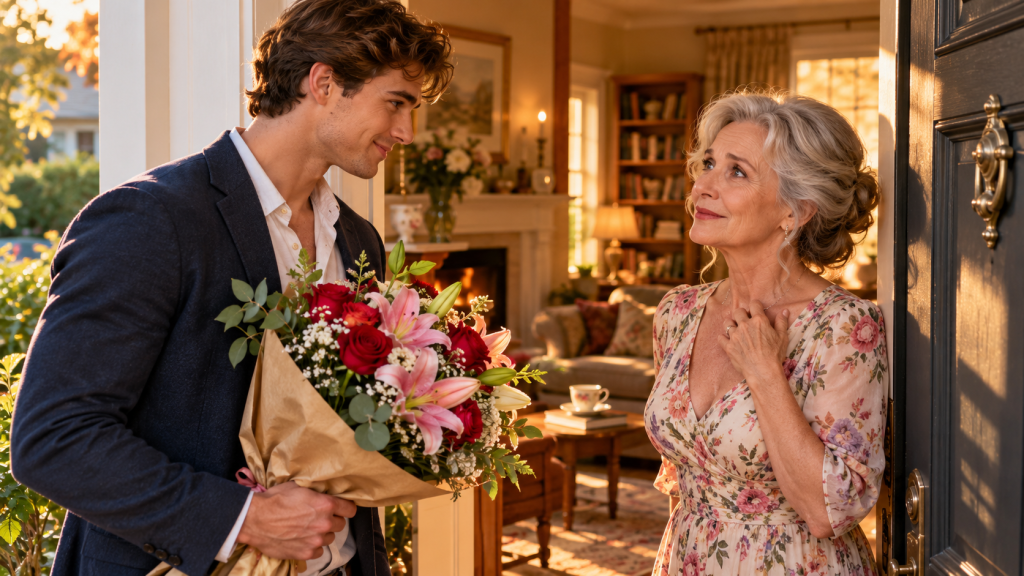
“He claims you gave the gold bars to his mother.” The police officer’s words seemed to travel toward me from a great distance. For a moment, I couldn’t understand them. I stood in my doorway wearing the pale blue cardigan my late husband had bought me for our last wedding anniversary, staring at the photograph in the officer’s hand.
Adrian. My Adrian. The twenty-five-year-old man who had brought laughter back into my quiet house. The young man who had kissed my forehead and promised I would never regret trusting him. The man who had taken ten gold bars from the safe that morning. And now the police were standing on my doorstep.
“His mother?” I whispered. The older officer nodded. “Yes, ma’am.” I shook my head. “But I haven’t met his mother.” The younger officer glanced at his colleague. “That’s why we need to ask you some questions.” My fingers tightened around the doorframe. “Where is Adrian?” “He’s being interviewed.” “Is he under arrest?”
“Not at this moment. We’re investigating several complaints and determining what happened to the property.”
I stared at him.
Then asked the question I was terrified to hear answered.
“Am I one of those complaints?”
The officer’s expression softened.
“Ma’am, that is something we’re trying to establish.”
Behind me, the living room clock struck nine.
Nine small chimes.
Each one sounding like a nail being driven into the life I thought I’d found.
I stepped aside.
“Please come in.”
My name is Eleanor Bennett.
I am sixty-five years old.
For thirty-four years, I taught literature to teenagers who believed every tragedy in the world could be avoided if the characters simply made better decisions.
I used to smile at their certainty.
I would tell them that people rarely recognize the most important decision of their lives while they’re making it.
Usually, they understand only afterward.
When the letter has been sent.
When the train has departed.
When the person they trusted has already walked away.
That morning, as two police officers sat at my dining table, I finally understood what I’d spent decades trying to teach.
A person can be intelligent.
Experienced.
Educated.
And still become vulnerable when loneliness begins speaking more loudly than caution.
Detective Sarah Morgan introduced herself.
Her colleague was Officer Daniel Ruiz.
They were polite.
Patient.
Almost painfully gentle.
Which frightened me more than anger would have.
Detective Morgan took out a notebook.
“Mrs. Bennett, when did you meet Adrian?”
“Eight months ago.”
“And his surname?”
“Adrian Cole.”
She wrote something.
Then looked up.
“Are you certain?”
My stomach tightened.
“That’s what he told me.”
“Did you ever see identification?”
I opened my mouth.
Then closed it.
No.
I had seen his photographs.
His messages.
His smiling face across restaurant tables.
The bright screen of his laptop while he showed me sketches for the studio he dreamed of opening.
But I had never seen his identification.
Not once.
Detective Morgan waited.
Finally, I whispered, “No.”
She nodded without judgment.
“That’s all right. Tell us how the relationship developed.”
I told her about the painting class.
The rainy afternoon when my bicycle tire went flat.
The coffee shop where Adrian ordered hot chocolate because he claimed coffee made him nervous.
The little bouquets he brought me.
The dinners.
The walks through the botanical garden.
The night he told me I was beautiful.
I felt ridiculous saying those things aloud.
Especially in front of strangers.
At one point, my voice broke.
“He made me feel alive again.”
Detective Morgan lowered her pen.
For a moment, she said nothing.
Then she replied, “That feeling was real to you, Mrs. Bennett. We understand.”
I looked away.
Because I didn’t know which possibility hurt more.
That Adrian had never loved me.
Or that somewhere along the way, I had mistaken being wanted for being safe.
Eventually, we reached the gold.
Ten small bars.
Each one stored in a protective case.
They were not decorations.
Not extravagant possessions collected to impress visitors.
They represented years of careful saving.
My husband, Thomas, had purchased them gradually as part of our retirement investments.
When he became ill, we reorganized our finances.
Some investments were sold to pay for treatment.
Others were transferred into accounts we could access more easily.
But the gold remained.
Thomas had insisted.
“Eleanor,” he told me once, “this isn’t money for showing off. It’s something you can fall back on if life becomes difficult.”
I remembered how he’d smiled.
“You’ve spent enough years taking care of everybody else.”
He’d touched my cheek.
“Promise me you’ll take care of yourself too.”
I promised.
And five years after his death, I had handed those bars to a young man who said he loved me.
Detective Morgan asked whether I had signed a loan agreement.
I shook my head.
“Did Adrian provide receipts?”
“No.”
“Did he identify the investors?”
“He mentioned a business partnership.”
“Did he tell you where the bars would be stored?”
I hesitated.
“He said his mother would keep them until the arrangement was finalized.”
“Did you meet his mother?”
“No.”
“Did you speak to her?”
“No.”
The detective’s eyes held mine.
“And did he tell you why a proposed design studio needed physical gold?”
I stared at my hands.
Because that was the question I should have asked.
The question I would have asked any student who presented such a story in an essay.
Why would a design business need ten gold bars?
Why couldn’t Adrian use a bank?
Why did the arrangement have to happen before I met his parents?
Why did he need the gold immediately?
I’d accepted answers that had never truly answered anything.
Because the explanation had been wrapped in affection.
And I had wanted so desperately for the affection to be genuine.
“Mrs. Bennett?”
I looked up.
Detective Morgan’s voice was soft.
“Do you have any written messages about the loan?”
I nodded.
“Yes.”
“Would you be willing to preserve those and share copies with us?”
“Of course.”
She explained how to avoid deleting anything and how to document the messages properly.
Then she placed a photograph on the table.
Adrian stood outside a café.
His arm was around an older woman with silver hair.
The woman looked happy.
Her hand rested gently against his chest.
I recognized the expression on her face.
It was the expression I saw in my own mirror whenever Adrian told me he loved me.
“Who is she?” I asked.
Detective Morgan paused.
“Her name is Margaret Ellis.”
I swallowed.
“His mother?”
“No.”
The room seemed to darken.
“She believed she was his girlfriend.”
I covered my mouth.
Detective Morgan continued carefully.
“Margaret is seventy-two. She reported losing a substantial amount of money after someone she knew as Daniel persuaded her to invest in a business.”
“Daniel?”
The detective nodded.
“That is the name he used with her.”
I stared at the photograph.
Adrian.
Daniel.
Two names.
Two women.
Two promises.
My fingers began trembling.
“Did he tell her he loved her?”
Detective Morgan’s expression was answer enough.
I looked down.
Then whispered, “Of course he did.”
The officer placed another photograph beside the first.
Adrian standing outside a small cottage with a different older woman.
She wore a green dress.
Her white hair was tied back.
She was smiling at him.
“Her name is Helen Parker,” the detective explained.
I stared.
“How many?”
“We’re still establishing that.”
My throat tightened.
“How many women did he do this to?”
Detective Morgan didn’t offer a number she couldn’t verify.
“We have several reports involving similar approaches. We’re examining whether they’re connected to the same person and whether others participated.”
I looked toward the window.
The garden was full of roses.
Thomas had planted them.
Every spring, they bloomed.
Every spring, I cut a few and placed them beside his photograph.
And while those roses opened outside, I sat at my table discovering that the man who had made me feel loved might have been repeating the same performance for other lonely women.
I began crying.
Not loudly.
Not dramatically.
The tears simply came.
Detective Morgan quietly slid a tissue box toward me.
I shook my head.
“I taught school for thirty-four years.”
She listened.
“I taught children about manipulation.”
“About characters who lie.”
“About people who believe what they want to believe.”
My voice broke.
“And I couldn’t recognize it in my own life.”
She answered gently.
“People who deceive others often spend considerable effort earning trust. Being deceived doesn’t mean you lack intelligence.”
I covered my face.
But her words couldn’t immediately reach the part of me that felt ashamed.
Then my phone rang.
My daughter.
Clara.
I stared at the screen.
I had kept Adrian a secret from my children.
Not because I didn’t trust them.
But because I feared their reaction.
I imagined the surprise.
The awkward questions.
The concern over our age difference.
I wanted a little more time to enjoy being loved before everyone began examining it.
Now Clara was calling because someone had apparently used my address on a loan application.
And I could no longer protect the secret.
I answered.
“Hello, sweetheart.”
“Mom?”
Her voice was sharp with worry.
“Are you okay?”
I looked at the two officers.
Then at the photographs.
Then at my wedding ring, still resting on my finger even after five years of widowhood.
“No,” I whispered.
“Mom?”
My voice collapsed.
“Clara, I think I’ve done something terrible.”
She arrived twenty minutes later.
My daughter was forty-two.
A practical woman.
An accountant.
The kind of person who checked details twice and rarely made impulsive decisions.
She rushed through the doorway and stopped when she saw the police.
“Mom?”
I stood.
Her face drained.
“What happened?”
I tried to speak.
But no words came.
Finally, I pointed toward the empty place beside the cabinet where my gold had been stored.
“It’s gone.”
Clara stared.
“What?”
“The gold.”
Her eyes widened.
I swallowed.
“I lent it to someone.”
She looked at the detectives.
Then back at me.
“Who?”
My throat tightened.
“A man I was seeing.”
Silence.
Clara blinked.
Then slowly sat down.
“A man?”
I nodded.
Her expression changed.
Not into anger.
Into heartbreak.
“Oh, Mom.”
That was all she said.
And somehow, those two words broke me more than a lecture ever could.
She moved beside me.
Put her arms around my shoulders.
And held me.
I began sobbing.
“I was going to tell you.”
“I know.”
“I thought he loved me.”
Clara squeezed me tighter.
“I know, Mom.”
I shook my head.
“I gave him everything Thomas wanted me to protect.”
She pulled back slightly.
“Mom, we’ll figure out what can be done.”
I stared at her.
“But what if the gold is gone?”
Her eyes filled.
“Then we’ll deal with that too.”
She took my hands.
“But right now, I need you to understand that you matter more than the gold.”
I wish I could say those words immediately made me feel better.
They didn’t.
Because grief isn’t always reasonable.
And shame is rarely persuaded by kindness on its first attempt.
But I held on to her hands.
And for the first time that morning, I felt less alone.
Detective Morgan asked Clara about the loan application.
My daughter opened her phone.
She explained that an acquaintance working in a financial institution had alerted her to a possible identity-verification issue involving my address.
The detective carefully stopped her.
“We’ll need to establish exactly what information was accessed and how it was obtained. Please don’t have anyone disclose confidential records improperly.”
Clara nodded.
“Of course.”
She showed the detective the message she’d received.
It didn’t reveal the entire application.
Only a concern that someone appeared to be using my address in connection with financing.
Detective Morgan asked us to preserve the message and allow investigators to follow lawful procedures.
Then she looked toward me.
“Mrs. Bennett, did Adrian ever ask to use your address?”
I thought back.
A month earlier, he’d asked whether a package could be delivered to my house.
He said his apartment building had problems with missing parcels.
I’d agreed.
The package arrived.
A large envelope.
He collected it that evening.
I never asked what was inside.
My stomach turned.
“Yes,” I whispered.
“He used my address.”
Clara closed her eyes.
The detective wrote carefully.
Then asked another question.
“Did he have access to your identification documents?”
I thought about the afternoon he’d helped me organize my phone.
The day he showed me how to store photographs digitally.
The evening he offered to scan old documents so I wouldn’t lose them.
My heart began pounding.
“He scanned some papers.”
Clara looked up sharply.
“What papers?”
“My passport.”
“My insurance card.”
“Some bank statements.”
The room went silent.
Detective Morgan’s expression became serious.
“Did he retain copies?”
“I don’t know.”
Clara reached for my hand.
I stared at the detective.
And realized the gold might not be the only thing I’d put at risk.
The officers guided us through immediate steps.
Contacting financial institutions.
Securing accounts.
Changing passwords from a trusted device.
Reviewing statements.
Placing appropriate fraud alerts where available.
Keeping records.
Not responding to unexpected financial requests.
And avoiding direct confrontation with Adrian.
Clara helped me make the calls.
My hands shook so badly I could barely enter my own birthday into the verification prompts.
At noon, Detective Morgan received a call.
She stepped outside.
When she returned, her expression had changed.
“Mrs. Bennett, we may have located the woman Adrian referred to as his mother.”
My heart jumped.
“Where?”
“She lives approximately three hours from here.”
I swallowed.
“Is she really his mother?”
“We’re verifying her identity and relationship.”
“Does she have the gold?”
The detective paused.
“We don’t know yet.”
I felt hope rise.
Then immediately forced it down.
Because I’d already learned how dangerous hope could become when it outran the facts.
That afternoon, after the police left, I stood in my bedroom staring at the empty safe.
The roses Adrian brought me the previous evening sat in a vase on the dresser.
Their petals were beginning to curl.
The sight made me nauseous.
I picked up the bouquet.
Walked toward the kitchen.
Then stopped beside the trash bin.
For a moment, I couldn’t throw it away.
It was absurd.
They were flowers.
Ordinary flowers.
But they represented the last night I believed I was loved.
I stood there holding them.
Then slowly placed them in the bin.
One rose slipped free.
It fell onto the floor.
Its red petals scattered across the tiles.
I looked down.
And began crying again.
Clara found me there.
She didn’t ask why I was crying.
She simply knelt beside me.
Helped gather the petals.
Then guided me to the kitchen table.
“Mom.”
I looked at her.
She hesitated.
“Can I ask you something?”
I nodded.
“Why didn’t you tell us about him?”
I closed my eyes.
Of all the questions she’d asked, that one hurt most.
Because the answer exposed something I’d barely admitted to myself.
“I was afraid you’d laugh.”
Clara stared.
“What?”
My voice trembled.
“I thought you’d think I was foolish.”
Her face crumpled.
“Mom…”
I looked down.
“He was so young.”
I swallowed.
“And I was so happy.”
Tears filled my eyes.
“I didn’t want anyone to take that happiness away.”
Clara sat silently.
Then took my hand.
“Mom, I might have had questions.”
I nodded.
“I know.”
“But I wouldn’t have laughed.”
Her voice broke.
“I wish you’d let me be there for you.”
We cried together.
Then Clara said something I will remember for the rest of my life.
“Dad’s death didn’t mean your life was over.”
I looked at her.
She continued.
“You’re allowed to love again.”
My eyes filled.
“You’re allowed to date.”
“To laugh.”
“To feel beautiful.”
She squeezed my fingers.
“But someone who loves you shouldn’t need you to hide everything from the people who care about you.”
I lowered my head.
Because that was exactly what Adrian had encouraged.
He never openly demanded secrecy.
He was too clever for that.
He simply said he wanted our relationship to remain special.
Private.
Protected from judgment.
He told me other people wouldn’t understand.
That they would try to separate us.
That our love belonged only to us.
At the time, those words felt romantic.
Now I heard something different.
Isolation.
That evening, my grandson called.
His name was Benjamin.
Twenty-three years old.
Studying engineering.
He was only two years younger than Adrian.
The comparison made my face burn.
But Ben didn’t laugh.
He didn’t ask how I could have been so foolish.
He listened.
Then said, “Grandma, I wish you’d told me.”
I wiped my eyes.
“I know.”
He paused.
Then spoke gently.
“Can I come over tomorrow?”
My throat tightened.
“Of course.”
“Good.”
I could hear him breathing.
Then he added, “And Grandma?”
“Yes?”
“I love you.”
I covered my mouth.
“Love you too, sweetheart.”
After the call, I went into the bedroom and opened Thomas’s old wardrobe.
Most of his clothes were gone.
I’d donated them after his death.
But one jacket remained.
Brown wool.
Slightly worn at the elbows.
I lifted it from the hanger.
Pressed my face against the fabric.
The familiar scent had faded years earlier.
But I remembered it anyway.
Thomas.
My husband.
My companion.
The man who held my hand through thirty-seven years of marriage.
I sat on the bed with his jacket in my arms.
And whispered, “I’m sorry.”
Not because I’d fallen in love again.
Thomas would never have wanted me to spend the rest of my life alone.
I knew that.
I was sorry because I’d forgotten something he had tried to teach me.
Love shouldn’t require surrendering your peace.
The next morning, Clara and Ben arrived together.
My grandson brought groceries.
My daughter brought a notebook.
I almost laughed.
“An accountant and an engineer.”
Clara smiled sadly.
“Your personal investigation team.”
Ben kissed my cheek.
“Except we leave the actual investigation to the police.”
I smiled for the first time in two days.
And something inside me softened.
We spent the morning organizing my records.
Not searching Adrian’s accounts.
Not trying to track anyone through private systems.
Simply gathering what I already possessed.
Text messages.
Photographs.
Receipts.
Dates.
Bank records.
The rental car photograph.
The packaging from the flowers he’d brought.
And the little notebook where I kept appointments.
Ben helped me back up my messages.
Clara made a chronology.
I told them everything I could remember.
Sometimes I cried.
Sometimes I had to stop.
But they remained patient.
Then Ben found something.
A photograph I’d taken at the painting class.
Adrian standing beside an easel.
Smiling.
Behind him was a woman arranging brushes.
Silver hair.
Green blouse.
A familiar face.
Ben frowned.
“Grandma?”
I looked up.
“What?”
He enlarged the picture.
“Isn’t that the woman the detective showed you?”
My stomach tightened.
I looked.
Margaret Ellis.
The seventy-two-year-old woman who believed Adrian loved her too.
She had been standing in the same painting class.
Only a few feet away from me.
I stared at the photograph.
Then whispered, “Oh, my God.”
I remembered Margaret.
She attended the class occasionally.
Quiet.
Polite.
Always wearing a little pearl brooch.
She once complimented my watercolor painting of a garden.
She told me the colors reminded her of her childhood home.
We’d spoken several times.
I’d even shared a table with her.
But I’d never known she was involved with Adrian.
And apparently, she’d never known about me.
My stomach turned.
“He introduced us.”
Clara looked up.
“What?”
I pointed toward the photograph.
“Adrian introduced me to Margaret.”
Ben stared.
I closed my eyes.
“He said she was an old friend from the community center.”
My voice broke.
“And she smiled at me.”
Detective Morgan asked for a copy of the photograph.
She also asked whether there were any other people Adrian had introduced me to.
I thought carefully.
An older man at a café.
A woman who worked near the design district.
A couple who supposedly owned a small gallery.
At the time, I’d believed Adrian had a wide circle of friends.
Now I wondered which relationships were genuine and which were part of the performance.
Two days later, the detective called.
“Mrs. Bennett?”
I answered immediately.
“Yes?”
“We have some developments.”
My heart began pounding.
“Did you find the gold?”
“Not yet.”
My shoulders fell.
“But we have identified the woman Adrian described as his mother.”
I closed my eyes.
“Who is she?”
The detective paused.
“Her name is Evelyn Hart.”
I frowned.
“I’ve never heard that name.”
“She has been associated with several business entities under review.”
My stomach tightened.
“And is she his mother?”
“We’re still confirming their legal and biological relationship. What we know is that Adrian directed your gold toward her.”
I gripped the phone.
“So he was telling the truth?”
“His account may contain some accurate details,” the detective replied. “That doesn’t establish that the transfer was authorized or that the business explanation was genuine.”
I swallowed.
Of course.
A lie didn’t have to be entirely false to be dangerous.
Sometimes the most convincing deceptions contain just enough truth to survive the first question.
Then Detective Morgan said something unexpected.
“Mrs. Bennett, has Adrian ever shown you photographs of his childhood?”
I thought back.
A little boy standing beside a lake.
A family Christmas.
A graduation picture.
“Yes.”
“Did he identify his parents?”
“He said his father left when he was young.”
“And his mother?”
“He called her Evelyn.”
The detective paused.
“Did he ever explain why he hadn’t introduced you sooner?”
I closed my eyes.
“He said she was traditional.”
“Traditional?”
I felt foolish repeating it.
“He said she wouldn’t approve of our age difference until she saw how serious he was.”
Detective Morgan was quiet.
Then asked, “Did he ever suggest that lending him money would help you gain her approval?”
My breath caught.
The flowers.
The invitation.
The nervous smile.
The request for ten gold bars.
All of it happened the day before I was supposed to meet his parents.
“Yes,” I whispered.
“He did.”
That evening, I opened our message history.
I scrolled back through months of affection.
Good morning, beautiful.
Don’t forget your vitamins.
Have you eaten?
I miss your smile.
You’re my favorite person.
At first, the messages made me cry.
Then I began noticing a pattern.
Whenever I mentioned my children, Adrian changed the subject.
Whenever I suggested meeting his colleagues, he said work was complicated.
Whenever I asked about his apartment, he said he preferred my home.
And whenever I expressed uncertainty, he became wounded.
Don’t you trust me?
I thought we were different.
I can’t believe you would doubt me.
I had apologized so many times.
For reasonable questions.
For ordinary caution.
For wanting clarity.
I stared at the screen.
And realized how often I had mistaken being made to feel guilty for having disappointed someone I loved.
A week later, the police asked whether I would be willing to participate in a formal identification procedure and provide further information.
I agreed.
Clara drove me.
I wore a simple navy dress.
The one I used to wear for school ceremonies.
I wanted to feel like myself.
Even if I no longer knew exactly who that was.
At the station, Detective Morgan explained that Adrian was being investigated under an identity that differed from the one he had given me.
His legal name was Adrian Mercer.
He had used other names.
Including Daniel Cole.
And records suggested possible connections to several questionable financial arrangements.
The police were examining the allegations.
No verdict had been reached.
I understood that.
But the photographs, messages, and inconsistent identities already told me enough to know our relationship had not been what I’d believed.
Then the detective asked whether I wanted to see him.
I stared.
“Is that necessary?”
“No. Any contact would have to be appropriate to the investigation, and you are under no obligation to speak with him.”
I looked down.
Part of me wanted to see his face.
To demand why he’d done it.
To ask whether a single moment had been real.
But another part of me knew that Adrian had been extraordinarily skilled at making me doubt myself.
And I didn’t want to give him another chance.
I took a slow breath.
“No.”
Detective Morgan nodded.
“That’s completely fine.”
I looked at her.
“Please communicate through the proper channels.”
“Of course.”
That decision felt small.
But it changed something inside me.
For months, Adrian had set the pace of our relationship.
When we met.
When we spoke.
When we shared things.
When I was allowed to ask questions.
Now I had made a decision without considering how he would feel about it.
And I was surprised by how much relief followed.
Several weeks passed.
The investigation continued.
My financial accounts were reviewed.
Some suspicious activity required further examination.
Fortunately, the immediate safeguards limited additional harm.
But there were still applications and inquiries I had never authorized.
Clara helped me respond through the appropriate institutions.
I felt exhausted.
Embarrassed.
Angry.
Sometimes I woke in the night wondering what else Adrian had done.
Sometimes I dreamed he was sitting beside me in the painting class, smiling.
Then I would wake and remember.
And the grief would begin again.
One morning, I received a letter from a woman named Margaret Ellis.
She had asked Detective Morgan whether she could contact me.
I agreed.
The envelope contained two pages.
Her handwriting was neat.
Careful.
Almost teacherly.
The first line made my eyes fill.
Dear Eleanor,
I don’t know whether this letter will help, but I wanted you to know you’re not alone.
I sat down.
Then continued.
When I saw Adrian’s photograph, I felt as though someone had taken the floor from beneath me.
He called himself Daniel when he was with me.
He told me he wanted to open a studio.
He brought me flowers.
He asked about my late husband.
He remembered my birthday.
And he told me I was beautiful.
I covered my mouth.
Every sentence felt familiar.
Margaret continued.
I spent two years after my husband’s death barely leaving my house.
Then this young man made me feel seen.
I know people will wonder why a woman my age believed him.
Perhaps I will always wonder too.
But I want you to know something.
The affection we offered was real.
The deception belonged to the person who abused it.
I began crying.
Then read the final paragraph.
If you ever want to have tea with someone who understands, I would like that.
No pressure.
No explanations required.
Just tea.
Margaret.
I called her the next day.
My hands trembled.
She answered on the third ring.
“Hello?”
“Margaret?”
“Yes?”
“This is Eleanor Bennett.”
A long silence.
Then she whispered, “Oh, Eleanor.”
Neither of us spoke.
Then she began crying.
And I did too.
We met at a little café near the community center.
I arrived early.
Margaret came in wearing a pale green blouse and the same pearl brooch I remembered from painting class.
For a moment, we stood awkwardly.
Then she smiled sadly.
“Hello.”
I smiled through tears.
“Hello.”
We sat.
Ordered tea.
And began talking.
The similarities were almost unbearable.
Adrian had told Margaret he dreamed of starting a design studio.
He had shown her sketches.
He’d talked about investors.
He’d promised a future.
He’d said their age difference didn’t matter.
He’d insisted other people wouldn’t understand.
And eventually, he’d asked for financial help.
The details differed.
But the emotional pattern was frighteningly familiar.
Margaret looked at me.
“Did he ever tell you that you had the most beautiful smile he’d ever seen?”
My throat tightened.
“Yes.”
She closed her eyes.
“He told me that too.”
For a moment, I felt a sharp sting of jealousy.
How absurd.
Jealousy over a man who had deceived us both.
Then Margaret reached across the table.
And took my hand.
“It wasn’t a competition, Eleanor.”
My eyes filled.
“I know.”
She swallowed.
“He made us believe we were special.”
I nodded.
“And we were.”
I looked up.
She smiled sadly.
“Just not for the reasons he claimed.”
We sat together for nearly three hours.
Sometimes crying.
Sometimes laughing at the absurd details.
Sometimes sitting in silence.
When we finally stood to leave, Margaret looked at me.
“Would you like to come back to painting class?”
I stared.
I hadn’t returned since the day Adrian disappeared.
The thought frightened me.
That room held too many memories.
Too many conversations.
Too many places where I’d believed I was falling in love.
“I don’t know.”
Margaret nodded.
“That’s all right.”
She smiled.
“But if you do, I’ll save you a seat.”
I thought about her words for days.
Then one Wednesday morning, I took my old painting bag from the closet.
The brushes were dusty.
My watercolor palette had dried.
I stood holding it for a long time.
Then I put on a floral dress.
Not because Adrian liked floral dresses.
Because I did.
I applied lipstick.
Not because I wanted someone to find me attractive.
Because the color made me smile.
Then I drove to the community center.
My hands trembled as I entered the classroom.
The familiar smell of paint.
The folding tables.
The bright windows.
The easels lined against the wall.
Every detail brought memories rushing back.
I nearly turned around.
Then Margaret waved from the corner.
“Eleanor!”
Her smile was warm.
Genuine.
She had saved me a seat.
I walked toward her.
Sat down.
And began unpacking my brushes.
Our instructor, Mrs. Phillips, approached.
She was seventy-four.
A cheerful woman with bright scarves and a habit of calling everyone darling.
“Eleanor!”
She hugged me.
“We’ve missed you.”
My throat tightened.
“I’ve missed you too.”
She looked at me gently.
Then said, “No pressure today. Paint whatever you feel.”
I nodded.
“Thank you.”
I stared at the blank paper.
For a long time, I couldn’t move.
Then I dipped my brush into green paint.
Drew a single stem.
Added leaves.
Then a flower.
A yellow rose.
Thomas’s favorite.
Before long, the page held a small garden.
Not perfect.
Not especially skillful.
But mine.
Margaret glanced over.
“That’s lovely.”
I smiled.
“Thank you.”
She pointed toward the roses.
“Are those from your garden?”
I nodded.
“My husband planted them.”
Her expression softened.
“He must have loved you.”
I looked at the painting.
Then whispered, “He did.”
That night, I placed the watercolor beside Thomas’s photograph.
For the first time since Adrian disappeared, I didn’t feel as though the act of painting belonged to him.
It belonged to me.
It always had.
Two months later, Detective Morgan called again.
This time, she asked whether Clara and I could come to the station.
I felt my stomach tighten.
“Is something wrong?”
“We have information about the missing gold.”
My heart began pounding.
“Did you find it?”
She paused.
“We have recovered items believed to be connected to the property taken from you. We need to verify identification and ownership.”
I pressed my hand against my chest.
For a moment, I couldn’t speak.
Then I whispered, “I’ll come.”
Clara drove.
I sat in the passenger seat clutching my purse.
My hands were cold.
My daughter reached across the console.
“Mom?”
I looked at her.
“Whatever happens, we’ll handle it.”
I nodded.
But I was terrified.
Not only of losing the gold permanently.
But of being disappointed again.
At the station, Detective Morgan showed us photographs of several gold bars seized during an authorized search connected to the investigation.
There were identifying details.
Packaging.
Serial markings.
Records of purchase.
I recognized some immediately.
Thomas had kept careful documentation.
Clara had helped me locate it.
The detective explained that ownership needed to be established and that the items might remain in evidence during proceedings.
But the preliminary information was promising.
At least some of the bars appeared to be mine.
I stared at the photographs.
My eyes filled.
“Thomas…”
Clara squeezed my hand.
Detective Morgan looked at me.
“We’re continuing to trace the remaining property.”
I nodded.
For the first time in months, I felt a small measure of relief.
Not triumph.
Not revenge.
Relief.
Because perhaps some of what had been taken could eventually come home.
Then the detective explained another development.
Investigators had identified evidence suggesting that Adrian had worked with others to solicit money and property through false business proposals.
Evelyn Hart was one of the people under investigation.
She had been presented as his mother.
Whether that relationship was biological remained less important than her potential role in moving property.
The evidence would be examined.
Charges, if supported, would proceed through the legal system.
I listened carefully.
This time, I did not ask whether Adrian loved me.
I asked about documentation.
About the status of the recovered property.
About the next steps.
About protecting myself.
It was a small but important change.
I was beginning to think about my future again.
Not about winning his approval.
Several weeks later, I received official notice that criminal proceedings were moving forward.
The allegations included fraud-related offenses connected to multiple complainants.
I understood that allegations weren’t convictions.
That evidence would have to be tested.
That everyone had legal rights.
And that the process could take time.
But I was ready to participate.
Not because I wanted to see Adrian suffer.
Because I wanted the truth established.
And I wanted the women he’d approached to know their experiences mattered.
Margaret called that evening.
“Eleanor?”
“Yes?”
“Did you get the notice?”
“I did.”
She was quiet.
Then whispered, “Are you frightened?”
I looked toward the garden.
“Yes.”
She sighed.
“Me too.”
I smiled sadly.
“Then I suppose we’ll be frightened together.”
Margaret laughed softly.
“I suppose we will.”
As the proceedings developed, more details emerged.
There were financial records.
Messages.
False representations.
Witness accounts.
And documentation connecting certain transactions.
The case was not as simple as a single young man persuading an older woman to lend him valuables.
It involved multiple people and repeated patterns.
The authorities worked to establish which acts were criminal and who was responsible.
I attended when required.
Answered questions truthfully.
And tried to remain grounded in what I knew firsthand.
During one proceeding, I saw Adrian across the room.
It was the first time I’d seen him since the night he brought me roses.
My breath caught.
He looked different.
Not because he’d physically changed much.
His hair was the same.
His face familiar.
His eyes still bright.
But the expression I’d once interpreted as tenderness now filled me with uncertainty.
He glanced toward me.
For a moment, our eyes met.
I felt an old ache.
A memory of laughter.
Coffee.
Rain on the windshield.
His hand holding mine.
Then I remembered the gold.
The messages.
The other women.
And the false names.
I looked away.
Not because I was afraid.
Because I no longer needed to search his face for proof of something he had never given me.
Later, I was asked to speak about the circumstances surrounding the loan.
I told the truth.
I explained how we met.
How our relationship developed.
What he said about the business.
Why I believed him.
What he promised.
And what happened afterward.
At one point, my voice trembled.
I looked toward the people listening.
Then continued.
“I didn’t give him the gold because I expected profit.”
I swallowed.
“I gave it because I believed he was someone who loved me.”
The room was quiet.
I took a breath.
“And that belief influenced my decision.”
Afterward, Clara hugged me.
“Mom.”
I looked at her.
“Yes?”
“You did well.”
My eyes filled.
I shook my head.
“I was terrified.”
She smiled gently.
“Courage doesn’t mean you weren’t frightened.”
I laughed softly.
“You sound like something I used to tell my students.”
She grinned.
“Learned from the best.”
The case took many months to resolve.
Some matters were contested.
Some evidence required specialist analysis.
The different complainants had experienced different losses.
Not every allegation was established in exactly the same way.
But the proceedings ultimately produced findings of wrongdoing against Adrian in connection with fraudulent representations and property transfers.
There were legal consequences.
Orders relating to restitution where supported.
And continued efforts to recover assets.
When I received the news, I didn’t celebrate.
I sat quietly.
Margaret was beside me.
She took my hand.
“It’s over.”
I looked at her.
“Not completely.”
She nodded.
“No.”
Because a judgment couldn’t restore the months we’d spent trusting someone.
It couldn’t return every dollar.
It couldn’t erase humiliation.
It couldn’t make loneliness disappear.
But it could acknowledge that what happened was wrong.
And sometimes, that acknowledgment matters.
Eventually, several of my gold bars were returned after the necessary legal process.
The remainder were not recovered in their original form.
Financial recovery efforts continued according to the available legal remedies, but I knew there might be losses I would never fully recoup.
I accepted that with difficulty.
Some mornings, I still felt angry.
Other mornings, sad.
But I had learned that waiting for every loss to be repaired before allowing myself to live would only give Adrian more power over my future.
When the returned gold finally came home, Clara accompanied me to secure it properly.
I held one bar carefully.
Its weight surprised me.
Not because I’d forgotten how heavy gold was.
Because I remembered Thomas placing it in its little case years earlier.
He’d smiled.
“One more piece of security for us.”
I traced the edge.
Then began crying.
Clara put her arm around me.
“Mom?”
I whispered, “Your father worked so hard.”
She nodded.
“I know.”
I swallowed.
“I feel like I failed him.”
Clara turned toward me.
“Mom, Dad loved you.”
I closed my eyes.
She continued.
“He didn’t marry a perfect woman.”
“He married you.”
My eyes filled.
“And he wouldn’t want you spending the rest of your life punishing yourself.”
I began crying harder.
Then nodded.
Because somewhere deep inside, I knew she was right.
That evening, I took Thomas’s photograph from the shelf.
I placed it beside the returned property documents.
Then sat quietly.
For a long time, I thought about our marriage.
The years of ordinary happiness.
The nights he worked late.
The mornings he brought me tea.
The way he always checked the tires on my bicycle because he worried I’d forget.
Then I smiled through tears.
And whispered, “I’m going to be okay.”
I began attending a support group for older adults who had experienced financial exploitation or coercive relationships.
At first, I hated the idea.
I imagined sitting in a circle describing my mistakes.
I imagined strangers judging me.
But when I arrived, I found people who looked like me.
Retired teachers.
Nurses.
Business owners.
Widows.
Divorced people.
Men and women.
People who had spent their lives taking care of others.
People who believed they should have known better.
And people who were trying to rebuild.
One woman had been persuaded to invest in a nonexistent property development.
Another had sent money to someone she believed was working overseas.
A man had lost savings after trusting a supposed business partner.
Their stories differed.
But the emotions were familiar.
Shame.
Anger.
Grief.
Fear.
And the desperate question beneath all of them.
How could I have let this happen?
During my third meeting, the facilitator asked whether anyone wanted to share.
I sat silently.
My hands folded in my lap.
Then, slowly, I raised one hand.
“My name is Eleanor.”
The room became quiet.
“I was a literature teacher.”
A few people smiled.
I swallowed.
“I spent thirty-four years telling teenagers to think critically.”
My voice trembled.
“And then I fell in love with someone who wasn’t who he claimed to be.”
I looked around.
Nobody laughed.
Nobody shook their head.
Nobody seemed shocked.
They simply listened.
And for the first time, I told my story without feeling I needed to apologize for having wanted affection.
Afterward, a woman approached.
She was seventy.
Her name was Ruth.
She took my hand.
“Thank you.”
I looked at her.
“For what?”
She smiled sadly.
“For saying you wanted to be loved.”
My throat tightened.
She continued.
“Sometimes I think that’s the part we’re most ashamed of.”
I nodded.
She squeezed my fingers.
“But there’s nothing shameful about that.”
I began crying.
And hugged her.
Slowly, my life changed.
Not dramatically.
Not overnight.
I didn’t wake one morning suddenly healed.
There were still painful days.
But they became less frequent.
I returned to painting regularly.
Started walking in the mornings.
Joined a book club.
Helped organize a small literary discussion group at the community center.
And spent more time with Clara and Ben.
One afternoon, my grandson asked whether I would help him choose a painting for his apartment.
I laughed.
“Since when do you care about art?”
He grinned.
“Since I discovered blank walls are depressing.”
I smiled.
“Fair enough.”
We spent Saturday morning looking at local galleries.
He asked questions.
I told him stories about artists.
We laughed.
And at lunch, he reached across the table.
“Grandma?”
“Yes?”
“I’m glad you’re coming out again.”
My eyes filled.
“Me too.”
Then he hesitated.
“Can I ask something?”
I nodded.
“Of course.”
“Do you think you’ll ever date again?”
The question surprised me.
I looked out the window.
A couple walked past holding hands.
Both elderly.
Both laughing.
For a moment, I felt a familiar ache.
Then I smiled sadly.
“I don’t know.”
Ben nodded.
“That’s okay.”
I looked at him.
“But I hope I don’t become afraid of people.”
His expression softened.
I continued.
“I don’t want one person’s dishonesty to make me suspicious of every act of kindness.”
Ben smiled.
“That’s a good goal.”
I laughed.
“Very teacherly of you.”
He grinned.
“Runs in the family.”
Margaret and I became close friends.
We painted together.
Went to concerts.
Shared books.
And occasionally sat in my garden drinking tea while talking about the strangest things.
One day, she looked toward the roses.
“Do you think he ever cared about us?”
I knew who she meant.
Adrian.
For a moment, I considered.
Then answered honestly.
“I don’t know.”
Margaret nodded slowly.
I continued.
“And I don’t think I’ll ever know.”
She looked down.
I took her hand.
“But I know we cared.”
Her eyes filled.
“And I don’t want to become ashamed of that.”
She smiled through tears.
“Neither do I.”
That became our quiet promise.
We would be wiser.
More careful.
More willing to ask questions.
But we would not punish ourselves for having hearts.
A year after the case concluded, I received an unexpected envelope.
No return address.
Inside was a short handwritten letter.
From Adrian.
My hands began trembling.
For a moment, I considered putting it aside unread.
Then I called Clara.
She came over.
We sat at the kitchen table.
The envelope lay between us.
“Mom,” she said gently, “you don’t have to read it.”
I nodded.
“I know.”
I looked toward the garden.
Then back at the letter.
Finally, I opened it.
Eleanor,
I’ve thought about what happened.
I know I hurt you.
I know you trusted me.
I don’t expect you to forgive me.
There were moments when I enjoyed being with you.
I hope you can believe that.
I’m sorry.
Adrian.
I stared at the words.
For a long time, I felt nothing.
Then a familiar sadness moved through me.
Not because the apology changed anything.
But because part of me had once imagined receiving a letter like that.
A letter proving that somewhere beneath the deception, the young man I’d loved had existed.
I read it again.
Then looked at Clara.
“What do you think?”
She paused.
Then answered carefully.
“I think only he knows what he intended.”
I nodded.
She continued.
“And I think you don’t owe him a response.”
I looked down.
At the words.
At the handwriting.
At the name.
Then slowly folded the letter.
Placed it back in the envelope.
And put it away with the case documents.
I didn’t answer.
Not out of revenge.
Not to punish him.
But because there was nothing left I needed from him.
That night, I slept peacefully.
For the first time in months, I didn’t dream about Adrian.
I dreamed about Thomas.
We were sitting beside the sea.
Young again.
Our children playing nearby.
The wind lifting his hair.
He looked at me.
And smiled.
I woke with tears on my cheeks.
But they were gentle tears.
The kind that come when a beautiful memory visits unexpectedly.
On the sixth anniversary of Thomas’s death, I visited his grave.
I brought yellow roses.
The same flowers I had painted when I returned to class.
I stood beside the headstone.
Then whispered, “Hello, darling.”
The cemetery was quiet.
Birds sang in the trees.
I knelt carefully.
Placed the flowers.
And touched his name.
For a long time, I sat there thinking about everything that had happened.
Then I began speaking.
Not because I believed I would receive an answer.
But because after thirty-seven years of marriage, talking to Thomas still felt natural.
“I made a mistake.”
My voice trembled.
“A very big one.”
I looked down.
“I trusted someone who didn’t deserve it.”
The breeze moved through the trees.
I swallowed.
“I lost some of what we saved.”
Tears filled my eyes.
“But I didn’t lose everything.”
I smiled sadly.
“Clara was there.”
“Ben too.”
“And I made a friend named Margaret.”
I laughed softly.
“You would’ve liked her.”
I sat quietly.
Then whispered, “I started painting again.”
My throat tightened.
“And I’m laughing.”
“Not every day.”
“But more often.”
I touched the stone.
“I think you wanted that for me.”
Tears slipped down my cheeks.
Then I smiled.
“I’m trying, Thomas.”
“I really am.”
As I stood to leave, I felt something shift.
Not the grief.
Grief doesn’t disappear simply because you decide to live.
But the guilt.
The belief that loving Adrian had somehow betrayed my husband.
The belief that being deceived meant I had failed Thomas.
I began to understand that my marriage and my later relationship did not have to cancel each other.
Thomas had been real.
Our love had been real.
And my longing to experience love again had been real too.
Adrian’s deception belonged to Adrian.
It didn’t erase the life I had shared with Thomas.
When I returned home, I opened the windows.
Sunlight filled the living room.
The roses outside were blooming.
I made tea.
Then took out my favorite novel.
Persuasion.
Jane Austen.
A story I’d taught so many times.
A story about regret.
Second chances.
And the quiet courage of allowing the heart to hope again.
I smiled.
Then began reading.
Months passed.
I became involved in helping the community center organize presentations about recognizing financial manipulation and protecting personal information.
We invited qualified professionals.
Consumer protection specialists.
Financial counselors.
People who could explain warning signs without humiliating those who had already been harmed.
I didn’t present myself as an expert.
I was simply someone who had lived through an experience and wanted others to feel less alone.
At one session, an older man raised his hand.
He looked embarrassed.
“What if someone really does love you?”
The room became quiet.
He continued.
“How do you know?”
I thought carefully.
Then answered.
“I don’t think there is a single test that proves love.”
He nodded.
I continued.
“But genuine affection should be able to survive reasonable questions.”
The man looked up.
“Questions?”
I smiled gently.
“About identity.”
“Finances.”
“Relationships.”
“Plans.”
“Boundaries.”
I paused.
“And someone who respects you should not make you feel guilty for protecting your future.”
The man slowly nodded.
I looked around the room.
Then added something I’d learned the hard way.
“Love is not a reason to abandon caution. It should be one more reason to practice it.”
Afterward, several people approached.
Some thanked me.
Others shared stories.
One woman began crying.
“I thought I was the only one.”
I took her hand.
“No.”
My voice softened.
“You’re not.”
That evening, Clara came over for dinner.
She brought a bottle of sparkling apple juice.
I laughed.
“What’s the occasion?”
She smiled.
“You.”
I raised an eyebrow.
“Me?”
She nodded.
“Mom, I’ve watched you work so hard to rebuild.”
My eyes filled.
She continued.
“You’ve helped other people.”
“You’re painting.”
“You’re going out.”
“You’re laughing.”
I looked down.
She reached for my hand.
“And I’m proud of you.”
I began crying.
Because for most of my life, I’d been the one telling my children I was proud of them.
Hearing it from my daughter felt like a gift I hadn’t known I needed.
We ate dinner on the porch.
The sun was setting.
Clara told me about work.
Ben’s latest project.
A neighbor’s new puppy.
Ordinary things.
Beautifully ordinary things.
Then she looked at me.
“Mom?”
“Yes?”
“Are you happy?”
I considered.
The question would have terrified me a year earlier.
Because I’d believed happiness meant having someone to love romantically.
Someone who brought flowers.
Someone who held my hand.
Someone who made me feel young.
Now I understood that happiness could take quieter forms.
A book.
A garden.
A daughter.
A friend.
A painting.
A peaceful night’s sleep.
I smiled.
“Yes.”
Clara’s eyes filled.
“Really?”
I nodded.
“Really.”
That winter, Margaret persuaded me to enter one of my paintings into a local art exhibition.
I laughed when she suggested it.
“Margaret, I’m an amateur.”
She shrugged.
“So?”
I smiled.
“My roses look like cabbages.”
She laughed.
“Very charming cabbages.”
I shook my head.
But she wouldn’t let the idea disappear.
And eventually, I agreed.
I painted my garden.
Not the garden as it looked.
The garden as I felt it.
Yellow roses.
A narrow path.
A little bench.
Morning sunlight.
And in the distance, the faint outline of a woman walking toward an open gate.
When I finished, I sat back.
For a long time, I stared at the canvas.
Then I began crying.
Because I recognized the woman.
She was me.
Not the woman who had waited for Adrian’s messages.
Not the woman who had stood trembling before the empty safe.
But the woman who was learning to walk forward.
I titled the painting After the Rain.
Margaret loved it.
Clara cried when she saw it.
Ben insisted I frame it.
And at the exhibition, a stranger approached me.
An older gentleman.
Perhaps seventy.
He stood beside the painting for several minutes.
Then turned toward me.
“Did you paint this?”
I smiled.
“Yes.”
He looked back at the canvas.
“There’s something peaceful about it.”
My throat tightened.
“Thank you.”
He smiled.
“My wife loved roses.”
I nodded gently.
“Did she?”
He looked down.
“She passed away three years ago.”
I felt a familiar ache.
“I’m sorry.”
He nodded.
“Thank you.”
Then he looked at the painting again.
“She used to say gardens teach patience.”
I smiled.
“My husband believed something similar.”
For a moment, we stood quietly.
Two strangers.
Both carrying memories.
Both looking at a painting of a garden after rain.
His name was Samuel Harris.
A retired architect.
Seventy-one.
Widowed.
Soft-spoken.
He volunteered at a local historical preservation society and loved old books.
We spoke for nearly twenty minutes.
About art.
Gardens.
Literature.
And the way people change after losing someone they love.
He didn’t ask for my phone number.
Didn’t flatter me extravagantly.
Didn’t tell me I was the most beautiful woman he’d ever seen.
He simply thanked me for the conversation.
Then moved on to another painting.
I watched him walk away.
And felt something unfamiliar.
Not the dizzy excitement I’d felt with Adrian.
Not the sudden rush of being chosen.
Something quieter.
Interest.
The possibility of another conversation.
Without pressure.
Without promises.
Without urgency.
A month later, I saw Samuel at the library.
He was browsing a shelf of poetry.
I recognized him immediately.
He smiled.
“Mrs. Bennett.”
I laughed.
“Samuel.”
He held up a book.
“Still painting roses?”
I grinned.
“Still designing buildings?”
He laughed.
“Only in my imagination.”
We spoke for a while.
Then he asked whether I’d like to have coffee in the library café.
I hesitated.
Only for a moment.
Then smiled.
“Yes.”
We had coffee.
Nothing more.
We talked about books.
His grandchildren.
My years teaching literature.
The novels we loved.
The ones we disagreed about.
He told me his wife had been a musician.
I told him about Thomas.
We laughed.
Then said goodbye.
And I went home feeling peaceful.
Samuel didn’t ask me to lend him money.
Didn’t insist I keep our conversations secret.
Didn’t complain when I mentioned Clara.
Didn’t become offended when I said I preferred to take things slowly.
He simply said, “Of course.”
And continued treating me with kindness.
Over time, we became friends.
Then something more.
Not quickly.
Not dramatically.
We met in public.
Spent time with friends.
Introduced one another to our families when the relationship became serious.
Discussed finances openly while keeping our assets separate.
And respected the responsibilities and histories we each carried.
The first time Clara met Samuel, she studied him carefully.
I couldn’t blame her.
After everything that happened, she had earned the right to be cautious.
Samuel greeted her warmly.
They talked.
About architecture.
Literature.
And Ben’s engineering work.
Later, Clara pulled me aside.
“Mom?”
I smiled nervously.
“Yes?”
“He seems nice.”
My eyes filled.
“You think so?”
She nodded.
“Yes.”
Then her expression became serious.
“Just keep taking your time.”
I smiled.
“I will.”
She hugged me.
“And enjoy yourself.”
That made me cry.
Samuel never tried to replace Thomas.
And I never asked him to.
We spoke openly about our late spouses.
Sometimes we visited places connected to them.
Sometimes we laughed at memories.
Sometimes we became quiet.
There was room for grief.
Room for affection.
Room for the complicated truth that loving someone new doesn’t erase the people you loved before.
One afternoon, Samuel helped me repair the old bench in the garden.
Thomas had built it years earlier.
The wood had begun to rot.
I considered replacing it.
Samuel shook his head.
“It’s still sound in the important places.”
I laughed.
“Are you talking about the bench or me?”
He smiled.
“Both, perhaps.”
I laughed harder.
Then he added gently, “We can repair it without changing what makes it special.”
I looked at the bench.
Then at him.
And something warm moved through my chest.
We spent the afternoon sanding.
Replacing damaged boards.
And applying fresh paint.
When we finished, the bench looked beautiful.
Not new.
But cared for.
Samuel stepped back.
“Not bad.”
I smiled.
“Not bad at all.”
Then we sat down together.
The roses moved in the breeze.
A bird sang from the fence.
And Samuel reached for my hand.
Not dramatically.
Not possessively.
Just gently.
I let him hold it.
For the first time in years, I felt the possibility of romance without feeling I was abandoning my judgment.
It was a quiet kind of happiness.
The kind that didn’t demand proof.
The kind that made room for questions.
The kind that didn’t require me to become smaller to keep someone interested.
One evening, I told Samuel about Adrian.
Not every detail.
Not all at once.
But enough.
He listened without interrupting.
When I finished, he looked sad.
“I’m sorry that happened.”
I nodded.
“Thank you.”
He was quiet.
Then asked, “Is there anything you’d like me to understand about how it affects you now?”
The question surprised me.
I considered.
Then answered.
“I need honesty.”
He nodded.
“Of course.”
“And time.”
He smiled.
“We have no reason to hurry.”
My throat tightened.
“And I need to keep my finances separate.”
He nodded again.
“That sounds sensible.”
I stared at him.
“That’s all?”
He looked confused.
“What else should there be?”
I began laughing through tears.
Then covered my face.
Because for so long, I’d expected a boundary to offend someone.
And here was a man who simply respected it.
We continued seeing each other.
Slowly.
Carefully.
Happily.
I never promised marriage.
He never demanded it.
We enjoyed our lives.
Our families.
Our independence.
And the time we chose to spend together.
On my seventieth birthday, Clara organized a small gathering.
Ben came home.
Margaret brought a painting she’d made.
Samuel brought a book of poetry.
There was cake.
Laughter.
Music.
And a little speech from my grandson.
He stood beside the table, smiling nervously.
“Grandma…”
I laughed.
“Oh, dear.”
He grinned.
“Don’t worry. I’ll be brief.”
Everyone laughed.
Then his expression softened.
“You taught me something important.”
My eyes filled.
He continued.
“Not when I was little.”
“But these past few years.”
I swallowed.
“You taught me that a person’s worst experience doesn’t have to become their entire identity.”
The room became quiet.
He looked at me.
“You had a really difficult time.”
My throat tightened.
“But you kept going.”
He smiled.
“You made friends.”
“You learned new things.”
“You helped people.”
“And you still make the best lemon cake in the world.”
Everyone laughed.
I began crying.
Ben raised his glass.
“To Grandma.”
His voice broke.
“Who taught me that courage doesn’t have an age limit.”
I covered my mouth.
Samuel squeezed my hand.
Clara wiped her eyes.
Margaret smiled through tears.
And for a moment, I looked around the room and realized how much love remained in my life.
After the guests left, I stood alone in the garden.
The evening air was warm.
Roses bloomed along the fence.
I looked toward the stars.
Then whispered, “Thomas, you would have liked today.”
I smiled.
“And you would have liked Samuel.”
A breeze moved through the leaves.
I closed my eyes.
For years, I’d feared that growing older meant having fewer reasons to hope.
Now I knew something different.
Hope doesn’t belong only to the young.
Neither does love.
Neither does joy.
But hope needs wisdom beside it.
And love needs honesty.
And trust should be built through consistent behavior, not bought with extravagant promises.
Sometimes I still think about Adrian.
Not with longing.
Not with hatred.
Mostly with sadness.
Sadness for the woman I was when I met him.
The woman who had spent five years grieving.
Who wore plain clothes because she no longer cared how she looked.
Who stopped attending gatherings.
Who believed the most beautiful part of her life had ended with Thomas.
Adrian had entered that emptiness.
And for a while, he’d filled it with the appearance of love.
But the most important discovery I made afterward was that the joy I’d felt wasn’t something Adrian created.
It had been inside me all along.
My laughter.
My love of music.
My delight in painting.
My excitement over new experiences.
My willingness to wear floral dresses and lipstick.
Those things belonged to me.
Adrian had merely awakened parts of myself I’d allowed to sleep.
And when he disappeared, he didn’t have the right to take them with him.
I kept painting.
Kept laughing.
Kept wearing the dresses.
Kept exploring.
Kept living.
On a quiet Sunday morning, Samuel and I walked through the botanical garden where Adrian once took me.
For a moment, the memories returned.
A bench beneath a flowering tree.
The café where we shared hot chocolate.
The path where Adrian held my hand.
I stopped walking.
Samuel noticed.
“Eleanor?”
I took a breath.
“This place reminds me of something.”
He nodded gently.
“We can go somewhere else.”
I considered.
Then looked around.
The flowers were beautiful.
Children were laughing near the fountain.
An elderly couple sat feeding birds.
And I realized the garden didn’t belong to my memories of Adrian.
It belonged to everyone who came there.
Including me.
I smiled.
“No.”
Samuel looked at me.
I took his hand.
“I’d like to stay.”
We continued walking.
Slowly.
Without hurry.
At the end of the path, we reached a little bridge overlooking a pond.
Samuel leaned against the railing.
“Beautiful day.”
I smiled.
“Yes.”
He turned toward me.
“Penny for your thoughts?”
I laughed.
“Only a penny?”
He grinned.
“Inflation has been difficult.”
I laughed harder.
Then grew quiet.
“I was thinking about how much my life has changed.”
Samuel nodded.
“In good ways?”
I considered.
“Some painful ones.”
He waited.
Then I smiled.
“But yes.”
“Good ones too.”
We stood together for a while.
Then Samuel said something simple.
“I’m glad I met you.”
My throat tightened.
I looked at him.
“I’m glad I met you too.”
He smiled.
And that was enough.
No dramatic promises.
No urgent declarations.
No business opportunities.
No requests for gold.
Just two people grateful for each other’s company.
Years earlier, I would’ve thought that kind of love was too quiet.
Not exciting enough.
Not romantic enough.
Now I understood.
Peace can be romantic.
Respect can be romantic.
Trust can grow without urgency.
And affection can feel warm without making you afraid of losing it.
At seventy-two, I was invited to speak at a community event about resilience in later life.
I hesitated.
I had never considered myself especially resilient.
I had simply kept waking up.
Making tea.
Attending appointments.
Calling my daughter.
Returning to painting class.
And trying to live.
But Clara encouraged me.
“Mom, people need to hear stories that don’t end with shame.”
So I agreed.
The event was held in a bright hall filled with older adults.
Some arrived alone.
Some with friends.
Some holding the hands of spouses.
I stood at the podium.
My notes trembled slightly.
Then I looked around the room.
And began.
“My name is Eleanor Bennett.”
I smiled.
“I spent thirty-four years teaching literature.”
A few people smiled back.
“And at sixty-five, I fell in love again.”
The room became quiet.
I continued.
“He was forty years younger than me.”
A few eyebrows rose.
I laughed softly.
“Yes. I know.”
Then I took a breath.
“And I trusted him with something precious.”
I told them about the painting class.
The flowers.
The compliments.
The promise of meeting his family.
The request for gold.
The morning he disappeared.
And the police officers at my door.
I didn’t dramatize the facts.
They were painful enough.
Then I spoke about what happened afterward.
The investigation.
The financial safeguards.
My daughter.
My grandson.
Margaret.
The support group.
And painting.
At one point, I paused.
Then said something I had needed to hear at sixty-five.
“Being lonely does not make a person foolish.”
The room grew still.
“Wanting love does not make a person weak.”
I swallowed.
“But we need to protect ourselves, especially when affection is tied to urgent financial requests.”
Several people nodded.
I continued.
“And when something goes wrong, shame should not keep us from asking for help.”
My eyes filled.
“Because secrecy is often where exploitation grows.”
When I finished, the room applauded.
I stood quietly.
Overwhelmed.
Then I noticed Clara near the back.
She was crying.
Ben stood beside her.
Samuel held her hand.
Margaret smiled.
And I realized the people who loved me had never needed me to be perfect.
They simply wanted me to be safe.
And present.
And alive.
After the event, a woman approached.
She was perhaps sixty-eight.
Her eyes were swollen.
“Mrs. Bennett?”
I smiled.
“Yes?”
She took a breath.
“I think something similar is happening to me.”
My heart tightened.
I listened.
She told me about a man she’d met online.
His promises.
His compliments.
His sudden financial emergency.
The secrecy.
The guilt.
I didn’t tell her what decision to make.
But I encouraged her to pause any transfer, talk with someone she trusted, verify the claims independently, and seek qualified help.
She nodded.
Then whispered, “I was afraid everyone would laugh.”
My eyes filled.
I took her hand.
“I understand.”
Several weeks later, she sent a note.
She’d contacted the appropriate consumer protection resources and declined the requested transfer.
She was grateful someone had listened without judgment.
I read the note twice.
Then placed it beside Thomas’s photograph.
Not because it made my own experience worthwhile.
I would never call what happened to me a blessing.
But because something useful had grown from the pain.
A conversation.
A warning.
A moment of courage for someone else.
As the years passed, I began keeping a small journal.
At first, it contained ordinary details.
The weather.
Books I wanted to read.
Recipes.
Ideas for paintings.
Then I began writing reflections.
About grief.
Love.
Trust.
Age.
And the strange beauty of discovering that your life isn’t finished simply because one chapter ends badly.
One evening, I wrote:
At sixty, I believed my life ended with my husband’s.
At sixty-five, I believed a young man’s affection had brought me back to life.
At sixty-six, I thought his betrayal had destroyed me.
But now I understand that I was never waiting for someone else to give me life.
I was waiting for permission to live my own.
I stared at those words.
Then began crying.
Not because they were tragic.
Because they felt true.
On my seventy-fifth birthday, I returned to the painting class where I met Adrian.
Mrs. Phillips had retired.
A younger instructor now led the group.
Margaret still attended.
So did I.
The tables were different.
The chairs newer.
But the sunlight still entered through the same windows.
I sat down.
Opened my paints.
And began working on a portrait.
Not of Adrian.
Not of Thomas.
Not of Samuel.
Of myself.
I used a photograph Clara had taken that morning.
My silver hair.
The wrinkles beside my eyes.
The age spots on my hands.
The gentle curve of my smile.
At first, I wanted to soften the lines.
Make myself look younger.
Then I stopped.
And painted them honestly.
Every wrinkle.
Every mark.
Every detail.
When I finished, I sat back.
The portrait wasn’t perfect.
The eyes were slightly uneven.
The mouth too serious.
But something about it made me smile.
Because for the first time, I looked at my own aging face without wishing it were different.
I saw a woman who had loved.
Lost.
Trusted.
Been deceived.
Grieved.
Recovered.
And kept living.
Margaret approached.
She looked at the painting.
Then smiled.
“That’s beautiful.”
I laughed.
“The nose is wrong.”
She shook her head.
“No.”
She pointed toward the eyes.
“Those are right.”
I looked closer.
And began crying.
Because she was right.
The woman in the painting looked tired.
But peaceful.
Older.
But alive.
That afternoon, I carried the portrait home.
Samuel helped me hang it in the hallway.
Beside photographs of Thomas.
My children.
My grandchildren.
And the garden.
He stepped back.
“Perfect.”
I laughed.
“Hardly.”
He smiled.
“Perfect for this house.”
I looked around.
At the photographs.
The books.
The flowers.
The familiar furniture.
And felt a deep warmth.
This house had witnessed grief.
Loneliness.
Betrayal.
And recovery.
But it had also witnessed love.
Real love.
The kind that stayed without demanding payment.
One evening, my grandson Benjamin visited with his little daughter.
She was four.
Curious.
Full of questions.
She wandered through the hallway and stopped before my portrait.
“Great-Grandma?”
I smiled.
“Yes, sweetheart?”
She pointed.
“Is that you?”
I laughed.
“It is.”
She tilted her head.
“Why did you paint yourself?”
I considered.
Then smiled.
“Because I wanted to remember what I look like.”
She frowned.
“But you can look in the mirror.”
I burst out laughing.
“Very true.”
She studied the painting.
Then said seriously, “You look happy.”
My throat tightened.
I knelt beside her.
“Do I?”
She nodded.
“Yes.”
I smiled through tears.
“Good.”
Later that evening, after everyone left, I sat beside Thomas’s photograph.
I looked toward my self-portrait.
Then at the flowers on the table.
And thought about the young man who had once told me I was the most beautiful woman in the painting class.
For months, I’d believed those words gave me value.
That they transformed me.
That they made me worth seeing.
Now I understood.
I had always been worthy of being seen.
Whether someone complimented me or not.
Whether I was married or widowed.
Whether I was sixty-five or seventy-five.
Whether my hair was dark or silver.
Whether anyone wanted to hold my hand.
My worth had never depended on Adrian.
And it never would.
I sometimes wonder what would’ve happened if I’d refused to lend him the gold.
Perhaps he would have disappeared immediately.
Perhaps he would have tried another approach.
Perhaps I’d have recognized the warning signs sooner.
I don’t know.
But I no longer spend my nights rewriting that decision.
Because the past doesn’t change simply because we examine it from every possible angle.
We can learn.
We can protect ourselves differently.
We can help others.
But we cannot live forever inside the moment we wish we’d chosen another path.
The ten gold bars were precious.
They represented Thomas’s hard work.
Our careful saving.
Our plans.
And the security he wanted me to have.
Losing some of that value was painful.
But the greatest danger wasn’t merely financial.
It was the possibility that shame would convince me to withdraw from life again.
To stop trusting anyone.
To stop painting.
To stop laughing.
To believe that being deceived meant I didn’t deserve happiness.
I refused to let that happen.
Not immediately.
Not easily.
But gradually.
I chose to keep living.
One Sunday morning, Samuel and I sat together in the garden.
He was reading.
I was painting.
The roses were blooming.
Birds sang near the fence.
For a while, neither of us spoke.
Then Samuel looked up.
“Eleanor?”
I smiled.
“Yes?”
“Are you happy?”
I put down my brush.
Considered.
Then looked around.
At the sunlight.
The flowers.
The books.
The old bench we’d repaired.
And the man sitting beside me.
I smiled.
“Yes.”
He returned the smile.
“Good.”
Then he went back to reading.
That was all.
And it was enough.
At sixty-five, I thought falling in love with a twenty-five-year-old man meant I had been given a second youth.
I wore lipstick.
Bought dresses.
Laughed more.
And felt my heart race whenever my phone rang.
I believed I’d been rescued from loneliness.
But the truth was more complicated.
The joy I felt had come from my own willingness to open my life again.
The betrayal belonged to the person who exploited that openness.
And the recovery came from choosing not to close my heart forever.
I learned that age doesn’t protect us from manipulation.
Education doesn’t make us immune.
Loneliness can affect anyone.
And affection becomes dangerous when someone uses it to rush us into decisions that place our security at risk.
But I also learned that growing older doesn’t mean becoming helpless.
We can ask questions.
Set boundaries.
Seek advice.
Protect our finances.
Build friendships.
Discover new interests.
And find love in forms we never expected.
Most importantly, we can rebuild after mistakes.
Even painful ones.
Even embarrassing ones.
Even the ones that make us question our own judgment.
Sometimes, the strongest thing a person can do is admit they need help.
And sometimes, the bravest thing is allowing themselves to feel joy again afterward.
I still have the painting I made during my first class after Adrian disappeared.
The yellow roses.
Thomas’s flowers.
It hangs beside the window.
Every morning, sunlight falls across the paper.
And every morning, it reminds me of the day I walked back into a room I’d been afraid to enter.
The day Margaret saved me a seat.
The day I picked up my brush.
And began painting again.
That was the day I truly started returning to myself.
Not the day Adrian complimented me.
Not the day he held my hand.
Not the day he promised to introduce me to his parents.
But the day I walked into painting class without him.
And realized I still belonged there.
The young man once told me:
“You’ll never regret trusting me.”
He was wrong.
I regretted the financial decision.
I regretted ignoring warning signs.
I regretted keeping the relationship secret from the people who loved me.
But I no longer regretted wanting companionship.
Or believing that at sixty-five, life could still surprise me.
Because it could.
And it did.
Just not in the way Adrian promised.
The real surprises came afterward.
From my daughter’s compassion.
My grandson’s patience.
Margaret’s friendship.
The support of people who understood.
My own courage to begin again.
And the quiet affection of a man who never asked me to prove my love by surrendering what I needed to feel safe.
When I turned seventy-six, Clara asked whether I wanted to write down my story.
I laughed.
“Who would read it?”
She smiled.
“People like you.”
I looked at her.
She continued.
“People who think they’re the only ones.”
My throat tightened.
I considered.
Then nodded.
“Perhaps.”
So I began writing.
Not a warning against love.
Not a story about a foolish widow.
Not a tale meant to frighten older women into avoiding romance.
A story about how loneliness can make promises sound louder than questions.
About how trust should grow through honesty.
And about how a person can recover their life after someone takes advantage of their hope.
I wrote about Thomas.
Our marriage.
His illness.
The long silence after his death.
The painting class.
Adrian’s smile.
The roses.
The gold.
The police.
The photographs.
Margaret.
Clara.
Ben.
And the day I finally returned to my paints.
I didn’t pretend the ending was perfect.
Some financial losses remained.
Some memories still hurt.
And some questions about Adrian’s intentions would never be answered.
But I no longer needed perfect closure.
I needed a life I could live peacefully.
And I had one.
When I finished the manuscript, I read the final paragraph aloud to Clara.
My voice trembled.
I believed a young man brought me back to life.
But he only reminded me that I had forgotten how to live.
When he disappeared, I thought he took my happiness with him.
Then I discovered the laughter, the beauty, and the courage had always belonged to me.
Clara began crying.
I looked up.
“What?”
She shook her head.
“Nothing.”
Then she smiled.
“It’s beautiful, Mom.”
My eyes filled.
“Thank you.”
I closed the notebook.
For a moment, I thought about everything that had happened since I turned sixty-five.
The hope.
The humiliation.
The legal proceedings.
The recovered property.
The friendships.
The slow return of confidence.
And the realization that life doesn’t become worthless because someone betrays us.
Then I looked at Clara.
My daughter.
The little girl I’d once held in my arms.
Now a grown woman who had held me through one of the hardest periods of my life.
I reached for her hand.
“Thank you for not judging me.”
Her eyes filled.
She squeezed my fingers.
“Mom, you spent your life teaching me how to get back up.”
I smiled through tears.
She continued.
“I was just there when you needed someone to remind you.”
We hugged.
And I cried.
Not the desperate tears of the morning the police arrived.
But the warm tears of someone who finally understood how much love surrounded her.
That evening, Samuel arrived with flowers.
Yellow roses.
My favorite.
He stood in the doorway smiling.
“For you.”
I laughed.
“You spoil me.”
He smiled.
“Only a little.”
I took the bouquet.
Then kissed his cheek.
No rush.
No promises of impossible futures.
No mysterious business proposals.
Just flowers.
And kindness.
And a familiar hand reaching for mine.
We sat together on the porch while the sun went down.
The garden glowed.
The air smelled of roses.
A bird settled on the fence.
Samuel opened his book.
I leaned back in my chair.
For a long time, we sat quietly.
Then I looked toward the sky.
And whispered, “Thomas, I think I’m doing all right.”
Samuel glanced at me.
I smiled.
“Just talking to an old friend.”
He nodded gently.
Then returned to his reading.
I closed my eyes.
And felt the evening breeze against my face.
At sixty-five, I had believed my happiness depended on being loved by someone new.
At seventy-six, I knew something much more important.
Happiness could grow from love.
But it also grew from peace.
Friendship.
Purpose.
Self-respect.
And the courage to begin again.
The gold bars had once represented my security.
And they had value.
Real value.
But my life was never contained inside that safe.
It was in the roses Thomas planted.
The daughter who came running when I needed her.
The grandson who told me he loved me.
The friend who saved me a seat in painting class.
The strangers who found comfort in my story.
And the quiet man beside me, turning the pages of his book.
I had lost money.
Lost trust.
Lost a relationship I believed was real.
But I had not lost the most important thing.
Myself.
And that is the lesson I carry now.
When someone offers affection, enjoy the kindness.
But pay attention to whether their actions match their words.
Ask questions.
Protect your independence.
Keep your relationships with family and friends.
And never allow urgency, guilt, or fear of losing someone to make financial decisions for you.
Real love doesn’t become angry when you need time.
It doesn’t demand secrecy as proof of devotion.
It doesn’t measure trust by the amount of money you’re willing to surrender.
And it doesn’t disappear simply because you say no.
I learned those truths painfully.
But I learned them.
And I continued living.
One morning, years after Adrian disappeared, I was preparing for painting class when I found the old photograph of us together.
It had slipped between two books.
Adrian stood beside me.
His arm around my shoulders.
I wore a floral dress.
My cheeks were pink.
I was laughing.
For a moment, I stared at the picture.
Then something unexpected happened.
I smiled.
Not because I missed him.
But because I recognized the woman in the photograph.
She was alive.
Excited.
Hopeful.
She had forgotten how much she loved being part of the world.
And even though the person beside her had deceived her, the smile on her face had belonged to her.
I studied the photograph.
Then carefully cut away the portion showing Adrian.
I didn’t do it in anger.
I simply wanted to keep a picture of myself.
A sixty-five-year-old woman wearing a floral dress.
Laughing in the sunlight.
I placed it in a little frame.
And set it beside my paints.
Every time I look at it, I remember something.
That woman wasn’t foolish for wanting happiness.
She was human.
And she deserved better than what happened to her.
Now, when people ask me whether I would risk loving again, I smile.
Because I already have.
Not recklessly.
Not blindly.
But with an open heart and open eyes.
I loved Thomas.
I believed I loved Adrian.
I grew to care deeply for Samuel.
Each relationship belonged to a different chapter of my life.
And none of them erased the others.
But the most important relationship I rebuilt was with myself.
The woman I’d abandoned during the years of grief.
The teacher.
The painter.
The reader.
The mother.
The grandmother.
The woman who loved yellow roses and old poetry.
The woman who could still learn.
Still laugh.
Still hope.
At sixty-five, I thought my heart was beating again because a twenty-five-year-old man had fallen in love with me.
Now I know the truth.
My heart was beating because I was still alive.
And I had forgotten what a beautiful privilege that was.
Samuel closed his book.
The sun had nearly disappeared behind the trees.
He looked at me.
“Eleanor?”
I turned.
“Yes?”
“Shall we go inside?”
I smiled.
“In a moment.”
He nodded.
Then sat quietly beside me.
I looked toward the garden.
The yellow roses.
The little bench.
The evening light.
And the home that had witnessed so many versions of me.
A devoted wife.
A grieving widow.
A woman in love.
A woman betrayed.
A woman rebuilding.
And finally, a woman at peace.
I took Samuel’s hand.
Then whispered, “I’m ready.”
He smiled.
And together, we walked inside.
The ten gold bars had once made me believe I could survive any financial emergency.
But life had taught me that security is more than what we own.
It’s also the people we can trust.
The questions we’re willing to ask.
The boundaries we have the courage to protect.
And the knowledge that losing something valuable doesn’t mean losing our worth.
Adrian had promised me a future.
But he hadn’t given me one.
I built it myself.
With help.
With tears.
With patience.
And with the stubborn determination of a woman who refused to let one betrayal write the rest of her life.
And if I could speak to the sixty-five-year-old widow who opened her safe for a young man holding roses, I would gently take her hand.
I wouldn’t call her foolish.
I wouldn’t shame her.
I wouldn’t tell her she was too old to fall in love.
I would simply say:
“Eleanor, ask more questions.”
“Take your time.”
“Keep your loved ones close.”
“And remember that someone who truly cares about you will not require you to risk your security to prove your love.”
Then I would remind her of something she had almost forgotten.
She was already worthy.
Before the flowers.
Before the compliments.
Before the kisses.
Before anyone told her she was beautiful.
She had always been worthy of love.
And she would remain worthy long after the man who deceived her disappeared.
That was the truth I finally learned.
And it was worth carrying into every year I had left.
I once thought growing older meant watching the world slowly close around me.
But now I know that life can open in unexpected ways.
Not always safely.
Not always easily.
And never without the need for wisdom.
But there are still new friends to meet.
New books to read.
New places to visit.
New paintings to create.
And new reasons to smile.
I am Eleanor Bennett.
A retired literature teacher.
A widow.
A mother.
A grandmother.
A woman who once trusted the wrong person with ten gold bars.
And a woman who learned that a broken heart can heal without becoming hard.
I don’t tell my story because I want pity.
I tell it because somewhere, another lonely person may be receiving beautiful messages from someone who refuses to answer ordinary questions.
Someone may be hearing promises of a future tied to an urgent request for money.
Someone may be afraid to tell their family because they worry they’ll be judged.
And someone may need to know that asking for help is not a failure.
So I tell the truth.
All of it.
The hope.
The mistake.
The grief.
The investigation.
The recovery.
And the life that came afterward.
Because the ending of my story isn’t the moment Adrian vanished.
It isn’t the empty safe.
It isn’t the police arriving at my door.
And it isn’t even the return of some of my gold.
The ending is a quiet evening.
Yellow roses blooming.
A book resting on my lap.
My daughter’s voice on the telephone.
My grandson laughing in the next room.
Margaret waiting for me at painting class.
And Samuel reaching for my hand without asking me for anything in return.
The ending is peace.
And at seventy-six years old, after everything I’ve lived through, I’ve learned something I wish I’d understood much earlier.
Love may bring beauty into our lives, but it should never require us to abandon ourselves.
I lost ten gold bars to a man who promised me a future.
I recovered some of them.
I rebuilt my security.
And I discovered that the most precious things in my life had never been stored in a safe.
They were the people who stayed.
The courage I found.
The laughter that returned.
And the life I finally allowed myself to live.
When Samuel opened the door that evening, he smiled.
“After you, Eleanor.”
I laughed softly.
“Such a gentleman.”
He grinned.
“I try.”
I stepped inside.
Then turned once more toward the garden.
The roses moved gently in the night breeze.
For a moment, I imagined Thomas smiling among them.
I smiled back.
Then whispered, “Good night, darling.”
Samuel waited beside the doorway.
No hurry.
No demands.
No promises I had to purchase.
Just patience.
And warmth.
And the quiet comfort of being treated with respect.
I took his hand.
And we went inside.
Not because I needed someone to save me.
But because, after everything, I was finally free to choose the life I wanted.
And that life was still beautiful.
THE END STORIES! THANK YOU FOR READING GOOD LUCK !❤️
Related Posts