I stared at the photograph on my phone until the letters began to blur. LILY MORGAN FAMILY PROTECTION TRUST. My daughter’s name appeared in large black print across the first page. Beneath it was a date. A trustee designation. And the name of a woman who supposedly approved the arrangement. Mine.
Claire Morgan. I had never seen the document before. Never discussed establishing such a trust. Never appointed my parents to manage my daughter’s inheritance. And I certainly hadn’t signed anything that allowed them to move money belonging to a nine-year-old child. Yet there it was.
My name. My supposed signature. And two people listed as successor managing trustees. Richard and Evelyn Whitmore. My parents. The same people who had removed Lily from medical care, left her alone inside a vacant rental house, and boarded a plane for a luxury vacation while she was struggling to remain conscious.
I lowered myself into the chair beside her hospital bed.
For a moment, I couldn’t feel my hands.
“Mom?”
Lily’s voice came softly from the pillows.
I immediately locked my phone.
“Yes, sweetheart?”
She studied my face.
“Are you crying?”
I hadn’t even realized tears were falling.
I wiped them away.
“Just a little.”
“Because of me?”
My heart broke.
I leaned forward and kissed her forehead.
“Oh, Lily. Never because of you.”
She watched me with those enormous brown eyes she’d inherited from her father.
“Are Grandma and Grandpa mad?”
I swallowed.
“Why would they be mad?”
Her fingers tightened around the edge of her blanket.
“Because I told you.”
For a moment, the entire room seemed to go still.
I pulled my chair closer.
“Lily, look at me.”
She did.
“You are allowed to tell me anything that happens to you. Anything that scares you. Anything that makes you uncomfortable.”
Her lower lip trembled.
“Even if Grandma says it’s a secret?”
“Especially then, sweetheart.”
She took a shaky breath.
Then whispered something that made the cold spread through me all over again.
“Grandma said if I told you about the papers, we’d lose our house.”
I didn’t ask her another question.
Not immediately.
Lily had just undergone an urgent procedure to treat internal bleeding caused by the collision. Her doctors had explained that she needed close monitoring, rest, and a careful recovery plan.
She was improving.
Her color had returned.
Her breathing was steadier.
But she was still a little girl recovering from a frightening injury.
I wasn’t going to turn her hospital bed into an interrogation room.
Instead, I stroked her hair.
“Our home is safe, Lily.”
She swallowed.
“Are you sure?”
“Yes.”
“And my room?”
“Your room too.”
She glanced toward the window.
“What about Daddy’s cabin?”
My hand stopped moving.
Daddy’s cabin.
A small lakeside property her father had inherited from his grandparents.
A place where we’d spent summers before his death.
A place I’d promised Lily would always be waiting for her.
I looked at my daughter.
“Why are you asking about the cabin, sweetheart?”
She hesitated.
Then whispered:
“Grandpa said it was going to help everyone.”
My heart began pounding.
I kissed her forehead.
“You don’t need to worry about any of that right now.”
Her eyes filled.
“But what if he gets upset?”
“Then that’s something the adults will handle.”
I held her hand.
“Your job is to get better.”
For the first time that morning, her shoulders relaxed.
She nodded.
“Okay, Mom.”
Then she closed her eyes.
Within minutes, she was asleep.
And I sat beside her wondering how a nine-year-old child had become entangled in a financial arrangement I knew nothing about.
My husband, Ethan Morgan, had died three years earlier.
He’d been thirty-eight.
A structural engineer who loved the water, terrible puns, and making pancakes shaped like animals that never resembled the animals he intended.
He was a wonderful father.
Not a perfect man.
He left wet towels on the bathroom floor and never remembered where he’d put his keys.
But when Lily called his name, he answered.
Even if he was tired.
Even if he was working.
Even if she wanted to tell him something as insignificant as the exact number of ladybugs she’d found in the garden.
To Ethan, nothing Lily wanted to share was insignificant.
After he died, I learned how many small things make up a marriage.
A second toothbrush.
A familiar pair of shoes by the door.
The sound of someone opening the refrigerator late at night.
For months, I couldn’t throw away the grocery list he’d written on a yellow sticky note.
Milk.
Bread.
Strawberries.
And at the bottom:
Tell Lily I love her more than all the stars.
Ethan had made provisions for us.
There was life insurance.
An education trust established as part of his estate plan.
And the little cabin by the lake, held for Lily’s benefit under arrangements managed by independent professionals, with me involved in the decisions affecting her.
The money was meant to provide security.
School.
Medical expenses.
Opportunities.
A future in which she could make choices without feeling trapped by financial fear.
My parents knew about the general existence of those arrangements.
They’d been present during the months when I was grieving and trying to organize paperwork.
But they weren’t trustees.
They weren’t authorized to redirect Lily’s assets.
And Ethan had never asked them to control anything he left our daughter.
Yet the document on my phone claimed otherwise.
A knock came at the hospital-room door.
I looked up.
Detective Daniel Alvarez stood in the doorway.
He was in his late forties, with graying hair and the quiet manner of someone accustomed to meeting people on terrible days.
“Mrs. Morgan?”
I stood carefully.
“Detective.”
He glanced toward Lily.
“Is she resting?”
“Yes.”
“Could we speak outside?”
I looked back at my daughter.
A nurse was seated at the workstation just beyond the doorway.
I made sure someone would remain aware that Lily was asleep, then followed him into a small family consultation room.
Alvarez closed the door.
He placed a folder on the table.
“Claire, I need to clarify something about the photograph I sent you.”
My chest tightened.
“The trust documents?”
He nodded.
“The photograph was taken after investigators examined the vehicle involved in the collision. We’re establishing where the documents came from and whether they were authentic.”
I sat.
“They aren’t.”
He looked at me.
“I never signed those.”
“I understand that’s your account. We are gathering the original records needed to verify it.”
I swallowed.
“My parents are listed as trustees.”
He nodded.
“That’s one reason we’ve asked for the documents from the financial institution involved.”
My pulse quickened.
“What financial institution?”
He opened the folder.
“Harbor State Fiduciary Services.”
I recognized the name immediately.
They administered part of the legitimate trust Ethan had established for Lily.
I stared at him.
“How could my parents submit documents to Harbor State?”
“That’s what we’re investigating.”
“Did they take the money?”
He paused.
“We haven’t established that the disputed transfer was completed.”
I closed my eyes.
The relief was immediate.
But brief.
Because I could already see what mattered.
Somebody had tried.
Alvarez continued.
“Claire, do you know a company called Whitmore Property Holdings?”
I stared.
“It’s my parents’ real-estate business.”
He nodded.
“What do you know about its finances?”
I almost laughed.
Very little, apparently.
My parents had spent thirty years buying, renovating, and renting properties.
They drove luxury cars.
Hosted elaborate holiday dinners.
Talked about investments as though every decision they made was brilliant.
My father liked to say he understood money better than anyone he’d ever met.
My mother preferred to discuss the beautiful things that money purchased.
I had assumed they were comfortable.
Successful.
Perhaps even wealthy.
“They own several properties,” I said.
“Anything else?”
“Why?”
Alvarez studied me.
“Because the documents we’ve recovered appear connected to an attempted financing arrangement involving that company.”
I went still.
“Using Lily’s trust?”
“That’s one question we’re examining.”
I stared at the table.
The photograph.
The forged signature.
The folder my mother had been arguing about inside the car.
Suddenly, the accident seemed less like an isolated disaster.
And more like something that had happened in the middle of another terrible decision.
“Detective,” I whispered, “what happened to the other driver?”
His expression softened.
“She’s alive.”
I closed my eyes.
For three days, I’d been terrified that someone else had been killed.
“She sustained injuries and received treatment. Her condition is stable, but recovery will take time.”
Tears filled my eyes.
“Thank God.”
He nodded.
“Her name is Nina Ellis.”
I whispered the name to myself.
Nina Ellis.
A stranger whose life had been changed by the same collision that nearly took my daughter.
“Does she know about Lily?” I asked.
“She knows a child was involved in the other vehicle. We’re being careful about sharing private medical details.”
I nodded.
“Of course.”
Then I swallowed.
“Can I tell her I’m sorry?”
Alvarez looked at me kindly.
“You can express concern through appropriate channels. But Claire, you weren’t driving.”
I looked down.
“I know.”
“And we’re still establishing what happened.”
My voice broke.
“Still, I can’t stop thinking about her.”
He let me sit quietly for a moment.
Then opened another page.
“There’s something else you should know.”
My stomach tightened.
“The traffic footage doesn’t tell us everything, but it establishes that your father left the collision scene.”
I nodded.
“You told me.”
“We’ve also obtained additional camera footage from a nearby business.”
I looked up.
He continued.
“It shows your parents’ vehicle stopping briefly after the collision.”
My breath caught.
“Stopping?”
“Yes.”
“And then?”
He hesitated.
“Your mother got out.”
For a moment, I couldn’t breathe.
I stared at him.
“What?”
Alvarez looked directly at me.
“She walked toward the damaged vehicle your father was driving. She retrieved an item from the passenger compartment and returned to the car.”
My fingers went cold.
“The folder.”
“Possibly.”
I swallowed.
“Did she check on the other driver?”
His expression became serious.
“The footage doesn’t show her approaching the injured driver.”
I covered my mouth.
My mother had stepped out of the car.
After a collision.
Knowing Lily was frightened and hurt.
Knowing another vehicle had been struck.
And apparently her priority was retrieving something from inside their own car.
The folder.
The papers.
The document bearing my signature.
“Detective,” I whispered, “please tell me someone helped Nina.”
He nodded.
“A witness stopped and called emergency services. Other people came to assist.”
Tears ran down my face.
I closed my eyes.
A stranger had done what my parents hadn’t.
Alvarez waited until I looked up again.
Then said:
“Claire, we’re arranging a child-sensitive interview so Lily can share what she remembers without being repeatedly questioned.”
I nodded immediately.
“Good.”
“Her medical team will determine when she’s well enough.”
“Yes.”
He paused.
“One more thing. Have your parents contacted her directly?”
“No.”
“Have they attempted to?”
I swallowed.
“My mother has called my phone dozens of times.”
He nodded.
“I’d recommend preserving those messages and discussing any contact arrangements with the professionals helping you protect Lily.”
I looked toward the door.
My daughter was sleeping just beyond it.
For a moment, I remembered my childhood.
My mother checking my forehead for fever.
My father teaching me to ride a bicycle.
The way they stood applauding at my graduation.
Then I thought about a vacant rental property.
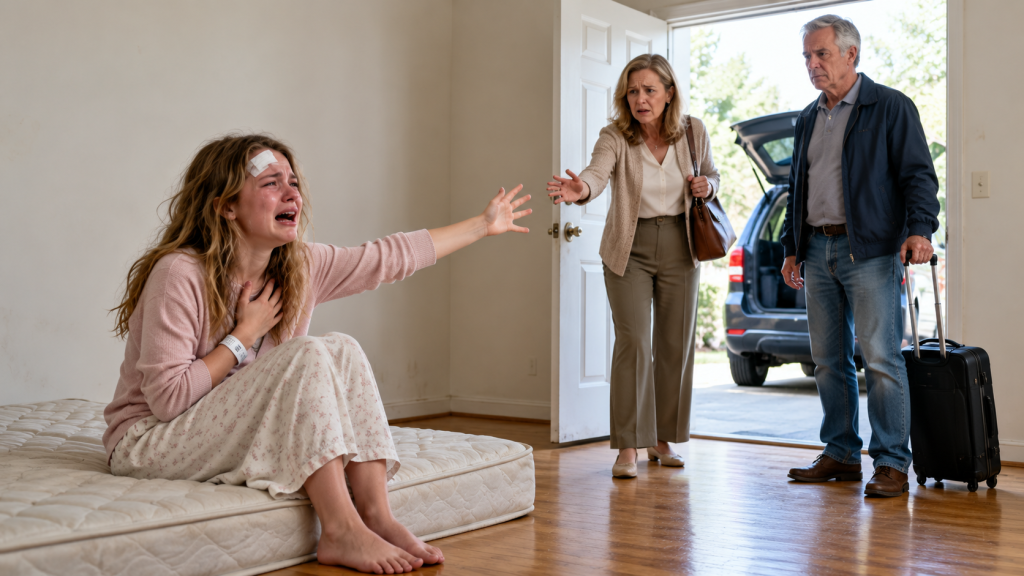
A mattress on the floor.
A plastic cup of water.
And Lily whispering that she felt tired before the phone went silent.
I looked at Alvarez.
“They’re not seeing her right now.”
He nodded.
“Understood.”
When I returned to Lily’s room, she was awake.
She held the small stuffed rabbit she’d carried everywhere since she was four.
Its name was Button.
Ethan had bought it for her at a seaside carnival.
One ear was permanently bent.
Its pale pink nose had almost worn away.
Lily loved it more than any expensive toy she’d ever owned.
“Mom?”
I smiled.
“Yes?”
“Can we go home soon?”
I sat beside her.
“When the doctors say it’s safe.”
She sighed.
“I miss my bed.”
“I know.”
“And Button misses his friends.”
I smiled.
“His friends?”
She nodded seriously.
“The other stuffed animals.”
I laughed.
“Of course.”
Then her expression changed.
“Mommy?”
“Yes, sweetheart?”
“Grandpa said you didn’t understand money.”
My smile disappeared.
She watched me.
“He said that’s why they had to fix everything before you found out.”
I swallowed.
“What did Grandma say?”
Lily lowered her eyes.
“She said it would all be okay once the bank agreed.”
My heart began pounding.
I took her little hand.
“Lily, thank you for telling me.”
She looked frightened.
“Am I in trouble?”
“No, baby.”
I kissed her forehead.
“You’ve done nothing wrong.”
She hesitated.
Then whispered:
“Grandma told me not to say Daddy’s name.”
My breath caught.
“Why?”
Her eyes filled.
“Because she said Daddy wasn’t here to help us anymore.”
For a moment, I couldn’t speak.
Then I leaned over and held my daughter.
Because I finally understood how my parents had been talking about Ethan’s legacy.
Not as a promise to protect Lily.
But as an obstacle to something they wanted.
That evening, I called the attorney who’d handled Ethan’s estate.
Her name was Rebecca Sloan.
She had been with us through the worst months after his death.
She knew every provision of his estate plan.
Every safeguard.
Every account established for Lily.
And unlike my parents, she had never treated my grief as an invitation to make decisions for me.
“Claire?”
“Rebecca.”
My voice broke.
“I need your help.”
She became serious immediately.
“What happened?”
I told her about the accident.
Lily’s condition.
The false discharge paperwork.
The photograph.
And the trust documents bearing my signature.
For several seconds, Rebecca was silent.
Then she asked:
“Has Harbor State received a notice of dispute?”
“The detective has contacted them.”
“Good. I’ll work with you on notifying the relevant administrators and preserving the records.”
I swallowed.
“Rebecca, could my parents have moved Lily’s money?”
“Not lawfully merely by producing a new document. But we need to know what they attempted, what information they had, and whether anyone relied on it.”
I closed my eyes.
Then whispered:
“Ethan trusted me to protect her.”
Rebecca’s voice softened.
“Claire, protecting Lily is exactly what you’re doing.”
A tear rolled down my cheek.
I wished that was enough to quiet the guilt.
But every time I closed my eyes, I heard Lily’s voice.
Mom, I feel really tired.
Rebecca continued.
“I want you to send me everything you’ve received, including the suspicious documents and the hospital records.”
“I will.”
“And Claire?”
“Yes?”
“Don’t let anyone pressure you into signing something to make this problem disappear.”
I swallowed.
“Why would they?”
She was quiet.
Then answered:
“Because people who rely on a disputed signature sometimes become very eager to obtain a genuine one.”
I stared at the wall.
And felt the truth of that sentence settle heavily over me.
At nine that night, my father left a voicemail.
I didn’t answer his call.
I let the recording play while Rebecca’s words were still fresh in my mind.
His voice sounded strained.
“Claire, sweetheart, I know you’re upset.”
A pause.
“Your mother and I are dealing with some complications.”
I closed my eyes.
“There’s no reason to involve outsiders. These financial arrangements can be corrected privately.”
My heart began pounding.
Then he said:
“We only need you to sign a clarification acknowledging what you already agreed to.”
I stopped breathing.
There it was.
Exactly what Rebecca had warned me about.
My parents didn’t merely want me to forgive them.
They wanted my signature.
A real one.
To repair the damage caused by a false one.
The voicemail continued.
“Please don’t let Lily’s situation destroy the family. We’re trying to protect everybody.”
A pause.
Then his voice lowered.
“If the bank doesn’t receive the corrected paperwork by Friday, the consequences could be serious.”
The recording ended.
I stared at my phone.
Friday.
Three days away.
Apparently, even after nearly losing their granddaughter, my parents were still counting down to a financial deadline.
I forwarded the voicemail to Rebecca and Detective Alvarez.
Then I turned off notifications from my parents’ numbers.
I didn’t block the records from being preserved.
I simply stopped allowing their calls to interrupt Lily’s recovery.
At midnight, Rebecca emailed me.
She’d obtained preliminary information from Harbor State through the proper channels.
The legitimate trust remained under its existing administration.
There was no verified authorization transferring control to my parents.
But a recent packet had been submitted requesting a major restructuring.
The packet included the disputed trust agreement.
A purported parental consent.
And a request to allow assets held for Lily’s benefit to support financing for Whitmore Property Holdings.
I stared at the screen.
Then reached the final page.
A loan proposal.
Amount:
$780,000.
For several seconds, I couldn’t breathe.
Seven hundred and eighty thousand dollars.
Borrowed against the security of a child’s future.
To rescue a business her grandparents controlled.
And then I noticed the date.
The application had been submitted forty-eight hours before the accident.
My parents hadn’t made a desperate decision after Lily was injured.
They had been planning the financial transaction before they ever put her in the car.
The collision had happened while they were trying to complete it.
And the false hospital authorization had helped them remove Lily before her injuries—and their explanations—could receive closer attention.
I shut my laptop.
Then sat beside my daughter’s bed.
The room was quiet.
Her little chest rose and fell beneath the blanket.
Button was tucked beneath her arm.
I looked at her.
And whispered:
“I’m going to protect what Daddy left you.”
My voice broke.
“But more importantly, sweetheart, I’m going to protect you.”
Because my parents had made a terrible mistake.
They believed money was the center of this story.
They were wrong.
The center of this story was a nine-year-old girl who had trusted her grandparents to bring her home safely.
And I would not let them turn her suffering into another document they could explain away.
The following morning, the hospital’s patient-safety director asked to meet with me.
Her name was Dr. Helena Price.
She was a composed woman with silver-rimmed glasses and the exhausted eyes of someone who had spent too many hours asking how a system intended to protect people could sometimes fail them.
A representative from the hospital’s compliance department joined us.
So did Rebecca, by telephone.
I had requested that she be included because the disputed discharge paperwork had become part of a wider investigation.
Dr. Price sat across from me.
“Claire, before we discuss the records, I want to say how relieved we are that Lily is recovering.”
I nodded.
“Thank you.”
She folded her hands.
“We’ve begun reviewing the circumstances of her initial discharge.”
My stomach tightened.
“Good.”
She took a breath.
“There were concerns documented by the clinical team about her need for further observation and evaluation.”
I stared.
“Then why was she allowed to leave?”
Dr. Price’s expression grew serious.
“That is one of the central questions in our review.”
I leaned forward.
“My parents aren’t Lily’s legal guardians.”
“We understand that.”
“They didn’t have permission to decline recommended care on my behalf.”
“We understand that too.”
I swallowed.
“Then somebody accepted a document that wasn’t from me.”
The compliance representative looked down.
Dr. Price nodded.
“A purported authorization was added to Lily’s record.”
She placed a printout on the table.
I recognized it immediately.
It was the message supposedly sent from my telephone.
I, Claire Morgan, authorize my parents to handle Lily’s discharge. We decline additional testing at this time and accept responsibility for follow-up.
Beneath it was my full name.
My phone number.
And a timestamp.
I stared.
“That’s not a message from my phone.”
Rebecca spoke through the conference speaker.
“Has the hospital verified whether the message actually originated from Mrs. Morgan’s number?”
The compliance representative hesitated.
“The record currently establishes that an image of the message was uploaded through a patient communication channel.”
I looked up.
“An image?”
“Yes.”
“Not an actual text sent to the hospital?”
“Based on the audit information reviewed so far, the authorization was submitted as an attachment.”
For a moment, I felt dizzy.
A screenshot.
That was what had been presented as my permission.
Not a verified conversation.
Not a secure confirmation.
Not a telephone call in which somebody recognized my voice.
A picture of words someone claimed I’d written.
Rebecca’s voice sharpened.
“Who uploaded it?”
The representative glanced at Dr. Price.
Then answered.
“The account was accessed through an email address associated with the emergency-contact information.”
My breath caught.
“The rental-property email?”
“We’re still confirming the identity of the person who used that account.”
I remembered what Detective Alvarez had told me.
The recovery number linked to my parents’ property-management account.
An address they controlled.
A system they used to handle tenant messages and rental maintenance requests.
Dr. Price leaned forward.
“Claire, I want to be clear. We’re not suggesting this should have been treated as sufficient authorization merely because it was uploaded.”
I stared at her.
She continued.
“Staff should have followed the applicable procedures for confirming who had authority to make decisions and for addressing a disagreement about recommended care.”
I swallowed.
“Did anyone try to call me?”
“We found an attempted call to a contact number.”
I sat straighter.
“What number?”
The compliance representative looked at the record.
Then read it.
The last four digits were unfamiliar.
I shook my head.
“That’s not mine.”
Dr. Price made a note.
I continued.
“My number hasn’t changed in seven years.”
She nodded.
“We’ll examine how that number entered the record.”
For a moment, I could barely breathe.
My parents had not merely lied.
Someone had supplied false contact information in a situation involving urgent medical decisions for a child.
And the hospital had not adequately established that I had agreed.
I looked at Dr. Price.
“Lily could have died.”
Her expression softened.
“Yes, the complication discovered after her return was serious.”
My eyes filled.
“She was alone.”
Neither woman spoke.
“She was lying on a mattress in an empty house.”
My voice broke.
“She called me because she felt so weak she couldn’t stay awake.”
Dr. Price handed me a tissue.
I didn’t take it.
Not because I wanted to be rude.
Because I needed her to understand.
“My parents told you I approved her discharge.”
“Yes.”
“They told me she was fine.”
Dr. Price nodded.
“And while everyone accepted those stories, my daughter was getting worse.”
For a moment, silence filled the room.
Then I whispered:
“Please don’t let another family discover this kind of failure only after a child is hurt.”
Dr. Price’s eyes filled.
“We’re conducting a formal review and will address any failures we identify.”
I nodded.
It wasn’t an answer that fixed what happened.
Nothing could.
But it was a beginning.
When the meeting ended, I walked back toward Lily’s room.
Halfway down the corridor, I stopped beside a window.
Outside, a woman was helping a little boy into a wheelchair.
He was laughing.
His mother was laughing too.
It was an ordinary moment.
One of the countless little moments parents barely notice until the possibility of losing them becomes real.
I pressed my hand against the glass.
And cried.
Lily’s doctors cleared her for discharge two days later.
This time, I listened to every instruction.
I asked questions.
Wrote notes.
Confirmed her medication schedule and activity restrictions.
Made sure I understood the warning signs that required immediate medical attention.
And arranged the follow-up appointments before taking her home.
When the nurse handed me the discharge packet, I stared at it for a moment.
She noticed.
“Mrs. Morgan?”
I smiled faintly.
“I’m just making sure I understand everything.”
Her expression softened.
“Of course.”
Lily was sitting on the edge of the bed wearing a soft blue sweatshirt.
Button was tucked beneath one arm.
Her hair was brushed.
Her cheeks were still pale, but her eyes were brighter.
“Mom?”
“Yes, sweetheart?”
“Are we really going home?”
I smiled.
“Yes.”
Her face lit up.
“Can we stop for strawberry ice cream?”
I laughed.
“Not today, baby. Let’s follow the doctor’s advice and get you settled first.”
She considered.
Then nodded solemnly.
“Tomorrow?”
“We’ll see how you’re feeling.”
She smiled.
For a moment, she looked so much like Ethan that my throat tightened.
I carried her small bag while a hospital staff member helped us to the car.
Lily settled carefully into her seat.
I checked her belt.
Then checked it again.
She watched me.
“Mom.”
“Yes?”
“It’s okay.”
I stopped.
She gave me a gentle smile.
“You’re doing the belt right.”
My eyes filled.
I kissed her forehead.
“I know, sweetheart.”
But the truth was that I no longer trusted ordinary things to remain ordinary.
A car ride.
A hospital form.
A call from my parents.
Even a quiet afternoon.
Everything had become something I wanted to check twice.
When we reached home, Lily asked to see her bedroom first.
I helped her upstairs.
She paused in the doorway.
Her bed was made.
Her favorite books stood on the shelf.
A string of little stars hung above the window.
And beside her pillow were the stuffed animals she’d been missing.
“Button!” she announced.
She lifted her rabbit toward the others.
“We’re home!”
I laughed.
Then covered my mouth as tears rose unexpectedly.
Lily looked back at me.
“Mommy?”
I shook my head.
“Nothing, sweetheart.”
She frowned.
“You’re doing the crying thing again.”
I laughed through tears.
“Yes.”
She reached for my hand.
“Happy crying?”
I swallowed.
“Very happy crying.”
That night, I slept in the chair beside her bed.
I knew I couldn’t do that forever.
Her doctors and counselor would eventually help us return to ordinary routines.
But for that first night, I needed to hear her breathing.
And when she woke at two in the morning and whispered my name, I was there.
“Mom?”
“Yes, Lily?”
“Can you promise something?”
My chest tightened.
“What is it?”
She looked toward the dark window.
“Can you promise Grandma won’t take me somewhere without telling you?”
I leaned forward.
“Yes.”
My voice was steady.
“I will make sure the adults responsible for you know exactly who is authorized to collect you.”
She nodded.
“And Grandma isn’t?”
“Not right now.”
Lily looked relieved.
Then her expression became sad.
“Is she angry with me?”
I brushed her hair away from her face.
“If Grandma is upset, that is for her to handle.”
My voice softened.
“You haven’t done anything wrong.”
She studied me.
Then whispered:
“Sometimes I miss her.”
My heart tightened.
I remembered my mother teaching Lily how to bake cinnamon rolls.
Their flour-covered noses.
The way Lily used to run toward her grandparents whenever their car pulled into our driveway.
“It’s okay to miss her,” I said.
Lily’s eyes filled.
“Even after what happened?”
“Yes.”
I kissed her forehead.
“You can love someone and still need to be safe from their choices.”
She thought about that.
Then nodded.
“Okay.”
The following week, Lily spoke with a trained child interviewer.
The meeting was arranged with care, after consultation with her medical team and professionals experienced in supporting children.
I wasn’t in the room directing her answers.
I didn’t rehearse a story with her.
I didn’t ask her to repeat painful details at home.
I wanted her account to belong to her.
Later, Detective Alvarez shared the portions he was permitted to discuss.
Lily remembered the drive.
My father at the wheel.
My mother in the passenger seat.
A brown leather folder resting between them.
They were arguing.
Grandpa had received a message on his phone.
Grandma became angry.
She said the bank had asked for something they didn’t have.
A verification.
A signed confirmation.
Something that would prove I had approved the trust arrangement.
My father insisted they had everything they needed.
My mother didn’t believe him.
She reached for the folder.
A page slipped free.
He glanced down.
Then at his phone.
And the collision happened.
Lily remembered the sound.
A sudden horn.
My mother’s scream.
The jolt that threw her forward against her seat belt.
Then a terrible silence.
She remembered crying.
“My stomach hurts.”
My father was breathing hard.
My mother kept saying:
“Drive. Richard, just drive.”
Lily said she saw the other car through the window.
It had struck a barrier.
She asked whether the woman inside needed help.
My mother told her not to look.
My father drove away.
Then came the hospital.
The questions.
The doctors recommending more observation.
My mother standing in the corridor with a telephone.
My father repeatedly checking the time.
And an argument about their flight.
Lily remembered hearing my mother say:
“We can’t miss the plane because of this.”
My father answered:
“Evelyn, we need to think.”
And my mother said:
“We have thought. We’ve already paid for everything. Claire will panic if she finds out about the crash.”
My chest tightened when Alvarez told me.
Not because the words surprised me anymore.
Because Lily had been close enough to hear them.
A child sitting in a hospital after a collision, watching the adults responsible for her discuss airline tickets while doctors worried about her condition.
Then Alvarez told me one more detail.
Lily remembered a conversation near the hospital exit.
My father had asked why they were taking her to the empty rental property.
My mother replied:
“Because Claire knows the house. If we tell her Lily is resting there, she’ll think she’s safe.”
I closed my eyes.
They hadn’t even taken Lily to their own home.
They’d chosen the property because they knew I would recognize the address.
Because they wanted me to believe she was somewhere familiar.
“Detective,” I whispered, “why didn’t they just call me?”
He was quiet.
Then answered:
“That’s one of the questions they’ll need to address.”
I thought about that for days.
Because the simplest decision would have saved so much suffering.
Call me.
Tell me there had been a collision.
Tell me Lily needed me.
I would have come.
I would have dropped everything.
I would have met them at the hospital, stayed beside my daughter, and handled the rest later.
Instead, they chose secrecy.
Then another lie.
Then another.
Until a nine-year-old child was lying alone in a vacant house while her grandparents boarded a plane.
Three days after Lily came home, I received a message from a number I didn’t recognize.
Claire, this is Rachel. Please call me when you can.
My stomach tightened.
Rachel Whitmore was my younger sister.
We weren’t estranged.
But we weren’t close.
She lived several hours away and worked as a physical therapist.
Our parents often described her as overly sensitive.
Too independent.
Too critical of the family’s decisions.
For years, I believed Rachel simply disliked conflict.
Now I wondered whether she’d seen something I hadn’t.
I called.
She answered immediately.
“Claire?”
“Hi, Rachel.”
Her voice broke.
“Oh, thank God.”
I swallowed.
“What happened?”
She began crying.
“I just heard about Lily.”
I closed my eyes.
“She’s home now.”
“Is she okay?”
“She’s recovering.”
Rachel let out a shaking breath.
For a moment, neither of us spoke.
Then she whispered:
“Claire, Mom and Dad have been lying to you about more than the accident.”
My stomach tightened.
I sat down.
“What do you mean?”
Rachel hesitated.
Then said:
“Dad’s business has been in trouble for almost a year.”
I stared at the wall.
She continued.
“They’ve missed payments on several properties.”
My heart began pounding.
“How do you know?”
“Dad asked me for money last winter.”
I swallowed.
“How much?”
“Fifty thousand dollars.”
My eyes widened.
“Rachel…”
She gave a bitter laugh.
“I didn’t have that kind of money.”
I sat quietly.
Then she said:
“When I told him no, Mom said I wasn’t loyal to the family.”
My chest tightened.
“She said that?”
Rachel laughed sadly.
“Claire, that’s what she always says when someone refuses.”
For a moment, I thought about my own childhood.
My father taught us that family came first.
My mother said people who loved one another didn’t keep score.
Those words had sounded beautiful when we were children.
But somewhere along the way, my parents began using them whenever they wanted us to ignore something uncomfortable.
“Rachel,” I whispered, “why didn’t you tell me?”
She was quiet.
Then answered:
“Because Mom told me you already knew.”
I stopped breathing.
“What?”
“She said you were helping them through a temporary cash-flow problem.”
I stared.
“And I believed her.”
Rachel’s voice broke.
“Claire, I’m so sorry.”
I closed my eyes.
My parents had been telling different stories to different people.
To Rachel, I was helping them.
To me, everything was fine.
To the bank, apparently, I had authorized a trust that placed Lily’s inheritance within their reach.
“Rachel,” I said quietly, “did they tell you about the trust?”
There was a long silence.
Then she whispered:
“Yes.”
My heart stopped.
“When?”
“About six weeks ago.”
I stared.
“What did they say?”
Rachel sounded frightened.
“Mom said Ethan had left Lily more money than you knew how to manage.”
I closed my eyes.
She continued.
“She said you were signing documents so Dad could help invest it.”
My hands began trembling.
“And you believed her?”
Rachel swallowed.
“At first.”
I waited.
“Then I asked why you needed Dad when Ethan had already arranged professional management.”
My throat tightened.
“What did Mom say?”
Rachel’s voice cracked.
“She told me to stop asking questions.”
For a moment, I couldn’t speak.
Then Rachel said:
“Claire, I didn’t know they had forged anything.”
“I believe you.”
She began crying.
“But I knew something was wrong.”
I took a breath.
“Do you have any messages about it?”
“Yes.”
“Please preserve them.”
“I already have.”
Then she said something that made my heart begin pounding.
“Claire, there’s another reason I’m calling.”
I stared at the wall.
“What?”
“Mom called me from the airport.”
“After the accident?”
“Yes.”
My chest tightened.
“She said Lily was with a family friend.”
I closed my eyes.
Rachel continued.
“She asked whether I could drive over and check on her.”
I sat straighter.
“Rachel, you were hours away.”
“I told her that.”
My breath caught.
“What did she say?”
Rachel began crying.
“She said, ‘Then don’t bother. Claire will probably come eventually.’”
For several seconds, I couldn’t breathe.
Eventually.
As though my daughter were a package someone might collect when convenient.
Rachel’s voice shook.
“I didn’t understand Lily was alone, Claire.”
I covered my mouth.
“I know.”
She began crying harder.
“If I’d known, I would’ve called emergency services myself.”
“I know.”
For a long moment, we cried together.
Then Rachel whispered:
“I have one more thing.”
I swallowed.
“What?”
“Dad emailed me a copy of a proposed loan agreement.”
My heart tightened.
“Why?”
“He wanted me to sign as an additional guarantor.”
I stared.
“Did you?”
“No.”
Relief washed through me.
Rachel continued.
“But Claire, there’s something strange about the collateral list.”
My stomach tightened.
“What?”
She took a breath.
“It’s not just Lily’s trust assets.”
I closed my eyes.
Then Rachel whispered:
“They included Ethan’s lake cabin.”
For a moment, I could hear nothing except my own breathing.
Ethan’s cabin.
The one place Lily still called Daddy’s house.
The place where he’d taught her to skip stones across the lake.
Where he’d painted tiny yellow stars on the ceiling above her bed because she was afraid of the dark.
Where we’d spent our last summer together before his illness became serious.
My parents had apparently included it in a proposed financial arrangement.
Without asking me.
Without Lily understanding.
Without any right to do so.
“Rachel,” I whispered, “send that agreement to Rebecca.”
“I will.”
“And keep the original email.”
“Of course.”
I swallowed.
“Did Dad say why he needed another guarantor?”
Rachel hesitated.
“He said the bank had become difficult.”
I closed my eyes.
“That usually means the bank is asking questions.”
She gave a sad laugh.
“That’s what I told him.”
After we ended the call, I sat at the kitchen table for a long time.
Lily was upstairs resting.
A home-health nurse had visited earlier to check her recovery and help us understand the care plan.
The house was peaceful.
Sunlight fell across the kitchen floor.
A bowl of apples stood beside Ethan’s old coffee mug.
Everything looked normal.
But I felt as though someone had opened a door beneath my feet.
Rebecca called an hour later.
She had reviewed Rachel’s documents.
“Claire, the cabin is listed as proposed additional collateral.”
My stomach tightened.
“Can they do that?”
“Not by simply listing property they don’t control.”
I let out a breath.
She continued.
“The property is held under arrangements established through Ethan’s estate. Your parents can’t pledge it merely because their names appear on a separate document.”
I closed my eyes.
“But they tried.”
“According to the documents, yes. We’re verifying what was actually submitted and to whom.”
I thought of my parents’ beautiful vacation photographs.
The ocean.
The hotel balcony.
The elaborate dinner my mother posted with a caption about being grateful for life’s blessings.
They had enjoyed every luxury while I was sitting in a hospital praying Lily would survive.
“Rebecca,” I whispered, “are they bankrupt?”
She paused.
“I don’t have enough verified information to say that. But the materials Rachel provided suggest serious financial pressure.”
I swallowed.
“And the vacation?”
“That’s another question.”
A few days later, I learned the answer.
Not from my parents.
From the financial records reviewed during the investigation.
Whitmore Property Holdings had several overdue obligations.
One lender had demanded additional assurances.
Another was reviewing whether to continue financing the company’s properties.
There were contractor invoices that had gone unpaid.
And a substantial short-term loan was approaching its repayment deadline.
My parents had continued presenting themselves as successful investors.
They entertained friends.
Bought expensive clothes.
Made reservations at luxury resorts.
And spoke about property values as though every investment they owned was a triumph.
Behind that image, however, the company’s finances had become dangerously unstable.
The attempted seven-hundred-and-eighty-thousand-dollar financing arrangement was supposed to give the business more time.
The trust document was an effort to make Lily’s assets appear available as security.
And my parents had apparently counted on the lender accepting the paperwork before anyone questioned whether I had signed it.
But Harbor State had asked for independent verification.
The lending institution had also requested clarification of the trustees’ authority.
The deadlines my father mentioned weren’t legal deadlines forcing me to sign anything.
They were commercial deadlines created by his own financial arrangements.
And those deadlines were collapsing.
I should have felt triumphant.
Instead, I felt sick.
Because Lily had been hurt in the middle of a crisis that had never belonged to her.
One afternoon, Rachel came to stay for a few days.
She arrived carrying a bag of groceries and a small stuffed dolphin for Lily.
My daughter was delighted.
“Aunt Rachel!”
Rachel knelt beside her.
“Hey, sweetheart.”
Lily hugged her carefully.
“You came!”
Rachel’s eyes filled.
“Of course I came.”
For a moment, I watched them.
Rachel had always been the quiet sister.
She remembered birthdays.
Sent handwritten cards.
And asked about Lily’s school projects even when our parents were too busy talking about their investments.
I wondered how many times I’d allowed my parents to define her for me.
Rachel is difficult.
Rachel asks too many questions.
Rachel doesn’t appreciate family.
Now, I understood something.
Rachel hadn’t been disloyal.
She’d simply learned to recognize when a request was unreasonable.
That evening, after Lily fell asleep, Rachel and I sat on the back porch.
The air smelled of rain.
Somewhere nearby, a dog barked.
Rachel held a cup of tea between her hands.
“Claire, I need to tell you something.”
I looked at her.
“What?”
She took a breath.
“Mom has been calling relatives.”
My stomach tightened.
“About me?”
Rachel nodded.
“She says you’ve turned a minor accident into a police investigation because you want control of the family properties.”
For a moment, I stared at her.
Then I laughed.
A sharp, disbelieving sound.
“Control of the properties?”
Rachel smiled sadly.
“I know.”
I looked toward the dark garden.
“Lily needed an emergency procedure.”
“I know.”
“She was left alone.”
“I know.”
“And somehow the story is that I want their rental buildings?”
Rachel shook her head.
“Mom is frightened.”
I looked at her.
Rachel continued.
“When she’s frightened, she tries to decide what everyone else believes.”
I swallowed.
“That doesn’t make it acceptable.”
“No.”
Rachel set down her cup.
“And that’s why I called the relatives who contacted me and told them they should not repeat things they couldn’t verify.”
I looked at her.
“Thank you.”
She nodded.
“I’m not going to fight Mom’s battles for her anymore.”
The next morning, Detective Alvarez called.
He had an update concerning the other driver.
Nina Ellis was recovering.
She had experienced a concussion and a fractured collarbone, along with other injuries requiring follow-up care.
She was home with her husband.
The investigation into the collision was continuing.
I sat quietly.
Then asked:
“Would it be appropriate to send her a note?”
Alvarez said he could ask whether she wanted contact, without sharing either family’s private information unnecessarily.
I nodded.
“Please.”
Several days later, Nina agreed.
We met in a quiet café near her home.
I went alone.
Rebecca knew where I was.
There were no cameras.
No lawyers presenting documents.
No attempt to obtain a statement.
Just two women whose children and futures had been affected by the same afternoon.
Nina arrived wearing a sling.
She was in her thirties, with dark curls and a tired smile.
When she saw me, she hesitated.
“Claire?”
I stood.
“Yes.”
She approached slowly.
For a moment, we simply looked at each other.
Then she said:
“How’s your little girl?”
My eyes filled.
“She’s getting better.”
Nina closed her eyes.
“I’m so glad.”
We sat.
I didn’t know where to begin.
Finally, I whispered:
“I’m sorry for what happened to you.”
She shook her head.
“You weren’t driving.”
“I know.”
I swallowed.
“But I wanted you to know that I care.”
Her eyes filled.
“Thank you.”
For a moment, neither of us spoke.
Then Nina looked down at her sling.
“I remember hearing a horn.”
I sat very still.
She continued.
“I was going through the intersection. I had the right of way. Then a car came toward me.”
Her voice shook.
“I tried to avoid it.”
I swallowed.
“And afterward?”
She closed her eyes.
“I remember being frightened because I couldn’t move properly.”
My heart tightened.
“I’m so sorry.”
Nina looked up.
“Someone stopped.”
I nodded.
“The detective told me.”
She gave a small smile.
“A delivery driver. His name was Marcus.”
Tears filled my eyes.
“He called for help?”
“Yes.”
She swallowed.
“He stayed with me until the ambulance came.”
For a moment, I thought about my mother stepping out of her car.
Retrieving a folder.
Then getting back inside and leaving.
And about Marcus, a stranger, stopping his work to help someone he had never met.
Nina looked at me.
“I heard there was a child in the other car.”
My throat tightened.
“Yes.”
Her expression softened.
“I hoped she was okay.”
I began crying.
Nina reached across the table with her uninjured hand.
“Claire.”
I looked up.
“Please don’t carry guilt that belongs to somebody else.”
The words broke something open inside me.
For days, I’d been blaming myself.
For trusting my parents.
For working forty minutes away.
For not insisting they call before taking Lily anywhere.
For not seeing their financial trouble.
For not knowing what documents they had gathered.
But Nina was right about one thing.
My parents had made their own choices.
And I couldn’t protect Lily by spending the rest of my life pretending I could have controlled every decision they made.
I wiped my cheeks.
“Thank you.”
Nina smiled.
Then said something I hadn’t expected.
“I hope your daughter never thinks the accident was her fault.”
My chest tightened.
“She has asked.”
Nina’s eyes filled.
“Then please tell her I don’t blame her.”
I nodded.
“I will.”
When I got home, Lily was sitting on the sofa with Rachel.
They were watching a nature documentary.
I sat beside my daughter.
“Sweetheart?”
She looked up.
“Yes?”
“I met the woman who was in the other car.”
Her eyes widened.
“Is she okay?”
“She’s recovering.”
Lily looked frightened.
“Does she hate us?”
My heart broke.
“No, baby.”
I took her hand.
“She specifically wanted you to know she doesn’t blame you.”
Lily’s lower lip trembled.
“Really?”
“Yes.”
For a moment, she stared at me.
Then she began crying.
I pulled her into my arms.
“I wanted Grandpa to stop,” she whispered.
“I know.”
“I told him.”
“I know, sweetheart.”
Her shoulders shook.
“I thought maybe if I shouted louder—”
I gently pulled back.
“Lily, listen.”
She looked at me.
“You weren’t driving the car.”
She nodded.
“You weren’t responsible for the adults’ decisions.”
More tears rolled down her cheeks.
“And you don’t have to spend your life imagining how you could have made them behave differently.”
She threw her arms around my neck.
And I held her until the crying stopped.
The next major revelation came from the hospital’s electronic audit.
Investigators had obtained records showing how the false discharge authorization had entered Lily’s chart.
The suspicious image had been uploaded using an account linked to my parents’ emergency-contact information.
Its associated contact details had been altered shortly before Lily was brought to the hospital.
The original files and logs were preserved for technical review.
The person who completed the upload had used a device associated with my mother’s property-management office.
That did not, by itself, prove who had touched the screen.
But the timing, surrounding messages, and other records were beginning to form a consistent picture.
Then Detective Alvarez told me something that made me sit completely still.
A message had been recovered from my mother’s communications with my father.
It was sent while Lily was still being evaluated at the hospital.
The message read:
Use the authorization image. Don’t call Claire until Lily is out.
I stared at the words.
My mother.
The woman who’d once held my hand while I gave birth.
The woman who cried when Lily entered the world.
The woman who called herself the most devoted grandmother in the neighborhood.
Had apparently instructed my father to use a false authorization rather than contact me while my daughter needed medical attention.
I looked at Alvarez.
“Was Mom the one who prepared it?”
He answered carefully.
“The records indicate she was involved in arranging its submission. We’re continuing to establish exactly who created the image and who used the account.”
I nodded.
Then he placed another message in front of me.
It was from my father.
The doctor wants more tests. We should stay.
For a moment, I couldn’t breathe.
My father had wanted to stay.
At least for that moment.
He’d recognized that Lily needed further care.
My mother’s reply appeared beneath it.
If we miss the flight, everything gets complicated. Claire can deal with Lily later.
I stared.
For a long moment, the room seemed to tilt.
My parents had not simply misunderstood the doctor’s recommendation.
They had discussed it.
One had recognized the danger.
And both had still left.
I covered my mouth.
Then began crying.
Alvarez waited.
After a while, I whispered:
“Did Dad try to contact me?”
He paused.
“The records we’re examining do not show a completed call to you before they left the hospital.”
I nodded.
My chest ached.
For years, I’d thought of my father as the sensible one.
The person who balanced my mother’s impulsiveness.
The one who said he’d always protect his family.
Now I was looking at evidence that he had recognized a problem and allowed himself to be persuaded to ignore it.
That wasn’t innocence.
It was a different kind of failure.
I stood slowly.
For a moment, I wanted to call them.
Demand to know why a plane ticket mattered more than Lily’s health.
Ask whether they understood how close they’d come to losing her.
But I knew their answers already.
We thought she’d be fine.
We didn’t mean for anything bad to happen.
You always overreact.
I was done arguing with explanations that changed whenever evidence appeared.
That afternoon, Rebecca called.
“Claire, the financial institution has completed its preliminary review of the proposed trust restructuring.”
I sat down.
“And?”
“The attempted transfer of authority was not accepted.”
I closed my eyes.
Relief washed through me.
“Lily’s trust?”
“Remains under the valid arrangements established through Ethan’s estate.”
“And the cabin?”
“Was not transferred or validly pledged through the disputed paperwork.”
I began crying.
Rebecca waited.
Then added:
“Claire, there is more.”
My stomach tightened.
“What?”
“The lender received an additional communication after you disputed the documents.”
I stared.
“From whom?”
“Your father’s company.”
“What did it say?”
Rebecca took a breath.
“It proposed that you might be willing to sign a new agreement voluntarily.”
For a moment, I couldn’t speak.
Then I remembered my father’s voicemail.
We only need you to sign a clarification.
I looked out the window.
My parents had tried to use a forged signature.
When that failed, they wanted a genuine one.
Even after the accident.
Even after Lily’s emergency treatment.
Even after the investigation began.
“Rebecca,” I whispered, “please make it clear that I will not sign anything pledging Lily’s assets for their business.”
“I already have.”
I closed my eyes.
“Thank you.”
She paused.
Then said gently:
“Claire, your parents may face serious financial consequences.”
“I understand.”
“They may lose properties.”
“I understand.”
“And relatives may pressure you to help.”
I swallowed.
“I know.”
For a moment, I thought of my childhood home.
The family dinners.
The Christmas tree.
The photographs lining my parents’ hallway.
Then I looked toward the stairs where Lily was resting.
“I won’t sacrifice my daughter to save their lifestyle,” I said.
Rebecca was quiet.
Then answered:
“That’s a clear decision.”
That evening, my parents returned from their vacation.
I knew because my mother sent a message.
We’re home. We need to see Lily.
I stared at it.
Then another arrived.
This has gone far enough.
And a third.
Your father is devastated. Please let us explain.
I didn’t answer immediately.
I forwarded the messages to Rebecca.
Then I went upstairs.
Lily was sitting on her bed drawing.
I sat beside her.
“Sweetheart?”
She looked up.
“Yes?”
“Grandma and Grandpa are back.”
Her hand stopped moving.
For a moment, she said nothing.
Then whispered:
“Are they coming here?”
My heart tightened.
“No.”
She let out a breath.
I brushed her hair away from her face.
“Do you want to talk about them?”
Lily shook her head.
Then hesitated.
“Maybe later.”
I nodded.
“Whenever you’re ready.”
She looked down at her drawing.
It showed a little house beside a lake.
Two people stood on the porch.
One tall.
One small.
Above them were bright yellow stars.
“Is that Daddy’s cabin?” I asked.
Lily smiled faintly.
“Yes.”
I pointed toward the two figures.
“That’s us?”
She nodded.
Then she looked up.
“Mom?”
“Yes?”
“Can we go there when I’m better?”
My throat tightened.
“Of course.”
She smiled.
“Just us?”
I pulled her close.
“Just us.”
And in that moment, I understood what my parents had never understood about Ethan’s inheritance.
Its value was not only the money.
Not the appraisal.
Not the amount a lender might advance against it.
It was the promise that Lily would have a place in the world where she felt safe.
My parents had tried to turn that promise into collateral.
I was going to make sure it remained a home.
My parents came to my house the following Saturday.
They didn’t call first.
They didn’t ask whether Lily was well enough for visitors.
At eleven fifteen, the doorbell rang.
I was in the kitchen helping Lily arrange strawberries on a plate when Rachel glanced at the security monitor.
Her face changed.
“Claire.”
I looked up.
She turned the screen toward me.
My mother stood on the porch wearing an expensive cream-colored coat.
My father was beside her.
He held a large bouquet of flowers.
A gift bag rested near his feet.
For a moment, I couldn’t move.
Lily looked between us.
“Who’s here?”
Rachel hesitated.
I crouched beside my daughter.
“Grandma and Grandpa have come to the house.”
Her expression changed.
She put down the strawberry in her hand.
“Do I have to see them?”
My chest tightened.
“No, sweetheart.”
She swallowed.
“Can Aunt Rachel stay with me?”
Rachel immediately nodded.
“Of course.”
I kissed Lily’s forehead.
Then walked toward the front door.
I didn’t open it.
Instead, I spoke through the doorbell camera.
“Mom. Dad.”
My mother leaned toward the camera.
“Claire, thank goodness.”
Her smile disappeared when I didn’t unlock the door.
“Sweetheart, let us in.”
I took a breath.
“No.”
She blinked.
“What?”
“Lily is resting. This isn’t an appropriate time for a visit.”
My father stepped closer.
“Claire, we’ve been trying to reach you.”
“I know.”
He lifted the flowers.
“We came to apologize.”
I looked at the bouquet.
White lilies.
My daughter’s namesake.
For a moment, the irony hurt so sharply that I had to close my eyes.
“Please leave the flowers on the porch,” I said.
My mother stared.
“Claire, we didn’t fly all the way home to stand outside our own daughter’s house.”
I swallowed.
“Then you should have called before coming.”
Her expression hardened.
“We are Lily’s grandparents.”
“Yes.”
“And we love her.”
I felt tears rise.
“Then why did you leave her alone?”
Silence.
My father looked away.
My mother folded her arms.
“We’ve explained that.”
“No,” I said quietly.
“You’ve offered excuses.”
She glanced toward the camera.
“Claire, the doctors said it was a minor accident.”
“They recommended further care.”
“We thought she would recover at home.”
“You didn’t take her home.”
My mother’s jaw tightened.
I continued.
“You left her on a mattress in a vacant rental property.”
My father’s voice broke.
“We were wrong.”
For a moment, I stopped.
It was the first time I’d heard him say those words.
No qualification.
No argument.
Just:
We were wrong.
Then Mom interrupted.
“Richard, don’t make it sound as though we deliberately hurt her.”
I closed my eyes.
There it was again.
The desperate need to control how the story sounded.
“Mom,” I said, “I’m not discussing this at the front door.”
She leaned closer.
“Then let us in.”
“No.”
Her face flushed.
“Claire, you’re being cruel.”
I felt strangely calm.
“Lily needs to recover without being pressured to comfort the adults who frightened her.”
My father looked toward the ground.
Mom shook her head.
“You’re turning her against us.”
I swallowed.
“No.”
My voice remained steady.
“Your decisions changed how safe she feels around you.”
For a moment, nobody spoke.
Then Dad raised his eyes.
“Claire, can we at least talk about the financial documents?”
My stomach tightened.
There it was.
The reason I’d suspected they’d come.
“Not here,” I answered.
He swallowed.
“There’s a way to resolve everything.”
I closed my eyes.
“Through Rebecca and the appropriate legal process.”
My mother’s expression sharpened.
“Claire, your father could lose the business.”
I looked toward the hallway.
Lily was just out of sight.
Rachel was sitting with her.
Then I looked back at the camera.
“Lily could have lost her life.”
My mother went still.
I continued.
“If you think those two things belong in the same negotiation, then we have nothing else to discuss today.”
My father lowered his head.
For a long moment, he didn’t speak.
Then he set the flowers beside the door.
“I’m sorry, Claire.”
His voice shook.
“I’m sorry about Lily.”
Tears filled my eyes.
I wanted to believe him.
A part of me always would.
But I had learned that an apology was only the beginning of responsibility.
Not the end.
“Dad,” I whispered, “tell the investigators everything.”
He looked up.
I continued.
“Tell them what happened at the intersection.”
“What happened at the hospital.”
“And what you knew about the trust.”
He swallowed.
Then nodded.
My mother stared at him.
“Richard.”
He didn’t look at her.
I watched them for a moment.
Then said:
“Please leave.”
They walked back toward their car.
Mom was crying.
Dad moved slowly, as though each step hurt.
I watched until they drove away.
Then I leaned against the wall.
And cried.
Rachel appeared beside me.
She didn’t say anything.
She simply put her arm around my shoulders.
And for the first time in years, I allowed my little sister to be the strong one.
The months that followed were difficult.
The investigation into the collision established that my father had been distracted while driving and had failed to remain at the scene as required.
The medical records, communications, and witness accounts provided evidence concerning the decisions my parents made after Lily was injured.
The false authorization submitted to the hospital was examined separately from the financial documents.
And the attempted trust restructuring became part of an investigation into suspected forgery and financial misconduct.
Eventually, prosecutors brought charges relating to the conduct supported by the evidence.
My parents obtained attorneys.
The proceedings continued through the appropriate legal process.
I didn’t attend every hearing.
I didn’t need to.
I gave truthful statements when asked.
Provided the original messages.
Preserved the relevant documents.
And let the people responsible for investigating and deciding those matters do their jobs.
My father eventually acknowledged that he’d driven away from the collision and that he had permitted Lily to leave medical care despite recognizing the doctors’ concern.
My mother faced the evidence connecting her to the false authorizations.
Their accounts were tested against records rather than accepted simply because they were my parents.
The financial damage to Whitmore Property Holdings was substantial.
Without the proposed financing, the company had to confront obligations it had been hiding behind increasingly complicated arrangements.
Some properties were sold.
Other debts were renegotiated or addressed through formal proceedings.
My parents’ lifestyle changed.
The expensive trips stopped.
The constant photographs of glamorous dinners disappeared.
But none of that gave me pleasure.
I didn’t want my parents to suffer.
I wanted them to understand.
And I wanted Lily to be safe.
The hospital also completed its internal review.
Its representatives acknowledged significant failures in verifying parental authority and responding to the concerns documented by Lily’s medical team.
The institution took corrective steps involving identification procedures, escalation of disputed consent, and staff training.
The appropriate oversight processes addressed what had happened.
It couldn’t erase the fear of receiving Lily’s call.
It couldn’t give back the hours she spent alone.
But it mattered that the failures were named rather than buried.
Nina continued recovering too.
She returned to work gradually.
On the anniversary of the collision, she sent a small card to Lily.
Inside, she’d written:
Dear Lily,
I’m glad we’re both doing better.
I hope you always remember that the accident was not your fault.
Keep drawing beautiful pictures.
Your friend, Nina.
Lily read the card three times.
Then placed it beside the photograph of Ethan on her bedside table.
That evening, she drew Nina a picture of two butterflies flying above a field of flowers.
I helped her address the envelope.
Then she looked up.
“Mom?”
“Yes, sweetheart?”
“Do you think Nina knows how brave she is?”
I smiled through tears.
“Maybe we should tell her.”
We added a little note.
Thank you for being kind to us.
And mailed it the next morning.
As Lily grew stronger, her fear began to change.
At first, she wanted me near her constantly.
She asked where I was going whenever I left the room.
She worried about car rides.
And once, when we passed a house with dark windows, she began crying because it reminded her of the empty rental property.
We sought support from a counselor experienced in helping children after frightening experiences.
We moved slowly.
We didn’t force her to talk when she wasn’t ready.
And we never told her that being brave meant she had to pretend nothing had happened.
Sometimes she wanted to discuss the accident.
Sometimes she wanted to play with Button.
Sometimes she wanted to tell me about the little garden she’d like to plant beside the cabin.
I made room for all of it.
Rachel became part of our everyday lives.
She visited often.
Helped when my work became busy.
And made Lily laugh with terrible jokes that Ethan would have adored.
One afternoon, Lily looked at us both and said:
“You two should have been best friends when you were little.”
Rachel laughed.
“We tried.”
I smiled sadly.
“Then we let other people convince us we didn’t understand each other.”
Rachel looked at me.
For a moment, her expression softened.
“Good thing we’re fixing that.”
I reached for her hand.
“Yes.”
The trust arrangements remained protected.
Rebecca confirmed that the disputed documents had not transferred Lily’s assets or validly placed the cabin at risk.
I reviewed the existing safeguards with the appropriate professionals.
Updated emergency contacts.
And made sure no one who had abused our trust retained access to information or authority they didn’t need.
I also made changes in my personal life.
Not because I believed I could prevent every emergency.
But because Lily deserved clear plans.
I updated her school pickup authorizations.
Confirmed who could make decisions if I became unavailable.
And talked with her, gently and at an age-appropriate level, about how to ask for help when an adult’s instructions made her feel unsafe.
She listened carefully.
Then asked:
“Even if the adult is family?”
My throat tightened.
“Yes, sweetheart.”
She nodded.
“Okay.”
One evening, several months after the accident, Lily asked whether she could read one of Ethan’s letters.
He’d left a small collection for her before he died.
Birthday notes.
Encouragement.
Little messages for the days he knew he might not be there.
I brought the box from my bedroom.
Lily selected an envelope marked:
FOR A DAY WHEN YOU FEEL SCARED.
She held it carefully.
“Can you read it?”
I smiled through tears.
“Of course.”
My beautiful Lily,
Sometimes the world will feel bigger than you are.
Sometimes something will happen that you don’t understand.
When that happens, remember that being scared doesn’t make you weak.
You are allowed to ask questions.
You are allowed to ask for help.
And you never have to keep a secret that makes you feel unsafe.
My voice broke.
Lily leaned against me.
I continued.
You are loved because you’re you.
Not because you’re perfect.
Not because you make everyone happy.
Just because you’re Lily.
And that will always be enough.
Love, Daddy.
For a long time, neither of us spoke.
Then Lily whispered:
“Daddy would’ve come to the hospital.”
I closed my eyes.
“Yes, sweetheart.”
“He would’ve stayed.”
My tears fell.
“Yes.”
She looked up.
“And you stayed too.”
I pulled her into my arms.
“As long as you needed me.”
The following summer, when her doctors had cleared her for ordinary activities and she felt ready, we went to the cabin.
Just the two of us.
We packed sandwiches.
Strawberries.
Board games.
And Button.
The drive was peaceful.
Lily watched the trees through the window.
At one point, she reached for my hand when we stopped at a traffic light.
I squeezed it gently.
She took a breath.
Then let go when she felt ready.
When the cabin appeared through the trees, her face lit up.
“Mom!”
I smiled.
“There it is.”
The little blue house stood beside the lake.
The porch railing needed repainting.
Wildflowers had grown beside the path.
And the wooden swing Ethan built still hung from the old oak tree.
Lily climbed carefully out of the car.
She stood looking at the house for a long moment.
Then whispered:
“Daddy’s place.”
My eyes filled.
“Yes, baby.”
We unlocked the front door.
Inside, everything smelled faintly of cedar and old books.
Ethan’s fishing hat still hung beside the kitchen.
His favorite mug stood on the shelf.
And the little yellow stars he’d painted above Lily’s bed were exactly where he’d left them.
My daughter walked into her bedroom.
Looked up.
Then smiled.
“He remembered all the stars.”
I stood behind her.
My throat tightened.
“He did.”
That afternoon, we sat on the dock.
Lily dangled her feet above the water.
Button sat between us.
The sun was warm.
Small waves tapped softly against the wooden posts.
“Mommy?”
“Yes?”
“Can I ask you something?”
I smiled.
“Always.”
She stared across the lake.
“Will Grandma and Grandpa ever come here again?”
I took a breath.
“I don’t know.”
She nodded slowly.
“Do you still love them?”
The question hurt.
I thought about my mother’s arms around me when I was little.
My father’s laughter.
The memories that remained true even after everything else changed.
“Yes,” I answered.
Lily looked surprised.
“Even after what they did?”
I nodded.
“Love doesn’t always disappear when somebody hurts us.”
She thought about that.
Then asked:
“Does that mean we have to let them come back?”
I shook my head.
“No, sweetheart.”
She looked at me carefully.
I continued.
“Loving someone doesn’t mean giving them permission to hurt you again.”
She nodded.
“And forgiving someone doesn’t mean pretending what happened was okay.”
For a long moment, she stared at the water.
Then whispered:
“I think I love Grandma.”
My eyes filled.
“That’s okay.”
“But I don’t want her to take me anywhere.”
I pulled her close.
“That’s okay too.”
She leaned against me.
Then looked toward the cabin.
“Mom?”
“Yes?”
“Does this place really belong to me?”
I smiled.
“It’s being kept safe for you under Daddy’s arrangements.”
Her eyes brightened.
“And nobody can just take it?”
“Not because they want it.”
I kissed her forehead.
“There are people and protections in place to look after what Daddy left you.”
She nodded seriously.
Then smiled.
“Good.”
For a moment, we sat quietly.
Then she asked:
“Can we plant strawberries here?”
I laughed.
“Why strawberries?”
She grinned.
“Because Daddy loved them.”
I looked toward the little garden beside the porch.
He had loved strawberries.
He used to buy too many and pretend he was surprised when Lily ate half before dinner.
I smiled through tears.
“Yes.”
“We can plant strawberries.”
That evening, we sat outside beneath the stars.
Lily was wrapped in a warm blanket.
A real blanket.
One she could keep.
One no one would quietly remove while she slept.
She rested her head against my shoulder.
“Mom?”
“Yes, sweetheart?”
“Do you think Daddy can see us?”
My throat tightened.
“I don’t know exactly how those things work.”
She considered.
Then whispered:
“I hope he can.”
I kissed her hair.
“Me too.”
For a long moment, we watched the stars.
Then Lily said:
“I think he’d be happy we’re here.”
My eyes filled.
“Yes.”
I smiled.
“I think he would.”
I looked toward the dark water.
And thought about everything that had happened.
The accident.
The hospital.
The false paperwork.
The vacant property.
The missed calls.
The forged trust.
The frightened little girl who believed she’d caused trouble by telling her mother the truth.
My parents had spent years insisting that family loyalty meant keeping difficult things private.
They believed embarrassment was worse than dishonesty.
That appearances mattered more than accountability.
That a child’s inheritance could become a solution to adult financial problems.
And that an expensive vacation was too important to interrupt for a granddaughter who needed medical care.
But the truth eventually reached everyone they tried to keep it from.
Doctors.
Investigators.
Financial institutions.
Family members.
And, most importantly, me.
Their carefully maintained image collapsed.
Not because I wanted revenge.
Not because I shouted louder than they did.
But because the records, the witnesses, and their own messages told a story they could no longer explain away.
I hadn’t saved Lily by winning an argument.
I saved her by believing her when she said something was wrong.
By calling for help.
By refusing to sign what I hadn’t agreed to.
And by deciding that protecting my daughter mattered more than protecting my parents’ reputation.
Lily shifted beside me.
“Mommy?”
I looked down.
“Yes, baby?”
“Can we come back next weekend?”
I smiled.
“Absolutely.”
She grinned.
“With Aunt Rachel?”
“If you’d like.”
She nodded.
“And Nina someday?”
I laughed softly.
“Maybe, if she’d enjoy that.”
Then Lily wrapped both arms around me.
“I’m glad you came for me.”
My heart broke and healed a little in the same moment.
I held her close.
“Always, sweetheart.”
She looked up.
“Even when people say I’m fine?”
I swallowed.
“Even then.”
I kissed her forehead.
“Because if you tell me you need help, I’m going to listen.”
Above us, the stars shone.
Across the lake, a breeze stirred the trees.
And behind us stood the little cabin Ethan had wanted our daughter to have.
Not as an investment.
Not as collateral.
But as a place filled with memories, possibilities, and love.
I thought about the moment Lily’s voice disappeared during our telephone call.
The terrible silence.
The drive to the rental house.
The sight of the ambulance.
For a long time, I’d feared those memories would define the rest of our lives.
But sitting beside her that night, I understood something.
They would always be part of our story.
They didn’t have to be the ending.
My parents tried to protect their money by hiding the truth.
I protected my daughter by refusing to hide it.
They had treated her safety as an inconvenience.
Her inheritance as an opportunity.
And her silence as something they could demand.
But Lily was not a financial asset.
She was not a problem to be managed.
And she was not responsible for rescuing the adults who had failed her.
She was a little girl who deserved to feel safe.
To laugh.
To heal.
To grow.
And to know that when she called for her mother, someone would come.
I wrapped the blanket a little more securely around her shoulders.
Lily yawned.
Then smiled sleepily.
“Love you, Mom.”
Tears filled my eyes.
“I love you too, sweetheart.”
And while the stars reflected across the lake, I made myself a promise.
I would never again confuse keeping the family together with keeping its secrets.
I would never let another adult’s reputation matter more than my daughter’s well-being.
And I would never apologize for choosing her safety.
Because the most important inheritance Ethan left Lily wasn’t the money or the cabin.
It was the certainty that she deserved to be loved, believed, and protected.
And that was the promise I intended to keep.
THE END STORIES! THANK YOU FOR READING GOOD LUCK !❤️
Related Posts